The Greening Of The Valleys
This document on the KeolisAmey web site details their plans for the new Wales and Borders Franchise.
The documents gives these two definitions.
- South Wales Metro – Includes the full set of local services around South East Wales. This includes what is currently known as the ‘Valley Lines’, plus services between Cardiff and Ebbw Vale, Maesteg and extending to Severn Tunnel Junction and beyond.
- Central Metro -Refers to the sub-set of the South Wales Metro train services which run from Treherbert, Aberdare, Merthyr Tydfil, Radyr, Rhymney and Coryton, through Queen Street to Cardiff Bay, Cardiff Central, Penarth, Barry Island and Bridgend.
For these services around Cardiff and on the Cardiff Valley Lines, KeolisAmey Wales intend to acquire the following fleet.
- 11 x four-car Stadler Flirt DEMU
- 7 x three-car Stadler Flirt Tri-mode MU
- 17 x four-car Stadler Flirt Tri-mode MU
- 36 x three-car Stadler Citylink Metro Vehicles
This diagram from the document shows the routes and the frequencies.

They also say the following surrounding the map in the document.
- Maintains all existing connections to Cardiff Queen Street and Cardiff Central stations.
- Service pattern easy to understand
- Most frequencies even in the hour ‘clockface’ (e.g. 00-15-30-45 past)
- Vale of Glamorgan, Barry, Penarth and City Lines integrated into Central Metro solution.
- 2tph from Pontypridd station ‘divert’ via City Line but don’t terminate at Central i.e. Aberdare – City Line – Central – Merthyr
Note that Aberdare, Merthyr Tydfil, Rhymney and Treherbert stations all get a total of four trains per hour (tph)
The Trains In More Detail
Stadler Rail are building the three fleets of rail vehicles.
Stadler Flirt DEMUs
Over a thousand Stadler Flirts have been sold to operators around the world. Most have been or will be built in Switzerland.
From the pictures, the trains, that will be delivered to Wales, look very much like the Class 755 trains, that have been ordered by Greater Anglia. These trains will enter service next year.
Stadler Flirt DEMUs gives more details of these trains and the closely-related fleets.
The trains will operate services between Cardiff and Ebbw Vale, Maesteg and extending to Severn Tunnel Junction and beyond.
Tri-Mode Stadler Flirts
I would expect that these trains are very similar to the bi-mode Flirt DEMUs, but that the power-pack would also contain a battery.
Tri-Mode Stadler Flirts gives more details of these trains and how I think they will operate.
The Tri-Mode Stadler Flirts are intended for Rhymney/Coryton <> Penarth/Barry Island/Bridgend via the Vale of Glamorgan Line.
There will be a lot of commonality between the two types of Flirts and I suspect driver and other staff training for the two variants will be the same.
Stadler Citylink Metro Vehicles
The Stadler Citylink Metro Vehicles in the KeolisAmey document. look very similar to Sheffield Supertram‘s Class 399 tram-trains, that are providing a tram service in Sheffield and will soon be running on the heavy rail network to Rotherham.
Stadler Citylink Metro Vehicles gives more details of these trains and how I think they will operate.
From Cardiff Queen Street To The Flourish
It looks like the Metro vehicles will use the batteries for power on the extension to the new terminal station at The Flourish.
I describe the proposal for the extension to the Flourish in The Flourish Station Is The Focus Of The South Wales Metro.
Electrically-Efficient Operation Of The Metro
I have a feeling that Stadler are bringing some of their mountaineering experience from Switzerland to the valleys of South Wales.
It is interesting that both the Tri-mode Stadler Flirts and the Stadler Citylink Metro Vehicles will have batteries.
Climbing The Hills
The main purpose of the batteries is to make the climb and descent to the terminals at the heads of the valleys as energy efficient as possible.
Efficient climbing of the hills will need all uphill tracks to be electrified.
The KeolisAmey document states this about the electrification.
Discontinuous overhead line electrification to 25 KVAC with permanently earthed sections around restricted structures, saving 55 interventions e.g. rebuilding bridges/no need for wire in Caerphilly tunnel.
Battery power would be invaluable for jumping the gaps in the electrification.
Coming down, I believe that the trains and tram-trains will use the batteries to handle the energy generated by regenerative braking.
This means.
- The electrification can be simpler.
- There might be no need to electrify the downhill track in double-track sections.
- Trains can use the battery power to cross sections without wires or restarting from stations, when going downhill.
- Tram-trains going to The Flourish will arrive at Cardiff Queen Street station with enough energy in the batteries for the return trip to The Flourish.
- The Cardiff Bay Line doesn’t need to be electrified, which saves money and possibly increases safety and reduces visual intrusion.
It is not only energy efficient, but it saves construction costs and time.
Why Aren’t Citylink Metro Vehicles Used On The Rhymney Line?
There are several possible reasons.
- Calculations have shown, that the battery capacity of the smaller Citylink vehicle might not be enough to go uphill through the Caerrphilly tunnel.
- The route may need more powerful vehicles.
- More capacity may be needed on this line, so the larger Tri-mode Stadler Flirts will be used.
- The Flirts could use their diesel engines to rescue a train stuck in the tunnel.
But whatever the reason, I’m sure it’s a good one!
Could Downhill Tracks Not Be Electrified?
I think this may be possible, as vehicles coming down the hills could use gravity and small amounts of battery power.
Regenerative braking would also be continuously charging the batteries.
It would certainly be simpler, than having to constantly swap between overhead and battery power on the descent, where the electrification was discontinuous.
As the lines are going to have a more intensive service, there will be additions of a second track in places to allow trains to pass.
Any electrification that could be removed from the project would be beneficial in terms of building and operational costs.
How Would Discountinuous Electrification Be Handled?
I discus this in How Can Discontinuous Electrification Be Handled?
The Lines In More Detail
Click these links to find out more about the individual lines.
Conclusion
The two types of compatible vehicles, allows the plans for the South Wales Metro to be a cost-effective and very green solution for Cardiff’s transport needs.
It is a model, that can be used elsewhere.
Will railway engineers in future talk of the Cardiff Model, just as they talk of the Karlsruhe Model?
A Reason Why The UK Is Fertile Territory For Tram Trains
The UK has several modern tram systems. If you look at the cross section of trams you get the following figures.
- Blackpool Tramway – Width 2.65 metres – Height 3.42 metres
- Edinburgh Trams – Width 2.65 metres – Height 3.4 metres
- Manchester Metrolink – Width 2.65 metres – Height 3.67 metres
- Midland Metro – Width 2.65 metres – Height 3.4 metres
- Nottingham Express Transit – Width 2.40 metres – Height N/A
- Sheffield Supertram – Width 2.65 metres – Height 3.65 metres
- Tramlink – Width 2.65 metres – Height 3.67 metres
I wonder why Nottingham is twenty-five centimetres narrower!
If you look at the Class 399 tram-train, it has a width of 2.65 metres and a height of 3.67 metres.
So no wonder, there has been no problems with Class 399 tram-trains running on the Sheffield Supertram as trams!
Various trains that run local rail networks include.
- Class 142 – Width 2..8 metres – Height 3.86 metres
- Class 150 – Width 2.8 metres – Height 3.8 metres
- Class 222 – Width 2.73 metres
- Class 319 – Width 2.82 metres – Height – 3.58 metres
- Class 345 – Width 2.78 metres – Height N/A
- Class 378 – Width 2.80 metres – Height 3.78 metres
- Class 700 – Width 2.80 metres – Height N/A
- Class 769 – Width 2.82 metres – Height 3.58 metres
- Mark 4 Coach – Width 2.73 metres – Height 2.79 metres
These are some figures from German trains.
- DBAG 641 – Width 2.90 metres – Height 3.7 metres
- BD Class 420 – With 3.08 metres
- ICE 3 – Width 2.95 metres – Height 3.89 metres
I’ll look at various issues.
Tram And Train Height
I think this is not a big issue.
If a tram or electric train can run on a particular track, then there should be no height problems running a tram-train over the route, providing overhead wires can be erected.
UK Tram And Train Width
It would appear that the maximum width of UK trains is 2.82 metres. In some stations, where there is only one class of train, level access is possible.
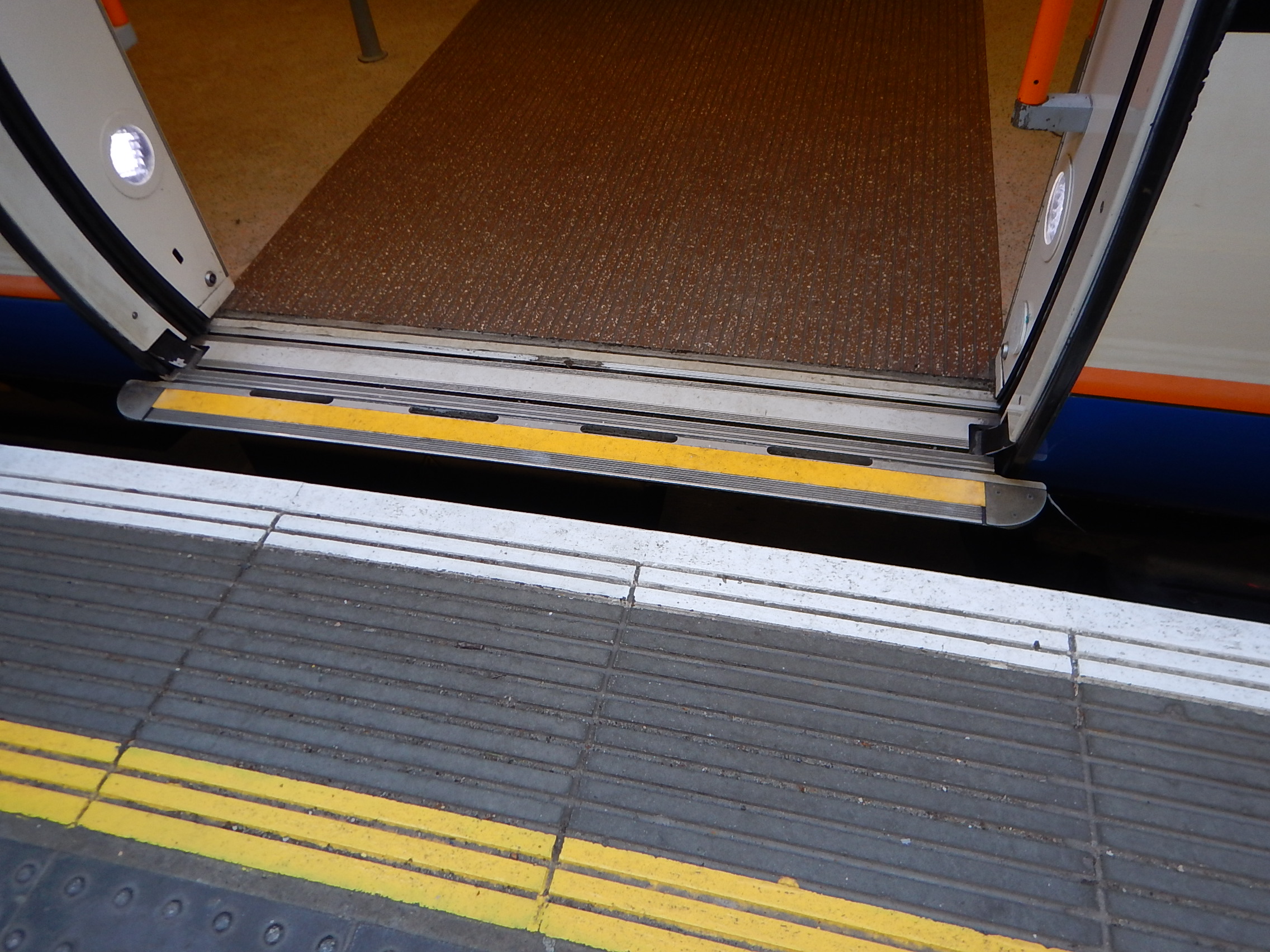
The picture shows a Class 378 train on the London Overground.
This is not one of the best I’ve seen, but there is no reason, why someone in a wheelchair shouldn’t be able to wheel themselves into every train at every station.
This is in the train operating company’s interest, as one of the things that delays trains, is getting someone in a wheelchair on and off the train with a portable ramp.
If we take the UK train width of 2.82 metres and compare that to the width of a Class 399 tram-train, which is 2.65 metres, that means that there is seventeen centimetres difference or eight and a half centimetres on each side of the train.
If the platform can be arranged to be level, that is not a large gap. It’s probably about the same size as this gap in this picture.
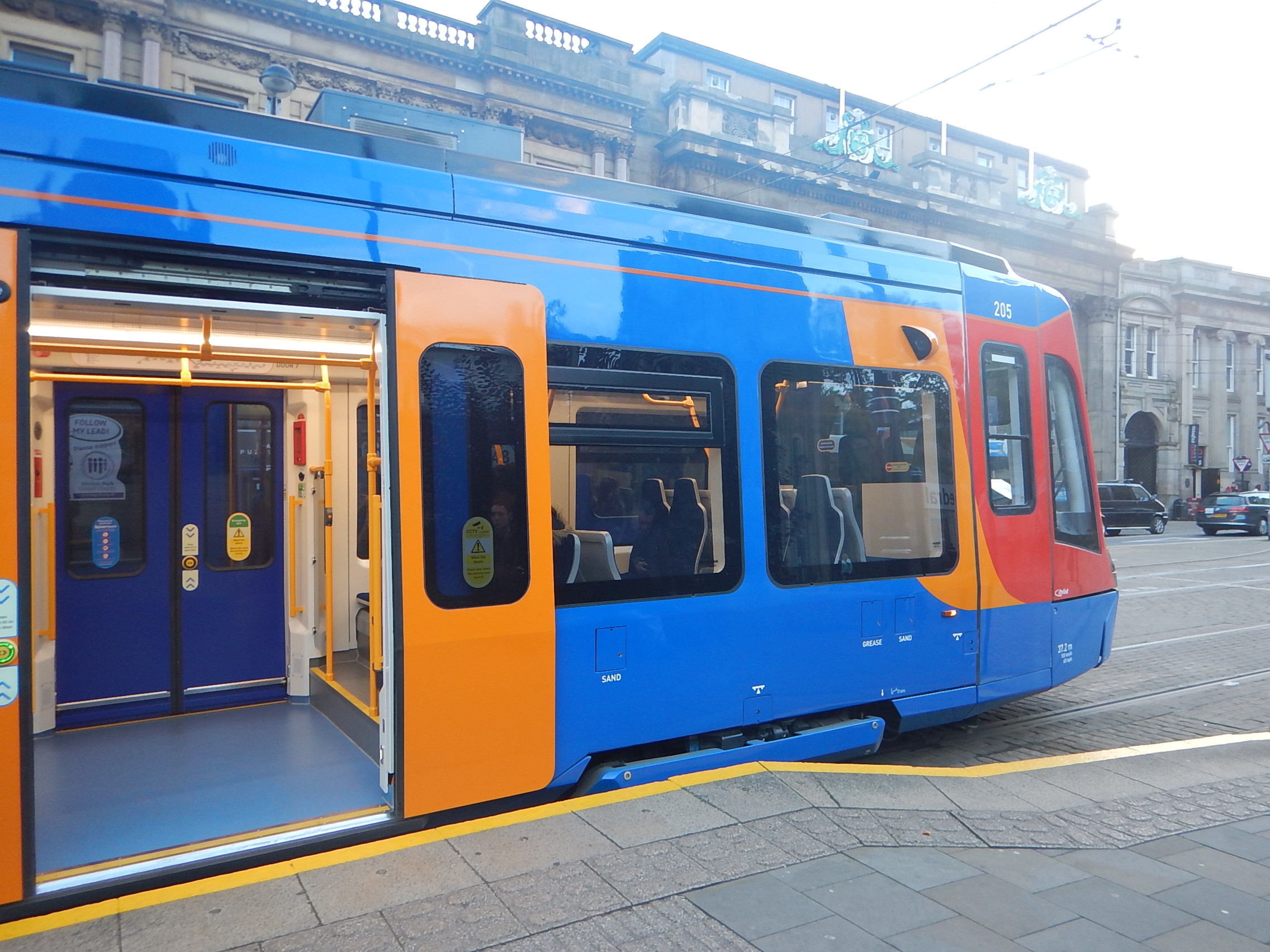
Shown is a Class 399 tram-train at a tram stop on the Sheffield Supertram.
Continental Tram And Train Width
But on the Continent, where the trains are wider and the loading gauge is bigger, the gap will be larger.
Trains on the Continent also often have a significant step up as this picture shows.
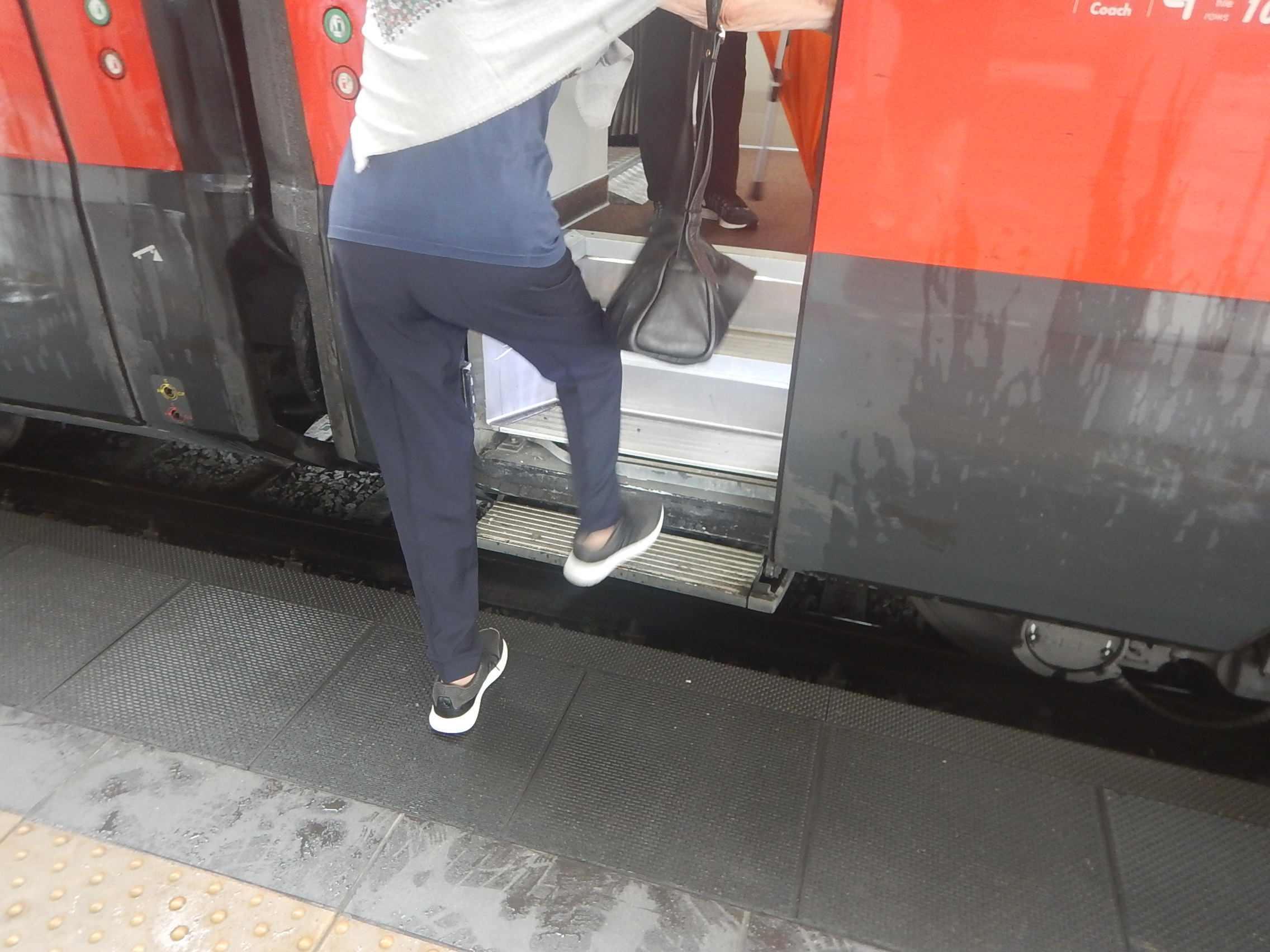
Shown is an Italian High Speed train.
If the EU wanted to improve train travel for the disabled, those in wheelchairs, those with buggies and the elderly, they should make it compulsory for all trains to have level access from the platform.
It’s very rare to find level access on the Continent and not that easy in parts of the UK.
Gap Fillers
But things are getting better, as this picture shows.
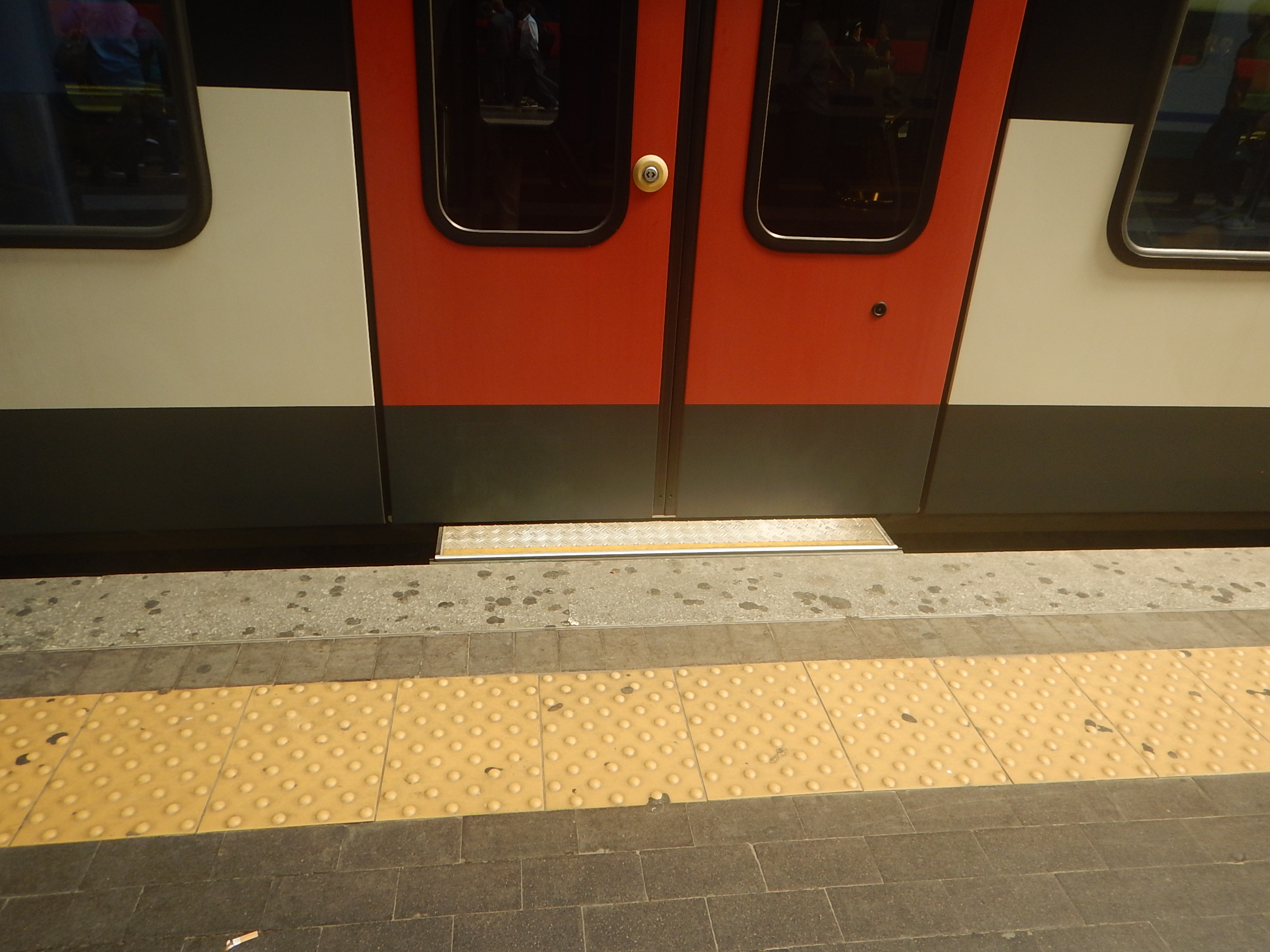
Shown is a Stadler Flirt with a rather nifty automatic gap filler.
Merseyrail’s New Class 777 Trains
Gap fillers will be fitted to Merseyrail‘s new Class 777 trains, which are being built by Stadler.
The Class 777 trains and the current Class 507 trains have the same width of 2.82 metres, but the new Stadler trains have an eighteen centimetre lower floor.
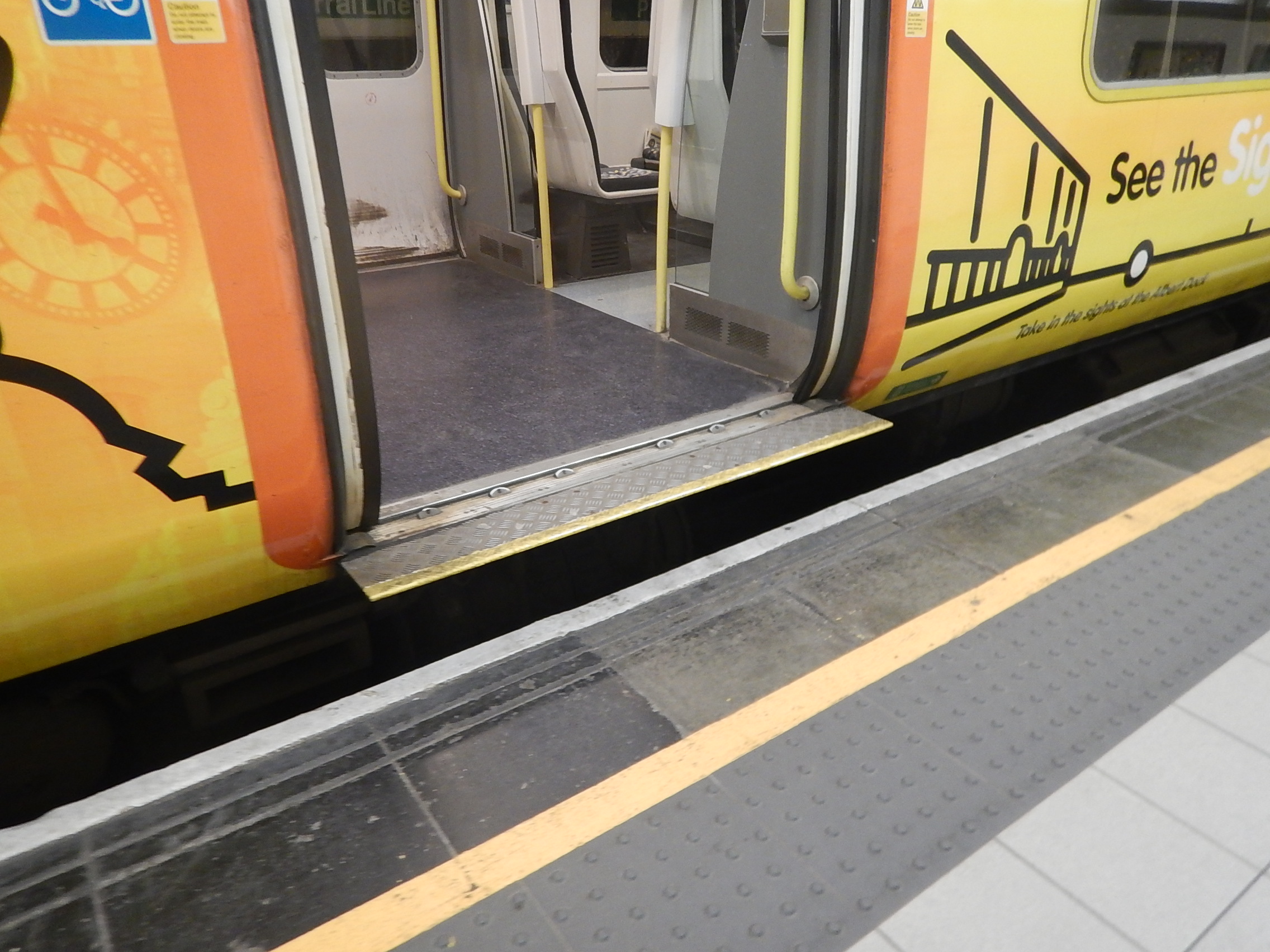
The picture shows a Class 507 train at one of Liverpool’s underground stations.
Eighteen centimetres wouldn’t be far away from the height of the step in the picture.
The design must also allow both classes of trains to be in service at the same time, to ease introduction of the new Class 777 trains.
Talk about Swiss precision!
South Wales Metro
This document on the KeolisAmey web site details their plans for the new Wales and Borders Franchise.
For services around Cardiff and on the Cardiff Valley Lines, KeolisAmey Wales intend to acquire the following fleet.
- 11 – four-car Stadler Flirt DEMU
- 7 – three-car Stadler Flirt Tri-mode MU
- 17 – four-car Stadler Flirt Tri-mode MU
- 36 – three-car Stadler Citylink Metro Vehicles
Note.
- The Stadler Flirts look very similar to Greater Anglia‘s Class 755 trains, that by the time of delivery of these trains for Wales, will have proven themselves on the mountains of East Anglia.
- The tri-mode multiple units will be able to run on electric, diesel or battery power.
- The Stadler Citylink Metro Vehicles look very similar to Sheffield Supertram‘s Class 399 tram-trains, that are providing a tram service in Sheffield and will soon be running on the rail network to Rotherham.
- It is an all-Stadler fleet.
This is a clip from the KeolisAmey document.

This looks like a visualisation of one of the Flirts, as the Citylink tram-trains have flat sides.
I will be very surprised if Stadler don’t provide the Cardiff area, with one of the best step-free networks in the world.
Conclusion
The UK’s standard tram width of 2.65 metres and our small loading gauge must make it easier to design tram-train systems for the UK.
.
More Information From The International Railway Journal About The New Wales And Borders Franchise
In Every Pair Of Pictures Tell A Story, I said I needed more information on what was happening with the new Wales and Borders franchise.
This article on the International Railway Journal is entitled £800m fleet renewal plan for new Welsh franchise, gives a lot more serious information.
These two paragraphs outline the plans.
According to the Welsh government, around £800m will be invested in rolling stock to ensure that by 2023, 95% of journeys will be made on a new fleet of 148 trains. The average age of the fleet will drop from 25 years to seven years by 2024.
More than half of the new trains will be assembled in Wales, indicating a major order will be placed with CAF, which is currently building a new assembly plant near Newport.
The article then goes on to make specific points.
Class 769 Trains
Class 769 trains will be used as a stop-gap measure until the arrival of new bi-mode trains.
Five of these trains are on order for delivery in the next eighteen months.
Class 230 Trains
Class 230 trains will join the fleet.
Perhaps they will be used on the Conwy Valley Line.
The line is rather isolated from depots at Cardiff, Chester and Machynlleth, which would find the Class 230 trains remote servicing capabilities useful.
The Wikipedia entry for KeolisAmey Wales states that the Class 230 trains will work the Borderlands Line, which will have a two trains per hour (tph) frequency.
As the journey takes an hour each way with a round trip possible in two hours, I suspect that a two tph frequency will need four trains, with perhaps a fifth one ready to step into service.
Again the remote servicing capability of the Class 230 train will come into play, as will the train’s affordability.
Class 170 Trains
Several Class 170 trains will join the fleet.
These could be coming from Greater Anglia, who currently have twelve of the trains, that will be replaced by Class 755 trains.
This page on the Welsh Government web site, contains this sentence.
On the Heart of Wales line, introduce refurbished Class 170 two-car units by 2022.
If you want to find out more about train services in Mid and South-West Wales, the page is well-worth a read.
Mark 4 Carriages
Mark 4 Carriages released from the East Coast Main Line will replace the current Mark 3 Carriages.
Phasing Out Of Diesel Multiple Units
The article makes these two points.
- Pacers will be withdrawn by the end of 2019.
- Class 150, Class 153, Class 158 and Class 175 trains will be completely replaced by 2023.
The only ones worth keeping could be the Class 158 trains, most of which if fitted with wi-fi would be acceptable on many routes.
New Diesel Multiple Units For Long Distance Services
The article says that new diesel multiple units will be introduced on these routes.
- North Wales Coast and Cambrian lines in 2022
- Milford Haven – Manchester route by 2023
This page on the Welsh Government web site, also says a new Swansea to Manchester service will be introduced from 2024.
In Every Pair Of Pictures Tell A Story, I suggested that Class 755 trains could be used on these routes.
- They have similar performance to the Class 175 trains.
- Length and power can be tailored for each route. Greater Anglia have ordered two sizes.
- As they are bi-modes, they could take advantage of the electrification East of Cardiff and around Birmingham and Manchester.
But the biggest thing in favour of Class 755 trains, is that the thirty-eight units for Greater Anglia are scheduled to be completed by the end of 2019. So if the Welsh trains are virtually identical to those for Greater Anglia, there would not be any serious certification problems.
The Wikipedia entry for KeolisAmey Wales indicates that these trains could be diesel versions of the CAF Civity.
The South Wales Metro
The IRJ article says that £738 million will be invested in this project.
The Wikipedia entry for KeolisAmey Wales gives a few more details of train frequencies.
- A new 1 train per hour (tph) Ebbw Vale to Newport service by May 2021.
- 2 tph between Cardiff and Bridgend via the Vale of Glamorgan Line from December 2023
- 4 tph throughout on the Rhymney line from December 2023
- 4 tph to Treherbert from December 2022
- 6tph to Cardiff Bay from December 2022
- 4 tph between Merthyr Tydfil, Aberdare and Cardiff from December 2022
This is an increase in frequency.
It appears there will be two distinct sections of this network, which I’ll discuss in the next two sub-sections.
An Electric Network On The Cardiff Valley Lines
The IRJ article says this.
A new fleet of low-floor vehicles offering level boarding will be introduced on the network by December 2022.
I think we can assume this about the vehicles.
- They will be tram-trains.
- They will have batteries.
- They will be able to use 750 VDC and 25 KVAC electrification.
- There will be a proportion of street running in Cardiff.
It would also be highly likely, that these vehicles will be built by CAF, in their new Newport factory. Wikipedia mentions a tram-train version of their Urbos trams, which are used in Edinburgh and the Midlands, which is called an Urbos TT.
A Complimentary Tri-Mode Network
The article says this.
A new fleet of Stadler “tri-mode” (electric/diesel/battery) multiple units will maintain links from Penarth, Barry and Bridgend to stations north of Cardiff Central. These trains will enter service from December 2023.
It looks from the pictures that these will be a version of the Class 755 trains.
In From Novara To Aosta, I described the route, where similar Stadler trains will be used on the Chivasso-Ivrea-Aosta railway to reach the town of Aosta. I would suspect that the Italian route could be more challenging, than anything South Wales has to offer.
The Heads Of The Valleys Stations Will Be Served By CAF’s Tram-Trains And Stadler Tri-Modes
It would appear from Wikipedia, that the stations at the heads of the valleys will have the following frequencies.
- 4 tph – Aberdare
- 2 tph – Ebbw Vale
- 4 tph – Merthyr Tydfil
- 4 tph – Rhymney
- 4 tph – Treherbert
These frequencies and some single-platform terminal stations, will mean that careful design must be applied, so that all vehicles have level access from platform to vehicle.
This picture shows the access to a Stadler Flirt in Italy.
Note the gap filler, which automatically moves into place.
I’m sure engineers and designers working for KeolisAmey, CAF and Stadler can come up with a very good solution.
Will The Valley Lines Be Electrified With 25 KVAC?
I think it is highly likely that CAF’s vehicles for the tram section of the South Wales Metro will be tram-trains with a dual 750 VDC/25 KVAC capability and batteries.
Imagine one of these vehicles climbing to say Aberdare using the Merthyr Line, which is a mixture of single and double-track to Cardiff.
Going up to Aberdare, due to the gradients, the vehicles will need access to electrical power, so electrification is necessary, unless each vehicle has a massive diesel generator or ultra-large battery, which are respectively not very environmentally friendly or practical.
But I doubt it will matter if the electrification is 750 VDC or 25 KVAC.
Going down the valley to Cardiff, I believe that CAF’s vehicles will use Newtons friend; gravity and regenerative braking to control the speed. The energy generated by the braking would be stored in an onboard battery.
CAF have all the technology and it would be extremely energy efficient.
The Stadler tri-modes would have to use diesel on the way up, but given they have batteries, I suspect they’d come down in a similar way to the CAF tram-trains.
So what voltage should be used?
- The CAF tram-trains will probably be able to use either voltage.
- If batteries are used to handle regenerative braking, this works with all voltages.
- The Stadler tri-modes will probably need 25 KVAC.
- Electrifying with 25 KVAC would allow the Stadler tri-modes to avoid a lot of running on diesel.
- Any electric locomotives hauling freight would need 25 KVAC.
I wouldn’t be surprised to see the valley lines electrified with 25 KVAC.
Will Only The Uphill Tracks Be Electrified?
I believe that if trains coming down the valleys use batteries for regenerative braking and restarting at stations, it may be possible to only electrify a single-track, that is always used for uphill trains.
But only the tracks for uphill trains were electrified, this would make the works easier and reduce costs and disruption to passengers.
Conclusion
It looks like KeolisAmey have got a well thought-out plan!
Every Pair Of Pictures Tell A Story
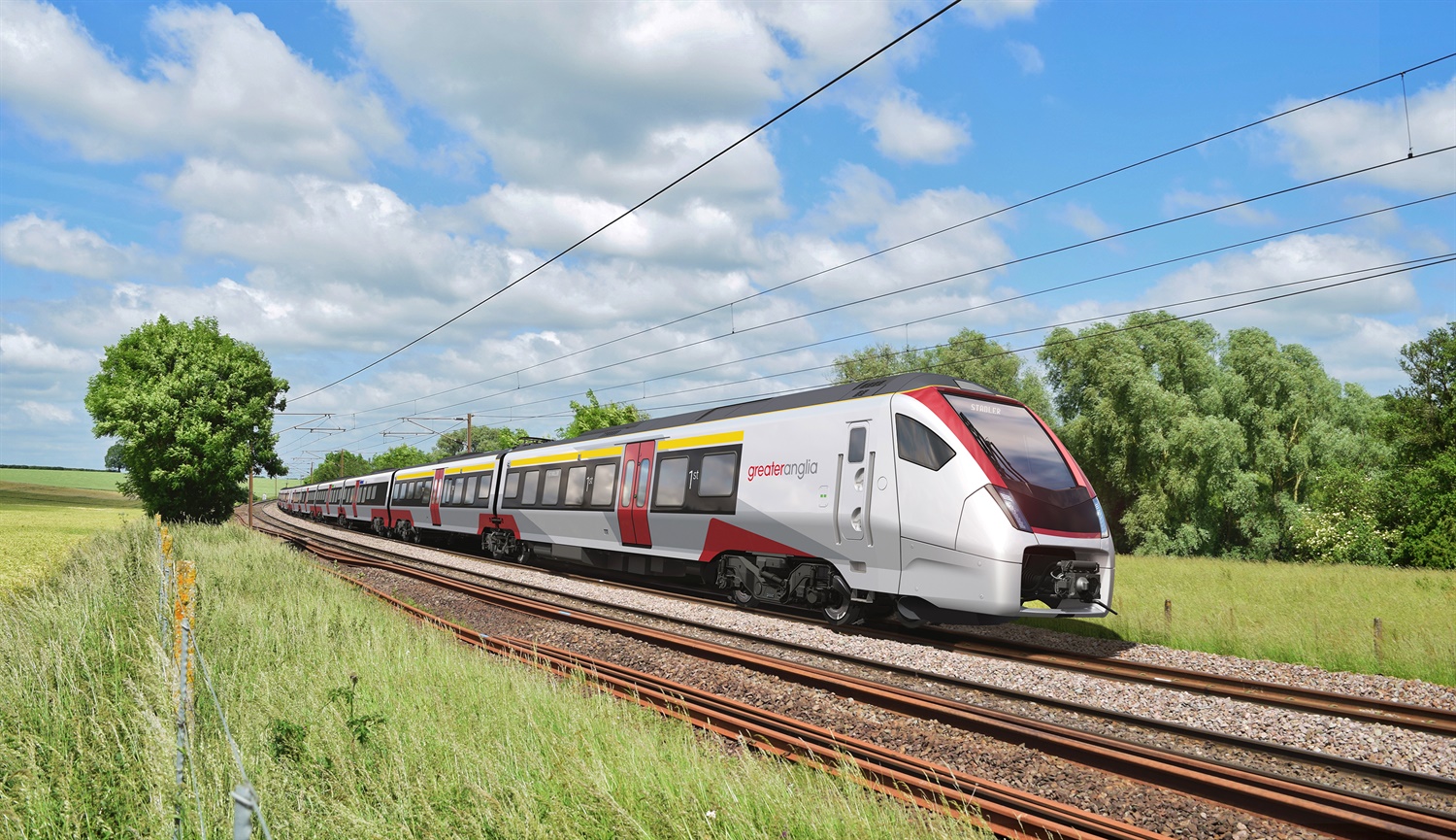
This picture on the Rail Technology Magazine website shows a Greater Anglia Class 755 train.
And this picture on the Global Rail News website shows one of the new trains for Transport for Wales.
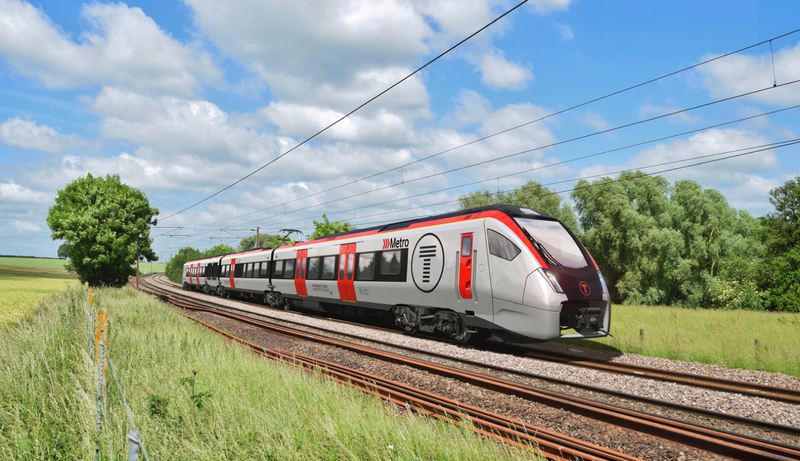
It is captioned “A Tri-mode unit on the Rhymney Line”.
On another report it is captioned “How a KeolisAmey tram-train will look”.
All trains look very similar and I’m pretty certain that Wales will be getting some Class 755 trains.
Class 755 Trains
Class 755 trains will have the following characteristics.
- 100 mph operating speed.
- Able to work on 25 KVAC overhead electrification
- Able to work using an onboard diesel power-pack.
- Three or more passenger cars.
- Ability to be lengthened by adding extra cars as required.
- Lots of power.
They would be ideal replacements for the current Class 175 trains, as the performance would appear to be similar.
They would also be ideal for services on the following routes.
When running around Birmingham, Cardiff, Crewe, Liverpool and Manchester, they would be able to use the electrification.
So are Keolis/Amey going for a predominantly uniform fleet of perhaps three-car and four-car Class 755 trains outside of the Cardiff Valley Lines, just as Greater Anglia used these trains on their routes without electrification North of Cambridge and Ipswich?
The Borderlands Line
The interesting route is the Borderlands Line between Wrexham Central and Bidston stations.
Currently, to get to and from Liverpool, there is a need to change trains at Bidston.
Merseyrail‘s new Class 777 trains are being built by Stadler.
- They will link Bidston station to Liverpool, where they will call at several stations in a single-track loop tunnel.
- The trains have been designed to work under battery power.
- Both classes of train are likely to be very similar under the skin.
So to eliminate the time-wasting change of train at Bidston station, I wonder if Stadler have designed the Class 755 and Class 777 trains, so that they can both run in the loop tunnel.
The additions needed to the Welsh Class 755 trains, over the Greater Anglian versions would be.
- Ability to use Merseyrail’s third rail electrification.
- Clearance to run in the tunnel with diesel onboard.
- Ability to evacuate passengers in the tunnel, in an emergency.
As Merseyrail have recently rebuilt the tunnel for the new Class 777 trains, I suspect that Stadler can design a Class 755 train, that would be able to avoid the change of train at Bidston.
I’ll Wait For More Information
It would seem prudent to wait for more information.
Heavyweight Backing Expected For £1.5bn Crossrail Extension
The title of this post, is the same as that of this article on New Civil Engineer.
This is the first paragraph.
Government infrastructure tsar Sir John Armitt is this week expected to throw his weight behind a £1.5bn extension to Ebbsfleet.
The article also says.
- Circumstances have changed greatly since the 2008 Crossrail Act.
- Canary Wharf Group, who contributed £150million to the building of Canary Wharf station, may be prepared to contribute, as this will give access from their site to Eurostar.
- The extension could support the construction of 55,000 new homes and 50,000 jobs.
The extension would take ten years to design and construct.
Eurostar
After my forays to and from Europe recently by Eurostar, I feel that a Crossrail link to Ebbsfleet will be heavily used.
- As more destinations are served by trains from St. Pancras, more passengers will find Ebbsfleet a more convenient station for the Continent.
- Ebbsfleet will be linked directly to Canary Wharf, the City of London, the West End and Heathrow.
- Crossrail will give an easy Undergound-free link between Wales and the West Country and Ebbsfleet stations with a single change at Paddington station.
- When HS2 opens, there will be an easy Underground-free link between the Midlands and the North and Ebbsfleet stations with a single change at Old Oak Common station.
- St. Pancras only has four platforms with no space to expand, but it could be relatively easy to add capacity at Ebbsfleet.
If I was in charge of designing and building the Crossrail extension, I’d make sure that Eurostar made a contribution, as they will be big winners from the extension.
The City Of London
The extension may be beneficial to the City of London.
- The extension would add more stations within easy reach of terminal stations in the City.
- The extension might give an easier route to and from the City.
- After Brexit, I suspect the institutions of the City will want more good connections to Amsterdam, Brussels, Frankfurt and Paris.
,Perhaps one of the big City companies might like to finance construction and charge a royalty on each rain?
London City Airport
Should the project to build the extension also include building a Crossrail station at London City Airport?
This would mean that passengers between places like Aberdeen, Belfast, Dublin, Edinburgh, Glasgow, the Isle of Man and Manchester, and Continental destinations served by train would have a more convenient interchange in London.
Ebbsfleet Valley
Ebbsfleet Valley is a proposed new town of 16,000 homes being built on brownfield land close to Ebbsfleet station.
£300million of government money has been pumped into the project. But according to Wikipedia, there has been criticisms of the project.
London Paramount Entertainment Resort
London Paramount Entertainment Resort is described like this in Wikipedia.
London Paramount Entertainment Resort (commonly referred to as London Paramount) is a proposed theme park for the London Resort in Swanscombe, Kent. The project was announced on 8 October 2012 and it was estimated to open by around 2023.. In June 2017, it was announced that Paramount had pulled out of the project[2]. However, London Resort Company Holdings still insist the project is going ahead.
I’ve never been to a theme park, as I prefer the real thing!
But others will like it!
Conclusion
The beneficiaries of extending Crossrail to Ebbsfleet, include a lot of big players with possibly large financial resources.
I would suspect that some could be persuaded to fund particular parts of the project.
After all, if a housing developer invested say £10 million, in a new station for a development and then found it easier to sell the houses, there comes a point, where they make more profit and house buyers get a much better place to live.
Has The Queen Ever Ridden In a Battery-Powered Train?
Countryfile this evening had a special program about the Queen’s Scottish house and estate at Balmoral.
One archive film, showed her arriving at Ballater station in a train hauled by a locomotive with a number that looked slightly familiar. Looking it up, it was a B1 Class locomotive, which I must have seen regularly, when I went train-spotting on the West Anglia Main Line in the 1950s.
So I looked up Ballater station in Wikipedia.
The station, which was on the 43 mile long Deeside Railway from Aberdeen, is now closed but there was this paragraph on Wikipedia under Services.
When the battery multiple unit was introduced, services were doubled to six trains a day from 21 April 1958, and Sunday service reinstated. The line was chosen for testing the unit because the stations were well spaced and the 1 in 70 ruling gradients would require substantial discharge rates.
As someone very interested in railways at the time, I’d never heard of British Rail’s use of battery trains.
Remarkably, the battery electric multiple train, is still in existence and is being preserved at the Royal Deeside Railway, not far from Balmoral.
It looks to me. that a lot of engineers at Derby, made sure that this train survived.
So what was it like?
- It was based on the Derby Lightweight diesel multiple unit.
- The North of Scotland Hydro-Electric Board initiated the design and was a joint sponsor.
- The train had an operating speed of 60 mph.
- The train was powered by two 100 kW traction motors.
- Power was provided by 416 lead-acid cells, giving a total of 440 V and 1070 A hour capacity.
- The batteries weighed nine tonnes.
- There were seats for twelve First Class passengers and a hundred and five in Second Class.
It couldn’t been that bad a train, as it ran between Aberdeen and Ballater station from 1958 to 1962.
There’s more about the train here.
Conclusion
But I can’t help wondering, if the Queen ever used the train!
These Dreaded Glasses Are Starting To Appear In Hotels
In my hotel in Novara, I didn’t get a proper glass or even a hard plastic one, like those I use at home.
I got one of these design crimes!

Consider.
- They are single-use plastic of the worst kind.
- They are difficult to open with my gammy hand.
- When I opened one in Germany I destroyed the glass.
But the worst thing, is that they are unstable and one tipped over in Novara and ruined my paper, in which I was doing the sudoku.
Ban them!
Are The UK’s Train Troubles Caused By A Perfect Storm?
I have wondered, why this year we have had such troubles over the May timetable change.
Let’s consider various factors.
The Average Train Driver
I would suspect that the demographics of the average train driver are very much like the average working person, who earns about the same salary.
They would be quite likely to be married or living with a partner and to have 2.4 children, some of whom could still be at school.
Like many of us, they probably enjoy a responsible drink, supporting and watching sport, especially football, and having the occasional holiday in the sun.
Some train drivers have had a more stressful winter than many, due to the Beast From The East and other bad weather.
Remember too, that not all drivers work in warm, air-conditioned trains.
So I suspect that like most of us, many were or still are looking for a holiday to blow away the winter.
The Late May Bank Holiday On May 28th
Next year it’s the 27th and in 2020 it’s the 25th.
Is this too close to the timetable change?
The Massive Timetable Change On May 20th
Normally, the May timetable change is much smaller and I can’t remember one that has caused so much disruption.
But this year, there was completely knew services for three major pieces of new infrastructure; Blackpool |Electrification, Thameslink and the Ordsall Chord.
Living in London, I don’t have day-to-day observations on the Northern services, but Thameslink has meant changes to many other services in the South East. Some of these new services seem to have a very high incidence of cancellation, which have been put down to driver shortage.
It also appears that here in the South East, the second week of the new timetable, could have been worse than the first week.
Surely, things should get better, with each week!
The Late Publishing Of The May 20th Timetable
This surely didn’t help and until we get a definitive view as to why Network Rail were so late with publishing it, I will not speculate.
The Beast From The East
This obviously had various effects on the railway industry.
As I said earlier, it probably contributed to the need for drivers to have a week off.
But did it also interrupt the training of drivers for the new routes?
Non-Delivery Of New Trains
The North was also due to get some extra trains.
Some Class 170 trains were supposed to be cascaded from ScotRail, but due to non-delivery of their replacements, they didn’t arrive.
Some Class 769 trains were supposed to be in service in December 2017, but they have not arrived.
The World Cup In Russia
This stretches from the 14th of June to the 15th of July.
This is the same length as 2014 in Brazil, but does the late May Bank Holiday put pressure on where working people can take a much needed holiday?
Conclusion
This year all these factors came together and the result was chaos!
I suspect, that a lot of drivers and other staff took a much-needed and well-deserved holiday after the May Bank Holiday!
Perhaps, it would be better to have the timetable change in June?
Scotland’s New Railway Race
There have been five railway races involving Scotland over the years.
- London To Edinburgh in 1888
- London To Aberdeen in 1895
- London To Edinburgh in 1901
- LNER and LMS
- British Rail
This article in Rail Engineer is entitled Full Glasgow To Edinburgh Electric Service In July.
The article suggests this could be another railway race with Scotland involved.
In the red corner are the devious English, who are entering a series of redundant Class 365 trains, that nobody else wants.
- They are thirty-year-old trains
- They were built by British Rail.
- To improve their relationship with drivers, WAGN fitted them with cab air-conditioning. Marketing then named them Happy-Train, as the air-conditioning inlet, had given them a smile.
- It has also been rumoured that their class number was chosen to give the air of year-round reliability.
To gain an advantage, the first train was actually sneaked into Glasgow by road, as no-one was sure that they could fit the routes to Scotland.
To get the trains ready for Scotland, work is being done by the German company; Knorr-Bremse Rail Services at Springburn in Glasgow.
The Scottish entry in the blue corner, is the Hitachi Class 385 train, which is manufactured mainly in Japan and screwed together at Newton-Aycliffe.
Unfortunately, the train was designed for drivers with Asian eyesight and the curved windows in the cabs, give unreliable images at night, with the average Scottish driver, even if they’ve been training hard on Irn-Bru!
It is hoped that new windscreens will be approved for use soon!
So the race is on to see who can get their train into service first.
As to the verdict on which train is better, I think we could be seeing a split decision.
Glasgow will prefer one train and Edinburgh will prefer the other!
 The Anonymous Widower