Catenary Masts Erected On Alloa Branch
The title of this post is the same as that of an article in Issue 851 of Rail Magazine.
Alloa is one of the many Scottish towns and cities, that I only know through the results of Alloa Athletic FC, at around 17:00 on a Saturday afternoon.
Alloa station has a chequered history with growth through the Victorian era and total closure in October 1968.
The station was demolished to make way for a leisure centre.
But then in 2008, the line to Stirling station was reopened and a new station was built.
Wikipedia says this about the reopening.
Passenger use of the new railway station has greatly exceeded forecasts and since re-opening the service has been improved by increasing evening and Sunday frequencies from two-hourly to hourly and by adding the peak hour service to Edinburgh in 2009. In its first year the station was used by 400,000 passengers, against a forecast of 155,000.
Now the branch to Alloa is getting the ultimate upgrade – It is being electrified.
This could provide a lot of useful data on the financial returns of electrification.
Use Of Battery Trains
When I first saw a map of this line which clings to the North shore of the Forth of Firth, I was surprised that Strling to Alloa should be electrified.
It is only eight miles and if it is a level coastal railway, it could surely be handled by battery-powered trains.
So why electrify now, rather than wait for Hitachi to bring their technology to the UK and save costs?
But digging deeper, there are two large industrial sites further to the East.
- The closed Longgannet power station, which sits on a massive site.
- The large Rosyth Docks, which seems to have plans to create businesses, employment and housing.
The railway from Alloa extends to Dunfermline Town station on the Fife Circle Line and could play a part in the development of both sites.
An electrified line to Alloa, leaves all options open.
The Wikipedia entry for the Stirling–Alloa–Kincardine Rail Link says more.
This is the first paragraph.
The Stirling–Alloa–Kincardine rail link was a project to re-open 21 kilometres (13 mi) of railway line between Stirling, Alloa and Kincardine in Scotland. The route opened to rail traffic in March 2008.
The rail link effectively had two purposes.
- To allow passenger trains to run as far as Alloa station.
- To allow coal trains to run to Longannet power station, without using the Forth Bridge.
The Wikipedia entry says this under Future Expansion.
The retention of the coastal route offers the possibility of providing passenger services to Dunfermline via Clackmannan, Kincardine, Culross, Valleyfield and Cairneyhill. The former direct main line from Alloa to Dunfermline (which was not proposed for closure by Dr. Beeching) is now partly obstructed by developments on the site of the old Dunfermline Upper station. There would appear to be no prospect of access to the existing Dunfermline Town (formerly Dunfermline Lower) station by this route, unless a new stretch of line were built west of Dunfermline. However, the coastal Kincardine line does give direct access to Dunfermline Town.
There has been some discussion of the possibility of providing a service to Rosyth Ferry Terminal.
The Scottish Government have a lot of options to provide the best rail system for the current rail travellers and future developments in the area.
Wet Wipes Could Face Wipe-Out In Plastic Clean-Up
The title of this post, is the same as this article on the BBC.
What are wet wipes?
In my seventy years, I’ve never used or even seen one!
I don’t think my late wife ever used one either!
Do we really need them?
TPE Pledges Capacity Boost With Class 68/Mk 5A Sets
The title of this post is the same as that of an article in Issue 851 of Rail Magazine.
It adds a few extra details to those, that I wrote about in Nova 3 On The Test Track.
This information is revealed.
The Route
The TransPennine Express fleet will run on the Liverpool Lime Street-Manchester Airport-Scarborough/Middlesbrough Routes, replacing three car Class 185 trains.
Train Length
Each Mark 5A car has a length of 22.2 or 22.37 metres.
Adding on the Class 68 locomotive gives a train length of 131.84 metres.
This compares with a train length for the Class 185 train of 71.276 metres.
It means that two Class 185 trains working together, which is current practice, are longer than the new fleet.
This must limit platform and depot modifications.
The Capacity
The number of seats on the two trains are as follows.
- Class 185 train – 15 First Class – 165 Second Class
- Class 68/Mk 5A sets – 30 First Class – 261 Second Class
This gives twice as many seats in First Class and nearly sixty percent more in second.
Both trains seem to have around sixty seats in each car.
Technical Characteristics
The Rail Magazine article gives several technical characteristics.
- Each coach has two passenger doors, except the First Class coach which has one.
- There is Selective Door Opening controlled by GPS.
- Door controls are in the Driver Trailer and Class 68 cans, which the driver controls.
- Two door control panels are in every vehicle for usde by the conductor.
- Wheel Slip Protection is fitted.
- Automatic passenger counting is provided.
- Wi-fi is fitted.
The trains have a high specification.
OLE Upgrades Complete At Anglia As Part Of £46m Transformation
The title of this article, is the same as that of this article on Rail Technology Magazine.
I hope this is actually the case.
- I’ve had enough of rail replacement buses, when trying to get to football at Ipswich on a Saturday.
- For at least the last three years, I’ve probably seen more away matches, than those at Portman Road.
- Three hours each way to Ipswich, effectively means, the only pleasurable thing you do is see the match.
- This work has probably hit attendances at both Norwich and Ipswich.
- I’ve renewed my season ticket fort next season, but if it is as thin on home matches as this one has been, it will be my last season of travel.
What puzzles me, is why can’t Network Rail adjust their work schedule, so that at least important matches like the two Derbies have trains?
But then you wouldn’t rate Network Rail highly for Project Management!
Discontinuous Electrification For Valley Lines?
The title of this post, is the same as that of an article in the May 2018 Edition of Modern Railways.
The Valley Lines in question are the Cardiff Valley Lines, that fan out from Cardiff Central and Cardiff Queen Street stations in various directions.
- Some of the lines into the valleys are quite steep.
- The lines in the Cardiff area seem to be typical coastal lines and fairly flat.
- The lines are a mixture of single and double track.
- There are various plans to extend some of the branches.
According to the article, it would appear that the current diesel system would be replaced with a system, with these characteristics.
- Light rail vehicles
- Discontinuous electrification
- Use of stored energy.
- Street running is expected to be in the specification for the vehicles to be used, to allow extension in the Cardiff Bay area and perhaps other places.
The proposal would save costs against full electrification and heavy rail.
My observations follow.
Batteries
Batteries will be an integral part of the design of the new rail vehicles.
Powering The Trains
The article states that battery power will be used to power the trains on sections that are difficult to electrify, like the mile-long Caerphilly Tunnel.
Battery power could also be used on level and downhill sections of track up to a few miles, but I suspect on steep uphill sections, electrification will be needed.
Handling Regenerative Braking
I believe that regenerative braking will be employed on the rail vehicles and the energy generated will be stored in the batteries.
The main advantage of this is that it simplifies the power supply to the electrification, as it only has to handle power going to the train.
This less complex electrical system, saves construction costs.
Recovering The Train’s Potential Energy
A train travelling from Cardiff to one of the terminal stations at the heads of the valleys, will need to acquire an amount of potential energy, based on the train’s mass and the height involved. This will be provided by the train’s traction system powered by the electrification and the energy in the batteries.
Coming down the hill, the regenerative braking will control the speed of the train and store any energy generated in the batteries.
This will save on the cost of energy to operate the system.
Charging The Batteries
The batteries will be charged from both the overhead electrification and the regenerative braking.
Extensive simulations of the route on computers would be able to calculate the following, for a wide range of scenarios.
- The size of the batteries.
- The power of the traction motors.
- Where the electrification needs to be installed.
- The maximum power output of the electrification system.
These calculations could also lead to an energy-saving operating philosophy, that could be programmed into the train’s computer system.
I suspect the worst case scenario, would be a train full of the heaviest Welshmen after an important rugby match at the Millennium Stadium.
Electrification
My thoughts on how various sections of track would be electrified follow.
Tracks With A Significant Uphill Gradient
These would need to be electrified, as I doubt battery power on the steepest gradients, would be enough to take a fully-loaded train to the top of the hill.
Electrification would be lighter-weight 750 VDC overhead wires.
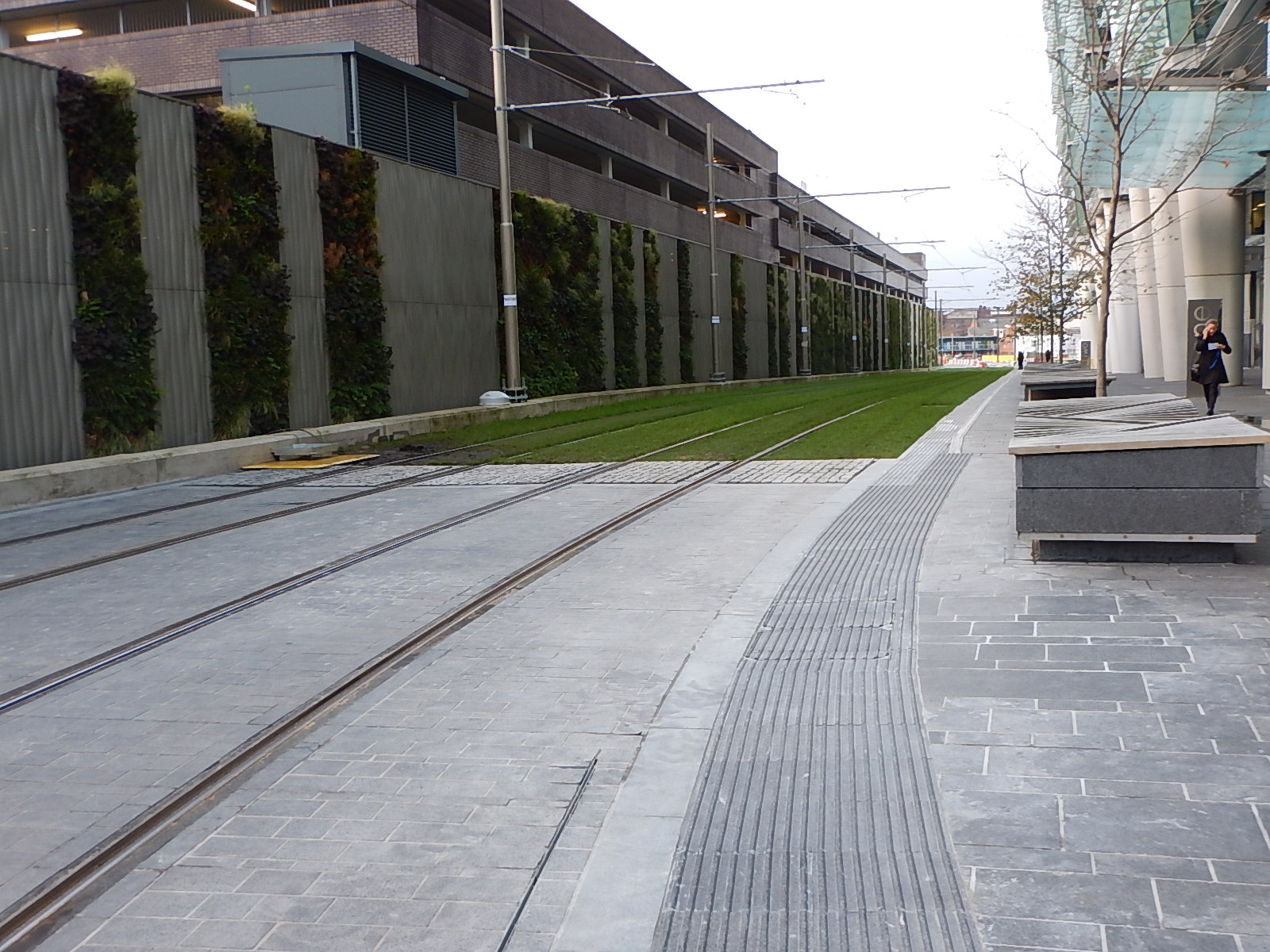
The picture shows some of the overhead wires in Birmingham, that are used by the Midland Metro’s Urbos 3 trams.
Tracks With A Downhill Gradient
These would not need to be electrified, as Newton’s friend gravity would do most of the work.
However, as batteries will be fitted, these can have three important functions on downhill stretches of track.
- Give the tram a nudge if needed.
- Restart the train after a stop at a station.
- Store any energy created by regenerative braking.
Note that we could have the unusual situation on a double-track section of line, where the uphill track was electrified and the downhill track was left without electrification.
Level Tracks
These would not need to be electrified, as battery power would be used to propel the train.
Selected Stations
Some stations could need to be electrified to ensure that the service was reliable. These might include terminal stations or those with tricky gradients on either side.
Tracks With 25 KVAC Electrification
Some of the tracks used by the trains on the Cardiff Valley Lines should be electrified with 25 KVAC, by the end of December 2018.
Class 399 tram-trains, that are used in Sheffield can use either 750 VDC and 25 KVAC overhead electrification.
it would probably be a good idea, if the new vehicles on the Cardiff Valley Lines could also use both voltages.
Automatic Pantographs
The pantographs on the vehicles would be raised and lowered automatically to access the electrification. This could even be GPS-controlled and able to be carried out at line speed.
Tram-Trains?
I very much feel, that tram-trains could be used to advantage.
- Some of the Valley Lines are also used by freight trains, so couldn’t be converted to trams-only.
- Tram-trains like the Class 399 tram-train, under test in Sheffield can work on both 750 VDC and 25 KVAC overhead wires.
- Tram-trains can use conventional railway signalling.
- Tram-trains could work on the South Wales Main Line to Newport.
- Modern tram-trains like the Class 399 tram-train have performance, that is about the same as a Class 142 train, which is a Pacer, that works the Cardiff Valley Lines, in large numbers.
- Tram-trains could run on the streets as trams, as they do in Sheffield.
Several manufacturers make tram-trains, which I believe could be suitablefor the Cardiff Valley Lines.
Stadler’s Class 399 Tram-Trains
Nothing is said about the vehicles, that would be used, but I think they need the following characteristics.
- Ability to climb the steepest section of the routes using 750 VDC overhead electrification.
- Ability to store energy.
- Regenerative braking to charge the batteries coming down the hills into Cardiff.
- A similar capacity to a Class 150 train, which is around 150 seats.
- It would be a bonus if they could use 25 KVAC overhead electrification, which will be available on part of some of the routes.
- Ability to raise and lower the pantograph quickly and automatically.
- Ability to run on the National Rail network.
- Ability to run on the street.
This specification is virtually the same as a Class 399 tram-train with the following additions.
- More seats and possibly an extra car.
- Batteries.
Class 399 tram-trains are a UK version of the Stadler Citylink tram-train. The German version is used in Karlsruhe to climb into the hills surrounding the city, on routes that are as challenging as the Cardiff Valley Lines.
So I have no worries about a version of the Class 399 train handling the Cardiff Valley Lines.
I certainly believe after my experience in Karlsruhe, and looking at other Citylink variants, that Stadler can come up with a tram-train for Cardiff based on the Class 399 tram-train.
And Then There’s CAF!
CAF have provided the Urbos 3 trams for Edinburgh Trams and the Midland Metro.
These are modern trams, that will be doing the following in a few years in the Midlands.
- Running on stored energy in the centre of Birmingham and to Wolverhampton station.
- Sharing the South Staffordshire Line with heavy freight on a new route to Merry Hill Shopping Centre.
This sounds like a tram-train with stored energy.
Wikipedia also lists a version of the Urbos family, called an Urbos TT, which is described like this.
The Urbos TT series is built with tram-train technology, connecting existing heavy rail infrastructure directly to urban tramway systems.
This document on the CAF web site, gives more details of Urbos variants, including the Urbos TT.
Looking at the modular nature of the design, you could have a custom-built tram-train tailored to the rail network.
But surely, the major factor with CAF, is that they have recently opened a factory at Newport.
If CAF get the order for the Cardiff Valley Lines, they could do a substantial part of the train building in a factory connected directly to the lines.
Converting The Valley Lines
I think that there are advantages and cost savings to be had, by good design in this area.
Could The Rail Vehicles Be Designed To Fit The Existing Platforms?
The first thing to do would be to design, build and fully test the rail vehicles.
Could the tram-trains be built, so that they fitted all the existing platforms?
- Class 150 trains are 2.82 metres wide.
- Urbos 3 trams on the Midland Metro are 2.65 wide.
If the tram-trains could run without platform modifications, this would be a big cost saving and still allow diesel units to use the lines, at the same time.
Testing The Trains
If the tram-trains were being given a 25 KVAC capability, they could even be tested on the quadruple-track the South Wales Main Line after the line is electrified through Newport.
Electrifying The Lines
It could be that the only sections of the valley lines that will need electrification, are the steep lines into the hills, as all other sections could use stored power or the 25 KVAC, where it exists.
- It would probably be possible to put up the simpler 750 VDC overhead lines during weekend and perhaps longer possessions.
- The electrification could be designed so that it doesn’t interfere with existing services.
- The lines would be converted one at a time.
- ,Note that tram-trains could share track and platform with the current diesel trains working the lines.
If CAF were to get the order surely the Ebbw Valley Line, which could be connected easily to the factory would be the first to be converted.
Conclusion
Obviously, the devil will be in the detail, but it does look like a viable plan will emerge.
I think that if CAF get the order, that they could be big winners.
The Cardiff Valley Lines could demonstrate the following.
- Running on main lines with 25 KVAC electrification.
- Running on 750 VDC electrification.
- Running on batteries.
- Running on lines with steep hills.
- Street running.
- Sharing tracks with freight trains and other passenger services.
- The tram-trains could also connect to Cardiff Airport.
It is a world-class demonstration and test track for innovative tram-trains, designed to cope with challenging rail networks.
With a factory close by at Newport, the selling of the tram-trains to other operators would be a salesman’s dream.
I think there’s more to CAF coming to Newport, than was apparent, when the deal for the factory was signed.
Huge Outlay On Motorways Despite Reduction In Traffic
The title of this post, is the same as a small news item in The Times on Friday.
According to the Commission on Travel Demand, individuals used cars and other vehicles fourteen percent less than they did in 2002.
Reasons given include internet shopping, Netflix and flexible working.
They also say that many in their teens and early twenties shunning car ownership altogether.
There is a graph in the article, which shows that the reduction has been largest in Greater London. That seems to fit with my observations.
- I’ve chatted to several youngsters , who have no intention of learning to drive for some years. It’s all just too costlyin the Capital and there are few places to park securely.
- I’m also sure, that my road which is wide and has cars parked on both sides, is less crowded than when I moved here nearly ten years ago. Now, when I get a parcel delivery, there is always space for the van outside.
- In Dalston, we have also benefited from the Overground and lots of new buses, although the frequency of the latter hasn’t increased.
- I wouldn’t underestimate the fact that those of a certain age, like myself, get free public transport in Greater London.
- There has also been a tremendous increase in the use of bicycles for commuting.
I don’t think that all parts of London have seen as much reduction as the North and East.
It always seems that traffic is busy, when I go to Chelsea, Westminster or the West End. But I don’t think we can stop, those with large 4x4s going to the local Waitrose and Harrods.
I also think, that Crossrail will reduce traffic across a whole swathe of London from Ealing to Ilford via Paddington, the West End and the City.
It will be a well-designed stylist railway with trains every few minutes.
According to the article, Metropolitan areas are also seeing a reduction in car use.
Although, they haven’t got as comprehensive, a public transport network as London, over the last ten years, several large metropolitan areas have improved public transport considerably.
Traffic also seems to have reduced slightly in what the report calls shire towns, resort and rural.
I would put this down to the three factors said earlier by the article; internet shopping, Netflix and flexible working.
The only places not showing a less significant decline is districts with industry and new towns.
But a lot of these have been built for car use.
Conclusion
It is a thought-provoking article.
Given that Greater London has shown the biggest decline in traffic and it has the most comprehensive public transport system in the UK, the question has to be asked if more money is spent on public transport, could it reduce the amount of money spent on the roads!
I would do the following.
- Build more welcoming new stations with adequate parking like, Apperley Bridge , Bromsgrove, Cambridge North, Ilkeston, Kenilworth, Kirkstall Forge and Maghull North.
- Update some of the worst stations in the country to a modern standard.
- Put more seats on busy routes.
- Increase train frequency where possible.
- Make certain everybody who wants to, can work flexibly from home.
- Use more sophisticated and better managed home delivery systems.
- Build HS2 as fast as possible.
- Develop more rail-based freight solutions.
- Make it possible to get to most Airports by public transport.
Hopefully, with local mayors and other devolved bodies, we’ll see more areas of the country taking the decisions they need.
Artificial Photosynthesis Offers Clean Source Of Hydrogen
The title of this post, is the same as that of this article on The Engineer.
This is the first paragraph.
Devices made using conventional semiconductor technologies could make hydrogen using just fresh or saltwater and sunlight.
It would appear to be an interesting concept, but after reading the article, there is still a lot of research and development to be done before it is an affordable proposition.
But I do feel, it could be one of those technologies that are commonplace in a few decades.
Greater Anglia’s Class 755 Trains Seem To Have Bags Of Grunt
This article on Rail Magazine, is entitled IN PICTURES: Greater Anglia Unveils First New Stadler Bi-Mode Train In Switzerland.
The text with the excellent and numerous pictures is informative, with other details of the Class 755 trains.
Dynamic Testing
This starts in July and involves.
- Sixteen trains.
- Eight teams.
- Seven locations across Europe including the Czech Republic, Germany, Poland, Romania and Switzerland.
No-one can say that Stadler are not being thorough.
Entry Into Service
The bi-modes will enter service in Summer 2019, when Greater Anglia hope to have twenty trains in service.
The first Class 755 train will be delivered to Norwich Crown Point depot in October.
Articulated Trains
The trains are articulated and the article has a good image of two carriages showing the join.
Power Car And Car Lengths
The article says that the engines will be located in a power car. There is also an image looking through the power car.
I’m still unsure, whether the length of the train, includes the power car!
There are two versions.
- Three-car Class 755/3 trains.
- Four-car Class 755/4 trains.
This clipped image from Wikipedia shows the train formats.
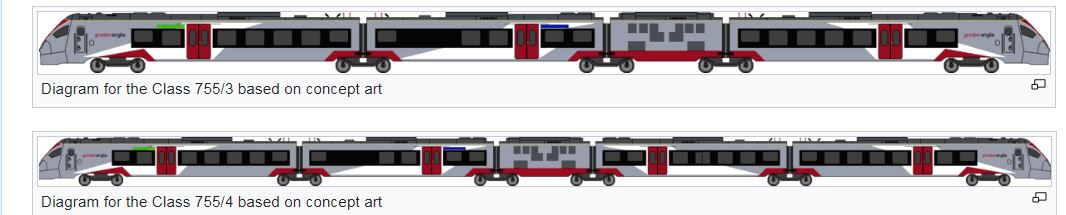
It looks like the four-car Class 755/4 trains, a three-car train with an extra passenger car.
The Class 755/4 train would appear to consist of the following
- Two full-length drive cars, with passenger accommodation.
- A half-length power car.
- Two full-length passenger car.
The three-car Class 755/3 car train would not have the extra full-length passenger car.
So in terms of full-length passenger cars, train lengths could be as follows
- Class 755/3 trains – 3 cars
- Class 755/4 trains – 4 cars
Wikipedia says that each train has the following number of seats
- Class 755/3 trains – 166 seats
- Class 755/4 trains – 224 seats
Calculating the seats per car, gives the following.
- Class 755/3 trains – 55.3 seats/car.
- Class 755/4 trains – 56 seats/car.
This suggests to me, that the interior of a passenger car is very similar to that of a driver car, which must mean manufacturing cost savings.
Diesel Engines
Both trains are fitted with 16 litre V8 engines supplied by Deutz which produce 478 kW.
The power cars have the following numbers of engines
- Class 755/3 trains – 2 engines – 956 kW – 319 kW per car
- Class 755/4 trains – 4 engines – 1912 kW – 478 kW per car.
I suspect that a fifth car could be added to a Class 755 train. This would have 1912 kW and 382 kW per car.
Add a sixth car and this would have 1912 kW and 319 kW per car.
Comparison With A Class 170 Train
Compare these figures with a diesel Class 170 train, which has 315 kW per car.
Both trains are 100 mph trains, built from aluminium, so I suspect that the performance of three-car Class 755/3 and Class 170 trains are roughly the same.
But the four-car Class 755/4 trains have fifty percent more power per car, than the Class 170 train, so these will be no sedate rural trundlers.
Looking at the power figures for five-car and six-car units, they would still have at least as much power per car as a Class 170 train.
Other Possible Routes For Class 755 Trains
Could Class 755 trains be a replacement for routes like the following?
- Aberystwyth to Shrewsbury
- Basingstoke to Exeter – Stadler are doing third-rail in Liverpool
- Birmingham to Stansted Airport
- Cardiff to Holyhead
- Cardiff to Shrewsbury
- Holyhead to Liverpool via Halton Curve
- Holyhead to Manchester Piccadilly
- Liverpool to Norwich
- Milford Haven to Manchester Piccadilly
- Swansea to Shrewsbury
Trains could be any suitable length from three to six cars.
Note that electric FLIRTs can attain 125 mph, so could we see a train with the following characteristics?
- 125 mph on electrified lines, where operating speeds allow.
- 100 mph on lines with no electrification.
This performance is not far off Hitachi’s Class 802 train.
The other major competition could be Bombardier’s proposed 125 mph bi-mode Aventra, that I wrote about in Bombardier Bi-Mode Aventra To Feature Battery Power.
The winners will be the train operating companies and their passengers.
A Video
Greater Anglia have put a video on YouTube.
Conclusion
The Class 755 trains certainly seem to have bags of grunt!
Thameslink Information At London Bridge Station – 3rd March 2018
This picture was taken at the foot of the escalators leading to the Thameslink Platforms 4 and 5 at London Bridge station.

The trains were fairly crowded, although it was mid-afternoon.
But at the bottom of the escalators under the tracks going through the station, in the vast space, there were relatively few travellers.
I should visit in the Peak.
But it does seem the design is working.
 The Anonymous Widower