Budget Trains To Get Rail Network Flying
The title of this post is the same as that of an article in The Times.
It outlines how open access operators like Grand Central and Hull Trains, are being encouraged by the Office and Rail and Road to set up new services.
I think that these companies are a welcome addition to the UK rail network.
I don’t always use them, when one is available, but if their train is at the right time for my trip, I usually do.
Sometimes I save money and sometimes I don’t!
Grand Central Opts For Split And Join
An article in the April 2018 Edition of Modern Railways is entitled Grand Central Appies For Extra Services.
Grand Central wants to run the following services.
- An extra daily round trip between Sunderland and Kings Cross.
- An extra service from Bradford to Kings Cross.
- An early morning service from Wakefield Kirkgate to Kings Cross.
- A late evening service of two trains; one for Wakefield and one for York, whicj would split at Doncaster.
Cleethorpes would also be served by running West Riding services as two trains, which would split and join at Dncaster.
All this can be done with the current fleet of ten Class 180 trains, supplemented by four extra released by Hull Trains, on delivery of new Class 802 trains.
By running as pairs between Kings Cross and Doncaster, the operator cuts the number of paths needed, on a crowded East Coast Main Line.
Joining and splitting is not without problems.
- Train timings need to be accurate.
- Joining and splitting hasn’t been done on the East Coast Main Line before, so would need permission.
- I suspect that, the process won’t be automatic, as on Hitachi’s trains.
But get it right and this would surely open up the possibility of extra destinations in the North, provided like Bradford, Cleethorpes, Sunderland, Wakefield and York, they are on railway routes North of Doncaster.
The Class 180 trains are 125 mph diesel trains, that are about fifteen years old.
All other operators on the East Coast Main Line in a few years will be running variants of Class 800 trains, which will be capable of running at 140 mph on large parts of the route, when in-cab signalling is up and running.
As these trains can split and join with ease, surely Grand Central will be looking for some suitable new trains.
Currently, the fastest trains take about around a hundred minutes between London and Doncaster.
A rough estimate says that savings of around ten minutes could result from all trains being 140 mph capable, which would benefit all services.
But all operators on the line would have joining and splitting, so expect some new destinations from Kings Cross.
i
MK-Bedford New Line Mooted
The title of this post, is the same as the title of an article in the April 2018 Edition of Modern Railways.
This is the first paragraph.
A new railway between Milton Keynes and Bedford for the East West Rail project has been suggested as a way of avoiding problems with the Marston Vale Line, where the hourly stopping service and numerous level crossings limit capacity for through regional trains.
Another aim is that the next phase of the project should be completed by the end 2022, which is between a one and two years earlier than the existing target.The Chairman of the East West Rail Company, then said he’d like the the railway to open in 2027.
The article says a new route will be expensive, but innovative ways of doing things could help.
Consider these points about the Marston Vale Line
- The stations need development.
- There are at least thirteen level crossings.
- New houses are being built near some stations.
- The operating speed is just 50 mph.
- Finding a new route at Fenny Stratford, Woburn Sands, Aspley Guise, Ridgmont and Lidlington could be difficult.
- The railway passes under the M1 and the A421, so moving these crossing points could be difficult.
It’s all a complicated design problem.
East West Rail could borrow a trick from the Heathrow Southern Railway, which is planned to run alongside the M25 to get to Heathrow. The new railway could be routed alongside the A421 in the Bedford area.
This Google Map shows the A421 to the South of Bedford.
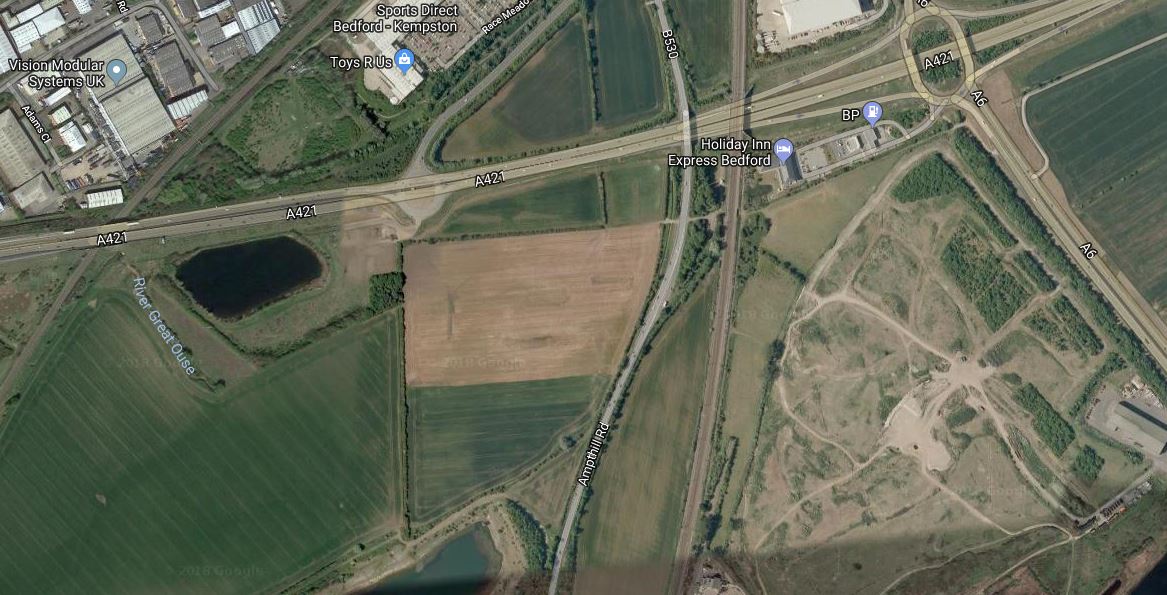
Note.
- The Marston Vale Line goes across the North West corner of the map.
- The Midland Main Line goes across the map in a North-South direction.
- The roundabout at the North East connects the A421 to the A6.
- The building by the roundabout is a hotel.
If the East West Rail Link was routed alongside the by-pass a station could be built where the two lines cross.
- The Midland Main Line and Thameslink would be linked to the East West Rail Link.
- Passengers for Bedford would be able to use the frequent Thameslink service to get to the town.
- A big Park-and-Ride could be built.
- Marston Vale Line services would take the same route as they do now, via Bedford St. Johns station.
If it was desired, chords could be built to enable services on the East West Rail Link to serve Bedford with a reverse in Bedford station.
Oxford has a Parkway station, Milton Keynes has a Milton Keynes South station at Bletchley, Cambridge will probably have a Cambridge South station, so why shouldn’t Bedford have a Bedford South station?
D-Train Order For Marston Vale Confirmed
The title of this post, is the same as the title of an article in the April 2018 Edition of Modern Railways.
It gives a few more details on the order from West Midlands Trains for three Class 230 trains to provide the service on the Marston Vale Line.
- The trains will be in operation in December 2018
- Two trains will operate the daily service.
- The trains will be diesel-powered.
When the trains come into operation, extra early morning and late-night services will be added from Monday to Saturday.
Battery Prototype
The article also gives more details of the battery prototype.
- The train has four battery rafts, each with a capacity of 106 kWh
- Range is up to fifty miles with a ten minute charge at each end of the journey.
- Range will increase as battery technology improves.
- The train is charged using a patented automatic charging point.
- The batteries will have a seven-year lifespan, backed by a full warranty.
- Battery rafts would appear to be interchangeable with the diesel generators.
- Hydrogen power will be used within the next few years.
The specification seems comprehensive and it would appear there is a high degree of innovative automation and well-thought-out electrical engineering.
Train Energy Consumption
The train has the following characteristics.
- Two cars
- 424 kWh of battery capacity.
- 50 mile range
This gives a consumption 4.24 kWh/per car/per mile.
In an article in the October 2017 Edition of Modern Railways, which is entitled Celling England By The Pound, Ian Walmsley says this in relation to trains running on the Uckfield Branch, which is probably not much more taxing than the Marston Vale Line.
A modern EMU needs between 3 and 5 kWh per vehicle mile for this sort of service.
I am surprised that the Class 230 train lies in the 3-5 kWh range, but then I’m not sure of the weights of the two trains.
I estimate two-car units to weigh as follows.
- Class 230 train plus batteries – Around 50 tonnes.
- Electrostar – Around 90 tonnes
- Aventra – Around 80 tonnes
I shall get some better figures, when I actually see the trains, as the weight is on the side.
The Pop-Up Train
The article talks of the concept of a low-cost pop-up train as a solution for a regional or commuter train.
Export To America?
This pop-up train could be designed to be used to demonstrate rail services in America.
Henry Posner, who is promoting the train in America is quoted as saying cities could use the train to test possible services with passengers on board ‘for less than the cost of a consultant’s study into a possible service’.
These demonstrations will be on freight lines, where for reasons of safety, the passengers trains would run during the day and freight trains at night.
Is America ready for an invasion of remanufactured forty-year-old London Underground D78 Stock trains?
Huisman Weighs Into Storage
The title of this post is the same as thia article in RENews.
This is the first two paragraphs.
Edinburgh start-up Gravitricity is teaming up with Dutch lifting specialist Huisman to develop gravity-fed energy storage projects at the sites of disused mines in Scotland.
The partners plan to develop a 250kW demonstration project and test it early next year, and ultimately aim to scale up to 20MW commercial systems.
I think that this idea has a chance to be a success.
As an aside, one of my first experiences of industry was working at Enfield Rolling Mills. On one of their rolling mills, there was a ninety-three tonnes two-metre ring flywheel, which was attached to the mill. The flywheel was spun to 3000 rpm, before the copper wirebar was passed through the mill. You could see the flywheel slow, as it passed it’s energy to the mill, as it turned the wirebar into a thinner strand of copper, so that it could be drawn into electrical cable.
I think, that flywheel had an energy storage of over a MwH. Shimatovitch, the Chief Engineer reckoned that if had come of its mountings at full speed, it would have gone a mile before the houses stopped it.
Will We See More Slab Track On UK Railways?
I ask this question, as I’ve just read this article on Rail Engineer, which is entitled Slab Track Austria: Now A Serious Contender?
Slab track or ballastless track has a Wikipedia entry.
This is said under Characteristics.
In ballastless tracks, the rails are rigidly fastened to a special type of concrete ties/sleepers that are themselves set in concrete. Ballastless tracks therefore offer a high consistency in track geometry, the adjusting of which is not possible after the concreting of the superstructure. Therefore, ballastless tracks must be concreted within a tolerance of 0.5 millimetres. The elasticity of the ballast in the traditional railway superstructure is replaced by flexibility between either the rails and the concrete ties/sleepers or the ties/sleepers and the concrete or asphalt slab as well inherent elasticity within the conglomerate of the tie/sleeper, whereas the concrete or asphalt slab is usually inelastic.
Applications in the UK recently include.
- Tunnels on Merseyrail, Crossrail and other routes.
- Gospel Oak to Barking Line.
- Borders Railway.
- Edinburgh to Glasgow Line at Glasgow Queen Street station and the Winchburgh Tunnel.
This picture shows some of the slab track on the Gospel Oak to Barking Line.

I suspect, that slab track was used here mainly because of limited clearance. But low maintenance and long life, must have improved the financial case.
Returning to the Rail Engineer article, it would appear that the engineers behind the slab track, have rethought a lot of the process of building a railway.
Slab Track Austria, which used to be called PORR-STA, seems to offer the following.
- Factory-build or one-site fabrication.
- Ease of installation.
- Accurate alignment
- Switches and crossing can be fabricated.
- Transition solutions to ballasted track.
- Low noise and vibration.
- Ease of maintenance
- Sixty year life.
Slab Track Austria would also appear to have worked extensively with Austrian Railways, to get everything as right as possible.
It just shows how much improvement can be squeezed out of some traditional industrial and construction processes.
HS2
TheSlab Track Austria track has also been used extensively on the new Berlin to Munich high speed line, that I wrote about in From Berlin To Munich In Four Hours By Train. This is said about the use of the track on that line, in the Rail Engineer article.
PORR was contracted to design and build three major sections of the railway route. Its patented slab track, STA, was installed over a total length of 320km, in tunnels, on bridges and in open sections. Operations started successfully in December 2015 on the VDE 8.2 section, from Erfurt to Leipzig and Halle. Since December 2017, the sections VDE 8.1.2, from Coburg to Illmenau, and VDE 8.1.3, from Bad Staffelstein to Coburg, have been in operation. Trains have been running on the STA slab track layout at speeds of 300km/h. Prior to commissioning, this slab track was tested at 330 km/h.
So it would appear to be suitable for the 400 kph, that is quoted for HS2, with perhaps a bit of tweaking.
The article also says this about using the track on HS2.
Cost analysis research suggests that the savings made from the reduced maintenance required for STA track will equate to a payback of within 15 to 20 years when compared to ballasted track systems. The opportunity for significant savings, as well as increased network availability due to the reduced maintenance requirement, has to mean that this system is a serious contender for any new railway route, one of which, of course, is HS2.
A dedicated factory producing the slabs would surely increase quality.
But whatever happens, with its numerous, bridges, tunnels and viaducts, I suspect that HS2 will be built using slab track.
In the last quote, a payback time of fifteen to twenty years is suggested, if the track is used on a new railway.
So where else could slab track be used to advantage?
East-West Rail Link
I feel that the East West Rail Link, could be a possibility.
Consider.
- It will not be initially electrified.
- It is through terrain that is not very challenging
- It is fairly close to HS2 and a possible slab track factory.
Building the line with slab track, could help make the East West Rail Link a low-energy and low-noise line for battery or hydrogen trains.
West Anglia Main Line Four-Tracking
Adding two extra tracks to the West Anglia Main Line between Coppermill Junction, which is just South of Tottenham Hale station, and Broxbourne station will be a difficult project.
The line is hemmed in on both sides by housing and slab track might give advantages.
- Ease to squeeze the tracks in the limited space available.
- Reduced noise.
- Speedier construction.
If Crossrail 2 is built, this four-tracking will have to be done.
Calder Valley Line
The Calder Valley Line should be updated to create a quality roue across the Pennines from Preston to Leeds.
Parts of the line would be challenging to improve to say the least, with lots of heritage features around the track.
Using slab track in places, has has been done on the Gospel Oak to Barking Line, might help with the following.
- The construction works needed.
- Increasing line speed.
- Lowering noise.
- Reduced maintenance.
The Wikipedia entry for the Calder Valley Line has a section called Holme Tunnel Engineering Work. This is said.
Holme Tunnel, which lies between Hebden Bridge and Burnley Manchester Road, was closed for 20 weeks from November 2013 until March 2014. This was to allow for major engineering work to fix the distorted shape of the tunnel, caused by movement of the ground through which it passes. The project was budgeted to cost £16.3million. During the works, buses replaced train services. Trains can now pass through at 45 mph.
I don’t think slab track was used in the work in this tunnel, but do we need 45 mph speed limits on Trans Pennine routes? After reading this article on Rail Engineer, it would appear that 75 mph will be possible in the future.
But this project does show some of the major problems on Trans Pennine routes!
It will be interesting to see what happens on this line.
Other Trans Pennine Routes
The other two Trans Pennine routes, the Huddersfield Line and the Hope Valley Line both have similar characteristics.
- Twisting routes.
- Several tunnels.
- Lots of bridges.
They are also busy with passenger and freight traffic.
When the plans for the updating of these lines is published, I suspect that slab track will feature, especially in some of the tunnels.
Across Chat Moss
George Stephenson had difficulty building the Liverpool to Manchester Railway across Chat Moss in 1829. Wikipedia says this about his solution.
Chat Moss threatened the completion of the Liverpool and Manchester Railway, until George Stephenson, with advice from East Anglian marshland specialist Robert Stannard, succeeded in constructing a railway line through it in 1829; his solution was to “float” the line on a bed of bound heather and branches topped with tar and covered with rubble stone. The M62 motorway, completed in 1976, also crosses the bog, to the north of Irlam.
I have talked to drivers, who drive Class 319 trains along the now-electrified line across Chat Moss. They told me, that the soft suspension gives an interesting ride.
Under Timings And Line Speeds in the Wikipedia entry for the Liverpool-Manchester Lines, this is said.
The fastest recorded run was from Manchester Exchange to Liverpool Lime St in 30 minutes 46 seconds by a 1936 built Jubilee 5707 with 7 coaches. An 1882-built compound steam locomotive was timed on the same route in 38 minutes 18 seconds. Until 1968 trains from Liverpool to Manchester by all 3 routes were scheduled to take 40 minutes and often took less. The southern route via Warrington is now restricted to 85 mph and the northern route via Earlestown to 90 mph, with 75 mph over Chat Moss.
It would appear that something needs to be done to get timings between Liverpool and Manchester, back to those of the 1930s.
Would slab track across Chat Moss be part of the solution?
Tunnels
Various tunnel upgrades have shown how using slab track in tunnels is a very helpful technique.
Many tunnels will need to be updated to increase clearance for freight trains and overhead wires and also to solve structural problems caused by anno domini.
I believe we’ll see a lot more slab track in tunnels on the UK rail network.
Noise Reduction
The Rail Engineer article, says this about Slab Track Austria’s slab track.
The elastomeric layer also helps to reduce vibration and structure-borne noise, thus offering protection to supporting structures and reducing the noise created by passing trains – an important feature in built-up areas and tunnels.
So will we see increasing use of slab track in areas, where noise asnd vibration is a problem?
Other Lines
I see the Gospel Oak to Barking Line, as an example use of slab track that will be very much copied.
Slab track has been used successfully in sections, where clearance is limited and noise is a problem.
The use of slab track, might have meant that several bridges didn’t need to be rebuilt.
How many places in the UK have similar needs.
Conclusion
The rethinking of how we build railways by Slab Track Austria, will benefit our rail network and all those who use it.
We’ll be seeing a lot more slab track!
Will Heathrow Southern Railway Make Heathrow’s Cargo More Efficient?
This page on the Heathrow web site talks about the future for cargo at the Airport.
It starts with this paragraph.
Heathrow is the largest UK port by value and our ambition is to become one of Europe’s best airports for cargo. We have listened to our customers and developed a cargo strategy that will take us there.
The airport sums up its plan for cargo with these bullet points.
- Halve current throughput times to be more efficient
- Make cargo throughput times predictable to reduce costs
- Grow cargo capacity at the airport to generate additional cargo volumes for our airline partners
- Work with the cargo community, including through engagement and discussion
- Be 100% e-freight compliant to reduce waste, costs and delays
- Be a great airport of choice for cargo
- Provide a safe working environment.
Nothing is said about being more energy efficient and emitting less carbon dioxide.
This document on Heathrow’s web site is entitled Heathrow’s Blueprint For Reducing Emissions.
They list ten things they are doing.
- Bring in the newest and cleanest aircraft.
- Continue to drive down emissions from aircraft at the gate.
- Improve taxying efficiency.
- Charge forward with electric cars and buses.
- Heathrow cycles.
- Drive sustainable freight operations.
- Plug in more electric airside vehicles.
- Provide a pool of low emission vehicles.
- Efficient driver training and education.
- Host an air quality conference.
This list was from a couple of years ago and there is a certain amount of PR, but there is some thinking in the right way.
To return to cargo, which is on Heathrow’s list of ten things they are improving, the following can be said.
- Heathrow handles a lot of cargo by value.
- Most air cargo from Heathrow goes in the holds of passenger aircraft.
- Very little if any comes into the airport by rail.
This Google Map shows the central part of Heathrow Airport.
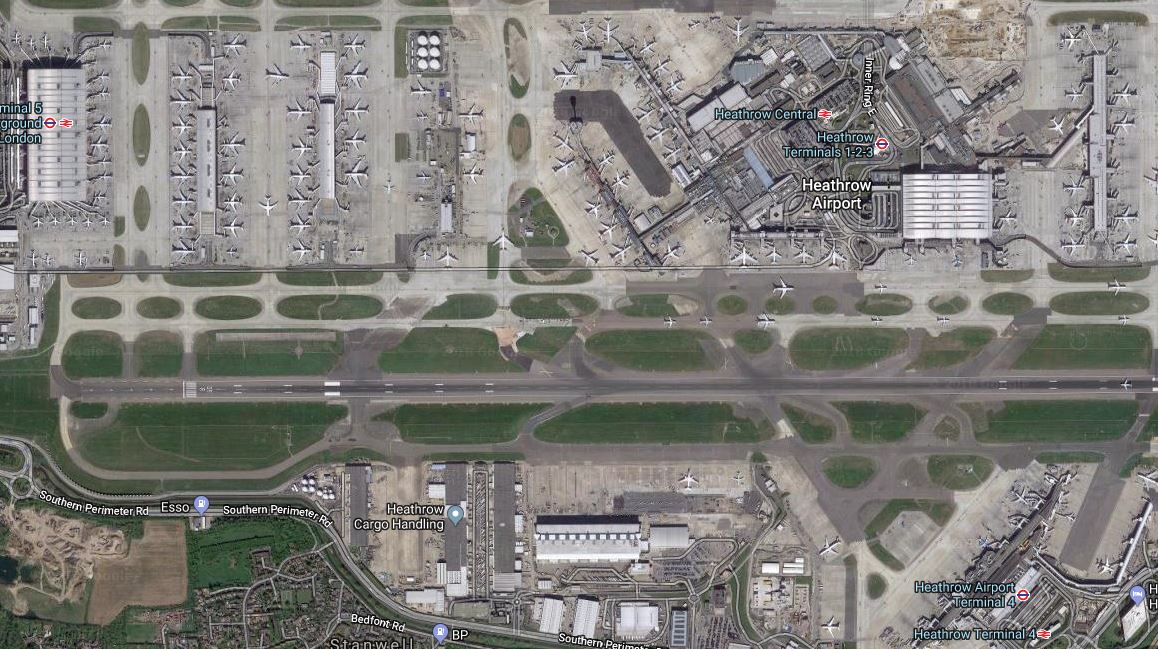
Note Heathrow Cargo Handling towards the South West corner of the Airport.
This map from carto.metro.free.fr shows the rail lines under Heathrow.
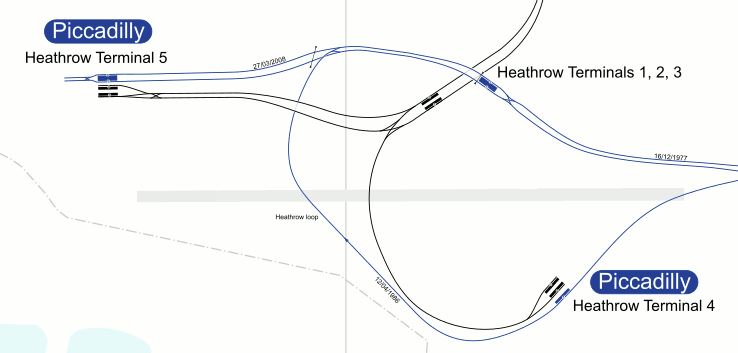
Consider.
- I actually think, that some lines go under the cargo area.
- There must be scope for consolidating cargo outside the airport and bringing in the containers in special trains.
- There would be plenty of capacity on the link into Terminal 5 station.
- Replacing trucks with electric trains would reduce the airport’s carbon footprint.
I am led to the conclusion, that there may be possibilities to bring cargo into and out of Heathrow Airport by train, using the link created by the Heathrow Southern Railway.
MTR Vying To Join Heathrow Southern Rail Bid
The title of this post, is the same as that of this article in New Civil Engineer.
The title gives you all you need, but consider these facts about MTR.
- MTR is a Hong Kong company with a revene of about £4 billion per year, which is about the same size as the Stagecoach Group.
- MTR will be running Crossrail for Transport for London.
- MTR in partnership with First Group, are running South Western Railway.
In addition, FirstGroup are running Great Western Railway.
So it could seem logical for MTR to be included in the consortium behind Heathrow Southern Railway, as they could have a lot of influence on the consortium’s policies.
In an argument about train paths or stations, MTR or their partner; First Group, will be involved on both sides.
The problem is Heathrow Airport and their ownership of Heathrow Express, especially if it is extended deep into South Western Railway territory at Basingstoke, Guildford or Working.
This is said on the Heathrow Southern Railway web site.
Whether or not a third runway is built, many more passengers and airport workers need to be accessing Heathrow by train. The Government’s recent M25 South West Quadrant Study ruled out widening the motorway. HSR provides the alternative, switching traffic from the roads and contributing to improving local air quality. We estimate that HSR will reduce use of this section of the M25 by over three million car trips a year.
Heathrow might be a greedy bully, but they probably need a superb rail service more, than they need to own Heathrow Express.
MTR and AECOM, who is a large partner in Heathrow Southern Railway partner, are big enough to stand up to anybody.
Traffic Between Windsor And Staines After The Building Of Heathrow Southern Railway
Currently, Windsor and Eton Riverside station has a two train per hour (tph) service to Waterloo, which calls at Staines.
These are also the only trains on the Staines-Windsor Line.
So if, there are four tph on a Crossrail service from Heathrow to Staines, as I talked about in Heathrow Southern Railway’s Plans For Staines, then that only raises the frequency of the trains on the Southern part of the Staines-Windsor Line to six tph.
In his article about the Heathrow Southern Railway in the December 2016 Edition of Modern Railways, Chris Stokes says this.
With the addition of a chord at Staines, it would also be potentially possible to operate a half-hourly Weybridge – Virginia Water – Egham – Terminal 5 service, providing a further attractive local link to Heathrow.
If this service were to be added, that only raises the frequency to eight tph.
I suspect that if modern signalling techniques were applied, that the capacity of this route would be above this frequency.
Heathrow Terminal 5 Station
I doubt there will be any problems of capacity at Heathrow Terminal 5 station.
The station has been built with two Piccadilly Line and four heavy rail platforms.
This map from carto.metro.free.fr, shows the platform layout.
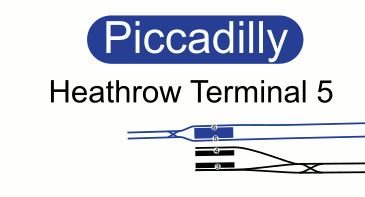
Note.
- It would appear there are only two heavy rail platforms in use.
- Through trains would use these currently in use platforms.
- The two spare platforms could be arranged, so that they could handle a terminating train from either direction.
- The terminating platforms can probably handle four tph or even six tph.
- The through platforms can handle well over ten tph, with the right signalling.
Someone seems to have got the design right.
The Future Of Heathrow Express
In his Modern Railways article, Chris Stokes says this about services from Woking to Heathrow.
We have assumed half-hourly services from Basingstoke and Guildford to Heathrow and Paddington, providing a 15-minute frequency from Woking, with stops at Farnborough Main (Basingstoke services), Working, Terminal 5, Terminal 2 and 3 and Old Oak Common.
He also says that this service could take over the Heathrow Express paths and it would use the through platforms at Heathrow Terminal 5 station.
This arrangement has several advantages.
- Heathrow Express doesn’t terminate in the tunnels under Terminal 5.
- No new train paths between Heathrow and Paddington are required
- Heathrow Express gets new destinations without any expensive new infrastructure.
But it would appear that Heathrow Express may have a future.
Heathrow Southern Railway’s Plans For Staines
In an article in the December 2016 Edition of Modern Railways about the Heathrow Southern Railway, Chris Stokes outlines how railway will serve Staines.
The addition of a bay platform at Staines, deliverable within the existing railway boundary, would assist service resilience and potentially allow extension of Crossrail services from T5 to Staines, providing a highly attractive alternative route from Staines to central London, together with enhanced interchange with South Western services. Journey times from Staines to Paddington would be as fast as to Waterloo, with excellent central London distribution provided by Crossrail. We would expect the majority of Staines to central London passengers to transfer to Crossrail, with significant interchange to Crossrail from intermediate stations between Staines and Reading, relieving overcrowding between Staines and Waterloo.
This map from carto.metro.free.fr shows the rail lines at Staines station.
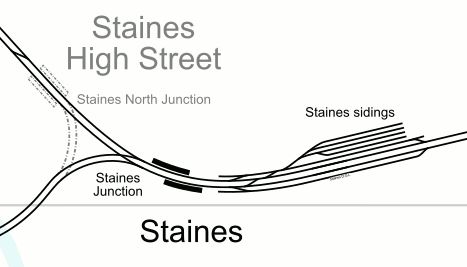
Note.
- London trains take the lines to the East.
- Windsor and Heathrow trains take or will take the lines to the North-West.
- Reading trains take the lines to the South-West.
Heathrow Southern Railway plan to add a bay platform in the North West corner of the station.
- It will be built on current railway land. (Chris Stokes)
- It will help with the resilience of the train service. (Chris Stokes)
- It could possibly be the terminus of an extended Crossrail service from Heathrow Terminal 5. (Chris Stokes)
I shall now look at various features, benefits and possible problems in detail.
Could A 205 Metre Long Platform Be Built?
The Google Map shows Staines station.
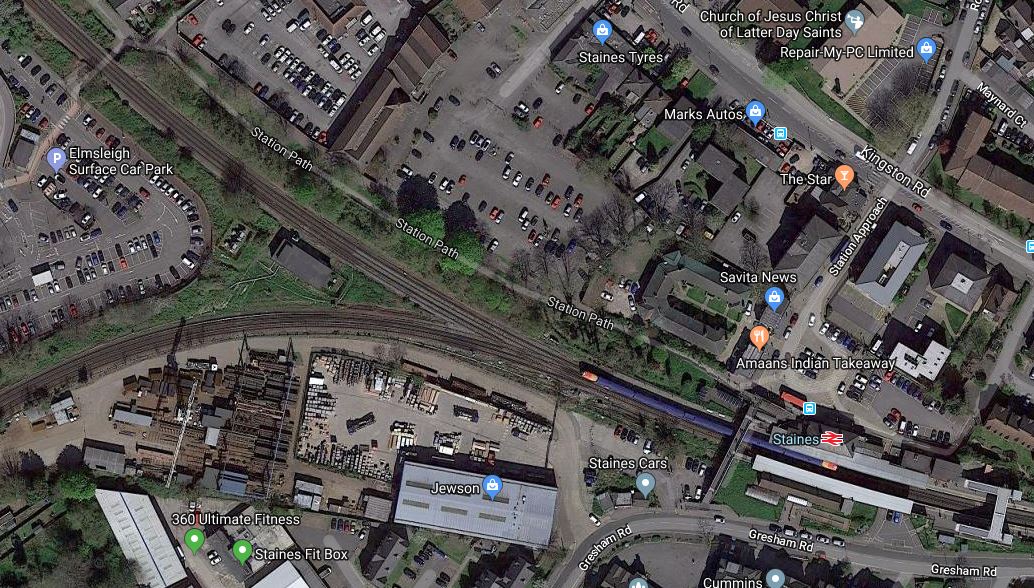
Note.
- The five-car blue train in the station.
- The train is probably a Class 458 train, which is just over a hundred metres long.
- Crossrail’s Class 345 trains are up to 205 metres long.
- The two footbridges over the tracks.
- The junction, where the tracks split to the West of the station.
These pictures show the area, where the new bay platform would go.





The Station Path and the green space are clearly shown on the Google Map.
Using the train in the station as a hundred metre ruler, I feel that with good design a platform, that was long enough for a Class 345 train could be built.
- The path would be landscaped.
- The platform would connect to the London-bound Platform 1.
- There is probably space for some shelters and other facilities.
- There might be a new entrance to the station at the West end.
Platforms have been built in much more difficult locations than this.
What Frequency Of Trains Could The Platform Handle?
Many terminal platforms in the UK handle four trains per hour (tph).
Crossrail will actually handle 12 tph using three terminal platforms at Shenfield station, when the station gets the full service in May 2019.
I don’t think it would be outrageous to say, that the single bay platform at Staines station would be able to handle four tph.
Would Crossrail Want To Serve Staines?
Crossrail’s current service plans are lop-sided, with more trains going to the East than to the West. This means that 12 tph turnback at Paddington station.
I’m sure they would welcome extra termini in the West!
Heathrow Southern Railway’s plan is that trains will pass through Heathrow Terminal 5 station and then take the new rail link to Staines.
Crossrail’s current plan envisages two tph terminating in Heathrow Terminal 5 station, but I don’t think with the right signalling and timetable, that running four tph through the airport to the bay platform at Staines, would be impossible.
But this will only happen if there are the passengers to use the service.
Who Might Use Crossrail To And From Staines?
Chris Stokes said this.
We would expect the majority of Staines to central London passengers to transfer to Crossrail
As there is research behind the proposal, this will be right.
But there is one group of passengers, who will welcome Crossrail with open arms.
That is those people, who live in Staines or the surrounding area and work or want to work at Heathrow.
As Chris Grayling announced that Southern access to Heathrow was a priority, I discussed it with one of South Western’s station staff.
They put me right about getting from Staines to Heathrow for an early shift.
Crossrail’s Plans for Heathrow at 6th January 2019
Om the 9th January 2019, Wikipdia said that following Crossrail trains will run to Heathrow.
- Terminal 4 – Four trains per hour (tph)
- Terminal 5 – two tph
In addition it looks like Heathrow Express will run four tph to Terminal 5.
Heathrow Southern Railway plan to run the Heathrow Express services through to Basingstoke, Guildford and Woking.
If Crossrail were to run four tph to Staines in addition the extended Heathrow Express at four tph, that would only be one train every seven and a half minutes. Compare this with the time it takes of ten minutes to turn trains in the platform at Heathrow Terminal 5 station.
I would suspect it could be possible to run four tph through Terminal 5 to a bay platform at Staines.
Conclusion
It’s amazing what can happen, when you add a simple bay platform!
 The Anonymous Widower