Invinity’s New Flow Battery Aimed At Enabling ’24/7 Solar’ For The Grid
The title of this post, is the same as that of this article on Solar Power Portal.
These three paragraphs outline the story.
New vanadium redox flow battery (VRFB) technology from Invinity Energy Systems makes it possible for renewables to replace conventional generation on the grid 24/7, the company has claimed.
Anglo-American flow battery company Invinity launched its new product, Endurium, today. It follows around three years of R&D, testing, and prototyping, during which Invinity has partnered with Siemens Gamesa on technology development.
Designed for high energy throughput with unlimited cycling and with at least a 50% reduction in the footprint required for installation at project sites, the company said it could cost-competitively tackle present-day energy storage markets and emerging long-duration energy storage (LDES) opportunities alike.
This looks like it could be a bit of a breakthrough.
After reading this article, it would appear that traditional lithium-ion battery energy storage systems (BESS) now have another competitor along with Highview Power’s liquid air battery.
The Borough Of Islington Has Increased Residents Parking By 43 %
boroughSocial Media alive with the message, that the Borough of Islington has put up Residents Parking from £ 175 this year to £ 250 in 2025.
That is an increase of 43 %. Although the good mathematicians of Islington say it’s 70 %.
The politicians obviously know the residents can’t do maths, so they can get away with fleecing them.
Plans For New Tram In Wales’ Capital City Revealed
The title of this post, is the same as that of this article on the BBC.
The BBC Article is a good introduction to Cardiff Crossrail.
This is my one thought.
As Cardiff and the valleys will be using Stadler Citylink tram-trains, I think it will be likely similar vehicles will be used across Cardiff.
New Bid To Connect Heritage Railway To Mainline
The title of this post, is the same as that of this article on the BBC.
The is the sub-heading.
A bid to connect one of the longest heritage railways in Britain with mainline services has taken a step forward.
These are the first two paragraphs.
West Somerset Railway (WSR) and Somerset Council have now submitted a business plan to the government to restore the mainline from Taunton to the final WSR stop at Bishop’s Lydeard.
The proposal suggests Bishop’s Lydeard could become a commuter and tourist hub.
There has been several attempts to connect the branch to Taunton station.
These are my thoughts.
Minehead, Bishop’s Lydeard And Hinckley Point C
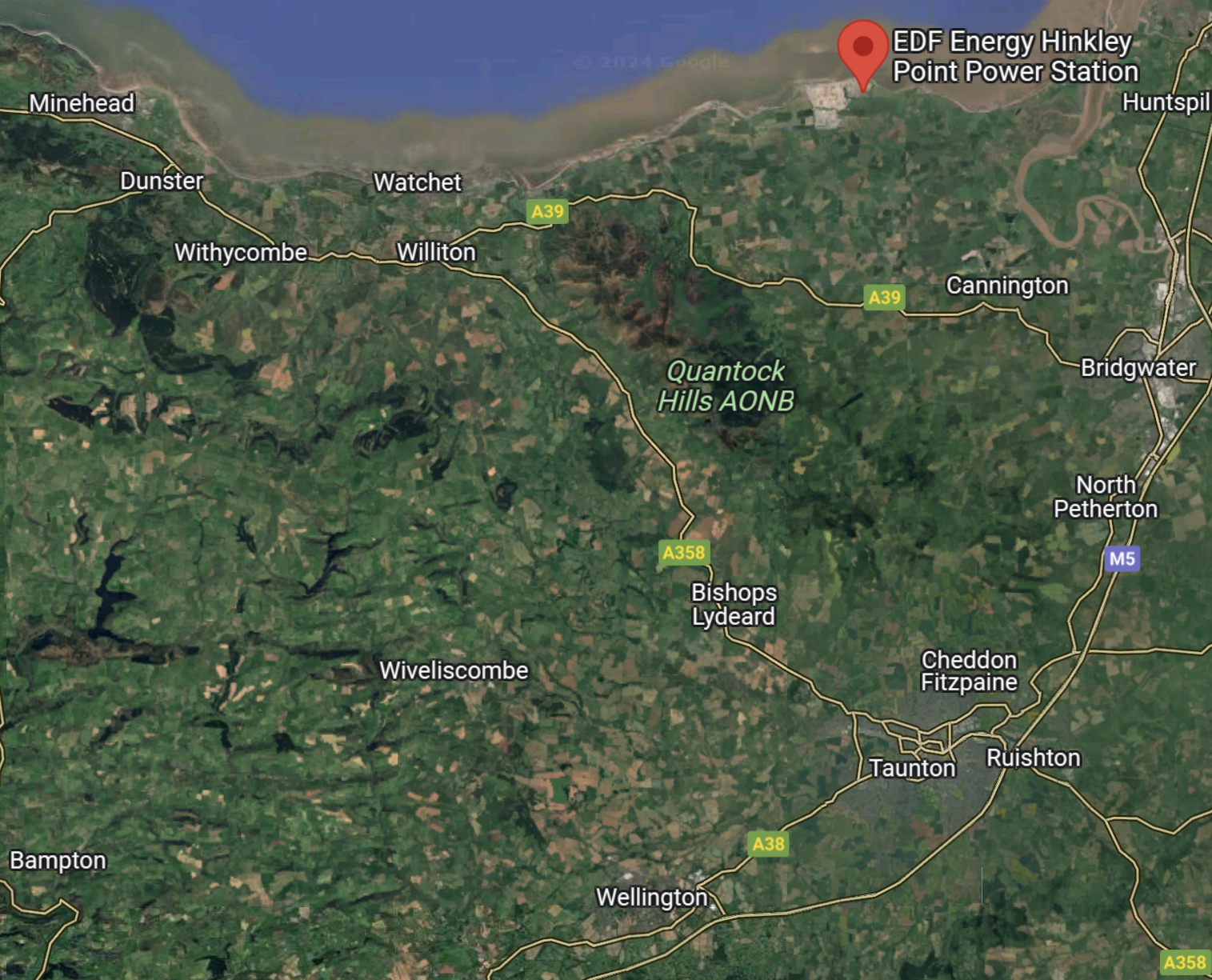
This Google Map shows the area.
Note.
- Minehead is in the North-West corner of the map.
- Hinckley Point power station is indicated by the red arrow.
- Bishop’s Lydeard is in the middle of the map.
- The M5 motorway curves diagonally between the North-East and South-West corners of the map.
- There are motorway services at Taunton Deane, which is to the South of Taunton and Cullompton, which is a few miles South-West of Wellington.
- The large town of Taunton is the junction of the London and Exeter and the Bristol and Exeter railway lines.
- The town of Wellington will be getting a new railway station.
It is a very busy area and it will only get busier, as the availability of power will only attract industry, like the battery factory pencilled in for Bridgewater.
The Major Effect Of Hinckley Point C
Hinckley Point C will generate 3.26 GW of electricity and to operate the power station will need around nine hundred workers.
I can also expect that the Hinckley Point site will get involved in other energy handling and use.
- The site would be an ideal place for a large electrolyser to produce hydrogen.
- Wind turbines in the Bristol Channel could use Hinckley’s grid connection.
- Energy could be stored on the site. It could be an ideal location for one of Highview Power’s 200 MW/3.25 GWh liquid air batteries.
- Hydrogen could be exported using coastal tankers.
- Interconnectors could take electricity to Cornwall, Devon, Wales and Ireland.
All of these activities would create needs for workers at all levels.
- A rail connection to Taunton and Bristol, will probably be needed to bring workers into Hinckley Point.
- A rail connection would be ideal for bringing construction materials, steel and other heavy goods into and out of the Hinckley Point site.
- Hydrogen could also be taken out in rail tankers.
- Nuclear waste could be taken out by train.
I think it is highly likely, that Hinckley Point will need a rail connection for efficient operation.
Sizewell C And Hydrogen
Hydrogen is so important to the philosophy of the design and construction of Sizewell C, that hydrogen has its own section on the Sizewell C web site.
Hydrogen produced by nuclear power stations like Hinckley Point C, is called pink hydrogen, but like green hydrogen it is zero-carbon and pollution-free.
Hinckley Point C And Hydrogen
I can envisage Hinckley Point C will create a lot of hydrogen both for use locally and distribution to remote users.
- Hydrogen could be delivered locally by truck, just as propane is today around the world.
- Coastal tankers could distribute the hydrogen from a jetty.
- Pipelines could connect the two nearby motorway service stations to the power station site.
Just as is happening at Sizewell, a local hydrogen network could be built.
Hydrogen Refuelling On The M5
Consider.
- In MAN Expands Its Zero-Emission Portfolio, I talked about MAN’s new hydrogen-powered hTGX truck, which has been designed with a 600 km. or 373 mile range.
- As Cullompton, which is the Southernmost of the two services on the M5 that are close to Hinckley Point C, is only 124.9 miles from Penzance, it should be possible for a truck, with a range similar to that of the MAN hTGX to do a round trip from the Southern end of the M5 to Penzance, without refuelling.
- As the total length of the M5 is only 163 miles, a hydrogen-powered truck with the range of the MAN hTGX would be able to do a delivery anywhere along the motorway and return to the hydrogen from Hinckley Point C, without refuelling.
- MAN are saying that the hTGX truck can be refuelled in less than fifteen minutes.
It looks to me, that a hydrogen electrolyser at Hinckley Point C would be ideally located to provide pink hydrogen for a zero-carbon hydrogen-powered route to and from the far South-West.
I believe that if there were a best-in-class hydrogen-refuelling facility close to Hinckley Point C, it would encourage those who regularly drove to Devon and Cornwall to look seriously at hydrogen-powered vehicles.
The Nature Of The Hinckley Point C Rail Link
Sizewell C are using a simple practical approach to connect the Sizewell C site to the nearby East Suffolk Line.
- The existing freight sidings are being expanded.
- Two Park-and-Ride sites are being created at stations in the East Suffolk Line.
- A link road will be built between the railway and the Sizewell C site.
- A fleet of hydrogen-powered double-deck buses has been ordered to take workers between the railway and the power station.
- The signalling on the East Suffolk Line is being improved.
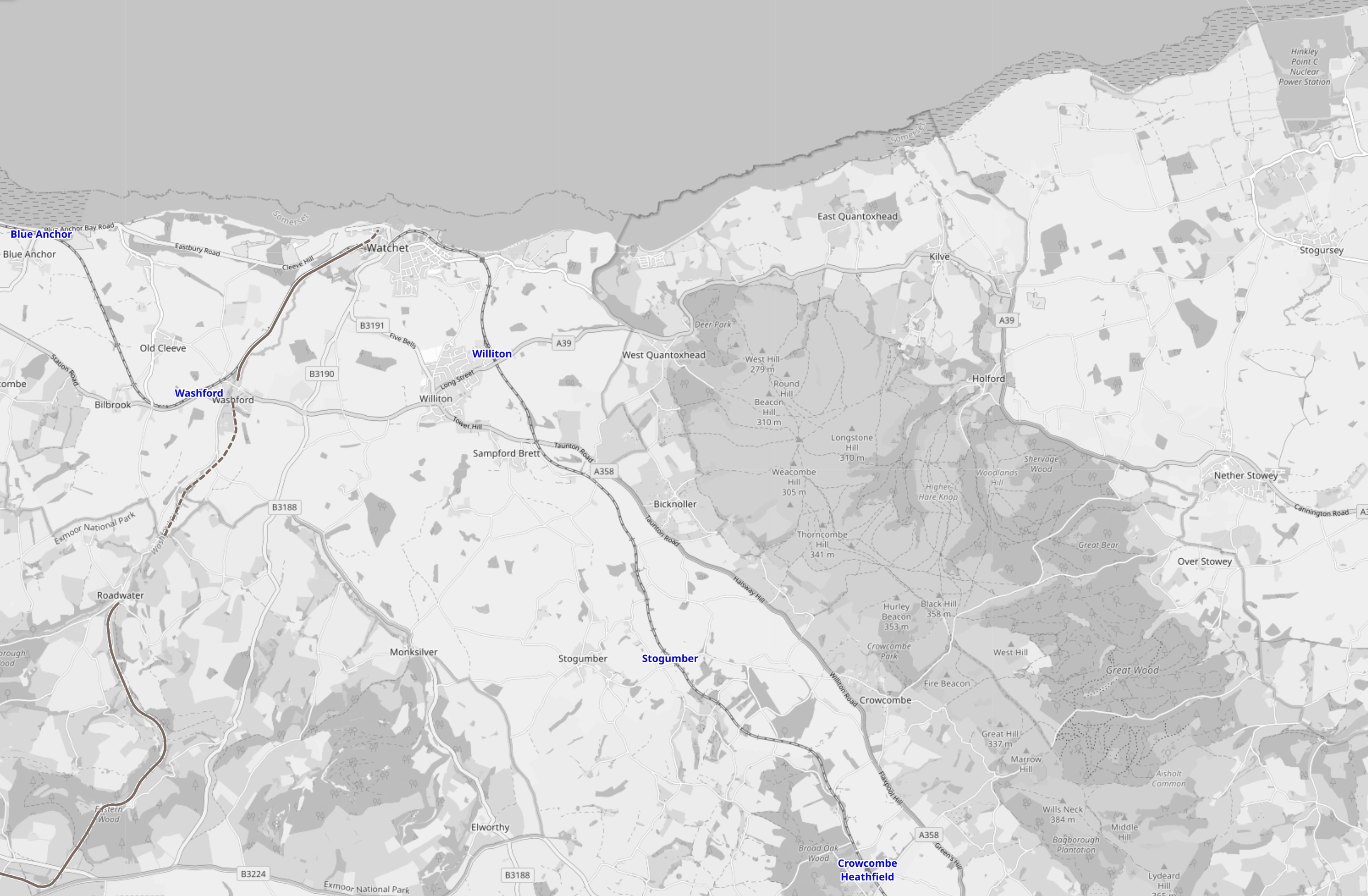
This map from OpenRailwayMap shows the Northern end of the West Somerset Railway and its relationship to Hinckley Point C power station.
Note.
- Hinckley Point C power station is in the North-East corner of the map.
- Crowcombe & Heathfield, Stogumber, Sampford Brett, Doniford Halt, Williton, Watchet, Washford and Blue Anchor are existing or former stations on the West Somerset Railway.
- Existing stations are shown in blue.
- West of Blue Anchor are the two existing stations of Dunster and Minehead.
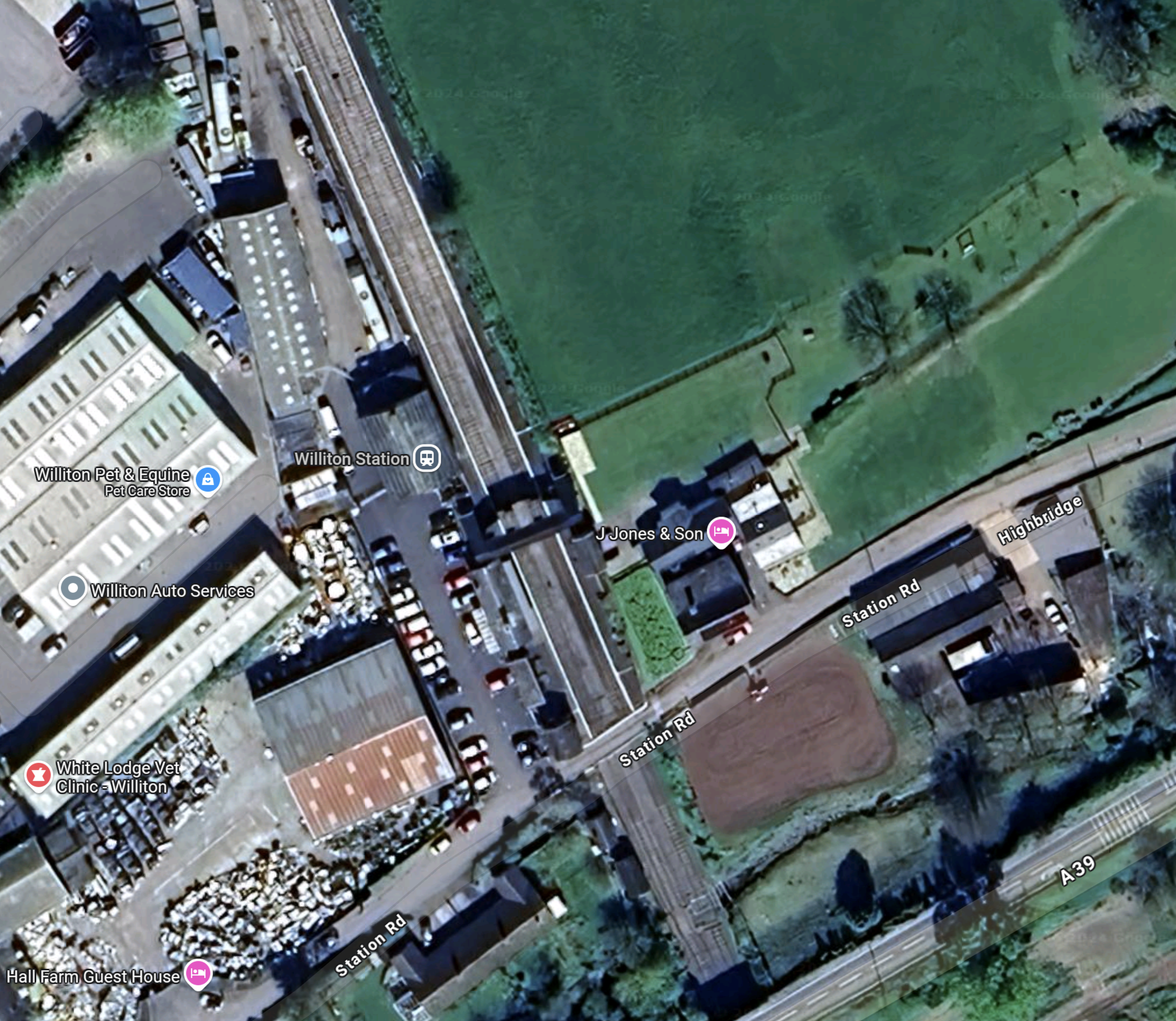
This Google Map shows Williton station, which is the nearest station to Hinckley Point C.
Note.
- The station has a footbridge, which was erected in 2011, so is probably in good condition.
- There are several Listed buildings on the site.
- Going East on the A39 should lead to Hinckley Point C.
I suspect a quality bus company could build a small fleet of buses to shuttle workers, visitors and others to Hinckley Point C.
As I’m sure, hydrogen will be in plentiful supply, I’m certain hydrogen-powered buses could be used.
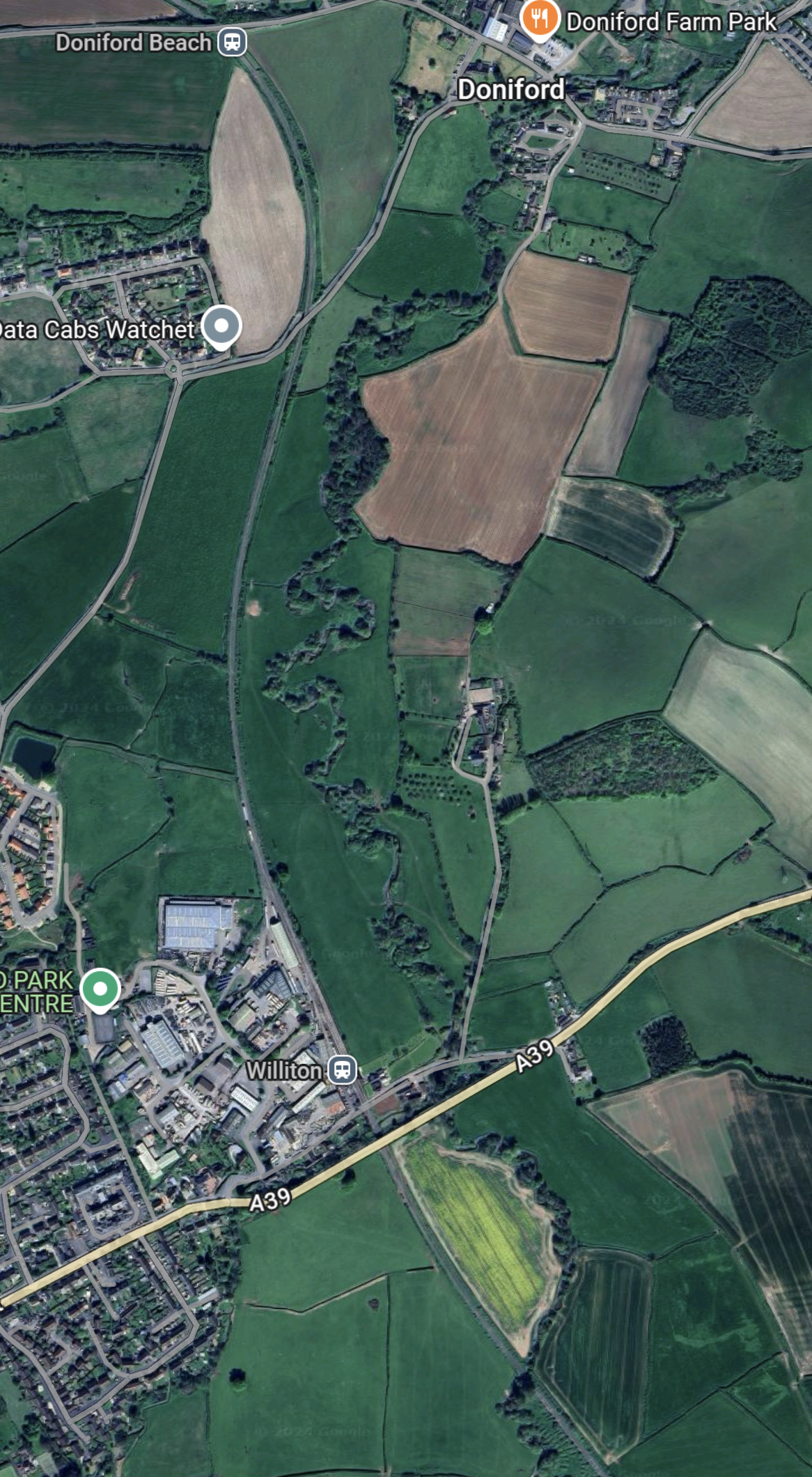
This Google Map shows a longer section of the West Somerset Line through Williton station.
Note.
- The West Somerset Line runs North-South down the map.
- Doniford Halt station is at the top of the map, where the coast road crosses the railway on a bridge.
- Williton station is in the middle of the map, where the A39 crosses the railway.
Looking at the railway, which runs mainly between fields, I wouldn’t be surprised that if Hinckley Point wanted a freight siding, they could fit one in.
Go-op
Go-op are an open access railway company, that wants to run services in Somerset.
I wrote about their successful application in Regulator Approves New Go-op Train Service Between Swindon, Taunton and Weston-super-Mare.
This is the first paragraph of their Wikipedia entry.
Go-op Cooperative Ltd.,[ branded as Go-op, is an open access train operating company, proposing to operate a service in south-west England between Taunton and Swindon, via Westbury. It aims to become the first cooperatively owned train operating company in the United Kingdom, to improve access to the public transport infrastructure through open access rail services linking main lines to smaller market towns, and by co-ordinating services with light rail, bus links and car pools.
If you read their Wikipedia entry and their web site, they seem to have ambition and be different.
According to Wikipedia, they have made no less than five different proposals, but it is the fourth that I find interesting.
In 2021, Go-op began discussions with Network Rail for services between Swindon and Bishops Lydeard (just beyond Taunton), which it hoped to begin in mid-2022. At first there could only be three services per day, due to congestion between Swindon and Westbury; a further three could be provided to Frome or Westbury, connecting with existing services to Swindon. These plans would also improve local services on the TransWilts Line, calling at Trowbridge and Melksham.
The plans for Bishops Lydeard would restore the link broken in 1971 between the national network and the preserved West Somerset Railway, which runs leisure services to Minehead.
This sounds very much like an extended and simplified version of the West Somerset Line proposal.
But it does look like two groups have looked at the infrastructure and what is needed and come to similar conclusions.
Perhaps, they have other things in common like train procurement and servicing.
Stadler Presents A World First In Berlin
The title of this section, is the same as that of this press release from Stadler.
These are the first two paragraphs.
With the RS ZERO, the rail vehicle manufacturer is presenting the successor to the successful Regio-Shuttle RS1 model. There is a choice of two modern and environmentally friendly drive technologies: Hydrogen and battery. Both will enable CO2 emission-free operation of secondary lines in the future.
Stadler today unveiled the prototype of the new RS ZERO, the innovative successor to the successful RS1 Regio-Shuttle. The Regio-Shuttle has been one of the most popular vehicles in German regional rail transport for 28 years, with around 500 RS1 vehicles currently in operation in Germany and the Czech Republic. Stadler is building on this proven technology and integrating state-of-the-art, environmentally friendly drive systems. The RS ZERO is optionally available with a hydrogen and/or battery drive and thus not only sets new standards for environmentally friendly rail transport, but also presents a world first.
These pictures from Chemnitz Trams And The Chemnitz Model, show the Regio-Shuttle RS1.

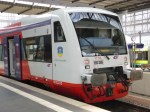
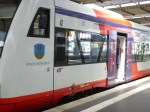
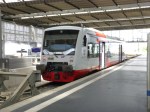
Note.
- The Regio-Shuttles can run as up to seven car trains.
- These Regio-Shuttles are electro-diesel.
- The distinctive diagonal windows.
- They can carry 170 passengers at 75 mph.
- They can run as train-trams using the Chemnitz model on compatible tram networks.
The Regio-Shuttle Wikipedia entry gives more details.
This image from the press release shows the prototype RS ZERO.
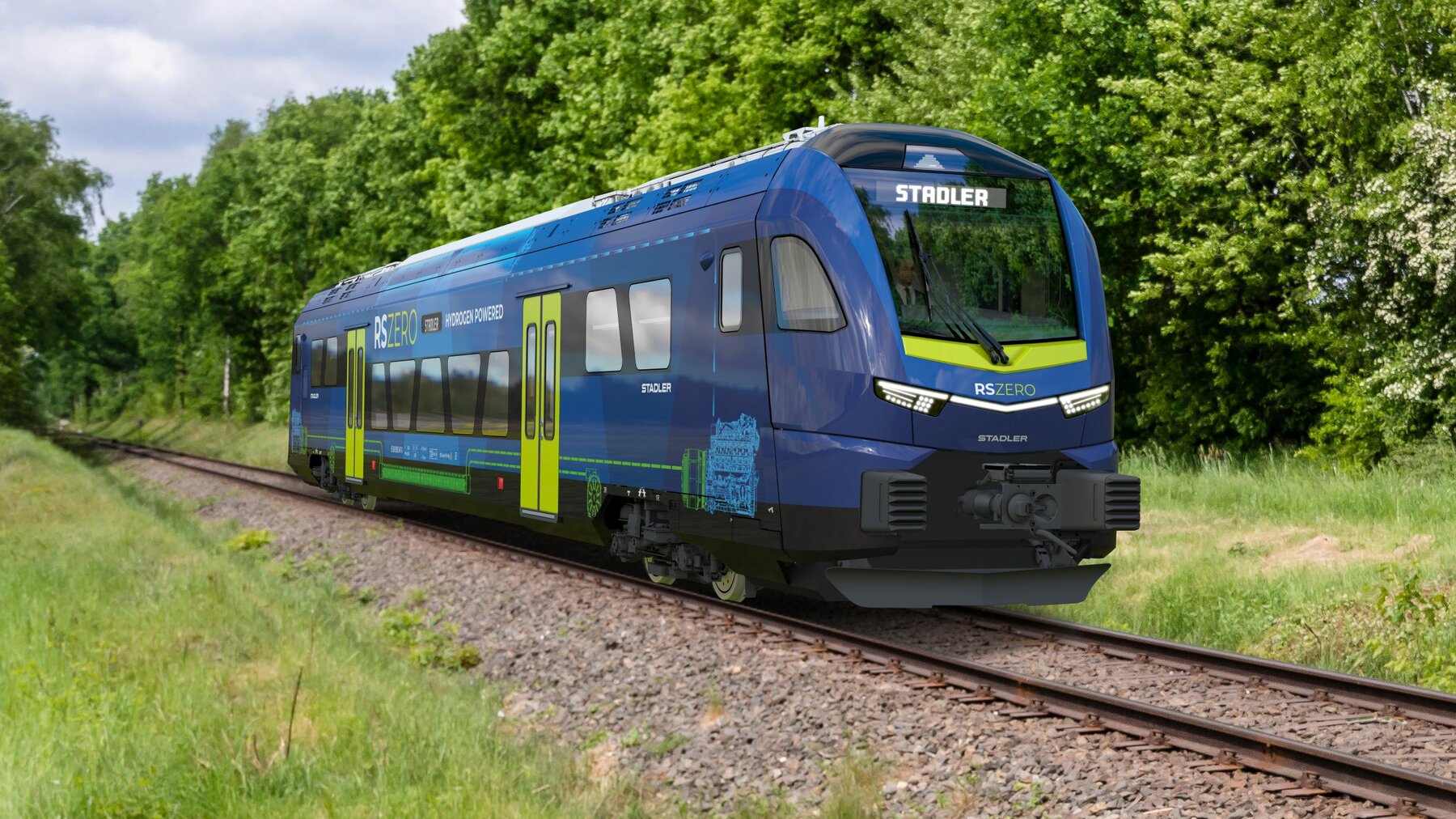
It looks very similar to my pictures from Chemnitz.
I have a few thoughts.
Comparison To A Class 150 Train
A Class 150 train can carry up to 149 seated passengers at 75 mph, which is similar to the RS ZERO.
As Stadler have built trains for Greater Anglia, Merseyrail and the Glasgow Subway, I believe that Stadler could build an RS ZERO, that would fit the UK loading gauge.
In What Train Is This?, I show the standard of interior, that can be achieved by refurbishing a Class 150 train, but unlike the RS ZERO, the train won’t be zero-carbon.
Does The RS ZERO Have A Toilet?
This is a paragraph from the press release.
The prototype of the RS ZERO presented today in Berlin is a one-car vehicle with hydrogen drive. Stadler is demonstrating the numerous design options with a multi-purpose area equipped for carrying bicycles, pushchairs and bulky luggage, lounge and comfort zones, standard and privacy seats, a wheelchair space, WC and a train office.
The train appears to be able to have what an operator might need.
What Will Be The Range Of An RS ZERO On Hydrogen?
I suspect, Stadler will provide a train, that will handle the route.
Would Stadler Be Able To Produce An RS ZERO That Could Satisfy The West Somerset/Go-op Requirement?
I obviously, can’t answer that.
But.
- The train is zero-carbon.
- It’s the right size.
- I suspect that the hydrogen fuel will be available from Hinckley Point C.
- The design has a proven track record.
- The train is not by any means vapourware!
- Stadler need a launch order.
- An experienced ROSCO would probably finance the trains.
One perk is that those involved in buying the train, could probably wangle a trip to Chemnitz to see several Regio-Shuttle RS1 trains at work.
Note that Chemnitz used to be Karl-Marx Stadt, so some of our Government will feel nostalgic.
But I do believe, this could be a very handy train to decarbonise branch and secondary lines in the UK.
Crystal Palace Subway – 1st December 2024
This is the sub-heading on the Crystal Palace Subway web site.
The Grade II* listed Crystal Palace Subway is a beautifully designed and crafted relic of Victorian construction, built to provide access to the Crystal Palace for first-class rail passengers. In September 2024 a major restoration project was completed, just in time for its 160th anniversary in 2025.
These two paragraphs outline the relationship of the two stations at Crystal Palace.
The Palace was originally served by two railway stations: Crystal Palace Low Level station (still in use), which opened in 1854, and the High Level Station, designed by Charles Barry Junior, which opened in 1865 on the western side of Crystal Palace Parade.
It was intended that first-class passengers should enter the Palace through groined arches of coloured brick and stone, leading to a vestibule roofed with glass and iron, the grandeur of which was considered a fitting approach to the Crystal Palace.
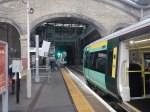
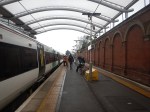
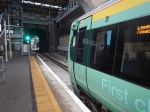
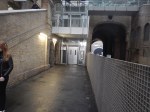
These pictures give a flavour of the current Crystal Palace station.
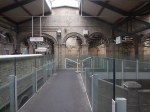
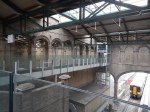
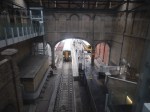





Note.
- It is served by both Southern and London Overground services.
- The station has several good lifts.
- There are toilets in the station by the gate line.
- The station is in excellent condition.
- The cafe in the station has a good reputation and I’ve used it several times.
If like me today, you are going up the hill to the bus station, Crystal Palace Parade or Crystal Palace Subway, there is a convenient bus stop on the other side of the road from the station. Any bus going to Crystal Palace should do.
These pictures document my visit to the Crystal Palace Subway.
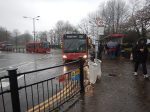










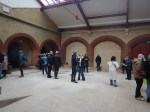













Note.
- Some of the ie Trams were running.
- The people were turning up.
- The restoration is top class.
And all despite the weather.
Old Street Station – 29th November 2024
I went back to the station today and took more pictures of the parts, I didn’t photograph yesterday.













Note.
- I arrived in and left from Silicon Roundabout via City Road to the South.
- There is a single lift on the North-East side of the roundabout to give access to the lower level.
- There is no lift access to the platforms.
This map from Transport for London shows the future layout of Old Street Roundabout.
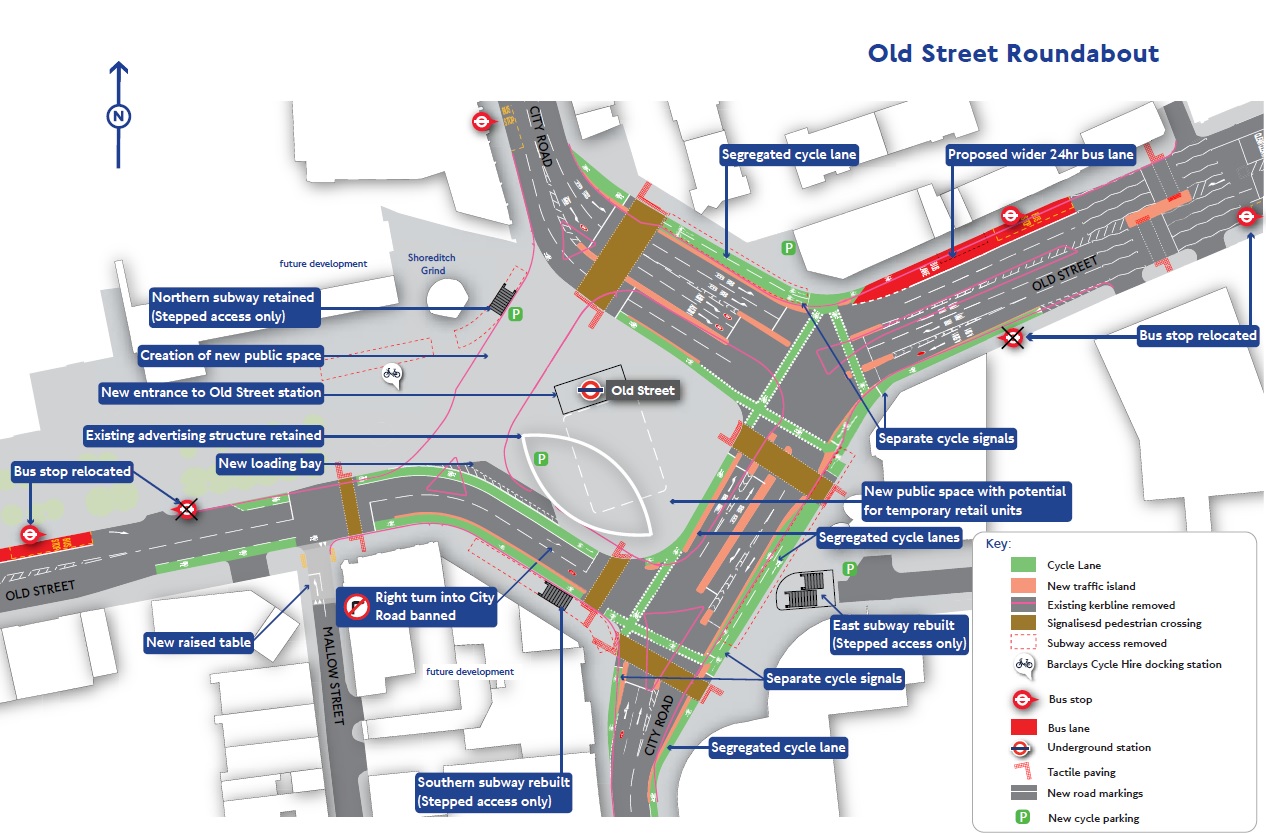
The step-free access could be better.
A Result With A Spam R-Mail
About eleven last night, I received a spam e-mail from an American e-mail address saying, if I invested a few thousand dollar with them, I’d get a good return.
It was as fraudulent as a ten-bob note.
So I forwarded it to report@phishing.gov.uk!
Around midnight, I received another e-mail saying from America saying I’d unsubscribed. It was a professional job with a Re-subscribe button.
It looks to me, that phishing.gov.uk has removed the scammer.
Old Street Station – 28th November 2024
The Central Entrance appears to be more or less finished.





Note.
- The green line leading to Moorfields Eye Hospital.
- Towers around the roundabout are sprouting skywards.
- The Victorian terracotta building on the North-West corner.
- The White Collar Factory on the South-West corner.
This map from Transport for London shows the future layout of Old Street Roundabout.
The construction has taken a long time.
Are Too Many Pharmaceuticals Round And White?
Last week one of the nine pills I take was changed from a small plain cream pill to one that was white, slightly larger with a slash on it.
I now take nine pills daily of which five are white and round, with two having slashes on them.
It didn’t cause any confusion with the dispensing, as I made sure I only pre-loaded a week’s drug containers. But, when I went to fill up Tuesday’s and Wednesday’s containers for this week, I couldn’t find the new drugs, as I’d confused them with the other drug with a slash and put them in the wrong drawer of the cabinet, where I store the drugs.
I put the confusion down to two many similar white drugs.
As a child, I used to build radios and amplifiers, so to avoid mistakes electricians and engineers started to use colour-coded wires, for all the different signals.
It became important, as some voltages used in high-power amplifiers could kill you. As Keith Relf of the Yardbirds was!
But then white drugs are cheap, just like grey cables.
New Tram-Like Bus Involved In Crash On Launch Day
The title of this post, is the same as that of this article on the BBC.
This is the sub-heading.
Transport for London (TfL) has said it is investigating after one of its new electric “tram-like” buses collided with a car on the day the new fleet was launched.
These are the three paragraphs of the article.
The Go-Ahead London bus was reportedly involved in the crash on Sevenoaks Road in Orpington, south-east London, on 20 November, when the new 358 buses came into service.
During a Bromley Council meeting, Labour councillor Kathy Bance said the bus collided with a car belonging to a Bromley Labour councillor’s wife.
A TfL spokesperson said no-one was injured and it was understood the collision was minor.
It appears to be very embarrassing, but not as serious, as it might have been.
If you go back to Edwardian times, there are tales of horses being startled by new-fangled motor-cars and charabancs, so could the councillor’s wife have been confused by this unusual looking bus?

I think it best to keep a watching brief, as to whether the bus did confuse the lady.
 The Anonymous Widower