Why Firms Are Racing To Produce Green Ammonia
The title of this post, is the same as that of this article on the BBC.
This is the sub-heading.
In the 19th Century, Europeans realised what the Inca had known long before. Bird droppings, or guano, made a fantastic fertiliser.
These are the first three paragraphs.
And so sprang up a gigantic industry dedicated to the harvesting of guano from Latin American bird colonies, where there were huge piles of the stuff.
It was so rich in ammonia, the key ingredient, that a mere whiff could induce coughing and sneezing. Not exactly a pleasant cargo to ferry across the world.
As demand for fertiliser rose in the early 1900s, someone began to think, “Perhaps there’s another way?” That someone was Fritz Haber, a German chemist who, along with Carl Bosch, developed the Haber-Bosch process for synthesising ammonia.
This Wikipedia entry describes the Haber-Bosch process.
This is the first paragraph.
The Haber process, also called the Haber–Bosch process, is the main industrial procedure for the production of ammonia. The German chemists Fritz Haber and Carl Bosch developed it in the first decade of the 20th century. The process converts atmospheric nitrogen (N2) to ammonia (NH3) by a reaction with hydrogen (H2) using an iron metal catalyst under high temperatures and pressures. This reaction is slightly exothermic (i.e. it releases energy), meaning that the reaction is favoured at lower temperatures and higher pressures. It decreases entropy, complicating the process. Hydrogen is produced via steam reforming, followed by an iterative closed cycle to react hydrogen with nitrogen to produce ammonia.
These companies are mentioned in the BBC article.
Starfire Energy
This is their web site.
Their home page has a title of Modular, Variable-Rate Ammonia (NH3) Production and this description of their technology.
We are scaling up technologies to make and use carbon-free ammonia fuel. Rapid Ramp is a variable-rate ammonia production process engineered into a modular plant design. Prometheus Fire is a lower temperature, high flow ammonia cracking process that allows ammonia to be used like natural gas, but with no CO2 emissions.
According to the co-founder of the company, Starfire’s process can use intermittent power, like wind and solar.
Could a farmer make their own fertiliser with a containerised system and say a 5MW wind turbine or a small solar farm?
Atmonia
This is their web site.
This description of their process is on their home page.
Atmonia is developing a nitrogen electrolyser with our patented catalyst. The technology uses only air, water and electricity for direct ammonia production. This enables zero carbon ammonia production, when applying renewable electricity.
Could a farmer make their own fertiliser with a containerised system and say a 5MW wind turbine or a small solar farm?
Jupiter Ionics
This is their web site.
Their home page has an endless video and this statement.
We’re commercialising carbon-neutral, electrochemical technology for sustainable agriculture, ammonia-fuelled transport and renewable energy exports.
These three paragraphs in the BBC article, say more about the process used by Jupiter Ionics.
Jupiter Ionics is currently planning to build an ammonia production module on the megawatt scale, which could produce a tonne per day.
Jupiter Ionics’ technology differs from Starfire Energy and Atmonia’s in that it uses lithium as a mediator to break apart nitrogen molecules, which naturally exist as strongly bonded pairs of nitrogen atoms, to form lithium nitride. This then reacts with hydrogen to make the ammonia.
Within the next 12-18 months, Jupiter Ionics aims to scale up its equipment so that it can produce a kilogram of ammonia per day. A grape farmer in the state of Victoria who has solar panels on his land is hoping to trial the system, says Prof MacFarlane.
It appears that Starfire Energy, Atmonia and Jupiter have containerised systems, that can take air, water and electricity and can create sizeable quantities of ammonia for fertiliser or a fuel.
This page on the Ammonia Energy Association web site is entitled Amogy: Ammonia-Powered Tractor, where this is said, alongside a picture of a standard John Deere tractor.
Earlier this month, Amogy demonstrated a new ammonia-powered tractor in Stony Brook, New York. A 100 kW ammonia-to-power system was successfully integrated into a John Deere mid-size standard tractor, which can operate on liquid ammonia fuel for a period of several hours. The tractor conversion demonstration was made possible by significant seed funding secured in late 2021.
The unique system is comprised of a standard liquid-storage tank and highly efficient ammonia-cracking modules integrated into a hybrid fuel cell system, which can provide consistent primary power for several hours per refueling. Therefore, the pioneering vehicle maintains the functionality and duration requirements operators rely on to support farming tasks, which has never been offered with other alternative energy solutions. The ammonia-powered tractor was driven for separate periods, with a refueling session in between. Refueling a tractor with liquid ammonia is fast and simple, similar to gas or diesel refueling.
This is Amogy’s web site.
I can also see a problem, if every farmer of a certain size wants to make their own ammonia for both fertiliser and fuel.
The NIMBYs will have a field day, but at least the countryside’s low-life won’t be nicking your diesel.
Nitricity
The BBC article also talks about Nitricity.
As Josh McEnaney, president and chief executive of Nitricity in the US, explains, spreading ammonia on fields results in greenhouse gas emissions that could be avoided if we took a more direct approach to applying nitrogen, the crucial element that promotes plant growth, to the soil.
His company is developing a system that uses solar-powered plasma cells to fix nitrogen from the air. This is then used to make nitric acid, which can be applied to the soil. Early experiments with tomato plants yielded success and the company is now trialling its technology with suppliers for the US fast food chain Chipotle.
“We don’t require any hydrogen production,” says Dr McEnaney. “We go straight for the fertiliser.”
This is the Nitricity web site.
Two Experts Give Their Views
The BBC article finishes with the views of two experts.
Bill David at the University of Oxford points out that, around the world, there is already lots of infrastructure designed to store and transport ammonia.
He praises large projects for manufacturing ammonia using renewable energy, such as the one in Uzbekistan that will reportedly spew out 454,000 tonnes of ammonia per year with the help of 2.4 gigawatts of wind energy.
While ammonia can be used as a fuel, it can also be cracked to release hydrogen, which may itself be burned as a fuel, points out Lindsey Motlow, senior research associate at Darcy Partners, a technology firm that works with the oil and gas industry.
“We’re seeing real progress in [the] development of ammonia cracking technology,” she says.
Conclusion
According to the BBC article, two percent of the carbon dioxide emitted on the planet comes from the creation of fertiliser.
So it looks like we can either fry or starve, if we don’t address the problem of zero-carbon fertiliser.
But the downside could be every farm having its own wind turbine.
The BBC article and the related web sites are a must-read.
Schneider Electric: Vertical Farming – The Next Yield In Data Centre Sustainability
The title of this post, is the same as that of this article on Intelligent Data Centres.
This is the sub-heading.
David Abrahams, Key Client Manager, Cloud and Service Partners at Schneider Electric UK and Ireland, discusses vertical farming and the next yield in data centre sustainability. He outlines new data centre sustainability strategies, vertical farming solutions and how data centres can apply already existent models which will allow plants and crops to thrive in unique Growth Towers.
These are the first two paragraphs.
As data centres begin to reach their physical sustainability limits without redefining the laws of physics, vertical farming could provide a new solution to the decarbonisation challenge, creating a symbiotic environment for both data and nature to benefit one another.
Coined by some as the fourth revolution in agriculture, vertical farms today provide closed conditions which deliver major sustainability benefits including limited or zero use of pesticides, while ensuring the farm is safe from extreme weather-related events such as high temperatures, humidity, floods and fires.
The last section is called Making The Concept A Reality, where these are the first three paragraphs.
Equinix has already taken the leap and has become the first global operator to develop a fully functioning vertical farm at its PA10 Paris data centre, creating a 4600 sq.ft greenhouse which is surrounded by 61,000 sq.ft of garden space.
The vertical farm is kept at an ideal growing temperature, using heat exchangers linked to the data centre’s chilled water-cooling system with sensors that monitor internal and external temperatures and humidity levels. With such available technology, farmers will be able to make real-time changes to their growing conditions to achieve higher yields at lower energy. This could be a game changer considering the greater strain on the global food supply chain and the general cost of energy.
With increased demands for efficiency and sustainability, both data centre and agricultural sectors are under the greatest scrutiny. The idea of data centre and farming worlds collaborating to create a circular economy to help futureproof both industries is not only exciting but unveils a world of new decarbonisation opportunities.
It strikes me that combining a data centre and a vertical farm could be a marriage made in eco-heaven.
I suggest you read all the original article.
Vertical Farming Consortium Secures UK Government Funding To Advance Low-Emission Food Production Using Energy Storage
The title of this post, is the same as that of this article on Renewable Energy Magazine.
This is the sub-heading.
A consortium of four British companies, comprising UK Urban AgriTech (UKUAT), Intelligent Growth Solutions Ltd, RheEnergise and James Hutton Institute has received a grant from the UK Government to advance the development of low-carbon and low-cost food production by co-locating renewable energy with vertical farms.
These paragraphs outline the project.
The V-FAST consortium’s £488,000 project will explore how co-locating RheEnergise’s HD Hydro Energy Storage system with vertical farms can support a low-emission route to growing protein-rich crops in a controlled environment.
Last year, V-FAST – Vertical Farming And Storage Technologies – started investigating sites in Scotland’s Central Belt for the location of Scotland’s next generation of hectare+ scale vertical farms, powered by 100 percent renewables and using RheEnergise’s High-Density Hydro energy storage system. These farms would provide locally produced fresh foods (salads and fruits) to over 60 percent of the Scottish population and help meet the Scottish Government’s ambitions to produce more homegrown fruit and vegetables. These site investigations in Scotland continue.
Now, with the Innovate UK and BBSRC funding as part of the Novel Low Emission Food Production Systems competition, V-FAST will broaden the area for its site feasibility studies to across the UK, using GIS to identify and rate suitable locations for vertical farms that are co-located with renewables and High-Density Hydro energy storage. As part of the project, V-FAST will also undertake crop trials to establish optimal climate recipes in terms of their energy efficiency relative to produce metrics (e.g. protein per kWh or kg of CO2e).
It certainly sounds unusual to pair vertical farming with energy storage, but if it works, why knock it?
RheEnergise’s HD Hydro Energy Storage system is effectively pumped storage hydroelectricity using a fluid with a specific gravity of 2.5.
So instead of needing mountains to store energy, it can use medium-sized hills.
The Wikipedia entry for vertical farming, introduces the concept like this.
Vertical farming is the practice of growing crops in vertically stacked layers. It often incorporates controlled-environment agriculture, which aims to optimize plant growth, and soilless farming techniques such as hydroponics, aquaponics, and aeroponics. Some common choices of structures to house vertical farming systems include buildings, shipping containers, tunnels, and abandoned mine shafts.
As both HD Hydro Energy Storage system and vertical farming seem to need some form of vertical space, can colocation be advantageous in terms of cost?
Wikipedia also says that vertical farms also face large energy demands due to the use of supplementary light like LEDs.
So could V-FAST be an unusal marriage made in heaven of plant science and energy storage?
Centrica Energy, Bord Gáis Energy And Mitsubishi Power Announce Development Of Europe’s First Ammonia Fired Power Generation Facility
The title of this post, is the same as that of this press release from Centrica.
This is the sub-heading.
Centrica plc and Mitsubishi Power Europe Limited “Mitsubishi Power Europe” have signed a Memorandum of Understanding (MOU) to explore the development, construction, and operation of Europe’s first-ever ammonia-fired power generation facility at Bord Gáis Energy’s Whitegate Combined Cycle Gas Turbine (CCGT) power station in Cork, Ireland.
These four paragraphs outline the project.
The project is being led by Centrica through its Bord Gáis Energy and Centrica Energy businesses and Mitsubishi Power Europe and would become Europe’s inaugural ammonia-fired power generation facility and one of only two such facilities in the world.
The utilisation of low carbon ammonia as a clean and sustainable fuel source for power generation has the potential to provide security of supply while reducing greenhouse gas emissions. Low carbon ammonia has a higher volumetric density than hydrogen, enabling the utilisation of low carbon hydrogen in a form which is easy to transport and store, resulting in a fuel that can be combusted with no carbon emissions at point of use. Its use as a fuel is a promising long-term energy solution for the transition to a low-carbon energy value chain.
Bord Gáis Energy’s facility at Whitegate CCGT power station would serve as a global demonstration site for ammonia-fired power generation technology, providing insight into the feasibility and scalability of low carbon ammonia as a green fuel and shaping the future of power generation worldwide, with low carbon ammonia being sourced through Centrica Energy’s global trading network.
Following the signing of the MOU, the project team is being established to commence project feasibility assessments. Upon the successful outcome of this assessment, extensive local stakeholder engagement will commence.
Note.
- No mention of the size of the new power station is given in the press release.
- Whitegate power station is a 445 MW combined cycle gas turbine (CCGT), that was built in 2010.
- It can meet ten percent of Ireland’s electricity demand.
I have a few thoughts.
Will The Existing Power Station Be Converted To Ammonia Or Will A New Ammonia-Fired Power Station Be Built Alongside?
Consider.
- If the second station doesn’t work, there’s no reduction in power.
- If a replacement station doesn’t work, ten percent of Ireland will be in the dark.
- Ireland will be needing more power in the next few years.
- A second power station can be appropriately-sized.
- Japanese don’t like to lose face!
Prudence probably says that building a second station alongside is the least risky route.
Wind Power In Ireland
This Wikipedia entry is entitled Wind Power In Ireland.
This is the first paragraph.
As of 2021 the island of Ireland has 5,585 megawatt and the Republic of Ireland has 4,309 MW of installed wind power nameplate capacity, the third highest per capita in the world. In 2020 wind turbines generated 36.3% of Ireland’s electrical demand, one of the highest wind power penetrations in the world.
There is also one 500 MW interconnector between the islands of Great Britain and Ireland, with another similar-sized one under construction.
As the wind doesn’t blow all the time, the island of Ireland will need some low-carbon backup.
Why Ammonia?
This paragraph from the press release gives several reasons.
The utilisation of low carbon ammonia as a clean and sustainable fuel source for power generation has the potential to provide security of supply while reducing greenhouse gas emissions. Low carbon ammonia has a higher volumetric density than hydrogen, enabling the utilisation of low carbon hydrogen in a form which is easy to transport and store, resulting in a fuel that can be combusted with no carbon emissions at point of use. Its use as a fuel is a promising long-term energy solution for the transition to a low-carbon energy value chain.
There may also be secondary issues here.
If you read the Applications section in the Wikipedia entry for ammonia, you will realise, what a useful chemical ammonia is.
As Ireland has a lot of agriculture, a fertiliser plant could be located close to the power station.
If the ammonia was green ammonia, then this will help to decarbonise the island of Ireland.
Where Will The Green Ammonia Come From?
These posts deal with the production and distribution of green ammonia.
- Could West Africa Become A Green Energy Powerhouse?
- H2U Eyre Peninsula Gateway Hydrogen Project Begins Largest Green Ammonia Plant
- KEPSA Signs Large-Scale Green Energy Projects MoU In Kenya
- Namibia Is Building A Reputation For The Cheapest Green Hydrogen
- Uniper To Make Wilhelmshaven German Hub For Green Hydrogen; Green Ammonia Import Terminal
Note.
- A continent with a lot of renewable energy like Africa or Australia can create lots of green ammonia.
- As the press release says, ammonia is easier to transport and store compared to hydrogen.
- The press release says that low carbon ammonia will be sourced through Centrica Energy’s global trading network.
- Fortescue Future Industries is mentioned in several posts, as producers of green hydrogen and green ammonia.
- Centrica is big enough to stand up to Andrew “Twiggy” Forrest and Fortescue Future Industries.
As in a few years, we will have many GWs of renewable energy, could we be making green ammonia for the Irish?
This news story on the UK Research and Innovation web site is entitled Designs For Green Ammonia Plant Become Reality.
This is the sub-heading.
Science and Technology Facilities Council (STFC) researchers are building a small-scale plant to generate ammonia using only renewable energy sources.
These two paragraphs outline the story.
Ammonia is a promising carbon-free fuel source of the future and so if successful, the plant has the potential to considerably advance the UK’s net zero ambitions.
It marks the second phase of the Ammonia Synthesis Plant from Intermittent Renewable Energy (ASPIRE) initiative which will be led by STFC in conjunction with the University of Bath, Johnson Matthey, and Frazer-Nash Consultancy.
The UK Research and Innovation news story has this description of the ASPIRE technology.
Current commercial ammonia synthesis is optimised for near steady production requiring constant power.
The first phase of ASPIRE however saw the design of a patented modular reactor and thermal management system that should enable operation from an intermittent renewable power supply.
The new plant will have three core elements:
- a pressure swing adsorption system which extracts nitrogen from air
- a modular electrolyser which splits hydrogen from water
- a synthesis loop that uses the modular reactor and a thermal management system to combine hydrogen and nitrogen to make ammonia
This will enable the entire production process to operate autonomously, powered by a small wind turbine and series of solar canopies with an ammonia generation rate proportional to the available renewable power.
There is even this quote from a Dr. Alan Partridge.
Thanks to the incredible work on this initiative by the team at Rutherford Appleton Laboratory as well as the University of Bath and private sector partners, we are closer than ever to producing industry-scale green ammonia for the UK and the world.
Perhaps, this technology will allow the island of Ireland to make all the green ammonia it needs.
Will Centrica Be Going Into The Green Ammonia Business?
The Centrica press release says they will be dealing in green ammonia for the benefit of Ireland. So Yes!
Conclusion
The news story on the UK Research and Innovation web site is a must-read.
As we have so much renewable energy in the UK, some company will build an ASPIRE-based green ammonia plant in the UK.
Toyota Unveils Prototype Hydrogen Fuel Cell Hilux
The title of this post, is the same as that of this article in The Engineer.
This is the sub-heading.
Toyota has today (September 5, 2023) unveiled a prototype hydrogen fuel cell-powered Hilux at Toyota Manufacturing UK’s Burnaston car plant in Derby.
This is the first paragraph.
The pick-up has been developed in a joint project with consortium partners Ricardo, ETL, D2H Advanced Technologies and Thatcham Research. and funding from the government via the Advanced Propulsion Centre (APC).
It would appear to be a consortium of some of the important great and good of British automobile engineering.
- Ricardo are a well-respected environmental and engineering consultancy, who probably know more about powering vehicles, than most companies have forgotten.
- Thatcham Research is the motor insurers’ automotive research centre.
- The Advanced Propulsion Centre collaborates with UK government, the automotive industry and academia to accelerate the industrialisation of technologies.
To my mind, the great advantage is that they are starting with a vehicle that has a formidable reputation.
When I outlined, the product to a friend, who had owned vehicles of this type, his reply was “Wow!”
Points from the article include.
- The expected driving range is more than 365 miles.
- The project began in early 2022 with a feasibility study undertaken by TMUK and Toyota Motor Europe with the consortium partners.
- Design and development started at July 1, 2022.
- Prototype construction began on June 5, 2023.
- The first vehicle was completed in three weeks.
- Ten preproduction examples will be produced before the end of the year.
- Ricardo supported preparations for the prototype build and will undertake complete evaluation of the vehicle over the coming months.
- Thatcham Research supported the project through the provision of sustainable repair consultancy and the preparation of hydrogen training for the repair market.
On paper, it looks like the consortium have taken an extremely useful vehicle and updated it for the 21st century.
Inly time will tell, if the design is right.
I have a few questions.
What Is The Towing Performance?
In my experience, many owners will want to tow heavy trailers, horse boxes or portable cafes and toilets for events like music festivals and agricultural and country shows.
If the towing performance matches that of a diesel Hilux, Toyota will probably have got it right.
How Many Miles Does The v Average Small Builder Or Smallholder Do In A Week?
Toyota must know this from servicing records of the diesel HiLux fleet.
I would suspect for many, 365 miles would allow a weekly or twice weekly refuelling!
Where Would Owners Refuel Their Hydrogen-Powered HiLux?
I suspect that Toyota dealerships Selling Hydrogen-Powered HiLux and Mirai, would make their own arrangements.
Would A Hydrogen-Powered HiLux Help To Decarbonise Work Sites?
I suspect it would and the electrical system could probably be used to power and charge small electrical tools.
Would A Hydrogen-Powered HiLux Be An Ideal Farm Runabout?
I am thinking about a friend of mine, who is a Suffolk farmer, who farms rare breed sheep.
He uses a big pick-up to tow a large trailer to take the sheep to market and shows and to move them around the country to other breeders. He has in the past used a golf buggy to check on his flocks and help with the welfare of the animals.
Some of his sheep are raised on the saltings, which gives them a unique flavour, but does involve the occasional accident, and sometimes needs a tricky recovery.
I spoke to him last night and he will be looking at this Toyota. His current vehicle does tend to frighten the sheep as it is too noisy.
Would A Hydrogen-Powered HiLux Work Well In Hot Countries?
The current HiLux is built in South Africa and those for Europe were generally made there.
So I would expect some African examples could have been made there.
Some hydrogen fuel cells need to be cooled, so would this be a problem in hot countries?
On the other hand , it does seem that hydrogen production in hot countries, with all that sun, might not be a problem.
Would A Hydrogen-Powered HiLux Make A Good Technical?
Diesel HiLux are popular as technicals and I suspect that the hydrogen-powered HiLux will be just as good.
Although the low-down mounting of the hydrogen tanks may make them susceptible to landmines.
Why Is It Not Called A HyLux?
I couldn’t resist asking that.
Conclusion
I like the hydrogen-powered HiLux and feel it will be a winner.
Fresh Air Fuels Global
Because of its history, South Africa has developed technology to create biofuels, as alternatives to diesel.
If you read the Wikipedia entry for South African chemical company; SASOL, you’ll see the things that South African chemists did, to get round the sanctions imposed because of apartheid.
SASOL has advanced the Fischer–Tropsch process and uses it to produce diesel and other fossil fuels.
Note that Velocys have also developed this process to make sustainable aviation fuel in the UK.
Fresh Air Fuels Global have a page on the G-volution web site.
The page is dominated by an infographic, which shows organic waste (animals and plants) going into an anaerobic digester, which produces.
- Biogas, which is used to create heat, electricity, CO2, biomethane, fuel and gas for the grid.
- Digestate, which is used for fertiliser and livestock bedding.
It almost sounds too good to be true.
This is the mission statement below the graphic.
Our mission: To be the most reliable producer of energy secure low carbon fuels.
There is then these paragraphs, which explain the relationship between G-volution and Fresh Air Fuels Global.
Global energy security concerns and climate targets necessitate countries and businesses to transition away from high-cost fossil fuels towards low-carbon alternatives.
Over more than a decade, Cape Advance Engineering South Africa (CAE) have been developing an incredibly cost-effective Anaerobic Digestion (AD) technology, which has proven to generate renewable energy from organic waste in the form of gas, heat and electricity that is cost competitive with fossil fuels.
G-Volution has partnered with CAE to form Fresh Air Fuels Global (FAFG), with aim of introducing the CAE technology to international markets that the G-Volution already have a foothold, constructing AD plants and creating carbon neutral biofuel from waste that can be used in dual fuel engines.
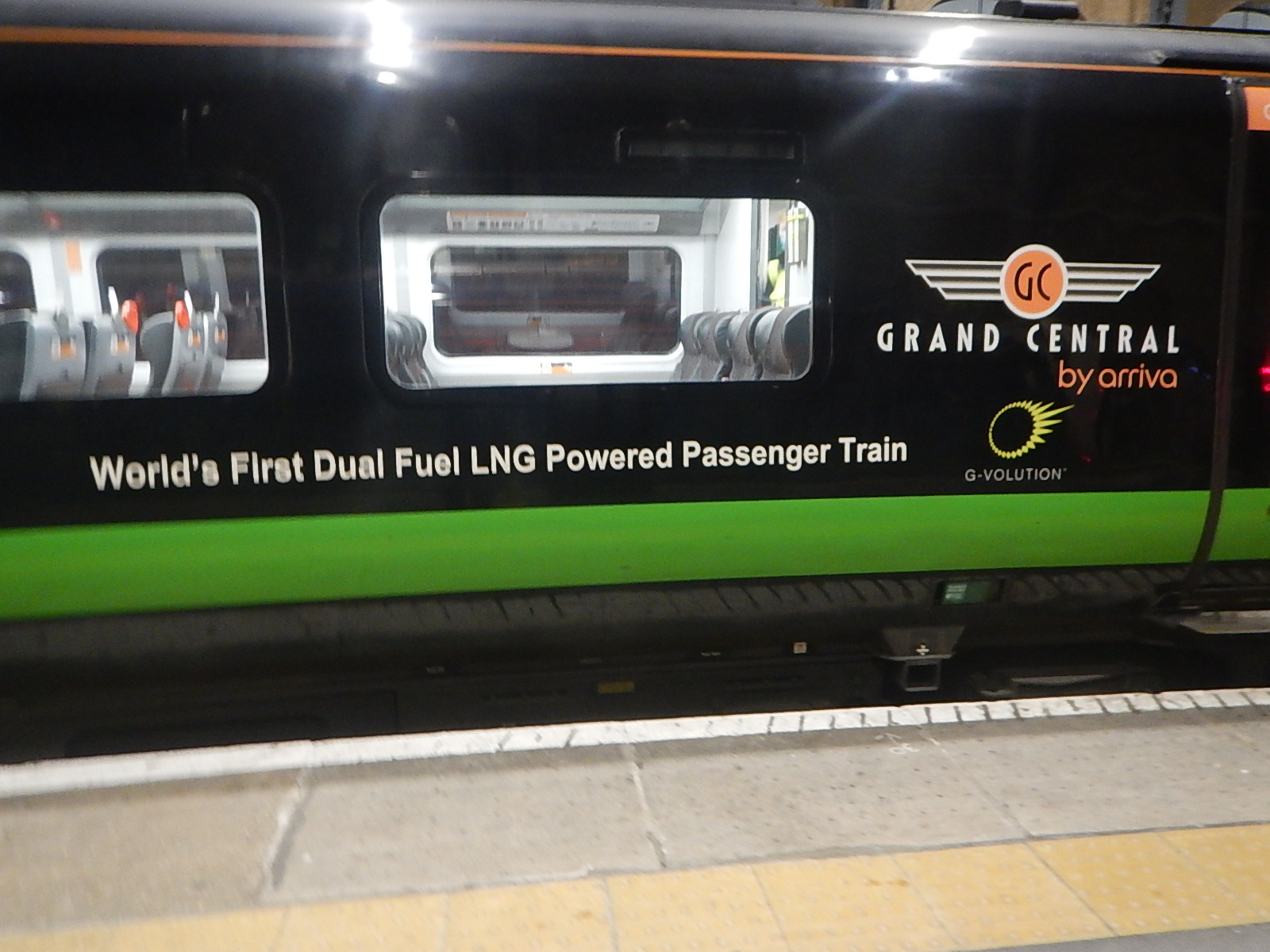
In Grand Central DMU To Be Used For Dual-Fuel Trial, I describe how G-volution’s dual fuel technology has been applied to one of Grand Central’s Class 180 train.
This picture I took after travelling in a Grand Central Class 180 train, shows that G-volution don’t hide their light under a bushel.
Note.
- This train appears to run on diesel and liquified natural gas.
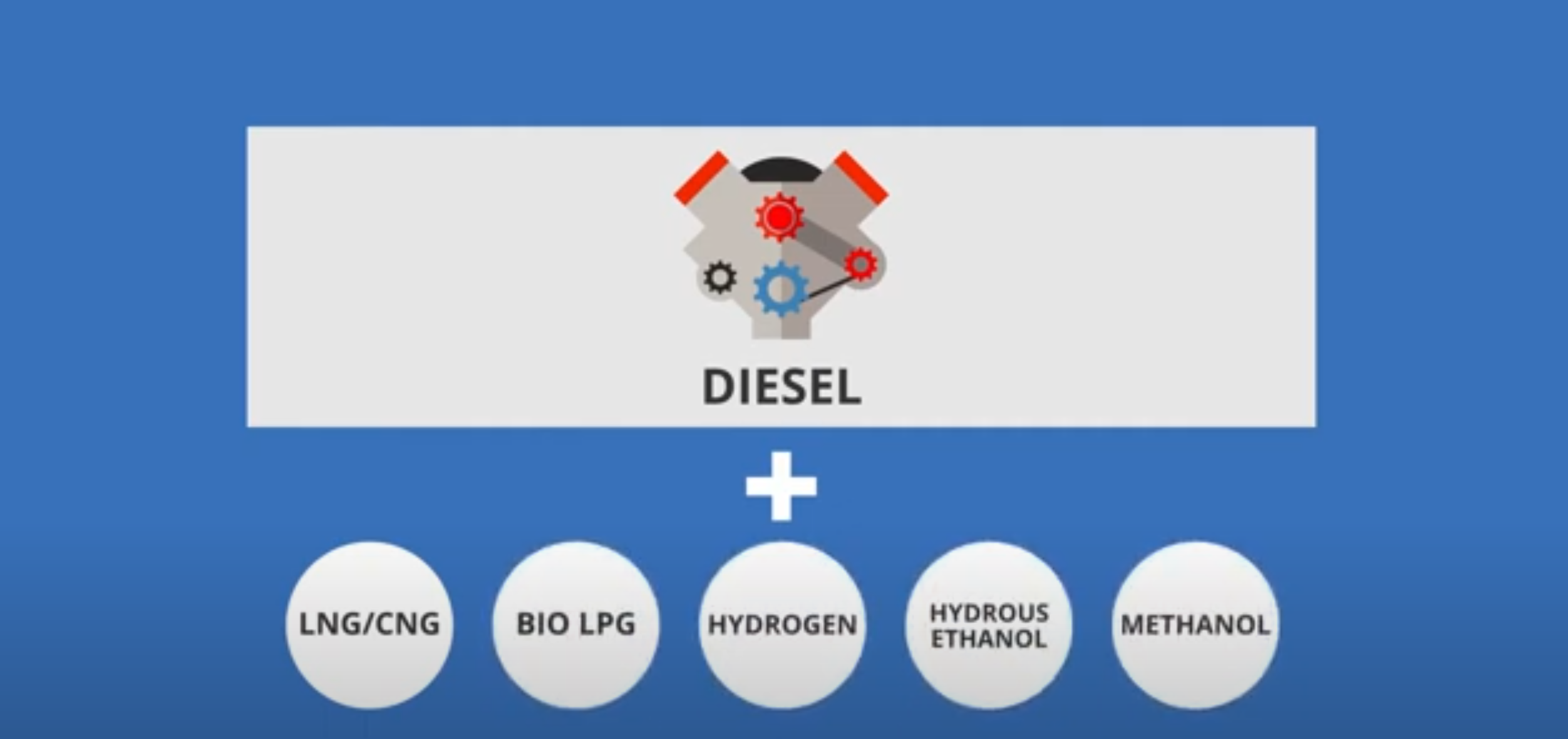
- This G-volution video gives more details.
This clip from the video, shows the possible fuels.
Note.
- Can the dual fuel engine use biodiesel or HVO instead of diesel?
- It looks like the Fresh Air Fuels Global process can produce biomethane, which could be liquified as LNG.
- Hydrogen is the only true zero-carbon secondary fuel.
- There is a Wikipedia entry for ethanol fuel.
- Hydrous ethanol is about 95% ethanol and 5% water and is used as a fuel in Brazil in petrol cars.
- There is a Wikipedia entry for the use of methanol as fuel.
Have G-volution got access to the technology to both reduce the fuel consumption of diesel engines and run them on zero-carbon fuel?
UK Trains That Have Cummins QSK-19 R Diesel Engines
Grand Central’s Class 180 trains have a Cummins QSK-19 R diesel engine.
All these trains have the same engine.
- 14 – Class 180 trains
- 51 – Class 185 trains
- 34 – Class 220 trains
- 44 – Class 221 trains
- 27 – Class 222 trains
In addition, Class 175 trains have a different engine made by Cummins.
Conclusion
If G-volution’s technology can be made to work successfully, it could play a large part in the decarbonisation of UK passenger trains.
Can ‘Enhanced Rock Weathering’ Help Combat Climate Change?
The title of this post, is the same as that of this article on the BBC.
This is the sub-heading.
In a quarry surrounded by the din of heavy machinery Jim Mann crouches down and picks up a handful of tiny black rocks.
These three sentences introduce Jim and his magic dust.
“This is my magic dust,” he says with a smile, gently rubbing them between his fingers.
He’s holding pieces of basalt. It’s a hard volcanic rock that is neither rare nor particularly remarkable.
But through a process known as ‘enhanced rock weathering’ it could help to cool our overheating planet.
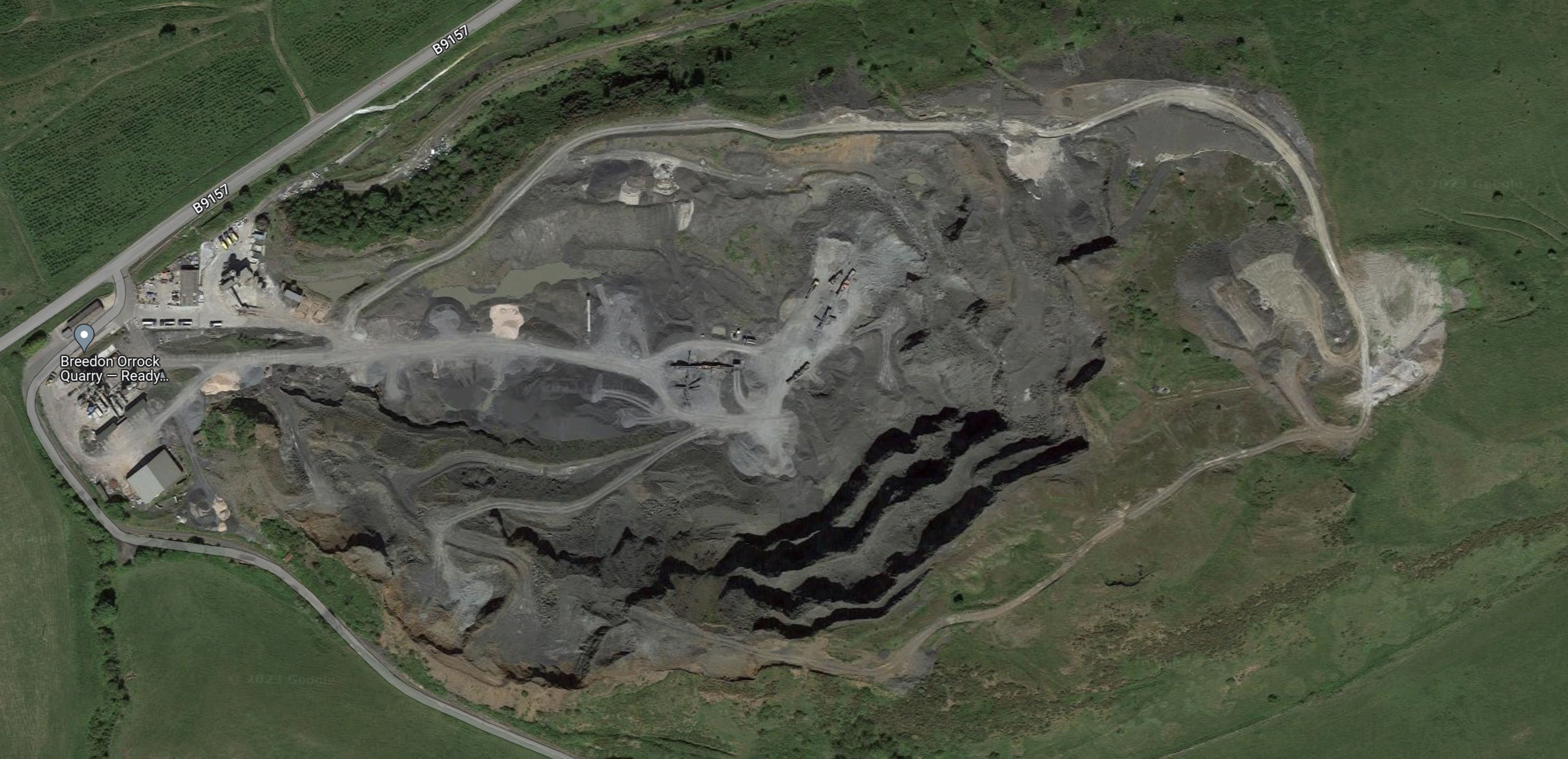
This Google Map shows Orrock Quarry, where the basalt is mined.
The article then gives a simple explanation of enhanced rock weathering.
When one of the companies, I’d backed won a green design award it was presented by David Bellamy. I remember having a very radical conversation with him, about some of the projects, where he’d been an advisor.
Some might have dismissive views about Jim Mann’s work as being too good to be true, but when I see the chemistry, I suspect,I’ll find it to be sound.
It would be a very interesting process to mathematically model!
Project Launches To Pair Offshore Wind With Sustainable Food Production
Note that it’s a little over a fortnight to April Fool’s Day!
The title of this post, is the same as that of this article on offshoreWIND.biz.
This is the sub-heading.
Win@Sea, a new collaboration between Vattenfall and Danish universities and companies, will investigate how to produce offshore wind power and sustainable food – all while improving the marine environment and biodiversity in the same marine area.
This is the first paragraph.
The partners will look into whether an offshore wind farm could simultaneously produce fossil-free electricity and sustainable food while also contributing positively to biodiversity in the same area.
But this report is not alone, in using the sea as a farm.
- Amazon Finances First-Ever Commercial-Scale Seaweed Farm Located Between Offshore Wind Turbines
- Brown Seaweed Could Remove 550 Million Tons Of Carbon
- The Plans For Giant Seaweed Farms In European Waters
- Oysters Get New Home At Eneco Luchterduinen Offshore Wind Farm
It sounds to me like a case of great minds thinking alike.
New California Hydrogen Fuel Plant Will Use Wood Waste
The title of this post, is the same as that of this article on Hydrogen Fuel News.
- It is being developed by a company called Mote.
- They are spending $100 million on the development.
- The plant will be built at Bakersfield in California.
The Mote web site is worth a look.
It explains their process with a good graphic.
- Wood waste is gasified and processed, so that the carbon dioxide and hydrogen are separated.
- The hydrogen is used as normal.
- The carbon dioxide is stored.
The company claims the process is carbon negative.
They also give figures for their first facility.
- It will remove 150,000 tonnes of carbon from the atmosphere every year.
- It will produce twenty tonnes of hydrogen per day.
Fluor, who are one of the United States largest construction companies are involved.
Conclusion
In Can The UK Have A Capacity To Create Five GW Of Green Hydrogen?, I said the following.
Ryze Hydrogen are building the Herne Bay electrolyser.
- It will consume 23 MW of solar and wind power.
- It will produce ten tonnes of hydrogen per day.
The electrolyser will consume 552 MWh to produce ten tonnes of hydrogen, so creating one tonne of hydrogen needs 55.2 MWh of electricity.
This would mean that Mote’s Bakersfield plant is twice the size in terms of hydrogen production, than the electrolyser at Herne Bay.
Looking up Bakersfield on Wikipedia, it appears that there is a lot of agriculture in the area and it ranks in the top five in the States.
I’d like to learn more about this company and their method of hydrogen production.
Does it count as green hydrogen, as it appears the carbon dioxide is stored.
Given the agriculture in the area, could the carbon dioxide be fed to plants growing in greenhouses.
MAHYTEC Creates World’s First Hydrogen-Powered Riding Lawnmower
I searched for hydrogen-powered lawnmower and found this page.
Surely ideal for the Prince of Wales to buy for Camilla, when she does the mowing at Highgrove.
But seriously, if you can make a hydrogen-powered ride-on mower, you can make any number of smaller horticultural and agricultural vehicles, that run on hydrogen.
How long before John Deere or one of the big Japanese manufacturers releases a hydrogen-powered lawnmower, that takes the large grass-cutting market by storm?
It won’t be just the grass, that is green!
I suspect a company like ITM Power will provide the operator with their own hydrogen generator.
I can envisage the farm of the future, having the following.
- Hydrogen powered tractors, loaders and other powered machinery.
- Hydrogen-powered Range-Rover to speed through the lanes.
- Hydrogen-powered lawn mower to make the place look good.
- Hydrogen-powered vehicles for road use.
All would be powered by the farm’s own hydrgen generator, which might use their own wind turbine.
 The Anonymous Widower