Uttoxeter Station – 14th October 2026
Becuse Uttoxeter station could be on a possible open access service between St. Pancras and Manchester Piccadilly stations, I went and had a look.
























My father would have made a comment about Molotov as regards this station.
Molotov had this reputation for always saying no.
This station is rather short in its list of facilities.
- It has no lifts for the footbridge.
- It has no staff.
- There was no obvious information about local transport.
- I saw no details of how to get a taxi.
- There were no litter bins on Platform 1.
- Poor early and late trains.
I believe this station needs a lot of improvement.
These are my thoughts.
Are Any Improvements Planned At Uttoxeter Station?
I thought I had better ask this question of Google AI first, so I didn’t repeat myself.
Google AI gave me this answer to the question.
Several service and timetable improvements are planned for Uttoxeter station:
Sunday Train Timetable Changes: Starting in December 2026, Sunday train services through Uttoxeter and Tutbury will be expanded to run from 9:30 AM onward, removing the previous restriction where trains did not start until after 3:00 PM.
Local Campaign for Increased Frequency: Local campaigns and discussions with East Midlands Railway (EMR) and Network Rail are underway to assess adding more frequent local train services and extra carriages on the Derby-to-Crewe line, including through Uttoxeter.
Proposed Open Access Services: Grand Central Trains has submitted an application for a new open access train service connecting Manchester Piccadilly and London St. Pancras that would call at Uttoxeter (proposing five trains per day).
Regional Infrastructure Upgrades: Network Rail has conducted ongoing infrastructure and track-renewal works across Derbyshire and Staffordshire (such as recent upgrades near Wychnor Viaduct and Clay Mills level crossing) to improve overall line reliability for services passing through Uttoxeter.
Note.
- When I visited the station, a guy complained to me about train times.
- I took one train to Uttoxeter and one from the station. Both were crowded.
- I believe Grand Central Trains service between London St. Pancras and Manchester Piccadilly will be a winner.
- Good to see that a level crossing has been removed.
Nothing seems to be planned, except for the better timetable.
Would Adding The Open Access Service Be Welcomed?
The open access service could have these effects.
- Five more trains in each direction would add more capacity.
- Trains could be timetabled to run in busy times.
- Early and late trains, would benefit shift workers.
- Running to London St. Pancras would connect to Continental services in the same station.
- Running to stations like Derby, Leicester, Stoke-on-Trent, Stockport and Manchester Piccadilly would widen the employee catchment area for employers in Uttoxeter.
- Alton Towers, JCB and Uttoxeter racecourse would probably all benefit from a direct train service to London St. Pancras, Derby, Stockport and Manchester.
Andy Burnham says he wants growth. Surely these five trains in each direction would inject growth into Uttoxeter and the surrounding area.
A Decent Bus Service To Local Attraction Would Be Needed
I took these pictures today of a small bus in London.




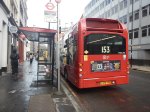



Note.
- It is a Wrightbus GB Kite electric bus.
- It was built in Northern Ireland.
- Wrightbus is owned by Lord Bamford’s son.
- Lord Bamford’s family own JCB.
I’m sure the family can agree on a deal to make Uttoxeter a must-visit place.
ORR Rejects WSMR And Lumo WCML Bids
The title of this post, is the same as that of this article on Modern Railways.
These two paragraphs add more details.
Aspirations by Wrexham, Shropshire & Midlands Railway Company (WSMR) and Lumo to run more open access services on the West Coast main line have been rejected by the Office of Rail and Road.
WSMR hoped to run four Wrexham-London Euston return services, and Lumo up to four return trains between Rochdale and Euston. The ORR also rejected Avanti West Coast’s bid for extra Blackpool-Euston trains.
I feel by its rejection of the two open access bids from WSMR and Lumo, the ORR is showing its obedience to its socialist masters and following a policy of no trains, must be run by private enterprise.
But its rejection of more services to Blackpool, is surely an error of the highest order.
- Blackpool needs more express trains.
- Blackpool North station now has a well-designed interchange between the trains to Preston, Manchester, Liverpool, London and the South and the Blackpool tramway.
- Blackpool North and Euston is a fully-electrified route.
- There is scope to add extra services to the Blackpool tramway.
- Avanti West Coast will be run by the state from the 7th March 2027.
Surely, similar rules can apply independently of the owner?
But obviously not in Burnham’s Bankrupt Britain.
Could Centrica Build An Alternative Grid For The UK?
Andy Burnham’s Speech In Liverpool Introduced The Great British Grid
This extract is what he said on energy and the grid.
One of the biggest barriers to growth in the UK is the cost of energy. British businesses and billpayers pay some of the highest energy costs in Europe.
Within 10 years, I want those costs to be in line with our neighbours.
This means reforming a broken energy market so it better serves the public interest.
We are already taking more control of our electricity prices with a massive expansion of home-grown renewables and nuclear. I have asked Miatta to speed up the breaking of the link between what we pay for power at home and the international gas market, to get bills down.
And we will be pragmatic in relation to the North Sea as we build a bridge to a clean energy future and face the climate crisis.
But it’s not just the price. The system needs to work better too. You would not believe how many businesses complain to me they can’t get going because they can’t get connected to the grid.
It pushes costs up. It drags growth down. And it holds Britain back. We won’t get the growth and inward investment we need if we don’t fix it.
So, for the first time, we will have a national energy plan and we will bring back local democratic control through a stronger role for mayors and local leaders.
But we must go further. Today I can announce our plan for Great British Grid. A new branch of Great British Energy. A publicly-owned company that will challenge the private sector operators.
But is Andy Burnham’s plan realisable?
The Great Grid Upgrade From Norwich To Tilbury
National Grid are aiming to replace the grid between Norwich and Tilbury to add extra capacity and the details of the project are on this web site.
This is a map of the route.

To ascertain the level of objections, I asked Google AI “Norwich to Tilbury grid objections” and received this reply.
Local councils, residents, and organizations object to National Grid’s Norwich to Tilbury Project primarily due to the visual and ecological damage of using 50-meter overhead pylons instead of offshore or underground alternatives.
Key Objections and Concerns
Overhead Pylons vs. Alternatives: Opposition to roughly 100 miles (159–183 km) of towering onshore overground lines. Objectors demand fully costed offshore high-voltage direct current (HVDC) or underground cabling options.
Environmental & Landscape Harm: Severe impact on protected and valued landscapes, including the Dedham Vale national landscape and Waveney Valley, alongside extensive tree loss and disruption to local wildlife habitats.
Heritage & Property Impacts: Damage to the settings of historic buildings and significant property or land devaluation, including negative impacts on planned developments like the Dunton Hills Garden Village in Brentwood.
Unrealistic Delivery Timeline: Concern that the targeted 2030/2031 completion deadline is overly ambitious, forcing rushed implementation without proper scrutiny of cumulative effects from multiple East Anglian energy projects.
Community Disruption: Strain on local highways, disruptive weekend and bank holiday working hours, agricultural disruption, and a lack of adequate community compensation or tangible social value.
The Nimbys don’t seem very keen on more and bigger overhead power lines.
Conclusion
I believe building a second set of power lines across the country will be very difficult, if not impossible.
The Investment Of Centrica And Others In innovative Energy Technology
I think we’ll see innovation from the likes of Centrica, Octopus, National Grid and others, as to how we get our energy delivered.
Centrica and others, who include the UK Government, have backed four British companies, that I’m sure will be used in the grid of 2030.
- Ceres have developed a fuel cell that runs on hydrogen, biomethane or natural gas. It was thought it would be used to power data centres, but it could be used to provide power anywhere there is a gas supply, like a big factory or a new housing estate.
- Heata was developed by British Gas Research and is part of a data centre, which sits in a domestic hot water tank and the waste heat gives you affordable hot water.
- Highview Power make liquid-air batteries up to 300 MW/3.2 GWh. Significantly, Andy Burnham performed the groundbreaking for a 50 MW/300 MWh battery in Manchester, when he was Mayor of Greater Manchester.
- HiiROC from Hull University have a way to make hydrogen that uses only a fifth of the electricity. Cemex are using HiiROC to make low-carbon cement at Rugby. I also think Jim Ratcliffe has plans for HiiROC, as he is an investor with Centrica and others.
Could Centrica build an innovative Great British Grid from their investments?
I don’t think so because of the problem I indicated earlier with Norwich to Tilbury of putting up more overhead cables.
But all of these four companies can provide support and enhancement to the existing grid.
- Ceres could be used to provide extra power, where it is needed, if there is a suitable gas supply.
- Heata could be used to give a large proportion of houses and flats affordable hot water.
- Highview Power could be used to provide energy storage where too much energy is being generated at times and needs to be stored for a number of hours.
- I believe that many large wind farms will be connected to the grid, with a Highview Power battery at the sub-station.
- I also believe that we could see Highview Power batteries installed offshore to smooth wind farm output.
- HiiROC could produce hydrogen when and where it is needed.
The big problem will be that the grid will get more complicated and will be more difficult to control.
In Centrica And Return Partner To Scale Battery Flexibility In Germany, I ask Google AI if Centrica are good at optimising batteries and received this reply.
Yes, Centrica is considered a strong and established player in grid battery (BESS) optimisation.
Centrica Energy leverages over 15 years of flexible asset trading experience and has actively optimised battery energy storage systems since 2018. They currently manage over 950 MW of grid-scale batteries on contract across the UK and Europe.
It may be difficult to manage all these assets, but it does appear that Centrica have the mathematicians and engineers, who are up to the task.
The Future Of Nuclear
Consider.
- The four nuclear stations at Hartlepool, Heysham 1, Heysham 2 and Torness are to be shut down by March 2030, which will lose approximately 5 GW of zero-carbon electricity.
- Hinckley Point C will deliver 3.2 GW from the early 2030s.
- Sizewell C will deliver 3.2 GW at some time in the future.
Can we rely on solar and wind power to power the UK?
It is not a question of can, but we have to.
But Centrica have made a bold move to link up with X-energy of the US to build a fleet of small modular reactors called an Xe-100.
- I wrote about the initial deal in Centrica And X-energy Agree To Deploy UK’s First Advanced Modular Reactors.
- In Hartlepool Nuclear Reactor Moves To UK Regulatory Assessment, I talk about how the first reactor will be built at Hartlepool.
- In Centrica, X-energy Advance Nuclear Plans As UK Regulators To Begin Design Review For Xe-100, I say more about the design and the parners in the Xe-100.
- In With Federal Funding Windfall, X-energy Advances Small Nuclear Reactor, I talk about US Federal funding for X-energy.
- In TRISO-X Completes Vertical Construction Of TX-1 Fuel Fabrication Facility, I describe how they are cracking on with the fuel facility in the US.
It certainly, seems to be a project that has started with a certain degree of momentum, which says to me, they have got the project management right.
But believe that these 80 MW Xe-100 reactors, if strategically placed around the country will keep us going as older nuclear and gas power stations are retired.
The Relationship Between Andy Burnham And Chris O’Shea
I wrote about this in Have Chris O’Shea And Andy Burnham Met?
I will assume its a good relationship, until proven otherwise.
Conclusion
I wonder whether in the end, the Great British Grid is a series of extensions to the current grid we have.
Have Chris O’Shea And Andy Burnham Met?
I feel that this is a sensible question to ask Google AI.
I received this answer.
Yes, Centrica CEO Chris O’Shea and Prime Minister Andy Burnham have met.
They most recently crossed paths at the September 2026 Labour Party Conference in Liverpool.
During the event, Chris O’Shea was part of a slimmed-down delegation of top British business executives who attended a private meeting where Andy Burnham took questions and delivered a frank address regarding the “cost of business” and his future economic strategy.
They have also met previously during Burnham’s tenure as Mayor of Greater Manchester.
For instance, in April 2022, the banking group NatWest arranged a high-level meeting involving both Andy Burnham and Chris O’Shea to discuss green energy initiatives and policy incentives for sustainable housing.
It should also be noted, that Centrica, where Chris O’Shea is Chief Executive, have backed Highview Power’s 50 MW/300 MWh battery at Carrington in Greater Manchester. I wouldn’t be surprised that given the NatWest meetings, that Burnham and O’Shea met at Carrington at some point. In Andy Burnham and Highview Power, I investigated Burnham’s attitude to the Carrington battery and it appears to be positive.
I have just read this interview with Chris O’Shea in the Guardian.
Burnham and O’Shea have a lot of similarities in their lives.
- There is only a four years difference in their ages.
- Both are from Catholic families.
- Both may have had financial troubles in their families as children.
- Both went to good universities.
- Both are keen football supporters.
I can expect that on a lot of important issues, they are in agreement.
Power Lines Disappear From Cornish Beauty Spot
The title of this post, is the same as this news item from National Grid.
This is the sub-heading.
Visitors to a North Cornwall beauty spot will be able to enjoy improved views after overhead power lines were removed by our engineers.
These three paragraphs add more detail.
They took down more than a mile of poles and lines at Hawkers Cove, near Padstow, which have been replaced by underground cables.
The cove is a popular destination known for its coastal scenery and views across the Camel Estuary, and we worked with Cornwall National Landscape, Cornwall Council, local landowners and a tenant farmer to identify which overhead equipment could be removed.
This resulted in more than a dozen poles and 15 spans of high and low voltage conductors covering 1,600 metres being taken down.
It appears that National Grid work in partnership with National Parks and National Landscapes, to identify and prioritise schemes.
I posted this story, as in Burnham’s speech, he said he would be setting up Great British Grid.
Will this mean, if you vote Labour, you’ll get ugly cables removed from around your house, so that it goes up in value?
Should Number 10 North Have Good Rail Connections To London?
The answer to this question must be Yes! But it must also have good rail connections to the rest of the UK.Heron House
The current Number 10 North is at Heron House, which is shown on this OpenRailwayMap.
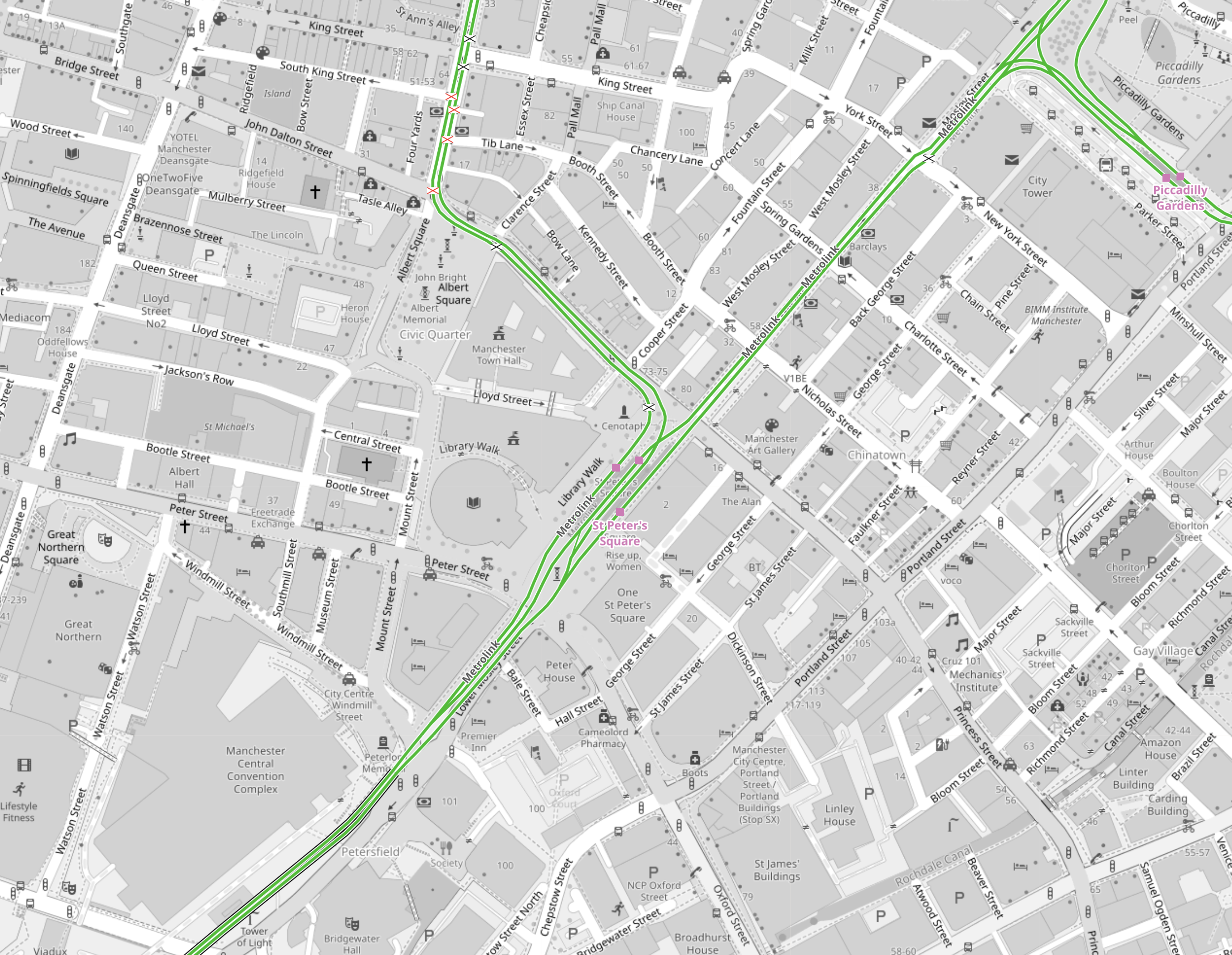
Note.
- The green lines are Manchester’s Metrolink.
- Piccadilly Gardens with its tram stop is in the North-East corner of the map.
- The tram lines going South-East from Piccadilly Gardens go to Manchester Piccadilly station.
- The tram lines going North-East from Piccadilly Gardens go to Manchester Victoria station.
- In the middle of the map, there is St. Peter’s Square tram stop, which are within a five-minute walk to the circular Manchester Central Library and the triangular Manchester Town Hall.
- Heron House is on the opposite side of Albert Square to Manchester Town Hall.
Andy Burnham has obviously chosen a location he knows well from his nine years as the Mayor of Greater Manchester.
Long-term there are plans to move Number 10 North to the Manchester Digital Campus in Great Ancoats Street, Ancoats, Manchester, when construction is completed around 2032.
This Google Map shows the location of Great Ancoats Street with respect to Manchester City Centre.
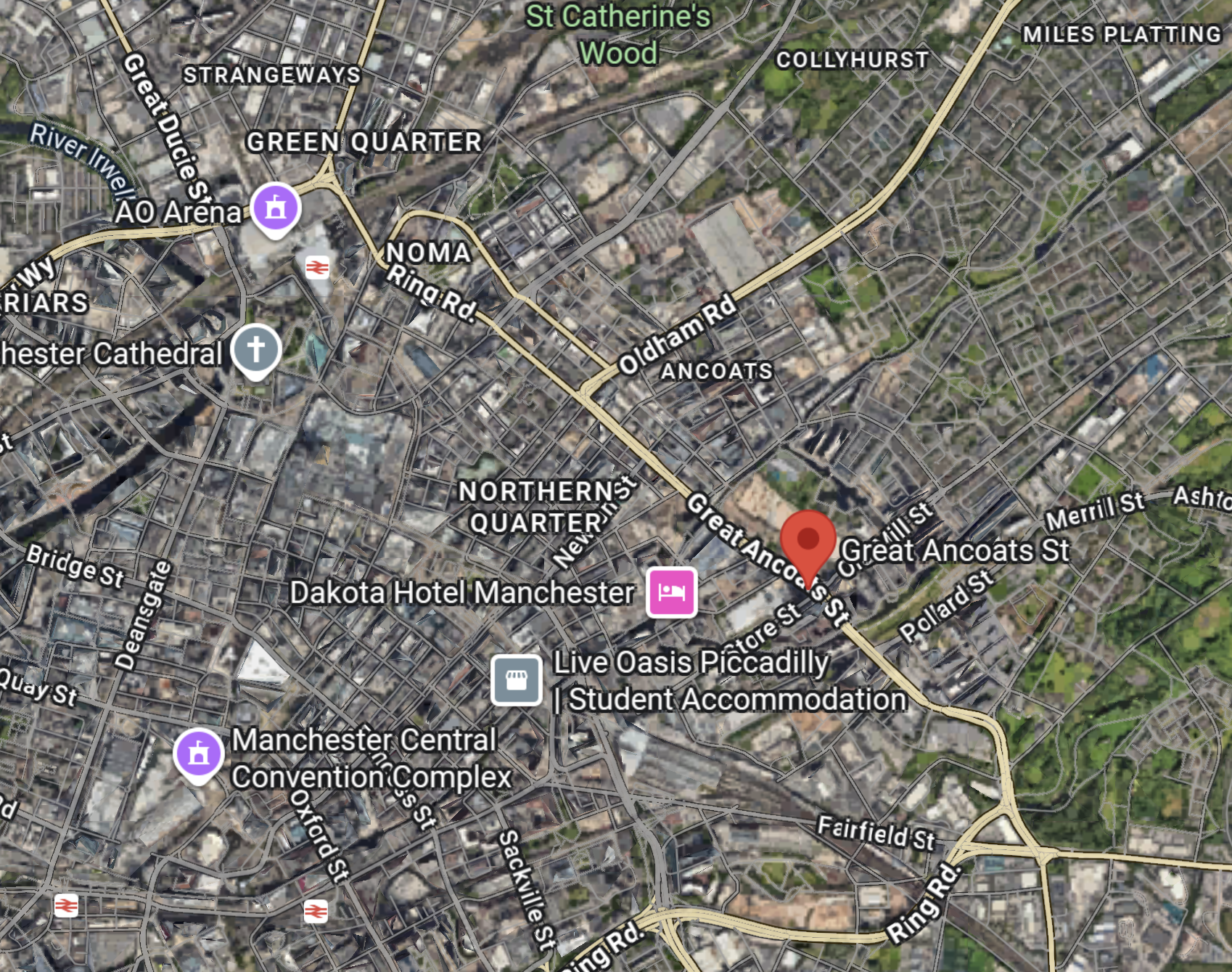
Note.
- Great Ancoat’s Street appears to be part of Manchester’s Inner Ring Road.
- Google placed the red arrow, but I suspect Number 10 North could be somewhere near the arrow.
- Manchester Piccadilly station is not marked on the map, but is about a 0.8 mile South-West of the red arrow, at the end of the rail line going South-East from the map.
- Number 10 North should be about a 5 to 10 minute walk from Manchester Piccadilly station.
- Currently, there is no tram running in this direction.
- The two stations in the South-West corner of the map are Deansgate in the West and Manchester Oxford Road in the East.
- The fourth station in Manchester City Centre is Manchester Victoria in the North-West corner of the map, by the AO Arena and Manchester Cathedral.
- Located between Deansgate, Oxford Road and Victoria stations is a white triangle, which is Manchester Town Hall, with the current location of Number 10 North at Heron House to its West.
- There don’t appear to be any trams on Great Ancoat’s Street, but there are buses between Manchester Victoria and Great Ancoat’s Street, which take about 11-20 minutes.
- As an alternative between Manchester Victoria and Great Ancoat’s Street, you can take a tram to New Islington and walk.
This brief look seems to indicate, that to get to Great Ancoat’s Street, you either walk from Manchester Piccadilly or take trams or buses and a short walk from Manchester Victoria.
This OpenRailwayMap shows Manchester Piccadilly, Manchester Victoria and New Islington.
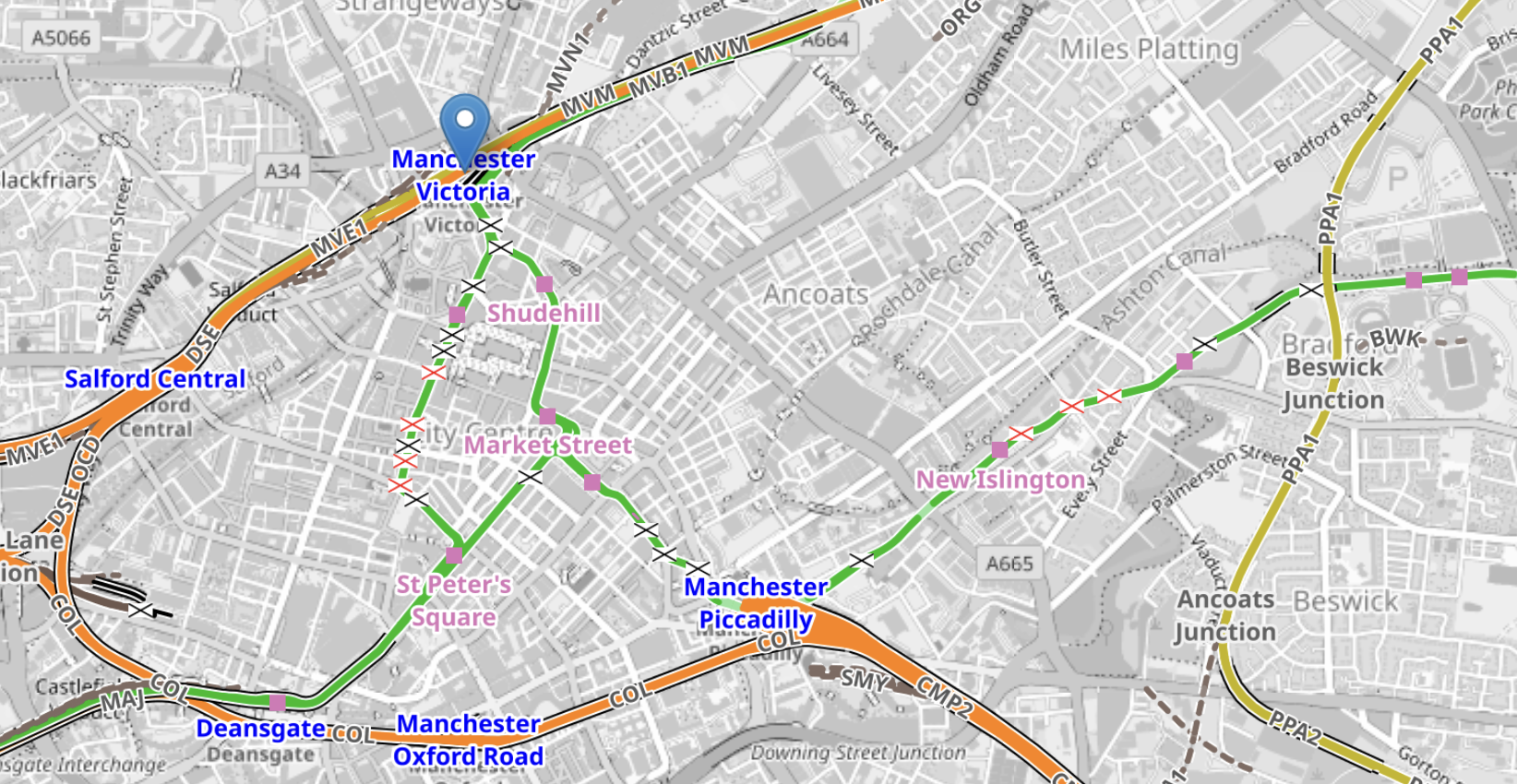
Note.
- Manchester Victoria station is indicated by a blue arrow.
- Manchester Piccadilly station is towards the bottom of the map.
- New Islington tram stop is North-West of Manchester Piccadilly on the green tram line to the Etihad Stadium and Ashton-Under-Lyme tram stops.
- The Etihad Stadium can be seen three tram stops on from New Islington at the Eastern edge of the map.
- Passengers going between Manchester Victoria and New Islington would change trams at Picadilly Gardens tram stop.
I believe that the Future Number 10 North will be within easy walking distance of the New Islington tram stop.
Current London And Manchester Services
Avanti West Cost currently run three hourly trains between Euston and Manchester Piccadilly.
- 1 train per hour (tph) stops at Milton Keynes Central, Rugby, Stoke-on-Trent, Macclesfield, Stockport
- 1 tph stops at Nuneaton, Stoke-on-Trent, Stockport
- 1 tph stops atStafford, Crewe, Wilmslow, Stockport
I don’t think this gives a wide enough coverage of stations.
Lumo’s Proposed London And Manchester Services
Lumo want to run six daily trains between between Euston and Rochdale.
These will stop at Warrington Bank Quay, Newton-le-Willows, Eccles and Manchester Victoria.
Note.
- This could be a fast service, as it is proposed to be non-stop between Euston and Warrington Bank Quay.
- It will probably be only five-cars, which would give no problems terminating at Euston and Rochdale stations.
- Eccles and Rochdale are in Greater Manchester.
- Currently, Warrington Bank Quay, Newton-le-Willows, Eccles and Manchester Victoria don’t have direct trains to London.
- I can see this service appealing to thrifty Yorkshire folk, as Rochdale has 3 tph to Hebden Bridge and Leeds, 2 tph to Halifax and Bradford Interchange, and 1 tph to Brighouse and Dewsbury.
- It could be a low-cost service.
I can see it being successful.
The Role Of Train Stations In Driving Economic Growth
The title of this post, is the same as that of this article on Business Live.
This is the sub-heading.
This role of railway stations is set out in a recent report by Development Economics.
These two paragraphs add more detail.
We usually think of railways and railway stations as places to catch trains. And so they are. They provide us in parts of Wales with an alternative to the motor car particularly for longer journeys; and within the UK where air travel options are few.
This role of railway stations is set out in a recent report by Development Economics: Growing Places – Railway Stations: Engines of Economic Growth. It illustrates the impact of Great Western main line stations including Carmarthen, a medium size station in terms of passenger numbers handling nearly half-a-million entries and exits annually.
It sounds to me, that next time I go to South Wales, I should go and look at Carmarthen.
The report from Development Exconomics is also mentioned in this article on Rail Industry Connect, which is entitled Railway Stations Emerge As Engines Of Growth, But SMEs Must Move Quickly To Secure Their Place.
This is the sub-heading.
Railway stations across the UK are being recast as far more than transport hubs, with new analysis positioning them at the centre of economic growth, regeneration and investment. A recent report by Great Western Railway, Growing Places: Railway Stations – Engines of Economic Growth, sets out the scale of this shift and, crucially, what it means for the rail supply chain.
The initial paragraph adds some more detail.
For SMEs, the message is clear. The opportunity is substantial, but it is evolving. Value is no longer created solely through infrastructure delivery; it is increasingly tied to the wider economic ecosystems that stations enable.
Both articles are a must read.
Andy Burnham should read both!
Will Andy Burnham Take The Highview Road To Lower Energy Bills?
Has Andy Burnham Ever Said He’d Like Energy Bills To Come Down?
I asked Google AI, the question in the title of this section of this post, and received this reply.
Yes, Andy Burnham has explicitly stated he wants to bring energy bills down, making it a central priority upon becoming UK Prime Minister in July 2026. He has pledged to give voters “breathing room” on the cost of living and is considering radical market overhauls to reduce household costs.
But has he looked at radical engineering solutions, that would also help to push energy bills down.
This morning, I wrote Molten Salt And Human Sweat: The Weird Batteries That Could Store Renewable Energy, which is based on a must-read article in today’s Guardian.
The Guardian article shows Andy Burnham with Highview Power’s engineers and managers at the ground breaking ceremony of Highview Power’s 50MW/300 MWh liquid-air grid battery at Carrington in Andy Burham’s feifdom of Greater Manchester, where he was mayor for nine years.
In Andy Burnham and Highview Power, I asked Google AI about their relationship and Andy Burnham came over as an enthusiastic supporter of Highview Power.
In UK Wind Risks ‘Exponentially Rising’ Curtailment Without Energy Storage, I discuss using Highview’s batteries to avoid shutting wind turbines down, when we have too much electricity.
I believe that if Andy Burnham, were to experdite up to 20 of Highview’s largest 300 MW/3.2 GWh batteries around the UK, this would have the right effect on energy bills.
I would hope that Andy Burnham is watching the progress of the Carrington battery closely.
Molten Salt And Human Sweat: The Weird Batteries That Could Store Renewable Energy
The title of this post is the same as that of this article in The Guardian.
This is the sub-heading.
From Nevada to Manchester, developers are trialling innovative solutions to clean energy’s biggest challenge
These first three paragraphs give a taste of what is to come.
In the deserts of the United Arab Emirates a sprawling clean energy project, stretching across an area roughly the size of 12,600 football fields, will play host to a breakthrough allowing solar energy to power the equivalent of half a million homes through the night.
The Gulf state has been steadily combining 5.2GW of solar power capacity with 19GWh of battery storage to create the largest battery scheme in the world.
Meanwhile, about 7,500 miles away, at the US’s National Renewable Energy Laboratory facility in Colorado, researchers and engineers are making some of the smallest batteries the world has ever seen. A fraction of the size of the grid-scale lithium-ion batteries used to store renewable energy, they have been designed to power electronic tags that will track the 3in-long (about 7.5cm) young from salmon and eel species.
And seeing, that they used to be the Manchester Guardian and that Andy Burnham is surely the man-of-the-day for other reasons, Highview Power’s 50 MW/300 MWh at Carrington in Manchester gets a big mention under a section heading of Liquid Air, with Burnham in hi-vis jacket and hard hat.
This picture, which is courtesy of The Guardian, shows the groundbreaking ceremony of the Carrington battery.
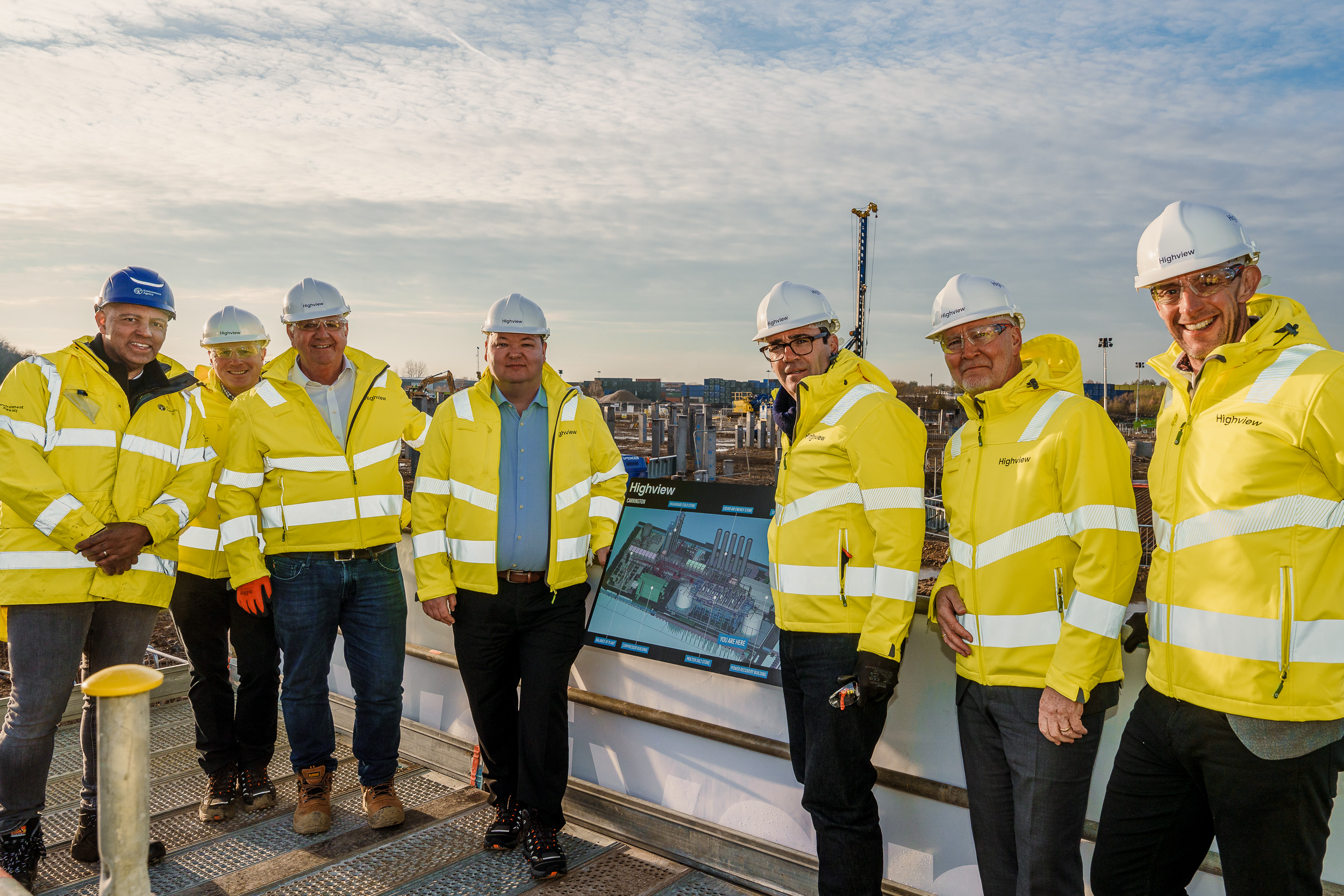
Andy Burnham is third from the right.
The Guardian article is very much a must read, that features projects from the United Arab Emirates, Colorado, Finland, Manchester, Nevada and Japan.
Andy Burnham Promised 10,000 Council Houses. Guess The Tally So Far
The title of this post, is the same as that, of this article in The Times.
This is the sub-heading.
Greater Manchester is a success story but that has little to do with the mayor, still less the economic model he is touting for the country
These are the first two paragraphs.
I don’t like being mean to Andy Burnham. With his soft, doe-eyed features, it feels rather like punching a lamb. But it’s quite an achievement when “We’ve got to get beyond this thing of being in hock to the bond markets” isn’t actually the stupidest thing a politician has said in any given week.
The other day Burnham kicked off his not-quite-a-leadership bid by urging Labour to embrace “Manchesterism”. This he defined as “business-friendly socialism”, in which the state “rolled back the 1980s” by seizing control of “the basics of life”: housing, energy, water, rail. This included borrowing £40 billion for new council housing.
This paragraph from Robert Colville gives the current progress on housing in Manchester.
Burnham did announce, in May 2024, that he was going to build 10,000 council houses by 2028. But over the following year the region started construction on just ten. No, that’s not a typo.
That is not a good start!

