Batteries Ordered For Grand Central Inter-City Trains
The title of this post, is the same as that of this article on Railway Gazette.
These three paragraphs add detail to the article.
Hitachi Rail has selected Turntide Technologies to supply lithium iron phosphate batteries for use on electric-diesel-battery hybrid inter-city trainsets it is to build for Arriva’s open access operator Grand Central.
Nine five-car trainsets are to be manufactured at Hitachi Rail’s Newton Aycliffe factory for delivery in 2028 under a order placed by leasing company Angel Trains in March.
Under the latest agreement announced on July 2 Hitachi Rail will place orders worth nearly £10m for Turntide to continue with R&D and supply next-generation LFP batteries, which are designed to be smaller and more powerful than previous lithium-ion batteries. The Safety Integrity Level 2 and IEC 61508 compliant battery management system will detect and mitigate hazards and meet the IEC 62243 cybersecurity standard.
There is also this paragraph, which describes the benefits of the trains.
The battery technology is expected to cut the Grand Central trains’ emissions and fuel consumption by around 30%, with the trains entering and exiting stations in zero-emission mode to improve air quality and reduce noise in urban centres.
Angel Trains, Grand Central, Hitachi Rail and Turntide Technologies seem to be playing this all carefully, as I suppose that they don’t want to be left with a large problem, if the current government decides to take over open access services.
Arriva Group Invests In New Battery Hybrid Train Fleet In Boost To UK Rail Industry
The title of this post, is the same as that of this news item from Arriva Group.
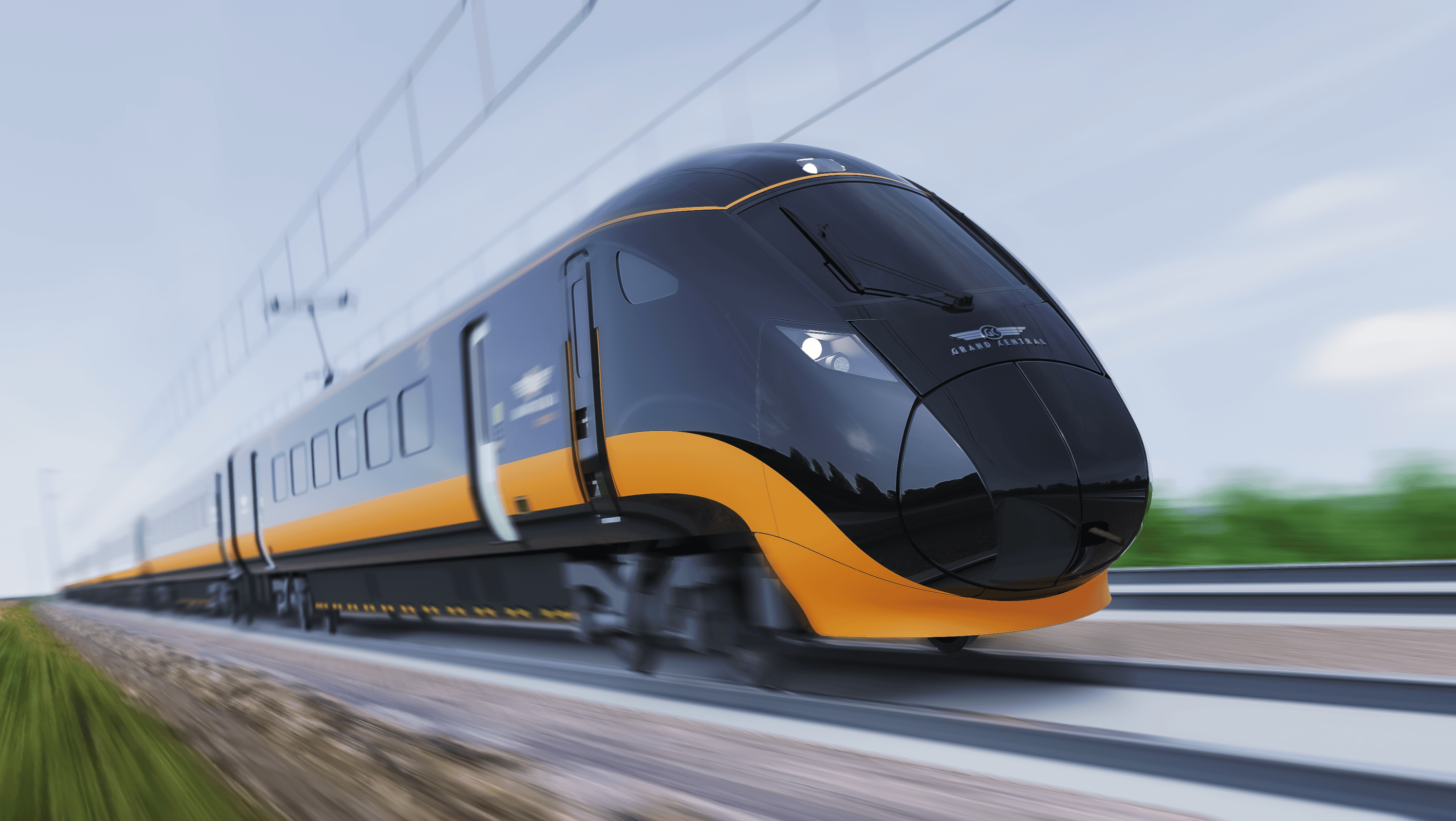
These four bullet points act as sub-headings.
- Order worth around £300 million for fleet of new trains, which will increase seats by 20 per cent, improving capacity and connectivity.
- 45 rail cars to be manufactured at Hitachi Rail in the North East and financed by Angel Trains, helping secure highly skilled jobs and unlocking a new advanced manufacturing opportunity for rail.
- State-of-the-art ‘tri-mode’ train technology has proven its ability to cut emissions and fuel costs by around 30 per cent to support UK Government’s decarbonisation agenda.
- Announcement is made from Hitachi’s Newton Aycliffe factory and attended by the Secretary of State for Transport, Heidi Alexander MP.
These three paragraphs give more details.
Arriva Group announced today an order for nine cutting-edge battery hybrid trains to replace its entire Grand Central fleet, providing a major boost to regional economies and offering passengers more comfortable, greener travel options.
The order for 45 Hitachi Rail ‘tri-mode’ cars, which have the flexibility to run on electrified and non-electrified tracks, along with a 10-year maintenance contract, represents an investment of around £300 million. Tri-mode means the trains can be powered using electricity, battery or diesel.
It follows approval by the rail regulator for extended track access rights for Grand Central’s existing services through to 2038, with the investment underpinning Arriva’s long-term commitment to UK rail and to delivering sustainable public transport solutions to communities up and down the country and across Europe.
The trains will be built by Hitachi at Newton Aycliffe.
I have some further thoughts and questions.
What Distances Will The Trains Run Away From Electrification?
The distances that the various services will run away from electrification are as follows.
- King’s Cross and Bradford Interchange – Doncaster and Bradford Interchange – 52.1 miles.
- King’s Cross and Cleethorpes – Doncaster and Cleethorpes – 52.1 miles.
- King’s Cross and Sunderland – Longlands junction and Sunderland – 48.5 miles.
It would appear that a train with a range away from electrification of 55 miles would be enough, if there were to be charging at all the destinations.
Will The Trains Be Able To Take The Great Northern And Great Eastern Joint Line (GNGE) Diversion Via Lincoln On The East Coast Main Line?
I discussed using this diversion in detail in London And Edinburgh By Lumo Using the Joint Line Diversion.
In that post, I said this.
The January 2024 Edition of Modern Railways says that the diversion is approximately 90 miles or 145 kilometers.
If the trains have a 90 mile capability on batteries and/or diesel, they will be able to use the diversion.
As Hull Trains, LNER and Lumo all need this ability to take the GNGE Diversion, I suspect, it will be a tick-box on the order form for the trains.
When Will The Trains Be In Service?
The news item says this.
The trains will be delivered in 2028 under a 10-year leasing arrangement, in partnership and financed by Angel Trains.
Will The New Trains Be Faster?
They might save a couple of minutes, if Doncaster is the first stop.
Will The New Trains Be Quieter?
The news item says this about noise and emissions.
State-of-the-art ‘tri-mode’ train technology has proven its ability to cut emissions and fuel costs by around 30 per cent to support UK Government’s decarbonisation agenda.
Hitachi have said that the diesel engines will not run in stations.
Could The Trains Run Grand Central’s Routes Carbon-Free?
In The Data Sheet For Hitachi Battery Electric Trains, I came to these conclusions
- The battery pack has a capacity of 750 kWh.
- A five-car train needs three battery-packs to travel 100 miles.
- A nine-car train needs five battery-packs to travel 100 miles.
- The maximum range of a five-car train with three batteries is 117 miles.
- The maximum range of a nine-car train with five batteries is 121 miles.
As battery technology gets better, these distances will increase.
If I was choosing the trains for Grand Central, the trains would be able to operate these routes without using diesel.
- Doncaster and Bradford Interchange and return.
- Doncaster and Cleethorpes and return.
- Longlands junction and Sunderland and return.
Passengers might not like to have noisy passengers.
Probably, the best insurance policy to avoid running out of battery power, would be to have perhaps fifty metres of electrification at terminal stations. Hitachi claim they can offer a nice line in short lengths of electrification.
Quiet Trains Should Attract Passengers
I’ve seen it before and also with buses.
The Number Of Trains Ordered
The basic order is for nine trains, but Railway Gazette says this.
Arriva welcomed the ‘swift decision-making’ by ORR and the backing of the Department for Transport and Network Rail. It has also submitted applications to run more trains to Bradford and introduce services to Cleethorpes, and has an option to buy more trains if these are approved.
I’ve read somewhere that the option is for three extra trains.
So that’s a total of twelve, which would replace the ten Class 180 trains and two Class 221 trains, that Grand Central Trains currently run.
What About Chiltern Railways And CrossCountry?
Train operating companies Chiltern Railways, CrossCountry and Grand Central Trains are all wholly owned subsidiaries of Arriva Trains UK, who are described like this in the first paragraph of their Wikipedia entry.
Arriva UK Trains Limited is the company that oversees Arriva’s train operating companies in the United Kingdom. It gained its first franchises in February 2000. These were later lost, though several others were gained. In January 2010, with the take-over of Arriva by Deutsche Bahn, Arriva UK Trains also took over the running of those formerly overseen by DB Regio UK Limited
Arriva is ultimately owned by American infrastructure investment company; I Squared Capital.
Both Chiltern Railways and CrossCountry have trains, that are coming to the date, when they will need to be replaced and similar trains to those ordered by Grand Central could be suitable. to replace some.
Chiltern Railways have six rakes of Mark 3 coaches, that are hauled by diesel locomotives between London Marylebone and Birmingham Moor Street stations, These rakes of coaches could be replaced by Hitachi tri-mode trains, of perhaps five or six cars.
Chiltern Railways also have about sixty assorted diesel multiple units totalling up to about 150 carriages.
CrossCountry Trains have twenty-nine two- or three-car Class 170 trains and sixty-one four- or five car Class 220 or 221 trains. All these ninety trains were built this century and are diesel-powered.
The Government’s policy of net-zero by 2050, would probably mean a significant number of these smaller diesel multiple units need to be replaced by 2030.
If the Grand Central Trains new Hitachi trains are a success, then changing the longer four-, five- and six-car trains for similar Hitachi trains, would be a low-risk replacement strategy for I Squared Capital, that could be applied at Chiltern Railways and CrossCountry.
I can also see a need for a two-, three- or four-car tri-mode train for Chiltern Railways and CrossCountry.
Was The Date Of The Announcement Significant?
In October 2020, I wrote Hitachi Targets Export Opportunities From Newton Aycliffe and I believe that tri-mode trains like these that Grand Central have ordered could have export opportunities.
One country for exports has possibilities and that is the United States.
- Hitachi AT-300 trains like these don’t need expensive high-speed tracks and there are probably many lines in the United States, where these trains could fit existing tracks.
- This page on the Hitachi Rail web site is entitled Hitachi Rail in the USA and Canada.
- In the UK, companies like GWR, LNER, Southeastern and TransPennine Express effectively use theHitachi trains as fast commuter trains on some routes.
- Trump’s tariffs would only be 10 % on these trains.
- The Grand Central version looks very stylish!
- Hitachi’s battery technology is owned by Turntide Technology, who are a US company.
- For some routes, the trains would probably only need to be battery-electric.
Has the experience of running Chiltern Railways, CrossCountry and Grand Central Trains convinced I Squared Capital, that running railways is a good investment?
Have I Squared Capital identified some railroads in the United States, that could follow a similar upgrade path to Chiltern Railways?
Was it significant that the order was announced the day after Trump’s tariffs?
.
Fourteen New Trains To Drive First Rail Open Access Growth
The title of this post, is the same as that of this press release from First Group.
These four bullet points are sub-headings.
- The Group has signed an agreement with Angel Trains and Hitachi to lease 14 new five-car class 80X Hitachi electric, battery electric or bi-mode trains (70 cars in total) at a cost of c.£500m including maintenance, over a ten year lease period
- The trains will be manufactured by Hitachi in County Durham, securing the skills base and jobs in the local area
- The new trains will enable FirstGroup to significantly expand its open access portfolio and will be used on the newly announced London-Carmarthen route and to increase the number of cars on the existing Lumo and Hull Trains services
- The agreement also contains an option for FirstGroup to lease up to an additional 13 trains on the same terms if the Group’s open access applications are granted by the Office of Rail and Road (‘ORR’)
These first three paragraphs add a bit more detail.
Prime Minister Sir Keir Starmer is visiting Newton Aycliffe, County Durham, today to celebrate a significant agreement for the Hitachi factory which has secured an order to manufacture 70 new rail cars for FirstGroup’s growing open access business, creating certainty for the manufacturing skills base, and the factory’s future.
The Lease Agreement will deliver 14 new trains, which will not only give the Group a homogenous fleet across its open access operations, ensuring flexibility and reliability for customers, but also facilitates the Group’s strategic objective of materially increasing its open access capacity. Delivery of the new trains is expected to commence in late 2027. The lease will be financed by Angel Trains, adding to their portfolio of Hitachi assets. The trains will be maintained by Hitachi at their facilities around the country.
The trains will be used on the Group’s open access rail services, including the Carmarthen-London route announced on 5 December, and the existing Hull Trains and Lumo services on the East Coast Mainline.
Note.
- Does the presence of Keir Starmer indicate any approval for open access?
- Trains could be electric, battery electric or bi-mode.
- Bi-mode trains should only be purchased these days, if they are convertible to battery-electric trains. Hitachi’s can.
- Delivery is expected to commence in late 2027.
- The first fourteen trains will be deployed on the London to Carmarthen, Edinburgh and Hull routes.
This table shows the trains needed initially for each route.
- Carmarthen – Class 802 trains – 5 tpd – 5 trains – 75.3 miles unelectrified
- Edinburgh – Class 803 trains – 5 tpd – 5 trains – electrified
- Hull – Class 802 trains – 5 tpd – 5 trains – 44.3 miles unelectrified
Note.
- tpd is trains per day.
- I’m assuming that as unelectrified distances to Carmarthen and Hull are not that far apart, the number of trains needed is the same.
- Class 802 trains are bi-mode.
- Class 803 trains are electric.
After the fourteen new trains are delivered, there will be a combined fleet of 29 trains.
Consider.
- Hull Trains have started running some services as pairs of trains. I wrote about this in Ten-Car Hull Trains.
- Lumo has been a success and perhaps needs more capacity.
The Wikipedia entry for Grand Union says this.
Grand Union proposed to operate with ex-LNER Class 91s and Rail Operations Group Class 93s hauling nine-car Mark 4s and a Driving Van Trailer.
So perhaps the Carmarthen service needs ten-car trains.
That would mean that the number of routes needed for the three routes would be as follows.
- Carmarthen – Class 802 trains – 5 tpd -10 trains
- Edinburgh – Class 803 trains – 5 tpd -10 trains
- Hull – Class 802 trains – 7 tpd – 10 trains
It would appear that we’re a train short with 29 in the combined fleet against a need of 30 trains.
But then it would also appear that Hull Trains can provide the required five/ten car service with only four trains.
I would assume that the extra train, goes to make up the numbers for Lumo’s Carmarthen service.
Brand New Battery Technology To Be Trialled On TransPennine Train
The title of this post, is the same as that of this press release from Hitachi.
These three bullet points, act as sub-headings.
- First-ever trial in the UK to replace a diesel engine with a battery on an intercity train is underway.
- Pioneering collaboration between Angel Trains, TransPennine Express, Turntide Technologies and Hitachi Rail.
- Hitachi Rail has built a battery using the North East supply chain, with one battery unit predicted to reduce emissions and fuel costs by as much as 30%.
These are my thoughts on some of the paragraphs in the press release.
The First Paragraph
This is the first paragraph.
Testing of the UK’s first intercity battery train commenced earlier today. The battery, which generates a peak power of more than 700kw, has now been successfully retrofitted onto a TransPennine Express ‘Nova 1’ train (five-carriage intercity Class 802), ahead of the trial on Transpennine routes this summer.
Each of the three diesel power packs in on of TransPennine Express’s Class 802 trains can generate 700 kW, so the battery packs can provide the same power as the current Rolls-Royce mtu diesel power packs.
The Third Paragraph
This is the third paragraph.
The single battery unit is incredibly powerful, storing enough electricity to power more than 75 houses for a day. This impressive energy and power density will deliver the same levels of high-speed acceleration and performance, while being no heavier than the diesel engine it replaces.
This equity of high-speed acceleration and performance is to be expected, as the train power and weight is the same, if the power is diesel engines or batteries.
The Fourth Paragraph
This is the fourth paragraph.
The installation of a battery will reduce emissions and improve energy efficiency. It is predicted to reduce emissions and fuel costs by as much as 30% on a Hitachi intercity train.
I would assume that this improvement in emissions and fuel costs, is due to the use of regenerative braking to recharge the batteries, when the train slows down.
The Fifth Paragraph
This is the fifth paragraph.
Most importantly for passengers, the trial will test how intercity trains can enter, alight and leave non-electrified stations in zero-emission battery mode to improve air quality and reduce noise pollution.
As the trains enter a non-electrified station, the regenerative braking will recharge the batteries to both power the train in the station and accelerate the train on its way.
The Seventh Paragraph
This is the seventh paragraph.
The trial will provide real-world evidence to inform the business case for a 100% -battery-electric intercity train, capable of running up to 100km in battery mode. This remarkable range means this battery technology could be deployed to cover the final non-electrified sections of intercity routes in the coming years. It will also demonstrate how battery technology can reduce infrastructure costs by reducing the need for overhead wires in tunnel sections and over complex junctions.
Note that 100 kilometres is 62.1 miles.
You can never do too much real world testing!
These are my further thoughts.
Acceleration And Braking Under Battery Power
This graph from Eversholt Rail, shows the acceleration and deceleration of a five-car Class 802 electric train.
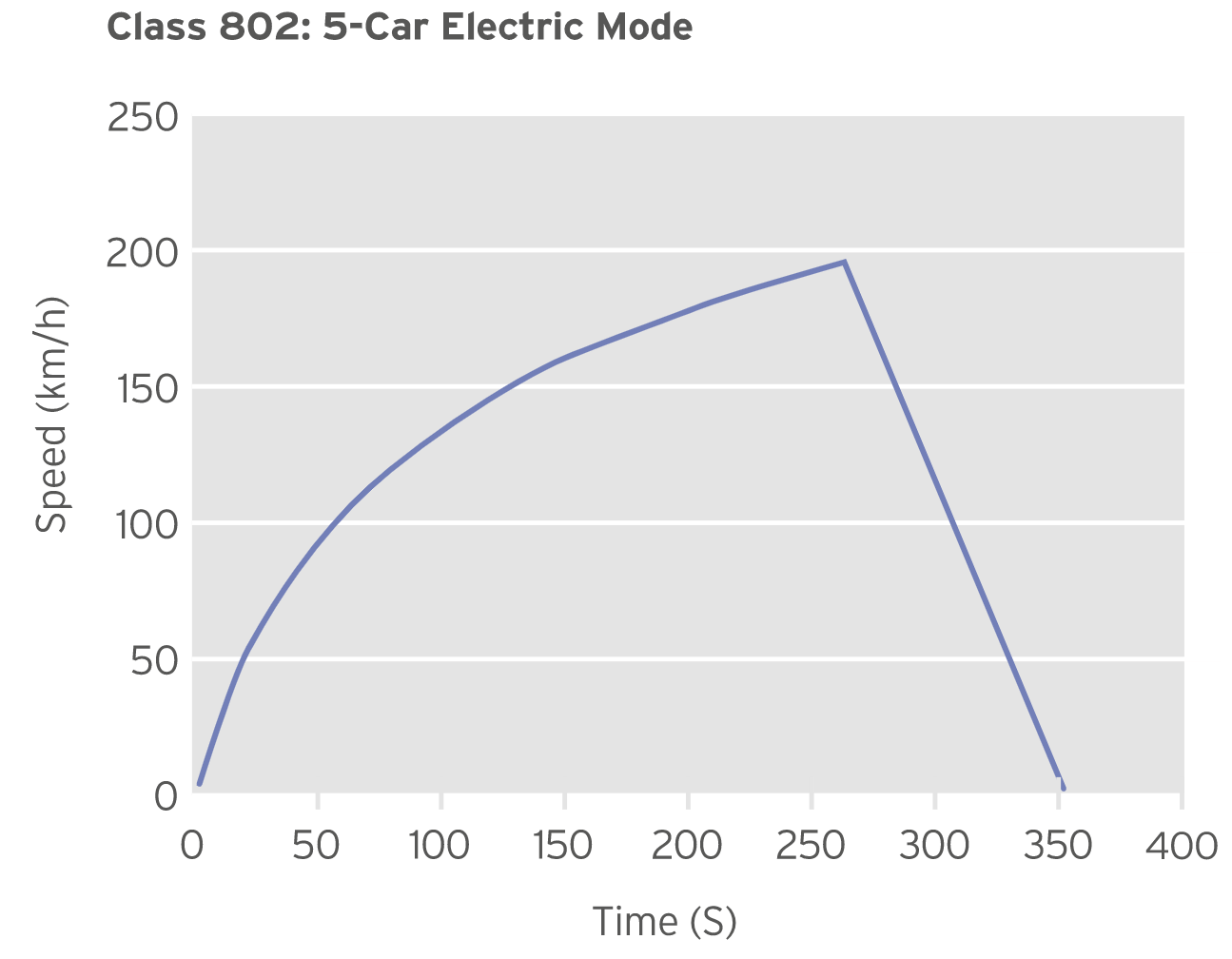
As Hitachi have said in the press release that.
- The weight of a battery pack is the same as a diesel engine.
- The power of a battery pack is the same as a diesel engine.
The acceleration and braking curve for a Class 802 train, with a single traction battery will surely be the same.
Would this mean, that if a battery-electric train replaced a diesel-electric train, the timetable would be the same?
What would be the effects, if a second diesel engine were to be replaced with a battery pack?
- The train would still weigh the same.
- The train’s performance would still be the same.
- The train would have 1400 kW of power available, but I doubt this could be used efficiently, as it might exceed the train’s performance limits.
- The train would have enough electricity for a 200 kilometre or 124.3 mile range.
There might be a need for a sophisticated control system to set the power mode, but in my experience of riding in the cab of an InterCity 125 and a Boeing 747, drivers or pilots have enough intelligence and fingers to control systems with multiple engines.
What would be the effects, if a third diesel engine were to be replaced with a battery pack?
- The train would still weigh the same.
- The train’s performance would still be the same.
- The train would have enough electricity for a 300 kilometre or 186.4 mile range.
The range is sufficient for a lot of routes.
London And Beverley
Consider.
- This route has 44.3 miles of unelectrified track between Temple Hirst Junction and Beverley.
- One battery range is 100 kilometres or 62.1 miles.
- As the trains have three slots for battery packs or diesel engines, they could always carry a diesel engine for emergencies.
The route could be run in one of two ways.
- By using one battery, that would be charged at Beverley.
- By two batteries, that would be charged on the main line to the South of Temple Hirst Junction. One battery would be used in each direction.
Note.
- The second method would not require any new infrastructure at Beverley or Hull.
- All batteries would be identical 100 km batteries.
- Trains would just swap an appropriate number of diesel engines for batteries.
The service could run as soon as the trains had the power transplants.
Using The Lincoln Diversion
In Extra Luggage Racks For Lumo, I also talked about Lumo taking the diversion via Lincoln.
Consider.
- This route is 88.5 miles of unelectrified track.
- It would be possible to be handled by a Class 802 train with two battery packs.
- Hull Trains will need battery packs to get to Beverley.
- Some LNER services will use battery packs.
Perhaps trains will use one battery to Lincoln and one from.
Crewe And Holyhead
In October 2023, the government said, that the North Wales Coast Line would be electrified.
Consider.
- Crewe and Holyhead are 105.5 miles apart.
- The route currently has no electrification.
- It has been planned to electrify the 21.1 miles between Crewe and Chester for some time.
- A lot of the route West of Chester may arouse the wrath of the Nimbies and be politically difficult to electrify, as castles and electrification don’t mix.
- Llandudno Junction station might be a station, where trains could be charged.
- Shotton and Chester stations need rebuilding.
- The line is not short of electric power, because of Electric Mountain and the windfarms along the coast.
- The route will soon be served by Hitachi Class 805 trains.
I believe the North Wales Coast Line could be one of those routes, which Hitachi’s partial electrification might be ideal.
I also believe that, it could be an extension of High Speed Two from Crewe, which provided a zero-carbon route between London and Ireland.
Conclusion
I can see if the tests perform as expected, that there will be some battery express trains running soon.
Hydrogen Rail Project Collaboration Launched By Angel Trains And University of St Andrews
The title of this post, is the same as that of this article on Rail Technology Magazine.
This is the sub-heading.
Angel Trains, the UK’s largest rolling stock company, has partnered with the University of St Andrews to support an innovative hydrogen train project.
On Friday 29th September, an event was held to mark the donation of a hydrogen electrolyser to the university by Angel Trains. The electrolyser will form an integral part of the university’s ongoing, cutting-edge green hydrogen research.
This is the first paragraph.
The donation follows Angel Trains’ support for the delivery of Scotland’s first zero-emission hydrogen-powered train. The project entailed the conversion of a three-car Class 314 train to a hydrogen fuel cell electric powertrain. The electrolyser was key to enabling the trial to successfully demonstrate how a green-energy fuel cycle would work.
Hopefully, this initiative will lead to better use of hydrogen on the railways of the UK.
The Future Of West Midlands Trains’s Class 350 Trains
Currently, West Midlands Trains have four sub-fleets of Class 350 trains.
- Class 350/1 – 30 trains – Leased from Angel Trains
- Class 350/2 – 37 trains – Leased from Porterbrook
- Class 350/3 – 10 trains – Leased from Angel Trains
- Class 350/4 – 10 trains – Leased from Angel Trains
Note.
- All are 110 mph trains
- The trains are capable of being modified for 750 VDC third-rail electrification.
Under Future the Wikipedia entry for Class 350 trains says this.
West Midlands Trains announced that they would be replacing all 37 of their 350/2 units for Class 350/4 units cascaded from TransPennine Express and brand new Class 730 units which both can travel up to speeds of 110 mph.
In October 2018, Porterbrook announced it was considering converting its fleet of 350/2s to Battery electric multiple units for potential future cascades to non-electrified routes.
As West Midlands Trains have ordered 45 Class 730 trains for express services, it looks like they will be expanding services on the West Coast Main Line and around the West Midlands.
But it does appear that as many as thirty-seven trains will be returned to Porterbrook.
Class 350 Trains With Batteries
I believe that if fitted with batteries, these trains would meet or be very near to Hitachi’s specification, which is given in this infographic from Hitachi.

Note that 90 kilometres is 56 miles.
Could West Midlands Trains Run Any Services With Class 350 Trains With Batteries?
I think there are some possibilities
- Birmingham New Street and Shrewsbury – 30 miles without electrification between Shrewsbury and Wolverhampton – Charging facility needed at Shrewsbury.
- Birmingham New Street and Hereford via Worcester – 41 miles without electrification between Hereford and Bromsgrove – Charging facility needed at Hereford.
- Leamington Spa and Nuneaton via Coventry – 19 miles without electrification – Charging on existing electrification at Coventry and Nuneaton.
- The proposed direct Wolverhampton and Walsall service, that i wrote about in Green Light For Revived West Midlands Passenger Service.
There may also be some services added because of the development of the Midlands Rail Hub and extensions to London services,
Who Has Shown Interest In These Trains?
I can’t remember any reports in the media, about any train operator wanting to lease these trains; either without or with batteries.
Conclusion
It does all seem a bit strange to me.
- As a passenger, I see nothing wrong with these trains.
- They are less than twenty years old.
- They are 110 mph trains.
- They have 2+2 interiors, with lots of tables.
- They could be fitted with batteries if required.
But then, all of those things could be said about Greater Anglia’s Class 379 trains.
Class 165 Trains To Go Hybrid
There must be something in the DNA of British Rail’s rolling stock.
Mark 3-based trains like the InterCity 125, Class 319 and Class 321 trains seem to have had collectively more lives than a city full of feral cats.
It is also understandable, that MTU are looking at upgrading modern rolling stock built with their engines to be more efficient and environmentally-friendly. They have launched the MTU Hybrid PowerPack, which adds up to four 30 kWh batteries, electric drive and regenerative braking to a typical diesel multiple unit built in the last twenty years.
So now, upgrading the traction systems of the Class 165 trains is being undertaken.
The Wikipedia entry for Class 165 trains, says this under Future Development.
It was reported in September 2018 that Angel Trains were to convert class 165 units for Chiltern Railways to hybrid diesel and battery-powered trains, and that the first Class 165 HyDrive train should be ready by late 2019.
There is more in this article on Rotherham Business, which is entitled Magtec Changes Track To Convert Diesel Trains.
This is said.
Magtec, the UK’s largest supplier of electric vehicle drive systems, is working to deliver the rail industry’s first conversion of a diesel-powered train to hybrid drive.
Founded in 1992, MAGTEC designs and manufactures electric drive systems and components for a wide range of applications including trucks, buses and military vehicles.
This is also said about the modified trains performance.
In future, passengers using the Class 165 HyDrive could benefit from potentially reduced journey times, thanks to the improved acceleration offered by the hybrid technology compared to its diesel-only counterparts. Additionally, when the hybrid system detects proximity to stations or depots, it will turn the engines off and run on its battery, removing gaseous and noise emissions from populated areas.
That sounds very good to me.
There is also a serious article in the Financial Times, which is entitled Hybrid Battery Trains Set To Shorten Commuter Journey Times.
The headline sounds like hype, but then it is the FT, who usually tell it as it is. Read the article and there is a lot of philosophy and reasons behind this avalanche of retrofitting old trains with new innovative traction systems, in Germany, France and the UK.
It should be remembered that Chiltern have a record of doing the right things.
Further Development
MAGTEC look to be a very innovative company.
The Class 465 train is a third-rail electric train, that is closely-related to the Class 165 train.
It should be noted that sixteen miles of the London to Aylesbury Line is electrified using London Underground’s fourth-rail system.
So could we see the creator’s of the Class 165 HyDrive train, raid the Class 465 train’s parts bin, so the trains can use London Underground’s electrification?
Conclusion
If the project produces a successful outcome, there are seventy-five Class 165 trains running on Chiltern and Great Western Railway, which all seem to be in good condition.
 The Anonymous Widower