AI Could Make New Runways Obsolete
The title of this post, is the same as that of this article on Jewish News.
This is the sub-heading.
As Heathrow’s controversial third runway gets the green light and Gatwick looks on track for a second one, an Israeli tech innovation could reduce the need for such costly expansions.
These paragraphs add some detail.
IntellAct is a cutting-edge AI company that helps airports maximise efficiency, cut delays and save billions of pounds. By optimising ground operations and reducing aircraft turnaround times, it could spare airports the need for new runways entirely.
“The aviation industry is bleeding from a thousand cuts,” says Udi Segall, IntellAct’s founder and CEO. “Constant delays – with an average of 15.5 minutes per flight — add up to billions in costs. We saw a financial opportunity in how airlines manage their activities, and that’s where IntellAct comes in.”
IntellAct leverages big data and machine learning to provide airlines, airports and ground handling teams with real-time visibility into service performance bottlenecks and the ability to address them in a way that can yield significant operational improvements and a dramatic reduction in flight delays.
It’s an interesting thought.
I am reminded of a story from the 1960s, from ICI.
They had a polypropylene plant, that was notoriously inefficient, so a guy called Humphrey Bowen (?) used a discrete simulation program called HOCUS to create a board game of the chemical plant. This game was then played one Sunday, with beer and sandwiches between the various teams of production workers. It became heated at one point, but they did learn a lot about the behaviour of the plant and improved its efficiency.
I think it is true to say, that in the early 1970s, I worked with a bunch of interesting people at ICI Plastics.
These days, use might be made of a digital twin.
A Funny Sunday Morning
I didn’t sleep that well and I got up about 05:45.
But by 06:30, I’d completed and entered the Sunday Times Prize Sudoku, as I always do.
The odds of winning must be exceedingly long, as I complete it every week and have not won anything yet.
I had my bath and flushed the sleep from my eyes in the hot water as I always do and by 10:15, I was sitting in Leon at the Angel having my usual gluten free Full-English breakfast.
I also went round the corner to the Marks and Spencer to buy a few items I needed.
- Bananas – I can never have too many
- British Strawberries – Strawberries are rich in magnesium and coeliacs can be low, so when I see quality strawberries I usually buy.
- Liver and Bacon Ready Meal for One – I have one a week to keep up my B12 levels and Ocado didn’t have any yesterday.
- Packet of Chocolate Cakes – I am slightly addicted.
The strawberries were from Dyson Farming, which I would have thought was the wrong side of the political spectrum for Islington.
My left knee also had a funny turn, which I was looking for the liver. Was it just reminding me that, if it didn’t get its B12, it would play up something rotten or was my brain using my knee to signal that it was low in B12 after the superb work on the sudoku?
Thirteen years ago I had a serious stroke and two or three serious doctors have said I’ve made a remarkable recovery.
From what I can gather on the Internet in the United States, I would have been given B12 injections for my stroke.
But then I am, as I am coeliac and Addenbrooke’s prescribed the injections, when I was diagnosed as coeliac in the 1990s. So is that behind my excellent recovery from stroke or did the Chinese doctors in Hong Kong diagnose my stroke as worse than it was?
Since I swapped to Ocado for my food purchases about two months ago, I have found it easier to buy the Marks and Spencer’s Liver and Bacon. I now eat one every week to top up my B12 and the arthitis, I occasionally get in my joints has reduced.
So I asked Dr. Google if arthritis gets worse after a stroke.
They pointed me to this paper on the National Library of Medicine. They also helpfully gave me this AI-derived answer to my question.
Yes, arthritis can worsen after a stroke:
Osteoarthritis
A common type of arthritis that can worsen after a stroke. This can be due to spasticity that develops after a stroke. Osteoarthritis can also make it harder for stroke patients to recover during rehabilitation.
Rheumatoid arthritis
Patients with RA may experience worse functional outcomes after a stroke due to pain and swelling in their extremities. RA patients may also have an increased risk of ischemic stroke.
Other types of pain that can occur after a stroke include: Headaches, Tingling sensations, Shoulder pain, and Central post-stroke pain.
Pain after a stroke can range from headaches that resolve on their own to chronic, severe joint pain.
Ic like the answer, as it fits my symptoms. Is artificial intelligence going to do some doctors out of a job?
I certainly get the tingling sensations.
I’ve just prescribed myself Liver and Bacon for a late lunch.
I’ll report back later!

Note, that I’m eating in front of the computer with the new keyboard.
£10bn Investment In AI Data Centre Confirmed
The title of this post, is the same as that of this article on the BBC.
This was the sub-heading.
A £10bn investment in a new artificial intelligence data centre will create about 4,000 jobs, the government has said.
These two paragraphs add more details.
The site in Cambois, near Blyth, Northumberland, will become one of Europe’s biggest AI data centres.
The land was bought by private equity giant Blackstone earlier this year, after the collapse of Britishvolt which had planned to build an electric car battery factory on the site.
In My First Trip On The Northumberland Line – 18th December 2024, I said this after my first trip to the line.
The Blyth Valley Is Well Supplied With Electricity
Several high-capacity connections to wind farms and Norway are planned to come ashore at Blyth and it appears from the pictures that the area is well connected to the grid.
This must have nudged Britishvolt to put their battery plant at Blyth.
But no matter for those jobs, as with a rail service to Greater Geordieland and lots of electricity, there must be other energy-hungry businesses like datacentres or small modular reactor factories, who would want the site.
The Long Platforms
I am fairly sure that some of the platforms have been sized to take a five-car Hitachi Class 80x train, which are only 130 metres long and can carry around 400 passengers.
This must enable the ability to use the Northumberland Line as a diversion for the East Coast Main Line.
Some services could perhaps stop at Blyth for the large factories and/or Northumberland Park for the Metro.
It looks to me, that the Northumberland line was designed for large factories or businesses with lots of workers, that needed lots of electricity.
I’ve Got Uncomplicated Pancolonic Diverticular Disease
No doctor or anybody else for that matter seems at all bothered.
I did ask Dr. Google, if there was a link between pancolonic diverticular disease and coeliac disease and this paper entitled Prevalance Of Celiac Disease In Subjects With Diverticular Disease Of The Colon was indicated.
This was the conclusion of the researchers.
The results show an inverse relationship between
diverticular disease of the colon and celiac disease. These data
support that the presence of celiac antibodies may have a
preventive role in the development of colon diverticular disease.
The mechanism of the presented finding is still unclear. More
research is needed.
I can accept that conclusion.
Click this link to see what the NHS says about Diverticular Disease and Diverticulitis.
It’s not very helpful, but just a bit frightening.
Could it be, that my strong immune system is protecting me?
I have a few extra thoughts.
Living With Uncomplicated Pancolonic Diverticular Disease
I have now been living with Uncomplicated Pancolonic Diverticular Disease for around six months.
But I don’t feel that much different to say, when I was 18, 50 or 70.
In the mid-1990s, I was diagnosed as a coeliac using the new genetic test, in a couple of days between blood test and letter on the mat. So surely, at fifty, I must have had coeliac antibodies in my blood.
I asked Dr. Google how the standard coeliac test worked and got this reply.
The standard coeliac disease test involves a two-step process: blood tests to detect antibodies, followed by an intestinal biopsy to confirm the diagnosis. The blood test looks for specific antibodies produced when the body reacts to gluten, while the biopsy examines a tissue sample from the small intestine for damage characteristic of coeliac disease.
My excellent now-retired GP, told me, that the antibodies test was usually all that was needed.
So have I had coeliac antibodies in my blood, virtually all my life and have these played a preventive role in the development of colon diverticular disease?
So was I protected from a disease with a long and complicated name, by another disease, I didn’t know that I had?
Using AI To Inveestigate Uncomplicated Pancolonic Diverticular Disease
I have been impressed by th answers Google has given for other things using AI, so I’ve been asking a few questions on uncomplicated pancolonic diverticular disease.
Question: Does Uncomplicated Pancolonic Diverticular Disease Make You Want To Poo?
AI Overview
Yes, uncomplicated pancolonic diverticular disease, also known as Symptomatic Uncomplicated Diverticular Disease (SUDD), can cause a change in bowel habits, which may include a feeling of needing to poo. This change can manifest as constipation or diarrhea, or a pattern of constipation followed by diarrhea.
From personal experience I’ll go along with that.
Question: Does Uncomplicated Pancolonic Diverticular Disease Make You Want To Drink More Fluids?
AI Overview
Yes, individuals with uncomplicated pancolonic diverticular disease are often advised to increase their fluid intake. This is because adequate hydration helps soften stools, which can ease the passage of waste and reduce strain on the inflamed colon. Additionally, when experiencing a flare-up of diverticulitis, it’s common to be placed on a liquid diet to allow the colon to rest and heal, further emphasizing the importance of staying hydrated.
No doctor has told me to drink more fluids or suggested I go on a liquid diet. But I do drink a lot of fluids, including two or three bottles of low-alcohol beer per day.
Question: Is Uncomplicated Pancolonic Diverticular Disease Helped By A Gluten-Free Diet?
AI Overview
A gluten-free diet is not specifically recommended or beneficial for uncomplicated pancolonic diverticular disease. While a high-fiber diet is generally recommended to manage and prevent diverticular disease, there’s no evidence to suggest that eliminating gluten from the diet provides any particular advantage.
As I am coeliac, I’m on a strict gluten-free diet anyway, and have been for the last thirty years.
I’m not particularly on a high fibre diet, but an experienced dietician told me to eat a small can of beans a week to lower my cloresterol levels. And it worked!
But from what I found earlier, it does appear that coeliac disease does help to protect you from uncomplicated pancolonic diverticular disease.
Question: Is Uncomplicated Pancolonic Diverticular Disease Helped By Five Portions Of Fruit And Vegetables Per Day?
AI Overview
Yes, eating five portions of fruits and vegetables per day is generally recommended for individuals with uncomplicated pancolonic diverticular disease, as part of a balanced, high-fiber diet. This dietary approach can help to soften stools, reduce the risk of constipation and straining, and potentially prevent further complications.
I try to stick to a diet like this with a lot of non-alcoholic fluids.
Question: Is Uncomplicated Pancolonic Diverticular Disease Linked To Gallstones?
AI Overview
Yes, there is evidence suggesting a link between diverticular disease of the colon and gallstones, with some studies indicating a higher prevalence of gallstones in individuals with diverticular disease. Specifically, one study found that 45% of patients with diverticular disease had gallstones, compared to 22% in a control group, though this difference was only statistically significant in women.
I had gallstones and I described their removal in Goodbye To My Gallstones.
As the answer mentioned women and coeliac disease is more common, in the female of the species, I wonder if that accounts for the results quoted in the AI Overview.
Matchday Travel Made Easy With Lumo
The title of this post, is the same as that as this new item from Gateshead FC.
These three paragraphs outline the partnership between Lumo and Gateshead FC.
Lumo, our official rail partner, continues to offer Gateshead fans the perfect means for travelling to London and back on away days.
Operating exclusively electric trains, Lumo’s fleet run at times convenient for football matches, allowing fans to travel to London from Newcastle train station in just under 3 hours and vice versa. Lumo is committed to delivering sustainable travel without compromising on comfort, convenience, or cost.
Discover the tips and offers from Lumo below to make planning your next trip to t Capital easier, more affordable, and completely hassle-free.
Two tips and offers are listed.
- Plan Ahead – Tickets Available Until Spring 2025.
- Stay Flexible With LumoFlex
I have a few thoughts and observations.
Lumo Is Faster Than AI
According to the September 2024 Edition of Modern Railways, Lumo holds the record of two hours and 33 minutes from King’s Cross to Newcastle.
- Google’s AI-enhanced search engine gives three minutes longer.
- Looks like a stupid computer to me.
If Lumo could keep their record pace going to Edinburgh, they’d be in the Scottish Capital in three hours 43 minutes after leaving King’s Cross.
There Are Eleven Teams In The Same Division Of The National League As Gateshead, That Can Be Reached Easily From London
The teams are.
- Aldershot Town – Train from Waterloo
- Barnet – Underground and Bus
- Braintree – Train from Liverpool Street
- Dagenham & Redbridge – Underground and Bus
- Eastleigh – Train from Waterloo
- Ebbsfleet United – Thameslink
- Maidenhead – Elizabeth Line
- Southend United – Train from Liverpool Street
- Sutton United – Thameslink
- Wealdstone – Underground
- Woking – Train from Waterloo
Note.
- Maidenhead and Sutton United are probably the easiest.
- Woking could be the most difficult.
- Thameslink and the Elizabeth Line are useful.
If Lumo bring a train-full of passengers to London, that is 400 passengers per train at £18 each way, if all supporters get the best price.
So each train could produce £14,400, if it was full. If Lumo can run ten-car instead of five-car trains, that doubles the revenue to £28,800.
I think Lumo see this as a nice little earner and they are going for it.
Conclusion
Train companies could support fans a lot better than they do.
AI Tech Tracking Seabirds At Aberdeen Bay Offshore Wind Farm
The title of this post, is the same as that of this article on offshoreWIND.biz.
This is the sub-heading.
Vattenfall, Norwegian AI technology start-up Spoor, and British Trust for Ornithology have teamed up on a project that will test AI technology in tracking 3D flight paths of seabirds flying near the wind turbine blades at the Aberdeen Bay Offshore Wind Farm in Scotland.
This is the first paragraph.
The project has already started, with four cameras already installed and collecting data on birds’ 3D flight paths throughout the wind farm and in the immediate vicinity of the turbine blades. Data on seabird movements has already started coming in and validation trials have been completed both offshore, with an observer present, and onshore, with a drone, according to Vattenfall.
This looks like a very neat piece of technology, that hopefully will solve how birds interact with wind turbines.
From my experience of landing and taking off light aircraft at the old Ipswich Airport, where there were a lot of seabirds, my money would be on that birds will learn to use their AI (Avian Intelligence) to avoid the blades of wind turbines.
Birth Of A Station
Thanet Parkway station is under construction and should be opened in May next year.
Work is progressing as this Google Map shows.

Note.
- The A299 goes across the top of the map.
- The Ashford – Canterbury – Ramsgate Line runs diagonally from South-West to North-East across the map.
- Ashford and Canterbury are to the South-West.
- Ramsgate is to the North-East.
The new Thanet Parkway station appears to be being built on the triangular site between the A299 and the railway.
- There appear to be two entrances/exits to the station from the A299.
- The pedestrian bridge over the railway is under construction.
- The roads and walkways around the station are being laid.
This video gives more details of the station.
Parking At Thanet Parkway
According to the video, there are nearly three hundred parking spaces, with a number of disabled spaces and spaces with charging for electric cars.
Is that going to be enough spaces?
But at least, there may be fields around the station, that could be used to provide additional parking.
Richborough Energy Park
This Google Map shows the area around the station and to the South towards Richborough.
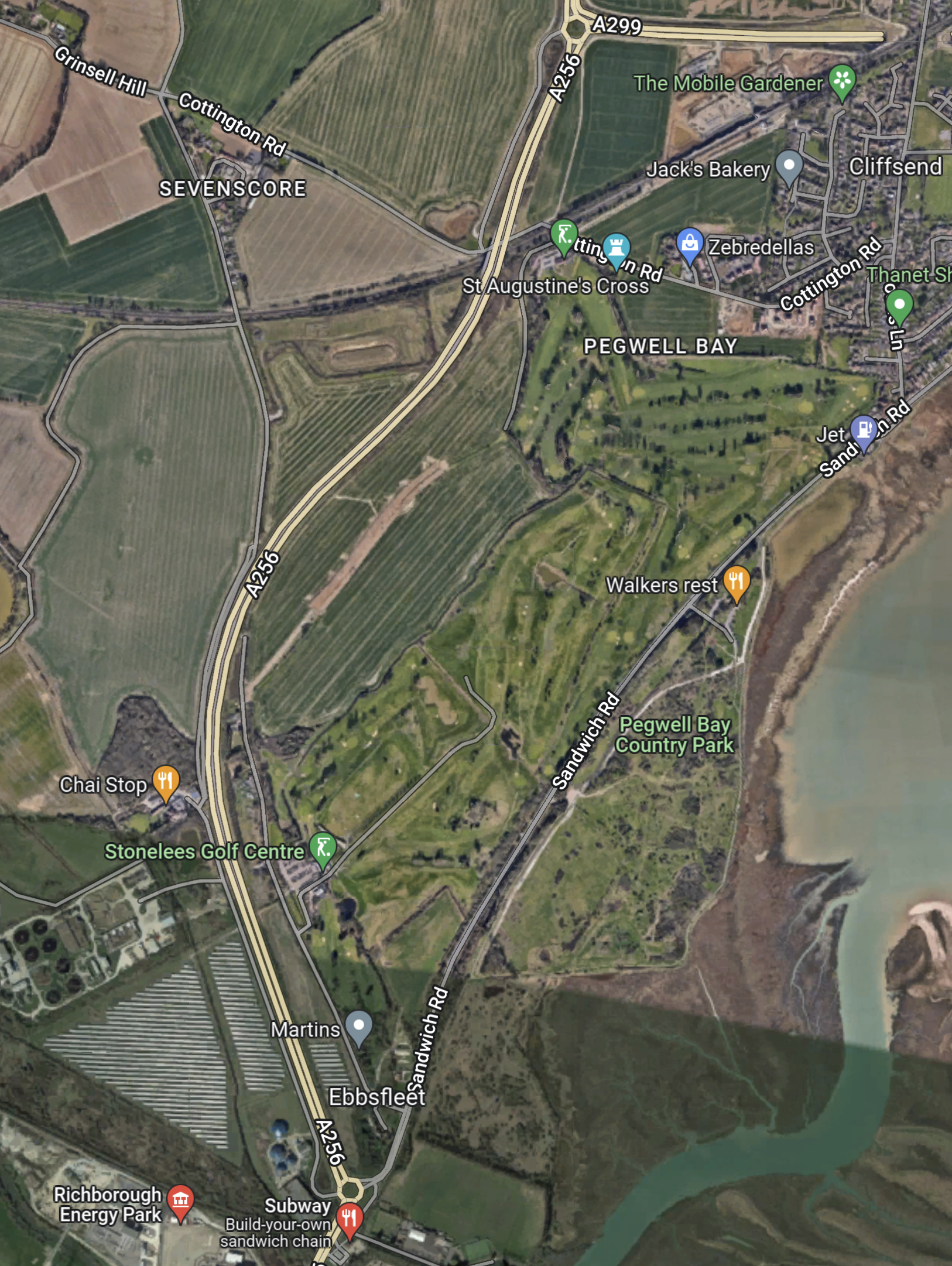
Note.
- The under-construction Thanet Parkway station is in the North-East corner of this map to the West of the village of Cliffsend.
- The dual-carriageway of the A256 runs North-South down the map to a roundabout.
- To the West of the roundabout is Richborough Energy Park.
This Google Map shows the are round the energy park and the roundabout in more detail.
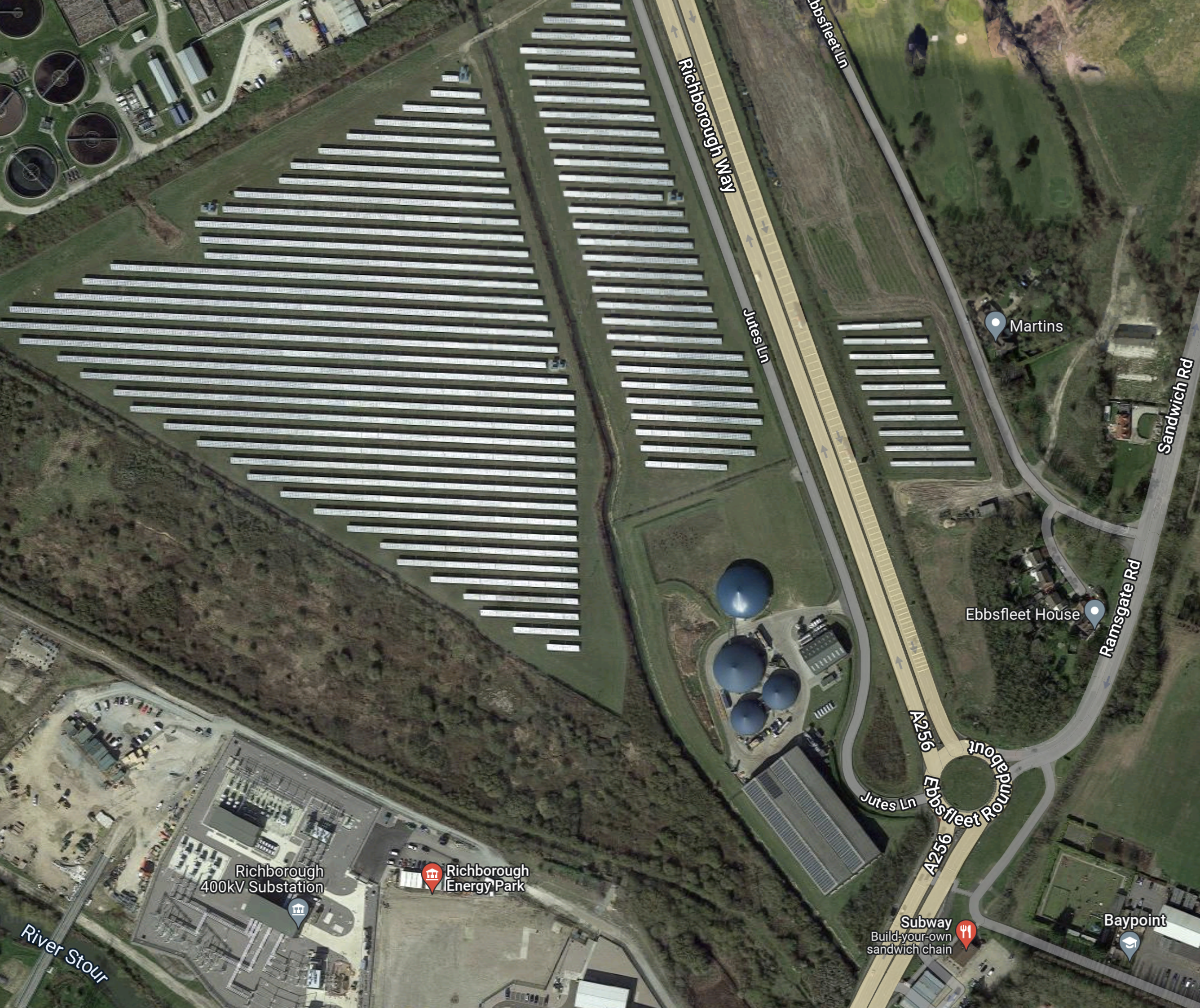
Note.
- The Richborough substation in the South-West corner of the map.
- The Richborough Energy Park sits to the East of the substation.
- The solar panels to the North of the roundabout are the 4.9 MW Ebbsfleet Solar Farm, which is part of Richborough Energy Park.
Richborough Energy Park is an ongoing project.
The national grid interconnector from the original power station is still in place, and is now the grid link for the 300 MW offshore Thanet Wind Farm.
It is the terminal for the NemoLink interconnector to Belgium.
Wikipedia says this about future plans.
The current owner of the site, BFL Management Ltd, plan to bring the site back into use as a £750 million green energy park. There are additional plans to create additional recycling and green energy facilities on site, including an anaerobic digester, a waste processing plant, a biomass combined heat and power generator, a pyrolysis plant and a peak demand 30MW diesel generator. When fully operational, the park could provide up to 1,400MW of power, employing 100 full-time equivalent, with up to 500 jobs in the construction phase.
I am surprised, that there is no mention of batteries or energy storage.
This press release from Network Rail is entitled Charge While You Travel With New Electric Vehicle Charging Points At Network Rail Stations.
This the body of the press release
Rail passengers with electric vehicles will be able to charge while they travel thanks to the introduction of 450 new electric vehicle charging points at Network Rail-managed car parks at railway stations.
The charging points, powered by guaranteed renewable energy, provide enough power to fully charge a vehicle in as little as 3-4 hours.
In this phase, Network Rail has powered: 160 charging points in Reading, 111 in Manchester, 84 in Edinburgh, 56 at Leeds and 41 in Welwyn Garden City.
Electric vehicle charging points will be installed across 10% of car parking spaces (approximately 779 spaces) at car parks managed by Network Rail by March 2024.
Rail is already the leading form of green public transport and this marks another milestone in Network Rail’s commitment to a low-emission railway – making sure rail is environmentally-friendly, resilient to climate change and able to provide an excellent service for years to come.
The new Compleo charging points are marked with green parking bays and passengers can pay for what they need quickly and easily via the APCOA Connect app.
Note, that there is no mention, if these are vehicle-to grid (V2G) chargers.
In Airport Plans World’s Biggest Car Parks For 50,000 Cars, I stated my belief that car parks, with hundreds or even thousands of vehicles could be turned into giant grid batteries.
- All electric vehicles, when they are parked would be plugged in to V2G chargers.
- The vehicle and the grid, would know your expected return time and how much power you would need. Probably from a parking app, assisted by AI!
- If the grid borrowed your electricity, whilst you were away, you wouldn’t know, until you received the payment for the loan.
- If your car runs on hydrogen, the parking could also handle the battery, that all hydrogen-powered vehicles have.
Thanet Parkway station would be an ideal station for such a parking system for electric vehicles.
Foot Crossing Obstacle Detection Using AI
The title of this post, is the same as that as this article on the Railway Gazette.
This is the introductory paragraph.
Seibu Railway is to start testing a newly-developed AI-assisted warning system for detecting obstacles on foot crossings at two stations on the Ikebukuro Line in the suburbs of Tokyo.
The article is a detailed description of how the Japanese are using technology to make foot crossing a lot safer.
I can see applications for this technology not just on the rail system, but in other situations as well.
Leaves On The line? AI Signals End To Commuters’ Train Pain
The title of this article is the same as that of an article, that was on the front page of yesterday’s copy of The Times.
It talks about a system being developed by Hack Partners, that uses a camera to record lineside trees and then a computer using AI directs tree cutting gangs to the right places.
This is one of several systems that are to be funded by the Government. This paragraph summarised the grants.
The DfT and Innovate UK, the government’s technology agency, will announce today that up to £7.8 million is being invested in 24 trials of projects to boost performance on the railway. Each will receive between £250,000 and £350,000.
I particularly like a system from a Dutch company called 4Silence, which is designed to cut the noise of trains, which is described like this.
other schemes being funded include a noise barrier only 1m high topped by a steel grid, developed by the Dutch company 4Silence, which can deflect the sound of passing trains, improving the quality of life for residents near by.
I wonder what percentage of these trials will be winners.
I hope those who judge the success of these schemes, except that not all innovation succeeds.
Open Banking
Open Banking – Not for me.
But as a retired world-class programmer, I can envisage an AI-based computer system, that you can run on your laptop to guide your financial decisions!
In my lifetime, I have come across various pieces of financial advice, that proved to be totally crap.
For a start, I’ve met at least four people, who used the strength of the Icelandic banking system to lose all their savings.
Every financial expert told me not to touch Zopa. But it has paid me five percent before tax on my savings for ten years.
There’s an old City joke.
The best way to make a small fortune is to give a large one to a financial adviser.
Many a true word was spoken in jest.
 The Anonymous Widower