Giant Solar Farm Project In Doubt After Disagreement Between Mike Cannon-Brookes And Andrew Forrest
The title of this post, is the same as that of this article on the Guardian.
This is the sub-heading.
Australian billionaires had backed $30bn Sun Cable venture designed to help power Darwin, Indonesia and Singapore but the company has gone into voluntary administration.
It does look like the administrators will be able to continue the project and look for more funding.
Qatar must be in the frame, as this link will probably cut some of their gas sales.
I wrote about this monster project in Sun Cable’s Australia-Asia PowerLink.
I wonder if this administration will have any effects on the prospects of the other giant intercontinental interconnectors?
- EuroAfrica Interconnector – See The EuroAfrica Interconnector
- EuroAsia Interconnector – See The EuroAsia Interconnector
- Morroco-UK Power Project – See Moroccan Solar-Plus-Wind To Be Linked To GB In ‘Ground-Breaking’ Xlinks Project
- TransPacific Interconnector – See Chile Wants To Export Solar Energy To Asia Via 15,000km Submarine Cable
The economics will decide. But I do think, the last one could be a bit ambitious.
How Liquid Air Could Solve The UK’s Energy Conundrum
The title of this post, is the same as that of this article on The Telegraph.
The article is mainly an article that described the technology and it discloses a few facts.
- The Carrington plant should be delivered in 2024.
- Carrington will be a 30 MW/30 MWh system.
- Efficiency is around 50 %, but there are possibilities to raise it to 70 %.
- Australia is mentioned as a market.
- It is likely to be paired with supercapacitors or a flywheel to have a quick start.
- It seems to me, that turning an idea into a practical system is taking a lot of work and money, and a bit of a rethink.
But hopefully, the system will eventually be developed, as it does promise to be an energy storage system, that doesn’t make high demands on the environment in terms of expensive metals and rare earths.
Low Carbon Construction Of Sizewell C Nuclear Power Station
Sizewell C Nuclear Power Station is going to be built on the Suffolk Coast.
Wikipedia says this about the power station’s construction.
The project is expected to commence before 2024, with construction taking between nine and twelve years, depending on developments at the Hinkley Point C nuclear power station, which is also being developed by EDF Energy and which shares major similarities with the Sizewell plant.
It is a massive project and I believe the construction program will be designed to be as low-carbon as possible.
High Speed Two is following the low-carbon route and as an example, this news item on their web site, which is entitled HS2 Completes Largest Ever UK Pour Of Carbon-Reducing Concrete On Euston Station Site, makes all the right noises.
These three paragraphs explain in detail what has been done on the Euston station site.
The team constructing HS2’s new Euston station has undertaken the largest ever UK pour of Earth Friendly Concrete (EFC) – a material that reduces the amount of carbon embedded into the concrete, saving over 76 tonnes of CO2 overall. John F Hunt, working for HS2’s station Construction Partner, Mace Dragados joint venture, completed the 232 m3 concrete pour in early September.
The EFC product, supplied by Capital Concrete, has been used as a foundation slab that will support polymer silos used for future piling works at the north of the Euston station site. Whilst the foundation is temporary, it will be in use for two years, and historically would have been constructed with a more traditional cement-based concrete.
The use of the product on this scale is an important step forward in how new, innovative environmentally sustainable products can be used in construction. It also helps support HS2’s objective of net-zero construction by 2035, and achieve its goal of halving the amount of carbon in the construction of Britain’s new high speed rail line.
Note.
- Ten of these slabs would fill an Olympic swimming pool.
- I first wrote about Earth Friendly Concrete (EFC) in this post called Earth Friendly Concrete.
- EFC is an Australian invention and is based on a geopolymer binder that is made from the chemical activation of two recycled industrial wastes; flyash and slag.
- HS2’s objective of net-zero construction by 2035 is laudable.
- It does appear that this is a trial, but as the slab will be removed in two years, they will be able to examine in detail how it performed.
I hope the Sizewell C project team are following High Speed Two’s lead.
Rail Support For Sizewell C
The Sizewell site has a rail connection and it appears that this will be used to bring in construction materials for the project.
In the January 2023 Edition of Modern Railways, there is an article, which is entitled Rail Set To Support Sizewell C Construction.
It details how sidings will be built to support the construction, with up to four trains per day (tpd), but electrification is not mentioned.
This is surprising to me, as increasingly, big construction projects are being managed to emit as small an amount of carbon as possible. Sizewell C may be an isolated site, but in Sizewell B, it’s got one of the UK’s biggest independent carbon-free electricity generators a couple of hundred metres away.
The writer of the Modern Railways article, thinks an opportunity is being missed.
I feel the following should be done.
- Improve and electrify the East Suffolk Line between Ipswich and Saxmundham Junction.
- Electrify the Aldeburgh Branch Line and the sidings to support the construction or agree to use battery-electric or hydrogen zero-carbon locomotives.
Sizewell C could be a superb demonstration project for low-carbon construction!
Sizewell C Deliveries
Sizewell C will be a massive project and and will require a large number of deliveries, many of which will be heavy.
The roads in the area are congested, so I suspect rail is the preferred method for deliveries.
We already know from the Modern Railways article, that four tpd will shuttle material to a number of sidings close to the site. This is a good start.
Since Sizewell A opened, trains have regularly served the Sizewell site to bring in and take out nuclear material. These occasional trains go via Ipswich and in the last couple of years have generally been hauled by Class 88 electro-diesel locomotives.
It would be reasonable to assume that the Sizewell C sidings will be served in the same manner.
But the route between Westerfield Junction and Ipswich station is becoming increasingly busy with the following services.
- Greater Anglia’s London and Norwich services
- Greater Anglia’s Ipswich and Cambridge services
- Greater Anglia’s Ipswich and Felixstowe services
- Greater Anglia’s Ipswich and Lowestoft services
- Greater Anglia’s Ipswich and Peterborough services
- Freight services serving the Port of Felixstowe, which are expected to increase significantly in forthcoming years.
But the Modern Railways article says this about Saxmundham junction.
Saxmundham junction, where the branch meets the main line, will be relaid on a slightly revised alignment, retaining the existing layout but with full signalling giving three routes from the junction protecting signal on the Down East Suffolk line and two in the Down direction on the bidirectional Up East Suffolk line. Trap points will be installed on the branch to protect the main line, with the exit signal having routes to both running lines.
Does the comprehensive signalling mean that a freight train can enter or leave the Sizewell sidings to or from either the busy Ipswich or the quieter Lowestoft direction in a very safe manner?
I’m no expert on signalling, but I think it does.
- A train coming from the Lowestoft direction needing to enter the sidings would go past Saxmundham junction on the Up line. Once clear of the junction, it would stop and reverse into the branch.
- A train coming from the Ipswich direction needing to enter the sidings would approach in the wrong direction on the Up line and go straight into the branch.
- A train leaving the sidings in the Lowestoft direction would exit from the branch and take the Up line until it became single track. The train would then stop and reverse on to the Down line and take this all the way to Lowestoft.
- A train leaving the sidings in the Ipswich direction would exit from the branch and take the Up line all the way to Ipswich.
There would need to be ability to move the locomotive from one end to the other inside the Sizewell site or perhaps these trains could be run with a locomotive on both ends.
The advantage of being able to run freight trains between Sizewell and Lowestoft becomes obvious, when you look at this Google Map, which shows the Port of Lowestoft.
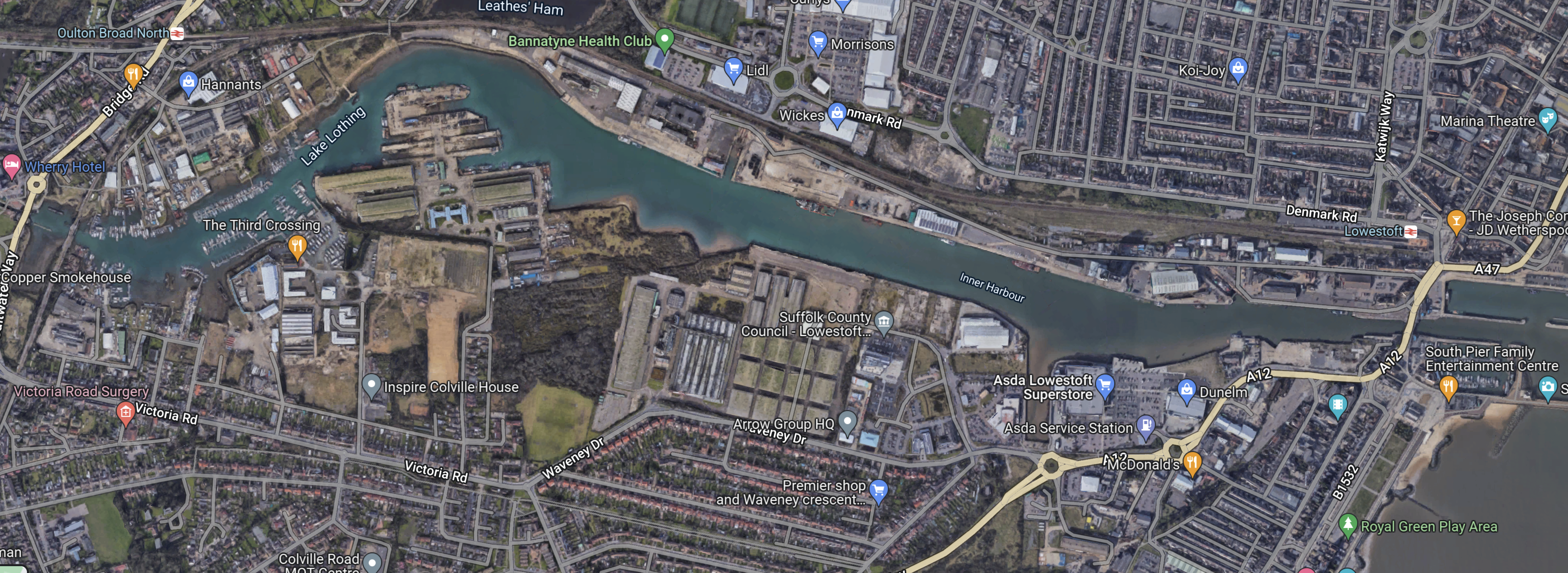
Note.
- The Inner Harbour of the Port of Lowestoft.
- The East Suffolk Line running East-West to the North of the Inner Harbour.
- Lowestoft station at the East side of the map.
I doubt it would be the most difficult or expensive of projects to build a small freight terminal on the North side of the Inner Harbour.
I suspect that the easiest way to bring the material needed to build the power station to Sizewell would be to do the following.
- Deliver it to the Port of Lowestoft by ship.
- Tranship to a suitable shuttle train for the journey to the Sizewell sidings.
- I estimate that the distance is only about 25 miles and a battery or hydrogen locomotive will surely be available in the UK in the next few years, that will be able to provide the motive power for the return journey.
In The TruckTrain, I wrote about a revolutionary freight concept, that could be ideal for the Sizewell freight shuttle.
In addition, there is no reason, why shuttle trains couldn’t come in from anywhere connected to the East Suffolk Line.
Zero-Carbon Construction
Sizewell C could be the first major construction site in the UK to use electricity rather than diesel simply because of its neighbour.
Conclusion
I shall be following the construction methods at Sizewell C, as I’m fairly sure they will break new ground in the decarbonisation of the Construction industry.
Good Vibrations Turbo Charge Green Hydrogen Production
The title of this post, is the same as this news item from RMIT University in Australia.
This is the sub-heading.
Engineers in Melbourne have used sound waves to boost production of green hydrogen by 14 times, through electrolysis to split water.
And these are the first two paragraphs.
They say their invention offers a promising way to tap into a plentiful supply of cheap hydrogen fuel for transportation and other sectors, which could radically reduce carbon emissions and help fight climate change.
By using high-frequency vibrations to “divide and conquer” individual water molecules during electrolysis, the team managed to split the water molecules to release 14 times more hydrogen compared with standard electrolysis techniques
I could understand a two or three times increase, but fourteen times is sensational.
Again, Australia seems to have found the gold through innovative green technology.
Other Benefits
Read the last sections of the news item.
- The process allows the use of cheaper silver electrodes instead of platinum and iridium.
- The engineers also feel that their technique could help in this and other process where bubbles are a problem.
Sound waves have been used for decades for various processes and I am surprised that this appears to be the first time, they’ve applied to electrolysis.
Conclusion
I worked in a hydrogen factory around 1970 and have watched developments over the years.
I am now convinced that an individual or a company will come up with an affordable way to make green hydrogen.
Promising technologies in addition to this one include.
- High Temperature Electrolysis. See Nuclear-Enabled Hydrogen – How It Helps To Reach Net Zero.
- HiiROC See Centrica Partners With Hull-Based HiiRoc For Hydrogen Fuel Switch Trial At Humber Power Plant.
- Electrolysis of sea water. See Torvex Energy.
I can see a combination of a couple of methods.
New South Wales Plans Three Batteries
This article on Energy Storage News is entitled Shell Battery Project In New South Wales Would Add 1GWh Energy Storage To Growing Market.
The three batteries are.
- Shell – 500MW/1,000MWh BESS project in Wellington, in Central West NSW.
- Waratah Super Battery 700MW/1,400MWh transmission system “shock absorber”
- A proposed 500MW/2,000 MWh BESS from energy generator-retailer EnergyAustralia.
Note.
- All batteries appear to be lithium ion.
- This gives a total output of 1.7 GW and a total storage capacity of 4.4 GWh.
- The NSW government is targeting 12GW of renewable energy capacity by 2030.
- 3 GW of utility-scale wind and solar in development, construction, or already in operation, in the state.
The state seems to be making a good start.
Another Aussie Green Hydrogen Hub In The Works As Total Eren Eyes 1GW Darwin Project
The title of this post, is the same as that of this article on Recharge.
These two paragraphs introduce the project.
Developer Total Eren is sizing up the potential for a 1GW green hydrogen project in Australia’s Northern Territory (NT), taking the total capacity of green H2 projects under development in the state to 13.8GW.
A Memorandum of Understanding (MoU), signed between Total Eren and the NT state government on Monday, will see the two work together to progress the project, dubbed the Darwin H2 Hub.
This paragraph gives a few numbers.
Plans for the scheme comprise more than 2GW of solar PV generation, which will power a 1GW electrolyser. The project aims to produce 80,000 tonnes of hydrogen a year, equivalent to around 4% of the 1.96 million tonnes of green H2 South Korea expects to import from overseas by 2030.
Note.
- Australia seems to be the place to develop large hydrogen and energy projects.
- South Korea will beat a path to your door, if you have the capacity to create millions of tonnes of green hydrogen.
The article finishes with a good summary of the future prospects of Australia’s green hydrogen industry.
I believe that Australia could become a world superpower, as it will certainly provide zero-carbon power to a good proportion of South East Asia.
The Australian Tycoon With Designs On U.S. Coal Mines
The title of this post, is the same as that as this article on Politico.
The article is a must-read, as it is an interview with Andrew Forrest about his very strong views on the future of the coal industry in the United States.
This is a typical question from the interview and Forrest’s forthright answer.
Biden put jobs at the center of his climate messaging. Does the messenger actually need to be someone with a track record of creating jobs?
It’s a bloody good point. I think I can deliver that message much stronger, because I’m not a politician. I’m not looking for votes, this is the hardcore reality.
Rio Tinto’s Big Energy Project Attracts Multiple Bidders
The title of this post, is the same as that of this article on Mining Technology.
The article has this subtitle.
The company seeks to offset its power consumption with a massive renewable plant.
These two paragraphs introduce the project.
British and Australian mining giant Rio Tinto has attracted multiple bids for a massive renewable power infrastructure project.
The company currently seeks suppliers to build up to 4GW of renewable generation for its alumina and aluminium operations in Queensland, Australia. Speaking to the Melbourne Mining Club, the company’s CEO of Australia, Kellie Parker, said that it had received proposals for “a lot more than 4GW”. Parker also said that construction of the project “would not be easy” due to the cost of construction for Australian projects.
In the UK, we may talk of wind farms like Hornsea, which could produce 6 GW, but the Aussies can produce similar amounts of energy from the sun.
This will be the fourth major renewable power development in Australia to be announced in the last few months.
- The Asian Renewable Energy Hub could generate up to 26 GW in Western Australia.
- I wrote about Andrew Forrest’s ambitions in Andrew Forrest Snaps Up Pilbara And Gascoyne Cattle Stations For Green Energy Production.
- The Australia-Asia Power Link will export solar power from Australia to Singapore.
Australia is certainly looking to power the world.
Energy Storage
Rio Tinto are also talking about energy storage, as other systems of this type and size do. Could this be one of a number of Australian projects mentioned on the Highview Power web site?
Will We See More Multi-Country Renewable Energy Deals?
In this blog, I have talked about various deals, where two or more countries and/or companies are getting together to generate electricity in one country and transfer it to another, either as electricity or as hydrogen
Examples include.
- The Asian Renewable Energy Hub, which I first wrote about in Vast Australian Renewable Energy Site Powers BP’s Ambitions.
- The Australia-Asia PowerLink, which I first wrote about in Sun Cable’s Australia-Asia PowerLink.
- Fortescue Future Industries will convert cattle stations in Western Australia into renewable power stations.
- The EuroAfrica Interconnector is a HVDC interconnector and submarine power cable between the Greek, Cypriot, and Egypt power grids, which I first wrote about in The EuroAfrica Interconnector.
- The EuroAsia Interconnector is a proposed HVDC interconnector between the Greek, Cypriot, and Israeli power grids via the world’s longest submarine power cable, which I first wrote about in The EuroAsia Interconnector.
- Icelink is a proposed electricity interconnector between Iceland and Great Britain, which I first wrote about in Is Iceland Part Of The Solution To The Problem Of Russia?
- The Morocco-UK Power Project, which I first wrote about in Moroccan Solar-Plus-Wind To Be Linked To GB In ‘Ground-Breaking’ Xlinks Project.
- Namibian Green Hydrogen, which I first wrote about in Namibia Is Building A Reputation For The Cheapest Green Hydrogen.
There are also all the hydrogen deals done by Fortescue Future Industries.
Where Are There Possibilities Of More Multi-Country Renewable Energy Deals?
These are a few serious possibilities.
Argentina
This is an extract from this page on Wind Energy International, which is entitled Argentina.
Argentina has an estimated technical wind energy potential of 300 GW. In southern Patagonia (Chubut and Santa Cruz provinces), average wind speeds range between 9.0 and 11.2 m/s, whereas in the north (Neuquén and Río Negro provinces), wind speeds range from 7.2 to 8.4 m/s. The general average capacity factor for Argentina is 35% and in the Patagonia region it ranges between as much as 47% and 59%. Especially in Northwest Patagonia, locally known as the Comahue region, hydro and wind may seasonally complement each other and.benefit both technologies. One other promising region for wind power development is the Atlantic sea coast.
As I wrote in Australia’s FFI Plans $8.4 Billion Green Hydrogen Project In Argentina, it appears that Andrew Forrest and FFI are already on the ground.
Australia
There are already three major schemes based on Australia and I am certain they will be more. Especially, as Japan, Korea, Malaysia and Singapore will need the zero-carbon energy.
It would appear that except for the Australia-Asia PowerLink, the energy will be transferred as liquid hydrogen or liquid ammonia.
Bangladesh
Bangladesh wouldn’t be on the lists of many, where ideal countries for renewable energy are being discussed.
But, this report on Energy Tracker Asia is entitled The Renewable Energy Potential of Bangladesh, where this is said.
A report investigating the renewable energy technical capacity of Bangladesh found that the country could deploy up to 156 GW of utility-scale solar on 6,250 km2 of land and 150 GW of wind. Offshore wind power would account for 134 GW of this total capacity.
I wouldn’t be surprised to see Bangladesh, supplying renewable energy to the East, with international companies and organisations developing the renewable infrastructure.
I think it should be noted that international companies flock to countries, where the investment opportunities are good. That has happened in the UK, with offshore wind, where many wind farms have been developed by companies such as Equinor, Iberola, RWE and Wattenfall.
Chile
Chile has started to develop the 100,000 square kilometres of the Atacama Desert for solar power and I wrote about this in The Power Of Solar With A Large Battery.
This sentence in the Wikipedia entry for Energy In Chile, illustrates the potential of solar power in the Atacama Desert.
In 2013, Total S.A. announced the world’s largest unsubsidised solar farm would be installed with assistance from SunPower Corp into Chile’s Atacama desert.
I also wrote Chile Wants To Export Solar Energy To Asia Via 15,000km Submarine Cable, about Chile’s ambitions to supply Asia with energy.
Ethiopia
Andrew Forrest of Fortescue Future Industries is on the case, as I wrote in Fortescue Future Industries Enters Ethiopia to Produce Green Energy.
North Africa
Consider.
- The major North African countries of Morocco, Algeria, Tunisia, Libya and Egypt, all have and depend on to a certain extent on fossil fuels.
- There are gas pipelines to Spain and Italy.
- Morocco will be the Southern end of the Morocco-UK Power Project, if it gets developed.
- All five countries have some nuclear power stations.
- All five countries have lots of sun for solar power.
- Some Saharan countries to the South of Morocco, Algeria and Libya could also provide energy from the sun.
- Egypt has substantial hydro-electric power on the River Nile.
- Egypt will be connected to Greece through the EuroAfrica Interconnector.
I believe that a well-designed and co-ordinated project could generate a lot of electricity and hydrogen for Europe and bring much-needed income and employment to North Africa.
I feel that if the Morocco-UK Power Project can be successfully built, then this could create a flurry of activity all over North Africa.
Saudi Arabia
Saudi Arabia has a problem. As the rest of the world moves away from fossil fuels in the next few decades, they will see the revenues from oil and natural gas come under pressure.
But as a rich country, with 2.15 million km² of land and lots of sun, they must have some potential to generate solar electricity.
In the Wikipedia entry for Solar Power In Saudi Arabia, this is said.
The Saudi agency in charge of developing the nations renewable energy sector, Ka-care, announced in May 2012 that the nation would install 41 gigawatts (GW) of solar capacity by 2032.[2] It was projected to be composed of 25 GW of solar thermal, and 16 GW of photovoltaics. At the time of this announcement, Saudi Arabia had only 0.003 gigawatts of installed solar energy capacity. A total of 24 GW of renewable energy was expected by 2020, and 54 GW by 2032.
Wikipedia also says that Saudi Arabia also has nuclear ambitions.
I can see that Saudi Arabia will replace some of their oil and gas exports with green hydrogen.
Rolls-Royce Secures Funding To Build Direct Air Capture Demonstrator
The title of this post, is the same as that of this press release from Rolls-Royce.
These are the two introductory paragraphs.
Rolls-Royce has secured £3m from the UK Government to build a demonstrator Direct Air Capture (DAC) system, which could play a vital role in keeping global temperature rises to below 1.5C by removing CO2 from the atmosphere.
The demonstrator funding comes from the Net Zero Innovation Portfolio (NZIP) through the Department for Business, Energy and Industrial Strategy (BEIS) and helps deliver on the UK Government’s 10 Point Plan for a Green Industrial Revolution. It follows initial Phase 1 funding of £250,000 awarded in 2021, that allowed Rolls-Royce to design the demonstrator in partnership with the Commonwealth Scientific and Industrial Research Organisation (CSIRO).
These two paragraphs, give a few clues to the technology.
Jess Poole, Direct Air Capture Lead for Rolls-Royce, said: “Every credible climate change model requires us to decarbonise today’s emissions, as well as removing CO2 already in the atmosphere via carbon negative technologies such as DAC. Our system combines our expertise in moving large quantities of air efficiently and integrating complex systems, which have been gained from designing world-leading jet engines, with novel DAC technology developed by CSIRO.
“Together the system works like a giant lung, sucking in air, absorbing the CO2, and releasing what is not wanted. We use a water-based liquid to wash around 50% of the CO2 from the captured air. Our technology is distinctive because very little water is used, and the liquid is recycled at low temperatures, making it energy efficient. Other technologies consume a lot of water and require substantial amounts of energy to generate heat for the separation of the CO2.
I was unaware of CSIRO, but that is not surprising, as they are Australian. They are introduced like this in their Wikipedia entry.
The Commonwealth Scientific and Industrial Research Organisation (CSIRO) is an Australian Government agency responsible for scientific research.
CSIRO works with leading organisations around the world. From its headquarters in Canberra, CSIRO maintains more than 50 sites across Australia and in France, Chile and the United States, employing about 5,500 people.
Their motto is “We imagine. We collaborate. We innovate.”
There’s certainly been several brilliant ideas and projects from the country in the last few years.
Is this another?
Another Problem With Carbon Dioxide
When I’m in an optimistic mood, I feel that scientists and engineers may develop so many ideas for the use of carbon dioxide, that we may need to burn natural gas in power stations, so we have the carbon dioxide for industrial or agricultural uses.
I know of one tomato grower, who uses a gas-powered combined heat and power boiler to heat his greenhouses. The carbon dioxide is fed to the tomatoes and any spare electricity is sold to the grid.
Direct Air Capture (DAC) systems might be needed to provide a carbon dioxide feedstock for some processes. Suppose in the tomato example, the grower is heating his greenhouses with an energy source, that doesn’t generate carbon dioxide, he might want to obtain his carbon dioxide from the air.
 The Anonymous Widower