The title of this post, is the same as that of this press release from LNER.
This is the sub-heading.
A new generation of comfort and speed is coming for LNER customers on the East Coast Main Line with the introduction of 10 state-of-the-art intercity trains, delivering improved journey experiences.
These two paragraphs introduce the trains.
LNER has released a fleet name and the latest interior images of the trains, built by manufacturer CAF and financed by Porterbrook, to show customers what they can expect following their introduction to the UK rail network in the coming years.
The new fleet will help support and accommodate strong demand for rail travel on the East Coast Main Line. Since Covid, LNER has seen a year-on-year increase in customers, with more than 24 million customers in 2024-25. The introduction, in December 2025, of a new, transformative timetable has brought an extra 60,000 seats per week across the route, and new CAF-built trains will further grow capacity and reliability.
Note.
- The trains will be ten cars long.
- The trains will be tri-mode trains, which will be able to use 25 KVAC Overhead electricity, diesel and battery power.
- The trains will have a top speed of 125 mph.
- The trains will be named Serenza.
The trains will be numbered as Class 897 trains.
I have some further thoughts.
What Diesel Engines Will Be Used?
I asked Google AI this question and received this answer.
The British Rail Class 897 Civity, designed by CAF for London North Eastern Railway, are tri-mode electro-diesel multiple units. While they are built for electric, battery, and diesel operation, specific details regarding the engine manufacturer for the Class 897’s diesel power units have not been officially announced or detailed in public documentation.
Information on the specific model of the diesel engines (e.g., Cummins, MAN) is not available in the provided search results.
CAF’s other diesel-multiple units built in the UK, as eight of these Class 897 trains will be, have German-made Rolls-Royce mtu diesel engines.
Consider.
- American diesel-engine manufacturer; Cummins is specifically-mentioned by Google AI.
- Cummins have a large diesel engine factory in Darlington, just round the corner from Darlington station.
- Cummins are known to be decarbonising the company and are producing a range of diesel-engines, that can be converted to run in a carbon-zero mode on hydrogen.
- Wrightbus now produce the Streetdeck Ultroliner EU6 with a Cummins engine. They also say on their web site, that the bus can be decarbonised, by converting to electric power.
- Stadler produce the Class 99 locomotive with a Cummins engine.
An alternative and possibly simpler way to decarbonise the Streetdeck Ultroliner EU6s, the Class 99 locomotives and the Class 897 trains might be to convert the diesel engines to zero-carbon hydrogen?
I asked Google AI how many railway locomotives use Cummins diesel engines and received this reply.
More than 13,000 Cummins rail engines are in operation globally, powering various locomotives and railcars. They are heavily utilized in both passenger and freight applications, with over 10,000 underfloor engines in service for diesel railcars. They are commonly found in locomotives built by companies like Siemens and Stadler.
Replacing that number of diesel engines will be a large amount of work. And what better place to base the European side of that business, than in the historic railway town of Darlington?
Will The Class 897 Trains Be Able To Take The Great Northern and Great Eastern Joint Line?
As I write this post, some trains will be replaced by coaches at the weekend, so there is not much point in my mind for tri-mode trains not to be able to take the Diversion using the onboard diesel and battery power.
Google AI gave this answer.
Yes, the Class 897 “Serenza” trains, designed for LNER, are expected to be capable of using the Great Northern and Great Eastern Joint Line (GNGE). As tri-mode electro-diesel multiple units, they are designed for flexibility and can utilize battery power to navigate routes like the GNGE through Lincoln during engineering works or overhead wire issues.
I suspect it could also allow combining services like Lincoln and Middlesbrough if required.
Will The Class 897 Trains Be Able To Take Services To The North Of Scotland?
Google AI gave this answer.
Yes, LNER’s new Class 897 tri-mode trains are designed to operate across their entire network, including routes to Scotland, utilizing electric, diesel, or battery power. These 10-car units will replace older fleets, supporting, as noted by The Anonymous Widower, services from London to the North of England and Scotland, with deployment scheduled to begin from 2027.
Thanks, for the link, Google!
Will LNER Take On The Airlines To Scotland?
Consider.
- The Class 897 trains running as diesel tri-modes will probably emit less carbon dioxide, than the current Class 800/802 diesel bi-modes.
- If the Class 897 trains could run as hydrogen tri-modes, they could probably be zero-carbon trains.
- Hydrogen would not be needed South of Stirling or Edinburgh.
Think of the advertising possibilities to change travellers from the airlines to the trains.
Hydrogen-tri-mode trains make sense
Will The Class 897 Trains Be Able To Take Services To The New Destinations In South Yorkshire?
By reading a map, I feel that this route will be possible.
- Retford, where the train would leave the East Coast Main Line
- Worksop, where there is a good cafe with excellent cakes.
- Woodhouse for Advanced Manufacturing Research Centre.
- Sheffield with a reverse.
- Meadowhall for the shopping.
- Barnsley Interchange
- Wakefield Kirkdale.
- Leeds
Note.
The route I mapped out is not much different to Hull Trains’s route to Sheffield, that I wrote about in FirstGroup Applies To Run New London To Sheffield Rail Service.
- Trains could go on from Leeds to York, Darlington, Newcastle and Edinburgh on the East Coast Main Line.
- Trains could go on from Leeds to Settle, Carlisle, Lockerby, Motherwell and Glasgow Central on the Settle and Carlisle Line and the West Coast Main Line.
- I do like the idea of a King’s Cross and Glasgow service on the Settle and Carlisle.
There are certainly interesting possibilities for trains to take a number of routes through South Yorkshire.
February 2, 2026
Posted by AnonW |
Hydrogen, Transport/Travel | Advanced Manufacturing Research Centre, Barnsley Interchange Station, CAF, CAF Tri-Mode Train, Class 897 Train, Class 99 Locomotive, East Coast Main Line, Google AI, Great Northern and Great Eastern Joint Line (GNGE), Hull Trains, Hydrogen-Powered Buses, Hydrogen-Powered Locomotives, Hydrogen-Powered Trains, Leeds Station, Lincoln Station, LNER, Meadowhall Station, Middlesbrough Station, Porterbrook, Serenza, Settle And Carlisle Line, Sheffield Station, Siemens, Stadler, West Coast Main Line, Woodhouse Station, Worksop Station, Wrightbus |
Leave a comment
To get to Knottingley and the consultation about Ferrybridge hydrogen-fired power station, I had to change trains at Wakefield Westgate station.
Note.
- It is an impressive station.
- It has been rebuilt since the turn of the century.
- It is fully step-free.
- Entrance is level from the square outside the station to the Southbound platform.
- There are toilets on the Southbound platform.
- There are six trains per hour (tph) between Wakefield Westgate and Leeds.
Certainty, in the time I was changing trains and waiting for my train to Knottingley, there were a lot of trains going to and from Leeds.
The timetables are changing on December 14, 2025 and the October 2025 Edition of Modern Railways gives this summary for Wakefield.
On Mondays-Saturdays, the CrossCountry train calling at Westgate at 18:17 will no longer stop at Wakefield. Northern will introduce an additional hourly fast train seven days a week between Leeds and Sheffield, and on Saturdays there will be extra later last trains between Sheffield and Westgate via Rotherham and Sheffield and Kirkgate via Barnsley.
With the development of the Leeds Metro, I can see more services being added on the route between Doncaster and Bradford via Wakefield Westgate and Leeds.
- Bradford is getting a new through station.
- From December 14, 2025, Sunday services to Bradford Forster Square will be increased for two to six each way per day.
- It also looks like from December 14, 2025, the new Northern service between Leeds and Sheffield via Wakefield Westgate, will form a two trains per hour with the CrossCountry service.
It certainly looks like the train companies have been co-operating to create a high-class Trans-West Yorkshire service.
September 20, 2025
Posted by AnonW |
Transport/Travel | Barnsley Interchange Station, Bradford Forster Square Station, Bradford New Through Station, CrossCountry Trains, Doncaster Station, Ferrybridge Hydrogen Power Station, Knottingley Station, Leeds Metro, Leeds Station, LNER, Northern Trains, Rotherham Central Station, Sheffield Station, wakefield Kirkgate Station, Wakefield Westgate Station |
Leave a comment
East Midlands Railway’s new Class 810 trains have been designed, so that a pair will fit into one platform at St. Pancras.
If we assume one platform at St. Pancras is used for the Corby and Luton Airport Express services, that leaves three platforms for pairs of Class 810 trains to run expresses to the East Midlands.
This could be as many as twelve pairs of five-car trains per hour.
Where wioll they all terminate in the North?
Leeds station must be the obvious new destination.
- Leeds has the largest population and is the largest commercial and finance centre in Yorkshire and the North-East.
- Leeds would have gained three trains per hour (tph) from London, two tph from Birmingham and four tph from the East Midlands Hub at Nottinham.
- Leeds is getting a brand new metro.
- Leeds is a fully-electrified station, so it could charge the trains before they return to Sheffield, Leicester, Wigston junction and St. Pancras.
- Leeds and Wigston junction is 107.8 miles, which should be within the range of a battery-electric Class 810 train. If it is too far, an extended stop could be taken at Sheffield to top up the batteries.
- Note that Stadler hold the Guinness World Record for the greatest distance covered on one charge at 139 miles. Hitachi Rail, who are partnered with JCB’s battery-maker in Sunderland, should be able to smash that.
The Rail Minister; Lord Peter Hendy went to Leeds University.
Which Route Would The Trains Take Between Sheffield And Leeds?
Consider.
- The fastest trains between Sheffield and Leeds, go via Meadowhall, Barnsley and Wakefield Kirkgate stations.
- Trains take about an hour.
- The current frequency is two tph.
- The distance is 41.1 miles with no electrification.
A frequency of two additional tph between St. Pancras and Leeds would give the following.
- A nice round four tph between Yorkshire’s two most important cities.
- Four fast tph between Meadowhall, Barnsley and Wakefield Kirkgate stations, and Leeds and Sheffield.
- Two direct trains between Meadowhall, Barnsley and Wakefield Kirkgate, and Chesterfield, Derby, Long Eaton, East Midlands Parkway, Loughborough, Leicester and St. Pancras.
It would be complimentary to any Leeds Metro.
Could East Midlands Railways Also Serve Huddersfield?
Consider.
- Huddersfield is 36.4 miles further than Sheffield on the Penistone Line, which is not electrified.
- Wigston junctionand Huddersfield station is 105.3 miles.
- Huddersfield is a Grade I Listed station with two pubs in the middle of the town.
- Huddersfield station is being fully-electrified in connection with the TransPennine Upgrade.
- All trains from Sheffield, that use the Penistone Line terminate in Platform 2 at Huddersfield station.
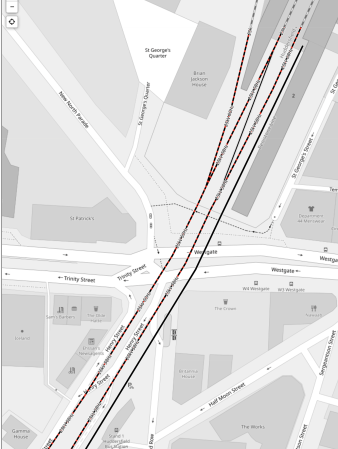
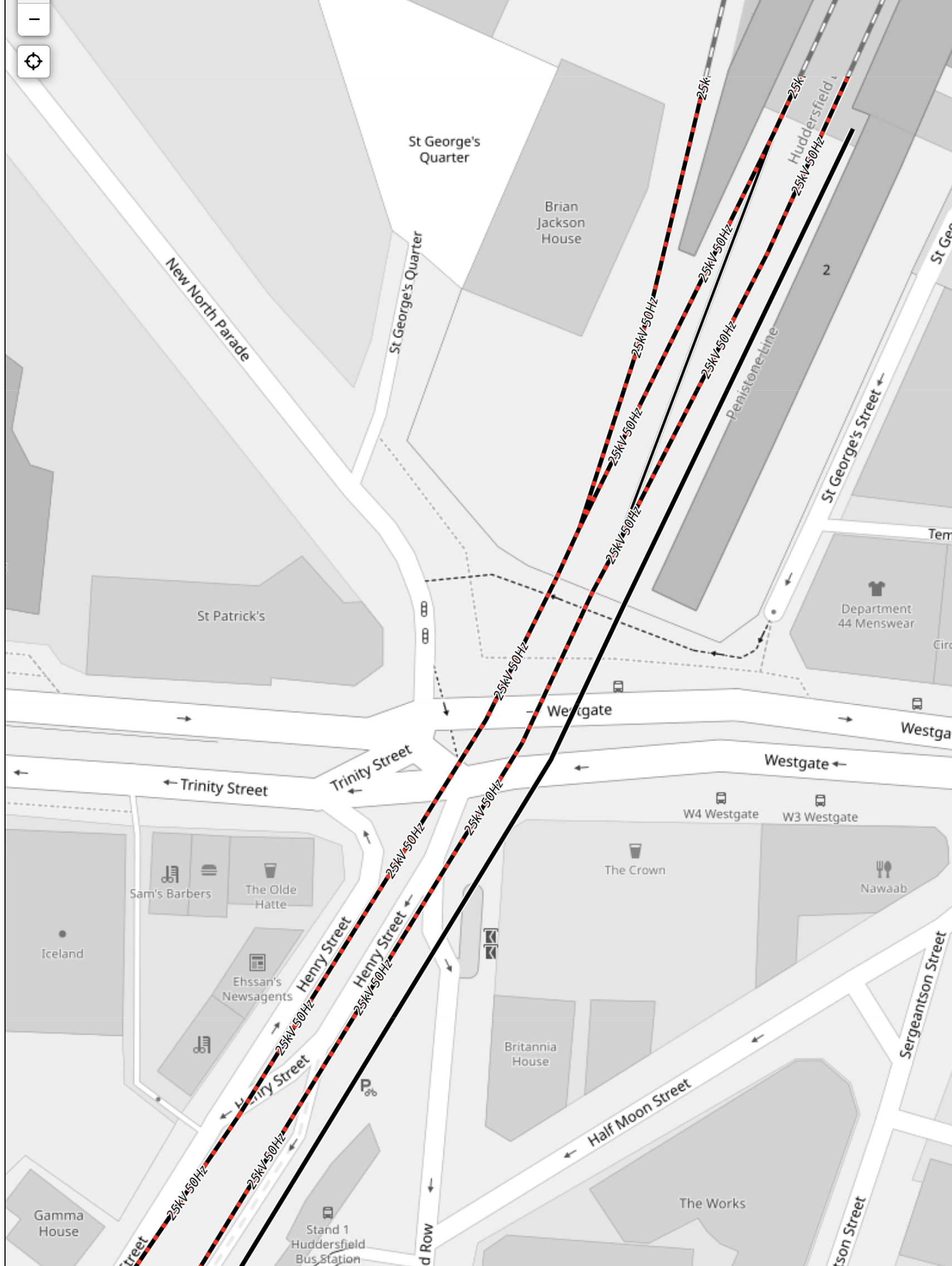
This OpenRailwayMap shows the position of Platform 2 in the station.
Note.
- The red-and-black dotted tracks are being electrified.
- The black tracks are not going to be electrified.
- Platform 2 is marked 2 in the top-right corner of the map.
- Platform 2 looks to be about 90 metres long.
- Five-car Class 810 trains are 120 metres long.
- From the map, it looks like the platform could be lengthened by the required thirty metres.
I suspect that some form of charger can be squeezed into the available space. After all, you don’t often get the chance to put charging into one of the most grand stations in Europe. Power supply would not be a problem, because of the electrification.
A frequency of twotph between St. Pancras and Huddersfield would give the following.
- Two fast tph between Meadowhall, and Barnsley, and Huddersfield and Sheffield.
- Two extra direct trains between Meadowhall and Barnsley, and Chesterfield, Derby, Long Eaton, East Midlands Parkway, Loughborough, Leicester and St. Pancras.
It would connect many stations to the TransPennine Route at Huddersfield station.
What Could The Sheffield and St. Pancras Look Like?
Consider that currently.
- There are two tph.
- Trains stop at Leicester, Loughborough (1tph), East Midlands Parkway (1tph), Long Eaton (1tph), Derby and Chesterfield.
- Trains are five- or seven-cars.
The simplest solution would probably be.
- A pair of five-car trains run all services.
- Trains split and join at Sheffield with one train going to Leeds and one going to Huddersfield.
I estimate that the Class 810 trains will offer about thirty more seats in every hour.
July 19, 2025
Posted by AnonW |
Transport/Travel | Barnsley Interchange Station, Battery-Electric Trains, Class 810 Train, Corby Station, East Midlands Railway, Electrification, Hitachi Intercity Battery Train, Huddersfield Station, JCB, Leeds Metro, Leeds Station, Leeds University, Luton Airport Express, Meadowhall Station, Penistone Line, Peter Hendy, Sheffield Station, St. Pancras Station, TransPennine Upgrade, wakefield Kirkgate Station, Wigston Junction |
1 Comment
The title of this post is the same as an article in the February 2024 Edition of Modern Railways.
I have covered this before in FirstGroup Applies To Run New London To Sheffield Rail Service.
These are extra pieces of information.
FirstGroup Says It’s Only A Start
This is a fragment from the article.
First says the service of two return services per day would enable testing of the market before considering more complex services as plans for the East Coast main line timetable and fleet plans develop. The service is planned to be an additional operation under the brand of existing open access operator Hull Trains, although it would be operated as ‘a separate free-standing daily set of services’.
Nothing is said, but expansion could be extra services or destinations beyond Sheffield.
Currently, Hull Trains run seven trains per day (tpd) between London and Hull, with two tpd extending to Beverley.
- Would seven tpd be an objective for between Sheffield and King’s Cross?
- Five-car Class 802 trains could run the services and look like they fit all the Sheffield, Woodhouse, Worksop and Retford stations.
- Between Sheffield and Retford, the Sheffield and Lincoln Line is not very busy.
- Paths between Retford and London could be a problem.
- However, the new digital signalling would allow the Hull and Sheffield services to run as a flight in the same path, perhaps two or three minutes apart.
- The trains would use one of the longer platforms at King’s Cross, which can accommodate two five-car Class 802 trains.
- I suspect that the new service would use one of the through platforms at Sheffield.
I think, there are three possibilities for extending the service from Sheffield.
- Huddersfield with a reverse and along the Penistone Line after calling at Meadowhall and Barnsley.
- Leeds with a reverse and calling at Meadowhall and Barnsley.
- Manchester Piccadilly calling at Hazel Grove and Stockport.
Note.
- I don’t think Huddersfield and Barnsley have a direct service to London.
- Huddersfield will be on the main electrified TransPennine route.
- Huddersfield station is being upgraded with more platforms and electrified.
- The Penistone Line is being upgraded.
- Leeds already has services from King’s Cross.
- Manchester Piccadilly could be used , when there are engineering works on the West Coast Main Line.
I feel that the Huddersfield service is the one that could be successful.
Hull Trains-Style Customer Service
This is a sentence from the article.
The level of customer service on board would match that which Hull Trains currently delivers.
I don’t think there’s anything wrong with that.
Woodhouse Station
This is a sentence from the article.
First says it will assess the requirement to invest in Woodhouse station to ensure its facilities are fit for purpose for long distance services and work in partnership with the station’s operator, as it did at Morpeth for Lumo services.
Woodhouse station certainly needs improvement.
Trains To Be Used
This is said in the article.
- As they want to start services in 2025, it looks like they will use the available Class 221 or 222 trains.
- But the article indicates that a consistent fleet for Hull Trains using possibly Class 802 trains would be best.
- The route will be cleared for both types of trains.
- Currently, overnight servicing for Hull Trains to Hull is done at Hull Botanic Gardens TMD.
I think that getting this route going by 2025 could give the project its own momentum and enable Hull Trains to add more trains to the fleet.
Timetable
Consider.
- The timetable is based on two trains per day (tpd) in both directions, seven days a week.
- The first train on Monday to Saturday from Sheffield leaves at 9:20, with the Sunday train forty minutes later.
- The second train on Monday to Saturday from Sheffield leaves at 16:54, with the Sunday train twenty minutes later.
- The first train on Monday to Saturday from London leaves at 12:48, with the Sunday train eight minutes later.
- The second train on Sunday to Friday from London leaves at 19:56, with the Saturday train thirty-one minutes later.
Note.
- If there are no problems, one train could shuttle between London and Sheffield all week.
- As Hull Trains have been using one train to boost some services to ten cars, I suspect they could run the initial Sheffield service with a five-car only Hull service. But what happens if they have a train failure?
- If you catch the first train up from Sheffield and the last train down from London, you have 8 hours and 12 minutes in London on Monday to Friday, 8 hours and 43 minutes on a Saturday and 7 hours and 48 minutes on a Sunday.
- It looks like, there is good time to watch a show or a match on Saturday and have a meal before returning North.
- All last trains return to Sheffield about 22:00.
It looks to be a well-thought out professional-written timetable.
Timetabling From And To Huddersfield
This is a sentence from the article.
It is currently thought the first Up and last Down service will run as empty coaching stock via Meadowhall, so it is proposed to call there on such workings.
Suppose though what would be possible if the First Up and Last Down services started from Huddersfield.
- A train between Huddersfield and Sheffield could call at Barnsley and Meadowhall.
- Class 150 trains take around 80 minutes between Sheffield and Huddersfield via Barnsley.
- Class 802 trains could probably do that route in an hour, once the Penistone Line has been improved.
- The second train from London will arrive at Sheffield between 21:56 and 22:26.
- The first train to London will leave from Sheffield between 09:20 and 09:57.
It looks to me, that the following would be possible every night.
- The second Hull Train service from London arrives in Sheffield between 21:56 and 22:26.
- It continues to Huddersfield, where it finishes its journey after dropping passengers at Meadowhall and Barnsley.
- Overnight servicing is arranged.
- In the morning, it runs to Sheffield, picking up passengers as required at Barnsley and Meadowhall.
The train then forms the first Hull Train service to London between 09:20 and 09:57.
Meadowhall, Barnsley and Huddersfield would get 1 tpd to and from London King’s Cross.
Conclusion
There is certainly scope to create a useful set of services between London King’s Cross and South Yorkshire.
January 25, 2024
Posted by AnonW |
Transport/Travel | Barnsley Interchange Station, Beverley Station, East Coast Main Line, FirstGroup, FirstGroup's Proposed Sheffield Service, Hazel Grove Station, Huddersfield Station, Hull Trains, King's Cross Station, Leeds Station, Meadowhall Station, Open Access Operators, Penistone Line, Retford Station, Sheffield and Lincoln Line, Sheffield Station, TransPennine Route, TransPennine Upgrade, Woodhouse Station, Worksop Station |
1 Comment
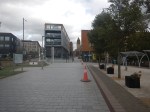
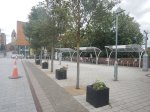
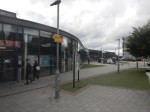
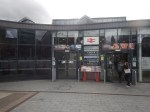
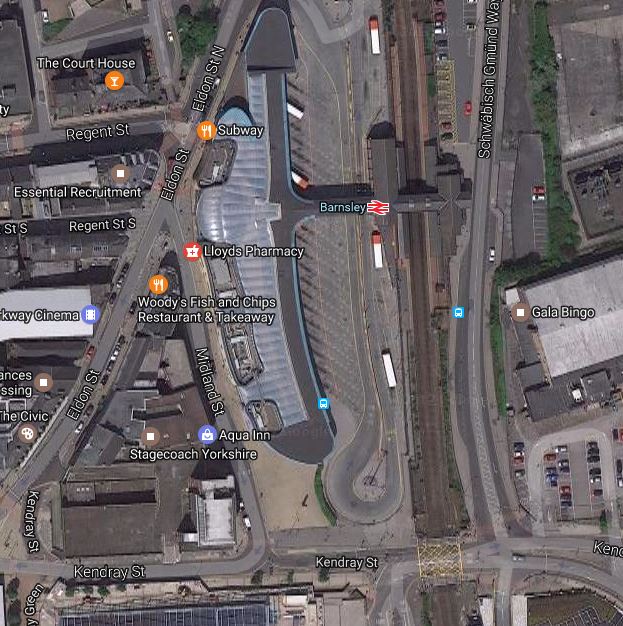
Barnsley Interchange station is unusual in that it is a combined train and bus station, that seems to be well-positioned in the town.
There is only one real problem and that is like Lincoln station, it is a town centre station with a level crossing.
The other problem with the station, is that it is a steep walk up the hill to the Football Ground.
The only solution would be a tunnel under the hill with a large lift to bring you into the Ground.
I don’t think it woud be very affordable or practical.
There is a lot to like about the station and this Google Map shows the overall layout.
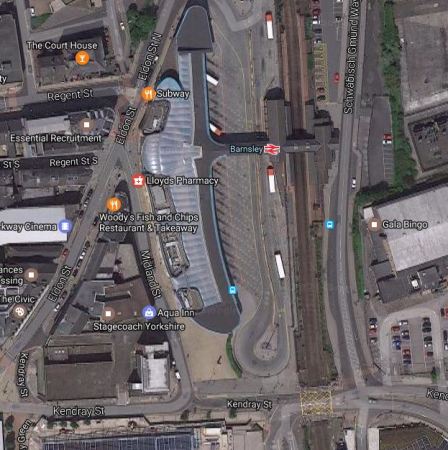
Note the level crossing at the South end of the station.
If you read the section on Services in the Wikipedia entry for the station, you’ll see that the station handles three or four trains per hour in both directions at times. The track layout on the Penistone Line doesn’t help, as this extract from Wikipedia describes.
Barnsley also marks the last continuous dual running track (except for parts) for trains heading towards Huddersfield, or the first continuous dual running track for trains heading towards Sheffield.
I suspect Network Rail and the Penistone Line Partnership have ideas for increasing capacity, but they’d really like the level crossing removed.
I did notice though, that trains in opposite directions, didn’t always seem to pass in the station, which is a technique that has been used in several places to cut the number of times crossings close.
Perhaps because of the single-track sections on the Penistone Line this is not possible.
But other factors will help.
- Northern’s new Class 195 trains will probably handle the stops a couple of minutes faster, than the current Pacers.
- As there are upwards of a dozen stops, this could save a lot of time and allow organising the passing of trains better.
- There are some other level crossings, which might be removed.
- Most of the line is single-track, but it does seem from my helicopter that the track-bed has been left wide enough to reinstate the original double-track.
So in a few years time with the new Class 195 trains, some track modifications and perhaps better signalling, a more frequent and better service might be possible.
March 11, 2017
Posted by AnonW |
Sport, Transport/Travel | Architecture, Barnsley Interchange Station, Football |
Leave a comment



 The Anonymous Widower