UK Among Tri-Axle Zero-Emission Wrightbus StreetDeck Prospects
The title of this post, is the same as that of this article on routeone.
This is the sub-heading.
Orders for new product ‘already lined up’ in Europe and the Far East, the manufacturer has said
These are the first two paragraphs.
Wrightbus sees UK sales opportunity for its new tri-axle zero-emission StreetDeck double-deck bus platform in addition to core Far Eastern markets for that class of vehicle, it says.
That was noted by CEO Jean-Marc Gales (pictured) when debuting prototype examples of the 6×2 bus that it says are “simultaneously” coming off production lines in Northern Ireland and Malaysia. The manufacturer adds that orders are “already lined up” for the product in Europe and the Far East.
I seem to remember that London’s electric trolleybuses used to have three axles.
So I asked Google AI if London’s trolleybuses did have three axles and got this reply.
Yes, London’s trolleybuses were predominantly three-axle vehicles. To accommodate their length and the power of their electric motors, most London trolleybuses, designed to replace trams, were built with three axles. This design allowed them to be larger and carry more passengers, similar to the trams they replaced.
So my memory was correct.
Where I live in De Beauvoir Town, the main North-South bus route is the 141 between London Bridge and Palmers Green.
- They are ten-year-old diesel hybrid buses.
- The route is busy and the buses are far too small.
- During my childhood, the route was the 641 trolleybus, which I used regularly.
- Southgate Road, where the trolleybuses ran is wider than most roads in London.
It would be ironic, if our inadequate 141 buses were to be replaced by new three-axle buses following some of the design rules of trolleybuses.
Is A Three-Axle Bus Better At Climbing Hills Than A Two-Axle?
In the UK, Bradford, Brighton and Sheffield are cities with hills.
If a three-axle bus is better at climbing hills, then this could be a big selling point.
The Chinese Won’t Be Pleased
This is said in the article.
The manufacturer adds that orders are “already lined up” for the product in Europe and the Far East
The Chinese won’t like Wrightbus stealing their markets.
Arriva Group Submits Open Access Rail Application To Connect Newcastle And Brighton, Via London Gatwick
The title of this post, is the same as that of this press release from Arriva Group.
These three bullet points act as sub-headings.
- New services operated by Arriva’s Grand Central would introduce a direct rail connection between the Northeast and Midlands to London Gatwick and the South Coast.
- Making better use of available network capacity, the proposed route would connect underserved communities in the UK and enhance long-distance connectivity without the need to interchange through London.
- The application reflects Arriva’s wider European strategy to connect people and places through sustainable transport solutions, strengthening regional economies and supporting modal shift.
This introductory paragraph provides more details.
Arriva Group has today announced it is submitting an open access application to the Office of Rail and Road (ORR) to introduce a new direct rail service between Newcastle and Brighton, via London Gatwick, providing vital connectivity for underserved communities along the route.
Other points to note include.
- There will be five trains per day in each direction.
- The proposed service would call at Durham, Darlington, Northallerton, York, Doncaster, Sheffield, Derby, Burton-on-Trent, Birmingham New Street, Warwick Parkway, Banbury, Oxford, Reading, Wokingham, Guildford, Redhill, London Gatwick and Haywards Heath.
- The service would be operated by Grand Central.
- The service could be introduced from December 2026.
It will be the be the first direct service between Newcastle and Brighton.
This final paragraph outlines where the service fits in Arriva’s wider philosophy.
The plans are part of Arriva Group’s broader commitment to strengthening regional connectivity and making better use of available rail capacity. By opening up new travel corridors, Arriva is helping to connect more people to jobs, education and leisure opportunities – and to encourage a greater shift from private cars to public transport.
There are certainly plenty of places in Europe, that could use a service like this one between Brighton and Newcastle.
In The Ultimate Open Access Service, I describe a possible open access service between Amsterdam and Hamburg, which is about the same distance as Brighton and Newcastle, which is 372.8 miles by Arriva’s proposed route.
These are some of my thoughts in no particular order.
A High-Class Service Between Oxford And Brighton Could Be An Interesting Development In Its Own Right
Governments, rail operators and passenger groups of all persuasions and flavours have warmly welcomed the planned reopening of the rail route between Oxford and Cambridge.
I suspect an Oxford and Brighton service would be equally welcomed.
Brighton may not be an academic powerhouse yet, but it does have one thing that Oxford and Cambridge lack ; the sea.
Gatwick Airport Will Surely Welcome The Extra Connectivity
Gatwick Airport will expand and extra rail services will do the following for the airport.
- Make it easier to get the planning permission for the second runway.
- Make it easier for passengers and airport and airline staff to get to the airport.
- Surely, the more direct rail connections the airport has, will increase the likelihood, that families and other groups, will choose to fly from Gatwick.
- More train services could cut the amount of car parking per flight needed at the airport.
Gatwick Airport station has recently rebuilt and added extra capacity, so I doubt there will be trouble accommodating another ten trains per day.
Would The Army Welcome The New Service?
Two of the British Army’s main training areas are in North Yorkshire and in Surrey.
Would they find a train service between the two areas useful?
What Trains Will Grand Central Trains Use For The New Service?
In Arriva Group Invests In New Battery Hybrid Train Fleet In Boost To UK Rail Industry, I talked about how Grand Central will be acquiring Hitachi trains for their routes between London and Bradford and Sunderland.
- These will be Hitachi tri-mode trains.
- The trains will have a range of over forty miles on batteries.
- They will probably be serviced in Yorkshire or the North-East.
- The trains will be built by Hitachi at Newton Aycliffe, with batteries from Turntide Technologies in Sunderland.
- The first trains will be delivered in 2028.
As Arriva intend to start services from December 2026, they would probably use diesel trains to start with.
I would expect that Grand Central would go for a unified fleet, which would mean more Hitachi tri-mode trains.
For convenience, they could all be serviced at Doncaster, which all Grand Central services will pass through.
What Sections Will Not Be Electrified Between Brighton and Newcastle?
As far as I can see from OpenRailwayMap, the following sections of the route are not electrified.
- Two sections of the North Downs Line – 29 miles.
- Didcot and Birmingham New Street – 80.9 miles
- Birmingham New Street and Derby – 41.3 miles
- Derby and Sheffield – 36.4 miles
- Sheffield and Doncaster – 18.4 miles
Note.
- Electrification South of Reading will be third rail, so some trains will need to have third-rail shoes.
- The length without electrification is a total of 206 miles.
- As Newcastle and Doncaster, Redhill and Brighton, Reading and Didcot, and Birmingham New Street station are all electrified, the longest sections the trains would run without electrification would be between Didcot and Birmingham New Street and between Birmingham New Street and Doncaster.
- The planned electrification between Derby and Sheffield would make life easier.
It appears that trains capable of handling a hundred miles of unelectrified railway are needed.
Hitachi have shown that a five-car train with one battery will travel 70 km (43.5 miles) on a full battery, so one with three batteries should be able to manage the hundred miles needed in a few years.
Will Any Extra Electrification Be Needed?
I think Birmingham New Street station will be the critical point.
- The next electrification on the route to the South of Birmingham New Street is at Didcot, which is 80.9 miles away.
- The next electrification on the route to the North of Birmingham New Street is at Doncaster, which is 96.1 miles away.
These battery ranges should be possible, but an alternative would be to provide an electrified platform at one or more intermediate stations to be safe.
Stations that could be equipped to the South would include Oxford and Banbury and to the North would include Burton-on-Trent, Derby and Sheffield.
Perhaps electrifying a single platform at these stations, should be the first thing to be done, so that battery-electric trains can run on some useful routes as soon as they are delivered and approved.
Electric Trains, Even Battery-Electric Ones, Will Be Quick Off The Mark
Electric trains have good acceleration and I wonder, if this acceleration will enable stops, that are not feasible with diesel trains to be fitted in with electric trains, without having to take the same time penalty.
This might allow useful stops to be added to the service.
- Chesterfield is not mentioned, but most trains passing through stop.
- As I said, Farnborough North could be a useful stop for the Army.
- There might be a case for selective stopping patterns.
Battery-electric trains stop without any noise or pollution.
Connection To The Ivanhoe Line At Burton-on-Trent
The proposed Ivanhoe Line is intended to link Burton-on-Trent and Leicester.
As it is intended that the Newcastle and Brighton service will call ten times per day at Burton-on-Trent station, this must surely improve the economics of the Ivanhoe Line.
Are there any other new or reopened rail schemes, that will be helped by the proposed Brighton and Newcastle service?
Updated Frequencies At Sheffield
Currently, trains at Sheffield have these daily frequencies to the towns and cities on the proposed Newcastle and Brighton route.
- Newcastle – 18
- Durham – 16
- Darlington – 15
- Northallerton – 0
- York – 19
- Doncaster – 64
- Derby – 58
- Burton-on-Trent – 9
- Birmingham New Street – 21
- Warwick Parkway – 0
- Banbury – 0
- Oxford – 3
- Reading – 4
- Wokingham – 0
- Guildford – 0
- Redhill – 0
- London Gatwick – 0
- Haywards Heath – 0
- Brighton – 0
Note.
- Sheffield gets five trains per day (tpd) direct connections to nine new destinations.
- Other useful destinations will get five more tpd.
- Reading is a useful interchange for Wales and the West.
- Guildford is a useful interchange for Portsmouth, Southampton and West Surrey.
- Reading and Guildford have coach services to Heathrow.
There are also a large number of universities along the route.
Hitachi Can Offer A One-Supplier Battery-Electric Train Solution
It should be noted that Hitachi can offer a complete package including battery-electric trains and all the electrification, transformers and other electrical gubbins needed.
So perhaps for the Chiltern Main Line, which is used for part of the route between Didcot and Birmingham, Hitachi could deliver a one-supplier solution, that would also electrify Chiltern’s services between Marylebone and Birmingham Moor Street.
Remember, Chiltern are another Arriva Group company.
If Hitachi get this right, I can see other lines being electrified in this way.
Could This One-Supplier Battery-Electric Solution Be Exported?
I discussed this in Arriva Group Invests In New Battery Hybrid Train Fleet In Boost To UK Rail Industry, where I suggested that the United States could be a market.
- Arriva Group are ultimately American-owned.
- Hitachi’s battery technology is also American-owned.
In these days of Trump’s tariffs, these could prove useful facts.
As Arriva Group used to be owned by Deutsche Bahn, they may be another interested party, especially as they have a lot of lines, where I believe Hitachi’s solution would work.
Conclusion
A battery-electric railway service of nearly four hundred miles would certainly attract the passengers.
Gatwick’s Hydrogen Advantage Over Heathrow
The Future Of Hydrogen In Aviation
I believe that hydrogen will have a big future in aviation.
Powering Aircraft
It will be some years, but not as many as some people think, before we see hydrogen-powered aircraft in the air.
Airbus have produced this infographic of three possible hydrogen-powered aircraft.

Discover the three zero-emission concept aircraft known as ZEROe in this infographic. These turbofan, turboprop, and blended-wing-body configurations are all hydrogen hybrid aircraft.
I wrote a bit more about these three hydrogen-powered concepts in ZEROe – Towards The World’s First Zero-Emission Commercial Aircraft.
My best estimate is that we’ll see hydrogen-powered aircraft in the air by 2035.
Towing Aircraft Around
Most aircraft are very heavy and towing them around needs a lot of zero-carbon energy.
So I think it is likely, that at some time in the near future,tugs to tow large aircraft around an airport will be hydrogen powered.
If you type “hydrogen-powered aircraft tug” into Google, you get several sensible product developments, including ones from.
- Exeter Airport
- Teesside Airport
- The Royal Air Force.
- The US Air Force
Note.
- The involvement of the military.
- At least two of the tugs are conversions of existing equipment.
- The extra weight of the battery in an electric-powered tug, may make the realisation of a viable electric aircraft-tug difficult.
I suspect we’ll see hydrogen-powered aircraft tugs in use on airports around the world in the near future.
Long-Term Car-Park Buses
I would have thought that using hydrogen-powered or battery-electric buses to serve long-term car-parks at an airport would be an obvious application. But it does appear that airports using zero-carbon buses to serve long-term car-parks are not very common.
- Gatwick uses a large fleet of hydrogen buses to bring passengers and staff to the airport, but these don’t appear to be linked to car parking.
- Incheon Airport in Korea does appear to use hydrogen-powered buses.
Please let me know, if you know of any other uses of hydrogen-powered vehicles at airports.
Hydrogen For Heathrow
This Google Map shows Heathrow Airport.
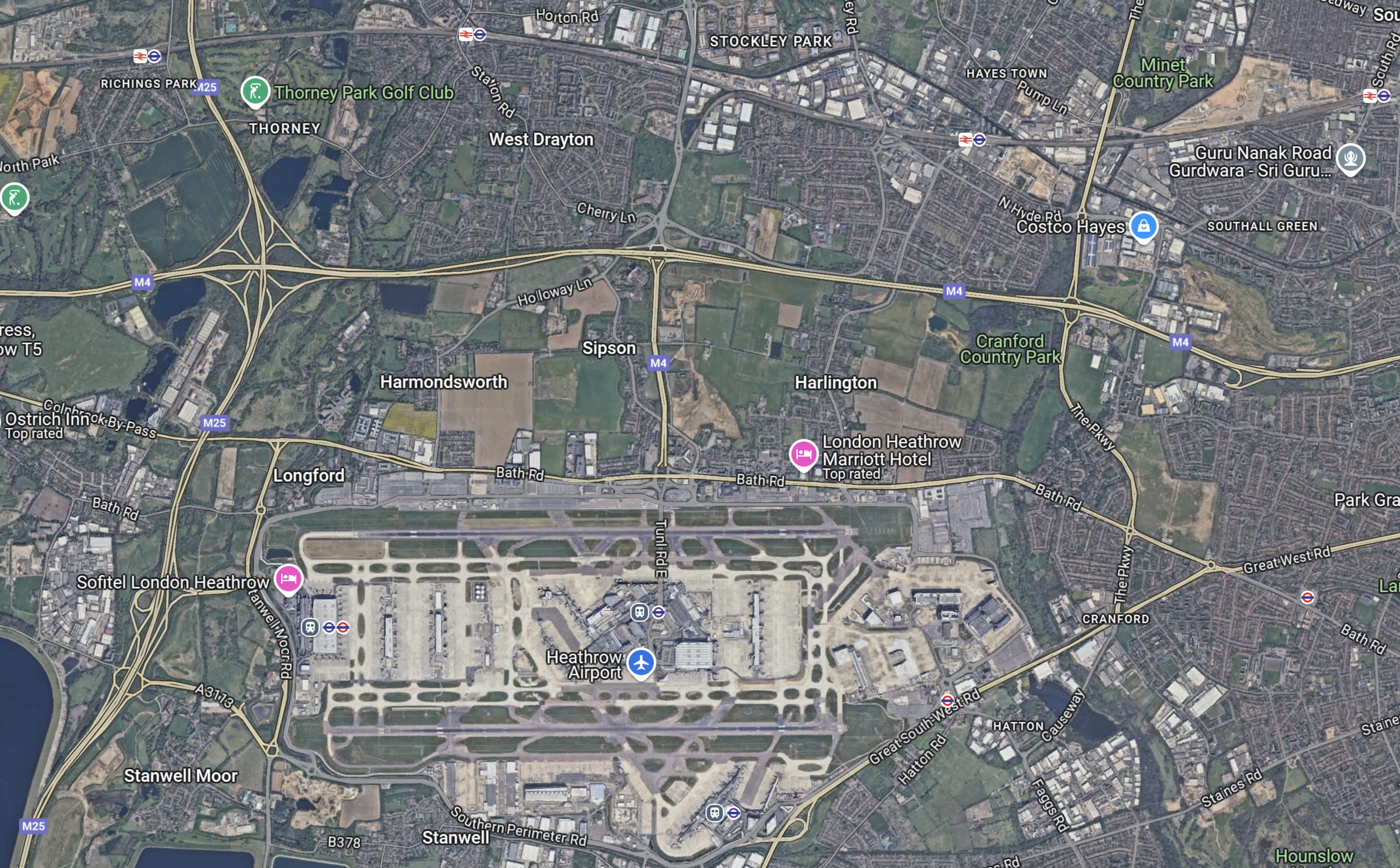
Note.
- The M4 going across the map.
- The two main runways.
- A new third runway would go between the M4 and the Northern runway.
It is likely if the third runway goes ahead, the village of Harmondsworth will be flattened.
It is likely that supplying hydrogen to Heathrow will mean a hydrogen terminal somewhere South of the M4, which could be supplied by rail tankers.
Hydrogen For Gatwick
This Google Map shows Gatwick Airport.
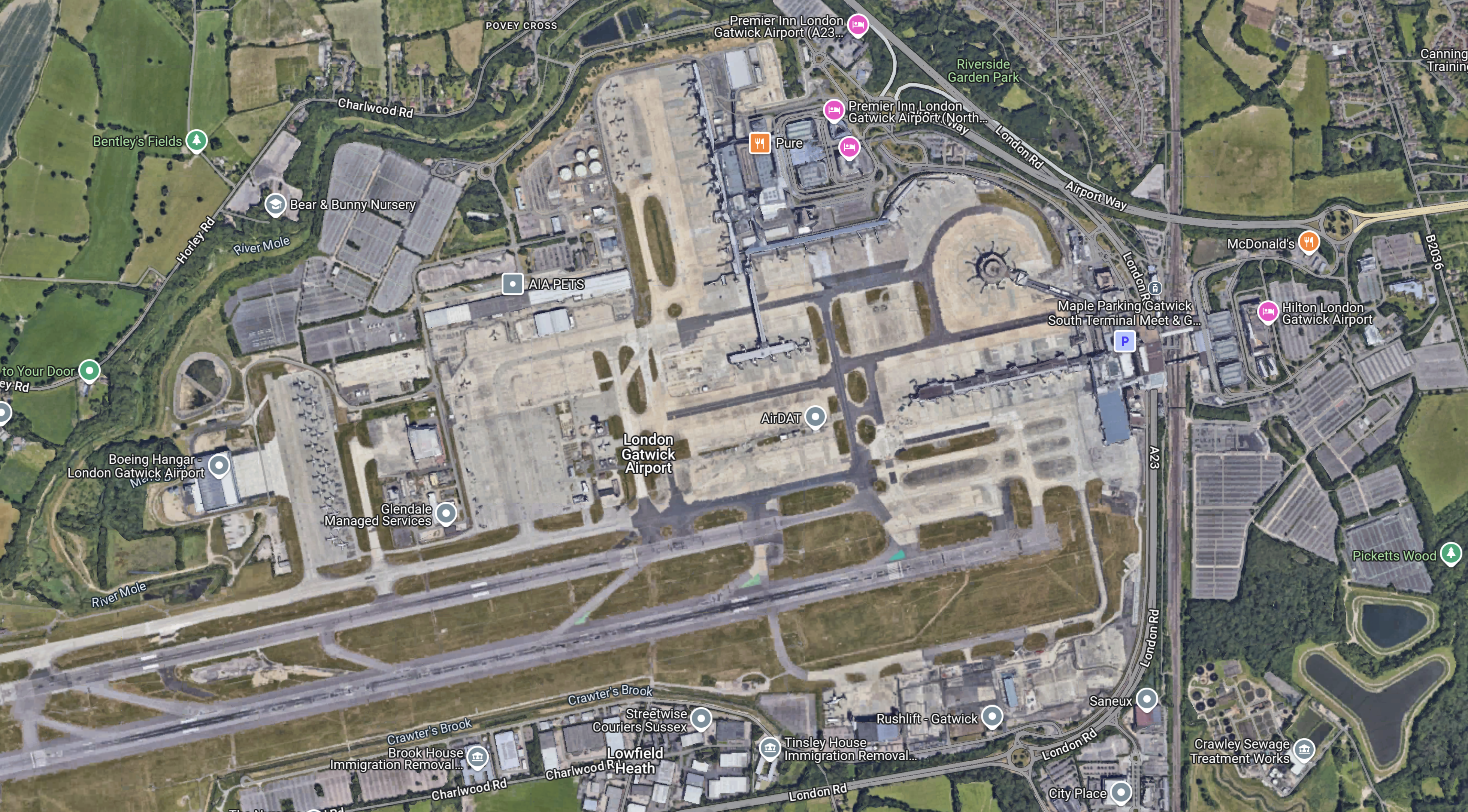
Note.
- The current main runway with the emergency runway to its North.
- Because the runways are too close together they cannot be used simultaneously.
- To create a second runway, the two runways would be moved further apart and the current emergency runway would be enlarged.
- The Brighton Main Line runs North-South past the Eastern end of the main runway.
Gatwick’s expansion plan doesn’t appear to require any properties outside the airport boundaries to be demolished.
This Google Map shows Sussex between Gatwick Airport and Brighton.
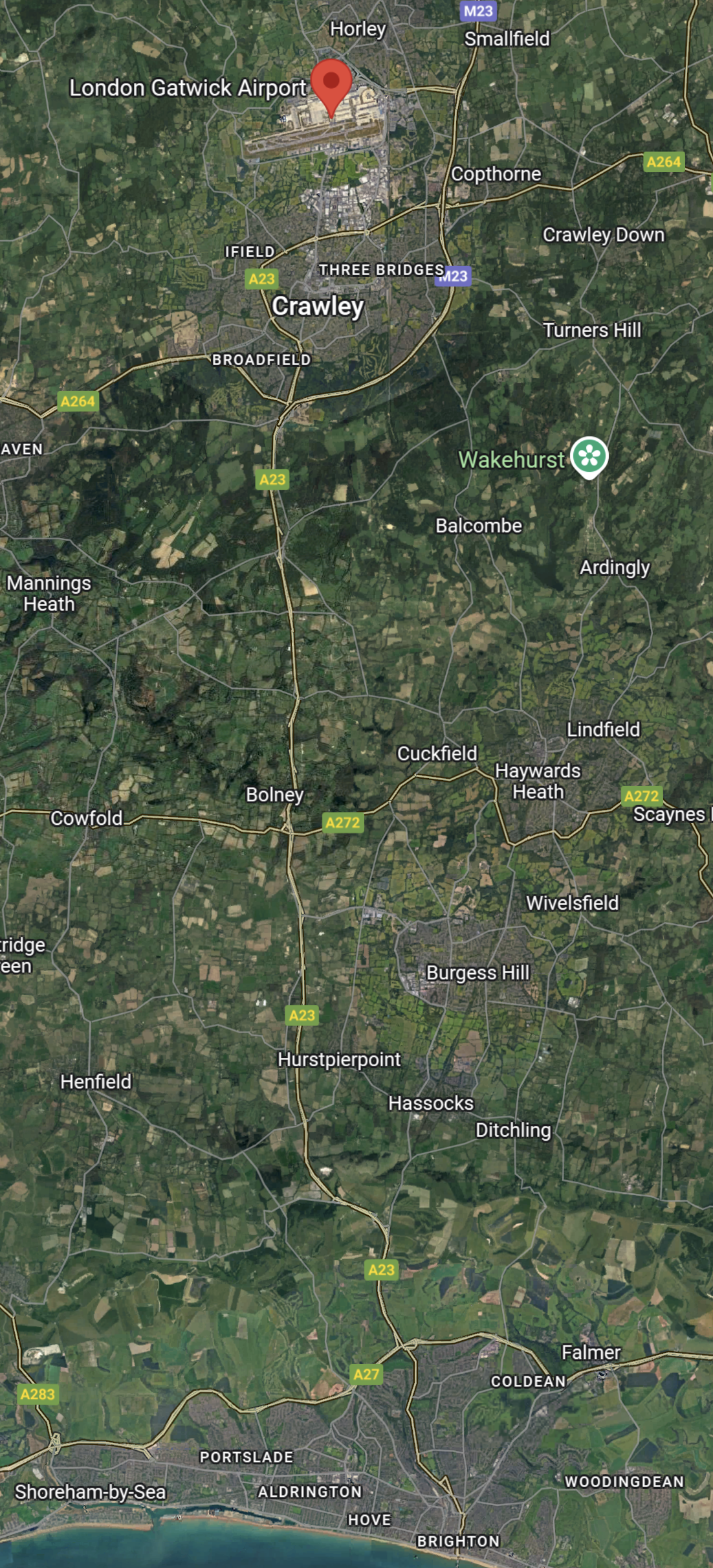
Note.
- Gatwick Airport is indicated by the red arrow at the top of the map.
- Gatwick’s runways can be picked out under the red arrow.
- The South Coast is at the bottom of the map.
- The M23 and the Brighton Main Line connect Gatwick Airport and Brighton.
- Shoreham and Brighton are on the South Coast.
- Click the map to show on a larger scale.
Under current plans, the Ramplion offshore wind farm off the South Coast is going to be increased in size to 1.6 GW.
The simplest plan to provide large amounts of green hydrogen to Gatwick would be to build a large electrolyser in the Port of Shoreham and pipe it along the railway to Gatwick Airport. Hydrogen could also be shipped at night into the Airport using rail tankers.
There’s no doubt in my mind, that it will be much easier to supply large quantities of hydrogen to Gatwick, rather than Heathrow.
In 2023, I wrote Discover How Greater Brighton Is Championing The Transition To Hydrogen, which probably indicates that the locals and their politicians, would welcome the investment in hydrogen in their city.
It should also be noted that world class consultants Ricardo, who are very much involved in the development and promotion of hydrogen technology are based in Shoreham.
Liquid hydrogen could also be imported and distributed from the Port of Shoreham.
Brighton could end up as the South of England’s Hydrogen City.
Hydrogen Bus Fleet Project Gains Momentum
The title of this post, is the same as that of this article from Energy Live News.
This is the sub-heading.
Luxfer Gas Cylinders and Ricardo have formed a partnership to advance a project that aims to deploy 150 hydrogen-powered buses on UK routes by 2024
I first came across this project in June 2022 and wrote Ricardo Repowers Double Decker Diesel Bus With Hydrogen Fuel Cells, where I said this.
The title of this post, is the same as that of this press release from Ricardo.
Ricardo, a global strategic, environmental, and engineering consulting company, in partnership with Stagecoach North East, has repowered a diesel, double decker bus with a hydrogen fuel cell propulsion system. Delivering zero tailpipe emissions, Ricardo is now seeking to secure customers to invest in the production of a fleet of passenger vehicles fit for the future of sustainable shared mobility.
The project, part funded by the Department of Transport, through its Hydrogen Transport Hub Demonstration competition, saw Ricardo, working with Stagecoach North East to retro-fitted hydrogen fuel cell technology into an existing double decker bus. It created a zero emissions demonstrator that is now undergoing a ten-week test and demonstration programme around the Tees Valley and Brighton and Hove. Feedback and data from the trials will support the team to explore future market opportunities and applications with bus operators and other partners across the UK and beyond.
Given that there are around 38,000 existing buses in the UK, many of which still have a few years of life left, this surely must be an affordable way of creating more zero-carbon hydrogen buses.
It appears that Ricardo are aiming to have an initial batch of 150 buses in service from late 2024.
It looks to me, that this project is certainly gaining momentum.
Sussex Will Be Leader In Hydrogen Energy Production
The title of this post, is the same as that of this article on The Argus.
These are the first three paragraphs.
The county is today launching its bid to become a pioneer for use and production of hydrogen energy.
Experts will unveil Brighton’s hydrogen strategy this morning showing how the city and surrounding areas are championing a clean energy infrastructure.
With plans for a Worthing crematorium to become the first in the world powered entirely by hydrogen, development of a green energy production facility in Shoreham, and a growing fleet of hydrogen-powered buses in Crawley, the region is already breaking ground in the hydrogen industry – and shows no sign of stopping.
These are my thoughts.
The Plan Is Comprehensive
This document of the Council website, is entitled the Greater Brighton Hydrogen Strategy.
It is very comprehensive and discusses hydrogen in Sussex from all angles.
Every Council in the UK needs to have their own comprehensive strategy like this.
The Report Cautions That Greater Brighton May Need More Renewable Energy
Consider.
- The Rampion wind farm, with a capacity of 400 MW is already operating in the sea South of Brighton.
- This should be joined by the 1200 GW rampion 2 wind farm in the next few years.
It is unlikely substantial onshore wind and solar farms will be built in the area.
Gatwick Airport Is Expected To Need A Hydrogen Supply
The strategy says this about Gatwick and the two Rampion wind farms.
The offshore wind farm Rampion is large enough to be considered nationally significant infrastructure. There
is a second development for this wind farm planned for 2025-6, which will connect into Bolney substation as
per the existing wind farm.The GBEB energy plan suggested that an electrolyser could be sited there, although there are no identified demand locations nearby other than potential refuelling of passing traffic on the A23.
However, considering the relative distance to Gatwick airport, which is expected to be a significant future
demand, there may be an opportunity for a direct pipeline. This would be further into the future and requires
further analysis and bilateral engagement between Rampion and Gatwick. Engagement with Rampion found
that, given the large population supplied by the Rampion wind farms, and the relative lack of other large-scale
renewables locally, these wind farms are unlikely to face significant curtailment and will fully contribute to
decarbonising the local electricity grid. Therefore, using Rampion to produce hydrogen by electrolysis is not
seen as the best use case in the near term.
It looks to me, that because of the electricity demand in the Brighton and Gatwick area, that a big decision needs to be made to create some more renewable capacity.
Could this mean a Rampion 3 or perhaps a fleet of small modular nuclear reactors at Dungeness?
An Electrolyser At Bolney Substation
This Google map shows the position of Bolney substation.
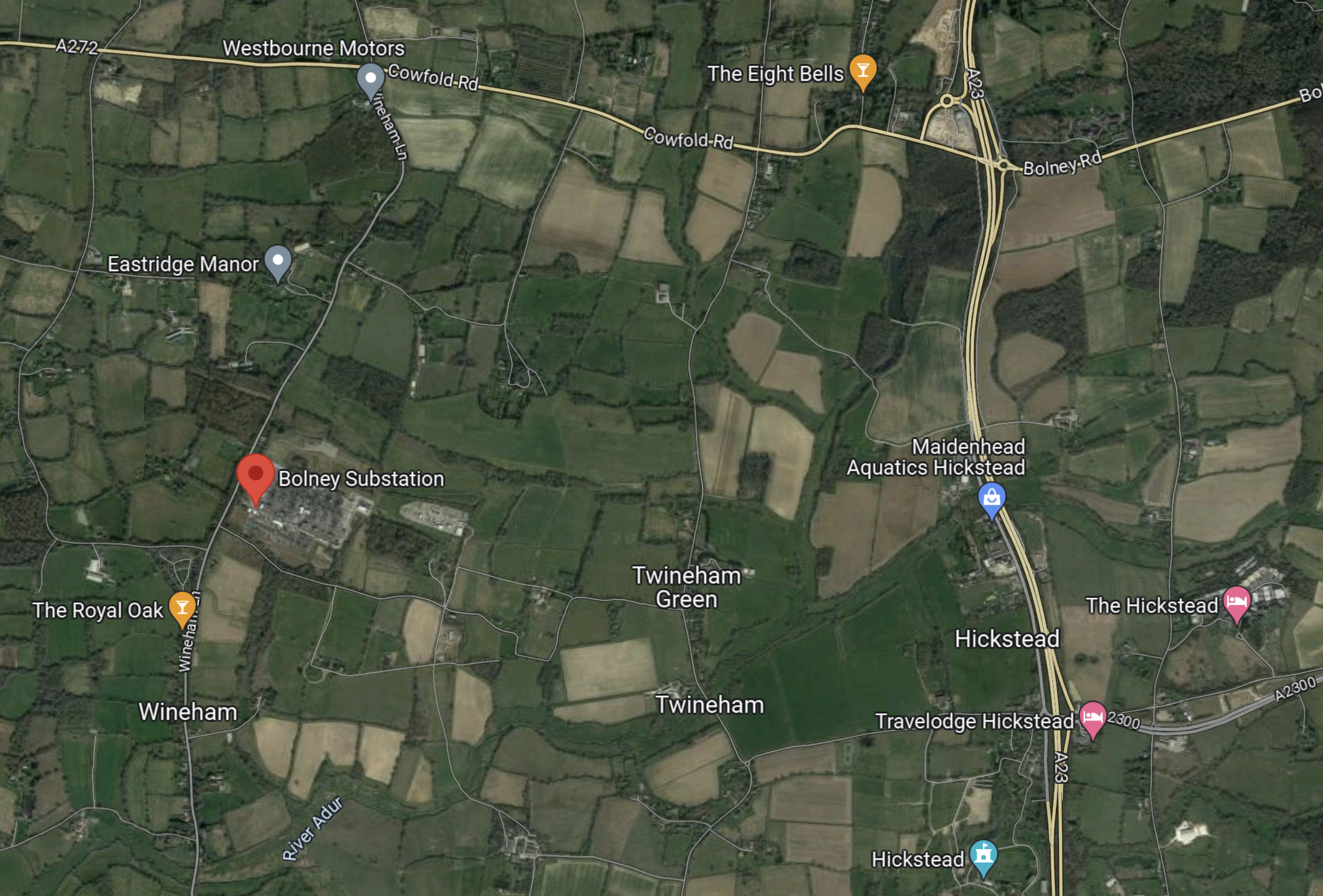
Note.
- The A23 is the main London-Brighton road.
- Bolney substation is indicated by the red arrow.
- The substation doesn’t have very good road access.
- I also suspect that the locals wouldn’t like an electrolyser in their midst.
On a brief look, I suspect that an electrolyser at Bolney substation will be a non-starter.
Shoreham Port As A Hydrogen Hub
The strategy mentions Shoreham Port several times, but gives the impression that progress is slow.
This Google Map shows Shoreham Port.
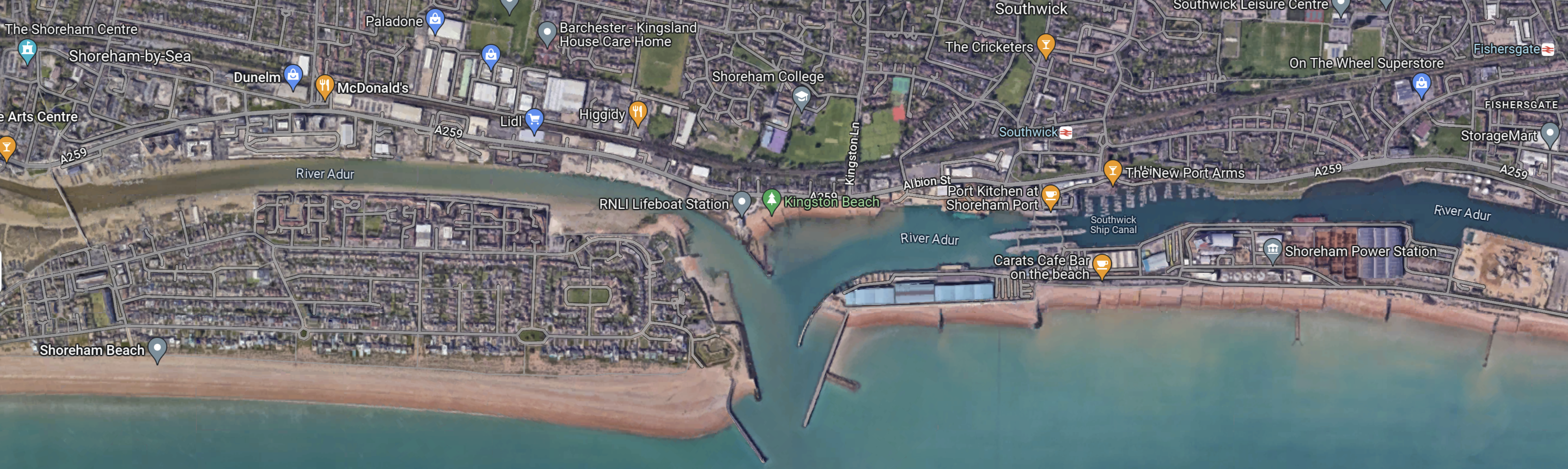
Note.
- Shoreham is in the West.
- The port reaches a long way to the East.
- The 420 MW gas-fired Shoreham Power station, is at the Eastern end of the port, close to the sea.
There appears to be spaces along the water for developing hydrogen infrastructure.
This page on the H2Green web site is entitled Agreement to Develop Clean Energy Hub for Shoreham Port, Sussex, starts with this paragraph.
Getech, the geoscience and geospatial technology provider and data-led energy asset developer, is pleased to announce that its wholly owned hydrogen subsidiary, H2 Green, has signed a Collaboration Agreement (the “Agreement”) with Shoreham Port.
It lists these three highlights.
- H2 Green granted a two-year legally binding exclusive right to develop a renewable energy hub (the “Hub”) at the Port of Shoreham, West Sussex.
- Under plans submitted by H2 Green to Shoreham Port, the Hub will initially focus on the provision of green hydrogen and renewable electricity to the Port’s fleet of 39 heavy forklift trucks and 12 heavy goods vehicles.
- Green Hydrogen will be sourced by a scalable green hydrogen production, storage and refuelling facility – the economics of which will be optimised by its integration with new solar and wind electricity generation capacity.
- The Hub will then be expanded to facilitate the decarbonisation of more than 800 heavy goods vehicles that enter Shoreham Port daily, and to provide fuel to port and coastal marine vessels.
That is all good stuff, but I do wonder, where the renewable electricity is going to come from.
In Further Thoughts On BP’s Successful INTOG Bid, I looked at BP’s plan for a 50 MW wind farm.
- It will be about twenty miles offshore from Aberdeen.
- With an appropriate electrolyser 50 MW of electricity would produce twenty tonnes of hydrogen per day.
- The electrolyser could be onshore or even offshore.
- The technology has all been developed.
Could H2Green be thinking of developing a similar hydrogen production facility?
Discover How Greater Brighton Is Championing The Transition To Hydrogen
The title of this post, is the same as that of this news item from Brighton & Hove Council.
This is the introduction to the news item.
Local experts will present the strengths and opportunities for developing the hydrogen economy in the Sussex area at an online launch on 11 July.
Register for the online launch of the Hydrogen Strategy
Developed by local company Ricardo, on behalf of Hydrogen Sussex, the Greater Brighton Hydrogen Strategy shows that with the right focus, collaboration and action, the region has real potential to stand out within the UK hydrogen landscape and gain economic and environmental benefits.
Brighton & Hove Council seem to be taking a sensible approach, but then they do have one of the world’s most respected hydrogen companies; Ricardo, a few miles to the West.
This section outlines, how Brighton is embracing hydrogen.
Hydrogen is a fast-growing sector with the potential to enable decarbonisation, support national energy security, create green growth and improve air quality.
The Greater Brighton and wider Sussex area has already broken ground in the Hydrogen industry, with advanced engineering, education and research being very well represented. Local initiatives include:
-
- Hydrogen buses: Metrobus has just launched 15 hydrogen buses to serve the Crawley and Gatwick area, with a further 34 hydrogen buses joining their fleet over the next 18 months.
- Shoreham Port: The port is working with partners H2Green to create a Green Energy Hub, producing green hydrogen in a multi-megawatt electrolysis plant – initially for Shoreham Port, and then supplying green hydrogen across the region.
- Maritime sector: Sussex’s engineering companies are at the forefront of hydrogen decarbonisation in the maritime sector. Bramble Energy, Cox Marine, Ceres Power and Ricardo are just some of the local companies which have received Government funding to tackle marine decarbonisation.
- Sussex and Brighton universities: The two universities in the area have PHD studies on innovations in the sector, with Brighton University partnering with companies to win government research funding.
- Worthing Crematorium: Could become the first in the world to trial a switch to 100% hydrogen. If testing is successful with cremator manufacturer DFW Europe, hydrogen technology will be brought over to Worthing Crematorium as early as spring 2024.
The region is already home to several hydrogen technology companies and has a strong capacity for innovation which could be developed to expand its engineering excellence.
That list looks fairly comprehensive.
Conclusion
Other towns, cities and regions in the UK, should look at what Brighton is doing, with respect to hydrogen.
Britain’s Longest Road Tunnel Could Be Built Along A27
The title of this post is the same as that of this article in The Argus.
These three paragraphs outline the scheme.
The longest road tunnel in the UK could be built as a long-term solution to congestion along the A27.
The tunnel, which would cost around £2 billion, has been touted as a way of addressing traffic and a way to improve local quality of life.
A new report by Transport for the South East (TfSE) said investing in such schemes is the only way carbon emissions from congested road traffic can be seriously tackled and improve.
The article also states, that the project is unlikely to be started before 2050.
These are my thoughts.
Where Will The Tunnel Be Built?
This Google Map shows Worthing.
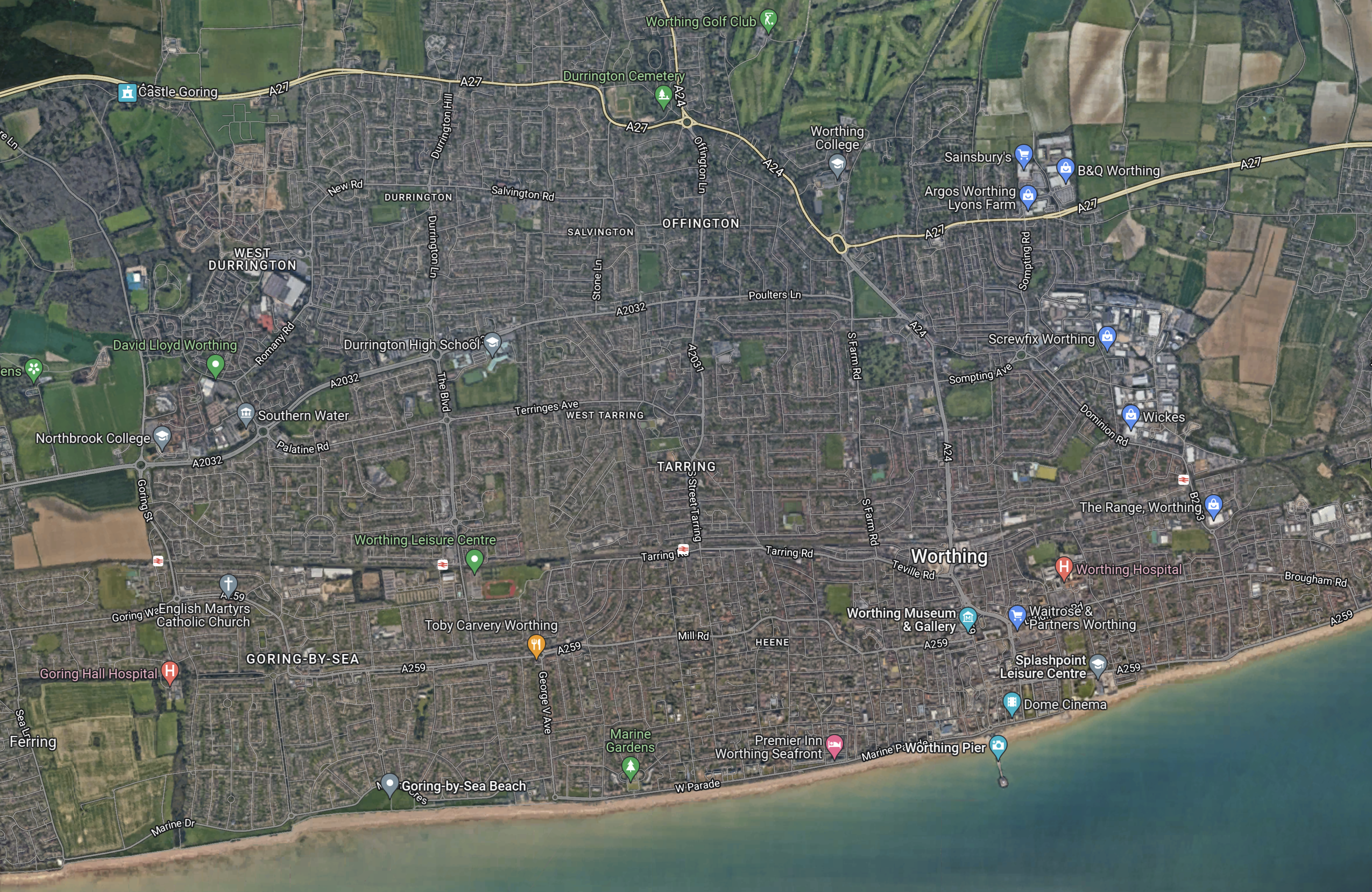
Note.
- The A27 road runs roughly across the top of the map.
- The A27 has sections of dual-carriageway.
- There are two roundabouts, where the A27 connects with the A24 road between London and Worthing via Sutton, Dorking and Horsham.
- The West Coastway Line runs across the middle of the map.
- Four of the five stations in Worthing are visible.
- From East to West the stations are East Worthing, Worthing, West Worthing and Durrington-on-Sea, with Goring-by-Sea off the map to the West.
This Google Map shows the section of the A27 to the West of the A24.
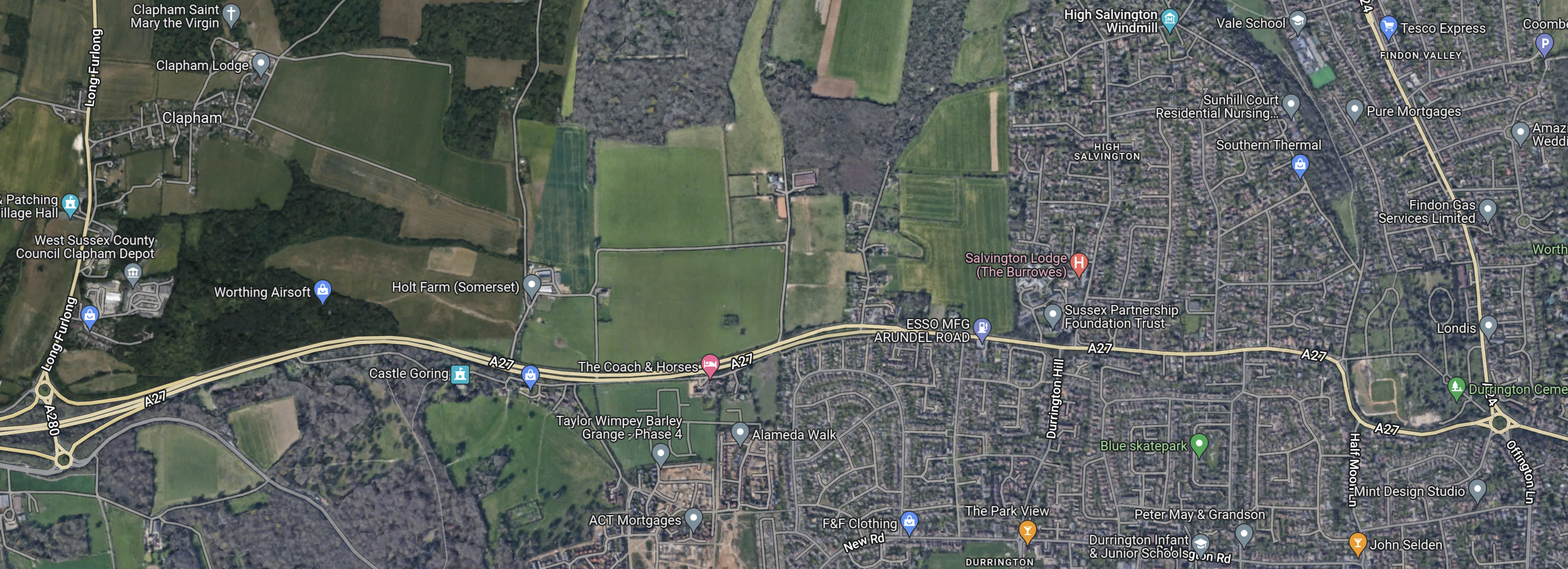
Note.
- The A27 goes all the way across the map.
- There is a large junction with the A280 at the Western edge of the map.
- There is a large roundabout at the junction with the A24, at the Eastern edge of the map.
- The Western half of the A27 between the two junctions, appears to be dual-carriageway.
- The A27 continues in the West as a dual-carriageway between the junction with the A280, almost as far as Arundel.
I suspect the Western portal of the tunnel would be close to the junction with the A280 and for much of the route, it could be bored under the A27 to minimise noise and vibration for those living along the route.
This third Google Map shows the section of the A27 to the East of the A24.
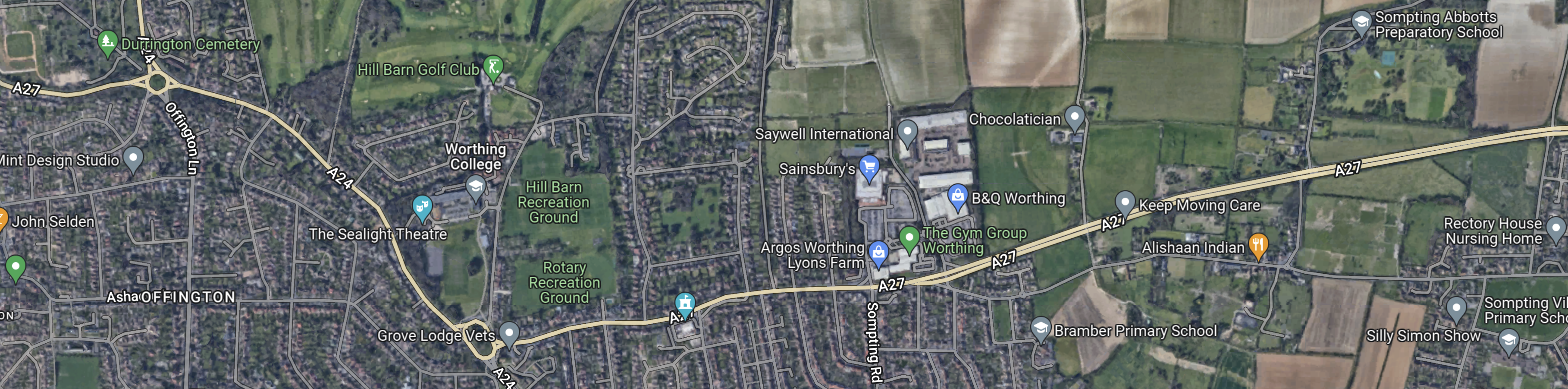
Note.
- The A27 goes all the way across the map.
- It shares a route with the A24 between the two roundabouts towards the West of the map.
- The Eastern section of the A27 appears to be dual-carriageway.
- T27 continues in the East to the North of Shoreham and Brighton and the South of Lewes.
I suspect the Eastern portal of the tunnel would be close to the Western end of the dual-carriageway section to Lewes and for much of the route, it could be bored under the A27 and A24 to minimise noise and vibration for those living along the route.
As we’re good at tunneling in the UK, I don’t think this will be a difficult tunnel to bore.
What Should We Do In The Interim?
The article in the Argus says this.
Should the plans go ahead, the tunnel could be ready for construction by 2050, with a range of other measures proposed to cut congestion in the short term.
2050 is a long time to wait.
I haven’t driven in the area much in the last twenty years, as even before I didn’t drive, I’ve tended to take the train to places like Brighton, Eastbourne, Portsmouth and Southampton.
In my experience the East and West Coastway Lines along the South Coast have reasons, why people drive for preference.
- The trains are not frequent enough. There should be four trains per hour (tph) if possible.
- There needs to be more direct train services to London and Gatwick Airport.
- Some of the stations are not very passenger-friendly. More step-free access is needed.
- Some of the stations can’t handle twelve-car trains.
- The Class 313 trains, that are used to the West of Brighton, were built in the 1970s. Similar trains of that period in the rest of the UK, have either been replaced or will soon be.
- Is there enough car parking?
- Could some closed stations be reopened?
- Could Park-and-Ride facilities be built, where the A27 crosses the railway?
- Would it help, if the West and East Coastway Lines didn’t need a change at Brighton?
- Would a high speed service between Eastbourne and London via Hastings and High Speed One attract leisure passengers.
An improved railway might reduce traffic on the A27.
Perhaps the easiest improvement would be to replace all the East and West Coastway fleet with new or refurbished trains with the following specification.
- 100 mph operation.
- High-class well-designed interior matched to the passenger mix.
- Ability to handle the Marshlink Line and other sections without electrification.
- Wi-fi and power sockets.
- A refreshment trolley might be a good idea.
A marketing campaign might help.
Brighton Buses – 30th March 2022
I had a short ride up from the sea-front back to Brighton station on a bus, as the climb is a bit much for me on some days.
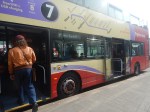
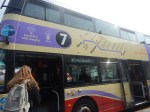
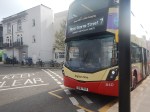

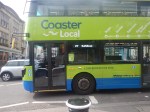

Note.
- The bus I travelled on had two doors like London’s, which makes entry and exit so much more efficient.
- Brighton seems to have contactless ticketing, where you touch-in and touch-out, as you do on the London Underground.
- The two buses in the pictures have the route on the side.
I was very surprised that there were no stops on the sea-front, where you can get a bus to the station, as not all visitors to the city, are in the first flush of youth.
There wasn’t even any instructions about how to find a bus.
Go-Ahead Group Signs Contract For Its First Hydrogen Fuel Cell Buses
The title of this post, is the same as that of this article on Intelligent Transport.
This is the first paragraph.
Brighton & Hove and Metrobus have ordered 20 hydrogen fuel cell vehicles, which are set to be delivered in June 2022, signalling the Go-Ahead Group’s first order of hydrogen powered buses.
The vehicles are single-decker GB Kite Hydroliner FCEV buses.
These buses can be configured to carry up to ninety passengers and they have a range of up to 640 miles.
The article says these buses are for Faraway-branded express buses, so the long range will enable buses to be garaged centrally and refuelled once a day.
It looks like this could be the first of several orders from Go-Ahead for hydrogen buses.
London Has A New Underground Line
On Friday, I went between Brighton and Cambridge stations on one of the first Thameslink services on the route.
I wrote about it in Observations On Thameslink Between Brighton And Cambridge.
That journey took me on London’s new Underground Line between London Bridge and Finsbury Park stations.
The following trains are going North from London Bridge to Finsbury Park.
- 11:29 – Horsham to Peterborough – Arrives at Finsbury Park at 11:52
- 12:49 – Brighton to Cambridge – Arrives at Finsbury Park at 13:13
- 15:04 – Horsham to Peterborough – Arrives at Finsbury Park at 15:27
- 15:34 – Brighton to Cambridge – Arrives at Finsbury Park at 15:57
And the following trains are going South from Finsbury Park to London Bridge.
- 10:59 – Peterborough to Horsham – Arrives at London Bridge at 11:24
- 12:09 -Cambridge to Brighton – Arrives at London Bridge at 12:37
- 14:29 – Peterborough to Horsham – Arrives at London Bridge at 14:55
- 15:11 – Cambridge to Brighton – Arrives at London Bridge at 15:37
All journeys take around 23-25 minutes, with stops at Blackfriars, City Thameslink, Farringdon and St. Pancras International stations.
It may officially be part of Thameslink, but it will function like a convewntional Underground Line, but with bigger trains.
The Underground Alternative
If you look at Transport for London’s Journey Planner, this give a time of twenty minutes for a journey between London Bridge and Finsbury Park, using the Northern and Victoria lines with a change at Euston.
That is also not a step-free or wheel-chair friendly route.
Obviously, at the moment, most passengers have no choice, as there is only four trains per day in each direction on the new Thameslink route.
But when a Full Service is running, with a train every ten minutes, things will be very different.
My Access To Thameslink
Timings to Thameslink stations from my house are as follows.
- Finsbury Park – 15 mins by 141 Bus and Piccadilly Line
- London Bridge – 25 mins by 21 or 141 Bus
- London Bridge – 31 mins using Transport for London’s Journey Planner’s recommended route via Dalston Junction and Canada Water.
The latter probably explains why Londoners are generally Grade 1 Duckers-And-Divers!
I suspect, when I go to Gatwick Airport, I’ll go via Finsbury Park, using the mini-cab from around the corner or a black cab, as both will be quicker.
I suspected right. Returning from Finsbury Park station to home this evening, took ten minutes and cost a tenner.
A Preview Service
Thameslink are only running a preview service between London Bridge and Finsbury Park at the current time.
On my Friday trip, it was particularly noticeable, that passengers were thin on the ground between the two stations.
- But then passengers probably didn’t know about the service and may have been confused seeing a train going to Cambridge.
- It’s also not shown on the Tube Map.
- I didn’t notice any advertising for the new route.
So how do you use something that you don’t know about?
The Full Service
This route will have the following characteristics, when Thameslink open it fully.
The Route Will Serve The City of London Well
These factors will help this section of Thameslink serve the City of London.
- Step-free stations at Farringdon, City Thameslink and London Bridge ring the South and West of the City of London.
- Crossrail with an interchange with Thameslink at Farringdon also gives a quick route to the East of the City of London and Canary Wharf.
- The City of London is also planning a lot of pedestrianisation.
Other developments like Crossrail and the expansion of Bank station and the Docklands Light Railway, will make London’s financial district, one of the best connected by public transport in the World.
The Route Will Have Tourist Attractions
The route could have been designed for tourists.
- London Bridge station has London and Tower Bridges, Southwark Cathedral, Borough Market, HMS Belfast and the Shard.
- But the most spectacular modern architecture at London Bridge, is the station itself, with its lifts, escalators, fifteen platforms and a shopping centre.
- Blackfriars is a unique station, as it spans the Thames with entrances on both banks, and it is the world’s largest solar-powered bridge.
- Blackfriars station is a short walk along the river from the Tate Modern and the Millennium Bridge.
- Many good walks along the river start from Blackfriars.
- City Thameslink station dates from 1990 and it shows, but it is close to St. Paul’s Cathedral, the Old Bailey, so it attracts visitors at both ends of the moral spectrum.
- Farringdon station will be a major interchange, where Crossrail and Thameslink connect, so don’t let unsuitable organisations build all the hotels this area will attract.
- Farringdon is close to two of London’s iconic markets; Smithfield meat market and the attached wife market.
- Saint Pancras International station is a fur coat and no knickers station, as although it looks good, it’s practicality is suspect.
- If they’d given the job to the architect, who updated Kings Cross station next door, they would have got a a more practical station.
- Finsbury Park station is a place, where you go and explore the local area, which is vibrant and full of history.
- You may even get as far as Alexandra Palace or Manor House, where I saw John Mayall and the Bluesbreakers with a very drunk Eric Clapton in the 1960s.
It is a line to explore London.
Six Trains Per Hour
There will be six trains per hour (tph), which will run All Day.
- Two tph – Peterborough to Horsham – twelve-car
- Two tph – Cambridge to Brighton – twelve-car
- Two tph – Cambridge to Maidstone East – eight-car
This gives a six tph service between Finsbury Park and London Bridge and also a four tph service to East Croydon and Gatwick Airport.
Two Additional Trains Per Hour In The Peak
In the Peak, there will be two tph, that run from Welwyn Garden City to Sevenoaks.
But they will go via Elephant and Castle rather than London Bridge.
Thameslink must have their reasoning behind this service, but I have some questions.
- Would commuters in the Peak prefer to go to London Bridge?
- Would passengers from Sevenoaks and Welwyn Garden City like an All Day service?
These questions and others will be answered in the next few years, as hameslink develops.
Full Step-Free Access At London Bridge Station
London Bridge station has full step-free access for all the following services.
- Thameslink
- Services to and from Cannon Street station
- Services to and from Waterloo East and Charing Cross stations.
- Jubilee and Northern Lines of the Underground
- Terminating services at London Bridge
- Several bus routes, including my bus home!
Note.
- Passengers will use the escalators to get to the right destination.
- Thameslink passengers will use the island platform to reverse direction.
- It took me just two minutes to change from Platforms 2/3 to Platforms 8/9.
- Going from Platform 6/7 to the bus station was under three minutes and a 141 Bus was just getting ready to leave.
- Passengers can walk across London Bridge to the City of London.
There are few stations better than London Bridge anywhere in the world!
Full Step-Free Access at Finsbury Park Station
Finsbury Park station is being updated to have full step-free access for the following services.
- Thameslink
- Great Northern Services to Cambridge, Kings Lynn and Peterborough
- Northern City Line services to and from Moorgate station
- Piccadilly and Victoria Lines. of the Underground.
There will also be same-platform interchange between Thameslink and Northern City Line services.
The Improved Northern City Line At Finsbury Park Station
The Northern City Line will be substantially improved.
- New Class 717 trains have been ordered.
- This could mean an increased All Day service of perhaps 10-12 tph.
- Moorgate station will be on Crossrail.
- There will be a same-platform interchange with Thameslink at Finsbury Park station.
- Hopefully, the terrible stations on the route will be improved.
This line will change from being a crowded, outdated backwater of the UK rail system to an important modern link to the City of London and Crossrail from large parts of North and North-East London.
The Link To Crossrail
The link between Thameslink and Crossrail at Farringdon station will probably be heavily used, if it is well-designed and fully-step free. Which I suspect it will be, until proven otherwise!
Don’t forget too, the link to the Metropolitan and Circle Lines at this key station, which is much better than the link at St. Pancras
Step-Free Access At All The Intermediate Stations Between London Bridge and Finsbury Park
Access at Blackfriars, City Thameslink, Farringdon and St. Pancras stations are all fully step-free.
The Fastest Way To Gatwick Airport And Brighton From North London
My friend lives in Walthamstow and always goes to Gatwick Airport by using the Victoria Line and Gatwick Express.
- This takes twenty-three minutes for the Victoria Line and thirty minutes for the train.
- The Thameslink route via Finsbury Park, takes nine minutes for the Victoria Line and an hour for the train.
Note.
- Both trains will run every fifteen minutes, when the full Thameslink service is running.
- The Thameslink timing is only the time of the Preview Service. Will the Full Service be faster?
- Finsbury Park and Victoria will both be fully step-free within a year or so.
- The trains on Gatwick Express will be more comfortable.
- The walk at Finsbury Park is shorter than at Victoria.
- The Thameslink route will be more affordable.
Everybody will have their own preference.
The biggest winners will be.
- Those living on the Northern reaches of the Piccadilly Line, who will have a full step-free interchange to Thameslink at Finsbury Park
- Those living on the Northern City Line, who will have a same-platform interchange to Thameslink at Finsbury Park.
- Those who walk, cycle or take a bus or cab to Finsbury Park.
Gatwick Airport could be a big winner, as a whole area of North London and Hertfordshire now has a new excellent direct connection to the Airport.
What Still Needs To Be Done?
It is a well-thought out route, but some things still need to be done.
Is Six Tph Enough Trains Between London Bridge And Finsbury Park?
I ask this question, with my scheduling hat on!
At the moment of the 24 tph through the Snow Hill Tunnel, two-thirds of the trains go up the Midland Main Line, with just a third on the East Coast Main Line.
I think that, when Thameslink increase the frequency through the central core, that they will increase the frequency through Finsbury Park.
Could Two Tph From The Sutton Loop Go To Welwyn Garden City?
Curremtly, four tph start at St. Albans City station, go through London, then round the Sutton Loop, before returning to St. Albans City.
Would it be desirable to start two of these services from Welwyn Garden City station?
It will all depend on operational issues and the routes passengers take.
City Thameslink And St. Paul’s Stations Need A Connection
I believe this is possible and I wrote about it in A Pedestrian Connection Between City Thameslink Station And St. Paul’s Tube Station.
Should The Docklands Light Railway Be Extended To City Thameslink, Euston And St. Pancras?
I wrote about this extension in detail in A Connection Between City Thameslink Station And The Docklands Light Railway.
Could Thameslink Connect To The Waterloo And City Line?
I wrote about this connection in Could The Waterloo And City Line Have An Intermediate Station At Blackfriars?
Development of new trains for the Underground, will make this link possible.
Should Thameslink Be On The Tube Map
I wrote about this in Thameslink Should Be On The Tube Map.
All Of Thameslink Should Be In The Oystercard Area
Gatwick Airport is already in the Oystercard area, but it is silly that Oyster cards and contsctless cards can’t be used on all Thameslink services.
Conclusion
The possibilities for Thameslink and the effects it will have will be enormous.
 The Anonymous Widower