How Much Electricity Do You Need To Charge A Garage Full Of Electric Buses?
Consider.
- A couple of years ago, I had a long discussion and a few beers with three managers of bus garages.
- In First Bus To Launch 1MW BESS Unit In Hampshire, Aberdeen To Follow, I talk about a specialist battery to charge buses.
- In Is Sumitomo Heavy Industries Highview Power Energy Storage System On line At Hiroshima?, I talk about an efficient, renewable power supply for an LNG Terminal.
I asked Google AI the question in the title of this post and received this comprehensive answer.
Charging a full garage of electric buses requires massive amounts of electricity, with typical, non-optimized charging for a 100-bus depot capable of drawing nearly 10 megawatts (MW) of power. To put this into perspective, a 100-bus depot might require roughly 150 Megawatt-hours (MWh) of energy to recharge over an eight-hour night.
Key Factors and Energy Requirements
Energy Consumption per Bus: A typical electric bus has a battery capacity between 300-500 kWh. Energy consumption averages around 1.11 to 1.35 kWh/km, with higher consumption in winter or with heavy A/C use.
Total Depot Power: For a 100-bus depot, power requirements can reach 10 MW, equivalent to the power output of a small hydroelectric dam.
Optimal Charging: Using smart charging, a 100-bus depot can reduce its peak demand to around 4 MW.
Daily Usage: A single, large electric bus can consume up to 500 kWh per day, with daily demand ranging from 189 to 231 kWh for typical operations.
Infrastructure and Grid Considerations
Charging Infrastructure: Depots often use 40 kW to 250 kW chargers, with 100 kW common for overnight charging.
Grid Capacity: A 34-bus depot might require a new 1000kVA transformer to handle the load.
Voltage: 11,000 volts may be required to power new substations, which are then stepped down to 400 volts for charging.
Operational Factors Affecting Energy Need
Heating and Cooling: Cold weather can increase energy consumption by up to 45% (due to electric heating).
Driving Style: Inefficient driving can increase energy consumption by 0.24 kWh/km above average.
Regenerative Braking: This can recover 37–40% of energy for 40-60 ft buses.
Cost Implications
Energy Bills: A 100-bus depot can incur monthly energy bills between $112,000 and $515,000 without optimization.
Cost Savings: Electric buses are generally cheaper to fuel, costing ~£0.21/mile compared to £0.49/mile for diesel.
Could A System Based On The Sumitomo/Highview Power System At Hiroshima Charge Electric Buses?
The optimal charging figure for a 100-bus garage would appear to be in the region of 4-5 MW.
In Is Sumitomo Heavy Industries Highview Power Energy Storage System On line At Hiroshima?, I state, that it looks like Highview Power’s CRYOBattery™ at the heart of the system has a capacity of 5 MW/20 MWh.
I also state in the post, that the Hiroshima facility is designed to support grid stability and enhance renewable energy integration.
Does this all mean that if you can install enough solar panels on the roof of the garage or perhaps a wind turbine nearby, that you can have buses substantially powered by the sun and wind.
Chicago would just love wind-powered buses!
First Bus To Launch 1MW BESS Unit In Hampshire, Aberdeen To Follow
The title of this post, is the same as that of this article on Solar Power Portal.
This is the sub-heading.
Bus operator First Bus has launched its largest energy storage facility yet in Hampshire.
These four paragraphs add more detail.
Located at the company’s Hoeford bus depot, the 1MW battery storage unit, with a 2-hour duration, will begin operations next month.
This will be followed by a bigger battery storage unit with 2MW/4MWh capacity at its depot in Aberdeen, which will begin work by the end of the year.
The FirstGroup division said that it will explore opportunities to build more battery sites across the UK in the future.
The new battery storage facilities will be used to store surplus electricity that will be distributed back to the grid during peak demand and help maintain power supplies. It will also be used to power the company’s more than 1,200 electric bus fleet.
Note.
- Hoeford’s 1MW/2MWh and Aberdeen’s 2MW/4MWh are big batteries.
- They will be installed, where there is a predictable need.
- Google AI says that the First Bus UK News “About Us” page lists 65 depots and outstations.
- I suspect some clever data analysis is being used to optimise the size of a battery to the route structure and number of buses at a depot.
The batteries appear to come from a company called Palmer Energy Technology, who are backed by Barclays, First Bus and the University of Oxford.
This is the Palmer Energy Technology web site, which has these two paragraphs.
Palmer Energy designs and manufactures Battery Energy Storage Systems that apply automotive‑grade principles to stationary applications. PETL specifies premium cells, uses liquid cooling as standard and focuses on intelligent control to drive down operating costs for customers in transport, industry and the grid.
Through our 100% ownership of Brill Power, a University of Oxford spin out, we incorporate Brill Power’s patented active loading BMS technology in all our BESS to increase the lifetime of systems, improve safety and remove geopolitical risks by storing all data on UK servers.
These are my further thoughts.
Electric Bus Charging Puts A Strain On The Grid
A couple of years ago, I had a drink with three bus depot managers in London. They said that some depots were having difficulty getting sufficient power from the grid.
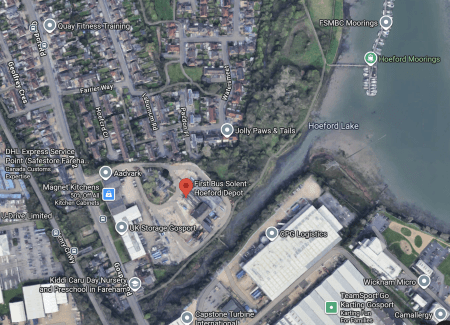
This Google Map shows Hoeford Depot where the first battery has been installed.
Note.
- Hoeford Depot is by the water at Fareham.
- The depot is indicated by the red arrow.
- The depot is surrounded by houses and other businesses.
As an electrical engineer, I would expect that a battery of the right size could sort out any charging problems.
Bus Garage Batteries Could Mop Up Surplus Electricity
Consider.
- I would expect bus garages have a predictable pattern for energy use.
- Buses will often be charged at night, when solar power is low.
- Do bus garages get a cheaper electricity rate at night?
- There will be times, when bus garages can accept excess energy from the grid and store it until they need it.
- This will mean that wind turbines won’t have to be turned off so often.
Palmer’s batteries installed in a bus garage seem to be a simple way to increase renewable energy efficiency and possibly reduce the cost of battery charging.
Would A Bank Finance The Batteries?
I am not a banker or an accountant, but I have worked with some of the very best. One banker, who sadly has now passed on, would have surely backed this company if the technology and the forecasts stacked up, just as he backed the company, that I helped to start.
It does look as if Barclays are backing the company.
Exploring London Bus Route 132
London Bus Route 132, is run by battery-electric buses and it the first in London to use opportunity charging.
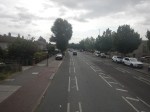
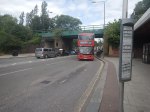
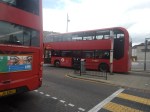
These pictures show the route from North Greenwich to Bexleyheath Shopping Centre.









































Note.
- These pictures were shot in two sections on the 3rd and the 6th of July 2023.
- The break was at Eltham station.
- Some sections of the route had a lot of cars.
- Some side roads were full of parked cars.
- There were large numbers of cars parked in front of houses.
There are my thoughts.
More will appear here over the next couple of days.
The Buses
The buses used on the route are Alexander Dennis Enviro400EV, which are built on a BYD Auto chassis.
They have a range of 160 miles.
The Route
The route has several inclines both ways and I estimate it is just under ten miles.
At North Woolwich, the bus didn’t appear to have a charge, but I can’t be sure.
But it disappear at Bexleyheath Shopping Centre and I was certain it went for a charge.
So is the operational philosophy to fill, the bus up overnight and then top the battery up every time, that it needs it at Bexleyheath.
A Comparison With A Similar Route In Birmingham That Has Hydrogen-Powered Buses
As the bus ran between North Woolwich and Bexleyheath Shopping Centre, I was comparing it, with the trip, I made across Birmingham, in hydrogen-powered buses, that I wrote about in Riding Birmingham’s New Hydrogen-Powered Buses.
Both were quality buses, but I felt the hydrogen bus had more power.
Opportunity Charging At Bexleyheath
If, buses need to be charged at the Bexleyheath Shopping Centre end of the route, where will they go?
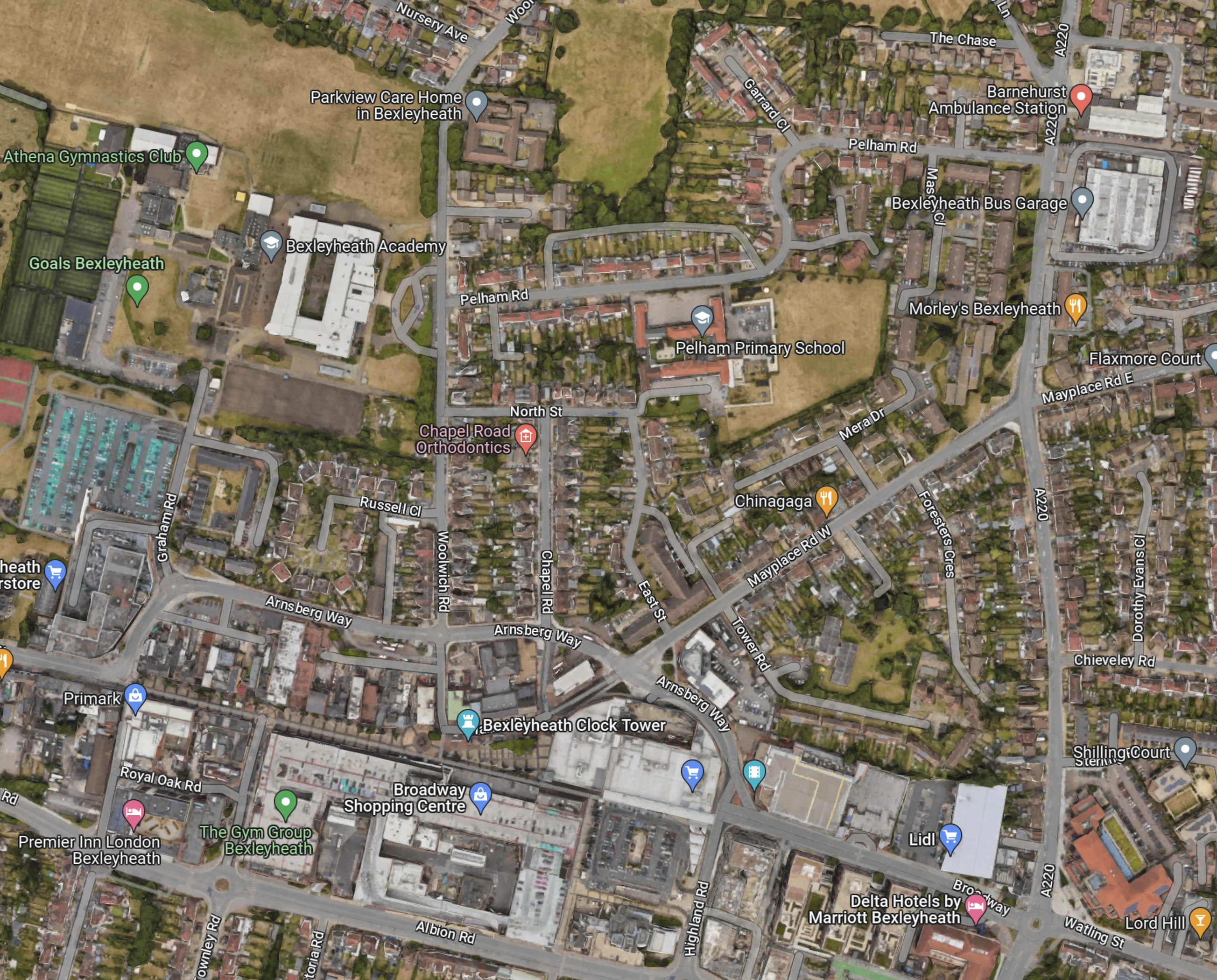
This Google Map shows Bexleyheath Bus Garage in relation to the Shopping Centre.
Note.
- Bexleyheath Bus Garage is in the North-East corner of the map.
- It looks like it shares a site with Bexley Fire Station and Barnehurst Ambulance station.
- So the garage is well located for any future lithium-ion battery fires.
- In the middle of the map at the bottom, is Bexleyheath Clock Tower, in the middle of the town centre.
- I estimate it’s less than two kilometres between Bexleyheath Bus Garage and the Shopping Centre.
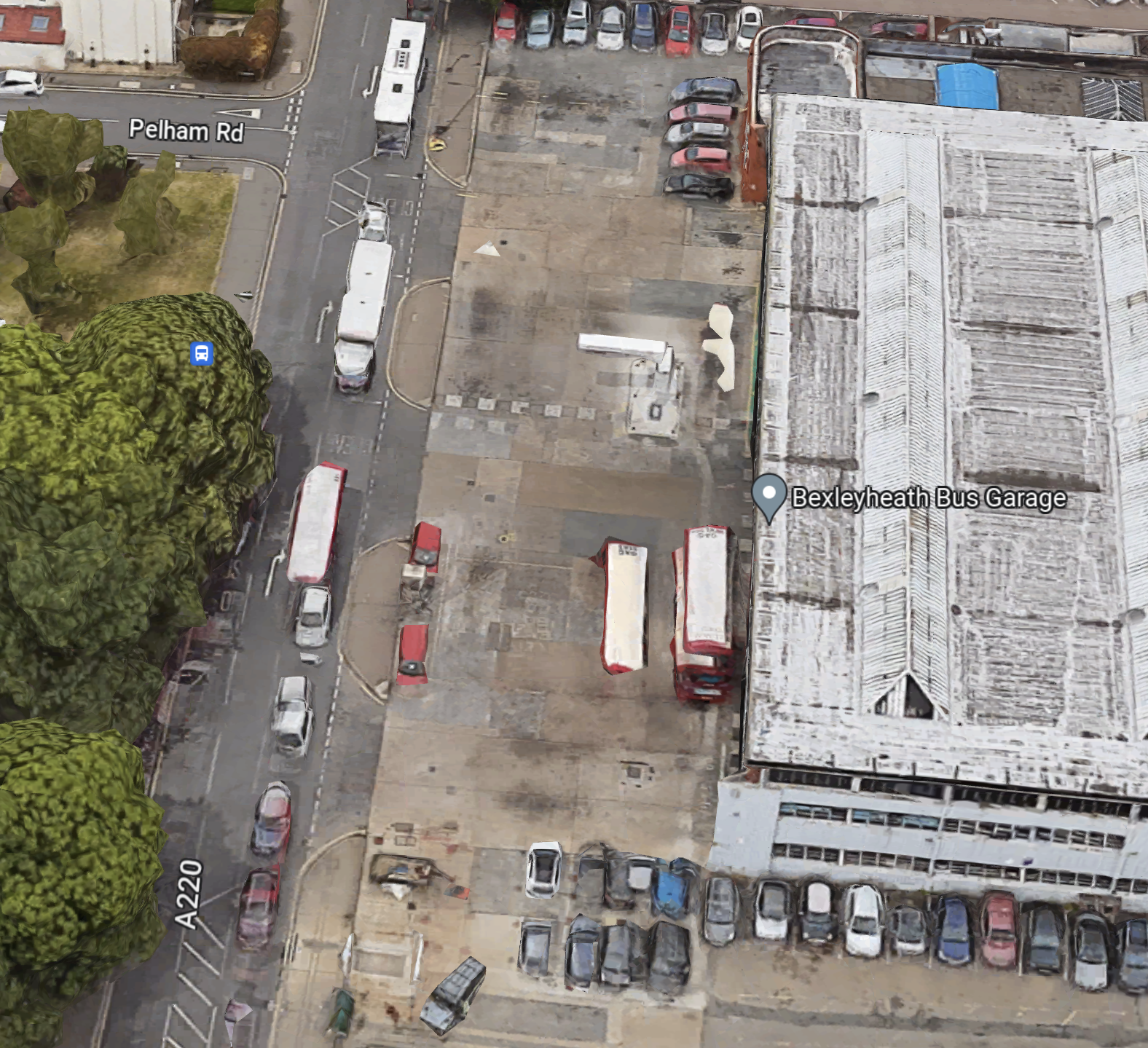
This Google Map shows a close-up of the Western side of the Bexleyheath Bus Garage.
Note.
- The two buses parked by the side of the garage.
- Behind them a white arm reaches over towards the road.
- This is the charger and buses connect using a pantograph on the roof.
It could be an All-In-One Fast Charging Station AIO from Furrer+Frey.
The Electrical Connection At Bexleyheath Bus Garage
Consider.
- The bus garage shares a site with a fire station and an ambulance station, which surely must need a reliable power source.
- This is London’s first application of opportunity charging.
- There are improvements constantly happening to London’s struggling power network.
- It is a large site and I suspect there is space for a battery to boost power.
I would assume that Transport for London wouldn’t have chosen a bus garage with a dodgy power supply.
Could The Charger Be Solar-Powered?
This Google Map shows the roof of Bexleyheath Bus Garage.

Note.
- It appears to be a square with a length of about six buses.
- It looks rather dirty.
I suspect that the roof could be replaced with a modern solar roof.
Hydrogen Or Electric
This article on RouteOne is entitled Enviro400FCEV Hydrogen Bus Fleet For Liverpool Debuts.
This paragraph describes the performance.
Alexander Dennis has chosen the heavy-duty variant of VEDS. It is designed to deliver up to 410kW of power, but the vehicle OEM says that in the Enviro400FCEV, output is limited to 350kW. Such an approach will maximise fuel economy while still enabling a high road speed and good hill climbing ability. Expected range is up to 300 miles.
So the range on hydrogen is nearly doubled.
Wrightbus’s outwardly similar electric and hydrogen buses have ranges of 200 and 280 miles, but filling times of 2.5 hours and 8 minutes.
The problem with hydrogen in London, is that the Mayor and Transport for London, don’t appear to have a hydrogen policy.
But I think, that hydrogen will win out in cities and areas, where hydrogen can be supplied.
I also believe that hydrogen has other advantages.
- There is likely to be significant progress in improving hydrogen-powered heavy vehicles.
- Hydrogen internal combustion engines are coming and could promise more affordable hydrogen buses.
- Better and more affordable methods to create green hydrogen are being developed.
- Some existing diesel buses will be able to be converted to buses powered by hydrogen internal combustion engines.
- Lithium-ion batteries have a high environmental footprint.
Hydrogen is also likely to be the fuel of choice for heavy trucks.
Brits Are Future Proofing Their Homes, Increasingly Valuing Sustainable Elements
The title of this post, is the same as that of this news item from Centrica.
These are the first two paragraphs.
It may still be true that for many, their home is their ‘castle’ but if so, it better be a well-insulated castle, as new research shows that Brits increasingly value energy efficient and environmentally friendly houses.
A survey from Hive revealed that the top selling points on a dream home for modern Brits are related to sustainability, with solar panels (68 percent) and good roof insulation (67 percent) valued more than design features such as natural lighting (53 percent), wooden flooring (22 per cent) and reclaimed woodwork (21 percent). Smart home technology such as a smart heating system (62 percent), a smart energy meter (48 percent) and an EV charger on the driveway (39 percent) were also top considerations.
As I fitted solar panels and good roof insulation to my house, their research could fit me.
I haven’t fitted an EB charger as I don’t drive.
Birth Of A Station
Thanet Parkway station is under construction and should be opened in May next year.
Work is progressing as this Google Map shows.

Note.
- The A299 goes across the top of the map.
- The Ashford – Canterbury – Ramsgate Line runs diagonally from South-West to North-East across the map.
- Ashford and Canterbury are to the South-West.
- Ramsgate is to the North-East.
The new Thanet Parkway station appears to be being built on the triangular site between the A299 and the railway.
- There appear to be two entrances/exits to the station from the A299.
- The pedestrian bridge over the railway is under construction.
- The roads and walkways around the station are being laid.
This video gives more details of the station.
Parking At Thanet Parkway
According to the video, there are nearly three hundred parking spaces, with a number of disabled spaces and spaces with charging for electric cars.
Is that going to be enough spaces?
But at least, there may be fields around the station, that could be used to provide additional parking.
Richborough Energy Park
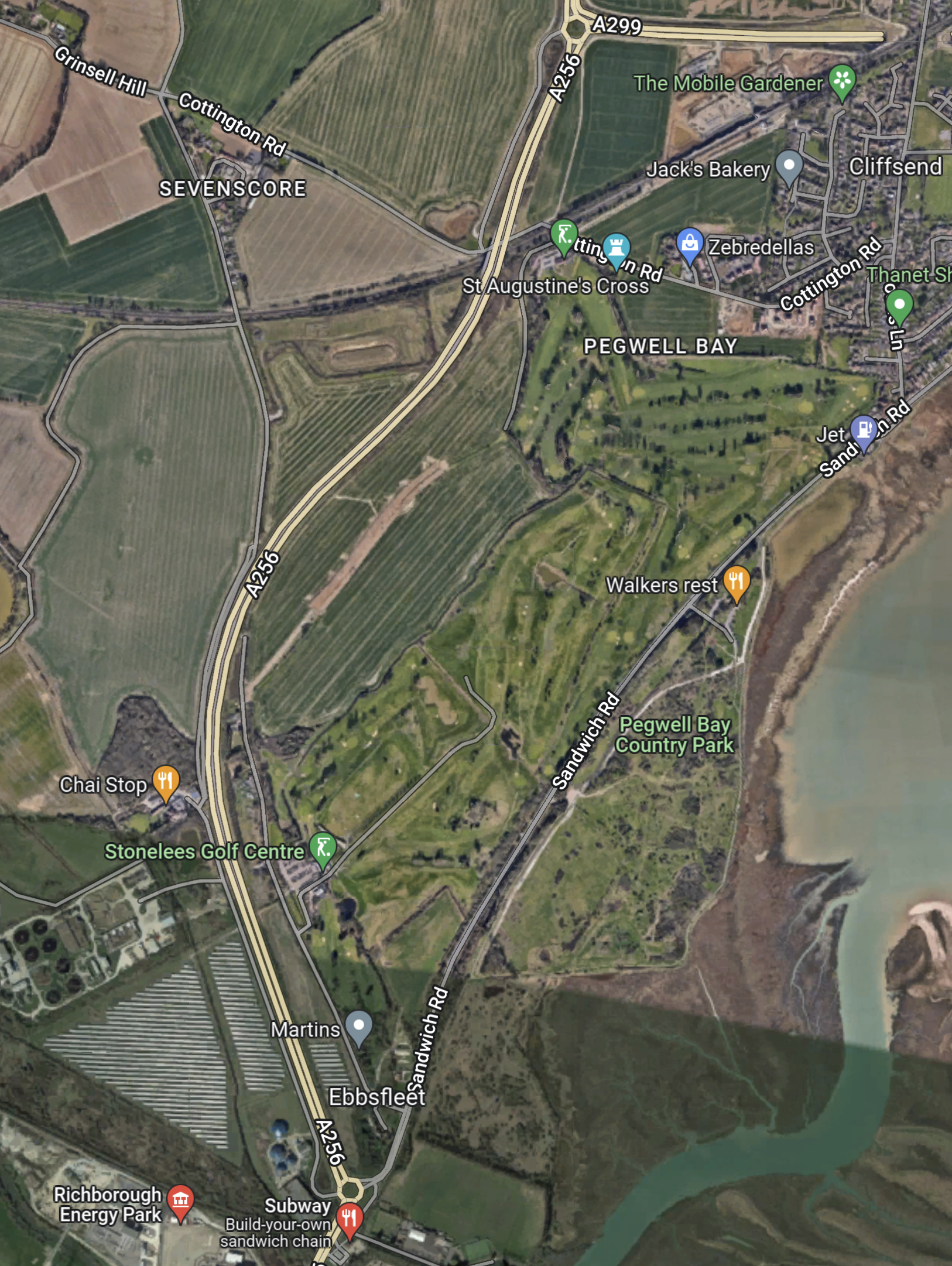
This Google Map shows the area around the station and to the South towards Richborough.
Note.
- The under-construction Thanet Parkway station is in the North-East corner of this map to the West of the village of Cliffsend.
- The dual-carriageway of the A256 runs North-South down the map to a roundabout.
- To the West of the roundabout is Richborough Energy Park.
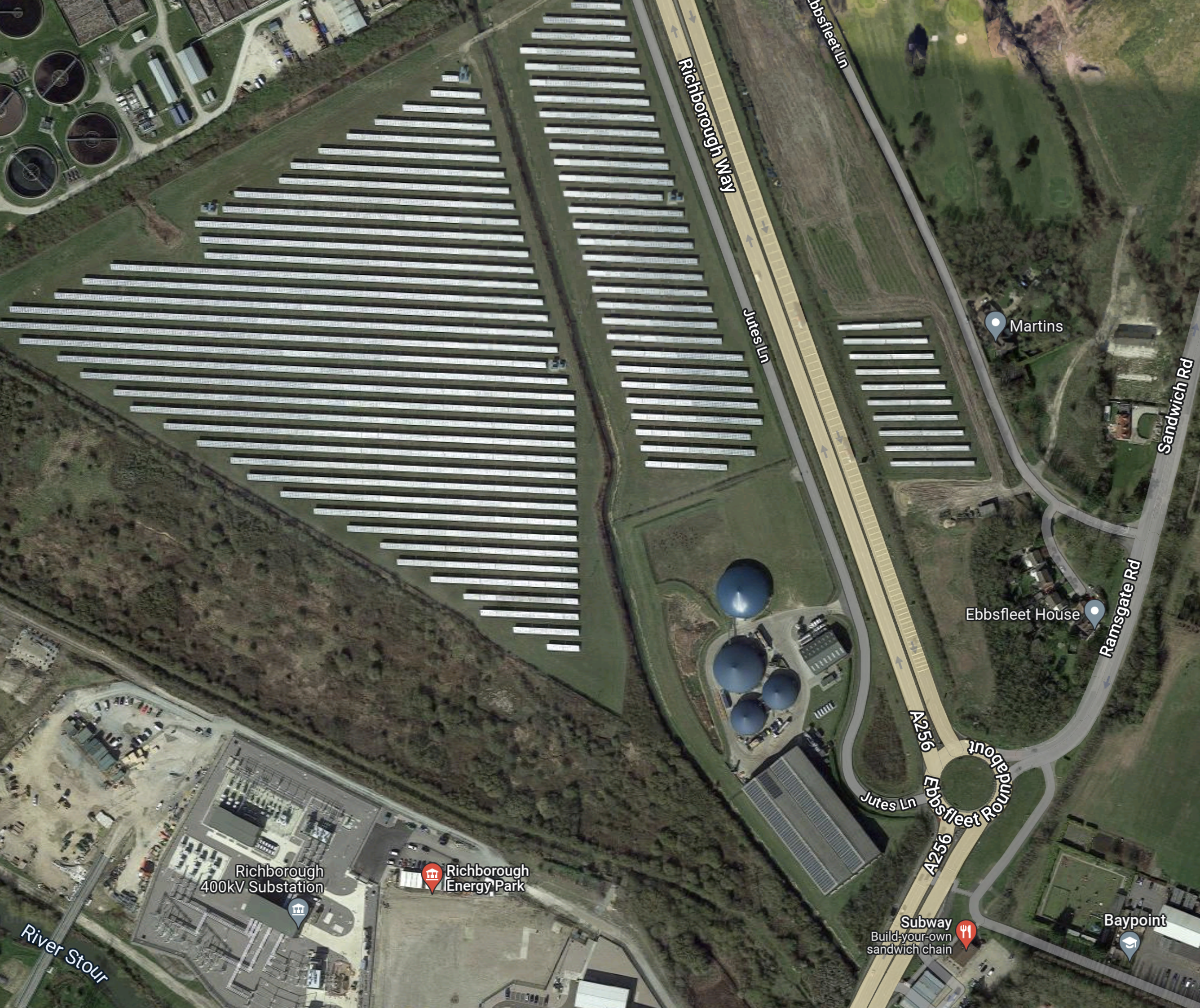
This Google Map shows the are round the energy park and the roundabout in more detail.
Note.
- The Richborough substation in the South-West corner of the map.
- The Richborough Energy Park sits to the East of the substation.
- The solar panels to the North of the roundabout are the 4.9 MW Ebbsfleet Solar Farm, which is part of Richborough Energy Park.
Richborough Energy Park is an ongoing project.
The national grid interconnector from the original power station is still in place, and is now the grid link for the 300 MW offshore Thanet Wind Farm.
It is the terminal for the NemoLink interconnector to Belgium.
Wikipedia says this about future plans.
The current owner of the site, BFL Management Ltd, plan to bring the site back into use as a £750 million green energy park. There are additional plans to create additional recycling and green energy facilities on site, including an anaerobic digester, a waste processing plant, a biomass combined heat and power generator, a pyrolysis plant and a peak demand 30MW diesel generator. When fully operational, the park could provide up to 1,400MW of power, employing 100 full-time equivalent, with up to 500 jobs in the construction phase.
I am surprised, that there is no mention of batteries or energy storage.
This press release from Network Rail is entitled Charge While You Travel With New Electric Vehicle Charging Points At Network Rail Stations.
This the body of the press release
Rail passengers with electric vehicles will be able to charge while they travel thanks to the introduction of 450 new electric vehicle charging points at Network Rail-managed car parks at railway stations.
The charging points, powered by guaranteed renewable energy, provide enough power to fully charge a vehicle in as little as 3-4 hours.
In this phase, Network Rail has powered: 160 charging points in Reading, 111 in Manchester, 84 in Edinburgh, 56 at Leeds and 41 in Welwyn Garden City.
Electric vehicle charging points will be installed across 10% of car parking spaces (approximately 779 spaces) at car parks managed by Network Rail by March 2024.
Rail is already the leading form of green public transport and this marks another milestone in Network Rail’s commitment to a low-emission railway – making sure rail is environmentally-friendly, resilient to climate change and able to provide an excellent service for years to come.
The new Compleo charging points are marked with green parking bays and passengers can pay for what they need quickly and easily via the APCOA Connect app.
Note, that there is no mention, if these are vehicle-to grid (V2G) chargers.
In Airport Plans World’s Biggest Car Parks For 50,000 Cars, I stated my belief that car parks, with hundreds or even thousands of vehicles could be turned into giant grid batteries.
- All electric vehicles, when they are parked would be plugged in to V2G chargers.
- The vehicle and the grid, would know your expected return time and how much power you would need. Probably from a parking app, assisted by AI!
- If the grid borrowed your electricity, whilst you were away, you wouldn’t know, until you received the payment for the loan.
- If your car runs on hydrogen, the parking could also handle the battery, that all hydrogen-powered vehicles have.
Thanet Parkway station would be an ideal station for such a parking system for electric vehicles.
If We Have More Electric Cars Do We Need More Parkway Stations?
We are all being encouraged by carrot-and-stick methods to change to zero-carbon vehicles.
And it’s not just from Government and environmental activists!
I was recently asked on a train, if I drove an electric car, by the guy sitting opposite me at a table. He told me, that his ten-year-old BMW needed replacing and his daughters were pestering him to get an electric car.
- He had looked into it and said he could afford one.
- However like many, he was worried about the battery range.
- He also said charging at home would not be a problem, as he lived in a house with parking for three cars and could install his own grid-to-vehicle charger.
- I asked him what he did and like my late wife; C, he was a family barrister.
C would drive thousands of miles a year to Court from our house in Suffolk in her Porsche Boxster, to places like Bedford, Cambridge, Chelmsford, Colchester, Ipswich, Milton Keynes, Norwich, Southend and Yarmouth. Only when she went to London did she use a train from Whittlesford Parkway station.
There are a lot of people like family barristers, where their profession dictates that they travel long distances by car to a variable place of work.
Purchase of an electric car, for some drivers may turn out to be a worrying one, as will they always find a charger at the other end of their journey, to charge the vehicle to get home.
I can see parkway stations like Whittlesford developing into electric parkway stations, where most parking spaces have a charger.
- Parking could be booked, as in many railway car parks.
- Some stations could probably host one or more wind turbines.
- The vehicle batteries with the appropriate grid-to-vehicle technology could be used as grid storage.
Get the technology and the locations right and I can see more parkway stations being developed.
It might also be the sort of infrastructure project that a financial institution like L & G might finance.
Megawatt Charging System Set To Rapidly Reduce Fuelling Time For Commercial EVs
The title of this post, is the same as that of this article on Electric Autonomy Canada.
This is the sub-title.
An international task force says their recent high power “charge-in” event has yielded promising results with successful testing of novel connector prototypes that could overhaul the long-haul industry.
The problem of charging heavy freight trucks is a big market in North America and it seems that the event attracted some big players, like ABB, Daimler and Tesla.
- In the trucking industry, speed and range count for a lot.
- Trucks need to be charged during a driver’s rest break of about thirty minutes.
- In the U.S., transport made up 28 per cent of greenhouse gas emissions.
- Charging lots of trucks on typical state-of-the-art car chargers would probably crash the system.
The Megawatt Charging System aims to solve the problems.
How Would It Work?
This paragraph from the article, outlines the problems.
But how, one may ask, could such a massive electrical draw — as much as 4.5 megawatts — be supported by a grid, especially when the usage scale is not just one truck charging up, once a day, but thousands of 18-wheelers rolling and charging across the country.
The MCS Task Force seem to be suggesting that these systems will work as follows.
- A large battery or energy storage system will be trickle charged.
- The truck will be connected and the electricity will flow into the truck.
- It could all be automated.
It sounds very much like Vivarail’s Fast Charge system, which uses batteries as the intermediate store.
As an Electrical and Control Engineer, I would use a battery with a fast response.
I think I would use a Gravitricity battery. This page on their web site describes their technology.
Gravitricity™ technology has a unique combination of characteristics:
- 50-year design life – with no cycle limit or degradation
- Response time – zero to full power in less than one second
- Efficiency – between 80 and 90 percent
- Versatile – can run slowly at low power or fast at high power
- Simple – easy to construct near networks
- Cost effective – levelised costs well below lithium batteries.
Each unit can be configured to produce between 1 and 20MW peak power, with output duration from 15 minutes to 8 hours.
Clean Air For All: Lampposts To Charge Electric Cars
The title of this post, is the same as that of this article on The Times.
This is the introductory paragraph.
An “electric avenue” has been developed where lampposts have been converted into chargers for battery-powered cars.
The project has been led by Siemens.
Surely, all lampposts should have an electric car charging point.
A Regret
I am limiting my travel because of COVID-19 and only using Shanks’s pony, so I will not be able to provide one of my pictures of the chargers.
Airport Plans World’s Biggest Car Parks For 50,000 Cars
The title of this post, is the same as that of an article in Wednesday’s copy of The Times.
This is the first two paragraphs.
The biggest car parks in the world will be built as part of a £14 billion expansion of Heathrow amid fresh claims that the scheme will be an “environmental disaster”.
Parking for almost 53,000 vehicles will be built as part of a 30-year masterplan, even though the airport insists that expansion can be achieved without any extra cars on the road.
This sounds to be contradictory, as why would you need to build extra car parking, if there were no more extra cars on the road?
Perhaps there is a clue later in the article, where this is is a paragraph.
Heathrow said that the overall number of parking spaces would “not change materially from today”, insisting that spaces were simply being consolidated on bigger sites. It pointed out that car parks would allow for 100 per cent electric vehicle usage in the future. In total, the number of parking spaces, including those for staff and spaces at nearby offices, will grow from 64,000 today to 67,000.
Admittedly, it only says allow, but Heathrow are future-proofing themselves for the day when everyone is driving electric cars.
Heathrow and others are also planning to do the following.
- Charge a congestion charge of up to £15 a day will be imposed by 2026 to dissuade passengers from travelling to the airport by car.
- A “green loop” — a 12-mile pedestrian and cycle network — will also circle the airport.
- Finish Crossrail.
- Improve Heathrow Express.
- There will be a rail link to Reading.
- There will be a second rail link to Waterloo via Clapham Junction.
- There could be a rail link to Basingstoke, Guildford and Woking, possibly by extending Heathrow Express.
Will these measures nudge travellers in one of two positive directions?
- Using public transport to get to the Airport.
- Cycling or walking to the airport.
- Using an electric car to get to and from the Airport.
I am a Control Engineer, who spent a working life of nearly fifty years analysing data and doing mathematical calculations, hopefully to improve little bits of the world.
So What Would I Do?
It is absolutely essential that it is known, where all the vehicles to the airport are travelling to and from.
No-one is going to stop using their car, if there is no creditable alternative.
The ultimate aim must also be that, all transport within a certain distance of the Airport must be zero-carbon.
- All vehicles used by travellers and workers to get to and from the Airport.
- All vehicles bringing supplies to the Airport.
- All airside vehicles.
What will happen to those that lived in the zone?
This Google Map shows Hanwell Village to the South-West of the Airport.
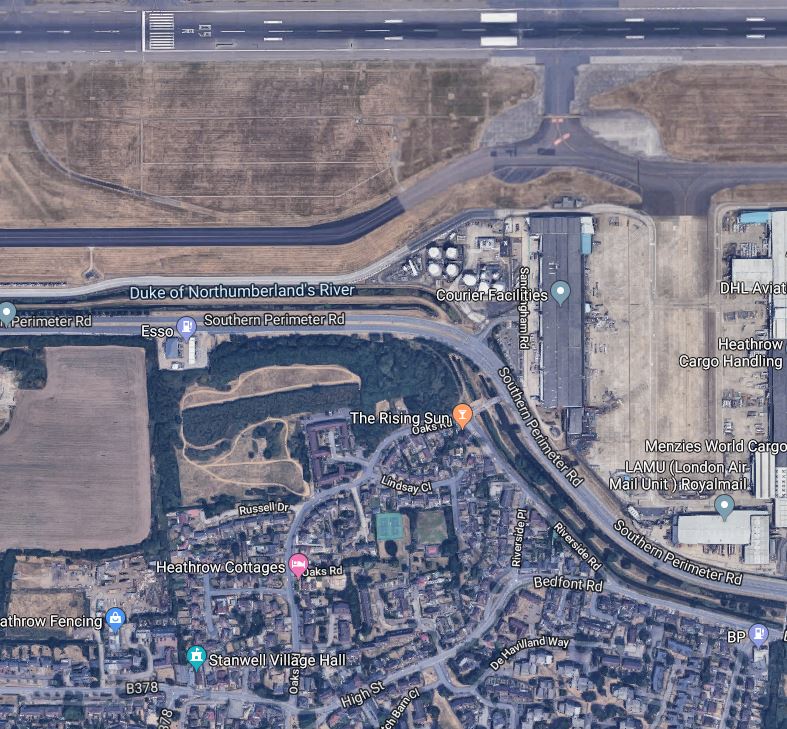
Will all those residents pay the congestion charge?
But suppose Heathrow could get ninety percent of all cars travelling to the Airport and using the car parks, to be electric vehicles.
This would be 45,000 vehicles, each with a battery of between 30-60 kWh. Let’s call it, 30 kWh.
This would mean that the total of energy storage on a typical day at the Airport would be 1.35 GWh.
Compare that to the 9.1 GWh capacity of Electric Mountain.
Electric Mountain would be bigger, but intelligent control of the batteries of these electric vehicles could create a massive electricity storage resource at the Airport.
- Vehicles would be connected to a two-way vehicle-to-grid charger (V2G), when the driver went about their business at the Airport, after telling the vehicle when they would return.
- On return to the vehicle, it would have enough charge for the next journey.
- The driver would also have an app on their phone, so they could alter their expected return time.
- Whilst the driver was away, the grid would borrow electricity from the vehicle’s battery if required.
All the technology exists and National Grid are looking at ways to use electric vehicle batteries for energy storage.
National Grid have suggested, that they might even pay for the use of your battery.
I suspect that all parking for electric vehicles in the future, will work using something like this model.
Note the following calculation.
In December 2018, there were 31.5 million cars and four million light goods vehicles in the UK.
In a few years time, suppose half of these vehicles are electric with a 20 KWh battery.
That works out at an astronomical 355 GWh or nearly forty Electric Mountains.
- Electric Mountain cost £425 million in 1984.
- Applying a web inflation calculator means it would cost around £1350 million today.
- So forty Electric Mountains would cost £54 billion.
That is a lot of money and we have no place to put them.
But we have this massive storage capability in the millions of electric vehicles, that will be on the roads in a few years.
Conclusion
All future large car parks must be built to be large storage batteries, when drivers plug in their electric cars using vehicle-to-grid (V2G) technology.
If you were to be paid for the use of your car’s battery, would that ease the expense of owning an electric car?
 The Anonymous Widower