Canal Water To Heat Some Of Liverpool’s Most Famous Buildings In Hi-Tech Carbon-Cutting Scheme
The title of this post is the same as that of this press release from Liverpool City Region.
These five bullet-points act as subheadings.
- Energy generated from Leeds and Liverpool canal by one of the UK’s largest water source heat pumps
- Announcement comes as Mersey Heat Energy Centre officially opens
- Scheme to connect Georges Dock, Cunard and the Museum of Liverpool buildings to Mersey Heat Network
- Joint project between Combined Authority, Liverpool City Council and National Museums Liverpool
- Key part of Combined Authority plan to reach net zero by 2035
These introductory paragraphs add more detail.
Three major public buildings on Liverpool’s waterfront are to slash carbon emissions by joining a heat network driven by energy from canal water.
Under the plan, an extended pipeline will connect Georges Dock building, the Cunard building, and the Museum of Liverpool, part of National Museums Liverpool (NML), to the Mersey Heat network.
The newly opened Mersey Heat Energy Centre is already supplying the Liverpool Waters site, the Titanic Hotel and the Tobacco Warehouse apartments.
It uses one of the UK’s largest water source heat pumps to extract energy from the Leeds and Liverpool Canal to power a network of heating pipes.
The project is the latest in the Liverpool City Region’s five-year carbon action plan and journey to reach net zero. The Combined Authority has recently secured an additional £35m to decarbonise dozens of other public buildings from the Department of Energy Security and Net Zero.
This map of the Liverpool Waterfront shows the canal and some of the buildings mentioned.
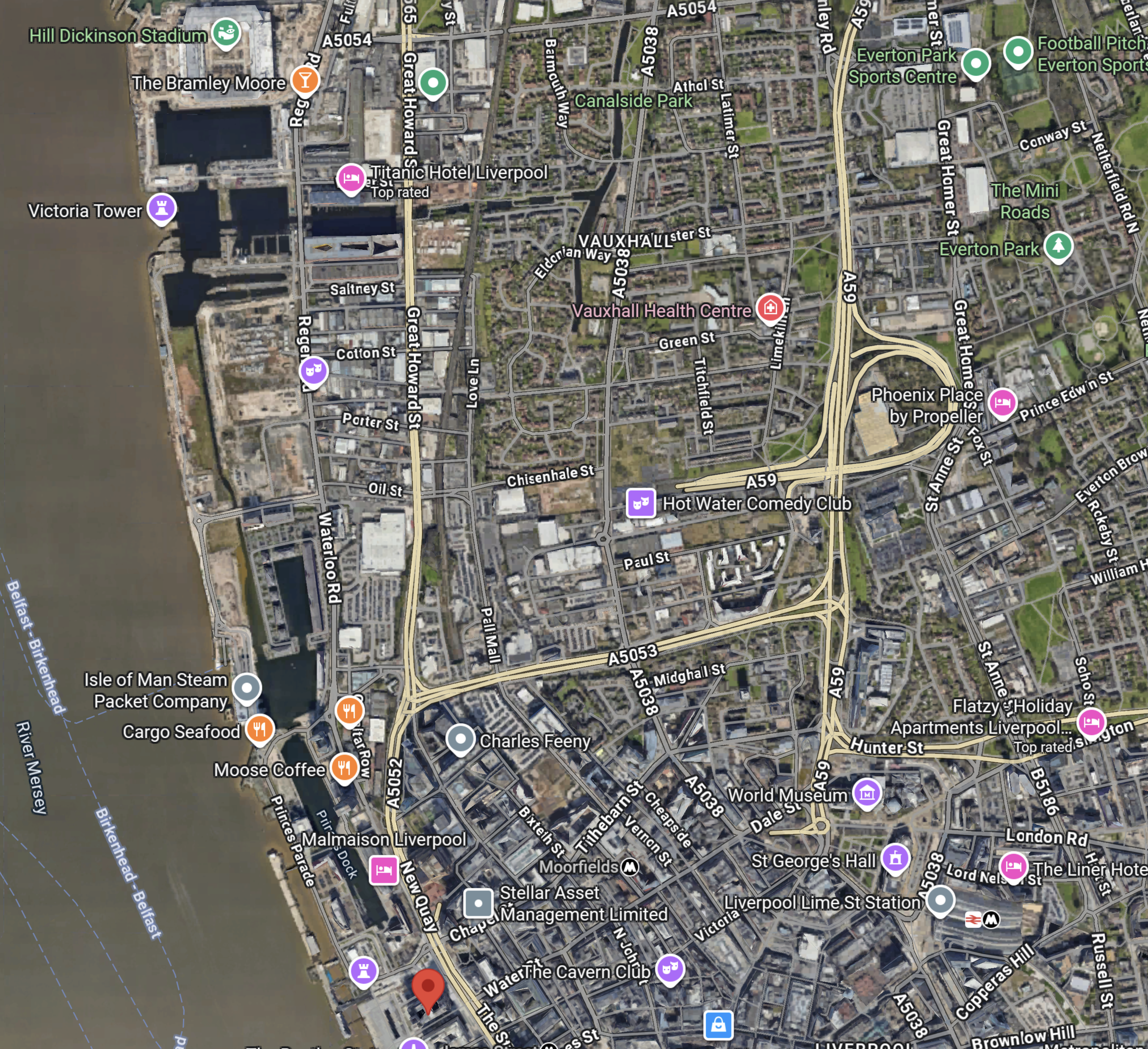
Note.
- In the top-left corner is Everton’s new Hill-Dickenson Stadium, which at the time of this map was under construction.
- The pink arrow to its right indicates the Titantic Hotel.
- The Leeds and Liverpool canal passes on the South side of the hotel.
- On the other bank of the canal is the Tobacco Warehouse.
- The canal goes East and then turns North before going all the way to Leeds. The Wikipedia entry gives full details of the canal.
- From the Titanic Hotel, the Leeds and Liverpool Canal also turns South and boats can go along Liverpool’s famous Waterfront to Canning Dock, in front of the Tate Liverpool.
- The red arrow marks the Liver Building.
- Georges Dock building, the Cunard building, and the Museum of Liverpool are just to the South the Liver Building.
- To the East of the Liver building, there is Liverpool City Centre, with beyond it Liverpool Lime Street station, with another collection of important buildings including St. George’s Hall, the Picton Library, World Museum and the Walker Art Gallery.
The Combined Authority will not have a shortage of buildings to decarbonise with the £35m from the Department of Energy Security and Net Zero.
These are my thoughts.
What Is A Water Source Heat Pump?
I asked Google AI this question and received this answer.
A water source heat pump (WSHP) is a highly efficient, low-carbon renewable energy system that extracts heat from a nearby water source like a lake, river, or canal to provide heating and hot water for a building, and can also be used for cooling. It works by using electricity to transfer this thermal energy into the building’s heating system, offering a more efficient alternative to traditional boilers and reducing energy bills. There are two main types: closed-loop systems, which circulate a fluid through pipes submerged in the water, and open-loop systems, which directly pump and then discharge the water.
Is Mersey Heat Energy Centre A Closed Or Open-Loop Water Source Heat Pump?
I asked Google AI this question and received this answer.
The Mersey Energy Heat Centre uses an open-loop water source heat pump system. It abstracts water from the Leeds and Liverpool Canal, extracts heat from it, and then returns the water back to the dock system.
As the Leeds and Liverpool Canal is 127 miles long, and there appears from the map to be a lot of water in the docks at the Liverpool end, I would expect that Liverpool will have more than enough water to extract heat from.
Where Exactly Is The Mersey Heat Energy Centre?
In this article on Place North West, which is entitled Work Begins On Peel’s Mersey Heat Energy Centre, has this image, which is labelled as the Mersey Heat Energy Centre.
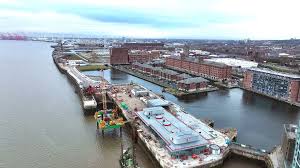
Note the large building in the foreground with the circular objects on the roof. Could these be fans or vents?
This Google Map shows the area.
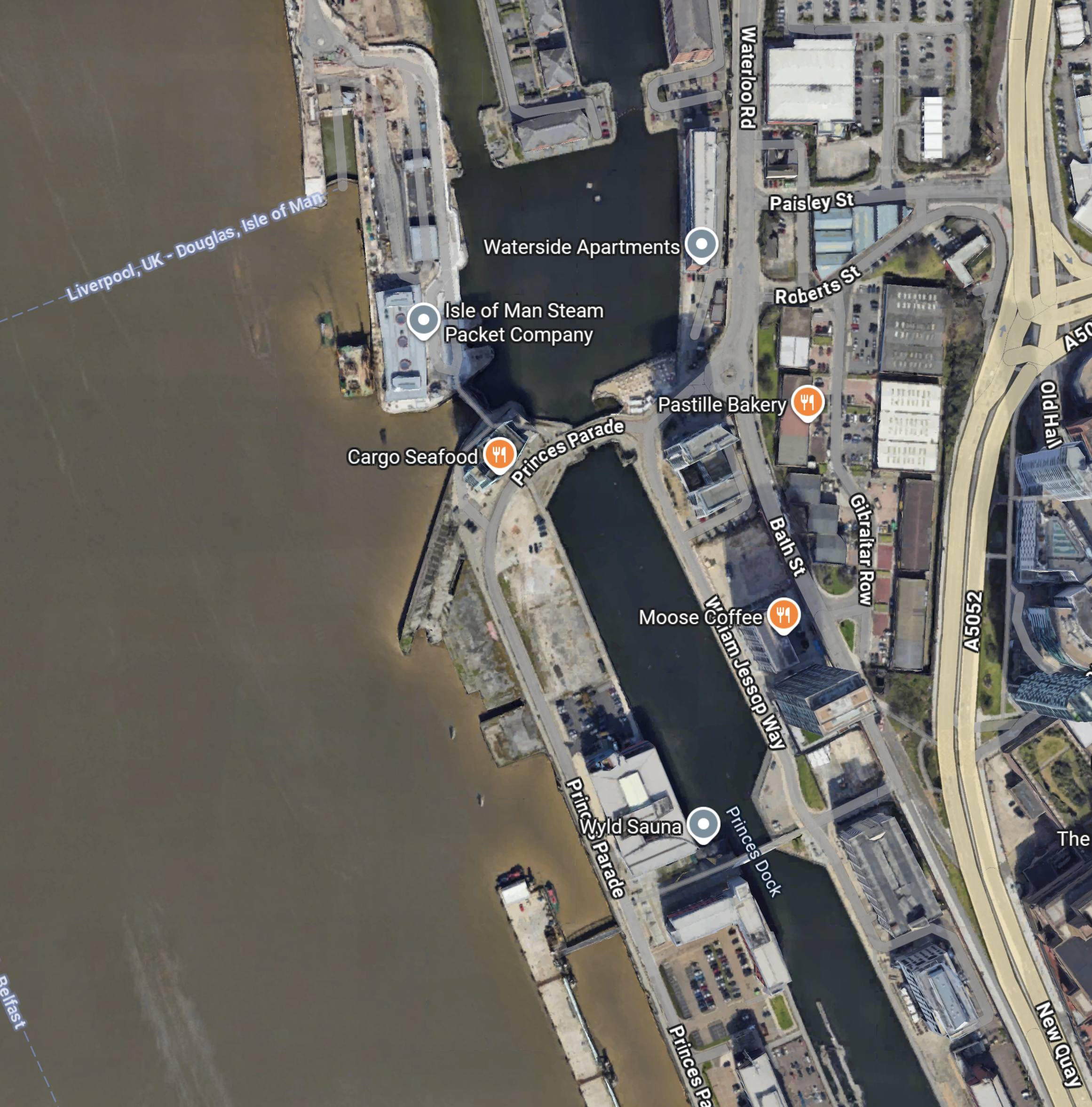
Note.
- The two docks at the top of the map can be picked out in the image.
- The main breakwater on the left, which is marked Isle of Man Steam Packet Company, looks very similar to the one shown in the image.
- The bridge between the two docks on the left appears to be the same in both map and image.
I am fairly sure, that the large building on the breakwater with the three circles on the roof, is the Mersey Heat Energy Centre.
It certainly looks to be a building, that could provide a substantial amount of heat and power .
What Is The Output Of The Mersey Heat And Energy Centre?
I asked Google AI this question and received this answer.
The Mersey Heat and Energy Centre produces low-carbon heat for up to 6,700 homes and 1.3 million square feet of commercial space, aiming to deliver around 20GWh of heat per year. The project is also planned to expand to supply around 45GWh annually. This heat is delivered to buildings for their heating and hot water needs through the Mersey Heat network.
This article on Place North West, also has this similar answer.
Led by district heat network specialist Ener-Vate, the Mersey Heat Energy Centre will feature two 3MW water source heat pumps that would work on an ‘open loop’ system to take heat from water from the Leeds-Liverpool canal. This heat would be used to warm surrounding homes and businesses within six kilometres.
Plans form the first phase of Peel NRE’s Mersey Heat network. The initial project could supply 20GWh of heat every year, with planning permission secured to expand to supply around 45GWh – the equivalent of supplying heating and hot water to 17,000 homes.
It looks like we’re getting similar answers from different sources.
Does the Merseyside Area Have Enough Green Electricity To Power A Large Water Source Heat Pump?
In Could Liverpool Develop A Massive Zero-Carbon Data Centre?, I calculated the operational and planned offshore wind power in Liverpool Bay and got these results.
- 2509 MW has been commissioned.
- 3980 MW is being planned.
That is a total of 6489 MW or about twice the output of Hinckley Point C nuclear power station.
This map shows the existing wind farms in the sea between Liverpool, Lancashire and the Isle of Man.
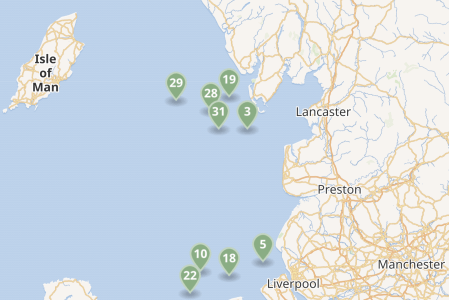
Note.
- Each green arrow is a wind farm.
- There is the 2452 MW Heysham nuclear power complex near Lancaster.
- The Western HVDC Link is a 2250 MW connection between Hunterston in Western Scotland near Glasgow and Connah’s Quay on the Wirral.
- I also suspect more space in Liverpool Bay could be developed with wind farms.
Spinal Tap turned the power up to 11, Liverpool, being Liverpool, they have enough power to go to at least sixteen.
Will Merseyside Have Lots Of Data Centres?
Consider.
- It has the power.
- It has the water.
- The locals speak a form of English.
- Merseyside will be two hours from London by train.
- There are two Premier League football teams.
- The golf courses are good.
- It is a city that is famous all over the world.
I am sure the number of data centres will grow.
Ørsted Raises EUR 7.98 Billion In Oversubscribed Rights Issue
The title of this post, is the same as that of this article on offshoreWIND.biz.
This is the sub-heading.
Ørsted has completed its rights issue, raising DKK 59.56 billion (approximately EUR 7.98 billion) with a subscription rate of approximately 99.3 per cent, the company said on 6 October.
These two introductory paragraphs add more details.
Existing shareholders were offered new shares at DKK 66.60 (EUR 8.92) each. The demand for shares not taken up via the rights issue was “extraordinarily high,” according to the developer’s announcement of the Rights Issue results, and allocations were capped per application, meaning no subscriptions were required under the underwriting bank syndicate.
As reported in August, the company appointed a syndicate of BNP PARIBAS, Danske Bank A/S and J.P. Morgan SE as Joint Global Coordinators, next to Morgan Stanley & Co International, to jointly underwrite the rights issue for the approximately 49.9 per cent that would not be subscribed to by Ørsted’s majority shareholder, the Danish state (50.1 per cent).
I dread to think what spiteful punishment that Trumpkopf will inflict on Ørsted.
But the oversubscribed Rights Issue may be good news for the UK.
Ørsted has only one major project under development or construction in the UK.
But it is the large Hornsea Three wind farm, which has this opening paragraph on its web site.
Hornsea 3 Offshore Wind Farm will deliver enough green energy to power more than 3 million UK homes. An £8.5 billion infrastructure project, Hornsea 3 will make a significant contribution toward UK energy security, as well as the local and national economy.
Note.
- Ørsted are raising £7.98 billion and spending £8.5 billion, which must do something for the UK’s economy.
- Hornsea 3 will have a generating capacity of 2.9 GW.
- Ørsted are now delivering the world’s single largest offshore wind farm.
- Hornsea 3 will connect to the National Grid at Swardestone in Norfolk.
In Grid Powers Up With One Of Europe’s Biggest Battery Storage Sites, I describe how the 300 MW/600 MWh Swardestone BESS will be built, where Hornsea 3 connects to the grid.
As Swardestone will have 2.9 GW from Hornsea 3 and a powerful battery, I would expect someone will be looking to site a data centre or something with a need for a lot of stable electricity at or near Swardestone.
In Opportunity For Communities To Have Their Say On National Grid Proposals For Norwich To Tilbury Project, I talk about a line of pylons between Swardestone and Tilbury and show this map of the route.
This page on the National Grid web site has an interactive version of this map.

Note.
- The mauve line indicates the route of the Norwich to Tilbury project.
- Swardestone is at the Northern end of the project a few miles South of Norwich.
- Tilbury is at the Southern end of the project on the Thames estuary.
- The project connects Norwich, Ipswich, Colchester and Chelmsford to Hornsea 3 at Swardestone.
- I suspect the project will connect to Ipswich at the Bramford substation.
- The Sizewell nuclear site is to the North-East of Woodbridge and connects to the grid at the Bramford substation.
I know East Anglia well and I would suspect that Norwich, Ipswich, Colchester, Chelmsford and Southend-on-Sea could support one or more data centres.
Conclusion
I asked Google AI, who owns Hornsea 1 and received this reply.
Hornsea 1 is owned by a partnership including Ørsted, Equitix, TRIG, GLIL, Octopus, and Brookfield, with Ørsted also providing the operational management. A 2018 agreement between Ørsted and Global Infrastructure Partners (GIP) originally established the 50/50 joint venture for the project.
I then asked Google AI, who owns Hornsea 2 and received this reply.
The ownership of the Hornsea 2 wind farm is shared between several entities, including a 37.55% stake held by Ørsted, a 25% stake each by AXA IM Alts and Crédit Agricole Assurances, and a 12.45% stake held by Brookfield. The wind farm is located offshore in the UK’s North Sea, approximately 89 km off the Yorkshire coast.
In November 2019, I also wrote World’s Largest Wind Farm Attracts Huge Backing From Insurance Giant.
It does seem to me that Ørsted are past masters of developing a wind farm, then selling it on and using that money to develop the next wind farm.
The Rights Issue just makes that process easier.
America’s Looming Electricity Crisis Is Trump’s Achilles’ Heel
The title of this post, is the same as that of this article in the Telegraph.
This is the sub-heading.
Culture war banter and point-scoring have left Maga facing a self-inflicted energy shortage
These are the first three paragraphs.
The US is in danger of losing the global AI race for the most banal and careless of reasons: it is critically short of electricity.
The country is sitting on a neglected pre-modern grid that cannot meet surging power demand for data centres, cryptocurrencies, the reshoring of semiconductor plants and the proclaimed revival of the American industrial base.
Nor can it meet the needs for air conditioning through hotter and more humid summers. While we all talk about AI, the chief cause of rising electricity use last year was for cooling. Bitcoin mining took another 2pc of US power, for no productive purpose.
It looks like we can add simple arithmetic to the skills the Trump Administration lacks.
The Telegraph article and myself have some other thoughts.
The Planned Increase In Electricity Is A Fifth Of What’s Needed
This is a paragraph from the Telegraph.
The US Energy Department said in its Resource Adequacy Report in July that the planned increase in firm electricity supply is a fifth of what is needed by 2030.
In Renewable Power By 2030 In The UK, I stated that by 2030, the UK would add nearly 59 GW of offshore wind.
Surely, using the population size difference of four times, 240 GW of offshore wind, would do the USA nicely?
But, Trump doesn’t like wind turbines.
Texas Has A Shortage Of Electricity
These are two paragraphs from the Telegraph.
The Texas grid operator Ercot expects peak power demand in its region to soar from 87 gigawatts (GW) this year to 138 GW by 2030. This is physically impossible.
Texas passed a law in June giving the state emergency authority to cut off power to data centres. Ercot is already having to deploy “mobile generation plants” at exorbitant cost to avert blackouts even today.
It sounds pretty desperate.
Texas needs another 51 GW by 2030, which is less than we intend to delivery from just offshore wind.
If Little Great Britain can do it, then surely Texas can? After all, Texas is three almost times larger than the UK.
I get the idea, that someone isn’t doing any planning.
The United States Needs A Lot Of Transformers
These are three paragraphs from the Telegraph.
The National Infrastructure Advisory Council (Niac) says the average age of America’s 60 million large power transformers is 38 years. Many are beyond their design life.
The US supply chain is not capable of delivering the 12 million new transformers needed each year to keep the show on the road. The backlog has risen to four years. The cost of transformers has jumped 80pc since the pandemic.
There is an acute shortage of electrical steel needed to make them. This comes mostly from China, Japan, Korea or Germany. In his infinite wisdom, Trump has imposed 50pc tariffs on steel, aluminium and copper. That cost shock has yet to feed through.
The Niac says it is a similar tale for “other critical grid components such as conduit, smart meters, switchgear and high-voltage circuit breakers”.
It looks like, there’s another fine mess, you’ve got us in, Donny!
Maga Wants More Coal
These are three paragraphs from the Telegraph.
The quickest way to generate more power is to roll out wind and solar. Trump is actively intervening to obstruct this. Maga wants coal instead.
This week the administration announced $625m of taxpayer subsidy to “expand and reinvigorate” the coal industry. It will open new federal lands, slash the royalty fees for extracting coal, and lift curbs on mercury pollution.
“In addition to drill, baby drill, we need to mine, baby, mine,” said Doug Burgum, the interior secretary.
When it should be spin, baby, spin.
Conclusion
Read the article in full.
We certainly, don’t want anybody, with an energy policy like Trump, influencing the UK’s energy policy.
If Trump carries on like this, he’ll end up in a terrible mess.
Ørsted In Talks To Sell Half Of Huge UK Wind Farm To Apollo
The title of this post, is the same as that as this article in The Times.
This is the sub-heading.
The US investment giant is eyeing a 50 per cent stake in the Danish energy company’s £8.5 billion Hornsea 3 project off the Yorkshire coast
These are the first three paragraphs, which add more detail.
An American investment giant is negotiating a deal to buy half of what will be the world’s largest off-shore wind farm off the coast of Yorkshire from the troubled Danish energy company Ørsted.
New York-based Apollo, which oversees assets of about $840 billion, is in talks with Ørsted about acquiring a 50 per cent stake in Hornsea 3, an £8.5 billion project that started construction in 2023 and will be capable of powering more than three million UK homes.
A transaction would be a boost for Orsted, which has come under pressure in recent months from rising costs and a backlash against renewables in the United States by President Trump. Orsted started the process of selling a stake in Hornsea 3 in 2024 and said last month that it had an unnamed preferred bidder for the asset, which the Financial Times first reported was Apollo.
I have written several times about Ørstedregularly building a large wind farm and then selling it, so they must be doing something right.
In World’s Largest Wind Farm Attracts Huge Backing From Insurance Giant, I wrote about how Aviva bought Hornsea 1 from Ørsted.
One of the guys at Aviva explained that these sort of investments gave the right sort of cash flow to fund insurance risks and pensions.
Now that Trump has attempted to give his kiss of death to wind power in the United States, will US funds be looking for quality investments like Hornsea 3 in the UK and other large wind farms in France, Germany, Norway, Japan and Korea?
Already, Blackrock are investing billions to build a massive data centre at Blyth, where there are Gigawatts of offshore wind power and an interconnector to Norway, so that UK and Norwegian wind can be backed up by UK nuclear and Norwegian hydropower.
Highview Power And Ørsted
I wrote Highview Power, Ørsted Find Value In Integrating Offshore Wind With Liquid Air Energy Storage in November 2023.
I would have thought, that by now a battery would have been announced in one of Ørsted’s many projects.
I asked Google AI if Highview Power and Ørsted were still talking about liquid air energy storage and received this reply.
Yes, Highview Power and Ørsted are still actively involved in Liquid Air Energy Storage (LAES), having completed a joint study in late 2023 on combining LAES with offshore wind to benefit the UK grid, and the findings were presented to the government for its long-duration energy storage (LDES) consultation. They believe LAES can reduce wind curtailment, increase energy productivity, and support grid resilience, with potential projects aligned with offshore wind farm timelines.
Perhap’s Ørsted are getting their finances aorted first?
Conclusion
The Times They Are A-Changing!
How Will The UK Power All These Proposed Data Centres?
On Wednesday, a cardiologist friend asked me if we have enough power to do Trump’s UK AI, so I felt this post might be a good idea.
Artificial Intelligence Gave This Answer
I first asked Google AI, the title of this post and received this reply.
The UK will power proposed data centres using a mix of grid-supplied low-carbon electricity from sources like offshore wind and through on-site renewable generation, such as rooftop solar panels. Data centre operators are also exploring behind-the-meter options, including battery storage and potential future nuclear power, to meet their significant and growing energy demands. However, the UK’s grid infrastructure and high energy prices present challenges, with industry calls for grid reform and inclusion in energy-intensive industry support schemes to facilitate sustainable growth.
Google also pointed me at the article on the BBC, which is entitled Data Centres To Be Expanded Across UK As Concerns Mount.
This is the sub-heading.
The number of data centres in the UK is set to increase by almost a fifth, according to figures shared with BBC News.
These are the first three paragraphs.
Data centres are giant warehouses full of powerful computers used to run digital services from movie streaming to online banking – there are currently an estimated 477 of them in the UK.
Construction researchers Barbour ABI have analysed planning documents and say that number is set to jump by almost 100, as the growth in artificial intelligence (AI) increases the need for processing power.
The majority are due to be built in the next five years. However, there are concerns about the huge amount of energy and water the new data centres will consume.
Where Are The Data Centres To Be Built?
The BBC article gives this summary of the locations.
More than half of the new data centres would be in London and neighbouring counties.
Many are privately funded by US tech giants such as Google and Microsoft and major investment firms.
A further nine are planned in Wales, one in Scotland, five in Greater Manchester and a handful in other parts of the UK, the data shows.
While the new data centres are mostly due for completion by 2030, the biggest single one planned would come later – a £10bn AI data centre in Blyth, near Newcastle, for the American private investment and wealth management company Blackstone Group.
It would involve building 10 giant buildings covering 540,000 square metres – the size of several large shopping centres – on the site of the former Blyth Power Station.
Work is set to begin in 2031 and last for more than three years.
Microsoft is planning four new data centres in the UK at a total cost of £330m, with an estimated completion between 2027 and 2029 – two in the Leeds area, one near Newport in Wales, and a five-storey site in Acton, north-west London.
And Google is building a data centre in Hertfordshire, an investment worth £740m, which it says will use air to cool its servers rather than water.
There is a map of the UK, with dots showing data centres everywhere.
One will certainly be coming to a suitable space near you.
Concerns Over Energy Needs
These three paragraphs from the BBC article, talk about the concerns about energy needs.
According to the National Energy System Operator, NESO, the projected growth of data centres in Great Britain could “add up to 71 TWh of electricity demand” in the next 25 years, which it says redoubles the need for clean power – such as offshore wind.
Bruce Owen, regional president of data centre operator Equinix, said the UK’s high energy costs, as well as concerns around lengthy planning processes, were prompting some operators to consider building elsewhere.
“If I want to build a new data centre here within the UK, we’re talking five to seven years before I even have planning permission or access to power in order to do that,” he told BBC Radio 4’s Today programme.
But in Renewable Power By 2030 In The UK, I calculated that by 2030 we will add these yearly additions of offshore wind power.
- 2025 – 1,235 MW
- 2026 – 4,807 MW
- 2027 – 5,350 MW
- 2028 – 4,998 MW
- 2029 – 9,631 MW
- 2030 – 15,263 MW
Note.
- I have used pessimistic dates.
- There are likely to be more announcements of offshore wind power in the sea around the UK, in the coming months.
- As an example in Cerulean Winds Submits 1 GW Aspen Offshore Wind Project In Scotland (UK), I talk about 3 GW of offshore wind, that is not included in my yearly totals.
- The yearly totals add up to a total of 58,897 MW.
For solar power, I just asked Google AI and received this answer.
The UK government aims to have between 45 and 47 gigawatts (GW) of solar power capacity by 2030. This goal is set out in the Solar Roadmap and aims to reduce energy bills and support the UK’s clean power objectives. The roadmap includes measures like installing solar on new homes and buildings, exploring solar carports, and improving access to rooftop solar for renters.
Let’s assume that we only achieve the lowest value of 45 GW.
But that will still give us at least 100 GW of renewable zero-carbon power.
What will happen if the wind doesn’t blow and the sun doesn’t shine?
I have also written about nuclear developments, that were announced during Trump’s visit.
- Centrica And X-energy Agree To Deploy UK’s First Advanced Modular Reactors
- Is Last Energy The Artemis Of Energy?
- National Grid And Emerald AI Announce Strategic Partnership To Demonstrate AI Power Flexibility In The UK
- Nuclear Plan For Decommissioned Coal Power Station
- Raft Of US-UK Nuclear Deals Ahead Of Trump Visit
- Rolls-Royce Welcomes Action From UK And US Governments To Usher In New ‘Golden Age’ Of Nuclear Energy
This is an impressive array of nuclear power, that should be able to fill in most of the weather-induced gaps.
In Renewable Power By 2030 In The UK, I also summarise energy storage.
For pumped storage hydro, I asked Google AI and received this answer.
The UK’s pumped storage hydro (PSH) capacity is projected to more than double by 2030, with six projects in Scotland, including Coire Glas and Cruachan 2, potentially increasing capacity to around 7.7 GW from the current approximately 3 GW. This would be a significant step towards meeting the National Grid’s required 13 GW of new energy storage by 2030, though achieving this depends on policy support and investment.
There will also be smaller lithium-ion batteries and long duration energy storage from companies like Highview Power.
But I believe there will be another source of energy that will ensure that the UK achieves energy security.
SSE’s Next Generation Power Stations
So far two of these power stations have been proposed.
Note.
- Both power stations are being designed so they can run on natural gas, 100 % hydrogen or a blend of natural gas and hydrogen.
- Keadby will share a site with three natural gas-powered power stations and be connected to the hydrogen storage at Aldbrough, so both fuels will be available.
- Ferrybridge will be the first gas/hydrogen power station on the Ferrybridge site and will have its own natural gas connection.
- How Ferrybridge will receive hydrogen has still to be decided.
- In Hydrogen Milestone: UK’s First Hydrogen-to-Power Trial At Brigg Energy Park, I describe how Centrica tested Brigg gas-fired power station on a hydrogen blend.
- The power stations will initially run on natural gas and then gradually switch over to lower carbon fuels, once delivery of the hydrogen has been solved for each site.
On Thursday, I went to see SSE’s consultation at Knottingley for the Ferrybridge power station, which I wrote about in Visiting The Consultation For Ferrybridge Next Generation Power Station At Knottingley.
In the related post, I proposed using special trains to deliver the hydrogen from where it is produced to where it is needed.
Could HiiROC Be Used At Ferrybridge?
Consider.
- HiiROC use a process called thermal plasma electrolysis to split any hydrocarbon gas into hydrogen and carbon black.
- Typical input gases are chemical plant off gas, biomethane and natural gas.
- Carbon black has uses in manufacturing and agriculture.
- HiiROC uses less energy than traditional electrolysis.
- There is an independent power source at Ferrybridge from burning waste, which could be used to ower a HiiROC system to generate the hydrogen.
It might be possible to not have a separate hydrogen feed and still get worthwhile carbon emission savings.
Conclusion
I believe we will have enough electricity to power all the data centres, that will be built in the next few years in the UK.
Some of the new power stations, that are proposed to be built, like some of the SMRs and SSE’s Next Generation power stations could even be co-located with data centres or other high energy users.
In Nuclear Plan For Decommissioned Coal Power Station, I describe how at the former site of Cottam coal-fired power station, it is proposed that two Holtec SMR-300 SMRs will be installed to power advanced data centres. If the locals are objecting to nuclear stations, I’m sure that an SSE Next Generation power station, that was burning clean hydrogen, would be more acceptable.
Nuclear Plan For Decommissioned Coal Power Station
The title of this post, is the same as that of this article on the BBC.
This is the sub-heading.
Nuclear power could be generated on the site of a former coal power station in Nottinghamshire.
These first four paragraphs add details.
Cottam Power Station was decommissioned in 2019, and in August its eight 114m (375ft) cooling towers were demolished.
Three businesses – American energy firm Holtec International, EDF UK, and real estate manager Tritax – have now signed an agreement to set up a small modular reactor (SMR) to power “advanced” data centres at the 900-acre site.
Holtec said the project could create “thousands of high-skilled manufacturing and construction jobs”, as well as “long-term roles”.
The SMR at Cottam would be the second of its kind, following the creation of a plant at Palisades in Michigan, in the US.
Note.
- Cottam was a 2,000 MW power station, that could run on coal, oil and biomass.
- If a nuclear power station is built at Cottam, it will be one of the first nuclear stations not close to the coast.
I asked Google AI for details of the plant at Palisades in Michigan and received this reply.
The Palisades SMR project at the Palisades Nuclear Plant in Michigan will feature two Holtec SMR-300 units, each producing at least 300 megawatts of power, for a combined total of at least 600-640 megawatts of net power. This project aims to have the first US dual-unit SMR 300 system operational by 2030, and the SMRs are designed to produce electricity and provide steam for other industrial purposes.
It does appear that the new generation of reactors from Holtec, Rolls-Royce and X-energy are smaller than many nuclear reactors built in the last twenty years.
This Google Map shows the Cottam site.
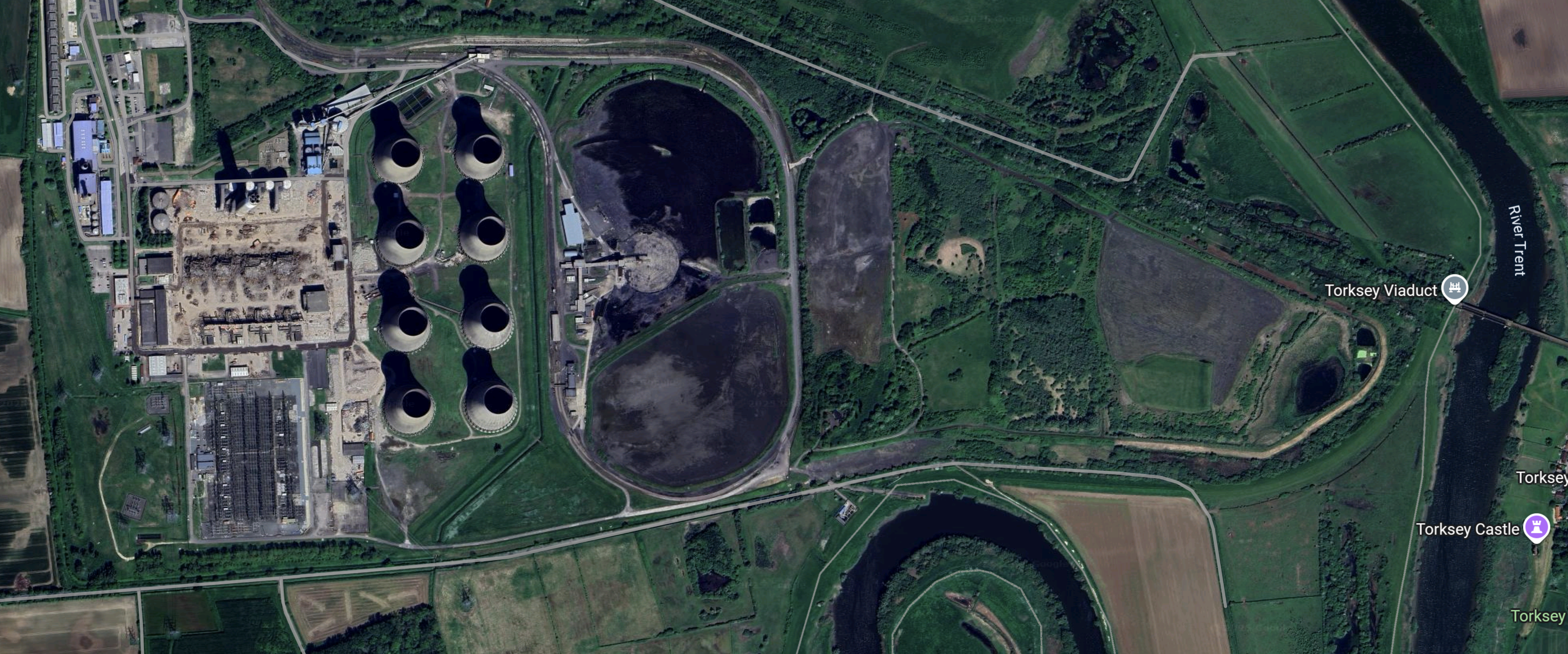
Note.
- The River Trent surrounds the site.
- Could the Trent be used for cooling water?
- The cooling towers are still in place, so the image must have been taken before August.
- The sub-station is in the South-West corner of the site.
- The railway over Torksey viaduct is disused.
It would appear that there is generous space for the SMRs and a few data centres.
The Cottam Solar Project
In DCO Decision On 480MW West Burton Solar NSIP Delayed Until 2025, I wrote about three large solar projects in Eastern England.
The Cottam Solar Project was one of the projects and wants to use the Cottam site.
- The Cottam Solar Project has a web site.
- It will have a capacity of 600 MW, with a battery, with a battery with a 600 MW output and a 600 MWh capacity.
- The solar farm will use the grid connection of the former coal-powered Cottam power station.
- The project is massive and will cover 1270 hectares.
Will this solar project lease space for the SMR, so they can co-exist?
Conclusion
It does appear that there are more than one use for old coal-fired power station sites.
I’ve Signed Up For A Heata
I’ve now got the new boiler, I said I was getting in I’m Getting A New Hydrogen-Ready Boiler.
But unfortunately, during the fitting, we found that my hot water system had a leak problem and the immersion heater wasn’t working.
So I decided to sign up for a heata, which I wrote about in British Gas Partners With heata On Trial To Reuse Waste Heat From Data Processing.
It was a painless process, but unfortunately, I can’t have one yet, as they told me this.
Thank you for registering interest in being part of the heata network, very much appreciated.
We’ll be in touch when there is an opportunity to be part of a pilot, eg testing our unvented heata unit, or to join the network as it expands.
The heata team.
That is very fair.
They didn’t request anything more than name, e-mail address, broadband speed and my hot water tank type.
They didn’t ask for full address, credit card or even, who was my energy supplier.
In the meantime, I can use the new boiler for hot water.
How Heata Works
This page on the heata web site, describes how the system works.
I’m Getting A New Hydrogen-Ready Boiler
The pump in my current nine-year-old boiler has died and it needs to be replaced.
The plumber gave me two solutions.
- Put a new pump in the old boiler.
- Replace the boiler with the current version of the old boiler.
Note.
- The plumber said the new boiler would be hydrogen-ready.
- I seem to remember the same pump failed before.
- The pump had failed because of a water-leak into its electrics.
- Was the previous failure of the pump caused by the same water-leak?
- Fitting a heat pump in my house would probably cost more than I could afford.
- The new boiler would come with a ten-year guarantee.
As an engineer, I can see the following scenarios for heating my house and providing hot water.
1. Keeping Calm And Carrying On
This means that the current arrangements for energy continue.
- There would be no compulsory heat pumps.
- There would be no change to any of my hardware, after installing the new boiler.
- I would continue to get gas for heating and hot water delivered through the mains.
The new boiler solution should give me ten years of reasonably trouble free-running, so long as the gas was natural gas, hydrogen blend or hydrogen.
2. Keeping Calm And Carrying On But My Energy Supplier Switches My Gas To 20 % Hydrogen-Blend
This means that the current arrangements for energy continue.
- There would be no compulsory heat pumps.
- There would be no change to any of my hardware, after installing the new boiler.
- I would continue to get gas for heating and hot water delivered through the mains.
- The gas pipe into my house would have to be checked for compatibility with hydrogen-blend. But then I encountered no problems when switched from coal-gas to North Sea Gas around 1970.
The new boiler solution should give me ten years of reasonably trouble free-running, so long as the gas was natural gas, hydrogen-blend or hydrogen.
3. Keeping Calm And Carrying On But My Energy Supplier Switches My Gas To 100 % Hydrogen
This means that the current arrangements for energy continue.
- There would be no compulsory heat pumps.
- There would be no change to any of my hardware, after installing the new boiler.
- I would continue to get gas for heating and hot water delivered through the mains.
- The gas pipe into my house would have to be checked for compatibility with hydrogen.
The new boiler solution should give me ten years of reasonably trouble free-running, so long as the gas was natural gas, hydrogen blend or hydrogen.
4. Switching To Some Form Of Heat Pump
- This would mean that I would go all electric.
- My house is a concrete lump and a guy I trust, said it would be difficult to fit a heat pump.
- I am suspicious of scientific and technical solutions proposed by politicians.
I’m not saying, I’d never use a heat pump, but I will take a lot of convincing.
5. Switching To Some New Form Of Electric Heating
I have seen two companies, which use the excess heat from a data centre to heat water for central heating and/or hot water for domestic needs.
- heata is a spin out from Centrica, that provides hot water and saves you money on your utility bill.
- thermify is a startup from Wales, that replaces the gas boiler, with an electric one.
There are probably other similar systems under development.
From my knowledge of computing and electrical engineering, I believe devices like this could be new form of cost-efficient electric heating.
Because my house has three-bedrooms, I would need a thermify, for both heating and hot water, but a heata working in tandem with my gas boiler could probably keep me in hot water.
I would feel that large blocks of flats or offices could have a data centre in the basement to provide heat for the building.
I would also suspect, that there are other devices out there, that work on different principles.
My Decision
I’m fitting a new boiler, as that should give me ten years’guarantee-backed and trouble free running and future-proof me for all possible government decisions, except saying that everybody must fit a heat pump.
When, this new boiler pops its clogs, i would hope, that some clever engineers have come up with a plug-compatible electric replacement for the new boiler I am about to have fitted.
Singapore’s First Hydrogen-Powered Data Center Launched By DayOne Using SOFC Technology
The title of this post, is the same as that of this article on Fuel Cell Works.
These two bullet points act as sub-headings.
- DayOne has broken ground on its first AI-ready hyperscale data center in Singapore, a 20MW facility set to be operational in 2026. The project integrates 100% renewable energy, SOFC-based hydrogen power generation, and cutting-edge hybrid cooling technologies.
- Strategic partnerships with Sembcorp and NUS will drive green energy adoption and R&D in sustainable tropical data center innovation, aligning with Singapore’s AI and digital infrastructure goals.
This data centre and the companies and the technologies behind it, are certainly ones to watch.
The R & D and innovation behind it could allow data centres to be built in more tropical places than is currently possible.
National Grid Starts Work On New Substation In Buckinghamshire To Power Data Centres
The title of this post, is the same as that of this press release from National Grid.
These three bullet points act as sub-headings.
-
New substation site at Uxbridge Moor in Buckinghamshire will power new data centres –delivering economic growth and enabling UK digitalization
-
Site to feature two SF6-free gas-insulated switchgear (GIS) substations to minimise environmental footprint
-
Work comes as National Grid is planning £35 billion investment in its transmission network between 2026 to 2031
This is the first paragraph.
National Grid is starting work on its new Uxbridge Moor substation in Buckinghamshire which will connect over a dozen new data centres to its network.
This Google Map shows the current Iver substation.
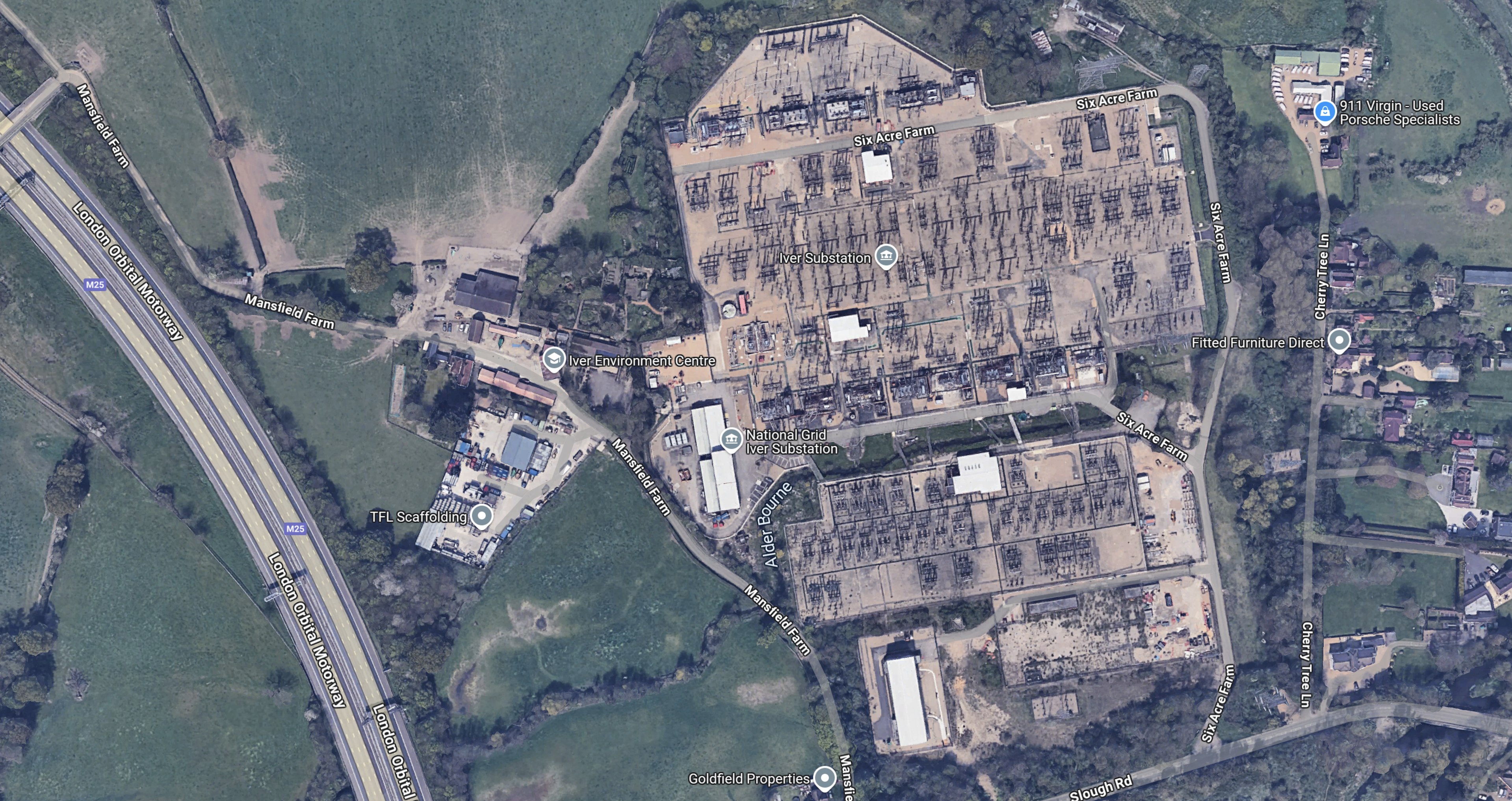
The road on the left is Western section of the M25, which gives an idea of the size of the substation.
These two paragraphs give more details of the new Uxbridge Moor substation.
The requests from data centres to connect at Uxbridge Moor will require around 1.8GW of new capacity, equivalent to adding a mid-sized city to the grid on the outskirts of London. When built, it will be the largest new substation on National Grid’s network by gigawatt capacity.
The new substation site borders National Grid’s existing Iver 400kV substation in Buckinghamshire, which has reached capacity and cannot be expanded to meet the demand from data centres and other customers for connections in the area.
Nothing about the new substation appears small!
The cost of the Uxbridge Moor substation does not appear to have been disclosed by National Grid, but they do say this about their projected total spend in the next few years.
National Grid is planning £35 billion of investment between 2026 to 2031 to connect both large sources of demand such as data centres and gigafactories, and new sources of electricity generation such as wind and solar.
But then it’s not their fault, that the UK is a superb place for renewable energy and we generally speak English.

