NI Green Hydrogen Projects Win Government Grants
The title of this post, is the same as that of this article on the BBC.
This is the sub-heading.
Two green hydrogen projects in Northern Ireland have won government grants in the first round of the UK Net Zero Hydrogen Fund.
These three paragraphs outline the projects.
Green hydrogen is made by using renewable electricity to separate water into oxygen and hydrogen – a process called electrolysis.
The grants will be used to help fund the construction of electrolysers.
One will be at the Mannok cement plant in Fermanagh, the other at Wrightbus in Ballymena.
I talked about the Wrightbus project in Ballymena: Wrightbus To Develop Hydrogen Production Facility.
ZeroAvia To Bring Zero-Emissions Flight To Sweden
The title of this post, is the same as that of this article on AviationSourceNews.
These three paragraphs outline the deal.
ZeroAvia has announced this week that it has struck a deal to bring zero-emissions flights to Sweden.
Such a deal has been struck to allow commercial routes from Skellefteå Airport using hydrogen-electric powertrains with Braathens Airlines.
Braathens Airlines operates a fleet of 14 ATR 72 aircraft, which will eventually have these powertrains utilized for flights across Sweden.
ZeroAvia are also targeting de Havilland Canada Dash 8 airliners for conversion to hydrogen.
BP Launches Plans For Low-Carbon Green Hydrogen Cluster In Spain’s Valencia Region
The title of this post is the same as that of this press release from BP.
These are the four bullet points.
- Aims to make Valencia region a leader in green hydrogen production
- Cluster to include world-scale green hydrogen production at bp’s Castellón refinery of up to 2GW of electrolysis capacity by 2030
- Supports transformation and decarbonization of the refinery, together with tripling biofuel production
- Transformation of Castellón could see bp invest up to €2 billion
This is the first paragraph.
bp today launched the green hydrogen cluster of the Valencia region (HyVal) at its Castellón refinery. Led by bp, this public-private collaborative initiative is intended to be based around the phased development of up to 2GW of electrolysis capacity by 2030 for producing green hydrogen at bp’s refinery.
It certainly is a big hydrogen-friendly project and is a roadmap of how to decarbonise an oil refinery.
This massive commitment to hydrogen makes me more certain, that bp’s offshore 50 MW wind farm twenty miles from Aberdeen, is designed to produce hydrogen for the granite city.
Are bp putting together a strategy to bring hydrogen to the world?
After all hydrogen is the only zero-carbon fuel, that can directly replace fuels like natural gas, diesel and many hydrocarbon fuels in a large number of applications.
New Mexican Carrier Aerus To Operate Regional Routes Left By Aeromar
The title of this post, is the same as that of this article on Simple Flying.
This is the first paragraph.
The new Mexican regional startup carrier Aerus will begin flying next month, according to the company’s Chief Executive Officer, Javier Herrera. With a fleet of Cessna and Alice aircraft, Aerus is looking to replace Aeromar as the country’s leading regional airline flying point-to-point routes from its base in Monterrey International Airport (MTY).
The Rise Of Zero-Carbon Airlines
It looks like Aerus could be heading to join a list of zero- or low-carbon airlines.
Current airlines going in that direction include.
- Air New Zealand, who have released this press release, which is entitled Air New Zealand Launches Ambitious pProgramme For Zero Emissions Aircraft.
- Cape Air who have a large fleet of up to nine seat commuter airliners and 75 Eviation Alice on order.
- Evia AERO, which I wrote about in EVIA AERO Orders 25 Eviation Alice Aircraft.
- GlobalX has been reported as having 50 Eviation Alice on order.
- Harbour Air, which I wrote about in Harbour Air Set To Become The First All-Electric Airline In The World.
Some parts of aviation do seem to be decarbonising.
13 Offshore Wind Projects Selected In World’s First Innovation And Targeted Oil & Gas Leasing Round
The title of this post, is the same as that of this article on offshoreWIND.biz.
This is the sub-heading.
Crown Estate Scotland has selected 13 out of a total of 19 applications with a combined capacity of around 5.5 GW in the world’s first leasing round designed to enable offshore wind energy to directly supply offshore oil and gas platforms.
This paragraph outlines INTOG (Innovation and Targeted Oil & Gas) and its objectives.
INTOG, which has been designed in response to demand from government and industry to help achieve the targets of the North Sea Transition Sector Deal through decarbonising North Sea oil and gas operations, is also expected to further stimulate innovation in Scotland’s offshore wind sector, create additional supply chain opportunity, assist companies to enter the renewable energy market, and support net-zero ambitions.
This is undoubtedly the most important news of the day.
- When complete it will generate 5416 MW of electricity.
- 4068 MW will be used primarily to decarbonise oil and gas platforms with surplus electricity going to the grid.
- The amount of carbon dioxide released by oil and gas platforms in the North Sea will be reduced.
- The gas saved by decarbonising oil and gas platforms, will be transported to the shore and used in the UK gas grid.
- 449 MW will be generated in innovative ways in small wind farms, with a capacity of less than 100 MW.
One of the benefits of INTOG is that the UK will be able to reduce gas imports, which must increase energy security.
This map from this document from the Crown Estate Scotland, shows the INTOG wind farms.
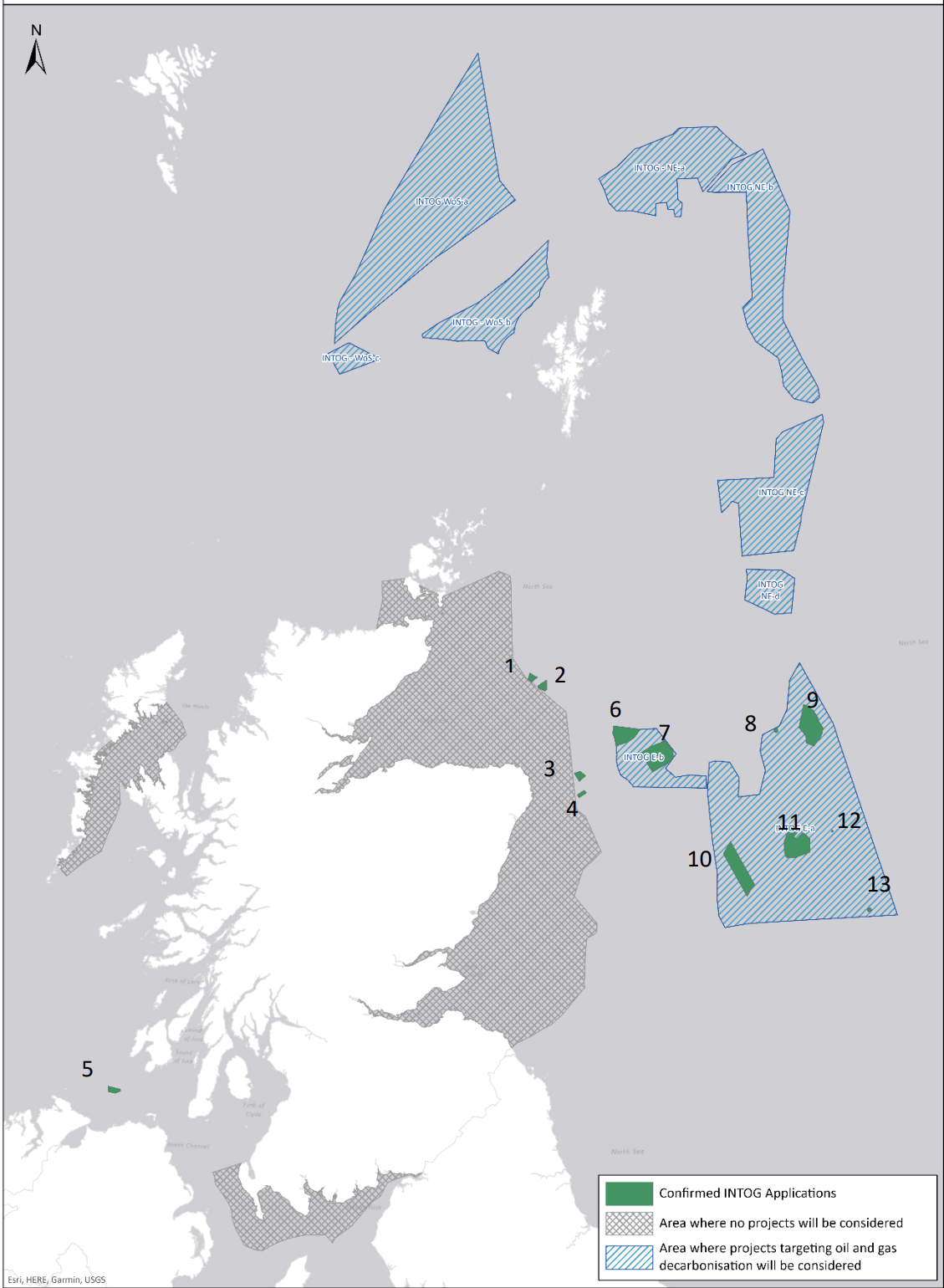
This is a list of the farms.
- 1 – Bluefloat Energy/Renantis Partnership – Innovation – Commercial – 99.45 MW
- 2 – Bluefloat Energy/Renantis Partnership – Innovation – Supply Chain – 99.45 MW
- 3 – Simply Blue Energy (Scotland) – Innovation – Supply Chain – 100 MW
- 4 – BP Alternative Energy Investments – Innovation – New Markets – 50 MW
- 5 – ESB Asset Development – Innovation – Cost Reduction – 100 MW
- 6 – Floatation Energy – Targeted Oil & Gas – 560 MW
- 7 – Cerulean Winds – Targeted Oil & Gas – 1008 MW
- 8 – Harbour Energy – Targeted Oil & Gas – 15 MW
- 9 – Cerulean Winds – Targeted Oil & Gas – 1008 MW
- 10 – Cerulean Winds – Targeted Oil & Gas – 1008 MW
- 11 – Floatation Energy – Targeted Oil & Gas – 1350 MW
- 12 – TotalEnergies – Targeted Oil & Gas – 3 MW
- 13 – Harbour Energy – Targeted Oil & Gas – 15 MW
Note.
- These total up to 5.42 GW.
- The five Innovation sites seem to be as close to the coast as is possible.
- I thought some Innovation sites would be closer, so supply difficult to reach communities, but they aren’t.
- Floatation Energy and Cerulean Winds seemed to have bagged the lion’s share of the Targeted Oil & Gas.
- Sites 6 and 7 sit either side of a square area, where Targeted Oil & Gas will be considered. Is that area, the cluster of oil and gas facilities around Forties Unity, shown on the map in this page on the BP web site?
- Harbour Energy have secured two 15 MW sites for Targeted Oil & Gas.
These are my thoughts on the various companies.
Bluefloat Energy
Bluefloat Energy has posted this press release on their web site, which is entitled Bluefloat Energy | Renantis Partnership Bid Success For Two 99mw Innovation Projects In Crown Estate Scotland’s INTOG Process.
The press release starts with these three bullet points.
- BlueFloat Energy | Renantis Partnership offered exclusivity rights to develop its Sinclair and Scaraben floating wind projects north of Fraserburgh – leveraging synergies via its 900MW Broadshore project.
- The projects seek to trial innovative floating wind technology solutions, kick-starting supply chain growth and job creation in Scotland and providing a ‘stepping-stone’ to the partnership’s ScotWind projects.
- Bid proposals include the intention to develop a scalable community benefit model – creating a potential blueprint for floating offshore wind in Scotland.
The first three paragraphs expand the bullet points.
The BlueFloat Energy and Renantis Partnership has been offered seabed exclusivity rights to develop two 99MW projects under the innovation arm of Crown Estate Scotland’s INTOG (Innovation and Targeted Oil & Gas) auction process. The auction saw ten projects bid to bring forward the development of small-scale innovation projects.
The Sinclair and Scaraben projects, located north of Fraserburgh and adjacent to the Partnership’s 900MW Broadshore project, seek to trial innovative foundation technologies, associated fabrication works and mooring systems with a view to maximising opportunities for the Scottish supply chain, driving local investment and job creation.
A key element of the bid proposals is the opportunity to test and adapt a community benefit model, governed independently, and directed by the communities in which the schemes will operate, through collaboration with our supply chain and project partners. The model could create a blueprint, shaping the future of community benefit from floating offshore wind throughout the whole of Scotland. This builds on Renantis’ successful track record of deploying similar schemes via its onshore wind farms in Scotland.
Note.
- Companies called Sinclair Offshore Wind Farm and Scaraben Offshore Wind Farm were registered a few months ago in Inverness.
- I couldn’t find the websites, so I suspect they’re still being created.
- These two projects appear to be pathfinders for the 900 MW Broadshore project, with regards to the supply chain and community involvement.
It certainly looks like the partnership are going about the development of these two projects in a professional manner.
BP Alternative Energy Investments
There has been no press release from BP as I write this, so I will have to deduce what BP are planning.
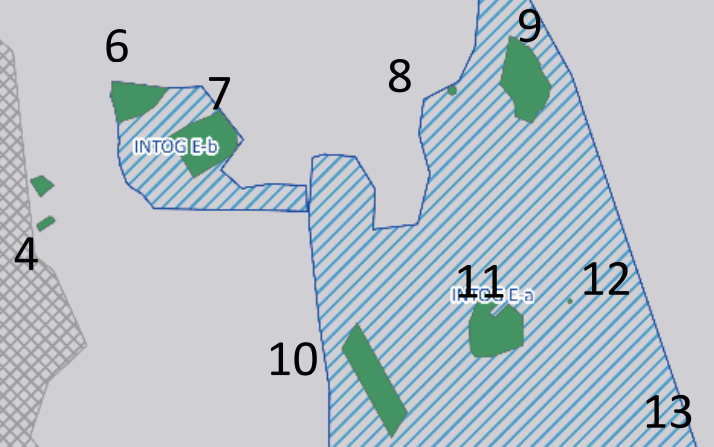
This map from this document from the Crown Estate Scotland, shows the Southern INTOG wind farms.
Note.
- Site 4 is the site of BP Alternative Energy Investments’s proposed wind farm.
- Sites 6 and 7 could be either side of the cluster of platforms around Forties Unity.
Consider.
- In the wider picture of wind in the North Sea, BP’s proposed 50 MW wind farm is a miniscule one. SSE Renewables’s Dogger Bank wind farm is over a hundred times as large.
- A cable to the shore and substation for just one 50 MW wind farm would surely be expensive.
- BP Alternative Energy Investments are also developing a 2.9 GW wind farm some sixty miles to the South.
- It would probably be bad financial planning to put large and small wind farms so close together.
For these are other reasons, I believe that there is no reason to believe that the proposed 50 MW wind farm is a traditional wind farm.
But if I’m right about sites 6 and 7 indicating the location the position of Forties Unity, it might open up other possibilities.
This document from INEOS, who own the Forties Pipeline System, explains how the pipeline works.
The Forties Pipeline System (FPS) is an integrated oil and gas transportation and processing system. It is owned and operated by INEOS and utilises more than 500 miles of pipeline to smoothly transport crude oil and gas from more than 80 offshore fields for processing at the Kinneil Terminal. At Kinneil the oil and gas are separated, with the oil returned as Forties Blend to customers at Hound Point or pumped to the Petroineos refinery at Grangemouth.
At the same time the gas goes to our LPG export facilities or is supplied to the INEOS petrochemical plant. FPS transports around 40% of the UK’s oil production supply and brings over 400,000 barrels ashore every day.
In Can The UK Have A Capacity To Create Five GW Of Green Hydrogen?, I said the following.
Ryze Hydrogen are building the Herne Bay electrolyser.
- It will consume 23 MW of solar and wind power.
- It will produce ten tonnes of hydrogen per day.
The electrolyser will consume 552 MWh to produce ten tonnes of hydrogen, so creating one tonne of hydrogen needs 55.2 MWh of electricity.
If BP were to pair the wind farm with a 50 MW electrolyser it will produce 21.7 tonnes of hydrogen per day.
Could it be brought to the shore, by linking it by a pipeline to Forties Unity and then using the Forties Pipeline System?
As the category on site 4, is New Markets, are BP and INEOS investigating new markets for hydrogen and hydrogen blends?
- Some of the latest electrolysers don’t need pure water and can use sea water. This makes them more affordable.
- Do BP and/or INEOS have the capability to extract the hydrogen as it passes through the Cruden Bay terminal, to provide the hydrogen for Aberdeen’s buses and other users?
- INEOS and BP probably have some of the best oil and gas engineers in the world.
- How many other places in the world have an offshore oil or gas field set in a windy sea, where floating wind- turbine/electrolysers could generate hydrogen and send it ashore in an existing pipeline?
- Several of these offshore oil and gas fields and the pipelines could even be owned by BP or its associates.
- Remember that hydrogen is the lightest element, so I suspect it could be separated out by using this property.
This BP site, is to me, one of the most interesting of the successful bids.
- BP probably have a large collection of bonkers ideas, that have been suggested during their long involvement with offshore oil and gas.
- Some ideas could be even suggested by employees, whose fathers worked for BP fifty years ago. I’ve met a few BP employees, whose father also did.
- Will the wind farm, be a floating electrolyser at the centre of a cluster of a few large floating turbines?
- Will each turbine have its own electrolyser and the substation only handle hydrogen?
- Will the floating electrolyser have hydrogen storage?
- Have BP got a floating or semi-submersible platform, that could either go to the breakers or be repurposed as the floating electrolyser?
- Repurposing a previous platform, would make all the right noises.
So many possibilities and so far, no clues as to what will be built have been given.
See also.
Further Thoughts On BP’s Successful INTOG Bid
Cerulean Winds
In What Is INTOG?, I said this about Cerulean Winds.
Cerulean sounds like it could be a sea monster, but it is a shade of blue.
This article on offshoreWind.biz is entitled Cerulean Reveals 6 GW Floating Offshore Wind Bid Under INTOG Leasing Round.
These are the two introductory paragraphs.
Green energy infrastructure developer Cerulean Winds has revealed it will bid for four seabed lease sites with a combined capacity of 6 GW of floating wind to decarbonise the UK’s oil and gas sector under Crown Estate Scotland’s Innovation and Targeted Oil and Gas (INTOG) leasing round.
This scale will remove more emissions quickly, keep costs lower for platform operators and provide the anchor for large-scale North-South offshore transmission, Cerulean Winds said.
Note.
-
- It is privately-funded project, that needs no government subsidy and will cost £30 billion.
- It looks like each site will be a hundred turbines.
- If they’re the same, they could be 1.5 GW each.
- Each site will need £7.5 billion of investment. So it looks like Cerulean have access to a similar magic money tree as Kwasi Kwarteng.
Effectively, they’re building four 1.5 GW power stations in the seas around us to power a large proportion of the oil and gas rigs.
For more on Cerulean Winds’s massive project see Cerulean Winds Is A Different Type Of Wind Energy Company.
So does it mean, that instead of 6 GW, they were only successful at three sites and the other or others were in the six unsuccessful applications?
There is a press release on the Cerulean Winds web site, which is entitled Cerulean Winds Wins Bid For Three INTOG Floating Wind Sites, where this is said.
Cerulean Winds and Frontier Power International have been awarded three lease options for the Central North Sea in the highly competitive INTOG leasing round, the results of which were announced by Crown Estate Scotland today.
The sites, in the Central North Sea, will enable the green infrastructure developer and its partners to develop large floating offshore windfarms to decarbonise oil and gas assets. The scale of the development will enable a UK wide offshore transmission system, that can offer green energy to offshore assets in any location and create a beneficial export opportunity.
Nothing about unsuccessful applications was said.
This map from this document from the Crown Estate Scotland, shows the Southern INTOG wind farms.
Note.
- Sites 7, 9 and 10 are Cerulean’s sites.
- Sites 6 and 11 are Floatation Energy’s sites.
- Site 4 is BP Alternative Energy Investments’s Innovation site.
- Sites 8, 12 and 13 are much smaller sites.
It looks like Cerulean and Floatation Energy are well-placed to power a sizeable proportion of the platforms in the area.
ESB Asset Development
ESB Asset Development appear to be a subsidiary of ESB Group.
The ESB Group is described like this in the first paragraph of their Wikipedia entry.
The Electricity Supply Board is a state owned (95%; the rest are owned by employees) electricity company operating in the Republic of Ireland. While historically a monopoly, the ESB now operates as a commercial semi-state concern in a “liberalised” and competitive market. It is a statutory corporation whose members are appointed by the Government of Ireland.
This press release, is entitled ESB Offered Exclusive Rights To Develop Innovative 100MW Floating Offshore Wind Project In The Malin Sea.
These two paragraphs outline the project.
ESB today welcomes the outcome of Crown Estate Scotland’s latest seabed leasing process which has resulted in the offer of exclusive development rights to ESB for a 100MW floating wind project in Scottish waters off the north coast of Northern Ireland. The successful project, Malin Sea Wind, is a collaborative bid between ESB and leading technology developers Dublin Offshore Technology and Belfast-based CATAGEN. The outcome underscores ESB’s growing capabilities and expanding presence in the offshore wind industry.
The Innovation and Targeted Oil and Gas (INTOG) seabed leasing process, run by Crown Estate Scotland, aims to drive cost reduction in the offshore wind sector by enabling the deployment of new and innovative technologies, and to harness wind energy to decarbonize the oil and gas sector. Malin Sea Wind aims to support the reduction of floating offshore wind costs by demonstrating Dublin Offshore’s patented load-reduction technology. Furthermore, the project will support decarbonisation of the aviation sector by powering sustainable aviation fuel (SAF) production technology currently under development by net-zero technology specialists, CATAGEN.
Note.
- I’ve just looked at the Technology page of the Dublin Offshore Technology web site.
- In the 1970s, I built large numbers of mathematical models of steel, concrete and water cylinders in my work with a Cambridge University spin-out called Balaena Structures.
- I believe, that an experienced mathematically modeller could simulate this clever system.
That would prove if it works or not!
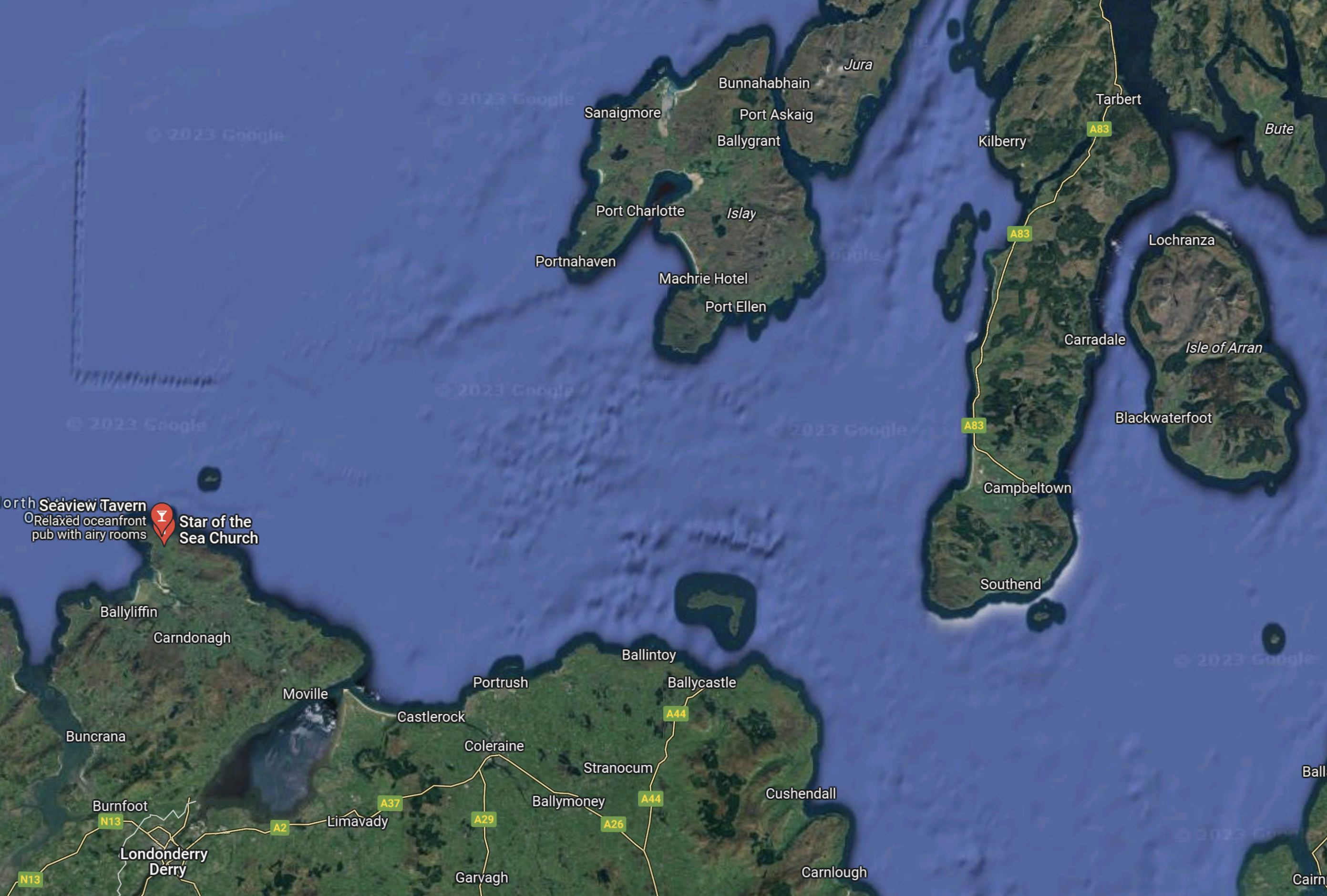
This Google Map shows the Malin Sea.
Note.
- Malin Head is marked by the red arrows on the Northern Irish coast.
- The most Westerly Scottish island is Islay and the most Easterly is the Isle of Arran.
- Between the two islands is the Kintyre peninsula.
- Portrush can be picked out on the Northern Irish coast.
By overlaying the two maps, I suspect the centroid of the wind farm will be North of Portrush about a few miles North of the Southern end of Arran.
I suspect that if all goes well, there could be a lot of floating wind turbines in the area.
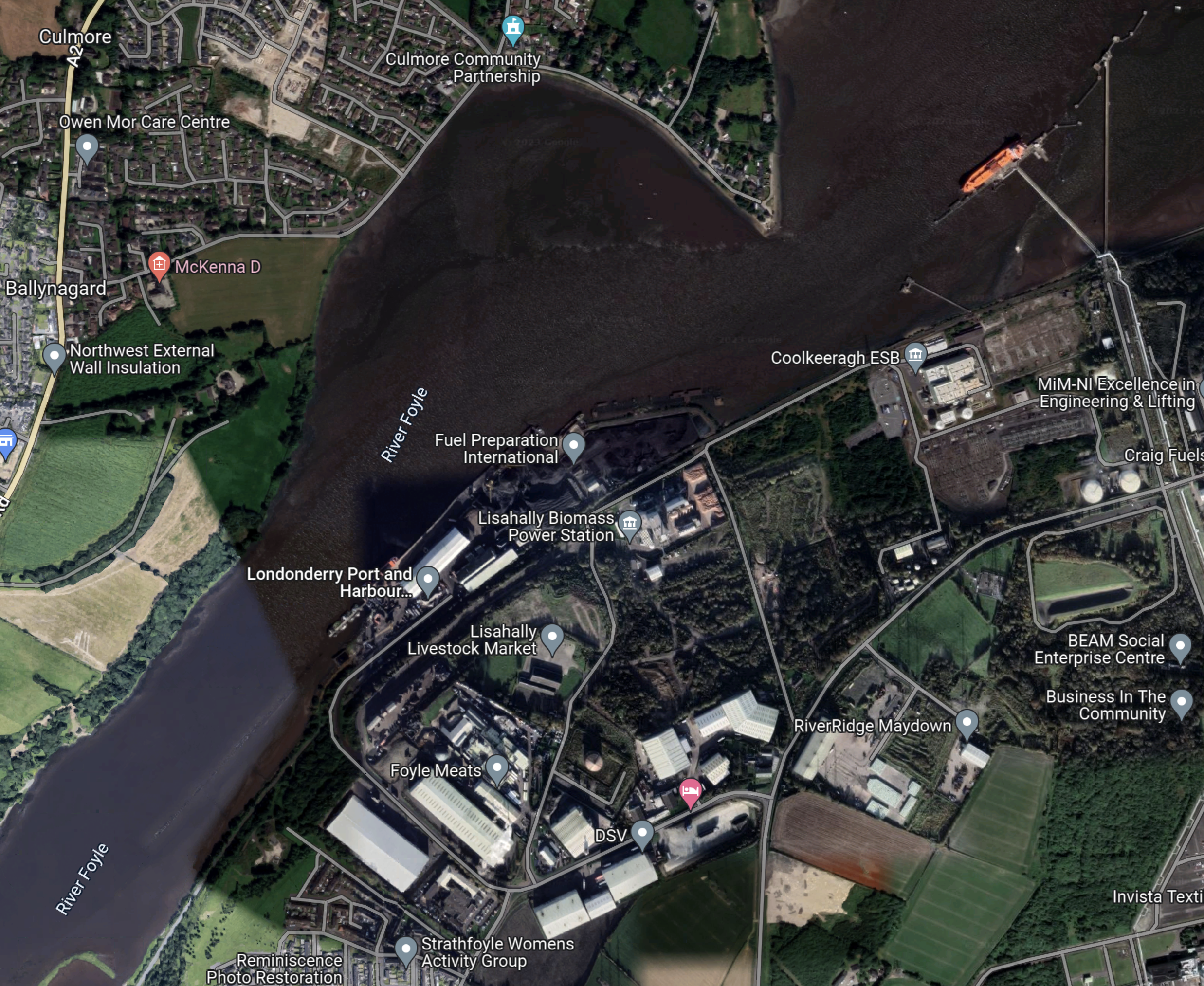
This Google Map shows the River Foyle estuary and Foyle Port to the North-East of Londonderry/Derry.
Note.
- Coolkeeragh ESB and Lisahally biomas power station on the South bank of the River Foyle.
- Lisahally biomas power station has a capacity of 16 MW.
- There appears to be a large substation at Coolkeeragh ESB.
- A tanker of some sort seems to be discharging.
Until told, I’ve guessed wrong, it looks to me like Coolkeeragh ESB could be the destination for the electricity generated by Malin Sea Wind. Given that this project’s aim is cost reduction, a 100 MW wind farm could make a difference.
In addition could Foyle Port be used to assemble and maintain the floating turbines?
Floatation Energy
Floatation Energy have posted this press release on their web site, which is entitled Flotation Energy and Vårgrønn Awarded Exclusivity To Develop Up To 1.9 GW Of Floating Offshore Wind In Scotland.
The first part of the press release, has a graphic.
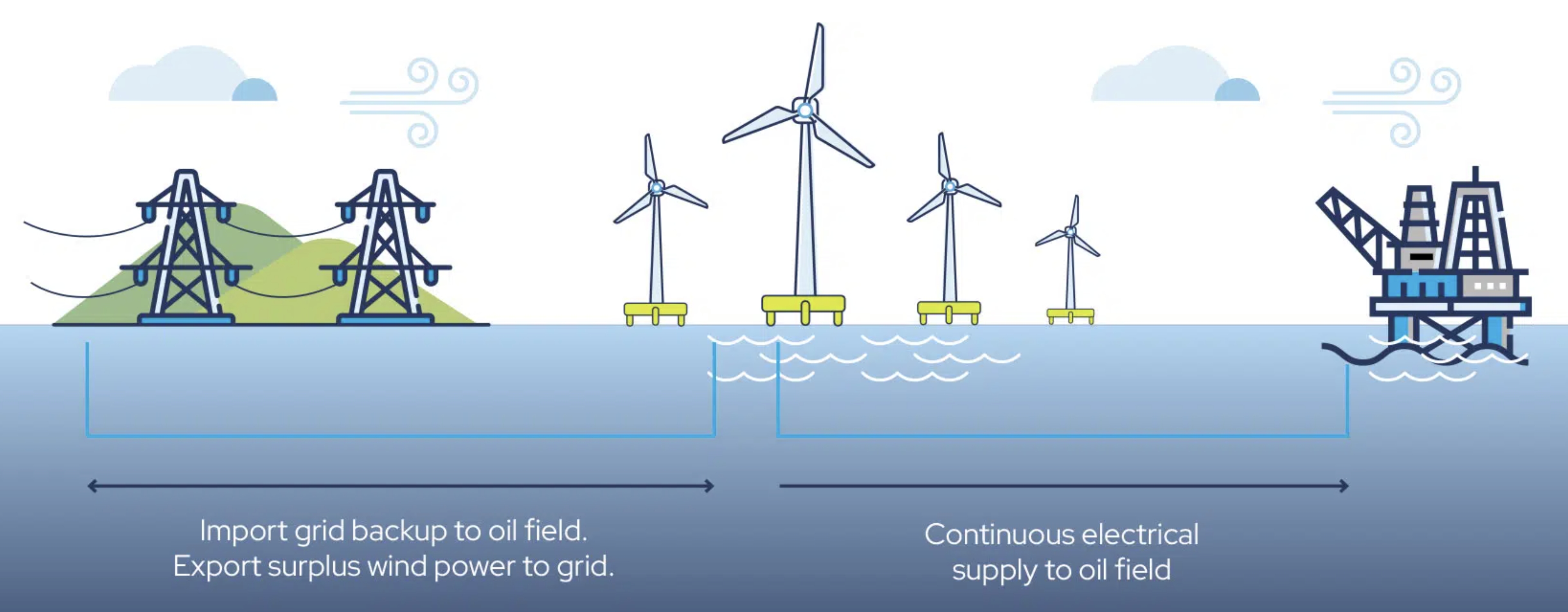
It shows how their proposed system will work.
- A floating wind farm will be placed between the shore and oil and gas platforms to be decarbonised.
- The wind farm will be connected to the shore by means of a bi-directional cable, so that the wind farm can export electricity to the grid and when the wind isn’t blowing the grid can power the platforms.
- A cable between the wind farm and the platforms completes the system.
It is a simple system, where all elements have been built many times.
Floatation Energy must have been fairly confident that their bids would be successful as they have already named the farms and set up web sites.
- Site 6 – Green Volt – 560 MW
- Site 11 – Cenos – 1350 MW
The websites are very informative.
The Timeline for 2019-2021 on the Green Volt web site describes the describes the progress so far on the project.
2019 – As construction of the Kindardine offshore floating wind farm kicks off, Flotation Energy identifies the Buzzard oil facility (a relatively new oil and gas platform with a long field life and high electrical load) as the optimal starting point for a significant contribution to the North Sea Transition Deal – the process of replacing large scale, inefficient gas-fired power generation with renewable electricity from offshore wind.
2020 – Flotation Energy begins environmental surveys on the Ettrick/Blackbird oil field, a redundant site nearby Buzzard, which is in the process of decommissioning. The “brownfield” site is confirmed as an exceptional opportunity to create an offshore floating wind farm, with water depths of 90-100m and high quality wind resource.
2021 – Flotation Energy works with regulators to understand the potential for project “Green Volt” to decarbonise offshore power generation for Buzzard. Flotation Energy completes and submits an Environmental Scoping report to Marine Scotland, reaching the first major milestone in the Marine Consent process. Crown Estate Scotland announces a new leasing round for Innovation and Targeted Oil and Gas Decarbonisation (INTOG).
On a section on the Cenos web site, there is a section called Efficient Grid Connection, where this is said.
The power generated by the wind turbines will be Alternating Current (AC) and routed to a substation platform. AC power will be exported to the oil and gas platforms.
For efficient export to the UK grid, the substation platform will include a converter station to change the AC power to Direct Current (DC) before the power is transported to shore. This is due to transporting AC power over long distances leading to much of the power being lost.
Cenos is working in partnership with the consented NorthConnect interconnector project, to utilise their DC cable routing where possible. Cenos will also use the NorthConnect onshore converter station planned for Fourfields near Boddam, which then has an agreed link into the Peterhead Substation. This collaboration minimises the need to construct additional infrastructure for the Cenos project.
That all sounds very practical.
Note.
- Floatation Energy delivered the Kincardine offshore floating wind farm.
- Both wind farms appear to use the same shore substation.
- Buzzard oil field is being expanded, so it could be an even more excellent oil field to decarbonise.
- NorthConnect is a bit of an on-off project.
Floatation Energy seem to have made a very professional start to the delivery of their two wind farms.
Harbour Energy
The Wikipedia entry for Harbour Energy describes the company like this.
Harbour Energy plc is an independent oil and gas company based in Edinburgh, Scotland. It is the United Kingdom’s largest independent oil and gas business. It is listed on the London Stock Exchange and is a constituent of the FTSE 250 Index.
But if you look at news items and the share price of the company, things could look better for Harbour Energy.
On their map of UK operations, I can count nearly twenty oil and gas fields.
As they have other oil and gas fields around the world, decarbonisation of their offshore operations could increase production by a few percent and substantially cut their carbon emissions.
That is a philosophy that could be good for profits and ultimately the share price.
So has the company gone for a very simple approach of two identical floating wind turbines?
They have been successful in obtaining leases for sites 8 and 13.
- Both have a capacity of 15 MW, so are the farms a single 15 MW wind turbine?
- I think this is likely, unless it is decided to opt for say a 16 MW turbine.
- Or even a smaller one, if the platform is in a bad place for wind.
- The wind turbine would be parked by the platform to be decarbonised and connected up, to a simple substation on the platform.
- I would recommend a battery on the platform, so that if the wind wasn’t blowing, power was still supplied to the platform.
- There would be no need for any cable between shore and wind farm and the only substation, would be a relatively simple one with a battery on the platform.
It could be a very efficient way of decarbonising a large number of platforms.
Once Harbour Energy have proved the concept, I could build a simple mathematical model in Excel, to work out any change in profitability and carbon emissions for a particular oil or gas platform.
Who Is Britannia Ltd?
In this document from the Crown Estate Scotland, there is a section that gives the partners in each project.
Listed for site 8 are Chrysaor (U.K.) and Britannia Limited and for site 13 is Chryasaor Petroleum Company UK Limited.
This page on the Harbour Energy web site gives the history of Chrysaor and Harbour Energy.
This is the heading.
Chrysaor was founded in 2007 with the purpose of applying development and commercial skills to oil and gas assets and to realise their value safely.
This is the history.
The Group grew rapidly over the years through a series of acquisitions. With backing from Harbour Energy – an investment vehicle formed by EIG Global Energy Partners – Chrysaor acquired significant asset packages in the UK North Sea from Shell (2017) and ConocoPhillips (2019) to become the UK’s largest producer of hydrocarbons.
In 2021, Chrysaor merged with Premier Oil to become Harbour Energy plc.
So that explains the use of the Chrysaor name or Chryasaor as someone misspelt it on the Crown Estate Scotland document.
I asked myself, if Britannia Ltd. could be a technology company, so I checked them out. The only company, I could find was a former investment trust, that was dissolved over ten years ago.
But Britannia is an oil and gas field in the North Sea, which is partially owned by Harbour Energy. It has a page on Harbour Enerrgy’s web site, which is entitled Greater Britannia Area.
This is said about the Britannia field.
Britannia in Block 16/26 of the UK central North Sea sits approximately 210-kilometres north east of Aberdeen. The complex consists of a drilling, production and accommodation platform, a long-term compression module of mono-column design and a 90-metre bridge connected to a production and utilities platform. Britannia is one of the largest natural gas and condensate fields in the North Sea. Commercial production began in 1998. Condensate is delivered through the Forties Pipeline to the oil stabilisation and processing plant at Kerse of Kinneil near Grangemouth and natural gas is transported through a dedicated Britannia pipeline to the Scottish Area Gas Evacuation (SAGE) facility at St Fergus.
Looking at the maps on the Crown Estate Scotland, Harbour Energy and others, it looks like site 8 could be close to the
Greater Britannia Area or even the Britannia field itself.
Simply Blue Energy
Simply Blue Energy are developing the 100 MW Salamander wind farm.
I wrote about this project in The Salamander Project.
Did it get chosen, as it was a project, where the design was at an advanced stage?
TotalEnergies
I wouldn’t be surprised to find out that TotalEnergies have gone a very similar route to Harbour Energy, but they are trying it out with a 3 MW turbine.
Conclusion
They are an excellent group of good ideas and let’s hope that they make others think in better and move innovative ways.
Politics will never save the world, but engineering and science just might!
Budweiser To Convert Second UK Brewery To Hydrogen
The title of this post, is the same as that of this article on The Engineer.
This is the sub-heading.
Samlesbury Brewery in Lancashire is set to be powered by green hydrogen from 2025, according to new plans announced by owner Budweiser Brewing Group.
This paragraph outlines what will be done at Salmesbury.
The Samlesbury Net Zero project will see the brewery paired with a new hydrogen production facility (HPF), delivered by UK hydrogen services company Protium. Situated adjacent to the brewery, the HPF will provide green hydrogen to meet the thermal demand of the brewing processes, as well as the building’s other heating requirements.
Note.
- A refuelling station for hydrogen-ready HGVs will also be developed as part of the project.
- Heat from the HPF will be recovered and used in Budweiser’s bottling process.
- This is the second project involving Budweiser and Protium, after one at Magor in South Wales.
- Beers produced at the facility include Budweiser, Stella Artois and Corona.
I may have had the odd bottle of Corona in the States, but I’ve generally drunk real ale only since, I started having halves of Adnams with my father at the age of thirteen.
Now, because I’m on Warfarin, I more or less exclusively drink zero-alcohol beers, most of which is Adnams, straight from the brewery.
I’ve yet to find any beer which is less than 0.5 % alcohol, has contained enough gluten to have an effect on my gut.
I have discussed this with experienced brewers and they are not surprised, as the brewing process for zero-alcohol beers doesn’t use much barley.
Conclusion
We need more integrated projects like this, that both decarbonise industrial processes and provide filling stations for hydrogen-powered vehicles.
This Hydrogen Combustion Engine Is The EV Alternative We’ve Been Waiting For – HotCars
The title of this post, is the same as that of this article on Hydrogen Central.
This must-read article is a reprint of an article in hotcars and it details the technology and thinking behind JCB’s new hydrogen engine.
As someone who believes, that hydrogen is the only way to go to power zero-emission vehicles in the future, I advise all hydrogen sceptics to read this article.
These two paragraphs, explain the thinking behind why JCB turned to hydrogen.
As they say, necessity is the mother of invention. JCB was struck with the problem of going zero emissions without sacrificing power and cost of purchase. In a previous Harry’s Garage episode, Lord Bamford, Chairman of JCB, mentioned that passenger cars, on average, run about 300 hours per year. In contrast, a regular heavy-duty backhoe would have running hours close to 10 times that amount. He adds that in countries like India, machines of this scale run for at least 5000 hours per year.
So, to have electricity run an industrial equipment for eight hours at the minimum requires significantly more batteries. Not only does it skyrocket the costs involved, but it will add a ton of complexity and increase the overall weight. Therefore, engineers had to think radically.
Many believe that Hydrogen engines will pump out loads of nitrogen oxides.
These two paragraphs outline JCB’s solution.
A known disadvantage of a hydrogen ICE is the production of Nitrogen oxides or NOX. The reason is high operating temperatures. JCB engineers, however, found a clever way to circumvent this by running the engine on a lean mixture of fuel. Hydrogen for a given mass has three times the energy density of its diesel equivalent.
This allowed the team to get the same torque figures without running the engine too rich. Another way to get rid of NOX is through selective catalytic reduction, a common practice in modern diesel engines.
It is my belief, that if a company or engineer solves the problem of making a small hydrogen internal combustion engine, they will make an absolute fortune, that will make Microsoft and Bill Gates look like paupers.
Engineering is the science of the possible, whereas politics is dreams of the impossible.
UK’s Largest Carbon Capture Project Will Turn 40,000 Tonnes Of CO2 Into Sodium Bicarbonate For Dialysis Machines, Pharmaceutical Tablets And Baking Soda Every Year
The title of this post, is the same as that of this article in the Daily Mail.
These bullet points summarise the article.
- A facility that turns carbon dioxide into sodium bicarbonate was opened today
- Tata Chemicals Europe will remove up to 40,000 tonnes of CO2 each year
- The resulting sodium bicarbonate will be used as baking soda and in tablets
- Much of it will be used in haemodialysis to treat people with kidney disease
When I worked at ICI in Runcorn, the company had a facility at Winnington.
- In the 1960s, when I was there the main product was soda ash, which was produced by the Solvay process.
- The plant is now owned by Tata Chemicals Europe, and I suspect the new process is a replacement for the Solvay process.
- The carbon dioxide probably comes from a local 94 MW gas-fired power station on the site.
This ia a good example of Carbon Capture and Use, where a modern process is much better for the environment.
How much better could we protect the environment and the health of everyone, by improving or changing industrial processes?
Memories of the Solvay Process
I went over one of the Solvay processes a couple of times, when I worked at Runcorn.
- I can’t remember why now, but it was probably just to give the newest engineer in the department some experience.
- ICI trained me well at that time, especially in Health and Safety.
- One of the Victorian plants, I went over was built using a framework of oak beams, rather than the steel, we’d use today.
- The thing, that I remember most was the white sodium bicarbonate powder everywhere at the finishing end.
All the grades had uses from baking down to clearing up acid spills. Wikipedia details these uses.
Solvay Process Repurposed
Searching the Internet for more information on Tata Chemicals Europe’s process, I found this article on Scientific American, which is entitled Desalination Breakthrough: Saving The Sea From Salt.
The first paragraph outlines the problem.
Farid Benyahia wants to solve two environmental problems at once: excess carbon dioxide in the atmosphere and excess salt in the Persian Gulf (aka the Arabian Gulf). Oil and natural gas drive the region’s booming economies—hence the excess CO2—and desalination supplies the vast majority of drinking water, a process that creates concentrated brine waste that is usually dumped back into the gulf.
Benyahia, who is a chemical engineer at Qatar University appears to have solved the problem, by repurposing and simplifying the Solvay process.
I suggest that if you’ve got this far, that you read the Scientific American article all the way through, as it paints a horrific vision of the dangers of water desalination.
Hopefully, though Benyahia has the solution, which turns the problem into baking soda and calcium chloride.
We Can Suck CO2 From The Air And Store It In The Ocean As Baking Soda
The title of this section is the same as that of this article on New Scientist.
I first heard about this process on Radio 5.
It concerns some work by Arup Sen Gupta at LeHigh University in Bethlehem, Pennsylvania.
He seems the sort of researcher, who does it properly and his research on capturing carbon dioxide and turning it into baking soda, that is stored in the ocean may well be an idea in the right direction.
It further supports my view that research will find new and better ways of reducing carbon dioxide levels in the atmosphere.
Cummins Launches Accelera By Cummins To Advance The Transition To A Zero-Emissions Future
The title of this post, is the same as that of this press release from Cummins.
These paragraphs outline the creation of the new brand.
Global power and technology leader Cummins Inc. (NYSE: CMI) today announced the launch of Accelera by Cummins, a new brand for its New Power business unit. Accelera provides a diverse portfolio of zero-emissions solutions for many of the world’s most vital industries empowering customers to accelerate their transition to a sustainable future.
The launch of Accelera is a significant step forward in Cummins’ efforts to achieve its Destination Zero strategy, focused on evolving Cummins technologies to reach zero emissions across its product portfolio. Cummins’ Destination Zero strategy is rooted in the understanding that multiple solutions are required to achieve industry-wide decarbonization across the diverse applications the company powers. Over the past several years, Cummins has invested more than $1.5 billion in research and technology, capital and acquisitions to build Accelera’s leadership and technological capabilities. Accelera is now a global leader in zero-emissions technologies, providing battery electric and fuel cell electric solutions across commercial and industrial applications with hundreds of electrolyzers generating hydrogen around the world today.
The press release then gives details of the zero-carbon products, that are in Accelera’s portfolio.
The press release finishes by announcing some zero-carbon projects. These are ones, thaat are new to me.
- Accelera by Cummins will supply a 90-megawatt proton exchange membrane electrolyzer system for Varennes Carbon Recycling’s plant in Quebec, Canada.
- Accelera and Blue Bird aim to power a new fleet of 1,000 electric school buses across the United States over the next 12-18 months.
- Cummins’ breakthrough technologies have reduced the company’s product emissions by more than 90% over the past 25 years, and Accelera will continue to advance the company’s path toward a zero-emissions future.
- Increasing global electrolyzer manufacturing capacity with gigawatt-scalable plants in Fridley, Minnesota – its first in the United States – and in Spain (now under construction).
- Powering the world’s first hydrogen refueling station for ships, cars, trucks and industrial customers in Antwerp, Belgium
- Powering the world’s first megawatt-scale demonstration plant for storing wind energy in the natural gas grid in Windgas Falkenhagen, Germany
- Deploying four hydrogen-fuel-cell-powered class 8 heavy-duty trucks with several marquis fleet customers in the United States.
- Powering refuse trucks with FAUN across Europe.
Cummins has arrived and will be a big player, as we more towards a zero-carbon world.
Only two people are mentioned in the press release.
- Jennifer Rumsey, Cummins President and Chief Executive Officer.
- Amy Davis, who has led the New Power business unit since 2020, will serve as President of Accelera.
Cummins has changed itself! Is it changing the world?
Hydrogen Engines To Be Mass Produced By Hyundai By 2025
The title of this post, is the same as that, of this article on Hydrogen Fuel News.
This is the sub-heading.
Hyundai Doosan Infracore is accelerating engine development
These are the first two paragraphs.
After the completion of its H2 internal combustion engines (ICE) design and rolling out the prototype, Hyundai Doosan Infracore (HDI) is revving up the development of its hydrogen engines, with the aim to mass produce these engines by 2025.
The hydrogen-powered internal combustion engine can produce a power output of 300 kW (402 HP) and a torque of 1700 NM at 2000 RPM. Fulfilling Tier 5/Stage 5/Euro7 regulation, the engine satisfies the emission requirements to be 90% decreased to the current level to meet Zero CO2 (below 1g/kwh) and Zero Impact Emission.
Note.
- The engine is described as an 11 litre class engine.
- The new hydrogen engines that will be produced will be installed on commercial vehicles, including large buses, trucks and construction equipment.
It should also be noted that Hyundai are investors in Hull-based hydrogen production company; HiiROC, as I wrote about in Centrica Partners With Hull-Based HiiRoc For Hydrogen Fuel Switch Trial At Humber Power Plant.
Hyundai now have the hydrogen internal combustion engine to go with HiiROC, who are developing the means to produce hydrogen at a filling station or depot.
A Problem With The Hydrogen Fuel News Article
This article on Diesel Progress, which is entitled Hyundai Doosan Infracore To Launch Hydrogen Engine covers the same story.
But it shows a different picture of the hydrogen internal combustion engine, which as it looks like one, I assume it is the correct image.
 The Anonymous Widower