Beeching Reversal – Reconnecting Ashfield Communities Through The Maid Marian Line
This is one of the Beeching Reversal projects that the Government and Network Rail are proposing to reverse some of the Beeching cuts.
Around the turn of the Century, I started to use the Robin Hood Line fairly regularly, as I had clients in both Nottingham and Mansfield and found it easier to drive up from Suffolk and park in Nottingham and get the train to Mansfield. When the Nottingham Express Transit opened in 2004 to Hucknall station, I would change there for Mansfield.
I can remember thinking at the time and discussing it with my client, that British Rail had certainly been mistaken to close the rail line between Hucknall and Worksop via Mansfield.
I first talked about the Maid Marian Line in Expanding The Robin Hood Line, which I wrote in 2015, although, it hadn’t been named at the time.
In 2015, there was talk of two extensions.
A Proposed Branch To Ollerton
In my investigations into Ilkeston station, the Robin Hood Line kept cropping up and especially talk of a branch from the line to Ollerton.
Search Google News for Robin Hood Line and articles with titles like Chancellor backs Robin Hood line passenger plans are found in the Mansfield and Ashfield Chad. This is the start to the article.
The Chancellor George Osborne, has confirmed his backing for plans to open a passenger service on the Robin Hood line, from Shirebrook to Ollerton, including passenger stations at Ollerton and Edwinstowe.
Other Government figures like David Cameron and Patrick McLoughlin and important local councillors are also quoted saying similar things.
What is not said is that the line will serve the CentreParcs Sherwood Forest and that the rail line needed is currently fully maintained for driver training.
This Google Map shows the area.
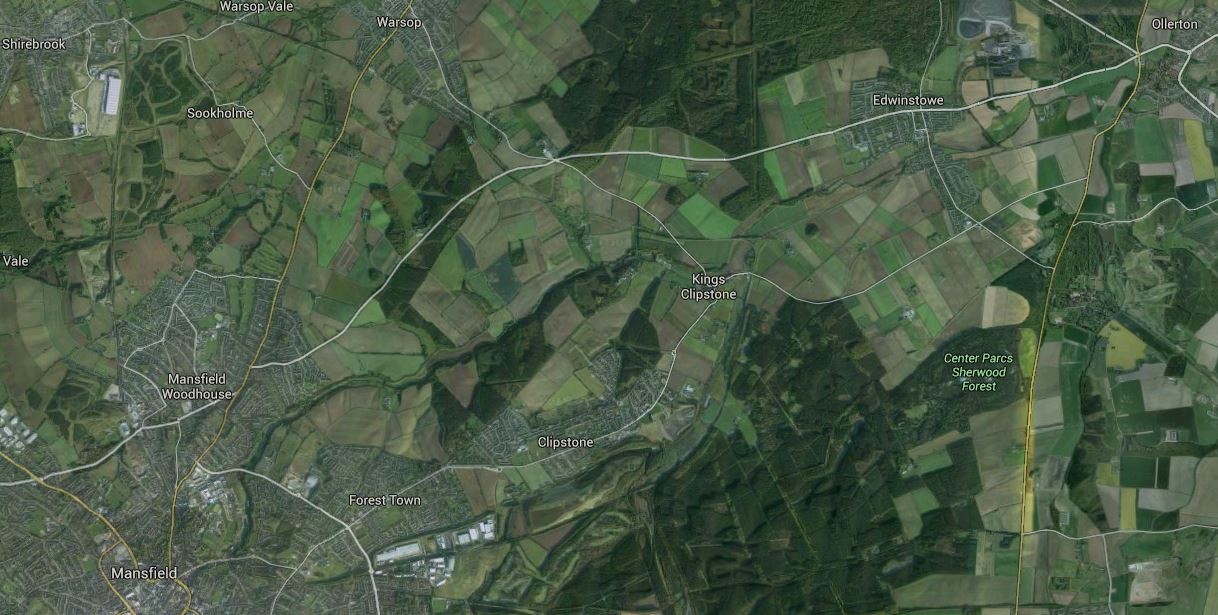
The Ollerton branch turns off from the Robin Hood Line just North of Shirebrook station in the top left hand corner of the map and then makes it way to Ollerton by way of the South of Warsop and Edwinstowe and North of the CentreParcs Sherwood Forest.
The line probably illustrates the only environmentally-friendly use for coal, which is to keep rail lines open and in good condition, until we can find a better use for them.
There is an interesting section called Branch Lines in the Wikipedia entry for Shirebrook station. This is said.
Two branch lines are plainly visible veering off north of the bridge at the north end of Shirebrook station.
The double tracks branching off eastwards (i.e. to the right as viewed from the station) to the side of the signalbox joined the LD&ECR’s one-time main line to Lincoln, next stop Warsop. The branch only ever carried a regular passenger service for a few years in Edwardian times. It did, however, carry Summer holiday trains such as the Summer Saturdays Radford to Skegness in at least 1963. The branch’s main purpose was always freight traffic, with coal being overwhelmingly dominant.
In 2013 the line gives access to Thoresby Colliery and to the High Marnham Test Track.
There is some hope of reopening the line as a branch off the Robin Hood Line and reopening Warsop, Edwinstowe and Ollerton stations, providing an hourly service to Mansfield and Nottingham.
This Google Map shows Shirebrook station and the railway lines around it.
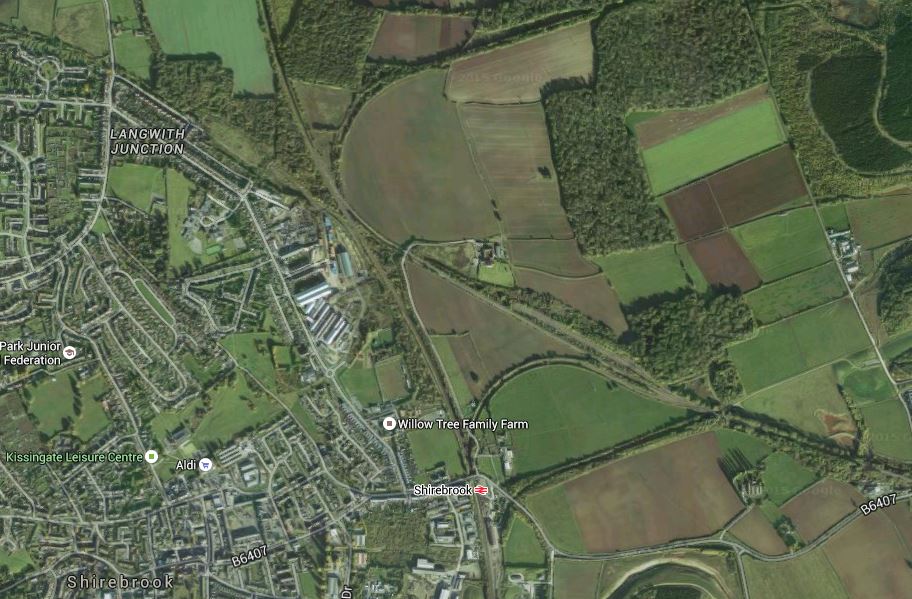
The junction of the Ollerton branch would appear to allow access to trains from or to either Nottingham and Mansfield in the South and Worksop in the North
It appears that there could be three stations; Warsop, Edwinstowe and Ollerton on a double-track branch.
Services To Derby
The area between Chesterfield, Mansfield and Nottingham is not very well connected to Derby.
If you want to go from Mansfield or Kirkby-in-Ashfield on the Robin Hood Line to Derby, you always have to change at Nottingham, with sometimes an extra change at East Midlands Parkway.
The Erewash Valley Line runs North-South a few miles to the West of the Robin Hood Line.
Despite being partially in Derbyshire, getting from stations like Alfreton, Langley Mill and the soon-to-be-opened Ilkeston stations to Derby, you have to change at either Nottingham or Chesterfield.
Look at this Google Map of the area
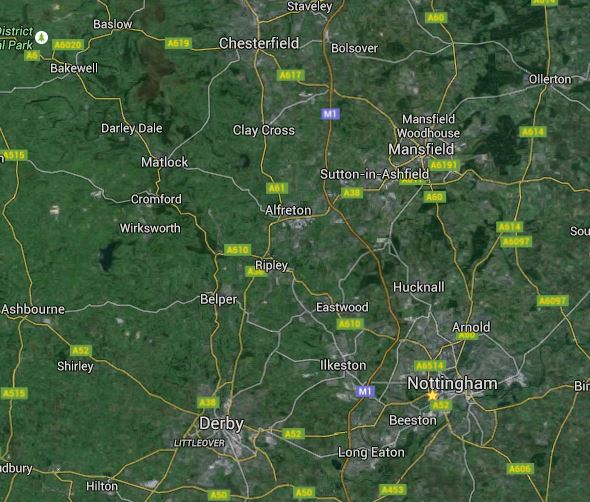
There must be a better way of getting to Derby, than by changing trains in Nottingham or Chesterfield.
But what?
There are four main North-South routes in the area.
- The Robin Hood Line between Nottingham and Worksop
- The Erewash Valley Line between Long Eaton and Chesterfield
- The Midland Main Line between Derby and Chesterfield
- The M1 Motorway
What seems to be missing is high-capacity East-West routes for both rail and road.
The Erewash Valley Line goes South to Long Eaton, which has several trains per hour direct to Derby, so this could be the key to getting to Derby.
In a Notes on Current Station section on the Wikipedia entry for Long Eaton station, this is said.
It is planned that both platforms will be extended by up to 10 metres by no later than 2012.
It is anticipated that developments along the Erewash line will result in changes for Long Eaton station. A plan drawn up in 2011 recommended a new Derby to Mansfield service via new stations at Breaston & Draycott, Long Eaton West (renamed from Long Eaton), Long Eaton Central, Stapleford & Sandiacre, Ilkeston, Eastwood & Langley Mill (renamed from Langley Mill), Selston & Somercotes and then to Pinxton via new trackbed connecting with the Mansfield line from Nottingham at Kirkby in Ashfield.
It strikes me that work at Long Eaton, the several new stations and improvements North of Langley Mill would enable direct services from Alfreton, Ilkeston and Langley Mill to both Derby and Mansfield. This service would also improve services from stations stations North of Mansfield to Derby.
A trackbed from Langley Mill to Kirkby in Ashfield is shown on Google Maps.

Alfreton is the station at the top left and Kirkby-in-Ashfield is at the top right. The Erewash Valley Line from Langley Mill, enters at the bottom and splits with one branch going to Alfreton and the other going East to cross the M1 and join the Robin Hood Line south of Kirkby-in-Ashfield.
On an Ordnance Survey map, dated 2009, the railway is shown as a multiple track line, probably serving collieries and open cast coalfields.
It all sounds very feasible too! Especially, as the Erewash Valley is an area of high unemployment, low car ownership and a dependence on public transport.
Would Both Branches Of the Robin Hood Line Form The Maid Marian Line?
Consider.
- The Ollerton Branch joins the Robin Hood Line to the North of Shirebrook station.
- The Pye Bridge Branch joins the Robin Hood Line to the South of Kirkby-in-Ashfield station.
- There are three statations between Shirebrook and Kirkby-in-Ashfield stations; Mansfield Woodhouse, Mansfield and Sutton Parkway.
- The Pye Bridge Branch joins the Erewash Valley Line to the North of Langley Mill station.
- From Langley Mill station, there are direct services to Nottingham station.
- I am also fairly certain that a passenger train can travel between Langley Mill and Derby via Ilkeston and Long Eaton.
It would certainly be possible for a passenger service to run between Ollerton and Ilkeston.
- It could terminate at either Derby or Nottingham.
- When High Speed Two is built, it could call at East Midlands Hub station.
As Shirebrook, Mansfield Woodhouse, Mansfield, Sutton Parkway, Kirkby-in-Ashfield, Langley Mill, Ilkeston and Long Eaton, all have connections to Nottingham, I suspect the core service would terminate at Derby.
One MP Is Not Happy
This article on NottinghamshireLive is entitled Leaders In Row Over Plans To Reopen Maid Marian Line.
This is said.
A row has erupted over proposals to reopen the disused Maid Marian Line in Nottinghamshire.
Lee Anderson, MP for Ashfield, has hit out at Ashfield District Council saying residents in areas like Selston will be “left behind” under plans to reopen the line.
From reading the article, it looks like an extra station at Selston might defuse the row.
Conclusion
Consider.
- This is a sound plan, that has been talked about for some years.
- Except for three or four stations, there is little serious construction needed.
- The line connects a large area to High Speed Two.
I feel that this could be one of the first schemes to be given the go-ahead to be built.
Midlands Rail Hub
On the Midlands Connect web site, they have a page, which is entitled Midlands Rail Hub.
This is the introductory paragraph.
The Midlands Rail Hub – our flagship project – is the biggest upgrade of our rail network for a generation.
The page contains this helpful map.

There is also a table of journeys and the improvements to be made.
- Birmingham – Nottingham – +1 tph – 72 minutes – 59 minutes
- Birmingham – Leicester – +2 tph – 66 minutes – 42 minutes
- Birmingham – Hereford – +1 tph – 85 minutes – 65 minutes
- Bitmingham – Worcester – +1 tph – 40 minutes – 35 minutes
- Birmingham – Derby – +2 tph – 38 minutes – 38 minutes
- Coventry – Leicester – +2 tph – 57 minutes – 38 minutes
- Coventry – Nottingham -+2 tph – 99 minutes – 63 minutes
- Birmingham – Bristol – +1 tph – 85 minutes – 80 minutes
- Birmingham – Cardiff – +1 tph – 117 minutes – 112 minutes
- Birmingham – Kings Norton – +2 tph – 18 minutes – 14 minutes
Note that the data by each route is the increase in frequency in trains per hour (tph), the current journey time and the future journey time.
I’ll now look at each route in more detail.
Birmingham And Bristol
Consider.
- Birmingham New Street and Bristol Temple Meads stations are 90 miles apart.
- Current service is two tph, which is provided by CrossCountry and goes via Worcestershire Parkway, Cheltenham Spa and Bristol Parkway.
- There is to be an increase of one tph.
- Current journey time is 85 minutes
- Future journey time is 80 minutes
As CrossCrountry’s Birmingham and Bristol service goes through to Edinburgh, Glasgow or Manchester Piccadilly, would it not be convenient, if the service could use High Speed Two to the North of Birmingham?
Birmingham And Cardiff
Consider.
- Birmingham New Street and Cardiff Central stations are 108 miles apart.
- Current service is two tph, which is provided by CrossCountry and goes via Worcestershire Parkway, Cheltenham Spa. Gloucester and Newport.
- There is to be an increase of one tph.
- Current journey time is 85 minutes
- Future journey time is 80 minutes
As CrossCrountry’s Birmingham and Cardiff service goes through to Nottingham, would it not be convenient, if the service could use High Speed Two between Birmingham and Nottingham?
It would appear that both Bristol and Cardiff services could benefit from a High Speed Two connection.
This map from High Speed Two shows the line’s route through the Water Orton area.
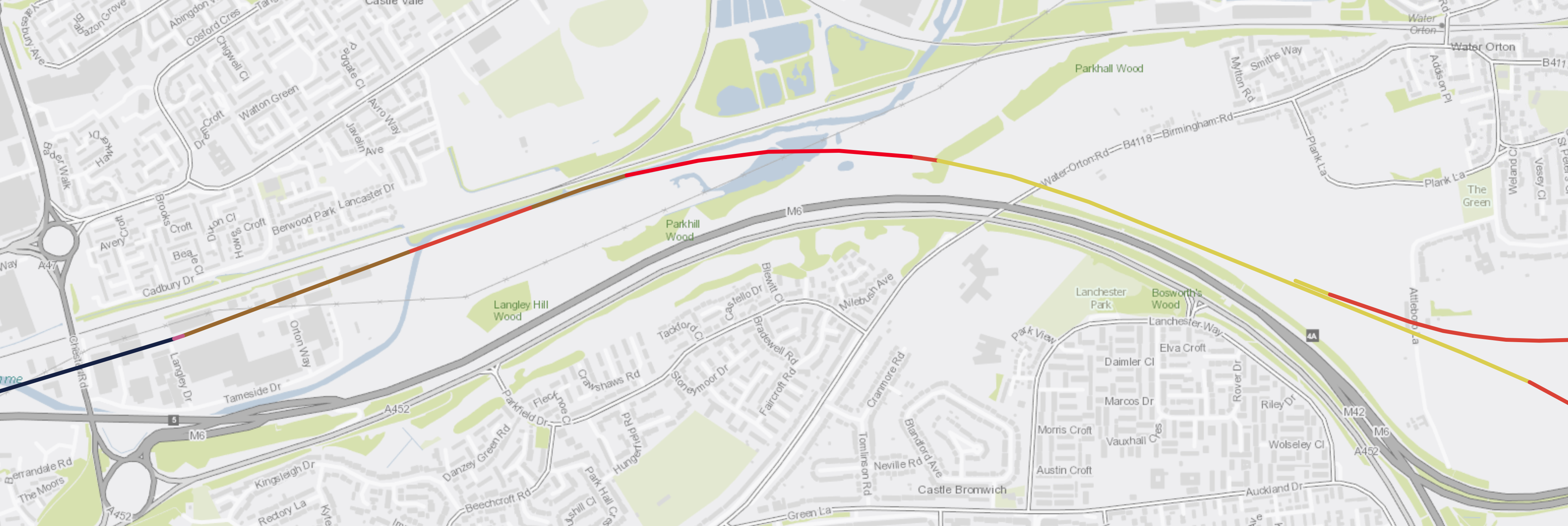
Note.
- High Speed Two is shown in various colours.
- High Speed Two splits at the Eastern edge of the map, with the Northern link going to Northern destinations and the Southern link going to Birmingham Interchange and London.
- Curving across the map beneath it, is the M6 motorway, with Spaghetti Junction off the map to the West.
- Water Orton station is in the North East corner of the map.
- The Birmingham and Peterborough Line, which connects Leicester and Birmingham New Street stations via Water Orton runs just tom the North of the route of High Speed Two shown on the map.
This Google Map shows the area.
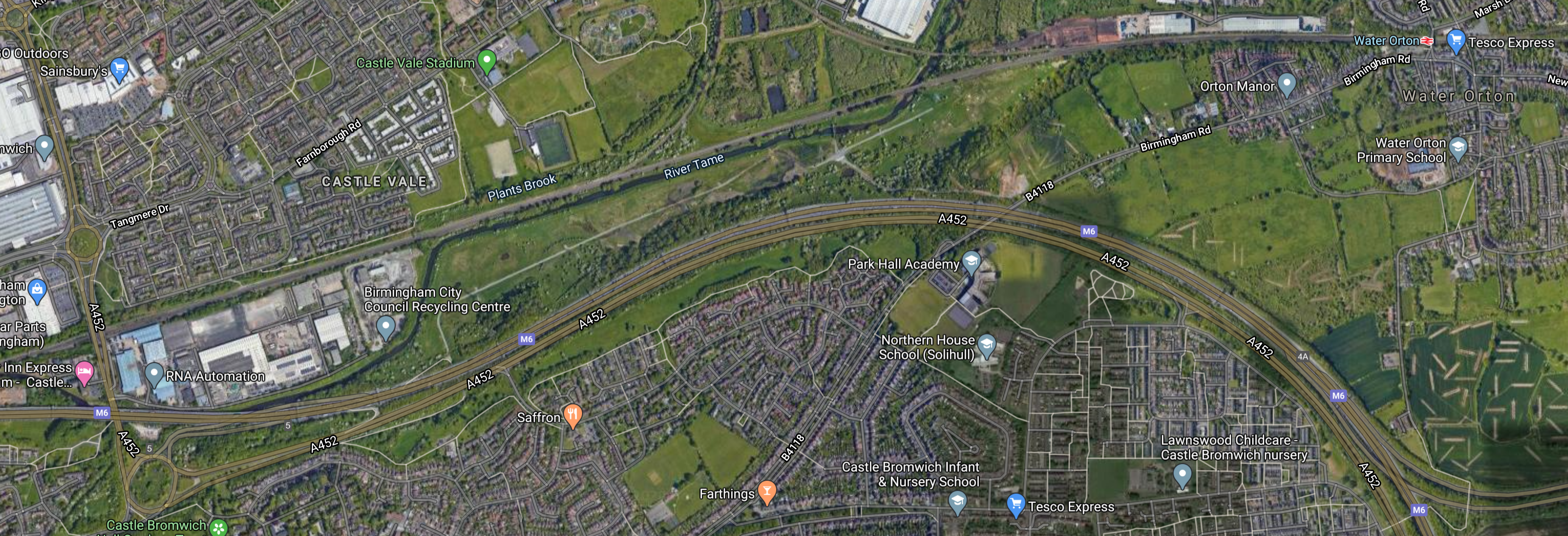
I wonder if it would be possible to provide links so that the following would be possible.
- Trains running East from New Street station could join High Speed Two to run to East Midlands Hub, Edinburgh, Glasgow, Leeds, Liverpool, Manchester, Newcastle, Sheffield and York.
- Trains from the North could run into New Street station and then continue to Bristol, Cardiff and Cheltenham.
The trains would have to be classic-compatible High Speed Two trains. These would fit into New Street station, as they are shorter than Class 390 trains and will have a aimilar height and width.
Time savings could be as follows.
- Bristol/Cardiff and Edinburgh – 110 minutes
- Bristol/Cardiff and Manchester Piccadilly- 50 minutes
- Bristol/Cardiff and Newcastle – 80 minutes
- Bristol/Cardiff and Nottingham – 45 minutes
All trains would be direct.
Birmingham And Derby
Consider.
- Birmingham New Street and Derby stations are 41 miles apart.
- Current service is two tph, which is provided by CrossCountry and goes via Wilnecote, Tamworth and Burton-on-Trent
- There is to be an increase of two tph.
- Current journey time is 38 minutes
- Future journey time is 38 minutes
- High Speed Two will run three tph between Birmingham Curzon Street and East Midlands Hub station in 20 minutes.
- Midlands Connect will run one tph between Birmingham Curzon Street and Nottingham Station in 30 minutes. See Classic-Compatible High Speed Two Trains At East Midlands Hub Station
Will passengers between Birmingham and Derby use High Speed Two services, which will be four tph or the current ones?
Birmingham And Hereford Via Worcester
Consider.
- Birmingham New Street and Hereford stations are 55 miles apart.
- Current service is one tph, which is provided by West Midlands Trains, and goes via Bromsgrove, Malvern Link and Great Malvern.
- There is to be an increase of one tph.
- Current journey time is 85 minutes
- Future journey time is 65 minutes
- The track between Bromsgrove and Birmingham is electrified.
- Hereford and Bromsgrove are 41 miles apart.
- Worcester and Bromsgrove are 13 miles apart.
With charging facilities at Worcester, this route would be an ideal one for battery electric trains.
Birmingham And Leicester
Consider.
- Birmingham New Street and Leicester stations are 40 miles apart.
- Current service is two tph, which is provided by CrossCountry and goes via Water Orton, Coleshill Parkway, Nuneaton, Hinckley and Narborough.
- There is to be an increase of two tph.
- Current journey time is 66 minutes
- Future journey time is 42 minutes
Birmingham – Nottingham
Consider.
- Birmingham New Street and Nottingham stations are 57 miles apart.
- Current service is two tph, which is provided by CrossCountry and goes via Tamworth, Burton-on-Trent and Derby.
- There is to be an increase of one tph.
- Current journey time is 72 minutes
- Future journey time is 59 minutes
- High Speed Two will run three tph between Birmingham Curzon Street and East Midlands Hub station in 20 minutes.
- Midlands Connect will run one tph between Birmingham Curzon Street and Nottingham Station in 30 minutes. See Classic-Compatible High Speed Two Trains At East Midlands Hub Station
Will passengers between Birmingham and Nottingham use High Speed Two services, which will be four tph or the current ones?
Coventry And Leicester
Consider.
- Coventry and Leicester are 28 miles apart.
- There is currently no direct train and a change is needed at Nuneaton
- There is to be an increase of two tph.
- Current journey time is 57 minutes
- Future journey time is 38 minutes
I suspect that a direct Coventry and Leicester service is being provided that does one of the following.
- Reverses in Nuneaton station.
- Takes a new flyover to cross the West Coast Main Line.
Would the Southern terminus of the route be Coventry, Leamington Spa or Stratford-on-Avon?
Coventry And Nottingham
Consider.
- Coventry and Nottingham are 55 miles apart.
- There is currently no direct train and a change is needed at Birmingham New Street or at both Nuneaton and Leicester.
- There is to be an increase of two tph.
- Current journey time is 99 minutes
- Future journey time is 63 minutes
Would this service be an extension of the Coventry and Leicester service?
As Leicester and Nottingham takes around thirty minutes, this could be the case.
Birmingham And Kings Norton Via The Camp Hill Line
The Midlands Rail Hub page, says this about the Bordesley Chords, which will connect Birmingham Moor Street station to the Camp Hill Line.
Construction of the Bordesley Chords, two viaducts creating new paths to the East Midlands and South West from Birmingham Moor Street Station.
This Google Map shows where they will be built.
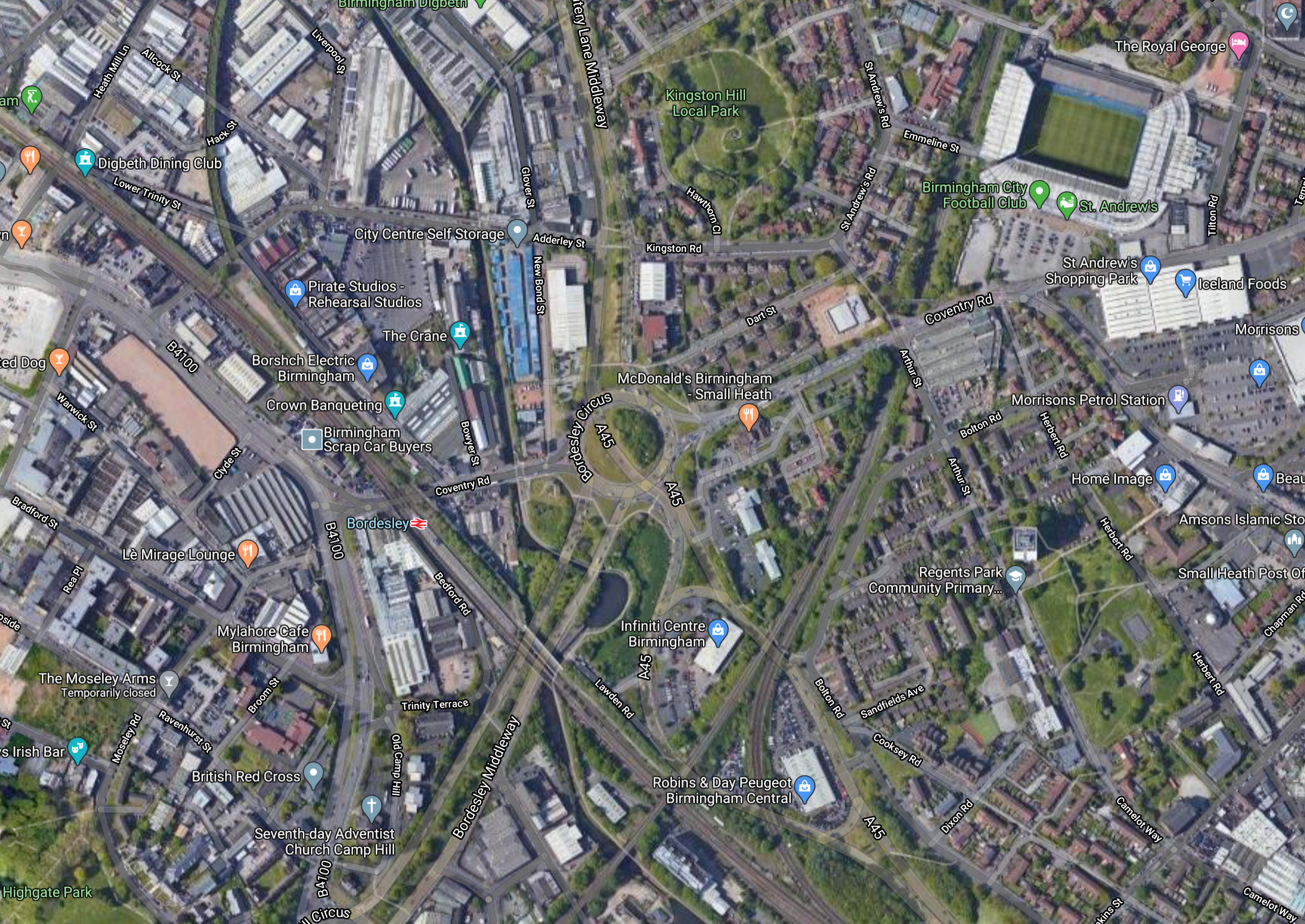
Note.
- The Football ground in the North-East corner of the map is St. Andrew’s, which is Birmingham City’s home ground.
- The rail line going North South across the map and passing to the West side of the ground is the Camp Hill Line, which leads to Water Orton station in the North and Kings Norton station in the South.
- The station in the middle of the map is Bordesley station.
- The rail line going NW-SE across the map through the station is the Chiltern Main Line into Birmingham Moor Street station, which is a couple of miles to the North-West.
The two Bordesley chords will be double-track chords linking the following routes.
- Moor Street station to the Camp Hill Line going South to Kings Norton via new stations at Moseley, Kings Heath and Hazelwell.
- Moor Street station to the Camp Hill Line going North to Water Orton station.
The initial service would appear to be two tph between Moor Street and Kings Norton stations.
CrossCountry Trains and Moor Street Station
Consider.
- Birmingham New Street station is very busy.
- Some CrossCountry trains take a Water Orton-Birmingham New Street-Kings Norton route across the city.
Could these trains go between Water Orton and Kings Norton, with a reverse in Moor Street station?
- Plymouth and Edinburgh Waverley
- Cardiff Central and Nottingham
And could these services terminate at Moor Street station?
- Birmingham New Street and Nottingham
- Birmingham New Street and Stansted Airport via Leicester
- Birmingham New Street and Leicester
It would seem there must be scope improve the operation of New Street station, by using Moor Street station and the Bordesley chords.
If all these trains used Moor Street station it would be a very busy station.
In an hour it would handle these trains via the Bordesley chords.
- CrossCountry – 1 tph – Cardiff Central
- CrossCountry – 1 tph – Edinburgh Waverley
- West Midlands Railway – 2 tph – Kings Norton
- CrossCountry – 2 tph – Leicester
- CrossCountry – 2 tph – Nottingham
- CrossCountry – 1 tph – Plymouth
- CrossCountry – 1 tph – Stansted Airport
That is a balanced five tph to the North and five tph to the South.
There would also be the existing services.
- Chiltern Trains – 2 tph – London Marylebone and Birmingham
- West Midlands Railway – 6 tph – Dorridge/Stratford-upon-Avon/Whittocks End and Stourbridge Junction
There would also be the proposed Moor Street and Oxford service.
Battery Electric Trains
If we assume that a battery electric train has a battery range equal to or longer than Hitachi’s quoted figure of 56 miles, these routes are possibilities for battery electric trains.
- Birmingham and Leicester with either electrification or charging at Leicester.
- Birmingham and Hereford with charging at Hereford
- Birmingham and Kings Norton
- Birmingham and Oxford with charging at Oxford and Banbury
- Coventry and Leicester
If the Midland Main Line is electrified in the Nottingham Area, then all services to Nottingham could be added.
CrossCountry And High Speed Two
Consider.
- There are up to half-a-dozen spare hourly paths on both the Northern legs of High Speed Two.
- Using High Speed Two tracks to the North of Birmingham can speed up services considerably.
- CrossCountry needs a new fleet of trains.
- Services could be run using classic-compatible High Speed Two trains.
- The trains might be shorter and would certainly have independent power sources.
It could be a large improvement in quality and journey times, with all current destinations served.
The only extra infrastructure needed would be a connecting junction near Water Orton station. A junction there would work, whether services used Moor Street or New Street station in Birmingham.
Cnnclusion
The concept of a Midlands Rail Hub is very sound.
Could The Crewe And Derby Line Become A Much More Important Route?
On the Midlands Connect web site, they have a page, which is entitled Derby-Stoke-Crewe.
This is the introductory paragraph.
Our plans have the potential to increase passenger demand on the corridor by 72%, with faster, more frequent services.
They then give the outline of their plans, which can be summed up as follows.
- Currently, the service is one train per hour (tph) and it takes 79 minutes.
- The service frequency will go to two tph.
- Twenty minutes could be saved on the second service by adjusting calling patterns.
- Improved links at Crewe for High Speed Two. This must have been written before Stafford and Stoke got the High Speed Two service to Macclesfield.
- East Midlands Railway are planning to extend the current Crewe and Derby service to Nottingham.
It seems a safe, and not overly ambitious plan.
These are my thoughts.
The Route
I have flown my virtual helicopter along the route and it appears to be double track all the way, except for a three mile section to the East of Crewe, that British Rail reduced to single track
However, in recent years the A5020 was built under the railway and the new bridge appears to have space for the second track to be restored, as this Google Map shows.
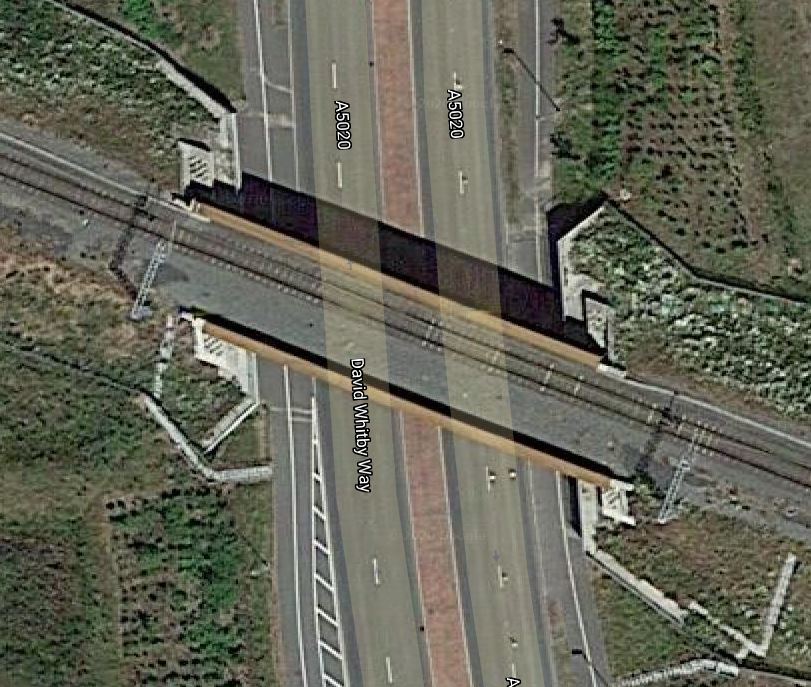
Note.
- The single track appears to be electrified, from the shadows of the gantries at either end of the bridge.
- West Midlands Trains appear to run an electric service between Crewe and Stafford on this route.
- I suspect it’s also used as a diversion route for Avanti West Coast’s Manchester service via Stoke-on-Trent or for train positioning.
Will this route allow High Speed Two trains to run between Stoke-on-Trent and Manchester Piccadilly?
From picture and comments in a rail forum, I suspect that the route could be redoubled fairly easily.
- The electrification runs for about 15.5 miles, between Crewe station and Stoke Junction, which is about half-a-mile on the other side of Stoke-on-Trent station.
- Trains seem to be connected to the electrification for over twenty minutes, so it could be useful for charging a battery train, running between Stoke-n-Trent and Crewe stations.
This Google Map shows Stoke Junction.
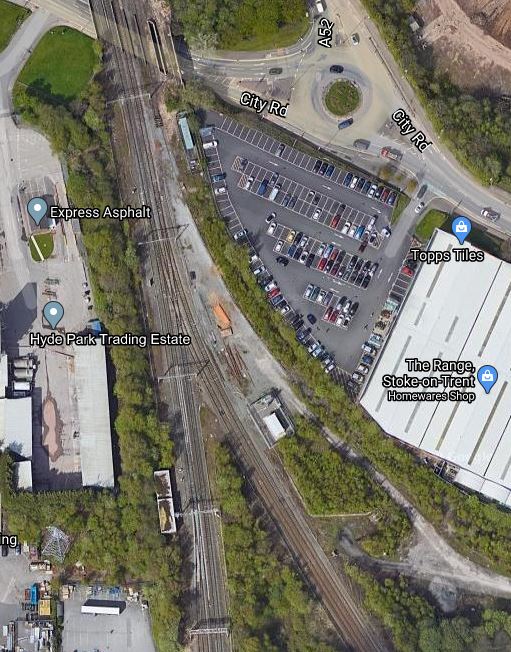
Note,
- Stoke-on-Trent station is to the North.
- The electrified railway going due South is the West Coast Main Line to Stone and Stafford stations.
- The line without electrification going off in a more South-Easterly direction is the line to Uttoxeter and Derby.
Following the route between Derby and Crewe, these are my observations.
- There is a level crossing at Blythe Bridge station.
- Most of the bridges over the route are modern, so I suspect will accept electrification.
- The route would appear to have a speed limit of 70 mph, but I would suspect that this could be increased somewhat as it doesn’t look too challenging.
- The route is 51 miles long, so a service that takes the current 79 minutes with nine stops, would average 38.7 mph.
- The proposed time of 59 minutes, would average 51.8 mph
I suspect there could be more to come, as the timetable is probably written for a Class 153 train.
A Crewe And Nottingham Service
The Midlands Connect plan says the service will be the following.
- Two tph
- A slow train in 79 minutes.
- A fast train in 59 minutes.
- East Midlands Railway want to extend services to Nottingham.
It could be a fairly simple easy-to-use timetable.
Fast Trains
Consider.
- Derby and Nottingham are 16 miles apart and fastest trains take between 19-22 minutes between the two cities.
- When it opens, all trains would stop at East Midlands Hub station between Nottingham and Derby.
- East Midlands Railway have a fleet that will include forty Class 170 trains.
- I suspect that these 100 mph trains will be able to run between Crewe and Nottingham including the turnround in under 90 minutes.
This would mean that a fast hourly service would need three trains.
Slow Trains
Consider.
- I wouldn’t be surprised to see the slower services continuing as now and not extending to Nottingham.
- 79 minutes is probably a convenient time, which would give a ninety minute time for each leg between Derby and Crewe, when turnround is included.
- Trains would be more of the Class 170 trains.
This would mean that a slow hourly service would need three trains.
Could Battery Electric Trains Be Used?
Consider.
- I think it is likely that the route between Derby and East Midlands Parkway via East Midlands Hub station, will be electrified, in conjunction with Midland Main Line electrification.
- Between Derby and Long Eaton stations via East Midlands Hub station is just under ten miles and takes ten minutes.
- Nottingham and Crewe is 66 miles of which 25 miles in total could be electrified.
- Derby and Crewe is 51 miles of which 15 miles are electrified.
- The longest section without electrification is between Derby station and Stoke Junction, which is 35.5 miles.
Batteries would be charged in the following places.
- Between Long Eaton and Derby stations.
- During turnround at a fully-electrified Derby station.
- Between Stoke-on-Trent and Crewe stations.
- During turnround at a fully-electrified Crewe station.
That’s a lot better than with an electric car.
In Sparking A Revolution, I quoted this Hitachi-specification for a battery-electric train.
- Range – 55-65 miles
- Performance – 90-100 mph
- Recharge – 10 minutes when static
- Routes – Suburban near electrified lines
- Battery Life – 8-10 years
I can’t see any problem with one of these trains or other battery-electric trains with a similar performance, running between Crewe and Nottingham or Derby via Stoke.
Could Hydrogen-Powered Trains Be Used?
I would suspect so, as the Alsthom Coradia iLint runs a similar route in Germany.
Connections To High Speed Two
Midlands Connect noted the route’s link to High Speed Two at Crewe.
But it also has other links to High Speed Two at Stoke-on-Trent and East Midlands Hub stations.
I suspect some stations like Uttoxeter or Alsager will have a choice of fast routes to London or Scotland.
Could Services Be Extended From Crewe?
In Connecting The Powerhouses, I talked about an article in the June 2017 Edition of Modern Railways, which proposed reopening the Midland Railway route between Derby and Manchester.
Some passengers and commentators fell a direct fast link is needed.
When High Speed Two is completed, the main route into Manchester Piccadilly will be a high speed spur from Crewe via Manchester Airport. Current plans include the following services.
- One tph from London Euston via Old Oak Common and Birmingham Interchange.
- Two tph from London Euston via Old Oak Common
- Two tph from Birmingham Curzon Street
Note.
- All services will call at Manchester Airport.
- It is likely that Northern Powerhouse Rail will add six tph to Manchester Piccadilly from Liverpool via Warrington.
- Some services will extend through Manchester Piccadilly to Bradford, Doncaster, Huddersfield, Hull, Leeds, Newcastle, Sheffield and York.
- High Speed lines will probably have a capacity of up to eighteen tph.
The Birmingham Curzon Street, Liverpool and London Euston services would be eleven tph, so there would be more than enough capacity for an hourly train from Nottingham.
What would the service be like?
- It would be between Nottingham and Manchester Piccadilly stations.
- It could call at East Midlands Hub, Derby, Uttoxeter, Stoke-on-Trent, Kidsgrove, Crewe and Manchester Airport stations.
- It would probably be hourly.
Timings could be as follows.
- Nottingham and Manchester Airport – 87 minutes
- Nottingham and Manchester Piccadilly – 91 minutes
- Derby and Manchester Airport – 67 minutes
- Derby and Manchester Piccadilly – 71 minutes
- Stoke-on-Trent and Manchester Airport – 32 minutes
- Stoke-on-Trent and Manchester Piccadilly – 36 minutes
The trains used on this and other local services that might need to use High Speed Two infrastructure would be performing a similar role as that of the Class 395 trains on High Speed One.
Possibilities must include.
- A classic-compatible High Speed Two train.
- A five-car AT-300 train, like East Midlands Railway’s Class 810 trains.
- An updated Class 395 train.
All trains would need a battery capability with a range of 40 miles.
It should also be noted that in Options For High Speed To Hastings, I worked through the options needed to run high speed commuter services to Hastings.
This was the last sentence in that post.
It’s all about selling trains and a company that had a 140 mph or 225 kph high-speed electric train, that could do perhaps 25 miles or 40 kilometres on batteries, would have a valuable addition to their product range.
A train with a range of 50 miles on battery power, would be suitable for the following routes.
- London St. Pancras and Hastings via Ashford International.
- Manchester Piccadilly and Nottingham via Manchester Airport, Crewe, Derby and East Midlands Hub.
- Manchester Piccadilly and Barrow-in-Furness via Manchester Airport, Warrington Bank Quay, Wigan North Western, Preston and Lancaster.
- Manchester Piccadilly and Chester via Manchester Airport and Crewe.
- Manchester Piccadilly and Shrewsbury via Manchester Airport and Crewe.
Charging might be needed at some of the terminal stations.
Discontinuous Electrification Through Leicester Station
Leicester station is an important station on the Midland Main Line
- Leicester is an urban area of half a million people.
- All of East Midlands Railway Intercity services call as they pass through the station.
- Leicester station is only sixteen miles North of the end of the Southern electrification at Market Harborough station.
- Birmingham New Street is 40 miles away.
- Clay Cross North Junction is 50 miles away.
- Derby is 29 miles away.
- East Midlands Parkway is 19 miles away.
- Long Eaton is 21 miles away.
- Nottingham is 27 miles away.
- Peterborough is 52 miles away.
- Sheffield is 66 miles away.
A sensible decision would probably be to extend the electrification from Market Harborough to a few miles North of Leicester, so that battery-electric trains could reach all the places in the above list.
Unfortunately, the following about the bridge at the Southern end of Leicester station, must be noted.
- The bridge doesn’t have sufficient clearance for electrification and would need to be rebuilt.
- It carries the main A6 road to London over the railway.
- The station building also spans the railway lines.
- To complicate matters, there is an important sewer either in or under the bridge.
This Google Map shows the bridge and the Southern end of the station.
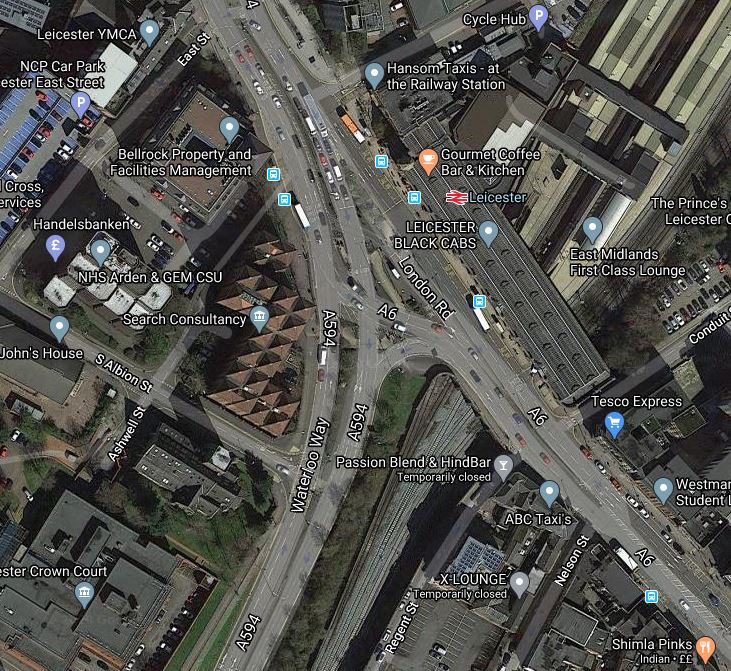
It looks to me, that Leicester station and the road, would have to be closed to traffic for some time, if the bridge were to be rebuilt, to allow the erection of electrification through the area.
A solution could be discontinuous electrification.
- The electrification from the South, would finish on the South side of bridge.
- The electrification from the North, would finish in Leicester station.
- Electric trains would cover the gap of a few hundred metres on battery power.
Pantographs could be raised and lowered, where the wires exist.
- On the North side of the bridge, this could be in Leicester station, whilst passengers are getting off and on the train.
- On the South side of the bridge, this could be as far South as Market Harborough, which is sixteen miles away.
The other big problem area of electrification on the Midland Main Line is North of Derby, where the railway runs through the World Heritage Site of the Derwent Valley Mills. There might be serious opbjections to electrification in this area.
- But if electrification were to be installed between Leicester and Derby stations, the following would be possible.
- The Midland Main Line would be electrified at East Midlands Hub station.
- Power could be taken from High Speed Two’s supply at East Midland Hub station.
- Battery-electric trains could do a return trip to Nottingham from an electrified East Midlands Parkway, as it’s only sixteen miles in total.
- Battery-electric trains could reach the High Speed Two spur into Sheffield at Clay Cross from Derby, as it’s only twenty-one miles.
I am assuming, that Hitachi’s Class 810 trains will have range of over fifty miles on battery power, which fits with Hitachi’s statements.
Conclusion
Discontinuous electrification and batteries on trains can solve the problem of electrification through Leicester station.
Also. electric trains could run between London and Sheffield, if the following were done.
- The Class 810 trains were to be given a range of twenty-five miles
- Electrification were to be erected between Leicester and Derby stations.
- Electrification were to be erected between Sheffield and Clay Cross Junction, as required by High Speed Two.
The electrification could be brought forward, to bring Sheffield early benefits of High Speed Two.
Railway Lines Through East Midlands Hub Station
This Google Map shows the position of High Speed Two‘s East Midland Hub station to the West of Nottingham.
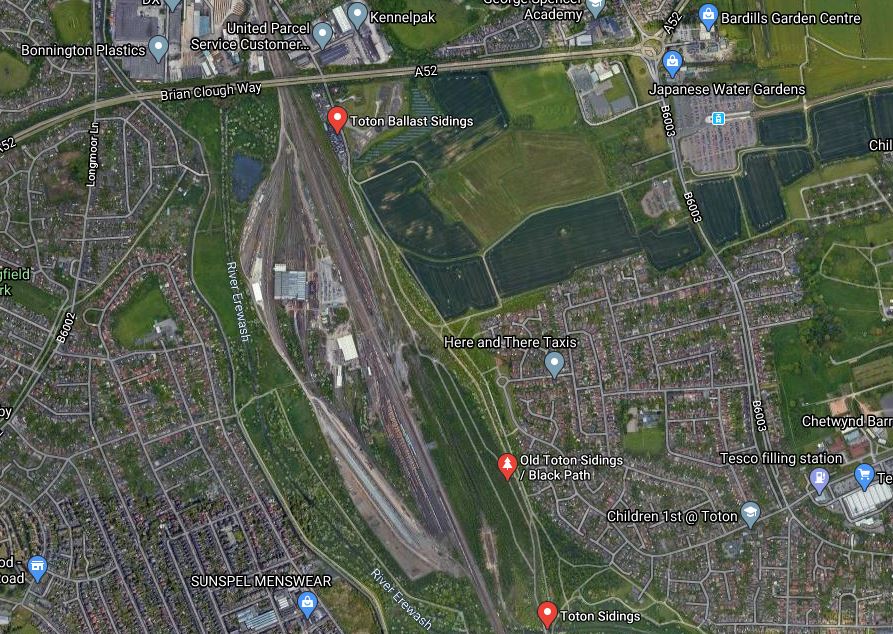
Note.
- In the North East Corner of the map, is a label saying Japanese Water Garden. Below that is a blue dot, which marks the Toton Lane tram stop.
- Three red arrows relate to Toton Ballast Sidings, Old Toton Sidings (Black Path) and Toton Sidings from North to South.
- Running to the West of the arrows is a double-track railway and beyond that are a large number of sidings.
This second Google Map shows some of the sidings.

The double track main line is the Erewash Valley Line.
- This line goes North to Ilkeston, Langley Mill, Alfreton, Clay Cross North Junction, Chesterfield and Sheffield.
- Going South, the route splits with one branch going East through Attenborough and Beeston to Nottingham station.
- The other branch turns to the West and then splits again at the massive Trent Junction.
- One branch goes West through Long Eaton station, under the M1, through Spondon station and on to Derby station.
- The second branch goes South over the River Trent to join up with the Midland Main Line and pass through East Midlands Parkway station.
- There is also a chord across the Trent Junction to allow trains to go between Long Eaton and East Midlands Parkway stations.
It is sounds complicated this map from High Speed Two may help.

Note.
- High Speed Two is shown in orange, with the blue dot indicating the East Midlands Hub station.
- Nottingham station is to the North East.
- Attenborough station can be picked out on the line going to Nottingham station.
- The water is in the Trent Valley.
- Trent Junction is the large triangular junction to the West of High Speed Two.
- Two rail lines lead to the West from Trent junction; the northerly one goes to Derby by Long Eaton and the other is a freight line to Castle Donington and East Midlands Gateway.
It is worth looking at how the various passenger services go through the area.
- CrossCountry – Cardiff and Nottingham goes via Derby, Long Eaton, Attenborough, Beeston and Nottingham
- CrossCountry – Birmingham and Nottingham goes via Derby, Long Eaton, Attenborough, Beeston and Nottingham
- East Midlands Railway – Leicester and Lincoln goes via East Midlands Parkway, Attenborough, Beeston and Nottingham
- East Midlands Railway – Liverpool and Norwich goes via Alfreton, Langley Mill, Ilkeston and Nottingham
- East Midlands Railway – Matlock and Newark Castle goes via Derby, Long Eaton, Attenborough, Beeston and Nottingham
- East Midlands Railway – St. Pancras and Sheffield goes via East Midlands Parkway, Long Eaton and Derby
- East Midlands Railway – St. Pancras and Nottingham goes via East Midlands Parkway, Attenborough, Beeston and Nottingham
- Northern – Leeds and Nottingham goes via Alfreton, Langley Mill, Ilkeston and Nottingham.
Note.
- Not one service goes past the site of the new East Midlands Hub station.
- Most services to and from Nottingham seem to use the Attenborough and Beeston route
- Services between Derby and Nottingham go via the Long Eaton, Attenborough and Derby route.
- Services from the North use the Erewash Valley Line and turn East at Trowell for Nottingham.
It is fairly obvious that there needs to be a sort-out of services to fit in with the location of the new East Midlands Parkway station.
Access To Toton – Scheme 6 – Trowell Curve
In £2.7bn East Midlands Plan Unveiled For HS2 Links, a series of schemes are given, which improve access to the High Speed Two East Midlands Hub station.
Scheme 6 is defined like this.
The implementation of a minimum of four direct rail services per hour linking the HS2 East Midlands Hub station to Derby, Nottingham and Leicester stations, as well as Loughborough, Matlock, Mansfield, Newark, Alfreton and Grantham, made possible by the building of a new piece of infrastructure, the Trowell Curve, which will link to the Midland Mainline. These additional connections will also create direct links to Stoke-on-Trent, Crewe, Newark and Lincoln, by extending services on existing routes.
That is a comprehensive set of connections.
The Trowell Curve
This Google Map shows the location of the village of Trowell.
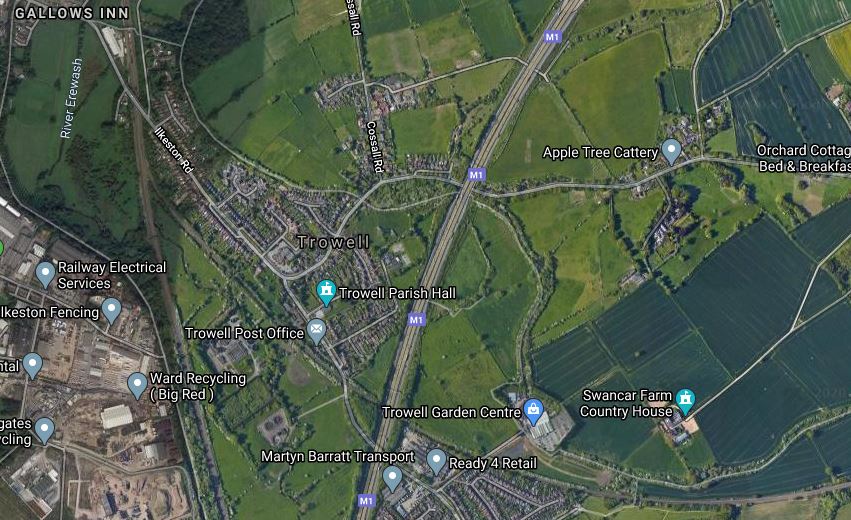
Note.
- The M1 Motorway running North-South up the map.
- The village of Trowell on the Western side of the motorway.
- Many people will have stopped at Trowell services on the motorway, which are just to the North of the top edge of the map.
- The North-South railway line to the West of the village is the Erewash Valley Line, that runs North from the East Midlands Hub station at Toton to Ilkeston, Langley Mill, Alfreton, Clay Cross North Junction, Chesterfield and Sheffield.
There is also another railway line, that runs on the South Western side of the village and across the bottom of the map, that connects the Erewash Valley Line to Nottingham station.
Trains can go between Nottingham and the North, but there is no connection to go between Nottingham and the South.
It looks like the proposed Trowell Curve will add extra connectivity to the junction, so that all these directions are possible.
- Nottingham to Ilkeston and the North.
- Ilkeston and the North to Nottingham.
- Nottingham to East Midlands Hub Station and the South.
- East Midlands Hub Station and the South to Nottingham
The Trowell Chord will be double-track or bi-directional and must certainly improve connectivity.
East Midlands Hub Station
The East Midlands Hub station will link various bus, tram and train services to High Speed Two.
According to the latest reports in the June 2020 Edition of Modern Railways there will be nine high-speed trains per hour (tph) through the station of which seven tph will stop.
Destinations served would be.
- Birmingham Interchange – 1 tph
- Birmingham Curzon Street – 3 tph
- Chesterfield – 1 tph
- Darlington – 1 tph
- Durham – 1 tph
- Leeds – 5 tph
- London Euston – 4 tph
- Newcastle – 1 tph
- Old Oak Common – 4 tph
- Sheffield – 2 tph
- York – 2 tph
As the capacity of High Speed Two has been said to be 18 tph, there must be the possibility for extra services to run on this leg of High Speed Two.
As four tph is considered by many to be a good Turn-Up-And-Go frequency and two tph a sensible minimum frequency, I can see another train between Birmingham Curzon Street and Newcastle with stops at East Midlands Hub, Leeds, Darlington and Durham.
The design has certainly left enough capacity for those that follow us!
Especially, as Wikipedia says that the new East Midlands Hub station will have eight platforms.
- It would need a minimum of two through platforms for High Speed Two services
- Would it need a terminating platform for High Speed Two services? Not for the currently proposed timetable.
- It would need a minimum of two through platforms for East Midlands Railway’s Inter-City services.
- Would it need a terminating platform for East Midlands Railway’s Inter-City services? Not for the currently proposed timetable.
- There would probably be a need for two through platforms for local services.
On this crude look, eight platforms would appear to be more than enough.
Current Services Through The Area
In Railway Lines Through East Midlands Hub Station, I detailed where the new East Midlands Hub station is to be built and the rail services in the area.
After listing all the services I said this.
Note.
- Not one service goes past the site of the new East Midlands Hub station.
- Most services to and from Nottingham seem to use the Attenborough and Beeston route
- Services between Derby and Nottingham go via the Long Eaton, Attenborough and Derby route.
- Services from the North use the Erewash Valley Line and turn East at Trowell for Nottingham.
It is fairly obvious that there needs to be a sort-out of services to fit in with the location of the new East Midlands Parkway station.
So will the new Trowell Curve give the new station, the rail access it needs?
The Splitting Of The Norwich and Liverpool Service
I wrote about this in Abellio’s Plans For Norwich And Liverpool, where I said this about the basic plan.
Early in the new franchise the Liverpool – Nottingham section will transfer to another operator, which will enable the two halves of the service to better meet the needs of customers.
It will become two services.
- Norwich and Derby via Nottingham, Trowell Curve, East Midland Hub and Long Eaton.
- Nottingham and Crewe via Trowell Curve, East Midland Hub, Long Eaton and Derby.
The second service will go to another operator.
I said earlier, this change is for the needs of customers.
It will also have other effects.
- It will add an extra service between Nottingham and Derby
- It will remove the Norwich and Liverpool service from the Erewash Valley Line.
Has this change being driven by the need to provide good connections to High Speed Two?
Train Services To East Midlands Hub Station
The following sub-sections detail the service between various stations and the East Midlands Hub station.
Alfreton Station
Alfreton station on the Erewash Valley Line, is going through major changes to train services.
Currently, there are these two hourly services.
- East Midlands Railway’s Liverpool and Norwich service.
- Northern’s Leeds and Nottingham service.
Neither service currently goes through the site of East Midlands Hub station and East Midlands Railway will split the Liverpool and Norwich service, so it won’t go anywhere near Alfreton.
Consider.
- Alfreton station probably needs at least a two tph service to East Midlands Hub station.
- The Northern service might be able to go via East Midlands Hub station.
- Both Alfreton and the East Midlands Hub station are on the Erewash Valley Line.
- Trains could run between Alfreton and Nottingham via Langley Mill, Ilkeston, East Midlands Hub, Attenborough and Beeston.
- Trains could run between Alfreton and Derby via Langley Mill, Ilkeston, East Midlands Hub, Long Eaton and Spndon.
Or would it be best to put in a bay platform at Alfreton station and run a shuttle service between Alfreton and the East Midlands Hub stations?
- The minimum frequency would be two tph.
- Up to four tph could probably be easily run.
- Trains would call at all stations.
- Extra stations could be added.
- The distance between Alfreton and East Midlands Hub stations is around twenty miles, so a battery-electric train could be possible.
This Google Map shows Alfreton station.
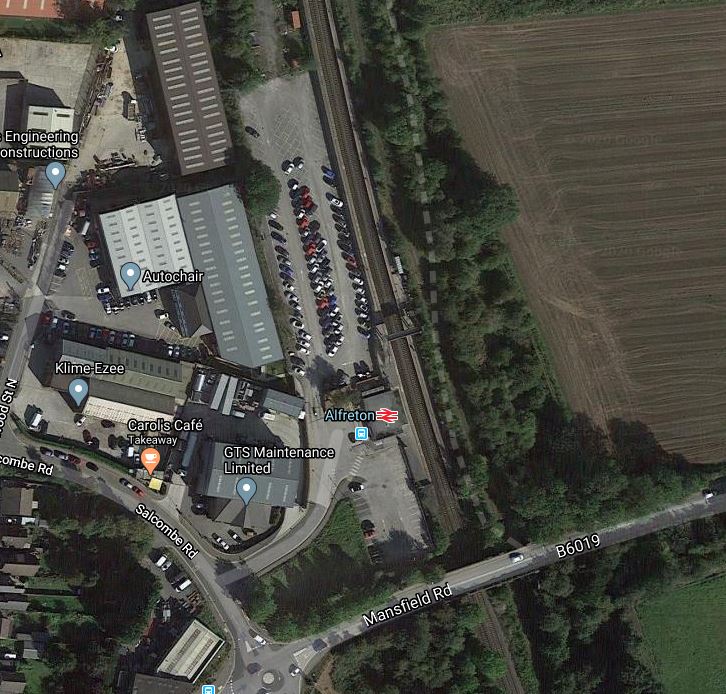
I suspect a bay platform could be added. Or failing that, there could be a turnback siding to the North of the station.
Surely, a local train solution would be a spur to development in the area, especially if it connected to High Speed Two at East Midlands Hub station for High Speed Two.
Derby Station
Consider.
- The current half-hourly East Midlands Railway services between St. Pancras and Sheffield, could not call at both the East Midlands Hub and Derby stations, unless it performed a reverse at East Midlands Hub station.
- Two hourly CrossCountry services, that call at both Derby and Nottingham could use a route via Long Eaton, East Midlands Hub and Trowell Curve.
- An hourly East Midlands Railway service between Newark Castle and Matlock could use a route via Long Eaton, East Midlands Hub and Trowell Curve
- The split service between Liverpool and Norwich would run two tph between Nottingham and Derby, via Long Eaton, East Midlands Hub and Trowell Curve, in both directions.
Six tph can be provided by existing services calling at the new East Midlands Hub station.
Grantham Station
Consider.
- The current hourly East Midlands Railway service between Norwich and Liverpool, calls at Grantham station and could call at the East Midlands Hub, if it used the Trowell Curve route.
- After the service has been split, the two sections will probably both go between Nottingham and Derby via long Eaton, East Midlands Hub and Trowell Curve.
- The current hourly East Midlands Railway service between Nottingham and Skegness calls at Grantham station, but doesn’t pass the site of the East Midlands Hub station.
- This service could be extended to the East Midlands Hub station using the Trowell Curve or the Beeston/Attenborough route, where it would terminate.
It appears relatively easy to give Grantham a two tph service to the East Midlands Hub station.
Ilkeston Station
Ilkeston station would be a stop on all services between the East Midlands Hub and Alfreton and Mansfield stations, so would have a frequent service to the East Midlands Hub station.
Langley Mill Station
Langley Mill station would be a stop on all services between the East Midlands Hub and Alfreton and Mansfield stations, so would have a frequent service to the East Midlands Hub station.
Leicester Station
Consider.
- The current half-hourly East Midlands Railway services between St, Pancras and Nottingham, could call at both the East Midlands Hub and Leicester stations, if the trains used the Trowell Curve.
- Any Ivanhoe Line services between Lincoln and Leicester, could call at both the East Midlands Hub and Leicester stations, if the trains used the Towell Curve.
Leicester would get a frequent train service from the East Midlands Hub station.
Lincoln Station
Lincoln is the Eastern terminal of Ivanhoe Line services. Currently, they run as far as Leicester, but by the time the East Midlands Hub station opens, the services will probably terminate at Burton-on-Trent. I wrote about this project, which is being promoted by the Restoring Your Railway Fund in Reinstatement Of The Ivanhoe Line.
I can see two tph between Lincoln and Burton-on-Trent.
- Stations served could be Newark, Nottingham, East Midlands Hub, East Midlands Parkway, Loughborough, Leicester, Coalville and Ashby-de-la-Zouch.
- The services would use the proposed Trowell Curve.
- Services could be extended to Grimsby and Cleethorpes at the Lincoln end of the service.
- Services would co-ordinate with East Midlands Railway’s Inter-City services to and from London with easy interchange at Leicester and or East Midlands Hub stations.
- Trains could be five-car Class 810 trains to take full advantage of the 125+ mph running between Leicester and Trowell.
- These trains have a shorter dwell time than many and timings could benefit.
Effectively, East Midlands Railway would have a second main line.
Loughborough Station
Consider.
- East Midlands Railway currently has two Inter-City and one Ivanhoe Line service, that stop in Loughborough station and could stop at the East Midlands Hub station.
With another service, Loughborough could have four tph to and from the East Midlands Hub station.
Mansfield Station
This is where Maid Marion flashes her lashes and gets the engineers to reopen her line for passenger trains between North of the former Pye Corner station on the Erewash Valley Line and Kirkby-in-Ashfield station on the Robin Hood Line.
This Google Map shows the route.
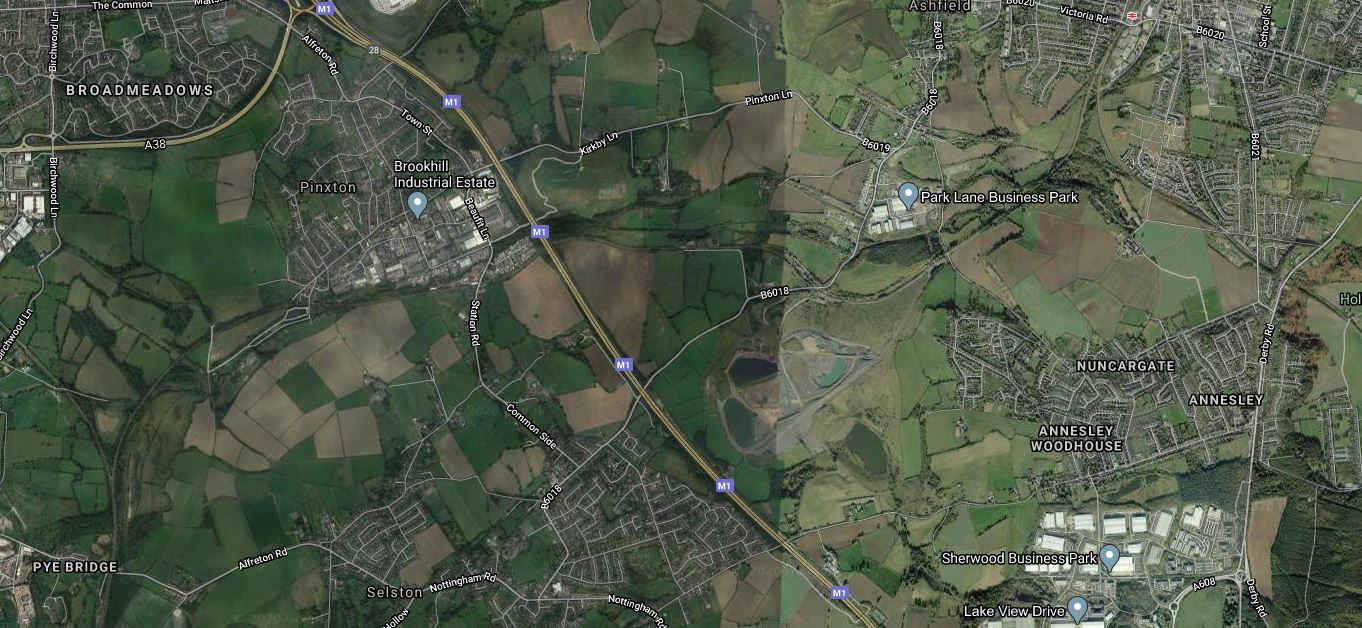
Note.
- The M1 Motorway crossing the map from North-West to South-East.
- Pye Corner is in the South-West corner of the map.
- The Erewash Valley Line runs North-South through Pye Corner.
- Kirkby-in-Ashfield is the urban area in the North-East corner of the map.
- Kirkby-in-Ashfield station is shown by the usual red symbol.
- The Robin Hood Line runs North-South through Kirkby-in-Ashfeld station.
On a high-resolution screen, it’s possible to pick out the freight line, that will become the Maid Marian Line.
- The Maid Marian Line is double-track.
- According to Real Time Trains, the distance between Kirkby-in-Ashfield and Langley Mill stations is around nine miles.
- A freight train took twenty-two minutes between the two stations.
- As there are two tph on the Robin Hood Line, I think it would be reasonable to have a similar frequency on the Maid Marian Line.
- Trains between the East Midlands Hub and Mansfield stations would pass Ilkeston, Langley Mill, Kirkby-in-Ashfield and Sutton Parkway stations.
- Trains could terminate at Nottingham using the Attenborough route.
- Trains could terminate at Derby using the Long Eaton route.
The Maid Marian Line could improve services from Derby, Mansfield, Nottingham and Worksop stations to the new East Midlands Hub station.
Matlock Station
Consider.
- Matlock is currently served by an hourly service between Matlock and Newark Castle via Derby, Spondon, Long Eaton, Attenborough, Beeston, Nottingham and several other smaller stations, which is a service that goes past the site of the East Midlands Hub station.
If this service were to call at the East Midlands Hub station and be doubled in frequency, it would be a very valuable connecting service to and from the East Midlands Hub station.
To call at East Midlands Hub station, it would need to use the Trowell Curve.
Newark Station
Consider.
- Newark is a calling point on the Ivanhoe Line service between Lincoln and Leicester.
- Newark is currently served by an hourly service between Matlock and Newark Castle via Derby, Spondon, Long Eaton, Attenborough, Beeston, Nottingham and several other smaller stations, which is a service that goes past the site of the East Midlands Hub station.
Both services could be increased to two tph, so Newark might end up with a four tph service to Nottingham and East Midlands Hub stations with a two tph service to Derby and Lincoln.
Nottingham Station
Consider.
- The current half-hourly East Midlands Railway services between St. Pancras and Nottingham could use the Trowell Chord route, as this would allow a call at the East Midlands Hub station.
- Ivanhoe Line services between Lincoln and Leicester could also use the Trowell Chord route, which with a change at the hub station, would give Lincolnshire a faster service to and from London and Birmingham.
- In Reinstatement Of The Ivanhoe Line, I wrote about plans to extend the Ivanhoe Line to Burton on Trent.
- The split service between Liverpool and Norwich would run two tph between Nottingham and Derby, via Long Eaton and East Midlands Hub stations, in both directions.
- If the Nottingham and Skegness service, were to be extended to East Midlands Hub, this would add extra services between Nottingham and East Midlands Hub stations.
The required four tph between the East Midlands Hub and Nottingham station could be provided by the diversion of existing services to call at the East Midlands Hub station and using the Trowell Curve.
Stoke-on-Trent And Crewe Stations
Consider.
- Currently, there is an hourly East Midlands Railway service between Crewe and Derby, that calls at nine stations including Kidsgrove, Stoke-on-Trent and Uttoxeter.
- There are also plans to split the Liverpool and Norwich service into two, with the Western half possibly becoming a Crewe and Nottingham service via Derby, East Midlands Hub and Long Eaton.
These two services could be arranged to give a two tph service between Nottingham, Long Eaton, East Midlands Hub and Derby in the South and Stoke-on-Trent and Crewe in the North.
Back-To-Back Services At East Midlands Hub Station
Running services through a station is always more efficient as terminating services in a station will need a bay platform or turnback facility of some sort.
In my analysis, I have proposed that these services might terminate at East Midlands Hub Station.
- A possible shuttle service between East Midlands Hub and Alfreton stations.
- The Maid Marian Line service between East Midlands Hub and Mansfield and Worksop stations.
- The Nottingham and Skegness service could be extended to East Midlands Hub station.
- The Crewe and Derby service could be extended to Nottingham via East Midlands Hub station.
Note.
- The splitting of the Liverpool and Norwich service will result in an overlap between Nottingham and Derby.
- Matlock and Newark services already run back-to-back through the area.
So would it be logical to join some services back-to-back through East Midlands Hub station?
s an example, the Maid Marian Line and Skegness services could be joined into one service.
Other services could follow the precedent of the splitting of the Liverpool and Norwich service.
- Trains coming and going from the East terminate at Derby.
- Trains coming and going from the West terminate at Nottingham.
If the following were arranged.
- Grantham and Mansfield were back-to-back.
- Alfreton and Crewe services terminated at Nottingham.
- Norwich services terminated at Derby.
There would be seven tph between Nottingham and Derby via Long Eaton and East Midlands Hub stations.
Battery-Electric Operation
Consider.
- Hitachi are claiming, that the battery-electric versions of their AT-300 trains, like the Class 810 trains will have a battery range of 55-65 miles and take ten minutes to recharge.
- Nottingham and Derby are sixteen miles away and trains between the two cities, take as long as thirty minutes for the trip.
- There will be high quality electrification at East Midlands Hub station.
In addition, station distances from the East Midlands Hub station are as follows.
- Alfreton – 17 miles
- Crewe – 55 miles – 35 miles without electrification (Derby and Stoke Junction)
- Derby – 6 miles
- Grantham – 20 miles
- Ilkeston – 7 miles
- Langley Mill – 10 miles
- Lincoln – 43 miles
- Mansfield – 23 miles
- Matlock – 23 miles
- Newark Castle – 26 miles
- Nottingham – 10 miles
- Skegness – 80 miles
- Stoke-on-Trent – 42 miles – 35 miles without electrification (Derby and Stoke Junction)
I think the following would be possible on battery power.
- Return journeys to Alfreton, Grantham, Ilkeston, Langley Mill, Mansfield, Matlock and Newark Castle.
- Return journeys to Lincoln with a charge at the destination.
- Return journeys to Crewe and Stoke using the electrification between Stoke Junction and Crewe.
Running battery-electric trains between East Midlands Hub and Skegness station would need a bit of ingenuity.
The building of the Allington Chord in 2005, may have opened up a way for battery-electric trains to be able to run between Nottingham and Skegness.
Consider.
- Bottesford station is the station nearest to Grantham on the Western side of the East Coast Main Line and it is 15.3 miles from Nottingham.
- Ancaster station is the station nearest to Grantham on the Eastern side of the East Coast Main Line and it is 28 miles from Nottingham.
- The original route between Bottesford and Ancaster station caused delays on the main line, so it was replaced by two routes.
- A modified version of the original route allows trains to call at Grantham station, where they reverse before continuing. The distance is 18.7 miles and typically takes 33 minutes
- A double-track short cut under the East Coast Main Line is about 12.7 miles and typically takes 17 minutes.
- The distance between Ancaster and Skegness is 46.7 miles.
- The East Coast Main Line is electrified.
I wonder, if it were possibly to electrify the following tracks.
- The direct double track between Ancaster and Bottesford stations.
- The access lines from the Allington Chord into Grantham station.
Hopefully, as the tracks, were built in 2005, they shouldn’t be too challenging to electrify.
This would enable a train from East Midlands Hub to Skegness to use the following procedure.
- Use the electrified line between East Midlands Hub and Nottingham stations, charging the battery en route.
- Call at Nottingham station and lower the pantograph.
- Leave Nottingham with a full battery.
- Run between Nottingham and Bottesford stations on battery power.
- Call at Bottesford station and raise the pantograph.
- Use either of the electrified routes between Bottesford and Ancaster stations, charging the battery en route.
- Call at Ancaster station and lower the paragraph.
- Run between Ancaster and Skegness stations on battery power.
After charging the train at Skegness, the return would use the following procedure.
- Leave Skegness with a full battery.
- Run between Skegness and Ancaster on battery power.
- Call at Ancaster and raise the paragraph.
- Use either of the electrified routes between Ancaster and Bottesford stations, charging the battery en route.
- Call at Bottesford station and lower the pantograph.
- Run between Bottesford and Nottingham on battery power.
- Call at Nottingham station and raise the pantograph.
- Use the electrified line between Nottingham and East Midlands Hub stations, charging the battery en route.
It’s almost as if, the Allington Chord was designed for battery-electric trains.
Conclusion
The Trowell Curve with a little bit of help from a few friends can create a battery-electric network of local lines based on the three important stations of Nottingham, East Midlands Hub and Derby.
I
Abellio’s Plans For Norwich And Liverpool
This page on the Department for Transport web site is an interactive map of the Abellio’s promises for East Midlands Railway.
These are mentioned for services between Norwich and Liverpool.
Splitting Of The Service
Early in the new franchise the Liverpool – Nottingham section will transfer to another operator, which will enable the two halves of the service to better meet the needs of customers.
The section remaining with East Midlands Railway will become a Norwich and Derby service via Nottingham.
This has been said for some time by the Department of Transport.
It is also said that limited services will continue to operate via Stamford and Loughborough.
Looking at trains between Nottingham and Norwich., they take these routes.
- Grantham, Peterborough, Ely, Thetford
- East Midlands Parkway, Loughborough, Melton Mowbray, Oakham, Peterborough, Ely, Thetford
The service will be extended from Nottingham to Long Eaton, the future East Midlands Hub and Derby.
Refurbished Modern Trains
It is proposed that the service will be run by refurbished modern trains.
Features include.
- More reliable service
- Improved comfort
- Passenger information system displays
- free on-board Wi-Fi
- at-seat power sockets
- USB points
- Air conditioning
- Tables at all seats
- Increased luggage space.
- No date for introduction is given.
This all sounds fine to me.
The Current Trains On The Route
Before discussing the possible new trains, I will look at the current service, that I have used many times.
Class 158 trains are used,
Normally, a pair of two-car trains run together to make a four-car formation.
- At times, these trains are very overcrowded.
- I don’t think, the trains have a universal access toilet.
- The trains are thirty years old and some detailing is not very good or very last century.
- The air-conditioning may be a bit dodgy.
- Nottingham and Norwich is probably about the maximum comfortable range for passenger on these trainss.
I suspect too, that they have operational problems.
- They are only 90 mph trains and they will share tracks with faster trains.
- As part of this route could be on the East Coast Main Line, scheduling trains would be easier, if the trains were capable of 125 mph.
- On board catering is provided by a trolley. Can it be pushed between the two trains?
Abellio are obviously quite right to promise a better train for both passengers, staff and their bottom line.
An Ideal Train For The Route
An ideal train would have a specification something like this.
- Modern train, built since 2000.
- Five or six cars
- 125 mph operating speed.
- An onboard cafe-bar.
- Universal-access toilet.
It sounds to me, like a Class 222 train with a high-class refurbishment.
Currently, there are these Class 222 trains available to the franchise.
- Four by four-car
- Seventeen by five-cars
- Six by seven-cars.
Many of the Class 222 trains, will be replaced in 2022, when the new bi-mode trains are delivered.
The New Trains For The Route
It does look to me, that East Midlands Trains could do a lot worse, than use refurbished Class 222 trains between Norwich and Derby.
- Their engineers and drivers know the trains well.
- They could be arranged as four or five coaches for the route.
- Tory are 125 mph trains, which must bring journey time savings, especially on the East Coast Main Line.
- Bombardier have proposed, that they could be fitted with batteries to reduce the need to run the engines in stations.
Refurbishing something you know, is probably one of the cheaper options.
How Many Trains Are Needed For An Hourly Service Between Nowich And Derby?
I suspect that running to a well defined timetable that times of around three hours could be achieved between Norwich and Derby.
This would probably mean that a train could go from Norwich to Derby and back in under seven hours.
This would mean that seven trains would be needed for an hourly service running all day.
If the 125 mph trains could use their speed on the East Coast Main Line and perhaps on the Breckland Line, it might be possible to do the round trip in six hours and therefor need a train less.
Would Finding Seven Class 222 Trains Be Possible?
Obviously, once the Midland Main Line routes have been replaced by new bi-mode trains in 2022, there will be a lot of Class 222 trains available and seven trains to run the Norwich and Derby service will not be a problem.
Some other factors will help.
Trains Will Be Released By The London And Corby Electric Service
In December 2020, when the London and Corby service receives electric trains, the current Class 222 trains on this route will become available.
I think that this service currently needs three trains.
More Mark 4 Coach/Class 43 locomotive Sets Could Be Created
In Abellio’s Plans For The Midland Main Line, I described how interim sets could be built by replacing the non-compliant Mark 3 coaches in an InterCity 125, with the compliant Mark 4 coaches from an InterCity 225.
These trains would be used to release some of the Class 222 trains on the Midland Main Line.
Another five Mark 4 Coach/Class 43 Locomotive sets would probably release the same number of Class 222 trains.
Trains Could Be Reorganised With A Better Plan
I have a feeling that by reorganising the Class 222 trains and bringing in more more Mark 4 Coach/Class 43 Locomotive sets, could mean that a better plan on the Midland Main Line could be developed.
As an example, when boarding a train at St. Pancrass, I often notice two trains are in the platform and you have to walk to the far train. This is not efficient and surely slows down the turnround of trains.
Platforms 1 to 4 are reserved for East Midlands services at St. Pancras station.
- Two trains per hour to Derby, Chesterfield and Sheffield
- Two trains per hour to Nottingham
- One train per hour to Corby, which goes to two trains per hour in December 2020.
Surely, it would be easier, if the station was organised as follows.
- Sheffield, Nottingham and Corby trains all have their own platform, with one spare for luck!
- All trains are full length, with First Class at the London end
- One train per platform.
This would make things easier for passengers and reduce turnround times.
No More Two Trains Running Together
I think that the practice of train companies running two or more trains together to increase capacity is a bad idea, unless you have no other way.
Consider two four-car trains running together as an eight-car train.
- You have two driving cabs in the middle, which serve no purpose and just take up space. and add useless weight.
- A buffet car in the train can be available to all passengers.
- The First Class seats could be in two separate places on the train.
- With trains like the Hitachi Class 800 trains, onboard staff can only move between trains in a station.
- Walk-through trains allow passengers to position themselves for a convenient and quick exit.
Anybody who procures trains to run in multiple formations all the time, instead of buying longer trains, is generally incompetent.
A Rough Estimate
I have done a very rough estimate and feel that the Midland Main Line services can be run with the following numbers of trains.
- Sheffield services – Ten trains
- Nottingham services – Eight trains
- Corby services – Six trains
As the Corby services will be run by refurbished twelve-car trains, it looks to me that there is a need for eighteen diesel trains for Sheffield and Nottingham services.
I would go for eighteen Mark 4 Coach/Class 43 locomotive sets, with perhaps a couple of spare sets..
Conclusion
The following services should be run with Mark 4 Coach/Class 43 locomotive sets of an appropriate length.
- London and Nottingham
- London and Sheffield
This would release the Class 222 trains for other services like those between Norwich and Derby.
 The Anonymous Widower