Beeching Reversal – Reinstatement Of The Beverley And York Rail Line
This is one of the Beeching Reversal projects that the Government and Network Rail are proposing to reverse some of the Beeching cuts.
The York And Beverley Line does what it says in the name.
A section in the Wikipedia entry is entitled Re-Opening Proposals and the treatment of the trackbed after closure would appear to be a case study in how not to mothball a railway.
- The original route has been built on in several places at Huntingdon, New Earswick, Pocklington and Stamford Bridge.
- A new route will have to be built to connect to the York and Scarborough Line at Haxby.
- There may also be problems at Beverley.
The only positive thing I can see, is that York City Council, want to re-open Haxby station. If this station were to be re-opened with a future-proofed design that might help in the wider scheme of reopening the Beverley and York Line.
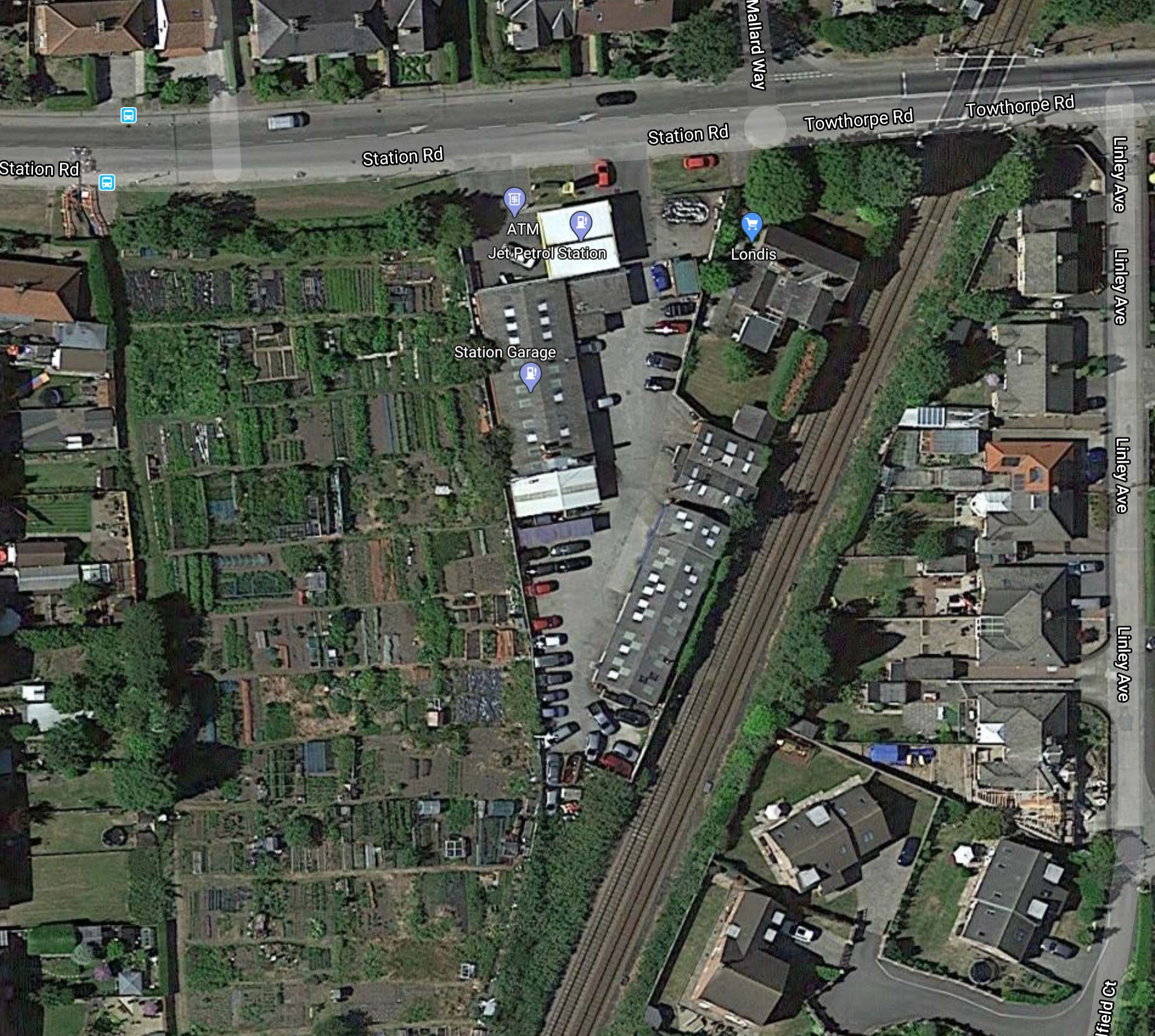
This Google Map shows the original location of Haxby station.
Note.
- There is a dreaded level crossing in the middle of the village, that typically has around two trains per hour (tph)
- The road going to the West at the top of the map, is called Station Road, which is a bit of a giveaway.
- The building on the triangular site is called Station garage.
- Some reports on the Internet say that allotments will be turned into car parks.
- According to Wikipedia 22,000 people live within three miles of the station site.
The station site appears to be hemmed in by housing and comments from readers on one report are complaining about car parking being a problem an definitely don’t want the station.
Wikipedia says this about the proposed service on the Beverley and York Line.
The report recommended reinstating a service from Hull via Beverley, Market Weighton, Stamford Bridge and Pocklington connecting to the York to Scarborough Line at Haxby, on a double track line with a frequency of 2 trains per hour, with intermediate stations only at Market Weighton, Pocklington and Stamford Bridge. The estimate journey time was under 1 hour.
As the Beverley and York Line can’t join the York and Scarborough Line in the middle of Haxby, would it join North or South of the town?
Joining to the North would allow the Beverley trains to call at Haxby, but that would mean the level crossing was busy with six tph.
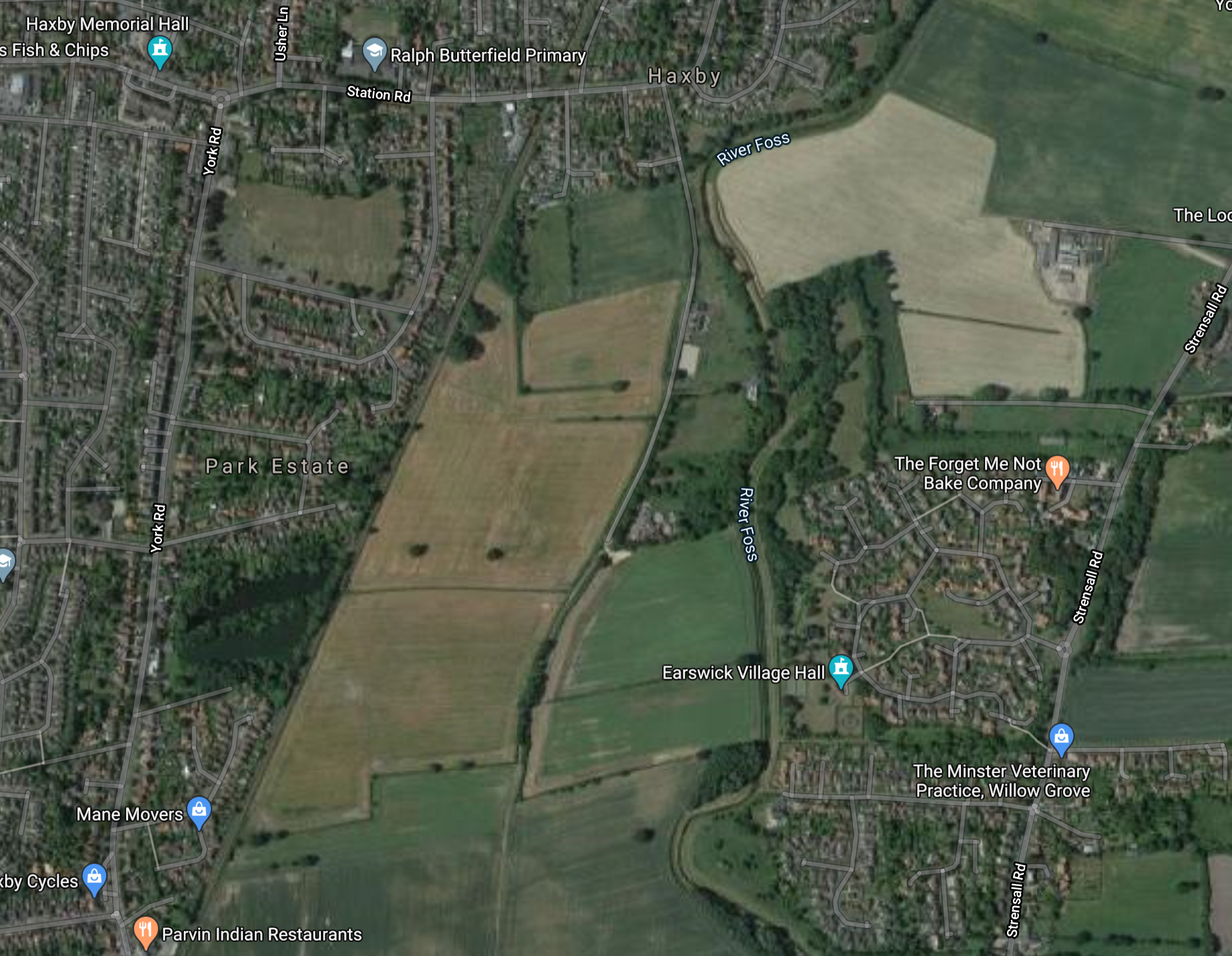
This Google Map shows the countryside between Haxby in the North and Earswick in the South.
Note.
- The York and Scarborough Line going through the centre of Haxby and then passing down the West side of the light brown fields.
- York is to the South and Scarborough is to the North.
I wonder, if the Beverley and York Line could branch to the East here and skirt to the North of Earswick before continuing to Pocklington for Beverley.
Perhaps, a Park-and-Ride station could be situated, where the railway and the road called Landing Lane cross?
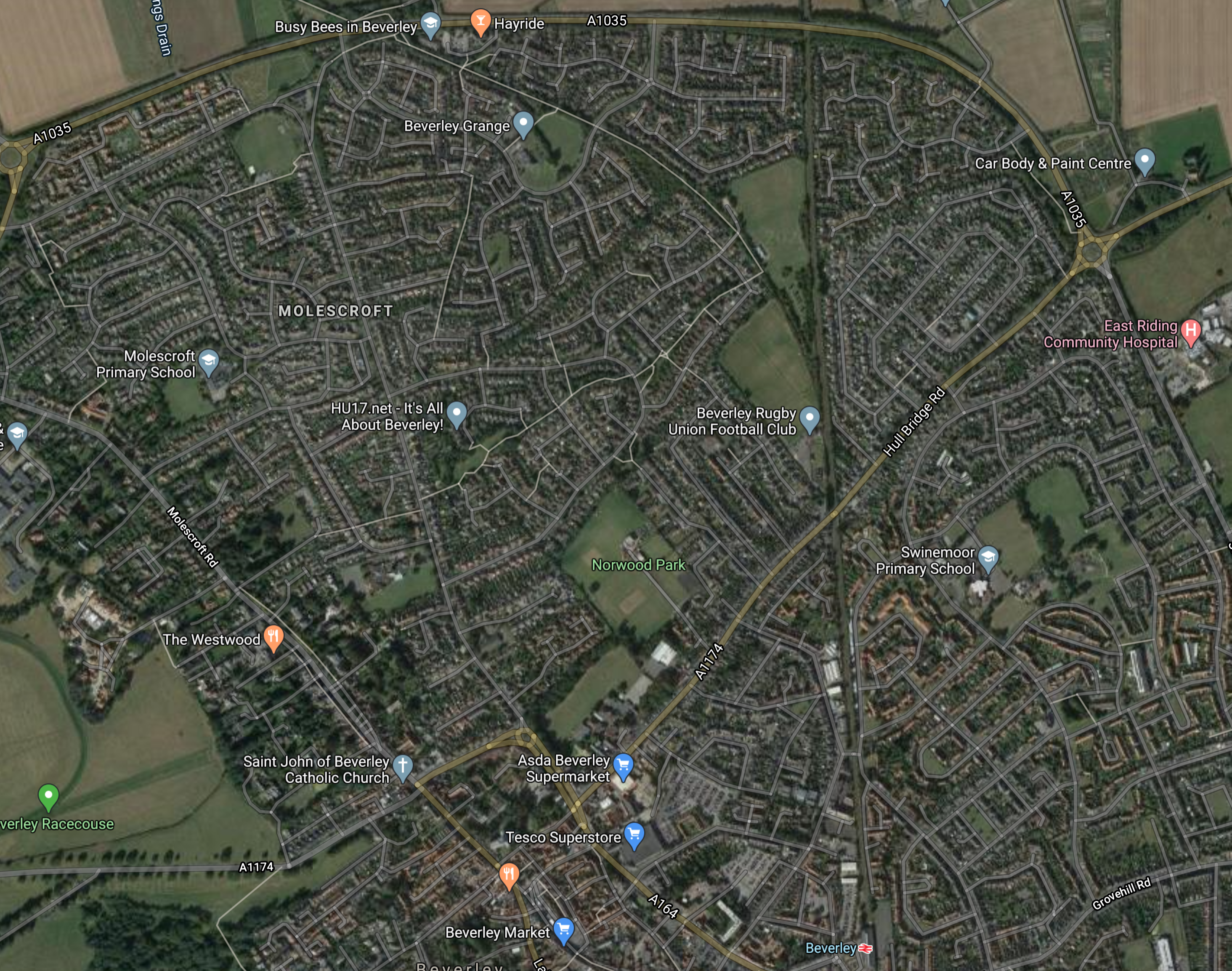
At Beverley, this Google Map shows how the Beverley and York Line connects to the station.
Note.
- Beverley station at the bottom of the map.
- The Hull and Scarborough running North-South through the station.
The line divides by Beverley Rugby Football Club, with the trackbed of the Beverley and York Line going off in the North-Westerly direction.
This seems a lot easier than at the York end of the route.
I have flown my virtial helicopter over much of the route between Beverley and York, and the trackbed is visible but missing in places, where construction has taken place.
Would The Route Be Single Or Double-Track?
The plans call for double track, but would it be necessary?
- There will only be two tph, that will take under an hour.
- No freight trains will use the line.
- The route is 32 miles long.
I suspect a single track would suffice, with a passing loop at Market Weighton station.
Should The Line Be Electrified?
I wouldn’t electrify the whole line, but I would electrify the following.
- Hull and Beverley, so that battery trains to and from London could top up their batteries.
- Haxby and York, so that battery trains to and from Scarborough could top up their batteries.
These two short stretches of electrification would allow battery electric operation between Hull and York, trains could charge their batteries at either end of the route.
Electrification Between Hull And Beverley
Consider.
- Hull Trains extend their London and Hull services to Beverley.
- Hull and Beverley are just over eight miles apart.
- Trains to and from London Kings Cross use the electrification on the East Coast Main Line to the South of Temple Hirst Junction.
- Hull and Temple Hirst Junction are thirty-six miles apart.
- Hull Trains and LNER use Hitachi Class 800 or Class 802 electro-diesel trains on services between London Kings Cross and Hull.
Hitachi’s proposed battery-electric conversion of these trains, would have a range of 56 miles, according to this infographic.

I have flown my helicopter along the route and counted the following.
- Level crossings – 5
- Modern road bridges – 5
- Footbridges – 5
- Other bridges – 5
- Stations – 1
Nothing looked too challenging.
In my view electrification between Hull and Beverley and at convenient platforms at both stations, would be a simple way of decarbonising rail travel between London and Hull.
If this electrification were to be installed, distances from the electrification between Hull and Beverley, these would be the distances to be covered on battery power to various places.
- Bridlington – 23 miles
- Doncaster via Goole – 41 miles
- Leeds – 52 miles
- Neville Hill Depot – 49 miles
- Scarborough – 45 miles
- York – 52 miles
Note.
- All of these places would be in range of a fully-charged Hitachi battery electric train running to and from Hull.
- Of the destinations, only Bridlington and Scarborough, is not a fully-electrified station.
- One of the prerational problems in the area, is that due to a lack of electrification to the East of Neville Hall Depot, electric trains from York and Hull have difficulty reaching the depot. Trains with a battery capability won’t have this problem.
- Hull and Beverley and a lot of stations in the area, would only be served by electric trains, with a battery capability.
There would be a large decrease in pollution and emissions caused by passenger trains in the area.
Electrification Between Haxby And York
Consider.
- York and Haxby are 4 miles apart.
- York and Scarborough are 42 miles apart.
- York and Beverley are 32 miles apart.
Note that unlike at Beverley, there is no need to electrify the end of the route, as trains can be charged in the turnround at York.
With a charging facility at Scarborough, the Class 802 trains of TransPennine Express could work this route if fitted with batteries.
Could Lightweight Electrification Be Used?
Electrification gantries like these have been proposed for routes, where the heavy main-line gantries would be too intrusive.
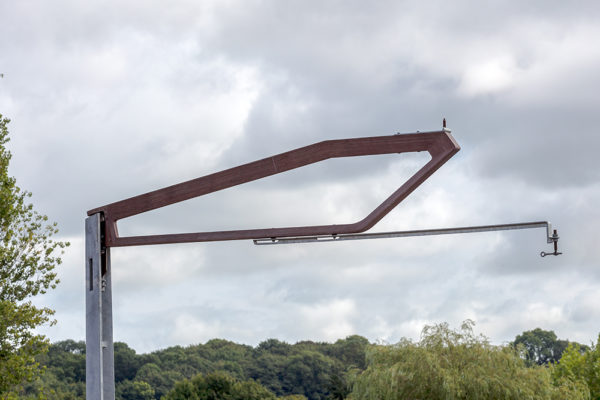
They could have a place in the rebuilding of lines like Beverley and York.
Trains Between York And Beverley
The UK’s railways need to be decarbonised before 2040.
As a train delivered today, would probably last forty years, I think it would be prudent to only introduce zero-carbon trains to the network, where they are able to run the proposed services.
There is no doubt in my mind, that all these local services in East Yorkshire could be run using battery-electric trains with a 56 mile range.
- Hull and Doncaster
- Hull and Leeds
- Hull and Neville Hill Depot
- Hull and Scarborough
- Hull and York via Beverley and Market Weighton
- Hull and York via Selby
- York and Scarborough
The only electrification needed would be as follows.
Electrification between Hull and Beverley.
Electrification of some platforms at Beverley and Hull stations.
Some form of charging at Scarborough.
Charging may also be needed at Bridlington station.
The trains needed for the route seem to fit Hitachi’s specification well and a Class 385 train to the following specification, would do a highly capable job.
- Three or four-cars.
- Batteries for a 56 mile range.
- 90-100 mph operating speed.
I’m also sure that Bombardier, CAF and Stadler could also provide a suitable train.
Could Tram-Trains Be Used?
I feel that they could be used successfully and might enable cost savings on the substantial rebuilding of the route needed.
- Lighter weight structures.
- Single track with passing places.
- Tramway electrification or battery.
- Less vidual intrusion.
- The service could also have more stops.
Perhaps too, it could go walkabout in Hull City Centre to take passengers to and from Hull station.
Conclusion
It is rebuilding the tracks between Beverley and York, that will be difficult in the reopening of this line, which with hindsight should have not been vandalised by British Rail.
But even, if the Beverley and York Line is not re-opened, it does look that if Beverley and Hull were to be electrified, it would enable a network of battery electric zero-carbon trains in East Yorkshire and allow battery electric trains to run between Kings Cross and Hull.
South Wales Metro Railway Works Imminent
The title of this post, is the same as that of this article on Rail Technology Magazine.
Work starts on the third of August and is described in this sentence,
TfW is now starting to build the South Wales Metro which will see major infrastructure works including the electrification of over 170km of track mostly with overhead lines, station and signalling upgrades and the construction of at least five new stations.
It will be one of the most innovative electrification projects ever performed in the UK, as it uses discontinuous electrification.
I explained discontinuous electrification in More On Discontinuous Electrification In South Wales, where I said this.
In the July 2018 Edition of Modern Railways, there is an article entitled KeolisAmey Wins Welsh Franchise.
This is said about the electrification on the South Wales Metro.
KeolisAmey has opted to use continuous overhead line equipment but discontinuous power on the Core Valley Lnes (CVL), meaning isolated OLE will be installed under bridges. On reaching a permanently earthed section, trains will automatically switch from 25 KVAC overhead to on-board battery supply, but the pantograph will remain in contact with the overhead cable, ready to collect power after the section. The company believes this method of reducing costly and disruptive engineering works could revive the business cases of cancelled electrification schemes. Hopes of having money left over for other schemes rest partly on this choice of technology.
Other points made include.
-
- A total of 172 km. of track will be electrified.
- The system is used elsewhere, but not in the UK.
- Disruptive engineering works will be avoided on fifty-five structures.
- Between Radyr and Ninian Park stations is also proposed for electrification.
Nothing is said about only electrifying the uphill track, which surely could be a way of reducing costs.
I wrote the last sentence, as surely coming down the hills, the trains can be powered by Newton’s friend.
The New Stations
This article on Business Live, gives the list of new stations and their completion dates.
- Crwys Road – End of 2022
- Loudoun Square – End of 2023
- Cardiff Bay – End of 2023
- Treforest Estate – End of 2025
- Gabalfa – 2028
If the builders crack on as they did at Horden station, I wouldn’t be surprised to see those dates achieved, with time to spare.
Electrifying Wales
I would not be surprised to learn that Wales wants to decarbonise their railways.
At present, Wales only has the following electrified railways either in operation or under construction.
- The South Wales Main Line between the Severn Tunnel and Cardiff.
- The South Wales Metro based on local railways around Cardiff and Newport is being created and will be run by electric trains.
There is no more electrification planned in the future.
Hitachi’s Specification For Battery Electric Trains
Recently, Hitachi have released this infographic for their Regional Battery Train.
This gives all the information about the train and a definitive range of 90 km or 56 miles.
The Welsh Rail Network
If you look at the network of services that are run by Transport for Wales Rail Services, they connect a series of hub stations.
Major hubs include the following stations.
- Cardiff Central – Electrified
- Chester
- Hereford
- Shrewsbury
- Swansea
Smaller hubs and termini include the following stations.
- Aberystwyth
- Birmingham International – Electrified
- Birmingham New Street – Electrified
- Blaenau Ffestiniog
- Carmarthen
- Crewe – Electrified
- Fishguard Harbour
- Hereford
- Holyhead
- Llandudno Junction
- Manchester Airport – Electrified
- Manchester Piccadilly – Electrified
- Machynlleth
- Milford Haven
- Newport – Electrified
- Pembroke Dock
Running Welsh Routes With Electric Trains
These routes make up the Welsh rail network.
Chester And Crewe
Consider.
- The route between Chester and Crewe is without electrification.
- Crewe and Chester are 21 miles apart.
I believe that if a battery-electric train, with a range of 56 miles, can leave Chester and Crewe with full batteries, that it will be possible to run between Chester and Crewe stations.
Chester And Holyhead via Llandudno Junction
Consider.
- All services between Llandudno Junction and England call at Chester.
- All services running to and from Holyhead call at Llandudno Junction.
- The route between Chester and Holyhead is without electrification.
- Chester and Llandudno Junction are 54 miles apart.
- Llandudno Junction and Holyhead are 40 miles apart.
I believe that if a battery-electric train with a range of 56 miles can leave Chester, Llandudno Junction and Holyhead with full batteries, that it will be possible to run between Chester and Holyhead stations.
Chester And Liverpool Lime Street
Consider.
- The route between Runcorn and Liverpool Lime Street is electrified.
- The route between Chester and Runcorn is without electrification.
- Chester and Runcorn are 14 miles apart.
I believe that if a battery-electric train, with a range of 56 miles, can leave Chester and Runcorn with full batteries, that it will be possible to run between Chester and Liverpool Lime Street stations.
Chester And Manchester Airport
Consider.
- The route between Warrington Bank Quay and Manchester Airport is electrified.
- The route between Chester and Warrington Bank Quay is without electrification.
- Chester and Warrington Bank Quay are 18 miles apart.
I believe that if a battery-electric train, with a range of 56 miles, can leave Chester and Warrington Bank Quay with full batteries, that it will be possible to run between Chester and Manchester Airport stations.
Chester And Shrewsbury
Consider.
- The route between Chester and Shrewsbury is without electrification.
- Chester and Shrewsbury are 42 miles apart.
I believe that if a battery-electric train with a range of 56 miles, can leave Shrewsbury and Chester with full batteries, that it will be possible to run between Chester and Shrewsbury stations.
Llandudno And Blaenau Ffestiniog
Consider.
- The route between Llandudno and Blaenau Ffestiniog is without electrification.
- Llandudno and Blaenau Ffestiniog are 31 miles apart.
I believe that if a battery-electric train with a range of 56 miles, can leave Llandudno and Blaenau Ffestiniog with full batteries, that it will be possible to run between Llandudno and Blaenau Ffestiniog stations.
Machynlleth And Aberystwyth
Consider.
- The route between Machynlleth and Aberystwyth is without electrification.
- Machynlleth and Aberystwyth are 21 miles apart.
I believe that if a battery-electric train with a range of 56 miles, can leave Machynlleth and Aberystwyth with full batteries, that it will be possible to run between Machynlleth and Aberystwyth stations.
Machynlleth And Pwllheli
Consider.
- The route between Machynlleth and Pwllheli is without electrification.
- Machynlleth and Pwllheli are 58 miles apart.
I believe that if a battery-electric train with a range of upwards of 58 miles, can leave Machynlleth and Pwllheli with full batteries, that it will be possible to run between Machynlleth and Pwllheli stations.
Machynlleth And Shrewsbury
Consider.
- The route between Machynlleth and Shrewsbury is without electrification.
- Machynlleth and Shrewsbury are 61 miles apart.
I believe that if a battery-electric train with a range of upwards of 61 miles, can leave Machynlleth and Shrewsbury with full batteries, that it will be possible to run between Machynlleth and Shrewsbury stations.
Shrewsbury and Birmingham International
Consider.
- The route between Birmingham International and Wolverhampton is electrified.
- The route between Shrewsbury and Wolverhampton is without electrification.
- Shrewsbury and Wolverhampton are 30 miles apart.
I believe that if a battery-electric train, with a range of 56 miles, can leave Shrewsbury and Wolverhampton with full batteries, that it will be possible to run between Shrewsbury and Birmingham International stations.
Shrewsbury And Cardiff Central via Hereford
Consider.
- All services between Cardiff Central and Shrewsbury call at Hereford.
- The route between Cardiff Central and Newport is electrified.
- The route between Newport and Shrewsbury is without electrification.
- Shrewsbury and Hereford are 51 miles apart.
- Hereford and Newport are 44 miles apart.
I believe that if a battery-electric train, with a range of 56 miles, can leave Shrewsbury, Hereford and Newport with full batteries, that it will be possible to run between Shrewsbury and Cardiff Central stations.
Shrewsbury And Crewe
- The route between Shrewsbury and Crewe is without electrification.
- Shrewsbury and Crewe are 33 miles apart.
I believe that if a battery-electric train with a range of upwards of 61 miles, can leave Shrewsbury and Crewe with full batteries, that it will be possible to run between Shrewsbury and Crewe stations.
Shrewsbury and Swansea
Consider.
- The Heart of Wales Line between Shrewsbury and Swansea is without electrification.
- Shrewsbury and Swansea are 122 miles apart.
- Trains cross at Llandrindod and wait for up to eleven minutes, so there could be time for a charge.
- Shrewsbury and Llandrindod are 52 miles apart.
- Swansea and Llandrindod are 70 miles apart.
It appears that another charging station between Swansea and Llandrindod is needed
I believe that if a battery-electric train, with a range of 56 miles, can leave Shrewsbury, Swansea and the other charging station, with full batteries, that it will be possible to run between Shrewsbury and Swansea stations.
Swansea And Cardiff Central
Consider.
- The route between Swansea and Cardiff Central is without electrification.
- Swansea and Cardiff Central are 46 miles apart.
I believe that if a battery-electric train, with a range of 56 miles, can leave Swansea and Cardiff Central with full batteries, that it will be possible to run between Swansea and Cardiff Central stations.
Swansea And Carmarthen
Consider.
- The route between Swansea and Carmarthen is without electrification.
- Swansea and Carmarthen are 31 miles apart.
I believe that if a battery-electric train, with a range of 56 miles, can leave Swansea and Carmarthen with full batteries, that it will be possible to run between Swansea and Carmarthen stations.
Swansea And Fishguard Harbour
Consider.
- The route between Swansea and Fishguard Harbour is without electrification.
- Swansea and Fishguard Harbour are 73 miles apart.
- Tramins could top up the batteries during the reverse at Carmathen.
- Swansea and Carmarthen are 31 miles apart.
- Carmarthen and Fishguard Harbour are 42 miles apart.
I believe that if a battery-electric train, with a range of 56 miles, can leave Swansea, Carmathen and Fishguard Harbour with full batteries, that it will be possible to run between Swansea and Fishguard Harbour stations.
Swansea And Milford Haven
Consider.
- The route between Swansea and Milford Haven is without electrification.
- Swansea and Milford Haven are 72 miles apart.
- Tramins could top up the batteries during the reverse at Carmathen.
- Swansea and Carmarthen are 31 miles apart.
- Carmarthen and Milford Haven are 41 miles apart.
I believe that if a battery-electric train, with a range of 56 miles, can leave Swansea, Carmathen and Milford Haven with full batteries, that it will be possible to run between Swansea and Milford Haven stations.
Swansea And Pembroke Dock
Consider.
- The route between Swansea and Pembroke Dock is without electrification.
- Swansea and Pembroke Dock are 73 miles apart.
- Tramins could top up the batteries during the reverse at Carmathen.
- Swansea and Carmarthen are 31 miles apart.
- Carmarthen and Pembroke Dock are 42 miles apart.
I believe that if a battery-electric train, with a range of 56 miles, can leave Swansea, Carmathen and Pembroke Dock with full batteries, that it will be possible to run between Swansea and Pembroke Dock stations.
Other Routes
I have not covered these routes.
- Borderlands Line
- Cardiff Valley Lines, that will be part of the South Wales Metro
- Routes on the electrified South Wales Main Line, that are to the East of Cardiff.
The first will run between Chester and the electrified Merseyrail system and the others will be electrified, except for short stretches.
Stations Where Trains Would Be Charged
These stations will need charging facilities.
Aberystwyth
Aberystwyth station only has a single terminal platform.
I’ve not been to the station, but looking at pictures on the Internet, I suspect that fitting a charging facility into the station, wouldn’t be the most difficult of engineering problems.
Birmingham International
Birmingham International station is fully-electrified and ready for battery-electric trains.
Blaenau Fflestiniog
Blaenau Ffestiniog station has a single terminal platform.
My comments would be similar to what, I said for Aberystwyth station. I would hope a standard solution can be developed.
Cardiff
Cardiff station is fully-electrified and ready for battery-electric trains.
Chester
Chester station has two through platforms and one bay platform, that are used by Trains for Wales.
- The through platforms are bi-directional.
- The bay platform is used by services from Liverpool Lime Street and Manchester Airport and Piccadilly.
- The station is a terminus for Merseyrail’s electric trains, which use 750 VDC third-rail electrification.
- Some through services stop for up to seven minutes in the station.
This Google Map shows the station.
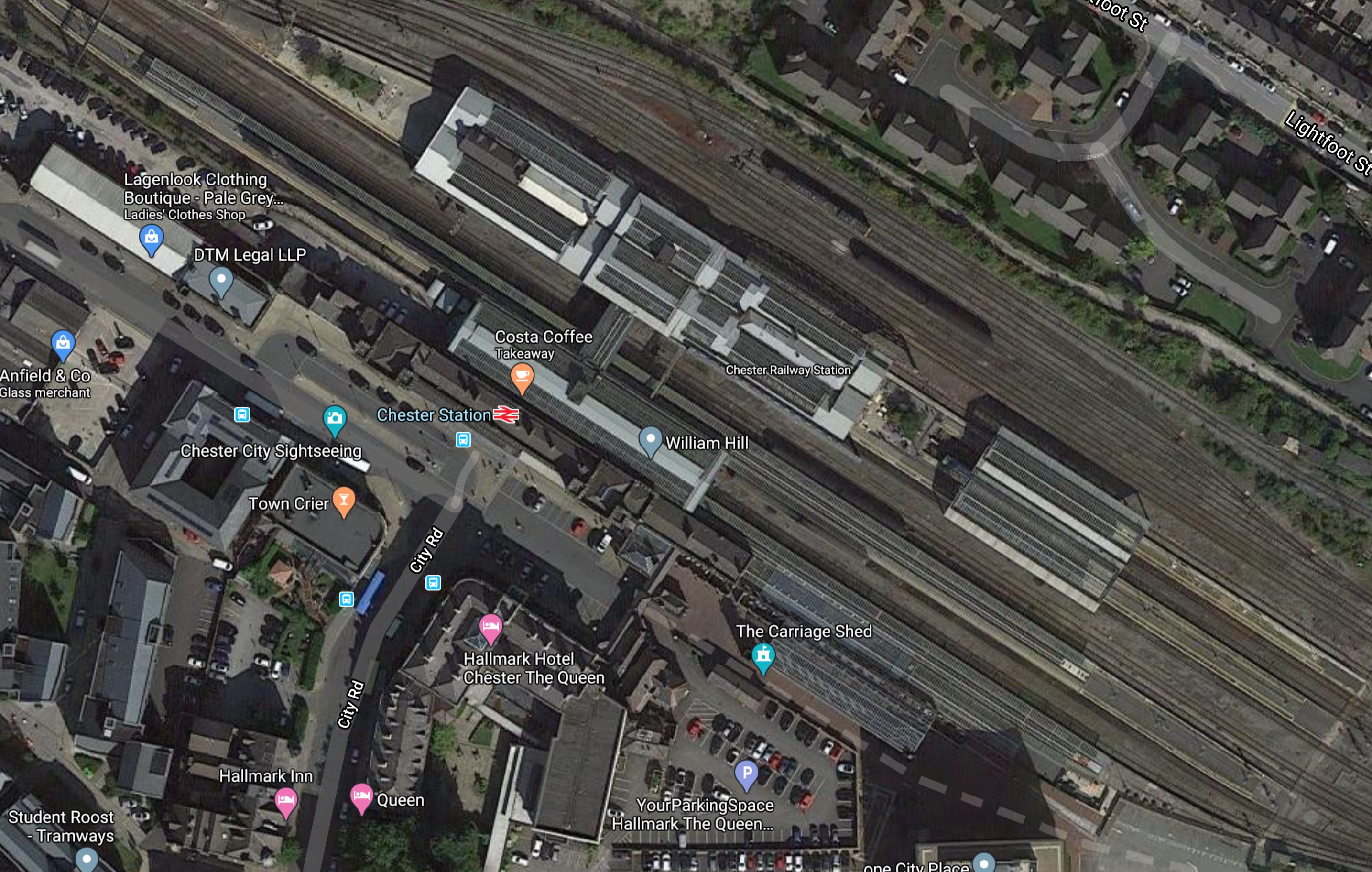
There is plenty of space.
The simplest way to charge trains at Chester would be to electrify the two through platforms 3 and 4 and the bay platform 1.
I would use 750 VDC third-rail, rather than 25 KVAC overhead electrification.
- I’m an engineer, who deals in scientifically-correct solutions, not politically-correct ones, devised by jobsworths.
- Maintenance staff at the station will be familiar with the technology.
- Station staff and passengers will know about the dangers of third-rail electrification.
- Trains connect and disconnect automatically to third-rail electrification.
- Trains don’t have to stop to connect and disconnect, so passing trains can be topped-up.
- Hitachi with the Class 395 train and Alstom with the Class 373 train, have shown even trains capable of 140 mph can be fitted with third-rail shoes to work safely at slower speeds on lines electrified using third-rail.
- Modern control systems can control the electricity to the third-rail, so it is only switched on, when the train completes the circuit.
I have a vague recollection, that there is an avoiding line at Chester station, so trains can go straight through. Perhaps that should be electrified too.
Carmarthen
Carmarthen station is a two platform station, with a rather unusual layout, that I wrote about in Changing Trains At Carmarthen Station.
I took these pictures when I passed through in 2016.



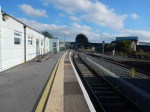
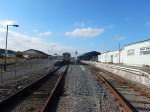
Note the unusual step-free crossing of the tracks.
This Google Map shows the layout at the station.
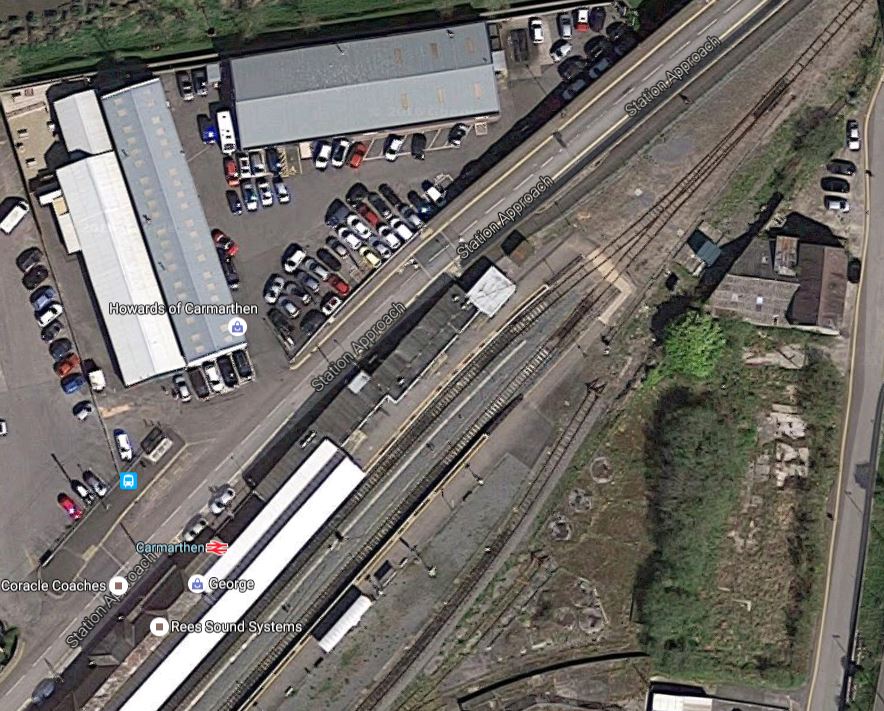
I believe it is another station, where third-rail electrification could be the solution.
- Most trains seem to reverse at the station, which gives time for a full charge.
- Others terminate here.
but would they still allow passengers to cross the line as they do now, whilst trains are being charged?
Crewe
Crewe station is fully-electrified.
- Trains for Wales seem to use Platform 6 for through trains and the bay Platform 9 for terminating trains.
- Both platforms appear to be electrified.
- Terminating trains appear to wait at least 9-11 minutes before leaving.
It does appear that Crewe station is ready for battery-electric trains.
Fishguard Harbour
Fishguard Harbour station only has a single terminal platform.
My comments would be similar to what, I said for Aberystwyth station. I would hope a standard solution can be developed.
Hereford
Hereford station has four through platforms.
This Google Map shows the station.
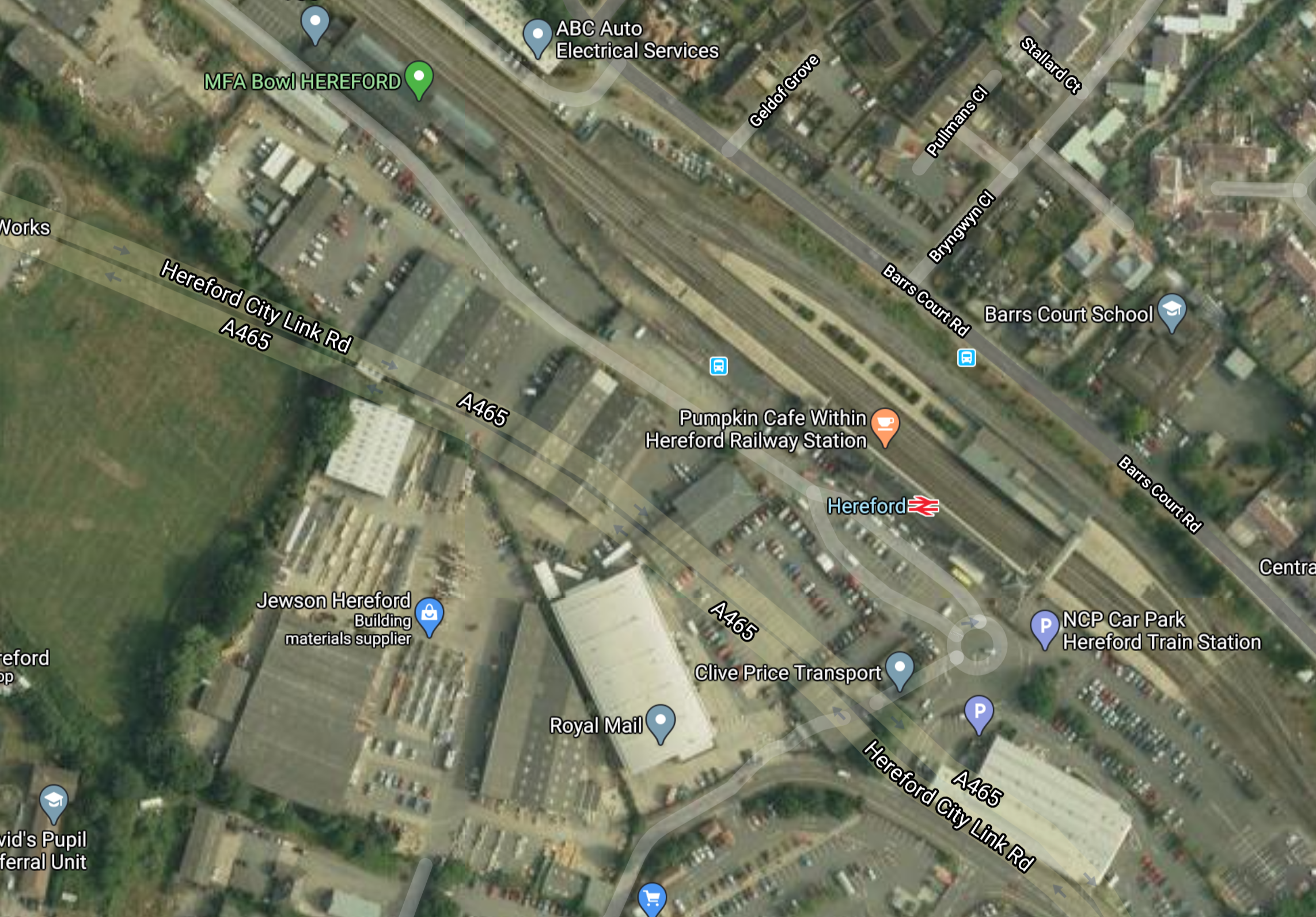
There is plenty of space.
As with Chester, I would electrify this station with 750 VDC third-rail equipment.
But the electrification wouldn’t be just for train services in Wales.
- West Midlands Trains, run an hourly service to Birmingham New Street and there is only a forty-one mile gap in the electrification between Hereford and Bromsgrove.
- Great Western Railway’s service to London, has a massive ninety-six mile run to the electrification at Didcot Junction, which could be bridged by installing charging facilities at Worcestershire Parkway and/or Honeybourne stations.
Both services have generous turnround times at Hereford, so would be able to leave fully-charged.
Distances from Hereford station are as follows.
- Abergavenny – 24 miles
- Bromsgrove – 41 miles
- Great Malvern – 21 miles
- Honeybourne – 48 miles
- Ludlow – 13 miles
- Newport – 44 miles
- Shrewsbury – 51 miles
- Worcester Parkway – 33 miles
Hereford station could be a serious battery-electric train hub.
Holyhead
Holyhead station has three terminals platforms.
My comments would be similar to what, I said for Aberystwyth station. I would hope a standard solution can be developed.
Liverpool Lime Street
Liverpool Lime Street station is fully-electrified and ready for battery-electric trains.
Llandrindod
Llandrindod station has two through platforms.
I took these pictures at the station as I passed through in 2016.

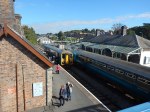


The Heart of Wales Line is certainly a route, that would benefit from larger trains. Zero-carbon battery-electric trains would surely fit well in the area.
This Google Map shows the station.
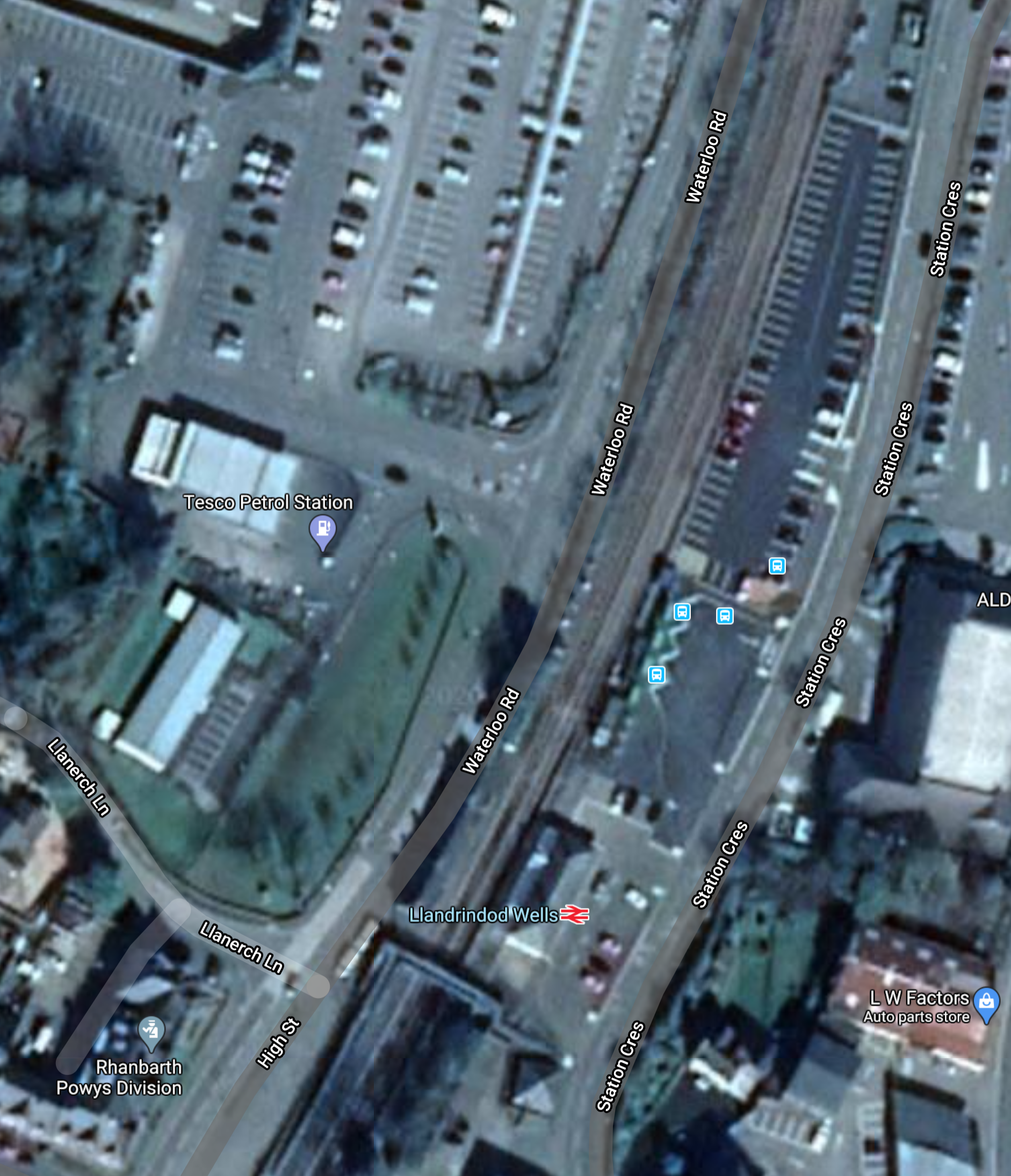
It would appear that, it is another station, that could be fitted with third-rail electrification to charge the trains.
Distances from Llandrindod station are as follows.
- Shrewsbury – 52 miles
- Llandovery – 27 miles
- Llanelli – 59 miles
- Swansea – 70 miles
It would appear that a second station with charging facilities or bigger batteries are needed.
Llandudno Junction
Llandudno Junction station has four platforms.
This Google Map shows the station.
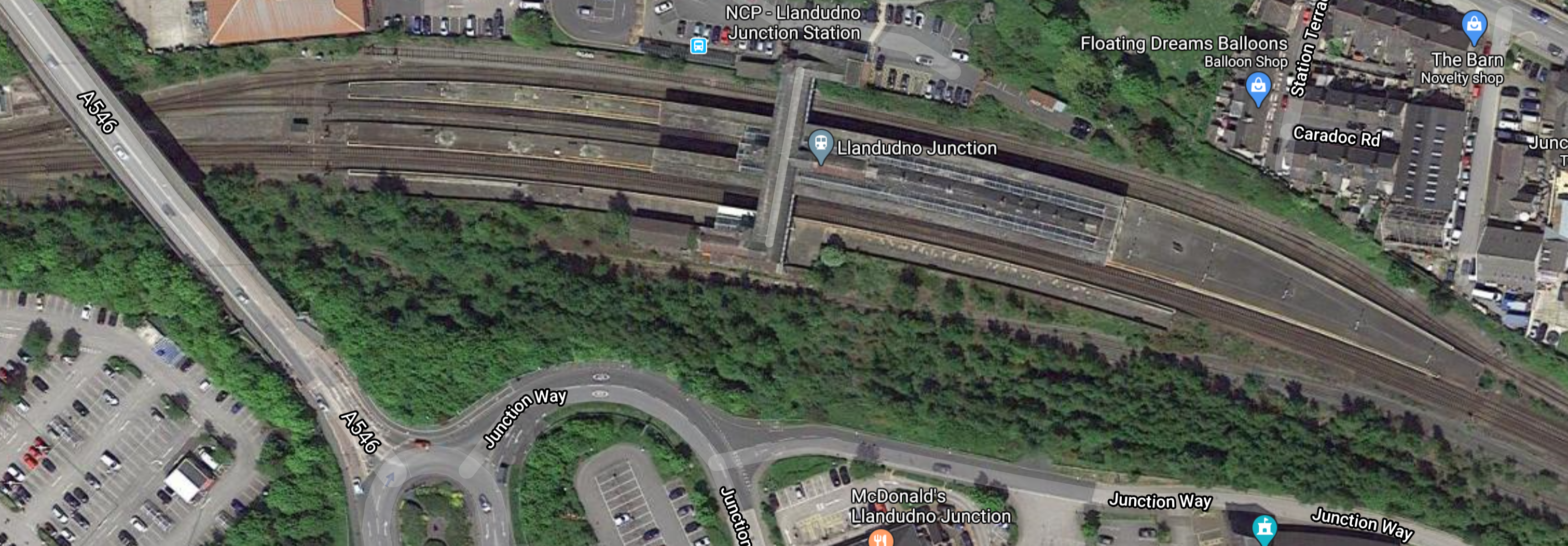
There is plenty of space.
As at Chester, the simple solution would be to electrify the platforms used by trains, that will need charging.
Butb there may also be a wider plan.
Llandudno Junction station is at the Western end of a string of five closely-spaced stations with Prestatyn station in the East.
- Llandudno Junction and Prestatyn are eight miles apart.
- Trains take twenty-three minutes to pass through this section.
- Some trains do a detour to Llandudno station before continuing.
- For part of the route, the railway lies between the dual-carriageway A55 road and the sea.
So why not electrify this section of railway between Llandudno Junction and Prestatyn stations?
- Either 750 VDC this-rail or 25 KVAC overhead electrification could be used.
- Prestatyn and Chester are 46 miles apart.
- Llandudno Junction and Holyhead are 40 miles apart.
If third-rail electrification were to be used, it might be advantageous to electrify to Llandudno station.
- It would be less intrusive.
- It would be quieter in an urban area.
- It would give the trains to Blaenau Ffestiniog trains a good charge.
But above all third-rail electrification might cost a bit less and cause less disruption to install.
Machynlleth
Machynlleth station is where the Aberystwyth and Pwllheli services split and join.
This Google Map shows the station.
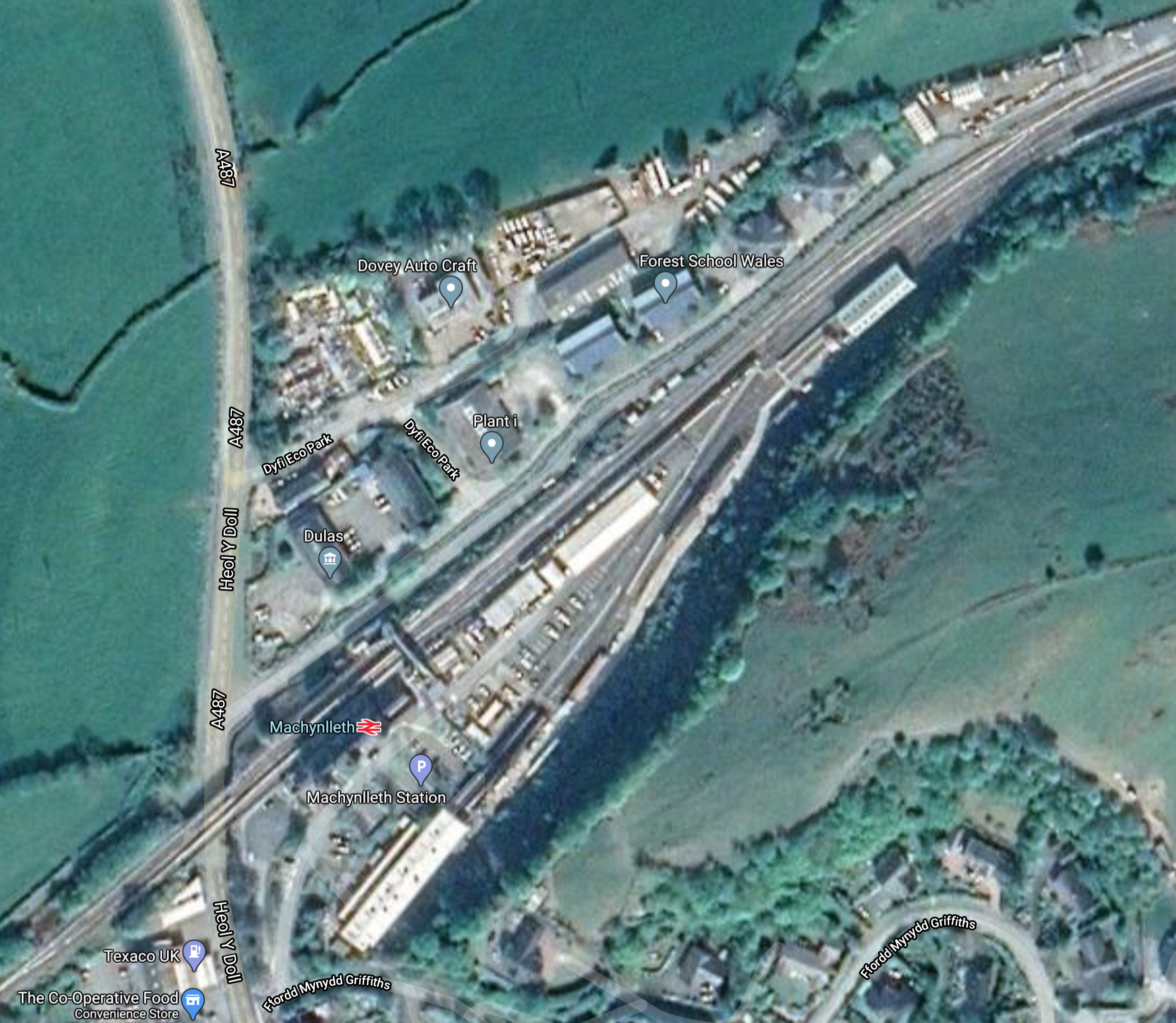
Consider.
- There is a train depot by the station.
- Will there be a good power supply at the station to charge the trains?
- Machnylleth and Pwllhelli are 58 miles apart.
- Machynlleth and Shrewsbury are 61 miles apart.
I think that Machynlleth might be pushing things too far, without extra stations with charging facilities.
One solution might be to develop the Riding Sunbeams concept and electrify the route between Newtown and Dovey Junction via Machynlleth, using third-rail technology powered-by solar or wind power.
Another solution would be batteries with a larger capacity.
Manchester Airport
Manchester Airport station is fully-electrified and ready for battery-electric trains.
Manchester Piccadilly
Manchester Piccadilly station is fully-electrified and ready for battery-electric trains.
Milford Haven
Milford Haven station only has a single terminal platform.
My comments would be similar to what, I said for Aberystwyth station. I would hope a standard solution can be developed.
Pembroke Dock
Pembroke Dock station only has a single terminal platform.
My comments would be similar to what, I said for Aberystwyth station. I would hope a standard solution can be developed.
Pwllheli
Pwhelli station is a only has a single terminal platform.
This Google Map shows the location of the station.
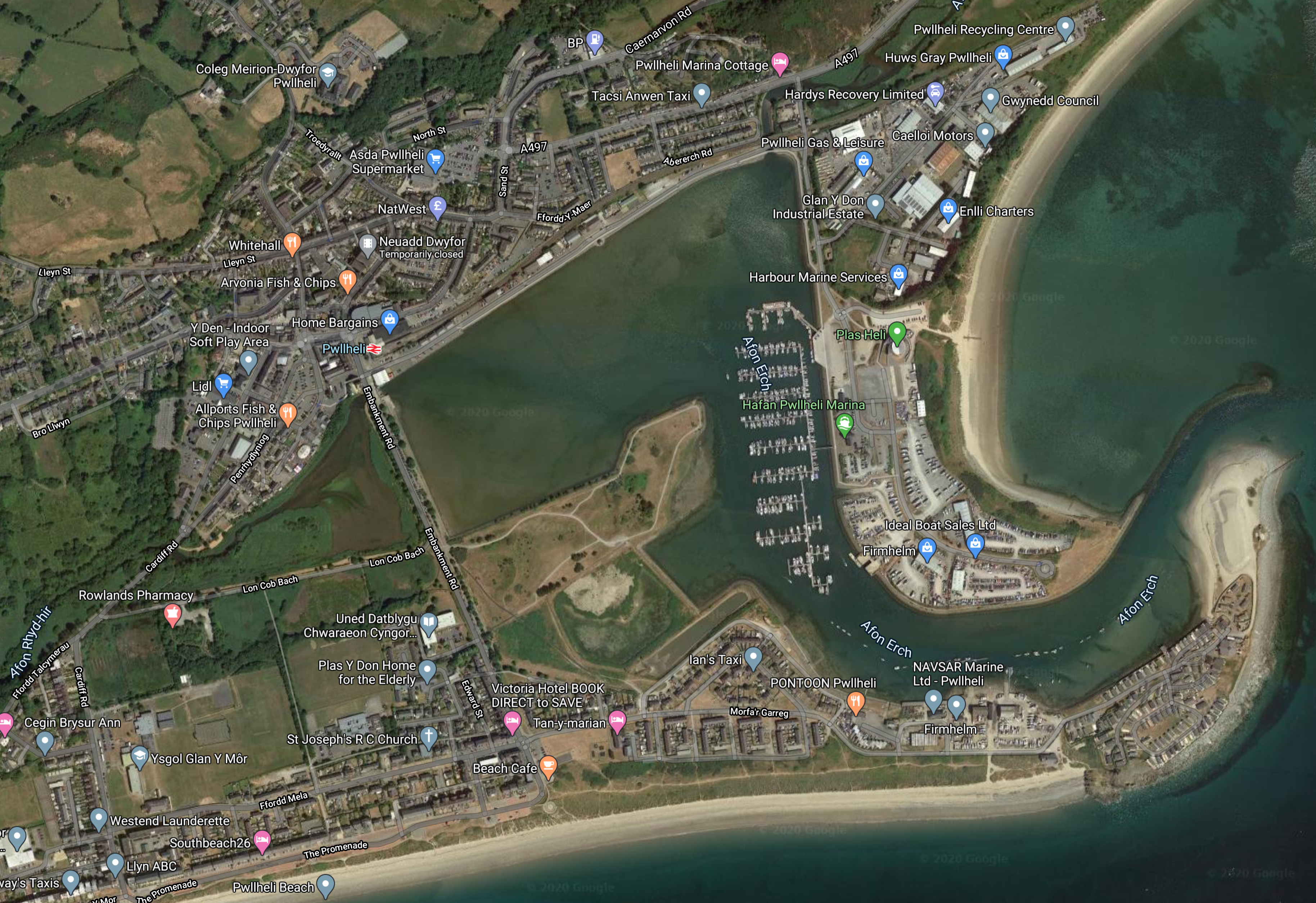
The stsation is at the North West corner of the bay.
My first reaction, when I saw this was that I have to go.
So I took a closer look at the station instead.

I suspect that fitting a charging facility into the station, wouldn’t be the most difficult of engineering problems. Although, there might be a problem getting a good enough connection to the National Grid.
Shewsbury
Shrewsbury station is a five-platform station.
This Google Map shows the station’s unusual location over the River Severn.
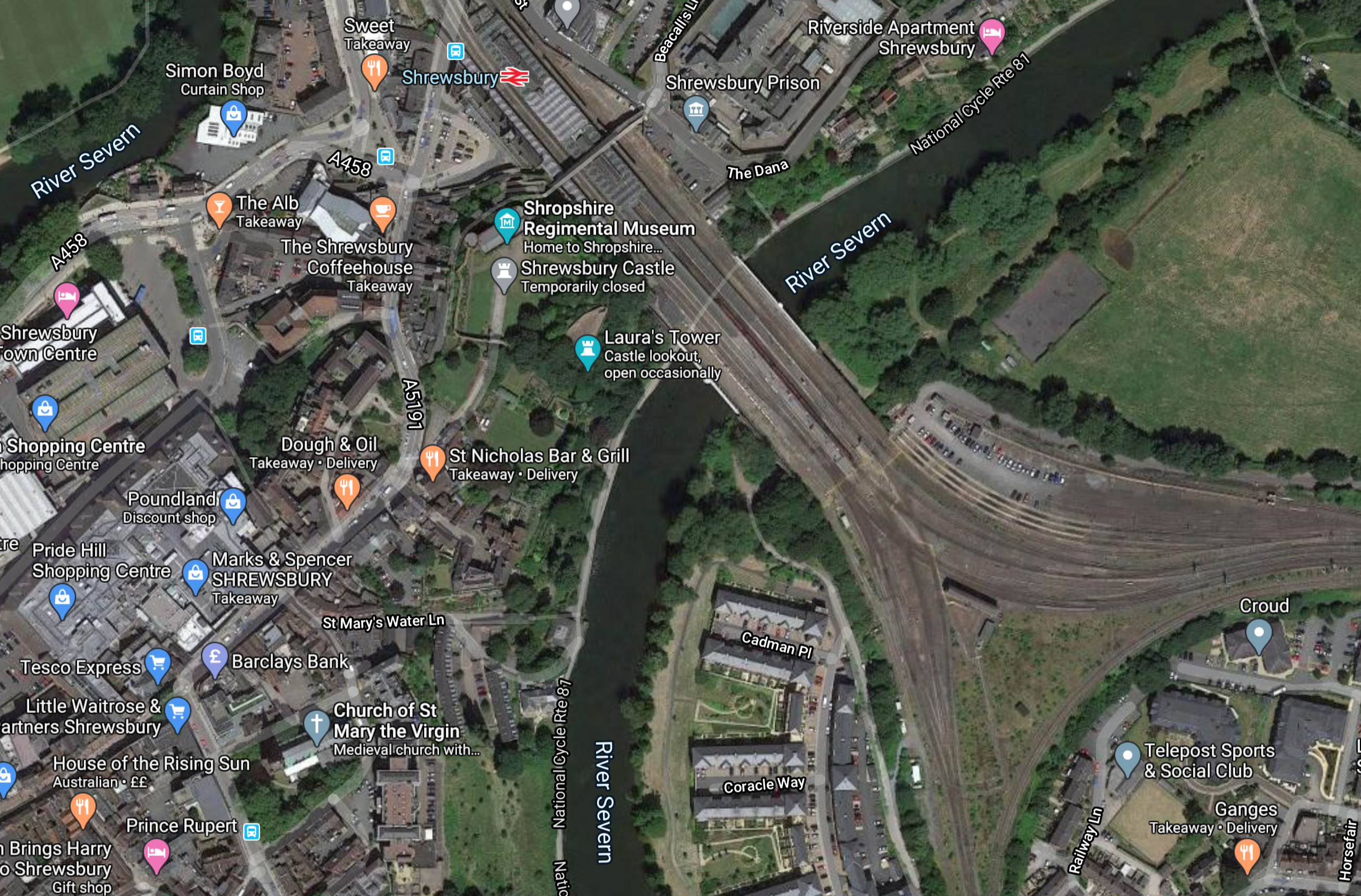
It must be one of few stations in the world, where trains enter the station from three different directions.
- From Crewe and Chester to the North.
- From Hereford and Wales to the South.
- From Birmingham and Wolverhampton in the East.
Adding electrification to all or selected platforms should allow trains to recharge and be on their way.
- Under current timetables, dwell times in Shrewsbury are up to eight minutes.
- I would suspect the train times could be adjusted, so that trains left the station with full batteries.
With battery-electric services to Aberystwyth, Birmingham International, Birmingham New Street, Cardiff Central, Chester, Crewe, Hereford, Holyhead, London Euston, Manchester, Pwllheli and Swansea, it will be a very important station.
Swansea
Swansea station has four terminal platforms.
A charging facility could be added to an appropriate number of platforms.
Or perhaps, the last few miles of track into the station should be electrified, so trains could charge on the way in, charge in the station and charge on the way out.
Third Rail Electrification
I have suggested in this post, that 750 VDC third-rail electrification could be used in several places.
I will repeat what I said earlier, when discussing Chester station.
- I’m an engineer, who deals in scientifically-correct solutions, not politically-correct ones, devised by jobsworths.
- Maintenance staff at the station will be familiar with the technology.
- Station staff and passengers will know about the dangers of third-rail electrification.
- Trains connect and disconnect automatically to third-rail electrification.
- Trains don’t have to stop to connect and disconnect, so passing trains can be topped-up.
- Hitachi with the Class 395 train and Alstom with the Class 373 train, have shown even trains capable of 140 mph can be fitted with third-rail shoes to work safely at slower speeds on lines electrified using third-rail.
- Modern control systems can control the electricity to the third-rail, so it is only switched on, when the train completes the circuit.
Third-rail electrification should be seriously considered.
A Standardised Terminal Solution
In this post, I mentioned that the following stations could be powered by a scandalised solution, as they are all one platform, terminal stations.
- Aberystwyth
- Blaenau Ffestiniog
- Fishguard Harbour
- Holyhead
- Milford Haven
- Pembroke Dock
- Pwllheli
The system might also be applicable at Carmarthen and Swansea.
My view is that Vivarail’s Fast Track charging based on third-rail technology would be ideal. I discussed this technology in Vivarail Unveils Fast Charging System For Class 230 Battery Trains.
Conclusion
With a bit of ingenuity, all train services run by Transport for Wales, can be run with battery-electric trains.
Discontinuous Electrification Through Leicester Station
Leicester station is an important station on the Midland Main Line
- Leicester is an urban area of half a million people.
- All of East Midlands Railway Intercity services call as they pass through the station.
- Leicester station is only sixteen miles North of the end of the Southern electrification at Market Harborough station.
- Birmingham New Street is 40 miles away.
- Clay Cross North Junction is 50 miles away.
- Derby is 29 miles away.
- East Midlands Parkway is 19 miles away.
- Long Eaton is 21 miles away.
- Nottingham is 27 miles away.
- Peterborough is 52 miles away.
- Sheffield is 66 miles away.
A sensible decision would probably be to extend the electrification from Market Harborough to a few miles North of Leicester, so that battery-electric trains could reach all the places in the above list.
Unfortunately, the following about the bridge at the Southern end of Leicester station, must be noted.
- The bridge doesn’t have sufficient clearance for electrification and would need to be rebuilt.
- It carries the main A6 road to London over the railway.
- The station building also spans the railway lines.
- To complicate matters, there is an important sewer either in or under the bridge.
This Google Map shows the bridge and the Southern end of the station.
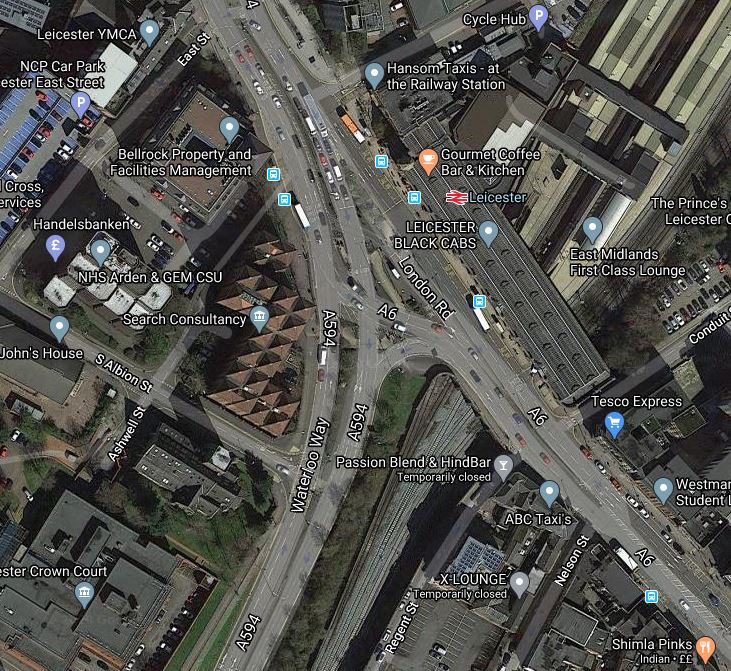
It looks to me, that Leicester station and the road, would have to be closed to traffic for some time, if the bridge were to be rebuilt, to allow the erection of electrification through the area.
A solution could be discontinuous electrification.
- The electrification from the South, would finish on the South side of bridge.
- The electrification from the North, would finish in Leicester station.
- Electric trains would cover the gap of a few hundred metres on battery power.
Pantographs could be raised and lowered, where the wires exist.
- On the North side of the bridge, this could be in Leicester station, whilst passengers are getting off and on the train.
- On the South side of the bridge, this could be as far South as Market Harborough, which is sixteen miles away.
The other big problem area of electrification on the Midland Main Line is North of Derby, where the railway runs through the World Heritage Site of the Derwent Valley Mills. There might be serious opbjections to electrification in this area.
- But if electrification were to be installed between Leicester and Derby stations, the following would be possible.
- The Midland Main Line would be electrified at East Midlands Hub station.
- Power could be taken from High Speed Two’s supply at East Midland Hub station.
- Battery-electric trains could do a return trip to Nottingham from an electrified East Midlands Parkway, as it’s only sixteen miles in total.
- Battery-electric trains could reach the High Speed Two spur into Sheffield at Clay Cross from Derby, as it’s only twenty-one miles.
I am assuming, that Hitachi’s Class 810 trains will have range of over fifty miles on battery power, which fits with Hitachi’s statements.
Conclusion
Discontinuous electrification and batteries on trains can solve the problem of electrification through Leicester station.
Also. electric trains could run between London and Sheffield, if the following were done.
- The Class 810 trains were to be given a range of twenty-five miles
- Electrification were to be erected between Leicester and Derby stations.
- Electrification were to be erected between Sheffield and Clay Cross Junction, as required by High Speed Two.
The electrification could be brought forward, to bring Sheffield early benefits of High Speed Two.
Solar Firm To Develop Novel Electronics For Rail Renewables
The title of this post is the same as that of this article on Engineering and Technology.
This is the introductory paragraph.
Solar energy company Riding Sunbeams has won funding to develop power electronics technology that will enable it to feed renewable electricity directly into railway overhead wires.
Because solar panels and lithium-ion batteries work in DC and overhead electrification works in AC, this sentence describes the main objective of the project.
The Daybreak demonstrator will repurpose existing technology already being used on UK rail networks for other purposes to create a new device that will provide the required power conversion.
Existing technology and equipment will be used to save time and costs and because it is already rail-certified.
The rest of the article fleshes out a few details.
The test system will be installed at Quinton Rail Technology Centre at Long Marston.
This is the closing paragraph.
In particular, Riding Sunbeams hopes its technology will be able to play a part in delivering 70MW of direct-wire renewable generation to help power the soon-to-be-electrified Core Valley Lines in South Wales through a mixture of solar, wind and energy storage.
As electrification in the Core Valley Lines will be discontinuous, it could appear that the technology developed in this project could help connect and reduce costs.
Steventon Listed Railway Bridge Saved From Demolition
The title of this post, is the same as that of this article on the BBC.
On the face of it it looks like victory for the Nimbys, who have saved a rather ordinary and possibly decrepit bridge from demolition.
But I believe there is more to this story than meets the eye.
The Bridge
The bridge at the centre of the argument may be Grade 2 Listed, but there are lots of similar bridges on UK railways in better condition with similar heritage, that don’t have a listing.
Type “steventon bridge electrification” into a search engine and you’ll find lots of images of the bridge.
- One picture shows, the bridge with the railway flooded, which puts an interesting slant on the debate. What are the foundations like?
- Notice, that the bridge seemed to suffer a rather botched repair at the hands of British Rail’s finest engineers.
- Having read a lot about this story, I suspect that the locals’ main reason for objecting, is that they don’t want the disruption, whilst it is rebuilt.
- Incidentally, I suspect Great Western Railway don’t want the bridge rebuilt either, as closure will be a long disruption to all services.
I have been involved in the refurbishment of several buildings of around the same age or even older than the bridge. This is the sort of construction, that will have to be replaced at some time. If it’s not replaced, some of the novel techniques that are now available to Network Rail will have to be applied.
Network Rail
The article says this about Network Rail’s solution to the problem.
But following what the company described as ‘extensive and breakthrough testing’ using computer simulations it found a speed reduction to 110mph through the village meant wires could pass underneath the existing bridge.
I do think, that 110 mph is rather convenient. if you look at the maximum operating speeds of trains and locomotives that will pass through.
- Class 801 train with digital signalling -140 mph
- Class 801 with conventional signalling – 125 mph
- Class 800/802 train on diesel power – 100 mph
- Class 80x train on battery power – 100 mph
- Class 387 train – 110 mph
- Class 90 locomotive – 110 mph
- Class 91 locomotive – 125 mph
- Class 93 locomotive – 110 mph
- High Speed Train – 125 mph
Very few trains will have to slow down.
Any train that used onboard power, like a High Speed Train or a Class 80x with batteries, could theoretically go through at the maximum speed, track, signalling and train taken together would allow.
Hitachi
In Issue 898 of Rail Magazine, there is an article, which is entitled Sparking A Revolution, which describes Hitachi’s work and plans on battery-powered trains. This is an extract.
Battery power can be used as part of electrification schemes, allowing trains to bridge the gaps in overhead wires where the costs of altering the infrastructure are high – in tunnels or bridges, for example. This would also have the immediate benefit of reducing noise and emissions in stations or built-up areas.
Elsewhere in the article, it is said that Hitachi trains will be able to do 100 mph on battery power for up to 60 miles.
But would they be able to do 125 mph on battery power for perhaps five miles? I can’t see why not!
The Google Map shows the track through Steventon.
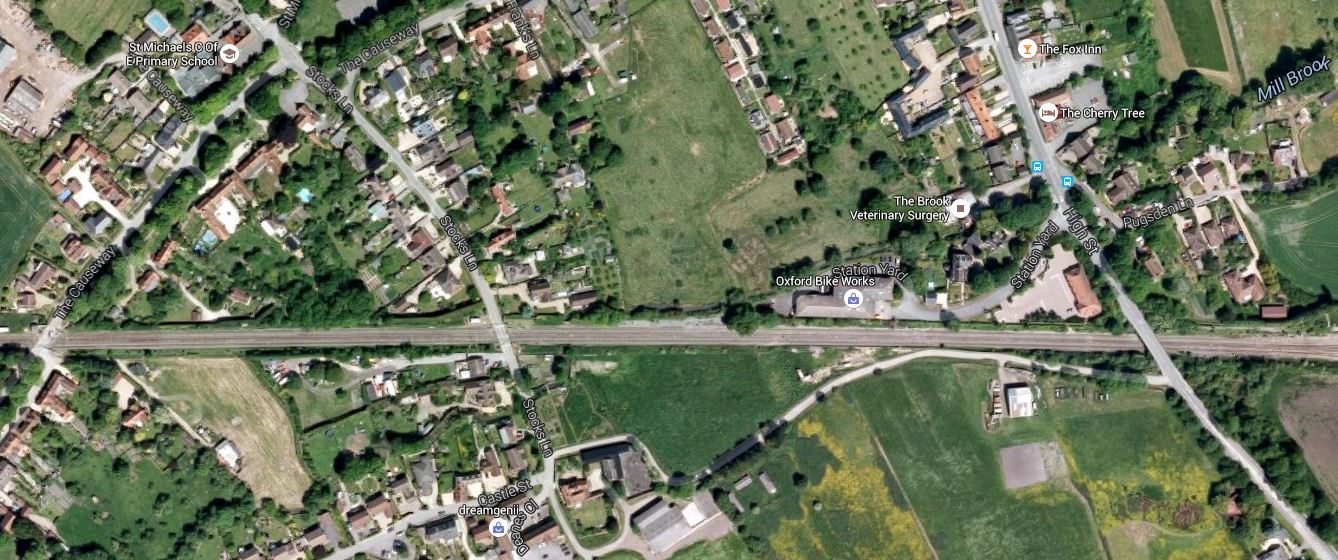
Note.
- The bridge in question is at the East.
- There are also a couple of level crossings in this stretch of track, where the height of wires is also regulated.
Perhaps, the pantograph should be dropped before going through section and raised afterwards, with power in the section taken from a battery.
Avoiding obstacles like this, may be an economic alternative, but it does require that all electric trains using the section are able to use battery power.
I have a feeling, I’ve read somewhere that a Class 88 locomotive can do a similar trick using the onboard diesel engine.
As a Control Engineer, who trained in the 1960s, I would expect that all pantographs can now be raised or lowered with all the precision and repeatability of an Olympic gold-medal gymnast!
I do wonder, if the Great Western Electrification Project had been designed around discontinuous electrification and battery-electric trains, the project would have gone better.
For instance, the Severn Tunnel is 7,000 metres long and trains take under four minutes to pass through. The Wikipedia entry for the tunnel has a section on Electrification, which details the complicated design and the trouble that there has been with corrosion.
Given that battery-electric trains have other advantages, design by hindsight, says that a tunnel without electrification and battery trains may have been a better solution.
Conclusion
Network Rail and Hitachi will get the speed of trains through Steventon up to 125 or even 140 mph, possibly by using battery power.
But whatever happens, I’m certain that the bridge will have to be rebuilt! It has the air of a derelict house, that will suck up all your money.
Will High Speed Two’s Classic-Compatible Trains Have Battery Operation?
I believe it is very likely, that High Speed Two’s new classic-compatible trains will have battery capabilities.
- Batteries would handle energy generated by regenerative braking.
- Batteries would give a train recovery capability in case of overhead catenary failure.
- Batteries would be used for depot movements.
- Batteries would probably improve the energy efficiency of the trains.
Effectively, the batteries would power the train and would be topped-up by the electrification and the regenerative braking.
But would they be able to give the trains a route extension capability on lines without electrification?
Consider.
- Battery technology is getting better with energy capacity per kilogram increasing.
- Batteries will be full, when the train leaves the electrification.
- These trains will be as light as possible.
- Trains will not be running at speeds in excess of perhaps 100 mph without electrification.
- Fast charging can be provided at station stops.
I think, that trains could be able to do at least 40 to 50 miles on a full charge.
Fast Charging Technology
The most promising fast-charging technology is Vivarail’s system of using a length of conventional third-rail connected to a bank of batteries. When the train connects with the third-rail, electricity flows to the batteries on the train.
There are also others working on systems that use short lengths of overhead electrification.
Both systems can be totally automatic and safe.
Example Routes
These are three possible example routes.
Aberdeen And Edinburgh
These are the distances between stops on the route between Aberdeen and Edinburgh.
- Aberdeen and Stonehaven – 12 miles
- Stonehaven and Montrose – 24 miles
- Montrose and Arbroath – 14 miles
- Arbroath and Dundee – 17 miles
- Dundee and Leuchars – 8 miles
- Leuchars and Kirkaldy – 25 miles
- Kirkcaldy and Inverkeithing – 13 miles
- Inverkeithing and Edinburgh – 13 miles
It is a total of 130 miles without electrification.
The route is also generally flat and mainly along the coast.
Inverness And Edinburgh
These are the distances between stops on the route between Inverness and Strirling.
- Inverness and Aciemore- 35 miles
- Aviemore and Kingussie – 12 miles
- Kingussie and Pitlochry – 43 miles
- Pitlochry and Perth – 30 miles
- Perth and Gleneagles – 15 miles
- Gleneagles and Stirling – 17 miles
It is a total of 152 miles without electrification.
As there are some steep gradients, there may be a need for some electrification in certain sections of the route.
Holyhead And Crewe
These are the distances between stops on the route between Holyhead and Crewe
- Holyhead and Bangor – 25 miles.
- Bangor and Llandudno Junction – 16 miles
- Llandudno Junction and Colwyn Bay – 4 miles
- Colwyn Bay and Rhyl – 10 miles
- Rhyl and Prestatyn – 4 miles
- Prestatyn and Flint – 14 miles
- Flint and Chester – 13 miles
- Chester and Crewe – 21 miles
It is a total of 105 miles without electrification.
The route is also generally flat and mainly along the coast.
A Stepping-Stone Approach
I believe there is a design of fast charger, that in say a three minute stop can charge the battery sufficient to get to the next station. The electrification might continue for perhaps a couple of hundred metres from the station on the tracks where the trains are accelerating.
A train making a stop at a station would do the following.
- As it approaches the stop, the train’s kinetic energy is turned into electricity by the regenerative braking.
- This energy is stored in the batteries.
- In the station, the batteries are charged from the fast charger or electrification.
- Whilst stopped, the batteries provide the power for the train’s systems.
- Accelerating away would use the batteries or electrification if it is installed.
The train’s computer would monitor the batteries and control the various power systems and sources to run the train in the most efficient manner.
This sequence would be repeated at each stop as the train progressed to its destination.
Extra Electrification
In the section on the challenging Edinburgh and Inverness route, I said that some gradients would probably need to be electrified to maintain progress.
But there are other sections, where electrification has been suggested.
- Stirling and Perth
- Crewe and Chester
So could we be seeing a mixture of electrification and charging stations on routes to allow electric trains to serve routes, where full electrification is impossible for practical, scenic, heritage or cost reasons?
The South Wales Metro is to use discontinuous electrification to save the cost of rebuilding innumerable bridges.
Conclusion
I believe that engineers can design high speed trains, that will be able to run on existing lines using battery power to serve the remoter parts of Great Britain.
More On Discontinuous Electrification In South Wales
In the July 2018 Edition of Modern Railways, there is an article entitled KeolisAmey Wins Welsh Franchise.
This is said about the electrification on the South Wales Metro.
KeolisAmey has opted to use continuous overhead line equipment but discontinuous power on the Core Valley Lnes (CVL), meaning isolated OLE will be installed under bridges. On reaching a permanently earthed section, trains will automatically switch from 25 KVAC overhead to on-board battery supply, but the pantograph will remain in contact with the overhead cable, ready to collect power after the section. The company believes this method of reducing costly and disruptive engineering works could revive the business cases of cancelled electrification schemes. Hopes of having money left over for other schemes rest partly on this choice of technology.
Other points made include.
- A total of 172 km. of track will be electrified.
- The system is used elsewhere, but not in the UK.
- Disruptive engineering works will be avoided on fifty-five structures.
- Between Radyr and Ninian Park stations is also proposed for electrification.
Nothing is said about only electrifying the uphill track, which surely could be a way of reducing costs.
Ystrad Mynach To Rhymney
The article also states that on the Rhymney Line, the section between Ystrad Mynach and Rhymney stations will be run on batteries.
- The distance is about ten miles.
- The altitude difference is is about 125 metres.
- The station area at Rhymney station will be electrified.
- Rhymney will be an overnight stabling point.
- Trains will change between overhead and battery power in Ystrad Mynach station.
- Trains could charge the batteries at Rhymney if required.
Effectively, there is a avoidance of at least fourteen miles of electrification.
- Four miles of double track between Ystrad Mynach and Bargoed.
- Six miles of single track between Bargoed and Rhymney.
But as Rhymney to Ystrad Mynach currently takes about fourteen minutes, there will have to be some extra double-track, so that the required frequency of four trains per hour (tph) can be achieved.
None of this extra track will need electrification.
As the trains working the Rhymney Line will be tri-mode Stadler Flirts, with the capability of running on electricity, diesel or battery, I don’t think that KeolisAmey are taking any risks.
The Merthyr Line
The Merthyr Line splits North of Abercynon station into two branches to Aberdare and Merthyr Tydfil stations.
- South of Abercynon the branch is double-track.
- Both branches are single track.
- The Aberdare branch is about eight miles long.
- Aberdare is around 40 metres higher than Abercynon.
- Trains take 27 minutes to climb between Abercynon and Aberdare stations and 21 minutes to come down.
- The Merthyr Tydfil branch is about ten miles long
- Merthyr Tydfil is around 80 metres higher than Abercynon.
- Trains take 27 minutes to climb between Abercynon and Merthyr Tydfil stations and 21 minutes to come down.
If the proposed four tph are to be run on these branches, there would need to be some double-tracking North of Abercynon.
Will both tracks be electrified, or will it be possible with just electrifying the uphill track?
The Rhondda Line
The Rhondda Line splits from the Merthyr Line to the North of Pontypridd station and goes North to Treherbert station.
- South of Porth station, the line is double-track.
- North of Porth station, the line is single-track with a passing loop at Ystrad Rhondda station.
- Treherbert is 90 metres higher than Porth..
- Trains take 28 minutes to climb between Porth and Treherbert and 20 minutes to come down.
If the proposed four tph are to be run on this branch, there may need to be some double-tracking North of Porth.
Will both tracks be electrified, or will it be possible with just electrifying the uphill track?
Conclusion
I suspect there’ll be more savings, as the engineers get to grips with the capabilities of battery trains and discontinuous electrification.
As I said, will it be necessary to electrify downhill tracks?
The tri-mode Stadler Flirts and the Stadler Citylink Metro vehicles could use regenerative braking to their batteries.
The use of gravity in this way to charge the batteries, would increase the efficiency of the South Wales Metro.
Caerphilly Station
Caerphilly station is an important one on the South Wales Metro.
The current service is a four trains per hour (tph) service to Cardiff Queen Street and Cardiff Central stations. Some trains travel through to Penarth station
In 2023, the service will be upgraded.
- Two tph between Barry Island and Rhymney stations via Cardiff Central.
- Two tph between Bridgend and Rhymney stations via Cardiff Central and Rhoose Airport
- Two tph between Penarth and Caerphilly stations via Cardiff Central.
In 2023, the service will be three minutes quicker to and from Cardiff.
In addition, note the following about Caerphilly station.
- The station is on the Rhymney Line, which will be worked by Tri-Mode Stadler Flirts.
- The station lies just to the North of the Caerphilly Tunnel, which is not being electrified and trains are expected to transit using battery power.
- The station has a bay platform.
- The station appears to be a hub for buses.
This Google Map shows the station.
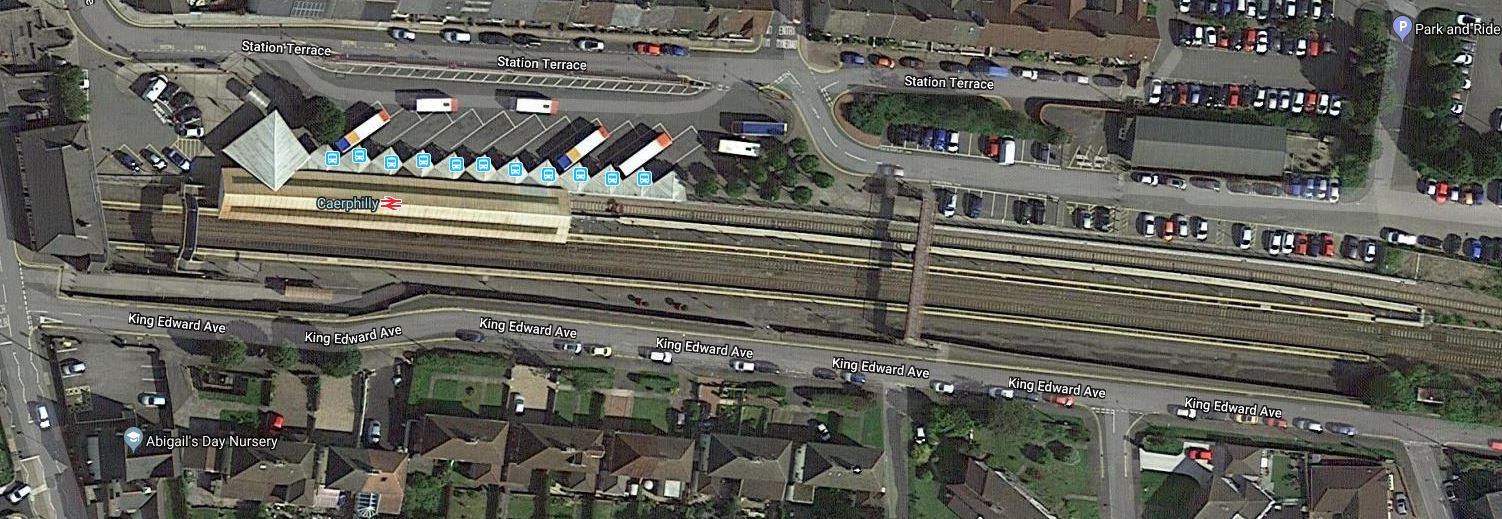
Note.
- The long bay platform on the North side of the station. It may be long enough to accommodate two of the Tri-Mode Stradler Flirts, which are 65/80 metres long. This means that the bay platform could be very valuable for service recovery.
- The station serves as a Park-and-Ride.
- Three structures cross the track, which from the left are the old station buildings, the station footbridge and a footbridge independent from the station.
- Looking at the track layout on the Eastern approach to the station, the cross-overs are within fifty metres of the platform end.
These pictures show the station.
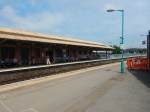
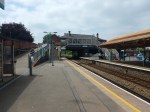
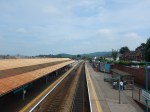
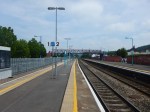
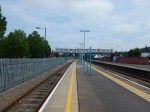
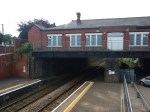
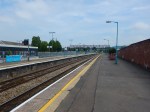

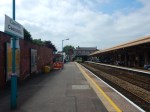

These are my thoughts on various issues.
Electrification Under The Bridges And The Old Buildings
I think there would be serious issues with standards for electrification at this station.
The three structures will have to be handled in the way I described in How Can Discontinuous Electrification Be Handled?
The Old Station Building
The old station building is integral with a road bridge and would be a costly and very disruptive operation to replace.
So if the structure will safely last a hundred years or so and the wires can be squeezed underneath using discontinuous methods, everybody wins.
The Easternmost Footbridge
The Easternmost bridge at the far end of the platforms looks to be a fairly recent structure and is independent of the station, as it just gives pedestrians a route across the railway. It might even have been built, when the bay platform was built a few years ago.
The Station Footbridge
So that leaves the elderly footbridge, which probably dates from 1871, when the station was moved to its present position.
It is the main way that passengers cross the line and given that Caerphilly station has nearly a million passengers a year, it would be classed by disabled activists as a disgrace.
A few stations up the line, lifts were added to the footbridge at Ystrad Mynach station, in conjunction with other works. Wikipedia says this.
In 2014, the station underwent a £1.6 million refurbishment with new ticket machines, waiting areas and ticket office, with disabled toilet being installed in addition to major work carried out on the footbridge with lifts being installed to improve accessibility.
Surely some of the money saved on electrification could be spent on improving access?
Electrification Between The Structures
25 KVAC wires have to be several metres away from any staff and passengers.
The Northbound Platform 3 is wide and if the overhead wire can be suspended high enough, I suspect that the latest regulations can be met.
The Southbound Platform 2 is narrower and the platform has a low roof, which might mean electrification is trickier.
But if as I suspect, battery power and gravity will be used to power the trains on the downhill track, then there could be a case for leaving the downhill track without wires.
That could save half the costs on some sections of the route.
Electrification Of The Crossover
On a railway with full electrification all crossovers must be electrified..
But on the Rhymney Line, all the trains will be Swiss all-purpose trains, that can work on all power sources, probably including cuckoo-clock motors.
So imagine a Tri-Mode Stadler Flirt arriving from Penarth, which will be turning back in the bay platform at Caerphilly.
- It would use the electrification between the unelectrified Caerphilly Tunnel to just before the crossover to come up the hill and probably add some charge to the batteries, that have been depleted in the run through the mile-long tunnel.
- \\\the train would probably rate at a signal just before the crossover, until told to proceed by the signalling system.
- The pantograph will be dropped and the train switched to battery or diesel power.
- When giving the green by the signal, the train would move into the bay platform.
All done efficiently and safely without any electrification, which would not be installed on the crossover or in the bay platform.
Train Failure In The Caerphilly Tunnel
There will have to be a plan for handling train failures in the tunnel. I suspect that as Switzerland has lots of railways in the mountains, some with extensive tunnels, that the Swiss have pretty good methods for dealing with failures.
One Train Rescues Another
Trains are generally designed, so that a second train can rescue a failed train of the same class or even a similar type. This makes good sense, as a train operator generally has several trains of the same type and their Thunderbird locomotive may be working miles away.
I’m sure that the Tri-Mode Stadler Flirts will have this capability.
Rescuing A Train Going Downhill
If a train should fail in the Caerphilly tunnel on the downhill track, a second train would probably couple up and shepherd the train slowly down the hill to the depot at Canton.
Rescuing A Train Going Uphill
If a train should fail in the Caerphilly tunnel on the downhill track, a second train would probably couple up and push the stricken train into the bay platform at Caerphilly station.
Conclusion
The more I look at the South Wales Metro, it has been designed in an holistic manner with routes, tracks, electrification, stations and trains all designed to work together.
How Can Discontinuous Electrification Be Handled?
On the proposed South Wales Metro, it is proposed to use discontinuous electrification to avoid rebuilding a lot of bridges and other structures.
This document on the KeolisAmey web site details their plans for the new Wales and Borders Franchise.
The document states this about the electrification.
Discontinuous overhead line electrification to 25 KVAC with permanently earthed sections around restricted structures, saving 55 interventions e.g. rebuilding bridges/no need for wire in Caerphilly tunnel.
So how are these interventions avoided?
The Karlsruhe Solution
On the Karlsruhe Stadbahn, similar Citylink vehicles to those proposed for Cardiff need to work on both the main line 15 KVAC used in Germany and the 750 VDC used by Karlsruhe trams.
To isolate the two voltages, a ceramic rod is placed in the catenary. The vehicle’s pantograph just rides across the voltage boundary and the vehicle’s electrical system uses whatever voltage is present.
Bridges On The South Wales Metro
These pictures show some of the types of bridges on the Cardiff Valleys Lines.

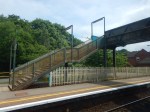
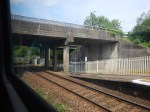


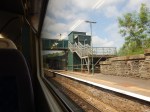
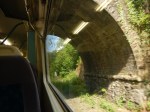

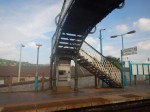


They are a real assortment.
- Some station footbridges from the Victorian era with nice castings and decoration, but no much-needed step-free access.
- Some quality brick and stone arch bridges.
- British Rail-era steel bridges, with no architectural merit
- Some modern road bridges in steel and concrete.
I also saw sizeable pipelines over the railway, which would need to be raised.
The greatest number were simple steel bridges like the one at Caerphilly station, designed to get pedestrians and cyclists, who were not using the railway, from one side of the tracks to the other.
I suspect the simplest way would be to erect two standard gantries at a safe distance of a few metres either side of the structure.
Between the two gantries would be an conductor, like this one. that I photographed in the Berlin Hauphtbahnhof.

It would be earthed, so that it offered no danger to life. There could even be extra supports under the bridge.
At each end, it would be connected to the 25 KVAC using a ceramic rod or other insulating device.
The vehicle’s pantograph would then ride from one side of the bridge to the other on its own track without being lowered.
Anything electrified at 25 KVAC would be kept at a very safe distance from the bridge.
In the earthed section, when the vehicle would be receiving no power, the vehicle would automatically switch to battery power. There would be no driver action required, except to monitor it was all working as it should.
As on the South Wales Metro, it appears that all vehicles using the lines proposed to be electrified will have their own onboard batteries, there shouldn’t be any problem.
In some ways, this discontinuous operation is a bit like using your laptop connected to the mains. When say the cleaner pulls out the plug to put in the vacuum cleaner, your laptop switches automatically to the battery.
The Caerphilly Tunnel
The Caerphilly tunnel is over a mile long. This picture shows the tunnel entrance.

It would probably be possible to electrify using a rail in the roof, but why bother if the trains running through the tunnel could go from one end to the other on their own battery power?
Trains could lower the pantograph before entry and then raise it again, when under the electrification at the other end.
This could be performed automatically using a GPS-based system.
I have also had an e-mail, which said this.
As I understand Caerphilly will have a natural bar in it but be much closer to the train roof than would be allowed with a live one.
Now there’s an idea!
A composite or earthed metal rail would be fixed to the roof of the tunnel, so that the pantograph could run smoothly from one electrified section on one side of the tunnel to the electrification on the other side, using battery power all the way.
Cost Savings
In Novel Solution Cuts Cardiff Bridge Wiring Cost, I talked about another method applied in South Wales to avoid rebuilding a bridge.
At this bridge, traditional electrification methods were used, but the need to demolish the bridge was avoided by using advanced insulation and protection measures.
This was my final statement.
Network Rail reckon that the solution will save about £10 million on this bridge alone, as it avoids the need for an expensive rebuild of the bridge.
The savings on this bridge will be higher as it is a large bridge over several tracks, but even saving a million on each bridge in the South Wales Metro is £55 million, which will probably be enough to build much of the infrastructure to extend to The Flourish, which would appear to not need expensive viaducts or electrification.
Should Downhill Tracks Be Left Without Electrification?
I think this may be possible on the South Wales Metro, as vehicles coming down the hills could use gravity and small amounts of battery power.
Regenerative braking would also be continuously charging the batteries.
It would certainly be simpler, than having to constantly swap between overhead and battery power on the descent, where the electrification was discontinuous.
As the lines are going to have a more intensive service, there will be additions of a second track in places to allow trains to pass.
Any electrification that could be removed from the project would be beneficial in terms of building and operational costs.
Other Routes
This post has used the South Wales Metro as an example, but I don’t see any reason, why the discontinous method and that used on the Cardiff Bridge can’t be applied to other bridges and structures over the lines on other routes in the country.
I suspect, that if they’d been used on the Gospel Oak to Barking Line, electric trains would have been running months ago!
Conclusion
Look what you get with thinking, when you have a Bonfire of the Boxes!
 The Anonymous Widower