The Missing Link At St. Pancras Station
This picture was taken inside St. Pancras station.
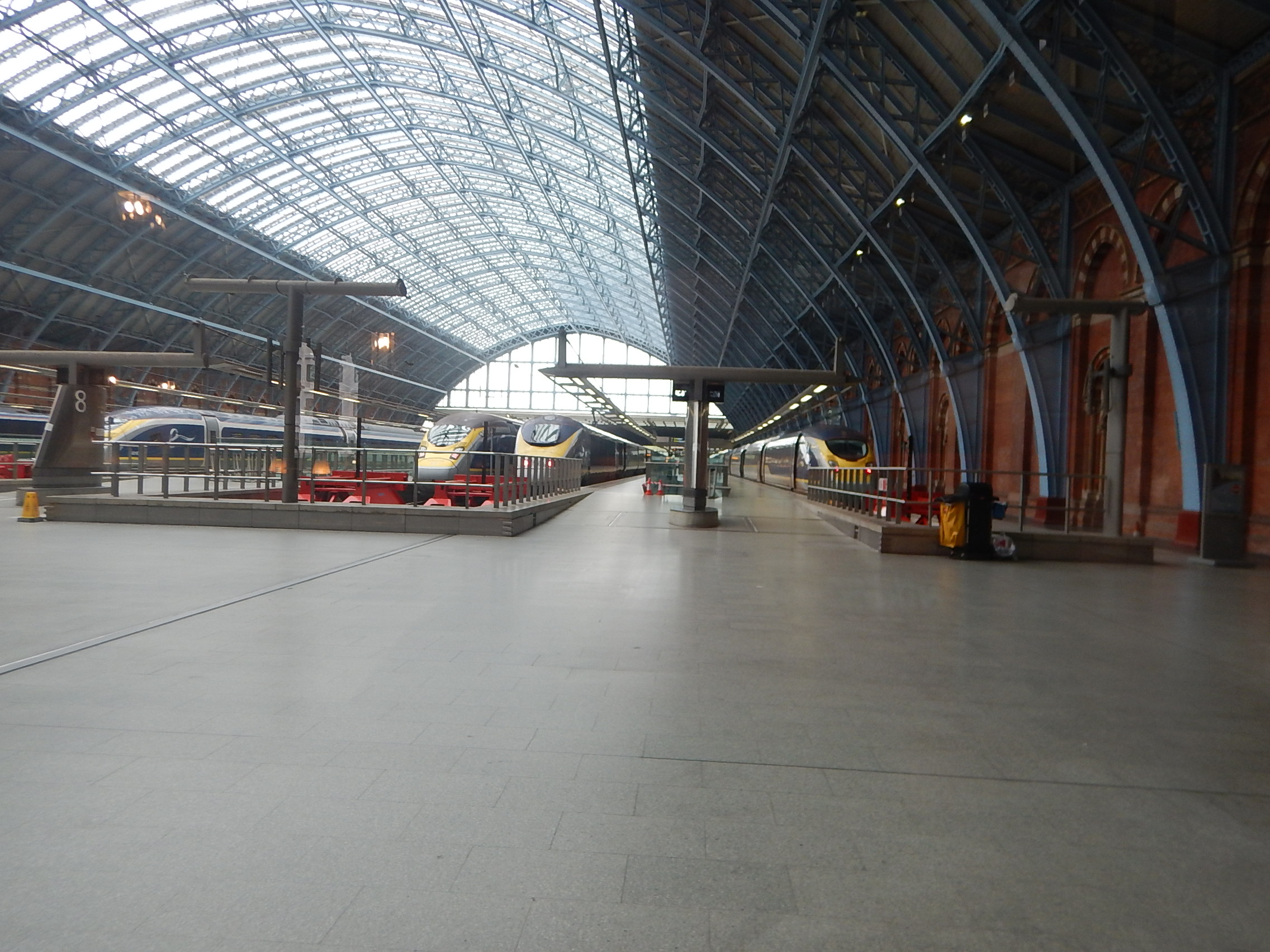
I was standing in front of the glass security wall, towards the East (Kings Cross) side of the station.
On the British Library side of the station it is possible to walk along to the four platforms for East Midlands Railway trains.
I wonder why, there isn’t a link down the Kings Cross side of the station, so that it would be possible to walk from the front of the station to the Souyjeastern HighSpeed commuter routes.
Bombardier And Hitachi Come Up With Similar Car Lengths
In an article in the October 2019 Edition of Modern Railways, which is entitled EMR Kicks Off New Era, more details of the new Hitachi bi-mode trains for East Midlands Railway are given.
This is said.
The first train is required to be available for testing in December 2021 with service entry between April and December 2022.
The EMR bi-modes will be able to run at 125 mph in diesel mode, matching Meridian performance in a step-up from the capabilities of the existing Class 80x units in service with other franchises. They will have 24 metre vehicles (rather than 26 metres), a slightly different nose to the ‘800s’ and ‘802s’, and will have four diesel engines rather than three.
I will examine this extract further.
Car Length
If you look at Bombardier’s Class 720 train, the five-car trains are 122 metres long, giving a 24 metre car length.
The ten car Class 720 train is 243 metres long, which is a similar length to three Class 360 trains running as a twelve-car train and only a few metres longer than three Class 321 trains running together.
This must be good for Greater Anglia’s train renewal, as it will minimise expensive platform lengthening.
It looks to me, that two of the new EMR InterCity trains running as a pair will be of a similar length to a twelve-car formation of Class 360 trains.
Consider.
- As trains for EMR InterCity and EMR Electrics will share platforms at some stations, platform lengthening will again be minimised.
- If you divide 240 by 10, you usually get the same answer of 24.
- But if 26 metre cars were to be used, a nine-car EMR bi-mode would be 234 meres long. and two five-car trains working together would be 260 metres long.
- Twelve-car Class 700 trains are 242.6 metres long.
These points lead me to believe that 24 metre cars are a better length for the Hitachi trains as ten-car formations are the same length as twelve-car formations of many of the UK’s older multiple units.
Maximum Speed On Diesel
Consider.
- Various places on the Internet say that the maximum speed on diesel of a Class 800 train is 118 mph.
- Maximum speed of a train is probably more determined by the aerodynamic drag of the train, which is proportional to the square of the speed.
- So if a Class 800 train needs 3 * 560 kW to maintain 118 mph, it will need 1885 kW or 12.2 percent more power to maintain 125 mph
- A fourth 560 kW diesel engine will add 33.3 percent more power.
This rough calculation shows that a fourth engine will allow the train to more than attain and hold 125 mph on the same track where a Class 800 train can hold 118 mph.
But adding a fourth engine is a bit of a crude solution.
- It will add more dead weight to the train.
- It will be useful when accelerating the train, but probably not necessary.
- It will add more noise under the train. Especially, if four cars had engines underneath.
- It could cause overheating problems, which have been reported on the current trains.
I’ll return to this later.
Aerodynamics
Power required to maintain 125 mph can be reduced in another much more subtle way; by improving the aerodynamics.
- I have stood on a platform, as an Aventra has silently passed at speed. It is very quiet, indicating that the aerodynamics are good.
- But then Bombardier are an aerospace company as well as a train builder.
I’ve no idea if a Bombardier Class 720 train has less aerodynamic drag, than a Hitachi Class 800 train, but I’m sure that aerodynamic wizards from Formula One could improve the aerodynamics of the average modern train.
Could better aerodynamics explain why the EMR InterCity bi-modes are stated to have a different nose?
Look at the noses on these Spanish High Speed trains, which were built by Talgo!
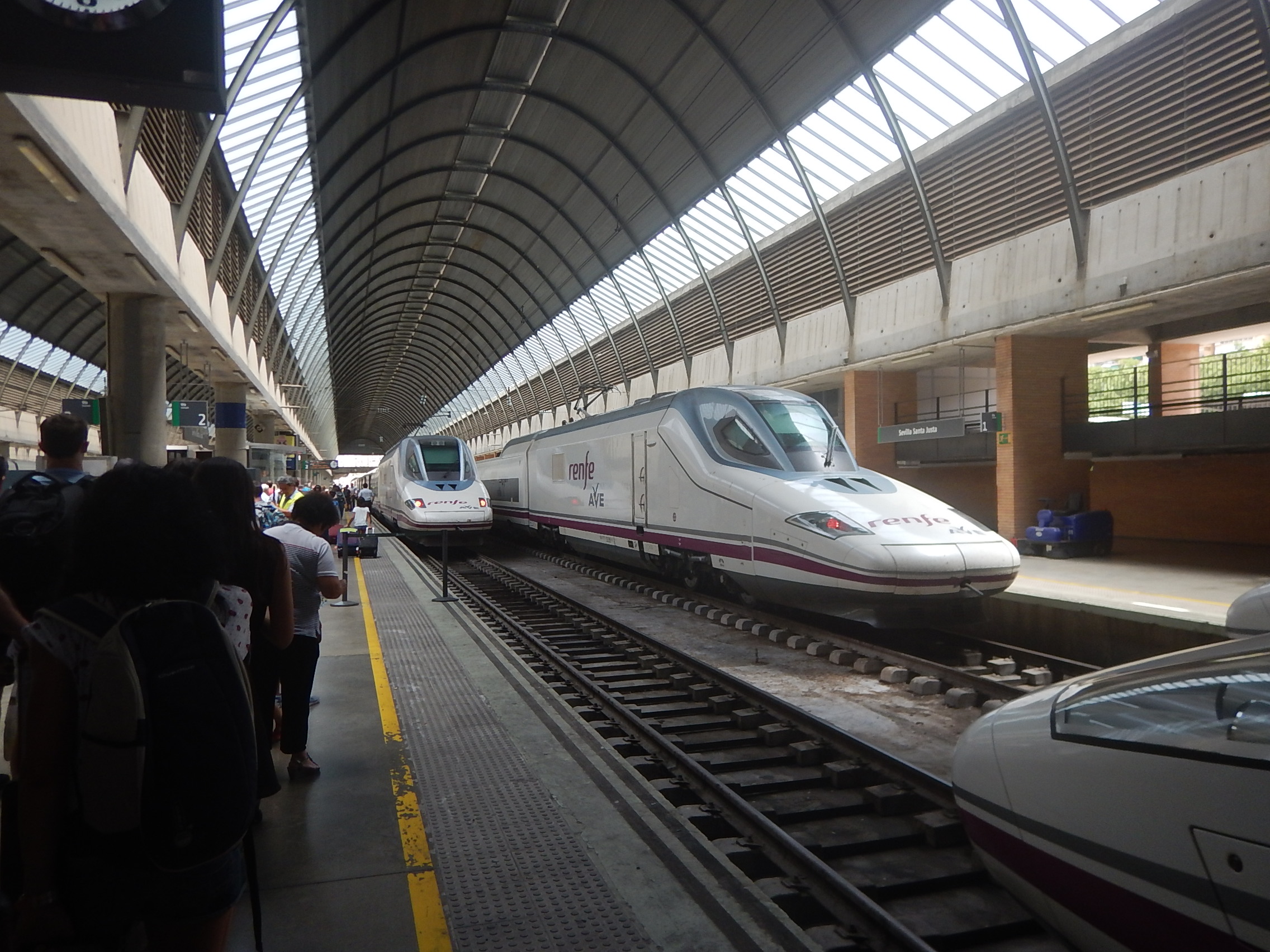
Are they more aerodynamic? Do they exert a higher down-force making the train more stable?
They certainly are different and they obviously work., as these are very fast trains.
Incidentally, these trains, are nicknamed pato in Spanish, which means duck in English.
Aerodynamic drag is proportional to a drag coefficient for the object and the square of the speed.
Let’s assume the following.
- The drag coefficient for the current train is d.
- The drag coefficient for the train with the aerodynamic nose is a.
- The terminal velocity of the train with the aerodynamic nose is v.
If the current Class 800 train travels at 118 mph on full power of 1680 kW, what speed would the train with an improved aerodynamic nose do on the same power, for various values of a?
If the new nose gives a five percent reduction in aerodynamic drag, then a = 0.95 * d, then the maximum speed of the train will be given by this formula
d * 118 * 118 = .0.95 * d * v* v
Solving this gives a speed of 121 mph.
Completing the table, I get the following.
- A one percent reduction in drag gives 119 mph
- A two percent reduction in drag gives 119 mph
- A three percent reduction in drag gives 120 mph
- A four percent reduction in drag gives 120 mph
- A five percent reduction in drag gives 121 mph
- A six percent reduction in drag gives 122 mph
- A seven percent reduction in drag gives 122 mph
- An eight percent reduction in drag gives 123 mph
- A nine percent reduction in drag gives 124 mph
- A ten percent reduction in drag gives 124 mph
- An eleven percent reduction in drag gives 125 mph
I can certainly understand why Talgo have developed the duck-like nose.
The conclusion is that if you can achieve an eleven percent reduction in drag over the current train, then with the same installed power can raise the speed from 118 mph to 125 mph.
Why Have A Fourth Engine?
If aerodynamics can make a major contribution to the increase in speed under diesel, why add a fourth engine?
- It might be better to fit four slightly smaller engines to obtain the same power.
- It might be better to put a pair of engines under two cars, rather than a single engine under four cars, as pairs of engines might share ancillaries like cooling systems.
- Extra power might be needed for acceleration.
- Four engines gives a level of redundancy, if only three are needed to power the train.
I wouldn’t be surprised to find out, that Hitachi are having a major rethink in the traction department.
Will The Trains Have Regenerative Braking To Batteries?
I would be very surprised if they don’t, as it’s the only sensible way to do regenerative braking on diesel power.
Will The Trains Be Built Around An MTU Hybrid PowerPack?
This or something like it from Hitachi’s diesel engine supplier; MTU, is certainly a possibility and it would surely mean someone else is responsible for all the tricky software development.
It would give the following.
- Regenersative braking to batteries.
- Appropriate power.
- Easier design and manufacture.
- MTU would probably produce the sophisticated power control system for the train.
- MTU could probably produce a twin-engined PowerPack
Rolls Royce MTU and Hitachi would all add to the perception of the train.
I would rate Hitachi using MTU Hybrid PowerPacks quite likely!
Would Two Pairs Of Engines Be Better?
The current formation of a five-car Class 800 train is as follows.
DPTS-MS-MS-MC-DPTF
Note.
- Both driver cars are trailers.
- The middle three cars all have generators, that are rated at 560 kW for a Class 800 train and 700 kW for a Class 802 train.
- Take a trip between Paddington and Oxford and you can feel the engines underneath the floor.
- The engines seem to be reasonably well insulated from the passenger cabin.
The system works, but could it be improved.
If I’m right about the aerodynamic gains that could be possible, then it may be possible to cruise at 125 mph using a power of somewhere around 1,800 kW or four diesel generators of 450 kW each.
Putting a diesel generator in four cars, would mean one of the driver cars would receive an engine, which might upset the balance of the train.
But putting say two diesel generators in car 2 and car 4 could have advantages.
- A Class 800 train has a fuel capacity of 1,300 litres, which weighs 11.06 tonnes. and is held in three tanks. Would train dynamics be better with two larger tanks in car 2 and 4?
- Could other ancillaries like cooling systems be shared between the two engines?
- Could a substantial battery pack be placed underneath car 3, which now has no engine and no fuel tank?
- As the engines are smaller will they be easier to isolate from the cabin?
The only problem would be fitting two generators underneath the shorter 24 metre car.
What size of battery could be fitted in car 3?
- According to this datasheet on the MTU web site, the engine weighs between five and six tonnes.
- I think this weight doesn’t include the generator and the cooling systems.
- Removing the fuel tank would save 3.7 tonnes
I suspect that a ten tonne battery could replace the diesel engine and its support systems in car 3..
On current battery energy densities that would be a battery of around 1000 kWh.
In How Much Power Is Needed To Run A Train At 125 mph?, I estimates that an electric Class 801 train needs 3.42 kWh per vehicle mile to maintain 125 mph.
This would give a range of almost sixty miles on battery power.
The battery would also enable.
- Regenerative braking to batteries, which saves energy at station stops.
- Diesel engines would not need to be run in stations or sensitive areas.
- Battery power could be used to boost acceleration and save diesel fuel.
You can almost think of the battery as an auxiliary engine powered by electrification and regenerative braking, that can also be topped up from the diesel generators.
It should also be noted, that by the time these trains enter service, the Midland Main Line will be electrified as far as Kettering and possibly Market Harborough.
This will enable the following.
- Trains will leave the electrification going North with a full battery.
- As Nottingham is less than sixty miles from Kettering and the trains will certainly have regeneratinve braking, I would not be surprised to see Northbound services to Nottingham being almost zero-carbon.
- A charging station at Nottingham would enable Southbound services to reach the electrification, thus making these services almost zero-carbon.
- Trains would be able to travel between Derby and Chesterfield, which is only 23 miles, through the World Heritage Site of the Derwent Valley Mills, on battery power.
- Corby and Melton Mowbray are just 26 miles apart, so the bi-mode trains could run a zero-carbon service to Oakham and Melton Mowbray.
- Trains could also run between Corby and Leicester on battery power.
- If and when the Northern end of the route is electrified between Sheffield and Clay Cross North Junction in conjunction with High Speed Two, the electrification gap between Clay Cross North Junction and Market Harborough will be under seventy miles, so the trains should be able to be almost zero carbon between London and Sheffield.
It does appear that if a battery the same weight as a diesel generator, fuel tank and ancillaries is placed in the middle car, the services on the Midland Main Line will be substantially zero-carbon.
What Would Be The Size Of |The Diesel Engines?
If the battery can be considered like a fifth auxiliary engine, I would suspect that the engines could be much smaller than the 560 kWh units in a Class 800 train.
Improved aerodynamics would also reduce the power needed to maintain 125 mph.
There would also be other advantages to having smaller engines.
- There would be less weight to accelerate and lug around.
- The noise from smaller engines would be easier to insulate from passengers.
- Engines could be used selectively according to the train load.
- Engines might be less prone to overheating.
The mathematics and economics will decide the actual size of the four engines.
Earlier, I estimated that a 10-11 % decrease in the trains aerodynamic drag could enable 124-5 mph with 1680 kW.
So if this power was provided by four engines instead of three, they would be 420 kW engines.
Conclusion
The Hitachi bi-modes for East Midlands Railway will be very different trains, to their current Class 80x trains.
Corby Class 360/1s Earmarked For 110 mph Running
The title of this post, is the same as that of an article on Page 10 of Issue 886 of Rail Magazine.
In Are Class 360 Trains Suitable For St. Pancras And Corby?, I came to this conclusion.
In my view there is a lot of upgrade work to be done to the Class 360 trains to make them suitable for working on the services between St. Pancras and Corby.
- They need a new upgraded interior.
- The trains need upgrading to at least 110 mph.
- A possible upgrading with digital signalling.
I can’t help feeling that the Class 360 trains would make a good stop-gap, but in the long-term it might be better to have a small fleet of electric trains.
The Rail Magazine article says the following will be done.
- Trains will be upgraded for 110 mph running.
- 3+2 seating will be replaced by 2+2 seating.
- Wi-fi, tables and updated information screens will be added.
This all sounds a lot better.
Are Class 360 Trains Suitable For St. Pancras And Corby?
It appears that East Midlands Railway will be using Class 360 trains on the route between St. Pancras and Corby stations running them under the branch name of EMR Electrics.
The London And St. Pancras Route
The route has the following characteristics.
- It is just short of 80 miles long.
- The current Class 222 trains take one hour and fifteen minutes for the journey.
- This means these trains have a start to stop average at 64 mph.
- Much of the route is cleared for 125 mph running.
- The route is being made a complete double track.
- The whole route is being electrified with 25 KVAC overhead wires.
In December 2020, the route will host a new electric service.
East Midlands Railway’s Train Specification For The Route
This page on the Department for Transport web site is an interactive map of the Abellio’s promises for East Midlands Railway.
These features are mentioned for Midland Main Line services to Corby.
- Increased capacity
- Twelve-car trains in the Peak.
- More reliable service
- Improved comfort
- Passenger information system
- Free on-board Wi-Fi
- At-seat power sockets
- USB points
- Air conditioning
- Tables at all seats
- Increased luggage space
- On-board cycle storage
What more could passengers want?
How Well Do Class 360 Trains Fit The Specification?
These are a few pictures of a Class 360 train, which I took today.
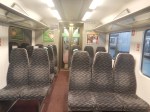

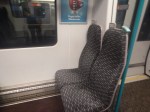

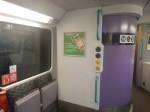
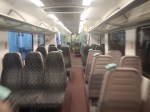
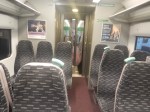
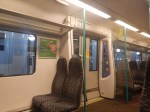
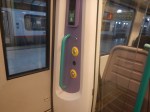
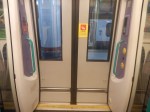
Some problems and strengths are immediately obvious.
- There are no tables.
- Will two+three seating e acceptable, considering that the current trains on the route have two+two seating.
- There is no space for bicycles.
- There are no luggage racks, which will be needed as the Corby service will also double as a service to Luton Airport.
- The trains are in reasonably good condition.
- There ia a fully-accessible toilet.
A lot of work will need to be done to update the interior of the trains to a standard, that fits East Midland Railway’s specification and their customers expectations.
But there is a full twelve months before the trains will be needed to run on the newly electrified route between St. Pancras and Corby stations.
This may seem enough time, but many current train refurbishment projects are running late.
Is The Performance Of Class 360 Trains Good Enough?
The current Class 222 trains have the following performance.
- 125 mph maximum speed.
- An acceleration rate of 0.80 m/sec/sec
By comparison the Class 360 trains have the following performance.
- 100 mph maximum speed.
- An acceleration rate of 0.98 m/sec/sec.
Given that much of the route between St. Pancras and Corby stastions will be constructed for 125 mph running, will the top speed of the Class 360 trains be high enough?
Will The Class 360 Trains And The Hitachi AT-300 Bi-Modes Be Compatible?
East Midlands Railway has ordered thirty-three AT-300 bi-modes, which will be able to run at 125 mph on the fully-electrified Midland Main Line to the South of Market Hsrborough station.
As thetwo trains will share the fast lines, with the Class 360 trains, will there be conflicts, as the Class 360 trains are only capable of 100 mph?
Ideally, the Class 360 trains should be upgraded to their highest speed possible.
Some of similar Class 350 trains are capable of 110 mph.
This could be enough, but surely for ease of operation, all of East Midlands Railway’s services into St. Pancras should be run by trains capable of running at 125 mph.
Will The Class 360 Trains Need Digital Signalling?
The Hitachi AT-300 trains will probably be able to run using digital signalling, which could be a valuable way of creating more paths on the Midland Main Line.
So will the Class 3560 trains be fitted with digital signalling?
Conclusion
In my view there is a lot of upgrade work to be done to the Class 360 trains to make them suitable for working on the services between St. Pancras and Corby.
- They need a new upgraded interior.
- The trains need upgrading to at least 110 mph.
- A possible upgrading with digital signalling.
I can’t help feeling that the Class 360 trains would make a good stop-gap, but in the long-term it might be better to have a small fleet of electric trains.
Electric AT-300 trains must be one of the favourites, although Class 745 trains, similar to those that Abellio will run between Liverpool Street and Stansted Airport, would do nicely.
East Midlands Railway Announces Three Brands
The title if this article is the same as that of this article on Railway Gazette.
This is a quote about their electric trains to Corby, which will run under the brand name of EMR Electrics.
EMR said that once various developments had been completed, passengers would be able to reach the terminal at Luton Airport in ‘a little under half an hour’ from central London.
Currently, the fastest services going to between St. Pancras and Luton Airport Parkway stations take twenty-four minutes using 125 mph Class 222 trains with Luton Airport Parkway as the first stop.
Thameslink using 100 mph Class 700 trains take 30 minutes and more!
I question, whether the 100 mph Class 360 trains, running with Luton Airport Parkway as the first stop, can do the trip in the 24-26 minutes to get to the terminal in under half an hour, even with Luton Airport’s DART shuttle train working!
In Are Class 360 Trains Suitable For St. Pancras And Corby?, I looked at Class 360 trains running the service between St. Pancras and Corby stations.
I came to this conclusion.
In my view there is a lot of upgrade work to be done to the Class 360 trains to make them suitable for working on the services between St. Pancras and Corby.
- They need a new upgraded interior.
- The trains need upgrading to at least 110 mph.
- A possible upgrading with digital signalling.
I can’t help feeling that the Class 360 trains would make a good stop-gap, but in the long-term it might be better to have a small fleet of electric trains.
Electric AT-300 trains must be one of the favourites, although Class 745 trains, similar to those that Abellio will run between Liverpool Street and Stansted Airport, would do nicely.
So will East Midlands Railway have updated and faster Class 360 trains or will they be bringing in 125 mph trains to hit the required schedule to Luton Airport Parkway?
Conclusion
Luton Airport will have a real Airport Express!
But will the Class 360 trains, be able to deliver it? I have my doubts!
Little Has Been Said About East Midlands Railway’s Promised Hydrogen Trains
In their proposal for the East Midlands franchise, Abellio said that they would trial hydrogen-powered trains on the Midland Main Line.
But little has been heard of this promise since winning the franchise.
So where could the franchise use hydrogen-powered trains on the Midland Main Line?
Extending Corby Trains To Oakham And Melton Mowbray
This is a distance of under thirty miles, so it would probably be within range of a well-designed hybrid battery-hydrogen-electric train.
- Refuelling with hydrogen could be at Corby or Melton Mowbray stations.
- Trains would be 240 metres long.
- In addition batteries would be charged between St. Pancras and Corby stations.
- Trains would run at 125 mph for much of the route between St. Pancras and Corby.
- Hydrogen power would be used as a top-up between Corby and Melton Mowbray if required.
The service could even go further and turn back at Leicester.
Perhaps one train per hour (tph) of the two Corby services could be extended.
Non-Stop London To Leicester Trains
The Midland Main Line will be electrified as far as Market Harborough, so there would be under twenty miles without electrification on the route between St. Pancras and Leicester stations.
- Trains would run at 125 mph for much of the route between St. Pancras and Leicester.
- Refuelling could be at Leicester.
- To publicise the service, it might be best to run two tph non-stop.
- Perhaps the only stop would be Luton Airport Parkway, as the Airport wants more fast services.
As with the Corby Extension service, it wouldn’t require a great deal of running on hydrogen.
Why Not Run A Loop From London?
If the Corby Extension service went as far as Leicester it would approach the station from the North, whereas the London service would approach from the South.
So why not run the services back-to-back?
- There could be two tph in each direction.
- There could be a longer stop at Leicester to take on hydrogen.
- Stops could include Luton Airport Parkway in both directions, to give the Airport four tph to and from London and Leicester.
- There might also be the possibility of an improved station at Syston, which is to the North-East of Leicester.
It wouldn’t need any new platforms or other infrastructure, except for the hydrogen filling station at Leicester and the possible improvements at Syston.
It would deliver high speed hydrogen-powered trains to Leicester at a frequency of two tph direct and two trph via Corby.
It would fit Luton Airport’s ambitions as I outlined in Luton Trains Its Eye On Sub 30-Minute Express.
What would that do for the prestige of the Leicester and the ambitions of Luton Airport?
Who Would Build The Trains?
These are my thoughts.
- Alston have the technology, but do they have the train?
- Bombardier have stated they are not interested in hydrogen.
- CAF have the train and the battery technology, but do they have the hydrogen technology?
- Hitachi have the train, but do they have the battery and hydrogen technology?
- Stadler have the train and the battery technology, but do they have the hydrogen technology?
I have heard rumours they are pushing hydrogen technology and also that their PowerPack concept works at 125 mph, so I suspect that Stadler are as likely as any to produce a working high speed hybrid hydrogen train.
But they will have several dozen trains working in the UK in a year or so.
They are not to be underestimated.
But then the prize for successfully running a 200 kph or 125 mph zero-carbon train will be immense, and this will not be lost on the train builders.
Or East Midlands Railway for that matter!
The first person, who does something is always remembered!
Losers come second!
Are East Midlands Railway Jumping The Gun?
The pictures show the Class 222 train, that I rode from Sheffield to London, after my trip to Huddersfield

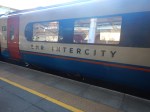
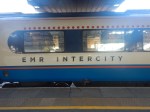
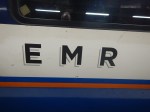
I thought East Midlands Railway don’t take over the franchise until the 18th of August!
I suppose it’s only an interim livery.
South Lincolnshire, West Norfolk And The North Netherlands
These three areas are very similar.
This sentence comes from the Wikipedia entry for The Fens, which are found where Cambridgeshire, Lincolnshire and Norfolk come together.
Most of the Fenland lies within a few metres of sea level. As with similar areas in the Netherlands, much of the Fenland originally consisted of fresh- or salt-water wetlands. These have been artificially drained and continue to be protected from floods by drainage banks and pumps.
I have heard it said, that The Fens owe a lot of their landscape to the Dutch, as it was the Dutch, who originally had a lot to do with draining the land.
It should also be noted, that one of the most famous people from the area is Commander George Vancouver of the Royal Navy, who was the son of John Jasper Vancouver, a Dutch-born deputy collector of customs in King’s Lynn. He gave his name to the Canadian city of Vancouver.
The Dutch have returned in that two of the three rail franchises in the area, are under the control of the Dutch company; Abellio; Greater Anglia (GA) and East Midlands Railway (EMR).
Current and future services through the area include.
- GA – Stansted Airport and Norwich via Ely and Cambridge
- GA – Liverpool Street and King’s Lynn via Ely and Cambridge
- GA – Colchester and Peterborough via Ipswich, Bury St. Edmunds and Ely
- EMR – Norwich and Nottingham
- EMR – Peterborough and Doncaster via Spalding, Sleaford and Lincoln
- EMR – Nottingham and Skegness via Grantham, Sleaford and Boston
- CrossCountry – Birmingham and Stansted Airport via Peterborough, Cambridge and Ely.
- Great Northern – King’s Cross and King’s Lynn via Ely and Cambridge
- Thameslink – King’s Cross and Peterborough
- Thameslink – King’s Cross and Cambridge
Note.
Most services are hourly, with some London services at a higher frequency.
- EMR are planning to increase certain early, late and Sunday services, so there may be improvements.
- GA are planning to introduce new Class 755 trains pn diesel services and new Class 720 trains on electric services.
- The Ely, Cambridge North and Cambridge corridor can have a frequency as high as eight trains per hour (tph)
Will EMR and GA work together to improve services in the area they jointly serve?
These are a few of my thoughts.
A Look At The North Of The Netherlands
In The Train Station At The Northern End Of The Netherlands, I looked at what the Dutch are doing in the North of the country, near to the city of Groningen.
- Groningen is a city of around 200,000 people and a major rail hub, with services fanning out through the flat landscape.
- The trains are mainly Stadler GTWs, which are the forerunners of GA’s Class 755 trains.
- The Dutch are developing a hydrogen-based economy in the area, which I described in The Dutch Plan For Hydrogen.
Are Abellio looking to bring some of the ideas from the Netherlands to the UK?
I think to a certain extent, we’re going the same way. For instance, in the North of Lincolnshire a lot of development is going on to develop an energy economy based on offshore wind and energy storage.
The Cambridge Effect
Cambridge effects the whole of the area, in its demand for housing and premises for research, development and manufacture.
The Cambridge And Peterborough Problem
I used to play tennis, with a guy, who was promoting Peterborough as an expansion area for Cambridge. Peterborough is a city, with space and good connections to London and the North, by rail and the A1 road.
,But the problem is that the road and rail links between the two cities are atrocious, with a two-lane dual-carriageway and an hourly three-car diesel train.
It is my view, that the gap in the electrification between Ely and Peterborough should eventually be removed.
- The land is flat.
- The route is thirty miles long.
- The route was recently upgraded to take the largest container trains, so electrification, surely wouldn’t be too difficult.
- The biggest problem would probably be dealing with the numerous level crossings.
Electrification would allow.
- More frequent and faster passenger trains between Cambridge, Ely and Peterborough.
- Freight trains between Felixstowe and the North would be easier to haul using electro-diesel locomotives like the Class 88 and Class 93.
- It would create an electrified diversion route for trains on the East Coast Main Line.
After electrification, it would be possible to have a much-needed four tph service between Cambridge and Peterbough with stops at Cambridge North, Waterbeach, Ely, Manea, March and Whittlesea.
- Cambridge and Peterborough sstations both have several platforms, that could be used to terminate extra services.
- The service could be extended to Cambridge South station, when that is built in a few years.
GA’s Class 755 trains could even provide the service without electrification.
What About Wisbech?
Wisbech is a town of 33,000 people without a passenger rail link.
But it does have the Bramley Line.
This is the introductory paragraph in Wikipedia.
The Bramley Line is a railway line between March and Wisbech in Cambridgeshire, England. A number of proposals are currently being investigated relating to the possible restoration of passenger services along the route.
The Association of Train Operating Companies and various politicians have supported creating a passenger service between Wisbech and Cambridge via March and Ely.
The service could be as follows.
It would use an existing single-track line, which would probably just need upgrading.
- Cambridge and Wisbech would take around forty-five minutes.
- A train would take two hours for the round trip.
- An hourly service would take two trains.
What is useful, is that the length of the branch line is short enough, that it may be possible to be run the service using One Train Working.
Improvements Between Cambridge And King’s Lynn
This article on Rail Technology Magazine is entitled Work On £27m East of England Upgrades Set To Begin.
It lists the work to be done and the benefit in these two paragraphs.
The upgrades, between Cambridge and King’s Lynn, will include two platform extensions at Waterbeach and a platform extension at Littleport.
This will allow the introduction of eight-car services during peak times, providing passengers with more seats and a better experience.
The works will certainly add capacity for commuters to and from Cambridge and London.
Will the upgrade at Waterbeach station allow Greater Anglia’s four-car Class 755 trains to call.?
There is a section in the Wikipedia entry for Waterbeach station, which is entitled Future Plans, where this is said.
Plans to develop a New Town of 8,000 to 9,000 homes on the former Waterbeach Barracks site have been outlined by South Cambridgeshire District Council. As part of the proposal, there are plans to relocate the station to a new site and extend the platforms to accommodate 12 car trains.
This is more housing for Cambridge and I’m sure that the promised Norwich and Stansted Airport service will call.
Will Services Be Joined Back-To-Back At Peterborough?
Train companies sometimes find that joining two services together in a busy station is a good idea.
- It may use less trains and drivers.
- It uses a through platform rather than two bay platforms.
- Trains could be turned in a more convenient station.
A proportion of passengers don’t have to change trains.
Note.
- |East Midlands Railway are joining the Doncaster and Lincoln, and Lincoln and Peterborough services into one service.
- Greater Anglia are extending the Peterborough and Ipswich service to Manningtree.
- Greater Anglia are extending the Norwich and Cambridge service to Stansted Airport.
But East Midlands Railway are also splitting the Norwich and Liverpool service into two.
These are the services that are planned to terminate at Peterborough.
- Peterborough and Colchester via Ipswich, Bury St. Edmunds and Ely
- Peterborough and Doncaster via Spalding, Sleaford and Lincoln
As I said earlier, I would’ve be surprised to see extra Cambridge and Peterborough services to increase capacity between the two cities.
Current timings of the various sections are as follows.
- Peterborough and Lincoln – one hour and twenty-three minutes
- Lincoln and Doncaster – fifty-four minutes
- Peterborough and Ipswich – one hour and thirty-nine minutes
- Ipswich and Colchester – nineteen minutes
- Peterborough and Cambridge – fifty minutes
Adding up 3 and 4 gives a Colchester and Peterborough timing of one hour and fifty-eight minutes. But the new Class 755 trains are faster and will be running at full speed on electrification for sections of the journey.
With the turnround at both ends, a round trip would be under four hours. This would mean that four trains would be needed for an hourly service.
Adding up 1 and 2 gives a Peterborough and Doncaster timing of two hours and seventeen minutes.
With the turnround at both ends, a round trip would be under five hours. This would mean that five trains would be needed for an hourly service.
Could these two services be run back-to-back to create a Colchester and Doncaster service?
It would take four hours and fifteen minutes or nine hours for a round trip. This would mean that nine trains would be needed for an hourly service.
This is the same number of trains that would be needed for the two separate services.
The two companies might decide to run a joint service, but!
- In whose colours would the train run?
- Would there be crewing difficulties?
- If a train fails, it would probably be a long way from home.
- It has been felt sensible to split the five hour and thirty-five minute Norwich and Liverpool services.
Would it be possible to run a service between Cambridge and Lincoln?
- Adding up 1 and 5 gives a timing of two hours and thirteen minutes.
- With the turnround at both ends, a round trip would be under five hours.
- This would mean that five trains would be needed for an hourly service.
It would be possible, but would the convenience attract enough passengers to make the service viable?
Would It Be Worth Reinstating March And Spalding?
There used to be a railway between March and Spalding.
Wikipedia says this about the closure of the route.
When the line closed between March and Spalding in 1982,[3] freight traffic was diverted through Peterborough station instead of cutting across the western edge of the Fens to avoid the line through Peterborough station
Some have called for the route to be reinstated to enable freight trains to by-pass Peterborough, when travelling between Felixstowe and the route to the North through Spalding, Sleaford, Lincoln and Doncaster.
- It is not a long route.
- It could provide a passenger route between Cambridge and Lincoln.
I suspect that Network Rail looked at this scheme as an alternative to the Werrington Dive Under, which has been costed at £200 million.
Wikipedia says this about the Werrington Dive Under.
The project will see the construction of 1.9 miles (3 km) of new line that will run underneath the fast lines, culverting works on Marholm Brook and the movement of the Stamford lines 82 feet (25 m) westwards over the culverted brook. The project, coupled with other ECML improvement schemes (such as the four tracking from Huntingdon to Woodwalton) will improve capacity on the line through Peterborough by 33% according to Network Rail. This equates to two extra train paths an hour by 2021, when the work is scheduled to be completed.
A thirty-three percent capacity increase seems a powerful reason to build the Werrington Dive Under.
Would it also enable a faster route for trains between King’s Cross and Lincoln?
As to whether the direct route between March and Spalding will ever be reinstated, this will surely depend on several factors.
- The number of freight trains needing to go between Felixstowe and Doncaster.
- The maximum number of freight trains, that can use the freight route, through Spalding, Sleaford and Lincoln.
- Whether a passenger service on the route is worthwhile.
There are also protests about the number of freight trains already using the route.
I can see the capacity of the freight route being increased and the route being made a more friendly neighbour, after the opening of the Werrington Dive Under.
- Level crossings will be replaced by bridges.
- Adoption of zero-carbon locomotives.
- Installation of noise-reduction measures.
The line might even be electrified.
Peterborough After Werrington
If we assume that the services stay as currently proposed, the following trains will stop at Peterborough on their way to either Cambridge or Lincoln.
- GA – Peterborough and Ipswich or Colchester – Platform 6
- EMR – Peterborough and Lincoln or Doncaster- Platform 1 or 2
- EMR- Norwich and Nottingham – Platform 7
- EMR- Nottingham and Norwich – Platform 6
- CrossCountry – Stansted Airport and Birmingham – Platform 7
- CrossCountry – Birmingham and Stansted Airport- Platform 6
Note.
- Trains going to Cambridge use Platform 6.
- Trains coming from Cambridge use Platform 7
- The Ipswich or in the future; Colchester service uses Platform 6 to turnback.
- The Lincoln or in the future; Doncaster service uses Platform 1 or 2 to turnback.
- Platform 6 and 7 is a new island platform with direct access to the Stamford Lines and the tracks in the Werrington Dive Under that connect to Spalding, Sleaford and Lincoln.
This means that after the Werrington Dive Under opens in a couple of years, the Peterborough and Doncaster service will stop in the wrong side of the station.
So it is likely, that Doncaster services will continue from the Werrington Dive Under into Platform 6 or 7 in Peterborough station.
As the Colchester service will probably still turnback in Platform 6 could we see the Doncaster and Colchester services timed to be in the island platform 6 & 7 at the same time.
Passengers would just walk a few metres between the two trains.
This Google Map shows the lines South of the station.
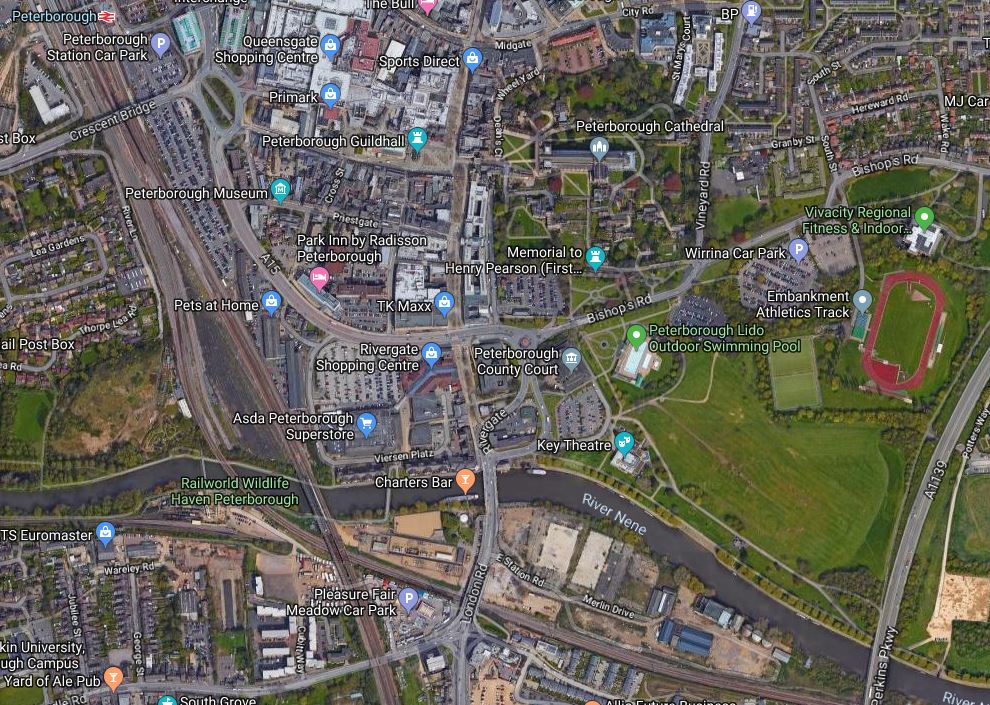
The Peterborough-Ely Line can be seen running East-West, to the South of the River Nene and then going under the East oast Main Line, before connecting to Platforms 6 and 7 on the West side of the station.
This Google Map shows the station.
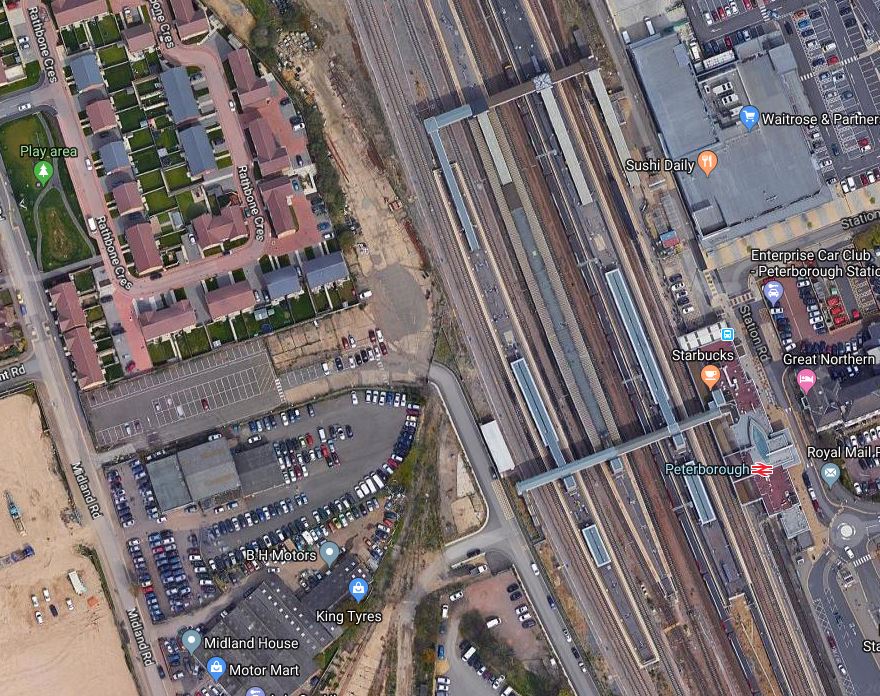
Note the three island platforms, which are numbered 6 & 7, 4 & 5 and 2 & 3 from West to East.
The Wikipedia entry for Peterborough station, says this about Platforms 6 & 7.
Platforms 6 & 7: These new platforms were commissioned over the Christmas break 2013, and are now used by CrossCountry services between Stansted Airport/Cambridge via Ely and Birmingham New Street via Leicester; East Midlands Trains services between Norwich and Liverpool; and Greater Anglia services to Ipswich.
North from Peterborough station and just South of the site of the Werrington Dive Under is the Cock Lane Bridge. I took these pictures in November 2018.
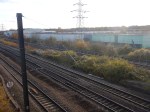
Note the three fast lines of the East Coast Main Line on the Eastern side and the two Stamford Lines on the Western side.
Just North of thie bridge, the Stamford Lines will split and trains will be able to continue to Stamford or cross under the East Coast Main Line towards Lincoln.
As there is a loop for freight trains through Peterborough station, the Werrington Dive Under will be able to handle sufficient trains.
Conclusion
The layout of Peterborouh station and the Werrington Dive Under will give Abellio a lot of flexibility to improve services in South Lincolnshire and West Norfolk.
Network Rail gets a lot of criticism, but you can’t fault the design and what lies behind it, in this instant!
Will Abellio East Midlands Railway Go Flirting?
Abellio take over the East Midlands franchise in a few days and it will be renamed to East Midlands Railway.
It has already disclosed that it will have three divisions.
- EMR Intercity for long distance services from London St Pancras
- EMR Regional for local services
- EMR Electrics for the London St Pancras to Corby service
It has also confirmed it has ordered thirty-three AT-300 trains for EMR Intercity.
Wikipedia also shows, that the following trains will be transferred to East Midlands Railway.
- Nine Class 156 trains from Greater Anglia.
- Twenty-one Class 360 trains from Greater Anglia.
- Five Class 170 trains from ScotRail
- Four Class 180 trains from Hull Trains
The first three fleets will come from Abellio-run franchises and the last will be released fairly soon, as Hull Trains new fleet is arriving.
Looking at the EMR Regional fleet it will comprise.
- 21 – Class 153 trains
- 24 – Class 156 trains
- 26 – Class 158 trains
- 5 – Class 170 trains
Consider.
- Many probably feel that the Class 153 trains are inadequate.
- Except for the Class 170 trains, these trains are around thirty years old.
- Some of the Class 156 trains, which will be transferred from Greater Anglia, are currently being replaced with brand-new Class 755 trains.
- Abellio are going through extensive fleet replacement exercises in ScotRail, Greater Anglia and West Midlands Trains.
The EMR Regional routes, that they will run are a mixed bunch.
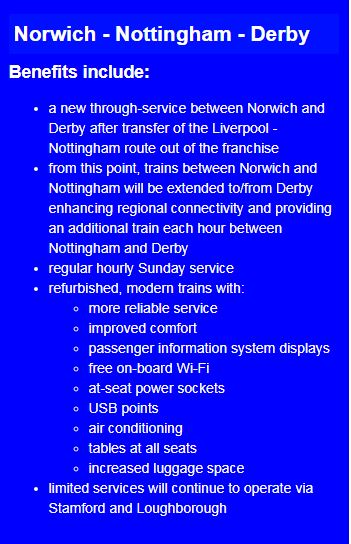
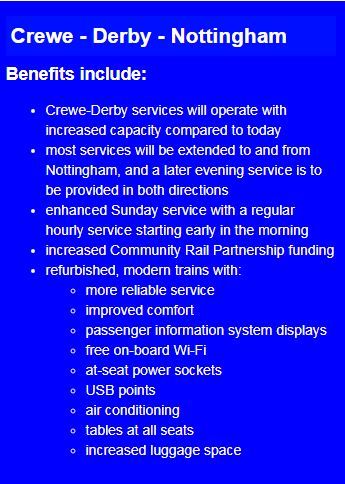
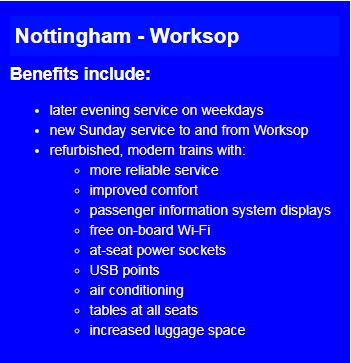
This page on the Department for Transport web site is an interactive map of the Abellio’s promises for East Midlands Railway.
Digging out the blurb for each route shows the following.
Norwich – Nottingham – Derby
Crewe – Derby – Nottingham
Matlock – Derby – Nottingham

Nottingham – Lincoln – Grimsby

Nottingham – Worksop
Nottingham – Skegness
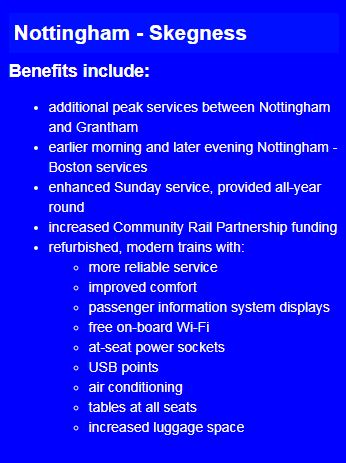
Leicester – Nottingham
 Peterborough – Lincoln – Doncaster

Barton-On-Humber – Cleethorpes

Lincoln – London
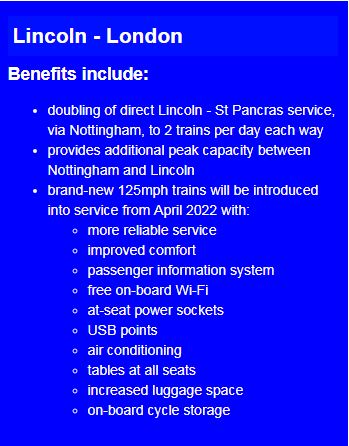
London – Oakham – Melton Mowbray

London- Leeds – York
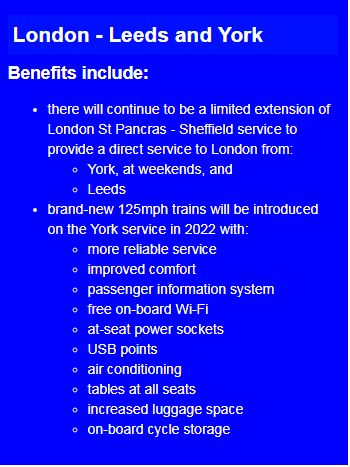
Newark North Gate – Lincoln

I have come to a few conclusions.
The Fleet Is Not Being Expanded Enough To Retire The Class 153 Trains
Consider.
- There are twenty-one Class 153 trains.
- Five Class 170 trains and nine Class 156 trains are being added to the fleet.
Surely, this means that some Class 153 trains will be retained.
Perhaps, the remaining Class 153 trains, will be reorganised into two-car trains to increase capacity.
Extended Services Will Be Run Using New Bi-Mode AT-300 Trains
Services to Leeds and York, Oakham and Melton Mowbray and Lincoln would appear to be run by the new AT-300 trains that have been ordeed from Hitachi.
I’ve no problem with that,but there are three developments that may effect passenger numbers.
- There is a lot of housing development in the Corby, Oakham and Melton Mowbray area.
- There is a very large renewable energy sector developing in North Lincolnshire.
- Sheffield are proposing to add new stations between Sheffield and Leeds, at Rotherham and Barnsley Dearne Valley.
Does the proposed service pattern take this fully into account?
In a way it doesn’t matter, as the worst that could happen, is that East Midlands Railway will need to increase the fleet size by a small number of trains.
Hopefully, they’ll just need to get Hitachi to build the trains!
Most Regional Services Will Be Run By Refurbished Modern Trains
Most services will be run by refurbished modern trains with the following features.
- More reliable service
- Improved comfort
- Passenger information system
- Free on-board wi-fi
- At-seat power sockets
- USB points
- Air-conditioning
- Tables at all seats
- Increased luggage space
Can East Midlands Railway Refurbish Their Augmented Fleet To Meet Their Required Standards?
Consider.
- The Class 170 trains are relatively recent and were built to a high standard, so can probably meet EMR’s standard.
- The Class 158 trains are thirty years old and were built to a high standard, so they might be able to be upgraded to EMR’s standard.
- The Class 156 trains are thirty years old and noisy and old-fashioned, so will need a lot of work to bring them up to EMR’s standard.
- The Class 153 trains are thirty years old and only one car, so would probably be best retired or reduced to an auxiliary role like a bicycle car.
- Only the Class 170 and Class 158 trains can be high standard trains.
- All trains are diesel and only the Class 170 trains are possibly planned to be upgraded to more economical diesel hybrid trains
One additional option might be to refurbish some of the Class 222 trains, when they are replaced by the new Hitachi AT-300 trains on main line services, so they were suitable for the longer regional routes.
Will East Midlands Railway Replace The Fleet?
In their three other franchises in the UK; Greater Anglia, ScotRail and West Midlands Trains, Abellio have opted for replacement of all or a substantial part of the fleet.
So will the same action be taken at East Midlands Railway?
The company could do a lot worse, than invest in a fleet of Class 755 trains like Greater Anglia.
- They could be a mix of lengths, so each route could have a train with capacity for the traffic.
- The trains may be capable of 125 mph running on the Midland Main Line and the East Coast Main Line.
- The interiors meet the company’s requirements.
- The trains could use electrification , where it exists.
- The trains could be fast enough to cover for the AT-300 trains.
- Abellio Greater Anglia will soon have a large knowledge base for the trains.
The clincher could be, that as electrification increases, the trains could fit batteries and generate less carbon.
Conclusion
I wouldn’t be surprised to see Abellio East Midlands Railway buy a fleet of Class 755 trains for their EMR Regional services.
Bombardier Doesn’t Seem Too Disappointed On Missing Out On The Abellio East Midlands Railway Order
This article on the Derby Telegraph is entitled Derby’s Bombardier Misses Out On Big Contract To Supply Trains For The East Midlands.
This is two paragraphs from the article.
In a statement, Bombardier said: “Bombardier is clearly disappointed that we have not been selected to supply bi-mode trains for the East Midlands franchise.
“We believe we submitted a competitive bid – on technology, strength of product, deliverability and cost, and will seek formal feedback from Abellio.”
There certainly hasn’t been any published threat of legal action.
The Abellio East Midlands Railway Order From Hitachi.
The order placed was as follows.
Thirty-three five-car AT-300 trains.
- 25 KVAC overhead electrification.
- Four cars have underfloor diesel-engines.
- 125 mph running.
- 24 metre cars.
- Ability to work in pairs.
- Evolution of a Class 802 train.
- A new nose.
It is a £400 million order.
No Trains For Corby
In How Will Abellio East Midlands Railway Maximise Capacity On The Midland Main Line?, I calculated that the current timetable to Derby, Nottingham and Sheffield would need thirty-two trains.
So thirty-three trains would only be enough trains for the bi-mode services to the three Northern termini.
So it looks like Hitachi are not providing any trains for the Corby services! Surely, to have a compatible fleet from one manufacturer would be of an advantage to Abellio East Midlands Railway.
An Ideal Fleet For Corby
Trains between London and Corby take around 70-75 minutes, with a round trip taking three hours.
This means that to run a one train per hour (tph) service to Corby needs three trains and a two tph service will need six trains.
As trains go wrong and also need servicing, I would add at least one spare train, but two is probably preferable.
It would have the following characteristics.
- All electric.
- 125 mph running, as they will need to keep out of the way of the Hitachi bi-modes.
- 240 metres long.
- A passenger-friendly interior, with loys of tables.
- Energy efficient
If the last point s to be met, I and many other engineers believe that to save energy, trains must have regenerative braking to batteries on the train.
In Kinetic Energy Of A Five-Car Class 801 Train, I calculated that the kinetic energy of a Class 801 train, with every seat taken was 104.2 kWh
This calculation was performed for a half-length train, so a full electric train for London and Corby would have a kinetic energy of 208.4 kWh, if it was similar to one of Hitachi’s Class 801 train.
The reason the kinetic energy of a train is important, is teat if a train brakes from full speed and has batteries to handle the energy generated by regenerative braking, the batteries must be big enough to handle all the energy.
So a ten-car train similar in capacity and weight to a Class 801 train would need batteries capable of handling 208.4 kWh.
I’ll give a simple example.
A train similar to a Class 801, is full and running using electrification at 125 mph. It is approaching a station, where it will stop.
- The train’s computer knows the mass and velocity of the train at all times and hence the kinetic energy can be calculated.
- The train’s computer will constantly manage the train’s electricity supply, so that the batteries always have sufficient capacity to store any energy generated by braking.
- As the train brakes, the energy generated will be stored in the batteries.
- As the train moves away from the station, the train’s computer will use energy from the overhead electrification or batteries to accelerate the train.
Energy will constantly be recycled between the traction motors and the batteries.
I don’t know what battery capacity would be needed, but in my experience, perhaps between 300-400 kWh would be enough.
Any better figures, gratefully accepted.
When you consider that the battery in a Tesla car is around 60-70 kWh, I don’t think, there’ll be too much trouble putting enough battery power underneath a ten-car train.
Onward To Melton Mowbray
This page on the Department for Transport web site is an interactive map of the Abellio’s promises for East Midlands Railway.
These are mentioned for services to Oakham and Melton Mowbray.
- After electrification of the Corby route there will continue to be direct service each way between London and Oakham and Melton Mowbray once each weekday, via Corby.
- This will be operated with brand new 125mph trains when these are introduced from April 2022.
This seems to be a very acceptable minimum position.
Surely, in a real world driven by marketing and finance and more and more passengers wanting to travel regularly by train to places like London, Luton Airport and Leicester, there will come a time, when an hourly service on this route is needed.
Could a Corby service be extended to Melton Mowbray using battery power, at perhaps a slower speed of 90 mph?
Accelerating away from Corby, the train would need 108 kWh of energy to get to 90 mph with a full train.
- There would be a continuation of the electrification for perhaps a couple of hundred metres after Corby station.
- The train would probably leave Corby with a full battery, which would have been charged on the journey from London.
Once at cruising speed, the train would need energy to maintain line speed and provide hotel power.
In How Much Power Is Needed To Run A Train At 125 mph?, I calculated the figure for some high-speed trains.
This was my conclusion.
In future for the energy use of a train running at 125 mph, I shall use a figure of three kWh per vehicle mile.
So I will use that figure, although I suspect the real figure could be lower.
I will also assume.
- Corby to Melton Mowbray is 26.8 miles.
- It’s a ten-car train.
- Regenerative braking is seventy percent efficient.
- The train is running at 90 mph, between Cotby and Melton Mowbray, with an energy of 108 kWh
Energy use on a round trip between Corby and Melton Mowbray, would be as follows.
- Accelerating at Corby – 108 kWh – Electrification
- Stop at Oakham – 32.4 kWh – Battery
- Corby to Melton Mowbray – 804 kWh – Battery
- Stop at Melton Mowbray – 32.4 kWh – Battery
- Stop at Oakham – 32.4 kWh – Battery
- Melton Mowbray to Corby – 804 kWh – Battery
This gives a total of 1705.2 kWh
The battery energy need gets a lot more relaxed, if there is a charging station at Melton Mowbray, as the train will start the return journey with a full battery.
Energy use from Corby to Melton Mowbray would be as follows.
- Accelerating at Corby – 108 kWh – Electrification
- Stop at Oakham – 32.4 kWh – Battery
- Corby to Melton Mowbray – 804 kWh – Battery
This gives a total of 836.4 kWh.
Energy use from Melton Mowbray to Corby would be as follows.
- Accelerating at Melton Mowbray- 108 kWh – Battery
- Stop at Oakham – 32.4 kWh – Battery
- Melton Mowbray to Corby – 804 kWh – Battery
This gives a total of 944.4 kWh.
The intriguing fact, is that if you needed a train to go out and back from Corby to Melton Mowbray, it needs a battery twice the size of one needed, if you can charge the train at Melton Mowbray., during the stop of several minutes.
Charging The Train
This page on the Furrer + Frey web site, shows a charging station..
It might also be possible to erect a short length of 25 KVAC overhead electrification. This would also help in accelerating the train to line speed.
This Google Map shows Melton Mowbray station.
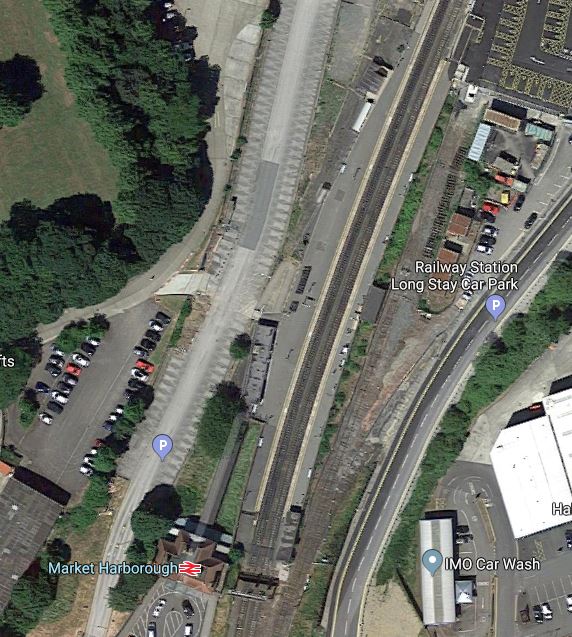
It looks to be a station on a large site with more than adequate car parking and I suspect building a bay platform with charging facilities would not be the most difficult of projects.
More Efficient Trains
I also think that with good design electricity use can be reduced from my figure of 3 kWh per vehicle mile and the regenerative braking efficiency can be increased.
Obviously, the more efficient the train, the greater the range for a given size of battery.
Onward To Leicester
If the train service can be extended by the 26.8 miles between Corby and Melton Mowbray, I wonder if the electric service can be extended to Leicester.
Under current plans the Northern end of the electrification will be Market Harborough.
In Market Harborough Station – 11th July 2019, I wrote about the station after a visit. In my visit, I notices there were a lot of croaaovers to the North of the station.
As it was a new track alignment, I suspect that they were new.
So is it the interntion to turnback services at Market Harborough or are the crossovers preparation for links to stabling sidings?
It got me asking if battery-electric trains could reach Leicester.
- Leicester and Market Harborough are only fourteen miles apart.
- There are no stops in between.
- Using my three kwH per vehicle mile, this would mean that a ten car train would use 420 kWh between the two stations at 125 mph.
I certainly believe that a Northbound train passing Market Harborough with fully-charged batteries could reach Leicester, if it had an adequate battery of perhaps 700 kWh.
As at Melton Mowbray, there would probably need to be a charging station at Leicester.

The picture shows the station from the Northern bridge.
The platforms shown are the two main lines used by most trains. On the outside are two further lines and one or both could be fitted with a charging station, if that were necessary.
An Example Electric Service Between London And Leicester
If they so wanted, Abellio East Midlands Railway could run 125 mph battery-electric services between London and Leicester.
The Current Timings
The fastest rains go North in around 66-67 minutes and come South in seventy.
So a round trip would take around two and a half hours.
Five trains would be needed for a half-hourly service.
I feel it would be very feasible, if Abellio East Midlands Railway wanted to increase services between London and Leicester, then this could be done with a fleet of zero-carbon battery-electric trains, using battery power between Leicester and Market Harborough.
A Non-Stop London And Leicester Service
I wonder what would be the possible time for an electric express running non-stop between London and Leicester.
- Currently, some diesel Class 222 trains are timetabled to achieve sixty-two minutes.
- Linespeed would be 125 mph for much of the route.
- There is no reason, why the fourteen mile section without electrification North of Market Harborough couldn’t be run at 1235 mph on battery-power, once the track is upgraded to that speed.
- iIn the future, modern digital signalling, as used by Thameslink, could be applied to the whole route and higher speeds of up to 140 mph may be possible.
I wouldn’t be surprised to see a battery-electric train travelling between London and Leicester in fifty minutes before 2030.
A fifty-minute service would result in a two-hour round trip and need just two trains for a frequency of two tph.
It would surely be a marketing man’s dream.
It should be noted that Abellio has form in this area and have introduced Norwich-in-Ninrty services on the slower London and Norwich route.
London And Leicester Via Corby, Oakham And Melton Mowbray
I have been very conservative in my calculations of battery size.
With real data on the terrain, the track profile, the train energy consumption, regenerative braking performance and the passengers, I do wonder, if it would be possible to run on battery power between Corby and Leicester via Oakham and Melton Mowbray.
- The distance would be 62 miles on battery power.
- Trains could serve Syston station.
- Using times of current services London and Leicester would take two hours fifteen minutes.
I suspect it would be possible, but it would be a slow service.
Would These Services Be An Application For Bombardier’s 125 mph Bi-Mode Aventra With Batteries?
Could Bombardier’s relaxed reaction to not getting the main order, be because they are going to be building some of their proposed 125 mph bi-mode trains with batteries, that will be able to work the following routes?
- London and Melton Mowbray via Corby and Oakham.
- London and Leicester via Market Harborough.
But I think that the main emphasis could be on a non-stop high-speed service between London and Leicester.
I have been suspicious that there is more to Bombardier’s proposed train than they have disclosed and wrote Is Bombardier’s 125 mph Bi-Mode Aventra With Batteries, A 125 mph Battery-Electric Aventra With Added Diesel Power To Extend The Range?
Since I wrote that article, my view that Bombardier’s train is a battery-electric one, with diesel power to extend the range, has hardened.
These Midland Main Line trains will run in two separate modes.
- On the Southern electrified sections, the trains will be 125 mph electric trains using batteries for regenerative braking, energy efficiency and emergency power in the case of overhead line failure..
- On the Northern sections without electrification,the trains will be battery-electric trains running at the maximum line-speed possible, which will be 125 mph on Leicester services.
There will be an optimum battery size, which will give the train the required performance.
Is there any need for any diesel engines?
Quite frankly! No! As why would you lug something around that you only need for charging the batteries and perhaps overhead supply failure?
- Batteries would only need to be charged at the Northern end of the routes. So use a chasrging station, if one is needed!
- Batteries can handle overhead supply failure, automatically.
Who needs bi-modes?
How Big Would The Batteries Need To Be?
A full train would have a kinetic energy of around 200 kWh and I said this about battery capacity for handling the energy from regenerastive braking.
I don’t know what battery capacity would be needed, but in my experience, perhaps between 300-400 kWh would be enough.
Any better figures, gratefully accepted.
To handle Corby to Melton Mowbray and back, I estimated that 1,800 kWh would be needed, but if the train had a top-up at Melton Mowbray a capacity of 1,000 kWh would be sufficient.
Pushed, I would say, that a battery capacity of 2,000 kWh would be sufficient to run both routes without a charging station, at the Northern end.
I also believe the following will happen.
- Trains will get more efficient and leighter in weight.
- Batteries will increase their energy density.
- Charging stations will charge trains faster.
- Battery costs will fall.
This would mean that larger battery capacities can be achieved without the current weight and cost penalty and the achievable range after the end of the wires will increase.
I wouldn’t be surprised to see ranges of over fifty miles in a few years, which with a charging station at the destination, means battery-electric trains could venture fifty miles from an electrified line.
A few other suggested routes.
- Ashford and Southampton
- Birmingham and Stansted Airport
- Carliswle and Newcastle
- Doncaster and Peterborough via Lincoln (CS)
- Edinburgh and Tweedbank (CS)
- London Euston and Chester
- London St. Pancras and Hastings
- London Waterloo and Salisbury (CS)
- Manchester and Sheffield (CS)
- Norwich and Nottingham (CS)
- York and Hull via Scarborough (CS)
Note.
- Stations marked (CS) would need a charging station.
- Some routes would only need 100 mph trains.
I think that a 125 mph battery train will have a big future.
Conclusion
I have a feeling that Bombardier are right to be not too disappointed.
« Previous | Next »
 The Anonymous Widower