Could London And Central Scotland Air Passengers Be Persuaded To Use The Trains?
How Many Passengers Fly Between London And Edinburgh?
Wikipedia gives these figures for 2024 for passengers from Edinburgh to London
- London City – 334,873
- London Gatwick – 476,152
- London Heathrow – 1,148,634
- London Luton – 338, 729
- London Stansted – 693,953
This gives a total of 2,992,341.
As Wikipedia doesn’t give complete figures for from London to Edinburgh, for the purpose of this analysis, I’ll assume they are the same.
How Many Passengers Fly Between London And Glasgow?
Wikipedia gives these figures for 2024 for passengers from Glasgow to London
- London City – 208,405
- London Gatwick – 456,002
- London Heathrow – 954,027
- London Luton – 255,095
- London Stansted – 225,110
This gives a total of 2,098,639.
As Wikipedia doesn’t give complete figures for from London to Glasgow, for the purpose of this analysis, I’ll assume they are the same.
How Many Passengers Fly Between London And Scotland’s Central Belt?
Adding the two figures gives 5,090,980. in both directions.
Which is an average of 97,903 per week or 13,948 per day.
How Many Train Seats Run Between London And Scotland’s Central Belt?
These figures are for Friday the 1st of August.
- Aventi West Coast – London Euston and Glasgow Central – 5 x 9-car Class 390 train – 2,345 seats
- Aventi West Coast – London Euston and Glasgow Central – 16 x 11-car Class 390 train – 6,677 seats
- LNER – London King’s Cross and Edinburgh – 26 x 9-car Class 801 train – 15,886 seats
- Lumo – London King’s Cross and Edinburgh – 5 x 5-car Class 803 train – 2,010 seats
Note.
- All services are all-electric.
- All services are fairly new or have recently been refurbished,
This gives a total of 26,918 train seats.
Adding Lumo’s Service To Glasgow
In Lumo Will Extend Its King’s Cross And Edinburgh Service To Glasgow, I suggested that the Glasgow service would be run as follows from December 2025.
- Two existing Lumo services will leave London as pairs of five-car trains.
- The pairs will split at Edinburgh.
- The leading train will go on to Glasgow Queen Street calling at Edinburgh Haymarket and Falkirk High stations.
- The trailing train will return to London King’s Cross.
- At the end of the day, the two trains in Glasgow will do a fast run back to London King’s Cross as a pair of 5-car trains.
This will add 804 seats per day between London and Glasgow Queen Street in both directions.
The daily total would now total 27,722 train seats, which compares with a daily average of 13,948 passengers per day, who travel by air.
Adding Lumo’s Service To Stirling
In Lumo To Expand Scotland’s Rail Network With New London-Stirling Rail Route From Spring 2026, I talk about Lumo’s new service to Stirling.
- There will be five trains per day (tpd) in each direction.
- Lumo’s new route will link London Euston directly to Stirling, also calling at Milton Keynes, Nuneaton, Crewe, Preston, Carlisle, Lockerbie, Motherwell, Whifflet (serving Coatbridge), Greenfaulds (serving Cumbernauld) and Larbert.
- The service will use 6-car Class 222 trains, which in the linked post, I estimate will have a similar one-class capacity to the Class 803 trains between London King’s Cross and Edinburgh.
- If the capacity of the two train types is similar, this should give operational advantages and allow some more Class 803 trains to run the Euston and Stirling route.
This second Scottish route will add 2010 train seats per day between London Euston and Stirling in both directions.
The daily total would now total 29,732 train seats, which compares with a daily average of 13,948 passengers per day, who travel by air.
Could More Capacity Be Added Between London And Scotland’s Central Belt?
I believe some of the Lumo services between London King’s Cross and Edinburgh could be doubled up to a pair of trains.
There would have to be no platform length issues at London King’s Cross, Stevenage, Newcastle and Morpeth stations.
If three trains could be doubled up, that would add 1,206 train seats per day between London and Edinburgh in both directions.
The daily total would now total 30,938 train seats, which compares with a daily average of 13,948 passengers per day, who travel by air.
I also suspect, that some of the Stirling services could be doubled up.
Connectivity Of England’s Northern Airports To London And Central Scotland
Birmingham Airport
Consider.
- There are easyJet flights to Edinburgh and Glasgow
- There are 1.5 trains per hour (tph) between Birmingham New Street and Edinburgh.
- There are 6 tpd between Birmingham New Street and Glasgow.
You would make your choice and pay the money.
East Midlands Airport
There are no flights or trains to Edinburgh and Glasgow.
Leeds Airport
Consider.
- There are no flights to Edinburgh or Glasgow.
- There is one tph between Leeds and Edinburgh
- There is one tpd between Leeds and Glasgow
Could Leeds and Glasgow get better connectivity?
Liverpool Airport
Consider.
- There are no flights to Edinburgh or Glasgow.
- There is one tph between Liverpool Lime Street and Edinburgh
- There is three tpd between Liverpool Lime Street and Glasgow
The Liverpool area is well connected to Crewe, Warrington Bank Quay, Wigan North Western and Preston stations on the West Coast Main Line for alternative services to Glasgow.
Manchester Airport
Consider.
- There are no flights to Edinburgh or Glasgow.
- There is one tph between Manchester Airport and Scotland via Manchester Piccadilly and Manchester Oxford Road, which alternates between Edinburgh and Glasgow.
The Manchester area is well connected to Crewe, Warrington Bank Quay, Wigan North Western and Preston stations on the West Coast Main Line for alternative services to Glasgow.
Omio gives this summary of flights between Heathrow and Manchester airports.
Flights from Manchester Airport to London Heathrow Airport depart on average 8 times per day, taking around 1h 6m. Cheap flight tickets for this journey start at £63 but you can travel from only £16 by coach.
Wrightbus and others will be producing mouse-quiet hydrogen-powered coaches in a couple of years. I suspect these will give short flights a good kicking.
Newcastle Airport
Consider.
- There are no flights to Edinburgh or Glasgow.
- There is three tph between Newcastle and Edinburgh with an additional 5 tpd from Lumo.
- There is two tpd between Newcastle and Glasgow.
- There is one tpd between Newcastle and Stirling.
- From December 2025, Lumo will add two tpd from Newcastle to Glasgow and one tpd from Glasgow to Newcastle.
- In Lumo Will Extend Its King’s Cross And Edinburgh Service To Glasgow, I stated that I believe that Lumo’s Glasgow to Newcastle service will be a late evening ten-car train, so travellers can have a long day in Glasgow, Edinburgh and Newcastle and still return to London.
Lumo would appear to fill in the gap between Newcastle and Glasgow.
Google AI gives this summary of flights between Heathrow and Newcastle airports.
There are usually 5-6 direct flights per day between Newcastle and Heathrow airports. These flights are operated by British Airways. The average flight time is around 1 hour and 10 minutes.
Note.
- In 2024, 497, 469 passengers flew between between Heathrow and Newcastle airports, which is an average of 681 passengers in each direction every day.
- This was an increase of 13.6 % on 2023.
- From December Lumo will be running extra London King’s Cross and Newcastle services, with each train having 402 seats.
- The improvements in rail services in and around Newcastle in recent months, will surely bring more passengers to use trains from Newcastle station.
- Will Lumo also target adverts at airline passengers?
London and Newcastle could be another route for mouse-quiet hydrogen-powered coaches.
Conclusion
These numbers summarise my calculations.
- Currently an average of 13,948 passengers per day fly between London and Central Scotland.
- Currently, there are 26,918 train seats available per day between London and Central Scotland.
- In December 2025, Lumo will add another 804 low-cost train seats between London King’s Cross and Glasgow Queen Street.
- In Spring 2026, Lumo will add 2010 low-cost train seats between London Euston and Stirling.
- From Spring 2026, there will be 29,732 train seats available per day between London and Central Scotland.
- This represents a 10 % increase of seats on the trains between London and Central Scotland.
How many passengers, who normally fly, will switch to using the train?
- Lumo may only offer one class, but you get a trolley and can order food from M & S and others to be delivered to your seat.
- Both LNER and Lumo accept dogs. I don’t know about Avanti.
- All services will be all-electric, when Lumo gets its new electric trains for Stirling, in a few years.
- It looks to me like Lumo could be offering a late train back to London from Edinburgh and Glasgow.
- Digital signalling on the East Coast Main Line should speed up services.
If Lumo to Glasgow and Stirling works out, it could also cut the total carbon footprint of travel between London and Central Scotland.
London Gatwick Implementing Time-Based Separation On Single Mixed-Mode Runway
The title of this post, is the same as that of this article on Flight Global.
These four paragraphs introduce the technique.
UK air navigation service NATS has applied its intelligent arrival separation system to a mixed-mode single runway for the first time, with implementation at London Gatwick.
The system uses dynamic time-based – rather than distance-based – approach spacing in order to maintain sufficient arrival rates in strong headwind conditions.
Headwinds reduce the groundspeed of inbound aircraft flying at a set airspeed. This means a longer interval between two arrivals spaced a fixed distance apart.
“Having to maintain set separation distances in those conditions reduces the landing rate and can have a significant knock-on effect to the airport operation,” says NATS.
I have flown light aircraft onto main runways at major airports several times, including Cardiff, Dublin, Edinburgh, Hamburg, Leeds, Liverpool, Manchester, Naples, Nice, Southend and Stansted.
In one approach I made to Dublin airport, this type of approach may well have been of assistance.
I was flying into Dublin in my Piper Arrow; G-JMTT.
- I had crossed over Anglesey to leave Wales and I was talking to RAF Valley, whilst I crossed the Irish Sea in more of a direct line for Dublin Airport.
- The RAF handed me over to Dublin Approach, who gave me a series of vectors to point me at the main runway at Dublin Airport.
- Dublin Tower, then gave me the instruction. “Tango-Tango Can you speed it up a bit! There’s a Jumbo on your tail!”
- I replied. “Affirmative! Tango-Tango!” I then lowered the nose and pointed it at the runway to speed things up a bit.
- Dublin Tower, then asked. “Tango-Tango On landing, can you expedite clearing the runway?”
- There was then a brief exchange, where I negotiated my route off the runway, by taking the first taxiway on the left and then stopping.
- After a safe landing and a stop on the taxiway, Dublin Tower called. “Tango-Tango! We’ll give you ten out of ten for that!”
- After which the Jumbo rushed past on the runway, with the pilot giving a quick laugh over the radio.
- Dublin Tower called. “Welcome to Dublin!”
The Irish have different ways of doing things!
But, seriously, NATS are probably just implimenting a computerised form of what good air traffic controllers have done for years.
In that arrival at Dublin, the controllers had stretched the time and distance between my small Piper and the Jumbo, so everything was safe.
There alternative would have been to delay one of the planes.
Conclusion
It looks to me that the application of a new algorithm by NATS, will squeeze a few more aircraft into Gatwick’s single runway.
Ecojet: Dale Vince Launches An Aviation Revolution
The title of this post is the same as that as this news story from Ecotricity.
This is the sub-heading.
The world’s first electric airline powered by renewable energy
These three paragraphs outline the project.
Ecotricity founder, Dale Vince, has announced the launch of Ecojet, the world’s first Electric Airline, powered by renewable energy. The move marks the beginning of an aviation revolution by making net-zero, emission-free air travel possible for the first time.
Ecojet’s fleet will comprise conventional planes retrofitted with hydrogen-electric powertrains. Once converted, the aircraft will operate with the same power output as before, but with a one-hundred percent reduction in CO2 emissions.
The decision to repurpose old planes rather than build new models from scratch will save 90,000 tonnes of carbon per year. The only byproduct will be water, which can be captured and released into the lower atmosphere to avoid the harmful effects of contrails.
These ae my thoughts.
The Aircraft
The news story contains pictures of two aircraft; a de Havilland Canada Twin Otter and a 737 or A320 variant.
- It also says that hydrogen-electric powertrains will be used.
- ZeroAvia in partnership with Cranfield Aerospace are developing such a powertrain and I suspect they could have one certified by 2025.
This would be used in the Twin Otter.
But what about 737 or A320 variant?
Airbus are already proposing the ZEROe Turbofan, which appears to be based on an improved A320 neo.
But the image on the news story looks more like a Boeing 737 from the wing-tips.
This article on the IET web site, which is entitled Airbus And Boeing To Embrace Hydrogen From Mid-2030s, indicates that it will be the mid-2030s before hydrogen twinjets of this size are in service.
This paragraph from the news story indicates his philosophy about the aircraft.
Short-term, to secure routes and a license from the Civil Aviation Authority, Ecojet will initially launch using conventionally fuelled planes. Ecojet will launch with two different sizes of turboprop aircraft (a 19-seat aircraft and a 70-seat aircraft). These aircraft will be retrofitted with the hydrogen-electric powertrains as they become approved for service by the CAA – the first retrofits will take place in 2025, one year after the commencement of flights.
Note.
- The news story clearly states that two types of aircraft will be used; a 19-seat turboprop and 70-seat turboprop.
- So the second picture of a Boeing 737 had nothing to do with the news story.
- They will be retrofitted with hydrogen-electric powertrains, when they have been certified.
- Flights are planned to start next year.
It looks a very canny philosophy, as Ecojet will be able to prove the route with aircraft running on traditional fuels or sustainable aviation fuel (SAF) and only switch to hydrogen, when the hydrogen-electric powertrains are proven, certified and installed, and the hydrogen infrastructure is in place.
The Smaller Aircraft
The first picture in the news story is of a de Havilland Canada Twin Otter.
- This aircraft accommodates 19-20 passengers.
- It has two turboprop engines.
- Production started in 1966 and it is still ongoing.
- Nearly a thousand have been built, so plenty of nearly-new examples will be available for refurbishment and conversion.
- Loganair operate three aircraft in Scotland.
It looks fairly certain, that Ecojet’s 19-seat aircraft will be a Twin Otter.
The Larger Aircraft
Possibilities would include these aircraft.
- ATR-72 – 72 seats
- de Havilland Canada Dash 8 – > 50 seats
Note.
- Both aircraft are still in production.
- In ZeroAvia To Bring Zero-Emissions Flight To Sweden, I talk about how ZeroAvia have sold their hydrogen-electric powertrains to Swedish ATR-72 operator; Braathens and are targeting Dash 8 operators.
- In Universal Hydrogen Successfully Completes First Flight Of Hydrogen Regional Airliner, I talk about Universal Hydrogen’s successful progress in selling hydrogen-electric powertrains for ATR-72s and Dash 8s. The first flight of their system was in an ATR-72.
It looks to me, that Dale Vince has a choice of two 70-seat aircraft and hydrogen-electric powertrains from two manufacturers; ZeroAvia and Universal Hydrogen.
In Monte To Purchase 100 FC Aircraft Drives From ZeroAvia, I talk about how Monte Aircraft Leasing have done a deal with ZeroAvia to lease ZeroAvia’s hydrogen-electric powertrains to regional airlines.
Has Dale Vince done a deal with Monte Aircraft Leasing for his aircraft?
- Monte Aircraft Leasing and ZeroAvia would get an eco-celebrity customer, who could even be the launch customer.
- Ecojet’s aircraft would all have similar ZeroAvia hydrogen-electric powertrains, although the size might be different.
- Dale Vince would only be sharing the risk, if the technology was a dog.
- De Havilland Canada and/or ATR will see how the passengers like zero-carbon flight.
There is also, one of aviation’s most powerful companies close to the deal, as Airbus own half of ATR.
Airbus are developing the hydrogen-powered ZEROe Turboprop, which is shown in this Airbus image.
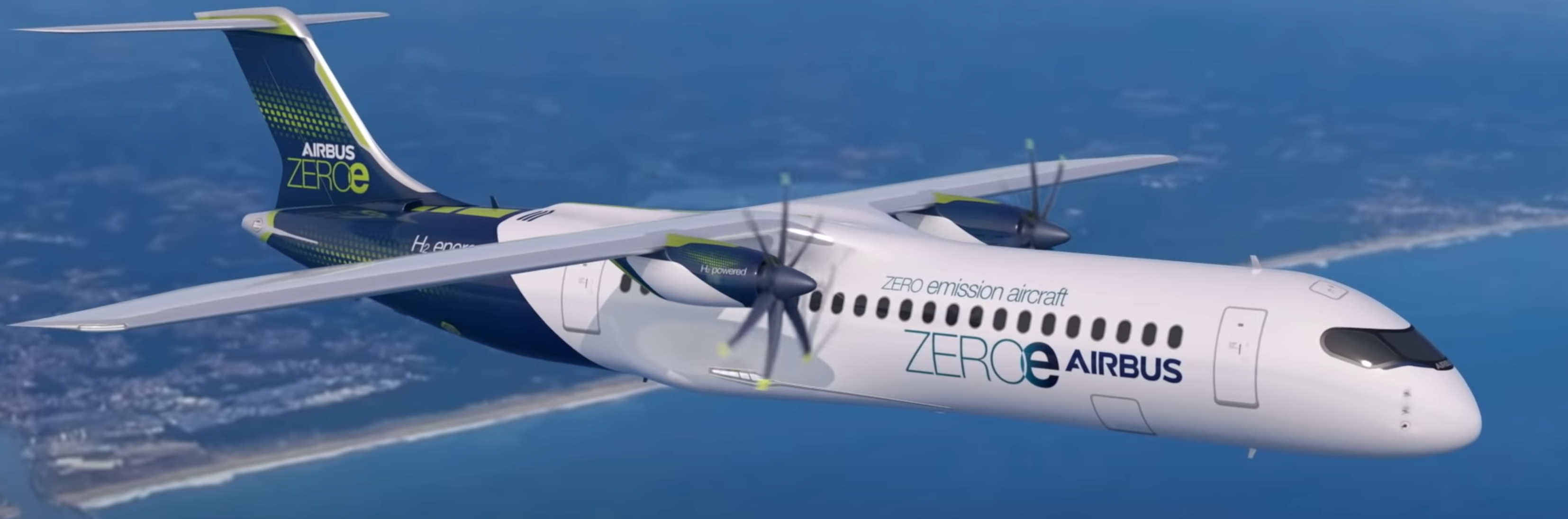
Note.
- It looks very much like an improved ATR-72.
- It has more extreme propellers and probably better aerodynamics.
- Airbus might like to persuade Ecojet to use ATR-72s as their 70-seat airliner.
- Information from an operator of hydrogen-powered airliners would be very valuable to Airbus.
I wouldn’t be surprised to see Ecojet lease some nearly new ATR-72s.
Would Airbus Fit ZeroAvia Hydrogen-Electric Powertrains In The ZEROe Turboprop?
This page on the Airbus website is entitled ZEROe.
In a section, which is entitled Hydrogen Propulsion To Power Future Aircraft, this is said.
All three ZEROe concepts are hybrid-hydrogen aircraft. They are powered by hydrogen combustion through modified gas turbine engines. Liquid hydrogen is used as fuel for combustion with oxygen.
In addition, hydrogen fuel cells create electrical power that complements the gas turbine, resulting in a highly efficient hybrid-electric propulsion system. All of these technologies are complementary, and the benefits are additive.
In 2022, we launched our ZEROe demonstrator with the aim to test hydrogen combustion technology on an A380 multimodal platform. Through future ground and flight testing, we expect to achieve a mature technology readiness level for a hydrogen-combustion propulsion system by 2025.
Note.
- Airbus state they are using modified gas turbine engines.
- Airbus also talk about using fuel cells to create electrical power that complements the gas turbines.
- Could the hydrogen fuel cells be used to power the aircraft’s systems, like avionics, control systems, air-conditioning and the hydrogen system for the main engine?
- This concept of effectively a hydrogen auxiliary power unit, might be a more efficient way of using the hydrogen, which either gives longer range or a smaller fuel tank.
- In The ZEROe Demonstrator Has Arrived, I talk about the ZEROe Demonstrator, which is a modified Airbus A 380.
Did the adding of hydrogen fuel cells to the ZEROe aircraft, lead to the concept of a hydrogen-powered auxiliary power unit, that I talked about in Airbus To Trial In-flight Auxiliary Power Entirely Generated By Hydrogen?
It looks to me, that Airbus have developed their own simple concept of powering the aircraft.
I doubt they will need ZeroAvia’s technology.
But.
- Aircraft manufacturers like Airbus generally fit the best and most suited engines they can find in their aircraft.
- The Wikipedia entry for ZeroAvia says that the prototype hydrogen-electric powertrain is in the cabin, consisting of two fuel cells and a lithium-ion battery for peak power.
- ZeroAvia have powerful shareholders like Amazon, Bill Gates and Royal Dutch Shell.
- ZeroAvia have also received grants from the UK Government.
I wouldn’t be surprised to learn, that Airbus have taken a long hard look at ZeroAvia’s technology.
After all, ZeroAvia could probably build a hydrogen fuel cell power pack, that would meet Airbus’s needs for a hydrogen-powered auxiliary power unit.
Remember too, that many fleets of aircraft have been updated with new engines for decades and I don’t think Airbus would mind ZeroAvia giving a new zero-carbon lease of life to the hundreds of ATR-72s in service around the world.
Surely, a successful hydrogen-powered ATR-72 is only going to create more interest in airlines buying ZEROe Turboprops.
All the converted aircraft will still need support from ATR.
Both the converted and new aircraft will need hydrogen refuelling services, so could the two aircraft use a common standard.
Airbus and ZeroAvia would appear to have several common interests.
Ecojet’s Core Route
This is a paragraph from the news story on the Ecotricity web site.
Dale has partnered with experienced pilot Brent Smith and a team of aviation specialists to set up Ecojet. Flights across the UK will commence in early 2024, starting with the Edinburgh to Southampton route, and expanding to mainland Europe shortly after, with long-haul flights planned for the future.
Note.
- The ATR-72 has a range of 949 miles, which is more than adequate for Southampton and Edinburgh, which is just over 350 miles.
- Diagonal journeys in the UK are often the most passenger-unfriendly by rail and tend to use diesel trains.
- Southampton Airport has good road and rail connections, with the terminal less than a minute from the station.
- Edinburgh Airport has good road and tram connections, with rail connections needing a short journey on the tram.
- Southampton Airport has flights to the Channel Islands, Ireland and Schiphol.
- Edinburgh Airport has a comprehensive service from major airlines and low-cost carriers, and several flights to destinations in the North of Scotland and on the Islands.
I think that it is a well-chosen core route for their 70-seat aircraft.
Which Routes Will Ecojet Fly With The Twin Otters?
Consider.
- My Scottish friends tell me that flying to the Scottish Islands, like the Hebrides, Orkney and Shetland is expensive.
- The growth of the Scottish wind power industry will mean, that more capacity is needed to serve the North of Scotland and the Islands.
- Tourism to the North of Scotland and the Islands is on the up.
- There will not be a shortage of green electricity to produce green hydrogen.
- The North of Scotland isn’t short of airports.
- The Twin Otter has a surprisingly long range on aviation fuel and I suspect, that a hydrogen version would be designed to have a similar range.
- The longest flight needed would probably be Edinburgh and Sumburgh, which is about 280 miles, which should be well within the range of a Twin Otter.
- I suspect that hydrogen refuelling could be easily provided at enough airports, to support hydrogen-powered airliners.
- I am sure, that the Twin Otters could be used on a network of zero-carbon flights from Edinburgh to the North of Scotland and the Islands.
- A zero-carbon airline would help Scotland’s net-zero ambitions.
There is certainly a need for another airline to connect Edinburgh to the North of Scotland and the Islands and the infrastructure could be upgraded to support a hydrogen-based zero-carbon airline.
Could Ecojet build a similar network at Southampton, that served the Channel Islands, Southern Ireland and Northern France?
Conclusion
There’s a lot more to this venture, than there appears at first sight.
O wish Vince and his partners well, but as a coeliac, I’ll skip the food.
Boost For Borders In New Report
This report on the Scottish Government web site is entitled Borders Transport Corridors – Pre-Appraisal.
It is a comprehensive report with a helpful pag of recommendations.
Recommendations that apply to rail include.
Develop Forestry Route Network
Improve network of internal forestry tracks as well as its connections to roads and railway, including ‘low-tech’ timber
pickup facilities.
This seems sensible, as some of the forests on both sides of the Scottish order are mature and need to be cut down and replanted.
Increase Park and Ride Provision
Increase capacity of existing Park-and-Ride sites and implement new Park-and-Ride schemes for all modes at strategic locations [e.g. Interchanges and Key Employment Areas]
Every part of the UK seems to need more Park-and-Ride. The Borders is no exception.
Borders Railway Extension – South/West
Extend the Borders Railway to Hawick and/or Carlisle
Will it go all the way to Carlisle?
Consider.
- The West Coast Main Line will need a capacity increase through Carlisle because of High Speed Two. These works could be combined with those on the Southern part of the Borders Railway.
- Plans exist for a large freight interchange at Longtown on the former MoD site.
- Linking the Tourist areas North and South of the Scottish Border by rail must be a good thing.
- Extension to Carlisle would give those in the Scottish Borders access to High Speed Two at Carlisle, without a long trip via Glasgow.
For these reasons, I think that the Borders Railway will go to Carlisle.
Borders Railway Extension – South/East
Extend the Borders Railway towards East Coast Main Line (ECML) via Berwick-upon-Tweed
This surprised me, but it does complete the jigsaw.
Does it offer a freight route for moving the timber out of the area?
It woulde certainly offer a scenic route between Edinburgh and Newcastle.
New Rail Stations
New rail stations on the existing Borders Railway
This is surely building on the success of the current Borders Railway.
Extension of Borders Railway Services
Link Borders Railway and Fife Circle, providing interchange at Edinburgh Gateway; West Edinburgh; and potential future link to Glasgow.
Back-to-back services across a city are always a good idea, as they cut the need for terminal platforms
- The Borders Railway and Fife Circle are both half-hourly services, so could be connected together, once suitable rolling stock is available.
- This service would also connect the Borders to the Edinburgh Airport tram at Edinburgh Gateway.
- With extra services, would the capacity of the Borders Railway will probably need to be increased?
Does the South East extension enable better services for the Borders beyond Edinburgh?
Conclusion
There are a lot of projects needing to be developed, but they will create a lot of economic activity in the Borders.
The two railway extensions to Hawick and/or Carlisle and Berwick-on-Tweed are the two most expensive projects, but both have English implications, so I don’t think Westminster will mind paying some of the cost.
 The Anonymous Widower