Observing Trains At Stafford Station
I’m fairly certain, that I’ve only been to Stafford once in my life, in the past. That would be in 1968, when I went to English Electric in the town, when I was looking for a job on leaving Liverpool University.
In the end, my first job on leaving was at ICI in Runcorn.
As Stafford station, is on the West Coast Main Line, I’ve been through the station many times, on my way to Liverpool, Manchester, Preston, Scotland and other places in the North West of England.
I travelled North to Stafford in one of London Northwestern’s Class 350 trains, which definitely had ironing board seats. Some of these trains are being replaced with new Class 730 trains.
Stafford Station
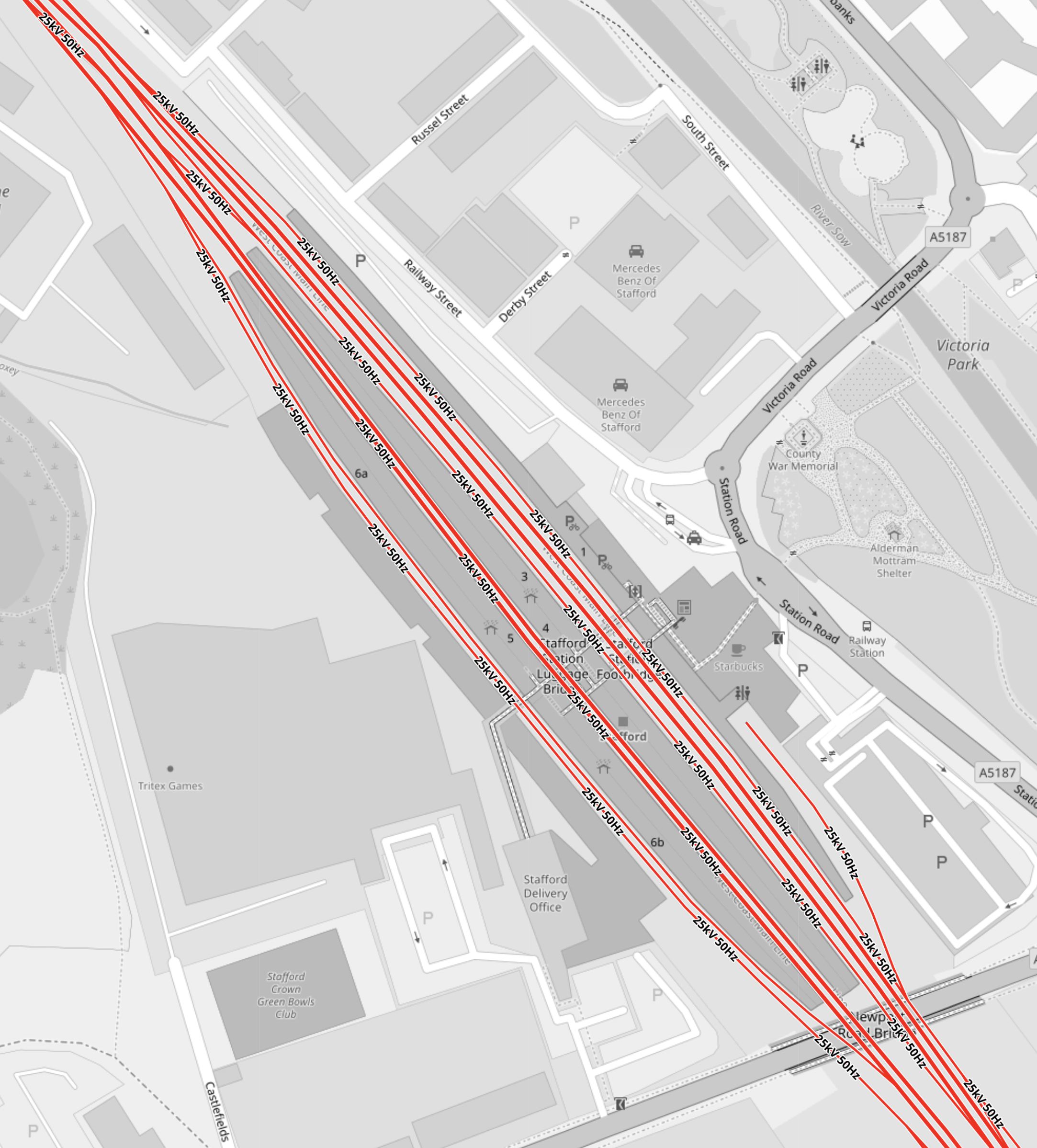
This OpenRailwayMap shows the layout of platforms at the station.
Note.
- Platforms are numbered starting with Platform 1 in the East.
- There are five through tracks for passenger trains and a double-track goods loop.
- All tracks are electrified and bi-directional.
- The platforms are three hundred metres long, but I feel they could be lengthened to take the 400 metre long High Speed Two trains.
- The platforms are certainly long enough for pairs of 200 metre long High Speed Two trains, to split and join at the station.
These pictures show Stafford station.
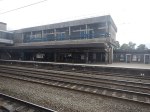
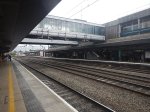
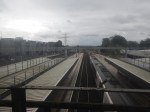
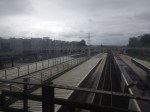
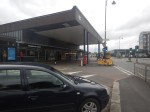
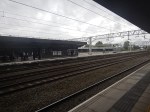
Note.
- The station was built of concrete in the early 1960s.
- It has a unique feature, in that there is a waiting area above the tracks, so kids of all ages can watch the trains speed through.
- It has been improved several times in recent years.
- It is step-free with several lifts.
I feel, the station could be converted into a major High Speed Two hub station.
High Speed Two Services
This graphic shows High Speed Two services after Phase 2b is completed.
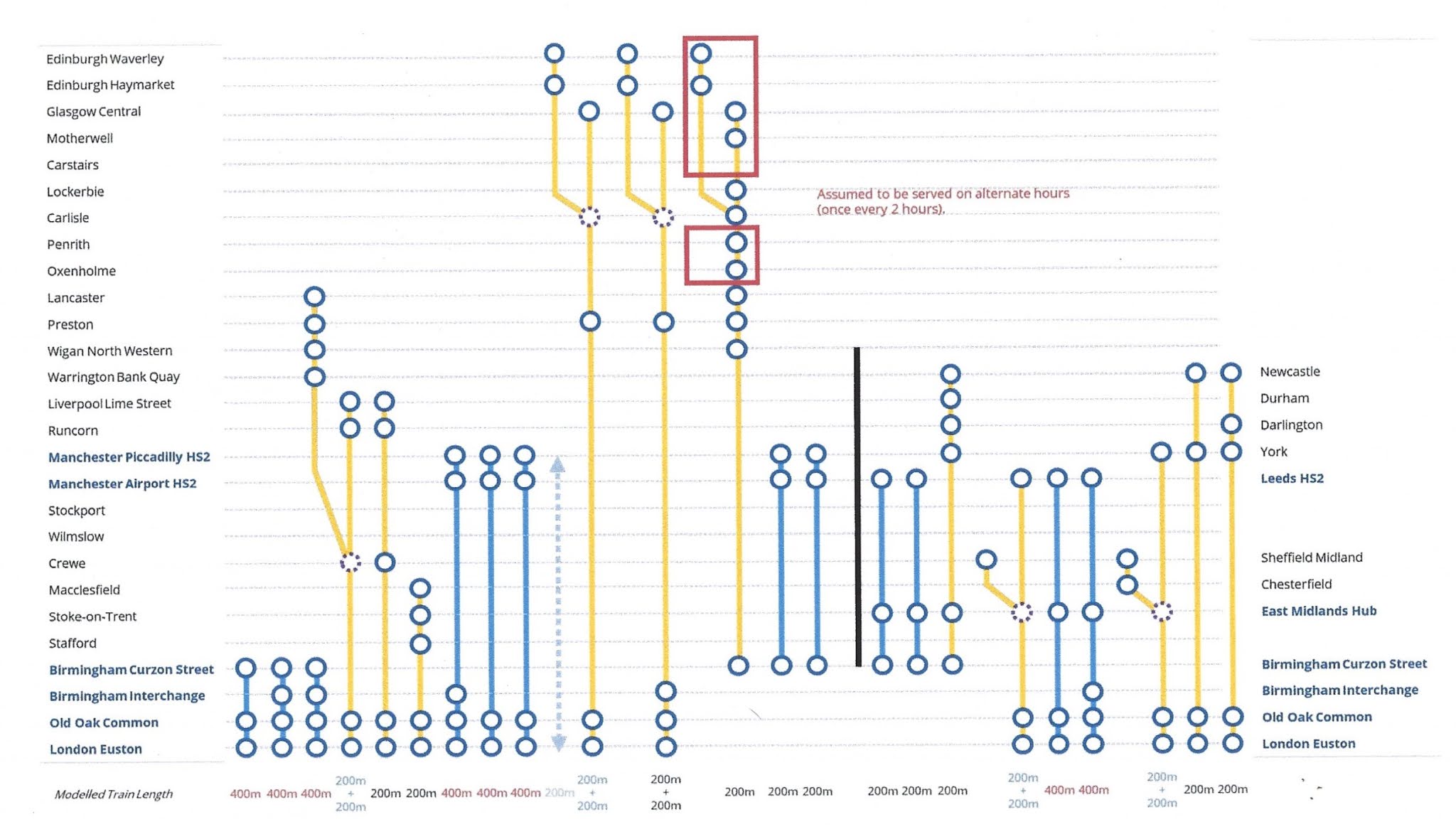
Note.
- Everything to the right of the vertical black line has now been cancelled
- Services shown in blue are run by High Speed Two Full Size trains.
- Services shown in yellow are run by High Speed Two Classic-Compatible trains.
- Each of these trains will have a frequency of one train per hour (tph).
These High Speed Two trains pass through Stafford.
- London and Lancaster/Liverpool Lime Street – Split/Join at Crewe
- London and Crewe/Runcorn/Liverpool Lime Street
- London and Stafford/Stoke-on-Trent/Macclesfield
- London and Manchester Airport/Piccadilly
- London and Manchester Airport/Piccadilly
- London and Manchester Airport/Piccadilly
- London and Edinburgh/Glasgow – Split/Join at Carlisle
- London and Edinburgh/Glasgow – Split/Join at Carlisle
- Birmingham and Edinburgh/Glasgow
- Birmingham and Manchester Airport/Piccadilly
- Birmingham and Manchester Airport/Piccadilly
In addition space will need to be found for these other services.
- Avanti – London and Chester/North Wales
- Avanti – London and Blackpool
- Freight – London and Liverpool/Manchester and Scotland
That gives a total of at least fourteen tph through Stafford station or one every 257 seconds.
Between Stafford and Crewe, with the completion of the flyover at Norton Bridge, there is effectively four tracks all the way, so this should give enough capacity to allow fourteen tph between Stafford and Crewe.
Between Stafford and Handsacre junction, where High Speed Two will join the Trent Valley Line about half the route is four-track with the rest being just two-track.
Will the two-track section be able to handle fourteen tph? I suspect it will, especially, as it is sandwiched between two four-track sections.
These are my thoughts about making the most of capacity through Stafford station.
Could Pairs Of High Speed Two Trains, Split And Join At Stafford?
Stafford station has 300 metre long platforms and pairs of High Speed Two Trains are 400 metres long.
Looking at maps and pictures of Stafford station, I suspect that lengthening the platforms at Stafford would be possible.
In the provisional High Speed Two service diagram, that I displayed earlier, these are two services.
- London and Crewe/Runcorn/Liverpool Lime Street
- London and Stafford/Stoke-on-Trent/Macclesfield
These could be run as a pair of trains between London and Stafford.
One advantage of running the two services as a pair, is that it would reduce the number of trains between Stafford and Handsacre junction by one, which might help the scheduling of trains through the double-track section, of the Trent Valley Line.
Fitting In The London and Chester/North Wales Services
Consider.
- These important services will soon be run by five-car Class 805 trains.
- The trains are diesel-electric.
- A pair would be 260 m long.
- There are ten trains per day (tpd) on the route.
The service has a few problems.
- It takes up a path between Crewe and Handsacre junction via Stafford, where train paths are at a premium.
- It is not zero-carbon.
- If London and Holyhead times were reduced, it would probably attract more passengers to the route.
As there are plenty of spare paths on High Speed Two, due to the cancellation of the Eastern leg, the easiest way to speed up the service would be to use High Speed Two between Handsacre junction and London.
200 metre long High Speed Two Classic-Compatible trains could be used, but this would need one of the following.
Electrification between Crewe and Holyhead. Although this was promised by the last government, I suspect the antis will stop it.
Partial electrification between Crewe and Holyhead. As Crewe and Holyhead is only 105.5 miles, I suspect a creditable scheme to use battery-electric trains could be developed. These trains could be useful in opening up High Speed Two to other destinations.
Could Other Services Piggy-Back On London and Chester/North Wales Services?
The London and Chester/North Wales services would all be run by 200 metre long High Speed Two trains.
There would be no reason, why on the London end of the journey, they could be paired with another High Speed Two train to and from another destination.
- They could split and join with a Blackpool service at Crewe.
- They could split and join with a Barrow service at Crewe.
- They could split and join with a second Stoke-on-Trent/Macclesfield service at Stafford.
Services like these, would improve the coverage of High Speed Two.
As with the joining of the Liverpool Lime Street and Macclesfield services, the pairing of trains reduces the number of paths needed on the double-track section of the Trent Valley Line to the South of Stafford.
Other Splitting And Joining At Stafford
It may be possible to arrange other splitting and joining at Stafford.
By rearranging the Manchester and/or the Scottish services, it might be possible to reduce the number of trains, through the double-track section of the Trent Valley Line.
There are certainly several possibilities.
Conclusion
Stafford station could be crucial, in making High Speed Two Lite feasible.
HS2 Manchester Route Not Sold Off Yet As Labour Weighs Up Rail Options
The title of this post, is the same as that of this article on i.
This is the sub-heading.
The Government has a looming dilemma with climbing costs and pressure from supporters to bring back the Birmingham to Manchester line
These first three paragraphs explain the problems.
Labour faces a £500m decision on what to do with HS2 land which was not sold despite promises by Rishi Sunak, as Sir Keir Starmer braces for new calls to resurrect the cancelled Birmingham to Manchester line.
The £50bn rail line is likely to cause the new Labour government a headache as supporters push for the party to support the project which was initially launched by former Prime Minister Gordon Brown in 2009.
Within Whitehall, civil servants are currently thought to be calculating the value for money of Mr Sunak’s HS2 plan in comparison to the previous HS2 plan to Manchester, with the result expected to favour the longer route.
These are my thoughts.
The Appointment Of Lord Peter Hendy As Rail Minister
Two of the more unusual ministerial appointments by Sir Keir Starmer were the appointment of James Timpson as Minister of State for Prisons, Parole and Probatio, and Lord Peter Hendy as Minister of State in the Department of Transport.
But if you read their Wikipedia entries, they both have great knowledge of the area to where they have been appointed.
This picking of Ministers outside of elected MPs has happened before, with the most recent being Rishi Sunak’s appointment of David Cameron as Foreign Secretary.
This is a paragraph from the article in the i, gives some views about Lord Hendy and High Speed Two.
The appointment of Lord Peter Hendy as rail minister has been received positively by many supporters of the high speed rail line, given his previous work around the project and Euston’s redevelopment, where he pushed for a more ambitious project. One industry source told i that Lord Hendy was “one of the most respected figures in the UK rail industry”, and a “definite supporter of HS2 to Manchester”.
As the current Chairman of Network Rail, I suspect Lord Hendy has had endless thoughts on how he can get High Speed Two to Manchester, within an acceptable budget.
I also believe that since being appointed to be Chairman of Network Rail, the performance of that company has improved.
Has Lord Hendy improved the quality of the workforce or imposed better top down project management?
The Euston Station Problem
The article in the i has several paragraphs on the Euston station problem.
Lord Hendy has probably, the best directory of contacts of property developers, architects and engineers in the UK and with his background of economics, he probably know how to sort the wheat from the dross.
So could Lord Hendy somehow conjure a solution for Euston station out of the speculation?
I wonder if he could find someone to develop a multi-billion commercial complex over the station, that this could generate the cash to pay for Birmingham and Manchester section of High Speed Two.
Like Baldrick, I suspect Lord Hendy could have a cunning plan, but based on sound economic sense.
For instance, I believe, that the best way to serve Leeds by High Speed Two could be via Manchester.
- Leeds would have a choice of routes from London; King’s Cross and Euston.
- It could possibly have three, if St. Pancras and Leeds via Derby and Sheffield were to be improved.
- Birmingham and Leeds services would be greatly improved if High Speed Two to Leeds, went via Manchester.
I would suspect every idea will be on the table.
250,000 Seats A Day On The WCML?
The title of this post, is the same as that of this article on Rail Engineer.
These are the first three paragraphs.
In the Parliamentary debate on the cancellation of HS2 phase 2, Transport Minister Mark Harper claimed that what remains of HS2 will deliver “a massive increase in capacity to the West Coast Main Line (WCML)” by providing 250,000 seats a day. This figure was subsequently repeated by the Prime Minister and Rail Minister who advised that it applies “across the primary long-distance operator on the West Coast.”
Yet without HS2 phase 2a, there is to be no WCML capacity increase north of Lichfield. Furthermore, with no HS2 station in Manchester it will not be possible to run the planned two-unit 400-metre HS2 trains to the city. Instead, there can only be single 200-metre unit HS2 trains which are shorter than the current 265-metre Pendolino trains.
Furthermore, 250,000 seats a day is equivalent to running 17 x 605-seat Pendolinos an hour, 24 hours a day. This is clearly not credible.
Note.
- The writer’s assumptions about Manchester are correct.
- Liverpool Lime Street is already is already HS2-ready for trains between Crewe and London, after the recent upgrade.
- Liverpool Lime Street will certainly be able to take two London trains per hour (tph), which can only be single 200-metre unit HS2 trains.
- Liverpool Lime Street may be able to take a third London train per hour.
These are my thoughts.
Current Services
Current services include.
- Avanti West Coast – London Euston and Blackpool North via Birmingham New Street – 2 trains per day (tpd)
- Avanti West Coast – London Euston and Glasgow Central via Birmingham New Street – 5 tpd
- Avanti West Coast – London Euston and Edinburgh Waverley via Birmingham New Street – 7 tpd
- Avanti West Coast – London Euston and Birmingham New Street – 1 tph
- Avanti West Coast – London Euston and Holyhead – 10 tpd
- Avanti West Coast – London Euston and Liverpool Lime Street – 1 tph – Increasing to 2 tph.
- Avanti West Coast – London Euston and Manchester Piccadilly via Stoke-on-Trent, Macclesfield and Stockport – 1 tph
- Avanti West Coast – London Euston and Manchester Piccadilly via Stoke-on-Trent and Stockport – 1 tph
- Avanti West Coast – London Euston and Manchester Piccadilly via Crewe, Wilmslow and Stockport – 1 tph
- Avanti West Coast – London Euston and Glasgow Central – 1 tph.
- West Midlands Trains – London and Birmingham New Street – 2 tph
- West Midlands Trains – London and Crewe – 1 tph
- West Midlands Trains – Birmingham New Street and Liverpool Lime Street – 1 tph
It looks like there are eight Avanti West Coast tph and two West Midlands Trains tph between Stafford and Crewe.
High Speed Two Services
This diagram shows High Speed Two services, as they were originally envisaged before Phase 2 was discontinued.
Note.
- Trains to the left of the vertical black line are Phase 1 and those to the right are Phase 2.
- Full-Size trains are shown in blue.
- Classic-Compatible trains are shown in yellow.
- The dotted circles are where trains split and join.
- In the red boxes routes alternate every hour.
- Was Lancaster chosen as it’s close to the new Eden Project Morecambe?
Click on the diagram to enlarge it.
The Author’s Assumption
The author has made these assumptions.
- Current West Coast Main Line capacity North of Lichfield; Avanti West Coast – 8 tph, West Midlands – 1 tph and freight trains – 4 tph
- HS2 offers no extra capacity North of Lichfield.
- Max capacity ; Old Oak Common – 8 tph and London Euston – 10 tph.
- 400-metre long trains North of Birmingham ; Min – 1 tph to Edinburgh/Glasgow
- 400-metre long trains North of Birmingham ; Max – plus 3 tph to Liverpool/Manchester
- Trains operate a maximum of 14 hours per day.
I would add.
- All pairs of 200-metre long trains split and join at Crewe.
- Birmingham Curzon Street has seven platforms.
- Lancaster and Macclesfield have long bay platforms, that can handle 200-metre trains
- Liverpool Lime Street and Manchester Piccadilly have two platforms, that can handle 200-metre trains.
- I suspect
- Liverpool Lime Street and Manchester Piccadilly could both handle four 200-metre trains tph hour – Three for London and one for Birmingham.
There is a surprising amount of capacity in the North.
The Author’s Minimum Plan For HS1 – Phase 1
I think his minimum plan is as follows.
- Old Oak Common and Birmingham Curzon Street – 400-metre long trains – 3 tph
- Old Oak Common and Liverpool Lime Street/Lancaster – 400-metre long trains – 1 tph – Splits at Crewe.
- Old Oak Common and Liverpool Lime Street – 200-metre long trains – 1 tph
- Old Oak Common and Macclesfield via Stafford and Stoke-on-Trent – 200-metre long trains – 1 tph
- Old Oak Common and Manchester Piccadilly – 200-metre long trains – 2 tph
- Old Oak Common and Edinburgh Waverley/Glasgow Central – 400-metre long trains – 1 tph – Splits at Crewe.
Note.
- 400-metre long trains are a pair of 200-metre long trains, that can split and join.
- This fulfils all the requirements of the original HS2 timetable for Phase 1.
- The total is nine tph and Old Oak Common can only handle 8 tph.
- Perhaps, the Liverpool Lime Street service could be a Liverpool Lime Street/Manchester Piccadilly service, that splits at Crewe?
I think it could work with London having the following services.
- Birmingham Curzon Street – 400-metre long trains – 3 tph
- Birmingham International – 400-metre long trains – 4 tph
- Carlisle – 200-metre long trains – 1 tph
- Crewe – 400-metre long trains – 3 tph
- Edinburgh Waverley – 200-metre long trains – 1 tph
- Glasgow Central – 200-metre long trains – 1 tph
- Lancaster – 200 metre long trains – 1 tph
- Liverpool Lime Street – 200-metre long trains – 2 tph
- Macclesfield – 200-metre long trains – 1 tph
- Manchester Piccadilly – 200-metre long trains – 2/3 tph
- Preston – 200-metre long trains – 2 tph
- Stafford – 200-metre long trains – 1 tph
- Stoke-on-Trent – 200-metre long trains – 1 tph
- Warrington Bank Quay – 200-metre long trains – 1 tph
- Wigan North Western – 200-metre long trains – 1 tph
Services care as good or better than the current services.
The Author’s Maximum Plan For HS1 – Phase 1
I think his maximum plan is as follows.
- London Euston and Birmingham Curzon Street – 400-metre long trains – 3 tph
- London Euston and Liverpool Lime Street/Lancaster – 400-metre long trains – 1 tph – Splits at Crewe.
- London Euston and Liverpool Lime Street/Manchester Piccadilly – 400-metre long trains – 1 tph – Splits at Crewe.
- London Euston and Macclesfield via Stafford and Stoke-on-Trent – 200-metre long trains – 1 tph
- London Euston and Manchester Piccadilly – 200-metre long trains – 2 tph
- London Euston and Edinburgh Waverley/Glasgow Central – 400-metre long trains – 1 tph – Splits at Crewe.
Note.
- 400-metre long trains are a pair of 200-metre long trains, that can split and join.
- This fulfils all the requirements of the original HS2 timetable for Phase 1.
- That is nine tph and London Euston can handle 10 tph.
- Perhaps, a tenth train could serve Edinburgh Waverley/Glasgow Central with a split at Crewe.
It should work.
Could High Speed Birmingham Curzon Street and Liverpool Lime Street And Manchester Piccadilly Services Be Provided With A Reverse At Birmingham Curzon Street?
A train would take this route.
- A 400 metre long train would leave London and go to Birmingham Curzon Street.
- At Birmingham Curzon Street the train would reverse and travel to Crewe.
- At Crewe the train would split with separate trains going to Liverpool Lime Street and Manchester Piccadilly.
Note.
- Automation could be used extensively to do the joining and splitting.
- The train would have an onboard team of drivers, so all joins, reverses and splits are performed as fast as possible.
- A local service could be paired with each train, so that intermediate stations on the Liverpool and Manchester branches had excellent connections to Birmingham and the South.
Suppose the maximum plan is now as follows.
- London Euston and Liverpool Lime Street/Manchester Piccadilly via Birmingham Curzon Street – 400 metre long trains – 3 tph – Reverses at Birmingham Curzon Street – Splits at Crewe.
- London Euston and Birmingham Curzon Street – 400 metre long trains – 1 tph
- London Euston and Lancaster – 200 metre long trains – 1 tph
- London Euston and Liverpool Lime Street – 200 metre long trains – 1 tph
- London Euston and Macclesfield via Stafford and Stoke-on-Trent – 200 metre long trains – 1 tph
- London Euston and Manchester Piccadilly – 200 metre long trains – 1 tph
- London Euston and Edinburgh Waverley/Glasgow Central – 400 metre long trains – 2 tph – Splits at Crewe.
Note.
- Birmingham Curzon Street, Liverpool Lime Street and Manchester Piccadilly would all get four tph to and from London.
- Birmingham Curzon Street, Liverpool Lime Street and Manchester Piccadilly would all get one tph to and from London, that could be non-stop and didn’t join, reverse or split.
- Birmingham Curzon Street and Liverpool Lime Street would have a three tph service.
- Birmingham Curzon Street and Manchester Piccadilly would have a three tph service.
- Lancaster, Edinburgh Waverley, Glasgow Central and other stations would get the originally-promised service to and from London.
- That is ten tph to and from London Euston and the station can handle that number of trains.
It should work.
Could High Speed Birmingham Curzon Street and Edinburgh Waverley and Glasgow Central Services Be Provided With A Reverse At Birmingham Curzon Street?
In the previous section, I showed how, three tph between London Euston and Liverpool Lime Street/Manchester Piccadilly could be provided with a reverse at Birmingham Curzon Street.
So could the fourth train between London and Birmingham Curzon Street take this route?
- A 400 metre long train would leave London and go to Birmingham Curzon Street.
- At Birmingham Curzon Street the train would reverse and travel to Crewe, or another station, where the split can be performed.
- The train would split with separate trains going to Edinburgh Waverley and Glasgow Central.
Note.
- They would use the current paths used by Avanti West Coast Birmingham and Scotland services along the West Coast Main Line.
- This would give a third train to both Edinburgh Waverley and Glasgow Central.
It certainly appears that by using a reverse at Birmingham Curzon Street, more capacity can be created on the West Coast Main Line/HS2 route.
Could High Speed Two Serve North Wales?
It finally looks like the North Wales Coast Lines will finally be electrified.
- Would this allow a 200 metre long train to run all the way to Holyhead for the boats to Ireland?
- There could be a join and split at Crewe with another train.
- Chester would also be served by HS2.
It would create a zero-carbon route to Ireland.
What Would Be The Daily Number Of Passengers Carried?
The maximum plan could now be as follows.
- London Euston and Liverpool Lime Street/Manchester Piccadilly via Birmingham Curzon Street – 400 metre long trains – 3 tph – Splits at Crewe.
- London Euston and Edinburgh Waverley/Glasgow Central via Birmingham Curzon Street – 400 metre long trains – 1 tph – Splits at Crewe.
- London Euston and Liverpool Lime Street/Lancaster – 400 metre long trains – 1 tph – Splits at Crewe.
- London Euston and Macclesfield via Stafford and Stoke-on-Trent – 200 metre long trains – 1 tph
- London Euston and Manchester Piccadilly/Holyhead – 400 metre long trains – 1 tph – Splits at Crewe.
- London Euston and Edinburgh Waverley/Glasgow Central – 400 metre long trains – 2 tph – Splits at Crewe.
Note.
- There are eight 400 metre long trains and one 200 metre long trains in both directions.
- A 200 metre long train hold 550 passengers.
- There are seventeen 200 metre long tph in both directions.
- Trains operate a maximum of 14 hours per day.
The number of passengers per day is 261,800.
How Hydrogen Will Power The Green Construction Eevolution
The title of this post, is the same as that of this news item from Ryze Hydrogen.
These two paragraphs introduce the news item.
According to the International Energy Agency buildings operations and construction emissions account for more than one-third of global energy-related emissions, significantly contributing to environmental degradation, with heavy machinery and standby power solutions relying heavily on fossil fuels.
Yet here at Ryze we know the industry stands on the brink of a green revolution, as clean energy solutions lead the charge towards decarbonisation.
The news item, is a must-read for anybody involved in construction.
Recently, a gas leak killed the roadside tree outside my house. I wrote about the incident in It Looks Like The Gas Leak Has Killed The Tree Outside My House.
What I didn’t say, was that when they cleaned up the mess, I had an eight-wheeled diesel truck with a grab, working outside my house for a couple of hours, spewing fumes everywhere.
Hopefully, green construction is friendlier to the neighbours and the workers on site.
High Speed Two is using green construction for this reason in sensitive locations.
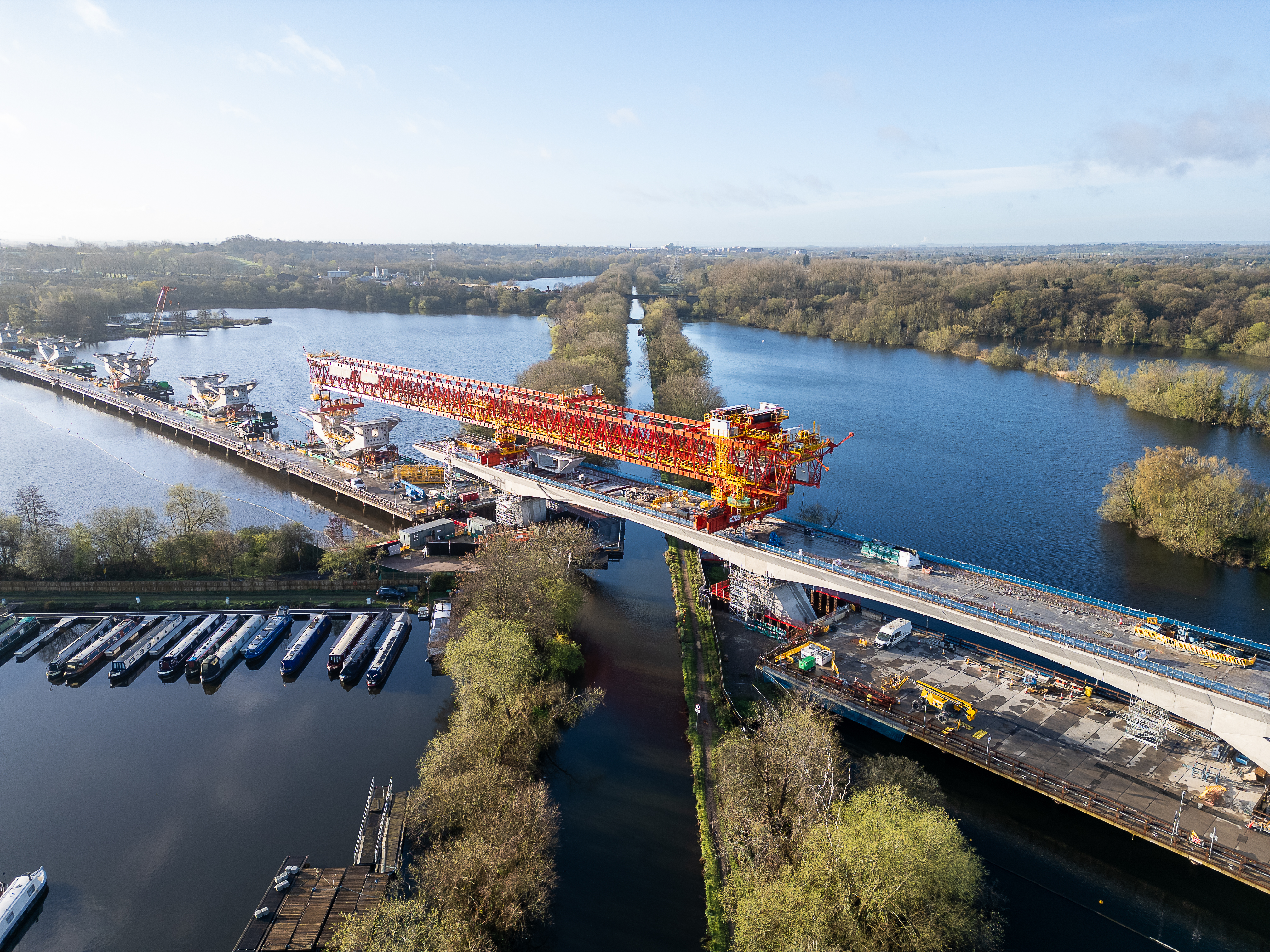
Twenty First And Eighteenth Centuries Meet As HS2 Traverses Grand Union Canal
The title of this post, is the same as that of this article on RailUK.
This High Speed Two picture is shown.
There is also this video.
Could Open Access Operators Use High Speed Two?
In Mayors Propose New Staffordshire To Manchester Rail Line, I suggested the Grand Union Trains might like to run their service between London Euston and Stirling via High Speed Two.
But would this be a feasible idea?
These are my thoughts.
What Is An Open Access Operator?
The Wikipedia entry for Open-Access Operator, provide this answer.
In rail transport, an open-access operator is an operator that takes full commercial risk, running on infrastructure owned by a third party and buying paths on a chosen route and, in countries where rail services run under franchises, are not subject to franchising.
It then lists fifty-four operators in fifteen countries.
As the companies, who provide the services take full commercial risk and don’t get a subsidy from the taxpayer, I don’t see why, that providing, the operator can get the paths, they should be allowed to operate.
If they fail, then that’s the operator’s problem.
Are Any Paths Available On High Speed Two?
These are High Speed Two services as originally planned.
Since the Eastern Leg was cancelled, the following has happened.
- There are only eleven trains per hour (tph) between London Euston and Birmingham Interchange.
- There are only ten tph between Birmingham and Crewe.
- There is one tph between Birmingham and Macclesfield via Stafford and Stoke-on-Trent.
Note.
The Trent Valley Line section between Stafford and Crewe is 24.3 miles.
The Trent Valley Line between Handsacre Junction and Crewe is nearly all four tracks.
Currently, this section carries these fast trains.
- Avanti West Coast – 1 tph – London Euston to Blackpool North, Edinburgh or Glasgow via Birmingham New Street.
- Avanti West Coast – 1 tph – London Euston to North Wales
- Avanti West Coast – 1 tph – London Euston to Liverpool Lime Street
- Avanti West Coast – 2 tph – London Euston to Manchester Piccadilly
- Avanti West Coast – 1 tph – London Euston to Scotland
- West Midlands Trains – 1 tph – London Euston to Crewe.
- West Midlands Trains – 1 tph – Stafford to Crewe.
- West Midlands Trains – 1 tph – Birmingham New Street to Liverpool Lime Street.
This totals nine tph and will be 10 tph, when a second London Euston to Liverpool Lime Street is added.
When High Speed Two opens between London Euston and Birmingham Curzon and Handsacre Junction, trains between London Euston and Liverpool, Manchester, the North and Scotland will switch to the Trent Valley Line at Handsacre Junction.
The Trent Valley Line section between Stafford and Crewe will carry these fast trains.
- Avanti West Coast – 1 tph – London Euston to North Wales
- High Speed Two – 2 tph – London Euston to Liverpool Lime Street
- High Speed Two – 3 tph – London Euston to Manchester Piccadilly
- High Speed Two – 2 tph – London Euston to Scotland
- High Speed Two – 1 tph – Birmingham Curzon Street to Scotland
- High Speed Two – 2 tph – Birmingham Curzon Street to Manchester Piccadilly
- West Midlands Trains – 1 tph – London Euston to Crewe.
- West Midlands Trains – 1 tph – Stafford to Crewe.
- West Midlands Trains – 1 tph – Birmingham New Street to Liverpool Lime Street
Note.
- This totals to ten tph for High Speed Two, 1 tph for Avanti West Coast and the tph for West Midlands Trains.
- There is no service to Blackpool.
- It looks to me that the London Euston to North Wales should, as soon as the North Wales Coast Line is electrified become a High Speed Two service.
- Should the Birmingham New Street to Liverpool Lime Street service be replaced with a High Speed Two from Birmingham Curzon Street to Liverpool Lime Street?
There is plenty of paths South of Handsacre Junction on High Speed Two to accommodate a few services to Blackpool and an open access operator like Grand Union Trains, who have been given permission to run a service to Stirling.
Conclusion
My rough calculation says that open access services could be fitted in on the latest variant of High Speed Two.
In Mayors Propose New Staffordshire To Manchester Rail Line, the two Andies; Burnham and Street proposed that the Handsacre Junction and Manchester Airport section of High Speed Two should be built.
If this should happen, then it would open up several possibilities for open access services for the North.
Mayors Propose New Staffordshire To Manchester Rail Line
The title of this post, is the same as that of this article on Greater Birmingham Chambers of Commerce.
These five paragraphs introduce the article.
The mayors of the West Midlands and Greater Manchester have set out proposals for a new railway line between Staffordshire and Manchester Airport in a bid to improve connections to the north.
Work commission by West Midlands mayor Andy Street and Greater Manchester mayor Andy Burnham has concluded the new line is the preferred option to tackle congestion on the West Coast Mainline, following the government’s decision to curtail HS2 beyond Birmingham.
A private sector group – chaired by infrastructure expert Sir David Higgins – had been looking at three potential options to improve connectivity between Birmingham and Manchester.
The options included undertaking significant engineering upgrades to the West Coast Main Line, building bypasses at the pinch points on the line and building a new railway between Handsacre and Manchester Airport.
The group, convened by the mayors, is led by global engineering firm Arup with input from over 60 partners from six other firms – Arcadis, Addleshaw Goddard, EY, Dragados, Mace and Skanska.
This paragraph gives the conclusion.
The group has provisionally concluded that a new line – running approximately 70 miles between HS2 at Handsacre and Northern Powerhouse Rail at High Legh – is likely to offer the best combination of costs and benefits.
It looks to me, that this professional approach has led to a sensible answer.
I will now look at the route.
This Open Railway Map shows the tracks to the South of Handsacre.
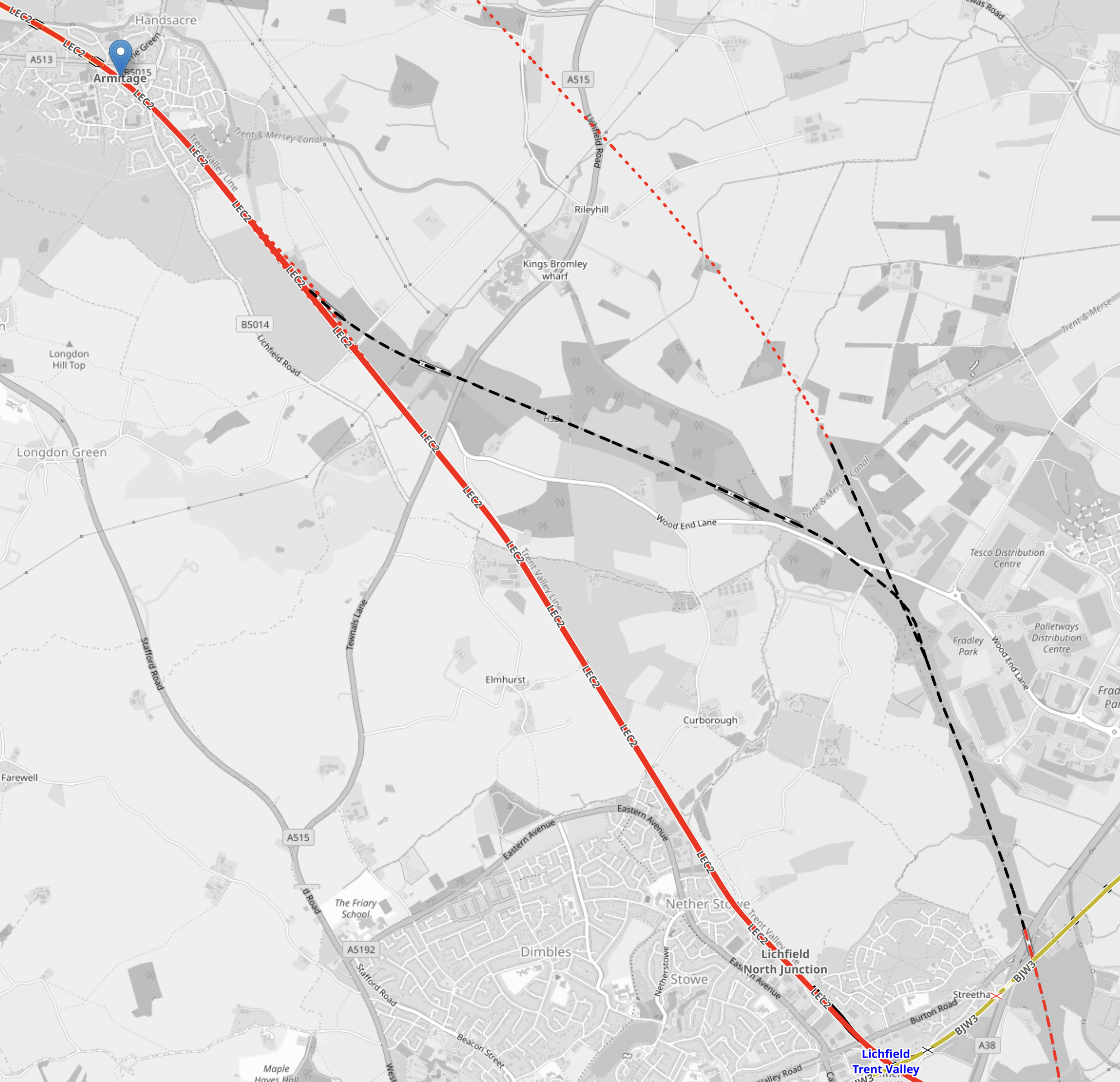
Note.
- The blue arrow in the North-West corner of the map, indicates the location of the former Armitage station, which had the village of Handsacre to its North-East.
- The red line through Armitage station is the Trent Valley Line.
- Lichfield Trent Valley station is at the bottom of the map.
- The line drawn with large dashes from the South-East corner of the map is the proposed line of High Speed Two. Red indicates under construction and black indicates proposed.
High Speed Two splits into two.
One branch goes North-West to join the Trent Valley Line, whilst the other just stops after about a kilometre.
- All trains for Liverpool, Manchester, North Wales, The North and Scotland will take the Trent Valley Line, when High Speed Two opens.
- Trains for Stoke-on-Trent, Macclesfield and some to Manchester will leave the Trent Valley Line at Colwich Junction.
- All other trains, will take the same route as now and proceed to Crewe via Stafford.
The red dotted line leading from the cancelled branch of High Speed Two shows where the original fast line to Crewe was planned to go.
This Open Railway Map shows the tracks around Crewe.
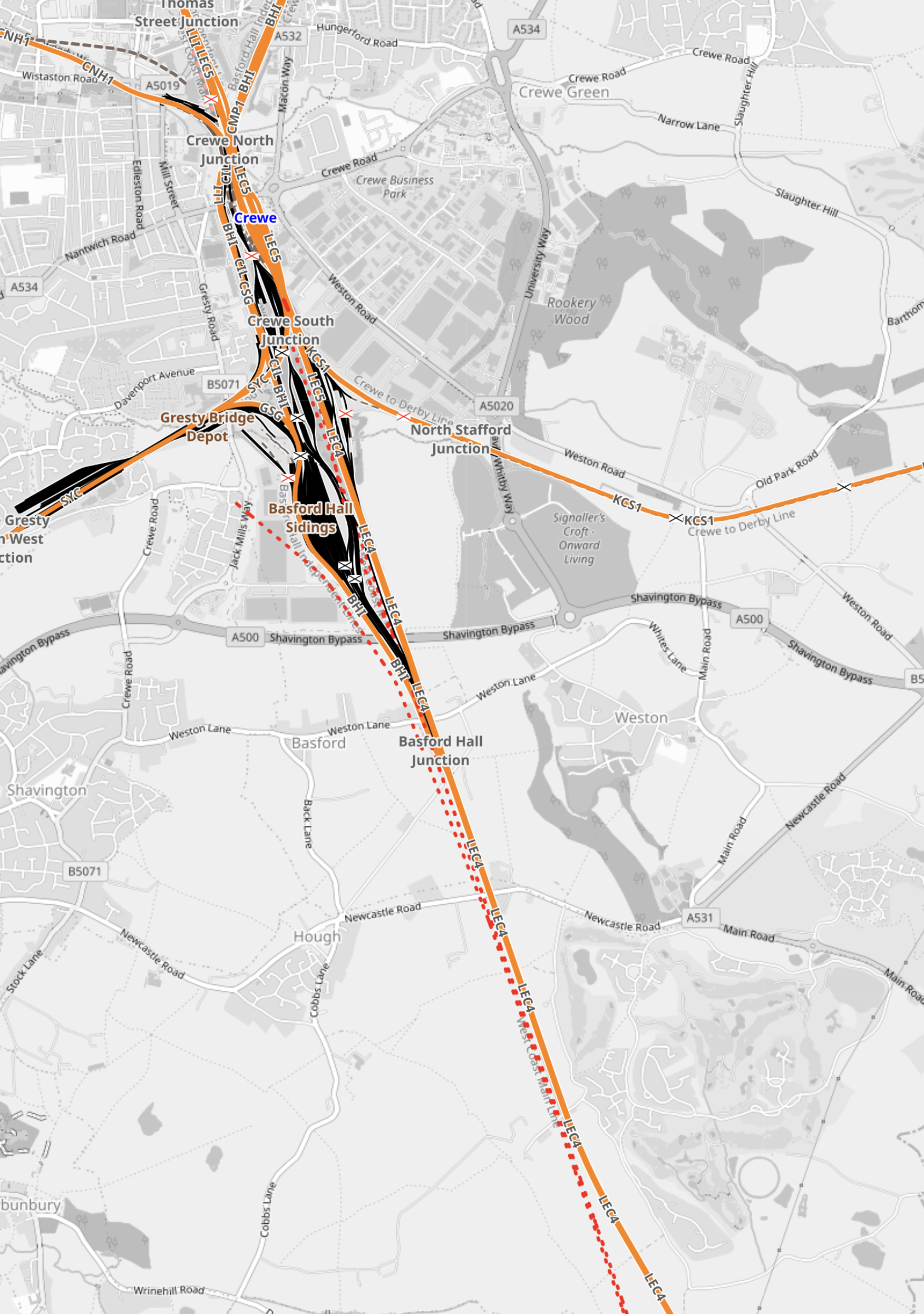
Note.
- Crewe is the important junction station towards the North-West corner of the map.
- The orange line going South is the West Coast Main Line to The South and London.
- The red dotted line running along the West side of the West Coast Main Line was the proposed route of High Speed Two from Birmingham, London and the South.
This Open Railway Map shows the originally proposed direct route of High Speed Two between Crewe and Handsacre.
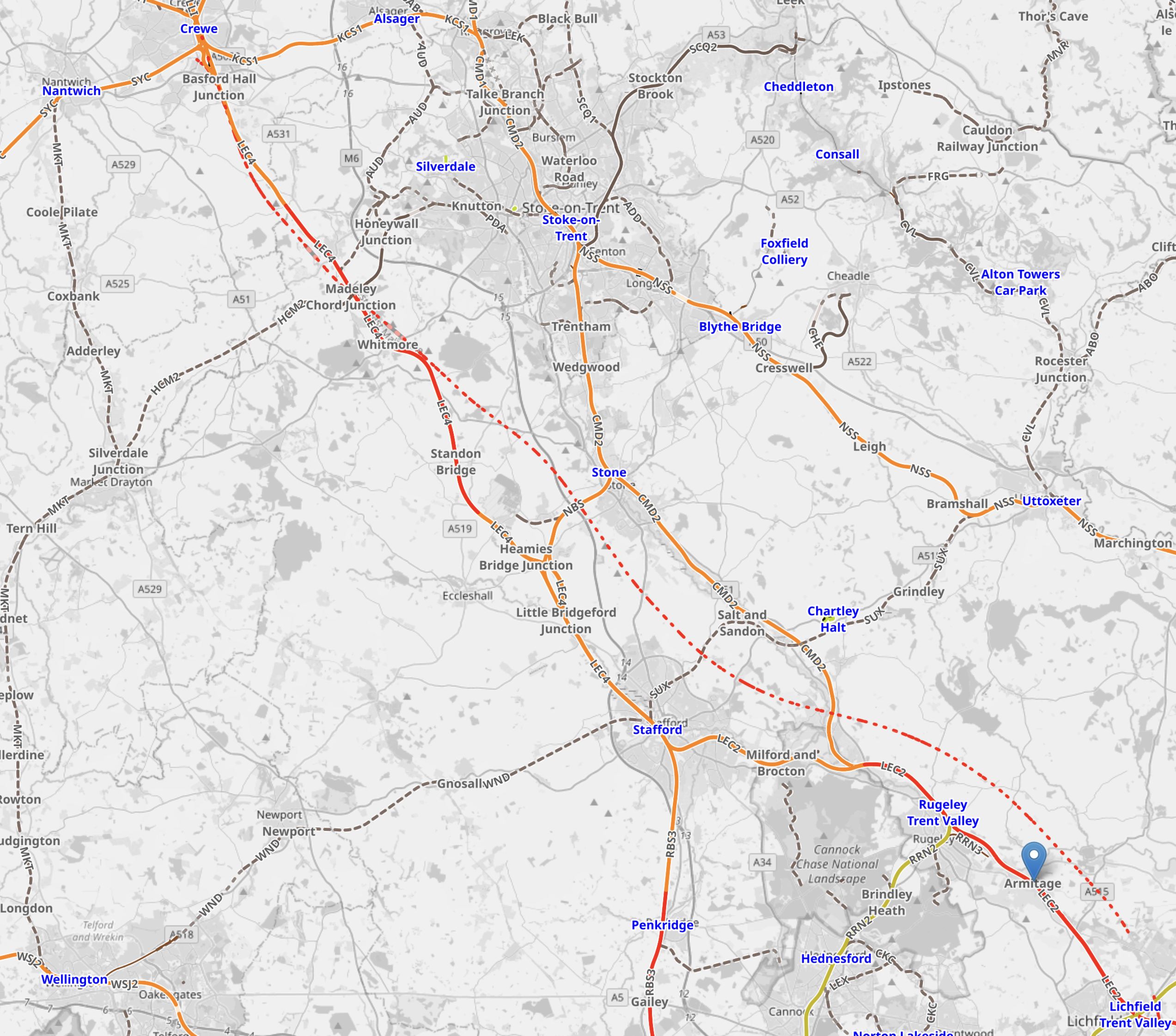
Note.
- Crewe is in the North-West corner of the map.
- The blue arrow in the South-East corner of the map, indicates the location of the former Armitage station, which had the village of Handsacre to its North-East.
- The dotted red line was the originally proposed route of High Speed Two.
I feel that this route between Handsacre and Crewe has advantages if it were to be chosen as part of a route between Handsacre and Northern Powerhouse Rail, as recommended by the Mayors and their consultants.
- The route seems to stay well clear of large conurbations.
- A lot of the design work has been at least started and major problems will be known.
- Crewe is the only station on the route, which will need to be upgraded.
- Services to Liverpool, Manchester, North Wales, The North and Scotland will be speeded up.
- With Crewe, Liverpool and North Wales, times could be as High Speed Two promised in the first place.
I feel that building the Handsacre and Crewe section, as originally envisaged, will score high in a benefit/cost analysis
This OpenRailwayMap shows the originally proposed route of High Speed Two between Crewe and Manchester Airport.
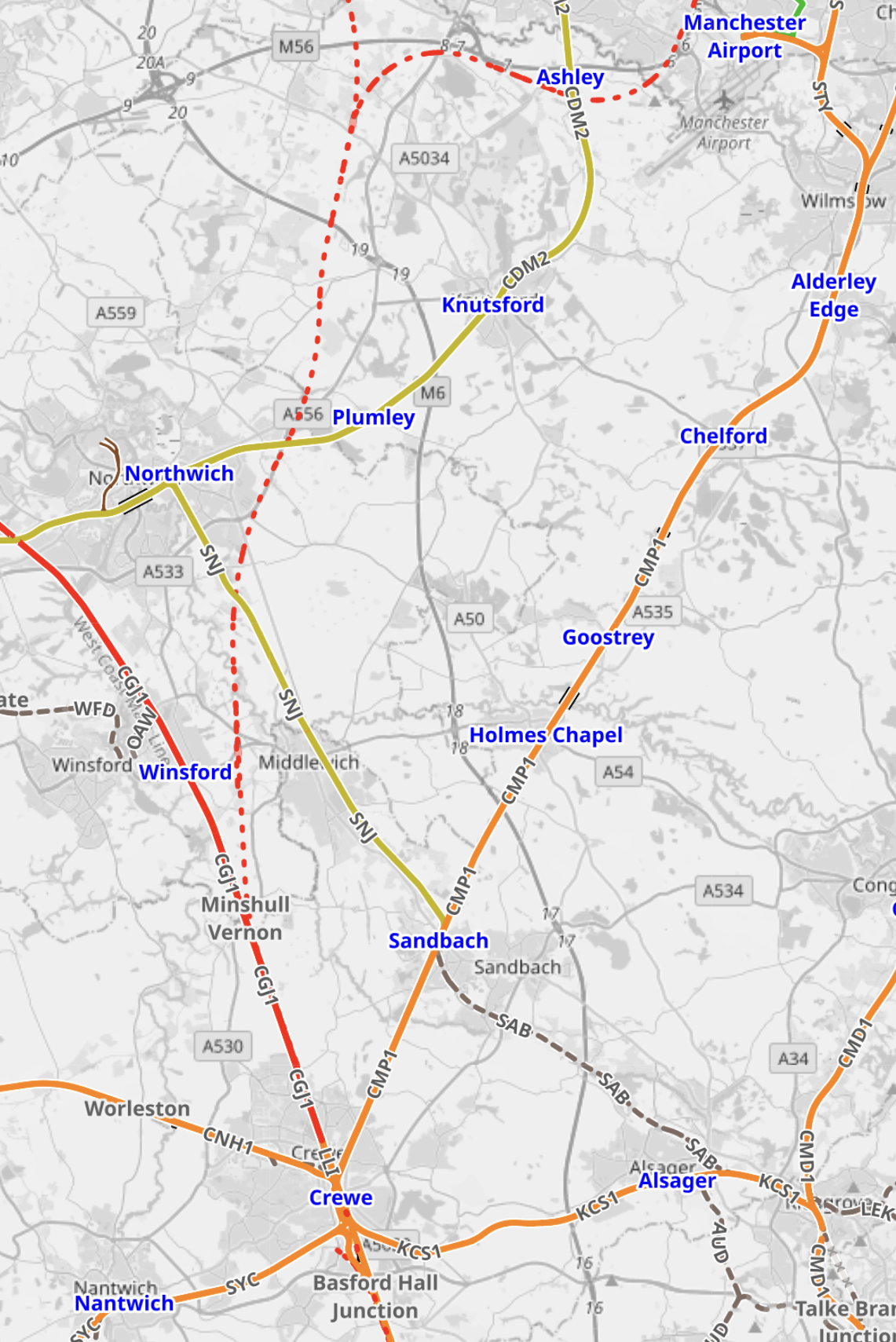
Note.
- Crewe is towards the South-West corner of the map.
- Manchester Airport is in the North-East corner of the map.
- The red line going North from Crewe is the West Coast Main Line.
- The dotted red line was the originally proposed route of High Speed Two, between the West Coast Main Line and Manchester Airport.
Northern Powerhouse Rail will go West from Manchester Airport towards Warrington and Liverpool and will join with High Speed Two at a junction at High Legh.
Northern Powerhouse Rail is currently being planned, but surely, if High Speed Two and Northern Powerhouse Rail share a line from High Legh to Manchester Airport and Manchester Piccadilly, this will be a more affordable project.
Services To Crewe
In Could The High Speed Two Link Between Lichfield And Crewe Still Be Built?, which I wrote after much of High Speed Two was chopped in 2023, I said this.
Currently, Avanti West Coast trains take around one hour and thirty minutes between London and Crewe.
The Wikipedia entry for High Speed Two gives these times between London and Crewe.
- Fastest time before High Speed Two – one hour and thirty minutes.
- Time after Phase 2a of High Speed Two opens – fifty-six minutes.
Note.
- That is a time saving of thirty-four minutes.
- High Speed Two Trains will use the direct line between Lichfield and Crewe.
- High Speed Two will also add eighteen tph to the capacity between London and Crewe.
This would seem to mean that any trains going to or through Crewe will be thirty-four minutes faster, if they use High Speed Two between London and Crewe.
If the Handsacre and Crewe direct line is built, it looks like London and Crewe will be the full High Speed Two time of 56 minutes.
Services To Liverpool
Consider.
- Liverpool Lime Street was originally planned to get two trains per hour (tph) to and from London using High Speed Two.
- The approaches into Liverpool were improved a few years ago.
- No more improvements are planned between Crewe and Liverpool Lime Street stations.
- Between Crewe and Liverpool Lime Street stations currently takes 38 minutes.
- There could be time savings on the 16.3 miles between Crewe and Weaver Junction, which currently takes 21 minutes.
It looks like a time of one hour and 34 minutes could be possible, with under one hour and 30 minutes not being impossible.
Services To Manchester
Consider.
- Manchester was originally planned to get three tph to and from London using High Speed Two.
- No improvements are planned between Crewe and the Manchester stations.
- Between Crewe and Manchester Piccadilly stations currently takes 34 minutes.
It looks like a time of one hour and 30 minutes could be possible.
But there is still the option of building a new line between Crewe and Northern Powerhouse Rail at High Legh.
I showed this OpenRailwayMap earlier and it shows the originally proposed route of High Speed Two between Crewe and Manchester Airport.
Note.
- Crewe is towards the South-West corner of the map.
- Manchester Airport is in the North-East corner of the map.
- The red line going North from Crewe is the West Coast Main Line.
- The dotted red line was the originally proposed route of High Speed Two, between the West Coast Main Line and Manchester Airport.
Northern Powerhouse Rail is currently being planned. and will go West from Manchester Airport towards Warrington and Liverpool and will be built first.
A junction at High Legh will be built to link the West Coast Main Line to Northern Powerhouse Rail.
Services To North Wales
Why Not? With the cancellation of the Eastern Leg of High Speed Two, there must be a path available for North Wales.
Consider.
- The North Wales Main Line has been promised electrification.
- As Holyhead and Crewe is only 105.5 miles, it could even be in battery high speed train range in a few years.
- All times to and from Crewe are assumed to be as Avanti West Coast achieve now.
- As Crewe and Chester currently takes 23 minutes, London and Chester would take 1 hour and 19 minutes.
- As Crewe and Llandudno Junction currently takes 1 hour and 22 minutes, London and Llandudno Junction would take 2 hours and 18 minutes.
- As Crewe and Holyhead currently takes 2 hours and 7 minutes, London and Holyhead would take 3 hours and 3 minutes.
Could this open up a fast zero-carbon route between London and Dublin?
Services To Blackpool, Lancaster, Preston, Warrington And Wigan
Why Not, Blackpool? With the cancellation of the Eastern Leg of High Speed Two, there must be an extra path available, if it is needed.
Cpnsider.
- All routes are electrified.
- All times to and from Crewe are assumed to be as Avanti West Coast achieve now.
- As Crewe and Blackpool currently takes 1 hour and 20 minutes, London and Blackpool would take 2 hour and 16 minutes.
- As Crewe and Lancaster currently takes 60 minutes, London and Lancaster would take 1 hour and 56 minutes.
- As Crewe and Preston currently takes 40 minutes, London and Preston would take 1 hour and 36 minutes.
- As Crewe and Warrington Bank Quay currently takes 22 minutes, London and Warrington Bank Quay would take 1 hour and 18 minutes.
- As Crewe and Wigan North Western currently takes 33 minutes, London and Wigan North Western would take 1 hour and 29 minutes.
Note.
- Lancaster in under two hours will help the Eden Project Morecambe.
- For some areas of the North West, it might be more convenient to change at Crewe, Warrington Bank Quay, Wigan North Western or Preston.
Improvements to track and signalling could probably bring benefits.
Services To Carlisle And Central Scotland
Cpnsider.
- All routes are electrified.
- All times to and from Crewe are assumed to be as Avanti West Coast achieve now.
- As Crewe and Carlisle currently takes 1 hour and 55 minutes, London and Carlisle would take 2 hours and 51 minutes.
- As Crewe and Lockerbie currently takes 2 hours and 6 minutes, London and Lockerbie would take 3 hours and 1 minute.
- As Crewe and Motherwell currently takes 2 hours and 45 minutes, London and Motherwell would take 3 hours and 41 minutes.
- As Crewe and Edinburgh currently takes 3 hours and 9 minutes, London and Edinburgh would take 4 hours and 5 minutes.
- As Crewe and Glasgow Central currently takes 3 hours and 3 minutes, London and Glasgow Central would take 3 hours and 59 minutes.
Note.
- Just under four hours to Glasgow Central would please the Marketing Department.
- Selective splitting and joining could increase the number of destinations.
Improvements to track and signalling could probably bring benefits.
Services To Stirling
In ORR: Open Access Services Given Green Light Between London And Stirling, I wrote about Grand Union Trains’s new open access service to Stirling.
There has been good feedback on this service, so perhaps one of the spare paths on High Speed Two could be allocated to Open Access Operators, so that more of the country could have a high speed service to London Euston and Birmingham Curzon Street stations.
In the related post, I showed that London Euston and Stirling takes forty five minutes longer than a London Euston and Motherwell service.
This would mean that a London Euston and Stirling service via High Speed Two would take four hours and 26 minutes.
Services Between Birmingham Curzon Street and the North West
Under the plans for High Speed Two, the following services would have run North from Birmingham Curzon Street.
- One tph to Edinburgh or Motherwell and Glasgow via Wigan North Western, Preston, Lancaster, Oxenholme, Penrith, Carlisle, Lockerbie and Carstairs.
- Two tph to Manchester Airport and Manchester Piccadilly.
But there are now spare paths South of Crewe, so Could a one tph Birmingham Curzon Street and Liverpool Lime Street service be squeezed in?
Could The Line Be Privately Financed?
I suspect that building the section between Handsacre and Crewe could be financed in perhaps a similar way, to the Chiltern improvements or the M6 Toll Road were financed.
- The Handsacre and Crewe section is just a simple stretch of rail, with a number of trains passing along it.
- The number of trains passing through, is likely to increase.
- Every train passing through would pay a track charge, just as they do to Network Rail.
- Those with lots of money to lend, like simple projects like wind farms or road tunnels, but think very hard about anything complicated like nuclear power stations or High Speed Two’s station at Euston.
Certainly, my late and very good friend, David, who dealt with the finance of some of London’s largest projects and was on the top table of London’s bankers, would have found a way. It might though have been unorthodox.
But then David was a rogue. But a rogue on the side of the angels.
Conclusion
I have come to these conclusions.
- Building the direct route between Handsacre and Crewe could be good value as it improves all routes that will pass through Crewe.
- Combining High Speed Two and Northern Powerhouse Rail could substantially cut the costs of both routes to the centre of Manchester.
- London and Crewe times should be 56 minutes.
- London and Liverpool Lime Street times could be under one hour and thirty minutes.
- London and Manchester Piccadilly times could start at one hour and thirty minutes and reduce when Northern Powerhouse Rail is built and linked to the West Coast Main Line.
- London and Holyhead could be just over three hours and could open up a fast zero-carbon route between London and Dublin.
- London and Lancaster in under two hours could help the Eden Project Morecambe.
It’s certainly not a bad plan and it should be looked at in more detail.
Extending The Elizabeth Line – Could Open Access Services Use The Elizabeth Line?
In the February 2024 Edition of Modern Railways, there is an article which is entitled First Bid For Sheffield To King’s Cross Paths.
The article is mainly about FirstGroup’s proposal for a new Sheffield and London service, running under the Hull Trains brand.
But, this is the last paragraph.
Modern Railways understands First is working on a number of proposals for additional open access services, and this is an early statement of intent. Other existing open access proposals include Grand Union Trains’ plans for London to Stirling and Cardiff to Edinburgh services, along with an already approved London to Carmarthen service, and the recently submitted Wrexham, Shropshire and Midland Railway application for a London to Wrexham service. It is understood other organisations, including MTR and Virgin, are also working up plans for new open access services.
The respected Modern Railways magazine seem to think, that we’ll be seeing more open access services on UK railways.
These are my thoughts.
A Simple Example – London Crosslink
In Extending The Elizabeth Line – London Crosslink, I said this.
In the Wikipedia entry for the London Crosslink, this is the introduction.
London Crosslink was a passenger train service operated by Anglia Railways between Norwich and Basingstoke, using the North London Line to bypass central London. Class 170 Turbostar diesel multiple units were used, and the service operated between 22 May 2000 and 28 September 2002, supported by funding from the Strategic Rail Authority through its Rail Passenger Partnership fund.
As it was discontinued and it doesn’t seem to be sadly missed, I’m not advocating its reinstatement, but just looking how it might be run after the full opening of the Elizabeth Line.
But surely, there were good reasons, why the service was run in the first place and there might be a need in the future.
These are some characteristics of the service.
- There were about half-a-dozen services in both directions every day.
- At its full length it ran between Norwich and Basingstoke.
- Stops included Diss, Stowmarket, Ipswich, Colchester, Witham, Chelmsford, Ingatestone, Romford, Stratford, Highbury & Islington, Camden Road, West Hampstead, Brentford, Feltham, Staines, Woking and Farnborough (Main).
- Each service seemed to have a different stopping pattern.
- The timetable wasn’t very regular.
- The route wasn’t fully electrified.
It appears that it may have been a difficult service to timetable.
I lived North of Ipswich for some years.
I never used the London CrossLink service, as I had moved away before the service started in 2000.
- I would have found the change to the Central Line at Stratford station useful.
- I would have found the change to the Victoria Line at Highbury & Islington station useful.
- I would have found the change to Thameslink at West Hampstead station useful.
- Basingstoke would have given access to Greater South-West England.
- I could have got a bus to Heathrow from Feltham.
But getting to Marylebone, Paddington and Waterloo would have still been tedious.
Could a replacement for the London CrossLink be routed via the Elizabeth Line?
- The service would use the Elizabeth Line between Stratford and Reading.
- The service would use the Reading and Basingstoke Line between Reading and Basingstoke.
The route has some advantages over the original route.
- Except for the 13.6 miles between Southcote Junction and Basingstoke, the route is fully-electrified.
- Whitechapel will give access to London Overground services.
- Farringdon will give access to Thameslink services.
- There will be a lot of connections at Tottenham Court Road and Bond Street.
- Paddington and Reading will give access to Heathrow, Oxford and West of England services.
- Basingstoke will give access to Greater South-West England.
It is certainly an as-useful route as the original, if not more so.
The Trains
In Extending The Elizabeth Line – Will There Be A Need For Long Distance Class 345 Train?, I set out how a standard Class 345 train could be updated with faster running and a more appropriate interior.
As the Elizabeth Line is likely to need some more trains if High Speed Two is delayed, perhaps some extra trains should be ordered fairly soon.
The Routes
Consider.
- A terminal station would probably need to be electrified to the Elizabeth Line route.
- It would need the infrastructure to turn the trains.
These stations could probably be used as terminal stations.
- Basingstoke
- Bristol
- Cardiff
- Colchester
- Faversham
- Hoo – See Extending The Elizabeth Line – A Branch To The Isle Of Grain.
- Ipswich
- Northfleet – For European services at Ebbsfleet International.
- Norwich
- Oxford
- Rochester
- Southampton
- Southend Victoria
There will certainly be others.
Why Use Open Access?
Suppose an operator wants to run a service between Bristol Parkway and Northfleet to give the West Country access to European services.
- The operator takes all the risk and Network Rail get track access charges.
- Do Transport for London get track access charges for the Elizabeth Line tunnels?
- If they get their predictions and sums wrong, they lose the money.
But if they get it right, they probably sell it to an infrastructure company at a profit.
Conclusion
I think open access operation might work through the Elizabeth Line Tunnels.
High Speed Yorkshire
In December 2019, I wrote Could High Speed Two Be A One-Nation Project?, which I started like this.
As currently envisioned, High Speed Two is very much an English project, with the following routes
- London and Birmingham
- London and Liverpool via Birmingham
- London and Manchester Airport/Manchester via Birmingham and Crewe
- London and Sheffield via Birmingham and the East Midlands Hub
- London and Leeds via Birmingham and the East Midlands Hub
There are large numbers of mid-sized towns and cities that it won’t serve directly.
This is what I said about the East Coast Main Line in the post.
The East Coast Main Line serves the following routes.
- London and Bradford
- London and Cambridge
- London and Edinburgh via Doncaster, York and Newcastle
- London and Harrogate via Leeds
- London and Hull
- London and Kings Lynn via Cambridge
- London and Lincoln via Newark.
- London and Leeds via Doncaster
- London and Middlesbrough
- London and Skipton via Leeds
- London and Sunderland
The East Coast Main Line could become another high speed line.
Extra services could be added.
- London and Norwich via Cambridge
- London and Nottingham
- London and Grimsby and Cleethorpes via Lincoln.
- London and Sheffield via Retford.
Add the East Coast Main Line and High Speed Two together and there could be a wider range of towns and cities served.
- Peterborough and Doncaster could play the same role in the East as Birmingham and Crewe will play in the West.
- The East Coast Main Line between London and Doncaster will be upgraded to in-cab ERTMS signalling in a few years time, which will allow 140 mph running on several sections of the route.
- Improvements are either under way or being planned to reduce bottlenecks on the East Coast Main Line.
- If High Speed Two can handle eighteen trains per hour (tph), then surely the East Coast Main Line, which has a lot of quadruple track, can handle upwards of twelve 140 mph trains per hour between London and Doncaster, after the improvements to track and signalling.
- I estimate that 140 mph running between London and Doncaster could save as much as twenty minutes.
- I feel that Barnsley, Doncaster, Hull, Leeds, Sheffield and York could all be reached in under two hours from London using the existing Azuma trains.
- This morning the 0700 from Kings Cross is timetabled to reach York at 0852. Would it be possible for London and York to be around just ninety minutes?
- Savings would also apply to trains between London and Leeds, Middlesbrough, Newcastle, Scotland and Sunderland.
- Sub-four hour journeys between London and Edinburgh would be commonplace.
Note that the Internet gives a driving time of nearly three and a half hours between London and Leeds. Surely, two hours or less on High Speed Yorkshire would be much preferable.
I would add this infrastructure.
- There might be a good case to create electrified routes to Hull and Sheffield and between Sheffield and Leeds, but they wouldn’t be needed to start the service or obtain the time savings. But they would ease operation, cut carbon emissions and save a few more minutes.
- A station at Doncaster-Sheffield Airport.
- A parkway station at Barnsley on the Dearne Valley Line with direct services to Doncaster, Leeds, London and Sheffield.
The two latter improvements have been proposed in Sheffield Region’s transport plans.
High Speed Yorkshire should be finished as soon as possible. A completion date of 2024 is not unreasonable.
This was the first time I used the term High Speed Yorkshire.
Benefits Of Digital Signalling On The East Coast Main Line
The obvious benefit is there will be 140 mph running on several stretches of the East Coast Main Line.
But as a Control Engineer, I believe that the digital signalling can be used to eliminate two major bottlenecks on the route.
- The Digswell Viaduct, which I wrote about in Is There An ERTMS-based Solution To The Digswell Viaduct?.
- The Newark Flat Crossing, which I wrote about in Could ERTMS And ETCS Solve The Newark Crossing Problem?.
Digital Signalling will also offer techniques to run more trains per hour on the route.
LNER Orders CAF Tri-Mode Sets
The title of this section, is the same as this article in the December 2023 Edition of Modern Railways, which has this paragraph.
Modern Railways understands the new fleet will be maintained at Neville Hill depot in Leeds and, like the ‘225’ sets, will be used predominantly on services between London and Yorkshire, although unlike the ‘225s’ the tri-modes, with their self-power capability, will be able to serve destinations away from the electrified network such as Harrogate and Hull.
Note.
- This surprised me, as I’d always expected the Yorkshire routes will be served by Hitachi battery-electric trains.
- But it does look that both Harrogate and Hull stations, have long enough platforms to hold a ten-car train.
- With their tri-mode technology, it also looks like the CAF trains won’t be needed to be charged before returning to London.
The last point would enable them to try out new routes.
But it does look like LNER are planning to strengthen their Yorkshire routes.
- Does Azuma Test Train Takes To The Tracks As LNER Trials Possible New Route, also mean that they’re looking at a service to Cleethorpes?
- The curtailment of High Speed Two was hard on Yorkshire.
- The Government has had time to get a verdict from experts on TransPennine Express.
It could just be that, it’s easier to sell rail tickets to Yorkshire folk, than Lancashire folk.
FirstGroup Applies To Run New London To Sheffield Rail Service
The title of this section, is the same as that of this press release from First Group.
These two paragraphs outline FirstGroup’s initial plans.
FirstGroup plc, the leading private sector transport operator, has today submitted the first phase of an application for a new open access rail service between London and Sheffield to the Office of Rail and Road (ORR).
FirstGroup plans to expand its open access rail operations as part of its award-winning Hull Trains business, building on their successful existing service which has transformed long-distance connectivity between Hull and London.
Note.
- FirstGroup want to run two trains per day (tpd) between London King’s Cross and Sheffield stations via Retford.
- Services will be non-stop between London King’s Cross and Retford.
- The service will be run by Hull Trains.
- I suspect that Hull Trains will use a fleet of identical Hitachi trains for both services.
- Hull Trains could decarbonise the services by using battery-electric trains.
- I believe a time of 82 minutes will be possible between London King’s Cross and Sheffield.
- High Speed Two were promising a time of 87 minutes for their route from London Euston via Birmingham and Nottingham.
I believe there could be up to seven tpd to both Hull and Sheffield.
Timings On High Speed Yorkshire
In FirstGroup Applies To Run New London To Sheffield Rail Service, I felt the following is possible, between London King’s Cross and Sheffield.
- After the digital signalling is completed between King’s Cross and Retford, I suspect that a 135 mph average speed can be maintained between Woolmer Green and Retford. This would mean that a King’s Cross and Retford time of 68 minutes would be possible.
- If Network Rail improve the track between Retford and Sheffield, I believe that a 70 mph average could be achieved on the Retford and Sheffield section. This would mean that a Retford and Sheffield time of 20 minutes would be possible.
- I would expect at least six minutes would be saved by missing stops.
This gives a time of 82 minutes between London King’s Cross and Sheffield.
I will use these timings to calculate other possible times.
- Current time between London King’s Cross and Retford – 82 minutes
- Digitally signalled average speed between Woolmer Green and Retford – 135 mph
- Digitally signalled time between London King’s Cross and Retford – 68 minutes
- Digitally signaled time between London King’s Cross and Sheffield – 82 minutes
These are my estimated timings from London King’s Cross.
Barnetby via Newark Northgate and Lincoln
Operator: LNER
Served by High Speed Two: No
Time to/from London King’s Cross: 114 minutes
Barnetby via Peterborough and Lincoln
Operator: LNER
Served by High Speed Two: No
Time to/from London King’s Cross: 128 minutes
Barnsley via Sheffield
Operator: Hull Trains
Served by High Speed Two: No
Time to/from London King’s Cross: 112 minutes
Note: Uses Penistone Line and Hull Trains times to Sheffield
Beverley
Operator: Hull Trains
Served by High Speed Two: No
Time to/from London King’s Cross: 101 minutes
Note: Uses Hull Trains times from Doncaster
Bradford Foster Square via Leeds
Operator: LNER
Served by High Speed Two: No
Time to/from London King’s Cross: 146 minutes
Note: Uses LNER times from Leeds
Bradford Interchange via Doncaster
Operator: Grand Central
Served by High Speed Two: No
Time to/from London King’s Cross: 166 minutes
Note: Uses Grand Central times from Doncaster
Brighouse via Doncaster
Operator: Grand Central
Served by High Speed Two: No
Time to/from London King’s Cross: 143 minutes
Note: Uses Grand Central times from Doncaster
Brough
Operator: Hull Trains
Served by High Speed Two: No
Time to/from London King’s Cross: 101 minutes
Note: Uses Hull Trains times from Doncaster
Cleethorpes via Newark Northgate and Lincoln
Operator: LNER
Served by High Speed Two: No
Time to/from London King’s Cross: 141 minutes
Cleethorpes via Peterborough and Lincoln
Operator: LNER
Served by High Speed Two: No
Time to/from London King’s Cross: 155 minutes
Darlington
Operator: LNER
Served by High Speed Two: Yes
High Speed Two time to/from London Euston: 116 minutes
Time to/from London King’s Cross: 127 minutes
Doncaster
Operator: Grand Cenreal, Hull Trains, LNER
Served by High Speed Two: No
Time to/from London King’s Cross: 76 minutes
Durham
Operator: LNER
Served by High Speed Two: Yes
High Speed Two time to/from London Euston: 136 minutes
Time to/from London King’s Cross: 160 minutes
Eaglescliffe
Operator: Grand Central
Served by High Speed Two: No
Time to/from London King’s Cross: 155 minutes
Note: Uses Grand Central times from Northallerton
Edinburgh
Operator: LNER
Served by High Speed Two: Yes
High Speed Two time to/from London Euston: 220 minutes
Time to/from London King’s Cross: 234 minutes
Grantham
Operator: LNER
Served by High Speed Two: No
Time to/from London King’s Cross: 53 minutes
Grimsby Town via Newark Northgate and Lincoln
Operator: LNER
Served by High Speed Two: No
Time to/from London King’s Cross: 134 minutes
Grimsby Town via Peterborough and Lincoln
Operator: LNER
Served by High Speed Two: No
Time to/from London King’s Cross: 148 minutes
Halifax via Doncaster
Operator: Grand Central
Served by High Speed Two: No
Time to/from London King’s Cross: 153 minutes
Note: Uses Grand Central times from Doncaster
Harrogate
Operator: LNER
Served by High Speed Two: No
Time to/from London King’s Cross: 147 minutes
Note: Uses LNER times from Leeds
Hartlepool
Operator: Grand Central
Served by High Speed Two: No
Time to/from London King’s Cross: 175 minutes
Note: Uses Grand Central times from Northallerton
Horsforth
Operator: LNER
Served by High Speed Two: No
Time to/from London King’s Cross: 124 minutes
Note: Uses LNER times from Leeds
Huddersfield via Leeds
Operator: LNER
Served by High Speed Two: No
Time to/from London King’s Cross: 161 minutes
Note: Uses LNER times from Leeds
Huddersfield via Sheffield
Operator: Hull Trains
Served by High Speed Two: No
Time to/from London King’s Cross: 140 minutes
Note: Uses Penistone Line and Hull Trains times to Sheffield
Hull
Operator: Hull Trains
Served by High Speed Two: No
Time to/from London King’s Cross: 114 minutes
Note: Uses Hull Trains times from Doncaster
Keighley via Leeds
Operator: LNER
Served by High Speed Two: No
Time to/from London King’s Cross: 178 minutes
Note: Uses LNER times from Leeds
Leeds
Operator: LNER
Served by High Speed Two: Yes
High Speed Two time to/from London Euston: 81 minutes
Time to/from London King’s Cross: 116 minutes
Lincoln via Newark Northgate
Operator: LNER
Served by High Speed Two: No
Time to/from London King’s Cross: 85 minutes
Lincoln via Peterborough
Operator: LNER
Served by High Speed Two: No
Time to/from London King’s Cross: 99 minutes
Market Rasen via Newark Northgate and Lincoln
Operator: LNER
Served by High Speed Two: No
Time to/from London King’s Cross: 101 minutes
Market Rasen via Peterborough and Lincoln
Operator: LNER
Served by High Speed Two: No
Time to/from London King’s Cross: 115 minutes
Meadowhall via Sheffield
Operator: Hull Trains
Served by High Speed Two: No
Time to/from London King’s Cross: 90 minutes
Note: Uses Penistone Line and Hull Trains times to Sheffield
Middlesbrough
Operator: LNER
Served by High Speed Two: No
Time to/from London King’s Cross: 155 minutes
Mirfield via Doncaster
Operator: Grand Ccentral
Served by High Speed Two: No
Time to/from London King’s Cross: 136 minutes
Note: Uses Grand Central times from Doncaster
Newark Northgate
Operator: LNER
Served by High Speed Two: No
Time to/from London King’s Cross: 60 minutes
Newcastle
Operator: LNER
Served by High Speed Two: Yes
High Speed Two time to/from London Euston: 137 minutes
Time to/from London King’s Cross: 145 minutes
Northallerton
Operator: Grand Central, LNER
Served by High Speed Two: No
Time to/from London King’s Cross: 126 minutes
Peterborough
Operator: Grand Central, LNER
Served by High Speed Two: No
Time to/from London King’s Cross: 40 minutes
Pontefract Monkhill
Operator: Grand Central
Served by High Speed Two: No
Time to/from London King’s Cross: 103 minutes
Note: Uses Grand Central times from Doncaster
Retford
Operator: LNER
Served by High Speed Two: No
Time to/from London King’s Cross: 68 minutes
Selby
Operator: Hull Trains
Served by High Speed Two: No
Time to/from London King’s Cross: 92 minutes
Note: Uses Hull Trains times from Doncaster
Sheffield
Operator: Hull Trains
Served by High Speed Two: Yes
High Speed Two time to/from London Euston: 87 minutes
Time to/from London King’s Cross: 82 minutes
Shipley via Leeds
Operator: LNER
Served by High Speed Two: No
Time to/from London King’s Cross: 168 minutes
Note: Uses LNER times from Leeds
Skipton via Leeds
Operator: LNER
Served by High Speed Two: No
Time to/from London King’s Cross: 191 minutes
Note: Uses LNER times from Leeds
Sleaford
Operator: LNER
Served by High Speed Two: No
Time to/from London King’s Cross: 83 minutes
Spalding
Operator: LNER
Served by High Speed Two: No
Time to/from London King’s Cross: 61 minutes
Sunderland
Operator: Grand Central
Served by High Speed Two: No
Time to/from London King’s Cross: 194 minutes
Note: Uses Grand Central times from Northallerton
Thirsk
Operator: Grand Central
Served by High Speed Two: No
Time to/from London King’s Cross: 116 minutes
Note: Uses Grand Central times from Northallerton
Thornaby
Operator: LNER
Served by High Speed Two: No
Time to/from London King’s Cross: 146 minutes
Wakefield Kirkgate
Operator: Grand Central
Served by High Speed Two: No
Time to/from London King’s Cross: 118 minutes
Note: Uses Grand Central times from Doncaster
Wakefield Westgate
Operator: LNER
Served by High Speed Two: No
Time to/from London King’s Cross: 95 minutes
Worksop
Operator: Hull Trains
Served by High Speed Two: No
Time to/from London King’s Cross: 81 minutes
York
Operator: LNER
Served by High Speed Two: Yes
High Speed Two time to/from London Euston: 84 minutes
Time to/from London King’s Cross: 98 minutes
Note.
- Times have improved because of the digital signalling.
- As the digital signalling goes further North timings will will come down further.
- Unelectrified branches like those to Beverley, Cleethorpes, Grimsby, Harrogate, Huddersfield, Hull, Lincoln, Middlesbrough and Sheffield will be improved and further bring down times.
Sheffield could be as low as 80 minutes, with York at 91 minutes.
FirstGroup Applies To Run New London To Sheffield Rail Service
The title of this post, is the same as that of this press release from First Group.
These four paragraphs outline FirstGroup’s initial plans.
FirstGroup plc, the leading private sector transport operator, has today submitted the first phase of an application for a new open access rail service between London and Sheffield to the Office of Rail and Road (ORR).
FirstGroup plans to expand its open access rail operations as part of its award-winning Hull Trains business, building on their successful existing service which has transformed long-distance connectivity between Hull and London.
FirstGroup’s new proposals comprise two return journeys a day from London King’s Cross, calling at Retford, Worksop, Woodhouse and Sheffield, and the company aims to provide a faster link between London and Sheffield than alternative services. Almost three quarters of trips between London and Sheffield are currently made by car, with a further 9% of trips made by coach, and a competitively priced new rail offering will help stimulate a shift in transport mode of choice from road to rail.
The new proposed route will give Sheffield the first regular service from London King’s Cross since 1968 and will also give Worksop in Nottinghamshire the first regular direct London trains in decades. FirstGroup estimates there are 350,000 people in the Worksop and Woodhouse catchment areas who will have direct rail access to London because of these proposals. A sizeable number of rail users in these areas currently drive to Doncaster station to pick up faster services to London rather than travelling via Sheffield, and a convenient rail offering from local stations will also help to reduce the number of these car journeys.
Note.
- The press release says this is only the first phase.
- It appears to be an extension of Hull Trains.
- Comments on a news story based on the press release in The Times, have been generally positive.
These are my thoughts.
The Two Routes Are Similar
Consider.
- Beverley is 44.3 miles from the electrified East Coast Main Line at Temple Hirst Junction.
- Hull is 36.1 miles from the electrified East Coast Main Line at Temple Hirst Junction.
- Sheffield is 23.5 miles from the electrified East Coast Main Line at Retford station.
- There is no electrification at Beverley, Hull or Sheffield.
Note.
- Trains must be capable of having a range sufficient to go from the East Coast Main Line to the destination and back again.
- It is slightly surprising that Sheffield station is closest to the electrification of the East Coast Main Line.
- Hull Train’s electro-diesel Class 802 trains regularly handle the 88.6 miles to Beverley and back.
It does look like an appropriate number of Class 802 trains could handle Hull Trains current and future services to Beverley, Hull and Sheffield.
Hull Trains Need Ten-Car Trains
Consider.
- In Ten-Car Hull Trains, I show some details of Hull Trains using a pair of five-car trains.
- I’ve since seen ten-car Hull Trains regularly.
- There were two ten-car services on the 29th December 2023 between London King’s Cross and Hull.
Hull Trains must procure enough trains for all possible scenarios.
Intermediate Stations Of The Two Routes
Intermediate stations are.
- Going North from London King’s Cross to Hull, trains call at Stevenage (limited), Grantham, Retford, Doncaster, Selby, Howden and Brough.
- Going North from London King’s Cross to Sheffield, trains call at Retford, Worksop and Woodhouse.
There are only a small number of stops on the Sheffield service. Is this to reduce the journey time as much as possible?
What Will Be The Time Of The London King’s Cross And Sheffield Service?
Consider.
- Non-stop trains take 82 minutes between London King’s Cross and Retford, which is 138.6 miles, so it’s an average speed of 101.4 mph.
- Woolmer Green and Retford are 111.7 miles and will in a couple of years, be digitally signalled.
- Non-stop trains take 66 minutes between Woolmer Green and Retford, which is an average speed of 112 mph.
- I have found a direct Retford and Sheffield train, that takes 31 minutes for the 23.5 miles with six stops, which is an average speed of 45 mph.
- The Retford and Sheffield section has a mostly 60 mph maximum speed.
I can now build a table of times between King’s Cross and Retford based on the average speed North of Woolmer Green.
- 125 mph – 72 minutes
- 130 mph – 70 minutes
- 135 mph – 68 minutes
- 140 mph – 66 minutes
Note.
- Getting a high average speed using the power of digital signalling can save several minutes.
- I have measured an InterCity 125 averaging 125 mph on that section.
I can now build a table of times between Retford and Sheffield based on the average speed.
- 45 mph – 31 minutes
- 50 mph – 28 minutes
- 60 mph – 24 minutes
- 70 mph – 20 minutes
- 80 mph – 18 minutes
Note.
- The planned service is expected to stop only twice after Retford, so if we take off two minutes for each of the four stops not taken, this could reduce the time between Retford and Sheffield by 8 minutes.
- There will be a couple of minutes to add for the stop at Retford.
- I feel a typical journey with 125 mph to Retford, 50 mph to Sheffield, could take 94 minutes
- Currently, the fastest London St. Pancras to Sheffield take around 116-118 minutes.
Hull Trains new service could save 22-24 minutes on the current service.
I also feel a fast journey could involve 130 mph to Retford, 60 mph to Sheffield, could take 88 minutes.
Hull Trains new service could save a few minutes over half-an-hour.
Could The Time Of The London King’s Cross And Sheffield Service Be Under 90 Minutes?
I reckon the following is possible.
- After the digital signalling is completed between King’s Cross and Retford, I suspect that a 135 mph average speed can be maintained between Woolmer Green and Retford. This would mean that a King’s Cross and Retford time of 68 minutes would be possible.
- If Network Rail improve the track between Retford and Sheffield, I believe that a 70 mph average could be achieved on the Retford and Sheffield section. This would mean that a Retford and Sheffield time of 20 minutes would be possible.
- I would expect at least six minutes would be saved by missing stops.
This gives a time of 82 minutes between London King’s Cross and Sheffield.
In Anxiety Over HS2 Eastern Leg Future, I said that High Speed Two’s promised London and Sheffield time via a dedicated track would be 87 minutes.
It looks to me that running under full digital signalling on the East Coast Main Line, Hull Trains can beat the HS2 time.
Could Hitachi’s Battery-Electric Trains Handle The Routes?
This page on the Hitachi web site is entitled Intercity Battery Trains.
This is the sub-heading
Accelerate the decarbonisation of intercity rail with batteries.
These paragraphs outline the philosophy of the design of the trains.
A quick and easy application of battery technology is to install it on existing or future Hitachi intercity trains. Hitachi Rail’s modular design means this can be done without the need to re-engineer or rebuild the train and return them to service as quickly as possible for passengers.
Replacing one diesel engine with just one battery reduces emissions by more than 20% and offers cost savings of 20-30%. Our intercity battery powered trains can cover 70km on non-electrified routes, operating at intercity speeds at the same or increased performance.
Wouldn’t it be great, if we could take the diesel engine out of our cars and replace it with an electric power pack?
Paul Daniels would’ve classed it as engineering magic.
But it’s an old engineer’s trick.
As a fifteen year old, I spent time in a rolling mill, building and fitting replacement control systems on large machines. Transistors were used to replace electronic valves and relays.
It’s certainly possible to create a battery pack, that is plug-compatible with an existing diesel generator, that responds to the same control inputs and gives the same outputs.
At the extreme end of this technology, there would be no need to change any of the train’s software.
In The Data Sheet For Hitachi Battery Electric Trains, these were my conclusions for the performance.
- The battery pack has a capacity of 750 kWh.
- A five-car train needs three battery-packs to travel 100 miles.
- A nine-car train needs five battery-packs to travel 100 miles.
- The maximum range of a five-car train with three batteries is 117 miles.
- The maximum range of a nine-car train with five batteries is 121 miles.
As the East Coast Main Line to Beverley is a round trip is 88.6 miles, I suspect that Hull Trains’s five-car Class 802 trains will need to be fitted with a full-complement of three batteries.
Will Hull Trains Have An Identical Fleet Of Trains?
An identical fleet must have advantages for train staff, maintenance staff and above all passengers.
I believe FirstGroup have two choices.
- They buy an appropriately-sized batch of identical Class 802 trains.
- They convert their current fleet to battery-electric operation and buy an appropriately-sized batch of identical new trains.
Note.
- The second option means that they fully-decarbonise Hull Trains.
- Neither option would need any new infrastructure.
- I feel this means that this order is more likely to go to Hitachi.
It’ll probably all come down to the accountants.
Retford Station
This OpenRailwayMap shows the tracks around Retford station.
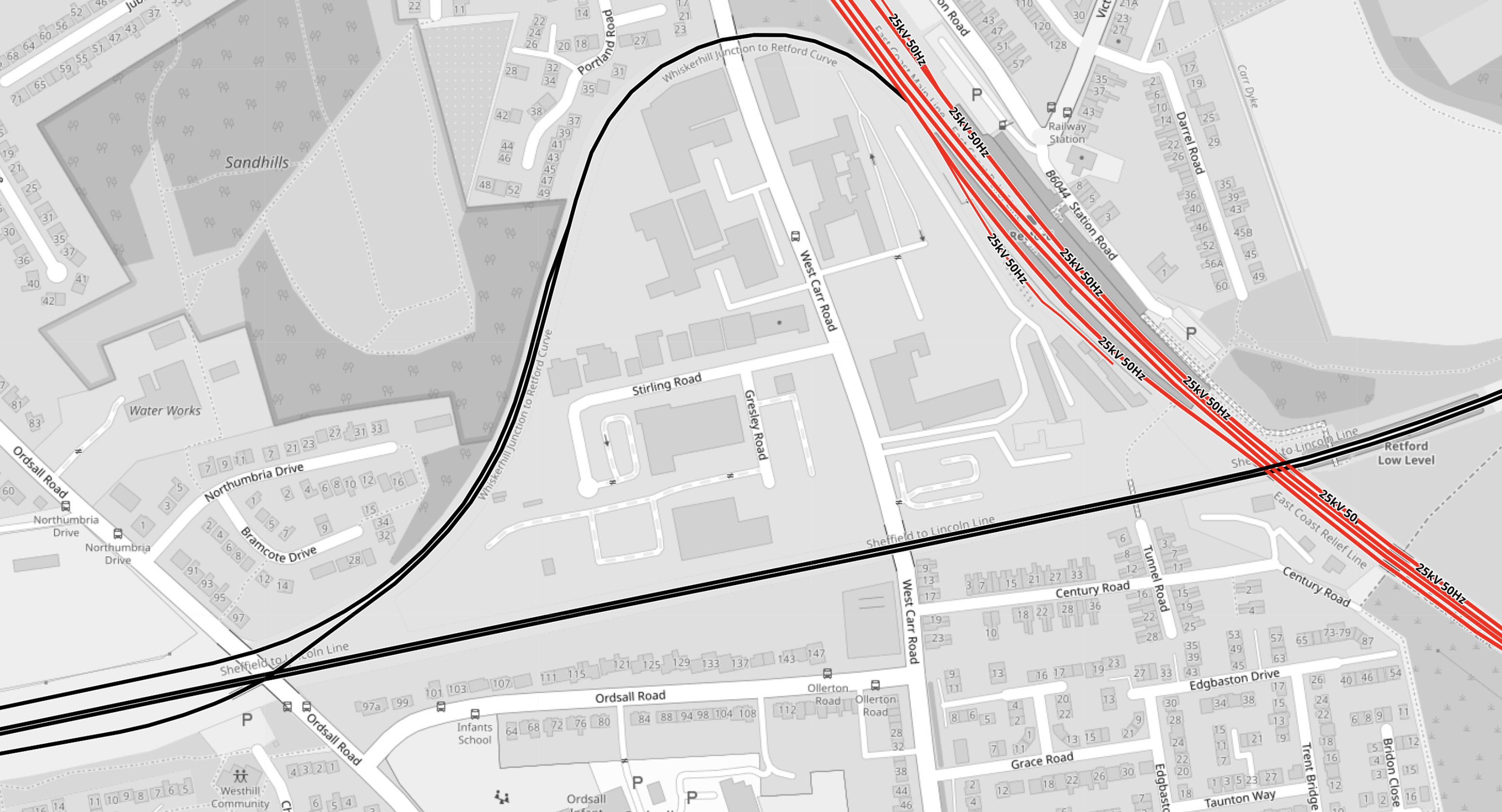
Note.
- The red tracks are electrified and are the East Coast Main Line.
- The black ones aren’t electrified.
- Doncaster is to the North.
- The black line to the East goes to Lincoln
- The black line to the West goes to Sheffield
- The red line going South-East goes to Peterborough and London.
The unusual loop allows trains to connect from one direction to another.
This second OpenRailwayMap shows the tracks in more detail.
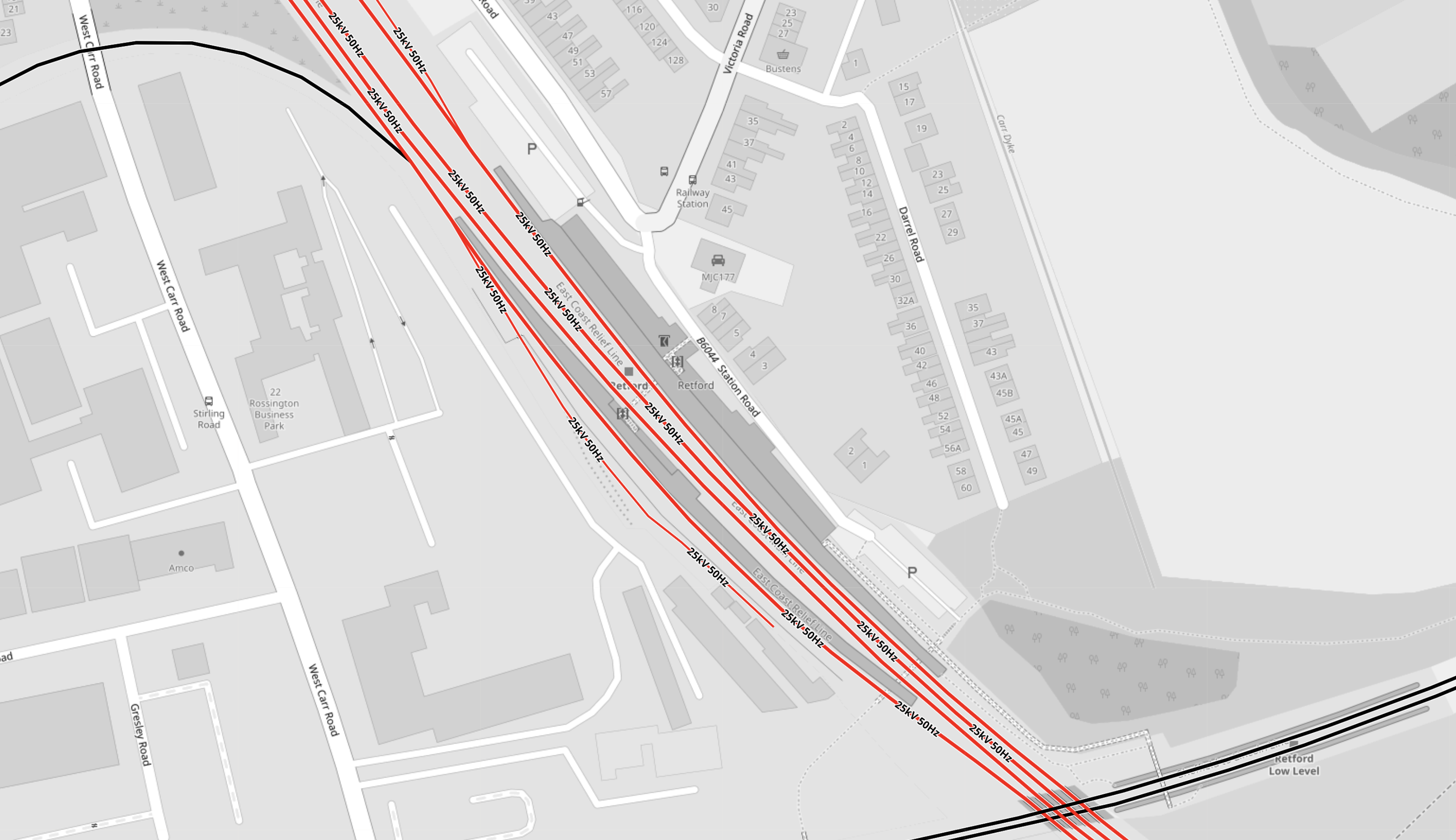
Note.
- As before red lines are electrified and black ones aren’t
- Platforms 1 and 2 are on the East Coast Main Line.
- Platforms 3 and 4 are on the Sheffield and Lincoln Line.
This third OpenRailwayMap shows the platforms in more detail.

Note.
- The yellow tracks are the 125 mph fast lines of the East Coast Main Line.
- The light blue tracks are the 40 mph relief lines of the East Coast Main Line.
- Northbound tracks are to the left of each pair of lines.
- The dark blue track is the 10 mph chord that connects the Northbound relief line of the East Coast Main Line to the Sheffield and Lincoln Line.
- Platform 1 is on the Southbound relief line.
- Platform 2 is on the Northbound relief line.
- Unusually, both platforms are on the same side of the line.
- In The Lengths Of Hitachi Class 800/801/802 Trains, I state that the full length of an InterCity 225 train is 245.2 metres.
- I suspect that both platforms can accommodate a full length InterCity 225, as the trains have been calling at Retford since the 1980s.
I doubt Retford station has any problem accommodating a pair of Class 802 trains, which it does regularly.
How Do Northbound Trains Go To Sheffield From Retford Station?
This OpenRailwayMap shows the tracks to the South of Retford station in detail.
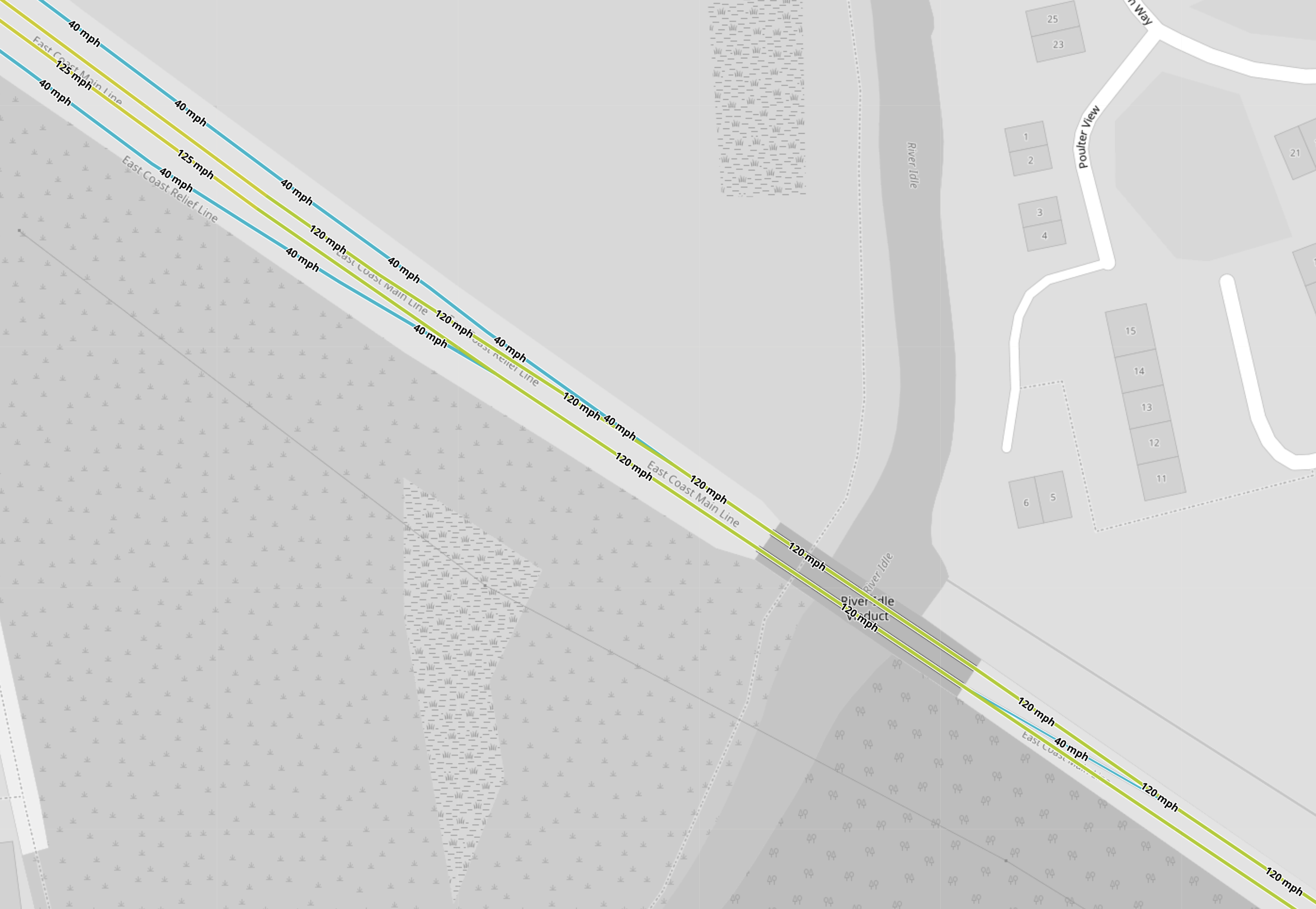
Note.
- The yellow tracks are the 125 mph fast lines of the East Coast Main Line.
- The light blue tracks are the 40 mph relief lines of the East Coast Main Line.
- Northbound tracks are to the left of each pair of lines.
Trains needing to stop in Retford station will need to cross to the Northbound relief line to enter Platform 2 at Retford station.
This OpenRailwayMap shows the curve that connects Platform 2 at Retford station to the Sheffield and Lincoln Line to Sheffield.

Note.
- The green tracks are the 60 mph Sheffield and Lincoln Line.
- Sheffield is to the West.
- The blue tracks are the curve that connects Platform 2 in Retford station to the Sheffield and Lincoln Line.
- There appears to be a grade-separated junction, where the two lines join to the West of Retford station.
A Northbound train to Sheffield will take curve and then join the line to Sheffield.
How Do Southbound Trains Go From Sheffield Through Retford Station?
I suspect trains do the opposite from a train going to Sheffield.
The train takes the curve and then stops in Platform 2 facing South.
This OpenRailwayMap shows the tracks to the South of Retford station in detail.
When the train is cleared by the signals to go South, it will leave Retford station going South on the Northbound relief line.
Note that on the map there are two crossovers, which the train will take to get on the Southbound fast line for Newark and London.
As a Control Engineer, I suspect this is the sort of manoeuvre, that modern digital signalling will make slicker and safer.
How Do Northbound Trains Go To Hull From Retford Station?
On leaving the station, the train will continue along the relief line until it merges with the Northbound fast line for Doncaster.
This is exactly as any Northbound train stopping at Retford does now.
How Do Southbound Trains Go From Hull Through Retford Station?
Currently, trains from Hull stop in Platform 1 on their way to London.
- Trains needing to stop in Retford station will need to cross to the Southbound relief line to enter Platform 1 at Retford station.
- When the train is cleared by the signals to go South, it will leave Retford station going South on the Southbound relief line.
- The Southbound relief line joins the Southbound fast line to the South of the station.
This is exactly as any Southbound train stopping at Retford does now.
Could A Hull And A Sheffield Service Run As A Pair And Split And Join At Retford Station?
Consider.
- Class 802 trains, as used by Hull Trains are designed to be run as a pair of trains, with easy coupling and uncoupling between the two trains.
- Hull Trains regularly run services as a pair of Class 802 trains.
- A pair of trains could leave King’s Cross. They would then split at a convenient station, after which the two trains go to different destinations.
- There are advantages with respect to infrastructure charges.
I feel that Hull Trains two services to Sheffield and Hull/Beverley could work as a pair.
- A pair of trains could leave King’s Cross.
- At Retford station they would split, with one train going to Hull and the other to Sheffield.
Coming South they would join at Retford.
How Would Splitting Of A Hull And Sheffield Service Be Performed At Retford Station?
The procedure would be something like this.
- As the pair of train is stopping in Retford station, it would use the relief line to enter Platform 2.
- It would stop in Platform 2.
- The trains would be uncoupled.
- The front train would go to its destination.
- The rear train would go to its destination.
Note.
- As the track to Doncaster and Hull is faster, the front train should probably be for Hull.
- Platform 2 is electrified, so the Sheffield train could top up its batteries .
- The Sheffield train could lower its pantograph.
Uncoupling takes about two minutes.
How Would Joining Of A Hull And Sheffield Service Be Performed At Retford Station?
Consider.
- Joining would have to be performed in Platform 2, as there is no route for a train from Sheffield to access Platform 1.
- North of Retford station there are two convenient crossovers, to allow a train to cross to the Northbound relief line. There are also a couple of loops, where trains could wait.
- As this is coal-mining country, perhaps, they were part of a freight route between Sheffield and Doncaster?
But this infrastructure would allow, a train from Hull to access Platform 2 at Retford station.
As the Sheffield train can easily access Platform 2, the two trains could meet in Platform 2 and then be joined together for a run to London.
Is There A Problem With Splitting And Joining Of the Hull And Sheffield Services?
Earlier, I said these were the stops of the two services.
- Going North from London King’s Cross to Hull, trains call at Stevenage (limited), Grantham, Retford, Doncaster, Selby, Howden and Brough.
- Going North from London King’s Cross to Sheffield, trains call at Retford, Worksop and Woodhouse.
Surely, if the trains were travelling as a pair, they would need to stop at the same stations to the South of Retford.
But modern digital signalling will allow trains to run closer together, so perhaps this would be the procedure going North.
- The two trains start in the same platform at King’s Cross, with the Sheffield train in front of the Hull train.
- The two trains leave King’s Cross a safe number of minutes apart.
- At its Stevenage and Grantham stops, the Hull train will tend to increase the distance between the two trains.
- The Sheffield train would stop in Platform 2 at Retford station, so that space is left for the Hull train.
- The Hull train will stop behind the Sheffield train in Platform 2 at Retford station.
- The Sheffield train will leave when ready.
- The Hull train will leave when ready.
And this would be the procedure going South.
- The train from Sheffield would line up in Platform 2 at Retford station.
- The train from Hull would line up in Platform 1 at Retford station.
- The train from Sheffield would leave when everything is ready and the train is cleared by the signalling system.
- The train from Hull would leave a safe number of minutes behind the train from Sheffield.
- At its Grantham and Stevenage stops, the Hull train will tend to increase the distance between the two trains.
- The trains could share a platform at King’s Cross.
The digital signalling and the driver’s Mark 1 eyeballs will keep the Hull train, a safe distance behind the faster Sheffield train.
The Capacity Of The Lincoln And Sheffield Line
Looking at the Sheffield and Lincoln Line, it has only an hourly train, that calls at Darnall, Woodhouse, Kiverton Park, Kiverton Bridge, Shireoaks and Worksop between Retford and Sheffield.
- I would suspect that there is enough spare capacity for Hull Trains to run a one train per two hours (tp2h) service between London King’s Cross and Sheffield.
- If LNER feel that a 1 tp2h frequency is viable for Harrogate, Lincoln and other places, surely Hull and East Sheffield could support a similar service from King’s Cross.
If the services could be run by battery-electric trains, capable of running at 140 mph on the East Coast Main Line and giving times of ninety minutes to Sheffield, this could be a success.
Could Woodhouse Station Become A Transport Hub?
This Google Map shows Woodhouse station.
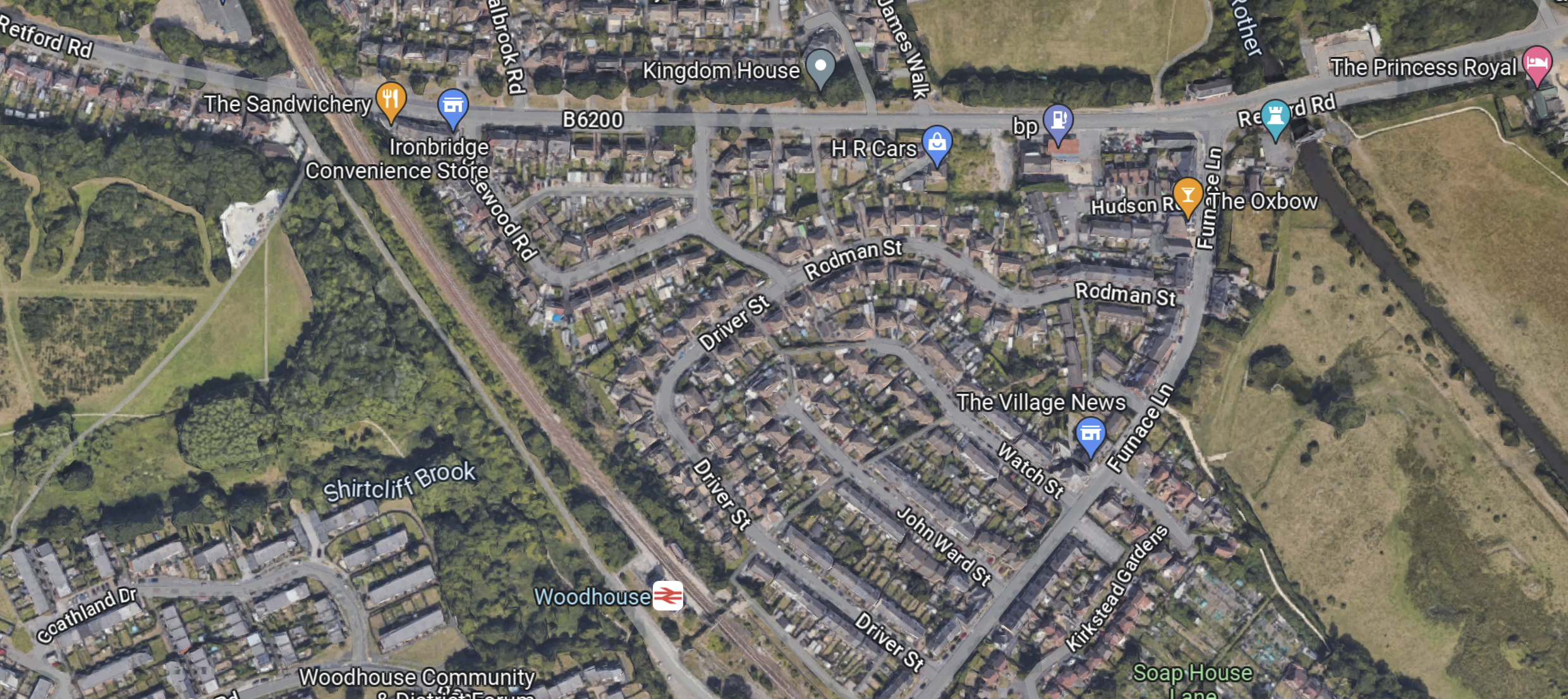
Note.
- It is certainly surrounded by a lot of houses.
- Could it be provided with car-parking?
Although, as this picture shows it is not blessed with lots of facilities.
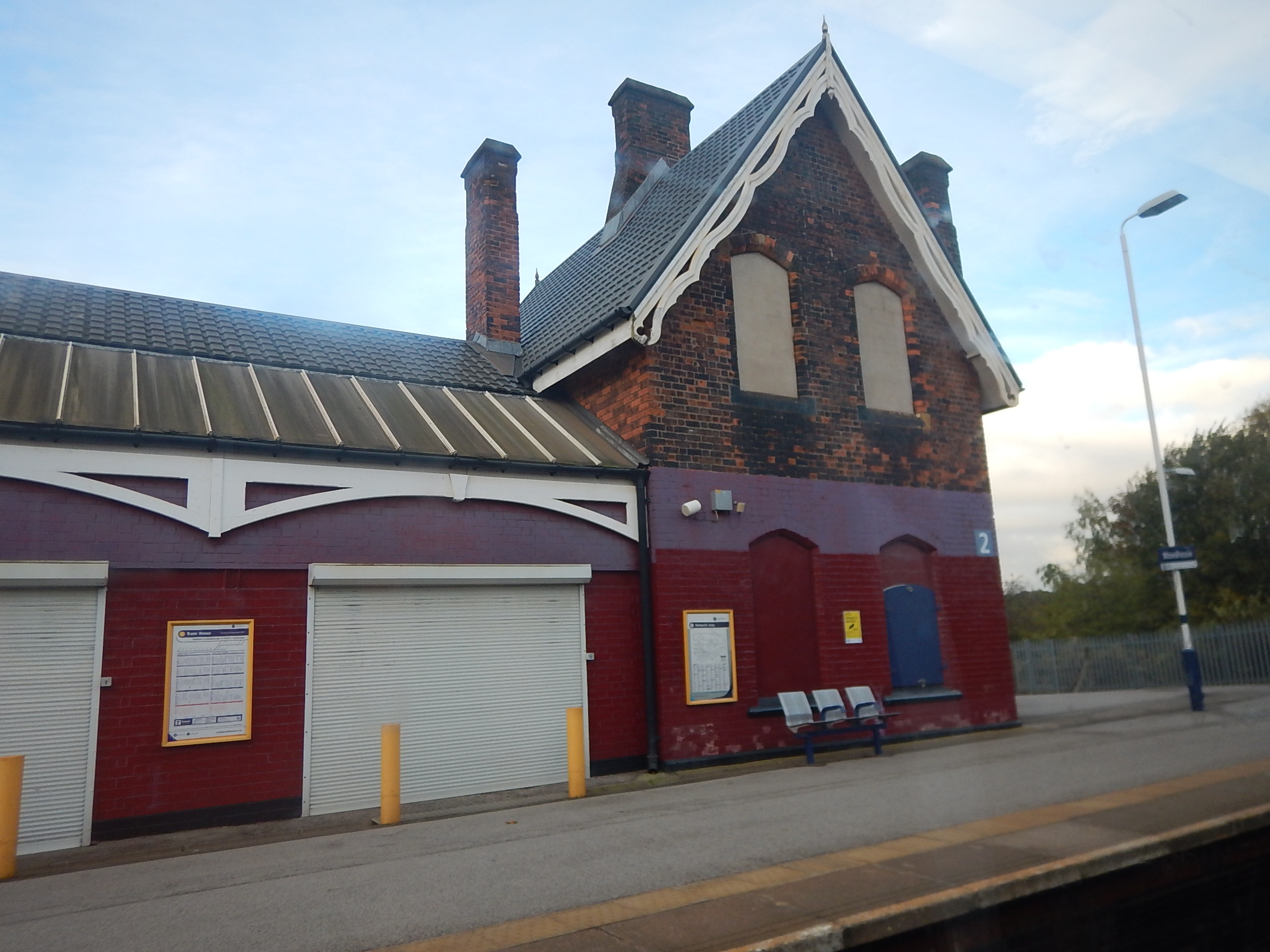
But.
- The station is in an area, which Sheffield want to develop.
- The Advanced Manufacturing Centre is nearby.
- There are aspirations to run a tram-train between Sheffield and Chesterfield via Darnall, Woodhouse and Barrow Hill stations.
- The station could be on the tram-train route to Stocksbridge, that I wrote about in Reopening The Don Valley Section Of The Former Woodhead Line Between Stocksbridge and Sheffield Victoria To Passenger Services.
Woodhouse station could be an interchange or it could become something bigger like a hub station.
How Many Sheffield Services Per Day Could Be Run?
If the Hull and Sheffield trains run as a flight under control of the digital signalling, this will mean that every Hull train can be paired with a Sheffield train.
- There are five trains per day (tpd) to and from Hull and two to and from Beverley.
- It seems a maximum of one tpd in both directions can be a ten-car train.
- Two five-car trains could fit in a platform at King’s Cross.
I suspect that the maximum number of trains per day to and from Sheffield is the same as for Hull. i.e. seven tpd.
But there is no reason, if they have enough trains and paths are available, that Hull Trains couldn’t add extra services to both destinations.
Onward From Sheffield
Several of those, who have commented on the new service have suggested that the service could go further than Sheffield, with Manchester and Leeds being given specific mentions.
This OpenRailwayMap shows the platforms at the Northern end of Sheffield station.
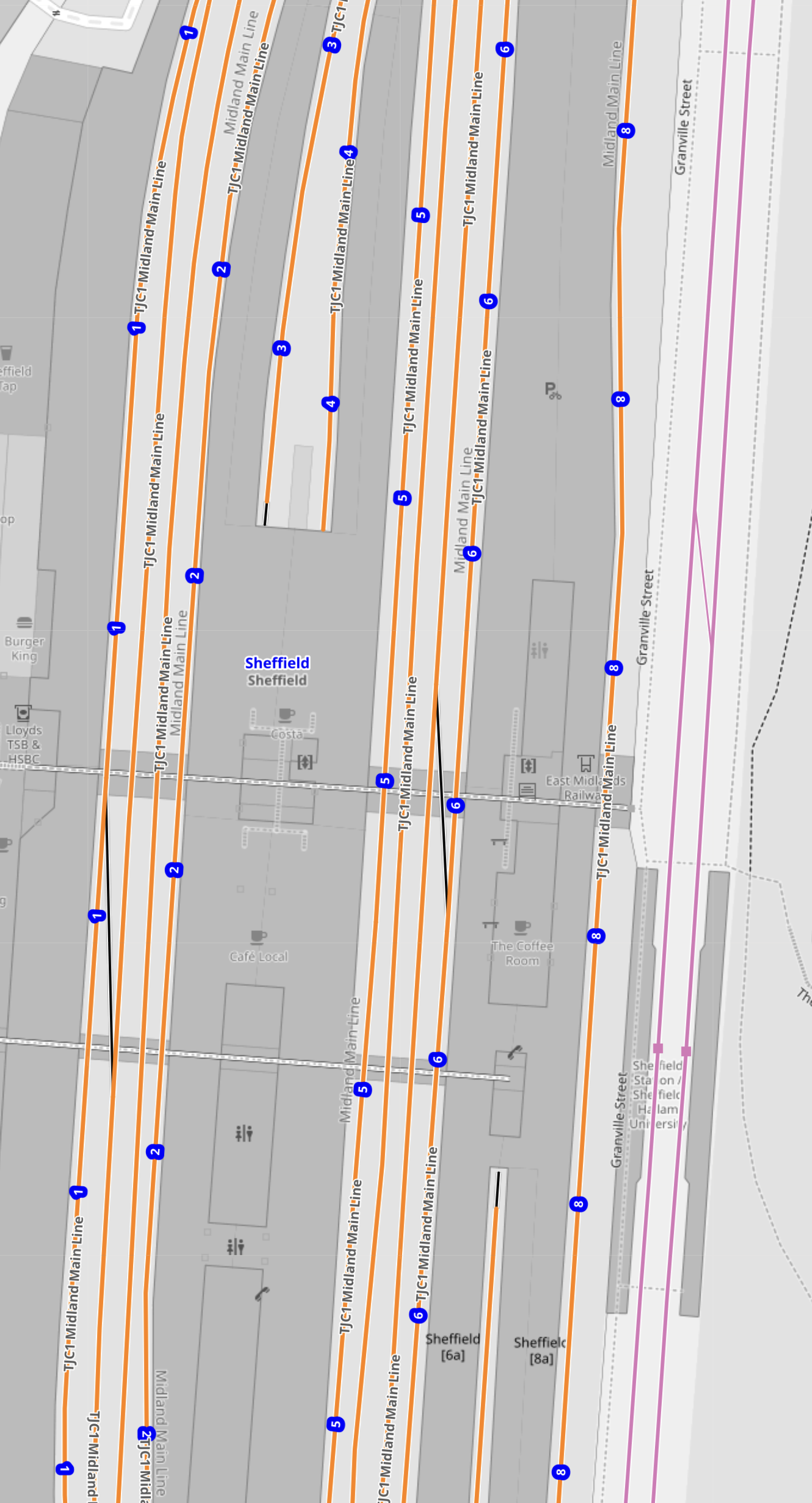
Note.
- The pink tracks at the East are the Sheffield Supertram.
- Trains to and from Barnsley, Huddersfield, Hull, Leeds, Lincoln and Retford access the station from the Northern end.
- Trains to and from Chesterfield, Derby, London, Manchester and Stockport access the station from the Southern end.
- The tracks in Sheffield station are numbered 1 to 8 from the West.
- There are five through platforms. 1, 2, 5, 6 and 8 and two bay platforms at either end.
- An extension of the service to Manchester via the Hope Valley Line, could go straight through the station.
- An extension of the service to Barnsley, Huddersfield or Leeds, would mean the train reversing at Sheffield.
It looks like an extension to Manchester Piccadilly over the recently upgraded Hope Valley Line would be the easiest extension. But would Avanti West Coast, who have FirstGroup as a shareholder want the competition?
Recently, it has been announced that the Penistone Line to Barnsley and Huddersfield will be upgraded to accept two trains per hour (tph) and allow faster running.
Because Sheffield could be around eighty minutes from London, there could be some smart times to and from the capital.
- Meadowhall in 90 minutes
- Barnsley in 112 minutes.
- Huddersfield in 140 minutes.
Huddersfield could be almost twenty minutes faster than the route via Leeds.
Comments From The Times
These are some readers comments from The Times.
- Hope the prices are competitive with LNER. I rarely go to London from Chesterfield with EMR as they’re so expensive. LNER from Newark is much cheaper but a service from Worksop for me would be perfect.
- Excellent News in so many ways. I hope it really takes off which could help ease the congestion on the M1 and also thin out overcrowding on busy LNER services. It really does deserve to succeed.
- This is excellent news. The Lumo service has been a game changer for me and those living in the north east.
The public seem in favour.
Conclusion
I really like this proposal from FirstGroup.
- It has the possibility to provide Sheffield with a fast train link to London.
- It could run about six trains per day.
- It will be faster than High Speed Two was proposed.
It could be the first service of High Speed Yorkshire.
 The Anonymous Widower