Keadby 3 Low-Carbon Power Station
This article on Business Live is entitled Huge Green Power Station Proposed By SSE As It Embraces Hydrogen And Carbon Capture.
SSE Thermal is working on a low-carbon 910 MW gas-fired power station to join Keadby and Keadby 2 power stations in a cluster near Scunthorpe.
A spokesman for SSE is quoted as saying they will not build the plant without a clear route to decarbonisation.
On this page of their web site, SSE Thermal, say this about Keadby 3.
As part of our commitment to a net zero emissions future, Keadby 3 will only be built with a clear route to decarbonisation, either using hydrogen as a low-carbon fuel, or equipping it with post-combustion carbon capture technology. The project is at the early stages of development and no final investment decision has been made.
It should also be noted that SSE Renewables have also built a wind farm at Keadby. The web site describes it like this.
Keadby Wind Farm is England’s largest onshore wind farm. This 68MW renewable energy generation site can power approximately 57,000 homes.
There are a lot of good intentions here and I think that SSE haven’t disclosed the full picture.
It would seem inefficient to use hydrogen to power a gas-fired power station to achieve zero-carbon power generation.
- If you are using hydrogen created from steam reforming of methane, this creates a lot of carbon-dioxide.
- If you are using green hydrogen produced by electrolysis, then, why don’t you store the electricity in a battery?
Perhaps, SSE are trying out a new process?
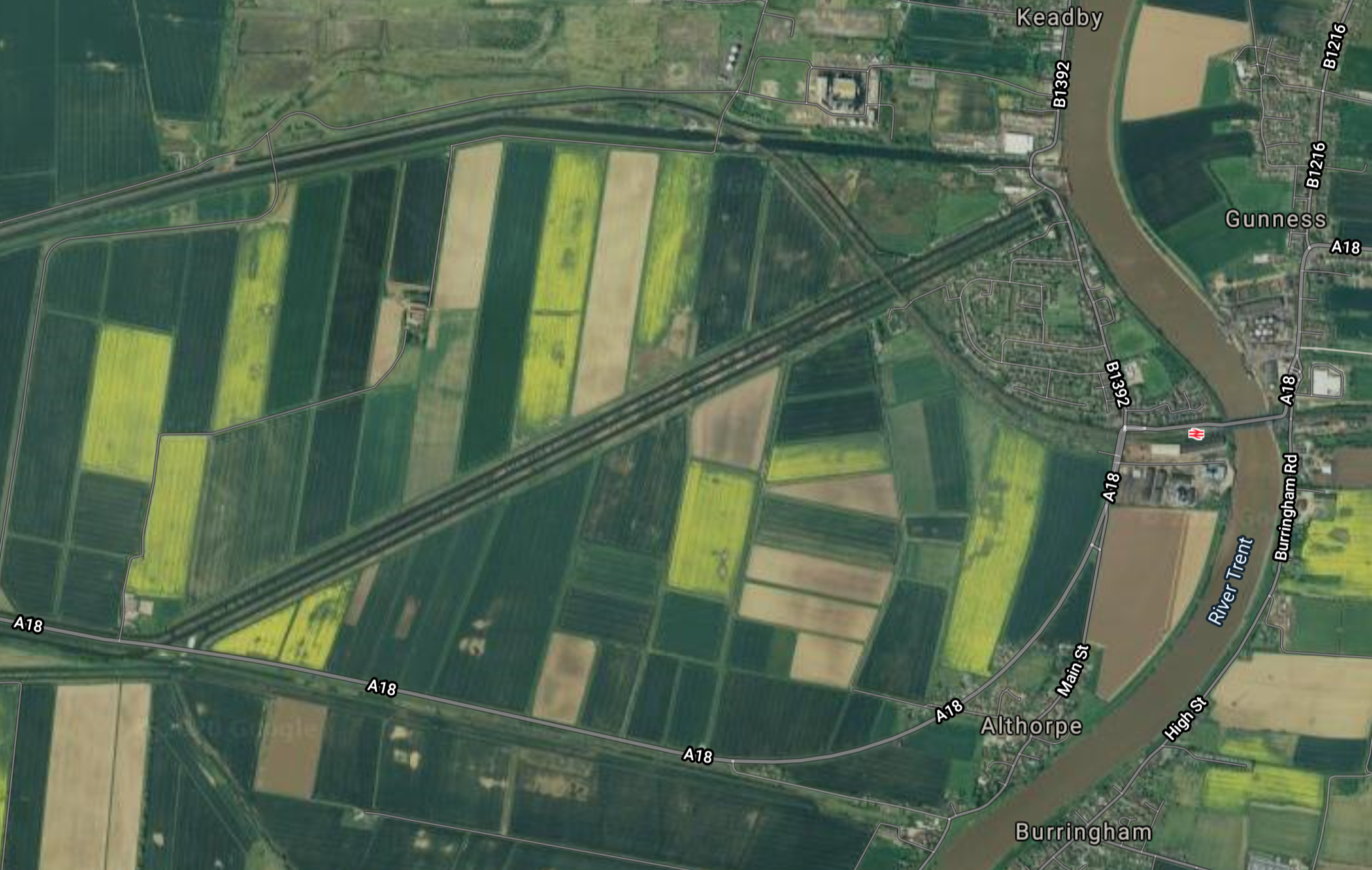
This Google Map shows the area of Keadby to the West of Scunthorpe.
Note.
- The River Trent meandering through the area.
- Althorpe station is in the bend of the River,
- I’m fairly certain, that I remember an old airfield in the area.
- Keadby power station is a bit to the North of the waterway running West from the River and close to where the railway crosses the waterway.
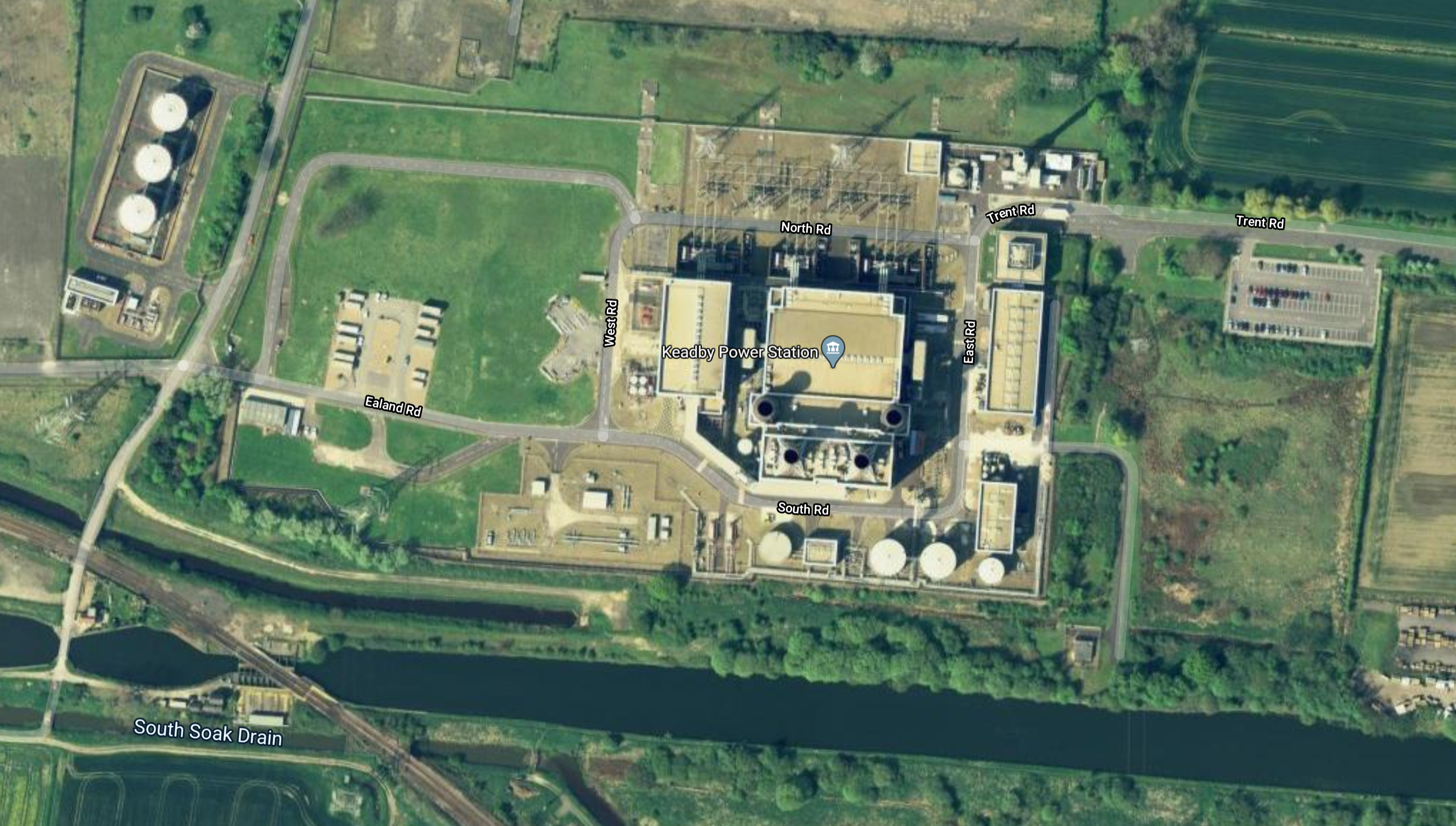
This second Google Map shows a close-up of the power station.
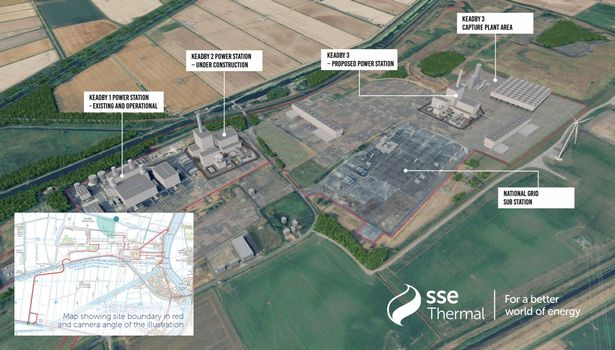
This visualisation from SSE Thermal shows how the site might look in the future.
For me the interesting location is the village of Althorpe, where C and myself had friends.
They were always getting tourists arriving in the village looking for Princess Diana’s grave!
Carbon Capture And Storage At Keadby
If SSE have three large power stations at Keadby, a shared carbon capture and storage system could be worthwhile.
- There are numerous gas fields in the area and a big gas terminal at Theddlethorpe, to where they all connect.
- I was surprised to see, that one of thee fields; Saltfleetby is owned by President Putin’s favourite gas company; Gazprom.
- Some of these fields are actually on-shore.
- The power stations probably get their gas from the same terminal.
Some of these gas fields that connect to Theddlethorpe could be suitable for storing the carbon dioxide.
As there is masses of space at Keadby, I can see more gas-fired power stations being built at Keadby.
All would feed into the same carbon capture and storage system.
If gas was needed to be imported in a liquified form, there is the Port of Immingham nearby.
Absorption Of Carbon Dioxide By Horticulture
Consider.
- Increasingly, horticulture is getting more automated and efficient.
- Automatic harvesters are being developed for crops like tomatoes and strawberries.
- Instead of storing the carbon-dioxide in worked-out gas fields, it can also be fed directly to fruit and vegetables that are being grown in greenhouses.
- Keadby is surrounded by the flat lands of Lincolnshire.
How long will it be before we see tomatoes, strawberries, peppers and cucumbers labelled as British zero-carbon products?
Offshore Hydrogen
I’ll repeat what I said in ITM Power and Ørsted: Wind Turbine Electrolyser Integration.
This is from a press release from ITM Power, which has the same title as the linked article.
This is the introductory paragraph.
ITM Power (AIM: ITM), the energy storage and clean fuel company, is pleased to share details of a short project sponsored by the Department for Business, Energy & Industrial Strategy (BEIS), in late 2019, entitled ‘Hydrogen supply competition’, ITM Power and Ørsted proposed the following: an electrolyser placed at the wind turbine e.g. in the tower or very near it, directly electrically connected to the DC link in the wind turbine, with appropriate power flow control and water supplied to it. This may represent a better design concept for bulk hydrogen production as opposed to, for instance, remotely located electrolysers at a terminal or platform, away from the wind turbine generator, due to reduced costs and energy losses.
Some points from the remainder of the press release.
- Costs can be saved as hydrogen pipes are more affordable than under-water power cables.
- The proposed design reduced the need for AC rectification.
After reading the press release, it sounds like the two companies are performing a serious re-think on how wind turbines and their links to get energy on-shore are designed.
- Will they be using redundant gas pipes to bring the hydrogen ashore?
- Will the hydrogen come ashore at Theddlethorpe and use the existing gas network to get to Keadby?
It sounds inefficient, but then the steelworks at Scunthorpe will probably want masses of hydrogen for carbon-free steel making and processing.
Boosting Power Station Efficiency
There is also a section in the Wikipedia entry for Combined Cycle Power Plant called Boosting Efficiency, where this is said.
The efficiency of CCGT and GT can be boosted by pre-cooling combustion air. This is practised in hot climates and also has the effect of increasing power output. This is achieved by evaporative cooling of water using a moist matrix placed in front of the turbine, or by using Ice storage air conditioning. The latter has the advantage of greater improvements due to the lower temperatures available. Furthermore, ice storage can be used as a means of load control or load shifting since ice can be made during periods of low power demand and, potentially in the future the anticipated high availability of other resources such as renewables during certain periods.
So is the location of the site by the Trent, important because of all that cold water?
Or will they use surplus power from the wind farm to create ice?
The Proposed North Sea Wind Power Hub
The North Sea Wind Power Hub is a proposed energy island complex on the Eastern part of the Dogger Bank.
- The Dutch, Germans and Danes are leading the project.
- Along with the Belgians, we have been asked to join.
- Some reporting on the Hub has shown, airstrips in the middle of the complex to bring the workforce to the site.
- A Dutch report, says that as much as 110 GW of wind power could be developed by 2050.
- We are also looking at installing wind farms on our section of the Dogger Bank.
Geography says, that one of the most convenient locations to bring all this electricity or hydrogen gas ashore is North Lincolnshire
A Very Large Battery
I would also put a very large battery on the site at Keadby.
One of Highview Power‘s proposed 1 GWh CRYOBatteries would be a good start. This will be four times the size of the 250 MWh CRYOBattery, which the company is currently designing and building at Carrington in Greater Manchester.
Conclusion
The three power stations at Keadby are the following sizes
- Keadby 1 – 734 MW
- Keadby 2 – 803.7 MW
- Keadby 3 – 010 MW
This adds up to a total of 2447.7 MW. And if they fit carbon capture and storage it will be zero-carbon.
Note.
- Hinckley Point C is only 3200 MW and will cost around £20 billion or £6.25 billion per GW.
- Keadby 2 power station is quoted as costing £350 million. or £0.44 billion per GW.
These figures don’t include the cost of carbon capture and storage, but they do show the relatively high cost of nuclear.
Highview Power On The Good News Network
If the Good News Network, is what it says on the tin, then I’m pleased that they’ve written this article, which is entitled World’s Biggest Liquid-Air Battery – ‘The Climate-Emission Killer’ – Is Now Under Construction In England.
The article, appears to be a rehash of what appeared in the Guardian, slanted for American readers.
It has the usual American fault of mixing up England with the UK, but surely the fact that it’s on the site, is good news for Highview Power.
Do We Need A UK Lithium-Ion Battery Factory?
My post, Gore Street Acquires 50MW Ferrymuir Battery Project, Eyes More In Scotland and the article on the Energyst with the same name, got me thinking.
It was this statement about Gore Street Energy Fund, that really started the thought.
The fund said the addition takes its portfolio built or under development to 293MW and added that is has options for a further 900MW.
Gore Street obviously have the money to build all of this energy storage.
- I have also looked at some of their projects on Google Maps and there are still plenty of sites on green- or brown-field land close to electricity sub-stations, where energy storage would be easy to connect.
- I suspect, they have some good engineers or electricity marketing specialists available.
- My worry, would be, with many countries going the energy storage route, is there enough capacity to build all the batteries we need.
We have three routes, we could easily take in this country.
- Convert suplus energy to hydrogen using electrolysers from ITM Power in Rotherham.
- Develop some BALDIES (Build Anywhere Long Duration Intermittent Energy Storage). British technology is available as the CRYObatteryfrom Highview Power, who signed to build their first full-size plant in the UK, last week.
- Build a lithium-ion battery factory. Preferably of the next generation, so that battery vehicles will go further on a charge.
It is my view, that we should do all three!
Will Gore Street, add a BALDIES to their portfolio of lithium-ion energy storage.
- In World First As Liquid-Air Energy Storage Makes Commercial Debut Near Manchester United Ground, I gave costs of £110/MWh for a CRYObattery and £231-470/MWh for lithium-ion batteries.
- Nothing exotic like lithium is needed to build a CRYObattery.
- Highview claim they can build bigger batteries than Elon Musk.
- They wouldn’t be the first substantial order.
I think the decision makers at Gore Street would sleep comfortably in their beds if they bought a CRYObattery for a location, that needed a larger battery.
Conclusion
As to the answer to my question, the answer is yes, as mobile application will need more and better batteries and on balance, we should have our own supply.
Air-Powered Energy Storage Knocks Out Coal & Gas — Wait, What?
The title of this post, is the same as that of this article on CleanTechnica.
After reading, this must read article, it could have had a title with Knocks Out Coal, Gas and Nuclear.
It makes a passionate article for Highview Power’s long term air-powered energy storage and other systems with a similar energy profile like Form Energy.
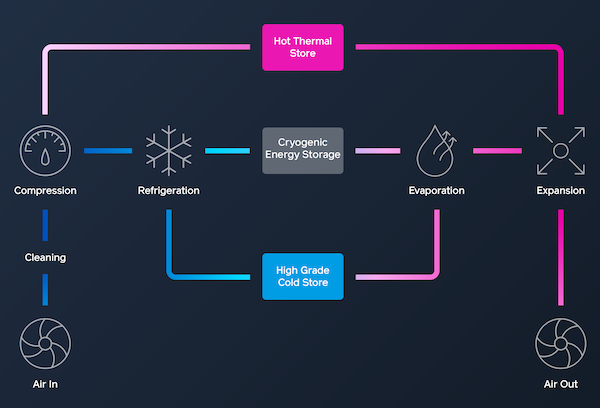
It also showed this good graphic from Highview Power, which shows how their system works.
This paragraph gives Highview’s view on what their CRYObatteries will do.
Grid operators are turning to long-duration energy storage to improve power generation economics, balance the grid, and increase reliability. At giga-scale, CRYOBatteries paired with renewables are equivalent in performance to – and could replace – thermal and nuclear baseload power in addition to supporting electricity transmission and distribution systems while providing additional security of supply,” enthuses Highview.
The author then chips in with the attitude of the US Department of Energy.
Don’t just take their word for it. The US Department of Energy is eyeballing long duration energy storage for the sparkling green grid of the future despite all the hot air blowing out of 1600 Pennsylvania Avenue.
In an interesting twist, the Energy Department’s interest in long duration storage was initially connected to its interest in at least preserving, if not growing, the nation’s aging fleet of nuclear power plants.
Will renewables be able to see off nuclear in a country with plenty of sun and/or wind like the United States?
Conclusion
With a lot of help from their friends in the long term energy storage business, the answer must be yes!
World First As Liquid-Air Energy Storage Makes Commercial Debut Near Manchester United Ground
The title of this post is the same as that of this article on Recharge.
I can add some extra information starting with this picture from Highview Power, which shows a visualisation of the CRYObattery.
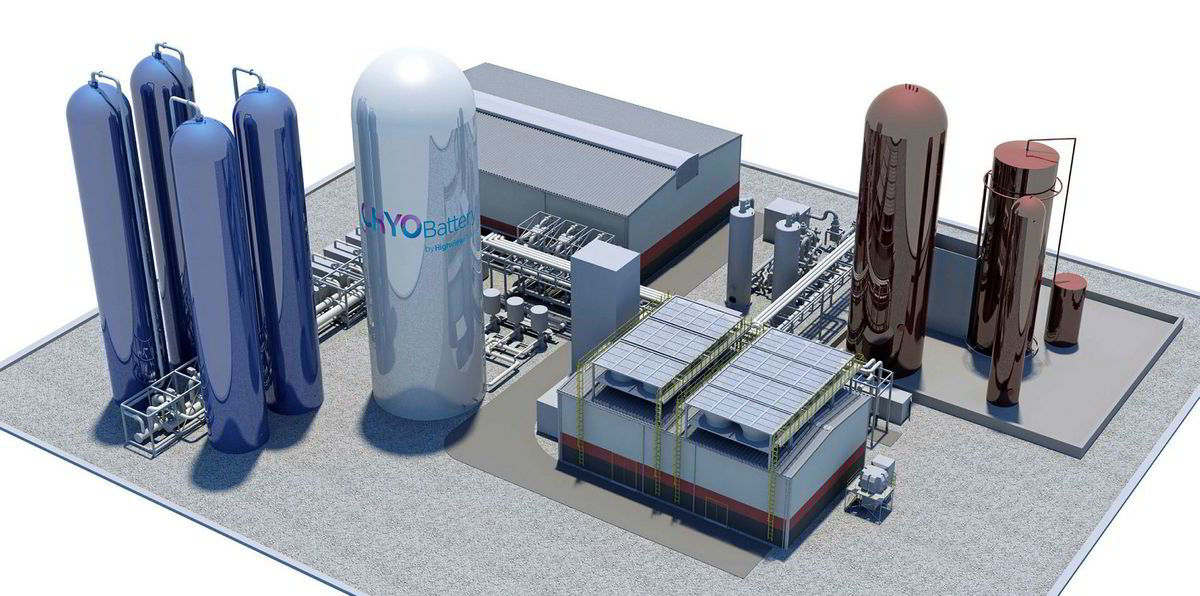
Unfortunately, it doesn’t show any objects, which can give an idea of the size of the plant.
Levelised Cost Of Energy
LCOE or Levelised Cost Of Energy will be a term, that will be increasing used, when electricity generation is discussed. This is Wikipedia’s definition of the term.
The levelized cost of energy (LCOE), or levelized cost of electricity, is a measure of the average net present cost of electricity generation for a generating plant over its lifetime. The LCOE is calculated as the ratio between all the discounted costs over the lifetime of an electricity generating plant divided by a discounted sum of the actual energy amounts delivered. The LCOE is used to compare different methods of electricity generation on a consistent basis. The LCOE “represents the average revenue per unit of electricity generated that would be required to recover the costs of building and operating a generating plant during an assumed financial life and duty cycle.” Inputs to LCOE are chosen by the estimator. They can include cost of capital, “fuel costs, fixed and variable operations and maintenance costs, financing costs, and an assumed utilization rate.
Make sure, when comparing different LCOE values for different methods of energy generation, that the same method was used to calculate LCOE.
Comparative Costs
The article quotes the following costs on an LCOS or Levelised Cost Of Storage basis, which enables comparison to be made according to the same rules.
- A 200 MW/2 GWh CRYObattery will cost £110/MWh
- Pumped storage/hydro will cost £123-150/MWh
- Lithium-ion will cost £231-470/MWh
I have converted some from dollars.
I do think that a 2 GWh CRYObattery could be very good value!
Income
The article says this about how the CRYObattery will earn us keep.
Income will come through grid balancing, ancillary services such as frequency response and voltage support, and arbitrage — buying electricity when wholesale prices are low and selling it when prices are high.
I suspect that if a company like Carlton Highview Power had several large batteries around the country, this would be an advantage to the company.
Will BALDIES Save The World?
I just had to use this new acronym, I’ve just found on the Internet.
BALDIES are Build-Anywhere-Long-Duration-Intermittent-Energy-Storage.
Climate Emission Killer: Construction Begins On World’s Biggest Liquid Air Battery
The title of this post, is the same at that of this article in the Guardian.
This is the introductory paragraph.
Construction is beginning on the world’s largest liquid air battery, which will store renewable electricity and reduce carbon emissions from fossil-fuel power plants.
These are a few points from the Guardian and other articles on other web sites, including Wikipedia.
- The size of the battery is 250 MWh.
- It can delivery up to 50 MW of power. which translates to five hours at full power, if the battery is full.
- If it was already working, it would be the ninth biggest battery of all types, except for pumped storage, in the world.
- It will be built at Trafford Energy Park near to Carrington power station.
- It will be double the size of the largest chemical battery, which was built by Tesla in South Australia.
- It is being built by a company call Carlton Highview Storage, which is a joint venture between Carlton Power and Highview Power.
- It should start commercial operation in 2022.
- The installation of the battery is an £85million project.
- The Government have chipped in with a £10million grant.
Some reports say, this could be one of four of Highview Power’s 250 MWh CRYObatteries to be developed by the joint venture.
I will add some observations of my own.
Carrington Power Station
This Google Map shows the site of Carrington Power station.
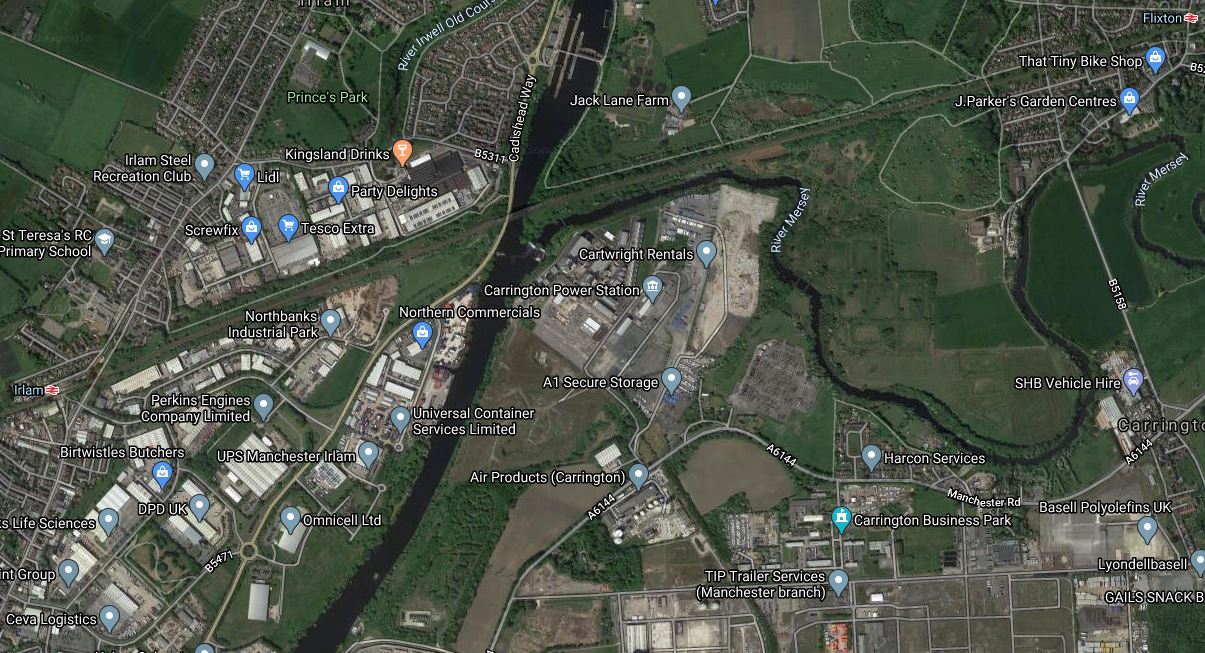
Note.
- Flixton station is in the North-East corner of the map.
- Irlam station is on the Western edge of the map.
- South of the railway between the two stations, there is a large industrial site, that sits in a bend in the River Mersey.
This second Google Map shows an enlargement of the site.
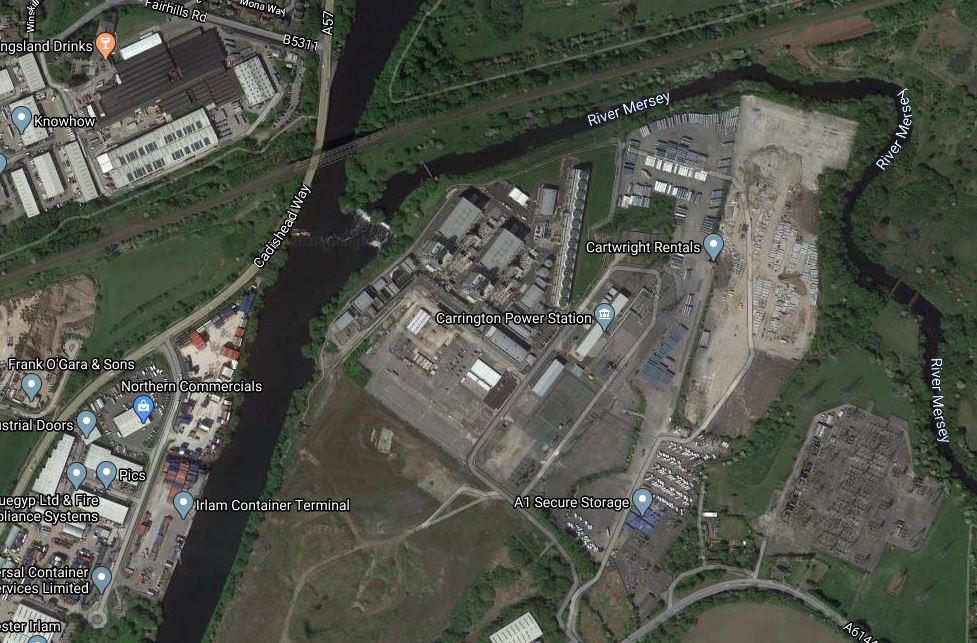
Note.
- Carrington power station in the middle of the site.
- Large amounts of brownfield land.
- The Manchester Ship Canal passing to the West of the site.
Wikipedia says this about the design of Carrington power station.
The station is a Combined-Cycle Power Plant (CCPP), using natural gas to generate 884MW of electricity. The CCPP uses both a gas and a steam turbine together, to produce up to 50 percent more electricity from the same fuel than a traditional simple-cycle plant. The waste heat from the gas turbine is routed to the nearby steam turbine, which generates additional power. Carrington consists of two CCPP KA26-1 units. At operating design conditions, each CCPP unit generates 442.3 MW net output. The station generates enough power to meet the electricity needs of one million homes in the UK and began commercial operation on 18 September 2016.
Wikipedia also says the following.
- The plant has an efficiency of 58%. Is that good for this type of gas-fired Combined Cycle Gas Turbine power station? 64% seems to be about the best but Carrington is better than the about 50% possible with a conventional gas turbine plant.
- Much of the heavy equipment for the power station was brought by barge along the Manchester Ship Canal.
- The station is also a combined heat and power plant, capable of providing nearby businesses with steam, if they require a supply. This could be useful to a Highview Power CRYObattery, as a low-grade heat-source is needed to recovery the stored energy by warming the liquid air.
Given the following.
- There is space available near to the power station.
- A 250 MWh CRYObattery would probably fit in a size smaller than two football pitches.
- Carlton have permission to build another CCGT at the site.
- Carrington has a very good electrical connection to the grid, as nearly all power stations do.
- Heavy components can be brought in by barge on the canal.
, it would appear that the area would be a good place to site the first gr-scale CRYObattery.
Conclusion
I think siting the first grid-scale CRYObattery close to Carrington power station at the Trafford Energy Park, fits together well and I could see more CRYObatteries being installed in the following types of location.
- At existing power stations.
- On the sites of demolished power stations, that still have good grid connections.
- Where interconnectors and power from offshore wind connects to the grid.
I wouldn’t be surprised to see Drax Group install a system at one of their sites, as a CRYObattery could help cut their carbon-emissions.
Lithium Battery Cell Prices To Almost Halve By 2029
The title of this post, is the same as that of this article on Energy Storage News.
This is the introductory paragraph.
Lithium-ion cell prices will fall by around 46% between now and 2029, according to new analysis from Guidehouse Insights, reaching US$66.6 per kWh by that time.
The rest of the article contains a lot more useful predictions.
I will add a prediction of my own.
The drop in prices of lithium-ion batteries will surely result in a lot more applications, in the following areas.
- Battery-electric vehicles
- Battery-electric vans and buses and light-trucks.
- Battery-electric trams and trains
- Battery-electric aircraft.
- Battery-electric ships.
- Battery-electric tractors
- Battety-electric construction plant
Lithium-ion batteries will also be used in hydrogen-powered versions of any of the above.
The cost of lithium-ion batteries, will also lead to more applications in the following areas.
- Grid energy storage or as it sometimes called; front-of-the-meter storage.
- Heavy trucks
- Double-deck buses
- Railway locomotives
These could use a very large number of lithium-ion cells.
Conclusion
Because as yet, there is no alternative to lithium-ion cells for mobile applications, I think we’ll see grid-energy storage going to one of the alternatives like Gravitricity, Highview Power or Zinc8.
US Deployed 98MW / 208MWh Of Energy Storage During First Quarter Of 2020
The title of this post, is the same as that of this article on Energy Storage News.
This is the introductory paragraph.
Research firm Wood Mackenzie has held onto its forecast that the US will deploy around 7GW of energy storage annually by 2025 and found that 97.5MW / 208MWh of storage was installed during the first quarter of this year.
The United States may be led by a President, who doesn’t believe in global warming, but individuals and businesses in the country seem to believe in battery storage and the benefits it brings.
This is an interesting paragraph from the article.
The overall deployments were also down in megawatt-hour terms: 208MWh in total was a 43% decrease quarter-on-quarter and down 34% year-on-year. Wood Mackenzie found that this was due to a majority of front-of-the-meter projects coming online being short duration energy storage. This meant that FTM storage accounted for 13% of Q1 2020 deployments in megawatt-hours but for 22% of the total megawatts deployed.
Front-of-the-meter storage is mainly used to maintain supplies, when demand is going up and down like a yo-yo in an area. Companies like Gresham House Energy Sorage Fund seem to be funding these batteries in the UK. Gravutricity, Highview Power and Zinc8 also seem to be targeting this market.
Conclusion
It would appear that the energy storage market is healthy on both sides of the Atlantic
UK’s Largest Solar Park Cleve Hill Granted Development Consent
The title of this post, is the same as that of this article on Solar Power Portal.
These are the two introductory paragraphs.
Cleve Hill Solar Park, set to be the largest in the UK, has been granted development consent by the energy secretary.
The colossal 350MW project will include 880,000 panels along with battery storage, and sit just one mile northeast of Faversham, in Kent, situated close to the village of Graveney.
Other points from the article.
- Cleeve Hill Solar Park is a £450million project.
- It is the first solar project to be considered a Nationally Significant Infrastructure Project.
- It is being developed as a joint venture between Hive Energy and Wirsol.
- It is due to be operational by 2022.
- To complete the project 700 MWh of energy storage will be added later.
The article also contains this quote from Solar Trade Associations chief executive Chris Hewett.
Solar has a significant role to play in boosting the economy in the wake of the coronavirus crisis. With the right policies we can expect to see an 8GW pipeline of solar projects unlocked and rapidly deployed, swiftly creating a wealth of skilled jobs and setting us on the path towards a green recovery.
8 GW of intermittent energy will need a lot of storage.
As Cleeve Hill’s developers are planning to provide 700 MWh of storage for 700 MW of solar panels, it would appear that 8 GW of solar panels could need up to 16 GWh of energy storage.
As our largest energy storage system is the pumped storage Electric Mountain in Snowdonia with a capacity of 9.1 GWh and most of the large solar developments are towards the South of England, the UK needs to develop a lot more energy storage, where the solar is generated and much of the energy is used.
I can see the following environmentally-friendly developments prospering.
- Highview Power‘s CRYOBattery, which uses liquid air to store energy. Systems have a small footprint and up to a GWh could be possible.
- Electrothermal energy storage like this system from Siemens.
- Using electrolysers from companies like ITM Power to convert excess energy into hydrogen for transport, steelmaking and injecting into the gas main.
- Zinc8‘s zinc-air battery could be the outsider, that comes from nowhere.
Developers could opt for conservative decision of lithium-ion batteries, but I don’t like the environmental profile and these batteries should be reserved for portable and mobile applications.
Floatovoltaics
One concept, I came across whilst writing was floatovoltaics.
The best article about the subject was this one on Renewable Energy World, which is entitled Running Out of Precious Land? Floating Solar PV Systems May Be a Solution.
A French company call Ciel et Terre International seem to be leading the development.
Their web site has this video.
Perhaps, some floatovoltaics, should be installed on the large reservoirs in the South of England.
- The Renewable Energy World article says that panels over water can be more efficient due to the cooling effect of the water.
- Would they cut evaporative losses by acting as sunshades?
- As the French are great pecheurs, I suspect that they have the answers if anglers should object.
This Google Map shows the reservoirs to the West of Heathrow.
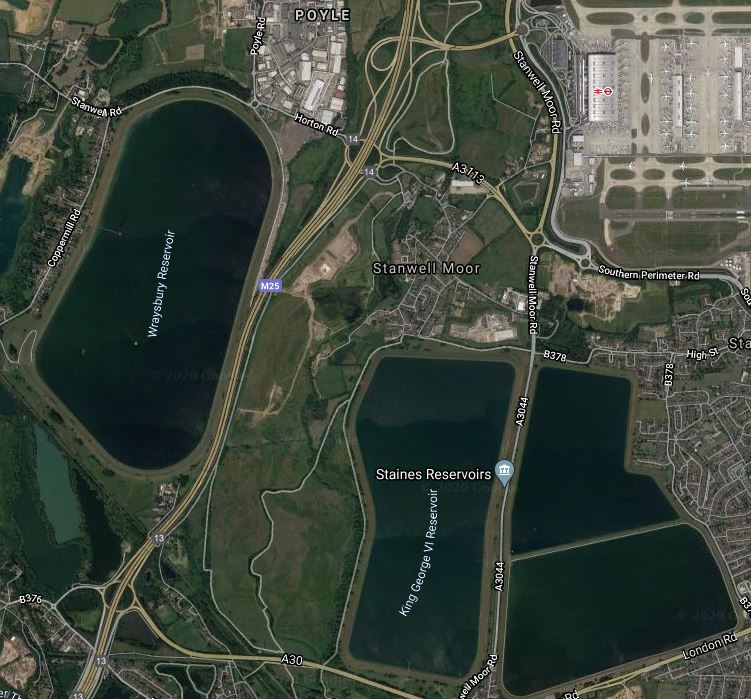
Note.
- Wraysbury Reservoir has an area of two square kilometres.
- King George VI Reservoir has an area of one-and-a-half square kilometres.
- Using the size and capacity of Owl’s Hatch Solar Farm, it appears that around 65 MW of solar panels can be assembled in a square kilometre.
- All these reservoirs are Sites of Special Scientific Interest because of all the bird life.
- Heathrow is not an airport, that is immune to bird-strikes.
Could floatovoltaics be used to guide birds away from the flightpaths?
Incidentally, I remember a report from Tomorrow’s World, probably from the 1960s, about a porous concrete that had been invented.
- One of the uses would have been to fill reservoirs.
- The capacity of the reservoir would only have been marginally reduced, as the water would be in the voids in the concrete like water in a sponge.
- Soil would be placed at the surface and the land used for growing crops.
I wonder what happened to that idea from fifty years ago!
 The Anonymous Widower