Tendering Begins For German Hydrogen Train Order
The title of this post is the same as that of this article in the International Railway Journal.
This is the first paragraph.
Rhine-Main Vehicle Management (Fahma), a subsidiary of Rhine-Main Transport Authority (RMV), published a tender notice in the Official Journal of the European Union on April 20 for a contract to supply a fleet of hydrogen fuel cell multiple units for regional services on non-electrified lines in the Taunus area of Hessen.
But then the Germans seem to be much easier to use gases of various types to solve problems, than other countries.
I’ve spoken about hydrogen trains to people in Germany and the UK and the Germans are more enthusiastic, whereas the Brits just question hydrogen’s ability to catch fire.
Perhaps, Gemans teach chemistry better?
Who knows? But the orders for hydrogen trains keep coming.
Routes For Bombardier’s 125 Mph Bi-Mode Aventra
This article in Rail Magazine, is entitled Bombardier Bi-Mode Aventra To Feature Battery Power.
A few points from the article.
- Development has already started.
- Battery power could be used for Last-Mile applications.
- The bi-mode would have a maximum speed of 125 mph under both electric and diesel power.
- The trains will be built at Derby.
- Bombardier’s spokesman said that the ambience will be better, than other bi-modes.
- Export of trains is a possibility.
Bombardier’s spokesman also said, that they have offered the train to three new franchises. East Midlands, West Coast Partnership and CrossCountry.
These are my thoughts on these franchises.
Bi-Mode And Pure Electric
I’m pretty certain that if you want to create a 125 mph bi-mode train, you start with a 125 mph electric train, if you want a high degree of commonality between the two trains.
Hitachi have a whole family of Class 800 trains, each of which has a different specification for the diesel power. Even the pure-electric Class 801 trains, has one diesel engine for emergencies.
An electric train with batteries could be very efficient, if the batteries were used to handle regenerative braking and boost the trains, where more power is required.
East Midlands
It is no surprise that Bombardier are talking to the groups, that are bidding to become the new franchise holder for the East Nidlands, when it is awarded in April 2019.
They wouldn’t want to see another company’s product roaring past the factory.
The proposed bi-mode Aventra will probably have been designed very much with the Midland Main Line in mind.
- The Midland Main Line will be electrified from St. Pancras to Kettering and Corby.
- Will the fast lines be electrified to Glendon Junction, where the Corby Branch joins the Midland Main Line?
- The route between St. Pancras and Glendon Junction is being upgraded to four tracks, with as much 125 mph running as possible.
- The non-stop nature of Midland Main Line services South of Kettering could be significant.
- North of Kettering, there is currently no electrification.
- The development of Toton station for HS2 is being accelerated and there could be an island of electrification here, by the mid-2020s.
- If HS2 shares the Midland Main Line corridor between Toton and Sheffield, this section could be electrified by the late-2020s.
Over the next decade, there will be more electrification and a greater proportion of the route, where 125 mph running will be possible.
There has been a bit of controversy, that the number of stops the franchise will make at Bedford and Luton is being reduced after May this year.
The reason given is that it will enable faster services to Derby, Nottingham and Sheffield.
North To Derby, Nottingham and Sheffield
Consider a bi-mode train with batteries going North.
- Between St. Pancras and Kettering, it will be at 125 mph for as long as possible.
- The train will also ensure that at Kettering, it has the batteries brim full, sfter charging from the electrification.
- After a stop at Kettering station, if the electrification reached to Glendon Junction, the acceleration would all be electrically-powered.
- Whether it stopped at Kettering or not, the train would pass Glendon Junction at line speed with full batteries.
It’s almost as if the electrification is being used as a catapult to speed the train North.
South From Derby, Nottingham and Sheffield
Being as electrically efficient coming South would be a lot more difficult.
- I suspect that train batteries will be charged at Derby, Nottingham and Sheffield, so they start their journey South with full batteries.
- Using a full battery and assistance from the onboard generator, trains would be accelerated away from the terminii.
- The trains computer would select automatically, whether to use battery or onboard generator power and would harvest all the power from regenerative braking.
- At each stop on the journey, energy would be lost, as regenerative braking systems do not are only between seventy and ninety percent efficient.
- Once at Glendon Junction, the train would raise the pantograph and switch to getting power from the overhead wires.
It’s all about a well-programmed computer on the train, which knows the route, the timetable and battery state so it can switch power sources appropriately.
Electrification
On the other hand, electrification around Toton could make everything easier and more efficient.
With electrification, every little helps.
- Modern trains can raise and lower pantographs, quickly and automatically.
- Faster journeys.
- Lower carbon emissions.
- Less noise and vibration from diesel generators.
Everyone’s a winner.
Oakham To Kettering
The Oakham-Kettering Line to Corby station is being electrified, double-tracked and I suspect speed limits will be raised.
Speed limits are also being raised and track improvements are being done, South of Glendon Junction.
Currently, services take seventy minutes. With the 125 mph Aventras on the route, they will not need to use the onboard generator, but surely the journey time could be reduced to under an hour, which would attract passengers and need less trains to run a two trains per hour (tph) service.
The Oakham Problem
Oakham station is in the middle of the town, as this Google Map shows.

The Department for transport would like to see more services to the town and the next station of Melton Mowbray.
But the line through the station is busy with freight trains and there is a level crossing in the middle of the town.
125 mph bi-mode trains, won’t help with the problem of Oakham.
Joining And Splitting Of Trains
There is also the possibility of joining and splitting trains.
Hitachi’s Class 800 trains can do this and I’m sure bi-mode Aventras will be able to do this automatically.
There is only four platforms available for trains on the Midland Main Line at St. Pancras and regularly two trains occupy one platform.
The ability to run a pair of bi-mode trains, that joined and split could be a great asset.
Liverpool To Norwich
This long route is an important one for those, who live near its stations. It is usually served by one or two Class 158 trains, which are often very crowded.
The route is partially electrified.
- Liverpool to Hunts Cross
- Manchester Oxford Road to Stockport
- Grantham to Peterborough
- Around Ely
- Around Norwich
So there should be plenty of places to raise the pantograph and charge the batteries.
It is a typical long-distance route for the UK and I’m sure it would benefit from 125 mph bi-mode Aventras.
West Coast Partnership
Bids for the West Coast Partnership, which will run services on the West Coast Main Line and HS2, will be submitted by July 2018. The winning bidder will be announced in May 2019 and take over services two months later.
A modern 125 mph bi-mode would be an ideal replacement for the current twenty Class 221 trains, that work on the West Coast Main Line.
These Class 221 trains are.
- Diesel powered.
- Five-cars long.
- Built in 2001-2002 by Bombardier.
- 125 mph capable.
- Some services are run by splitting and joining trains.
But most importantly, most services are run substantially under wires.
New 125 mph bi-mode trains would certainly improve services.
- Several of the current services operated by Class 221 trains, would become electric ones.
- How much faster would they be able to run a service between London Euston and Holyhead?
- They would also be able to run new services to places like Barrow. Blackburn and Huddersfield.
- Five cars could be a convenient train size for the operator.
But above all, they would offer a better passenger experience, with less noise and vibration from the diesel engines.
The longest section of running using onboard power of a bi-mode Aventra will be along the North Wales Coast Line to Holyhead.
- The line has an 90 mph operating speed.
- The line is 85 miles long.
- The gradients won’t be too challenging, as the line runs along the coast.
- Services stop up to half-a-dozen times on the route.
- From London to Crewe is electrified.
- The section between Crewe and Chester may be electrified.
It looks to be an ideal route for a 125 mph bi-mode Aventra.
As the route appears to not be as challenging as the Midland Main Line, could this route, be the ideal test route for a hydrogen fuel-cell powered Aventra.
West Coast Partnership may well have plans to use 125 mph bi-mode trains as feeder services for HS2’s hubs at Birmingham and Crewe.
I could certainly see West Coast Partnership ordering a mixed fleet of 125 mph Aventras, some of which would be bi-modes and some pure electric.
CrossCountry
CrossCountry has a diverse portfolio of routes, which have every characteristic possible.
- Some are lines with a 125 mph operating speed.
- Some are electrified with 25 KVAC overhead wires.
- Some are electrified with 750 VDC third-rail.
- Some are not electrified.
A bi-mode train with these characteristics would fit well.
- 125 mph capability on both electric and diesel power.
- Battery power for short branch lines.
- Modern passenger facilities.
- Five-cars.
- Ability to work in pairs.
They could actually go for a homogeneous fleet, if they felt so inclined.
That would be a substantial fleet of upwards of fifty five-car trains.
The new CrossCountry franchise will be awarded in August 2019 and start in December 2019.
Other Routes
If the 125 bi-mode Aventra with batteries is built, there could be other routes.
Borders Railway
Why would you run a 125 mph bi-mode Aventra on the 90 mph Borders Railway?
- The Borders Railway will be extended to Carlisle, which will mean, that both ends will be electrified for a few miles.
- This will mean that bi-mode trains with batteries could charge their batteries at both ends of the line.
- If traffic increases, extra cars can be added.
- The trains would be able to use the West Coast Main Line to link the Lake District to Edinburgh.
- They could be given a tourism-friendly interior, to go with the large windows common to all Aventras.
The trains would help to develop tourism in the South of Scotland and the North of England.
East West Rail
The East West Rail between Oxford and Cambridge is going to built without electrification.
- But that doesn’t mean that it should be built with an operating speed in the region of 90 mph!
- The legendary InterCity 125s have been running on lines without electrification at 125 mph since the late 1970s, so it isn’t an unknown practice.
So if the line were to be built for high speed across some of the flattest parts of England, why not unleash the 125 mph bi-mode Aventras?
They could serve Ipswich, Norwich and Yarmouth in the East using their onboard generators.
They could serve Bournemouth, Bristol, Reading and Southampton, if the trains had a dual-voltage capability.
They could use electrification at Bedford, Bletchley, Cambridge and Reading to charge the batteries.
Settle-Carlisle Line
Surely, if the 125 mph bi-mode Aventras are suitable for the Borders Railway, then it should be able to work the Settle-Carlisle Line.
- Both ends of the line are electrified, so batteries could be charged.
- The line needs more and better services.
But the main reason, is that there will be a high-class scenic route between Edinburgh and Leeds.
I estimate that a London to Edinburgh service via Leeds, Settle, Carlisle and the Borders Railway would take six and a half hours, using a 125 mph bi-mode Aventra.
Some tourists love that sort of trip.
Waterloo To Exeter
The West of England Line has the following characteristics.
- It runs between Basingstoke and Exeter.
- It is a hundred and twenty miles long.
- It has a 90 mph operating speed.
- The line is not electrified.
- It is connected to the electrified South Western Main Line to Waterloo.
- The route is electrified between Waterloo and Basingstoke.
- Direct trains take three hours twenty-three minutes between Waterloo and Exeter, with fourteen stops between Basingstoke and Exeter.
- The trains used on the route are twenty-five year-old Class 159 trains.
Would a 125 mph bi-mode Aventra improve the passenger service between Waterloo and Exeter?
- The Aventras are built for fast dwell times at stations, so there could be time saving with all those stops.
- The Aventras could use the third-rail electrification between Waterloo and Basingstoke.
- There may be places, where the operating speed can be increased and the faster Aventras would take advantage.
- The trains could have a passenger-friendly interior and features designed for the route.
The real benefits for South Western Railway and their passengers would come, if the trains could do Waterloo to Exeter in three hours.
Routes For A Pure-Electric Version
There are several routes in the UK, where the following apply.
- Some long-distance trains are run by 125 mph trains.
- The route is fully- or substantially-electrified.
- A proportion of the route allows 125 mph running.
- Sections of the route is only double-track.
Routes satisfying the criteria include.
- The West Coast Main Line
- The East Coast Main Line
- The Great Western Main Line
- The Midland Main Line
On these routes, I believe it would be advantageous, if all passenger trains were capable of operating at 125 mph.
This is cause if all trains were running at 125 mph, they could be more closely spaced, thus increasing capacity.
Digital signalling would probably be needed.
There are several train services,, that use the electrified 125 mph sections of these routes.
Birmingham/Liverpool/Manchester To Edinburgh/Glasgow
TransPennine Express, are replacing their current Siemens 110 mph Class 350 trains on this service, with new CAF 125 mph Class 397 trains.
Euston To The West Midlands, Liverpool And Preston
West Midland Trains are replacing some of their current Siemens 110 mph Class 350 trains with new Aventras.
Information is scarce at the moment, but could some of these new Aventras be 125 mph units for working on the West Coast Main Line?
Leeds/York To Edinbugh
TransPennine Express run trains on this route.
St. Panvras To Corby
The Corby Branch is being upgraded.
- Double-track
- 125 mph running
- Electrification
The section of the Midland Main Line between St. Pancras and Glendon Junction is also being upgraded to allow as much 125 mph running as possible.
If 125 mph bi-mode trains are to be used from St. Pancras to Derby, Nottingham and Sheffield, then surely, it would be logical to use a pure-electric version of the train between St. Pancras and Corby?
Various documents and web pages say, that the St. Pancras to Corby services are going to be worked by 110 mph Class 387 trains. Surely, faster 125 mph trains, which had been designed for the route would be better for passengers and the train operating company.
From my experience of scheduling, the section of the Midland Main Line between St. Pancras and Bedford, must be a nightmare to timetable successfully.
- There are two train operating companies using the route, who go a hundred miles in different directions.
- The Class 700 trains used by Thameslink are only 100 mph trains, so probably can’t use the fast lines too often, as if they do, they’ll delay the expresses..
- Regular passengers object to any change in stopping patterns or journey times.
- Passengers liked to get on express services at Bedford, but they now don’t stop.
- Passengers don’t like the Class 700 trains.
- Luton Airport wants more services.
My experience, says that something radical must be done.
Consider.
- Plans are for two tph between St. Pancras and Corby.
- How many passengers would complain if they ended up in the St. Pancras Thameslink platforms, rather than the high-level ones? They’re both equally badly connected to the Underground, buses and taxis.
- There will be four tph between Bedford and London all day on Thameslink, with an extra four tph in the Peak.
- Some or all of these services will call at both Luton and Gatwick Airports.
- Looking at the two semi-fast services. which both run at tw trph, they seem to stop virtually everywhere.
I think it would be possible for the two tph St. Pancras to Corby services to become express services between Corby, Gatwick Airport and Brighton.
- The services would only stop at Kettering, Bedford, Luton, Luton Airport Parkway, St. Albans, West Hampstead Thameslink, St. Pancras Thameslink, Farringdon, City Thameslink, Blackfriars, London Bridge and East Croydon.
- The services would use the 125 mph fast lines North of St. Pancras, as much as possible.
- Corby services would always call at St. Pancras Thameslink.
- The trains would be designed for both Airport services and long-distance commuting.
- The trains would be maximum length.
Obviously, this is my rough idea, but something like it might satisfy the stakeholders, more than what is proposed.
I think there are also other services, which are fully electrified, which could be upgraded, so that they would be suitable for or need 125 mph electric trains.
Kings Cross To King’s Lynn
I wrote about this route in Call For ETCS On King’s Lynn Route.
Portsmouth Direct Line
Under Topography Of The Line in the Wikipedia enter for the Portsmouth Direct Line, this is said.
The central part of the route, from Guildford to Havant, runs through relatively thinly populated country. The line was designed on the “undulating principle”; that is, successive relatively steep gradients were accepted to reduce construction cost. In the days of steam operation this made the route difficult for enginemen.
But with.
- A second man in the cab, in the shape of the train’s computer, juggling the power.
- Regenerative braking to the batteries saving energy for reuse when needed.
- Bags of grunt from the traction motors.
The pure electric version of the 125 mph Aventra might just have the beating of the topography.
South Western Railway plan to introduce an older train from Litchurch Lane in Derby on this route, in the shape of the last of the Mark 3s, the Class 442 train or the Wessex Electrics, which were built in the 1980s.
It will be interesting to see how a 125 mph pure electric Aventra compares to something made in the same works, thirty years earlier.
Waterloo To Southampton, Bournemouth and Weymouth
The South Western Main Line goes to Southampton Central, Bournemouth and Weymouth.
- It is a 100 mph line
- It is fully-electrified.
Would a 125 mph pure-electric Aventra be able to put the hammer down?
I’m sure Network Rail can improve the line to a maximum safe line-speed.
Conclusion
If Bombardier build a 125 mph bi-mode Aventra with batteries, there is a large market. Especially, if there is a sibling, which is pure electric.
Mathematics Of A Bi-Mode Aventra With Batteries
This article in Rail Magazine, is entitled Bombardier Bi-Mode Aventra To Feature Battery Power.
A few points from the article.
- Development has already started.
- Battery power could be used for Last-Mile applications.
- The bi-mode would have a maximum speed of 125 mph under both electric and diesel power.
- The trains will be built at Derby.
- Bombardier’s spokesman said that the ambience will be better, than other bi-modes.
- Export of trains is a possibility.
It’s an interesting specification.
Diesel Or Hydrogen Power?
Could the better ambience be, because the train doesn’t use noisy and polluting diesel power, but clean hydrogen?
It’s a possibility, especially as Bombardier are Canadian, as are Ballard, who produce hydrogen fuel-cells with output between 100-200 kW.
Ballard’s fuel cells power some of London’s hydrogen buses.
The New Routemaster hybrid bus is powered by a 138 kW Cummins ISBe diesel engine and uses a 75 kWh lithium-ion battery, with the bus being driven by an electric motor.
If you sit in the back of one of these buses, you can sometimes hear the engine stop and start.
In the following calculations, I’m going to assume that the bi-mode |Aventra with batteries has a power source, that can provide up to 200 kW, in a fully-controlled manner
Ballard can do this power output with hydrogen and I’m sure that to do it with a diesel engine and alternator is not the most difficult problem in the world.
The Mathematics
Let’s look at the mathematics!
I’ll assume the following.
- The train is five cars, with say four motored cars.
- The empty train weighs close to 180 tonnes.
- There are 430 passengers, with an average weight of 80 Kg each.
- This gives a total train weight of 214.4 tonnes.
- The train is travelling at 200 kph or 125 mph.
- A diesel or hydrogen power pack is available that can provide a controllable 200 kW electricity supply.
These figures mean that the kinetic energy of the train is 91.9 kWh. This was calculated using Omni’s Kinetic Energy Calculator.
My preferred battery arrangement would be to put a battery in each motored car of the train, to reduce electrical loses and distribute the weight. Let’s assume four of the five cars have a New Routemaster-sized battery of 55 kWh.
So the total onboard storage of the train could easily be around 200 kWh, which should be more than enough to accommodate the energy generated , when braking from full speed..
I wonder if the operation of a bi-mode with batteries would be something like this.
- The batteries would power everything on the train, including traction, the driver’s systems and the passenger facilities, just as the single battery does on New Routemaster and other hybrid buses.
- The optimum energy level in the batteries would be calculated by the train’s computer, according to route, passenger load and the expected amount of energy that would be recovered by regenerative braking.
- The batteries would be charged when required by the power pack.
- A 200 kW power pack would take twenty-seven minutes to put 91.9 kWh in the batteries.
- In the cruise the power pack would run as required to keep the batteries charged to the optimum level and the train at line speed.
- If the train had to slow down, regenerative braking would be used and the electricity would be stored in the batteries.
- When the train stops at a station, the energy created by regenerative braking is stored in the batteries on the train.
- I suspect that the train’s computer will have managed energy, so that when the train stops, the batteries are as full as possible.
- When moving away from a stop, the train would use the stored battery power and any energy used would be topped up by the power pack.
The crucial operation would be stopping at a station.
- I’ll assume the example train is cruising at 125 mph with an energy of 91.9 kWh.
- The train’s batteries have been charged by the onboard generator, on the run from the previous station.
- But the batteries won’t be completely full, as the train’s computer will have deliberately left spare capacity to accept the expected energy from regenerated braking at the next station.
- At an appropriate distance from the station, the train will start to brake.
- The energy of the train will be transferred to the train’s batteries, by the regenerative braking system.
- If the computer has been well-programmed, the train will now be sitting in the station with fully-charged batteries.
- When the train moves off and accelerates to line speed, the train will use power from the batteries.
- As the battery power level drops, the onboard generator will start up and replace the energy used.
This sequence of operations or something like it will be repeated at each station.
One complication, is that regenerative braking is not one hundred percent efficient, so up to thirty percent can be lost in the braking process. In our example 125mph train, this could be 27.6 kWh.
With an onboard source capable of supplying 200 kW, this would mean the generator would have to run for about eight and a half minutes to replenish the lost power. As most legs on the proposed routes of these trains, are longer than that, there shouldn’t be too much of a problem.
If it sounds complicated, it’s my bad explanation.
This promotional video shows how Alstom’s hydrogen-powered Coradia iLint works.
It looks to me, that Bombardier’s proposed 125 mph bi-mode Aventra will work in a similar way, with respect to the batteries and the computer.
But, Bombardier Only Said Diesel!
The Rail Magazine article didn’t mention hydrogen and said that the train would be able to run at 125 mph on both diesel and electric power.
I have done the calculations assuming that there is a fully-controllable 200 kW power source, which could be diesel or hydrogen based.
British Rail’s Class 150 train from 1984, has two 215 kW Cummns diesel engines, so could a five-car bi-mode train, really be powered by a single modern engine of this size?
The mathematics say yes!
A typical engine would probably weigh about 500 Kg and surely because of its size and power output, it would be much easier to insulate passengers and staff from the noise and vibration.
Conclusion
I am rapidly coming to the conclusion, that a 125 mph bi-mode train is a practical proposition.
- It would need a controllable hydrogen or diesel power-pack, that could deliver up to 200 kW
- Only one power-pack would be needed for a five-car train.
- For a five-car train, a battery capacity of 300 kWh would probably be sufficient.
From my past professional experience, I know that a computer model can be built, that would show the best onboard generator and battery sizes, and possibly a better operating strategy, for both individual routes and train operating companies.
Obviously, Bombardier have better data and more sophisticated calculations than I do.
D-Train Order For Marston Vale Confirmed
The title of this post, is the same as the title of an article in the April 2018 Edition of Modern Railways.
It gives a few more details on the order from West Midlands Trains for three Class 230 trains to provide the service on the Marston Vale Line.
- The trains will be in operation in December 2018
- Two trains will operate the daily service.
- The trains will be diesel-powered.
When the trains come into operation, extra early morning and late-night services will be added from Monday to Saturday.
Battery Prototype
The article also gives more details of the battery prototype.
- The train has four battery rafts, each with a capacity of 106 kWh
- Range is up to fifty miles with a ten minute charge at each end of the journey.
- Range will increase as battery technology improves.
- The train is charged using a patented automatic charging point.
- The batteries will have a seven-year lifespan, backed by a full warranty.
- Battery rafts would appear to be interchangeable with the diesel generators.
- Hydrogen power will be used within the next few years.
The specification seems comprehensive and it would appear there is a high degree of innovative automation and well-thought-out electrical engineering.
Train Energy Consumption
The train has the following characteristics.
- Two cars
- 424 kWh of battery capacity.
- 50 mile range
This gives a consumption 4.24 kWh/per car/per mile.
In an article in the October 2017 Edition of Modern Railways, which is entitled Celling England By The Pound, Ian Walmsley says this in relation to trains running on the Uckfield Branch, which is probably not much more taxing than the Marston Vale Line.
A modern EMU needs between 3 and 5 kWh per vehicle mile for this sort of service.
I am surprised that the Class 230 train lies in the 3-5 kWh range, but then I’m not sure of the weights of the two trains.
I estimate two-car units to weigh as follows.
- Class 230 train plus batteries – Around 50 tonnes.
- Electrostar – Around 90 tonnes
- Aventra – Around 80 tonnes
I shall get some better figures, when I actually see the trains, as the weight is on the side.
The Pop-Up Train
The article talks of the concept of a low-cost pop-up train as a solution for a regional or commuter train.
Export To America?
This pop-up train could be designed to be used to demonstrate rail services in America.
Henry Posner, who is promoting the train in America is quoted as saying cities could use the train to test possible services with passengers on board ‘for less than the cost of a consultant’s study into a possible service’.
These demonstrations will be on freight lines, where for reasons of safety, the passengers trains would run during the day and freight trains at night.
Is America ready for an invasion of remanufactured forty-year-old London Underground D78 Stock trains?
Is Hydrogen The Answer?
This excellent article on Rail Engineer, is a very good analysis of using hydrogen to power trains.
It is also crammed full of facts!
Could The Unwanted Class 707 Trains Be Converted To Hydrogen-Power?
South West Trains ordered a fleet of thirty Class 707 trains from Siemens for the route between Waterloo and Windsor and to increase services generally.
However, the new franchise holder; South Western Railway has decided to replace these new trains with new Class 701 trains from Bombardier.
Various reasons have been put forward for the very early replacement.
- Lower leasing costs.
- Lack of toilets on the new trains.
- The bad reputation with customers of the closely-related Class 700 trains on Thameslink.
- SWR want a unified fleet.
My observations include.
- MTR, who are a partner in SWR and the Crossrail operator, have got good reports of the Crossrail Aventras.
- SWR have ordered sixty ten-car trains and thirty five-car trains. So perhaps, SWT ordered the wrong mix of trains.
Crossrail 2 will probably use Aventras and it will take over some of SWR’s routes, So is there a degree of future-proofing for Crossrail 2 in the decision to abandon the Class 707 trains.
The Search For A New Operator For The Class 707 Trains
Wikipedia sums up the current situation.
Consequently, Angel Trains is looking for a future operator to lease these trains from 2019.
Will they find one?
The new franchise holder on Southeastern could be a possibility, if they decide to replace all their older units.
- Class 375 trains – 10 x 3 and 102 x 4
- Class 376 trains – 36 x5
- Class 465 trains – 147 x 4
- Class 466 trains – 46 x 2
This totals to 1,300 carriages. So they would have to buy a lot more trains of the same type to have an easy-to-manage unified fleet.
Buying that number of carriages, you will have to be very sure, that you had the design and the price right!
Northern and Scotrail could have been possible homes, but they have bought substantial numbers of other train manufacturers products.
\st.Pancras to Corby could be a possibility, but I think that route needs a faster train.
So is there a fleet of thirty five-car trains, that just don’t fit what train operating companies want?
The Need For A 100 mph Diesel Multiple Unit Replacement
Currently, there are the following larger DMUs on the UK network with speeds in the range of 90-100 mph.
- Class 158 train – 90 mph – 147 x 2 and 27 x 3
- Class 159 train – 90 mph – 30 x 3
- Class 165 train – 75/90 mph – 48 x 2 and 27 x 3
- Class 166 train – 90 mph – 21 x 3
- Class 168 train – 100 mph – 9 x 2, 8 x 3 and 11 x 4
- Class 170 train – 100 mph – 85 x 3 and 34 x 2
- Class 171 train – 100 mph – 12 x 2 and 8 x 4
- Class 172 train – 100 mph – 24 x 2 and 15 x 3
- Class 175 train – 100 mph – 11 x 2 and 16 x 3
This totals about 1200 carriages.
Note.
- Most are in good condition.
- Some are being replaced.
- They are run by most train operating companies.
- Some run on routes that are partially electrified.
- Trains sometimes run in longer formations to increase capacity
This story in City AM is entitled Transport Minister Jo Johnson Calls For Diesel-Only Trains To Be Ditched By 2040 And Fast Rollout Of Hydrogen Train Trials.
So is what Jo Johnson said feasble?
On a rough estimate there must be somewhere between two and four thousand carriages to replace before 2040, with some form of zero-carbon trains powered by batteries, hydrogen or Aunt Jemina’s extra strong knicker elastic.
Replacing four thousand carriages in twenty years is just two hundred a year or just four per week . Given that Bombardier have been quoted as saying that production rates as high as twenty-five carriages a week is possible in a single production line, I don’t think building the trains will be a problem.
|When you develop new or adapt technology in a disruptive way, you must be thorough in your development and testing.
So I think that Jo Johnson has come up with a feasible plan to decarbonise a lot of UK trains.
Lessons From The Alstom Coradia iLint
The world’s first hydrogen-powered train is a version of the Alstom Coradia Lint.
Alstom and Siemens have now merged their transportation interests, so could we be seeing a hydrogen-powered version of the Desiro City, which is the train family to which the Class 707 train belongs?
A hydrogen-powered Class 707 train, would probably be a useful train for a train operating company to have in its fleet.
Perhaps, the current unwanted thirty trains could be converted to dual-voltage hydrogen-powered trains?
Wikipedia gives details on the hydrogen-powered Alstom Coradia iLint.
- It is two-cars
- It is based on a successful train.
- It has a 140 kph operating speed.
- It has a range of 600-800 kilometres on a tank-full of hydrogen.
- It also uses a battery to store energy from traditional electrification, generated by hydrogen or from the regenerative braking system.
One of the keys to making it all work, is an intelligent computer system, that optimises energy generation and use according to the route.
A Hydrogen-Powered Class 707 Train
Could a conversion of a Class 707 train be tweaked to have the following performance and features?
- A 160 kph (100 mph) operating speed on hydrogen.
- The train already has this speed on electrification.
- Dual-voltage of 25 KVAC overhead and 750 VDC third-rail.
- A range on hydrogen in the region of four hundred miles.
- An interior designed for hundred mile trips, with toilets, wi-fi and power sockets.
The trains would need a substantial rebuild, but probably nothing too radical provided the hydrogen-powered generator, Hydrogen tank and the battery could be fitted in.
In The Formation Of A Class 707 Train, I describe hoe the Class 707 train, is two motored-cars, with three trailer-cars in between. I suspect, that the train can be lengthened or shortened by adding or removing trailer cars.
So could appropriate trailer cars be placed in the middle to create Battery, electric or hydrogen trains?
It very much looks like it!
Possible Routes
This train would be very useful for 100 mph partially-electrified routes.
- Basimgstoke to Exeter.
- Brighton to Ashford.
- London Bridge to Uckfield.
- Liverpool to Holyhead via the Halton Curve.
- Leeds to Carlisle via Settle.
- Newcastle to Carlisle
- Carlisle to Preston via Barrow and the Cumbrian Coast Line.
- Blackpool to Leeds via the Calder Valley.
- Blackburn to Manchester Airport via Todmorden
There are other routes, but most train operating companies have gone for a diesel or bi-mode solution.
Conclusion
I think that a hydrogen-powered Class 707 train is possible.
Alstom Seem To Be Stepping Up The Pressure To Get Hydrogen-Powered Trains Into The UK
This article on Rail Technology Magazine is entitled Alstom: Industry must start work bringing hydrogen trains to UK immediately.
This is said.
In an exclusive interview with RTM, Mike Muldoon, who leads on hydrogen for Alstom in the UK, also warned that if the British rail industry did not start trying to bring in hydrogen trains as quickly as possible, the country’s market could become less attractive.
Could it be that Alstom see the opportunity for hydrogen-powered trains closing and want to make sure that the UK Government comes on-side?
Would The Coradia iLint Be Able To Run In The UK?
This document on the Alstom web site is a data sheet for the Coradia iLint.
Unfortunately, the data sheet doesn’t give the height and width of the iLint, but I suspect that these and other dimensions are not much different to typical UK values.
Even if the current iLint is wider and taller, I suspect that on a lot of routes a Coradia iLint would be able to run.
Development Of A UK Hydrogen-Powered Train
The Alstom Coradia iLint was developed from an existing train in a few months, in much the same way that Bombardier’s Class 379 BEMU prototype was created.
There would be the following differences between a UK and a German version.
- Adjusted height, with and platform height.
- Would a different pantograph reach be required?
- 25 KVAC instead of 15 KVAC.
- Would a third-rail 750 VDC version be needed?
Notes.
- Point 1 is probably covered by the way modern trains are built.
- Point 2 is down to the pantograph manufacturer.
- Point 3 is covered by developing an electrical system that handles both voltages. After all 25 KVAC will be needed for France.
- Point 4 just needs the appropriate third-rail shoe and electrical system.
I think that all this could mean that a UK version of the iLint could be developed within a reasonable time and budget.
Have Alstom Said Anything Else About For The UK?
This article on the Engineer web site is entitled Alstom Eyes Liverpool Hydrogen Train Trials.
It would appear to be a good choice for the following reasons.
Location
Alstom’s UK base is at Widnes, which is in the South-East of the Liverpool City Region.
Test Partner
Merseyrail have shown in recent years, that they can think out of the box, about using trains and would be a very able partner.
Test Route
The article suggests that Liverpool to Chester via the Halton Curve could be the test route.
- The route is partly electrified from Runcorn to Liverpool.
- The route passes close to Alstom’s base.
- The section without electrification from Runcorn to Chester is probably about twenty miles long, which is a good test, but not a very difficult one.
- I don’t think that there are too many low over-bridges that would need to be raised.
There would also be good opportunities for publicity and photographs.
Availability Of Hydrogen
Hydrogen is available locally from the various petro-chemical industries along the Mersey.
Incidentally, I used to work in a chlorine plant at Runcorn, where brine was split into hydrogen and chlorine by electrolysis. There were hydrogen tankers going everywhere! Does the industry still exist?
Further Routes
If you look at a map of the railways in the area, there are several other possibilities of other services.
- Liverpool to Manchester via Warrington
- Chester to Manchester
- Serving new stations like Middlewich
The trains might be a possibility for the Borderlands Line.
Conclusion
Hydrogen trains would seem to be a possibility for running services in the Liverpool area and especially over the Halton Curve.
- Liverpool to Crewe via Runcorn is electrified.
- Hydrogen-powered trains could easily handle the routes without electrification.
- There is a plentiful local supply of hydrogen.
- There will be no great difficulty in updating the track and signalling.
Services could be run by existing diesel trains, until the new trains are available.
I also feel that Stadler’s new Class 777 trains for Merseyrail, when fitted with the ability to run on 25 KVAC overhead electrification and batteries could be able to handle Halton Curve routes.
Although, it is obviously very feasble to run hydrogen-powered trains, I have a feeling that the finances might not be as simple. Especially if Stadler make sure that their new Merseyrail trains can extend the Merseyrail network to town along routess without electrification.
Are Alstom stepping up the pressure, as they can see other trains arriving?
How Do Hydrogen-Powered Trains Work?
This promotional video shows how Alstom’s Coradia iLint works.
Note that it’s really a battery train, where the batteries are charged from the electrification or the hydrogen power-pack.
Thoughts On A Hydrogen-Powered Bi-Mode High Speed Train
My stockbroker and pension fund manager keeps contacting me about hydrogen power. There seems to be a lot of money chasing few good investments.
What I find surprising is that two of the leading fuel cell companies are Canadian; Ballard and Hydrogenics, with one supplying Alstom with fuel cells for their hydrogen powered train.
Bombardier at Derby, who are another Canadian company, have been very quiet on hydrogen.
These are my thoughts.
The Aventra Is A Plug-And-Play Train
I believe that the control system on an Aventra looks at the train and determines what cars make up the train. Hitachi certainly do this with their A-trains like Class 800 trains and I suspect that the control systems of most modern trains can do it, as it allows trains to be lengthened and shortened as required.
Electric Multiple Units Have An Electrical Power Bus
I believe that most electric multiple units have an electrical power bus that connects all cars to the electrical supply from the pantograph or third rail shoes.
On a Btoitish Rail-era Class 319 train, which has DC traction motors, this is 750 VDC, but on modern trains, which generally have AC traction motors, it is probably something more appropriate.
The Design Trend In Electrical Multiple Units Is To Have More Powered Axles
Bombardier are certainly going this route with the new Class 345 trains for Crossrail.
I found this snippet on the Internet which gives the formation of the new Class 345 trains.
When operating as nine-car trains, the Class 345 trains will have two Driving Motor Standard Opens (DMSO), two Pantograph Motor Standard Opens (PMSO), four Motor Standard Opens (MSO) and one Trailer Standard Open (TSO). They will be formed as DMSO+PMSO+MSO+MSO+TSO+MSO+MSO+PMSO+DMSO.
So as both PMSO cars are there, I would assume that the current seven-car trains are two MSO cars or an MSO and a TSO car short of a full-train.
The power cars/total cars ratio will be as follow.
- Seven-car train – 0.86
- Nine-car train – 0.89
In The Formation Of A Class 707 Train, I showed that the ratio for Class 707 trains is just 0.40, whereas Greater Anglia’s siomilar five-car Class 720 train appears to have five cars with motors.
Could this increase in the number of powered axles mean the following?
- Better acceleration for the same electrical power.
- More, but smaller and lighter traction motors.
- Less wheel-slip in some rail conditions.
- Each axle could be controlled individually, to minimise wheel-slip, which leads to extra maintenance costs.
- Smoother regenerative braking, as effectively every axle is braked without the use of inefficient friction brakes.
- If batteries are used for regenerative braking, then one smaller battery can be fitted to each car with motors.
But the extra traction motors could cost more.
Only Bombardier seem to have gone all the way. Perhaps, they have found that modern manufacturing methods can produce more affordable traction motors.
One consequence of distributed power, is that each car will have a high electrical load, so there will be a need for a sophisticated electrical power bus going to every can on the train.
A Car With A Diesel-Powered Electricity Generator
I have ridden in the cab of a Class 43 locomotive. Admittedly, it was one that had been modified with a new diesel engine, I was surprised how quiet 2,250 hp can be, just a few feet away.
Obviously, the sound-proofing was of the highest quality.
This picture shows a Stadler train, which has a diesel-powered car in the middle of the train.
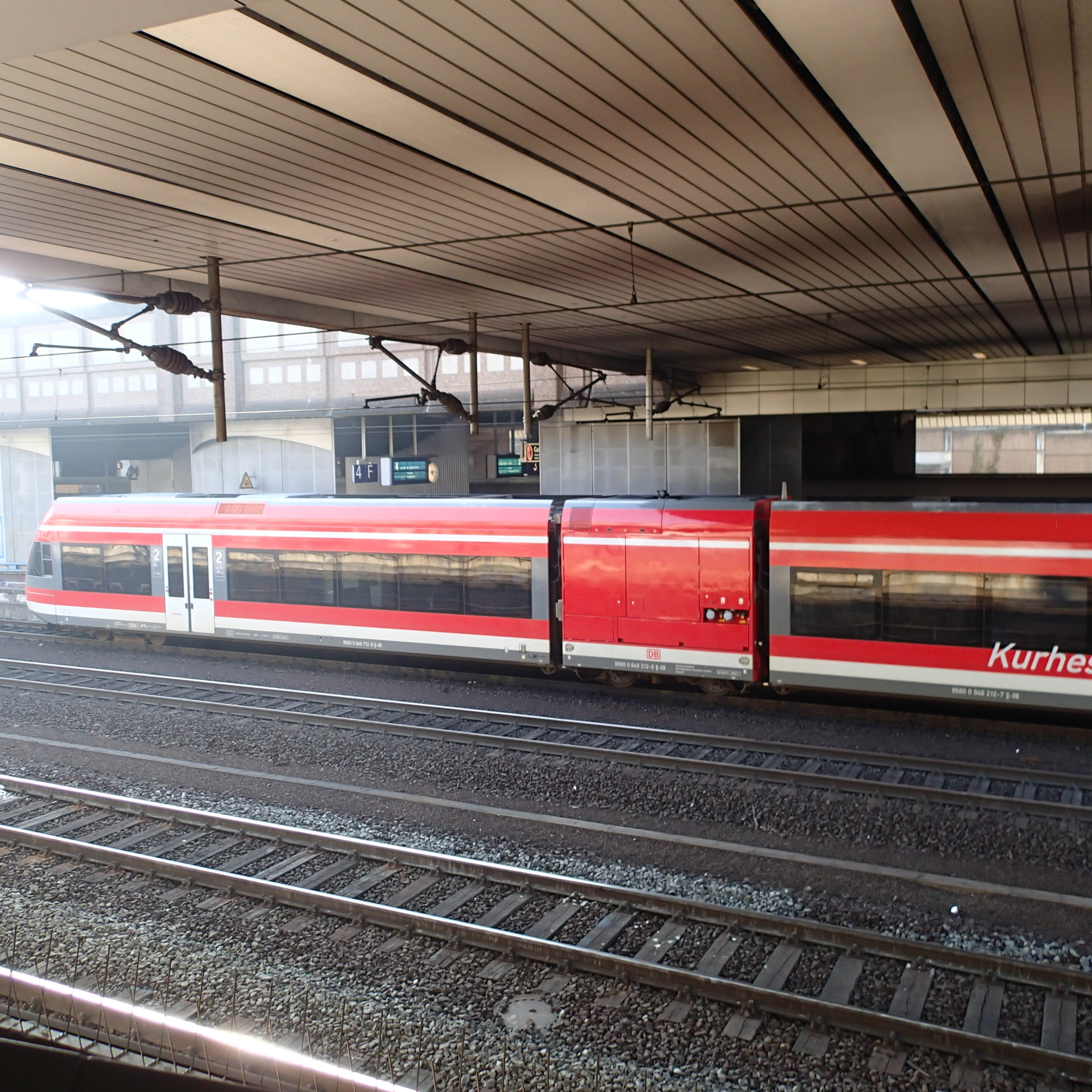
Greater Anglia’s new Class 755 trains will use this technique.
Intriguingly, British Rail designed the record-braking Class 442 train, with all the electrical equipment and traction motors in the middle car of a five-car set.
I suspect because of the design of an Aventra, Bombardier could put a diesel engine in one the middle cars to create a bi-mode Aventra.
Bombardier have said in this article on Christian Wolmar’s web site, that they are working on a 125 mph bi-mode Aventra.
In the Class 172 train, each car has a 360 kW diesel engine, so a five car 125 mph bi-mode train could need a substantial amount of power.
A Car With A Hydrogen-Powered Electricity Generator
In Alstom’s Coradia iLint, the hydrogen tanks and generators are mounted on the roof, thus taking advantage of the larger Continental loading gauge. Wikipedia says this about the train.
The Coradia iLint is a version of the Coradia Lint 54 powered by a hydrogen fuel cell. Announced at InnoTrans 2016, the new model will be the world’s first production hydrogen-powered trainset. The Coradia iLint will be able to reach 140 kilometres per hour (87 mph) and travel 600–800 kilometres (370–500 mi) on a full tank of hydrogen. The first Coradia iLint is expected to enter service in December 2017 on the Buxtehude-Bremervörde-Bremerhaven-Cuxhaven line in Lower Saxony, Germany.
In the UK, there isn’t the space, but I believe that a car could be built with a hydrogen tank and the appropriate size of hydrogen-powered electricity generator.
Bear in mind, that a hydrogen power system will be is a lot quieter and vibrate less, that a diesel one.
The Plug-and-Play nature of an Aventra or other modern trains, would mean that after the train software has been modified, it could detect that the train has a car with a hydrogen-powered electricity generator.
The car would deliver its electricity, when it is require, through the electrical bus.
The train’s computer system would control the generator, so that the level of power needed to move the train was available.
Batteries
Batteries are an integral part of Alstom’s Coradia iLint as this promotional video shows.
I believe that Bombardier make extensive use of batteries in the Aventra for regenerative braking, running for short distances without electrification and electrification failure.
Why Do I Think A Hydrogen-Powered High Speed Train Is Possible?
By High Speed Train, I mean one that can travel at 200 kph or 125 mph.
Most energy is needed to accelerate the train, not to maintain the high cruising speed.
So if you take a train running along a line with only a few stops, that is fairly level with no long climbs, there will be a minimal power requirement, except where accelerating from a stop.
Energy requirement can be reduced by the following.
- Design the line as straight as possible.
- Remove as many gradients as possible.
- Have separate tracks for stopping and high-speed traffic.
- Install a modern signalling system, so that trains run efficiently.
- Remove flat junctions and level crossings
- Have a very efficient train with low rolling resistance and good aerodynamics.
- Have as few stops as possible.
Network Rail seem to be improving the tracks all over the UK to this standard and Point 6 is satisfied by modern trains like Aventras.
Point 7 depends on getting the timetable right.
Adding all these factors together and you can see why I believe a hydrogen-powered High Speed Train is a possibility.
Development
The great advantage of developing a hydrogen-powered train, is that a lot of the initial testing can be done in a lab, as all you need to develop is a power module, that can fit in the train, that can generate the required number of kilowatts.
Independently, the train company would need to develop an electric train capable of 125 mph running.
Deployment
Hydrogen-powered High Speed Trains could run on several lines in the UK.
Midland Main Line
The Midland Main Line is the obvious line for a hydrogen-powered High Speed Train.
- A lot of the route is already capable of 125 mph running.
- Large sections are three or four tracks.,
- The Southern section from Bedford to St. Pancras is electrified, so hydrogen power would only be needed North of Bedford.
- The new East Midlands Franchise will streamline the intermediate stops.
- Parts of the line go through the World Heritage Site of the Derwent Valley and would be difficult to electrify. Quiet hydrogen-powered trains would be acceptable to all.
- Selective electrification could be applied at Derby, Leicester, Nottingham and Sheffield, to charge batteries and accelerate trains.
There is a lot of work going on =North of Bedford as far as Kettering and Corby.
- The Corby branch is being made double track.
- Bedford to Glendon Junction, where trains to Corby leave the Midland Main Line, will become four tracks.
- Tracks will be electrified to Kettering and Corby.
- 125 mph running will be possible as far as Glendon Junction and Corby.
Will the two fast lines be electrified between Kettering and Glendon Junction?
This would enable trains going North from Kettering to accelerate to 125 mph using the electrification, rather than hydrogen or battery power.
The electrification would catapult them the nearly thirty miles to Leicester at 125 mph, with speed maintained by using small amounts of hydrogen or battery power.
Coming South, the train would get to 125 mph leaving Leicester, either using a short length of electrification through the station or by use of the onboard power.
Small amounts of hydrogen or battery power would keep the train at 125 mph, until it could connect to the electrification at Glendon Junction.
I’m assuming that the signalling can keep the fast lines free of slow traffic. But even if they are slowed by a crossing train, regenerative braking using the battery will enable speed to be recovered quickly.
This article on Rail Technology Magazine is entitled DfT Deal Means East Midlands HS2 Station Could Open Early.
East Midlands Hub station would obviously be electrified for HS2 services from Birmingham and London.
So perhaps a few miles of electrification could be added to the Midland Main Line to get trains to operating speed, after a stop at the station.
In addition, could selective electrification be applied at other stations like Derby, East Midlands Parkway, Leicester, Nottingham and Sheffield.
It could be a bit like a game of 125 mph Pass-the-Parcel.
Trains could be at 125 mph for most of the way from St. Pancras to Sheffield, giving a journey time somewhere in the region of ninety minutes.
North Wales Coast Line
I’ve never travelled on the North Wales Coast Line.
- It is around ninety miles long.
- It has an operating speed of 90 mph
- As it’s a coastal line, I suspect that the route is fairly level.
- No-one would complain about the noise reduction of a hydrogen-powered train.
- Virgin’s Class 221 trains take about a hundred minutes from Holyhead to Chester with six stops.
It is a route, where a bi-mode train could probably save some minutes, as they could use the electrification South of Crewe.
Alstom have already set up a base in Widnes and are interested in demonstrating hydrogen trains between Chester and Liverpool via the Halton Curve when it reopens.
But a train with a slightly better performance to the Coradia iLint could be ideal for Liverpool to Chester and along the North Wales Coast.
Basingstoke To Exeter
The West Of England Line goes from Waterloo to Exeter and has the following characteristics.
- The Waterloo to Basingstoke section is forty-eight miles long and electrified.
- The Basingstoke to Exeter section is 124 miles long and not-electrified.
- The route is fairly level.
- The operating speed is 90 mph.
- The route is served by 90 mph Class 159 trains.
This is one of those lines, where a bi-mode train would be ideal.
The route might be suitable for a hydrogen-powered train.
Ashford To Southampton
Between Ashford and Southampton, there is only one section that is not electrified and that is the Marshlink Line, which is just 26 miles long.
Other Routes
I suspect there are other routes, but I do think gentle lines without too many gradients are probably the best lines for hydrogen-powered trains.
Other Trains
As Hitachi’s IEP and Stadler Flirts have similar electrical layouts and design, a similar technique involving hydrogen poower could probably be used.
Hydrogen Power – A Useful List
General
A Series Of Articles From The Guardian
Fuel Cell Mabufacturers
Trains
 The Anonymous Widower