Enabling The UK To Become The Saudi Arabia Of Wind?
The title of this post, is the same as that of a paper from Imperial College.
The paper can be downloaded from this page of the Imperial College web site.
This is a paragraph from the Introduction of the paper.
In December 2020, the then Prime Minister outlined the government’s ten-point plan for a green industrial revolution, expressing an ambition “to turn the UK into the Saudi Arabia of wind power generation, enough wind power by 2030 to supply every single one of our homes with electricity”.
The reference to Saudi Arabia, one of the world’s largest oil producers for many decades, hints at the significant role the UK’s energy ambitions hoped to play in the global economy.
Boris Johnson was the UK Prime Minister at the time, so was his statement just his usual bluster or a simple deduction from the facts.
The paper I have indicated is a must-read and I do wonder if one of Boris’s advisors had read the paper before Boris’s speech. But as the paper appears to have been published in September 2023, that is not a valid scenario.
The paper though is full of important information.
The Intermittency Of Wind And Solar Power
The paper says this about the intermittency of wind and solar power.
One of the main issues is the intermittency of solar and wind electricity generation, which means it cannot be relied upon without some form of backup or sufficient storage.
Solar PV production varies strongly along both the day-night and seasonal cycles. While output is higher during the daytime (when demand is
higher than overnight), it is close to zero when it is needed most, during the times of peak electricity demand (winter evenings from 5-6 PM).At present, when wind output is low, the UK can fall back to fossil fuels to make up for the shortfall in electricity supply. Homes stay warm, and cars keep moving.
If all sectors were to run on variable renewables, either the country needs to curb energy usage during shortfalls (unlikely to be popular with consumers), accept continued use of fossil fuels across all sectors (incompatible with climate targets), or develop a large source of flexibility such as energy storage (likely to be prohibitively expensive at present).
The intermittency of wind and solar power means we have a difficult choice to make.
The Demand In Winter
The paper says this about the demand in winter.
There are issues around the high peaks in heating demand during winter, with all-electric heating very expensive to serve (as
the generators built to serve that load are only
needed for a few days a year).Converting all the UK’s vehicles to EVs would increase total electricity demand from 279 TWh to 395 TWh. Switching all homes across the country to heat pumps would increase demand by a further 30% to 506 TWh.
This implies that the full electrification of the heating and transport sectors would increase the annual power needs in the country by 81%.
This will require the expansion of the electricity system (transmission capacity, distribution grids, transformers,
substations, etc.), which would pose serious social, economic and technical challenges.Various paths, policies and technologies for the decarbonisation of heating, transport, and industrial emissions must be considered in order for the UK to meet its zero-emission targets.
It appears that electrification alone will not keep us warm, power our transport and keep our industry operating.
The Role Of Hydrogen
The paper says this about the role of hydrogen.
Electrifying all forms of transport might prove difficult (e.g., long-distance heavy goods) or nigh impossible (e.g., aviation) due to the high energy density requirements, which current batteries cannot meet.
Hydrogen has therefore been widely suggested as a low-carbon energy source for these sectors, benefiting from high energy density (by weight), ease of storage (relative to electricity) and its versatility to be used in many ways.
Hydrogen is also one of the few technologies capable of
providing very long-duration energy storage (e.g., moving energy between seasons), which is critical to supporting the decarbonisation of the whole energy system with high shares of renewables because it allows times of supply and demand mismatch to be managed over both short and long timescales.It is a clean alternative to fossil fuels as its use (e.g., combustion) does not emit any CO2.
Hydrogen appears to be ideal for difficult to decarbonise sectors and for storing energy for long durations.
The Problems With Hydrogen
The paper says this about the problems with hydrogen.
The growth of green hydrogen technology has been held back by the high cost, lack of existing infrastructure, and its lower efficiency
of conversion.Providing services with hydrogen requires two to three times more primary energy than direct use of electricity.
There is a lot of development to be done before hydrogen is as convenient and affordable as electricity and natural gas.
Offshore Wind
The paper says this about offshore wind.
Offshore wind is one of the fastest-growing forms of renewable energy, with the UK taking a strong lead on the global stage.
Deploying wind turbines offshore typically leads to a higher electricity output per turbine, as there are typically higher wind speeds and fewer obstacles to obstruct wind flow (such as trees and buildings).
The productivity of the UK’s offshore wind farms is nearly 50% higher than that of onshore wind farms.
Offshore wind generation also typically has higher social acceptability as it avoids land usage conflicts and has a lower visual impact.
To get the most out of this resource, very large structures (more than twice the height of Big Ben) must be connected to the ocean floor and operate in the harshest conditions for decades.
Offshore wind turbines are taller and have larger rotor diameters than onshore wind turbines, which produces a more consistent and higher output.
Offshore wind would appear to be more efficient and better value than onshore.
The Scale Of Offshore Wind
The paper says this about the scale of offshore wind.
The geographical distribution of offshore wind is heavily skewed towards Europe, which hosts over 80% of the total global offshore wind capacity.
This can be attributed to the good wind conditions and the shallow water depths of the North Sea.
The UK is ideally located to take advantage of offshore wind due to its extensive resource.
The UK could produce over 6000 TWh of electricity if the offshore wind resources in all the feasible area of the exclusive economic zone (EEZ) is exploited.
Note.
- 6000 TWh of electricity per annum would need 2740 GW of wind farms if the average capacity factor was a typical 25 %.
- At a price of 37.35 £/MWh, 6000 TWh would be worth $224.1 billion.
Typically, most domestic users seem to pay about 30 pence per KWh.
The Cost Of Offshore Wind
The paper says this about the cost of offshore wind.
The cost of UK offshore wind has fallen because of the reductions in capital expenditure (CapEx), operational expenditure (OpEx), and financing costs.
This has been supported by the global roll-out of bigger offshore wind turbines, hence, causing an increase in offshore wind energy capacity.
This increase in installed capacity has been fuelled by several low-carbon support schemes from the UK government.
The effect of these schemes can be seen in the UK 2017 Contracts for Difference (CfD) auctions where offshore wind reached strike prices as low as 57.50 £/MWh and an even lower strike price of 37.35 £/MWh in 2022.
Costs and prices appear to be going the right way.
The UK’s Offshore Wind Targets
The paper says this about the UK’s offshore wind targets.
The offshore wind capacity in the UK has grown over the past decade.
Currently, the UK has a total offshore wind capacity of 13.8GW, which is sufficient to power more than 10 million homes.
This represents a more than fourfold increase compared to the capacity installed in 2012.
The UK government has set ambitious targets for offshore wind development.
In 2019, the target was to install a total of 40 GW of offshore wind capacity by 2030, and this was later raised to 50 GW, with up to 5 GW of floating offshore wind.
This will play a pivotal role in decarbonising the UK’s power system by the government’s deadline of 2035.
As I write this, the UK’s total electricity production is 31.8 GW. So 50 GW of wind will go a good way to providing the UK with zero-carbon energy. But it will need a certain amount of reliable alternative power sources for when the wind isn’t blowing.
The UK’s Hydrogen Targets
The paper says this about the UK’s hydrogen targets.
The UK has a target of 10 GW of low-carbon hydrogen production to be deployed by 2030, as set out in the British Energy Security Strategy.
Within this target, there is an ambition for at least half of the 10 GW of production capacity to be met through green hydrogen production technologies (as opposed to hydrogen produced from steam methane reforming using carbon capture).
Modelling conducted by the Committee on Climate Change in its Sixth Carbon Budget estimated that demand for low-carbon hydrogen across the whole country could reach 161–376 TWh annually by 2050, comparable in scale to the total electricity demand.
We’re going to need a lot of electrolyser capacity.
Pairing Hydrogen And Offshore Wind
The paper says this about pairing hydrogen and offshore wind.
Green hydrogen holds strong potential in addressing the intermittent nature of renewable generation sources, particularly wind and solar energy, which naturally fluctuate due to weather conditions.
Offshore wind in particular is viewed as being a complementary technology to pair with green hydrogen production, due to three main factors: a) the high wind energy capacity factors offshore, b) the potential for large-scale deployment and c) hydrogen as a supporting technology for offshore wind energy integration.
It looks like a match made in the waters around the UK.
The Cost Of Green Hydrogen
The paper says this about the cost of green hydrogen.
The cost of green hydrogen is strongly influenced by the price of the electrolyser unit itself.
If the electrolyser is run more intensively over the course of the lifetime of the plant, a larger volume of hydrogen will be produced and so the cost of the electrolyser will be spread out more, decreasing the cost per unit of produced hydrogen.
If the variable renewable electricity source powering the electrolyser has a higher capacity factor, this will contribute towards a
lower cost of hydrogen produced.Offshore wind in the UK typically has a higher capacity factor than onshore wind energy (up to 20%), and is around five times higher than solar, so pairing
offshore wind with green hydrogen production is of interest.
It would appear that any improvements in wind turbine and electrolyser efficiency would be welcomed.
The Size Of Wind Farms
The paper says this about the size of wind farms.
Offshore wind farms can also be larger scale, due to increased availability of space and reduced restrictions on tip heights due to planning permissions.
The average offshore wind turbine in the UK had a capacity of 3.6 MW in 2022, compared to just 2.5-3 MW for onshore turbines.
As there are fewer competing uses for space, offshore wind can not only have larger turbines but the wind farms can comprise many more turbines.
Due to the specialist infrastructure requirements for hydrogen transport and storage, and the need for economies of scale to reduce the costs of
production, pairing large-scale offshore wind electricity generation with green hydrogen
production could hold significant benefits.
I am not surprised that economies of scale give benefits.
The Versatility Of Hydrogen
The paper says this about the versatility of hydrogen.
Hydrogen is a highly adaptable energy carrier with numerous potential applications and has been anticipated by some as playing a key role in the future energy system, especially when produced through electrolysis.
It could support the full decarbonisation of “hard to decarbonise” processes within the UK industrial sector, offering a solution for areas which may be difficult to electrify or are heavily reliant on fossil fuels for high-temperature heat.
When produced through electrolysis, it could be paired effectively as an energy storage technology with offshore wind, with the potential to store energy across seasons with little to no energy degradation and transport low-carbon energy internationally.
The UK – with its significant offshore wind energy resources and targets – could play a potentially leading role in producing green hydrogen to both help its pathway to net zero, and potentially create a valuable export industry.
In RWE Acquires 4.2-Gigawatt UK Offshore Wind Development Portfolio From Vattenfall, I postulated that RWE may have purchased Vattenfall’s 4.2 GW Norfolk Zone of windfarms to create a giant hydrogen production facility on the Norfolk coast. I said this.
Consider.
- Vattenfall’s Norfolk Zone is a 4.2 GW group of wind farms, which have all the requisite permissions and are shovel ready.
- Bacton Gas terminal has gas pipelines to Europe.
- Sizewell’s nuclear power stations will add security of supply.
- Extra wind farms could be added to the Norfolk Zone.
- Europe and especially Germany has a massive need for zero-carbon energy.
The only extra infrastructure needing to be built is the giant electrolyser.
I wouldn’t be surprised if RWE built a large electrolyser to supply Europe with hydrogen.
The big irony of this plan is that the BBL Pipeline between Bacton and the Netherlands was built, so that the UK could import Russian gas.
Could it in future be used to send the UK’s green hydrogen to Europe, so that some of that Russian gas can be replaced with a zero-carbon fuel?
Mathematical Modelling
There is a lot of graphs, maps and reasoning, which is used to detail how the authors obtained their conclusions.
Conclusion
This is the last paragraph of the paper.
Creating a hydrogen production industry is a transition story for UK’s oil and gas sector.
The UK is one of the few countries that could produce more hydrogen than it consumes in hydrocarbons today.
It is located in the centre of a vast resource, which premediates positioning itself at the centre of the European hydrogen supply chains.
Investing now to reduce costs and benefit from the generated value of exported hydrogen would make a reality out of the ambition to become the “Saudi Arabia of Wind”.
Boris may or may not have realised that what he said was possible.
But certainly make sure you read the paper from Imperial College.
UK Sees Cleanest Power Grid In Q3 As Renewables Grow, Drax Report Says
The title of this post, is the same as that of this article on Renewables Now.
These are the first two paragraphs.
Renewables supplied over 40% of Britain’s electricity demand, the highest ever for the third quarter, helping the country achieve its cleanest power grid on record, according to the Drax Electric Insights report.
In the third quarter carbon dioxide (CO2) emissions from the generation mix were an average of 143 grams per kWh, for the first time below 150 g per kWh over the quarter, says the report, which is commissioned by biomass power generator Drax and prepared by a team from Imperial College London.
We’re certainly getting somewhere!
Seratech’s Technology Explained
I first wrote about Seratech in Carbon-Neutral Concrete Prototype Wins €100k Architecture Prize For UK Scientists, after reading about this carbon-neutral concrete in the Architect’s Journal.
I have just received Seratech’s October 2023 Newsletter, which contains two must-read articles.
Olivine In The Age Of Climate Crisis
I’d never heard of olivine until I read about the architecture prize, that was won by Seratech.
This is the Wikipedia entry for olivine.
These are the first three paragraphs of Seratech’s article.
On the west coast of Norway, a few kilometres from the village of Åheim, is an open excavation pit – home to the largest commercial olivine deposit in the world.
This seaside quarry, run by Belgian industrial minerals company, Sibelco, works to extract olivine from the earth’s crust by drilling, blasting and crushing. A single blast (used to break up the rocks) removes up to 40,000 tonnes of olivine.
The site is predominantly powered by hydroelectricity and boasts a 4km conveyor system for transport which limits the need for heavy vehicle or double-handling of materials in a bid to reduce emissions.
This is Sibelco’s video of their impressive mining process.
Note.
The mining operation is fully-integrated with its own ort.
- The video does the mining operation justice.
- Sibelco aim to make the mining of olivine carbon-neutral.
Olivine has this Wikipedia entry, which gives more information.
This Google Map shows the port complex at Åheim.
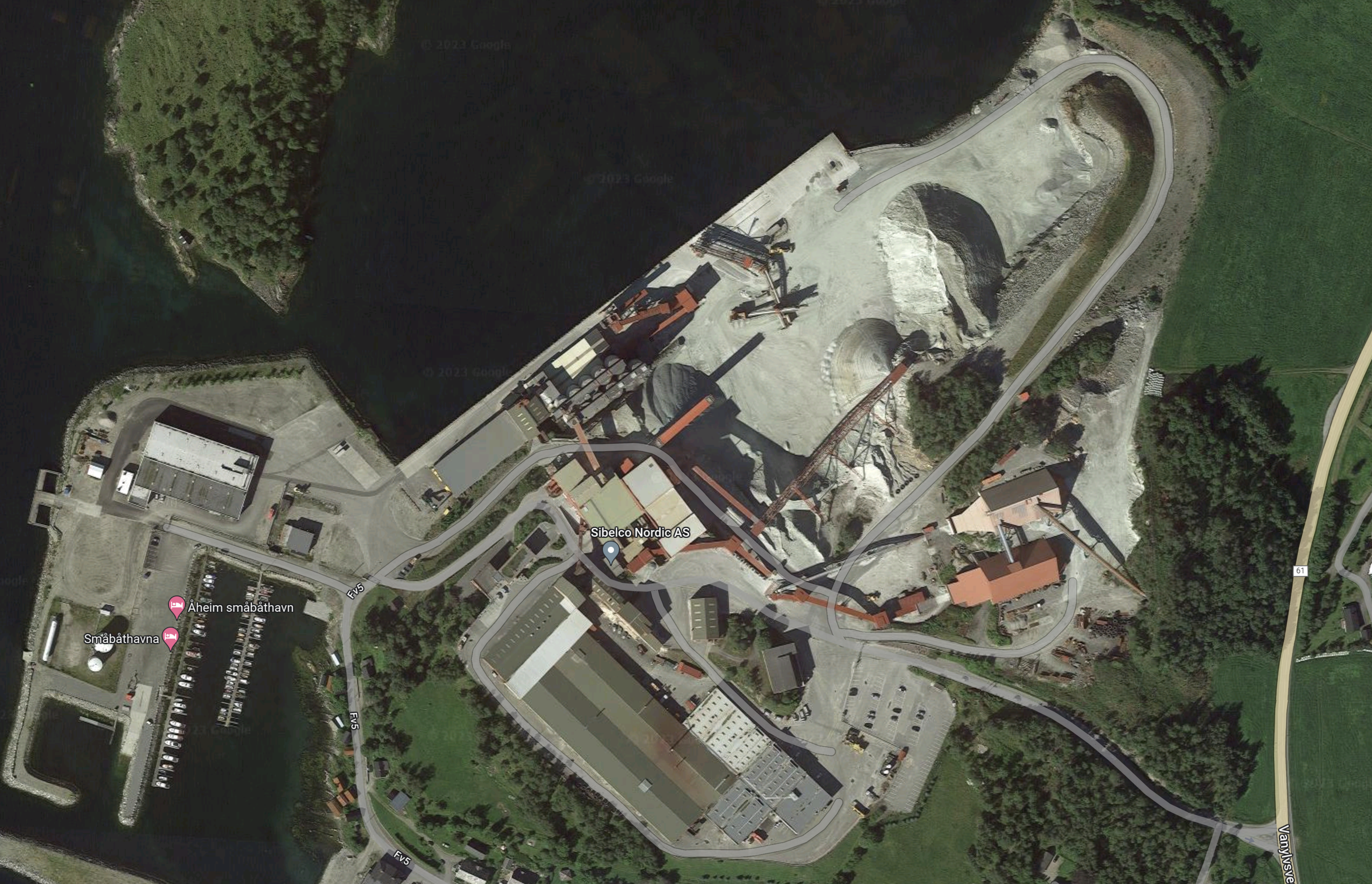
It looks like mine, processing and port all on one site.
The Big Interview With Mike Eberlin
This is the sub-heading.
Former Managing Director of Tarmac Cement & Lime and chair of MPA Cement, Mike Eberlin, became Seratech’s business advisor in June this year. He was intrigued by the novel technology Sam Draper and Barney Shanks had uncovered
These paragraphs are a summary of what Mike Eberlin said.
As we begin to talk, Mike is quick to point out there are two big advantages to Seratech: “They are using magnesium silicate as a starting material which produces silica as a cement replacement and magnesium oxide which can then absorb CO2”.
The CO2 absorption is what fascinates Mike as the type of magnesium carbonate Seratech produces is a “slightly unstable” version which when cured, becomes stable and reverts to the rock-like substance you would find in nature. “This came as a surprise because the chemistry wouldn’t indicate that was possible,” he explains.
Following this discovery, and as Seratech’s research progressed, it soon became apparent that the magnesium carbonate lends itself well as a binder and can be used in applications like building blocks and plasterboard: “It’s effectively carbon capture and use, not carbon capture and storage because you are mineralising the CO2 into a product.
“We end up in this clever situation whereby it’s not that we don’t emit the CO2, it’s better than that, we absorb CO2 and create two binders that replace cement”.
That’s what I call an endorsement.
Conclusion
I have this feeling that Seratech will be a very significant company in a couple of years.
The Case For Pumped Hydro Storage
The Coire Glas Project
Note that Coire Glas is a pumped storage hydroelectric scheme being developed by SSE Renewables.
- It is rated at 1.5 GW.
- It can store 30 GWh of electricity.
- It is being built in the Highlands of Scotland above Loch Lochy.
- The estimated construction time will be five to six years.
- It should be operational for more than 50 years.
- There is more about the project on this page on the Coire Glas web site.
Exploratory works have started.
The Case For Pumped Hydro Storage
The title of this post, as the same as that of this page on the Coire Glas web site.
This is the sub-heading.
A study by independent researchers from Imperial College London found that investing in 4.5GW of pumped hydro storage, with 90GWh of storage could save up to £690m per year in energy system costs by 2050, as the UK transitions to a net-zero carbon emission system.
And this is the first paragraph.
The report focused on the benefits of new long-duration pumped hydro storage in Scotland, as the current most established long-duration energy storage technology. The benefit of long duration storage compared to short duration batteries is being able to continuously charge up the storage with excess renewables and also discharge power to the grid for several hours or days when wind and solar output is low.
So Coire Glas will provide 1.5GW/30GW, so where will we get the other 3 GW/60GW?
Loch Earba Pumped Hydro
In Gilkes Reveals 900MW Scottish Pumped Storage Plan, I introduced Loch Earba Pumped Hydro.
- It is rated at 900 MW
- It can store 33 GWh of electricity.
- It is being built in the Highlands of Scotland to the East of Fort William.
- The estimated construction time will be three to four years.
- It should be operational for more than 50 years.
- There is more about the project on the Earba Storage web site.
It would appear we could be edging towards the Imperial College target in lumps of about 1GW/30 GWh.
Other Schemes In Scotland
These are other proposed or planned schemes in Scotland.
Balliemeanoch Pumped Hydro
Balliemeanoch Pumped Hydro now has a web site.
The proposed Balliemeanoch pumped hydro scheme will have these characteristics.
- Output of the power station will be 1.5 GW
- Available storage could be 45 GWh.
This medium-sized station has a lot of storage.
Corrievarkie Pumped Hydro
Corrievarkie Pumped Hydro now has a web site.
The proposed Corrievarkie pumped hydro scheme will have these characteristics.
- Output of the power station will be 600 MW
- Available storage could be 14.5 GWh.
This medium-sized station has a moderate amount of storage.
Loch Kemp Pumped Hydro
I wrote about Loch Kemp Pumped Hydro in Loch Kemp Pumped Hydro, where I said this.
The proposed Loch Kemp pumped hydro scheme will have these characteristics.
- Loch Kemp will be the upper reservoir.
- Loch Ness will be the lower reservoir.
- The power station will be on the banks of Loch Ness.
- The power station will be designed to fit into the environment.
- Eight dams will be built to enlarge Loch Kemp.
- Trees will be planted.
- Output of the power station will be 300 MW
- Available storage could be 9 GWh.
The medium-sized station will have almost as much storage capacity as Electric Mountain, but that power station has an output of 1.8 GW.
Red John Pumped Hydro
I wrote about Red John Pumped Hydro in Red John Pumped Storage Hydro Project, where I said this.
I have also found a web site for the project, which is part of the ILI Group web site.
- The scheme has an output of 450 MW.
- The storage capacity is 2,800 MWh or 2.8 GWh.
- The scheme has planning consent.
- The project is budgeted to cost £550 million.
- The construction program indicates that the scheme will be completed by the end of 2025.
Not a large scheme, but every little helps.
Proposed Pumped Hydro In Scotland
I have listed these schemes.
- Balliemeanoch – 1.5GW/45 GWh
- Coire Glas – 1.5 GW/30 GWh
- Corrievarkie – 600 MW/14.5 GWh
- Loch Earba – 900 MW/33 GWh
- Loch Kemp – 300 MW/9 GWh
- Loch Na Cathrach/Red John – 450 MW/2.8 GWh
Note.
- The scheme’s name is linked to their web site.
- The two figures are output and storage capacity.
There is a total output of 5.25 GW and a total storage capacity of 134.3 GWh.
Conclusion
If all these schemes are built, Imperial’s targets of an output of 4.5 GW and a storage capacity of 90 GWh will be comfortably exceeded.
Small Nuclear Power Plants To Replace Gas In Quest For Net Zero
The title of this post is the same as that of this article on The Times.
I was very much involved in the writing of project management software in the last three decades of the last century and if there’s one thing we’re generally good at in the UK, it’s complex project management.
Usually problems arise because of political or ignorant senior management meddling.
Our Energy Saviours
I believe our two energy saviours will be floating offshore wind and small nuclear reactors (SMRs) and both need good project management to be built successfully on production lines.
So I don’t see any reason, why we can’t build large numbers of floating offshore wind farms to supply our electricity.
They are also complimentary, in that the fleet of SMRs back up the wind.
Floating Wind First
Floating wind is likely to be developed at scale first, as certifying anything involving nuclear will take an inordinate time.
The electricity from floating wind farms will keep us going, but it is also starting to develop a nice line in exports.
This press release from Drax is entitled Britain Sending Europe Power Lifeline – Report, where this is the sub-title.
For the first time in over a decade, Britain became a net exporter of electricity to its European neighbours, making around £1.5bn for the economy in three months.
Note.
- The report was written by Imperial College.
- Two new interconnectors; Viking Link and NeuConnect between the UK and Europe are under construction.
- Several large wind farms are under construction and will be commissioned in 2023/24 and could add over 4 GW to UK electricity production.
Exports will only get better.
A Sprint For Wind
So we must have a sprint for wind, which will then provide the cash flow to allow the SMRs to roll in.
Or will that be too much for the ultra-greens, who would object to cash-flow from GWs of wind being used to fund SMRs?
Carbon-Neutral Concrete Prototype Wins €100k Architecture Prize For UK Scientists
The title of this post, is the same as that of this article on the Architect’s Journal.
Under a picture of two white-coated scientists with their protective boots on concrete samples, the story and their invention is outlined.
A pair of PhD students at Imperial College London have won a global architecture prize for devising a groundbreaking method of creating carbon-neutral concrete
Material scientists Sam Draper and Barney Shanks landed the €100,000 2022 Obel Award with their ‘simple way’ to capture carbon from industrial production processes and create an end product that can eliminate the CO₂ footprint of concrete.
The prototype technology, dubbed Seratech, takes industrial CO₂ emissions directly from flues and produces a carbon-negative cement replacement material (silica). According to the scientists, when this is used in combination with Portland cement, the carbon capture associated with producing the silica means the concrete products can be zero carbon.
One of the products, we will need in the world is concrete and if we can make it in a carbon-neutral manner, then that will surely reduce worldwide carbon emissions.
The Technology Explained
This page on the Seratech website is entitled Our Technology.
It gives this description of the technology.
Seratech has developed a process that consumes olivine and waste CO₂ from flue gases and produces two products which both have significant value in construction.
Silica is produced which can be used as a supplementary cementitious material (SCM) in concrete meaning the amount of Portland cement in the concrete can be reduced by up to 40%. As the silica comes from a process that captures CO₂ it is “carbon negative” and the concrete can become carbon neutral.
Magnesium carbonate is produced that can be used to make a range of zero carbon construction materials and consumer products, including alternatives to building blocks and plasterboard.
The aim is for humanity to be able to continue building robust cities and infrastructure, but without the climate cost of traditional cement mixes and with the Seratech technology this goal is achievable!
Note that olivine in Europe is generally mined in Norway.
Replacement Of Steel By Concrete
Could we also replace steel in some applications with concrete?
In UK Cleantech Consortium Awarded Funding For Energy Storage Technology Integrated With Floating Wind, I talked about some of ground-breaking methods used by a company called RCAM Technologies to create infrastructure using 3D printing of concrete.
If Imperial’s concrete, which is called Seratech can be 3D printed, I can see lots of applications for the technology.
So you could kill two sources of large carbon emissions with one technology.
Conclusion
I have said on this blog before, that we will have to keep or even build more gas-fired power stations, as they can be an efficient source of pure carbon dioxide, that will be needed as a feedstock to create an increasing number of agricultural and building products.
Students Design ‘Mitt’ Prosthetic Limb For Children
The title of this post, is the same as this article on the BBC.
This was the good news story of the day, which started with these two paragraphs.
Even the most up-to-date prosthetic limbs can often be too heavy, or hard for young children to use with ease.
But now, a group of Imperial College engineering students has created a new, lighter one.
There is a video in the BBC article, which shows how it works.
- It looks like it doesn’t have any power, so there are no heavy batteries.
- Tools are attached by a powerful magnet.
- As the name suggests, it is worn like a glove.
- Judging by the look on the little girl’s face, as she used it to do simple tasks, it has found a satisfied customer!
What puzzles me, is that it is such a simple idea, that it hasn’t been thought off before.
Could The Mitt Have Other Applications?
I have a feeling it could.
I recently cut the back of my hand badly.

The picture shows it soon afterwards.
I don’t work or do many dirty tasks around the house, but could the students use their design principles for someone, who has perhaps damaged their hand and needs some protection.

This second picture shows how well it healed in the end.
I think the principle behind the Mitt has legs.
One-Hour Covid Test Approved For Rollout
The title of this post, is the same as that of this article in The Times.
This article is more than the title as it details four testing methods, currently being rolled out.
After reading this article, I would not be surprised to see an affordable COVID-19 testing device being developed and available for non-professional use in the coming months.
Getting it right, will bring the team so much of a financial reward, they’ll make Dyson look like pauper. No wonder organisations like Cambridge University, Imperial College, big pharmaceutical companies and hedge funds are backing development.
As these tests are often about measuring the intricate properties of both human and virus DNA, I wonder how many other collateral benefits will aid diagnosis of diseases like cancer.
 The Anonymous Widower