How Can Discontinuous Electrification Be Handled?
On the proposed South Wales Metro, it is proposed to use discontinuous electrification to avoid rebuilding a lot of bridges and other structures.
This document on the KeolisAmey web site details their plans for the new Wales and Borders Franchise.
The document states this about the electrification.
Discontinuous overhead line electrification to 25 KVAC with permanently earthed sections around restricted structures, saving 55 interventions e.g. rebuilding bridges/no need for wire in Caerphilly tunnel.
So how are these interventions avoided?
The Karlsruhe Solution
On the Karlsruhe Stadbahn, similar Citylink vehicles to those proposed for Cardiff need to work on both the main line 15 KVAC used in Germany and the 750 VDC used by Karlsruhe trams.
To isolate the two voltages, a ceramic rod is placed in the catenary. The vehicle’s pantograph just rides across the voltage boundary and the vehicle’s electrical system uses whatever voltage is present.
Bridges On The South Wales Metro
These pictures show some of the types of bridges on the Cardiff Valleys Lines.

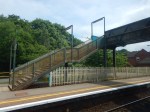
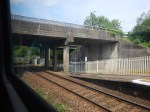


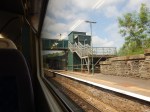
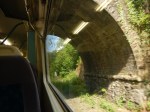
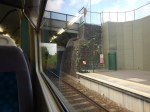

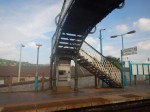


They are a real assortment.
- Some station footbridges from the Victorian era with nice castings and decoration, but no much-needed step-free access.
- Some quality brick and stone arch bridges.
- British Rail-era steel bridges, with no architectural merit
- Some modern road bridges in steel and concrete.
I also saw sizeable pipelines over the railway, which would need to be raised.
The greatest number were simple steel bridges like the one at Caerphilly station, designed to get pedestrians and cyclists, who were not using the railway, from one side of the tracks to the other.
I suspect the simplest way would be to erect two standard gantries at a safe distance of a few metres either side of the structure.
Between the two gantries would be an conductor, like this one. that I photographed in the Berlin Hauphtbahnhof.

It would be earthed, so that it offered no danger to life. There could even be extra supports under the bridge.
At each end, it would be connected to the 25 KVAC using a ceramic rod or other insulating device.
The vehicle’s pantograph would then ride from one side of the bridge to the other on its own track without being lowered.
Anything electrified at 25 KVAC would be kept at a very safe distance from the bridge.
In the earthed section, when the vehicle would be receiving no power, the vehicle would automatically switch to battery power. There would be no driver action required, except to monitor it was all working as it should.
As on the South Wales Metro, it appears that all vehicles using the lines proposed to be electrified will have their own onboard batteries, there shouldn’t be any problem.
In some ways, this discontinuous operation is a bit like using your laptop connected to the mains. When say the cleaner pulls out the plug to put in the vacuum cleaner, your laptop switches automatically to the battery.
The Caerphilly Tunnel
The Caerphilly tunnel is over a mile long. This picture shows the tunnel entrance.

It would probably be possible to electrify using a rail in the roof, but why bother if the trains running through the tunnel could go from one end to the other on their own battery power?
Trains could lower the pantograph before entry and then raise it again, when under the electrification at the other end.
This could be performed automatically using a GPS-based system.
I have also had an e-mail, which said this.
As I understand Caerphilly will have a natural bar in it but be much closer to the train roof than would be allowed with a live one.
Now there’s an idea!
A composite or earthed metal rail would be fixed to the roof of the tunnel, so that the pantograph could run smoothly from one electrified section on one side of the tunnel to the electrification on the other side, using battery power all the way.
Cost Savings
In Novel Solution Cuts Cardiff Bridge Wiring Cost, I talked about another method applied in South Wales to avoid rebuilding a bridge.
At this bridge, traditional electrification methods were used, but the need to demolish the bridge was avoided by using advanced insulation and protection measures.
This was my final statement.
Network Rail reckon that the solution will save about £10 million on this bridge alone, as it avoids the need for an expensive rebuild of the bridge.
The savings on this bridge will be higher as it is a large bridge over several tracks, but even saving a million on each bridge in the South Wales Metro is £55 million, which will probably be enough to build much of the infrastructure to extend to The Flourish, which would appear to not need expensive viaducts or electrification.
Should Downhill Tracks Be Left Without Electrification?
I think this may be possible on the South Wales Metro, as vehicles coming down the hills could use gravity and small amounts of battery power.
Regenerative braking would also be continuously charging the batteries.
It would certainly be simpler, than having to constantly swap between overhead and battery power on the descent, where the electrification was discontinuous.
As the lines are going to have a more intensive service, there will be additions of a second track in places to allow trains to pass.
Any electrification that could be removed from the project would be beneficial in terms of building and operational costs.
Other Routes
This post has used the South Wales Metro as an example, but I don’t see any reason, why the discontinous method and that used on the Cardiff Bridge can’t be applied to other bridges and structures over the lines on other routes in the country.
I suspect, that if they’d been used on the Gospel Oak to Barking Line, electric trains would have been running months ago!
Conclusion
Look what you get with thinking, when you have a Bonfire of the Boxes!
Has The Queen Ever Ridden In a Battery-Powered Train?
Countryfile this evening had a special program about the Queen’s Scottish house and estate at Balmoral.
One archive film, showed her arriving at Ballater station in a train hauled by a locomotive with a number that looked slightly familiar. Looking it up, it was a B1 Class locomotive, which I must have seen regularly, when I went train-spotting on the West Anglia Main Line in the 1950s.
So I looked up Ballater station in Wikipedia.
The station, which was on the 43 mile long Deeside Railway from Aberdeen, is now closed but there was this paragraph on Wikipedia under Services.
When the battery multiple unit was introduced, services were doubled to six trains a day from 21 April 1958, and Sunday service reinstated. The line was chosen for testing the unit because the stations were well spaced and the 1 in 70 ruling gradients would require substantial discharge rates.
As someone very interested in railways at the time, I’d never heard of British Rail’s use of battery trains.
Remarkably, the battery electric multiple train, is still in existence and is being preserved at the Royal Deeside Railway, not far from Balmoral.
It looks to me. that a lot of engineers at Derby, made sure that this train survived.
So what was it like?
- It was based on the Derby Lightweight diesel multiple unit.
- The North of Scotland Hydro-Electric Board initiated the design and was a joint sponsor.
- The train had an operating speed of 60 mph.
- The train was powered by two 100 kW traction motors.
- Power was provided by 416 lead-acid cells, giving a total of 440 V and 1070 A hour capacity.
- The batteries weighed nine tonnes.
- There were seats for twelve First Class passengers and a hundred and five in Second Class.
It couldn’t been that bad a train, as it ran between Aberdeen and Ballater station from 1958 to 1962.
There’s more about the train here.
Conclusion
But I can’t help wondering, if the Queen ever used the train!
The Hydrogen Train Of The Future Is A Lot Like The Train Of Today
The title of this post, is the same as that of this article on engardget.
It is an article worth reading ass it gives details of the philosophy of the guy behind the concept; Dr. Jörg Nikutta.
Novel Solution Cuts Cardiff Bridge Wiring Cost
The title of this post is the same as an article in the May 2018 Edition of Modern Railways.
This is the first paragraph.
Network Rail has applied an insulating coating to the underside of a bridge in Cardiff to protect against flashover from the future Overhead Line Equipment (OLE). It also intends to fit surge arresters at the bridge to prevent any sudden spikes in voltage overcoming the protection provided by the coating.
Network Rail reckon that the solution will save about £10million on this bridge alone, as it avoids the need for an expensive rebuild of the bridge.
Could wider applications of solutions like this, reduce the cost of electrification?
Hydrogen Trains Herald New Steam Age
The title of this post is the same as that of an article on nearly half of Page 4 of today’s Sunday Times.
When I saw the article with its large graphic showing the working of a hydrogen train, the train seemed rather familiar.
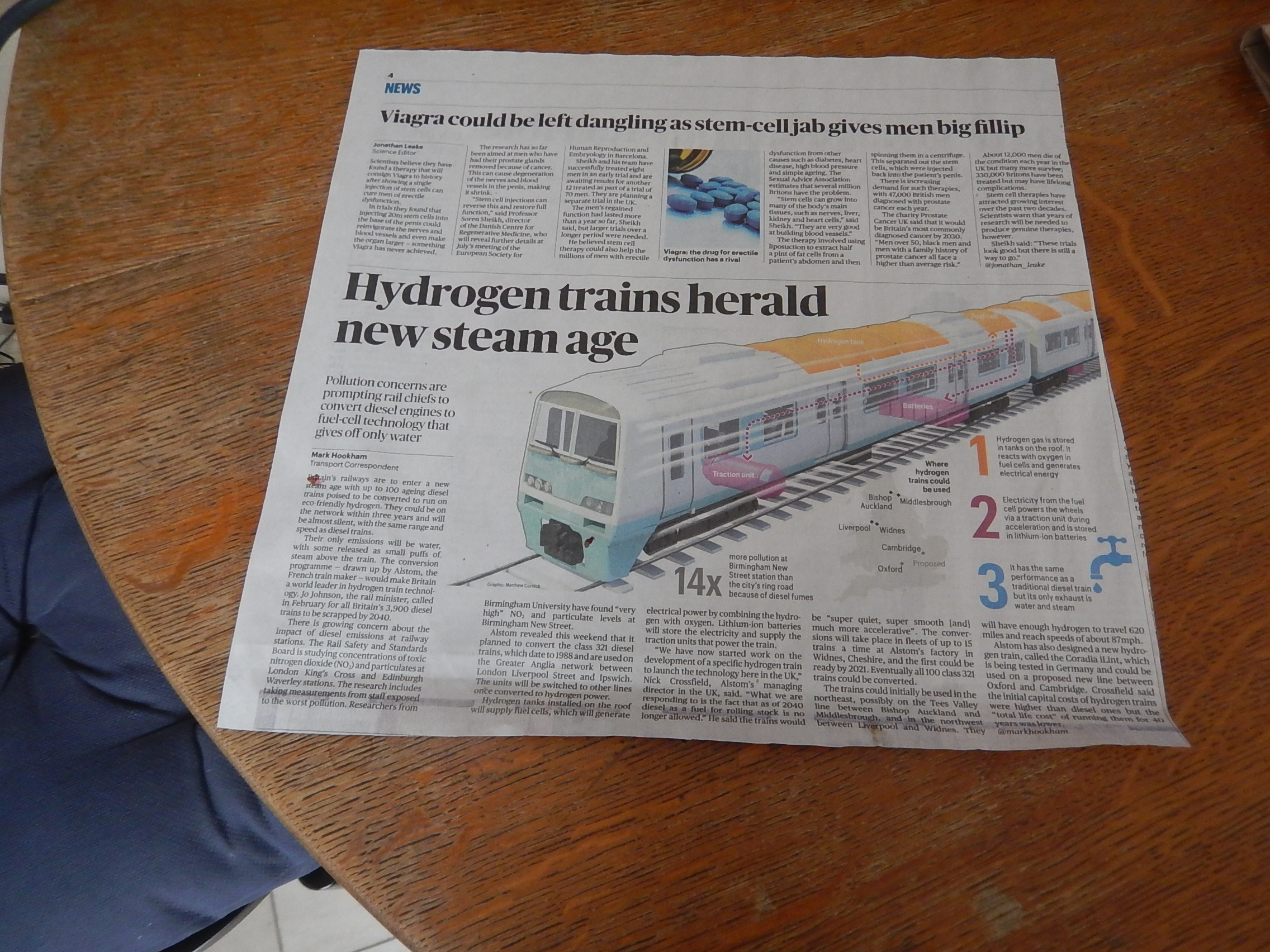
The leaning back front of the train with its two windows and the corrugated roof looked like a Class 321 train.
The large orange area on the roof is the hydrogen tank and the smaller one is the hydrogen fuel cell.
This is a paragraph from the article.
Alstom revealed this weekend that it planned to convert the Class 321 diesel trains, which date to 1988 and are used on the Greater Anglia network between London Liverpool Street and Ipswich. The units will be switched to other lines once converted to hydrogen power.
I suspect Mark Hookham, who wrote the article, has already been told by ninety percent of the train enthusiasts in this country, that Class 321 trains are electric multiple units.
This picture shows the first car of a Class 321 train in the sidings at Ipswich.
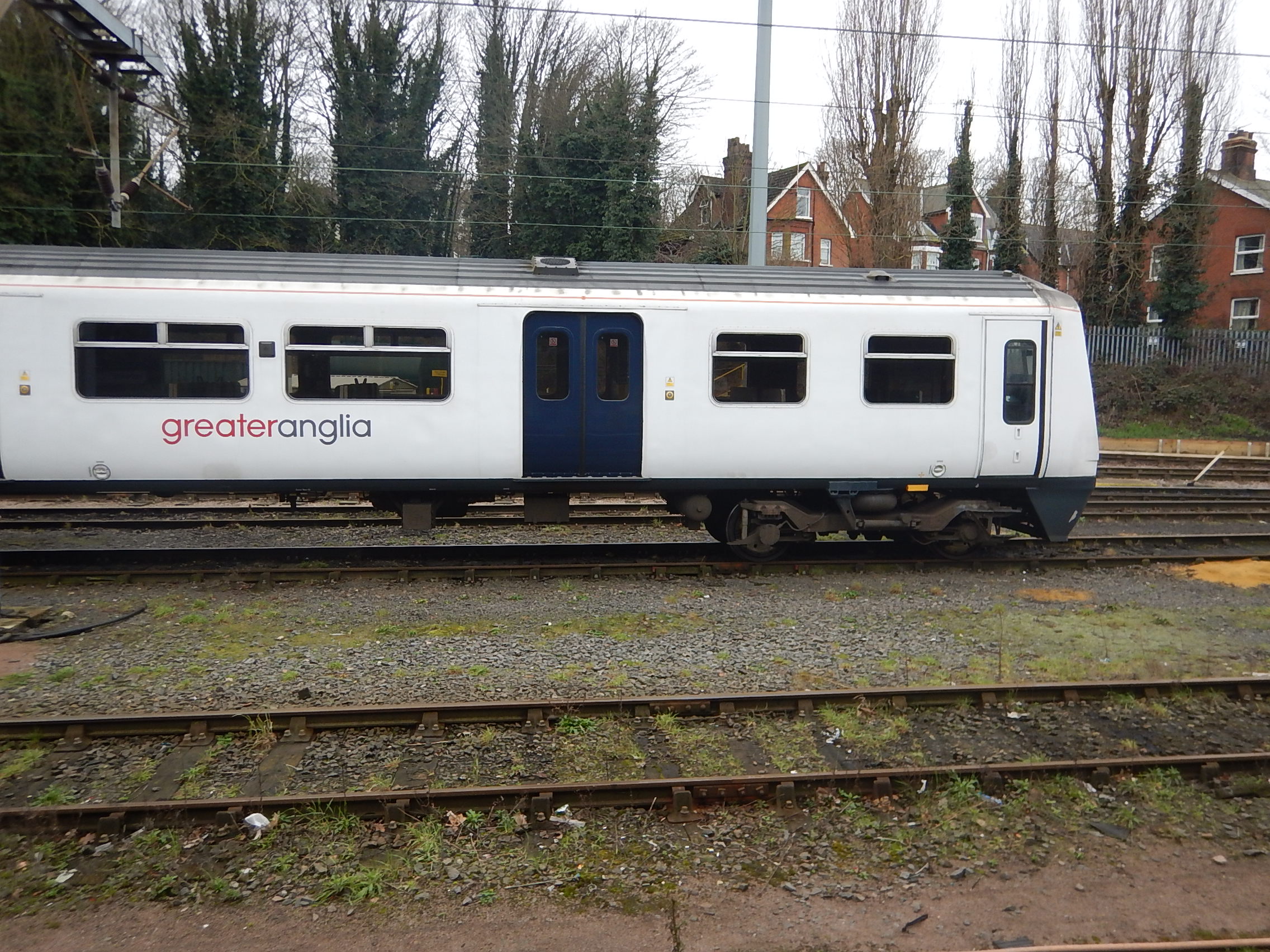
Note all the space, under the train, which would be an ideal place for the batteries and traction control, that are shown in that position, in pink, in the Sunday Times graphic.
But there are other reasons, why Class 321 trains may be ideal to convert to hydrogen power.
- Although they are thirty years old, they are a modern train, which meet all the latest regulations.
- They have a 100 mph operating speed on electricity.
- They operate on 25 KVAC overhead electrification.
- There are a hundred and seventeen four-car trains.
- Greater Anglia will be replacing over a hundred Class 321 trains, with new Class 720 trains in the next two years.
- A number of Greater Anglia’s trains have been upgraded to Class 321 Renatus. These trains are a substantial upgrade over the standard train..
- Greater Anglia’s trains appear to be in good condition.
- Designs have been tested to upgrade the traction motors and drive systems of the trains.
But most importantly, the trains are based on the Mark 3 coach, which gives the following advantages.
- An excellent ride and superb brakes.
- Bodies with a legendary strength and toughness.
- There is a vast amount of knowledge in the UK rail industry, that enables the trains to be kept at peak performance.
I doubt, that you could find a better fleet of a hundred trains to convert to hydrogen power anywhere in the world.
The article says or indicates the following.
- Hydrogen tanks will be mounted on the roof.
- An Alstom spokesman is quoted as saying. “We have now started work on the development of a specific hydrogen train to launch the technology here in the UK.”
- He also said that the trains would be super quiet, super smooth and much more accelerative. I assume that is compared to diesel.
- Conversion will take place in fleets of up to 15 trains a time at Alstom’s factory in Widnes.
- The first train could be ready by 2021.
- Eventually, all Class 321 trains could be converted.
- Initial routes could be on the Tees Valley Line and between Liverpool and Widnes.
- Range on a tank of hydrogen will be 620 miles.
- Top speed would be about 87 mph.
The article finishes with a quote from Alstom’s spokesman. “The initial capital costs of hydrogen trains were higher than diesel ones, but the “total life cost” of running them for 40 years was lower.”
I have my thoughts on various things said and not said in the article.
Alstom’s Widnes Factory
Alstom’s Widnes factory has just upgraded, Virgin Trains, fleet of Class 390 trains, so it does seem capable of handling heavy work on a number of trains at one time.
Train Certification
All trains have to be certified, as to being safe and compatible to run on the UK rail network.
Converting an existing train, must make this process a lot easier, especially as many of the hydrogen components and batteries have been used on trains in the EU.
The Proposed Routes
The routes named in the article are in the North East and North West of England, where hydrogen could be readily available from the petrochemical works, so fuelling the trains may not be a problem.
Power Supply
Class 321 trains were only built to work on lines with 25 KVAC overhead wires, but I suspect the parts exist to enable them to run on 750 VDC third-rail lines, if needed.
INEOS
INEOS is a very large multi-national petrochemical company, with a multi-billion pound turnover, which is sixty percent owned by Jim Ratcliffe, who has just been named the UK’s richest man.
So why would a company like that be involved in hydrogen-powered trains?
This news item from Reuters, is entitled AFC In Hydrogen Power Generation Deal With INEOS.
This is the first two paragraphs.
British budget fuel cell maker AFC Energy has signed a deal with British petrochemicals company INEOS to produce electricity using the hydrogen given off in chlorine manufacturing.
AFC said the project with INEOS ChlorVinyls would use surplus hydrogen from the chemical firm’s Runcorn facility in north-west England to supplement the plant’s energy needs.
I used to know the Runcorn plant well, when I worked there for ICI in the 1960s.
The hydrogen was produced when brine was electrolysed to produce chlorine.
So does Jim Ratcliffe, who is a qualified Chemical Engineer, see an opportunity to sell the by-product as train fuel to his neighbour; Alstom, on the other side of the Mersey?
Obviously, I don’t know what Jim Ratcliffe and INEOS are thinking.
But consider.
- The Sunday Times article says that the North West and the North East of England are two promising areas for hydrogen-powered trains.
- INEOS has large petrochemical plants on the Mersey and Teeside.
- I wonder how many plants owned by INEOS around the world have a surplus of hydrogen.
- Alstom would probably like to sell hydrogen-powered trains everywhere.
- A well-respected chemical engineer, once told me, that the only things that should go out of an integrated petrochemical plant is product that someone pays for, air and water.
As the other place in the UK, where INEOS have a large petrochemical plant is Grangemouth in Central Scotland, I wonder, if we’ll see hydrogen-powered trains North of the Border.
Availability of Hydrogen
This article on Process Engineering, which is entitled INEOS project reduces energy bill by £3m, starts with these three paragraphs.
INEOS Chlor is one of the major chlor-alkali and chlorine derivative producers in Europe. Its Runcorn site in north west England has two large chlorine plants: the original J Unit that uses a mercury cell electrolysis process route, and the more recently opened Genesis Membrane Chlorine Plant (MCP).
Continuous improvement of the manufacturing processes has taken the Runcorn site to a ’best in class’ cost base and environmental performance, and as part of this improvement programme the company wanted to minimise vented hydrogen and maximise the value of this resource at both plants.
Without a significant change in market demand for hydrogen, it was not possible to increase sales to existing customers. The only alternative was to increase the amount used as fuel to power on-site boilers, thereby reducing costs for purchased natural gas.
Burning the hydrogen in on-site boilers.obviously helps to reduce the energy bill, but surely, if the hydrogen could be sold to a local customer, that could be more profitable.
You certainly want to minimise the vented hydrogen!
A few days ago I wrote The Liverpool Manchester Hydrogen Clusters Project, which is a project to create a hydrogen network in the Liverpool Manchester area.
Surplus hydrogen from Runcorn and other placed would be piped around the area to augment the natural gas supply.
This network could supply Alstom’s new hydrogen-powered trains and INEOS have a new market for their surplus hydrogen.
I don’t know the petrochemical industry in the North East, but there are a lot of petrochemical plants and some are owned by INEOS.
Is there a surplus of hydrogen, that could profitably sold as fuel for Alstom’s hydrogen-powered trains. I don’t know!
And then there’s Grangemouth in Scotland! My Scottish agent in the Borderlands, used to work at the INEOS plant in Grangemouth and that had a hydrogen surplus.
Even, if we can’t pipe hydrogen to the various depots for the trains around the country, surely it can be transported by rail!
I think that we may be short of some things in this country, but hydrogen might not be one of them.
Given that Alstom have moved so quickly to start planning conversion of the Class 321 trains, they have probably identified sources of enough hydrogen to power the fleet, even if all are converted, as they hinted at in the Sunday Times article.
Eversholt Rail Group’s Involvement
All the trains are leased from the Eversholt Rail Group, who would probably like to see their assets continue to earn the best return possible.
A few days ago, I wrote Eversholt Joins Very Light Rail Consortium.
These two projects may be at both ends of the rail industry, but I believe, they show the willingness of Eversholt to invest in innovation, rather than allow an asset to drift towards the scrapyard.
The Class 321 Renatus
This page on their web site describes the Class 321 Renatus, which was an upgrade developed by Eversholt in conjunction with Greater Anglia, to improve the trains, whilst waiting for Greater Anglia’s new fleet to be delivered.
These are the listed improvements.
- New air-conditioning and heating systems.
- New, safer seating throughout
- Larger vestibules for improved boarding and alighting
- Wi-Fi enabled for passengers and operator
- Improved space allocation for buggies, bicycles and luggage
- Passenger power sockets throughout
- New, energy efficient lighting
- One PRM compliant toilet and a second controlled emission toilet on each unit
- Complete renewal and remodelling of all interior surfaces.
It would be a better interior than most British Rail-era trains.
Comparison With The Class 769 Train
The proposed hydrogen-powered Class 321 train, will inevitably be compared with Porterbrook‘s Class 769 train, which is a bi-mode upgrade of the Class 319 train.
Looking at operating speed on electricity and alternative fuel we find.
- Both trains can operate at 100 mph on lines with 25 KVAC overhead electrification.
- The Class 769 train can also operate at 100 mph on lines with 750 VDC third-rail electrification.
- According to the Sunday Times article, the Class 321 Hydrogen train can operate at about 87 mph on hydrogen.
- According to this article in Rail Magazine, the Class 769 train can operate at 91-92 mph on diesel.
So in terms of operating speed, the trains are more of less comparable, but emissions will be better with the hydrogen-powered train.
When it comes to interiors, as both trains are Mark 3-based, designed around the same time, train operating companies will have what their budget allows.
In the end the choice will come down to cost, which will surely be higher for the Class 321 Hydrogen, as this will require more expensive modifications and additional infrastructure for refuelling the train.
Could Any Other Trains Be Converted?
There are various other classes of electric multiple unit based on the Mark 3 coach.
I think there could be good reasons to only convert trains with the following characteristics.
- Four-cars or more.
- 100 mph capability
- Perhaps fifty or more trains to convert.
These rules would leave us with only the seventy-two Class 317 trains, many of which have been refurbished and are in very good condition.
Conclusion
I’m drawn to the conclusion, that Alstom and Eversholt are serious about producing hydrogen-powered trains for the UK.
I also think, they’ve identified enough hydrogen to power the whole fleet, if it’s converted.
Artificial Photosynthesis Offers Clean Source Of Hydrogen
The title of this post, is the same as that of this article on The Engineer.
This is the first paragraph.
Devices made using conventional semiconductor technologies could make hydrogen using just fresh or saltwater and sunlight.
It would appear to be an interesting concept, but after reading the article, there is still a lot of research and development to be done before it is an affordable proposition.
But I do feel, it could be one of those technologies that are commonplace in a few decades.
Another Ambitious Tunnel
This article on Global Rail News is entitled Study Finds C$1.7bn Undersea Rail Tunnel The Most Attractive Option For Labrador-Newfoundland Link.
The article cites innovations in tunnel technology is one of the reasons, that this tunnel is now possible at an affordable cost.
The study also proposed that the single rail tunnel, uses this operational method.
Travelling at up to 100km/h, the train would take 20 minutes to cross the strait. It would operate 12 hours a day, seven days a week, carrying a maximum of around 130 vehicles.
They indicate because of low traffic levels, this would handle traffic for over forty years.
Tunnel builders will increasingly get more ambitious and we’ll see more plans for tunnels in the future.
Charging For Single Use Plastic. Aluminium And Glass Drinks Containers
I’m all for this, but I feel we should look at how the empties are returned and refunds are obtained.
The Norwegians seem to have solved this by means of expensive machines, which give vouchers back.
But there must be something simpler.
A few of my thoughts.
Marking Chargeable Containers
All containers for which a deposit is made, should be clearly marked with symbol, which says that it is worth something to return.
Returning To Shops
Obviously, people will want to do this, but I suspect a lot of smaller shops will ask shoppers to take the empties elsewhere.
They might install a machine, but many shops couldn’t afford the expense.
Collecting For Charity Or Local Causes
Suppose, you had a simple steel bin with holes in the top, like those we had in Suffolk for bottles.
Anything that had the correct symbol could be put in the bin.
These bins would then be collected and sorted automatically at a large plant.
By weighing each bin and knowing its location and owner, it would be possible to apportion the refunds to the charity.
National charities might put recycling bins in car parks or prominent places.
But supposing, your area has a run down children’s playground, that everybody wants to improve.
A recycling bin is placed by the playground and everybody is asked to use it for bottles and other containers. All proceeds would go to the playground fund, with a collateral benefit, that the area of the playground wasn’t strewn with empty bottles.
Automatic Sorting Of Containers
If you have a large plant sorting the containers, it can do a better job, than the most expensive machine on the street.
- It would be able to sort plastic, glass and aluminium containers.
- I suspect technology exists to remove labels
- Glass would probably be washed and crushed.
- It could also sort out ordinary rubbish like fast food wrapping and boxes, newspapers and disposable nappies.
- Any washing water would be collected and reused.
The plant would calculate the various combination of materials and if the weight of the rubbish would known, could calculate the return.
Extending The System
There must be other containers, that are also recyclable. In my cupboard, I have a large glass mayonnaise jar, which would probably be recyclable if washed and the top is removed.
So perhaps the system could accept this bottle without its top. It would be washed and crushed, so it could be used instead of quarried aggregate.
Conclusion
There are much better ways to handle the charge on a drink container.
I would reckon, that some of the biggest recycling organisations in the UK are working on a solution, that benefits us all and is as widespread as possible.
D-Train Order For Marston Vale Confirmed
The title of this post, is the same as the title of an article in the April 2018 Edition of Modern Railways.
It gives a few more details on the order from West Midlands Trains for three Class 230 trains to provide the service on the Marston Vale Line.
- The trains will be in operation in December 2018
- Two trains will operate the daily service.
- The trains will be diesel-powered.
When the trains come into operation, extra early morning and late-night services will be added from Monday to Saturday.
Battery Prototype
The article also gives more details of the battery prototype.
- The train has four battery rafts, each with a capacity of 106 kWh
- Range is up to fifty miles with a ten minute charge at each end of the journey.
- Range will increase as battery technology improves.
- The train is charged using a patented automatic charging point.
- The batteries will have a seven-year lifespan, backed by a full warranty.
- Battery rafts would appear to be interchangeable with the diesel generators.
- Hydrogen power will be used within the next few years.
The specification seems comprehensive and it would appear there is a high degree of innovative automation and well-thought-out electrical engineering.
Train Energy Consumption
The train has the following characteristics.
- Two cars
- 424 kWh of battery capacity.
- 50 mile range
This gives a consumption 4.24 kWh/per car/per mile.
In an article in the October 2017 Edition of Modern Railways, which is entitled Celling England By The Pound, Ian Walmsley says this in relation to trains running on the Uckfield Branch, which is probably not much more taxing than the Marston Vale Line.
A modern EMU needs between 3 and 5 kWh per vehicle mile for this sort of service.
I am surprised that the Class 230 train lies in the 3-5 kWh range, but then I’m not sure of the weights of the two trains.
I estimate two-car units to weigh as follows.
- Class 230 train plus batteries – Around 50 tonnes.
- Electrostar – Around 90 tonnes
- Aventra – Around 80 tonnes
I shall get some better figures, when I actually see the trains, as the weight is on the side.
The Pop-Up Train
The article talks of the concept of a low-cost pop-up train as a solution for a regional or commuter train.
Export To America?
This pop-up train could be designed to be used to demonstrate rail services in America.
Henry Posner, who is promoting the train in America is quoted as saying cities could use the train to test possible services with passengers on board ‘for less than the cost of a consultant’s study into a possible service’.
These demonstrations will be on freight lines, where for reasons of safety, the passengers trains would run during the day and freight trains at night.
Is America ready for an invasion of remanufactured forty-year-old London Underground D78 Stock trains?
 The Anonymous Widower