Seratech’s Technology Explained
I first wrote about Seratech in Carbon-Neutral Concrete Prototype Wins €100k Architecture Prize For UK Scientists, after reading about this carbon-neutral concrete in the Architect’s Journal.
I have just received Seratech’s October 2023 Newsletter, which contains two must-read articles.
Olivine In The Age Of Climate Crisis
I’d never heard of olivine until I read about the architecture prize, that was won by Seratech.
This is the Wikipedia entry for olivine.
These are the first three paragraphs of Seratech’s article.
On the west coast of Norway, a few kilometres from the village of Åheim, is an open excavation pit – home to the largest commercial olivine deposit in the world.
This seaside quarry, run by Belgian industrial minerals company, Sibelco, works to extract olivine from the earth’s crust by drilling, blasting and crushing. A single blast (used to break up the rocks) removes up to 40,000 tonnes of olivine.
The site is predominantly powered by hydroelectricity and boasts a 4km conveyor system for transport which limits the need for heavy vehicle or double-handling of materials in a bid to reduce emissions.
This is Sibelco’s video of their impressive mining process.
Note.
The mining operation is fully-integrated with its own ort.
- The video does the mining operation justice.
- Sibelco aim to make the mining of olivine carbon-neutral.
Olivine has this Wikipedia entry, which gives more information.
This Google Map shows the port complex at Åheim.
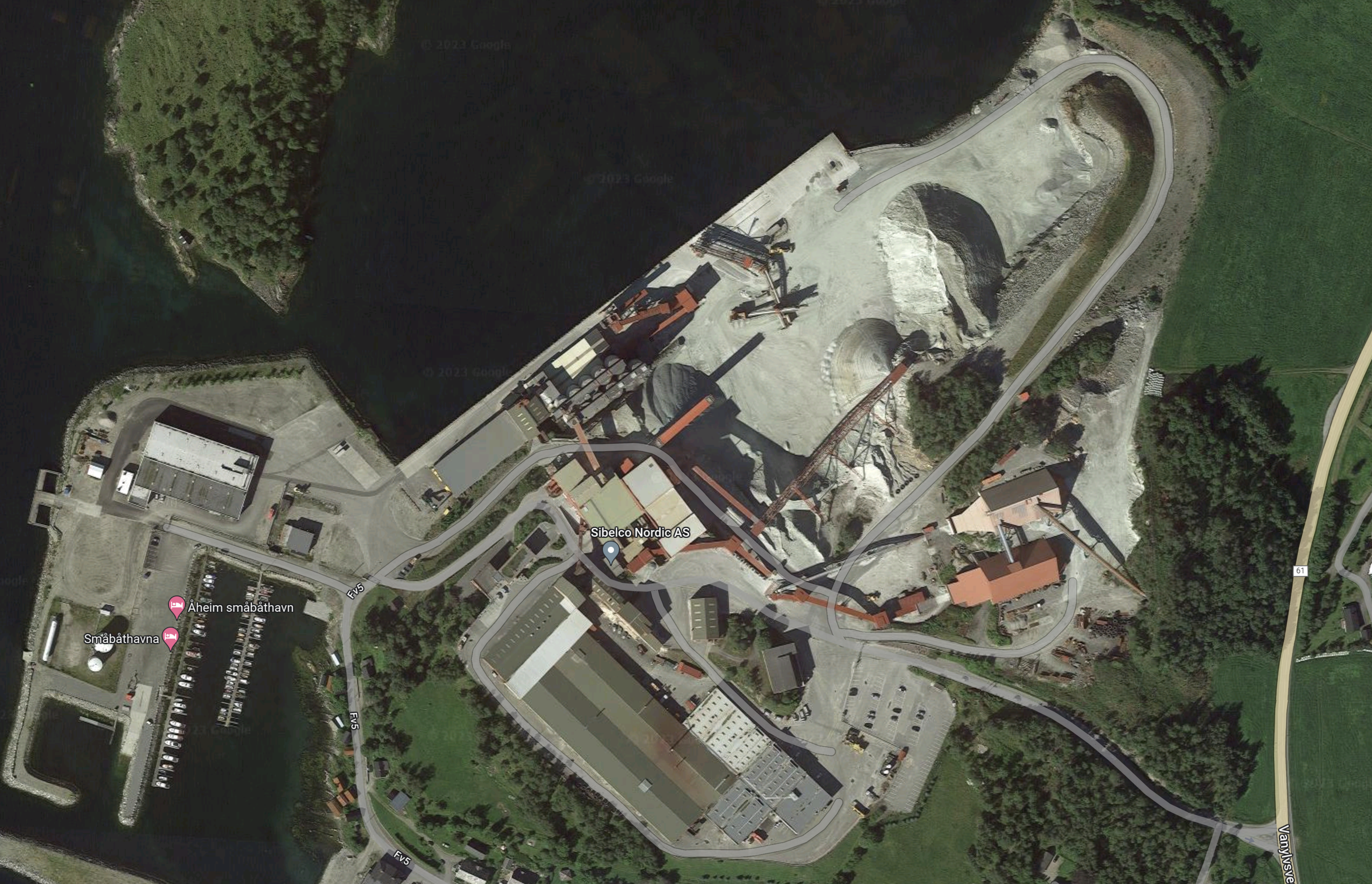
It looks like mine, processing and port all on one site.
The Big Interview With Mike Eberlin
This is the sub-heading.
Former Managing Director of Tarmac Cement & Lime and chair of MPA Cement, Mike Eberlin, became Seratech’s business advisor in June this year. He was intrigued by the novel technology Sam Draper and Barney Shanks had uncovered
These paragraphs are a summary of what Mike Eberlin said.
As we begin to talk, Mike is quick to point out there are two big advantages to Seratech: “They are using magnesium silicate as a starting material which produces silica as a cement replacement and magnesium oxide which can then absorb CO2”.
The CO2 absorption is what fascinates Mike as the type of magnesium carbonate Seratech produces is a “slightly unstable” version which when cured, becomes stable and reverts to the rock-like substance you would find in nature. “This came as a surprise because the chemistry wouldn’t indicate that was possible,” he explains.
Following this discovery, and as Seratech’s research progressed, it soon became apparent that the magnesium carbonate lends itself well as a binder and can be used in applications like building blocks and plasterboard: “It’s effectively carbon capture and use, not carbon capture and storage because you are mineralising the CO2 into a product.
“We end up in this clever situation whereby it’s not that we don’t emit the CO2, it’s better than that, we absorb CO2 and create two binders that replace cement”.
That’s what I call an endorsement.
Conclusion
I have this feeling that Seratech will be a very significant company in a couple of years.
Balmoral Launches New Scour Protection System For Jacket Foundations
The title of this post, is the same as that of this article on offshoreWIND.biz.
This is the sub-heading.
Following the launch of its HexDefence scour protection solution for monopile foundations earlier this year, Balmoral has now launched a HexDefence system specifically designed for offshore wind jacket foundations.
This is the first paragraph.
At the beginning of this year, the Scottish engineering company introduced HexDefence for monopile structures, which integrates seabed protection and flow reduction to minimise operational costs and prevent cable failure. Balmoral said the solution could potentially cut costs by up to 70 per cent when compared to the conventional method of rock dumping.
Balmoral have now developed the system, so it can be used for jacket foundations.
Check out Balmoral’s web site and the HexDefence web site.
Northern Trials New Technology To Blast Leaves From Train Tracks
The title of this post, is the same as that of this article on Rail Technology Magazine.
This is the sub-heading.
Northern is trialling new technology to blast leaves from train tracks this autumn. The technology, called Water-Trak, is attached to the undercarriage of passenger trains and sprays a small amount of water onto the track when a slippery rail is detected. This creates rainy-day conditions on the rail surface, which cleans the rail and makes the conditions better for braking.
Northern have fitted the Water-Trak system to five trains this autumn and seem pleased with the results, as they are fitting another eleven trains for next autumn.
RWE To Start Building Battery Storage That Will Support Dutch Offshore Wind Farm
The title of this post, is the same as that of this article on offshoreWIND.biz.
This is the sub-heading.
RWE has finalised its investment decision for a battery storage project in the Netherlands that will optimise the OranjeWind offshore wind farm’s integration into the Dutch energy system. The company plans to invest approximately EUR 24 million into the project.
This paragraph outlines the system.
The system, which will have an installed power capacity of 35 MW and a storage capacity of 41 MWh, will consist of a total of 110 lithium-ion battery racks that will be installed at RWE’s biomass plant in Eemshaven and will be virtually coupled with RWE’s power plants in the Netherlands.
There is also an explanatory infographic.
Note.
I visited Eemshaven in The Train Station At The Northern End Of The Netherlands.
- The wind farm has a capacity of 760 MW.
- Solar panels will float between the wind turbines.
- Surplus energy will be turned into hydrogen.
The OranjeWind wind farm has a web site, with a video that explains RWE’s philosophy.
The web site has a section, which is entitled Innovations At OranjeWind, where this is said.
In order to realise system integration and accelerate the energy transition, RWE is working together with a number of innovators on new developments in offshore wind farms. The company is realising and testing these innovations in the OranjeWind wind farm.
These innovations include offshore floating solar, a subsea lithium-ion battery, LiDAR power forecasting system and a subsea hydro storage power plant off-site.
Three innovations are discussed in a bit more detail, with links to more information.
- Subsea pumped hydro storage power plant – Ocean Grazer – More…
- Floating solar – SolarDuck – More…
- Intelligent Subsea Energy Storage – Verlume – More…
Big companies should always support innovation.
AI Tech Tracking Seabirds At Aberdeen Bay Offshore Wind Farm
The title of this post, is the same as that of this article on offshoreWIND.biz.
This is the sub-heading.
Vattenfall, Norwegian AI technology start-up Spoor, and British Trust for Ornithology have teamed up on a project that will test AI technology in tracking 3D flight paths of seabirds flying near the wind turbine blades at the Aberdeen Bay Offshore Wind Farm in Scotland.
This is the first paragraph.
The project has already started, with four cameras already installed and collecting data on birds’ 3D flight paths throughout the wind farm and in the immediate vicinity of the turbine blades. Data on seabird movements has already started coming in and validation trials have been completed both offshore, with an observer present, and onshore, with a drone, according to Vattenfall.
This looks like a very neat piece of technology, that hopefully will solve how birds interact with wind turbines.
From my experience of landing and taking off light aircraft at the old Ipswich Airport, where there were a lot of seabirds, my money would be on that birds will learn to use their AI (Avian Intelligence) to avoid the blades of wind turbines.
Fresh Air Fuels Global
Because of its history, South Africa has developed technology to create biofuels, as alternatives to diesel.
If you read the Wikipedia entry for South African chemical company; SASOL, you’ll see the things that South African chemists did, to get round the sanctions imposed because of apartheid.
SASOL has advanced the Fischer–Tropsch process and uses it to produce diesel and other fossil fuels.
Note that Velocys have also developed this process to make sustainable aviation fuel in the UK.
Fresh Air Fuels Global have a page on the G-volution web site.
The page is dominated by an infographic, which shows organic waste (animals and plants) going into an anaerobic digester, which produces.
- Biogas, which is used to create heat, electricity, CO2, biomethane, fuel and gas for the grid.
- Digestate, which is used for fertiliser and livestock bedding.
It almost sounds too good to be true.
This is the mission statement below the graphic.
Our mission: To be the most reliable producer of energy secure low carbon fuels.
There is then these paragraphs, which explain the relationship between G-volution and Fresh Air Fuels Global.
Global energy security concerns and climate targets necessitate countries and businesses to transition away from high-cost fossil fuels towards low-carbon alternatives.
Over more than a decade, Cape Advance Engineering South Africa (CAE) have been developing an incredibly cost-effective Anaerobic Digestion (AD) technology, which has proven to generate renewable energy from organic waste in the form of gas, heat and electricity that is cost competitive with fossil fuels.
G-Volution has partnered with CAE to form Fresh Air Fuels Global (FAFG), with aim of introducing the CAE technology to international markets that the G-Volution already have a foothold, constructing AD plants and creating carbon neutral biofuel from waste that can be used in dual fuel engines.
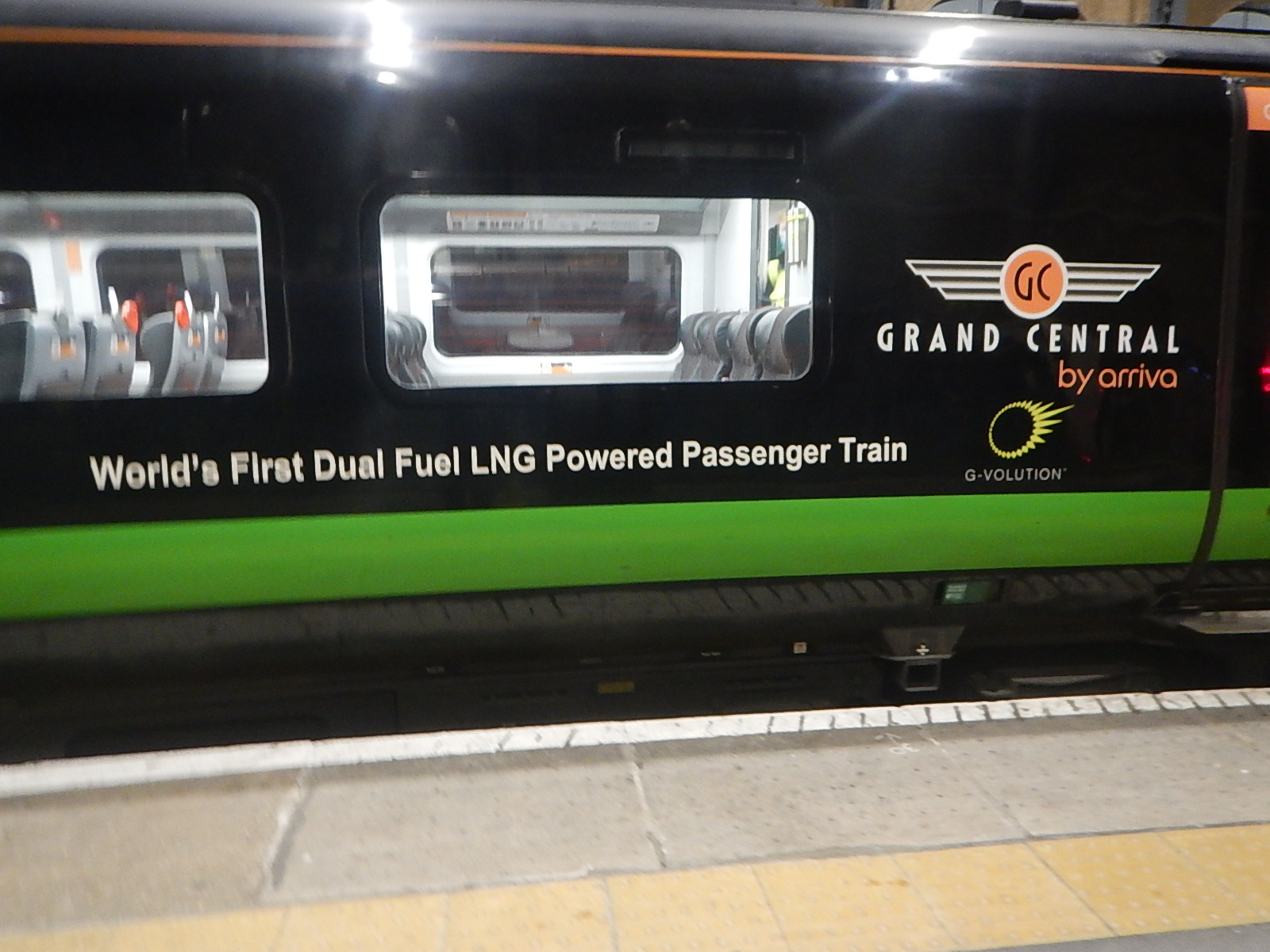
In Grand Central DMU To Be Used For Dual-Fuel Trial, I describe how G-volution’s dual fuel technology has been applied to one of Grand Central’s Class 180 train.
This picture I took after travelling in a Grand Central Class 180 train, shows that G-volution don’t hide their light under a bushel.
Note.
- This train appears to run on diesel and liquified natural gas.
- This G-volution video gives more details.
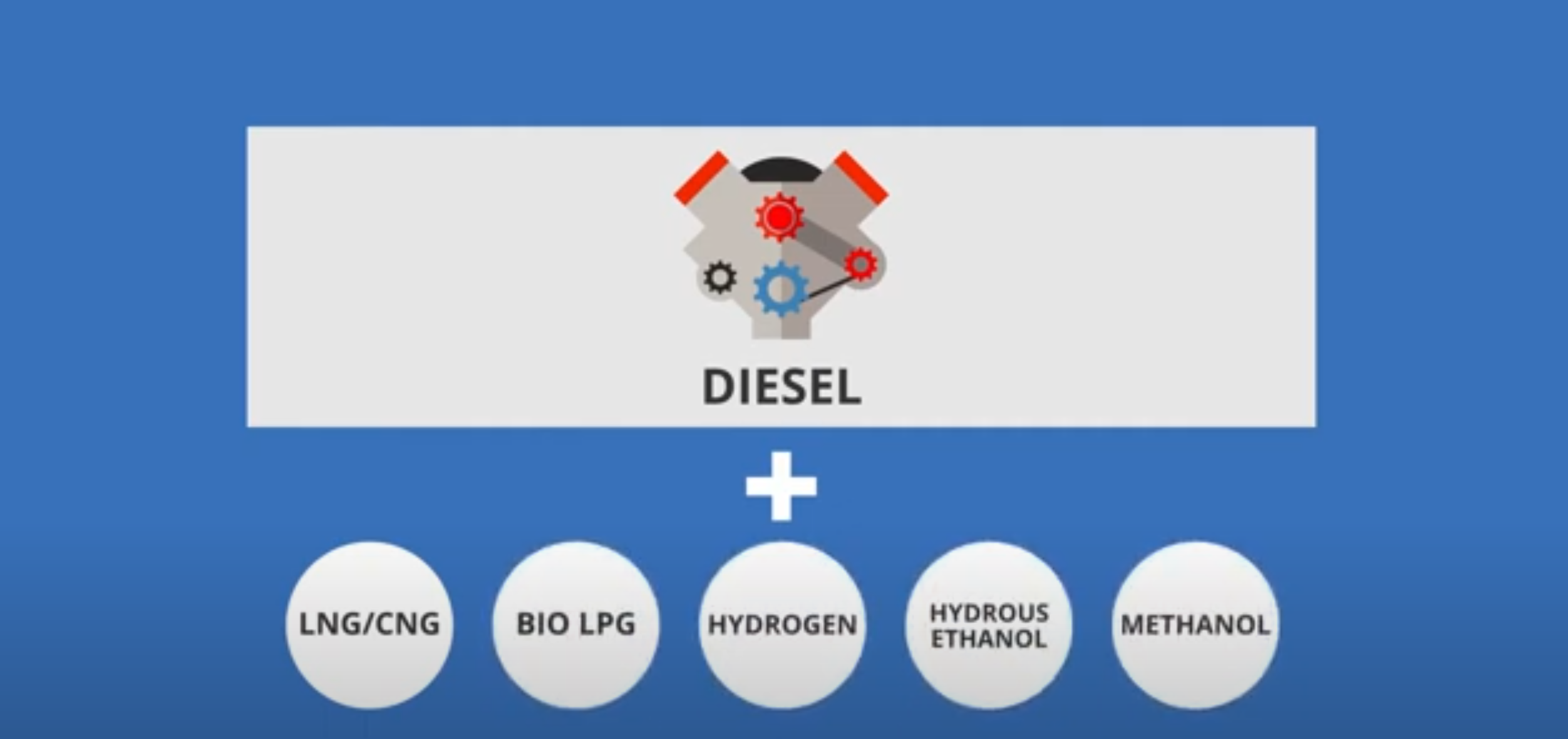
This clip from the video, shows the possible fuels.
Note.
- Can the dual fuel engine use biodiesel or HVO instead of diesel?
- It looks like the Fresh Air Fuels Global process can produce biomethane, which could be liquified as LNG.
- Hydrogen is the only true zero-carbon secondary fuel.
- There is a Wikipedia entry for ethanol fuel.
- Hydrous ethanol is about 95% ethanol and 5% water and is used as a fuel in Brazil in petrol cars.
- There is a Wikipedia entry for the use of methanol as fuel.
Have G-volution got access to the technology to both reduce the fuel consumption of diesel engines and run them on zero-carbon fuel?
UK Trains That Have Cummins QSK-19 R Diesel Engines
Grand Central’s Class 180 trains have a Cummins QSK-19 R diesel engine.
All these trains have the same engine.
- 14 – Class 180 trains
- 51 – Class 185 trains
- 34 – Class 220 trains
- 44 – Class 221 trains
- 27 – Class 222 trains
In addition, Class 175 trains have a different engine made by Cummins.
Conclusion
If G-volution’s technology can be made to work successfully, it could play a large part in the decarbonisation of UK passenger trains.
Introducing JetZero
The Times today has an article which is entitled Up, Up And Away On An Eco-Friendly, Blended-Wing Jet.
This is the sub-heading.
The US air force hopes that a $235 million contract for a radical new design will take off
The article goes on to give a good history of blended wing bodies, before describing JetZero’s blended-wing jet and the company’s deal with the US Air Force.
More on the aircraft is available on the company’s web site. Take a look at the WHY JETZERO page.
In ZEROe – Towards The World’s First Zero-Emission Commercial Aircraft, I describe Airbus’s ZEROe BWB, which is another proposed blended wing body.
The Power Behind Rolls-Royce
My post entitled ‘Spirit of Innovation’ Stakes Claim To Be The World’s Fastest All-Electric Vehicle, was based on this press release from Rolls-Royce, which has the same title.
In the post I talk about Rolls-Royce’s experimental electric aircraft; Sprit of Innovation.
- The aircraft set a world record for electric-aircraft of 345.4 mph.
- the aircraft clocked up a maximum speed of 387.4 mph.
- The aircraft was propelled on its record breaking runs by a 400kW electric powertrain.
- Rolls-Royce worked in partnership with aviation energy storage specialist; Electroflight and automotive powertrain supplier; YASA.
For comparison, my Cessna 340A had two 230 kW engines and a maximum speed of 281 mph.
Electroflight, Evolito And YASA
YASA has this description of the company on their home page.
YASA is at the forefront of eMotor innovation and development. Our axial flux technology motors are up to 4x more powerful than those used in nearly all Electric Vehicles on the road today, whilst being around 50% smaller & lighter.
We already feature in some of the best eMotor applications across multiple sectors, and now as part of Mercedes-Benz, with sites in Oxfordshire and Welshpool, we are accelerating development of axial flux eMotors and Control Systems for of the next generation of Electric Vehicles.
Evolito has this description of the company on their About page.
Evolito was spun out in 2021 by YASA, the world-leading pioneer of automotive axial-flux electric motors acquired by Mercedes-Benz in July 2021, to exclusively commercialise YASA’s next-generation electric motor technology and IP for the rapidly-growing aerospace market. Evolito is funded by a portfolio of private investors including B-FLEXION and Oxford Science Enterprises (OSE).
Electroflight has this company story on their About page.
Founded in 2011 to address battery-electric issues in the aerospace market, we are a UK-based innovation engineering company, taking expertise from across the automotive and aerospace sectors, working with leading airframers to develop and supply next-generation battery technology.
In 2019, Electroflight, Rolls-Royce and YASA partnered to design and build the worlds fastest all-electric vehicle – The Spirit of Innovation. 3 years of dedication from the team involved integrating the full powertrain into a NXT aircraft, optimising the system to peak performance and following rigorous testing processes in an emerging market with new regulations; in 2021 the record breaking flight reached a staggering 345.5 mph!
Following the successful spinout of Evolito (YASA’s Aerospace Division) in 2021, Evolito acquired Electroflight in July 2022 to offer a fully optimised powertrain solution for the electric aerospace industry.
It appears that Mercedes-Benz now own YASA’s technology for the the automotive industry and Evolito have the aerospace technology.
Evolito’s Technology
The Evolito web site has a Technology page, which is entitled The World’s Most Advanced Electric Propulsion Solution.
- Their Axial Flux Motors are certainly a revolutionary approach.
- It looks like one of their motors has a peak power of 280 kW, a continuous power of 100 kW and weighs just 35 Kg.
There is also this page, which gives more details about the creation of the Spirit of Innovation, which has this video.
Evolito And Project Fresson
This press release from Cranfield Aerospace Solutions is entitled Cranfield Aerospace Welcomes Ground-Breaking UK Technology Innovator Onboard Project Fresson.
These paragraphs explain the link-up.
Cranfield Aerospace Solutions (CAeS) welcomes Evolito, a ground-breaking UK technology innovator onboard as the motor & inverter supplier for its hydrogen-powered aircraft demonstrator – Project Fresson.
Evolito join Reaction Engines and Ricardo as technology collaborators on Project Fresson, showcasing the UK innovation that is redefining the aviation industry.
Based in Oxfordshire, Evolito is the aerospace spin out of YASA – the world-leading pioneer of automotive axial-flux electric motors.
Producing the world’s most advanced electric propulsion system, Evolito’s motors are smaller, lighter, and typically 4 times more power dense than radial flux solutions, making them ideally suited to the emerging zero-emissions aviation markets.
Evolito’s axial-flux technology requires up to 75% less iron, less copper and fewer permanent magnets than competing radial solutions, making it lighter and more environmentally friendly.
Note.
- Project Fresson is a project to develop an electric propulsion system for Britten-Norman Islanders.
- There are 700 Islander aircraft in service.
A hydrogen propulsion system, would be useful for new aircraft and conversions.
Fast Train Washer Is Client For Centre Of Rail Excellence
The title of this post, is the same as that of a small article in Rail Magazine.
This is the first paragraph.
The Orange Train Wash (OTW), which aims to clean a train carriage every 22 seconds while using just 1 % of the water of conventional equipment is one of the first commercial clients at the new £400 million Global Centre Of Rail Excellence in South Wales.
Note.
- This is the home page of the company’s web site.
- It has impeccable environmental credentials.
I also think, it has other applications.
 The Anonymous Widower