Manchester Piccadilly Station Platform Layout
In this post, I will look at the current platform layout at Manchester Piccadilly station and see if it could be updated for High Speed Two.
This OpenRailwayMap shows the current platform layout at the station.
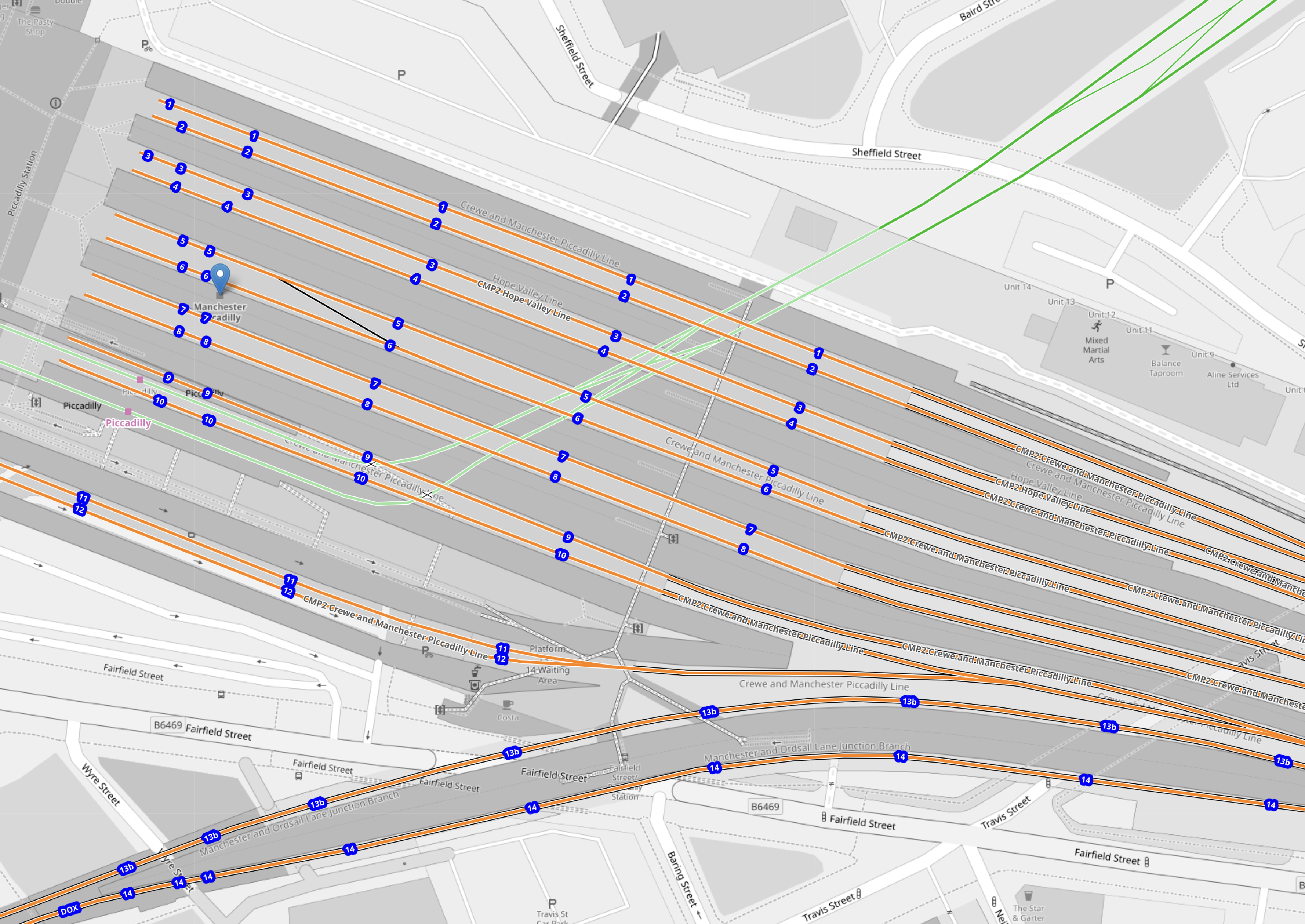
Note.
- There are twelve platforms in the main station, which are numbered 1 to 12 from North to South.
- There are also two platforms to the South of the main station, which are on the Castlefield Corridor and numbered 13 and 14.
- The current Avanti West Coast services use Platforms 5 to 8.
- Platforms 1 to 8 seem well-spaced.
- The Internet gives the length of Platform 1 as 238 metres, so it can be used as a ruler on all the platforms.
- The green tracks are for the Manchester Metrolink, which runs under the station.
I will now take a detailed look at the four platforms used by Avanti West Coast services, which are 5 to 8.
- The platforms are 340, 277, 277 and 340 metres long respectively.
- All four platforms can handle 11-car Pendolino Class 390 trains, which are 265.3 metres long.
- All four platforms will also handle 8-car HS2 Classic-Compatible trains, which will be 200 metres long.
- The platforms also seem to have a straight run-in to the buffers, which is about 260 metres long.
- This straight section is long enough to accommodate an 11-car Pendolino or an 8-car HS2 Classic-Compatible train.
I would think it reasonable that an 8-car HS2 Classic-Compatible train could take over the service of an 11-car Pendolino, but running on HS2 infrastructure, where it exists.
The current Avanti West Coast service to Manchester Piccadilly is as follows.
- 1 tph – 9-car or 11-car – London Euston and Manchester Piccadilly via Milton Keynes Central, Rugby, Stoke-on-Trent, Macclesfield and Stockport
- 1 tph – 9-car or 11-car – London Euston and Manchester Piccadilly via Nuneaton, Stoke-on-Trent and Stockport
- 1 tph – 9-car or 11-car – London Euston and Manchester Piccadilly via Stafford, Crewe, Wilmslow and Stockport
In the original design for HS2, this was the service pattern.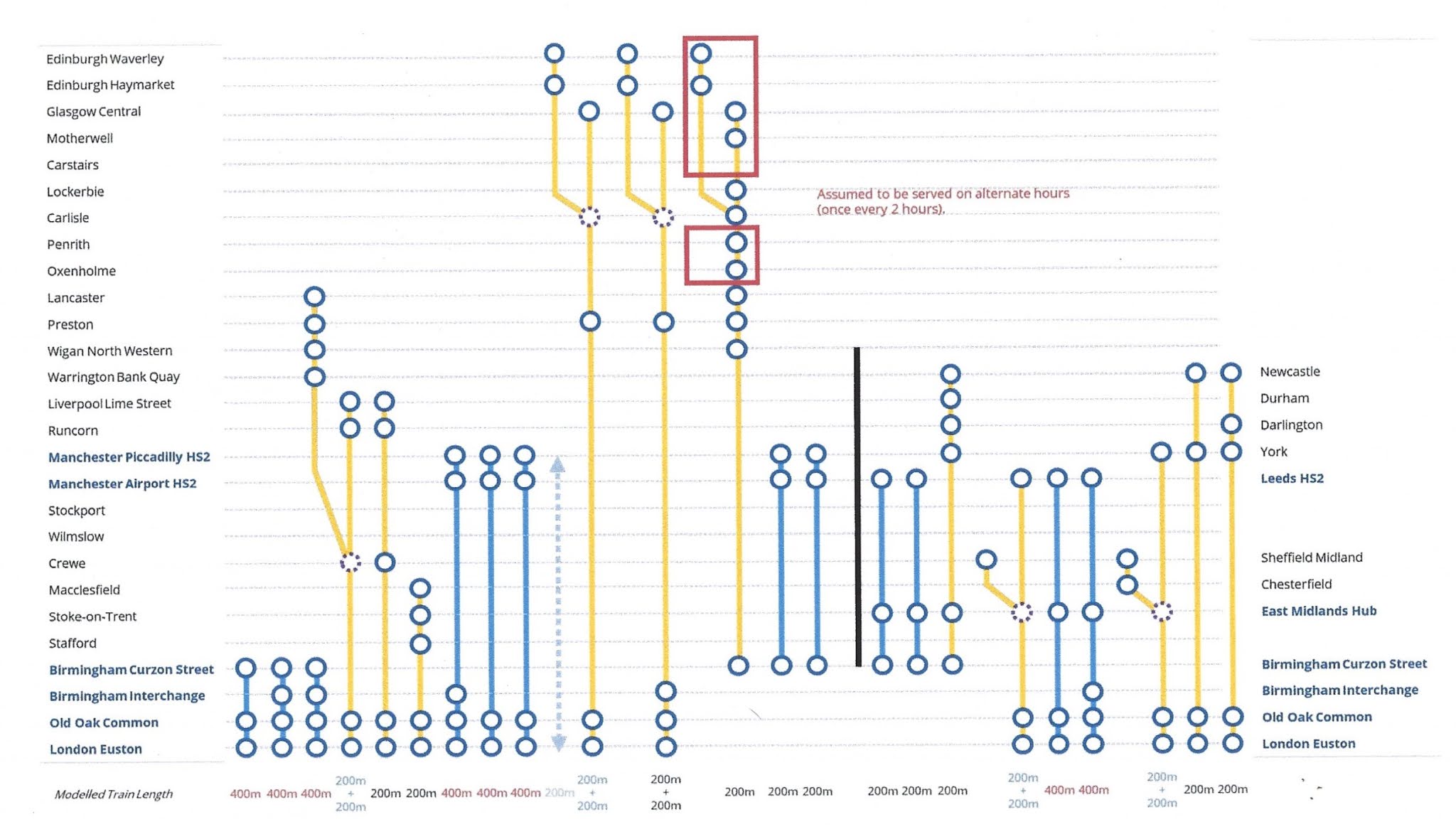
Note.
- Trains to the left of the vertical black line are Phase 1 and those to the right are Phase 2.
- Full-Size trains are shown in blue.
- Classic-Compatible trains are shown in yellow.
- The dotted circles are where trains split and join.
- In the red boxes routes alternate every hour.
Click on the diagram to enlarge it.
Services to Manchester Piccadilly and the Manchester area are as follows.
- Train 6 – 200 m. HS2 CC – London Euston and Macclesfield via Old Oak Common, Stafford and Stoke-on-Trent
- Train 7 – 400 m HS2 FS – London Euston and Manchester Piccadilly via Old Oak Common, Birmingham Interchange and Manchester Airport
- Train 8 – 400 m HS2 FS – London Euston and Manchester Piccadilly via Old Oak Common and Manchester Airport
- Train 9 – 400 m HS2 FS – London Euston and Manchester Piccadilly via Old Oak Common and Manchester Airport
- Train 13 – 200 m HS2 FS – Birmingham Curzon Street and Manchester Piccadilly via Manchester Airport
- Train 14 – 200 m HS2 FS – Birmingham Curzon Street and Manchester Piccadilly via Manchester Airport
Note.
- All trains are one train per hour (tph)
- Macclesfield should be able to handle one 200 m. HS2 Classic-Compatible train per hour, as it is shorter and has less passengers than an 11-car Pendolino.
- All Manchester Piccadilly services call at Manchester Airport.
I believe this allows two possible solutions.
- A largely tunneled solution, that gives access to enough 400 m platforms underneath or alongside Manchester Piccadilly station.
- An interim solution, that replaces 11-car Pendolinos with 200 m. HS2 Classic-Compatible trains.
I will answer this question first.
Will HS2 Use A Tunnel Between Manchester Airport And Manchester Piccadilly Station?
I asked Google AI and received this answer.
Yes, in the original HS2 proposals, a 7.5-mile twin-bore tunnel was planned to run between Manchester Airport and the Ardwick area, surfacing near Manchester Piccadilly. This tunnel was designed to carry the high-speed line underneath the built-up areas of south Manchester and into the terminal station.
Key Details of the Proposed Tunnel:
Purpose: To connect the new Manchester Airport High Speed Station with Manchester Piccadilly station.
Structure: A 7.5-mile (approx. 12km) twin tunnel.
Route: Following the airport, the line would enter the tunnel, traveling towards Piccadilly station.
Location: The tunnel handles the approach to Manchester city centre, allowing the high-speed tracks to bypass surface-level congestion in the south Manchester suburbs.
Note: While this was the planned route for Phase 2b, the future of the northern leg of HS2 has been subject to change and government reviews, which may impact these designs
The Full Solution
This will entail the following.
- A two-platform underground station at Manchester Airport, that is capable of handling 400 m. HS2 Full-Size trains.
- A large enough extension to Manchester Piccadilly station that is capable of terminating enough 400 m. HS2 Full-Size trains.
- The extension to Manchester Piccadilly station could be underneath or alongside, the current station.
- A 7.5 mile twin-bore tunnel between the two stations.
I also believe the full solution will need the completion of the high speed line between Handsacre junction and Crewe.
That would be an expensive and difficult solution, so we will need an interim solution.
The Interim Solution
This will entail the following.
- All HS2 services into Manchester Piccadilly will be run by 8-car 200 m. HS2 Classic-Compatible trains.
- They will use Platforms 5 to 8 in Manchester Piccadilly station, which are 340, 277, 277 and 340 metres long respectively.
- The Manchester Piccadilly services will not call at Manchester Airport.
- The Macclesfield service will run to serve Stafford and Stoke-on-Trent.
- I also believe the interim solution will not need the completion of the high speed line between Handsacre junction and Crewe.
My project management experience leads me to believe, that after HS2 is completed to Handsacre junction, Manchester Piccadilly station could be served by 8-car 200 m. HS2 Classic-Compatible trains.
How Many Trains Will The Interim Solution Run Through The Trent Valley Line?
If the interim solution is to work, then HS2 trains for North of Handsacre Junction will have to take their chances on the Trent Valley Line.
This OpenRailwayMap shows the route of the Trent Valley Line between Handsacre Junction and Crewe.
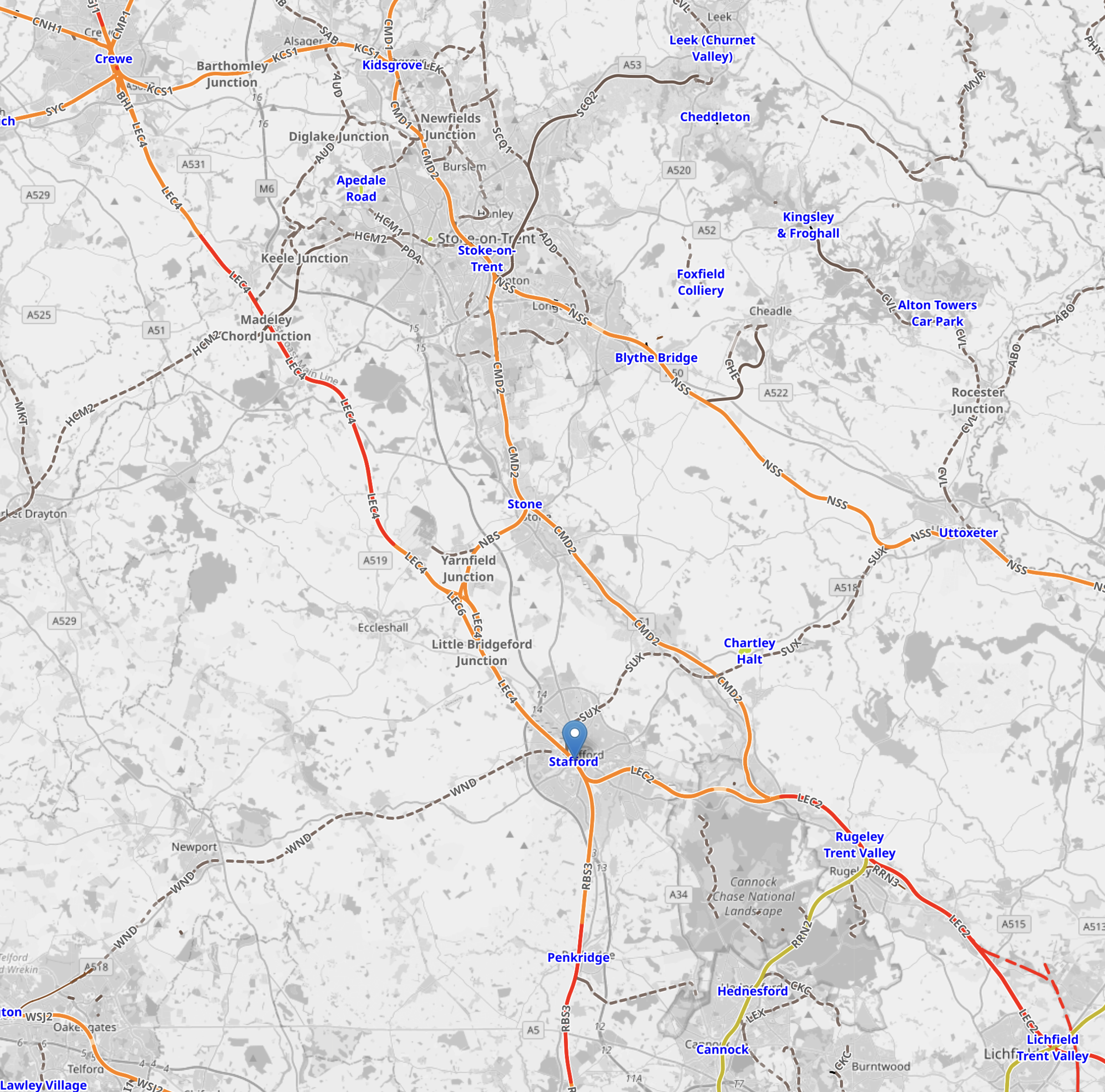
Note.
- Stafford station is marked with a blue arrow.
- Crewe station is in the North-West corner of the map.
- Lichfield Trent Valley station is in the South-East corner of the map.
- The Northern end of HS2 is should dotted around Lichfield Trent Valley station
- Rugeley Trent Valley station is to the North-West of Lichfield Trent Valley station.
- Crewe, Stafford, Rugeley Trent Valley and Lichfield Trent Valley stations are all on the Trent Valley Line, which runs North-West and South-East across the map.
- Handsacre junction is to the North of Lichfield Trent Valley station and links the North end of HS2 to the the Trent Valley Line.
This second OpenRailwayMap shows Handsacre junction in more detail.
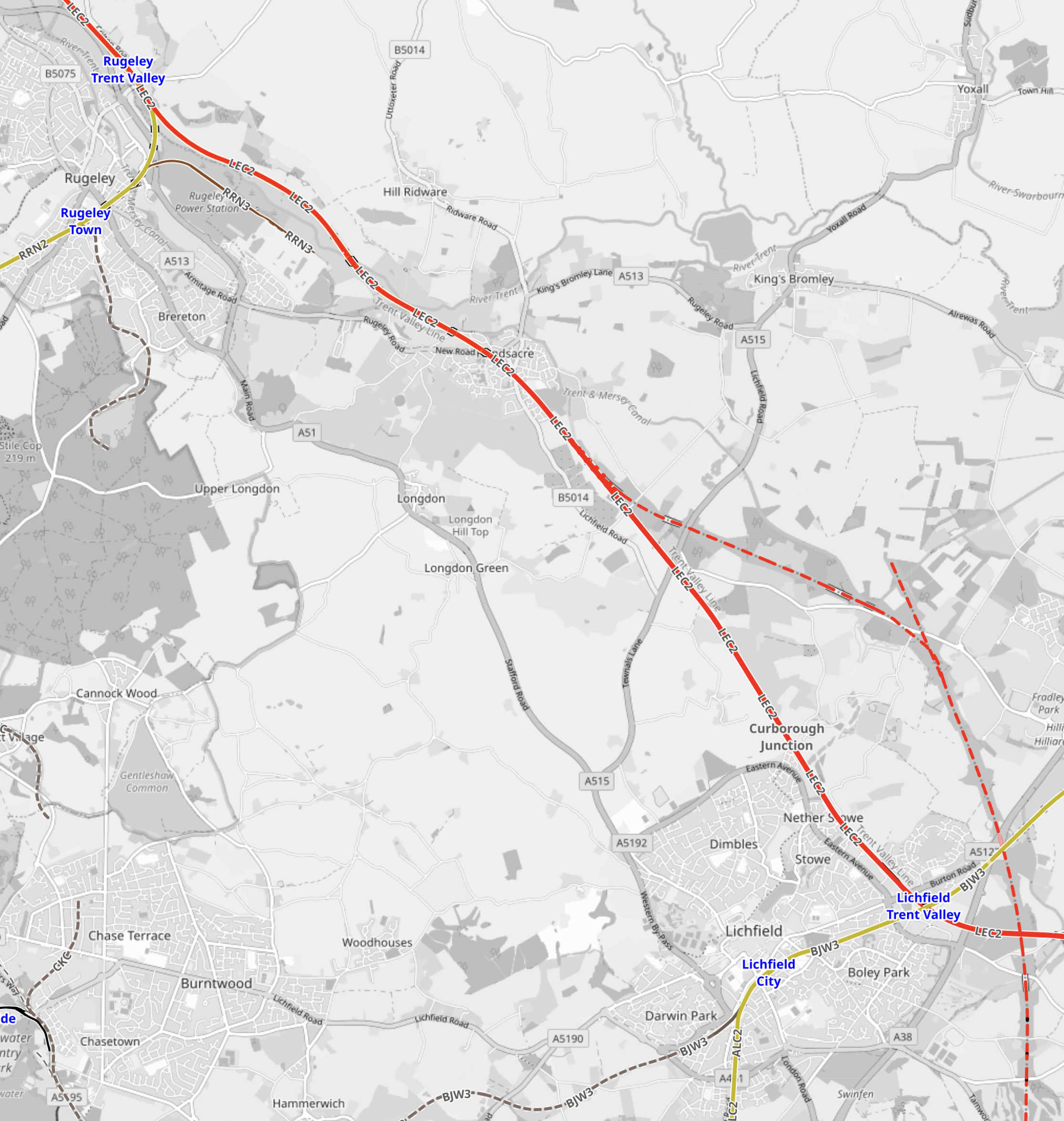
Note.
- Rugeley Trent Valley station is in the North-West corner of the map.
- Lichfield Trent Valley station is in the South-East corner of the map.
- The Trent Valley Line runs diagonally across the map between the two stations.
- The route of HS2 is shown as a dotted red line in the South-East corner of the map.
- HS2 and the Trent Valley Line will join at Handsacre junction.
The stub of HS2 in the North-East corner of the map, will eventually link to Crewe.
The following services will join the Trent Valley Line at Handsacre junction.
- Train 4a – 200 m. HS2 CC – London Euston and Lancaster via Old Oak Common, Crewe, Warrington Bank Quay, Wigan North Western and Preston
- Train 4b – 200 m. HS2 CC – London Euston and Liverpool via Old Oak Common, Crewe and Runcorn
- Train 5 – 200 m. HS2 CC – London Euston and Liverpool via Old Oak Common, Crewe and Runcorn
- Train 6 – 200 m. HS2 CC – London Euston and Macclesfield via Old Oak Common, Stafford and Stoke-on-Trent
- Train 7 – 200 m HS2 CC – London Euston and Manchester Piccadilly via Old Oak Common and Birmingham Interchange
- Train 8 – 200 m HS2 CC – London Euston and Manchester Piccadilly via Old Oak Common
- Train 9 – 200 m HS2 CC – London Euston and Manchester Piccadilly via Old Oak Common
- Train 10a – 200 m HS2 CC – London Euston and Edinburgh Waverley via Old Oak Common, Preston, Carlisle and Edinburgh Haymarket
- Train 10b – 200 m HS2 CC – London Euston and Glasgow Central via Old Oak Common, Preston and Carlisle
- Train 11a – 200 m HS2 CC – London Euston and Edinburgh Waverley via Old Oak Common, Birmingham International, Preston, Carlisle and Edinburgh Haymarket
- Train 11b – 200 m HS2 CC – London Euston and Glasgow Central via Old Oak Common, Birmingham International, Preston and Carlisle
- Train 12 – 200 m HS2 CC – Birmingham Curzon Street and Edinburgh Waverley/Glasgow Central via Wigan North Western, Preston, Lancaster, Oxenholme, Penrith, Carlisle, Lockerbie, Carstairs and Edinburgh Haymarket/Motherwell
- Train 13 – 200 m HS2 CC – Birmingham Curzon Street and Manchester Piccadilly
- Train 14 – 200 m HS2 CC – Birmingham Curzon Street and Manchester Piccadilly
Note.
- All trains are one train per hour (tph)
- Train 4 splits and joins at Crewe, so runs as a 400 m train on the Trent Valley Line.
- Train 10 splits and joins at Carlisle, so runs as a 400 m train on the Trent Valley Line.
- Train 11 splits and joins at Carlisle, so runs as a 400 m train on the Trent Valley Line.
- Train 12 runs alternatively to Edinburgh Haymarket and Edinburgh Waverley/Motherwell and Glasgow Central.
In any hour, it looks like eight single trains and three pairs will run along the Trent Valley Line.
How Close In Minutes Can Trains Run On The Trent Valley Line?
I asked Google AI and received this answer.
On the modernised Trent Valley Line (part of the West Coast Main Line), trains can run at high frequencies, often with fast, long-distance services operating with headway (spacing) of approximately 3 to 5 minutes, though typically, a 2-4 train per hour per direction service pattern is standard, equating to 15–30 minute intervals between similar services.
Capacity: The line is a four-track railway between Rugby and Stafford, allowing fast, long-distance express trains (up to 125 mph) to overtake slower, local, and freight trains.
Service Frequency: High-frequency, high-speed travel is standard.
Constraints: While the infrastructure supports close spacing, schedules are constrained by capacity at major bottlenecks and the requirement for consistent track maintenance.
It’s probably tight, but not impossibly so. Especially, as Train 6 to Macclesfield cuts off through Stoke-on-Tent after Stafford.
What Is The Capacity Of Each Train Timetable Between London Euston And Manchester Piccadilly/Macclesfield?
Consider.
- An 11-car Pendolino has 607 seats.
- I’m assuming all Pendolinos are 11-car trains.
- An 8-car HS2 Classic-Compatible train has 504 seats.
- I’m assuming that HS2 Full Size trains have the same capacity as the Classic Compatible trains.
These are figures for each timetable.
Current Timetable
3 x 11-car Pendolino = 1,821 seats. per hour
Interim Timetable
4 x 8-car 200 m. HS2 Classic-Compatible trains = 2,016 seats per hour, which is a 10.7 % increase over today.
Full Timetable
7 x 8-car 200 m. HS2 Classic-Compatible trains = 3,538 seats per hour, which is a 93.7 % increase over today.
How Many Trains Run On Each Section Of HS2?
Current Timetable
None
Interim Timetable
These are my estimates of trains per hour on each section.
- London Euston and Birmingham – 11 tph
- Birmingham and Stafford – 11 tph
- Stafford and Crewe – 10 tph
- Stafford and Macclesfield – 1 tph
- Crewe and Liverpool – 2 tph
- Crewe and Manchester Piccadilly – 5 tph
- Crewe and Preston – 4 tph
- Preston and Lancaster – 4 tph
- Lancaster and Carlisle – 3 tph
- Carlisle and Edinburgh Waverley – 2.5 tph
- Carlisle and Glasgow Central – 2.5 tph
There would appear to be spare capacity for up to six trains per hour, South of Crewe.
Full Timetable
These are my estimates of trains per hour on each section.
- London Euston and Birmingham – 11 tph
- Birmingham and Stafford – 11 tph
- Stafford and Crewe – 10 tph
- Stafford and Macclesfield – 1 tph
- Crewe and Liverpool – 2 tph
- Crewe and Manchester Airport- 5 tph
- Manchester Airport and Manchester Piccadilly – 5 tph
- Crewe and Preston – 4 tph
- Preston and Lancaster – 4 tph
- Lancaster and Carlisle – 3 tph
- Carlisle and Edinburgh Waverley – 2.5 tph
- Carlisle and Glasgow Central – 2.5 tph
There would still appear to be spare capacity for up to six trains per hour, South of Crewe.
Conclusions
Theses are my conclusions.
- There Are At Least Six Free Train Paths In Every Hour Between London And Crewe
This is partly because the Eastern leg was cancelled. But it does seem silly to waste them.
I believe Blackpool would be a good place to serve and I said so in Could High Speed Two Serve Blackpool North?
Other possible places would be Chester, Holyhead and Scotland.
2. There Will Need To Be A Tunnel To Connect Manchester Piccadilly And Manchester Airport
This is because you can’t knock all the houses down to build the link.
The Channel Tunnel Rail Link is tunnelled under Dalston in East London for the same reason.
3. Manchester Piccadilly and Manchester Airport services will be five Trains Per Hour
Two of these five trains will go to Birmingham Curzon Street and three to London Euston.
I would expect that the Manchester Tunnel will be an important project for the finances of Manchester Airport.
4. When The Manchester Tunnel Is Built, This Will Double Seat Capacity Between London And Manchester Piccadilly
This is because it will allow 400 metre trains between London Euston and Manchester Piccadilly.
5. HS2 Can Run To Manchester Without Building The Manchester Tunnel Or A High Speed Line Between Crewe And Birmingham
This surprised me at first, but it appears, that it’s because HS2 Classic-Compatible trains are shorter than 11-car Pendolinos.
6. HS2 Can’t Run To Manchester Airport Without Building the Manchester Tunnel.
It’s all because of the houses in between.
7. Single 200 m. HS2 Classic Compatible trains, Can Use The Unmodified Manchester Piccadilly.
This is because they are shorter than 11-car Pendolinos. But pairs can’t, as they are too long!
8. Stockport Gets A Raw Deal From HS2
Currently, Stockport, gets three 11-car Pendolino services between London Euston and Manchester Piccadilly.
Under the Interim Solution, these services will continue as HS2 Classic-Compatible trains are shorter than 11-car Pendolinos.
But under the Full Solution, HS2 trains will be in the Manchester Tunnel between Manchester Airport and Manchester Piccadilly.
9. The Interim Solution Will Work
I am more and more convinced, that a proposed solution which entails the following will work.
- A new service from London Euston to Macclesfield via Old Oak Common, Stafford and Stoke-on-Trent is introduced.
- 11-car Pendolinos are replaced by 8-car HS2 Classic-Compatible trains, which are shorter.
- The Trent Valley Line is updated, so that it can handle 11 trains per hour, that will eventually be transferred to the new HS2 line between Handsacre junction and Crewe.
- London Euston and Manchester Piccadilly will get three trains per hour via HS2 to Handsacre junction the Trent Valley Line.
- There will be no major work to be done at Manchester Piccadilly.
- Three trains per hour between London Euston and Manchester Piccadilly could still call at Stockport.
I also believe that this solution can be easily built, as it is mainly improving the existing route between Handsacre junction and Manchester Piccadilly via Crewe and Stockport.
Where Is Handsacre Junction?
Handsacre Junction is where High Speed Two trains from London Euston and Birmingham will join the Trent Valley Line to complete their journeys via Stafford and Crewe.
This OpenRailwayMap shows the junction.
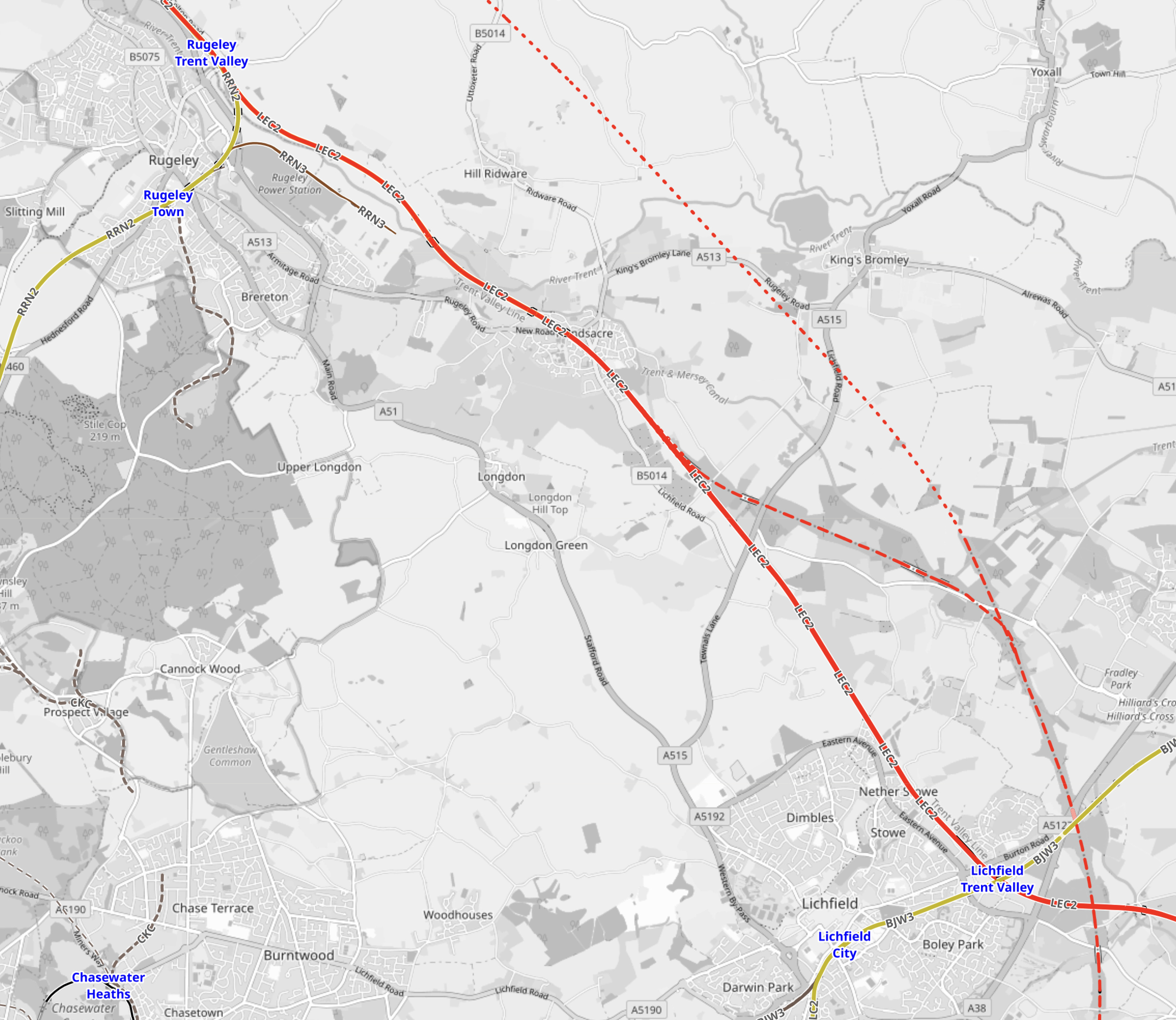
Note.
- The solid red track going diagonally across the map is the Trent Valley Line, which is a section of the West Coast Main Line.
- The station on the Trent Valley Line at the top of the map is Rugeley Trent Valley.
- The station on the Trent Valley Line at the bottom of the map is Lichfield Trent Valley.
- The dotted tracks running North-South show the proposed route of High Speed Two.
- Only the dashed sections of tracks will be built for Phase 1 of High Speed Two.
From the map, I estimate that that High Speed Two will join the Trent Valley Line at the mid-way point between the two stations.
According to Real Time Trains, the stations are these distances from Euston.
- Lichfield Trent Valley – 116.4 miles
- Rugeley Trent Valley – 124.4 miles
So this puts Handsacre Junction at 120.4 miles from Euston.
Searching the Internet, I find the distance between Euston and Handsacre Junction on High Speed Two as 192.77 km. or 119.8 miles.
It would appear that the High Speed Two route is 0.6 mile longer.
Euston And Handsacre Junction Times
This table shows Euston and Handsacre junction times at various speeds.
High Speed Two Average Speed – 205 mph – 35 mins.
Class 390 Train Average Speed – 140 mph – 51 mins.
Euston And Glasgow Central Times
If I assume, that the trains take the same three hours and 47 minutes between Handsacre junction and Glasgow Central as Class 390 trains do now, I get these times.
High Speed Two Average Speed – 205 mph – 4 hour and 22 mins.
Class 390 Train Average Speed – 140 mph – 4 hours and 38 mins.
Euston And Liverpool Lime Street Times
If I assume, that the trains take the same 71 minutes between Handsacre junction and Liverpool Lime Street as Class 390 trains do now, I get these times.
High Speed Two Average Speed – 205 mph – 1 hour and 46 mins.
Class 390 Train Average Speed – 140 mph – 2 hours and 2 mins.
Euston And Manchester Piccadilly Times
If I assume, that the trains take the same 66 minutes between Handsacre junction and Manchester Piccadilly as Class 390 trains do now, I get these times.
High Speed Two Average Speed – 205 mph – 1 hour and 41 mins.
Class 390 Train Average Speed – 140 mph – 1 hours and 57 mins.
Could High Speed Two Finish At Lichfield?
I wrote this post before Rishi Sunak made his speech.
I went to Manchester and Liverpool yesterday by train.
I took the 10:33 from Euston and this a summary of my journey.
- The train left Euston half a minute early.
- It arrived at Stafford (133.5 miles) at 11:50 and left at 11:52.
- It arrived at Crewe (158.0 miles) at 12:08 and left at 12.10.
- It arrived at Wilmslow (176.9 miles) at 12:25 and left at 12:27.
- It arrived at Stockport (183.0 miles) at 12:35 and left at 12:37.
- It arrived in Manchester Piccadilly (188.9 miles) at 12:46.
- It was two minutes late into Manchester and more or less on time at the other stops.
Note.
- The route was via the Trent Valley Line and the train passed through Nuneaton, Tamworth, Lichfield Trent Valley, Colwich and Stafford.
- Euston and Manchester had been timetabled at two hours and eleven minutes.
- This is an average speed of 86.5 mph.
- The Wikipedia entry for High Speed Two gives the fastest time before High Speed Two opens as one hour and fifty-four minutes.
- This will be an average speed of 99.4 mph.
Coming home, I took the 18:48 from Liverpool Lime Street and this a summary of my journey.
- The train left Liverpool on time.
- It arrived at Runcorn (13.2 miles) at 18:58 and left at 19:02.
- It arrived at Crewe (35.8 miles) at 19:26 and left at 19:28.
- It arrived at Milton Keynes (143.8 miles) at 20:27 and left at 20:29.
- It arrived in Euston (183.6 miles) at 21:00.
- It was five minutes late into Crewe and two minutes early at Euston.
Note.
- The route was via the Trent Valley Line and the train passed through Stafford, Colwich, Lichfield Trent Valley, Tamworth and Nuneaton.
- Liverpool and Euston had been timetabled at two hours and twenty minutes.
- This is an average speed of 78.7 mph.
- The Wikipedia entry for High Speed Two gives the fastest time before High Speed Two opens as two hours and three minutes.
- This will be an average speed of 89.6 mph.
This map clipped from the High Speed Two web site, shows the junction North of Lichfield, where High Speed Two connects to the Trent Valley Line through Stafford.

Note.
- High Speed Two runs North-South across the map.
- After the Junction by Fradley South, High Speed Two to Crewe and the North, is the branch to the East.
- The other branch connects to the Trent Valley Line at Handsacre junction.
- Trent Valley Line can be picked out North of Lichfield, where it passes through Lichfield Trent Valley station.
The Trent Valley Line is no Victorian double-track slow-speed bottleneck.
- The route between Rugby and Crewe is generally three or four tracks, with only one short stretch of double track, through Shugborough tunnel.
- The speed limit is generally 110 mph, with 90 mph at Shugborough.
- I wouldn’t be surprised to see Avanti West Coast’s Class 390 and Class 807 trains could be running at up to 140 mph on the route, if digital signalling were to be installed.
- This speed would probably be attained by High Speed Two trains.
London Euston and Stafford would only have under twenty miles of slower line and that could be 140 mph, so High Speed Two times on the route could be very fast.
This second map clipped from the High Speed Two web site, shows between High Speed Two’s two Birmingham stations and Lichfield.
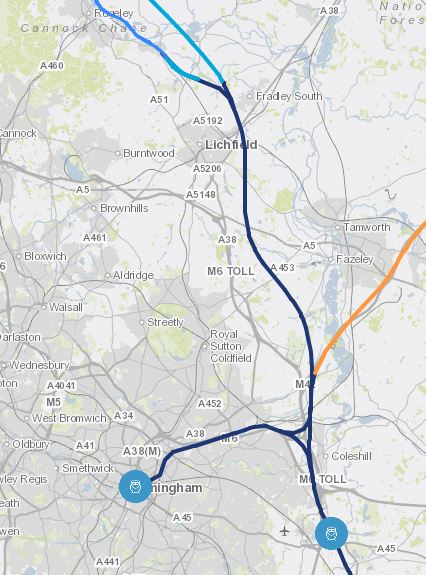
Note.
- High Speed Two Phases 1 and 2a are shown in blue.
- High Speed Two Phase 2b is shown in orange.
- At the top of the map, can be seen the junction, where High Speed Two to the North splits, that was shown in the previous map.
- The large blue dot in the West at the bottom of the map, is Birmingham Curzon Street station.
- The other large blue dot is Birmingham International station.
- The three sections of High Speed Two to London, Birmingham Curzon Street and the North meet at a triangular junction between the two Birmingham stations.
- High Speed Two to the East Midlands, branches off to the East North of the triangular junction.
This third map clipped from the High Speed Two web site, shows between Lichfield and Crewe.
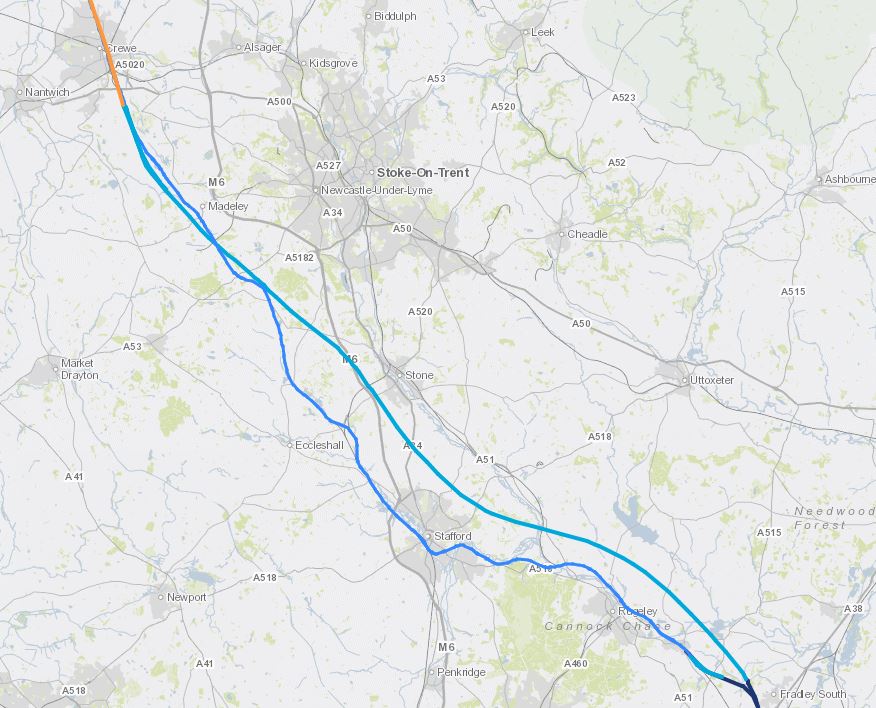
Note.
- High Speed Two Phase 2a is shown in blue.
- High Speed Two Phase 2b is shown in orange.
- Crewe is in the North-West corner of the map, where at the South end of the orange section.
- The junction at Lichfield is in the South-East corner of the map.
- The lighter blue route to the East, between the Lichfield junction and Crewe is the new tracks of High Speed Two.
- The darker blue route to the West, between the Lichfield junction and Crewe is the existing route of the Trent Valley Line and the West Coast Main Line.
- The Trent Valley Line joins the West Coast Main Line at Stafford.
These are a few thoughts and questions.
How Will Trains Go Between Birmingham Curzon Street And London?
Trains will use the triangular junction shown in the second map to go between the two Birmingham stations and then head South,
How Will Trains Go Between Birmingham Curzon Street And The North?
Trains will use the triangular junction shown in the second map to turn North and then take one of the two routes to the North; High Speed Two or Trent Valley Line/West Coast Main Line.
How Will Trains Go Between Birmingham Curzon Street And The North If High Speed Two Between Birmingham And The North Is Scrapped?
If High Speed Two is scrapped from the Northern point of the triangular junction to the North, there will be no way that trains could go North from Birmingham Curzon Street.
- The overcrowded Birmingham New Street station will still be the link to the North of England and Scotland for Birmingham.
- How would trains connect to the future branch to East Midlands Parkway, which connects just North of the triangular junction?
I suspect that a short stub will be built North of the triangular junction to connect to the Trent Valley Line, which is currently, the main route of trains between London and the North through the West Midlands, for trains that don’t go through Birmingham.
Trains Between London And Stafford
Currently, Avanti West Coast trains take around one hour and seventeen minutes between London and Stafford.
The Wikipedia entry for High Speed Two gives these times between London and Stafford.
- Fastest time before High Speed Two – one hour and seventeen minutes.
- Time after Phase 2a of High Speed Two opens – fifty-five minutes.
Note.
That is a time saving of twenty-two minutes.
High Speed Two Trains will use the link between the junction at Lichfield and the Trent Valley Line.
How Many Avanti West Coast Services Use The Trent Valley Line?
These trains use the Trent Valley Line.
- London and Holyhead – 8 tpd
- London and Liverpool Lime Street – 1 tph, which is planned to increase to 2 tph
- London and Manchester Piccadilly – 2 tph
- London and Blackpool North – 1 tpd
- London and Glasgow – 1 tph
Note.
- tpd is trains per day
- tph is trains per hour
This is roughly six tph.
Would It Be Possible To Finish High Speed Two At The Lichfield Junction And Connect It To The Trent Valley Line?
This is a repeat of the first map.
Note.
- High Speed Two runs North-South across the map.
- After the Junction by Fradley South, High Speed Two to Crewe and the North, is the branch to the East.
- The other branch connects to the Trent Valley Line at Handsacre junction.
- Trent Valley Line can be picked out North of Lichfield, where it passes through Lichfield Trent Valley station.
If the Eastern branch North from the junction were to be scrapped, all trains between London and North would go via Stafford.
As all these tracks are planned and must be at an advanced stage, that is ready for construction, I feel the route would be feasible.
It would have these benefits.
- Birmingham Curzon Street services and the North-West of England and the West of Scotland would be possible.
- Services between London and Stafford will be twenty-two minutes faster, than they are now.
- Time savings will also apply to services from London to Liverpool, Macclesfield, Manchester, Stoke-on-Trent and all stations between Crewe and Glasgow.
The capacity of the Trent Valley Line would be the limiting factor.
Time Savings Between Crewe And Preston
According to the Wikipedia entry for High Speed Two, after Phase 2a of High Speed Two opens, these will be the fastest times to Crewe and Preston.
- Crewe – 0:56
- Preston 1:18
Note.
- The fastest Preston service runs non-stop between Euston and Preston.
- Crewe and Preston are 51 miles apart.
A time of 22 minutes between Crewe and Preston, means the average speed is 139 mph.
Does this mean that High Speed Two will improve between Crewe and Preston to allow 140 mph non-stop running?
But 22 minutes is certainly an improvement on the current time between Crewe and Preston for Scottish trains of 40 minutes.
Time Savings Between Crewe And Liverpool
The upgrading of the line between might save another couple of minutes between Crewe and Weaver junction.
What Times Would Be Possible Via High Speed Two And The Trent Valley Line?
These times are based on the following.
- The twenty-two minute saving to Stafford, as all High Speed Two services to the North-West of England and the West of Scotland will go via Phase 1 of High Speed Two and Stafford.
- A saving of eighteen minutes will be applied to Scottish services because of savings between Crewe and Preston.
This would give these times in hours:minutes.
- Blackpool – 2:10
- Carlisle – 2:35
- Chester – 1:28
- Crewe – 1:08
- Glasgow – 3:50
- Holyhead – 3:10
- Lancaster – 2:03
- Liverpool Lime Street – 1:41
- Llandudno Junction – 2:24
- Macclesfield – 1:30
- Manchester Piccadilly via Crewe – 1:52
- Oxenholme – 1:54
- Preston – 1:46
- Runcorn 1:31
- Stafford – 0:55
- Stockport – 1:35
- Stoke-on-Trent – 1:10
- Warrington – 1:22
- Wigan 1:33
- Wilmslow – 1:25
I have calculated extra services to Blackpool and North Wales.
Adding The Lichfield And Crewe Section
Consider.
- My calculations indicate that London and Crewe will take 1:08.
- The Wikipedia entry for High Speed Two, after Phase 2a of High Speed Two opens, gives the fastest time to Crewe as 0:56.
This indicates that adding the section of High Speed Two between Lichfield and Crewe will save a further twelve minutes.
Conclusion
I strongly believe that an upgraded Trent Valley Line linked to a shortened High Speed Two at Lichfield could improve journey times between London, Birmingham and the North.
There are certainly savings to be made.
See Also
New Station Proposed For National Arboretum
The title of this post, is the same as that of this article on Railnews.
This is the first two paragraphs.
It has been revealed that a new station is being proposed at Alrewas between Lichfield Trent Valley high level and Wichnor Junction, which is on the line linking Tamworth and Burton-on-Trent. The original station serving the village of Alrewas was closed in 1965, although the line remained open.
A new Alrewas station would serve the National Memorial Arboretum, which is visited by more than 300,000 people a year and stages 250 events, including services of remembrance. It includes a Railway Industry Memorial, which was unveiled in May 2012, and also a memorial commemorating the thousands of prisoners of war who were forced to work on the infamous Burma Railway in the Second World War.
I first wrote about this proposed station in Everybody Could Do Better For Rail In South Staffordshire.
Two totally unrelated events had happened.
- I heard the exchange during Prime Minister’s Questions and Michael Fabricant was passionate about creating the rail service on the freight-only line to give passenger train access to the National Memorial Arboretum and Alrewas.
- Burton were playing Manchester City in the League Cup, so the Police thought it would be a good idea to shut the M6. Nothing moved for hours and many Burton supporters missed the match.
Note.
- Quite frankly, it is a disgrace, that the National Memorial Arboretum, has been designed for most visitors to come by car.
- The M6 incident was caused by illegal immigrants stuffed into the back of a truck, but surely the Police reaction to shut the motorway for so long was over the top?
- I have been to Burton by train a couple of times and it is one of those places, you wouldn’t go to by train, unless it was absolutely essential.
It would appear that after a quick glance, Michael Fabricant’s proposal could be one of those ideas, that would benefit a lot of travellers.
These are a few thoughts on the new service.
Services To And From Burton-on-Trent Station
I said this about services to and from Burton-on-Trent in Everybody Could Do Better For Rail In South Staffordshire.
If you look at the train services from the town, you can go to faraway places like Glasgow and Plymouth, but services to practical local places like Lichfield, Stoke and Derby are rare. There used to be a service to London, but that was discontinued in 2008.
A regular service between Burton and Lichfield, running at a frequency of two trains per hour (tph) could connect at Lichfield to the following services.
- Hourly services on the West Coast Main Line
- Half-hourly services across Birmingham on the Cross-City Line.
If a decent service via Lichfield had existed, how many fans on that League Cup night, would have used the trains to get to Manchester?
Not many probably, as there would not have been a late train home, as is particularly common in The Midlands. Try getting back to London from Derby, Nottingham or Sheffield, after 21:30 for example!
I am certain, that with a station at Alrewas and a well-designed train service between Burton-on-Trent and Birmingham stations via Alrewas for the National Memorial Arboretum and Lichfield would be a positive addition to the transport system of the area.
Electrification Between Litchfield Tent Valley And Burton-on-Trent Stations
This map from Open Railway Map shows the track between Litchfield Tent Valley and Burton-on-Trent stations.

Note.
- Burton-on-Trent station is in the North-East corner of the map.
- Lichfield Trent Valley station is in the South-West corner of the map.
- Burton-on-Trent and Lichfield Trent Valley stations are probably less than fifteen miles apart.
- The orange line is the Burton-upon-Trent and Birmingham line via Tamworth.
- The yellow line is the Burton-upon-Trent and Birmingham line via Lichfield.
The National Memorial Arboretum is just South of the junction between the orange and yellow lines.
This second map from Open Railway Map shows this junction to a larger scale.
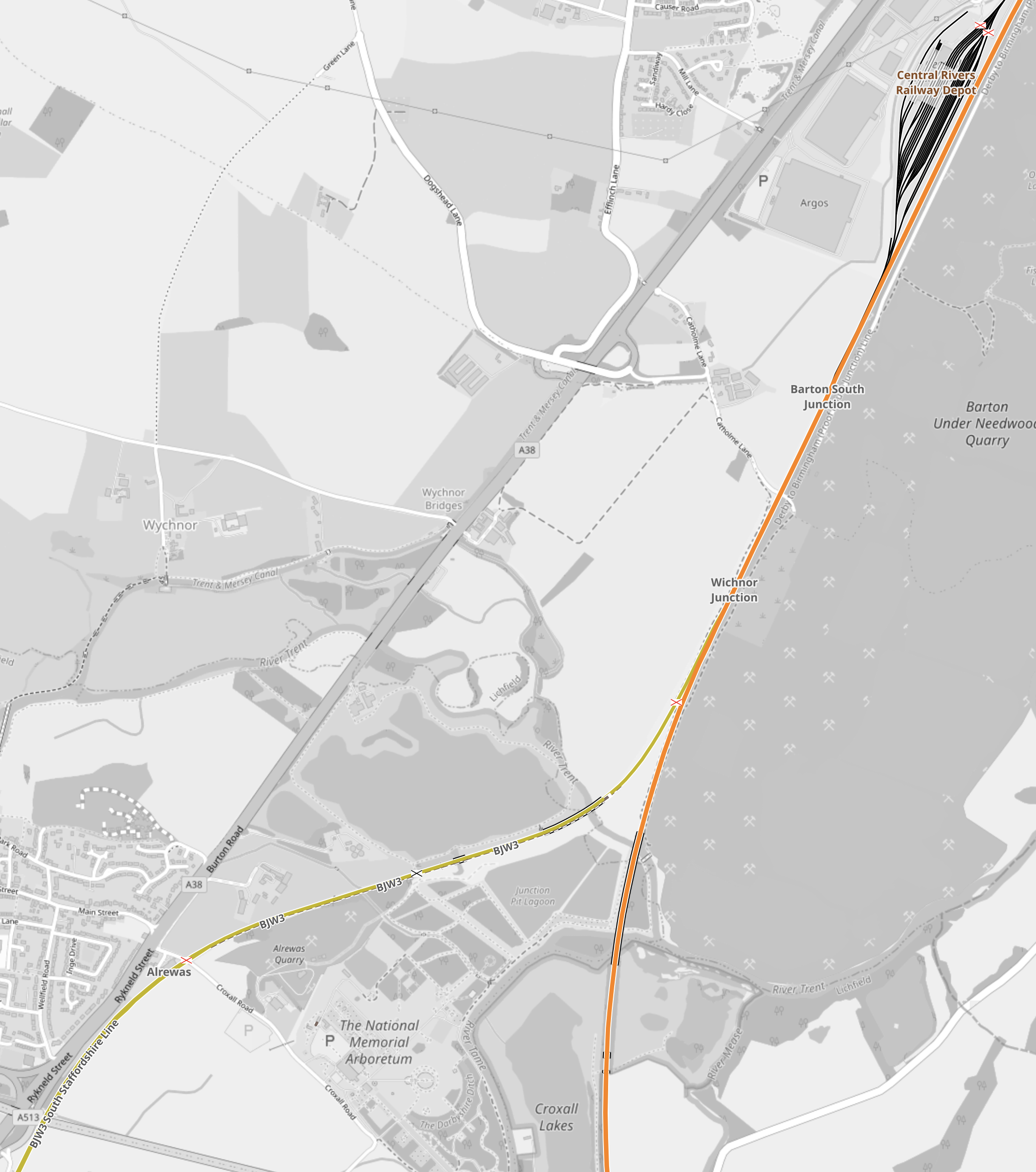
Note.
- The National Memorial Arboretum can be seen between the two tracks.
- The village of Alrewas and the site of the proposed Alrewas station are to the West of the arboretum.
- Central Rivers depot, where CrossCountry trains are serviced, is in the North-East corner of the map.
- I have found a twelve car formation of Class 220 trains running between Birmingham New Street station and Central Rivers depot.
There is electrification at Lichfield Trent Valley station as this picture shows.

This electrification could be extended as far as required.
I would extend the electrification all the way to Burton-on-Trent.
- This would mean that the Class 730 trains used on the Cross-City Line could terminate at Burton-on-Trent station, rather than Lichfield Trent Valley station, after extra stops at Alrewas for the National Memorial Arboretum and possibly another new station at Barton-under-Needwood.
- Excursion trains for the National Memorial Arboretum could be electric-hauled.
- It would also mean that electric trains could reach Central Rivers depot under their own power.
- It would probably require less than fifteen miles of double-track electrification.
- I suspect that the West Coast Main Line electrification could provide enough power for the branch electrification to Burton-upon-Trent.
I doubt that this would be considered a major electrification scheme.
Electric Services Between Birmingham New Street And Leicester Stations Via Burton-on-Trent
Consider.
- Leicester and Burton-on-Trent stations are under thirty miles apart on the Ivanhoe Line.
- The Ivanhoe Line is an existing freight line, that could be opened to passenger trains.
- Leicester is to be electrified in the Midland Main Line electrification.
A battery-electric service could be run between Birmingham New Street and Leicester stations via Burton-on-Trent, Alrewas and Lichfield Trent Valley stations.
It should also be noted that East Midlands Railway run a service between Lincoln and Leicester.
- Nottingham and Leicester will probably electrified with the rest of the Midland Main Line.
- Only thirty-four miles of the route between Leicester and Lincoln is not electrified.
If it were felt to be needed, a battery-electric service could be run between Birmingham New Street and Lincoln stations.
Heritage Rail Excursions To The National Memorial Arboretum
Type “Coach Trips To The National Memorial Arboretum” and you get a good selection of trips from all over the UK.
I believe that the National Memorial Arboretum, would make the ideal destination for steam- or diesel-hauled heritage rail excursions with all the trimmings.
- They could even be hauled by a Class 90 electric locomotive, dating from the late 1980s, if the route between Alrewas and Lichfield were to be electrified.
- Rakes of comfortable Mark III coaches could be used.
- A long platform at Alrewas station would be needed, so that the maximum size of heritage train could be handled.
- For steam locomotives, there may need to be a runround loop.
Track improvements at Lichfield Trent Valley station, may allow direct services from London.
This page on the West Midlands Rail Executive web site is entitled Steam Engine Rolls Into Moor Street Station To Launch New Vintage Trains Partnership.
This is the first two paragraphs.
Historic steam engines are set to play a greater role in the region’s rail network following the signing of a ground-breaking new partnership.
The West Midlands Rail Executive (WMRE) has teamed up with Tyseley-based Vintage Trains in a bid to establish the Shakespeare Line as Britain’s premier mainline heritage railway.
Perhaps, it would be possible to run a heritage train like a short-formation InterCity 125 between Stratford-om-Avon and the National Memorial Arboretum.
Conclusion
Opening up of the Lichfield Trent Valley and Burton route to passenger trains opens up a lot of possibilities.
Talks Take Place Over Plans To Reopen Railway Line Between Lichfield And The National Memorial Arboretum
The title of this post, is the same as that of this article on Lichfield Live.
The title is a good summary of what happened between the local MP, the Chief Executive of the West Midlands Rail Executive and the Chief Executive of the National Memorial Arboretum.
This map shows the National Memorial Arboretum.
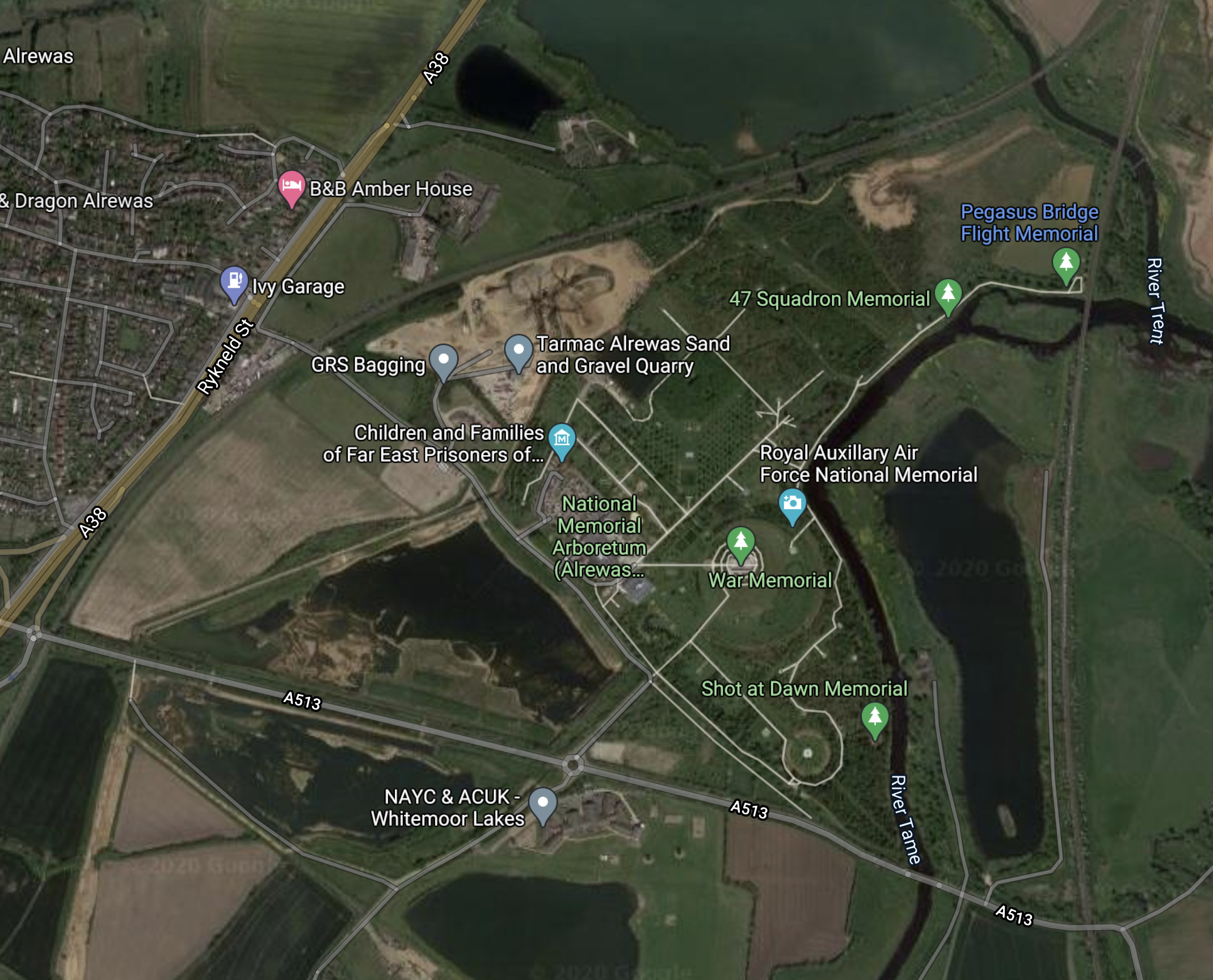
Note.
- The village of Alrewas is to the North West of the arboretum.
- The Burton and Lichfield line lies between the village and the arboretum.
- The station will go on this line.
The article also gives details of the station.
- It would initially be a simple single-platform station.
- Trains would not be electric.
- if successful, a two-platform station would be built.
- This station would be connected to the village by a footbridge over the A38.
- Many visitors would be able to walk to the arboretum, but an environmentally-friendly shuttle would be provided.
One of those at the talks is quoted as calling the station; National Memorial Arboretum at Alrewas.
A Train Service To National Memorial Arboretum at Alrewas
Currently, there is an electric train service to the high-level platform at Lichfield Trent Valley station, which is shown in this picture.
Note.
- The service runs with a frequency of two trains per hour (tph) across the City of Birmingham to either Redditch or Bromsgrove.
- The trains are being replaced with new Class 730 trains.
- Lichfield Trent Valley and Alrewas are about six miles apart.
- Lichfield Trent Valley and Burton-on-Trent are less than fifteen miles apart.
As the new Class 730 trains are Aventras, there is the possibility, that battery electric versions could be created.
Because of the distances involved, extending this route to the National Memorial Arboretum at Alrewas or even Burton-on-Trent, using battery electric trains is a very feasible proposition.
No new infrastructure, except for the new station at National Memorial Arboretum at Alrewas would be needed.
Conclusion
This is a very sensible proposal and I can’t understand, why when the National Memorial Arboretum was first proposed, that this rail service wasn’t built at the same time.
 The Anonymous Widower