A New Metier
This article in The Times today is entitled Too many Sir Humpreys are stopping London from taking a punt.
The article is about one of Britain’s most successful private investors ; John Gunn.
The article also introduces a new company to me, with this paragraph.
His latest enthusiasm is for Metier, a company that aims to leapfrog electric vehicle power to convert buses and heavy trucks to hydrogen fuel cells. Several big firms such as Volvo are making new hydrogen-powered vehicles, but Gunn and his partners reckon there is more money in reconfiguring existing ones.
It was Metier, that caught my eye.
In the 1970s, with three others, I started a company called Metier Management Systems, which developed a project management system called Artemis.
We were very successful, in that we sold the company for a nine figure sum and won two Queen’s Awards for Exports.
Since then, there have been several successful companies named Artemis, but we haven’t seen a Metier.
Until now that is and I hope that the hydrogen vehicle company is as successful worldwide as we were.
Strangely, my first job on leaving Liverpool University was in a hydrogen factory and I am a great believer in using the gas as a source of energy.
Metier have a web site, if you want to find out more about the company.
The Crown Estate Awards GBP 5 Million In First Supply Chain Accelerator Round
The title of this post, is the same as that of this article on offshoreWIND.biz.
This is the sub-heading.
The Crown Estate has awarded nearly GBP 5 million in funding to 13 organisations across England, Wales, and Scotland in the first round of its Supply Chain Accelerator.
These three paragraphs add more details.
According to The Crown Estate, the funding will help kick-start projects drawing down from a GBP 50 million fund established in May this year to accelerate and de-risk the early-stage development of UK supply chain projects that service the offshore wind sector.
The Crown Estate’s match funding will contribute to a combined development investment of over GBP 9 million, which, if the opportunities successfully conclude their respective development stages, could lead to more than GBP 400 million of capital investment, said the UK body.
Projects receiving funding include those enabling floating wind platforms, anchoring and mooring systems, operations and maintenance facilities, test facilities, and those supporting the skills
The grants have been widely spread in both the public and private sectors and appear to be supporting a variety of technologies.
What About Project Management?
When the four of us started Metier Management Systems to develop Artemis in the 1970s, we got no help from the Government or any agency.
I wonder what difference, government support of this nature would have made?
I don’t know whether any project management development is being supported, but it is my view, that each new generation of projects will bring forward new challenges.
Smart Train Lease Aims ‘To Make Renting Trains As Easy And Simple As Renting A Car’
The title of this post, is the same as that of this article on Railway Gazette International.
These four paragraphs outline the scheme.
Siemens Mobility has established a leasing subsidiary that would enable train operators to use its Mireo Smart battery, hydrogen and electric multiple-units without needing to make long-term investment commitments.
Smart Train Lease GmbH would make available at short notice multiple-units already approved for operation. These could be short or medium-term leases, with services such as maintenance available as part of the package. The aim is to provide operators with an economical way to quickly and flexibly expand their fleets and try out more sustainable traction technologies.
‘We want to make renting trains as easy and simple as renting a car, and thus help accelerate the mobility transition’, the leasing company’s CEO Benjamin Dobernecker explained on February 14.
Smart Train Lease will initially operate in Germany, although it plans to expand throughout Europe in the medium term.
I like this idea and I think it will work.
Metier Management Systems And Artemis
When four of us started Metier Management Systems in 1977 to sell our mini-computer-based project management system; Artemis, we generally rented or leased our systems, although we did sell some as the years progressed.
- For a fixed fee per month, a company got a project management computer and all the software.
- The fixed fee included installation, first line support, training and software updates.
- We could also supply extra training and project management consultancy at appropriate rates.
- The only extra costs to the client were the electricity to power the hardware and the paper to put in the printer.
- We also allowed clients to convert leases into outright sales.
This simple sales model appealed to a lot of our clients.
- The cost of the system was easy to budget.
- Many of our clients were happy with leasing or renting computer equipment.
- As the system was desk-sized, it easily fitted the average office.
But the leasing model was very advantageous to us.
- Most of our clients were large high-value quality organisations like big oil companies, nationalised industries and engineering consultancies.
- Our Finance Director and our Bank Manager at Lloyds Bank devised a plan, whereby we bundled a number of high-quality leases together and sold the bundle to Lloyds Bank’s leasing company.
The money we received gave us a healthy cash flow.
- The cash flow was then used to fund Research and Development and to finance more sales.
- If say someone like BP or Shell should phone up or send a fax, wanting a system immediately, we were generally able to fulfil their request.
I am sure that Siemens Mobility will be using a similar model.
They will aim to have trains in stock to fulfil clients needs.
So if Deutsche Bahn phone up saying have you got a three-car battery-electric train that works with 15 KVAC and has a range of 100 kilometres for next Monday, Siemens Mobility can generally say yes.
What helps is that the modular Mireo Smart multiple unit comes in battery, hydrogen and electric versions.
Extras could include full servicing a driver.
So Siemens Mobility will plug the train together and deliver it.
How Would Siemens Use The Leasing Model In Great Britain?
Consider.
- There are a lot of routes that need to be decarbonised in Great Britain.
- Many of these routes have electrification at one or both ends.
- Often these routes terminate in a bay platform.
- On most of these routes a two-, three-, four- or five-car train will be sufficient capacity.
- In the Desiro City, Siemens have a train, that is acceptable to Great Britain.
- If routes in Great Britain are to be electrified, they must be electrified with 25 KVAC overhead wires.
- Trains would be 100 mph, so they wouldn’t be limited as to routes.
- A Mireo-B has a range of between 80-100 kilometres or 49.7-74.6 miles.
I am sure Siemens Desiro City or its European equivalent; Mireo can be developed into a family of trains suitable for GB!
- The basic train would be two driving cars.
- Length would be increased by coupling trailer cars between the two driving cars.
- Hydrogen power would be in one of the trailers.
- Batteries would be under an appropriate number of cars.
Battery trains would be able to use a simple automatic charger, similar to the one, that I described in GWR Trialling Transformative Ultra-Rapid Charging Train Battery.
An Example – Mid-Cornwall Metro
This map shows the Mid-Cornwall Metro.

Consider.
- Newquay and Par is 20.8 miles.
- Falmouth Docks and Par is 30.8 miles.
- Newquay and Falmouth Docks is 51.6 miles.
- The maximum speed between Par and Newquay is around 30 mph
- The maximum speed between Par and Falmouth Docks is around 50-70 mph
- There are twelve intermediate stations.
- There is a reverse at Par station.
- Charging would be easy to install at Falmouth Docks, Newquay and Par.
- In Par Station – 10th February 2024, I suggested that Par station could be fully-electrified, so that expresses could have a Splash-and-Dash on their way to London and Penzance. If all platforms at Par were electrified the Mid-Cornwall Metro trains could charge from the electrification, as they reversed.
There are two main ways that the Mid-Cornwall Metro might operate.
- There would be chargers at Newquay and Falmouth Docks and trains would shuttle the 51.6 miles between the two stations.
- There would only be charging at Par and trains would after charging at Par go alternatively to Newquay and Falmouth Docks.
The first might need smaller batteries and the second would only need one charger.
An Example – Uckfield Branch
The Uckfield branch is in Southern England.
- It is not electrified between Hurst Green Junction and Uckfield, which is 24.7 miles.
- There are eight intermediate stations.
- The line can accommodate ten-car trains.
There is space at Uckfield station for a charger.

Charging would be at Uckfield station and North of Hurst Green Junction, where it will use the existing electrification.
Conclusions
This leasing/rental model will surely encourage train operators to replace diesels with appropriate zero-carbon alternatives on routes that need to be decarbonised.
Hail The Hercules
The title of this post was used on the front page to indicate an article in the Meccano Magazine about the arrival of the Lockheed Hercules in the mid-1950s.
The Wikipedia entry for the Hercules, starts with this sentence.
The Lockheed C-130 Hercules is an American four-engine turboprop military transport aircraft designed and built by Lockheed (now Lockheed Martin). Capable of using unprepared runways for takeoffs and landings, the C-130 was originally designed as a troop, medevac, and cargo transport aircraft.
The aircraft first flew in 1954 and nearly seventy years later they are still doing the same operations, they were designed for, with various reports of Hercules flying to the remote Wadi Seidna airstrip in Sudan.
This Google Map shows the airstrip.

Note.
- There appears to be two runways and some form of operational building or terminal.
- The River Nile is at the East of the map.
It looks like an airfield, where Hercules are intended to be used, even in circumstances, where severe damage has been inflicted to the runway.
When Metier Management Systems and Artemis were sold to Lockheed, I had several conversations with senior people and the company was and probably still is rightly proud of its long-lived design.
Maritime UK Launches Offshore Wind Plan
The title of this post, is the same as that of this article on offshoreWIND.biz.
This is the sub-heading.
Maritime UK has unveiled its Offshore Wind Plan which makes a series of recommendations for how the maritime sector, the offshore wind sector, and governments can work together to maximise growth
These are the first three paragraphs and they outline the plan.
The plan outlines how the growth of offshore wind can provide opportunities across the maritime supply chain in sectors like ports, shipbuilding, crewing, and professional services.
Opportunities identified in the Offshore Wind Plan include building vessels in the UK to support developments and further growing UK ports as centres for manufacturing and assembly for offshore developments
Key recommendations and proposals within the plan include: creating quality career pathways for young people; rewarding higher UK supply chain content in offshore wind projects; reforming the planning system to enable green projects to be delivered quicker; and encouraging lenders and investors to finance infrastructure and vessels
Note.
- Maritime UK have a web site.
- The report seems to be comprehensive.
- The report predicts hundreds of ships to build and service wind farms will be needed.
Overall, Maritime UK feel that the maritime sector has a lot to gain from co-operation with the offshore wind sector.
Improved Service Operation Vessels (SOVs)
I don’t see why the large number of Service Operation Vessels (SOVs) needed to serve all the wind farms around our shores, can’t be designed and substantially built in the UK.
In the 1970s, one of Metier Management Systems’ customers for Artemis were the shipbuilders; Austin & Pickersgill, who at the time were building a cargo ship called the SD14, which had been designed to replace the American Liberty ships.
In total 211 SD14s were built in the UK, Greece, Brazil and Argentina.
SD14 stands for Shelter Deck – 14,000 tonnes.
We surely have the technology from companies like BAe Systems, Rolls-Royce and others to design an advanced Service Operation Vessel.
Diversifying A US$200 billion Market: The Alternatives To Li-ion Batteries For Grid-Scale Energy Storage
The title of this post, is the same as that of this article on Energy Storage News.
This is the introductory paragraph.
The global need for grid-scale energy storage will rise rapidly in the coming years as the transition away from fossil fuels accelerates. Energy storage can help meet the need for reliability and resilience on the grid, but lithium-ion is not the only option, writes Oliver Warren of climate and ESG-focused investment bank and advisory group DAI Magister.
Oliver starts by saying we need to ramp up capacity.
According to the International Energy Agency (IEA), to decarbonise electricity globally the world’s energy storage capacity must increase by a factor of 40x+ by 2030, reaching a total of 700 GW, or around 25% of global electricity usage (23,000TWh per annum). For comparison, this would be like swelling the size of the UK’s land to that of the USA.
Similar to how “nobody ever gets fired for buying IBM”, lithium-ion holds a similar place in grid scale electrical storage today.
And just as IBM did in the last decades of the last century, the builders of lithium-ion will fight back.
He then lists the problems of grid-scale lithium-ion batteries.
- Shortage of cobalt.
- Toxic and polluting extraction of some much needed metals and rare earths from unstable countries.
- Lack of capacity to load follow.
- Limited lifespan.
He does suggest vehicle-to-grid can provide 7TWh of storage by 2030, but it has similar problems to lithium-ion grid scale batteries.
Finally, he covers these what he considers several viable methods of energy storage in detail.
He introduces them with this paragraph.
No single killer application or technology exists to get the job done. Diversification is key with success dependent on the wide-scale adoption of multiple grid-scale energy storage solutions.
- Energy Dome – Italy – Stylish Use of CO2
- Augwind Energy – Israel – Stores Energy As Compressed Air Underground
- Cheesecake Energy – UK – Stores Energy As Heat And Compressed Air
- Highview Power – UK – Stores Energy As Liquefied Air
- Ocean Grazer – Netherlands – Ocean Battery
- RheEnergise – UK – High Density Hydro
- Lumenion – Germany/Japan – Stores Energy As Heat
- Energy Vault – Switzerland – Raising And Lowering Of Weights
Note.
- All systems are environmentally-friendly and use readily-available materials like air, water, sea-water, steel and concrete for their systems.
- The most exotic materials used are probably in the control computers.
- Some systems use readily-available proven turbo-machinery.
- Most systems appear to be scalable.
- All systems would appear to have a working life measured in decades.
- I would expect that most well-educated teenagers could understand how these systems worked.
Only Augwind Energy and Lumenion are new to me.
He finally sums up the economics and the market potential.
Our ability to expand energy storage capacity is one of the most pressing issues that will determine whether this defining ‘transitional’ decade is a success. But we’ll need to invest wisely into the right technologies that get the greatest bang for the buck (in terms of GWh capacity and return on capital) given the limited lifespan of Li-Ion and the decarbonisation of the grid.
At a current capital cost of US$2,000 per kW quoted by the US National Renewable Energy Laboratory (NREL) for 6-hour Li-ion battery storage, the 700GW of capacity needed by 2030 equates to around a US$1.5 trillion market over the coming decade, making it worth nearly US$200 billion a year.
The Energy Storage News article is a comprehensive must read for anyone, who is considering purchasing or investing in energy storage.
I have some further thoughts.
From My Experience Would I Add Any Other Systems?
I would add the following.
- Form Energy, because its iron-air battery is well-backed financially.
- Gravitricity, because it can use disused mine shafts to store energy and the world has lots of those.
- STORE Consortium, because its 3D-printed concrete hemispheres, that store energy using pressurised sea-water can be placed within a wind farm.
I also suspect that someone will come up with an energy storage system based on tidal range.
Finance
When we started Metier Management Systems, finance to breakout from the first initial sales was a problem. We solved the problem with good financial planning and an innovative bank manager who believed us all the way.
David, was a rogue, but he was a rogue on the side of the angels. Long after Metier, he even came to my fiftieth birthday party.
David would have found a way to fund any of these systems, as they tick all the boxes of demonstrated, environmentally-friendly, safe and understandable. They are also likely to be bought by companies, governments and organisations with a high net value, a very respectable reputation and/or large amounts of money.
I also think, that just as we did with the original Artemis project management system, some of these systems can be leased to the operators.
Second-Use Of Systems
Several of these systems could be moved on to a new location, if say they were supporting an industry that failed.
That would surely help the financing of systems.
KPF Unveils Plans For Old Street Skyscraper
The title of this post, is the same as that of this article on the Architects’ Journal.
This is the sub-heading.
Kohn Pedersen Fox Associates (KPF) has unveiled early plans for a 160m office tower by Old Street roundabout in East London
These three paragraphs describe the development.
The site at 99 City Road is currently occupied by a 10-storey postmodern office block developed in the late 1980s as headquarters for satellite telecommunications company Inmarsat. However, Inmarsat relocated last year and developer Endurance Land bought the site in spring for £150 million.
The new owner now wants to demolish 37 per cent of the existing building, before vertically extending it to create an approximately 37-storey tower providing an additional 45,000m2 of office space, according to early plans published for consultation.
The tower scheme would feature improved public realm around the building, as well as active frontages, café space and 510m2 of flexible community space – including a triple-height ‘great room’, which could hold markets, exhibitions, and performances.
I took these pictures these morning as I passed the site at the front of the top-deck of a 21 bus.




















Note.
- I showed the approach to the station, to show the number of high rises in the area.
- The Inmarsat Headquarters at 99 City Road is on the South-East corner of the roundabout, with a new station entrance alongside.
- Unusually it has Inmarsat shown vertically on the front.
- The double-fronted curved building is the Bezier Apartments, which made the short-list for the Carbuncle Cup in 2010.
- The building on the South-West corner is the White Collar Factory.
The construction of the new Old Street station seems as slow as ever.
I have some thoughts.
Will The Building Fit In?
The architects’ Journal article says this.
Consultation documents said the tower’s design is ‘rooted in the distinct history of the local areas’, its appearance ‘tak[ing] inspiration from the Victorian buildings in the neighbouring conservation areas of Bunhill Fields, Finsbury Square and South Shoreditch’.
I can see some arguments as at 37 stories, it’s two higher than the Barbican towers.
Will Access Between The New Building And Old Street Station Be Good?
This map from Transport for London shows the future layout of Old Street Roundabout.
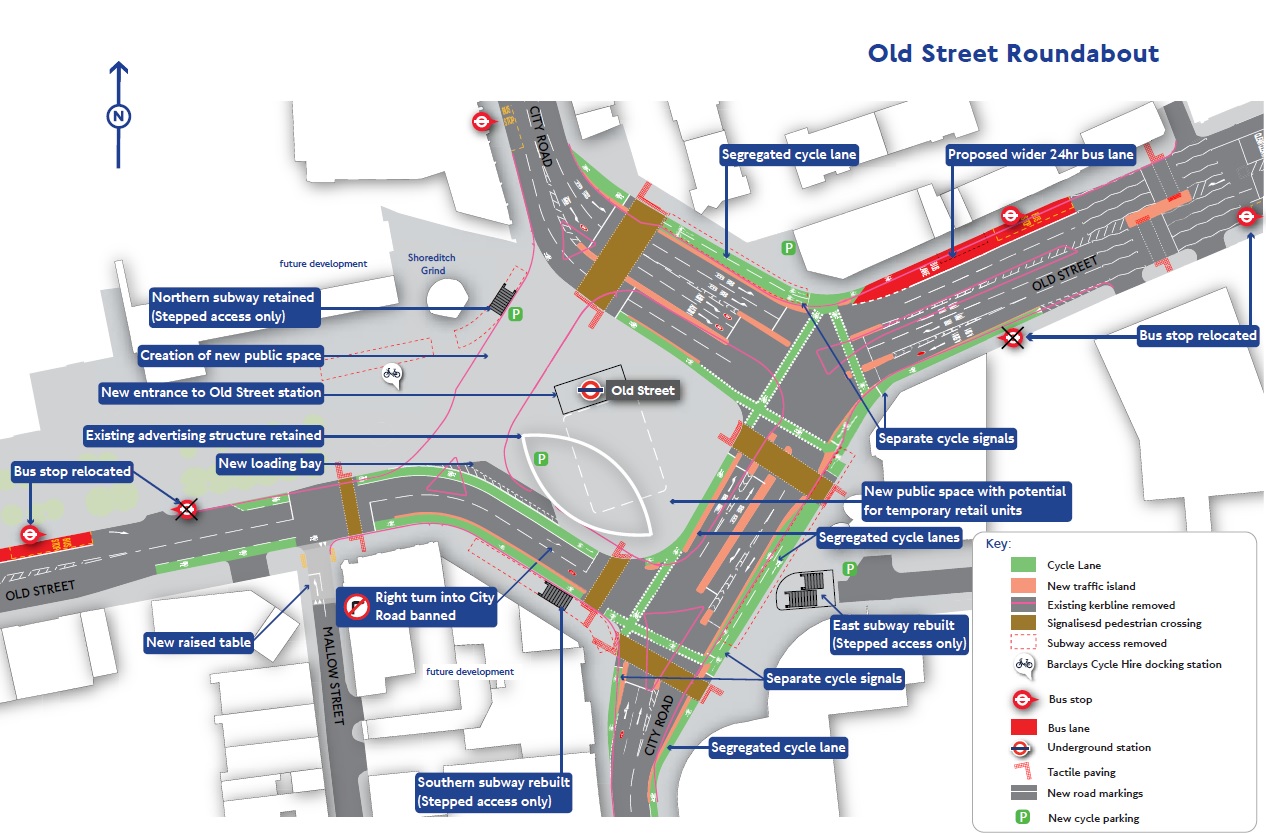
Note.
- The Inmarsat Headquarters is in the South-East corner of the roundabout.
- There is a new entrance to the station between the building and the Bezier apartments.
- The new main entrance to the station in the middle of the roundabout.
- Original plans showed a lift to the main station entrance from the surface, but two may have been built.
There appears to be a subway and two light-controlled pedestrian crossings between the new development and the station.
This Google Map shows the current state of Old Street Roundabout and the front of the Inmarsat Headquarters.

It can’t be long before developers build on the other two sides of the roundabout.
Who Will Be The Tenants?
This article on the Hackney Gazette, is entitled New 36-Storey Office Tower Proposed For Old Street.
It says this about the tenants.
The new site would contain approximately 4,000 sqm of new affordable workspaces that would be accessible to local businesses and organisations.
I suspect that these offices will be much better than some of the dumps Metier worked out of in the 1970s and 1980s.
Just promising to show the view could get a few visitors and some possible sales
Will The Building Have An Observation Platform?
At 160 metres tall, this building will be 150 metres shorter than The Shard, but it will be 27 metres than the Barbican towers.
So why not have an observation platform?
I suspect that from there, you will be able to see Hackney Mashes, as there are few buildings in between.
Portugal Were Glued, Stitched And Morocco-Bound
Metier’s amazing company accountant; Brian used to use a phrase of screwed, glued and tattooed, when a person or company was in trouble with the authorities and they would have to pay up.
My father was a printer and bookbinder and after today’s World Cup match between Portugal and Morocco, he’d have come up with an appropriate phrase like glued, stitched and Morocco-bound.
Note that both Brian and my father had a lot of the real East End about them.
Hanover Square – 9th May 2022
I went to have a look at the new entrance to Bond Street station in Hanover Square.








I have a strong affection for Hanover Square. The first picture shows a new block now, but it was where my bank manager friend had his office for a time.
I spent a lot of time with him and meetings in that office overlooking the square had a lot to do with the success of Metier Management Systems.
They don’t make bank managers like that anymore.
Are The Office Of Rail And Road (Or Their Lawyers) Too Risk Averse?
An article in the April 2022 Edition of Modern Railways is entitled Uckfield Third Rail Is NR Priority.
This is the first two paragraphs.
Electrification of the line between Hurst Green and Uckfield in East Sussex and the remodelling of East Croydon are the top Network Rail investment priorities south of the river, according to Southern Region Managing Director John Halsall. He told Modern Railways that third rail is now the preferred option for the Uckfield Line, as it would allow the route to use the pool of third-rail EMUs in the area. This is in preference to the plan involving overhead electrification and use of dual-voltage units put forward by then-Network Rail director Chris Gibb in his 2017 report (p66, September 2017 issue).
NR has put forward options for mitigating the safety risk involved with the third-rail system, including switching off the power in station areas when no trains are present and section isolation systems to protect track workers. ‘The Office of Rail and Road hasn’t yet confirmed third rail would be acceptable, but we are working out ways in which it could be’ Mr Halsall told Modern Railways. He added that bi-mode trains with batteries were not a feasible option on this line, as the 10-car trains in use on the route would not be able to draw sufficient charge between London and Hurst Green to power the train over the 25 miles on to Uckfield.
As an Electrical Engineer, who’s first real job in industry at fifteen was installing safety guards on guillotines nearly sixty years ago, I don’t believe that an acceptable solution can’t be devised.
But as at Kirkby on Merseyside, the Office Of Rail And Road, do seem to be stubbornly against any further third-rail installations in the UK.
I wonder what, the Office Of Rail And Road would say, if Transport for London wanted to extend an Underground Line for a few miles to serve a new housing development? On previous experience, I suspect Nanny would say no!
But is it more than just third-rail, where the Office Of Rail And Road is refusing to allow some technologies on the railway?
Battery-Electric Trains
I first rode in a viable battery-electric train in February 2015, but we still haven’t seen any other battery-electric trains in service on UK railways running under battery power.
Does the Office Of Rail And Road, believe that battery-electric trains are unsafe, with the lithium-ion batteries likely to catch fire at any time?
Hydrogen-Powered Trains
The hydrogen-powered Alstom Coradia iLint has been in service in Germany since September 2018.
But progress towards a viable hydrogen train has been very slow in the UK, with the only exception being demonstrations at COP26.
Are The Office Of Rail And Road still frightened of the Hindenburg?
Although hydrogen-powered buses have been allowed.
A Tale From Lockheed
When Metier Management Systems were sold to Lockheed, I worked for the American company for a couple of years.
I met some of their directors and they told some good American lawyer jokes, such was their disgust for the more money-grabbing of the American legal profession.
At the time, Flight International published details of an innovative landing aid for aircraft, that had been developed by Lockheed. It was a suitcase-sized landing light, that could be quickly setup up on a rough landing strip, so that aircraft, like a Hercules, with an outstanding rough field performance could land safely.
I read somewhere that a Flying Doctor service or similar had acquired some of these landing aids, so they could provide a better service to their clients.
But Lockheed’s lawyers were horrified, that they would get sued, if someone was seriously injured or even died, whilst the aid was being used.
Apparently, in the end, the aids were marked Not For Use In The USA.
Conclusion
I do wonder, if third-rail electrification, battery-electric trains and hydrogen-powered trains have come up against a wall created by over-cautious lawyers.
 The Anonymous Widower