BHP Joins The Party On Electric Rail
The title of this post, is the same as that of this article on Australian Mining.
This is the introductory paragraph.
BHP will add four battery-electric locomotives to its Western Australian rail network, becoming the fourth major miner to improve rail decarbonisation efforts in Australia since mid-December.
These are some details of the locomotives.
- Two are from Progress Rail and two are from Wabtec.
- The locomotives have 14.5 MWh batteries.
- The locomotives will be delivered by 2023.
BHP will also investigate the use of regenerative braking using the topography of the rail route.
With four companies going electric, it does seem that Australian mining, is very much driving the move to battery-electric heavy-haul freight.
Considering, that Wabtec only formally launched the FLXdrive concept in Pittsburgh in September last year, which I wrote about in FLXdrive ‘Electrifies’ Pittsburgh, that would appear to have been good going.
Green Ships Ahoy Along Vital Corridors
The title of this post, is the same as that of this article on 7 News Australia.
These are the first two paragraphs.
Australia’s biggest miners are preparing for a day of reckoning.
Shipping accounts for two to three per cent of global greenhouse gas emissions so manufacturers and retailers are no longer just considering what appears in national targets.
The article then goes on to explain how the big mining companies are cutting their emissions.
This paragraph illustrates how important mining and shipping is to Australia.
Resources and energy earnings passed $300 billion for the first time in 2020-21 and will surge towards $400 billion in 2021-22, according to December figures.
Hence the big need for ships fuelled by lower carbon fuels.
Green Trains On Their Way To Power One Of The World’s Most Abundant Mining Regions
The title of this post, is the same as that of this article on the Australian Broadcasting Corporation.
It is a comprehensive article, with maps, pictures and background information about the project I wrote about in Anglo American And Aurizon Look To Hydrogen-Powered Trains, that will create hydrogen-powered freight locomotives for Australia.
It should be noted that Aurizon operates a few hundred diesel-electric locomotives, so switching to hydrogen, would probably cut a lot of carbon emissions.
Anglo American And Aurizon Look To Hydrogen-Powered Trains
The title of this post, is the same as that of this article on World Coal.
This is the first paragraph.
Australia’s largest rail freight operator, Aurizon, and leading global mining company, Anglo American, have agreed to work together on a feasibility study to assess the introduction of hydrogen-powered trains for bulk freight in Queensland.
I find it interesting and very ironic, that this partnership has been formed, partly to transport the product, with the most polluting of end uses; coal.
The article also says this about Anglo American’s policy on decarbonisation of their mines.
As part of its commitment to carbon neutral mines by 2040, Anglo American has taken a global lead in the development of green hydrogen solutions for its ultra-class 290 t payload mine haul trucking fleet. Anglo American’s unique combination of powertrain technologies, designed to operate safely and effectively in real-world mine conditions, will displace the use of the majority of diesel at its mining operations, with an advanced trial of the prototype truck at its Mogalakwena platinum group metals mine in South Africa.
It does appear that the partnership are starting from a proven base of hydrogen technology.
Conclusion
This looks like a sound real-world project to produce a hydrogen-powered zero-carbon locomotive.
Plane Surveying Cornwall For Minerals
The title of this post, is the same as that of this article on the BBC.
These are the first two paragraphs.
A low-flying 1940s plane doing survey work will be a common sight over mid and west Cornwall during the next two to three weeks.
The geological mapping plane is hoping to identify where lithium and other minerals may be located underground.
But the most interesting thing about the project is the aircraft that does the surveying, which is a 1943 Douglas DC3.

It is being flown by Bell Geospace and the aircraft has been upgraded into a Basler BT-67, with turboprop engines, an improved airframe and modern avionics.
Having flown aircraft at the sort of height mentioned by the BBC, I’d love to get a lift on one of their survey flights.
Fortescue Future Industries As A First Mover In Global Green Hydrogen And Next Generation Mining Equipment
The title of this post, is the same as that of this article on International Mining.
This is the most significant sentence in the article.
Fortescue has set an industry leading target to be carbon neutral by 2030.
The article details how Andrew Forrest’s company intends to do it.
I found the article a fascinating read.
Blue Hydrogen Is Not Clean Energy, Says Mining Tycoon
The title of this post, is the same as that of this article on The Times.
This is the first paragraph.
Producing “blue hydrogen” from natural gas is not a clean energy source and is being wrongly promoted as one by the oil and gas industry, a billionaire mining mogul has claimed.
The mining mogul is Andrew Forrest, who is the second richest person in Australia.
I feel he is only partly right, as there are processes coming through that use a catalyst to split the hydrogen from the carbon.
But like the taxi in the picture at the top of the article with Mr. Forrest, his words are all good publicity.
Incidentally, I do believe that in a few years, we’ll have the technology to use so much carbon dioxide efficiently, that we may see gas-fired power stations used to create both energy and carbon dioxide.
Andrew Forrest’s Fortescue Future Industries Inks Deal With Kingdom of Jordan For Green Hydrogen Study
The title of this post, is the same as that of this article on The West Australian.
I can’t read the contents without subscribing, but I assume the title says it all.
However, I have a few thoughts.
This Google Map shows the Kingdom of Jordan.
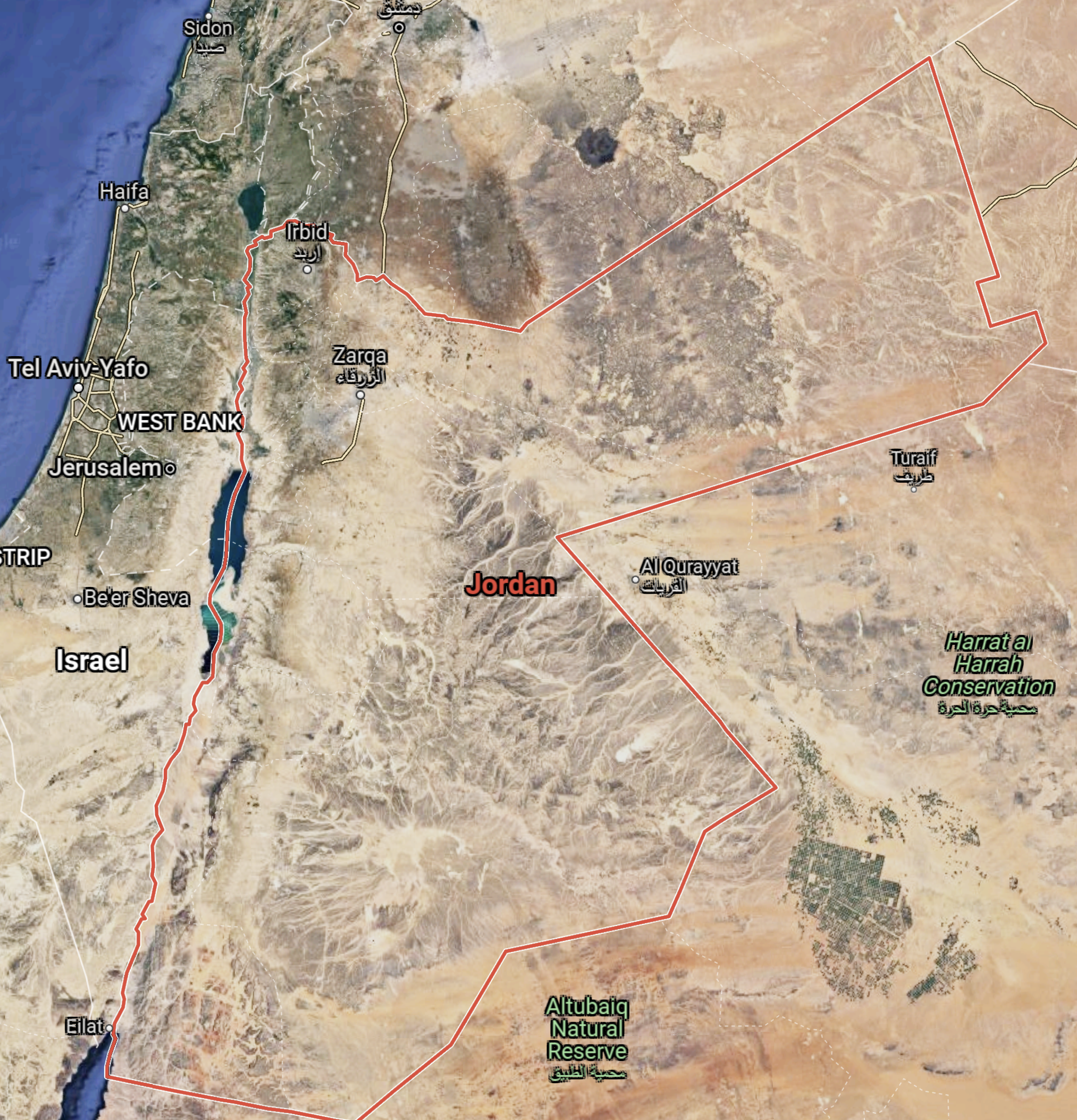
Jordan is outlined in red.
The map suggests how hydrogen could be produced.
- I would assume that there is plenty of sun in Jordan and there appears to be plenty of space for solar panels.
- What is the potential for wind energy in the desert?
- It would appear to me, that there are two routes to export the hydrogen. By pipeline across Israel to the Mediterranean Sea or by tanker from a port on the Red Sea, which just creeps onto the map in the South-West corner.
- Perhaps, a giant electrolyser and export terminal could be built near Aqaba, which is Jordan’s only seaport.
What I like about this plan, is that to the North-East and South-East of Jordan, lie the deserts of Iraq and Saudi Arabia. Could these in future be carpeted with solar panels, where the electricity is fed to Aqaba to create more green hydrogen?
Andrew Forrest is a busy man and seems to be organising a one man project to provide the world with green hydrogen.
- I wrote about his deal with Argentina in Australia’s FFI Plans $8.4 Billion Green Hydrogen Project In Argentina.
- I wrote about his deal with JCB in JCB Signs Green Hydrogen Deal Worth Billions.
He is the second richest Australian according to Wikipedia.
I wouldn’t be surprised to see some more hydrogen deals at COP26, where Andrew Forrest is involved.
Gravitricity Celebrates Success Of 250kW Energy Storage Demonstrator
The title of this post, is the same as that of this article on the Solar Power Portal.
I have already posted about this success in Gravitricity Battery Generates First Power At Edinburgh Site.
But the news story has now been mentioned in several respected publications and web sites.
So this idea, based on traditional Scottish products of heavy weights and girders seems to be getting valuable publicity.
The demonstrator is only small and uses two 25 tonne weights and a fifteen metre tower.
This is only a storage capacity of only 2.04 kWh, but the company is talking of weights totalling up to a massive 12,000 tonnes.
With a fifteen metre tower, that would be 490 kWh.
Note.
- The shafts at Kellingley Colliery in Yorkshire are 800 metres deep.
- The TauTona mine in South Africa is 3.9 kilometres deep
- In this article in The Engineer, Gravitricity talk about weights of up to 12,000 tonnes.
These are typical storage capacities.
- Kellingley – 50 tonnes – 109 kWh
- Kellingley – 12,000 tonnes – 26.15 MWh
- TauTona – 50 tonnes – 531 kWh
- TuaqTona = 12,000 – 127.5 MWh
Accountants before they invest in a company look at the financial figures. As an engineer, I look at the numbers in the science behind their claims.
If the engineering can be made to work, these figures are to say the least; very promising.
They are also beautifully scalable.
If say your application needed a 2 MWh battery and you had a 400 metre shaft available, you can calculate the weight needed. It’s around 1836 tonnes.
The Solar Power Portal article finishes with these two paragraphs.
The company will now look to rollout the technology in a series of full-scale 4-8MW projects, with conversations already underway with mine owners in the UK, Scandinavia, Poland and the Czech Republic, it said. Additionally, in South Africa Gravitricity is working closely with mine operator United Mining Services as part of a programme funded by an Innovate UK Energy Catalyst programme to identify potential schemes.
“A key feature of our full-scale projects will be their long life” added Blair. “Once built, our system can last for over 25 years, with no loss in output or degradation over time. This makes gravity storage cost-effective. And unlike batteries, we have no reliance on rare metals such as cobalt and nickel which are becoming increasingly scarce in the global drive to electrification.”
Note.
- I assume that they are 4-8 MWh projects.
- Charlie Blair is the Managing Director of Gravitricity.
- A weight of 1836 tonnes would give 4 MWh in the 800 metre shaft at Kellingley.
I wouldn’t be surprised that those owning a deep empty hole in the ground will be starting conversations with Gravitricity!
Conclusion
I am not worried, that I bought a few shares in Gravitricity in the crowd-funding last year!
All this good publicity from the BBC, Good News Network, Science, The Engineer, The Times and other media sites won’t harm my investment.
 The Anonymous Widower