Berwick Bank Wind Farm Could Provide Multi-Billion Pound Boost To Scottish Economy And Generate Thousands Of Jobs
The title of this post, is the same as that of this press release from SSE.
This press release is all about numbers.
- 307 turbines
- 4.1 GW nameplate capacity
- 5 million homes will be powered
- 8 million tonnes of carbon dioxide avoided
- Up to £8.3 billion to the UK economy
- 4650 potential jobs in Scotland
- 9300 potential jobs in the UK
These are all large figures.
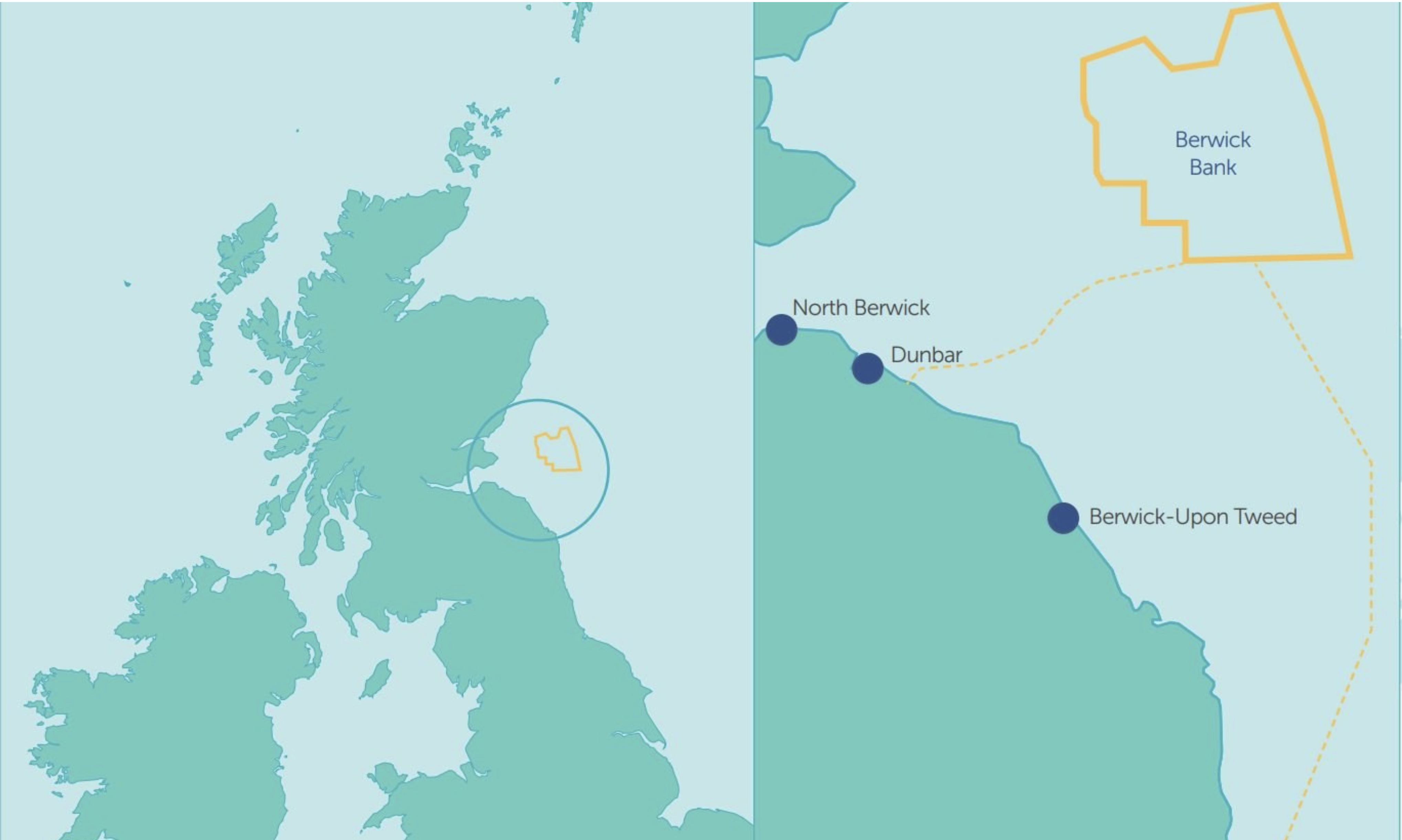
This map from SSE shows the location of the wind farm.
The press release says this about connections to the grid.
Berwick Bank has secured a grid connection at Branxton, near Torness, in East Lothian. A second grid connection will be required for the project, which has been determined as Blyth, Northumberland.
Note, that Torness is the site of Torness nuclear power station.
- It has a nameplate capacity of 1.29 GW.
- It is scheduled to be shutdown in 2028.
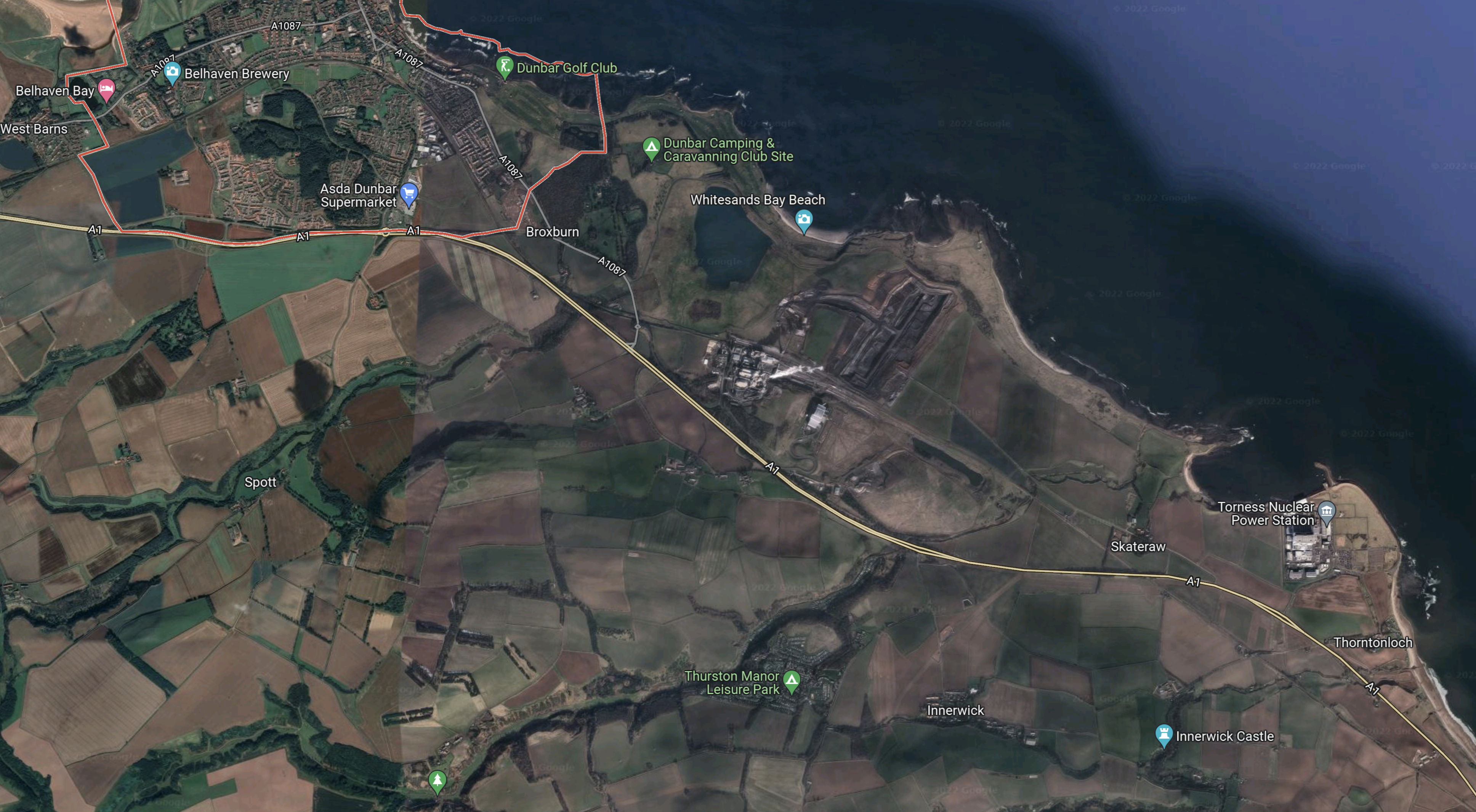
This Google Map shows the coast between Dunbar and Torness nuclear power station.
Note.
- The town of Dunbar is outlined in red.
- The yellow line running diagonally across the map is the A1 road.
- Torness nuclear power station is in the South-East corner of the map to the North of the A1.
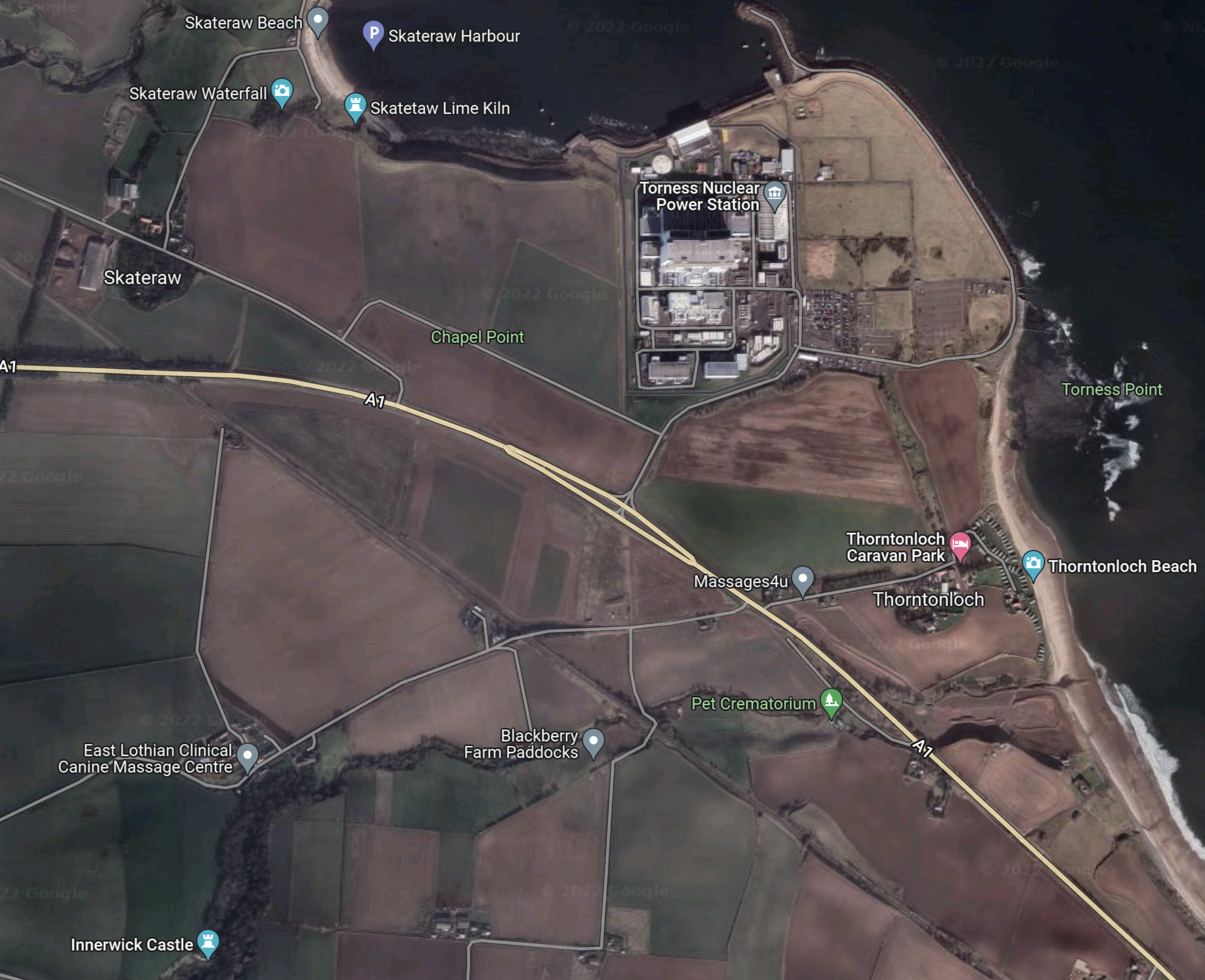
This second Google Map shoes an enlargement of the South-East corner of the map.
Note.
- Torness nuclear power station at the top of the map.
- The A1 road running across the map.
- The East Coast Main Line to the South of the A1.
- Innerwick Castle in the South-West corner of the map.
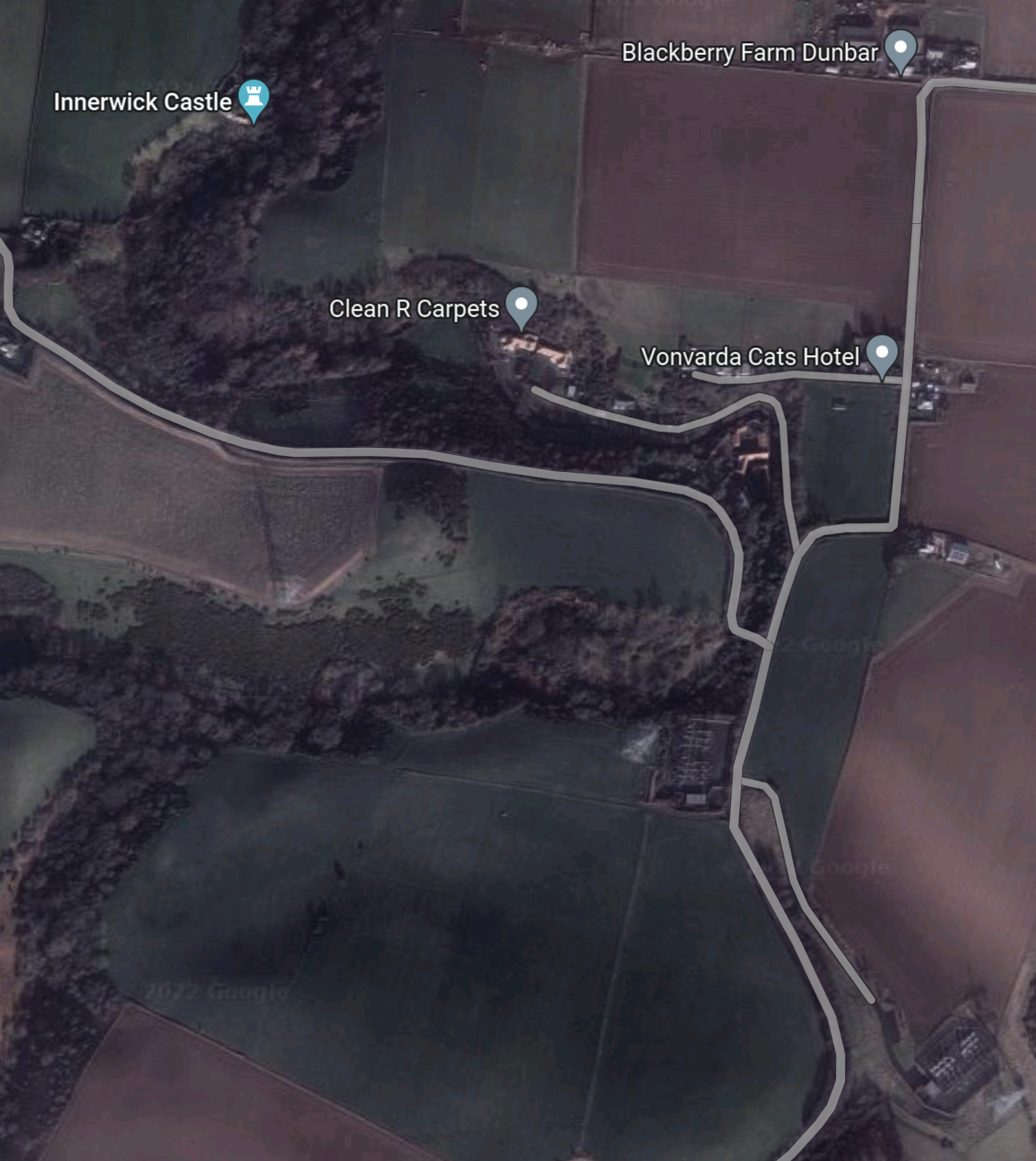
This Google Map shows the location of Branxton substation in relation to Innerwick Castle.
Note.
- Innerwick Castle is in the North-West corner of the map.
- Branxton substation is in the South-East corner of the map.
I estimate that the distance between Torness nuclear power station and Branxton substation is about five kilometres. The cable appears to be underground.
I have some thoughts.
Will The Connection Between Berwick Bank Wind Farm And Branxton Substation Be Underground?
If SSE follows the precedent of Torness nuclear power station, it will be underground.
Or will they use T-pylons?
This page on the National Grid web site is entitled What’s A T-Pylon And How Do We Build Them?.
From an engineering point of view, I suspect T-pylons could be used, but aesthetics and local preference may mean the cable is underground.
It should be noted that Torness nuclear power station will be shutdown in 2028. So will the current underground cable for the nuclear power station be repurposed after shutdown for the Berwick Bank wind farm?
This would mean, that the Southern connection cable to Blyth could be built first to support the first turbines erected in the wind farm.
When Will Berwick Bank Wind Farm Be Commissioned?
This page on the Berwick Bank wind farm web site is a briefing pack on the project.
The page gives construction and commission dates of 2026-2030.
Will There Be A Battery At Torness?
As we are talking about the latter half of the current decade for completion of the Berwick Bank wind farm, I believe that a substantial battery could be installed at Torness to smooth the output of the wind farm, when the wins isn’t blowing at full power.
One of Highview Power’s 2.5 GW/30 GWh CRYOBatteries could be about the right size if it has been successfully developed, but I am sure that other batteries will be of a suitable size.
If there is a case for a battery at Torness, there must surely be a case for a battery at Blyth.
Will Berwick Bank Wind Farm Be A Replacement For Torness Nuclear Power Station?
Consider.
- Torness nuclear power station is shutting down in 2028.
- Berwick Bank wind farm will be fully operational by 2030.
- Berwick Bank wind farm could use a repurposed connection to Branxton substation, if the nuclear power station no longer needs it.
- There is space on the Torness site for a large battery.
, it looks like Torness nuclear power station could be replaced by the larger wind farm.
Hornsea 2, The World’s Largest Windfarm, Enters Full Operation
The title of this post, is the same as that of this press release from Ørsted.
These are the first three paragraphs, which outline the project.
The 1.3GW project comprises 165 wind turbines, located 89km off the Yorkshire Coast, which will help power over 1.4 million UK homes with low-cost, clean and secure renewable energy. It is situated alongside its sister project Hornsea 1, which together can power 2.5 million homes and make a significant contribution to the UK Government’s ambition of having 50 GW offshore wind in operation by 2030.
The Hornsea Zone, an area of the North Sea covering more than 2,000 sq km, is also set to include Hornsea 3. The 2.8GW project is planned to follow Hornsea 2 having been awarded a contract for difference from the UK government earlier this year.
Hornsea 2 has played a key role in the ongoing development of a larger and sustainably competitive UK supply chain to support the next phase of the UK’s offshore wind success story. In the past five years alone, Ørsted has placed major contracts with nearly 200 UK suppliers with £4.5 billion invested to date and a further £8.6 billion expected to be invested over the next decade.
Note.
- Hornsea1 was the previous largest offshore wind farm.
- The first three Hornsea wind farms, could have a total output of over 5 GW.
- There is a possible Hornsea 4, that may be in the pipeline!
Will Hornsea 3 take the crown from Hornsea 2, when it is commissioned in 2027?
Prysmian Completes HVDC Submarine Cable Testing
The title of this post, is the same as that of this article on renews.biz.
The article has this sub-heading.
The ‘first’ 525kV extruded wire can increase maximum transmission capacity up to more than 2.5GW.
This paragraph gives the implications of this new maximum transmission capacity.
This will enable a massive increase of the maximum transmission capacity of bi-pole systems up to more than 2.5GW, which is more than double the value achieved with 320kV DC systems currently in service, Prysmian said.
As in the future we will have many more large offshore wind farms in the UK, this surely must mean that we will find connecting them up a lot easier.
Three Shetland ScotWind Projects Announced
The title of this post, is the same as that of this press release on Crown Estate Scotland.
These three paragraphs outline how the leases were allocated.
Three projects will be offered seabed agreements for offshore wind projects following Crown Estate Scotland’s ScotWind clearing process.
The announcement comes as an offshore wind supply chain summit is held in Aberdeen today (22 August) with Sir Ian Wood, chaired by Michael Matheson MSP, Cabinet Secretary for Energy, and including a keynote address by First Minister Nicola Sturgeon MSP.
Clearing saw the ‘NE1’ area east of Shetland made available for ScotWind applicants who met the required standards but who did not secure their chosen location earlier in the leasing process.
I think it was good idea to offer these leases to those bidders that failed to get a lease, the first time around, despite meeting the standards.
- Would it encourage bidders, if they knew that after the expense of setting up a bid, that if they failed, they could have another chance?
- It must also save the Scottish Government time and money checking out bidders.
- How many times have you interviewed several applicants for a job and then found jobs for some of those, that you didn’t choose for the original job?
Let’s hope the philosophy has generated some good extra contracts.
This map from Cross Estate Scotland shows all the contracts.

Note the three new leases numbered 18, 19 and 20 to the East of Shetland, in the North-East corner of the map.
Their details are as follows.
- 18 – Ocean Winds – 500 MW
- 19 – Mainstream Renewable Power – 1800 MW
- 20 – ESB Asset Development – 500 MW
Note.
All are floating wind farms.
- Ocean Winds is a Spanish renewable energy company that is developing the Moray West and Moray East wind farms.
- Mainstream Renewable Power appear to be a well-financed and ambitious company, 75 % owned by Aker.
- ESB Energy appear to be an experienced energy company owned by the Irish state, who operate several wind farms and Carrington gas-fired power station in the UK.
2.8 GW would appear to be a generous second helping.
Ocean Winds and Mainstream Renewable Power
This web page on the Ocean Winds web site, is entitled Ocean Winds Designated Preferred Bidder For Seabed Leases For 2.3 GW Of Floating Projects East Of Shetland, Scotland, contains several snippets of useful information.
- Crown Estate Scotland announced the result of ScotWind Leasing round clearing process, awarding Ocean Winds with two seabed leases for floating offshore wind projects: a 1.8 GW capacity site with partner Mainstream Renewable Power, and another 500 MW capacity site, east of the Shetland Islands.
- Ocean Winds’ international portfolio of projects now reaches 14.5 GW of gross capacity, including 6.1 GW in Scotland.
- Floating wind turbines for the two adjacent sites are confirmed, because of the water depth.
- The partners are committed to developing floating offshore wind on an industrial scale in Scotland, generating local jobs and opportunities in Scotland and the Shetland Islands.
- From the picture on the web page, it looks like WindFloat technology will be used.
- Ocean Winds developed the WindFloat Atlantic project.
Ocean Winds appear to want to go places.
The Shetland HVDC Connection
The Shetland HVDC Connection will connect Shetland to Scotland.
- It will be 160 miles long.
- It will have a capacity of 600 MW.
- It is estimated that it will cost more than £600 million.
- It will allow the 66MW Lerwick power station to close.
- It will be completed in 2024.
I have a feeling that all these numbers don’t add up to a sensible answer.
Consider.
- The three offshore wind farms can generate up to 2800 MW of green electricity.
- With a capacity factor of 50 %, an average of 1400 MW of electricity will be generated.
- The Viking onshore wind farm on Shetland could generate up to 450 MW.
- More wind farms are likely in and around Shetland.
- Lerwick power station can probably power most of the Shetland’s needs.
- Lerwick power station is likely to be closed soon.
- Sullum Voe Terminal has its own 100 MW gas-turbine power station.
- Load is balanced on Shetland by 3MWh of advanced lead-acid batteries.
- Lerwick has a district heating scheme.
If we assume that Shetland’s energy needs are of the order of a few hundred MW, it looks like at times the wind farms will be generating more electricity, than Shetland and the Shetland HVDC Connection can handle.
Various plans have suggested building electrolysers on Shetland to create hydrogen.
Conversion of excess electricity to hydrogen, would have the following advantages.
- The hydrogen could be used for local heavy transport and to replace diesel.
- Hydrogen could be used to fuel a gas turbine back-up power station, when needed.
- Hydrogen could be used for rocket fuel, if use of Shetland as a Spaceport for launching satellites takes off.
Any excess hydrogen could be exported to the rest of the UK or Europe.
First Power At Scotland’s Largest Offshore Wind Farm
The title of this post, is the same as that of this press release from Seagreen wind farm.
These two paragraphs summarize the project and its start-up.
TotalEnergies and its partner SSE Renewables, has announced first power generation from the Seagreen offshore wind farm, 27km off the coast of Angus in Scotland.
The first turbine of a total of 114, was commissioned in the early hours of Monday morning. The aim is for the 1075 MW farm to be fully operational in the first half of 2023. The £3bn Seagreen project will be Scotland’s largest offshore wind farm and the world’s deepest fixed bottom wind farm as it is being developed in up to water depths of 59 meters.
It looks like 1075 MW cost £3billion, so I suspect it’s reasonable to say that offshore fixed-foundation wind farms cost about £2.79billion per GW.
The press release also says this about yearly output.
When fully operational, the site will produce around 5 terawatt hours (TWh) of renewable electricity per year, enough to power the equivalent of 1.6 million households.
That looks like an expected capacity factor of 53.1 %.
Germany Has Potential For 82 GW Of Offshore Wind
The title of this post, is the same as that of this article on Renewables Now.
These are the two introductory paragraphs.
Germany has the potential to raise its offshore wind energy capacity to 81.6 GW which is above the federal government’s target of 70 GW by 2045, a study by research institute Fraunhofer IWES shows.
To exploit all the potential for wind energy in the North Sea and the Baltic Sea, Germany needs to devise a strategy for more efficient use of the available space and use new offshore wind power technologies in additional areas in a way that will not raise concerns and affect nature conservation.
This map shows the German parts of the North Sea and the Baltic Sea.
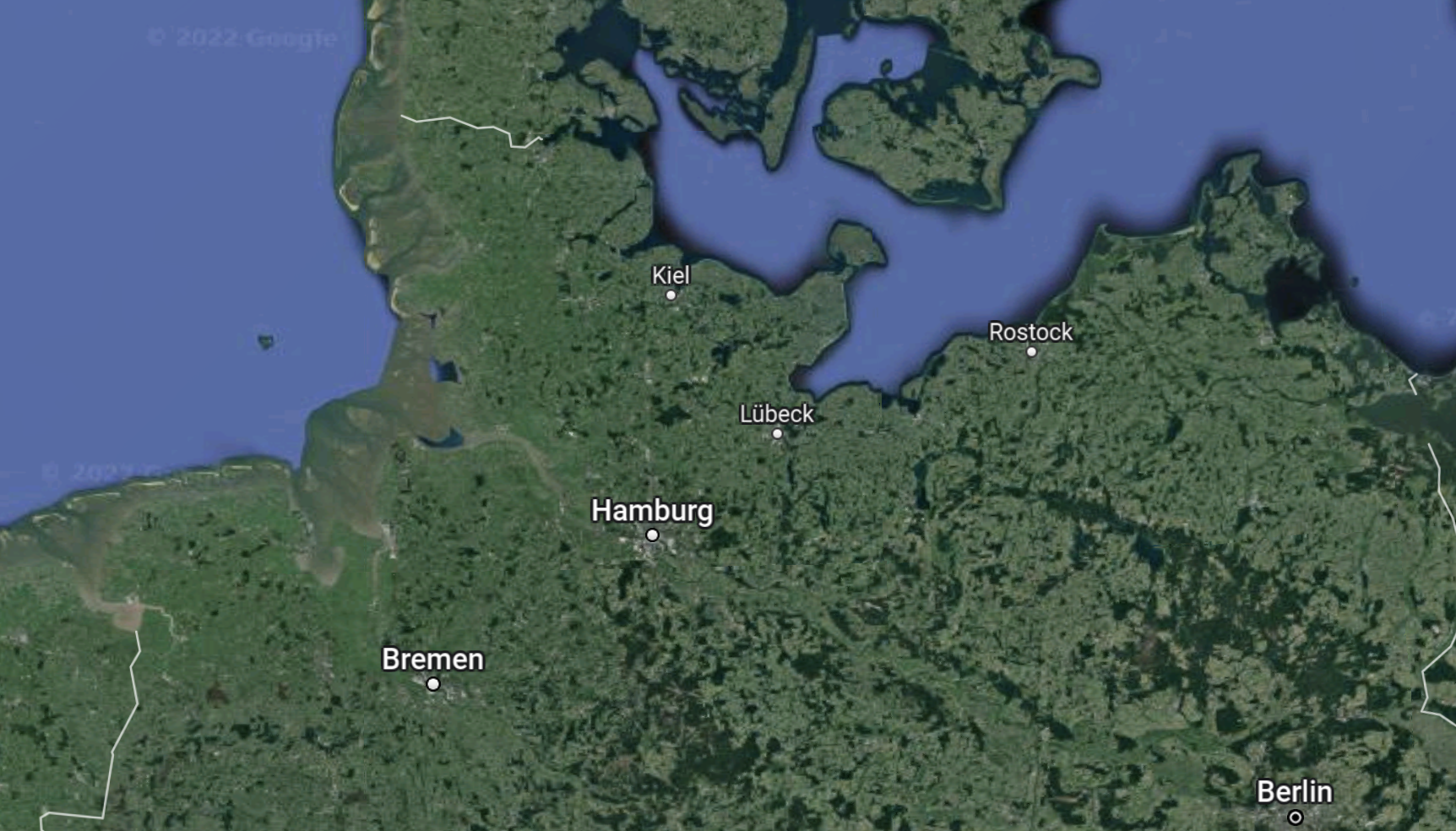
Note.
- White lines show the borders with The Netherlands, Denmark and Poland.
- Heligoland in the South-East corner of the North Sea. Could this island be used as a giant offshore substation?
- There are plenty of ports to service offshore developments.
- It looks like compared to the UK, a fair proportion of German offshore wind farms will be closer to the land.
Currently, Germany has 7.8 GW of offshore wind in operation, with around seventy percent of the turbines in the North Sea.
According to the Wikipedia entry called Wind Power In The UK, in 2019, the UK had installed 8.4 GW of offshore wind turbines, and there could be a potential to have a total of 120 GW in British waters.
With the Belgians, Danes, Dutch, Irish, Norwegians, Poles and Swedes joining this party, I can see the world’s largest wind power station being developed in the North and Baltic Seas.
UK CfD Round 4 Offshore Wind Projects Power Forward
The title of this post, is the same as that of this article on offshoreWIND.biz.
These are the first two paragraphs.
All 99 contracts offered through the fourth Allocation Round (AR4) of the UK government’s Contracts for Difference (CfD) scheme have now been signed and returned to Low Carbon Contracts Company (LCCC).
A total of 93 individual projects across Britain will now proceed to work with LCCC to meet the contractual milestones specified in the CfD, supporting projects’ development and the delivery of almost 11 GW of clean energy. The first AR4 projects are due to come online in 2023-24.
It does look like it’s a case of all systems go!
In Will We Run Out Of Power This Winter?, I estimated that these Round 4 projects would come onstream as follows.
- 2024 – Round 4 Solar – 125.7 MW
- 2025 – Round 4 Solar – 1958 MW
- 2025 – Round 4 Onshore Wind – 888 MW
- 2025 – Round 4 Energy from Waste – 30 MW
- 2026 – Round 4 Tidal Stream – 5.62 MW
- 2027 – Round 4 Tidal Stream – 35.2 MW
- 2027 – Round 4 Floating Offshore Wind – 32 MW
- 2027 – Round 4 Offshore Wind – 6994 MW
These are totals for the next four years from these contracts.
- 2024 – 125.7 MW
- 2025 – 2876 MW
- 2026 – 5.62 MW
- 2027 – 7061.2 MW
This is a total of over 10 GW.
Renewable Power’s Effect On The Tory Leadership Election
I wouldn’t normally comment on the Tory Leadership Election, as I don’t have a vote and my preference has already been eliminated.
But after reading this article on the Telegraph, which is entitled Britain Will Soon Have A Glut Of Cheap Power, And World-Leading Batteries To Store It, I feel I have to comment both about this election and the General Election, that will follow in a few years.
These two paragraphs from the article illustrate the future growth of offshore wind power.
It is a point about the mathematical implications of the UK’s gargantuan push for renewables. Offshore wind capacity is going to increase from 11 to 50 gigawatts (GW) by 2030 under the Government’s latest fast-track plans.
RenewableUK says this country currently has a total of 86GW in the project pipeline. This the most ambitious rollout of offshore wind in the world, ahead of China at 78GW, and the US at 48GW.
If we assume that there is eight years left of this decade, that means that we should install about 4.9 GW of offshore wind every year until 2030. If we add in planned solar and onshore wind developments, we must be looking at at least 5 GW of renewable energy being added every year.
We have also got the 3.26 GW Hinckley Point C coming on stream.
I think we can say, that when it comes to electricity generation, we will not be worried, so Liz and Rishi can leave that one to the engineers.
If we have an electricity problem, it is about distribution and storage.
- We need more interconnectors between where the wind farms are being built and where the electricity will be used.
- National Grid and the Government have published plans for two interconnectors between Scotland and England, which I wrote about in New Electricity ‘Superhighways’ Needed To Cope With Surge In Wind Power.
- We need energy storage to back up the wind and solar power, when the wind isn’t blowing and the sun isn’t shining.
I think it is reasonable to assume, that we will get the interconnectors we need and the Telegraph article puts forward a very feasible and affordable solution to the energy storage problem, which is described in these two paragraphs from the article.
That is now in sight, and one of the world leaders is a British start-up. Highview Power has refined a beautifully simple technology using liquid air stored in insulated steel towers at low pressure.
This cryogenic process cools air to minus 196 degrees using the standard kit for LNG. It compresses the volume 700-fold. The liquid re-expands with a blast of force when heated and drives a turbine, providing dispatchable power with the help of a flywheel.
The article also talks of twenty energy storage systems, spread around the UK.
- They will have a total output of 6 GW.
- In total they will be able to store 600 GWh of electricity.
The first one for Humberside is currently being planned.
Surely, building these wind and solar farms, interconnectors and energy storage systems will cost billions of pounds.
Consider.
- Wind and solar farms get paid for the electricity they generate.
- , Interconnectors get paid for the electricity they transfer.
- Energy storage systems make a profit by buying energy when it’s cheap and selling it, when the price is better.
- In World’s Largest Wind Farm Attracts Huge Backing From Insurance Giant, I talked about how Aviva were funding the world’s largest wind farm at Hornsea.
- National Grid has a history of funding interconnectors like the North Sea Link from large financial institutions.
I believe that the islands of Great Britain and Ireland and the waters around our combined shores will become the largest zero-carbon power station in the world.
This will attract engineering companies and financial institutions from all over the world and we will see a repeat of the rush for energy that we saw for oil and gas in the last century.
If we get the financial regime right, I can see a lot of tax money flowing towards the Exchequer.
The big question will be what do we do with all this energy.
- Some will be converted into hydrogen for transport, the making of zero-carbon steel and cement and for use as a chemical feedstock.
- Industries that use a lot of electricity may move to the UK.
- A large supply of electricity and hydrogen will make it easy to decarbonise housing, offices and factories.
The Telegraph article also says this.
Much can be exported to the Continent through interconnectors for a fat revenue stream, helping to plug the UK’s trade deficit, and helping to rescue Germany from the double folly of nuclear closures and the Putin pact. But there are limits since weather patterns in Britain and Northwest Europe overlap – partially.
I suspect that more energy will be exported to Germany than most economists think, as it will be needed and it will be a nice little earner for the UK.
Given the substantial amount of German investment in our wind industry, I do wonder, if Boris and Olaf did a deal to encourage more German investment, when they met in April this year.
- BP have been backed with their wind farms by a German utility company.
- RWE are developing the Sofia wind farm.
- Only last week, the deal for the NeuConnect interconnector between the Isle of Grain and Wilhelmshaven was signed.
- Siemens have a lot of investments in the UK.
I wouldn’t be surprised to see more German investments in the next few months.
The Golden Hello
Has there ever been a Prime Minister, who will receive such a golden hello, as the one Liz or Rishi will receive in September?
The Tory Leadership Election
Some of the candidates said they would reduce taxes , if they won and Liz Truss is still saying that.
I wonder why Rishi isn’t saying that he would reduce taxes, as he must know the cash flow that is coming. It may be he’s just a more cautious soul.
Britain Will Soon Have A Glut Of Cheap Power, And World-Leading Batteries To Store It
The title of this post, is the same as that of this article on the Telegraph.
This is the first four paragraphs.
Today’s electricity price shock is the last crisis of the old order. Britain will soon have far more power at times of peak production than it can absorb. The logistical headache will be abundance.
Wind and solar provided almost 60pc of the UK’s power for substantial stretches last weekend, briefly peaking at 66pc. This is not to make a propaganda point about green energy, although this home-made power is self-evidently displacing liquefied natural gas (LNG) imported right now at nosebleed prices.
It is a point about the mathematical implications of the UK’s gargantuan push for renewables. Offshore wind capacity is going to increase from 11 to 50 gigawatts (GW) by 2030 under the Government’s latest fast-track plans.
RenewableUK says this country currently has a total of 86GW in the project pipeline. This the most ambitious rollout of offshore wind in the world, ahead of China at 78GW, and the US at 48GW.
The article goes on to give a comprehensive account of where we are with renewables, where we are going and how we will handle things, when the wind doesn’t blow.
Dogger Bank
The article says this about the Dogger Bank wind farm, which is being developed by SSE.
The giant hi-tech turbines to be erected on the Dogger Bank, where wind conditions are superb, bear no resemblance to the low-tech, low-yield dwarves of yesteryear. The “capacity factor” is approaching 60pc, which entirely changes the energy equation.
A capacity factor of 60 % seems a bit high to me and is what can be expected with the latest floating turbines. But these are fixed to the sea floor.
The Wikipedia entry for the Dogger Bank wind farm, says this about the building of the the first two sections of the massive wind farm.
On 21 September 2020, it was announced that Dogger Bank A and B will use 190 GE Haliade-X 13 MW offshore wind turbines over both sites, meaning that 95 turbines will be used on each site.[19] The availability of upgraded Haliade-X turbines rated at 13 MW rather than 12 MW means that each site will be capable of generating up to 1.235 GW, for a total of 2.47 GW. Turbines will be pre-assembled at Able Seaton Port in Hartlepool, an activity that will lead to the creation of 120 skilled jobs at the port during construction. Turbine installation is expected to commence in 2023 at Dogger Bank A.[20] Power Purchase Agreements (PPA) for 15 years were signed in November 2020. Offshore cable laying started in April 2022. Installation of the turbine foundations was started in July 2022.
This GE data sheet about the Haliade-X offshore wind turbine, says this about capacity factor.
it also features a 60-64% capacity factor above industry standard. Capacity factor compares how much energy was generated against the maximum that could have been produced at continuous full power operation during a specific period of time.
A 60-64% capacity factor is exceptional.
Current plans for Dogger Bank indicate that 3.6 GW will be installed and operational by 2024/25.
Could that mean that Dogger Bank will be able to deliver 2.16 GW almost continuously, on GE’s figures? Sizewell B is only 1.25 GW.
Sofia Wind Farm
There was going to be a fourth section to Dogger Bank, but this is now the separate Sofia wind farm.
- It is being developed by RWE.
- The first phase of three has a capacity of 1.4 MW. Does that mean Sofia will eventually be a 4.2 GW wind farm?
- RWE seem to be putting in a very large offshore substation. Could this support a lot more turbines?
- The wind farm seems to be using high-specification SiemensGamesa 14MW SG 14-222 DD wind turbines, which have a Power Boost facility to deliver up to 15 MW.
- I can’t find anything about capacity factor.
Wikipedia gives a delivery date of 2023 for the first phase of Sofia.
Storing Electricity
The article says this about storing electricity.
Much of the power will have to be stored for days or weeks at a time. Lithium batteries cannot do the job: their sweet spot is two hours, and they are expensive. You need “long duration” storage at a cost that must ultimately fall below $100 (£82) per megawatt hour (MWh), the global benchmark of commercial viability.
That is now in sight, and one of the world leaders is a British start-up. Highview Power has refined a beautifully simple technology using liquid air stored in insulated steel towers at low pressure.
I have had Highview Power on my radar for some time.
Highview Power
What is there not to like about Highview Power?
- The original idea was developed in a shed in Bishop’s Stortford, by a lone inventor.
- Sumitomo are one of their backers.
- They are also backed by English Universities and the UK Government.
- They have run a successful pilot plant in Bury.
- They are now building their first full-size 50 MW/250 MWh commercial plant at Carrington near Manchester.
- Much of the equipment they use to build their batteries is standard equipment from world-class companies like MAN.
- There are no exotic and expensive materials used.
The writer of the article has obviously had a long chat with Rupert Pearce, who is Highview’s chief executive and ex-head of the satellite company Inmarsat.
Pearce happily discloses this monster.
Highview is well beyond the pilot phase and is developing its first large UK plant in Humberside, today Britain’s top hub for North Sea wind. It will offer 2.5GW for over 12 hours, or 0.5GW for over 60 hours, and so forth, and should be up and running by late 2024.
Note.
- The world’s largest battery is at Ouarzazate Solar Power Station in Morocco and it is 3 GWh.
- Highview’s Humberside battery is megahuge at 30 GWh.
- The world’s largest pumped storage power station is Fengning Pumped Storage Power Station in China and it is 40 GWh.
- My experience of doing the calculations for large reaction vessels and other structures, tells me, that Highview should be able to construct huge systems.
I suspect that it will be easier and more affordable to build the Humberside battery.
This is another pair of paragraphs.
Mr Pearce said Highview’s levelised cost of energy (LCOE) would start at $140-$150, below lithium, and then slide on a “glide path” to $100 with over time. The company has parallel projects in Spain and Australia but Britain is the showroom.
“The UK is a fantastic place to do this. It has one of the most innovative grids in the world and an open, fair, liquid, market mechanism with absolute visibility,” he said.
It looks to me, that Rupert Pearce has taken Highview Power to a different level, in his short tenure at the company.
The world will soon be very familiar with the name of Highview Power.
Boris Baldrick’s Cunning Plan
This written statement to Parliament on the UK Government web site, is entitled Transport Update: Transpennine Route Upgrade.
It has been published by Grant Shapps and this is the sub-title.
Additional funding has been made available for the Transpennine route upgrade.
This is the complete statement.
Today 19 July 2022, the government has made available £959 million of additional funding to continue to progress the delivery of the ambitious Transpennine route upgrade.
This funding is a significant milestone and another step towards upgrading the key east-west rail artery across the north of England, to further this government’s levelling up and decarbonisation objectives.
In addition to progressing the design of aspects of the upgrade, this funding will enable further on-the-ground delivery of electrification and journey time improvement works, mostly west of Leeds.
One of the first tangible benefits will be enabling electric trains to run between Manchester and Stalybridge by the middle of the decade. We are also developing scope that will enable the Transpennine route upgrade to become the first phase of Northern Powerhouse Rail, including plans to unlock freight flows and take thousands of lorries off our roads.
We are also more than trebling the investment in the Transpennine route upgrade from £2.9 billion to between £9.0 billion and £11.5 billion.
This additional investment will enable the roll out of digital signalling technology, electrification of the full route and the provision of additional tracks for commercial and freight services, giving rail users more reliable, more punctual, more comfortable and greener rail journeys.
I have some thoughts.
It’s Not A Wish List, But A Reality
The last paragraph reads like a wish list.
This additional investment will enable the roll out of digital signalling technology, electrification of the full route and the provision of additional tracks for commercial and freight services, giving rail users more reliable, more punctual, more comfortable and greener rail journeys.
But it’s not a wish list, it’s what is to be done.
Where Will The Government Get Between Nine and Eleven-And-A-Half Billion Pounds?
It’s not the sort of small change that you have in a sock draw.
This document on the UK government web site, is entitled PM Opening Remarks At Press Conference With German Chancellor Olaf Scholz: 8 April 2022, where this is these three paragraphs.
We will also agree on the importance of weaning ourselves off dependence on Russian gas and oil, and ensuring that our energy security cannot be threatened by a rogue state.
This is not easy for any of us, and I applaud the seismic decisions taken by Olaf’s government to move Germany away from Russian hydrocarbons.
Today we have agreed to maximise the potential of the North Sea and collaborate on energy security and on renewables, where Germany and the UK lead the way in new technology.
So did Boris and Olaf sign the world’s first Green Alliance based on zero-carbon energy?
- They may not have signed an Alliance, but they have agreed on common actions.
- Over the last year or so, German money and technology has started to be more visible in our offshore wind farms.
- BP have been backed by German utility; enBW in some of their huge wind farms.
- Siemens Gamesa are providing a lot of wind turbines.
- Will German shipyards build the floats for floating wind farms?
- An interconnector between the Isle of Grain and Wilhelmshaven is planned.
- Rolls-Royce and its German subsidiary MTU are charging into battle against climate change.
- The Germans have taken a liking to ITM Power’s electrolysers to produce hydrogen.
I can see the North Sea or the German Ocean becoming Europe’s power station, with by 2030, a large amount of the energy not needed by the UK, being exported to the Continent, either as electricity or hydrogen.
The Germans could become our magische Geldbäume.
But unlike gas and oil, wind power in the North Sea won’t run out, as it’s renewable.
In How Britannia With Help From Her Friends Can Rule The Waves And The Wind, this was my conclusion.
Boris’s vision of the UK becoming a Saudi Arabia of wind is no fantasy of a man with massive dreams.
Standard floating wind turbines, with the possibility of also harvesting wave power could be assembled in ports along the coasts, towed into position and then connected up.
Several GW of wind-power capacity could probably be added each year to what would become the largest zero-carbon power station in the world.
By harvesting the power of the winds and waves in the seas around the British Isles it is an engineering and mathematical possibility, that could have been developed by any of those great visionary Victorian engineers like Armstrong, Bazalgette, Brunel and Reynolds, if they had had access to our modern technology.
Up Yours! Putin!
This energy and the money it provides will finance our infrastructure and our tax cuts.
 The Anonymous Widower