Shell To Develop Blue Hydrogen Plant
The title of this post, is the same as that of this article in The Times.
The article is based on this press release from Shell, which is entitled Shell And Uniper To Work Together On Blue Hydrogen Production Facility In The UK.
These are the three bullet points of the press release.
- Shell and Uniper sign co-operation agreement to progress plans for low-carbon hydrogen production at Uniper’s Killingholme site in North Lincolnshire
- Hydrogen produced could be used to decarbonise heavy industry, transport, heating and power across Humber and beyond.
- Project recently passed eligibility phase for UK Government’s Phase-2 carbon capture, usage and storage Cluster Sequencing Process.
Note.
- The Killingholme site is currently occupied by the 900 MW gas-fired Killingholme power station.
- Heavy industry on Humberside includes chemicals and oil refineries and the Scunthorpe steelworks.
This Google Map shows the location of Killingholme power station.
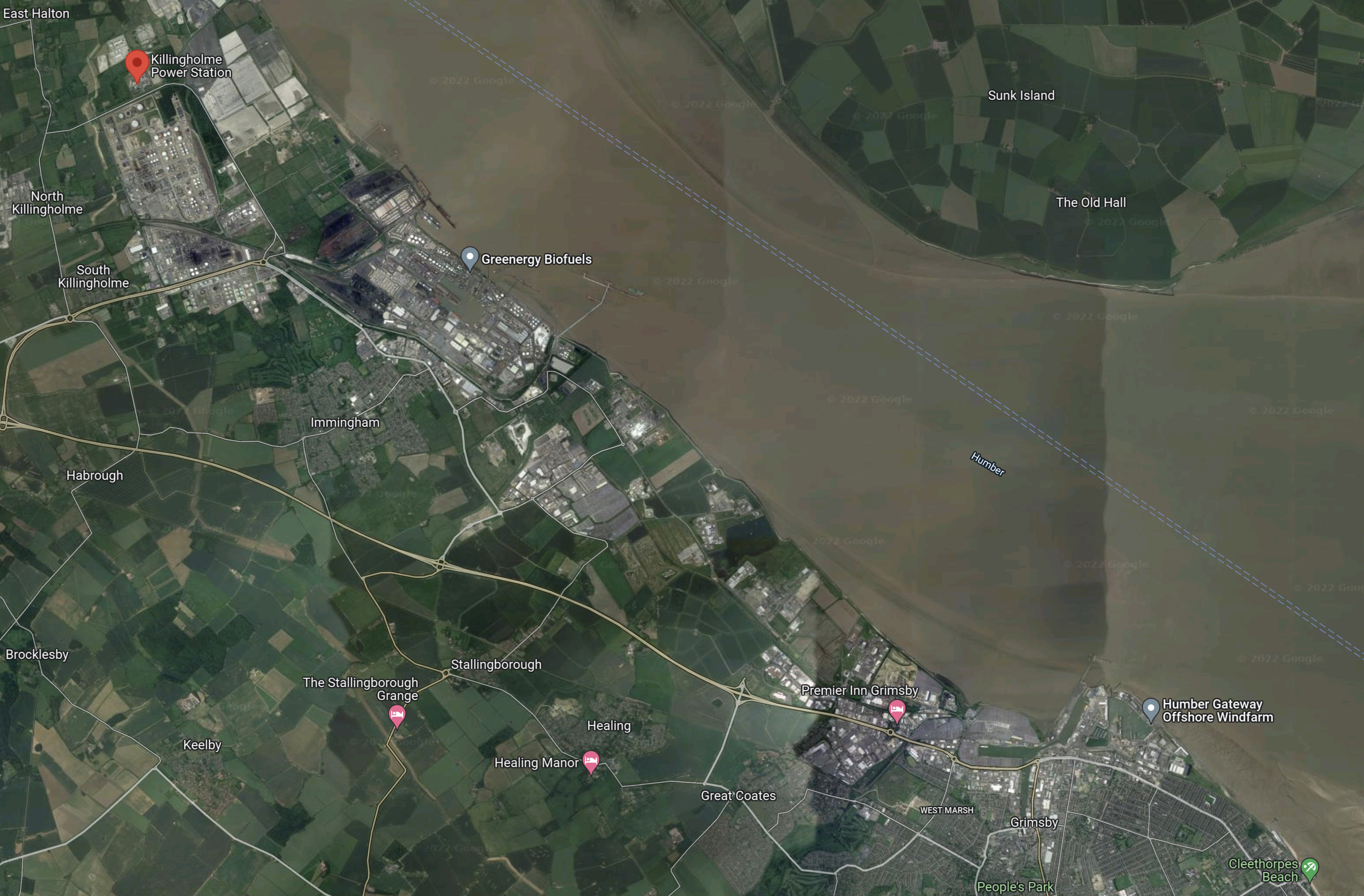
Note.
- Killingholme power station is marked by the red arrow.
- The river is the Humber.
- The Port of Immingham is on the power station side of the river.
- Cleethorpes Beach is marked by the green dot in the bottom-right hand corner.
- Grimsby is to the North of Cleethorpes.
- Between Grimsby and Killingworth power station is a mass of chemical works.
This second Google Map shows the area to the South-East of the power station.
Note.
- Killingholme power station is marked by the red arrow.
- The Hornsea 02 substation to the North of the power station.
- The large Uniper site to the South of the power station.
- The large number of tanks inland from the port and the chemical works.
I have some thoughts.
A Full Description Of The Project
This paragraph from the press release described the project.
Uniper has signed an agreement with Shell to progress plans to produce blue hydrogen at Uniper’s Killingholme power station site in the East of England. The hydrogen produced could be used to decarbonise industry, transport and power throughout the Humber region.
The Humber Hub Blue project includes plans for a blue hydrogen production facility with a capacity of up to 720 megawatts, using gas reformation technology with carbon capture and storage (CCS).
The captured carbon would be fed through the proposed Zero Carbon Humber onshore pipeline, part of the East Coast Cluster, recently selected as one of two CCS clusters to receive initial government support under the government’s cluster sequencing process.
I suspect that a lot of the plant from the existing Killingholme power station will be repurposed.
This is the specification of the power station.
The Uniper (Formerly E.ON UK) plant consists of two 450 MW Siemens V94.2 gas turbine modules each connected to a heat recovery steam generator using only a single steam turbine in a 2 into 1 configuration. Gas is supplied from a 26-mile pipeline from Theddlethorpe.
When it was built by Powergen (now called Uniper) and opened in April 1993 it was only the second gas-fired power station built in the UK. It was taken out of service in 2002 due to the lower price of electricity and was then restored to full service in August 2005, with one of the 450 MW units returning to service in April 2005.
It was announced that the power station will be closed in 2015.
Will The Project Use The Shell Blue Hydrogen Process?
Will the plant use the Shell Blue Hydrogen Process, that I described in Shell Process To Make Blue Hydrogen Production Affordable?
It appears the Shell Blue Hydrogen Process offers advantages.
- Shell are claiming, that with carbon dioxide costing $25-35/tonne, that their process is more economic than grey or green hydrogen.
- Steam reforming also needs steam, but this new process actually generates steam as a by-product, which further improves the economics, as integrated chemical plants use a lot of steam. Killingholme’s neighbours would probably welcome the steam.
- Shell are reporting capturing 99% of the carbon.
- It looks like savings of between 10 and 25 % are possible.
The most-fervent greens, may claim blue hydrogen is totally wrong.
But if it is more affordable than both grey and green hydrogen and all but one percent of the carbon dioxide is captured, I believe that this should be an option, that is fully investigated.
This appears to be a victory for top-class chemical engineering.
Northern Endurance Partnership
The Northern Endurance Partnership is described on this page of the Equinor web site, where this is said.
BP, Eni, Equinor, National Grid, Shell and Total today confirmed they have formed a new partnership, the Northern Endurance Partnership (NEP), to develop offshore carbon dioxide (CO2) transport and storage infrastructure in the UK North Sea, with bp as operator.
This infrastructure will serve the proposed Net Zero Teesside (NZT) and Zero Carbon Humber (ZCH) projects that aim to establish decarbonised industrial clusters in Teesside and Humberside.
There is also a map.
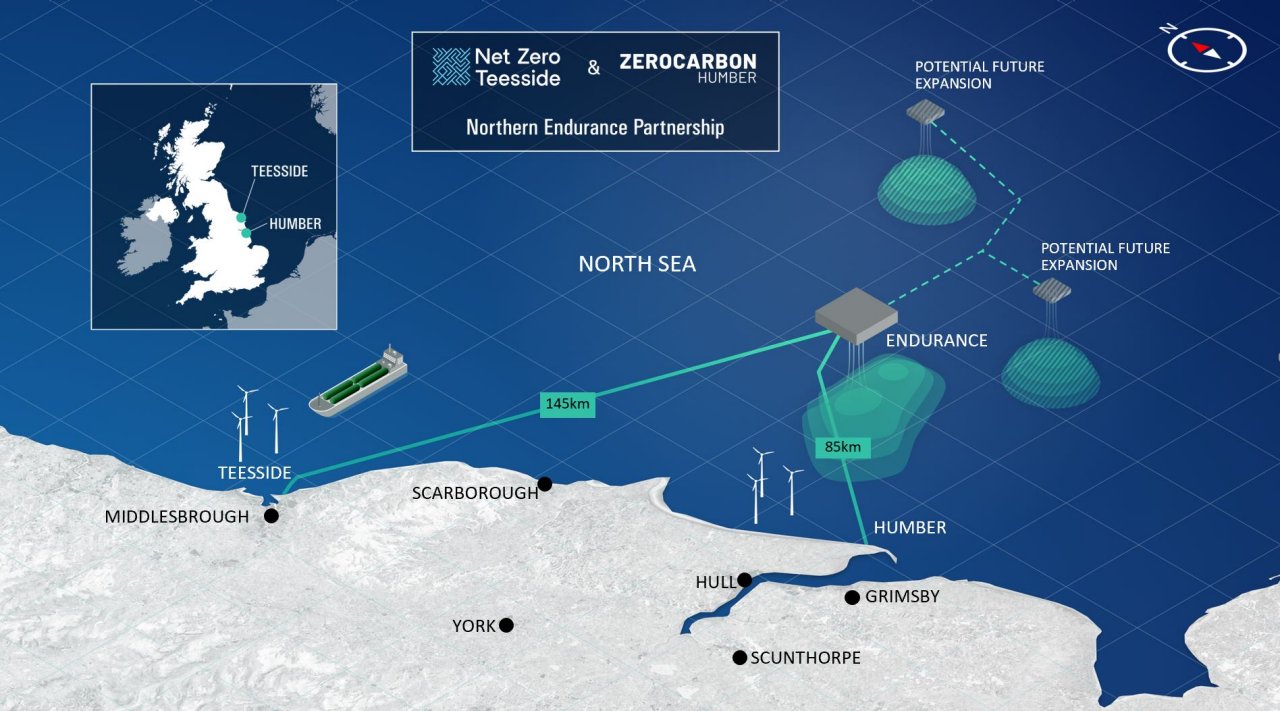
Note.
- One facility would appear to serve the Tees and the Humber.
It looks like the depleted gas fields could hold a lot of carbon dioxide.
Carbon Capture
Some points from the Equinor press release about carbon capture.
- Blue hydrogen production at Killingholme could see the capture of around 1.6 million metric tonnes (Mt) of carbon a year through CCS.
- The UK Government has set a target to capture 10 Mt of carbon a year by 2030.
- NEP has submitted a bid for funding through Phase 2 of the UK Government’s Industrial Decarbonisation Challenge, aiming to accelerate the development of an offshore pipeline network to transport captured CO2 emissions from both NZT and ZCH to offshore geological storage beneath the UK North Sea.
These projects could could decarbonise a lot of businesses on Teesside and the Humber.
Carbon Capture And Use
The Equinor press release says this about carbon capture and use.
The Northern Endurance Partnership will channel the extensive experience of its members to develop and deliver the offshore transport and storage infrastructure we need to unlock the enormous benefits of deploying CCUS across the Humber and Teesside. We’re delighted to start working together with five really world class energy companies to deliver a solution that will play a critical role in decarbonising the UK’s largest industrial heartland and protecting tens of thousands of jobs in the process.”
Uses include.
- Feeding to salad vegetables, tomatoes, soft fruit and flowers in giant greenhouses.
- Creating sustainable aviation fuel.
- Creating building products like blocks and plaster board.
- Making better concrete.
This is a list that will grow.
Making Hydrogen With An Electrolyser
The Shell press release says this.
Uniper continues to develop a separate green hydrogen project, using electrolytic hydrogen production technology, as part of the overall Humber Hub development at Uniper’s Killingholme site. Uniper, along with its project partners, will shortly complete the Project Mayflower feasibility study, part funded by the Department for Transport’s Clean Maritime Demonstration Competition, administered by InnovateUK, looking at the decarbonisation of port related activities at the Port of Immingham.
Note that the sub station for the 1.4 GW Hornsea 2 wind farm is close to both Killingholme power station and the Uniper web site.
What Will Happen To Shell’s Blue Hydrogen Plant?
I think there are two possible scenarios.
- It will be closed when Uniper’s electrolyser is fully on stream.
- It will become an emergency hydrogen source, when the wind is not blowing.
In both cases it will produce less carbon dioxide, thus leaving more space in the Northern Endurance Partnership.
Conclusion
It looks like there could be a comprehensive hydrogen production facility at Killingholme.
Should The Great Northern And Great Eastern Joint Line Be Electrified?
The Great Northern And Great Eastern Joint Line was created in the Nineteenth Century by the Great Northern Railway and the Great Eastern Railway.
- The main purpose was to move freight like coal, agricultural products and manufactured goods between Yorkshire and Eastern England.
- It originally ran between Doncaster and Huntington via Gainsborough, Lincoln, Sleaford, Spalding and March.
- It had a full length of almost 123 miles.
- There was a large marshalling yard at Whitemoor near March.
Over the years the line has been pruned a bit and now effectively runs between Doncaster and Peterborough.
- Trains between Lincoln and March are now routed via Peterborough.
- It carries upwards of twenty freight trains per day in both directions through Lincoln Central station.
- Many of the freight trains are going to and from the East Coast ports.
- The distance between Doncaster and Peterborough is 93.7 miles, as opposed to the 79.6 miles on the East Coast Main Line.
- The line is not electrified, but it connects to the electrified East Coast Main Line at both ends.
There have been some important developments in recent years.
2015 Freight Upgrade
Wikipedia says this about the major 2015 freight upgrade.
In 2015 a £280 million upgrade of the Joint Line by Network Rail was substantially complete, enabling two freight trains per hour to be diverted from the congested East Coast Main Line; gauge enhancements to enable the passage of 9 ft 6 in (2.90 m) containers were included in the work.
The Sleaford avoiding line had been substantially downgraded since the 1980s and was reinstated to double track as part of the 2015 scheme. Resignalling and modernisation of level crossings was included.
This means that freight trains have an alternative route, that avoids the East Coast Main Line.
Doncaster iPort
Over the last few years the Doncaster iPort has been developed, which is an intermodal rail terminal.
- It has a size of around 800 acres.
- The site opened in early 2018.
- There is a daily train to the Port of Southampton and two daily trains to both Teesport and Felixstowe.
- The Felixstowe trains would appear to use the Joint Line.
I feel that as the site develops, the Doncaster iPort will generate more traffic on the Joint Line.
This Google Map shows the Doncaster iPort.

There would appear to be plenty of space for expansion.
The Werrington Dive Under
The Werrington Dive Under has been built at a cost of £ 200 million, to remove a bottleneck at the Southern end of the Joint Line, where it connects to the East Coast Main Line.
The Werrington Dive Under was built, so that it could be electrified in the future.
LNER To Lincolnshire
LNER appear to have made a success of a one train per two hours (tp2h) service between London King’s Cross and Lincoln station.
- LNER have stated, that they want to serve Grimsby and Cleethorpes in the North of the county.
- North Lincolnshire is becoming important in supporting the wind energy industry in the North Sea.
- Lincoln is becoming an important university city.
- Several towns in Lincolnshire probably need a service to Peterborough and London.
- In 2019, the Port of Grimsby & Immingham was the largest port in the United Kingdom by tonnage.
I can see an expanded Lincolnshire service from LNER.
Full Digital Signalling Of The East Coast Main Line To The South Of Doncaster
This is happening now and it will have a collateral benefits for the Joint Line.
Most passenger and freight trains will also use the East Coast Main Line, if only for a few miles, which will mean they will need to be fitted for the digital signalling.
This could mean that extending full digital signalling to Lincolnshire will not be a challenging project.
Arguments For Electrification
These are possible arguments for electrification.
Electric Freight Trains To And From The North
It would be another stretch of line, that could accommodate electric freight trains.
An Electrified Diversion Route For East Coast Main Line Expresses
Currently, when there is engineering blockades between Doncaster and Peterborough on the East Coast Main Line, the Hitachi Class 800 and Class 802 trains of Hull Trains and LNER are able to divert using their diesel power.
But the electric trains of LNER and Lumo have to be cancelled.
An electrified diversion route would be welcomed by passengers and train companies.
It would also mean that any trains running from King’s Cross to electrified destinations would not to have any diesel engines.
An Electrified Spine Through Lincolnshire
If there was an electrified spine between Doncaster and Peterborough via Gainsborough, Lincoln, Sleaford and Spalding, these stations would be these distances from the spine.
- Boston – 16.8 miles
- Cleethorpes – 47.2 miles
- Grimsby Town – 43.9 miles
- Market Rasen – 14.8 miles
- Skegness – 40.7 miles
Note.
- These distances are all possible with battery-electric trains.
- Charging would be on the electrified spine and at Skegness and Cleethorpes stations.
All of South Lincolnshire and services to Doncaster would use electric trains.
London Services
London services would be via Spalding and join the East Coast Main Line at Werrington.
- Boston and Skegness would be served from Sleaford, where the train would reverse.
- Market Rasen, Grimsby Town and Cleethorpes would be served from Lincoln, where the train would reverse.
This would enable Cleethorpes and Skegness to have at least four trains per day to and from London King’s Cross.
North Lincolnshire Services
There are two train services in North Lincolnshire.
Cleethorpes and Barton-on-Humber.
Cleethorpes and Manchester Airport via Grimsby Town, Scunthorpe, Doncaster, Sheffield and Manchester Piccadilly.
Note.
- Cleethorpes would need to have a charger or a few miles of electrification, to charge a train from London.
- Doncaster, which is fully electrified is 52.1 miles from Cleethorpes.
- Barton-on-Humber is 22.8 miles from Cleethorpes.
Battery-electric trains should be able to handle both services.
Arguments Against Electrification
The only possible arguments against electrification are the disruption that the installation might cause and the unsightly nature of overhead gantries.
Conclusion
The Great Northern and Great Eastern Joint Line should be electrified.
Grant Shapps Announcement On Friday
I listened to Grant Shapps announcement on Friday, when he gave the daily COVID-19 Press Conference.
This article on the Velocys web site is entitled Government Announces Jet Zero Council And Confirms Support For Velocys Waste-To-Jet-Fuel Project.
The article shows a video of the speech and this summary paragraph.
At this afternoon’s COVID-19 press conference, Secretary of State for Transport, Grant Shapps, announced the establishment of a new Jet Zero Council and confirmed Government support for Velocys.
So who are the company with the strange name of Velocys?
This is a quote from the Velocys CEO; Henrik Wareborn.
Today’s announcement on the formation of a Jet Zero Council shows that a new era of net zero carbon flying is on a credible path, at a time when we need it more than ever. This follows news earlier today that our Altalto waste-to-jet fuel facility – the first of its kind in the UK – has received additional funding from Government and formally received planning permission, meaning it could be producing sustainable aviation fuel in commercial scale by the middle of this decade.
Is a new era of net zero carbon flying a possibility or is this a dream too far?
The AltAlto Project
Yhe project is called AltAlto and it has its own web site.
It is backed by British Airways and Shell, and uses technology from Velocys.
This description of the project is on the home page.
Altalto turns household and commercial waste into clean-burning fuels with reduced greenhouse gas emissions for air and road transport.
A page called Technology describes how it is done.
This is the initial summary.
Our process can accept a wide variety of waste, while delivering a clean product. There are very limited emissions to atmosphere from the plant except water and carbon dioxide. Components of the waste which do not get turned into fuel, such as metals and stones, are recycled; a small amount of it (less than 3%) goes to landfill.
This diagram from the Velocys web site illustrates the process.
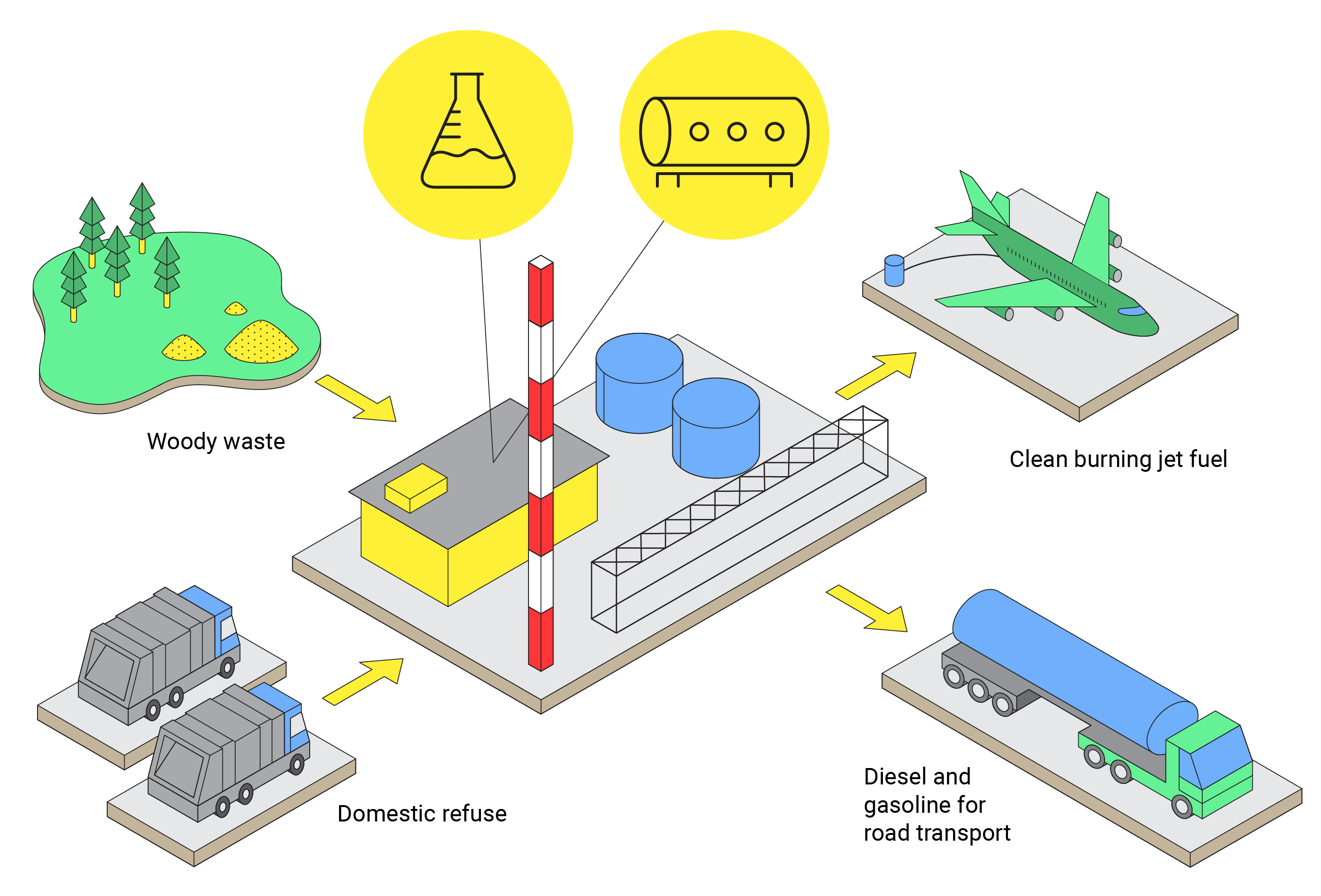
The then goes through the stages of the process.
- Stage 1 – Preparation – First the waste is treceived, sorted and prepared.
- Stage 2 – Gasification – Next the solid waste is gasified; heated to a high temperature to break it down and convert it into synthesis gas or syngas (carbon monoxide and hydrogen).
- Stage 3 – Synthesis – After cleaning, the syngas is used to synthesis hydrocarbons using the Fischer-Tropsch technology provided by Velocys.
- Stage 4 – Finishing – These hydrocarbons are then refined into the final products; renewable jet fuel (in the form of SPK) and naphtha.
They add this final summary.
The process is fundamentally different to incineration: instead of being burnt, the carbon in the waste is converted into a fuel for use in aircraft or vehicles.
There are many clean ways of making electricity, but it is really difficult to make sustainable jet fuel – this is one of the very few economic ways of doing so. It’s therefore a far better use of household waste than incineration, creating a much more valuable and environmentally beneficial product.
Could the process be considered a sophisticated waste incineration process, where the actual incineration is performed in the turbofan engine in the aircraft or the diesel engine in the truck to provide power?
I have a few questions.
What is Fischer-Tropsch Technology?
This is the first sentence for the Wikipedia entry for the Fischer-Tropsch Process.
The Fischer-Tropsch process is a collection of chemical reactions that converts a mixture of carbon monoxide and hydrogen into liquid hydrocarbons. These reactions occur in the presence of metal catalysts, typically at temperatures of 150-300 °C (302-572 °F) and pressures of one to several tens of atmospheres. The process was first developed by Franz Fischer and Hans Tropsch at the Kaiser-Wilhelm-Institut fur Kohlenforschung in Mulheim an der Ruhr, Germany, in 1925.
One of the companies involved in using the Fischer-Tropsch process is the South African company; Sasol. Wikipedia gives this summary about Sasol’s use of the process.
Another large scale implementation of Fischer-Tropsch technology is a series of plants operated by Sasol in South Africa, a country with large coal reserves, but little oil. The first commercial plant opened in 1952. Sasol uses coal and now natural gas as feedstocks and produces a variety of synthetic petroleum products, including most of the country’s diesel fuel.
The involvement with the apartheid regime in South Africa probably wasn’t the best of publicity for the process.
But have Oxford University and Velocys created a way of making net zero carbon aviation and diesel fuels?
What Is SPK?
SPK is Synthetic Paraffinic Kerosene and it is an aviation biofuel.
The Wikipedia entry for aviation biofuel has a sub-section called FT-SPK, where this is said.
The second route involves processing solid biomass using pyrolysis to produce pyrolysis oil or gasification to produce a syngas which is then processed into FT SPK (Fischer-Tropsch Synthetic Paraffinic Kerosene)
This sounds like the Velocys process.
What Are The Environmental Effects?
In the Wikipedia entry for aviation biofuel, there is a section called Environmental Effects. This is the first sentence.
A life cycle assessment by the Yale School of Forestry on jatropha, one source of potential biofuels, estimated using it could reduce greenhouse gas emissions by up to 85% if former agro-pastoral land is used, or increase emissions by up to 60% if natural woodland is converted to use. In addition, biofuels do not contain sulphur compounds and thus do not emit sulphur dioxide.
As Velocys produce their SPK from household waste, their fuel will have a different and more positive effect on greenhouse gas emissions.
This press release on the Velocys web site is entitled Plans Submitted For The First Waste To Jet Fuel Plant In The UK And Europe.
This is a paragraph.
The proposed plant will take hundreds of thousands of tonnes of household and commercial solid waste and turn it into clean burning sustainable aviation fuel, reducing net greenhouse gases by 70% compared to the fossil fuel equivalent – equal to taking up to 40,000 cars per year off the road.
Earlier, I quoted this about the process.
There are very limited emissions to atmosphere from the plant except water and carbon dioxide.
A lot depends on where the carbon dioxide is produced, but if it is produced by a well-designed process plant, it should be possible to capture it for storage.
There are also possibilities to reuse carbon-dioxide in the Fischer-Tropsch process.
Could Diesel Be Produced By The Process?
In the United States, Velocys are developing a project called Bayou Fuels.
This is said on the home page.
We are developing a plant in Mississippi that will create diesel fuel for road transportation in the U.S. It will process waste from the paper and lumber industries – woody biomass forest residue that would otherwise rot on the forest floor or contribute to forest fires.
It should be noted that this is said in the Wikipedia entry for the Port of Immingham.
In 2013 ABP began the development of the “Immingham Renewable Fuels Terminal” on the Humber International Terminal site, as part of a 15-year contract with Drax Power Station to supply biomass (wood pellet) to the powerplant. ABP’s total investment in biomass handling facilities, including installations at Hull and Goole was to be around £100 million.
As Velocys’s new plant will be at Immingham, close to the biomass port, I suspect the answer is yes.
Where Is The Plant Located?
This Google Map shows Immingham Port and the area to the South.
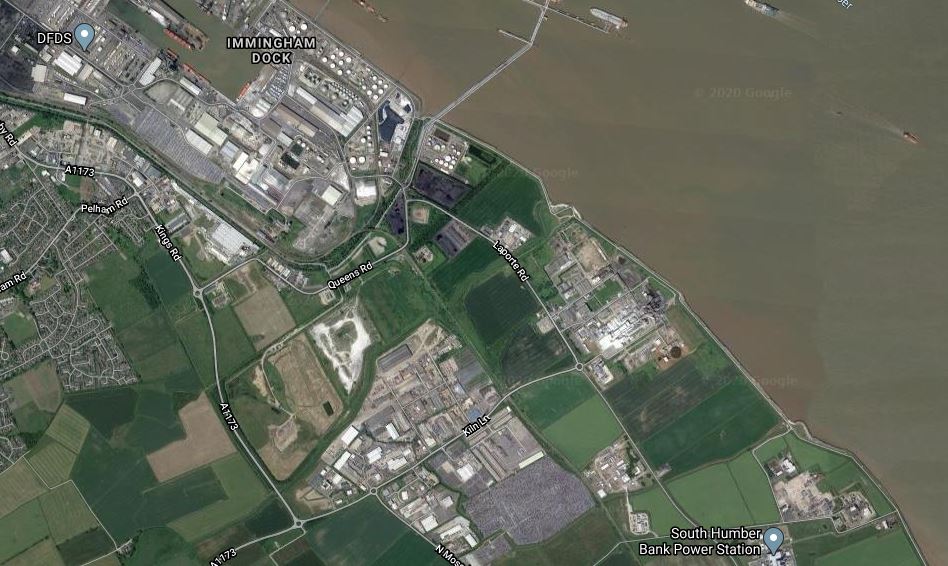
Note.
- Immingham Port is towards the North West corner of the map.
- South Humber Bank Power Station is towards the South East corner of the map.
It would appear that the Altalto plant, will be located on an 80 acre site between the port and the power station.
There would also appear from Google Maps that the Barton Line runs through the area, which would surely be handy for bringing in the waste and taking out the fuel.
This picture from the Altalto web site, shows a visualisation of the plant, looking North East.
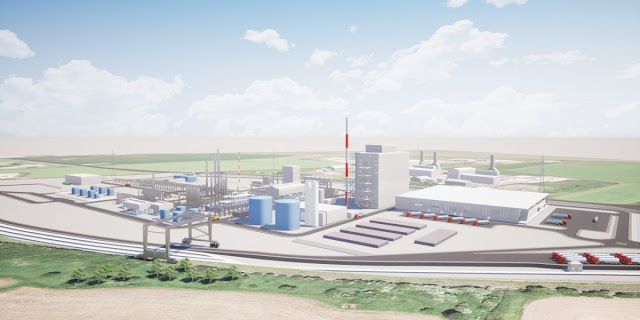
INote, what looks to be the railway, through the site in the foreground.
There are also a couple of informative videos, including one from the BBC, on this page of the Velocys web site.
t looks to be the ideal site.
How Much Fuel Will The Plant Produce?
According to the video on the web site, the plant will convert 500,000 tonnes of waste into 60,000,000 litres of fuel. I estimate that would be about 48,000 tonnes of jet fuel.
Could The Diesel Fuel Be Used To Decarbonise The Railways In The UK?
I believe that a substantial amount of the use of diesel on the UK’s railways will be cut by the use of battery and hydrogen power in multiple units and locomotives.
But some services like the heavy stone trains moving aggregates from the Mendips and the Peak District to London will be difficult to decarbonise, unless a locomotive manufacturer produces a hydrogen-powered locomotive with upwards of five megawatts of power. And that is a tough design challenge.
Low sulpur diesel produced from waste would be one way to reduce the carbon footprint.
Conclusion
It sounds a crazy idea to create aviation fuel and diesel from household waste!
Will It Work?
Consider.
- It appears that most of the technology used to produce this fuel has been around for decades.
- Sasol opened their first commercial plant in South Africa, using the Fischer-Tropsch process in 1952 and still use the technique today.
- Oxford University have added magic ingredients to the Fischer-Tropsch process.
- Velocys seem to have put in a lot of serious thought to get the Altalto project ticking all the right boxes.
The project could be late, but I feel it will deliver the main objective of converting household and commercial waste to jet fuel and diesel.
 The Anonymous Widower