Welsh Government Backs Marine Power Systems’ Floating Wind Tech With GBP 8 Million
The title of this post, is the same as that of this article on offshoreWIND.biz.
This is the sub-heading.
The Welsh government has invested GBP 8 million (approximately EUR 9.4 million) in Marine Power Systems (MPS) to support the commercialisation of its floating offshore wind technology.
These three paragraphs add more detail to the story.
According to the company, the funding will accelerate the deployment of its PelaFlex platform, a floating wind solution designed for deep-water sites where conventional fixed-bottom foundations are not viable.
Marine Power Systems said the investment will help move the technology from advanced development towards commercial-scale deployment and manufacturing. The company also plans to expand its industrial and assembly capabilities in the UK.
The PelaFlex platform has been designed to simplify fabrication, installation and long-term operations while enabling wind farms to be located further offshore where wind speeds are typically stronger and more consistent, MPS says.
The offshore wind industry in Wales seems to be gearing up for a big expansion.
Gwynt Glas is the collective name for the three 1.5 GW floating wind farms in the Western Approaches and in Gwynt Glas And South Wales Ports Combine Strength In Preparation For Multi-Billion Floating Wind Industry, I describe the initial agreement that started the Gwynt Glas project.
To my mind, Associated British Ports and the wind farm developers are making sure they can carpet the Western Approaches, with offshore wind farms.
In Ocean Winds Enters Lease Agreement With Crown Estate For 1.5 GW Celtic Sea Floating Wind Project, I talk in general about the progress of the first three 1.5 GW floating wind farms in Gwynt Glas and in particular about leasing of the third wind farm.
These two posts, indicate that the Port of Port Talbot is preparing itself to produce the floaters for floating wind turbines.
- BW Ideol, ABP To Explore Serial Production Of Floating Wind Foundations At Port Talbot
- Two Ports Advance To Next Stage Of UK Gov Funding For Floating Wind
It certainly appears, that South Wales will be able to build the heavyweight gubbins for floating offshore wind.
According to Was South Wales Once The World’s Largest Coal Exporter? it was, and in 1913, the region produced 57 million tons of coal, with more than half exported.
It does look like South Wales is going to repeat the economic success with offshore energy.
I’ve heard tales from elderly Welshmen talking of the coal ships in the docks of South Wales and will we be seeing gas tankers in the docks of South Wales?
Was South Wales Once The World’s Largest Coal Exporter?
I asked Google AI, the title of this post and received this answer.
Yes, South Wales was once the world’s largest coal-exporting region and home to the busiest coal-exporting ports in the world. During its peak in 1913, the South Wales coalfield supplied almost one-third of total global coal exports, with Cardiff and Barry leading the world as the top coal ports.
Key details regarding the coal boom in South Wales:
Peak Production: In 1913, the region produced 57 million tons of coal, with more than half exported.
Top Export Ports: In 1913, Barry was recognized as the world’s largest coal-exporting port, closely followed by Cardiff.
The “Coal Metropolis”: Cardiff became the world’s leading coal and shipping metropolis, with the Cardiff Coal Exchange setting the global price for steam coal.
Economic Impact: The boom drove massive population growth in the South Wales Valleys and created tremendous wealth for cities like Cardiff, Barry, and Newport.
Global Demand: Welsh coal was highly sought after for its high quality, fueling steamships, railways, and industries across the world, from Russia to South America.
By 1920, the industry employed over 270,000 miners, but it saw a steep decline thereafter due to economic depression, international competition, and the exhaustion of accessible reserves.
How Much Pumped Storage Hydro Will Be Operational In The UK By 2030?
Pumped Storage Hydro is the Bank of England-standard for energy storage.
I asked Google AI, the question in the title of this post and received this answer.
The UK currently has approximately 3 GW (roughly 26-28 GWh) of operational pumped storage hydro (PSH) capacity. By 2030, this capacity is expected to increase, driven by new projects in the pipeline that aim to meet a government goal of up to 8 GW of long-duration energy storage by that year.
Key Projects Expected Online by 2030-2031:
Coire Glas (SSE): A major project in Scotland with a planned capacity of 1.3 GW / 30 GWh, expected to be operational around 2030–31.
Cruachan Expansion (Drax): A 600MW plant in Scotland that has received approval, with construction expected to contribute to the 2030 goal.
Glenmuckloch: Projected to be operational by 2029. In
Other Developments:
Total Pipeline: Developers have identified up to 10 GW of potential projects in the Scottish Highlands and Wales, though not all will be operational by 2030.
Future Growth: The total installed capacity of PSH is expected to grow significantly, with one projection suggesting a rise from 26.7 GWh currently to over 122 GWh by 2034.
To support these projects, the UK government has confirmed a “cap and floor” investment framework to stimulate development of long-duration energy storage (LDES).
For a relatively small island we do seem to be an ideal place to develop pumped storage hydro!
The Coire Glas Pumped Storage Scheme
In The Coire Glas Pumped Storage Scheme, I give more details of this scheme.
The Glenmuckloch Pumped Storage Scheme
In The Glenmuckloch Pumped Storage Scheme, I give more details of this scheme, which is based on a disused open cast coal mine.
Addition Of Pumped Storage Hydro By 2030
This looks to be around 5 GW, but it is just a foretaste of the shape of things to come!
10 Exciting New Train Journeys Coming To The UK In 2026
The title of this post, is the same as that of this article in The Telegraph.
The journeys are.
South Wales Metro (The ‘Welsh Tube’)
Effectively, what the Welsh have done is turn the railways radiating from Cardiff into the sort of metro that Birmingham, Glasgow, Liverpool and Tyne-Tees have created over the last few decades.
- They are replacing a large proportion of the rolling stock, with new electric or hybrid-electric trains and tram-trains.
- Some of the lines are notably scenic.
- Some new stations have been added.
- There are attractions to visit.
- A Day Ranger ticket is available.
A few times in the past few years, when I feel I need some fresh air, I’ve taken a train to Cardiff, bought a Day Ranger and climbed a few hills in a train, as in my seventies, I’m too old to walk up.
I wouldn’t be surprised that the forthcoming Leeds Metro borrows heavily from ideas developed on the South Wales Metro.
London To Stirling
Stirling is one of those towns and cities, like Barrow-in-Furness, Blackpool, Shrewsbury and a few others, that Virgin and Avanti West Coast seem reluctant to serve.
I feel by choosing Stirling for a service, Lumo have just done the obvious.
- The route is fully-electrified.
- Stops will be Milton Keynes, Nuneaton, Crewe, Preston, Carlisle, Lockerbie, Motherwell, Whifflet, Greenfaulds, and Larbert.
- There will be four trains per day.
- The initial trains will be Class 222 trains.
- The electric Class 803 trains are on order.
- Hitachi are developing battery-electric trains for Lumo on the East Coast to be able to use the diversion via Lincoln, which would probably reach Perth.
- Car-hire companies will do well in Stirling.
- Stirling has onward train connections to Aberdeen, Dundee, Inverness, Montrose, Perth and Stonehaven.
- I wouldn’t be surprised to see FirstGroup, who are Lumo’s parent or another coach company, creating a hydrogen-powered coach network for the North of Scotland.
- The service will start in May 2026.
That really shows how railways can be used to boost growth. But will the SNP get the message?
I will use this service to have a few days in Stirling and explore the Southern part of the Scottish Highlands by train.
Caledonian Sleeper from Birmingham
This looks to be obvious addition to the Caledonian Sleeper.
The Telegraph says this.
The joys of the Caledonian Sleeper to Scotland, well known to travellers from London, are to be extended for the first time to those wanting to alight at Birmingham International. This change – the biggest in the Caledonian Sleeper schedule for 30 years – will mean that greeting the dawn approaching places as far flung as Fort William, Aberdeen and Inverness will be a far more realistic prospect for fans of this form of travel who live in the Midlands.
Note.
- The Birmingham stop will be at International not New Street.
- The service starts on January 16.
- Only the Highlander will stop at Birmingham International.
It seems to be a well-thought out simple addition to the service.
Newquay And Falmouth
The Telegraph says this.
Exciting news for fans of Cornwall where a new direct service linking the north and south coasts this year will make travelling by train between the key towns of Newquay and Falmouth considerably easier. The improvement to the current journey, frequently involving multiple changes and lasting two and half hours, will start with an increase in services between Newquay and Par in the spring and, by the end of the year, the commencement of the direct link all the way through to Falmouth.
Note.
The project is named the Mid Cornwall Metro.
The project has cost £57 million.
The route will be Newquay and Falmouth Docks via Quintrell Down, St. Columb Road, Roche, Bugle, Luxulyan, Par, St. Austell, Truro, Perranwell, Penryn, Penmere and Falmouth Town.
For more information, see midcornwallmetro.com
The journey time between Newquay and Falmouth will be cut by forty-five minutes.
I am sure that there are other rail systems in the UK, Ireland and in the wider world, that could benefit from a
High Speed Sonnet (Weardale To Stratford-upon-Avon)
The Telegraph says this.
And now for something completely different: a one-off charter train from the dales of County Durham to Stratford-upon-Avon, the heart of Shakespeare country. This journey, dubbed the “High Speed Sonnet”, comes as part of the 50th anniversary celebrations of the introduction of the legendary InterCity 125 high speed trains, one of which will be deployed on the run from Stanhope to the birthplace of the bard.
This train journey, although it is probably very nice is not really my scene.
- I don’t have a partner.
- I don’t live near to Weardale or Stratford-on-Avon.
- As I’m coeliac and low alcohol, I’m not really keen on gourmet dining events.
But the train is an Intercity 125, so some might like to take a ride.
For more details see excursionsbyrail.co.uk
West Highland Line, Scotland
The Telegraph says this.
A journey along the West Highland line, the most scenic stretch of track in Britain, and a visit to the Royal waiting room used by Queen Victoria during visits to Balmoral are two of the highlights of a new tour for 2026, offered by small group Scotland and UK specialists McKinlay Kidd.
Similar comments to the previous journey apply, except that it is West Scotland.
But the train is steam-hauled over the Glenfinnan Viaduct of Harry Potter fame, so some might like to take a ride.
For more details see mckinlaykidd.com
Mid Wales Explorer
The Telegraph says this.
Another new tour for 2026, this one run by The Railway Touring Company, has as its focus the central part of Wales. Highlights include a journey along the Welsh Highland line on the “Harbourmaster”, shorter trips on the celebrated little railways of Llangollen, Bala Lake, Talyllyn, Vale of Rheidol and Welshpool, and a narrowboat ride across world heritage Pontcysyllte Aqueduct located 38 metres above the River Dee. Tidy.
I might go on this one if the date of June 10th fits.
For more details see railwaytouring.net
Newcastle And Brighton
The Telegraph says this.
How about this for a tantalising prospect – a direct service between Newcastle and Brighton calling at York, Sheffield, Birmingham New Street, Oxford, Reading, and Gatwick Airport – with no need to change trains in London? This is the new route proposed by open-access operator Grand Central (part of Arriva UK Trains) and currently awaiting approval from the Office of Rail and Road.
All going well, services – five trains each way daily – should start by the end of the year. A potential game changer and, following the commencement of the direct link between Seaham and London in December 2025, a further example of Grand Central’s drive to connect underserved communities.
For more details see grandcentralrail.com
London And Cleethorpes
The Telegraph says this.
Another Grand Central proposal that whets the appetite is the application to run direct services (for the first time since 1992) between London and the Lincolnshire seaside town of Cleethorpes. While not without its critics, Cleethorpes is an old-school British resort with pier, promenade and the Cleethorpes Coast Light (miniature) Railway service. If approved, four services a day would be up and running by the end of 2026; additional stops would include Doncaster, Scunthorpe, Grimsby, Thorne South, Crowle and Althorpe.
For more details see grandcentralrail.com
Note.
Althorpe is not to be confused with the burial place of Princess Di.
In Lunch On The Pier In Cleethorpes, I wrote about excellent gluten-free fish and chips on the pier.
Champagne Moments On The Northern Belle
The Telegraph says this.
The late Queen Mother famously enjoyed G&Ts while seated in carriages which now form part of the the Northern Belle. This in mind, she would likely have approved of the latest innovation on one of Britain’s plushest trains: the addition of a “Krug class”, which includes one bottle of Krug Grande Cuvée Champagne per couple, to enjoy over a multi-course meal and seating in Duart (formerly a carriage on The Royal Train) or Glamis, named after the Queen Mother’s childhood home.
The train operates a number of day trips on scenic routes to landmark cities such as York, Edinburgh and Bath, and to colourful events such as the RHS Chelsea Flower Show.
For more details see 95pp; northernbelle.co.uk
Gwynt Glas And South Wales Ports Combine Strength In Preparation For Multi-Billion Floating Wind Industry
The title of this post, is the same as that of this news item from the Gwynt Glas wind farm.
The news item starts with a spectacular image of a port, that is assembling floating wind turbines and these three paragraphs.
Gwynt Glas Offshore Wind Farm has signed a Memorandum of Understanding (MoU) with the UK’s largest port operator, Associated British Ports, and Wales’ largest energy port, the Port of Milford Haven, to ready the ports for the future needs of floating offshore wind in the Celtic Sea.
Gwynt Glas is a joint venture partnership between EDF Renewables UK and DP Energy. The proposed floating offshore wind farm would generate 1GW of low carbon green energy in the Celtic Sea.
Under the MoU, information and industry knowledge will be shared to investigate the potential opportunities for manufacture, assembly, load-out and servicing for the Gwynt Glas project from the key South Wales Ports of Port Talbot and Milford Haven. This collaborative approach demonstrates a major commitment to supporting economic growth, investment and maximising social value in the region.
UK Solar Deployment Poised To Increase 50% YoY, Following Rapid Growth In The Second Half Of 2024
The title of this post, is the same as that of this article from Solar Power Portal.
This is the sub-heading.
Josh Cornes, analyst at Solar Media Market Research, looks at what 2025 might hold for the solar industry.
The first four paragraphs give some interesting statistics.
The UK is forecast to add between 3-3.5GWp-dc of capacity in 2025, just shy of the huge numbers seen in 2015 and huge growth on 2024.
The UK added around 2.3GWp-dc in 2024, exceeding original expectations with the help of a push in ground mounted projects toward the back end of the year. This equates to around 20% growth on the 1.9GW that was added in 2023.
Approximately 20% of the 2.3GW deployed in 2024 came from residential rooftop installations, continuing the boost in this sector, first highlighted by the near 200% year-on-year (YoY) increase from 2022 to 2023. Commercial rooftops also contributed 20% of installations in 2024 with a slight increase of 10% YoY.
Large-scale ground-mount installations in 2024 saw the largest growth, making up 60% of the annual capacity. This uptick has continued to be driven by projects with Contracts for Difference (CfD), with rounds AR4 and AR5, and even AR6, accounting for nearly 850MW of the 1.3GW added.
It is a well-written article, that should be read in full.
Summarising 2024
In 2024 solar installations broke down as follows.
- Ground-mounted -1.38 GW
- Residential rooftops – 0.46 GW
- Commercial rooftops – 0.46 GW
Which adds up to the total installed solar capacity of 2.3 GW.
3.5 GW of total solar is scheduled to be installed in 2025, which at that rate until the end of 2030 would add 21 GW of total solar power.
But the UK will get help from what I think is one of the best solar ideas, which surprisingly comes from The University of Swansea in Wales.
This Google Map shows the three large solar roof panels on Denmark Hill station in London.
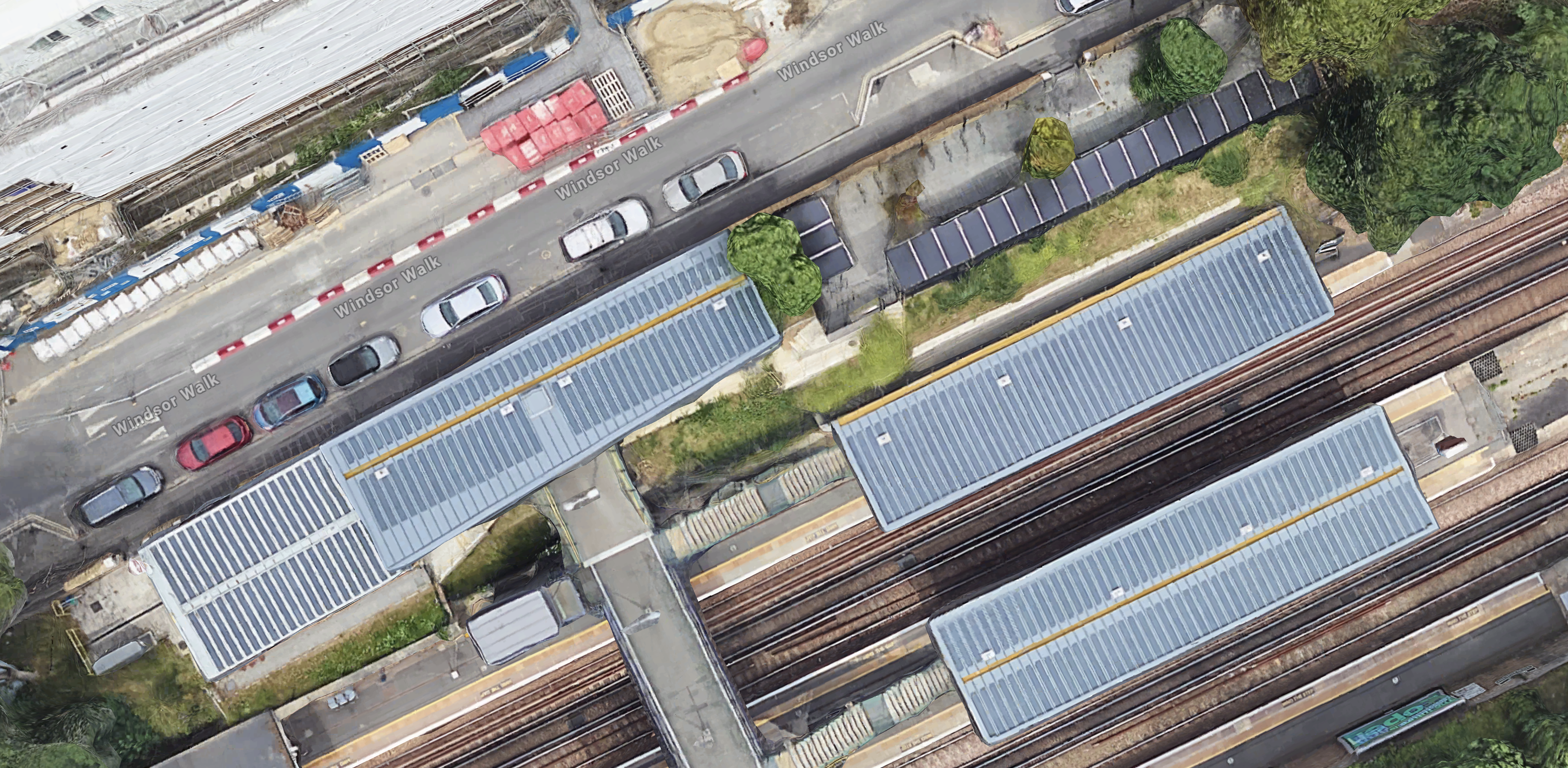
Note.
- The three large panels are flat.
- The panels are built on a steel substrate.
- Two provide shelter for three platforms.
- The third panel provides shelter for entering passengers.
These pictures show the panels from various angles.



















So often, a small improvement opens up a large opportunity.
This page on the Kalzip web site which is entitled Modernisation of Denmark Hill Station, gives more details of the station project.
Over the years, I put up a few steel-roofed buildings in my time and I helped design a few with a client in the 1970s, that could have benefited from solar panels like these.
Abergavenny Station – 13th October 2024
For a trip today, I went to Abergavenny station to see the progress on the new step-free bridge and take a few pictures.




























Note.
- The station has several unusual features.
- The car park could take all of about six cars.
- The current bridge would be dangerous for the elderly with shopping trolleys.
- Network Rail seem to be explaining the work in more detail, than usual.
Why is it that each new step-free station bridge appears to be a different design?
enfinium Announces Proposal For £200m Investment In Carbon Capture Project In North Wales
The title of this post is the same as that of this press release from enfinium.
This is the sub-heading.
The project could be capable of capturing up to 235,000 tonnes of CO2 every year, accelerating efforts to achieve net zero.
The first two paragraphs outline the project.
Today, enfinium, a leading UK energy from waste operator, announces it is progressing plans to invest around £200 million in carbon capture and storage (CCS) technology at the Parc Adfer energy from waste facility in Deeside, North Wales, providing vital carbon removals and boosting the green economy.
The project could capture up to 235,000 tonnes of carbon dioxide (CO2) every year. As over half of the waste processed at the facility is organic, installing CCS would enable the plant to take more CO2 out of the atmosphere than it produces. The Welsh Government’s Carbon Budget makes clear that Wales needs carbon removal solutions to mitigate other polluting parts of the economy to achieve a Net Zero economy.
The press release also says this about Paec Adfer.
Opened in 2019 in partnership with the five local authorities that make up the North Wales Residual Waste Treatment Partnership (NWRWTP), Parc Adfer currently diverts up to 232,000 tonnes of unrecyclable waste from climate damaging landfill. As recognised by the National Infrastructure Commission, emissions from energy from waste plants are lower per tonne of waste compared to landfill.
With CCS installed, Parc Adfer will support the Welsh Government’s ambition to have 100% zero carbon power by 2035 and support over 1,000 jobs in the green economy during the construction phase.
This Google Map shows the location of Parc Adfer, with respect to Liverpool and the River Dee.
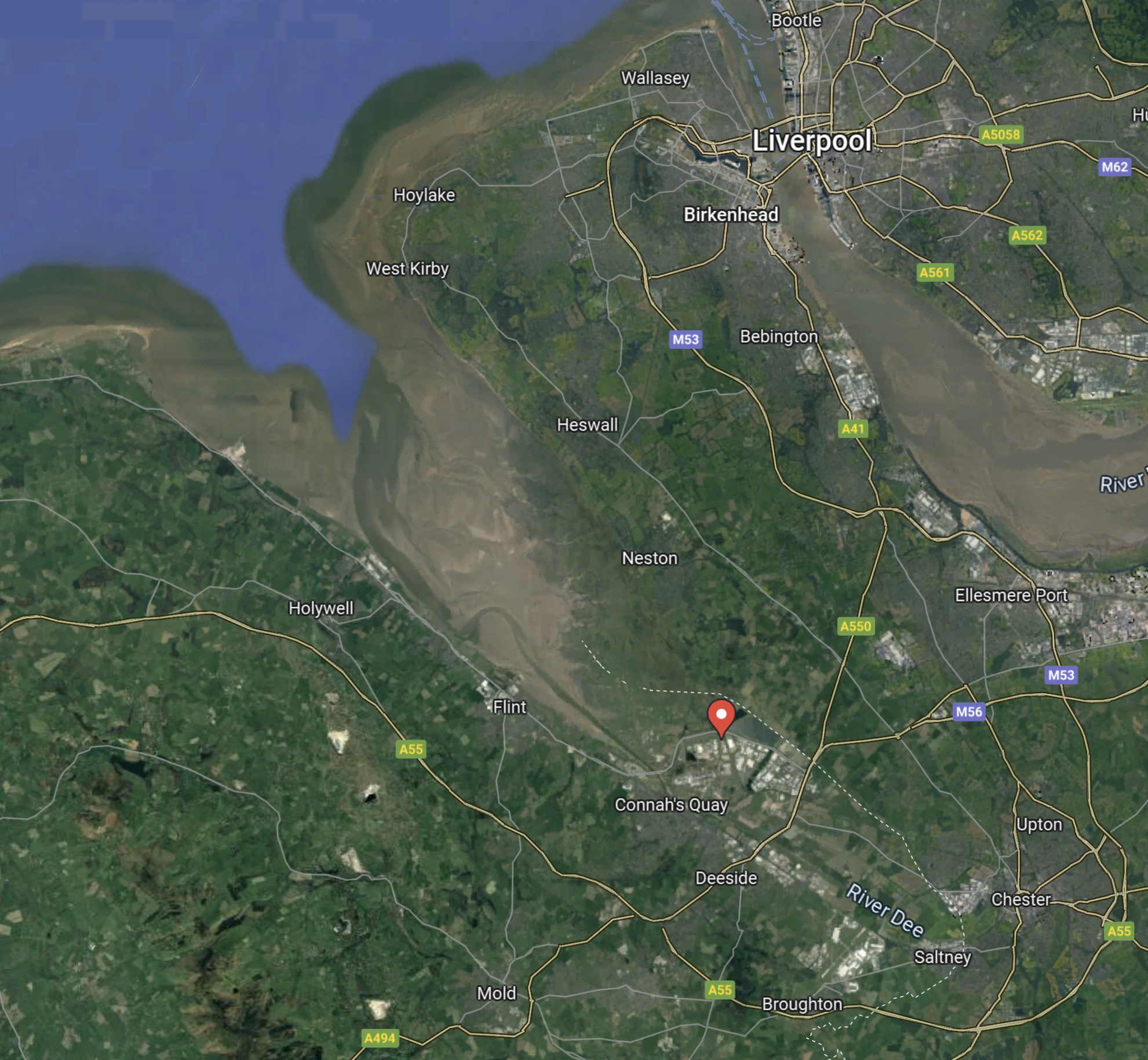
Note.
- Liverpool is in the North-East corner of the map.
- Chester is in the South-East corner of the map.
- The Dee Estuary is in the North-West corner of the map.
- The red arrow indicates the location of Parc Adfer.
This second Google Map shows the location of Parc Adfer in Deeside Industrial Park, which is just over the England-Wales border.
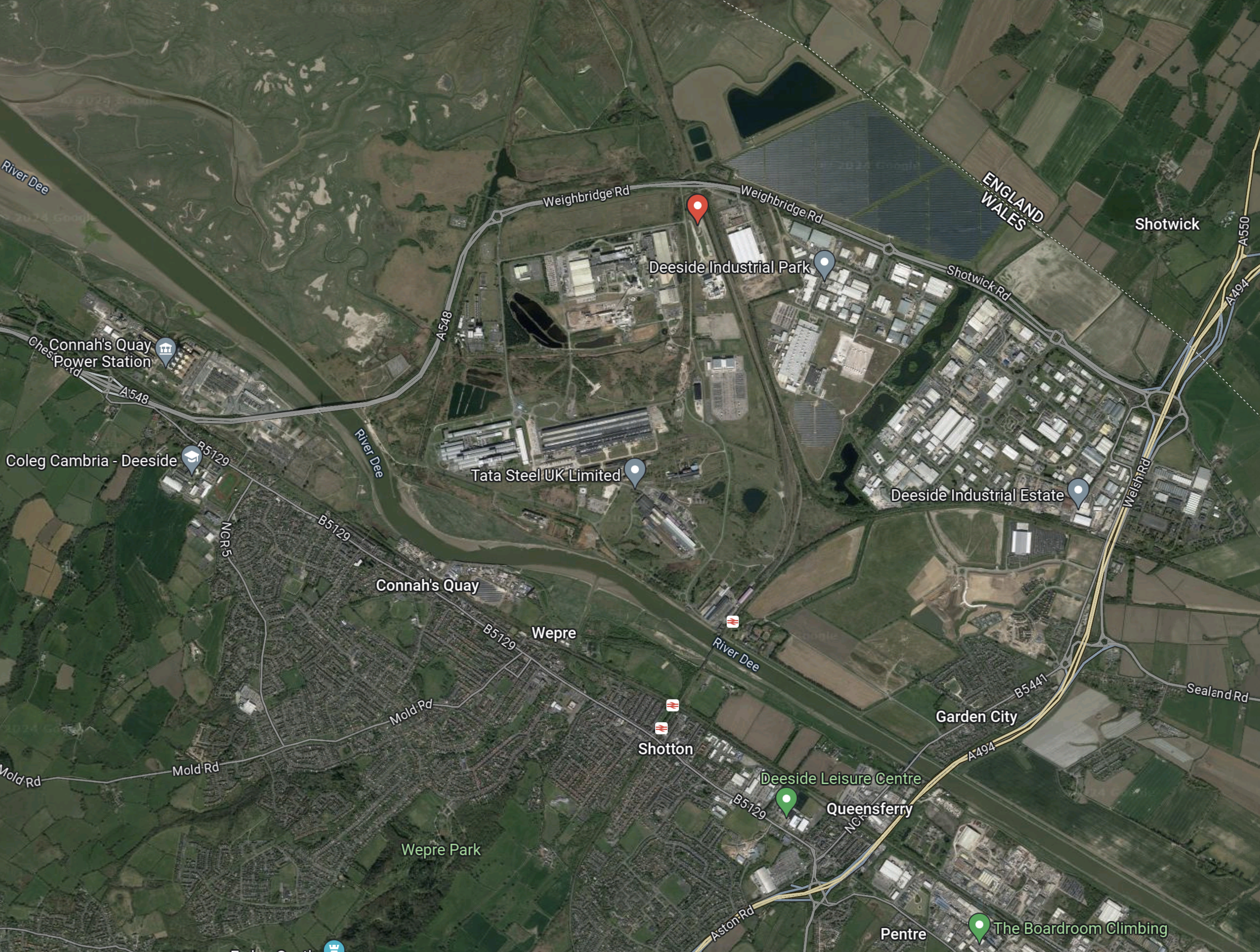
As before, the red arrow indicates the location of Parc Adfer.
This third Google Map shows the detailed area of Parc Adfer.
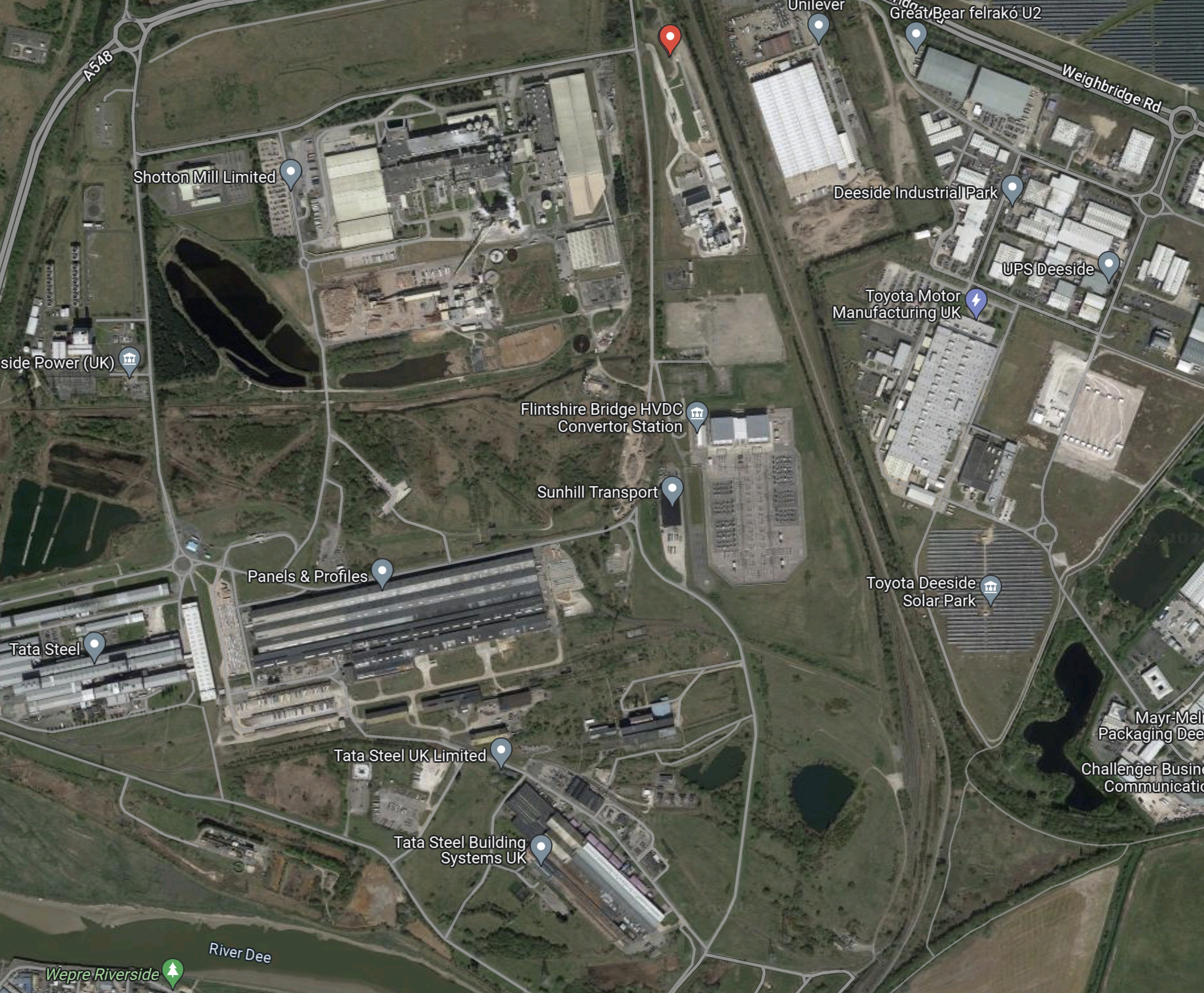
Note.
- The red arrow indicates the location of Parc Adfer.
- The Borderlands Line between Liverpool and Wrexham runs alongside the site.
- Around Parc Adfer are assorted steel works and the Flintshire Bridge HVDC Convertor Station for the Western HVDC Link to Hunterston in Scotland.
- On the other side of the tracks are Amazon, Great Bear Distribution, Toyota, Unilever and the Toyota Deeside Solar Park.
These are my thoughts.
Parc Adfer Has Excellent Electrical Connections
In addition to the 2.25 GW Western HVDC Link to Hunterston, there are following power sources in the area.
- The wind farms of Liverpool Bay.
- The 1.4 GW Connah’s Quay power station.
- The 498 MW Deeside power station.
From the enfinium web site, it looks like Parc Adfer will generate 21 MW of zero-carbon energy from waste.
Will Parc Adfer Have A Rail Connection?
According to the enfinium web site, Parc Adfer will process waste from Flintshire County Council, Denbighshire County Council, Conwy County Borough Council, Gwynedd Council and the Isle of Anglesey County Council.
I have arranged these councils in order from East to West and all are served by the North Wales Coast Line.
This OpenRailMap shows the rail connection between Parc Adfer and the North Wales Coast Line.
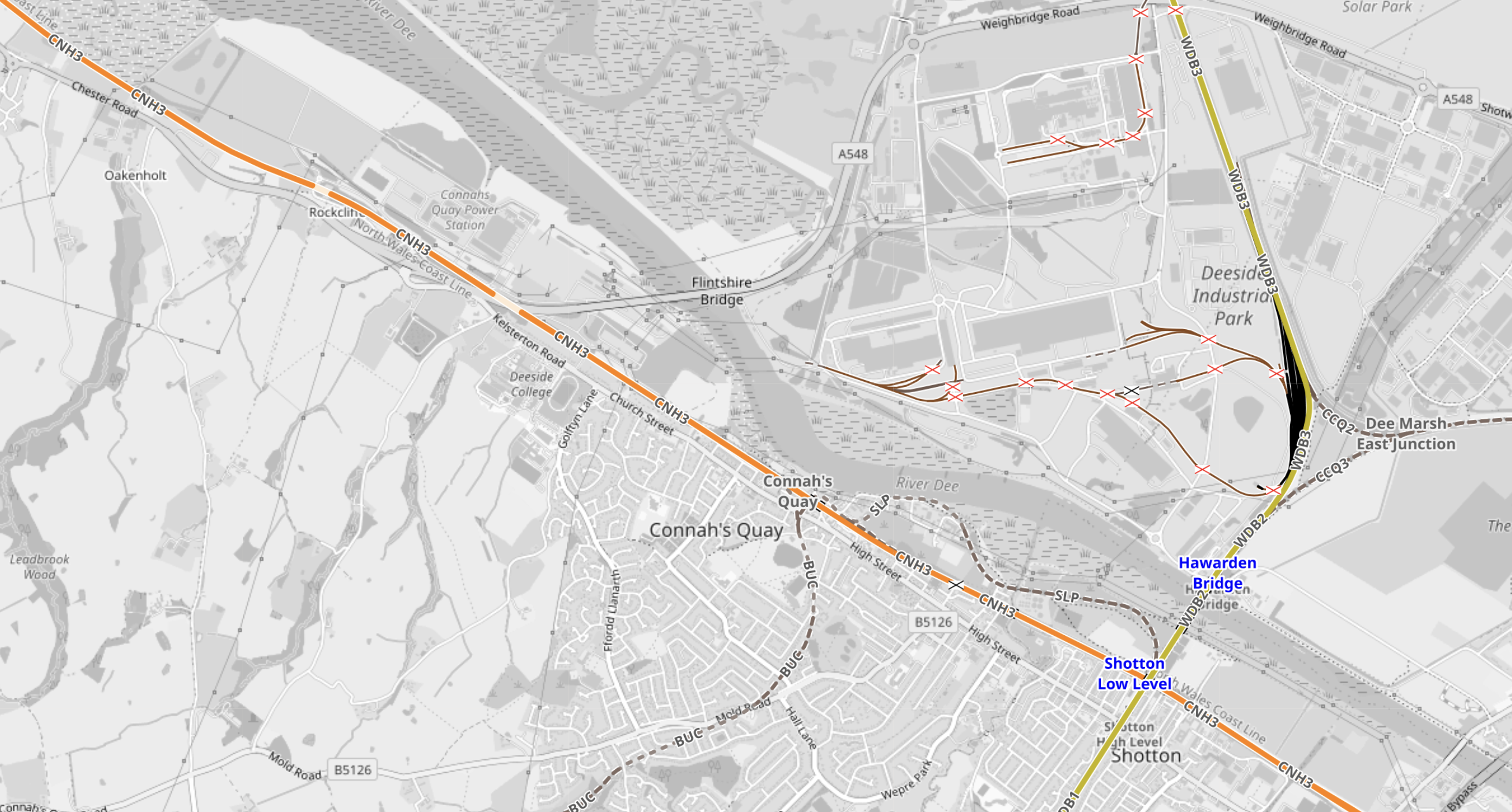
Note.
- The Borderlands Line is shown in yellow and runs between Liverpool and Wrexham.
- The Borderlands Line runs past Parc Adfer just off the North of the map.
- The North Wales Coast Line is shown in orange and runs between North Wales and Chester.
- There are two stations at Shotton; High and Low Levels, which allow a passenger connection.
Unfortunately, there is no rail connection for trains which would allow freight services between Parc Adfer and North Wales.
A section called Future, in the Wikipedia entry for Shotton station, says this about upgrading the station.
In March 2015 Network Rail published the draft version of their Welsh Route Study. It contained a proposal to build a new interchange station that would replace the existing High and Low Level stations, allowing for greater connectivity between the North Wales Coast Main Line and the Borderlands Line. The document recommended a transport planning study to establish the cost, feasibility and benefits of the proposed scheme.
It appears to be likely, that no rail route will be created to allow freight services between Parc Adfer and North Wales.
Deeside Parkway Railway Station
It does appear that a parkway station at Deeside Parkway is a possibility.
This is the opening paragraph of the Wikipedia entry for Deeside Parkway station.
Deeside Parkway is a proposed railway station situated between Neston and Hawarden Bridge on the Borderlands Line. The station is intended to serve the Deeside area of Flintshire, North Wales, particularly the Deeside Industrial Park.
The station is proposed to be park of the North Wales Metro, which is described in this Wikipedia entry.
Pension Power Backing For New Battery Energy Storage Plant
The title of this post, is the same as that of this article on Nation.Cymru.
These paragraphs outline the project,
A new battery energy storage plant at the site of a decommissioned power station will be funded by Welsh pensioners.
The plan for the facility at the former Uskmouth B Power Station at the Gwent Wetlands on the edge of Newport, was approved by the city council’s planning committee this January.
The batteries will store excess power during times of “excess supply” and then put that electricity back into the grid when demand is higher.
The Greater Gwent Pension Fund, which manages the retirement savings of more than 65,000 members from Blaenau Gwent, Caerphilly, Monmouthshire Newport and Torfaen councils as well as 52 other active employers in the Gwent region, has revealed it is investing in the project.
According to their Wikipedia entry, the Uskmouth power stations have had rather a chequered history and both appear to be currently non-productive.
- The original coal-fired Uskmouth A has been demolished and the site is now occupied by an 832 MW gas-fired CCGT power station. Currently, it is in a ‘dormant’ state, after its owner entered administration.
- The original coal-fired Uskmouth B has been converted and now can generate 363 MW on a mixture of biomass and waste plastic. Uskmouth B is currently being demolished.
This press release from Quinbrook Infrastructure Partners is entitled Quinbrook To Build Large-Scale Battery Storage Project At Uskmouth, South Wales.
This is the sub-heading.
Uskmouth will be one of the largest storage projects in the UK and will directly support the UK’s energy transition.
These first two paragraphs outline the project.
Quinbrook Infrastructure Partners (“Quinbrook”), a specialist investment manager focused on renewables, storage and grid support infrastructure has acquired the exclusive development rights for one of the UK’s largest battery storage projects to date.
The planned 230MW / 460MWh Battery Energy Storage System (“BESS”), will be located at the site of the former Uskmouth coal fired power station in south Wales (“Project Uskmouth”) and will seek to utilise existing power transmission infrastructure and provide a new lease of life to the area. Uskmouth was acquired from Simec Atlantis Energy Limited (“SAE”). Quinbrook has partnered with Energy Optimisation Solutions Limited (“EOS”) in the origination and development of Project Uskmouth, which represents a major anchoring project in the planned re-development and regeneration of the Uskmouth site into a Sustainable Energy Park that will support innovative future industry. Quinbrook considers these types of regeneration projects as key to making meaningful contributions to delivery of the Government’s Levelling Up ambitions.
Note.
- The battery can supply 230 MW for two hours.
- It looks like the battery will replace the older of the two power stations and work with the relatively-modern 832 MW gas-fired CCGT power station.
- Will they act as backup to renewables?
As there are very few renewables in the area, will this work with the wind farms being developed in the Celtic Sea or are Quinbrook anticipating wind farms South of Newport in the Bristol Channel?
I have a few thoughts.
Will Uskmouth Work With Hinckley Point C?
This Google Map shows the relative locations of Uskmouth and Hinckley Point C.

Note.
- Uskmouth is just South of Newport, in the North-East corner of the map.
- I estimate that Uskmouth and Hinckley Point C are 24.7 miles apart.
A cable across the Bristol Channel would surely increase the energy security of South Wales.
Will There Be Wind Farms In The Bristol Channel?
I feel that this is inevitable.
This document on the Welsh Government web site is entitled Future Potential For Offshore Wind In Wales, was written by The Carbon Trust.
This paragraph is the document’s assessment of wind farms in the Bristol Channel.
Despite high energy demand and good infrastructure, environmental conditions in the Bristol Channel
makes this area challenging for offshore wind development. In addition to lower average wind speeds,
the Bristol Channel has complex seabed, including areas of hard rock, and is exposed to strong tidal
currents from the Severn Estuary. Seabed conditions and tidal currents were the main drivers behind
cancellation of the Atlantic Array project and it is considered unlikely that a developer would look to
revive this site in the near-term, particularly given competition with other more favourable UK sites.
That doesn’t seem very promising.
But this is the document’s assessment of wind farms in the Pembrokeshire Atlantic area.
Exposure to the prevailing south-westerly Atlantic wind and swells means that the waters off
Pembrokeshire have excellent wind speeds, often exceeding 10 m/s, but also a harsher wave
environment than elsewhere in Wales. Significantly, water depths quickly increase to over 50m,
suggesting that floating foundations are likely to be required, particularly if projects are located
further from shore, which is likely given constraints from environmental impact and seascape near to
the Pembrokeshire Coast National Park.Grid infrastructure is constrained for thermal generation but should not be a barrier to new
renewables. The Greenlink interconnector could also support the addition of new capacity. The region
has good port infrastructure at Milford Haven and Pembroke Dock, which is already actively pursuing
upgrades to future proof the port for potential offshore wind deployment.
That is a lot more promising.
- Some demonstration wind farms are under development.
- Hopefully, the steel would be available at Port Talbot.
- I can see this area, having almost 50 GW of floating wind.
I do feel though, that once the sea off Pembrokeshire is full of wind farms, that developers will turn their attention to the more difficult waters of the Bristol Channel.
Is The Uskmouth BESS A Good Investment?
The Nation.Cymru article discusses this and what they say is well worth reading.
My feelings are that the BESS will be very busy balancing electricity on the South Wales Coast and to and from Ireland using the 500 MW Greenlink Interconnector, which opens this year.
These electrical systems are relatively easy to model and I suspect Quinbrook wouldn’t be investing, if the BESS was not going to generate a substantial income.
Slow Tourism Train Operator Launches First Service
Tyhe title of this post, is the same as that of this article on Railway Gazette.
These are the first two paragraphs.
FS Group’s recently formed tourist train business FS Treni Turistici Italiani has launched its first service.
Branded Espresso Cadore, the overnight service between Roma Termini and Calalzo-Pieve di Cadore-Cortina will run every Friday night until mid-February. On arrival, a connecting bus takes passengers to Cortina d’Ampezzo in 45 min. The return train departs on Sundays, arriving at Roma Termini on Monday morning.
It is surely an interesting concept and I believe it could work on several routes in the UK.
- Settle and Carlisle would be an obvious route.
- Cumbrian Coast Line.
- Bristol and Oxford, which I wrote about in Leisure Market Boom? GWR’s Vision For Direct Bristol-Oxford Services.
There must also be a couple of routes in Scotland and Wales.
As the three routes, I named are electrified at both ends, there is a possibility that they could be run by quiet battery-electric trains.
 The Anonymous Widower