Highview Power And Railway Electrification
In Encore Joins Highview To Co-Develop Liquid Air Energy Storage System In Vermont, I gave brief notes about a proposed Highview Power CRYOBattery in Vermont.
- The system will supply 50 MW for eight hours.
- The total capacity will be 400 MWh.
Other articles have suggested, that the system could be built on the site of a demolished coal-fired power station, which still has a good connection to the electricity grid.
In other words, I believe that a CRYOBattery can be considered to be a small 50 MW power station.
- It could be charged by local excess renewable energy during the day.
- It could be charged by excess renewal energy from the electricity grid during the night, when there can be large amounts of wind energy, that needs a home.
- Intelligent control systems, would balance the output of the CRYOBattery to the needs of the electricity grid.
It would be used in very much the same way as gas-turbine power-stations are used in electricity grids all over the world.
The Braybrooke Feeder Station
The National Grid is providing a feeder station at Braybrooke to support the Midland Main Line electrification.
This page on the Harbough Rail Users site is entitled Electrification Substation Plan for Braybrooke.
It gives this description of the sub-station.
Electrification of part of the Midland Main Line has moved a tentative step closer with the plans being prepared by National Grid for a feeder substation at Braybrooke, just outside Market Harborough. The location is where a high-voltage National Grid power-line crosses over the railway and the plan is for a substation and associated equipment plus an access road from the A6. The substation is due to be completed by October 2020 and is intended to feed the power supply for the Corby line pending electrification of the main line through Market Harborough.
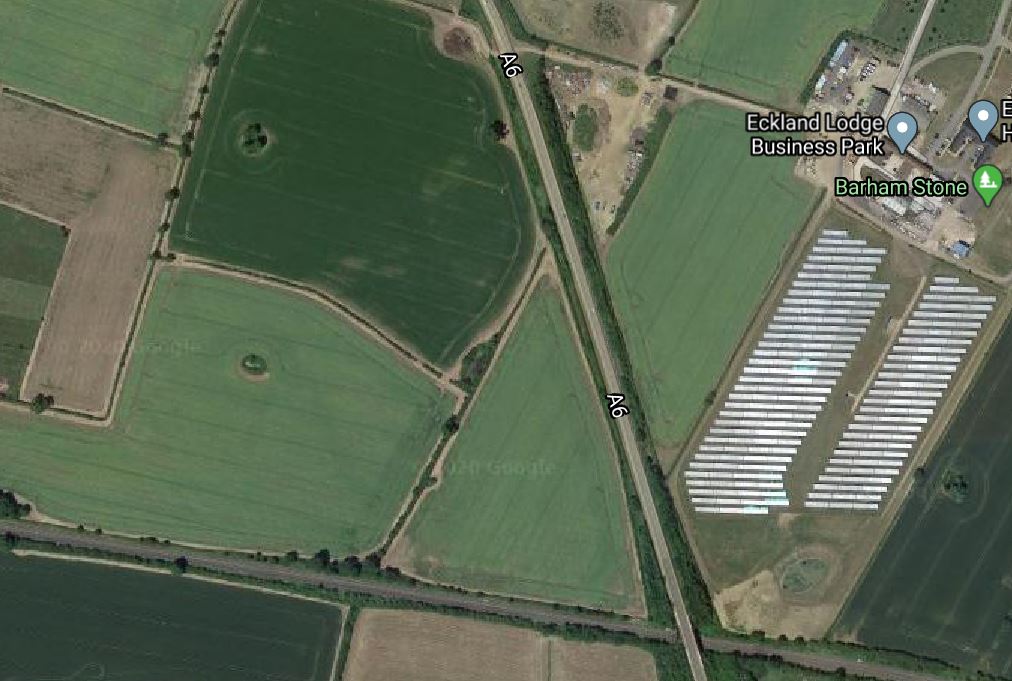
This Google Map shows the rough area, where it will be located.
Note.
- The A6 crossing the Midland Main Line.
- The solar farm in the South-facing field, which has a 3MW capacity, according to the Eckland Lodge Business Park web site.
- Various planning documents say the transformers on the substation will be 400/25 kV units.
- This means that the power-line in the area must be a 400 kV.
Unfortunately, I can’t pick out the line of 400 kV pylons marching across the countryside. But they are rather large.
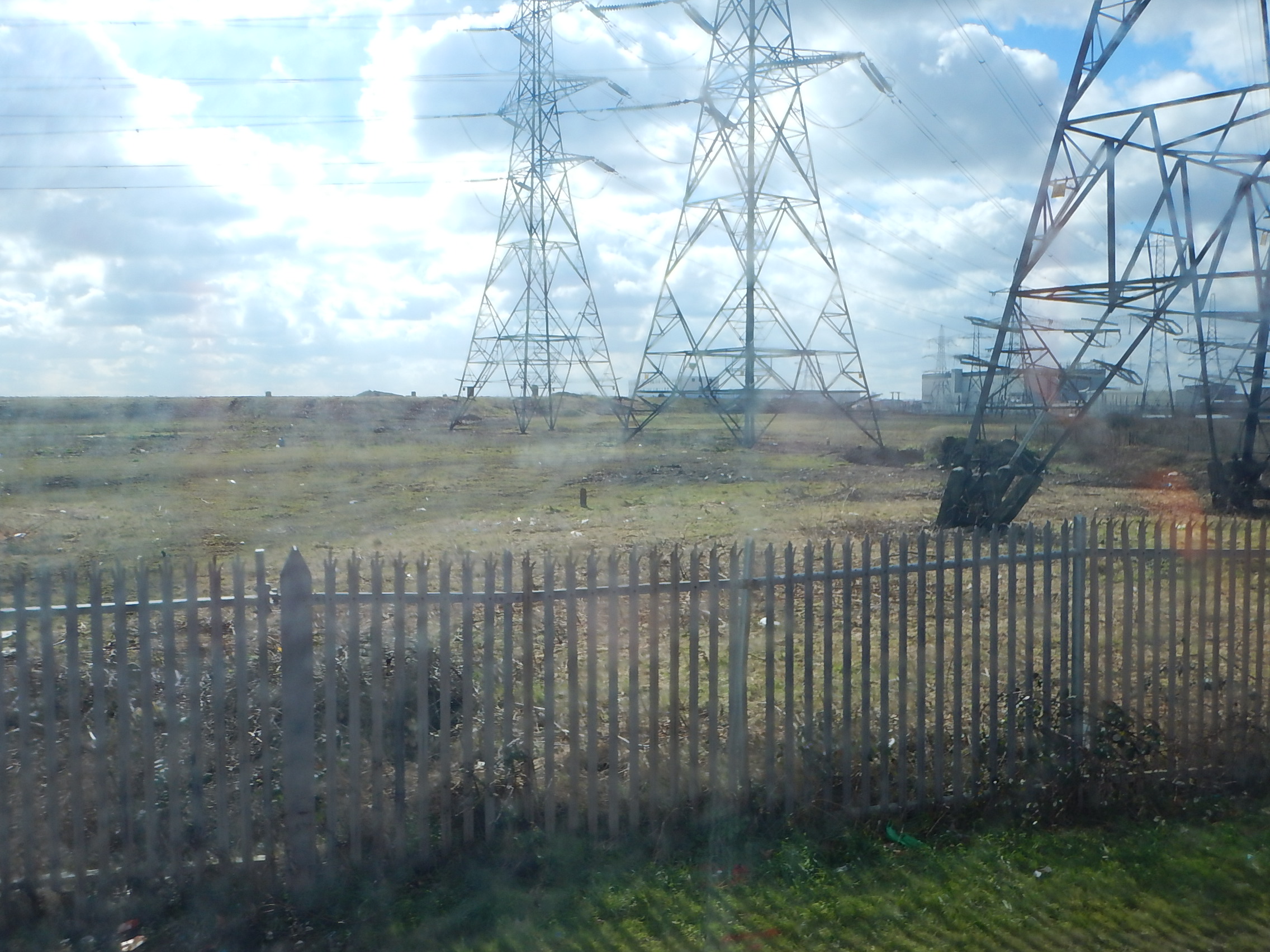
The pictures show a group of 400 kV pylons near Barking.
- The Midland Main Line at Braybrooke certainly seems to be getting a solid supply of electricity.
- It was originally planned, that the electrification would go all the way, but it was cut back to Kettering and Corby a couple of years ago.
- But to power, the electrification to Corby, it is being extended all the way to Braybrooke, so that the electrification can act as a giant extension lead for the Corby Branch Line.
The page on the Harborough Rail Users Site says this.
The Braybrooke substation is still planned, however, and the DfT has advised that the bi-mode trains will be able to switch power mode at speed. They would therefore be able to continue running electrically north from Kettering as far as Braybrooke before ‘pan down’
It would appear, that the end of the electrification will be at Braybrooke, but the sub-station seems to have enough power to extend the electrification further North if that is ever planned.
I also think, that is rather an efficient and affordable solution, with very little modification required to the existing electricity network.
But not all electricity feeds to railway electrification have a convenient 400 kV line at a handy site for installing all the needed transformers and other electrical gubbins.
How Much Power Will Needed To Be Supplied At Braybrooke?
This can probably be dismissed as the roughest or rough calculations, but the answer shows the order of magnitude of the power involved.
Consider.
- Braybrooke must be sized for full electrification of the Midland Main Line.
- Braybrooke will have to power trains North of Bedford.
- If there is full electrification of the Midland Main Line, it will probably have to power trains as far North as East Midlands Parkway station, where there is a massive power station.
- Trains between Bedford and Market Harborough take thirty minutes.
- Trains between Bedford and Corby take around thirty minutes.
- Four trains per hour (tph) run between Bedford and Market Harborough in both directions.
- The system must be sized to handle two tph between Bedford and Corby in both directions.
- The power output of each Class 360 train, that will be used on the Corby route is 1,550 kW, so a twelve-car set will need 4.65 MW.
- I can’t find the power output of a Class 810 train, but an InterCity 125 with similar performance has 3.4 MW.
- A Class 88 bi-mode locomotive has a power output of 4 MW when using the electrification.
I estimate that Braybrooke could have to support at least a dozen trains at busy times, each of which could need 4 MW.
Until someone gives me the correct figure, I reckon that Braybrooke has a capacity to supply 50 MW for trains on the Midland Main Line.
A Highview Power system as proposed for Vermont, would have enough power, but would need a lot more storage or perhaps local wind or solar farms, to give it a regular charging.
Riding Sunbeams
Riding Sunbeams are a company, who use solar power to provide the electricity for railway electrification.
I’ll let their video explain what they do.
It’s a company with an idea, that ticks a lot of boxes, but would it be able to provide enough power for a busy electrified main line? And what happens on a series of rainy or just plain dull days?
Highview Power
Could a Highview Power energy storage system be used?
- To store electricity from local or grid electrical sources.
- To power the local electrification.
If required, it could be topped up by affordable overnight electricity, that is generated by wind power.
The Highview Power system could also be sized to support the local electricity grid and local solar and wind farms.
Conclusion
I think that Riding Sunbeams and Highview Power should be talking to each other.
Highview Power Keeping Up Momentum
The title of this post is the same as that of this article on Gas World.
This is the introductory paragraph.
It’s full steam ahead for Highview Power as the energy storage provider’s CEO and President today updated on operations.
It does look thatHighview are optimistic since their partnership with Sumitomo Heavy Industries was announced, that I wrote about in Japanese Giant Sumitomo Heavy Invests In Liquid-Air Energy Storage Pioneer.
I am optimistic too!
- Highview’s system uses no difficult technology or rare materials.
- The system can provide large amounts of storage, which we are going to need with all the wind farms we are developing.
- From my Control Engineering and mathematical modelling experience, I believe, these systems can be used to boost power, where it is needed, in the same way gas-fired power stations do.
But above all, Highview Power has created a standalone energy storage system for the Twenty-First Century, that catches the needs and moods of the Age!
Our energy system is changing and it not expressed any better, than in this article on Physics World, which is entitled Does The UK Need 40 GW Of Firm Capacity?
This is the opening sentence.
Whether it comes from nuclear plants or fossil fuel-fired power stations with carbon capture and storage (CCS), the UK will need 30-40 GW of new “firm” low-carbon baseload generation by 2050 to meet the net-zero emissions target, Greg Clark reportedly said.
I don’t think that the country will allow any Government of the UK to build that much nuclear capacity and I have my doubts about the feasibility of large scale CCS. I also don’t think, the public will allow the building of large coal-fired power stations, even with CCS. And they don’t like nuclear either!
On Wikipedia, Wind Power in the UK, says this about the current Round 3 of proposals for wind farms.
Following on from the Offshore wind SEA announced by the Government in December 2007, the Crown Estate launched a third round of site allocations in June 2008. Following the success of Rounds 1 and 2, and important lessons were learnt – Round 3 was on a much bigger scale than either of its predecessors combined (Rounds 1 and 2 allocated 8 GW of sites, while Round 3 alone could identify up to 25 GW).
If you think UK politics is a lot of wind and bluster, that is pussy-cat’s behaviour compared to the roaring lions around our shores.
Wikipedia then lists nine fields, with a total power of 26.7 GW, but some are not being built because of planning.
But we ain’t seen noting yet!
Wikipedia says this about Round 4.
Round 4 was announced in 2019 and represented the first large scale new leasing round in a decade. This offers the opportunity for up to 7GW of new offshore capacity to be developed in the waters around England and Wales.
The Agreements for Lease will be announced in 2021.
Wikipedia then makes these points.
- Nuclear power stations have funding and technical problems.
- Since the Fukushima nuclear disaster public support for new nuclear has fallen
- The UK government increased its previous commitment for 40 GW of Offshore wind capacity by 2030, in the Queen’s Speech in December 2019.
- In 2020, this represents a 355% increase in ten years.
- It is expected the Crown Estate will announce multiple new leasing Rounds and increases to existing bidding areas throughout the 2020-2030 period to achieve the governments aim of 40 GW.
- The Scottish Government has plans to chip in 6 GW.
I will add these feelings of my own
- I have ignored the contribution, that better wind-power technology will make to get more GW for each billion pounds of investment.
- I can see a day, in the not too distant future, when on a day in the summer, no electricity in the UK comes from fossil fuel.
- There will be a merging between wind power and hydrogen generation, as I described in ITM Power and Ørsted: Wind Turbine Electrolyser Integration.
- Traditional nuclear is dead, although there may be applications for small nuclear reactors in the future.
- In parallel to the growth of wind power, there will be a massive growth of solar power.
But we will need to store some of this energy for times when the wind isn’t blowing and the sun isn’t shining.
- Pumped storage hydroelectric schemes, as at Electric Mountain in Snowdonia may have a part to play as I described in The New Generation Of Pumped Storage Systems. But sadly, the UK doesn’t have the terrain for another 9.1 GWh scheme.
- A lot of electricity will be converted to hydrogen to power industrial processes and augment and possibly replace natural gas in the UK’s gas network.
- Some electricity will be stored in batteries in houses and vehicles, when it is most affordable and used, when it is more expensive.
- Companies and funds, like Gresham House Energy Storage Fund will fund and build storage facilities around the UK.
- Traditional lithium-ion batteries require a lot of expensive raw materials controlled by the Chinese!
- But if we develop all these options, and generate tens of GWs using renewables, the UK will still need a substantial amount of GW-scale affordable energy storage systems.
It is my belief, that Highview Power is the only practical GW-scale affordable energy storage system.
My only worry about their system, is that the idea could be ripped off, by an unscrupulous country with a solid process plant industry!
To Revive Economy, Think Infrastructure
The title of this post is the same as that of this article on CommonWealth.
This is the sub-title.
It worked in the Great Recession and it can work now.
The author is talking about Massachusetts in 2008, but I’m sure it would work in the UK and other countries in 2020.
Projects I would bring forward in the UK.
- Build lots of wind farms, both onshore and offshore.
- Build energy storage. I would go for Highview Power.
- Use wind energy to generate hydrogen for industrial processes. ITM Power in Rotherham, have the technology.
- Build a refuelling network for hydrogen-powered cars, buses, trucks and other vehicles.
- Add new rail stations to the network, where needed.
- Update all possible rail, tram, light rail and Underground stations so they are step-free.
- Build the electrified Huddersfield and Leeds upgrade to the TransPennine Route.
- Expand the Blackpool Tram, the Edinburgh Tram, the Manchester Metrolink, Merseyrail, the Nottingham Express Transit, the Sheffield Supertram, the Tyne and Wear Metro and the West Midlands Metro.
- Extend the Docklands Light Railway West to Charing Cross, Euston, St. Pancras and Victoria.
I would setup a construction pipeline, so all areas of the country got a share of the new infrastructure.
We must be bold.
Hydrogen Islands
I found this concept on the ITM Power web site.
This was the sub-title.
Islands tend to have abundant renewable resources yet they rely heavily upon importing fossil fuels, often at relatively high cost.
And this was the body of the page.
The integration of renewables into an island’s power grid soon creates substantial balancing and curtailment problems. These can be overcome by deploying controllable rapid response electrolysers to produce green hydrogen for the island’s transport, heat and power sectors. Projects such as BigHit are demonstrating how this may be achieved.
It would create a zero-carbon island for an Internet tycoon or a Bond villain.
I’m certain that the concept would work for somewhere like a farm or even a small village, which is effectively a landlocked island, with perhaps wind turbines or solar panels.
ITM Power and Ørsted: Wind Turbine Electrolyser Integration
The title of this post is the same as that of this press release from ITM Power.
This is the introductory paragraph.
ITM Power (AIM: ITM), the energy storage and clean fuel company, is pleased to share details of a short project sponsored by the Department for Business, Energy & Industrial Strategy (BEIS), in late 2019, entitled ‘Hydrogen supply competition’, ITM Power and Ørsted proposed the following: an electrolyser placed at the wind turbine e.g. in the tower or very near it, directly electrically connected to the DC link in the wind turbine, with appropriate power flow control and water supplied to it. This may represent a better design concept for bulk hydrogen production as opposed to, for instance, remotely located electrolysers at a terminal or platform, away from the wind turbine generator, due to reduced costs and energy losses.
Some points from the remainder of the press release.
- Costs can be saved as hydrogen pipes are more affordable than underwater power cables.
- The proposed design reduces the need for AC rectification.
After reading the press release, it sounds like the two companies are performing a serious re-think on how wind turbines and their links to get energy on-shore are designed.
Will they be using redundant gas pipes to bring the hydrogen ashore?
I think, that they could go further than that!
- Imagine a very large wind farm built over a cluster of redundant gas-fields that are suitable for the storage of gas.
- The wind farm will produce hydrogen, which could be either sent to an onshore terminal or stored in one of the redundant fields.
- When hydrogen is needed onshore, it can come from the turbine/electrolysers in the wind-farm or from offshore storage.
- The pipeline to the shore would probably also be reversible and used to take carbon dioxide offshore for storage.
- If more electricity is needed onshore, the hydrogen is used as fuel for a gas-fired power station.
It sounds complicated, but hydrogen gives a lot of flexibility, as it is easily converted to and from electricity.
Controlling this network is a classic problem for Control Engineers and sophisticated computers will make sure, there is both enough electricity and gas.
The other application for combined wind turbines and electrolysers is where there is a need for moderate amounts of gas in the middle of nowhere.
Uses could include.
- Large farms all over places like East Anglia, much of North America, Australia and Serbia, where it would be used for motive power and heating.
- Islands like the Orkneys to decarbonise heating and transport and especially aviation and small ships like tugs and ferries.
- Hydrogen filling stations for trucks and other vehicles in places like the Mid West and large parts of Africa and Asia.
- Large transport depots, that switch from diesel to hydrogen might install their own combined wind turbine and electrolyser.
- Ports of all sizes will switch to hydrogen and smaller ports may well use combined wind turbines and electrolysers.
- Will isolated villages and small towns have their own combined wind turbines and electrolyser to bring a much needed gas supply?
I used to own a farm and I would certainly have looked at the technology to see, if it was worth installing.
It is my view, that combined wind turbines and electrolysers are one of those enabling technologies, that will find lots of different applications.
The Power Of Battery Storage
This article on Fastmarkets is entitled Neoen To Expand Li-ion Battery Capacity at Hornsdale Plant.
This is the introductory paragraph.
Australia’s Hornsdale Power Reserve, the world’s biggest lithium-ion battery plant, is set to expand capacity by 50% to 150 megawatts, according to Neoen SA, the French power producer that owns and operates the site.
If you read the article and the Wikipedia entry for Hornsdale Power Reserve (HPR), you’ll see why it is being expanded.
This paragraph is from Wikipedia.
After six months of operation, the Hornsdale Power Reserve was responsible for 55% of frequency control and ancillary services in South Australia.[11] By the end of 2018, it was estimated that the Power Reserved had saved A$40 million in costs, most in eliminating the need for a 35 MW Frequency Control Ancillary Service.
Somewhat surprisingly, the power is mainly generated by the associated Hornsdale Wind Farm.
These are some statistics and facts of the installation at Hornsale.
- There are 99 wind turbines with a total generation capacity of 315 megawatts.
- HPR is promoted as the largest lithium-ion battery in the world.
- HPR can store 129 MWh of electricity.
- HPR can discharge 100 MW into the grid.
- The main use of HPR is to provide stability to the grid.
HPR also has a nice little earner, in storing energy, when the spot price is low and selling it when it is higher.
It certainly explains why investors are putting their money in energy storage.
Wikipedia lists four energy storage projects using batteries in the UK, mainly of an experimental nature in Lilroot, Kirkwall, Leighton Buzzard and six related sites in Northern |England. One site of the six has a capacity of 5 MWh, making it one of the largest in Europe.
But then we have the massive Dinorwig power station or Electric Mountain, which can supply ,1,728-MW and has a total storage capacity of 9.1 GWh
Consider.
- Electric Mountain has seventy times the capacity of Hornsdale Power Reserve.
- Electric Mountain cost £425 million in 1984, which would be a cost of £13.5 billion today.
- Another Electric Mountain would cost about £1.6 billion per GWh of energy storage.
- Hornsdale Power Reserve cost $ 50 million or about £26 million.
- Hornsdale Power Reserve would cost about £0.2 billion per GWh of energy storage.
So it would appear that large batteries are better value for money than large pumped storage systems like Electric Mountain.
But it’s not as simple as that!
- There aren’t many places, as suitable as North Wales for large pumped storage systems.
- Omce built, it appears pumped storage system can have a long life. Electric Mountain is thirty-five years old and with updating, I wouldsn’t be surprised to see Electric Mountain in operation at the end of this century.
- Battery sites can be relatively small, so can be placed perhaps in corners of industrial premises or housing developments.
- Battery sites can be built close to where power is needed, but pumped storage can only be built where geography allows.
- Pumped strage systems can need long and expensive connections to the grid.
- I think that the UK will not build another Electric Mountain, but will build several gigawatt-sized energy storage facilities.
- Is there enough lithium and other elements for all these batteries?
- Electric Mountain is well-placed in Snowdonia for some wind farms, but many are in the North Sea on the other side of the country.
In my view what is needed is a series of half-gigawatt storage facilities, spread all over the country.
Highview Power looks to be promising and I wrote about it in British Start-Up Beats World To Holy Grail Of Cheap Energy Storage For Wind And Solar.
But there will be lots of other good ideas!
Renewable Energy Outperforms Fossil Fuels For A Whole Quarter
The title of this post is the same as that of an article in today’s copy of The Times.
This is the introductory paragraph.
Wind and solar farms and other sources of renewable power have produced more electricity than fossil fuels for the first time in a three-month period.
This is a good figure, but how do we compare with the rest of the world.
This Wikipedia entry is entitled List Of Countries By Electricity Production Prom Renewable Sources.
These are some example percentages of renewable energy production.
- Albania – 100 %
- Australia – 14.5 %
- Belgium – 16.6 %
- Brazil – 80.4 %
- Canada 65.0 %
- China – 24.5 %
- Denmark – 60.5 %
- Egypt – 8.2 %
- Ethiopia 93.6 %
- France – 17.5 %
- Germany – 29 %
- Hungary – 10.1 %
- Iceland – 100.0 %
- India – 16.88 %
- Indonesia – 15.9 %
- Iran – 5.8 %
- Iraq – 6.4 %
- Ireland – 24.7 %
- Israel – 2.5 %
- Italy – 37.3 %
- Japan – 15.0 %
- Kuwait – 0.1 %
- Libya – 0.0 %
- Malaysia – 13.7 %
- Netherlands – 12.1 %
- New Zealand – 83.9 %
- Norway – 97.2 %
- Poland – 13.7 %
- Qatar – 0.3 %
- Pakistan – 32.7 %
- Russia – 16.9 %
- Saudi Arabia – 0.0 %
- South Africa – 3.2 %
- South Korea – 2.8 %
- Spain – 38.1 %
- \sweden – 57.1 %
- Switzerland – 59.8 %
- Taiwan – 4.2 %
- Turkey – 32.9 %
- UAE – 0.3 %
- United Kingdom – 27.9 %
- United States – 14.7 %
Figures are for 2016
New Windfarms Will Not Cost Billpayers After Subsidies Hit Record Low
The title of this post, is the same as that of this article on The Guardian.
This is the first paragraph.
The UK’s next wave of offshore wind farms will generate clean electricity at no extra cost to consumers after record low-subsidy deals fell below the market price for the first time.
I have deliberately chosen to print this report from the Guardian, as they generally research carefully what they print and wouldn’t print anything that was parroting government PR.
Until they or another trusted source says otherwise, I’ll believe that we’ll be getting cheap wind-generated electricity.
There is another fact about this announcement; the timing!
Did the government deliberately time, something that even The Guardian would feel is good news to appear on the day when everyone is travelling to the Labour Conference in Brighton?
North Sea Wind Power Hub
I have just found the web site for the North Sea Wind Power Hub.
The Aim
This introductory paragraph details the aim of the project.
A coordinated roll-out of North Sea Wind Power Hubs facilitates an accelerated deployment of large scale offshore wind in the North Sea required to support realizing the Paris Agreements target in time, with minimum environmental impact and at the lowest cost for society (urgency & cost savings), while maintaining security of supply.
There is a lot to read on the site, however this article on the Daily Mail gives a good summary with lots of drsawings.
This is the sub-headline.
The world’s biggest wind farm? ‘Crazy’ artificial power island in the North Sea that could supply renewable energy to 80 million people in Europe is set to open in 2027.
Crazy comes from this paragraph of the article.
In an interview at the time, Torben Glar Nielsen, Energinet’s technical director, told the Independent: ‘Maybe it sounds a bit crazy and science fiction-like but an island on Dogger Bank could make the wind power of the future a lot cheaper and more effective.’
Another quote sums up the engineering problems as the Dutch sea it.
Addressing the engineering challenge ahead, Mr Van der Hage said: ‘Is it difficult? In the Netherlands, when we see a piece of water we want to build islands or land. We’ve been doing that for centuries. That is not the biggest challenge.’
Having spoken to one of the engineers, who planned and developed the Dutch sea defences after the floods of the 1950s, I’ll agree with that statement.
Nuclear Option Has Been Blown Away
The title of this post is the main title of Alistair Osborne’s Business Commentary of today’s copy of The Times.
He is referring to the government’s announcement about new wind farms, that I discussed in Climate change: Offshore Wind Expands At Record Low Price.
I particularly liked his final paragraph.
And nuclear’s not even green: it comes with a vast clean-up bill. True, it brings baseload energy that wind can’t yet match. But storage technology is advancing all the time. So why’s the government persisting with last century tech that comes at a radioactive price? Yes, offshore wind might endanger a seabird that’s forgotten its specs. But, luckily, it’s a bigger threat to another species: nuclear white elephants.
Climate change is so serious, people won’t believe it’s happening and take action unless the medicine is delivered with a spoonful of humour.
 The Anonymous Widower