Uniper To Make Wilhelmshaven German Hub For Green Hydrogen; Green Ammonia Import Terminal
The title of this post, is the same as that of this article on Green Car Congress.
This is the first two paragraphs.
Under the name “Green Wilhelmshaven,” Germany-based international energy company Uniper plans to establish a German national hub for hydrogen in Wilhelmshaven and is working on a corresponding feasibility study.
Plans include an import terminal for green ammonia. The terminal will be equipped with an ammonia cracker for producing green hydrogen and will also be connected to the planned hydrogen network. A 410-megawatt electrolysis plant is also planned, which—in combination with the import terminal—would be capable of supplying around 295,000 metric tons or 10% of the demand expected for the whole of Germany in 2030.
I can’t help feeling that there is some bad thinking here.
The Wikipedia entry for ammonia, says this about green ammonia.
Even though ammonia production currently creates 1.8% of global CO2 emissions, a 2020 Royal Society report claims that “green” ammonia can be produced by using low-carbon hydrogen (blue hydrogen and green hydrogen). Total decarbonization of ammonia production and the accomplishment of net-zero targets are possible by 2050.
So why is green ammonia imported rather than green hydrogen, which may have been used to manufacture the ammonia?
Green ammonia would appear to have two main uses in its own right.
- As a feedstock to make fertiliser and other chemicals.
- As a possible fuel for large ships, which could also be powered by hydrogen.
The only thing, I can think of, is that as liquid hydrogen boils at -253 ° C and liquid ammonia at -33 ° C, ammonia may be easier to transport by ship.
It may make a better fuel for large ships for the same reason.
This policy briefing from The Royal Society is entitled Ammonia: Zero-Carbon Fertiliser, Fuel And Energy Store.
This is the introductory paragraph.
This policy briefing considers the opportunities and challenges associated with the manufacture and future use of zero-carbon or green ammonia.
It is an excellent explanation of green ammonia and a must read.
Hydrogen for Wilhelmshaven
On the other hand, Wilhelmshaven, which is situated on Germany’s North West Coast would be in a good position to be a terminal for a hydrogen pipeline or electrical interconnector from the Dogger Bank, where both the Netherlands and the UK have plans for some of the largest windfarms in the world.
The UK’s Dogger Bank Wind Farm, which is being developed by SSE, looks to have an initial capacity of 4.8 MW, whereas the North Sea Wind Power Hub, being developed by the Danes, Dutch and Germans on their side of the Dogger Bank could be rated at up to 110 GW.
Wikipedia says this about how the two huge projects could be connected.
The power hub would interconnect the three national power grids with each other and with the Dogger Bank Wind Farm.
We could be seeing a 200 GW power station in an area of the sea, generally only known to those who listen to the shipping forecasts and fans like Marti Caine.
Under a section in the Wikipedia entry for the North Sea Wind Power Hub, which is entitled the North Sea Wind Power Hub Consortium, these points are made.
- It is hoped that Norway, the United Kingdom, and Belgium will join the consortium.
- Dutch gas-grid operator Gasunie has joined the consortium, suggesting converting wind power to gas and using near offshore gas infrastructure for storage and transport.
- The Port of Rotterdam became the fifth member of the consortium.
This looks like a party, where some of our North Sea gas fields and infrastructure, lying in the triangle of the Humber, Teesside and the Dogger Bank could add a lot of value.
We could even see hydrogen generated in the European Eastern part of the Dogger Bank, stored in a worked-out gas field in the UK sector of the North Sea and then when needed, it could be pumped to Germany.
A 410 Megawatt Electrolyser
Ryze Hydrogen are building the Herne Bay electrolyser.
- It will consume 23 MW of solar and wind power.
- It will produce ten tonnes of hydrogen per day.
This would produce just 5.6 percent of the hydrogen of the Wilhelmshaven electrolyser
In H2 Green Steel Plans 800 MW Hydrogen Plant In Sweden, I wrote about a 800 MW electrolyser, that would produce 380 tonnes of hydrogen per day.
It looks like the Wilhelmshaven electrolyser is very much a middle-sized one and would produce around 65,000 tonnes per year.
Conclusion
It looks like the Germans will be importing lots of green ammonia and green hydrogen from the North Sea.
Plans Announced For ‘Low Carbon’ Power Stations In Lincolnshire
The title of this post, is the same as that of this article on the BBC.
This is the introductory paragraph.
Hundreds of jobs could be created after plans were announced to build two “low carbon” power stations in North Lincolnshire.
Last year, I only had one night away from home and that was in Doncaster, from where I explored North East Lincolnshire and wrote Energy In North-East Lincolnshire, where I made a few predictions.
These are my thoughts on my predictions and other points made in the BBC article.
Keadby 1
Keadby 1 is a 734 MW gas-fired power station, that was commissioned in 1996.
Keadby 2
- Keadby 2 will be a 840 MW gas-fired power station.
- It will be possible to add Carbon Capture and Storage technology to Keadby 2 to make the plant net-zero carbon.
- Keadby 2 will be able to run on hydrogen.
Keadby 2 is under construction.
Keadby 3 And Keadby 4
I predicted that two new power stations would be added to the Keadby cluster.
- When I wrote the other post, SSE were still designing Keadby 3, but had said it would be a 910 MW station.
- This would mean that Keadby 1, Keadby 2 and Keadby 3 would have a combined capacity of 2484 MW of electricity.
- Adding a fourth station, which I called Keadby 4, which I proposed to be the same size as Keadby 3 would give a combined capacity of 3394 MW.
This will be more than the planned capacity of the under-construction Hinckley Point C nuclear power station will be able to generate 3200 MW.
The BBC article says this about the plans for Keadby.
One plant would burn natural gas and use carbon capture technology to remove the CO2 from its emissions. The CO2 would then be transported along pipelines before being securely stored in rocks under the North Sea.
The hydrogen power station would produce “zero emissions at the point of combustion”, its developers claimed.
It looks like Keadby will have the power of a Hinckley Point nuclear station, but running on gas.
Carbon Capture And Storage
From what I read on the sseThermal web site and published in Energy In North-East Lincolnshire, it looks like Keadby 2 and Keadby 3 will use carbon capture and storage and Keadby 4 will use hydrogen.
There are plenty of depleted gas fields connected to the Easington terminal that can be used for carbon-dioxide storage.
The Zero Carbon Humber Network
The Zero Carbon Humber is going to be a gas network along the Humber, that will distribute hydrogen to large industrial users and return carbon dioxide for storage under the North Sea.
This map shows the Zero Carbon Humber pipeline layout.

Note.
- The orange line is a proposed carbon dioxide pipeline
- The black line alongside it, is a proposed hydrogen pipeline.
- Drax, Keadby and Saltend are power stations.
- Easington gas terminal is connected to around twenty gas fields in the North Sea.
- The terminal imports natural gas from Norway using the Langeled pipeline.
- The Rough field has been converted to gas storage and can hold four days supply of natural gas for the UK.
I can see this network being extended, with some of the depleted gas fields being converted into storage for natural gas, hydrogen or carbon dioxide.
Enter The Vikings
This article on The Times is entitled SSE and Equinor’s ‘Blue Hydrogen’ Power Plant Set To Be World First.
This is the introductory paragraph.
The world’s first large-scale power station to burn pure hydrogen could be built in Britain this decade by SSE and Equinor to generate enough low-carbon energy to supply more than a million homes.
This second paragraph explains the working of the production of the blue hydrogen.
The proposed power station near Scunthorpe would burn “blue hydrogen”, produced by processing natural gas and capturing and disposing of waste CO2 in a process that has low but not zero emissions. Equinor is already working on plans for a blue hydrogen production facility at Saltend in the Humber.
This may seem to some to be a wasteful process in that you use energy to produce blue hydrogen from natural gas and then use the hydrogen to generate power, but I suspect there are good reasons for the indirect route.
I believe that green hydrogen will become available from the North Sea from combined wind-turbine electrolysers being developed by Orsted and ITM Power, before the end of the decade.
Green hydrogen because it is produced by electrolysis will have less impurities than blue hydrogen.
Both will be zero-carbon fuels.
According to this document on the TNO web site, green hydrogen will be used for fuel cell applications and blue hydrogen for industrial processes.
Blue hydrogen would be able to power Keadby 2, 3 and 4.
I can see a scenario where Equinor’s blue hydrogen will reduce the price of hydrogen steelmaking and other industrial processes. It will also allow the purer and more costly green hydrogen to be reserved for transport and other fuel cell applications.
Using The Carbon Instead Of Storing
The document on the TNO web site has this surprising paragraph.
Hydrogen produced from natural gas using the so-called molten metal pyrolysis technology is called ‘turquoise hydrogen’ or ‘low carbon hydrogen’. Natural gas is passed through a molten metal that releases hydrogen gas as well as solid carbon. The latter can find a useful application in, for example, car tyres. This technology is still in the laboratory phase and it will take at least ten years for the first pilot plant to be realised.
This technical paper is entitled Methane Pyrolysis In A Molten Gallium Bubble Column Reactor For Sustainable Hydrogen Production: Proof Of Concept & Techno-Economic Assessment.
This may be a few years away, but just imagine using the carbon dioxide from power stations and industrial processes to create a synthetic rubber.
But I believe there is a better use for the carbon dioxide in the interim to cut down the amount that goes into long-term storage, which in some ways is the energy equivalent of landfill except that it isn’t in the least way toxic, as carbon-dioxide is one of the most benign substances on the planet.
Lincolnshire used to be famous for flowers. On a BBC Countryfile program a couple of weeks ago, there was a feature on the automated growing and harvesting of tulips in greenhouses.
There are references on the Internet to of carbon dioxide being fed to flowers in greenhouses to make them better flowers.
So will be see extensive building of greenhouses on the flat lands of Lincolnshire growing not just flowers, but soft fruits and salad vegetables.
Conclusion
The plans of SSE and Equinor as laid out in The Times and the BBC could create a massive power station cluster.
- It would be powered by natural gas and hydrogen.
- Blue hydrogen will be produced by an efficient chemical process.
- Green hydrogen will be produced offshore in massive farms of wind-turbine/electrolysers.
- It would generate as much electricity as a big nuclear power station.
- All carbon-dioxide produced would be either stored or used to create useful industrial products and food or flowers in greenhouses.
Do power stations like this hasten the end of big nuclear power stations?
Probably, until someone finds a way to turn nuclear waste into something useful.
Orsted In Gigawatt-Scale Offshore Wind To Green Hydrogen Plan With Steel Giant ArcelorMittal
The title of this post, is the same as that of this article on Recharge.
The title says a lot and at the heart of the plan is a 1 GW electrolyser.
Now that is enormous.
Will it be made in Rotherham by ITM Power?
The article is a must read.
WindH2 Hydrogen Project Commissioned In Germany
The title of this post, is the same as that as this article on Chemical Engineering.
This is the introductory paragraph.
Salzgitter AG, Avacon and Linde have taken an important step on the path to decarbonizing the steel industry. With the commissioning of “Wind Hydrogen Salzgitter – WindH2”, Germany’s only cross-sector project, green hydrogen will be produced in future with electricity generated by wind power on the site of the steelworks in Salzgitter.
This sentence describes the hydrogen production.
Avacon, a member of the E.ON Group, operates seven newly built wind turbines with an output totaling 30 megawatts on the premises of Salzgitter AG. Salzgitter Flachstahl GmbH has installed two Siemens 1.25 megawatt PEM electrolyzer units on its plant site that are capable of producing around 450 m3 per hour of ultra pure hydrogen.
It appears that Salzgitter AG are initially using hydrogen to cut their carbon footprint.
To get an impression of the size of the steelworks, look at this Google Map.
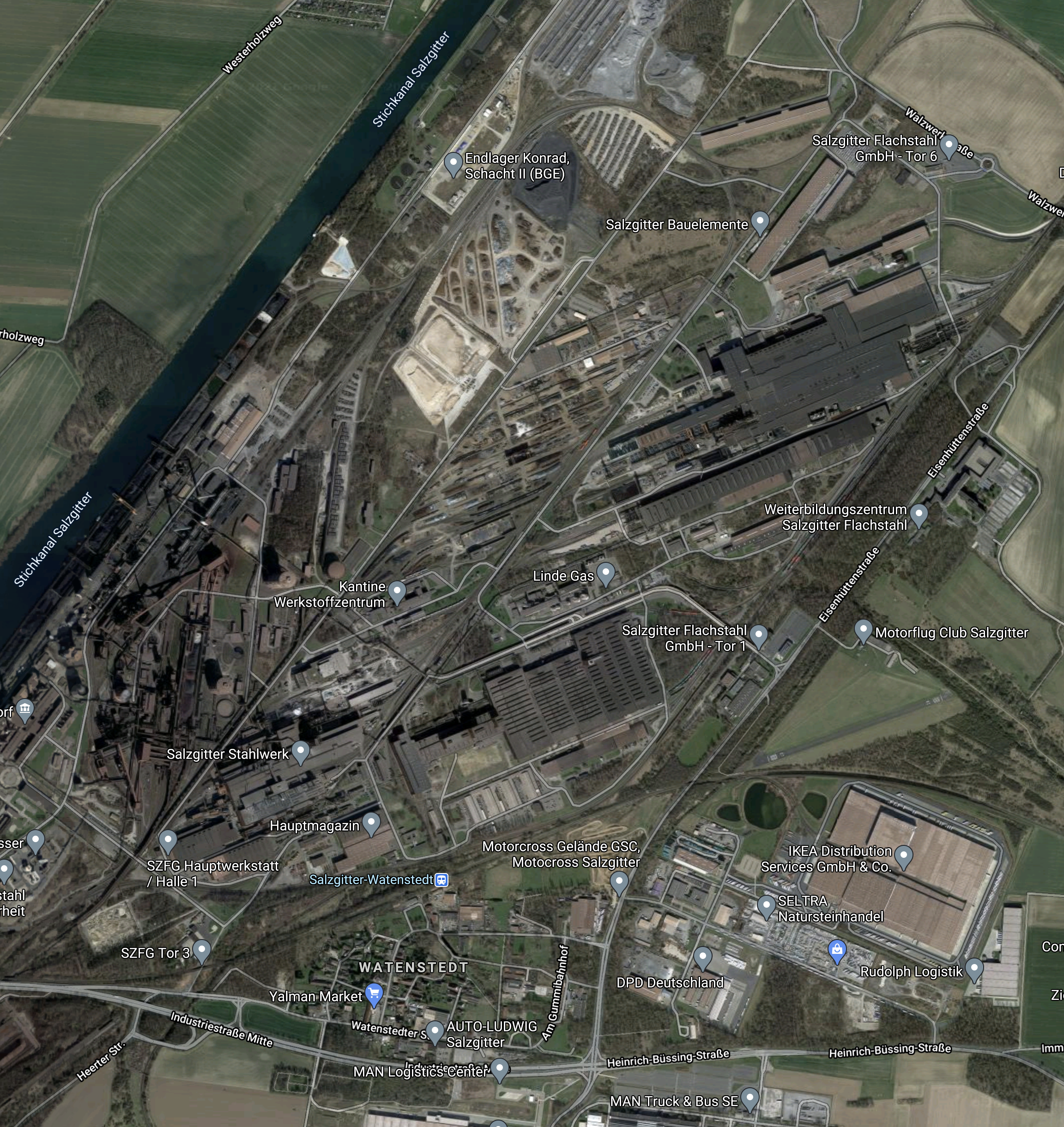
Note that if you click on the map to show it in a large scale, stahl is German for steel.
The article is certainly worth a read.
Morocco Could Produce Up To 4% Of World’s Green Hydrogen By 2030
The title of this post, is the same as that of this article on Morocco World News.
This is the first paragraph.
Morocco could produce up to 4% of the global demand for green hydrogen by 2030, according to the German Ministry of Economic Cooperation and Development.
They are aiming to produce 10,000 tonnes of hydrogen per year by 2025.
Wikipedia has an informative topic called Energy Policy in Morocco, which indicates the following.
- The country has little oil and gas reserves. Although it does have some oil shale, that could be developed.
- Wind, solar and hydro power are being developed.
- They could install a nuclear power station East of Rabat.
It sounds, that they could have an electricity structure, that would be ideal for the production of green hydrogen.
Conclusion
Morocco could be joining an ever growing club, which includes Australia, Saudi Arabia and Spain, who will produce hydrogen for export to countries like Germany, Japan and South Korea.
Ex-Steelworks To Make Wind Farm Parts In Plan For 6,000 Green Jobs
The title of this post, is the same as that of this article on The Times.
This is the introductory paragraph.
The government will invest almost £100 million creating new wind turbine ports in northeast England, with a big renewables company announcing plans to make crucial parts in Teesside.
The two ports will be on Teesside and North Lincolnshire.
The next generation of wind turbines in the North Sea will be very different.
Larger Turbines
They will be larger and the blades will be bigger, so building them close to, where they will be installed is a sensible idea.
We are also very good at aerodynamics in the UK. This is the reason Airbus designs and builds wings in the UK.
Floating Turbines
The next generation of wind farms will be floating, as for some reason, they have a higher capacity factor.
I am personally pleased about this, as it appears they are based on a patented but failed design of floating oil production platform from the 1970s, where I performed the calculations on how to install them.
Some of these floating wind turbines can also be floated into port for major services and upgrades, which probably means we need local manufacturing of as many parts as possible.
Hydrogen Rather Than Electrical Connection
They will also create hydrogen, rather than electricity, by using a combination of wind turbine and hydrogen electrolyser.
As distances between shore and wind farm get longer, it is cheaper to use a gas pipe, rather than a DC electricity link.
Hydrogen can also be stored in worked out gas fields and also brought ashore in redundant pipelines.
The hydrogen electrolysers will probably be built in the world’s largest electrolyser factory in Rotherham, owned by ITM Power; a UK company.
Conclusion
As we are going to build almost 70 GW of offshore wind in the next few years, we’re going to need a turbines and I believe increasingly, they will be built in the UK.
So these two wind ports at Teesside and in Lincolnshire are a good idea.
H2 Green Steel Plans 800 MW Hydrogen Plant In Sweden
The title of this post, is the same as that of this article on montel.
The title says it all.
In Can The UK Have A Capacity To Create Five GW Of Green Hydrogen?, I said the following.
Ryze Hydrogen are building the Herne Bay electrolyser.
- It will consume 23 MW of solar and wind power.
- It will produce ten tonnes of hydrogen per day.
The electrolyser will consume 552 MWh to produce ten tonnes of hydrogen, so creating one tonne of hydrogen needs 55.2 MWh of electricity.
This would mean that H2 Green Steel’s electrolyser could be producing around one hundred and forty thousand tonnes of hydrogen per year or 380 tonnes per day.
What About Scunthorpe?
I very much believe that Scunthorpe in Lincolnshire, would be the ideal place for hydrogen steelmaking in the UK as I outlined in Green Hydrogen To Power First Zero Carbon Steel Plant.
So could 800 MW of electricity be available to produce the hydrogen in the area.
Currently, the world’s largest offshore wind farm is Hornsea One with a capacity of 1218 MW, which feeds into the National Grid at Killingholme.
This Google Map shows the distance between Scunthorpe and Killingholme.
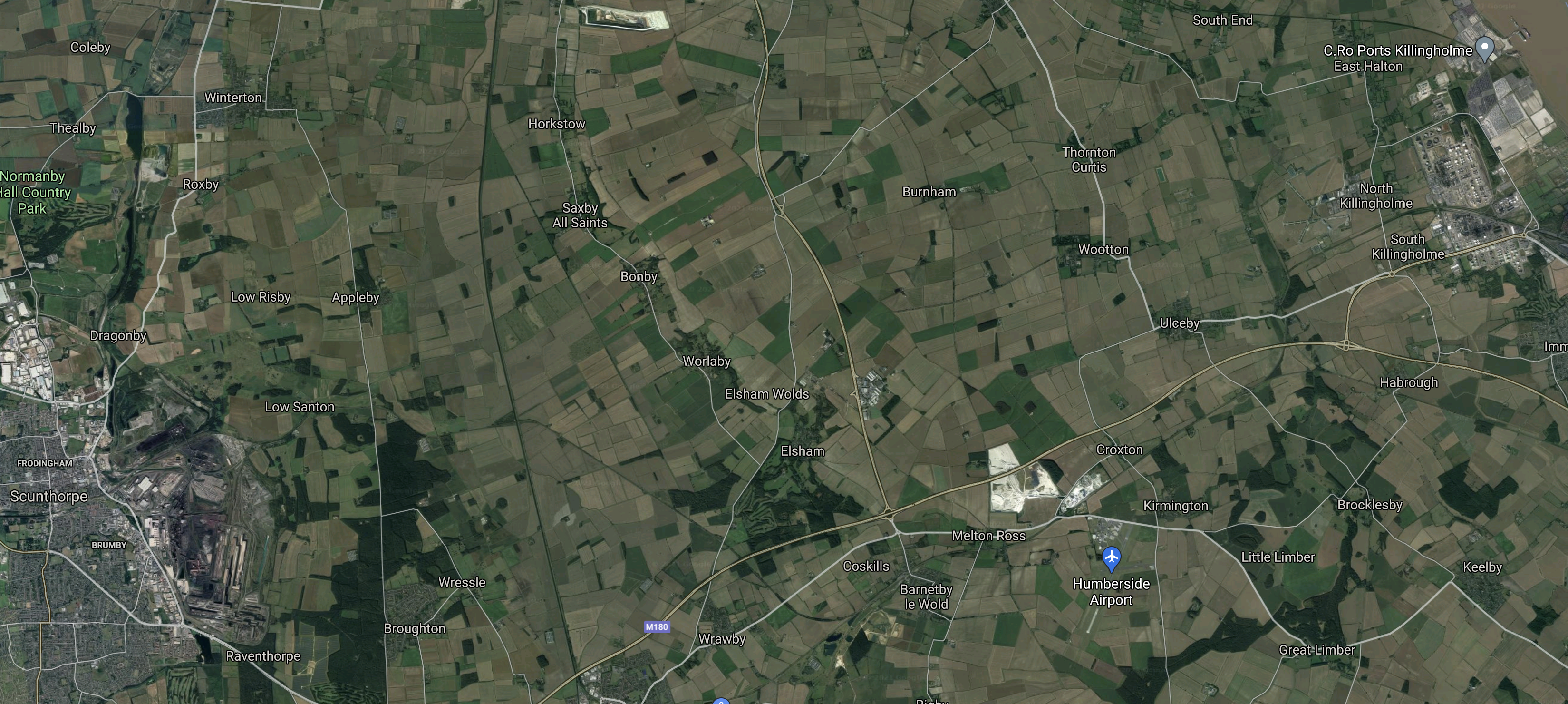
Note.
- Scunthorpe is in the South-West corner of the map.
- Killingholme is in the North-East corner of the map.
The distance is about twenty miles.
When fully developed, the Hornsea Wind Farm is planned to have a capacity of 6 GW or 6000 MW, so there should be enough renewable energy.
Could The Hydrogen Be Created Offshore?
In ITM Power and Ørsted: Wind Turbine Electrolyser Integration, I wrote about combining wind turbines and electrolysers to create an offshore wind turbine, that generates hydrogen, rather than electricity.
This approach may be ideal for the later phases of the Hornsea Wind Farm.
- Redundant gas pipes can be used to bring the hydrogen ashore.
- Worked-out offshore gas fields can be used to store hydrogen.
- Worked-out gas fields in the area, are already being used to store natural gas from Norway.
- The hydrogen can be fed directly into the HumberZero hydrogen network.
But the main reason, is that some serious commentators feel it is more affordable approach in terms of capital and maintenance costs.
It is also easy to convert hydrogen back to zero-carbon electricity, if you have a handy gas-fired power station. There could be as many of three of these at Keadby.
Conclusion
It’s all coming together on Humberside.
Anything the Swedes can do, we can do better!
SSE Goes Global To Reap The Wind
The title of this article on This Is Money is Renewable Energy Giant SSE Launches Plan To Become Britain’s First Global Windfarm Business As it Invests Up To £15bn Over Next Decade.
The title is a good summary of their plans to build wind farms in Continental Europe, Denmark, Japan and the US, in addition to the UK and Ireland.
I can also see the company developing more integrated energy clusters using the following technologies.
- Wind farms that generate hydrogen rather than electricity using integrated electrolysers and wind turbines, developed by companies like ITM Power and Ørsted.
- Reusing of worked out gasfields and redundant gas pipelines.
- Zero-carbon CCGT power stations running on Hydrogen.
- Lots of Energy storage.
I talked about this type of integration in Batteries Could Save £195m Annually By Providing Reserve Finds National Grid ESO Trial.
In the related post, I talked about the Keadby cluster of gas-fired power stations, which are in large part owned by SSE.
Conclusion
I think that SSE could be going the way of Equinor and Ørsted and becoming a global energy company.
It is also interesting the BP and Shell are investing in renewable energy to match the two Scandinavian companies.
Big Oil seems to be transforming itself into Big Wind.
All these companies seem to lack grid-scale energy storage, although hydrogen can be generated and stored in worked-out gas fields.
So I would expect that some of the up-and-coming energy storage companies like Gravitricity, Highview Power and RheEnergise could soon have connections with some of these Big Wind companies.
Aberdeen-Based Energy Storage Firm Aims To Raise £300 Million
The title of this post, is the same as that of this article on insider.
I like the Carbon Neutral Energy’s concept.
- It will provide small energy storage systems with an output of between 1 MW an 5 MW
- The energy storage systems appear to be mobile.
- It will create 200 Scottish jobs.
The company has signed an agreement with Muirden Energy, who are a wind energy developer. This is Muirden’s mission statement, from their web site.
Muirden Energy is a successful renewable energy developer specialising in onshore wind energy. We deliver sensitively designed wind projects across Scotland and forge strong working relationships with local communities. We are committed to contributing to Scotland’s renewable energy needs and supporting the economic development of surrounding communities.
They have installed 60 MW of generating capacity across 30 sites in seven years.
Conclusion
This looks like a company and a concept to follow.
How many villages, factories and stations, could be powered partly by one or more wind turbines and a battery?
Crown Estate’s Auction Of Seabed For Wind Farms Attracts Sky-High Bids
The title of this post, is the same as that of this article on The Times.
This is the opening paragraph.
An auction of seabed rights to build offshore wind farms around England and Wales has attracted frenzied bidding that could be worth hundreds of millions of pounds a year to the Treasury and the Queen.
I don’t find this surprising.
Bigger Seems Better Offshore
Wind turbine technology is getting better and much larger. It also seems that the new larger floating turbines are much more efficient and generate power for a greater proportion of the day.
- Hywind Scotland is the world’s first commercial wind farm using floating wind turbines.
- It is situated off Peterhead.
- It consists of five 6 MW turbines.
- Wikipedia says it has a capacity factor of over 50 %.
My project management software helped to harvest North Sea Oil and I have been told by many in the industry, that North Sea Oil really took off when platforms and the equipment like cranes used to build them got truly enormous.
I feel, we could be seeing the same size effect happening as we harvest the wind!
Hydrogen And Wind Power
The latest development is not to generate electricity, but to use it in the turbine to generate hydrogen, which is then piped to the shore.
- The UK Government is funding this technology in part with a grant to ITM Power.
- I wrote about the technology in ITM Power and Ørsted: Wind Turbine Electrolyser Integration.
- Existing gas networks can be reconfigured to bring the hydrogen to the shore.
- Piping hydrogen costs less than cabling electricity.
- Hydrogen networks are being built at several places in the UK, to fuel homes, power stations and industry like steel-making and petrochemicals.
Could all this explain Big Oil’s involvement?
Do they want to exchange fossil fuels for green hydrogen?
They certainly know how to distribute it.
Energy Storage
For my own investments, I’m looking at energy storage, where the UK has at least three promising new ideas, all of whom have had Government grants.
- Gravitricity
- Highview Power
- ReEnergise
The Government has also indirectly-backed Cornish Lithium

