Self-Orienting Floating Wind Turbine Completes Offshore Tests
The title of this post, is the same as that of this article on offshoreWIND.biz.
This is the sub-heading.
The PivotBuoy Project, developed by X1 Wind in collaboration with nine industry and R&D partners, has finalized its offshore demonstration in Spain with what the partners describe as ”excellent results that promise to revolutionize the floating wind industry”.
This is the first paragraph.
The Spanish firm’s X30 platform was tested in full operational conditions at PLOCAN offshore the Canary Islands from October 2022 to May 2023.
It is accompanied by a picture of this rather different way of mounting a wind turbine.
I discussed how how the concept works in X1 Wind – Disrupting Offshore Wind.
It’s certainly a technology to watch.
Plus Power Raises USD 1.8bn For Energy Storage In Texas, Arizona
The title of this post, is the same as that of this article on Renewables Now.
These two paragraphs outline the story.
Houston-based battery systems developer Plus Power LLC unveiled on Tuesday the completion of USD 1.8 billion (EUR 1.7bn) in new financing for the construction and operation of five standalone energy storage projects in Texas and Arizona.
The financing commitments, arranged in the form of construction and term financings, letters of credit, and tax equity investments, are dedicated to five projects with a combined capacity of 1,040 MW/2,760 MWh.
Note.
- This financing indicates how those banks and financial institutions with masses of money are prepared to put that money into energy storage.
- It is also good to see, that the journalist who wrote the story has given both the output of these batteries and their storage capacity.
- I can see many deals like this being done in the next few years.
But when will we see a financing deal like this for some of the other methods of storage that are being developed?
Scotland’s Largest Offshore Wind Farm Is Now Operational
The title of this post, is the same as that of this press release from Seagreen Wind Energy.
These three bullet points, act as sub-headings.
-
First Minister Humza Yousaf says Seagreen milestone takes Scotland a step closer to net zero
-
UK’s newest offshore wind farm is generating enough renewable energy to power almost 1.6m homes annually
-
Seagreen is now Scotland’s largest and the world’s deepest fixed-bottom offshore wind farm
These two paragraphs outline the current state of the project.
SSE Renewables, part of SSE plc, and its partner TotalEnergies have announced all 114 Vestas V164-10.0 MW turbines at the 1.1GW Seagreen Offshore Wind Farm off the coast of Scotland are now fully operational and are generating clean, renewable energy to Britain’s power grid.
Situated 27km off the Angus coast in the North Sea’s Firth of Forth, Seagreen is now Scotland’s largest wind farm as well as the world’s deepest fixed-bottom offshore wind farm, with its deepest foundation installed at a record 58.7 metres below sea level^. Seagreen is operated from a dedicated onshore Operations and Maintenance Base at Montrose Port.
Note.
- The capacity of the wind farm is 1,075MW.
- First power was in August 2022.
- It looks like that the original completion date was in 2024, but it was moved forward to October 2023, which has been met.
It seems that the project management was planned well.
Improvements To Leeds And Hull Services
This news story from the Department of Transport is entitled Yorkshire And The Humber To Benefit From £19.8 billion Transport Investment.
This is said about Leeds and Hull services.
Hull will also be brought into the Northern Powerhouse Rail network, reducing journey time from Leeds from 58 minutes to just 48. The number of trains between Hull and Sheffield will be doubled, to 2 per hour, with capacity also doubled. Journeys from Hull to Manchester will drop from 115 to 84 minutes, enabling 2 fast trains to Leeds.
I shall look at the 10:15 Northern Trains service between Hull and Leeds on the 13th October 2023.
- The distance is 51.8 miles.
- There are seven stops.
- The service is run by a diesel Class 158 train.
- Journey time is 69 minutes.
Ten minutes off this time would be worthwhile.
I shall look at the 10:03 TransPennine Express service between Hull and Leeds on the 13th October 2023.
- There are two stops.
- The service is run by a diesel Class 185 train.
- Journey time is 54 minutes.
Ten minutes off this time would be difficult.
Note.
- The line between Micklefield and Leeds is being electrified.
- The distance between Hull and Micklefield is 42 miles.
- The route has a maximum speed of between 75 and 90 mph.
There is also an historic swing bridge at Selby, which would probably be difficult to electrify.
How Many Minutes Could Electric Trains Save Between Leeds and Hull?
Electric trains have better acceleration and deceleration, when compared to diesel trains, so two minutes per stop and for the acceleration and deceleration at Hull and Leeds, would give the following times.
- Northern Trains – 53 minutes
- TransPennine Express – 48 minutes
As electrification is not mentioned for between Leeds and Hull, the only electric trains, that could work the route will be battery-electric trains.
Battery-Electric Trains Between Leeds and Hull
Consider.
- TransPennine Express already have Class 802 trains, from which the battery-electric version is being developed.
- Northern Trains would need a suitable battery-electric train. There has been talk of a CAF battery-electric Class 331 train, but nothing more. These would surly be ideal.
- Trains could be charged on new electrification in Hull station and between Micklefield and Leeds.
The trains would need a range of just 42 miles.
A Second Fast Train Between Leeds and Hull
What does this statement in the news story imply?
Journeys from Hull to Manchester will drop from 115 to 84 minutes, enabling 2 fast trains to Leeds.
I feel that this statement must be read in conjunction with the benefits of the TransPennine Route Upgrade.
One benefit is given as Faster Journeys, where this is said.
We’re speeding up journeys so you can travel to your favourite towns and cities more quickly. Our fastest journey times are forecast to be 63-66 minutes between Manchester and York and 41-42 minutes between Manchester and Leeds.
The news story says that the fastest journey times between Leeds and Hull will be 48 minutes, which would give a Hull and Manchester time of 89-90 minutes.
Alternatively, there could be these timings on one train.
- Hull and Leeds – 48 mins
- Hull and Manchester Victoria – 84 mins
- Leeds and Manchester Victoria – 36 mins
Note.
- The train would call at Brough, Selby, Leeds, Huddersfield and Stalybridge.
- There may be a new station at Leeds Thorpe Park
- The distance between Hull and Manchester Victoria is 94.7 miles.
- This is an average speed of 67.6 mph.
It almost looks like it’s connectivity East of Leeds and speed between Leeds and Manchester.
Conclusion
Battery-electric trains would provide all the improvements promised between Leeds and Hull.
Electrification Of The Hope Valley Line
This news story from the Department of Transport is entitled Yorkshire And The Humber To Benefit From £19.8 billion Transport Investment.
This is said about the Hope Valley Line.
The Hope Valley Line between Manchester and Sheffield will also be electrified and upgraded, with the aim of cutting journey times from 51 to 42 minutes and increasing the number of fast trains on the route from 2 to 3 per hour, doubling capacity.
The fast trains are currently TransPennine’s service between Liverpool Lime Street and Cleethorpes.
- Between Platform 13 at Manchester Piccadilly station and Sheffield station is 42.6 miles.
- At the Manchester end, there will be electrification between Manchester Piccadilly and Hazel Grove stations, which is 8.7 miles and takes typically 17 minutes.
- After the electrification of the Midland Main Line to Sheffield, there will be electrification between Dore & Totley and Sheffield stations, which is 4.2 miles and takes typically 8 minutes.
The gap in the electrification between Dore & Totley and Hazel Grove stations will be 29.7 miles.
But it will not be an easy route to electrify.
- At the Western end, there is the Disley Tunnel, which is 3535 metres long.
- In the middle, there is the Cowburn Tunnel which is 3385 metres long, that is also the deepest tunnel in England.
- At the Eastern end, there is the Totley Tunnel, which is 5700 metres long.
Yorkshire doesn’t have an Underground railway, but the combined length of these three tunnels is 7.84 miles, which means that over 26 % of the electrification needed between Manchester Piccadilly and Sheffield will have to be installed in tunnels.
Could The Route Be Run Using Battery-Electric Trains?
Consider.
- The gap in the electrification between Dore & Totley and Hazel Grove stations will be 29.7 miles.
- There is electrified sections at Dore & Totley and Hazel Grove stations, which will be able to charge the trains.
- Merseyrail’s Class 777 trains have demonstrated a battery range of 84 miles.
- A Stadler Akku train has demonstrated a battery range of 139 miles.
- Hitachi are developing a battery-electric version of TransPennine’s Class 802 train.
- If all trains can run on batteries or be self-powered, there would be no need to electrify the long and possibly difficult tunnels.
I believe that it would be possible to electrify all passenger services between Manchester and Sheffield using appropriate battery-electric trains.
Freight would be a problem and I suspect that hydrogen-hybrid and other self-powered locomotives could handle the route.
Could The Complete TransPennine Liverpool Lime Street and Cleethorpes Service Be Run By Battery-Electric Class 802 trains?
These are the various electrified and unelectrified sections.
- Liverpool Lime Street and Liverpool South Parkway – Electrified – 5.7 miles – 10 minutes
- Liverpool South Parkway and Trafford Park – Not Electrified – 25.2 miles – 30 minutes
- Trafford Park and Hazel Grove – Electrified – 12.6 miles – 28 minutes
- Hazel Grove and Dore & Totley – Not Electrified – 29.7 miles – 35 minutes
- Dore & Totley and Sheffield – Electrified – 4.2 miles – 6 minutes
- Sheffield and Doncaster – Not Electrified – 18.6 miles – 25 minutes
- Doncaster and Cleethorpes – Not Electrified – 52.1 miles – 78 minutes
Note.
- This is a total of 125.6 miles without electrification.
- The Manchester Piccadilly and Sheffield time is 56 minutes.
- The distance is 37.8 miles.
- That is an average speed on 40.5 mph.
- Most of the line between Manchester Piccadilly and Sheffield has an maximum speed of 70 mph, but there is a short length of track with a 50 mph speed and another longer one with 90 mph.
To achieve 40 minutes between Manchester Piccadilly and Sheffield would need an average speed of 60.7 mph. Given the improvements being carried out by Network Rail at the current time, I believe that forty minutes between Manchester Piccadilly and Sheffield should be possible.
I’ll look at a train going East.
- The train will leave Liverpool Lime Street with a reasonably full battery after charging using the current electrification in the station.
- The train will leave Liverpool South Parkway with a full battery after charging using the current electrification from Liverpool Lime Street.
- The train will arrive at Trafford Park with a battery perhaps two-thirds full, but it will be fully charged on the current electrification to Hazel Grove.
- The train will arrive at Dore & Totley with a battery perhaps two-thirds full, but it will be fully charged on the Midland Main Line electrification to Sheffield.
- The train will arrive at Doncaster with a battery perhaps two-thirds full and the train would wait until it had enough charge to reach Cleethorpes.
I’ll look at a train going West.
- The train will leave Cleethorpes with a full battery after charging using the new electrification in the station.
- The train will arrive at Doncaster with a battery perhaps two-thirds full and the train would wait until it had enough charge to reach Sheffield.
- The train will arrive at Sheffield with a battery perhaps two-thirds full, but it will be fully charged on the Midland Main Line electrification to Dore & Totley.
- The train will arrive at Hazel Grove with a battery perhaps two-thirds full, but it will be fully charged on the current electrification to Trafford Park.
- The train will arrive at Liverpool South Parkway with a battery perhaps two-thirds full, but the route is electrified to Liverpool Lime Street.
Note.
- If the battery range on a full battery was over 90 miles, the two most easterly sections could be run without any charging at Doncaster.
- If the battery range was over 125.6 miles, the journey could be done by starting with a full battery.
- If every time the train decelerated, regenerative braking would recover energy, which could be reused.
- The only new electrification needed will be a short length at Cleethorpes station, that would charge the trains.
I certainly believe that Liverpool Lime Street and Cleethorpes services could be run by battery-electric trains.
Could The Complete TransPennine Liverpool Lime Street and Cleethorpes Service Be Run By Battery-Electric Class 802 trains Without The Midland Main Line Electrification?
In this section, I’m assuming, that there is no electrification at Sheffield.
These would be the various electrified and unelectrified sections.
- Liverpool Lime Street and Liverpool South Parkway – Electrified – 5.7 miles – 10 minutes
- Liverpool South Parkway and Trafford Park – Not Electrified – 25.2 miles – 30 minutes
- Trafford Park and Hazel Grove – Electrified – 12.6 miles – 28 minutes
- Hazel Grove and Cleethorpes – Not Electrified – 104.6 miles – 143 minutes
Note.
- This is a total of 129.6 miles without electrification.
- The battery range of the train, should probably be around 120 miles to make sure the train could run between Hazel Grove and Cleethorpes.
- One diesel power-pack could be installed for emergency use.
I’ll look at a train going East.
- The train will leave Liverpool Lime Street with a reasonably full battery after charging using the current electrification in the station.
- The train will leave Liverpool South Parkway with a full battery after charging using the current electrification from Liverpool Lime Street.
- The train will arrive at Trafford Park with a battery perhaps 80 % full, but it will be fully charged on the current electrification to Hazel Grove.
- The train would then eek out what power it had left to reach Cleethorpes.
If necessary, the train could stop in the electrified Doncaster station to top up the batteries from the East Coast Main Line electrification for the run to Cleethorpes.
I’ll look at a train going West.
- The train will leave Cleethorpes with a full battery after charging using new electrification in the station.
- The train will arrive at Doncaster with a battery perhaps 57 % full and the train would wait if needed, until it had enough charge to reach Hazel Grove.
- The train will arrive at Hazel Grove with a battery perhaps one-thirds full, but it will be fully charged on the current electrification to Trafford Park.
- The train will arrive at Liverpool South Parkway with a battery perhaps one-thirds full, but the route is electrified to Liverpool Lime Street.
Note.
- If the battery range on a full battery was over 105 miles, the Eastern section could be run without any charging at Doncaster.
- If the battery range was over 129.6 miles, the journey could be done by starting with a full battery.
- If every time the train decelerated, regenerative braking would recover energy, which could be reused.
- The only new electrification needed will be a short length at Cleethorpes station, that would charge the trains.
However, it might be prudent to electrify the through platforms at Sheffield, so that they could be used for emergency charging if required.
Northern Train’s Service Between Sheffield And Manchester Piccadilly Via The Hope Valley Line
There is a one train per hour (tph) Northern service between Sheffield and Manchester Piccadilly.
- The Class 195 diesel train takes 78 minutes.
- The distance is 42 miles.
- The first mile or so at the Manchester end is electrified.
- Trains seem to take about sixteen minutes to turn round at Manchester Piccadilly.
- Trains seem to take about nine minutes to turn round at Sheffield.
- The service runs via Reddish North, Brinnington, Bredbury, Romiley, Marple, New Mills Central, Chinley, Edale, Hope, Bamford, Hathersage, Grindleford and Dore & Totley.
- The max speed is generally 60 mph to the West of New Mills Central and 70 mph to the East, with short lower speed sections.
There would appear to be two ways to run this route withy battery-electric trains.
- As Manchester Piccadilly station is fully-electrified and trains could be connected to the electrification for upwards of twenty minutes, trains will certainly be able to be fully-charged at Manchester. As the round trip is only 84 miles, could trains run the service without a charge at Sheffield.
- Alternatively, there could be a dedicated electrified platform at Sheffield. But the problem with this, is that currently this service uses a random platform at Sheffield.
It looks like, if the train has the required range, that charging at the Manchester end would be the better solution.
Liverpool And Norwich Via The Hope Valley Line
This service uses a similar route between Liverpool Lime Street and Sheffield, as the Liverpool and Hull service and then it meanders, through the East Midlands.
- Liverpool Lime Street and Liverpool South Parkway – Electrified – 5.7 miles – 11 minutes
- Liverpool South Parkway and Trafford Park – Not Electrified – 25.2 miles – 33 minutes
- Trafford Park and Hazel Grove – Electrified – 12.6 miles – 26 minutes
- Hazel Grove and Dore & Totley – Not Electrified – 29.7 miles – 28 minutes
- Dore & Totley and Sheffield – Electrified – 4.2 miles – 6 minutes
- Sheffield and Nottingham – Being Electrified – 40.6 miles – 52 minutes
- Nottingham and Grantham – Not Electrified – 22.7 miles – 30 minutes
- Grantham and Peterborough – Electrified – 29.1 miles – 29 minutes
- Peterborough And Ely – Not Electrified – 30 miles – 31 minutes
- Ely and Norwich – Not Electrified – 53.7 miles – 56 minutes
This is a total of 161.3 miles without electrification.
But as Sheffield and Nottingham and Grantham and Peterborough will be fully electrified, this route will be possible using a battery-electric train.
Electrifying Sheffield Station
I said earlier in this post, that electrifying Sheffield station would be an option for electrifying the Sheffield and Manchester Piccadilly service.
If this were to be done, it would have collateral benefits for other services that terminate at Sheffield, which could be charged whilst they turned around.
I wrote about Sheffield station as a battery-electric train hub in Could Sheffield Station Become A Battery-Electric Train Hub?
Conclusion
I believe that full electrification of the Hope Valley Line is not needed, if battery-electric trains are used.
I also believe that battery-electric trains and the current improvements being carried out on the Hope Valley Line will enable a forty minute time between Manchester Piccadilly and Sheffield.
ABP To Explore Opportunities For Offshore Wind Port In Scotland
The title of this post, is the same as that of this article on offshoreWIND.biz.
This is the sub-heading.
Associated British Ports (ABP) has signed an agreement to investigate an area for the development of infrastructure to support offshore wind manufacturing, assembly, and marshalling and green energy on the Cromarty Firth in Scotland, within the Inverness Cromarty Firth Green Freeport.
This first paragraph gives a bit more information including the possible location.
The area, located within the proposed Nigg and Pitcalzean area of the Green Freeport, could support both fixed-bottom and floating offshore wind projects and play a major role in the development of current and future ScotWind leasing rounds, said ABP.
This Google Map shows the location of the Port of Nigg.
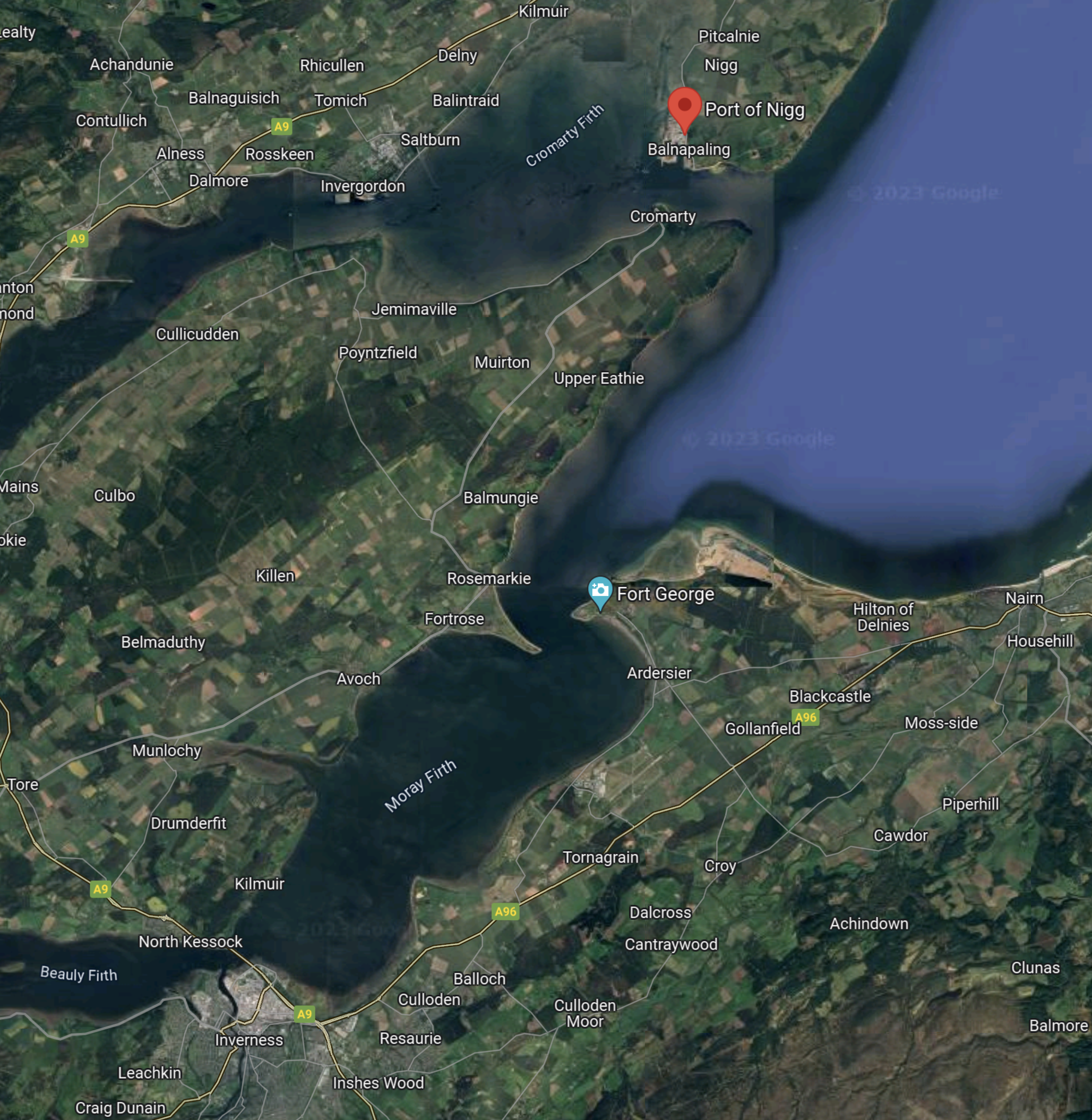
Note.
- The Moray Firth with Inverness at its Southern end is the large body of water in the centre of the Southern half of the map.
- The Port of Nigg is on Cromarty Firth and marked by a red arrow.
- Nigg and Pitcalzean are to the North of the port.
This second Google Map shows an enlarged view of the port.
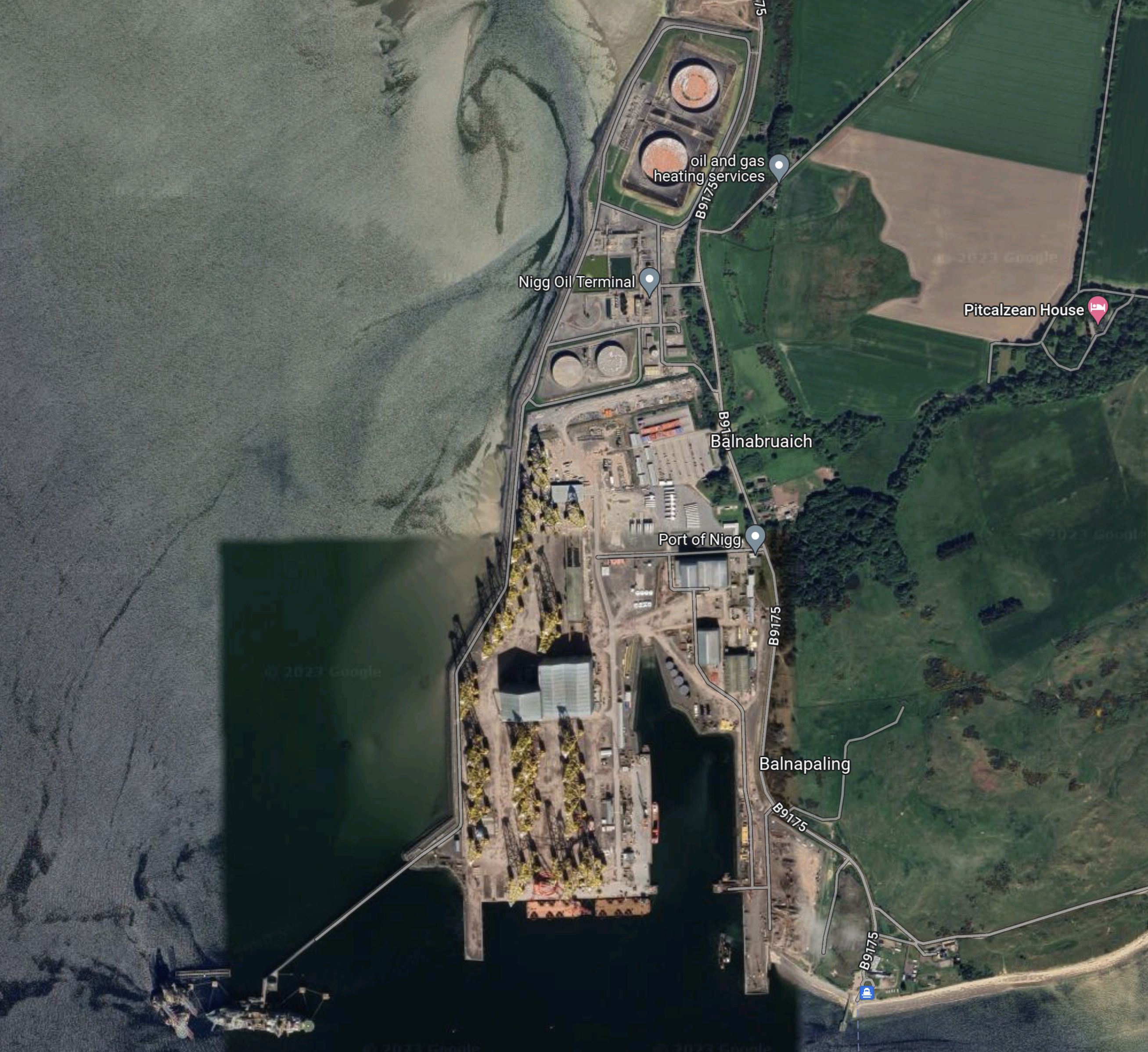
Note.
- Pitcalzean House is in the North-East corner of the map.
- The Port of Nigg is in the centre of the map.
- The water to the West and South of the port is Cromarty Firth.
- The yellow structures in the port are fixed-bottom foundations for wind farms.
Inverness & Cromarty Firth Green Freeport has a web site.
A Quote From Henrik Pedersen
Henrik Pedersen is CEO of ABP and the article quotes him as saying this.
We’re excited to explore the potential of Nigg, applying our experience across the UK, including at our Ports of Grimsby, Hull, Lowestoft and Barrow which already host significant offshore wind activity and at Port Talbot, where we are developing a Floating Offshore Wind port project. We look forward to working with key local partners, the community, and public sector stakeholders.
The article also has this final paragraph.
The Floating Offshore Wind Taskforce’s recently published “Industry Roadmap 2040”, estimated that planed floating offshore wind projects in Scottish waters alone will require three to five integration ports.
There is certainly going to be a significant number of ports, that will be supporting offshore wind activity.
Is Liverpool, England’s Biarritz?
Earlier in the week, I was feeling terrible, with pains in both lower legs.
This has been typical for some months and on Sunday, it was so bad in my right foot, that I tried a new cream called Udrate, that my GP prescribed for me last year.
It seemed to do the trick and I now rub it on twice a day.
On Thursday, I went to Liverpool and in the pouring rain at Euston, as I walked to the train, my legs were feeling terrible.
Throughout the day they improved and at the end of the day, I walked across the City Centre from Liverpool Central to the Albert Dock with no problem at all.
My legs have gradually got worse since I returned.
They are not bad now, but they are certainly worse than when I left Liverpool.
I wrote Would I Go Back To Biarritz Again?, after my one and only visit to the French resort, where I said this.
Of course I would!
Especially, if I could be guaranteed some weather like I had just experienced. The temperature had been about 14 °C with a humidity of over 50%
I do wonder about my father’s health. He suffered from a similar catarrh to that I’ve suffered for the last couple of years and he had lots of skin problems. He always put the latter down to the solvents he used in his printing business. I’m pretty certain he was a coeliac too, as I must have got the genes from somewhere.
I also remember him saying once that he had been to Biarritz. So did he go because he felt healthy there, as I just had?
I don’t know and there’s no-one I can ask who knew him, who’s still alive.
But as I seem to feel better in Biarritz, if I think I need a break in the winter, I think I’ll go.
Liverpool was warm and sunny on Thursday.

The picture shows the new Everton stadium being constructed at Bramley-Moore Dock in Liverpool, was taken as I returned from Headbolt Lane station.
This picture shows Biarritz in early December.

Both cities are bathed in sunshine.
Consider.
- Both cities have seafronts that face West.
- The prevailing winds are from the South-West.
- Both cities have land masses with mountains or hills to their South-West.
Do the hills induce turbulence to the air, which gives both cities, a healthy Autumnal climate that I find acceptable?
UK’s Nuclear Fusion Site Ends Experiments After 40 Years
The title of this post, is the same as that of this article on the BBC.
I have followed fusion research since ZETA at Harwell was started up in 1957.
These first few paragraphs from the BBC article, sum up up fusion research.
For the next four decades, the European project pursued nuclear fusion and the promise of near-limitless clean energy.
But on Saturday the world’s most successful reactor will end its last test.
Nuclear fusion was “discovered” in the 1920s and the subsequent years of research focused on developing fusion for nuclear weapons.
In 1958, when the United States’ war research on fusion was declassified, it sent Russia, UK, Europe, Japan and the US on a race to develop fusion reactions for energy provision.
Fusion is considered the holy grail of energy production as it releases a lot of energy without any greenhouse gas emissions.
It is the process that powers the Sun and other stars. It works by taking pairs of light atoms and forcing them together – the opposite of nuclear fission, where heavy atoms are split apart.
Four decades of research, loads of money and some of the best brains in the world have produced very little, except about knowing what doesn’t work.
It doesn’t seem that anybody is getting any value from fusion research any more.
It’s almost as if, we’ve hit a brick wall and we can’t go any farther.
It must be terribly demoralising for everybody involved.
Would the scientists and engineers be better employed on other research?
I wouldn’t totally abandon fusion research, but put it more on a watching brief, so that if anything positive happens elsewhere, the UK might be able to take advantage.
Could we even do what we have recently done with High Speed Two and scrap it, before using the money on other energy projects?
My priorities would be.
Floating Wind Research
Because we are surrounded by sea, offshore floating wind is likely to be our major energy source by the end of the decade.
Energy Network Control Research
Our energy network will be getting more complex and we need better algorithms to control it.
Storage Research
We need lots of energy storage, that is affordable to install, that can be placed everywhere in the UK.
Project Management Research
I believe that some of the energy ideas will need advanced project management techniques, that may or may not have been invented yet.
Small Modular Reactor Research
SMRs are one way to go, but is the backup research in place?
Tidal Research
Places in the UK have high tidal ranges and we should exploit them.
The Government And Research
The government is funding a lot of energy research.
Much of the funding is going for short term projects, which is good in that we have an urgent need for improvement in our energy performance, but is bad in that it ignores the future.
Diamond 2
The Diamond Light Source has been an unqualified success. I am convinced that we need Diamond 2 in the North, which I wrote about in Blackpool Needs A Diamond.
Evolyn To Launch Paris To London Route In Competition With Eurostar
The title of this post, is the same as that as this article on Rail Technology Magazine.
These first two paragraphs outline the plan.
A company aiming to operate services through the Channel Tunnel in competition with Eurostar has agreed to purchase 12 trains, it said.
Evolyn has stated that it is ready to invest £1 billion in its bid to start cross-Channel rail services in 2025.
It looks like the order will go to Alstom.
It will be interesting to see what sort of product is offered.
Arup and ILF Join Forces To Enhance Pumped Storage Projects In The UK
The title of this post, is the same as that of this of article on Water Power And Dam Construction.
These are the first two paragraphs.
Global sustainable development consultancy Arup and ILF Consulting Engineers have recently signed a Memorandum of Understanding (MOU) aimed at strengthening pumped storage projects in the UK. These projects include Coire Glas, Glenmuckloch, and up to 13 additional schemes in the pipeline.
This partnership marks a significant development in the hydropower sector in the UK, bringing both capacity and valuable experience to support the country’s net-zero energy transition.
Fifteen schemes could be a lot of energy storage.
These are a few useful web sites with information to back up the article.
As most of the work appears to be in Scotland, this would appear to be a second large installment of Power From The Glens. Perhaps it should be named Storage In The Glens.
 The Anonymous Widower