Longer Duration Energy Storage Demonstration Programme, Stream 1 Phase 1: Details Of Successful Projects
The title of this post, is the same as that of this document from the UK Government.
This is the introduction.
Stream 1 aims to accelerate commercialisation of innovative longer duration energy storage projects through to actual demonstrations. During Phase 1, projects will be expected to mobilise their proposed technologies to prepare for potential deployment on the UK energy system.
These are the projects.
Ballylumford Power-to-X
This is the description of this project in Northern Ireland.
B9 Energy Storage will receive £986,082 to mobilise a 20MW membrane free electrolyser green hydrogen project. Using otherwise curtailed wind power, hydrogen produced will be stored in local underground salt caverns for later use as a fuel in transport and electricity sectors, creating a full-cycle hydrogen economy (production, storage, distribution and usage) on site.
Note.
Ballylumford power station is a 600 MW gas-fired power station, that provides half of Northern Ireland’s electricity.
A 20 MW electrolyser will produce just under nine tonnes of hydrogen per day.
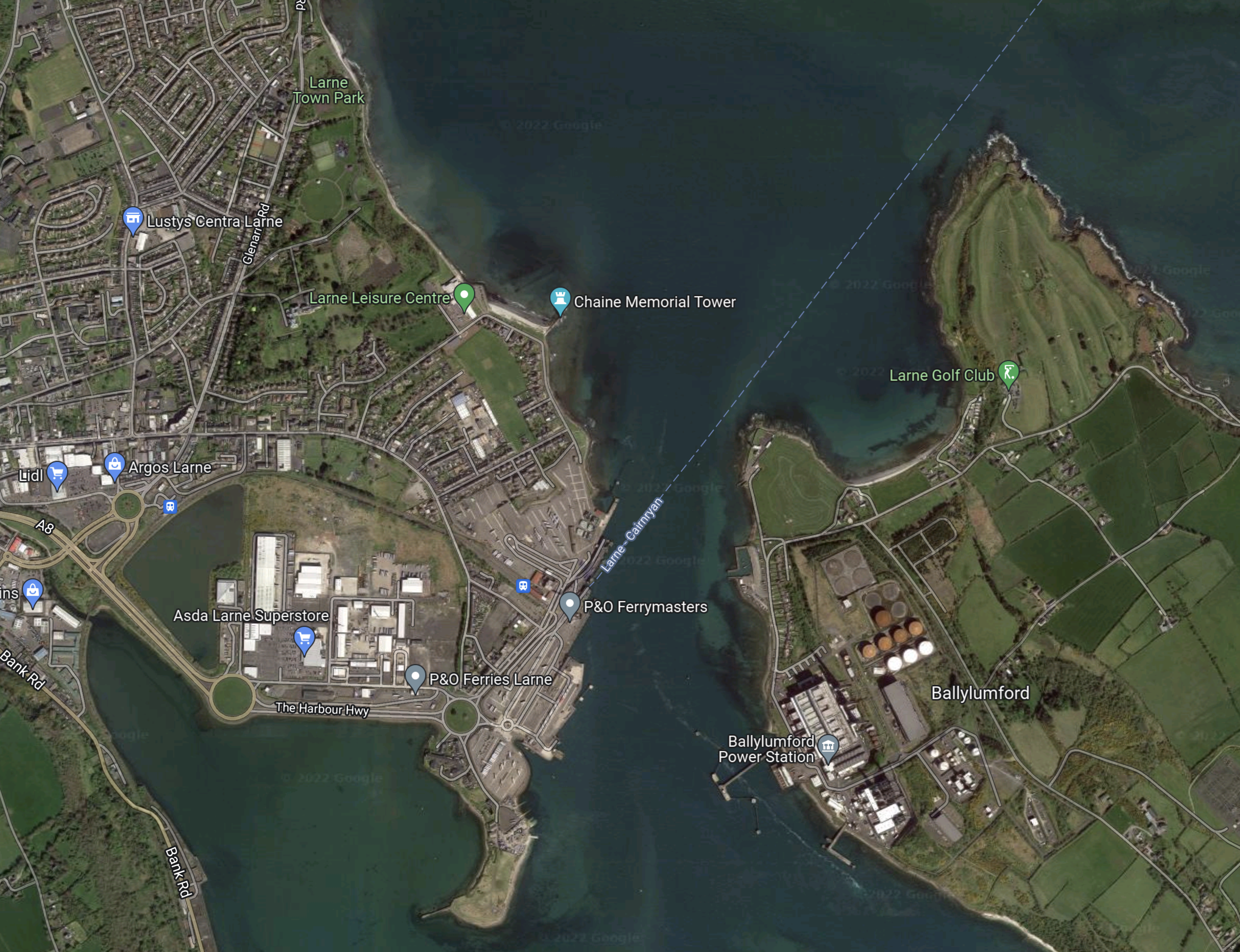
This Google Map shows the location of the power station opposite the port of Larne.
Note.
Ballylumford power station is clearly visible to the East of the channel towards the bottom of the map.
Ballylumford is also the Irish end of the HVDC Moyle interconnector from Scotland, which has a capacity of 500 MW.
Ballylumford would appear to have enough power for a large electrolyser.
Salt Beds In Northern Ireland
This document on the British Geological Survey web site is entitled Geological Storage In Northern Ireland.
The document discusses Irelands energy needs and gives a good description of using compressed air energy storage in salt caverns.
Then these two paragraphs describe the salt bed in Northern Ireland compare them to other deposits under Great Britain.
Thick halite deposits, found both onshore in Northern Ireland and immediately offshore in the North Channel, offer potential for salt cavern storage facilities. The salt deposits occur as bedded deposits with minor halokinesis (geological movement of salt) forming salt swells rather than pillows or domes so that the height of any cavern may be restricted by bed thickness. Pure salt beds tend to be thin (approximately 100-250 metres maximum thickness) compared to those used elsewhere and the presence of significant insoluble impurities and minor intrusive dolerite dykes or sills may reduce their suitability.
The Larne and Carrickfergus area of County Antrim is the only part of the whole island where thick salt beds occur. Elsewhere in the UK parts of Cheshire, Lancashire, Teesside, Humberside and Dorset have similar, or thicker, developments of salt beds and gas storage facilities are either in construction, or are already in operation.
It would appear that the thick salt beds in the Larne and Carrickfergus area could be suitable for gas storage.
Ballylumford might actually be on top of the salt beds, as Carrickfergus is a few miles to the South.
On a personal note, I used to work for ICI Mond Division and during that time and immediately afterwards, I met many people, who had been into the salt mines and worked with boreholes extracting the salt and the one thing everybody said about the salt mine, was that water must not get in.
Membrane-Free Electrolysis
I saw this in operation when I worked at ICI Mond. Most of their hydrogen and chlorine was produced using the main Castner-Kellner process at Castner-Kellner works in Runcorn. That is a nasty process that uses a lot of mercury, which got into the air and plant operators’ bodies.
But ICI also had a much smaller plant, where they used simple electrolysers, that had a metal cell, with a concrete top, with the anode and cathode going through the concrete into the brine. I seem to remember that its main purpose was to provide mercury-free hydrogen, chlorine and sodium hydroxide. I can remember seeing workers rebuilding the cells, as was done on a regular basis.
These were membrane free electrolysers and had been running successfully for many years.
Searching the Internet for “membrane free electrolyser” I found a company in Doncaster called CPH2.
The home page on their web site declares
Clean Power Hydrogen are the manufacturers of the unique Membrane-Free Electrolyser
Turning to the About page, this is said.
Being passionate about hydrogen as clean energy for the future, we wanted to find an alternative to PEM electrolysers as these had barriers to adoption. We realised that the cleanest way to produce hydrogen was by membrane-free water electrolysis, and in doing so, it would be a less expensive and more robust technology.
Dr. Nigel Williamson and Joe Scott established CPH2 (Ireland) in 2012 with the ambition to help clean up the environment for our children and future generations. Entering the green technology sector; a high growth and profitable market, they developed a Membrane-Free Electrolyser™ to produce hydrogen faster, more reliably, and more cost-effectively than other electrolysers.
They also have the ambition to be leading developer and manufacturer of green hydrogen technologies and an Irish connection.
My experience says that their technology will work. Especially, with the application of modern materials.
Have the Government backed the Ballylumford Power-to-X project, as they can back two promising technologies with one grant?
GraviSTORE
This is the description of this project.
Gravitricity Limited will receive £912,410.84 to design their multiweight energy store demonstrator project, which will store and discharge energy by lifting and lowering multiple weights in a vertical underground shaft.
Note.
- I like the Gravitricity concept and have invested through crowdfunding.
- The project will be based on a brownfield site in Northern England.
- Gravitricity’s current demonstrator in Edinburgh, which I wrote about in Gravitricity Celebrates Success Of 250kW Energy Storage Demonstrator, only uses a single weight, but this project talks about multiple weights.
According to other sources on the Internet, the demonstrator will have a storage capacity of 4 MWh and will be built on a brownfield site.
Will we see Gravitricity coming to a disused deep coal mine near you?
Long Duration Offshore Storage Bundle
This is the description of this project.
Subsea 7 Limited and FLASC B.V. will receive £471,760.00 to further develop the Long Duration Offshore Storage Bundle which will store energy as a combination of pressurised seawater and compressed air, using an innovative hydro-pneumatic technology.
Note.
- Subsea 7 Limited are a subsea engineering, construction and services company serving the offshore energy industry, domiciled in Luxembourg with headquarters in London.
- According to their web site, FLASC B.V. is a spin-off of the University of Malta, established in The Netherlands in 2019.
On the page on the FLASC web site, which is labelled The Technology, this is said.
FLASC is an energy storage device that can be integrated directly into a floating offshore platform. Energy is stored using a hydro-pneumatic liquid piston, driven by a reversible pump-turbine.
Charging Mode: electricity is used to pump water into a closed chamber containing pre-charged air.
Discharging Mode: the pressurised water is released through a hydraulic turbine to generate electricity.
FLASC leverages existing infrastructure and supply chains, along with the marine environment itself as a natural heatsink, resulting in a safe, reliable and cost-effective solution.
There is also this video.
The news page on the FLASC web site is a comforting read.
My knowledge of modelling vessel systems for chemical plants, tells my brain to like it.
Vanadium Flow Battery Longer Duration Energy Asset Demonstrator
This is the description of this project.
Invinity Energy Systems will receive £708,371 to demonstrate how a 40 MWh Vanadium Flow Battery could deliver long duration storage-enabled power on demand from UK-based solar generation.
Note.
- I wrote about Invinity Energy Systems in UK’s Pivot Power Sees First Battery On Line By 2021.
- Invinity Energy Systems was formed by a merger of RedT and Avalon Battery.
- The project appears to be located at Bathgate in Scotland.
This picture from EdF shows a large vanadian flow battery.
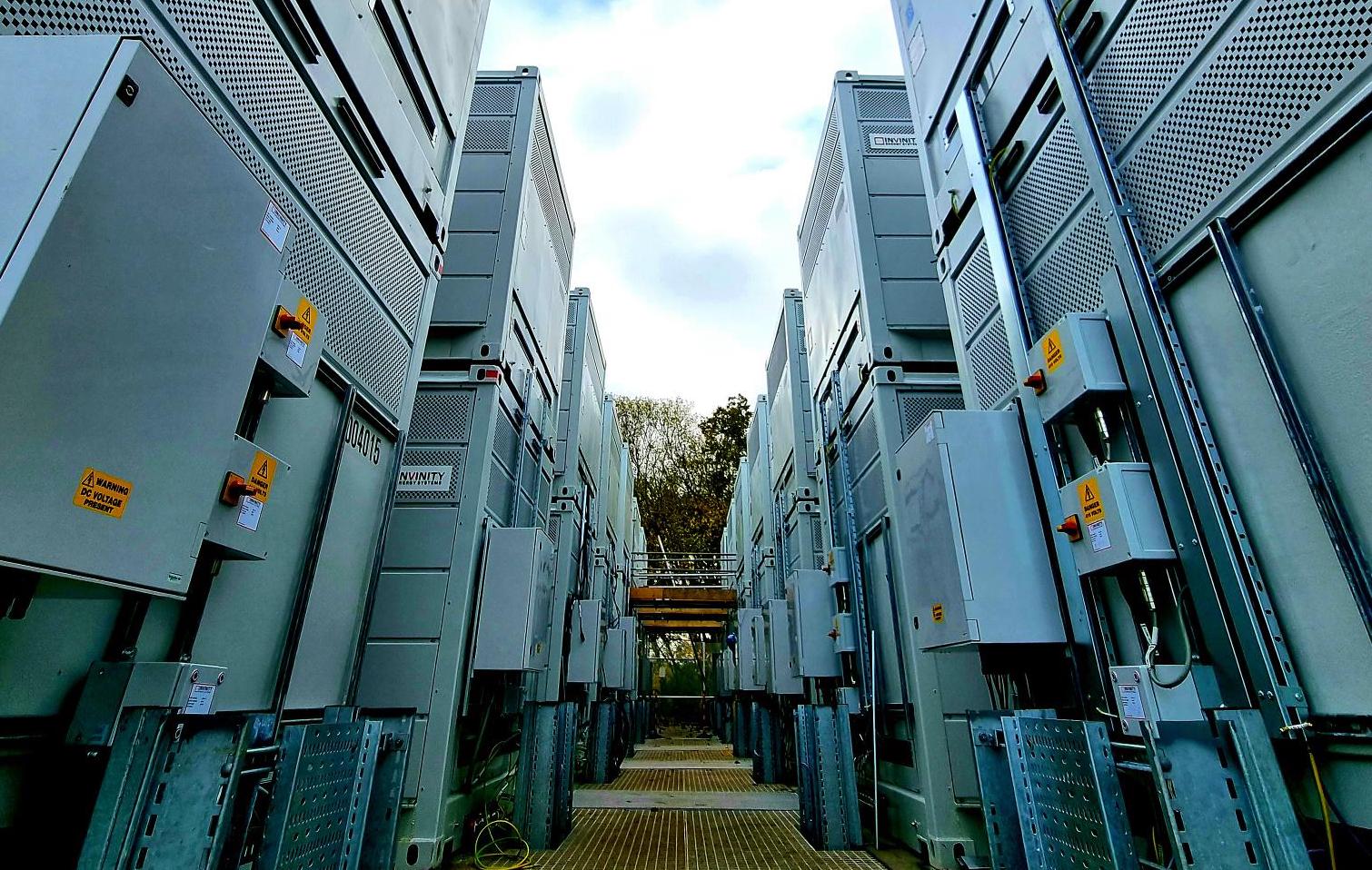
Invinity Energy Systems flow battery at Energy Superhub Oxford
If this project works out, vanadium flow batteries would be a good replacement for lithium-ion batteries.
Cheshire Energy Storage Centre
This is the description of this project.
io consulting will receive £1 million to enable its consortium to develop an electricity storage facility which could use mothballed EDF gas cavities in Cheshire utilising Hydrostor’s Advanced Compressed Air Energy Storage technology
Note.
- This is another project based on salt caverns.
- I wrote about Canadian company; Hydrostor in Gigawatt-Scale Compressed Air: World’s Largest Non-Hydro Energy-Storage Projects Announced.
- Hydrostor have received at least one large order for their system.
I have put Hydrostor on my list of tecnologies that should make it.
Conclusion
This is a well-balanced list of projects.
I would rate success as follows.
- Ballylumford Power-to-X – 60 %
- GraviSTORE – 80 %
- Long Duration Offshore Storage Bundle – 60 %
- Vanadium Flow Battery Longer Duration Energy Asset Demonstrator – 70 %
- Cheshire Energy Storage Centre – 80 %
But then all these projects are a bit of a gamble
Giant Batteries Will Provide Surge Of Electricity Storage
The title of this post, is the same as that of this article on The Times.
These are the first two paragraphs.
Britain’s capacity to store electricity in giant batteries is set to double after dozens of new projects won contracts through a government scheme to keep the lights on.
Developers of battery storage projects with a total output capacity of at least 3.3 gigawatts won contracts to operate from winter 2025-26 through the government’s “capacity market” auction, according to Cornwall Insight, the consultancy.
Note that Hinckley Point C is only 3.26 GW.
The biggest battery in these contracts is a giant that Intergen will be building at the London Gateway.
When the battery got planning permission in November 2020, Intergen published this press release, which is entitled InterGen Gains Consent To Build One Of The World’s Largest Battery Projects In Essex.
These are three bullet points at the head of the press release.
- Edinburgh-headquartered energy company InterGen has been granted planning consent to build the UK’s largest battery storage project at DP World London Gateway on the Thames Estuary.
- £200m project is set to provide at least 320MW/640MWh of capacity, with the potential to expand to 1.3GWh – more than ten times the size of the largest battery currently in operation in the UK and set to be one of the world’s largest.
- The battery will provide fast-reacting power and system balancing with an initial two-hour duration, and is a significant piece of infrastructure on the UK’s journey to net zero.
As Cilla might have said. “What a lorra lorra lot of lithium!”
But it’s not just lithium-ion batteries that are getting large.
In The Power Of Solar With A Large Battery, I talked about a Highview Power CRYOBattery with a capacity of 50MW/500MWh, that is being built in the Atacama desert in Chile.
The Essex battery is a giant battery and it’s bigger than the one in Chile, but I’m fairly sure Highview Power could build a battery bigger than the one InterGen are building. You just add more liquid air tanks and turbomachinery.
Avanti West Coast Looks To Recover
The title of this post is the same as an article in the March 2022 Edition of Modern Railways.
These are some points from the article.
Passengers Numbers Are Recovering
This is a paragraph.
Mr. Wittingham says the recovery has been strongest on the Anglo-Scottish and Liverpool corridors, while Manchester have begun to bounce back. Slowest to recover is the London to West Midlands market; ‘there’s several operators here and we were the main carrier of business passengers, and that sector has been recovering more slowly than leisure’ says Mr. Whittingham.
Phil Whittingham is MD of Avanti West Coast.
Train Numbers Are Recovering
Avanti are building up train numbers from Euston after the pandemic.
Frequencies are as follows in trains per hour (tph)
- Pre-Covid – 9
- During the pandemic – 4
- From December 2021 – 7
- Omicron – 4
- From February 2022 – 6
- From May 2022 – 6+
Avanti have reacted to demand.
Three Classes Of Travel
This is a paragraph.
Avanti’s business has historically been driven by leisure travel – before Covid this accounted for broadly 60 % of passengers, with most of the rest travelling for business plus a smaller number of commuters. ‘The demand is there, and we think by next year we’ll be on the way to full recovery’ says Mr. Whittingham. ‘Leisure has been strong, especially at weekends, but the missing bit is the corporate market.’
Avanti have been running a marketing campaign and it appears to have been successful.
This paragraph describes Avanti’s new Standard Premium class.
Last year, Avanti West Coast launched a new class of travel – Standard Premium. This was first introduced in May on an upgrade-only basis before going fully live in September with the option to book online in advance. The new class sits between Standard and First, giving passengers larger seats and greater space but without some of the extras that come with First Class Travel such as complimentary refreshments and lounge access.
These are Mr. Whittingham’s comments on the three classes.
The current split of passengers is 84% Standard, 12 % First and 4 % Standard Premium, but given the latter has been in place for less than a year there is clearly scope for growth. ‘Our research shows people have been upgrading to Standard Premium rather than downgrading from First’.
I have yet to try Standard Premium, but I will next time I use Avanti.
Refreshments
Avanti have decided to serve different refreshments in Standard Premium and First classes.
- In Standard Premium, they are now offering At Seat Orders.
- In First, they have updated the menu.
Both seem to have been well-received.
I like this statement from Mr. Whittingham.
We’ve tried to make it a more personalised service with a less rigid structure, so we give customers what they want, when they want it, rather than when we want to give it to them.
A Consistent Offer
This is a paragraph.
Mr. Whittingham says Avanti has not yet confirmed whether t will offer three classes of travel on the new Hitachi trains it has ordered, but says the aim is to provide a more consistent offer. Assisting this will be changes in the ongoing Pendolino refurbishment, where 11-car sets are having Coach G converted from First to Standard accommodation, meaning all Pendolinos, whether nine-car or 11-car, will have three coaches for First and Standard Premium passengers.
My instinct says that the four trains will be something like.
- Class 390 train – Pendolino – Nine-car – three First/Standard Premium cars – six Standard cars
- Class 390 train – Pendolino – Eleven-car – three First/Standard Premium cars – eight Standard cars
- Class 805 train – Hitachi – Five-car – one First/Standard Premium car – four Standard cars
- Class 807 train – Hitachi – Seven-car – two First/Standard Premium car – five Standard cars
Note.
- The Class 805 and Class 807 Hitachi trains are very much plug-and-play and can be lengthened or shortened as required.
- A regular passenger between London and Liverpool, who regularly upgrades from Standard to Standard Premium in a Class 390 train could be a bit miffed if he couldn’t, because the service was being run by a Class 807 train.
- Hitachi would probably be very happy to add extra cars to the Class 805 and Class 807 trains.
As the Class 390 Pendolino trains are being refurbished, I do wonder if they will be receiving some fittings from the Hitachi trains to make sure the trains are consistent to both on-board staff and passengers.
Pendolino Investment
The Pendolino refurbishment is comprehensive.
- It is one of the largest such programmes ever undertaken in the UK.
- Leasing company; Angel Trains are funding the work.
- Alstom are doing the work at Widnes.
- There appears to be a smooth plan to refurbish all trains.
- Coach G will be converted from First to Standard accommodation in eleven-car trains.
- Mr. Whittingham says that all trains will come out looking like a new train.
The eleven-car trains are being converted first, as the conversion of Coach G gives a capacity benefit of around thirty seats.
The awful seats in Standard Class will be replaced with Lumo-style seats and laptop-friendly fold-down tables.





These seats will be a big improvement!
New Trains Coming
This paragraph introduces the new trains.
The second major fleet investment from Avanti is the £350 million for new trains from Hitachi, financed by Rock Rail. These comprise 13×5-car Class 805 bi-modes, ordered for destinations off the electrified route including North Wales and Shrewsbury and 10×7-car Class 807 electrics. Deployment plans for the latter are still being worked through but are likely to include services to Birmingham and Liverpool, and potentially to Blackpool.
What is not said in this paragraph, is that all trains have a redesigned front end, which I suspect is more aerodynamic.
The all-electric Class 807 trains have no diesel engines or batteries, so have they been put on a diet, to improve the acceleration?
In Will Avanti West Coast’s New Trains Be Able To Achieve London Euston and Liverpool Lime Street In Two Hours?, I came to these conclusions.
- A two hour service between London Euston and Liverpool Lime Street will be possible with Avanti West Coast’s new Class 807 trains.
- The current Class 390 trains could go a bit faster and if they cut out a couple of stops could probably break two hours.
I also calculated that a two tph service between London and Liverpool in two hours would need nine trains.
Timetable Changes
This paragraph introduces the article’s section on timetable changes.
The project in turn feeds into a major timetable change planned by Avanti and other West Coast main line operators. This will be the first significant change to West Coast main line schedules since 2008; ‘the world has changed, and we need to think about how we best serve our markets’ says Mr Whittingham.
This paragraph sums up the major changes.
Of note are the planned changes to the pattern of London to West Midlands services; the pre-Covid 20-minute interval would be amended to offer faster journey times and greater connectivity. Also featuring in the new timetable aspirations would be additional Trent Valley calls in some Liverpool and Manchester services; Mr Whittingham cites as one benefit of this the potential for improved journey times between the North West and the East Midlands via a change of train at Nuneaton. The Hitachi trains, with their better acceleration, will be particularly useful on services with more frequent stops.
The next three sections will look at some timetable changes in a bit more detail.
London And West Midlands Services
Replacement of twenty diesel Class 221 trains with thirteen bi-mode Class 805 trains will mean a major reorganisation of services to the West Midlands.
- Some current diesel services will now be electric.
- All services between Birmingham New Street and Euston will now be electric.
- No services will run on diesel under live electrification.
- Avanti have promised to serve Walsall.
- There will be extra services to Shrewsbury and other places.
The electric services will also speed up some services to the West Midlands.
North West And East Midlands Services
I will look at train times for services between the North West (Liverpool Lime Street and Manchester Piccadilly) and the East Midlands (Leicester, Nottingham and Lincoln), where passengers change at Nuneaton.
These are the current fastest possible times according to the National Rail journey planner.
- Liverpool Lime Street and Leicester -2:24 with changes at Crewe and Nuneaton,
- Manchester Piccadilly and Leicester – 2:11 with change at Sheffield
- Liverpool Lime Street and Nottingham – 2:42 with no changes
- Manchester Piccadilly and Nottingham – 1:51 with no changes
- Liverpool Lime Street and Lincoln- 3:42 with changes at Sheffield and Doncaster
- Manchester Piccadilly and Lincoln – 2:38 with change at Sheffield
Note that times are in hours:minutes.
These are all current times for the various legs if the route is via Nuneaton.
- Avanti West Coast – Liverpool Lime Street and Nuneaton – 1:18
- Avanti West Coast – Manchester Piccadilly and Nuneaton – 1:13
- CrossCountry – Nuneaton and Leicester – 0:27
- East Midlands Railway – Leicester and Nottingham – 0:48 – Time from Leicester and Lincoln service.
- East Midlands Railway – Leicester and Nottingham – 0:20 – Time from St. Pancras and Nottingham service.
- East Midlands Railway – Leicester and Lincoln -1:42 – Time from Leicester and Lincoln service.
- East Midlands Railway – Nottingham and Lincoln -0:52 – Time from Leicester and Lincoln service.
Note that the two Avanti West Coast times have been estimated by taking the time from Real Time Trains and adding three minutes for the acceleration or deceleration at Nuneaton.
These would be possible times between the North West and the East Midlands via Nuneaton.
- Liverpool Lime Street and Leicester – 1:47
- Manchester Piccadilly and Leicester – 1:42
- Liverpool Lime Street and Nottingham – 2:37
- Manchester Piccadilly and Nottingham – 2:32
- Liverpool Lime Street and Lincoln- 3:31
- Manchester Piccadilly and Lincoln – 3:26
Note that I am assuming changes at Nuneaton and Leicester are cross-platform or same platform changes that take two minutes.
But there is another level of improvement possible.
Suppose that East Midlands Railway’s Lincoln and Leicester service were to be extended to Nuneaton and run by a train with this specification.
- 125 mph operating speed.
- Battery-electric power.
- 100 mph operating speed on battery power.
- Range of 56 miles on battery
- Ability to use the Midland Main Line electrification, when it is erected.
Charging stations would be needed at Nuneaton and Lincoln.
These would be possible times between the North West and the East Midlands via Nuneaton with the one change at Nuneaton.
- Liverpool Lime Street and Leicester – 1:45
- Manchester Piccadilly and Leicester – 1:40
- Liverpool Lime Street and Nottingham – 2:05
- Manchester Piccadilly and Nottingham – 2:00
- Liverpool Lime Street and Lincoln- 2:57
- Manchester Piccadilly and Lincoln – 2:52
Note.
I am assuming that the timings for the Nuneaton and Leicester and the Nottingham and Lincoln legs are as for the current trains.
I am assuming the change at Nuneaton is a cross-platform or same platform change that takes two minutes.
Trains run on battery where tracks are not electrified.
I can build a table of current times, times via Nuneaton and savings.
- Liverpool Lime Street and Leicester -2:24 – 1:45 – 0:39
- Manchester Piccadilly and Leicester – 2:11 – 1:40 – 0.31
- Liverpool Lime Street and Nottingham – 2:42 – 2:05 – 0:37
- Manchester Piccadilly and Nottingham – 1:51 – 2:00 – 0.09 slower
- Liverpool Lime Street and Lincoln- 3:42 – 2:57 – 0.45
- Manchester Piccadilly and Lincoln – 2:38 – 2:52 – 0:14 slower
It does appear that by using the 125 mph speed of the West Coast Main Line has a positive effect on some times from the North West to the East Midlands.
But times could be reduced further.
- Installing full digital signalling, that would enable 140 mph running between Crewe and Nuneaton, could save ten minutes.
- Improving the Nuneaton and Leicester and the Nottingham and Lincoln legs could allow faster running.
The more I look at changing at Nuneaton, I feel it is a good idea.
- It improves the connections between East Midlands Parkway and Loughborough and the North West.
- It improves the connections between Cambridge, Peterborough and Stansted Airport and the North West, if the change at Nuneaton is to CrossCountry’s Stansted Airport and Birmingham New Street service.
- It improves the connections between Coventry and Leamington Spa and the North West.
Avanti have come up with a cunning plan, worthy of Baldrick at his best.
A Second Hourly Service Between London And Liverpool
A paragraph talks about the second hourly service between London and Liverpool.
Avanti still has ambitions to introduce a second hourly service between Euston and Liverpool, but when this will come in will depend on demand recovery.
Consider.
- If would be desirable if some or all trains running on the route could achieve a timing of two hours between London and Liverpool.
- It is felt that the second service should stop at Liverpool South Parkway station, where the platforms are too short for eleven-car Class 390 trains.
- Avanti have stated they would like more stops in the Trent Valley, especially at Nuneaton, where they would connect to services to the East Midlands.
- Nuneaton is almost exactly halfway between London and Liverpool.
- Running two tph with Class 807 trains would need nine trains and Avanti have only ordered ten in total.
I believe that a practical timetable like this could work.
- Class 390 train – one tph – Non-stop or perhaps a single stop in the Midlands – Under two hours
- Class 807 train – one tph – Stopping at Nuneaton, Stafford, Crewe, Runcorn and Liverpool South Parkway – Current time or better
An hourly service between London and Liverpool in under two hours would surely be a passenger magnet.
Wind Turbines On A Train
I was searching for something else and found this video.
I wonder, if we’ll ever see wind-turbine blades transferred by rail in the UK!
Probably not, as our railway gauge is too small.
Calls For Study Into Reopening Of Leeds Railway Station To Expand Capacity
The title of this post, is the same as that of this article on Rail Technology Magazine.
This is the introductory paragraph.
Local politicians in Leeds have called for the revival of Marsh Lane railway station to ease some of the pressure on the city’s busy main station, seeking viability studies to be carried out on it and other sites as a first step.
This Google Map shows the area of the proposed Leeds Marsh lane station.

Note.
- The Leeds Playhouse, Leeds Conservatoire, Northern Ballet and large NHS offices in the centre of the circle of roads.
- Marsh Lane runs down the East side and crosses under the Leeds and Hull via Selby railway line.
- I would assume that the station will be built, where the road goes under the railway.
This second map is an enlargement of where the station used to be.
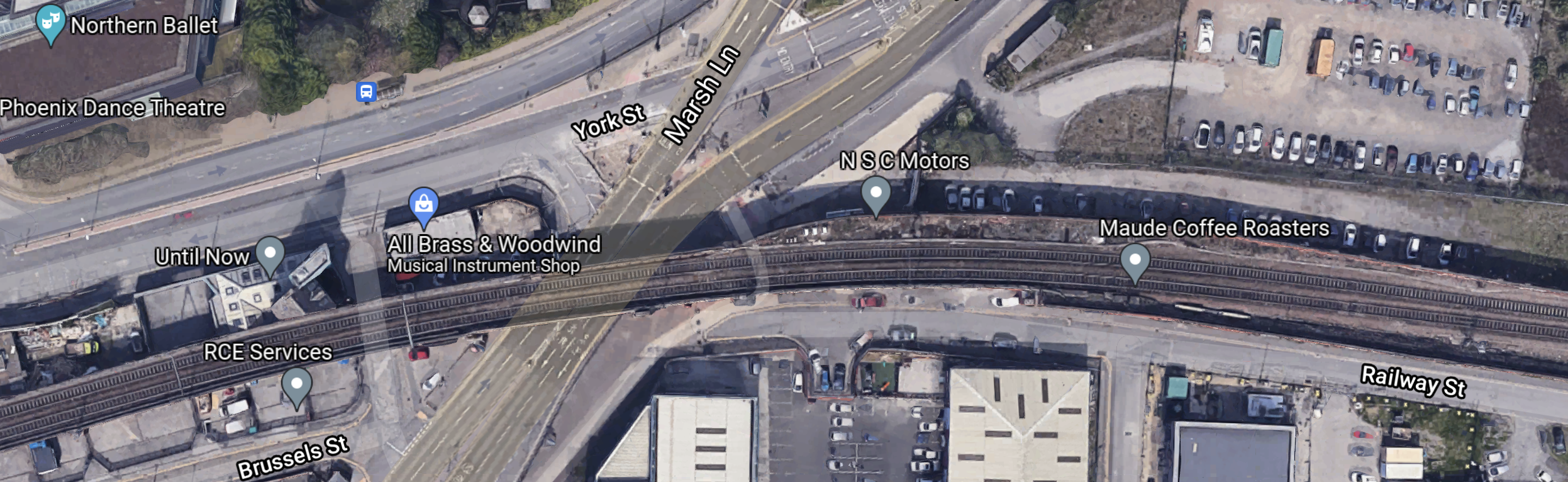
It looks like there would be space to put two platforms outside the double-track line.
Services Through Leeds Marsh Lane Station
The following services appear to run through the site of Leeds Marsh Lane Station.
- CrossCountry – Plymouth and Edinburgh/Glasgow
- LNER – Leeds and Edinburgh
- Northern – Blackpool North and York
- Northern – Halifax and Hull
- Northern – Leeds and York
- TransPennine Express – Liverpool Lime Street and Newcastle
- TransPennine Express – Liverpool Lime Street and Scarborough
- TransPennine Express – Manchester Airport and Newcastle
- TransPennine Express – Manchester Airport and Redcar
- TransPennine Express – Manchester Piccadilly and Hull
Note.
- All trains are hourly in both directions.
- There are also up to two freight trains per hour (tph) through the area.
There’s certainly scope for a balanced timetable through the station, but will there be enough time for all to stop?
Conclusion
Building this station looks to feasible and a good service could be provided.
Whether it is built would depend on passenger numbers and the cost of building.
Hence the need for a comprehensive study!
Was Storm Franklin Named By An Old Minchendenian?
This press release from the Met Office is entitled Storm Franklin Named.
When I first heard yesterday, that the storm was to be named, I must admit, that I allowed myself a small smile.
I went to Minchenden Grammar School in Southgate, leaving in 1965.
One teacher, that we looked upon with a degree of affection was our German teacher, who was Frank J Stabler, who some pupils referred to as Franklin J Stabler. I don’t know whether that was his real name or whether it was fellow pupils making it up.
But he did have one story, that he used to liven up one of the lessons, where he taught me enough German to get by in the country.
Apparently, he was returning from France to the UK on the night of Saturday, the 31st of January in 1953, using the ferry from Dieppe in France to Newhaven in Sussex.
That ferry route used to have a reputation for being rough and on one bad crossing around 1975, my five-year-old son fell and cut himself just above his eye. He was skillfully cleaned up and plastered by one of the chefs. Luckily the chef had been a soldier, who had been well-trained in first aid.
Back in 1953, Mr. Stabler could have chosen a better night for his trip, as that day was the night of devastating East Coast Floods, which killed over five hundred people in the UK.
The captain of the ferry decided to sit the storm out and crew and passengers spent twenty-four hours being tossed about like a cork in the English Channel, which was a tale Mr. Stabler told with great drama.
He finished the tale, by saying that in the end, he prayed for the boat to go down to put everybody out of their misery.
Conclusion
I have to ask if someone on the committee that decides storm names, either directly or indirectly, has heard this tale and decided that Franklin would be an appropriate name for a storm beginning with F.
The Big Beast In Your Electric Bus
This article on electrive.com is entitled BAE Systems Takes Orders For 340 Hybrid Drive Systems.
This is the first paragraph.
The Southeastern Pennsylvania Transportation Authority (SEPTA) has selected BAE Systems to supply up to 340 hybrid electric drive systems for its new fleet of low emission transit buses. BAE Systems will provide 220 electric drive systems to New Flyer of America, with an option for 120 additional systems, over the next three years.
The article also reveals that the company is working with AlexanderDennis.
The system appears to be hybrid, with a lot of intelligent choosing of when to use a polluting engine.
Repurposing The Great Glen Hydro-Electric Scheme
The Great Glen hydro-electric scheme was built in the 1950s and early 1960s, by the North of Scotland Hydroelectric Board.
- The scheme is now owned by SSE Renewables and has a page on their web site.
- There are six individual power stations; Ceannacroc, Livishie, Glenmoriston, Quoich, Invergarry and Mucomir.
- There are five dams; Cluanie, Loyne, Dundreggan, Quoich and Invergarry.
This map from the SSE Renewables web site shows the layout of the dams and power stations.
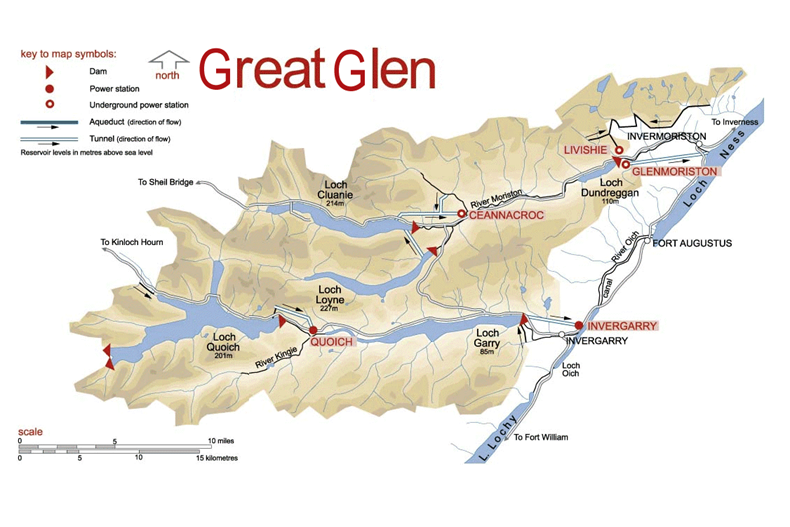
The sizes of the power stations in the scheme are as follows.
- Ceannacroc – 20 MW
- Livishie – 15 MW
- Glenmoriston- 37 MW
- Quoich – 18 MW
- Invergarry – 20 MW
- Mucomir – 1.7 MW
This gives a total power of 112.7 MW.
This Google Map shows the same area as the SSE Renewables Map.
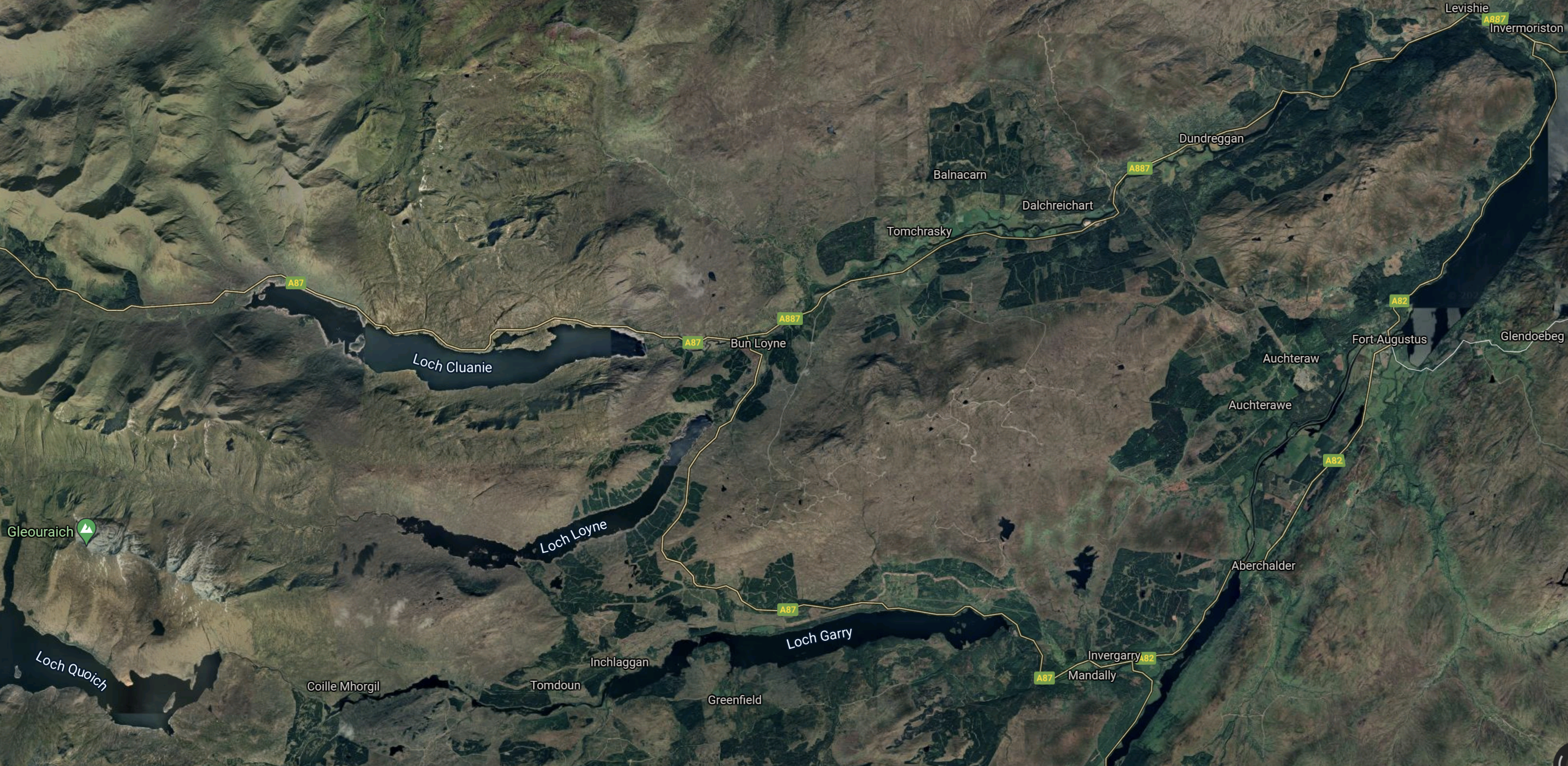
Note.
- Loch Quoich is in the South-West corner.
- To the East of Loch Quoich is Loch Garry and to the North-East is Loch Loyne.
- Loch Cluanie is to the North.
- Invermoriston is in the North-East corner.
The scheme also includes three underground power stations and several miles of tunnels.
Strathclyde University And Pumped Storage Power For Scotland
This page on the Strathclyde University gives a list of the pumped storage potential for Scottish hydrogen-electric dams and power stations.
These figures are given for the dams and lochs in the Great Glen scheme.
- Invergarry – 22 GWh
- Glenmoriston- 41 GWh
- Quoich – 27 GWh
It would appear that based on research from Strathclyde University, that the Great Glen scheme could support up to 90 GWh of pumped storage.
Water Flows In The Great Glen Scheme
Looking at the SSE Renewables map of the Great Glen scheme, water flows appear to be as follows.
- Loch Quoich to Loch Garry via Quoich power station.
- Loch Garry to Loch Oich via Invergarry power station.
- Loch Loyne to Loch Dundreggan via River Moriston.
- Loch Cluanie to Loch Dundreggan via Ceannacroc power station and River Moriston.
- Loch Dundreggan to Loch Ness via Glenmoriston power station.
All the water eventually flows into the sea at Inverness.
Refurbishing And Repurposing The Great Glen Scheme
Perhaps as the power stations are now over fifty years old, one simple way to increase the generating capacity of the Great Glen scheme, might be to selectively replace the turbines, with modern turbines, that can generate electricity more efficiently.
I suspect that SSE Renewables have an ongoing program of improvements and replacements for all of their hydro-electric stations in Scotland. Some turbines at Sloy power station have already been replaced with larger ones.
Adding Pumped Storage To The Great Glen Scheme
I would assume that the water to pump uphill at night or when there is a surplus of electricity will come from Loch Oich or Loch Ness.
Some power stations like Glenmoriston and Invergarry might be updated to both generate electricity or pump water up hill, as is required.
Conclusion
There would appear to be up to three schemes, that could each add around 30 GWh of pumped storage.
One advantage is that the waters of Loch Ness can be used for the lower reservoir.
LNER Launches International Website Making Travel Simpler For Overseas Tourists
The title of this post, is the same as that of this press release on LNER.
These four paragraphs describe the new website.
The new website coincides with the removal of pre-departure testing and quarantine rules for vaccinated people arriving in England or Scotland from 11 February 2022.
In a move that expands LNER’s global market, customers in 10 countries, including China, Japan, Spain, South Korea and Italy, are among the first to benefit when booking directly online.
LNER’s new search and booking engine offers international customers in those countries an option to purchase train tickets using their language and currency. The LNER.co.uk website will automatically detect those customers who are searching outside of the UK and will redirect them to the customised site to improve their online booking experience. The website launch comes as LNER reintroduces its full timetable, excluding pre-planned engineering works, meaning customers can discover destinations across the full 956-miles of East Coast route.
LNER has been working with travel tech company and rail retailer, Omio, to develop the site, which has the capability to operate in up to 20 languages and 26 currencies, including Euros, Korean Won and Japanese Yen or by using a payment method recognised in the home country.
Surely, if you run a travel company, your web site must be accessible to buy tickets from everywhere.
Repurposing The Affric/Beauly Hydro-Electric Scheme
The Affric/Beauly hydro-electric scheme was built in the 1950s and early 1960s, by the North of Scotland Hydroelectric Board.
- The scheme is now owned by SSE Renewables and has a page on their web site.
- There are six individual power stations; Mullardoch, Fasnakyle, Deanie, Culligran, Aigas and Kilmorack.
- There are seven dams; Mullardoch, Benevean, Monar, Loichel, Beannacharan, Aigas and Kilmorack.
This map from the SSE Renewables web site shows the layout of the dams and power stations.
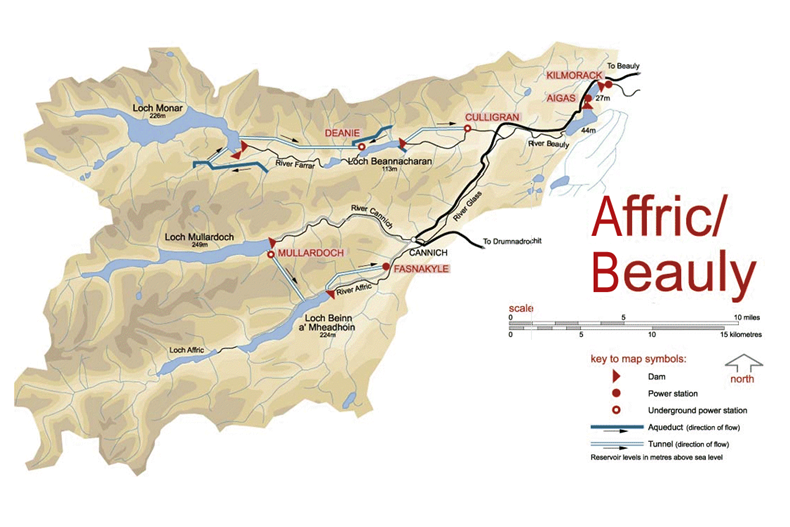
This description of the scheme is from Wikipedia.
The Affric / Beauly hydro-electric power scheme for the generation of hydro-electric power is located in the western Highlands of Scotland. It is based around Glen Strathfarrar, Glen Cannich and Glen Affric, and Strathglass further downstream.
The scheme was developed by the North of Scotland Hydro-Electric Board, with plans being approved in 1947.
The largest dam of the scheme is at Loch Mullardoch, at the head of Glen Cannich. From there, a tunnel takes water to Loch Beinn a’ Mheadhoinn (Loch Benevean) in Glen Affric, via a small underground power station near Mullardoch dam. Loch Benevean is also dammed, with a tunnel taking water to the main power station of Fasnakyle, near Cannich.
To the north in Glen Strathfarrar, Loch Monar is dammed, and a 9 km tunnel carries water to an underground power station at Deanie. Further down the glen, the River Farrar is dammed just below Loch Beannacharan, with a tunnel to take water to Culligran power station (also underground).
The River Farrar joins with the River Glass near Struy to form the River Beauly. Downstream on the River Beauly, dams and power stations have been built in gorges at Aigas and Kilmorack.
As the rivers in this scheme are important for Atlantic salmon, flow in the rivers is kept above agreed levels. The dams at Kilmorack, Aigas and Beannacharn contain Borland fish lifts to allow salmon to pass.
Note
- Culligran, Deanie and Mullardoch power stations are underground.
- Loch Beannacharan is the English name for Loch Beinn a’ Mheadhoin.
- The salmon impose a constraint on water levels.
The sizes of the power stations in the scheme are as follows.
- Mullardoch – 2.4 MW
- Fasnakyle – 69 MW
- Deanie – 38 MW
- Culligran – 19 MW
- Aigas – 20 MW
- Kilmorack – 20 MW
This gives a total power of 168.4 MW.
This Google Map shows the Western area of the SSE Renewables Map.
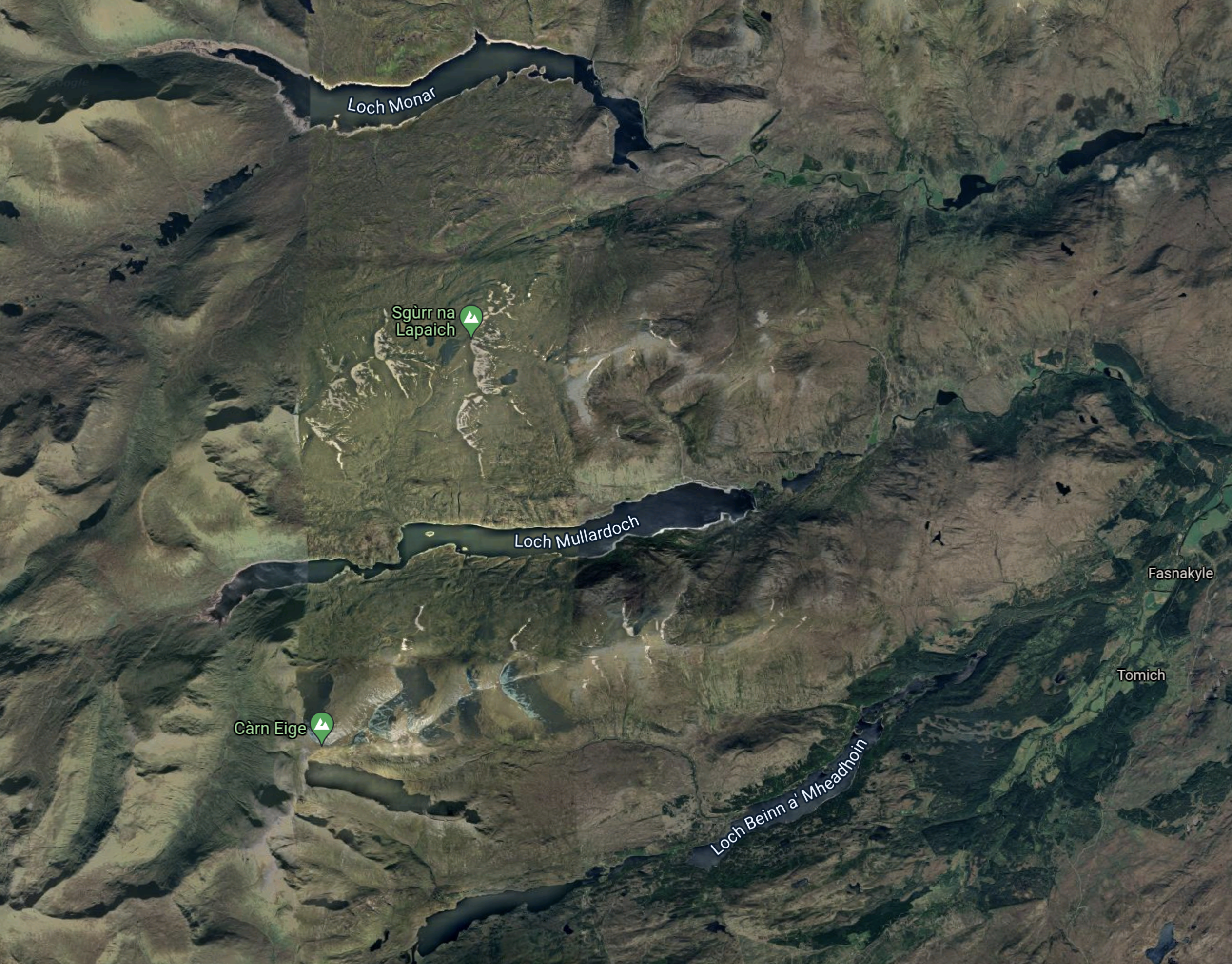
Note.
- The three lochs; Monar, Mullardoch and Beinn a’ Mheadhoin can be picked out on both maps.
- Fasnakyle, where the largest of the hydro-electric power stations in the Affric/Beauly scheme, is at the Eastern edge of the map about half-way up.
- The area doesn’t seem to have a large population.
This Google Map shows the location of Fasnakyle power station in more detail.
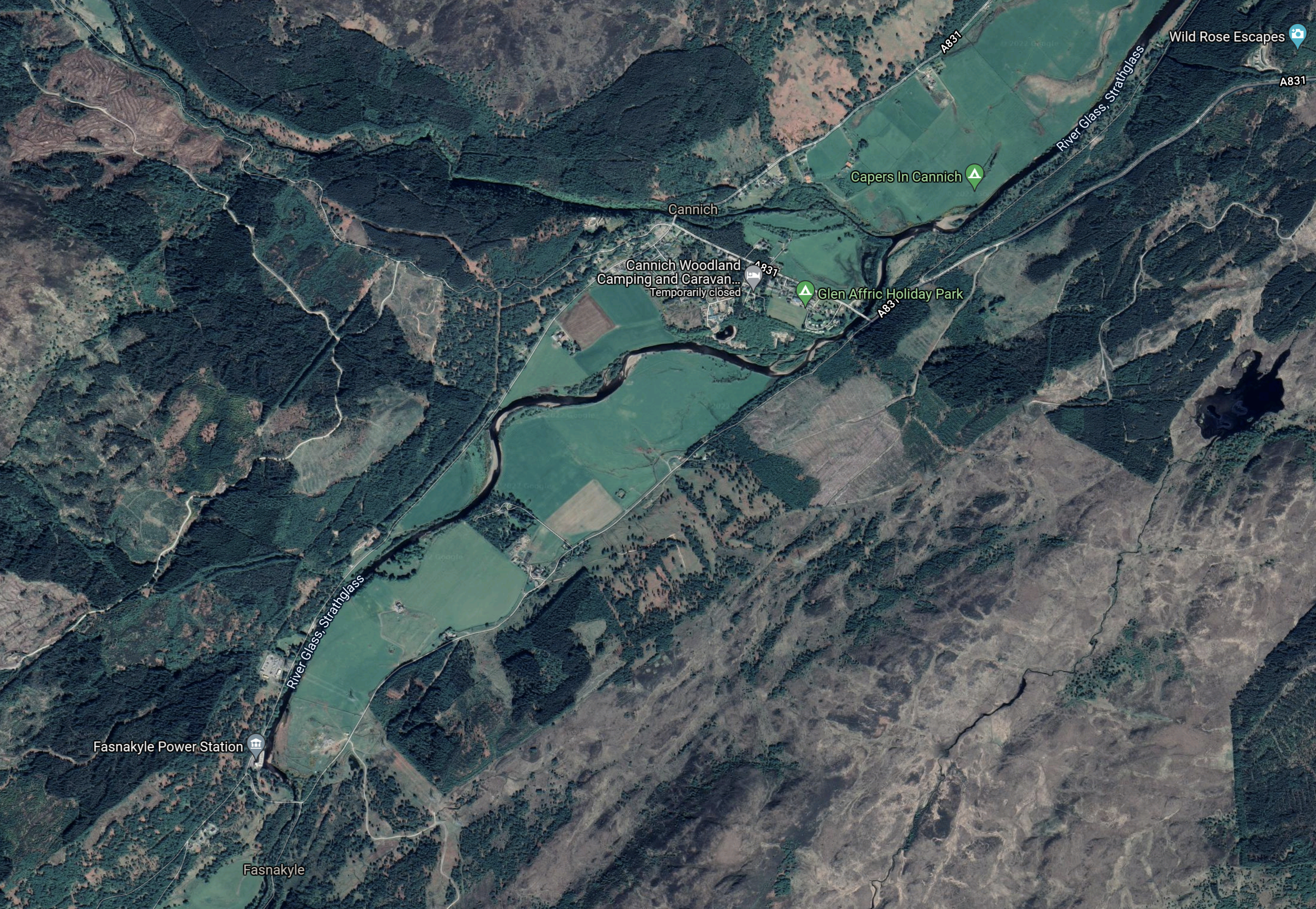
Note.
- Fasnakyle power station is in the South-West corner of the map. marked by a grey flag.
- It appears that all of the water that goes through the power station flows into the River Glass, Strathglass, which meanders its way towards Inverness on the bottom of what appears to be a broad valley.
This Google Map shows the next section of the river.
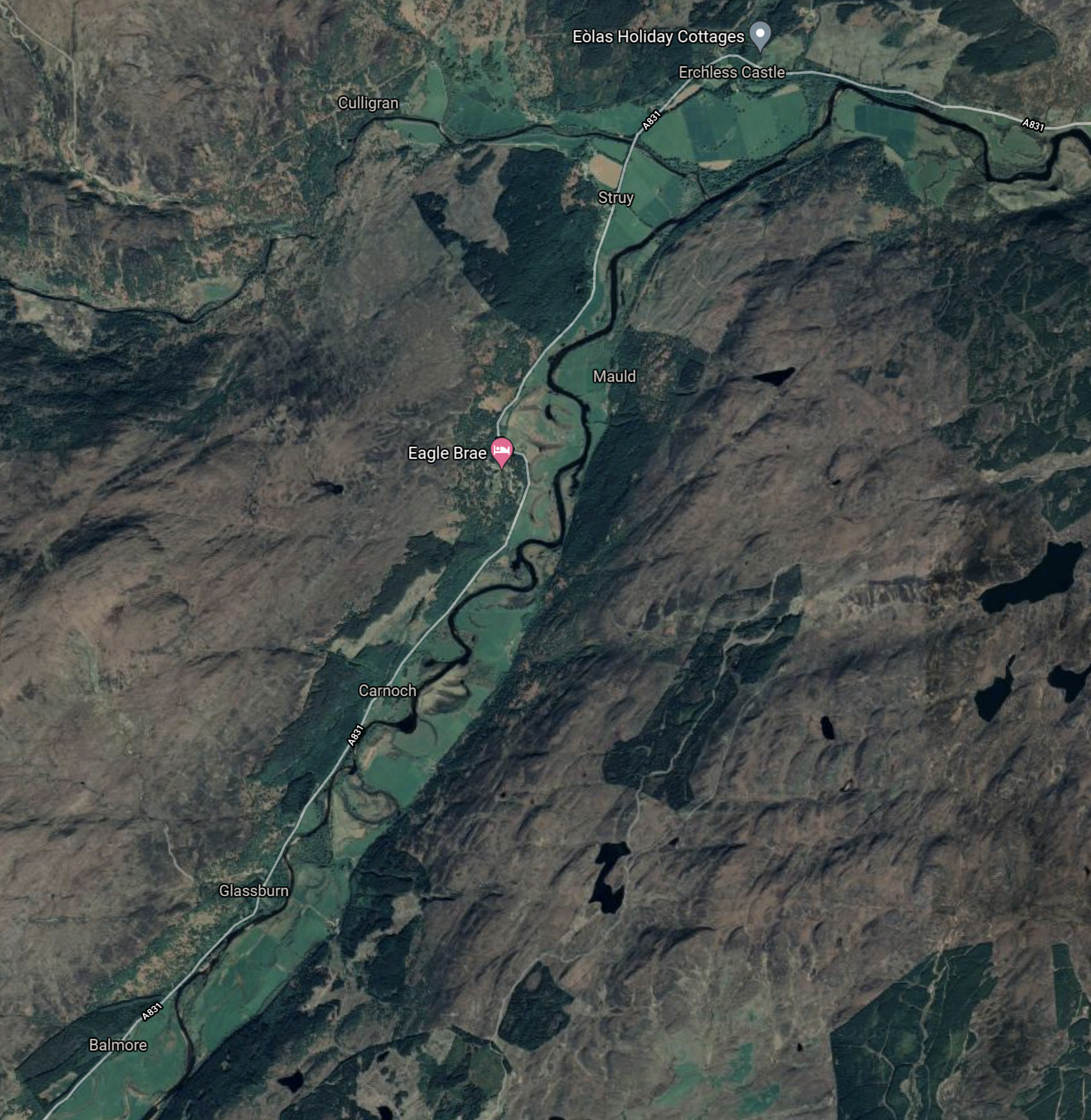
The River Glass, Strathglass joins the River Farrar near the top of the map an becomes the River Beauly.
This Google Map the River Beauly to Kilmorack.
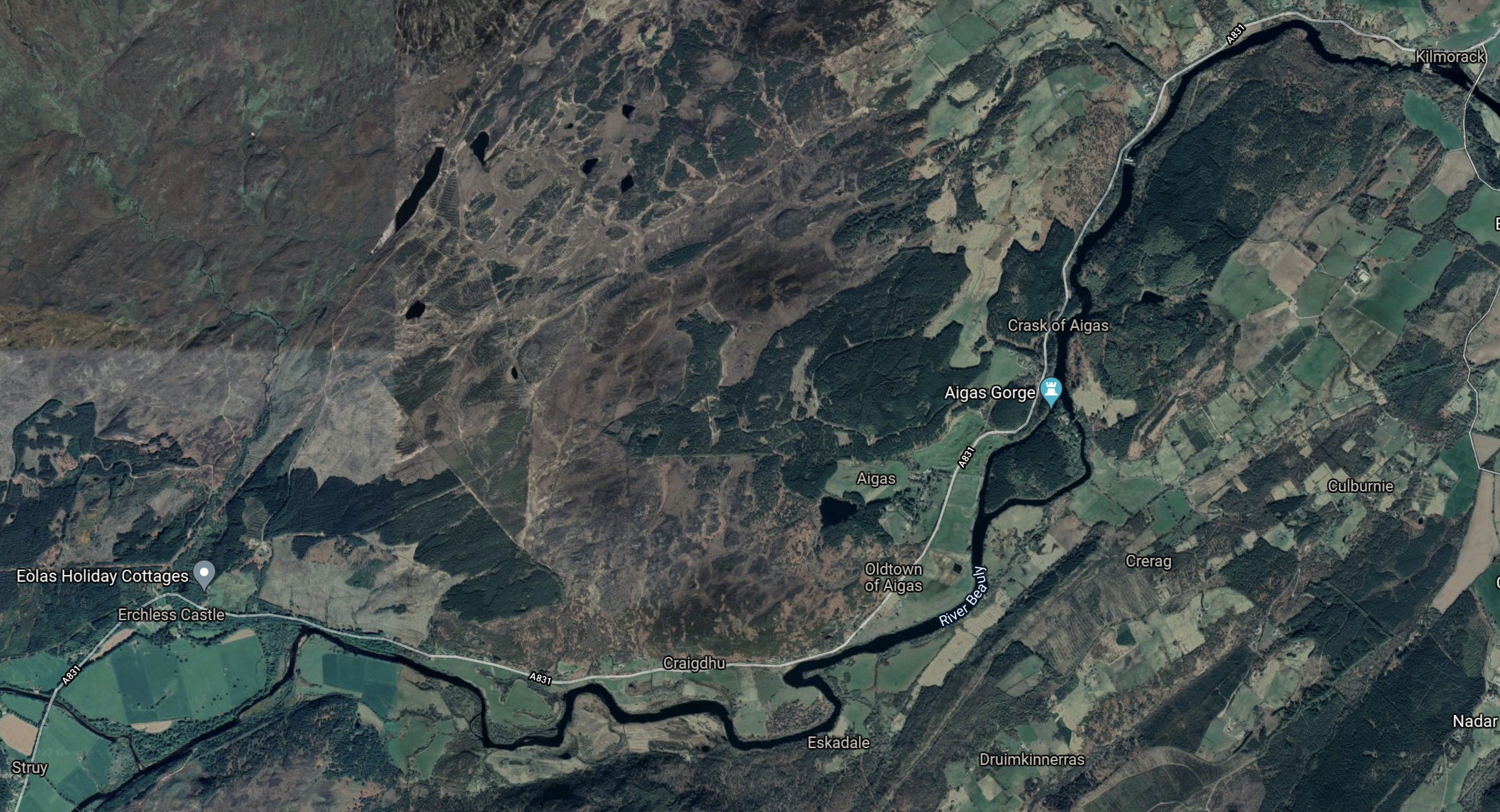
Wikipedia says this about this section of the River Beauly.
The river is part of the Affric-Beauly hydro-electric power scheme, with dams and power stations at Aigas and Kilmorack. Both have 20MW generators and include fish ladders to allow salmon to pass, the Aigas fish ladder is open to visitors in the summer.
This last Google Map shows the Beauly Firth.
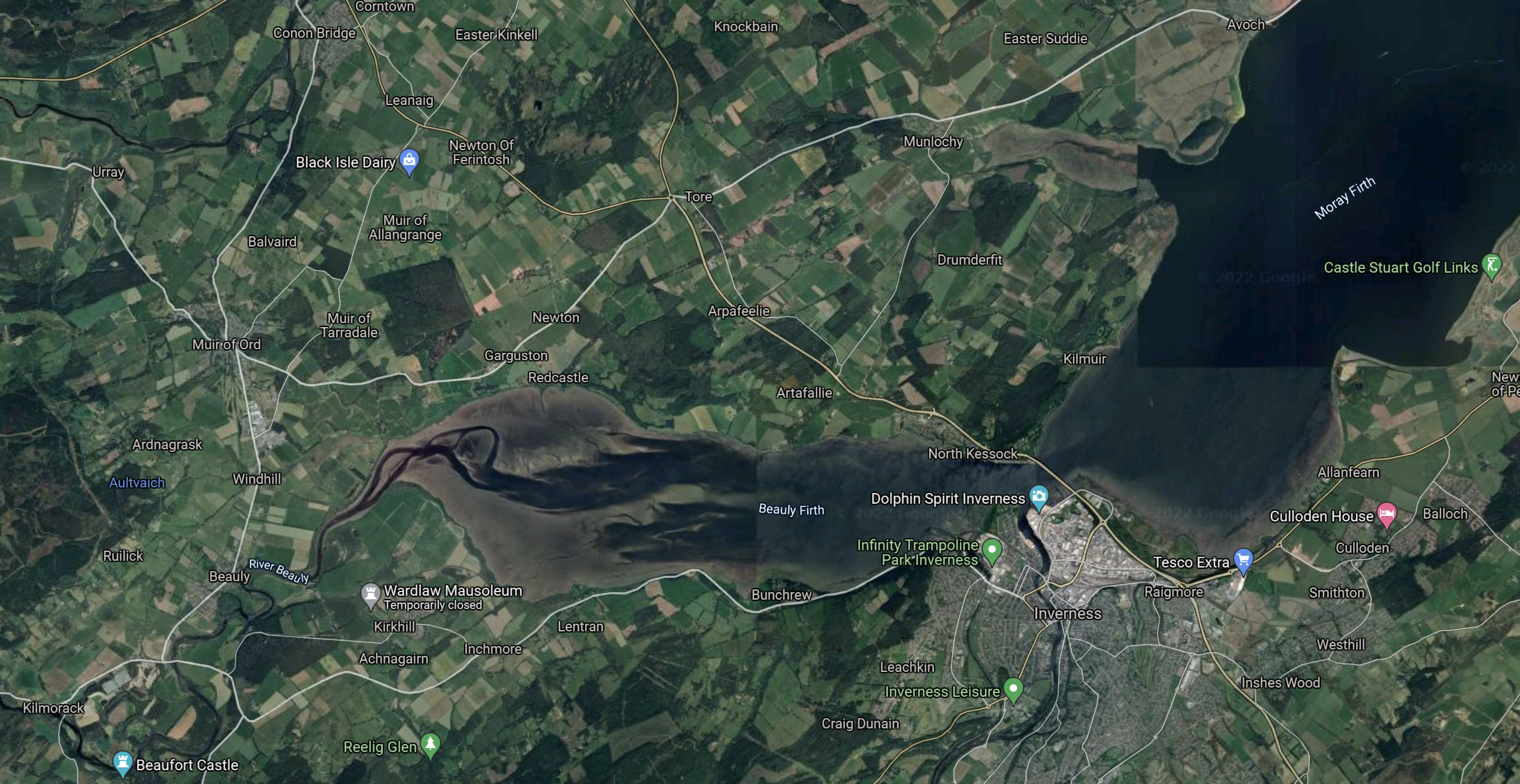
Note.
- Kilmorack is in the South-West corner of the map.
- The River Beauly flows into the Beauly Firth and ultimately out to see in the Moray Firth.
- The water flows past Inverness to the North.
It does strike me, that a lot of the water collected in the dams to the West of Fasnakyle, flows out to sea.
Strathclyde University And Pumped Storage Power For Scotland
This page on the Strathclyde University gives a list of the pumped storage potential for Scottish hydrogen-electric dams and power stations.
A figure is given for only one dam or power station in the Affric/Beauly scheme.
- Fasnakyle – 78 GWh
That would be a lot of pumped storage.
Water Flows In The Affric/Beauly Scheme
Looking at the SSE Renewables map of the Conon scheme, water flows appear to be as follows.
- Loch Monar to Loch Beannacharan via Deanie power station
- Loch Beannacharan to River Beauly via Culligran power station
- Lochs Mullardoch and Beinn a’ Mheadhoin both supply water to the Fasnakyle power station
- Fasnakyle power station to River Beauly via the River Glass, Strathglass.
- River Beauly to Beauly Firth via Aigas and Kilmorack power stations.
Note.
- Water from Loch Moray goes via Deanie , Culligran, Aigas and Kilmorack power stations on its journey to the sea.
- Water from Loch Mullardoch goes via Mullardoch , Fasnakyle, Aigas and Kilmorack power stations on its journey to the sea.
- Water from Loch Beinn a’ Mheadhoin goes via Fasnakyle, Aigas and Kilmorack power stations on its journey to the sea.
Fasnakyle, Aigas and Kilmorack power stations must work very hard.
Refurbishing And Repurposing The Affric/Beauly Scheme
Perhaps as the power stations are now over fifty years old, one simple way to increase the generating capacity of the Affric/Beauly scheme might be to selectively replace the turbines, with modern turbines, that can generate electricity more efficiently.
I suspect that SSE Renewables have an ongoing program of improvements and replacements for all of their hydro-electric stations in Scotland. Some turbines at Sloy power station have already been replaced with larger ones.
I also suspect that the whole scheme has a very sophisticated control system.
Consider.
- There is a need to control water levels to agreed minimum levels for the Atlantic salmon.
- Hydro-electric power stations have the ability to get to full power quickly, to cover sudden demands for more electricity.
- Electricity only needs to be generated if it can be used.
- Water might be held in Lochs Mullardoch and Beinn a’ Mheadhoin, as a reserve, as it goes through three or four power stations when it is released.
Over the years, SSE Renewables will have developed very sophisticated control philosophies.
Adding Pumped Storage To The Affric/Beauly Scheme
To do this a source of fresh-water must be pumped into Loch Mullardoch or Beinn a’ Mheadhoin, when there is a surplus of electricity.
It looks from Google Maps, that the river system between Fasnakyle and Aigas power stations has been effectively turned into a canal.
- I wonder, if it is deep enough to contain enough water to act as the lower level reservoir of a pumped-storage system.
- The higher level reservoir would be Loch Mullardoch.
- There would be a height difference of 200 metres.
- Calculations show around 1850 cubic metres of water would need to be pumped into Loch Mullardoch to store one MWh.
So long as enough water is left for the salmon, I suspect that if a way of pumping water from the River Glass to Loch Mullardoch, that an amount of pumped-storage can be added.
Conclusion
There would appear to be only one scheme, but if it was built it could add over 50 GWh of pumped storage.
 The Anonymous Widower