The Government’s Terrible COVID-19 Statistics
In an article in The Times today, Sir David Speigelhalter lambasts the Government over their collection of COVID-19 statistics.
I have been involved in the analysis of several very large databases and four factors improve the quality of the answers you get.
- The more records or in this case tests you have, the better. So I back David Speigelhalter! We should stop people on the street and test them!
- The more fields or pieces of data in each test you have, the better. So perhaps each test should be linked to your NHS record.
- The quality of the data is important. In my experience NHS scores about two out of five for quality as a lot of medical staff, often fill it in badly. In one case, I was looking for reasons for low birth weight babies and in many cases, the field was filled with 9.99 Kg.
- And then there’s the output of the data. I was taught how to display data for idiots, by the former Chief Accountant of a FTSE 500 company, who was working as the Chief Management Accountant of a Clearing Bank. He had found showing scatter diagrams with each branch as a single point on a large sheet, really got Branch Managers to think about what they are doing, if they weren’t running with the herd. These diagrams made problem branches stand out like the sorest of thumbs!
So where are the scatter diagrams for all of the Health Authorities in the UK, so everybody can see how their area, is doing against everybody else?
By the way, I trust Sir David, as we have the same birthday and share it with James Cameron, Jeff Thomson, Katherine Hamnett, Lawrence of Arabia, Menachem Begin and Madonna.
Orders For Alstom Breeze Trains Still Expected
It is almost a year since I wrote Breeze Hydrogen Multiple-Unit Order Expected Soon, but no order has so far been placed.
But some things have happened or are happening.
- The two pre-production Alstom Coradia iLint trains seem to be running without trouble in Germany.
- The Northern Franchise is now run by the Government and called Northern Trains.
- Greater Anglia‘s Class 720 trains are finally being delivered.
- This should release Class 321 trains for conversion to hydrogen power.
At present, Greater Anglia appear to have 102 Class 321 trains in service, all of which could be converted to Alstom Breeze trains.
Although it should be noted that thirty trains have been upgraded to a Renatus specification, as cover, if there are any problems during Greater Anglia’s fleet changeover.
The Conversion Process
The 102 Class 321 trains will release the same number of each of the following coaches.
- DTCO – Driving Trailer Composite Open
- TSO – Trailer Standard Open
- PMSO – Pantograph Motor Standard Open
- DTSO – Driving Trailer Standard Open
Each three-car Breeze will need two Driver Trailer cars and a Pantograph Motor car to be converted.
Driver Trailer Cars
Consider.
- Most two- and three-car diesel multiple units in the UK, don’t have First Class seats.
- Many new trains like those of Greater Anglia and South West Trains don’t have First Class seats.
- Seating in these cars will be very much reduced by the fitting of a large hydrogen tank.
I wouldn’t be surprised to see both types of Driver Trailer cars converted into identical cars.
Pantograph Motor Car
The Pantograph Motor car will be seriously modified, with these systems and components installed.
- A new AC traction system.
- Batteries fed by the fuel cells,
- Regenerative braking
All will be controlled by a sophisticated energy management system.
- Will regenerative braking be able to charge the batteries?
- Will the pantograph be retained, so that on electrified lines, the trains can use the electrification?
- Will the fitting of third-rail shoes be considered?
- Will the train retain the 100 mph capability of the Class 321 train?
The train could be a real 100 mph efficient go-anywhere train.
New Interiors
New Class 321 Renatus-style interiors will be fitted.
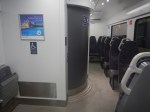






The Class 321 Renatus is a high-class interior for a suburban train.
- There are both fully-accessible and standard toilets.
- There are power sockets and wi-fi.
- Passenger information displays are fitted.
I suspect tables could be fitted, if the operator required them.
Northern Trains And The Alstom Breeze
The three-car Alstom Breeze is expected to have a similar capacity to a two-car diesel multiple unit.
Northern Trains Current And Future Trains
At present Northern have the following two-car diesel multiple units in service, according to Wikipedia.
- 7 x Class 155 trains
- 47 x Class 156 trains
- 45 x Class 158 trains
In addition, there are eight three-car Class 158 trains, which gives a total of 107 trains, that could be suitable for replacement by Alstom Breeze trains.
If these were the only trains available, Northern would have to keep some old diesel multiple units in service for longer.
But there are other trains expected to enter service, in the coming months.
- 7 x new two-car Class 195 trains
- 5 x new three-car Class 195 trains
- 3 x refurbished two-car Class 150 trains
- 8 x rebuilt four-car bi-mode Class 769 trains
Northern should just about scrape through, especially as COVID-19 has reduced services.
I would think, that Northern could absorb quite a lot of Alstom Breeze trains.
Deployment On Teesside
In Fuelling The Change On Teesside Rails, I talked about using the trains on Teesside.
- Services would be centred on Darlington and Middlesbrough.
- There is a supply of hydrogen nearby.
- Bishop Auckland, Newcastle, Nunthorpe, Redcar and Whitby could be served.
- The 1000 km range could be useful.
- The trains could even be a tourist attraction for the area.
In Northern’s Hydrogen Plans, I wrote about progress on these plans, which included applying for planning permission for the depot at Lackenby.
Deployment Around Widnes
In A Hydrogen Mobility Roadmap For North-West England, I wrote using the trains around Widnes.
- Services could be centred around Alstom’s Widnes factory.
- Hydrogen could be supplied by pipeline from Runcorn.
- Chester, Liverpool and Manchester could be served.
- Some routes might need more capacity.
Could Alstom introduce a couple of pre-production trains on a route past Widnes, in a similar way, that they have introduced the Coradia iLint train in Germany?
This approach seems to have helped a successful introduction into service of the trains.
Increasing Capacity
I do think that these trains will need extra capacity on some routes, like perhaps Liverpool and Manchester via Widnes and Warrington.
The solution would surely be to add one of the spare Trailer cars to bring the trains up to four cars and increase the passenger capacity by perhaps fifty percent.
Northern Routes Currently Run By Two-Car Diesels
Wikipedia lists these services as run by two-car-diesels in Classes 150, 155, 156 and 158.
- Barrow-in-Furness and Carlisle
- Barrow-in-Furness and Lancaster
- Blackburn and Rochdale
- Blackburn and Wigan Wallgate
- Blackpool North and York
- Clitheroe and Rochdale
- Hexham and Nunthorpe *
- Hull and Scarborough
- Hull and York
- Huddersfield and Castleford
- Huddersfield and Leeds
- Huddersfield and Sheffield
- Lancaster and Morecambe/Heysham Port
- Leeds and Carlisle
- Leeds and Chester
- Leeds and Goole
- Leeds and Knottingley
- Leeds and Lincoln
- Leeds and Manchester Victoria
- Leeds and Morecambe
- Leeds and Nottingham
- Leeds and Selby
- Leeds and Sheffield
- Leeds and Wigan Wallgate
- Leeds and York
- Liverpool Lime Street and Manchester Oxford Road *
- Manchester Piccadilly and Buxton
- Manchester Piccadilly and Chester
- Manchester Piccadilly and New Mills Central
- Manchester Piccadilly and Rose Hill Marple
- Manchester Piccadilly and Sheffield
- Manchester Victoria and Kirkby
- Manchester Victoria and Southport
- Manchester Victoria and Stalybridge
- Middlesbrough and Whitby *
- Newcastle and Carlisle
- Newcastle and Chathill
- Newcastle and Morpeth
- Oxenholme Lake District and Windermere
- Preston and Blackpool South
- Preston and Colne
- Preston and Ormskirk
- Saltburn and Bishop Auckland/Darlington *
- Sheffield and Adwick
- Sheffield and Bridlington
- Sheffield and Gainsborough Central
- Sheffield and Hull
- Southport and Alderley Edge
Those marked with an * could be served by hydrogen trains from Laverton and Widnes.
Positioning Hydrogen Trains
Trains often have to be positioned from and to the depot at the beginning and end of a day’s work.
On my list of services, there is an hourly shuttle service between Oxenholme Lake District and Windermere stations.
Suppose this service was to be run by an Alstom Breeze based at Widnes.
- The train could be fuelled with hydrogen at Widnes, early in the day.
- The train could position to Oxenholme Lake District along the West Coast Main Line, using the electrification, after joining it a few miles from the depot.
- Each round trip to Windermere is 20 miles or 32 kilometres.
- An Alstom Breeze train has a range of 1000 kilometres on hydrogen, so it could do thirty round trips without refuelling.
- At the end of the day, the train would return to the depot using the electrification.
I would expect, that the long range of hydrogen trains could make them easier to diagram or schedule, than battery ones.
They might also be able to work some distance away from the depot, if they could use an electrified route for positioning.
So if we look at Widnes, these are approximate distances to stations where hydrogen services might run.
- Liverpool Lime Street – 12 miles
- Manchester Airport – 33 miles
- Manchester Oxford Road – 22 miles
- Preston – 33 miles
- Warrington Central – 6 miles
- Wigan North Western – 18 miles
Some of the routes to these stations are partially electrified, so the trains could position using the electrification.
Consider these routes.
- Preston and Blackpool South – 20 miles
- Preston and Colne – 19 miles
- Preston and Ormskirk – 20 miles
A hydrogen train could position from Widnes and perhaps do fifteen trips before needing a refuel.
I will also look at distances from Lackenby, where the Teesside Depot will be built, as I wrote in Northern’s Hydrogen Plans.
- Darlington – 23 miles
- Newcastle via East Coast Main Line – 59 miles
- Newcastle via Durham Coast Line – 54 miles
- York via Northallerton and East Coast Main Line – 56 miles
I suspect quite a few services could be run from Lackenby depot, if the electrified East Coast Main Line was used to position the trains.
Possible Future Stages
If the trains are successful, I can see that Northern Trains will want to introduce more hydrogen trains.
As the Government controls this franchise, does this make more zero-carbon trains more or less likely?
More Trains
There are only so many Class 321 trains to convert, but after Alstom complete their takeover of Bombardier, I believe that a hydrogen-powered Aventra could become a reality.
I wrote about my ideas for this in I Design A Hydrogen Aventra.
So in the long term, if more hydrogen trains are needed, it shouldn’t be a problem.
More Depots
More depots will be needed and I would expect others like Lackenby will be added in strategic locations.
- Given the service pattern, Blackburn, Leeds and Sheffield must be possibilities.
- Hydrogen will probably be generated in the depots using electrolysers.
In the future could we see depots for hydrogen trains shared between bordering franchises?
- A depot at Carlisle could be shared between Northern and Scotrail
- A depot at Chester could be shared between Northern and Trains for Wales
- A depot at Exeter could be shared between Great Western and South West Railways
ITM Power in Rotherham have the technology to generate the hydrogen, which could also be used to fuel the local buses and other vehicles.
Conclusion
From pubished reports, it looks to me, that Northern have been thinking hard how they can deploy a substantial fleet of Alstom Breeze trains, by using depots at Widnes and Lackenby, where the trains can be refuelled overnight.
I am also fairly sure that Alstom will design the Breeze, so that trains can position themselves along the West and East Coast Main Lines, using the 25 KVAC electrification.
Success For Ovako In Green Steel Hydrogen Trial
The title of this post, is the same as that of this article in The Engineer.
Steel usually has to be heated to a high temperature before it can be rolled.
Normally, LPG is used, but Swedish steel company; Ovako, have conducted a full-scale trial using hydrogen, which seems to have proved it doesn’t result in lower quality.
150 Hours Of Storage? Company Says That’s True To Form
The title of this post, is the same as that of this article on Power Magazine.
It is very much a must-read about the emerging technology of high-capacity and long term energy storage, with particular reference to Highview Power and Form Energy.
The article fills out a lot of what I wrote in Will The Real Form Energy Please Stand Up!
I also feel that there’s also an old kid on the block, when it comes to long term energy storage and that is new methods of deploying pumped storage, that I wrote about in The New Generation Of Pumped Storage Systems.
Environmental Humour On Euston Road
I took this picture on the Euston Road outside Euston station.

It’s an area, where I don’t walk very often, so I don’t know how long it’s been there.
Euston Station – 8th May, 2020
I had walked to Euston station from Kings Cross along the back roads, which is a much better route than along the polluted Euston Road.










Note, that the train part of the station seemed to be functioning normally.
The Abandoned Tube Entrance At Euston
These pictures show the abandoned tube entrance at Euston station.


The station was built to serve the Charing Cross, Euston and Hampstead Railway, which is now part of the Northern Line.
- It opened in 1907.
- The building will now be demolished to make way for High Speed Two.
- I can’t ever remember using the entrance.
It looks to be a station, which are typical of many, that were created by Leslie Green.
- Wikipedia has a list of over forty stations, that were designed by Leslie Green.
- Many are Grade II Listed
- His designs inspired the look of the fictional Walford East Underground station in EastEnders.
I would reckon, the one I use most is Oxford Circus.
Will The Real Form Energy Please Stand Up!
Form Energy appears to be a start-up, that claims it has the solution to low-cost long-term energy storage.
The home page of their web site is little more than this headline.
We are developing long duration energy storage systems to enable a fully renewable, affordable and reliable electric system.
And a few links to press releases and a link marked See How.
I clicked it and got this page, with this mission statement.
We are going about this by developing a new kind of battery that would eliminate the need for coal and gas entirely, and allow for a 100% renewable, carbon free grid.
They say this about the technology.
Form Energy has identified and is developing a novel approach that is low-cost, safe, and scalable. This battery would allow for a 100% renewable, carbon free grid.
And this about the software.
Form Energy offers a software solution to the industry that models the efficiency and cost-saving benefits of using Form’s long duration storage and identifies value to the entire electricity ecosystem.
Now that I can understand.
When I was writing software, I wrote any number of models in project management, finance and engineering systems and I don’t doubt, that they have developed a sophisticated software system, that can model a large electricity network.
It would allow the following.
- Predictions to be made for the future, based on historic data and schedules for new plant coming on stream.
- It would have a graphical interface, so that changes to the power network could be performed quickly and easily.
- It would predict the size and capacities of Form Energy’s batteries, that would be needed.
- It could be used to model ways out of a serious breakdown in part of the grid.
I suspect that National Grid in the UK, EDF in France and other national equivalents, have been running such software systems for many years.
A Deal With Great River Energy
Does this press release on their web site, which is entitled Form Energy Announces Pilot with Great River Energy to Enable the Utility’s Transition to an Affordable, Reliable and Renewable Electricity Grid, give any more details about Form Energy’s technology?
This paragraph lays out the basics of the deal with Great River Energy.
Form Energy, a company developing ultra-low-cost, long-duration energy storage for the grid, today announced it signed a contract with Minnesota-based utility Great River Energy to jointly deploy a 1MW / 150MWh pilot project to be located in Cambridge, MN. Great River Energy is Minnesota’s second-largest electric utility and the fifth largest generation and transmission cooperative in the U.S.
The next paragraph gives a few details of the battery.
This system will be the first commercial deployment of Form Energy’s proprietary long-duration energy storage system. Form Energy’s aqueous air battery system leverages some of the safest, cheapest, most abundant materials on the planet and offers a clear path to transformationally low-cost, long-duration energy storage. The project with Great River Energy will be a 1-MW, grid-connected storage system capable of delivering its rated power continuously for 150 hours, far longer than the two to four hour usage period common among lithium-ion batteries being deployed at utility-scale today. This duration allows for a fundamentally new reliability function to be provided to the grid from storage, one historically only available from thermal generation resources.
A battery capable of storing 150 MWh and capable of delivering 1 MW for 150 hours is certainly impressive.
More About The Deal
This article on Green Tech Media is entitled Long Duration Breakthrough? Form Energy’s First Project Tries Pushing Storage To 150 Hours.
A few points from the article.
- Bill Gates, Macquarie Capital and Eni are backers of Form Energy.
- The aim is to have the plant online in 2023.
- Great River Energy depends heavily on Coal Creek power station, which is a 1151 MW lignite-fired power station, which is to be shut down in the second half of 2022.
- Form expect their battery to be competitive with lithium-ion on a per KW basis.
- A battery takes up about an acre.
- Batteries have a twenty-year life.
The article also says that Form is not sharing many details of its technology.
Can Great River Energy Replace The Power From Coal Creek With Wind Turbines And A 150 MWh Battery?
Consider these points from the Green Tech Media article and Wikipedia.
- Coal Creek power station provides half of Great River Energy’s needs.
- Coal Creek power station is rated at 1151 MW,
- Coal Creek power station will shut in 2022.
- Great River Energy intends to add 1,100 MW of wind turbines.
- North Dakota, South Dakota and Minnesota seem to be states where it is worth reaping the wind.
So can all this power and the disruption of shutting Coal Creek power station be balanced by one relatively small 180 MWh battery?
I have modelled systems as complex as this in finance, project management and process engineering and if Form Energy have done their modelling to a very detailed level and they say that a 1MW/180 MWh system will be big enough, then I’ll go along with that!
In my long experience of mathematical modelling of complex systems, the answer at the end, is often not what many expect.
So the answer must be extensively tested.
What Technology Are Form Using?
The press release about the deal with Great River Energy mentions an aqueous air battery system!
Water and air are not exotic materials and are readily available in most parts of the world. I would suspect that the only way to store large amounts of energy in air is to liquify it, as Highview Power is doing in their CRYOBattery. But where does the water come in?
Could both companies be following different routes using similar properties of two of the greenest and most abundant substances on the planet?
I also know from a very beneficial personal financial experience, that aqueous-air mixes have unusual properties.
Highview Power liquify air and then use a turbine to recover the energy.
Are Form also using liquified air and then using a different method based on the unusual properties of aqueous-air mixes to recover the energy?
I can’t wait for the secret of their technology to emerge!
A Comparison Of Form Energy And Highview Power
The Wikipedia entry for Highview Power, says this about their capabilities and what they are proposing to deliver.
It has permission for a commercial-scale 50 Megawatt/250 Megawatt-hour plant in England, building upon its earlier 5 Megawatt and 350 Kilowatt pilot plants. It plans to develop a 50MW plant/400MWh (eight hours of storage) in Vermont
Is 5 MW for eight hours more impressive than 1 MW for one hundred and fifty hours?
- Highview Power’s proposed Vermont battery is not far short of three times the size of Form’s Great River battery.
- Highview Power’s battery can supply five times the maximum current, than Form’s.
- Liquid air storage is very scalable, as you just add more tanks. I wouldn’t be surprised to see systems storing around a GWh of electricity.
- Could Highview’s battery supply 2 MW for two hundred hours? I suspect it could!
If it was a relay race, I would think that Highview Power are ahead after the first leg.
The following legs will be interesting.
- Both companies have backers with enormous pockets.
- Form have disclosed they have sophisticated modelling software.
- Form seem to have a firm order.
- Highview Power are in a country, that in the next couple of years will bring vast amounts of wind power on-line.
- Great River will have a power shortage, when Coal Creek lignite-fired power station is closed.
But above all the world needs terra-watt hours of affordable, zero-carbon energy storage.
A Hydrogen Mobility Roadmap For North-West England
In the last few days, the North West Hydrogen Alliance has published a document entitled A Hydrogen Mobility Roadmap.
Some information from a well-written and very informative document.
Vehicle Types Covered In The Roadmap
A composite picture at the start of the document shows the following hydrogen-powered vehicles.
- A double-deck bus.
- A heavy goods vehicle.
- A passenger car.
- A passenger train.
Other vehicles, which exist or are under development, could have been added.
- A refuse truck.
- A high capacity fork lift or dump truck.
- A freight locomotive.
- The availability of hydrogen fuel in an area, must encourage the use of hydrogen-powered vehicles.
Comparison Of Electric And Hydrogen
The document gives a comparison between electric and hydrogen power.
Speed Of Refuelling
- Electric – The current long duration of battery recharges rules out many forms of transport
- Hydrogen – Hydrogen refuelling speed is largely similar to current petrol and diesel fuelling
Distance On Single Charge/Tank
- Electric – At the present time, cars will travel 150-250 miles per charge, but current battery weight means they are unsuitable for HGVs
- Hydrogen – Vehicles can travel 500+ miles on a single tank of hydrogen, which can be scaled up to suit vehicle size
Availability Of Fuel
- Electric – Growing network of charge points, but this is creating problems for power networks
- Hydrogen – Only 12 refuelling stations in the UK
Availability Of Vehicles
- Electric – Various cars to choose from, buses and trains readily available, with HGVs and ships in development
- Hydrogen – Cars, buses and trains largely available. HGVs and ships in development
Note.
- The speed of refuelling and the range for hydrogen.
- The need for more hydrogen refuelling stations.
- Both battery and hydrogen ships are in development.
I think their points are fair.
Road, Rail And Marine
The document discusses the various modes of transport and how hydrogen can help, with respect to both carbon-emissions and pollution.
The Alstom Breeze Trains
This picture is a visualisation of the Alston Breeze.
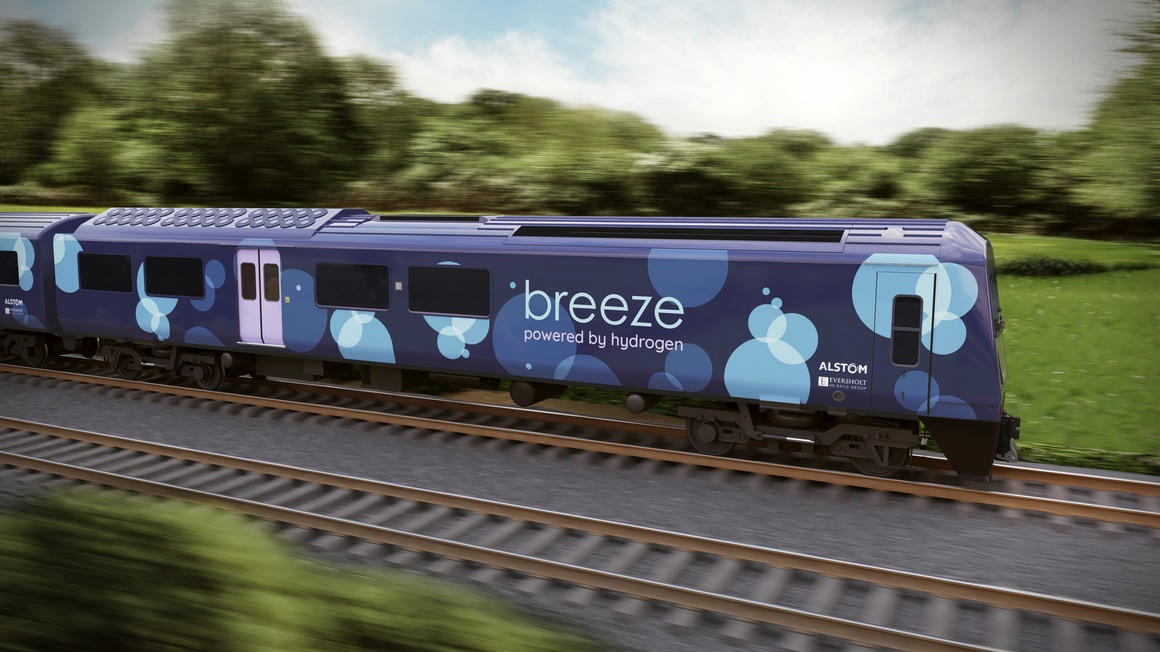
This is said about the Alstom Breeze trains.
Alstom in Widnes is ready to deploy its new Breeze trains and is working with Northern Rail to identify routes that are suitable for conversion to hydrogen.
A map also shows hydrogen train symbols on the Liverpool and Manchester Line, that goes via Widnes and Warrington and conveniently passes the Alstom factory at Widnes.
I wonder, if we’ll see an acceleration of this project?
Consider.
- Northern Rail is now directly controlled by the Government.
- Some Class 321 trains for conversion, will surely be available this summer.
- The updating of the trains, except for the hydrogen system has been developed in the Renatus project.
- Alstom have the experience of the successful hydrogen-powered Alstom Coradia iLint from Germany.
- Supplying the Alstom factory with hydrogen, shouldn’t be too difficult.
- I doubt any extra infrastructure is needed to run the trains.
- Alstom have sold two or three fleets of iLints on the back of a successful introduction into service of two prototype trains.
I don’t think, Alstom and all the various partners and stakeholders would object if the project were to be accelerated.
What’s Already Happening In The North West?
These hydrogen-powered projects are mentioned.
- Twenty double-deck buses for Liverpool City Centre.
- Alstom Breeze trains.
- storengy refuse trucks for Cheshire.
- ULEMCo are converting trucks and ferries.
- Port of Liverpool air quality.
It does seem to be that if you give an area a hydrogen network, possible users will find ways to use it to their advantage.
Rising To The Challenge
This section answers these questions.
Where Will The Hydrogen Come From?
Initially from INEOS at Runcorn, where I used to work around 1970 and BOC at St. Helens.
How Will It Be Transported?
Mainly by innovative use of new and existing pipelines.
How Do We Get To Critical Mass?
It looks like they’ll start slowly with hydrogen from Runcorn and St. Helens and build from there.
I would add a further question.
Will They Be Adding Hydrogen Filling Stations To The Network?
The North West needs them!
Hydrogen Storage
This is said about storing hydrogen.
Geologically, Cheshire is one of the few places in the UK where major underground gas storage in salt caverns has been delivered, paving the way for potential hydrogen storage, which is already done at scale elsewhere.
When I worked at ICI, I was given a tour of one of salt caverns. One is rumoured to be large enough to enable a full-size replica of Salisbury cathedral to be built inside.
Research
This is said about research.
Esteemed universities, and a wealth of innovative research companies, mean the region can deliver new hydrogen technologies. With academia working side-by-side with industry, the North West’s institutions can equip the next generation of skilled workers to support the hydrogen economy.
As a graduatev of one of those esteemed universities, how can I disagree?
Carbon Capture And Storage
This is said about carbon capture and storage.
Offshore reservoirs in the East Irish Sea can store carbon dioxide (CO2) produced from hydrogen production. Carbon Capture Utilisation and Storage (CCUS) is essential technology to help the UK in its fight against climate change. CCUS can capture up to 95% of the CO2 emissions associated with producing hydrogen from natural gas.
Whether you want to produce hydrogen this way is another matter. But the oil refineries and chemical plants along the Mersey are surely prime candidates for CCUS.
An Alliance
Not for nothing is the project called the North West Hydrogen Alliance!
Sixteen partners are mentioned at the end of the document.
Braving The London Underground
I took these pictures today, in a short Underground trip between Angel and Kings Cross St. Pancras tube stations.








It’s not very busy! Is it?
- There was no-one else in the tunnel as I walked between the escalators at Angel station.
- There was only two other people in my carriage on the train.
- There were few people in the tunnels at Kings Cross.
Isuspect that I travelled during lunchtime helped.
 The Anonymous Widower