Ukraine Tender Would Pair Hydroelectric Plants With Large-Scale Battery Storage
The title of this post, is the same as that of this article on Energy Storage News.
This is a must-read article, as it outlines the damage that Russia is doing to Ukraine’s energy generation.
It also reports how the World Bank is trying to help.
Innovative Hydrogen Energy Storage Project Secures Over £7 million In Funding
The title of this post, is the same as that of this press release from the University of Bristol.
These two paragraphs outline the project.
A consortium, involving the University of Bristol, has been awarded £7.7m from the Net Zero Innovation Portfolio (NZIP) of UK Government’s Department for Business, Energy & Industrial Strategy (BEIS) to develop pioneering hydrogen storage.
The University, EDF UK, UKAEA and Urenco will together develop a hydrogen storage demonstrator, in which hydrogen is absorbed on a depleted uranium ‘bed’, which can then release the hydrogen when needed for use. When stored, the hydrogen is in a stable but reversible ‘metal hydride’ form. The depleted uranium material is available from recycling and has been used in other applications such as counterbalance weights on aircraft.
I particularly like this paragraph from Professor Tom Scott.
Professor Tom Scott from the University’s School of Physics and one of the architects of the HyDUStechnology, said: “This will be a world first technology demonstrator which is a beautiful and exciting translation of a well proven fusion-fuel hydrogen isotope storage technology that the UK Atomic Energy Authority has used for several decades at a small scale. The hydride compounds that we’re using can chemically store hydrogen at ambient pressure and temperature but remarkably they do this at twice the density of liquid hydrogen. The material can also quickly give-up the stored hydrogen simply by heating it, which makes it a wonderfully reversible hydrogen storage technology.”
It’s elegant and it certainly, is an unusual method of storing hydrogen.
I do see a problem in that depleted uranium is controversial because of its use in munitions; most notably in the Gulf War.
I also see its heavy weight being rather a disadvantage in storing hydrogen for mobile applications.
So, I will keep an open mind on this technology.
Plan For £8.25m Plymouth Energy Plant To Generate Power From Cream-Like Fluid
The title of this post, is the same as that of this article on PlymouthLive.
These two paragraphs outline the project.
Plymouth’s Hemerdon tungsten mine has been chosen as the site of a pioneering £8.25m hydro energy plant which would see a cream-like fluid used to generate electricity. London-based renewable energy company RheEnergise wants to start construction of the High-Density Hydro storage system at the Plympton site as early as summer 2023.
The company has already spoken to the parish council and is to submit plans to Devon County Council soon. It hopes permission will be given and the site will be in operation by the end of 2023 and then trialled for two years before the technology is rolled out nationally and worldwide.
Note.
- RheEnergise has a web page, which describes how their High-Density Hydro storage system works.
- The system is sized at 250kW/1MWh and is described in the article as a demonstrator plant.
- In the future, rojects will range from 5MW to 100MW of power and can work with vertical elevations as low as 100m or less.
This sentence from the article lays out the potential of the system.
RheEnergise’s analysis of potential project opportunities has indicated there are about 6,500 possible sites in the UK, about 115,000 in Europe, about 345,000 in North America and about 500,000 in Africa and the Middle East.
This method of storing energy could be very useful.
Where Is Hemerdon Tungsten Mine?
This is a Google Map of the Plymouth area.
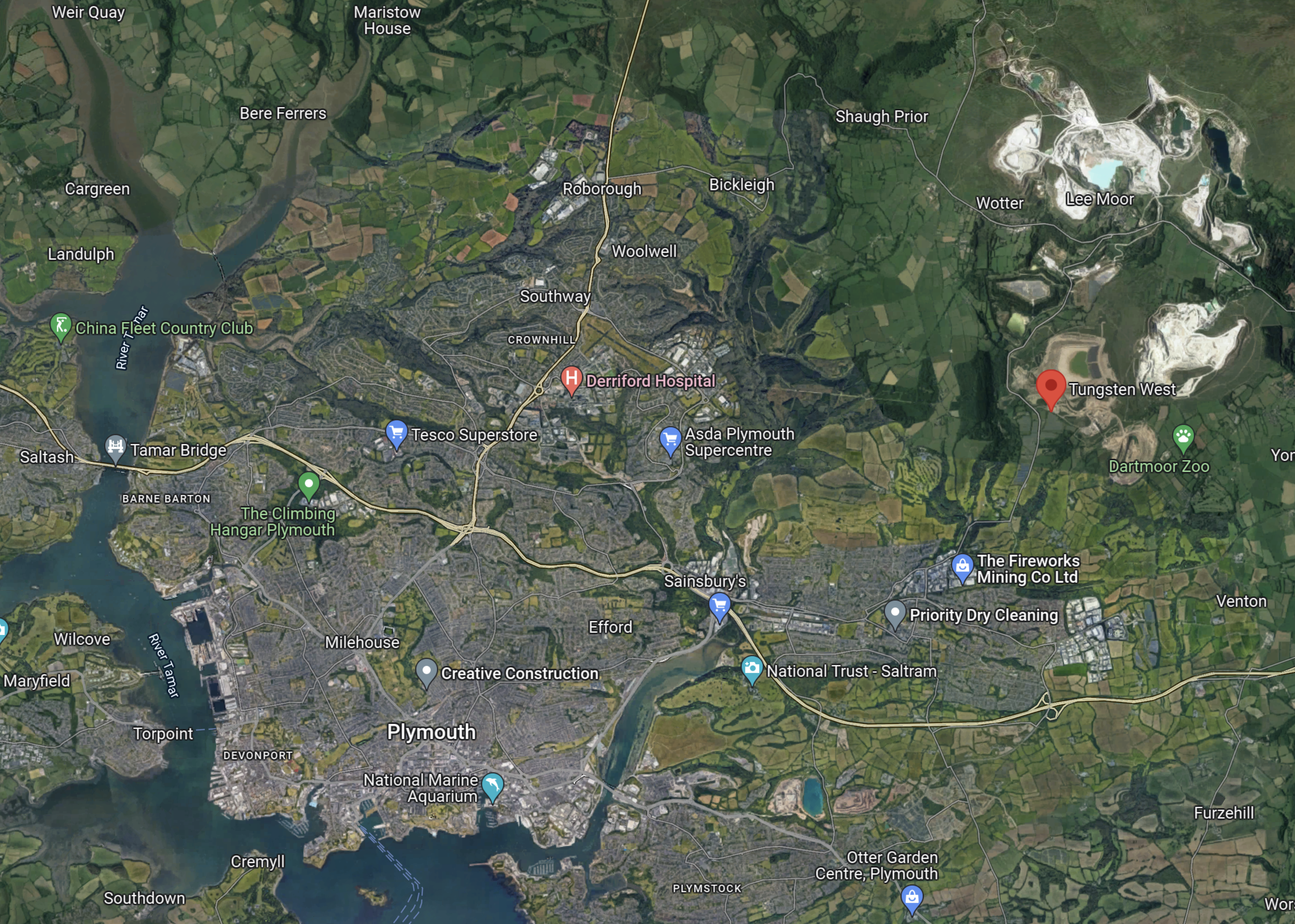
The red arrow indicates the Hemerdon Tungsten Mine, which has a Wikipedia entry as Drakelands Mine, where this is said about the last three years.
Tungsten West plc, which floated on the London Stock Exchange’s Alternative Investment Market on 21 October 2021,[49] have taken over the mine. They have conducted a review starting from the basics, of what is required to fix the problems that caused Wolf Minerals to fail. A better understanding of the mineralogy, with associated changes to the processing stream, and aggregate sales should lead to the mine re-opening at scale in 2022.
Tungsten West’s share price has had an up-and-down day. But are they adding energy storage to their income streams?
From the map, it does seem to be a possibility.
Highview Power In The Daily Express
This article in the Daily Express is entitled The Storage Sites Around The UK That Could Provide Cheap Power To Millions Of Homes.
Highview Power gets a large mention for its plan for twenty storage sites around the UK.
This is said about their planned sites at Carrington and on Humberside.
It is hoped that the first plant, a £250million Manchester station, will come online as early as 2024. It will have a 30megawatts capacity, able to store 300megawatt hours of electricity, enough to supply 600,000 homes with clean power for an hour.
The next plants will be even larger in scale, with four a five planned for Humberside with a 200megawatt/2.5gigwatt hour capacity. The CRYOBattery site would be able to store excess energy generated by the Dogger Bank, Hornsea and Sofia wind farms.
There is also a comprehensive map, with sites indicated at places like Aberdeen, Anglesey, Inverness, Liverpool, Montrose, Norfolk and Sizewell.
The sites seem to be following the wind, which is where excess power needs to be stored and released, when the wind is on strike.
Dogger Bank – The Joke That Is Growing Up To Be A Wind Powerhouse
The Wikipedia entry for the Dogger Bank, describes it like this.
Dogger Bank is a large sandbank in a shallow area of the North Sea about 100 kilometres (62 mi) off the east coast of England.
But many of my generation remember it from its use in the Shipping Forecast and as a joke place like the Balls Pond Road, Knotty Ash and East Cheam, in radio and TV comedy from the 1950s and 1960s.
But now it is being turned into one of the largest wind powerhouses!
According to Wikipedia’s list of the UK’s offshore wind farms, these wind farms are being developed on the Dogger Bank.
- Sofia Offshore Wind Farm – 1400 MW – Under Construction – Commissioning in 2023/26 – £39.65/MWh – RWE
- Dogger Bank A – 1235 MW – Under Construction – Commissioning in 2023/24 – £39.65/MWh – SSE/Equinor
- Dogger Bank B – 1235 MW – Pre-Construction – Commissioning in 2024/25 – £41.61/MWh – SSE/Equinor
- Dogger Bank C – 1218 MW – Pre-Construction – Commissioning in 2024/25 – £41.61/MWh – SSE/Equinor
- Dogger Bank D – 1320 MW – Early Planning – SSE/Equinor
- Dogger Bank South – 3000 MW – Early Planning – RWE
Note.
- These total up to 9408 MW.
- The Dogger Bank wind farms have their own web site.
- The Sofia offshore wind farm has its own web site.
- The Dogger Bank South wind farms have their own web site.
- Dogger Bank A and Dogger Bank B will connect to the National Grid at Creyke Beck to the North of Hull.
- Sofia and Dogger Bank C will connect to the National Grid at Lazenby on Teesside.
But this is only the start on the British section of the Dogger Bank.
This map, which comes courtesy of Energy Network Magazine and 4C Offshore is entitled 2001 UK Offshore Windfarm Map shows all UK offshore wind farms and their status. It looks to my naive mind, that there could be space for more wind farms to the North and West of the cluster of Digger Bank wind farms.
The North Sea Wind Power Hub
The UK doesn’t have full territorial rights to the Dogger Bank we share the bank with the Danes, Dutch and Germans.
In the Wikipedia entry for the Dogger Bank wind farm, this is said about the North Sea Wind Power Hub.
Dutch, German, and Danish electrical grid operators are cooperating in a project to build a North Sea Wind Power Hub complex on one or more artificial islands to be constructed on Dogger Bank as part of a European system for sustainable electricity. The power hub would interconnect the three national power grids with each other and with the Dogger Bank Wind Farm.
A study commissioned by Dutch electrical grid operator TenneT reported in February 2017 that as much as 110 gigawatts of wind energy generating capacity could ultimately be developed at the Dogger Bank location.
Note.
- 110 GW shared equally would be 27.5 GW.
- As we already have 9.4 GW of wind power, under construction or in planning around the Dogger Bank, could we find space for the other 18.1 GW?
- I suspect we could squeeze it in.
If we can and the Danes, Dutch and Germans can generate their share, the four countries would each have a 27.5 GW wind farm.
What would put the icing on the cake, would be if there could be a massive battery on the Dogger Bank. It wouldn’t be possible now and many would consider it a joke. But who knows what the capacity of an underwater battery based on concrete, steel, seawater and masses of ingenuity will be in a few years time.
Where Does Norway Fit In To The North Sea Wind Power Hub?
It could be argued that Norway could also connect to the North Sea Wind Power Hub.
- 110 GW shared equally would be 22 GW.
- Norway can build massive pumped storage hydroelectric power stations close to the landfall of an interconnector to the North Sea Wind Power Hub.
- the British, Danes, Dutch and Germans can’t do that, as they don’t have any handy mountains.
- Norway is a richer country the others involved in the project.
I can see Norway signing up to the North Sea Wind Power Hub.
The North Sea Link
The Wikipedia entry for the North Sea Link, introduces it like this.
The North Sea Link is a 1,400 MW high-voltage direct current submarine power cable between Norway and the United Kingdom.
At 720 km (450 mi) it is the longest subsea interconnector in the world. The cable became operational on 1 October 2021.
It runs between Kvilldal in Norway and Blyth in Northumberland.
I wouldn’t be surprised to see that the North Sea Link is modified, so that it has a connection to the North Sea Wind Power Hub.
Cryogenic Energy Plan Could Bring Jobs Boost To Largs
The title of this post, is the same as that of this article on the Largs and Millport Weekly News.
These paragraphs outline the project.
Proposals for a ground-breaking cryogenic energy storage system at Hunterston Marine Construction Yard have been unveiled..
The proposed development will generate 49.9MW of electricity – and is expected to create around ten jobs.
The cryogenic energy storage system comprises three main processes: a charging system, an energy store, and power recovery.
It turns ambient air into liquid, stores the liquid air in tanks and, when needed, expands the liquid air into a gas which generates electricity.
Highview Power are mentioned as behind the project.
As the report is dated the 21st if August 2021, is this another of Highview Power’s might-have-been projects?
UK Group Plans First Large-Scale Liquid Air Energy Storage Plant
The title of this post, is the same as that of this article on the FT.
This is the first paragraph.
Highview Power is attempting to raise £400mn to fund project with capacity to supply 600,000 homes.
Note.
- This battery will have an output of 30 MW and a storage capacity of 300 MWh.
- The battery will be built at Carrington, near Manchester.
- Highview Power hope it will be opened by the end of 2024.
- It appears that the £400 million will also be used to start the engineering for another four batteries.
The article gives a detailed history of the company.
How Is The XLinks Project Progressing?
The Wikipedia entry for the XLinks project has this introductory paragraph.
The Xlinks Morocco-UK Power Project is a proposal to create 10.5 GW of renewable generation, 20 GWh of battery storage and a 3.6 GW high-voltage direct current interconnector to carry solar and wind-generated electricity from Morocco to the United Kingdom. Morocco has far more consistent weather, and so should provide consistent solar power even in midwinter.
I ask the question in the title of this post, as there are two articles about the XLinks project in The Times today.
This article is optimistic and is entitled Xlinks Morocco Project Could Throw Britain A Renewable Energy Lifeline.
On the other hand this article is more pessimistic and is entitled Britain ‘Risks Losing Out’ On Green Energy From The Sahara.
This is the first paragraph of the second article.
Sir Dave Lewis has complained of “frustratingly slow” talks with the government over an £18 billion plan to generate power in the Sahara and cable it to Britain. The former Tesco chief executive has warned that the energy could be routed elsewhere unless ministers commit to the scheme.
It appears there have been little agreement on the price.
I have some thoughts.
Will XLinks Get Funding?
Xlinks is going to be privately funded, but I have doubts about whether the funding will be made available.
As an engineer, who was involved in many of the major offshore projects of the last forty years of the last century, I believe that the XLinks project is feasible, but it is only 3.6 GW.
These wind farm projects are also likely to be privately funded.
- SSE’s Berwick Bank project opposite Berwick is 4.1 GW
- Aker’s Northern Horizon off Shetland is 10 GW.
- The Scotwind Leasing Round is 25 GW.
- There is talk of 10 GW being possible off East Anglia.
- 50 GW may be being possible in the Celtic Sea.
- BP is planning 3 GW in Morecambe Bay.
Many of these enormous wind power projects are looking for completion on or before 2030, which is the date given for the Morocco cable.
I do wonder, if those financing these energy projects will find these and other projects better value than a link to Morocco.
Is the Project Bold Enough?
Consider.
- Spain has high levels of solar, wind and hydro power.
- France is developing wind to go with their nuclear.
- Both countries and Portugal, also have mountains for sensibly-sized pumped-storage hydroelectric power stations.
- France, Spain, Portugal and Ireland also have the Atlantic for wind, tidal and wave power.
Perhaps, the solution, is an Atlantic interconnector linking the UK, Ireland, France, Spain, Portugal and Gibraltar to West Africa.
Any excess power would be stored in the pumped-storage hydroelectric power stations and withdrawn as required.
In the UK, the National Grid are already using the huge 7800 GWh Ulla-Førre pumped-storage hydroelectric power station to store excess wind-generated energy using the North Sea Link from Blyth.
To my mind XLinks is just a UK-Morocco project.
BP’s Project In Mauretania
In bp And Mauritania To Explore Green Hydrogen At Scale, I discussed BP’s deal to create green hydrogen in Mauretania.
Is this a better plan, as hydrogen can be taken by tanker to where it is needed And for the best price.
Conclusion
I wouldn’t be surprised to see the XLinks project change direction.
Centrica Re-Opens Rough Storage Facility
The title of this post, is the same as that of this press release from Centrica.
It has this sub-heading.
Rough Operational For Winter And Increases UK’s Storage Capacity By 50%.
On the face of it, this sounds like good news and these two paragraphs give more details.
Centrica has announced the reopening of the Rough gas storage facility, having completed significant engineering upgrades over the summer and commissioning over early autumn.
The initial investment programme means the company has made its first injection of gas into the site in over 5 years and is in a position to store up to 30 billion cubic feet (bcf) of gas for UK homes and businesses over winter 2022/23, boosting the UK’s energy resilience.
Note.
- The Rough gas storage facility has been able to hold up to 100 billion cubic feet of gas in the past.
- Rough is a complex field with two platforms and thirty wells transferring gas to and from the facility.
- Additionally, there is an onshore gas-processing terminal at the Easington Gas Terminal, where it connects to the UK gas network.
It appears to be a comprehensive gas storage facility, that should get us through the 2022/3 winter.
These two paragraphs from the press release, which are the thoughts of the Centrica Chief Executive are significant.
Centrica Group Chief Executive, Chris O’Shea, said “I’m delighted that we have managed to return Rough to storage operations for this winter following a substantial investment in engineering modifications. Our long-term aim remains to turn the Rough field into the world’s biggest methane and hydrogen storage facility, bolstering the UK’s energy security, delivering a net zero electricity system by 2035, decarbonising the UK’s industrial clusters, such as the Humber region by 2040, and helping the UK economy by returning to being a net exporter of energy.
“In the short term we think Rough can help our energy system by storing natural gas when there is a surplus and producing this gas when the country needs it during cold snaps and peak demand. Rough is not a silver bullet for energy security, but it is a key part of a range of steps which can be taken to help the UK this winter.”
Note.
- Effectively, in the short term, Rough is a store for gas to help us through the winter.
- In the long-term, Rough will be turned into the world’s largest gas storage facility.
- It will be able to store both methane (natural gas) and hydrogen.
Having worked with project managers on complex oil and gas platforms and chemical plants, I wouldn’t be surprised to find, that when the design of this facility is released, it will be something special.
Centrica certainly seem to have upgraded Rough to be able to play a significant short term role this winter and they also seem to have developed a plan to give it a significant long-term role in the storage of hydrogen.
Aldbrough Gas Storage
A few miles up the coast is SSE’s and Equinor’s Aldbrough Gas Storage, which is being developed in salt caverns to hold natural gas and hydrogen.
Blending Of Hydrogen And Natural Gas
I believe that we’ll see a lot of blending of hydrogen and natural gas.
- Up to 20 % of hydrogen can be blended, without the need to change appliances, boilers and processes.
- This cuts carbon dioxide emissions.
I wrote about this in a post called HyDeploy.
It might be convenient to store hydrogen in Aldbrough and natural gas in Rough, so that customers could have the blend of gas they needed.
With two large gas stores for hydrogen under development, the HumberZero cluster is on its way.
National Grid’s North Sea Link Strengthens Electricity Supply And Repays Its Carbon Cost In Just Six Months
The title of this post, is the same as that of this press release from National Grid.
These are three bullet points from the press release.
- World’s longest subsea electricity cable has been in operation since Oct 2021.
- 5.7 terawatt (TWh) hours of clean power have been shared between GB and Norway, strengthening security of supply for consumers in both countries.
- It has saved 800,000 tonnes of carbon in the first year, paying off its carbon cost after only six months of operation.
This must surely be considered a good start.
These two paragraphs describe the operation in the first year.
During its first year of operation, the link has imported 4.6 TWh of clean electricity – enough to power 1.5 million British homes for a year.
North Sea Link has also exported 1.1 TWh to Norway, demonstrating the vital role that interconnectors play in strengthening energy security and maximising the benefits of clean energy sources for consumers across the UK and Europe.
In The Monster In The Mountains That Could Save Europe’s Winter, I describe what makes the North Sea Link so important.
It gives the UK access to the Norwegian Bank Of Electricity or Ulla-Førre, which is a complex of five hydroelectric power stations and a massive lake in the Norwegian mountains to the East of Stavanger.
- The power stations have a total generating capacity of 2.1 GW.
- Lake Blåsjø is able to hold enough water to generate 7800 GWh of electricity.
- Ulla-Førre can also supply electricity to Germany, through the 1.4 GW NordLink.
If Ulla-Førre has a problem, it is that if Norwegian weather is dry, the filling of Lake Blåsjø could be difficult, which is where the interconnector comes into its own, as excess UK wind power or the 1,185 MW Hartlepool nuclear power station, can be used to send electricity to Norway for storage.
In An Update To Will We Run Out Of Power This Winter?, I predicted we will add the following capacity to our renewable generation in the next three years.
- 2023 – 2925 MW
- 3024 – 3726 MW
- 2025 – 6476 MW
This is a total of 13,127 MW.
As a Control Engineer, I can see the following happening.
- Several of the UK’s gas-fired power stations will be mothballed.
- Some of the UK’s gas-fired power stations will be fitted with advanced control systems so they can supply more precise amounts of electricity.
- Some UK electricity is stored in Ulla-Førre for onward sale to Germany.
- Some UK electricity is stored in Ulla-Førre for withdrawal back to the UK, when needed.
One of Ulla-Førre’s main tasks could be to ensure that no UK electricity is wasted.
Conclusion
With all these wind generated electricity and electricity transfers, the Crown Estate, National Grid and the Treasury should be coining it.
The Germans are already building the 1.4 GW NeuConnect between the Isle of Grain and Wilhelmshaven to import more electricity.
But I do believe that another interconnector will be needed.

