Northern’s Battery Plans
The title of this post, is half of the title of an article in the March 2020 Edition of Modern Railways.
It appears that CAF will convert some three-car Class 331 trains into four-car battery-electric trains.
- A three-car Class 331 train has a formation of DMSOL+PTS+DMSO.
- A fourth car with batteries will be inserted into the train.
- Batteries will also be added to the PTS car.
- The battery-electric trains would be used between Manchester and Windermere.
It looks like a round trip would take three hours including turnarounds, thus meaning three trains would be needed to run the service.
The article says this.
The branch was due to be electrified, but this was cancelled in 2017, and as a result 3×3-car Class 195 trains were ordered. As well as the environmental benefits, introduction of the battery ‘331s’ on Windermere services would free-up ‘195s’ for cascade elsewhere on the Northern network.
Note that the total length or the route is 98 miles of which only the ten miles of the Windermere Branch Line are not electrified.
What Battery Capacity Would Be Needed?
I reckon it will be fine to use a figure of 3 kWh per vehicle-mile to give a rough estimate of the power needed for a return trip from Oxenholme to indermere.
- Two x Ten Miles x Four Cars x 3 kWh would give 240 kWh.
- There would also be losses due to the seven stops, although the trains have regenerative braking, to limit losses.
Remember though that CAF have been running battery trams for several years, so I suspect that they have the experience to size the batteries appropriately.
In Thoughts On The Actual Battery Size In Class 756 Trains And Class 398 Tram-Trains, I say that four-car Class 756 trains will have 600 kWh of batteries and a range of 40 miles. I wouldn’t be surprised to find that a four-car Class 331 train had similar battery size and range on batteries, as the two trains are competing in the same market, with similar weights and passenger capacities.
Charging The Batteries
The Modern Railways article says this about charging the train’s batteries.
Northern believes battery power would be sufficient for one return trip along the branch without recharging, but as most diagrams currently involve two trips, provision of a recharge facility is likely, with the possibility that this could be located at Windermere or that recharging could take place while the units are in the platform at Oxenholme.
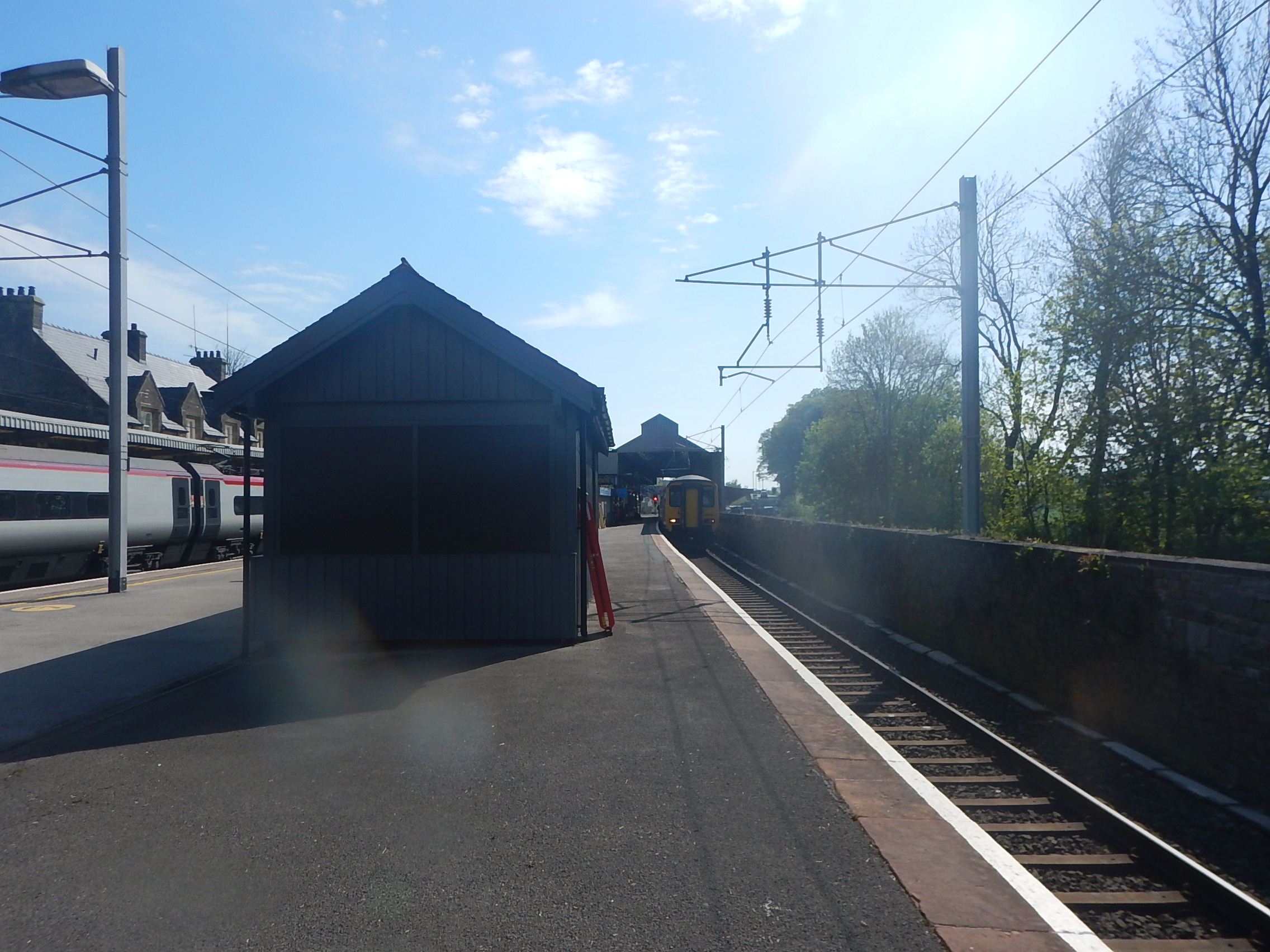
The bay platform 3 at Oxenholme station is already electrified, as this picture shows.
I particularly like Vivarail’s Fast Charge system based on third-rail technology.
A battery bank is connected to the third-rail and switched on, when the train is in contact, so that battery-to-battery transfer can take place.
It’s just like jump-starting a car, but with more power.
This form of charging would be ideal in a terminal station like Windermere.
- The driver would stop the train in Windermere station in the correct place, for passengers to exit and enter the train.
- In this position, the contact shoe on the train makes contact with the third-rail, which is not energised..
- The Fast Charge system detects a train is connected and connects the battery bank to the third-rail.
- Energy flows between the Fast Charge system’s battery bank and the train’s batteries.
- When the train’s batteries are full, the Fast Charge system switches itself off and disconnects the third-rail.
- The third-rail is made electrically dead, when the train has left, so that there is no electrical risk, if someone should fall from the platform.
Note that the only time, the third-rail used to transfer energy is live, there is a four-car train parked on top of it.
When I was eighteen, I was designing and building electronic systems using similar principles to control heavy rolling mills, used to process non-ferrous metals.
Changing Between Overhead Electrification And Battery Power
All trains running between Manchester Airport and Windermere, stop in Platform 3 at Oxenholme station to pick up and put down passengers.
- Trains going towards Windermere would lower the pantograph and switch to battery power.
- Trains going towards Mabchester Airport would raise the pantograph and switch to overhead electrification power.
Both changes would take place, whilst the train is stopped in Platform 3 at Oxenholme station.
Japanese Giant Sumitomo Heavy Invests In Liquid-Air Energy Storage Pioneer
The title of this post is the same as that of this article on RechargeNews.
This is the introductory paragraph.
Japanese industrial giant Sumitomo Heavy Industries (SHI) has made a $46m investment in UK long-duration energy storage outfit Highview Power as part of a partnership deal to develop projects using its ‘cryobattery’ technology around the world.
I have extremely strong positive feelings about Highview Power.
I just wish, I was a shareholder!
ITM Power signs deal with AEG Power Solutions
The title of this post, is the same as that of this article on the Yorkshire Post.
This is the first two paragraphs.
Energy storage and clean fuel company ITM Power has signed a deal with AEG Power Solutions.
The agreement means that Sheffield-based ITM Power will integrate its electrolyser technology, which produces hydrogen gas from electricity and water, with AEG’s power control electronics.
ITM Power are a company that certainly has some well-known friends.
Initially, they will be working together on five projects.
Highview Power’s Advantages
I have said before that I like Highview Power’s system for storing energy by liquifying air.
This article on CleanTechnica is entitled Shell Signs PPA With Largest Storage Battery In Europe.
But it also has a section entitled Other Storage Plans For UK Are In The Works, which gives more details on Highview Power.
Replacement Of Decommissioned Power Plants
Highview are proposing that their systems can replace an existing fossil-fuel power plant, by using the existing site and grid connections. Connecting a power station to the grid, is often an expensive process, but if you can use an existing one, it must be more affordable.
Cost Versus Lithium-Ion
Highview are claiming that they can provide power at $143 per MWh, which compares with a cost of $187 per MWh, as quoted by Bloomberg.
That is nearly 24 % more affordable.
Innolith Claims It’s On Path To 1,000 Wh/kg Battery Energy Density
The title of this post is the same as that of this article on InsideEVS.
This is the introductory paragraph.
Innolith, the Switzerland-based company with labs in Germany, announced that it is developing the world’s first rechargeable battery with an energy density of 1,000 Wh/kg (or simply 1 kWh per kg of weight). Such high energy would easily enable the production of electric cars with a range of 1,000 km (620 miles).
If they achieve their aim, a one MWh battery will weigh a tonne.
I am sceptical but read this second article on CleanTechnica, which is entitled Swiss Startup Innolith Claims 1000 Wh/kg Battery.
Innolith has a working battery at Haggerstown, Virginia, but say full production is probably 3 to 5 years away.
The CleanTechnica article, also says this about Tesla’s batteries.
Let’s put that into perspective. It is widely believed that Tesla’s latest 2170 lithium ion battery cells produced at its factory in Nevada can store about 250 Wh/kg. The company plans to increase that to 330 Wh/kg as it pursues its goal of being a world leader in battery technology. 1000 Wh/kg batteries would theoretically allow an electric car to travel 600 miles or more on a single charge.
So it would appear that Tesla already has an power density of 250 Wh/Kg.
Conclusion
I am led to believe these statements are true.
- Tesla already has an energy density of 250 Wh/Kg.
- Tesla will increase this figure.
- By 2025, the energy density of lithium-ion batteries will be much closer to 1 KWh/Kg.
- Innolith might achieve this figure. But they are only one of several companies aiming to meet this magic figure.
These figures will revolutionise the use of lithium-ion batteries.
Sparking A Revolution
The title of this post is the same as that of an article in Issue 898 of Rail Magazine.
The sub-title is.
When it comes to powering a zero-enissions train with no overhead line infrastructure, battery power is clearly the answer, according to Hitachi.
These are the first three paragraphs.
Over the next decade around 1,000 diesel-powered vehicles will need to be replaced with vehicles that meet emissions standards.
Hitachi, which has been building bi-mode trains for the UK since 2012, and electric trains since 2006, says that retro-fitting old vehicles alone will not be good enough to improve capacity, reliability or passenger satisfaction.
Battery power is the future – not only as a business opportunity for the company, but more importantly for the opportunities it offers the rail industry.
Speaking is Andrew Barr of Hitachi Rail.
Some important points are made.
- Hitachi has identified various towns and cities, where battery trains would be useful including Bristol, Edinburgh, Glasgow, Hastings, Leeds and Manchester.
- Andrew Barr says he gets a lot of questions about battery power.
- Battery power can be used as parts of electrification schemes to bridge gaps, where rebuilding costs of bridges and other infrastructure would be too high.
- Battery trains are ideal for decarbonising branch lines.
- Batteries could be fitted to Class 385, 800, 802 and 810 trains.
Hitachi would like to run a battery train with passengers, within the next twelve months.
The article also gives the specification of a Hitachi battery train.
- Range – 55-65 miles
- Performance – 90-100 mph
- Recharge – 10 minutes when static
- Routes – Suburban near electrified lines
- Battery Life – 8-10 years
These figures are credited to Hitachi.
Hitachi are also thinking about tri-mode trains.
- Batteries could be installed on Class 800-802/810 trains.
- Battery-only power for stations and urban areas.
- 20% performance improvements or 30% fuel savings.
These is also credited to Hitachi.
Costs And Power
This is an insert in the article, which will apply to all applications with traction batteries.
This is said.
The costs of batteries are expected to halve in the next five years, before dropping further again by 2030.
Hitachi cites research by Bloomberg New Energy Finance (BNEF) which expects costs to fall from £135/kWh at the pack level today to £67/kWh in 2025 and £47/kWh in 2030.
United Kingdom Research and Innovation (UKRI) is also predicting that battery energy density will double in the next 15 years, from 700 Wh/l to 1,400 Wh/l in 2035, while power density (fast charging) is likely to increase four times in the same period from 3 kW/kg now to 12 kW/kg in 2035.
In Batteries On Class 777 Trains, I quoted a source that said that Class 777 trains are built to handle a five tonne battery.
I estimated the capacity as follows.
Energy densities of 60 Wh/Kg or 135 Wh/litre are claimed by Swiss battery manufacturer; Leclanche.
This means that a five tonne battery would hold 300 kWh.
Hitachi’s figures are much higher as it looks like a five tonne battery can hold 15 MWh.
Batteries will be going places on Hitachi trains.
How Good Is ‘Freezing Air’ The Solution For Electricity?
The title of this post is the same as that for this article on Energy News 24.
The article discusses Highview Power’s proposed 400 MWh installation in Vermont, where they are installing lots of renewable power sources and need a way to store the energy, which is partly wasted.
Read the article and especially the last sentence.
Vice President Jason Burwen Energy Storage Association said the capacity of the plant would be “on par with today’s largest grid energy storage projects under construction.” He said it would be the equivalent electricity needed “to power maybe 50,000 homes for eight hours.”
Are the British coming?
The Highview Power system to me is a blindingly obvious simple idea, based on proven technology, that has been used for many decades. Add in clever computing technology to control it and blend it with renewable energy and every wind or solar farm, tidal power station and sizeable town or city should have one, where there is a site the size of a football pitch.
Could Modern Energy Systems Have A Secondary Role?
Close to where I live is a small heat and power system, that I wrote about in The Bunhill Energy Centre.
I first went over the centre during Open House.
Several of these modern systems are very good demonstrations of the principles of maths, physics and engineering.
So do these innovative energy systems do their bit in educating the next generation of scientists and engineers?
Some of the modern systems, that are in development like Highview Power’s energy storage using liquid air would be ideal for a secondary education role!
Most too, are very safe, as there are no dangerous processes or substances.
And in the next few years, there will be more systems all over the country and many in the hearts of towns and cities. Some schools, colleges and especially universities, will have their own innovative energy sources.
Liverpool University already has a system, which is described here.
Prowling for Solutions To Unleash Renewable Energy
The title of this post, is the same as this article on Toolbox.
It is a good summary of the best methods of storing renewable energy without using chemical batteries.
Gravitricity, Energy Vault and Highview Power are all mentioned.
This last paragraph, explains some of the philosophy behind Vermont looking seriously at Highview Power.
Vermont may well be tempted by liquid air energy storage because of its flexibility — simply requiring a two-acre site anywhere. One possible location could be near an abandoned power station. That’s a beautiful solution because the transmission lines that once transported the electricity from the plant are built and ready to use in the renewable era.
Note that a two-acre site is slightly smaller than a football pitch.
It is rather elegant to replace a coal- or gas-fired power-station with an environmentally-friendly energy storage system on the same site, which effectively does the same job of providing energy.
The article doesn’t mention employment, but surely many of the existing workforce can be easily retrained for the new technology.
Gore Street Contracts NEC For 100 MW Of Storage
The title of this post is the same as that of this article on the Solar Power Portal.
This is the introductory paragraph.
Gore Street Energy Storage Fund has awarded NEC Energy Solutions both EPC and long-term O&M contracts for 100MW of storage in Northern Ireland.
What I find most comforting, is the matter-of-fact tone of the article.
Although, the author does seem to think that MW and MWh are the same, when in fact MW is used to define the rate of energy used or transferred and MWh the quantity.
If you use one MW for an hour, that is one MWh.
Gore Street appear to have needed two 50 MW energy storage systems for Drumkee and Mullavilly in Northern Ireland to back up a solar farm investment.
And they appear to have just ordered them off the shelf from NEC, in much the way, an individual might buy a Tesla Powerwall for their house.
According to this article on OVO Energy, the average European house uses 3,600 kWh per year.As there are 8760 hours in a year, the average consumption for a year is 0.4 kW per hour.
So if we assume that these two energy storage systems can deliver 50 MW for an hour, the following can be said.
- The total capacity of each system is 50 MWh.
- Each system can supply 125,000 houses for an hour or 25,000 houses for five hours.
- As each housing unit has an average occupancy of 2.66 people, this means that a 50 MWh battery could supply a town of 66,500 people, for five hours.
Note that Lowestoft in Suffolk has a population of 71,000.
These batteries are not small.
 The Anonymous Widower