What Will Happen To The Class 379 Trains?
Greater Anglia’s fleet of thirty Class 379 trains are being replaced by by a brand new fleet of Class 745 Stadler FLIRT EMUs which will be fixed 12-car trains on Stansted Express services and Class 720 Bombardier Aventra EMUs on Cambridge services.
These trains have a high specification.
- Four-car trainsets.
- Ability to work as four, eight and twelve-car trains.
- 2+2 seating in Standard Class.
- 2+1 seating in First Class.
- Plenty of luggage space.
- Wi-fi and power sockets.
- Full compliance with all Persons of Reduced Mobility rules.
- 100 mph capability.
- Regenerative braking.
I also suspect the following is true about the trains.
- The ability to run on 750 VDC third rail electrification could be added reasonably easily.
- Lithium-ion batteries to give a limited range, can be fitted.
- The top speed could be upgraded to the 110 mph of the closely-related Class 387 trains.
- The trains have end gangways and could be certified to run through the core route of Thameslink, like the Class 387 trains.
So they would appear to be a very useful train.
So what will happen to the trains?
This is my speculative list of possible uses.
Continued Use By Greater Anglia
In some ways it’s strange that these reasonably new trains are being replaced on Stansted and Cambridge services.
They are being replaced by Stadler Class 745 trains, which like the Class 379 trains are 100 mph trains.
In the next decade or so, the West Anglia Main Line is to be upgraded.
- There will be four tracks at least between Tottenham Hale and Broxbourne stations.
- Cambridge South station and the East West Rail Link will have been completed.
- Line speed will have been improved to at least 100 mph along its full length.
- The High Meads Loop will be developed to allow more trains from the West Anglia Main Line to use Stratford instead of the overcrowded Liverpool Street as a London terminal.
I suspect the number of fast services between London and Cambridge along the West Anglia Main Line will be increased.
So are performance upgrades available for the Class 745 trains, which will deliver these improved services?
If Stadler are late with their delivery of the Class 745 trains, the Class 379 trains will continue to be used on Stansted and Cambridge services.
This is discussed in this article in Rail Magazine, which is entitled Contingency Plans In Place For Greater Anglia’s Main Line Fleet.
But surely, this would only delay their cascade to other operators.
According to Wikipedia, all of the replacement Class 745 trains, are scheduled to enter service in 2019, which should mean that the Class 379 trains should be available for cascade to other operators, sometime in 2020.
St. Pancras to Corby
Under Future in the Wikipedia entry for Corby station, this is said.
It is planned that a half-hourly London St Pancras to Corby service will operate from December 2019 using new Class 387 trains, once the Midland Main Line has been electrified beyond Bedford as part of the Electric Spine project. Network Rail has also announced that it plans to re-double the currently singled Glendon Junction to Corby section as part of this scheme.
In the December 2017 Edition of Modern Railways there is an article, which is entitled Wires To Corby Now in 2020.
This is the first paragraph.
Carillion is to deliver electrification of the Midland Main Line to Corby, but electric services will not start until December 2020, a year later than previously envisaged.
The article also states the following.
- A fourth track is to be installed between Bedford and Kettering.
- Track and wires are to be updated so that new 125 mph bi-mode trains can run between St. Pancras and Derby, Nottingham and Sheffield.
- Improvements to the current electrification South of Bedford.
Everything should be completed, so that the new bi-mode trains could enter service from 2022.
It should be noted that Wikipedia says this about the Future of the East Midlands Trains franchise.
The franchise is due to end in August 2019. The Invitation to Tender is due to be issued in April 2018, which will detail what improvements bidders for the franchise must make. The contract will then be awarded in April 2019.
This could give the following project schedule on the Midland Main Line.
- April 2019 – Award of new East Midlands franchise.
- August 2019 – New East Midlands franchise starts.
- December 2020 – Electric services to Corby start.
- December 2022 – Bi-mode services to Derby, Nottingham and Sheffield start.
These dates would fit well with the retirement of the Class 379 trains by Greater Anglia in 2020.
Current timings between Corby and London are 71 minutes with four stops. I don’t think it would be unreasonable to assume that the improved track and new trains would be designed so that the timings between Corby and London would be reduced to under an hour, with a round trip of two hours.
If this can be achieved, then just four trains of an appropriate length will be needed to meet the required two tph timetable.
- Four-car services would need four trains.
- Eight-car services would need eight trains.
- Twelve-car services would need twelve trains.
It might not be possible to run eight and twelve car services due to platform length restrictions.
If the two hour round trip could be achieved by an existing Class 387 or an uprated Class 379 trains, then either of these trains would be a shoe-in for the route.
Otherwise we’ll be seeing something faster like a Class 801 train.
But if services are to start in 2020, there would be a problem to manufacture the trains in the available time, as the contract will only have been awarded in April 2019.
I think that St. Pancras to Corby is a possibility for Class 379 trains, which may need to be uprated to 110 mph. On the other hand, Class 387 trains wouldn’t need to be uprated.
West Midlands Trains, who have a similar need for their Euston to West Midlands services, have ordered 110 mph Aventras.
- So perhaps the new East Midlands franchise will do the same.
- This would be more likely, if Bombardier come up with the rumoured 125 mph bi-mode Aventra.
- Or they could buy a mixture of Class 800 and 801 trains.
I don’t think the Class 379 trains will work St. Pancras to Corby.
Battery Services
A Class 379 train was used for the BEMU trial, where a battery was fitted to the train and it ran for a couple of months between Manningtree and Harwich, using overhead power one way and battery power to return.
Was this class of train chosen, as it was one of the easiest to fit with a battery? After all it was one of the later Electrostars.
This article on the Railway Gazette from July 2007 is entitled Hybrid Technology Enters The Real World. It describes the experimental conversion of a Class 43 power-car from a High Speed Train into a battery-assisted diesel-electric power-car.
A second article in the Railway Gazette from October 2010 is entitled First New Stansted Express Train Rolls Out. It describes the Class 379 train in detail. This is an extract.
Although part of the Electrostar family, the Class 379 incorporates a number of technical changes from the original design developed in the late 1990s, making use of technologies which would be used on the Aventra next-generation Electrostar which Bombardier is proposing for the major Thameslink fleet renewal contract.
The body structure has been revised to meet European crashworthiness requirements. The window spacing has changed, with the glass bolted rather than glued in place to enable faster repairs. The couplers are from Dellner, and the gangways from Hübner. Top speed is 160 km/h, and the 25 kV 50 Hz trains will use regenerative braking at all times.
The last statement about regenerative braking is the most interesting.
To my knowledge electric trains that use regenerative braking had never run on the West Anglia Main Line before and that to handle the return currents with 25 KVAC needs special and more expensive transformers. The obvious way to handle regenerative braking at all times without using the electrification is to put an appropriately sized battery on the train.
If Bombardier have done this on the Class 379 train, then it might be a lot easier to fit a large battery to power the train. This would explain why the trains were chosen for the trial rather than a train from a more numerous variant.
The result was a trial of which few, if any,negative reports can be found.

The result was a trial of which few, if any,negative reports can be found.
Class 379 Train Performance On Batteries
Little has been said about the performance of the train.
However, in this document on the Network Rail web site, which is entitled Kent Area Route Study, this is said.
In 2015, industry partners worked together to investigate
battery-electric traction and this culminated with a
practical demonstration of the Independently Powered
Electric Multiple Unit IPEMU concept on the Harwich
Branch line in Anglia Route. At the industry launch event,
the train manufacturers explained that battery
technology is being developed to enable trains to run
further, at line speeds, on battery power, indeed, some
tram lines use this technology in the city centres and many
London buses are completely electric powered.The IPEMU project looked at the feasibility of battery power
on the Marshlink service and found that battery was
sufficient for the train to run from Brighton to Ashford
International and back but there was insufficient charge to
return to Ashford International on a second round trip. A
solution to this could be that the unit arrives from Ashford
International at Brighton and forms a service to Seaford and
back before returning to Ashford International with a
charged battery.The IPEMU demonstration train was a Class 379, a similar
type to the Class 377 units currently operated by Southern, it
was found that the best use of the battery power was to
restrict the acceleration rate to that of a modern diesel
multiple unit, such as a Class 171 (the current unit type
operating the line) when in battery mode and normal
acceleration on electrified lines.
|Ashford to Brighton is 62 miles, so a round trip would be 124 miles.
The document doesn’t say anything about how many stops were made in the tests, but I’m sure that Bombardier, Greater Anglia and Network Rail have all the data to convert a Class 379 into a viable IPEMU or Independently Powered Electric Multiple Unit.
As to how long it takes to charge the battery, there is an interesting insight in this article from Rail Magazine, which is entitled Battery-Powered Electrostar Enters Traffic. This is said.
It is fitted with six battery rafts, and uses Lithium Ion Magnesium Phosphate battery technology. The IPEMU can hold a charge for 60 miles and requires two hours of charging for every hour running. The batteries charge from the overhead wires when the pantograph is raised, and from regenerative braking.
The two-one ratio between charging and running could be an interesting factor in choice of routes.
What About The Aventra?
I quoted from this article in the Railway Gazette from October 2010 earlier. This is said.
Although part of the Electrostar family, the Class 379 incorporates a number of technical changes from the original design developed in the late 1990s, making use of technologies which would be used on the Aventra next-generation Electrostar.
So would it be a reasonable assumption to assume, that if batteries can be fitted to a Class 379 train, then they could also be fitted to an Aventra?
This article in Global Rail News from 2011, which is entitled Bombardier’s AVENTRA – A new era in train performance, gives some details of the Aventra’s electrical systems. This is said.
AVENTRA can run on both 25kV AC and 750V DC power – the high-efficiency transformers being another area where a heavier component was chosen because, in the long term, it’s cheaper to run. Pairs of cars will run off a common power bus with a converter on one car powering both. The other car can be fitted with power storage devices such as super-capacitors or Lithium-ion batteries if required.
This was published in 2011, so I suspect Bombardier have refined the concept.
But it does look that both battery variants of both Class 379 trains and Aventras are possible.
Routes For Battery Trains
What important lines could be run by either a Class 379 train or an Aventra with an appropriate battery capability?
I will refer to these trains as IPEMUs in the remainder of this post.
I feel that one condition should apply to all routes run by IPEMUs.
The 2:1 charging time to running time on battery ratio must be satisfied.
East Coastway And Marshlink Lines
As Network Rail are prepared to write the three paragraphs in the Kent Area Route Study, that I quoted earlier, then the East Coastway and Marshlink Lines, which connect Brighton and Ashford International stations, must be high on the list to be run by IPEMUs.
Consider.
- All the route, except for about twenty-four miles of the Marshlink Line is electrified.
- Brighton and Ashford International stations are electrified.
- Some sections have an operating speed of up to 90 mph.
- Brighton to Hastings takes 66 minutes
- Ashford International to Hastings takes 40 minutes
- There is a roughly fifteen minute turnround at the two end stations.
The last three points, when added together, show that in each round trip, the train has access to third-rail power for 162 minutes and runs on batteries for 80 minutes.
Does that mean the 2:1 charging to running ratio is satisfied?
I would also feel that if third-rail were to be installed at Rye station, then in perhaps a two minute stop, some extra charge could be taken on board. The third-rail would only need to be switched on, when a train was connected.
It looks to me, that even the 2015 test train could have run this route, with just shoe gear to use the third-rail electrification. Perhaps it did do a few test runs! Or at least simulated ones!
After all, with a pantograph ready to be raised to rescue a train with a flat battery, they could have run it up and down the test route of the Mayflower Line at a quiet time and see how far the train went with a full battery!
Currently, many of the train services along the South Coast are run by a fleet of Class 313 trains, with the following characteristics.
- There are a total of nineteen trains.
- They were built in the late 1970s.
- They are only three cars, which is inadequate at times.
- They are 75 mph trains.
- They don’t have toilets.
- The trains are used on both the East Coastway and West Coastway Lines.
Replacing the trains with an appropriate number of Class 379 trains or Aventras would most certainly be welcomed by passengers, staff and the train companies.
- Diesel passenger trains could be removed from the route.
- There could be direct services between Ashford International and Southampton via Brighton.
- One type of train would be providing most services along the South Coast.
- There would be a 33% increase in train capacity.
- Services would be a few minutes quicker.
- For Brighton’s home matches, it might be possible to provide eight-car trains.
- The forty-year-old Class 313 trains would be scrapped.
The service could even be extended on the fully-electrified line to Bournemouth to create a South Coast Seaside Special.
London Bridge To Uckfield
I looked at Chris Gibb’s recommendation for this line in Will Innovative Electrification Be Used On The Uckfield Line?
These actions were recommended.
- Electrification of the branch using 25 KVAC overhead.
- Electrification of tunnels with overhead conductor rail.
- Dual-voltage trains.
- Stabling sidings at Crowborough.
How would this be affected if IPEMUs were to be used?
The simplest way to run IPEMUs would be to install third-rail at Uckfield to charge the train.
Current timings on the route are as follows.
- London Bridge to Hurst Green – electrified – 32 minutes
- Hurst Green to Uckfield – non-electrified – 41 minutes
- Turnaround at London Bridge – 16 minutes
- Turnaround at Uckfield – 11 minutes
Hurst Green station is the limit of the current electrification.
Adding these times together, show that in each round trip, the train has access to third-rail power for 91 minutes and needs to on batteries for 82 minutes.
It looks like the 2:1 charging to running ratio is not met.
To meet that, as the round trip is three hours, that means that there probably needs to be two hours on electrification and an hour on batteries.
So this means that at least eleven minutes of the journey between Hurst Green and Uckfield station needs to be electrified, to obtain the 2:1 ratio.
It takes about this time to go between Crowborough and Uckfield stations.
- Crowborough will have the new sidings, which will have to be electrified.
- The spare land for the sidings would appear to be to the South of Crowborough station in an area of builders yards and industrial premises.
- Crowborough Tunnel is on the route and is nearly a kilometre long.
- The route is double-track from Crowborough station through Crowborough Tunnel and perhaps for another kilometre to a viaduct over a valley.
- The viaduct and the remainder of the line to Uckfield is single track.
- The single track section appears to have space to put the gantries for overhead electrification on the bed of the original second track.
If you apply Chris Gibb’s original recommendation of 25 KVAC, then electrification between Crowborough and Uckfield station, might just be enough to allow IPEMUs to work the line.
- The sidings at Crowborough would be electrified.
- About half of the electrification will be single-track.
- Crowborough Tunnel would use overhead rails.
- Power could probably be fed from Crowborough.
- The regenerative braking would be handled by the batteries on the trains.
- Changeover between overhead power and batteries would be in Crowborough station.
- Buxted and Uckfield stations wouldn’t be complicated to electrify, as they are single-platform stations.
I very much feel that running IPEMUs between London Bridge and Uckfield is possible.
Preston to Windermere
The Windermere Branch Line is not electrified and Northern are proposing to use Class 769 bi-mode trains on services to Windermere station.
Current timings on the line are as follows.
- Windermere to Oxenholme Lake District – non-electrified – 20 minutes
- Oxenholme Lake District to Preston – electrified – 40 minutes
If you add in perhaps ten minutes charging during a turnaround at Preston, the timings are just within the 2:1 charging ratio.
So services from Windermere to at least Preston would appear to be possible using an IPEMU.
These trains might be ideal for the Windermere to Manchester Airport service. However, the Class 379 trains are only 100 mph units, which might be too slow for the West Coast Main Line.
The IPEMU’s green credentials would be welcome in the Lakes!
The Harrogate Line
This is said under Services in the Wikipedia entry for Harrogate station, which is served by the Harrogate Line from Leeds.
The Monday to Saturday daytime service is generally a half-hourly to Leeds (southbound) calling at all stations and to Knaresborough (eastbound) on the Harrogate Line with an hourly service onwards to York also calling at all stations en route.
Services double in frequency at peak time to Leeds, resulting in 4 trains per hour (tph) with 1tph running fast to Horsforth. There are 4 tph in the opposite direction between 16:29 and 18:00 from Leeds with one running fast from Horsforth to Harrogate.
Evenings and Sundays an hourly service operates from Leeds through Harrogate towards Knaresborough and York (some early morning trains to Leeds start from here and terminate here from Leeds in the late evening).
Proposals have been made to create a station between Harrogate and Starbeck at Bilton, whilst the new Northern franchise operator Arriva Rail North plans to improve service frequencies towards Leeds to 4 tph from 7am to 7pm once the new franchise agreement starts in April 2016.
I believe that the easiest way to achieve this level of service would be to electrify between Leeds and Harrogate.
- IPEMUs might be able to go between Harrogate and York on battery power.
- Leeds and York are both fully electrified stations.
- If a link was built to Leeds-Bradford Airport, it could be worked on battery power and the link could be built without electrification.
- The electrification could be fed with power from Leeds.
- There is also the two-mile long Bramhope Tunnel.
Full electrification between Leeds and Harrogate would allow Virgin’s Class 801 trains to reach Harrogate.
I’m fairly certain that there’s a scheme in there that with minimal electrification would enable IPEMUsy to reach both a new station at Leeds-Bradford Airport and York.
Conclusion
These routes show that it is possible to use IPEMUs to run services on partially-electrified routes.
As I said earlier, the 2:1 ratio of charging to running time could be important.
Airport Services
Class 379 trains were built to provide fast, comfortable and suitable services between London Liverpool Street and Stansted Airport.
Because of this, the Class 379 trains have a First Class section and lots of space for large bags.
Surely, these trains could be found a use to provide high-class services to an Airport or a station on a high-speed International line.
But there are only a limited number of UK airports served by an electrified railway.
- Ashford International for Eurostar.
- Birmingham
- Gatwick
- Heathrow
- Luton
- Manchester
- Southampton
- Southend
- Stansted
Most of these airports already have well-developed networks of airport services, but Class 379 trains could provide an upgrade in standard.
In addition, the following airports, may be served by an electrified heavy rail railway.
All except Doncaster Sheffield would need new electrification. For that airport, a proposal to divert the East Coast Main Line exists.
Possibilities for airport services using IPEMUs, based on Class 379 trains with a battery capability would include.
Ashford International
The completion of the Ashford Spurs project at Ashford International station will surely create more travellers between Southampton, Portsmouth and Brighton to Ashford, as not every Continental traveller will prefer to go via London.
Class 379 IPEMUs,with a battery capability to handle the Marshlink Line would be ideal for a service along the South Coast, possibly going as far West as Bournemouth.
Birmingham
Birmingham Airport is well connected by rail.
I think that as train companies serving the Airport, have new trains on order, I doubt we’ll see many Class 379 trains serving the Airport.
Bristol
Various routes have been proposed for the Bristol Airport Rail Link.
In my view, the routes, which are short could be served by light rail, tram-train or heavy rail.
As the proposed city terminus at Bristol Temple Meads station would be electrified and the route is not a long one, I’m pretty sure that a Class 379 IPEMU could work the route.
But light rail or tram-train may be a better option.
Gatwick
Gatwick Airport station is well served by trains on the Brighton Main Line, running to and from Brighton, Clapham Junction, East Croydon, London Bridge, St. Pancras and Victoria, to name just a few.
Gatwick also has an hourly service to Reading via the North Downs Line, which is only partly electrified.
In my view, the North Downs route would be a classic one for running using Class 379 IPEMUs.
- The Class 379 trains were built for an Airport service.
- Four cars would be an adequate capacity.
- No infrastructure work would be needed. But operating speed increases would probably be welcomed.
- Third-rail shoes could be easily added.
- Several sections of the route are electrified.
- Gatwick Airport and Reading stations are electrified.
Currently, trains take just over an hour between Reading and Gatwick Airport.
Would the faster Class 379 IPEMUs bring the round trip comfortably under two hours?
If this were possible, it would mean two trains would be needed for the hourly service and four trains for a half-hourly service.
There may be other possibilities for the use of Class 379 trains to and from Gatwick Airport.
- Luton Airport keep agitating for a better service. So would a direct link to Gatwick using Class 379 trains be worthwhile?
- Class 379 IPEMUs could provide a Gatwick to Heathrow service using Thameslink and the Dudding Hill Line.
- Class 379 IPEMUs could provide a Gatwick to Ashford International service for connection to Eurostar.
I also feel that, as the trains are closely-related to the Class 387/2 trains used on Gatwick Express, using the Class 379 trains on Gatwick services would be a good operational move.
Also, if Class 379 IPEMUs were to be used to create a South Coast Express, as I indicated earlier, two sub-fleets would be close together.
Leeds-Bradford
Earlier I said that the Harrogate Line could be a route for IPEMUs, where services could run to York, if the Leeds to Harrogate section was electrified.
A spur without electrification could be built to Leeds-Bradford Airport.
Based on current timings, I estimate that a Bradford Interchange to Leeds-Bradford Airport service via Leeds station would enable a two-hour round trip.
An hourly service would need two trains, with a half-hourly service needing four trains.
Manchester
Manchester Airport is well connected by rail and although the Class 379 trains would be a quality upgrade on the current trains, I think that as Northern and TransPennine have new trains on order, I doubt we’ll see many Class 379 trains serving the Airport.
Conclusion
Looking at these notes, it seems to me that the trains will find a use.
Some things stand out.
- As the trains are only capable of 100 mph, they may not be suitable for doing longer distances on electrified main lines, unless they are uprated to the 110 mph operating speed of the Class 387 trains.
- The main line where they would be most useful would probably be the East and West Coastway Lines along the South Coast.
- Converting some into IPEMUs would probably be useful along the Marshlink and Uckfield Lines, in providing services to Gatwick and in a few other places.
I also feel, that Aventras and other trains could probably be designed specifically for a lot of the routes, where Class 379 trains, with or without batteries, could be used.
This Is What I Call A MOAB
Jamestown is a small Australian town of a few over fourteen hundred souls, probably home to several million flies and some of the most venomous spiders and snakes known to man.
I have never visited the town, but I must have flown nearly over it, when I flew a Piper Arrow around Australia with C.
Just to the North of the town is the Hornsdale Wind Farm, which consists of 99 wind turbines with a generating capacity of 315 MW.
But this is not what brought the wind farm to my attention in an article in today’s Times under a headline of Biggest Ever Battery Plugs City’s Energy Gap.
This is said.
The battery array was built after a high-stakes bet by Elon Musk, 46, the US technology billionaire behind Tesla electric cars, that he could meet a 100-day building deadline or he would give the system away.
Wikipedia has a section on this battery.
This is said.
South Australia received 90 proposals and considered 5 projects. Tesla, Inc. is building the world’s most powerful lithium ion battery adjacent to the wind farm. It has two sections; a 70 MW running for 10 minutes, and a 30 MW with a 3 hour capacity. Samsung 21700-size cells are used.
It will be operated by Tesla and provide a total of 129 megawatt-hours (460 GJ) of storage capable of discharge at 100 megawatts (130,000 hp) into the power grid. This will help prevent load-shedding blackouts and provide stability to the grid (grid services) while other generators can be started in the event of sudden drops in wind or other network issues. It is intended to be built in 100 days counting from 29 September 2017, when a grid connection agreement was signed with Electranet, and some units were operational. The battery construction was completed and testing began on 25 November 2017. It is owned by Neoen and Tesla, with the government having the ability to call on the stored power under certain circumstances.
It certainly seems to be the Mother-Of-All-Batteries! Hence MOAB!
The Times is reporting that the battery system has cost £30 million.
This works out at about £233,000 to store each Megawatt-Hour stored.
When you consider that we have five offshore that are bigger than the Hornsdale Wind Farm, surely it is only a matter of time before we add a battery to one.
These MOABs are an intriguing concept!
Hybrid Trains Proposed To Ease HS1 Capacity Issues
The title of this post is the same as an article in Issue 840 of Rail Magazine.
This is the first paragraph.
Battery-powered hybrid trains could be running on High Speed 1, offering a solution to capacity problems and giving the Marshlink route a direct connection to London.
Hitachi Rail Europe CEO Jack Commandeur is quoted as saying.
We see benefit for a battery hybrid train, that is being developed in Japan, so that is an option for the electrification problem.
I found this article on the Hitachi web site, which is entitled Energy-Saving Hybrid Propulsion System Using Storage–Battery Technology.
It is certainly an article worth reading.
This is an extract.
Hitachi has developed this hybrid propulsion system jointly with East Japan Railway Company (JR-East) for the application to next-generation diesel cars. Hitachi and JR-East have carried out the performance trials of the experimental vehicles with this hybrid propulsion system, which is known as NE@train.
Based on the successful results of this performance trial, Ki-Ha E200 type vehicle entered into the world’s first commercial operation of a train installed with the hybrid propulsion system in July 2007.
The trains are running on the Koumi Line in Japan. This is Wikipedia’s description of the line.
Some of the stations along the Koumi Line are among the highest in Japan, with Nobeyama Station reaching 1,345 meters above sea level. Because of the frequent stops and winding route the full 78.9 kilometre journey often takes as long as two and a half hours to traverse, however the journey is well known for its beautiful scenery.
The engineers, who chose this line for a trial of battery trains had obviously heard Barnes Wallis‘s quote.
There is no greater thrill in life than proving something is impossible and then showing how it can be done.
But then all good engineers love a challenge.
In some ways the attitude of the Japanese engineers is mirrored by those at Porterbrook and Northern, who decided that the Class 769 train, should be able to handle Northern’s stiffest line, which is the Buxton Line. But Buxton is nowhere near 1,345 metres above sea level.
The KiHa E200 train used on the Koumi Line are described like this in Wikipedia.
The KiHa E200 is a single-car hybrid diesel multiple unit (DMU) train type operated by East Japan Railway Company (JR East) on the Koumi Line in Japan. Three cars were delivered in April 2007, entering revenue service from 31 July 2007.
Note that the railway company involved is JR East, who have recently been involved in bidding for rail franchises in the UK and are often paired with Abellio.
The Wikipedia entry for the train has a section called Hybrid Operation Cycle. This is said.
On starting from standstill, energy stored in lithium-ion batteries is used to drive the motors, with the engine cut out. The engine then cuts in for further acceleration and running on gradients. When running down gradients, the motor acts as a generator, recharging the batteries. The engine is also used for braking.
I think that Hitachi can probably feel confident that they can build a train, that can handle the following.
- High Speed One on 25 KVAC overhead electrification.
- Ore to Hastings on 750 VDC third-rail electrification.
- The Marshlink Line on stored energy in lithium-ion batteries.
The Marshlink Line has a big advantage as a trial line for battery trains.
Most proposals say that services will call at Rye, which is conveniently around halfway along the part of the route without electrification.
I believe that it would be possible to put third-rail electrification in Rye station, that could be used to charge the batteries, when the train is in the station.
The power would only be switched on, when a train is stopped in the station, which should deal with any third-rail safety problems.
Effectively, the battery-powered leg would be split into two shorter ones.
How Much Energy Does A Crossrail Class 345 Train Use?
I will start with the Crossrail Rolling Stock Technical Fact Sheet, which dates from 2012.
The Class 345 trains were built to this specification.
This is said about the power required.
Energy efficiency of 24 KWh per train kilometre (equivalent of 55g CO2 per passenger kilometre)
So what does this mean now that trains are running and trains will have been designed and probably accepted to this specification.
Assuming, that trains will be nine-car when completed, 24 KWh per train per kilometre translates into 2.67 KWh per car per kiometre or 3.29 KWh per car per mile.
Ian Walmsley’s Train Energy Usage Figure
In an article in the October 2017 Edition of Modern Railways, which is entitled Celling England By The Pound, Ian Walmsley says this in relation to trains running on the Uckfield Branch.
A modern EMU needs between 3 and 5 kWh per vehicle mile for this sort of service.
My calculated value is in line with this figure, as the Uckfield Branch is not that different to some of the Crossrail branches.
What Is The Kinetic Energy Of A Crossrail Train?
I ask this question to show the energy values involved.
If I take a nine-car Class 345 train, this has a mass of less than 350 tonnes and a maximum speed of 145 kph.
1500 passengers at 80 kg each works out at another 120 tonnes.
So for this crude estimate I’ll use 450 tonnes for the mass of a loaded train.
This gives the train an energy of 365 megajoules or 101 KWh.
This amount of energy is only a couple of KWh larger than the largest battery size of a Tessla Model S car.
It leads to the conclusion, that batteries could be large enough to store the regenerative energy generated by the train, when it stops.
How Far Could A Crossrail Train Run On Batteries?
If the batteries were sized for the regenerative braking, then a battery of 100 KWh would probably be sufficient in most circumstances.
Using Crossrail’s figure of 24 KWh per train per kiometre, gives a convenient range of four kilometres, which is probably in excess of the largest distance between stations.
But Crossrail trains are effectively two half-trains with two pantographs.
So perhaps they will be fitted with two batteries!
The battery capacity would be arranged to give the desired amount of emergency power.
Conclusion
There’s a lot more to learn about these Crossrail trains.
Diesel And Battery Trains Could Be The Solution For Island Line
The title of this post is the same ass this article on the Island Echo.
The article discusses what is going to happen to the Island Line. I wrote about this line in A Trip On The Island Line.
This is said.
South Western Railway have revealed that the Island’s 80-year-old trains could be replaced with a diesel, battery or flywheel powered locomotive, a tram or even a guided bus lane.
The train operator, which took over the running of Island Line earlier this year, has stated in a consultation document published this week that the Class 483 former London Underground trains are no longer viable, with parts availability becoming an issue and limited capability of electricity. supply.
They are obviously looking for some new trains.
The Current Trains On The Island Line
The current trains on the Island Line are Class 483 trains, which started life as London Underground 1938 Stock.
The trains are 2597 mm. wide and 2883 mm. high.
Looking at the height and widths of London Underground’s 1972 Stock and 1973 Stock, these current trains are about thirty mm. wider and a few mm. higher.
So it might be possible to take some o0f these trains and remanufacture them for the Island Line.
But there are problems.
- These trains are over forty years old.
- London Underground won’t be replacing these trains for several years yet.
- London Underground probably needs all the of the trains in these classes that it’s got.
So the Island Line needs some new trains from another source.
The Trains On The Glasgow Subway
The Glasgow Subway trains were constructed in the late 1970s, by Metro-Cammell, who built the 1972 and 1973 Stock for London Underground.
The Glasgow Subway has an unusual gauge of four foot, as opposed to standard gauge of four foot eight and a half inches. So the Glasgow hauge is 220 mm. narrower than standard.
The Glasgow Subway trains also seem to be 300 mm. narrower and 240 mm. shorter than the 1972 Stock.
I wouldn’t be surprised to be told, that the Glasgow Subway trains were designed by making them slightly smaller than the 1972 and 1973 Stock that had just been built.
New Glasgow Subway trains are being designed and built by Stadler. These will obviously be designed to fit the current platforms and tunnel, as they will have to work with the current trains.
New Trains For The Island Line
Modern computer-aided-design systems can probably scale up Stadler’s Glasgow Subway design to a train that would fit the Island Line.
Standard gauge bogies would have to be fitted.
But it surely is a route to get a basic train, that could be then fitted with appropriate motive power.
How Many Trains Would Be Needed For The Island Line?
Currently, trains on the Island Line run in pairs of two-car trains. This means that to maintain the the current two trains per hour service needs four two-car trains. According to Wikipedia, there are five operational Class 483 trains, with one in store.
If the new trains were similar to the new Glasgow Subway trains, which are four cars, two trains could provide the current service.
After upgrading the Brading loop, four trains would allow a four trains per hour service.
Would a spare train be needed?
Why Would A Big Company Like Stadler Want To Supply A Small Order For The Island Line?
This question has to be asked and I’ll use an extract from this article on Rail Engineer, which is entitled Subway Revival – Glasgow to introduce UTO.
Although there had been concerns that suppliers may not be interested in an order for a small number of four-foot gauge Subway trains, this proved not to be the case. Charlie commented that the Swiss company Stadler was “quite excited at the idea” as it has a bespoke manufacturing operation and its production lines can easily be changed to produce small orders, such as 34 cars for the Berlin Underground and 10 Croydon trams.
Sixteen or twenty cars for the Island Line doesn’t seem so small!
It certainly seems, that if you are a train or tram operator and you want a vehicle that is a little bit out-of-the-ordinary, then Stadler are interested!
What Would The Stadler Trains Be Like For Passengers?
Another extract from the Rail Engineer article, describes the new trains for the Glasgow Subway.
Stadler is to supply 17 four-car articulated trains with wide walk-through connections and a standard floor height, made possible by using smaller diameter wheels. Each train will be 39.25 metres long, compared with 37.74 metres for the current three-car units. The trains have 58 km/hr maximum speed and will have capacity for 310 passengers compared with the current 270. They will also accommodate wheelchairs.
I would suspect that the Island Line trains would be slightly wider and taller, which would give welcome space.
Battery Trains For The Island Line
The Island Echo article mentions battery trains.
So would they be a good idea on the Island Line?
Regenerative Braking
I would be pretty sure that the current Class 483 trains are not fitted with regenerative braking, which saves energy and cuts the electricity bill for running the trains.
I also suspect that the electrical power supply, is not capable of handling the return currents generated by regenerative braking.
However, the new trains for the Glasgow Subway, which I believe could be the basis for an Island Line train, do have regenerative braking.
Putting batteries on the train is a simple way of handling the electricity generated by braking. It is just stored in the battery and then used again, when the train accelerates away.
Health And Safety
Bombardier have stated that batteries on trains can be used to move trains in depots, so the amount of electrification in depots can be reduced.
As batteries can move the train short distances, there may be other safety critical places, where removing the electrification could be recommended.
Track Maintenance Savings
Reducing the amount and complication of electrified track, must save on maintenance.
Emergency Power
Despite the best of intentions, power failures do happen and having a capability to get the train to the next station using batteries must be a good thing.
Running On Batteries
The Island Line is less than ten miles long and the possibility must exist of being able to charge the batteries at each end of the line and run between Ryde Pier Head and Shanklin on batteries.
There would be a balance to be struck between battery size and the length of electrification at each end. Perhaps electrification could be kept on the following sections.
- Ryde Pier Head to Smallbrook Junction
- Sandown to Shanklin
A lot would depend on the state and design of the line’s power network.
Route And Track Extensions
Short extensions or new track layouts could be built without electrification to save building costs.
Conclusion
On balance, battery trains would seem t0 be a useful feature for the new trains on the Island Line.
Improvements To The Island Line
The Wikipedia entry for the Island Line has a section called Future. Various improvements are put forward.
It seems there has been a lot of talk and very little action.
My thoughts follow.
Brading Loop
Wikipedia says this about a loop at Brading station.
A suggestion in early 2009 was to reinstate the loop at Brading, thus allowing a ‘Clock Face’ timetable to encourage greater use. The outcome of this is still awaited.
This Google Map shows the station.
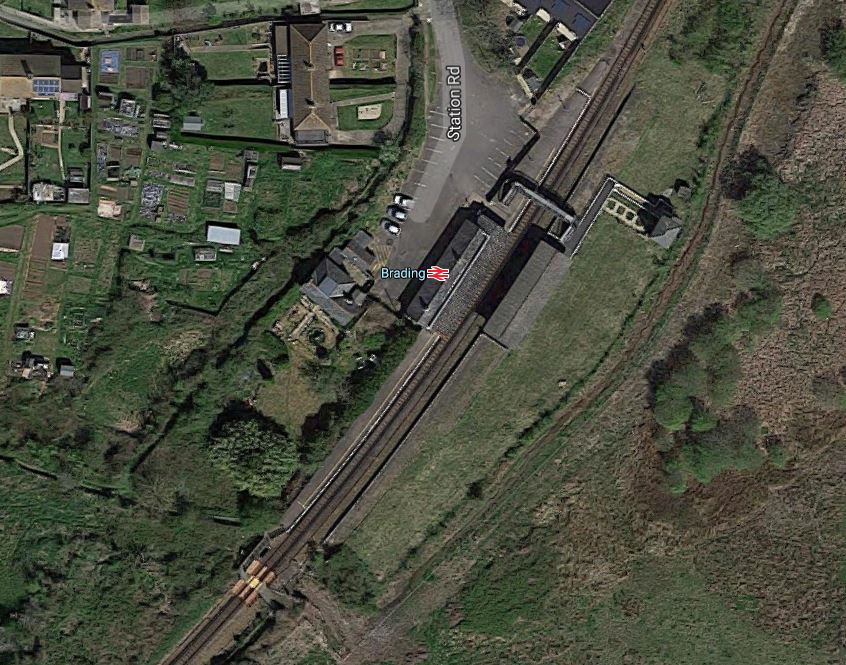
Note the loop is clearly visible to the East of the station.
Trains with a battery capability will give advantages.
- Flexibility of design.
- Simplified track layouts.
- No electrification of new track.
The much-needed loop could become affordable!
Extension to Ventnor
There have been proposals to reopen the line south of Shanklin, to the original terminus at Ventnor.
You can still trace the line on Google Map and if the need is there, trains with a battery capability would surely aid its reopening.
The line could be single track and without electrification.
Conclusion
New trains with a battery capability will give the Island Line a new lease of life.
I also believe that Stadler have the capability to build a suitable battery train, based on their design for the new trains for the Glasgow Subway.
Stadler Comes Up With A New Take And A Big Order For Hybrid And Battery Trains
This article on Global Rail News is entitled Vegetable Oil Fuel Trains To Run In The Netherlands Ahead Of Battery Conversion.
This is said.
- Arriva has ordered eighteen hybrid diesel trains from Stadler to operate its Northern Lines services in the Netherlands.
- The trains will initially be powered by Hydrotreated Vegetable Oil (HVO).
- The trains will have regenerative braking.
- Stadler have called the trains Flirtinos.
- The trains are capable of conversion to battery trains, when there is sufficient electrification.
- The first HVO trains will enter service in 2020.
- Arriva has committed to putting batteries into all of its fleet of fifty-one trains.
This a very strong environmental statement from Stadler and Arriva.
In July 2017, I wrote Battery EMUs For Merseyrail.
These trains are also being built by Stadler.
Conclusion
Have Stadler found the secret for better battery trains?
Certainly, the amount of money that Arriva is paying Stadler and the fact that Arriva are creating sixty-nine trains with batteries, indicates that they have confidence in the product!
You can’t fault Stadler’s marketing either!
Riding On A Battery-Electric Double-Deck Bus
This morning I rode on a battery-electric double-deck bus.




Some of these buses are russing on route 98 between Holborn and Willesden Garage, which includes a run down Oxford Street.
There’s more on the buses in this page on the Metroline web site.
I went upstairs and the experience was little different to that of a normal hybrid bus.
My Thoughts
My thoughts in various areas.
Design
It is a well-designed bus, that is easy to use for this seventy-year-old.
Passenger Experience
Travelling along Oxford Street, the passenger experience was equal to that of a New Routemaster, without the occasional low noise of the engine.
Performance Of The Bus
As we proceeded along Oxford Street, the performance of the bus, was very much in line with current hybrid buses.
The bus wasn’t full on the upper deck, but I suspect that the total weight of the passengers is very much lower than the weight of the battery, so this might mean that a full bus performs well compared with an empty bus.
Limited Space On The Lower Deck
There is one obvious problem and that is that the size of the battery reduces the number of seats downstairs.
As I said earlier, I doubt the weight of the passengers is a problem, but the available space, where they sit and stand could be.
Economics Of The Bus
The bus will obviously be expensive to purchase and to run, as batteries are expensive and need to be replaced every few years.
Coupled with the fact that capacity is smaller than current hybrid buses, which probably means more buses are needed to perform the required service, the economics of the buses may not be suitable for many routes.
I also wonder, if a battery-electric double-deck bus has better economics than a single-deck bus, as the extra weight of the top deck and the extra passengers is small compared to the weight of the battery.
But the economics will get better with improved battery technology.
The Marketing Advantages
BYD and Metroline could be big winners here, as corporate videos and marketing material showing buses in Central London, can’t be a bad thing!
The Competition From Diesel Hybrid Buses
I believe that one competitor to the battery-electric bus will be the next generation of diesel hybrid buses.
Take the current modern hybrid buses like a New Routemaster or any other hybrid bus built in the last couple of years. These have a battery that can power the bus for perhaps a couple of miles.
As the battery is smaller, it can be squeezed into an unlikely space. On a New Routemaster, the diesel engine is under the back stairs and the battery is under the front stairs.
A technique called geo-fencing can be retro-fitted, which forbids the use of the buses diesel engine in sensitive areas, based on GPS technology.
So a route like London’s route 98 could work through the ULEZ on battery power and charge the battery between Edware Road station and Willesden Garage.
The Competition From Hydrogen Hybrid Buses
This will surely be similar to that from diesel hybrid buses.
- Battery size will probably be as for a diesel hybrid bus.
- As hydrogen doesn’t give out noxious emissions, this will be an advantage and you won’t need the geo-fencing.
- But you will need to store the hydrogen.
As hydrogen technology improves, I feel that the hydrogen hybrid bus could become a formidable competitor.
The Competition From Converting Old Diesel Buses To Diesel Hybrid Buses
I talked about this in Arriva London Engineering Assists In Trial To Turn Older Diesel Engine Powered Buses Green.
Never underestimate good engineers with a good idea, that has a good financial payback.
Conclusion
There is going to be a lot of competition between the various technologies and the passengers, bus operators, London and London’s air will be big winners.
As all of this technology can be applied anywhere, other parts of the UK will benefit.
Auckland Rows Back On Battery Train Plan
The title of this post is the same as this article on the International ailway Journal.
This is said.
Following approval by Auckland Council, the proposal went to the New Zealand Transport Agency (NZTA) for final sign-off. However, in the run-up to New Zealand’s general election on September 23, a political consensus emerged in favour of bringing forward electrification of the Papakura – Pukekohe line, prompting the NZTA to reject the case for battery trains.
Can we assume the reason for the change of order is political?
Certainly, CAF, who are building the trains seem to have the required battery technology. This is also said.
CAF says the contract will include an option to equip the trains with battery packs at a later date if required.
I just wonder if battery trains are just too risky for politicians, who tend to be rather conservative and badly-informed about anything technological.
Is Hydrogen A Viable Fuel For Rail Applications?
Perhaps a good place to start is this article on Global Rail News, which is entitled In depth: What you need to know about Alstom’s hydrogen-powered Coradia iLint.
The article starts with this summary of where we are at present.
The global rail industry’s major players are competing to establish an affordable and green alternative to diesel.
Electric traction has been rolled out extensively but electrification can be very expensive – as the UK has learned – and a large part of Europe’s network remains unelectrified. In countries where the provision of electric services is patchy, bi-mode trains are a popular alternative.
I certainly believe that all trains should be powered by electricity, but then we have had diesel-electric locomotives in regular use pn the UK network since the 1950s.
The article mentions two alternatives to diesel.
Bombardier’s modified Class 379 train, which is now called an IPEMU, which I rode in public service in early 2015 is mentioned. I found this train impressive, as I reported in Is The Battery Electric Multiple Unit (BEMU) A Big Innovation In Train Design?. This was my conclusion.
Who’d have thought that such a rather unusual concept of a battery electric multiple unit would have so many possibilities.
I think I’ve seen the future and it just might work!
I still agree with that conclusion.
The second alternative has just arrived in the shape of the Alstom Coradia iLint, which is powered by hydrogen and just emits little more than steam and condensed water.
The Coradia LINT is a family of one and two car diesel trains.
Wikipedia has a section on the Coradia iLint and this is said.
The Coradia iLint is a version of the Coradia Lint 54 powered by a hydrogen fuel cell.[6] Announced at InnoTrans 2016, the new model will be the world’s first production hydrogen-powered trainset. The Coradia iLint will be able to reach 140 kilometres per hour (87 mph) and travel 600–800 kilometres (370–500 mi) on a full tank of hydrogen. The first Coradia iLint is expected to enter service in December 2017 on the Buxtehude-Bremervörde-Bremerhaven-Cuxhaven line in Lower Saxony, Germany. It will be assembled at Alstom’s Salzgitter plant. It began rolling tests at 80km/h in March 2017.
That sounds impressive.
The Global Rail News article gives a bit more detail, including the following.
- The train has no need for overhead catenary.
- The train has lithium-ion batteries to store generated energy.
- The train has a intelligent energy management system.
- Alstom propose to use wind energy to generate hydrogen in the future.
It also includes this promotional video for the Caradio iLint.
Some points from the video.
- The train has similar performance to comparable regional trains. Do they mean the Lint 54 on which it is based?
- The train captures regenerative braking energy.
- The train has been developed in co-operation with a Canadian company! Do they mean Ballard?
So what are my views about trains hydrogen power?
Hydrogen Power In Road Transport
London bus route RV1 has been run by hydrogen-powered buses since 2010.
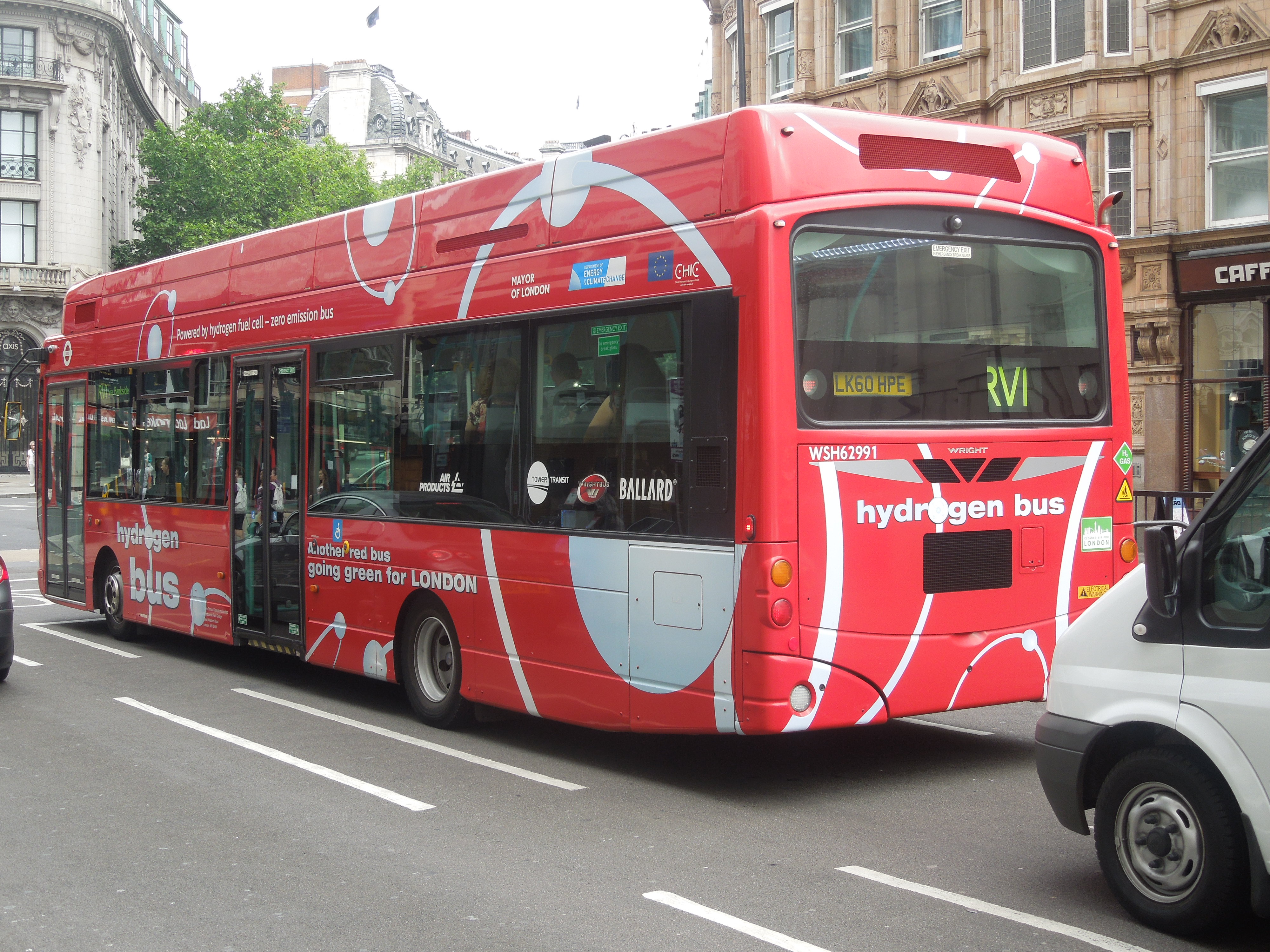
Note Ballard on the side of the bus!
There are also a number of hydrogen-powered cars including the Honda Clarity.
The latest Clarity has these characteristics.
- 4-door saloon.
- 366 mile range.
- 130 kW electric motor.
That seems very reasonable. But the car is only available in California, costs a lot and refuelling points are not everywhere.
The competition for the Honda and other hydrogen-powered cars is the electric car powered by batteries, where charging is getting much faster and easier and the price is getting more competitive.
I think that on the current technology, you’d have to be a very special individual to invest in a hydrogen fuel-cell car.
But use of hydrogen on a city-centre bus is more suitable.
- Pollution is often a problem in city-centres.
- Politicians like to show off their green credentials.
- Buses run fixed routes.
- Bus working schedules can be arranged, such that after a number of trips, they can return to a nearby garage for refuelling.
According to this fuel-cell bus entry in Wikipedia, there have been several trials with varying degrees of success.
My view is that with the current technology, there may be a niche market for hydrogen fuel-cell buses in city centres and environmentally-sensitive areas on defined routes, but that practically and economically, hydrogen fuel-cell cars are a non-starter.
There will be, improvements in current technology in the following areas.
- Vehicle design will result in lighter-weight vehicles and better aerodtnamics.
- Charging systems for electric vehicles will get more numerous and innovative.
- Batteries or energy storage systems will get smaller, lighter and will hold more energy.
Although these developments will also help hydrogen fuel-cell vehicles like buses, they will also help battery-powered vehicles a lot more.
So I would not be surprised to see hydrogen fuel-cell buses not being very successful.
The Advantage Of Rail Over Road
You can’t disagree with the laws of physics, although you can use them to advantage.
Rolling resistance is well described in Wikipedia. This statement starts the third paragraph.
Any coasting wheeled vehicle will gradually slow down due to rolling resistance including that of the bearings, but a train car with steel wheels running on steel rails will roll farther than a bus of the same mass with rubber tires running on tarmac. Factors that contribute to rolling resistance are the (amount of deformation of the wheels, the deformation of the roadbed surface, and movement below the surface. Additional contributing factors include wheel diameter, speed, load on wheel, surface adhesion, sliding, and relative micro-sliding between the surfaces of contact.
Also, as a tram or train system has control of the design of both the vehicle and the rail, it is much easier to reduce the rolling resistance and improve the efficiency of a rail-based system.
One factor; wheel load, is very important. Increasing the load on steel wheels running on steel rails can actually reduce the rolling resistance. So this means that a rail vehicle can better handle heavy components like perhaps a diesel engine, transformer, battery or hydrogen fuel-cell and tanks.
Hydrogen Power In Rail Transport
As Alstom appear to have shown, hydrogen fuel-cells would appear to be able to power a train at 140 kph. Although, there are no reports, that they have actually done it yet! But there has been an order!
The Coradia iLint
I will attempt to answer a few questions about this train.
How Much Power Will The Train Need?
The train is based on a Lint 54.
This document on the Alstom web site, is the brochure for the Coradia Lint.
This is said about the Lint 54.
Ideal for regional or suburban service: The two-car diesel multiple unit with four entrances per side combines all the advantages of its smaller brothers while offering space for up to 170 seats. The vehicle measures 54 m in length. Thanks to its powerful engines, the Lint 54 reaches a maximum speed of up to 140 km/h. With its three powerpacks, the vehicle has a performance of about 1 MW.
Does the iLint have a similar power of about 1 MW?
Could Ballard Power The Train?
If Ballard are Alstom’s Canadian partner could they power the train?
Searching the Ballard web site, I found a product called FCveloCity-HD, for which this document is the data sheet.
The data sheet shows that a 100 kW version is available.
I also found this press release on the Ballard web site, which is entitled Ballard Signs LOI to Power First-Ever Fuel Cell Tram-Buses With Van Hool in Pau, France.
The press release says that 100 kW versions of the FCveloCity-HD, designated FCveloCity-HD100, are used on the tram-buses.
All these applications lead me to believe that Ballard could meet the requirements of enough power for the train.
The video appears to show, that the fuel-cell charges the battery, which then drives the train.
This is not surprising, as most diesel-powered hybrid buses work the same way.
How Big Is The Fuel-Cell?
A Ballard FCveloCity-HD100 is 1200 x 869 x 506 mm. in size and it weighs 285 Kg.
The hydrogen tanks are probably bigger.
Would The Fuel-Cell Provide Enough Power For The Train?
Not on its own it wouldn’t, but adding in the lithium-ion battery and intelligent power management and I believe it would.
- The fuel-cell would generate a constant 100 kW assuming it’s a FCveloCity-HD100.
- The generated electricity would either power the train or be stored in the battery.
- The battery would handle the regenerative braking.
- Air-conditioning and other hotel functions for the train would probably be powered from the battery
The intelligent power management system would take the driver’s instructions and sort out how the various parts of the system operated.
- Moving away from a station with a full train would mean that the train used fuel-cell and battery power to accelerate up to line speed.
- Stopping at a station and the regenerative energy from braking would be stored in the battery.
- Running at 140 kph would need an appropriate power input to combat wind and rolling resistance.
- Any excess energy from the fuel-cell would go into the battery.
- Whilst waiting in a station, the fuel-cell would charge the battery, if it was necessary.
That looks to be very efficient.
How Big Would The Lithium-Ion Battery Need To Be?
I don’t know, but given the appropriate figures, I could calculate it. So Alstom have probably calculated the optimum battery size, based on the routes the train will serve.
Is The Coradia iLint A Battery Train With A Hydrogen-Powered Battery Charger?
I think it is!
But then many hybrid buses are battery buses with a diesel-powered charger.
In Arriva London Engineering Assists In Trial To Turn Older Diesel Engine Powered Buses Green, I wrote about a diesel-hybrid bus, that with the use of geo-fencing, turns itself into a battery bus in sensitive or low-emission areas.
How Would The Train Be Refuelled With Hydrogen?
The video shows a maintenance depot, where the train is topped up with hydrogen, probably after a day’s or a shift’s work.
The first iLint trains have been ordered for the Bremerhaven area, which is on the North Sea coast. So will the depot make its own hydrogen by electrolysis using local onshore or offshore wind power?
Some of that wind power could be used to charge the battery overnight in the depot.
It’s an excellent green concept.
What About The Hindenberg?
But then the very explosive use of hydrogen in the Space Shuttle External Tank never gave any trouble.
Does Alstom Have Any Plans For The UK?
This article on the Engineer web site is entitled Alstom Eyes Liverpool Hydrogen Train Trials.
It would appear to be a good chjoice for the following reasons.
Location
Alstom’s UK base is at Widnes, which is in the South-East of the Liverpool City Region.
Test Partner
Merseyrail have shown in recent years, that they can think out of the box, about using trains and would be a very able partner.
Test Route
The article suggests that Liverpool to Chester via the Halton Curve could be the test route.
- The route is partly electrified from Runcorn to Liverpool.
- The route passes close to Alstom’s base.
- The section without electrification from Runcorn to Chester is probably about twenty miles long, which is a good test, but not a very difficult one.
There would also be good opportunities for publicity and photographs.
Availability Of Hydrogen
Hydrogen is available locally from the various petro-chemical industries along the Mersey.
Incidentally, I used to work in a chlorine plant at Runcorn, where brine was split into hydrogen and chlorine by electrolysis. There were hydrogen tankers going everywhere! Does the industry still exist?
Where’s The Train?
Are Alstom going to build a new train as the Coradia iLint is not built for the British network? Or are they going to modify an existing train, they manufactured a few years ago?
Conclusion
Hydrogen would appear to be a viable fuel for rail applications.
Regenerative Braking On A Dual-Voltage Train
Yesterday, I found this document on the Railway People website, which is entitled Regenerative Braking On The Third Rail DC Network.
Although, the document dates from 2008, it is very informative.
Regenerative Braking On 25 KVAC Trains
The document says this.
For AC stock, incoming power from the National Grid at high voltage is stepped down by a transformer. The AC power is transmitted via OHL to the trains. When the train uses regenerative braking, the motor is used as a generator, so braking the axle and producing electrical energy. The generated power is then smoothed and conditioned by the train control system, stepped up by a transformer and returned to the outside world. Just about 100% of regenerated power is put back into the UK power system.
But I have read somewhere, that you need a 25 KVAC overhead electrification system with more expensive transformers to handle the returned electricity.
Regenerative Braking On 750 VDC Trains
The document says this.
After being imported from the National Grid, the power is stepped down and then AC power is rectified to DC before being transmitted via the 3rd rail. Regenerated Power can not be inverted, so a local load is required. The power has to be used within the railway network. It cannot be exported.
So the electricity, is usually turned into heat, if there is no train nearby.
The Solution That Was Applied
The document then explains what happened.
So, until such time as ATOC started to lobby for a change, regenerative DC braking was going nowhere. But when they did start, they soon got the backing of the DfT and Network Rail. It takes a real combined effort of all organisations to challenge the limiting assumptions.
In parallel, there were rolling stock developments. The point at which all the issues started to drop away was when the Infrastructure Engineers and Bombardier, helped out by some translating consultants (Booz & Company), started to understand that new trains are really quite clever beasts. These trains do understand what voltage the 3rd rail is at, and are able, without the need to use any complicated switch gear – just using software, to decide when to regenerate into the 3rd rail or alternatively, use the rheostatic resistors that are on the train.
Effectively, the trains can sense from the voltage if the extensive third-rail network can accept any more electricity and the train behaves accordingly.
As most of the electric units with regenerative braking at the time were Bombardier Electrostars, it probably wasn’t the most difficult of tasks to update most of the trains.
Some of the Class 455 trains have recently been updated. So these are now probably compatible with the power network. Do the new traction motors and associated systems use regenerative braking?
This document on the Vossloh-Kiepe web site is entitled Vossloh Kiepe enters Production Phase for SWTs Class 455 EMU Re-Tractioning at Eastleigh Depot and describes the updating of the trains. This is said.
The new IGBT Traction System provides a regenerative braking facility that uses the traction motors as generators when the train is braking. The electrical energy generated is fed back into the 750 V third rail DC supply and offsets the electrical demands of other trains on the same network. Tests have shown that the energy consumption can be reduced by between 10 per cent and 30 per cent, depending on conditions. With the increasing cost of energy, regenerative braking will have a massive positive cost impact on the long-term viability of these trains. If the supply is non-receptive to the regenerated power, the generated power is dissipated by the rheostatic brake.
So thirty-five year old British Rail trains now have a modern energy-saving traction system.
Has The Solution Worked On The Third-Rail Network?
The Railway People document goes on to outline how they solved various issues and judging by how little there is about regenerative braking on the third-rail network, I think we can assume it works well.
One Train, Two Systems
If you have a train that has to work on both the 25 KVAC and 750 VDC networks, as Thameslink and Southeastern Highspeed trains do, the trains must be able to handle regenerative braking on both networks.
So is there a better way, than having a separate system for each voltage?
In Do Class 800/801/802 Trains Use Batteries For Regenerative Braking?, I investigated how Hitachi’s new Class 800 trains handle regenerative braking.
A document on Hitachi’s web site provides this schematic of the traction system.

Note BC which is described as battery charger.
The regenerative braking energy from the traction motors could be distributed as follows.
- To provide power for the train’s services through the auxiliary power supply.
- To charge a battery.
- It could be returned to the overhead wires.
Hitachi’s system illustrates how using a battery to handle regenerative braking could be a very efficient way of running a train.
Hitachi’s diagram also includes a generator unit or diesel power-pack, so it could obviously fit a 750 VDC supply in addition to the 25 KVAC system on the Class 800 train.
So we have now have one train, with three power sources all handled by one system.
What Has Happened Since?
As the Hitachi document dates from 2014, I suspect Hitachi have moved on.
Siemens have produced the Class 700 train for Thameslink, which is described in this Siemens data sheet.
Regenerative braking is only mentioned in this sentence.
These new trains raise energy efficiency to new levels. But energy efficiency does not stop at regenerative braking.
This is just a bland marketing statement.
Bombardier are building the first batches of their new Aventra train, with some Class 345 trains in service and Class 710 trains about to enter testing.
Nothing has been said about how the trains handle regenerative braking.
But given that Bombardier have been experimenting with battery power for some time, I wouldn’t be surprised to see batteries involved.
They call their battery technology Primove and it has its own web site.
There is also this data sheet on the Bombardier web site.
Class 387 Trains
There is another train built by Bombardier, that is worth investigating.
The Class 387 train was the last and probably most advanced Electrostar.
- The trains have been built as dual-voltage trains.
- The trains have regenerative braking that works on both electrification types.
- They were built at around the time Bombardier were creating the Class 379 BEMU demonstrator.
- The trains use a sophisticated propulsion converter system called MITRAC, which is also used in their battery trams.
On my visit to Abbey Wood station, that I wrote about in Abbey Wood Station Opens, I got talking to a Gatwick Express driver about trains, planes and stations, as one does.
From what he said, I got the impression that the Class 387/2 trains, as used on Gatwick Express, have batteries and use them to keep the train and passengers comfortable, in case of an electrification failure.
So do these trains use a battery to handle the regenerative braking?
How Big Would Batteries Need To Be On A Train For Regenerative Braking?
I asked this question in a post with the same name in November 2016 and came to this conclusion.
I have a feeling that using batteries to handle regenerative braking on a train could be a very affordable proposition.
As time goes on, with the development of energy storage technology, the concept can only get more affordable.
Bombardier make a Primove battery with a capacity of 50 kWh, which is 180 mega-Joules.
So the braking energy of what mass of train could be stored in one of these batteries?
I got these figures.
- 100 mph – 180.14 tonnes.
- 110 mph – 148.88 tonnes.
What is the mass of a Class 387 train?
This is not available on the Internet but the mass of each car of a similar Class 378 train averages out at 32 tonnes.
Consider these points.
- A Class 387/2 train, has 219 seats, so if we assume each passenger and baggage weighs eighty kilograms, that adds up to 17.5 tonnes.
- As the Class 387 trains have a maximum speed of 100 mph on third-rail electrification, it would appear that a Primove 50 kWh battery could handle the braking energy.
- A Primove 50 battery with its controller weighs 827 Kg. according to the data sheet.
It all looks like using one of Bombardier’s Primove 50 batteries on a Class 387 train to handle the regenerative braking should be possible.
But would Bombardier’s MITRAC be able to use that battery power to drive the train in the most efficient manner? I suspect so!
If the traction layout is as I have outlined, it is not very different to the one published by Hitachi in 2014 on their web site for the Class 800 train.
Conclusion
Hitachi have got their traction layout right, as it can handle any number of power sources.
 The Anonymous Widower