Could We See More Bunhill 2s On The London Underground?
This article on Railway Gazette, is entitled Air-Conditioned Piccadilly Line Train Designs Presented.
This is said in the article about the air-conditioning of the new trains.
The trains will feature air-conditioning for the first time on one of the capital’s small-profile deep-level Tube lines, which has posed a significant engineering challenge. The heat passed into the tunnels from the air-conditioning units is expected to be offset by a reduced heat output from the traction and braking equipment, given the trains’ lower energy consumption.
Cutting the energy consumption will be mainy good basic engineering.
- Lighting will use LEDs to use less electricity and cut heat generated.
- Efficient air-conditioning units will save energy.
- All electrical equipment like traction motors, transformers and door actuators will be low energy units.
There could also be some more complex ways to save energy.
Extensive Mathematical Modelling Of the Temperature And Humidity Of The Trains
I have built large numbers of mathematical models. I can see a lot of scope to use the technique to find the most efficient method of operation.
- On hot days would the trains be cooled down on the surface sections, so that they entered the tunnels cold?
- Conversely on cold days, would the heat in the tunnels be recovered to get cold trains entering the long central tunnel up to temperature?
- How does passenger loading effect the temperature and humidity?
The model would help to identify, the best operating procedure given the weather conditions.
The mathematical model could even be built into the control system of the train.
Heated Floors
As I said in Air-Conditioned Piccadilly Line Train Designs Presented, the trains could have heated floors, which are an efficient use of space.
They might even be an efficient way of warming a train on a cold day.
I lived near Cockfosters Depot for the first sixteen years of my life and know from personal experience, it can get very cold in the winter.
Regenerative Braking To Batteries
Regenerative braking is used in two ways on the London Underground.
- As the system is DC, electricity generated during braking, can be returned to the rails for use by nearby trains.
- Some stations are also hump-backed, so trains are slowed coming up the hill into the station and pick the energy up, going downhill out of the station. Stations using this technique are very noticeable on the Victoria Line.
I believe that the new Siemens trains should and probably will use regenerative braking to batteries.
- Electricity generated during braking is stored in a battery or batteries on the train.
- When accelerating away from the station, this energy is reused.
The method has advantages.
- There is less electricity transfer between train and conductor rails, which means less heat generated and less contact shoe wear.
- If there is a power failure, the batteries can provide hotel power for the train and could even be large enough to move it to the next station for evacuation of the passengers.
- There may even be scope in building batteries and traction motors as an integrated unit to save weight and reduce heat generation.
- Because of the reuse of energy, energy use is reduced.
I will be very surprised if these new trains aren’t fitted with batteries.
Why Build More Bunhill 2s?
The Bunhill 2 Energy Centre is described on this page of the Borough of Islington web site, which is entitled Bunhill Heat Network.
This is said about Phase 2 of the project.
Phase 2 of the Bunhill Heat and Power network involves building a new energy centre at the top of Central Street, connecting the King’s Square Estate to the network and adding capacity to supply a further 1,000 homes.
The core of the new energy centre is a 1MW heat pump that will recycle the otherwise wasted heat from a ventilation shaft on the Northern Line of the London Underground network, and will transfer that heat into the hot water network. During the summer months, the system will be reversed to inject cool air into the tube tunnels.
Note that a 1MW heat pump can supply enough hot water to heat upwards of a thousand homes.
This page on the Islington web site lists the project partners.
Transport for London is a key partner and this is said.
As a key partner in the Bunhill 2 scheme, TfL upgraded its City Road mid-tunnel ventilation system to enable the capture and utilisation of waste heat from the Northern line tunnels to provide hot water to local homes and businesses. TfL is also carrying out further research to identify opportunities for similar projects across the Tube network as part of its Energy and Carbon Strategy.
So what other stations could be used?
These are disused stations on the deep lines.
- Brompton Road – Piccadilly Line
- Down Street – Piccadilly Line
- South Kentish Town – Northern Line
- York Road – Piccadilly Line
York Road, which is close to all the developments to the North of Kings Cross, would probably be the most likely to be converted into an energy centre to transfer heat to and from the Underground.
Could Some Ventilation Shafts Be Converted Into Energy Centres?
The obvious one is probably Green Lanes Ventilation Station.

Green Lanes Ventilation Station
But then I suspect this is on Transport for London’s list of sites to be converted into something more useful.
Get H2 Partners Propose Green Hydrogen Pipeline In Europe
The title of this post, is the same as that of this article on the Green Car Congress.
This is the first paragraph.
Seven companies from the GET H2 initiative in Europe want to build a cross-border pipeline for green hydrogen. From Lingen (Emsland) to Gelsenkirchen and from the Dutch border to Salzgitter, production, transport, storage and industrial acceptance of green hydrogen are to be connected in several steps between 2024 and 2030 under the umbrella of the overall project.
Note.
- I suspect this could be almost four hundred kilometres of hydrogen pipeline.
- The hydrogen will be used in refineries, for steelmaking and other industrial uses.
- It could avoid production of sixteen million tonnes of carbon dioxide by 2030.
This will need a lot of wind-turbines and electrolysers, most of which I expect will be in the German and Dutch parts of the North Sea.
Honeywell Introduces Power Source For Hybrid-Electric Aircraft
The title of this post, is the same as that of this article on Flying Magazine.
Honeywell have created a power source for hybrid-electric aircraft, that will run on a wide range of fuels including jet fuel, diesel and sustainable aviation fuel.
The Flying Magazine article is a must-read, which is mainly based on this press release from Honeywell, which is entitled Honeywell’s Newest Turbogenerator Will Power Hybrid-Electric Aircraft, Run On Biofuel.
The turbogenerator has two main parts.
Small Turbofan Provides The Power
These are details of the turbo fan.
- The small turbo fan is the auxiliary power unit or APU from an Airbus A 350 XWB.
- The APU is identified as a Honeywell HGT1700.
- Over four hundred of these APU’s have been delivered in Airbus A350 XWBs.
- It can run on jet fuel, diesel and sustainable aviation fuel.
- It can also run on Honeywell Green Jet Fuel.
- I suspect in the future, it will be able to run on hydrogen.
The APU is obviously well-proven technology, from a company with a large share in the airliner market.
Generator To Provide Electricity
These are details of the generator.
- It weighs 127 Kg or about two of me.
- It can generate a megawatt of electricity.
The generator sounds powerful to me.
The first demonstration of this turbogenerator system will occur in the third quarter of 2021, with ongoing development and qualification to follow.
Honeywell says this about their collaboration with Faradair and other companies.
In December, Honeywell signed a memorandum of understanding with British startup Faradair Aerospace to collaborate on systems and a turbogeneration unit that will run on sustainable aviation fuel to power Faradair’s Bio Electric Hybrid Aircraft (BEHA). Faradair intends to deliver 300 hybrid-electric BEHAs into service by 2030, of which 150 will be in a firefighting configuration. Honeywell is in advanced discussions with several other potential turbogenerator customers, working to help define power requirements based on mission profiles required by various manufacturers.
I can see a lot of customers for this turbogenerator.
And not all will be in aviation!
Coal Plant Closures Loom Large As NSW Backs Hydrogen For The Hunter
The title of this post, is the same as that of this article on the Sydney Morning Herald.
This is the first paragraph.
The future of NSW’s coal-fired power plants is under increasing threat from cheap renewable energy, which this week forced Victoria’s Yallourn coal plant to bring forward its closure date as analysts warn the end may come even sooner.
The future for coal in Australia certainly doesn’t look good.
Ex-Steelworks To Make Wind Farm Parts In Plan For 6,000 Green Jobs
The title of this post, is the same as that of this article on The Times.
This is the introductory paragraph.
The government will invest almost £100 million creating new wind turbine ports in northeast England, with a big renewables company announcing plans to make crucial parts in Teesside.
The two ports will be on Teesside and North Lincolnshire.
The next generation of wind turbines in the North Sea will be very different.
Larger Turbines
They will be larger and the blades will be bigger, so building them close to, where they will be installed is a sensible idea.
We are also very good at aerodynamics in the UK. This is the reason Airbus designs and builds wings in the UK.
Floating Turbines
The next generation of wind farms will be floating, as for some reason, they have a higher capacity factor.
I am personally pleased about this, as it appears they are based on a patented but failed design of floating oil production platform from the 1970s, where I performed the calculations on how to install them.
Some of these floating wind turbines can also be floated into port for major services and upgrades, which probably means we need local manufacturing of as many parts as possible.
Hydrogen Rather Than Electrical Connection
They will also create hydrogen, rather than electricity, by using a combination of wind turbine and hydrogen electrolyser.
As distances between shore and wind farm get longer, it is cheaper to use a gas pipe, rather than a DC electricity link.
Hydrogen can also be stored in worked out gas fields and also brought ashore in redundant pipelines.
The hydrogen electrolysers will probably be built in the world’s largest electrolyser factory in Rotherham, owned by ITM Power; a UK company.
Conclusion
As we are going to build almost 70 GW of offshore wind in the next few years, we’re going to need a turbines and I believe increasingly, they will be built in the UK.
So these two wind ports at Teesside and in Lincolnshire are a good idea.
Engine Development At ABC Shaped By Sustainability
The title of this post, is the same as that on this article on Riviera Maritime Media.
This is the introductory paragraph.
Belgian engine manufacturer ABC is supplying the power for a new ‘green’ oceanographic research vessel, while it continues development of a hydrogen engine.
The article then gives a good summary of the progress being made by ABC in developing diesel, dual and hydrogen power for ships, based on their existing diesel technology.
- Their diesel engines will be powering the new Belgian maritime research ship; Belgica.
- They are developing hydrogen engines up to 10 MW.
- They aim to have a hydrogen engine working by Q2 2021.
- They have the capacity to build up to a hundred engines a year.
The company seems to be following an alternative route to decarbonisation, by converting existing large diesel designs to hydrogen.
The article is very much worth a read.
H2 Green Steel Plans 800 MW Hydrogen Plant In Sweden
The title of this post, is the same as that of this article on montel.
The title says it all.
In Can The UK Have A Capacity To Create Five GW Of Green Hydrogen?, I said the following.
Ryze Hydrogen are building the Herne Bay electrolyser.
- It will consume 23 MW of solar and wind power.
- It will produce ten tonnes of hydrogen per day.
The electrolyser will consume 552 MWh to produce ten tonnes of hydrogen, so creating one tonne of hydrogen needs 55.2 MWh of electricity.
This would mean that H2 Green Steel’s electrolyser could be producing around one hundred and forty thousand tonnes of hydrogen per year or 380 tonnes per day.
What About Scunthorpe?
I very much believe that Scunthorpe in Lincolnshire, would be the ideal place for hydrogen steelmaking in the UK as I outlined in Green Hydrogen To Power First Zero Carbon Steel Plant.
So could 800 MW of electricity be available to produce the hydrogen in the area.
Currently, the world’s largest offshore wind farm is Hornsea One with a capacity of 1218 MW, which feeds into the National Grid at Killingholme.
This Google Map shows the distance between Scunthorpe and Killingholme.
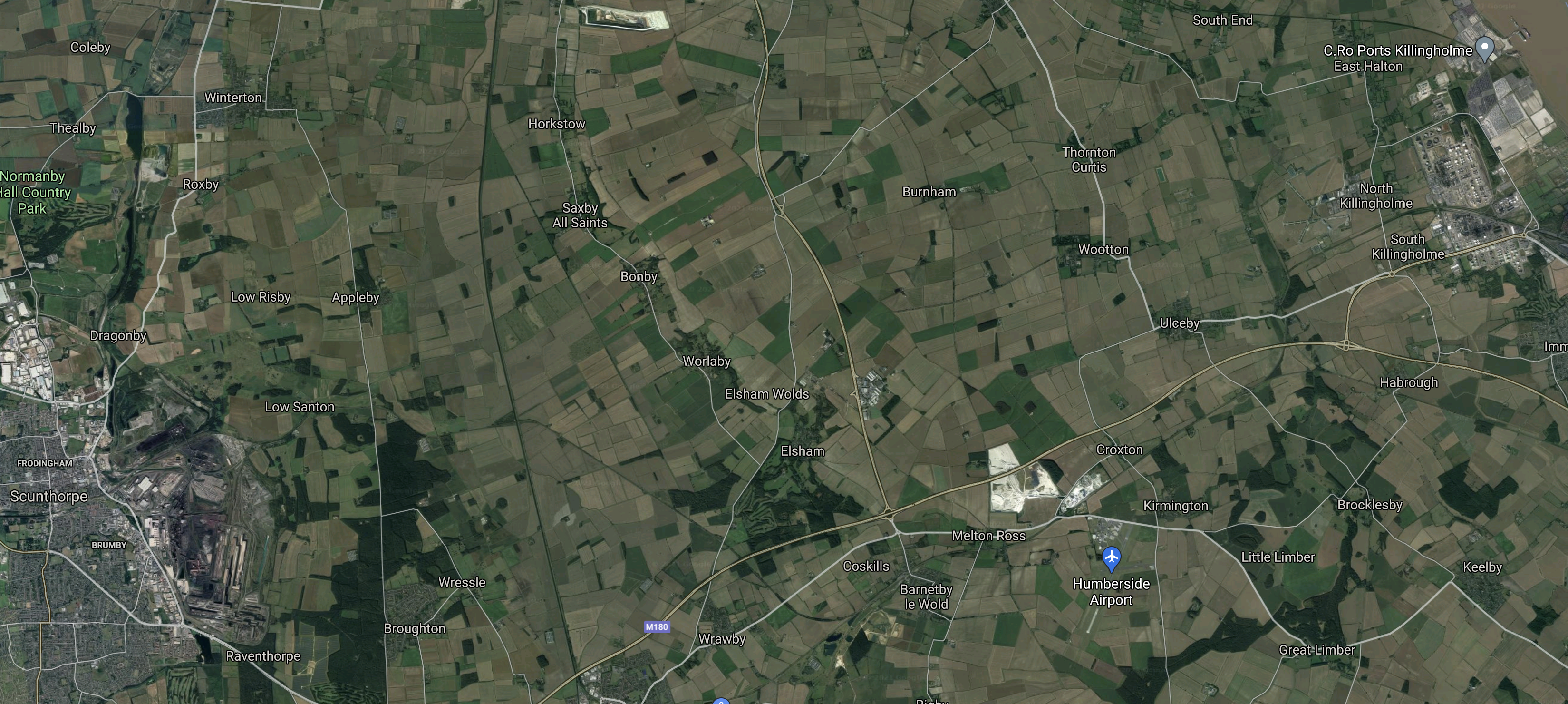
Note.
- Scunthorpe is in the South-West corner of the map.
- Killingholme is in the North-East corner of the map.
The distance is about twenty miles.
When fully developed, the Hornsea Wind Farm is planned to have a capacity of 6 GW or 6000 MW, so there should be enough renewable energy.
Could The Hydrogen Be Created Offshore?
In ITM Power and Ørsted: Wind Turbine Electrolyser Integration, I wrote about combining wind turbines and electrolysers to create an offshore wind turbine, that generates hydrogen, rather than electricity.
This approach may be ideal for the later phases of the Hornsea Wind Farm.
- Redundant gas pipes can be used to bring the hydrogen ashore.
- Worked-out offshore gas fields can be used to store hydrogen.
- Worked-out gas fields in the area, are already being used to store natural gas from Norway.
- The hydrogen can be fed directly into the HumberZero hydrogen network.
But the main reason, is that some serious commentators feel it is more affordable approach in terms of capital and maintenance costs.
It is also easy to convert hydrogen back to zero-carbon electricity, if you have a handy gas-fired power station. There could be as many of three of these at Keadby.
Conclusion
It’s all coming together on Humberside.
Anything the Swedes can do, we can do better!
Green Hydrogen To Power First Zero Carbon Steel Plant
The title of this post, is the same as that of this article on renews.biz.
This is the two introductory paragraphs.
A new industrial initiative, backed by EIT InnoEnergy, will build the world’s first large-scale steel production plant powered by green hydrogen, in north Sweden.
The H2 Green Steel industrial initiative, which will mobilise €2.5bn of investment, aims to deliver a project that will create a new green steel producer from inception.
These further points are made.
- There will be downstream steel products manufacture.
- The initiative will create 10,000 direct and indirect jobs.
- Production could start in 2024.
- Up to five million tonnes of steel could be produced by 2030.
The plant will be built in the Boden-Lulea area of Northern Sweden.

Note.
H2 Green Steel has a web site, which explains more.
What About Scunthorpe?
Surely, the obvious location for green steel production plant in the UK would be Scunthorpe.
- The HumberZero network can bring in hydrogen and take away any carbon dioxide.
- The steelworks makes world-class products like railway rails.
- It is a massive site.
- The site has good rail access.
But there don’t seem to be any plans for hydrogen steelmaking at Scunthorpe.
Conclusion
I hope we’ve not missed the boat for hydrogen steelmaking.
- We’ve certainly got the sites, the renewable energy and the hydrogen technology.
- On the other hand, I can remember sensible arguments for lots of much smaller steel plants from fifty years ago, as an alternative to nationalisation of the steel industry by the Wilson Government in 1967.
- I can also remember proposals for nuclear steelmaking.
I just wonder, if a design of hydrogen steelmaking plant could be developed, perhaps even using a small modular nuclear reactor to generate the hydrogen.
If we are going to have a steel industry in the future, we must do something radical.
Malta Inc Energy Storage Explained
Malta Inc first came to my notice in 2018 and I wrote Gates Among Billionaires Backing Alphabet Energy Spinoff.
But I couldn’t find much information at the time, but they now have a web site that gives a good explanation.
This page on the web site is entitled Our Solution.
This infographic from the web page, lays out the key features.
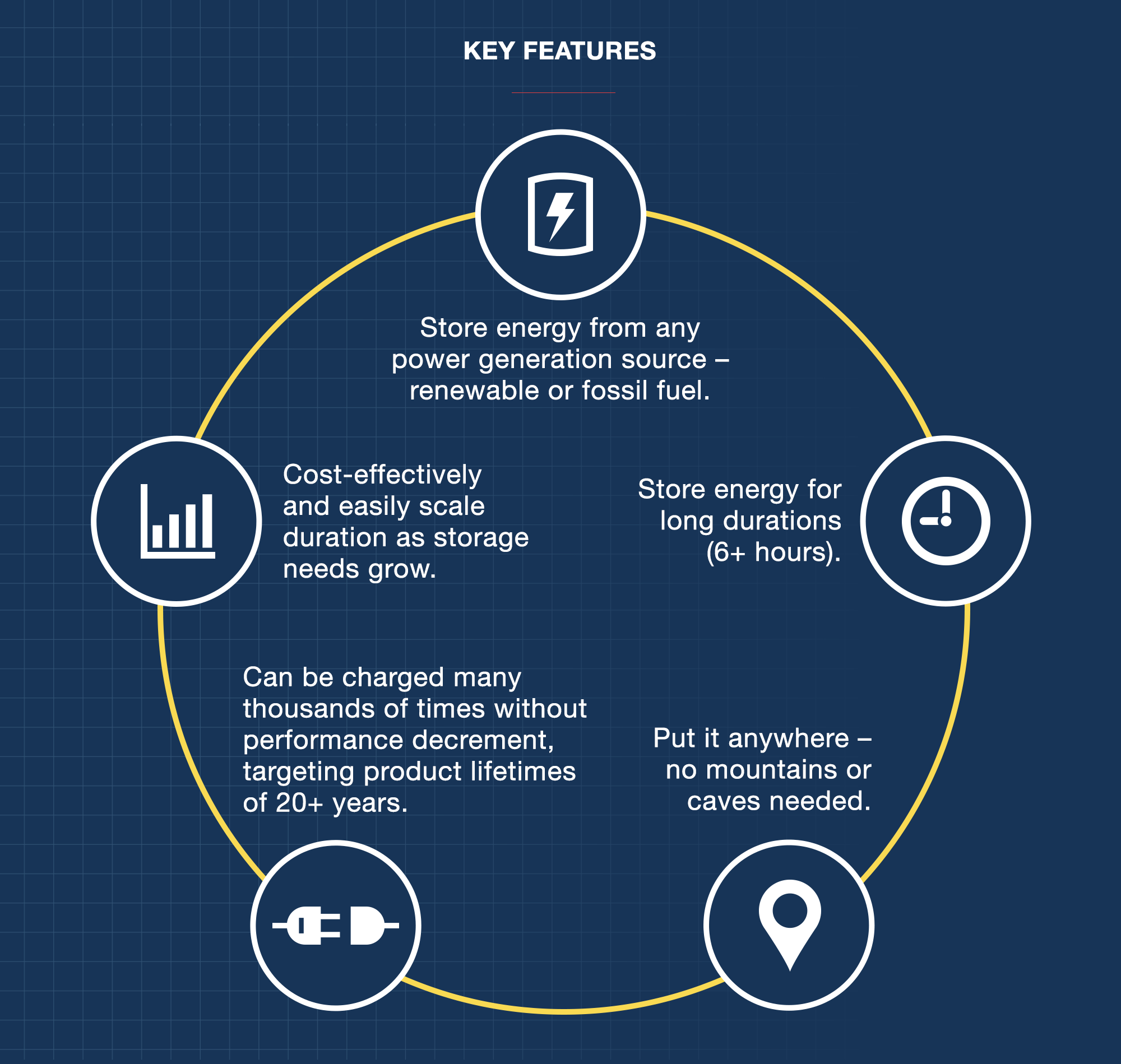
This sentence outlines the method of operation.
The Malta energy storage system takes electricity, converts and stores that electricity as heat, and then converts it back to electricity to be redistributed on the electric grid. In charge mode, the system operates as a heat pump, storing electricity as heat in molten salt. In discharge mode, the system operates as a heat engine, using the stored heat to produce electricity.
The operation is explained in five stages.
- Collects – Energy is gathered from wind, solar, or fossil generators on the grid as electrical energy and sent to Malta’s energy storage system.
- Converts – The electricity drives a heat pump, which converts electrical energy into thermal energy by creating a temperature difference.
- Stores – The heat is then stored in molten salt, while the cold is stored in a chilled liquid.
- Reconverts – The temperature difference is converted back to electrical energy with a heat engine.
- Distributes – Electricity is sent back to the grid when it is needed.
Note.
- The operation of the system is based on well-understood thermodynamic principles.
- Entergy is stored as both heat and cold.
- It provides several hours of energy storage.
- Systems are built using standard components, that are readily available.
In some ways the Malta Inc PHES is based on similar principles to Highview Power’s CRYOBattery and Siemens Gamesa’s ETES.
Conclusion
This is a company to watch, as they seem to have got the technology right.
The Earth’s Energy: Switching Geothermal Power On
The title of this post is the same as that of this article on Power magazine.
This must-read article talks about the awakening of geothermal power, which even featured in Rolling Stone magazine last year.
This is a paragraph of the article.
The U.S. Department of Energy (DOE) lists a number of benefits offered by geothermal resources. Among them is that geothermal energy can provide baseload power, regardless of weather conditions. Geothermal power plants are also generally compact, using less land per GWh (404 m2) than coal (3,642 m2), wind (1,335 m2), or solar photovoltaic (3,237 m2) power plants, according to a study cited by the DOE.
The dinosaur brigades, who feel renewable power is only an intermittent source and a total waste of money, are always going on about baseload power. So could geothermal provide it?
The article also talks about Chevron and BP investing $40 million in Eavor Technologies, a Canadian geothermal company. This is said of their investment.
Big Oil is an especially important partner for the geothermal industry because “not only do they bring money and motivation,” Redfern said, they bring expertise “in global operations and project management, and knowledge of the subsurface and how you mitigate risks.”
It sounds like sensible diversification to me for Big Oil. It’s a bit like INEOS diversifying into hand-sanitiser during the pandemic, as they make the stuff and only needed to add a bottling plant. If you have the expertise use it!
This paragraph sums up how we bring geothermal to the world by drilling deeper.
To truly unlock the potential of geothermal energy, the industry must develop better drilling techniques that can “mine heat at much deeper depths,” said Vinod Khosla, an entrepreneur, investor, and co-founder of Sun Microsystems. Today, geothermal companies typically drill to depths of about five kilometers at most. “If we [can] go to 15 to 20 kilometers … then we will have limitless heat everywhere on the planet, or most places on the planet, with geothermal. And that would expand the market for geothermal 100-fold,” said Khosla, who describes himself as being “very, very bullish on geothermal.”
Khosla believes that new drilling techniques will get us to these awesome depths and has put his money, where his mouth is.
Read the article.
 The Anonymous Widower