Shawton Energy Joins Up With The Co-Op For Rooftop Solar
The title of this post, is the same as that of this article on Solar Power Portal.
These two paragraphs describe the agreement.
Renewable technology developer Shawton Energy has signed an agreement with the Co-Op group to help support the retail giant’s rollout of rooftop solar PV.
Working with Sol PV as a delivery partner, Shawton Energy will design, develop, fund, and manage rooftop solar PV systems at key Co-op locations using a power purchase agreement (PPA) model. This allows Co-op to make significant energy and cost savings without having to put forward any upfront investment. Co-op will now purchase the power from Shawton Energy at a flat, discounted rate. While this rollout currently only covers some of the Co-Op’s over 2,500 retail locations, there remains potential for expanding this partnership in the future.
This looks to me to be a deal, where all parties benefit.
- Co-op have thousands of locations, that could have solar roofs, which would be good green publicity.
- I suspect that the Co-op own a lot of their properties, so the collateral is there, if the deal goes wrong.
- I suspect many buildings are very similar, so design and installation costs could be reduced.
- Co-op get reduced-cost electricity.
- Shawton Energy can add other technologies like batteries and rooftop turbines to the deal.
From my experience of both sides of the leasing of multiple systems, I believe, that this would be the sort of deal, that reputable banks and finance houses would be very happy to fund.
It looks like the sort of deal that can be replicated.
Especially, as Shawton Energy have already done a deal with the Bannatyne Group, according to these two paragraphs from the article.
This is not the first significant deal with a well-known British chain that Shawton Energy has agreed this year. The company announced in March of this year that it had made an agreement with health and wellness club operator the Bannatyne Group, which has installed solar panels on the rooftops of a number of its health clubs, hotels and spas under a similar PPA agreement to that Shawton Energy has made with the Co-Op.
According to the Bannatyne Group, the installations, which consist of 967 panels and 11 inverters across eight sites around the UK, have already provided significant energy savings to the group. Since their completion, each of the eight sites has reportedly secured energy savings of up to 25%.
Savings of 25 % are worth having.
Ambitious £3bn Pumped Hydro Project At Loch Ness Moves Forward
The title of this post is the same as that of this article on Sustainable Times.
These are the two introductory paragraphs.
A £3 billion pumped storage hydro (PSH) project near Scotland’s iconic Loch Ness is one step closer to becoming a reality. Glen Earrach Energy (GEE) confirmed on April 25th that it has officially submitted the planning application for its ambitious 2gw scheme.
If greenlit, this project would represent nearly three-quarters of the total PSH capacity planned for Loch Ness, contributing 34 GWh of the region’s 46 GWh storage goal. But it’s not just the storage that stands out. This development would also account for two-thirds of the generating capacity, all while using just half of the water previously considered. To put it into perspective, the project’s capacity would be on par with the combined output of around 800 onshore wind turbines scattered throughout the Highland Council area.
Note.
- The generating and pumping capacity for this ambitious scheme is given as 2 GW. Only three in China and one in the United States are larger.
- The storage capacity of 34 GWh will make it the largest in the UK, possibly the second largest in Europe to Ulla-Førre in Norway and one of the ten largest in the world.
- A projected 10% reduction in the UK grid’s carbon footprint is claimed.
- The cost of three billion is high, but compare that with the tens of billions quoted for the 3.26 GW Hinckley Point C.
The Glen Earrach scheme is not short on superlatives and the article in Sustainable Times is worth a thorough read.
Fifth Hydro Project Proposed At Loch Ness, is based on a BBC article of the same name.
These were my thoughts in the related post.
The Existing Hydro Schemes On Loch Ness
According to the BBC article, there are two existing hydro schemes on Loch Ness.
- Foyers is described on this web site and is a reasonably modern 305 MW/6.3 GWh pumped storage hydroelectric power station, that was built by SSE Renewables in the last fifty years.
- Glendoe is described on this web site and is a modern 106.5 MW conventional hydroelectric power station, that was built by SSE Renewables in the last twenty years.
Foyers and Glendoe may not be the biggest hydroelectric power stations, but they’re up there in size with most solar and onshore wind farms. Perhaps we should look for sites to develop 100 MW hydroelectric power stations?
The Proposed Hydro Schemes On Loch Ness
According to the BBC article, there are four proposed hydro schemes on Loch Ness.
- Coire Glas is described on this web site and will be a 1.5GW/30 GWh pumped storage hydroelectric power station, that is being developed by SSE Renewables.
- Fearna is described on this web site and will be a 1.8GW/37 GWh pumped storage hydroelectric power station, that is being developed by Gilkes Energy.
- Loch Kemp is described on this web site and will be a 600MW/9 GWh pumped storage hydroelectric power station, that is being developed by Statera.
- Loch Na Cathrach is described on this web site and will be a 450MW/2.8 GWh pumped storage hydroelectric power station, that is being developed by Statktaft.
In addition there is, there is the recently announced Glen Earrach.
- Glen Earrach is described on this web site and will be a 2GW/34 GWh pumped storage hydroelectric power station, that is being developed by Glen Earrach Energy.
Note.
- The total power of the seven pumped storage hydroelectric power stations is 4.76 GW.
- The total storage capacity is 89.1 GWh.
- The storage capacity is enough to run all turbines flat out for nearly nineteen hours.
I estimate that if 2 GW/34 GWh of pumped storage will cost £3 billion, then 4.76 GW/89.1 GWh of pumped storage will cost around £7-8 billion.
Avacon And Rolls-Royce Are Testing The Contribution Of Battery Storage And PV Systems To Grid Stability
The title of this post, is the same as that of this press release from Rolls-Royce.
These two bullet points act as sub-headings.
- Field tests are investigating the intelligent integration of renewable energies with home storage systems and larger mtu battery storage systems
- Objective: to contribute to the efficient energy supply of energy communities and grid support
This introductory paragraph adds more detail.
German energy supplier Avacon and Rolls-Royce together are driving forward the integration of battery storage into the power grid as part of a research project. Based on a field test, the aim is to show how energy communities, PV systems and mtu battery storage can be intelligently linked to contribute to an efficient energy supply and to stabilize the energy system. Avacon and Rolls-Royce are already collaborating on a second research project. The aim is to use battery storage to moderate generation peaks from PV systems and bring them into line with electricity consumption.
This all takes me back to the early 1970s, when my software was used by the Water Resources Board to plan future water supply in the South of England.
Given, that we don’t seem to suffer supply problems with water in the South, I feel that Dr. Dave Dimeloe and his team did a good job.
Some of the techniques, that I used fifty years ago, would allow an accurate model to be made of what Rolls-Royce call an energy community.
But my experience with water and later with the flow of money in peer-to-peer lending, lead to my thinking that energy communities will be stable.
But that is for Rolls-Royce to prove or disprove.
Earba 1.8GW Pumped Storage Hydro Project Secures Approval
The title of this post, is the same as that of this article on the Solar Power Portal.
These three paragraphs introduce the article.
Gilkes Energy has been awarded planning consent for its Earba Pumped Storage Hydro (PSH) scheme.
The Earba PSH scheme is set to be the largest project of its kind in the UK, with an installed capacity of 1.8GW and a storage capacity of 40GWh, meaning that it can provide 22 hours of storage at full power. The planning application for the project was submitted to the Scottish government in early March 2024.
The project will be located at Loch Earba in the Scottish central Highlands. Gilkes Energy states that this location was chosen because the area has an ideal combination of geology and topography, which the firm states will make it one of the most economically viable PSH projects under development in the UK.
In Gilkes Reveals 900MW Scottish Pumped Storage Plan, I said that Loch Earba was a 900 MW/33 MWh PSH scheme, but now it appears a it is 1.8 GW/40 GWh scheme, which will probably put it in the largest twenty PSH schemes in the world.
It will be one of four PSH schemes under development in Scotland.
- Coire Glas – 1.3 GW/30 GWh
- Loch Earba – 1.8 GW/40 GWh
- Loch na Cathrach (formerly known as Red John) – 450 MW/2.8 GWh
- Loch Sloy – 160 MW/16 GWh
In addition.
- Cruachan is being extended to 1 GW/7 GWh.
- Highview Power are planning to build two 200 MW/2.5 GWh of their liquid air batteries in Scotland.
Everything totals up to 5.1 GW/100.8 GWh, which compares with a UK electricity production as I write this article of just under 29.5 GW.
I wouldn’t be surprised to see some high-energy industries moving to Scotland because of all this renewable and hopefully reliable power.
E.ON, Superdielectrics Develop Polymer-Based Battery Tech For Residential Storage Applications
The title of this post, is the same as that of this article on the Solar Power Portal.
These two introductory paragraphs outline the deal.
Energy supplier E.ON and energy storage technology firm Superdielectrics have joined forces to promote and develop a new battery technology for stationary storage applications.
The new BESS technology takes a unique approach by using a polymer-based technology, with the main component being a membrane similar to contact lens materials. According to the two companies, these polymer batteries are both more affordable and more environmentally friendly than their lithium-ion counterparts.
I believe that this battery could be a game-changer. Especially, for those like me, who have solar panels on their roofs.
Check out the Superdielectrics web site for more details.
I First Spotted Superdielectrics In 2019
I wrote about them in Is Cambridge Going To Save The World From Global Warming? in 2019.
This was my conclusion in that post.
I have been observing technology since the 1960s.
This is either one of those scientific curiosities , like cold fusion, that appear from time-to-time and then disappear into the scientific archives or become a game-changer.
I suspect we’ll know in a couple of years.
But even if it is isn’t the solution to affordable and massive energy storage,, that will save the world, I believe that one of the teams of men and women in white coats, somewhere in the world will crack the problem.
It looks like they’ve taken longer than I thought they would.
Note though, that in the linked post, they have a link-up with Rolls-Royce.
Conclusion
This is one of the great energy breakthroughs of my life-time.
New York Governor: ‘I Will Not Allow This Federal Overreach To Stand’
The title of this post, is the same as that of this article on offshoreWIND.biz.
This is the sub-heading.
Following the order of the US Department of the Interior (DOI) to halt all construction activities on the Empire Wind 1 offshore wind project, New York Governor Kathy Hochul said she would fight the federal decision.
This fight could get very nasty.
In the green corner, we have the New York governor; Kathy Hochul, Østed, Denmark and probably a lot of workers who thought they’d retrained for a new growing industry.
And in the orange corner, we have Donald Trump, Vladimir Putin and all the other useful idiots.
Interestingly, I may have met one of referees to this spat.
In The Lady On The Train, I describe a meeting with one of the most powerful justices in the United States.
As she either sat on the US Supreme Court or the New York State Supreme Court, it will be interesting how she would judge this case, given the liberal scientifically-correct conversation we had a few years ago.
The fight in the Courts would be very hard against a whole bench of formidable adversaries like this lady.
Chinese firm ‘Will Not Bid’ To Run Essex Nuclear Plant
The title of this post, is the same as that of this article on The Times.
This is the sub-heading.
Sources no longer expect planning applications to be submitted by China General Nuclear Power Group for Bradwell B
These three paragraphs give brief details of the current situation.
Plans for China’s state-run nuclear company to develop and operate a proposed nuclear site in Essex will no longer go ahead, The Times can reveal amid renewed focus on Chinese involvement in Britain’s critical infrastructure.
Bradwell B, the proposed nuclear power station, was earmarked for investment by China General Nuclear Power Group (CGN) in 2015. CGN is the majority investor in the proposed development alongside French energy company EDF.
But government and industry sources told The Times and Times Radio they no longer expected planning applications to be submitted by CGN for the site, and EDF will look to take back the lease from the Chinese firm at the earliest opportunity.
So what will happen to the Bradwell Site?
This Google Map shows the Blackwater Estuary to the North of Southend.
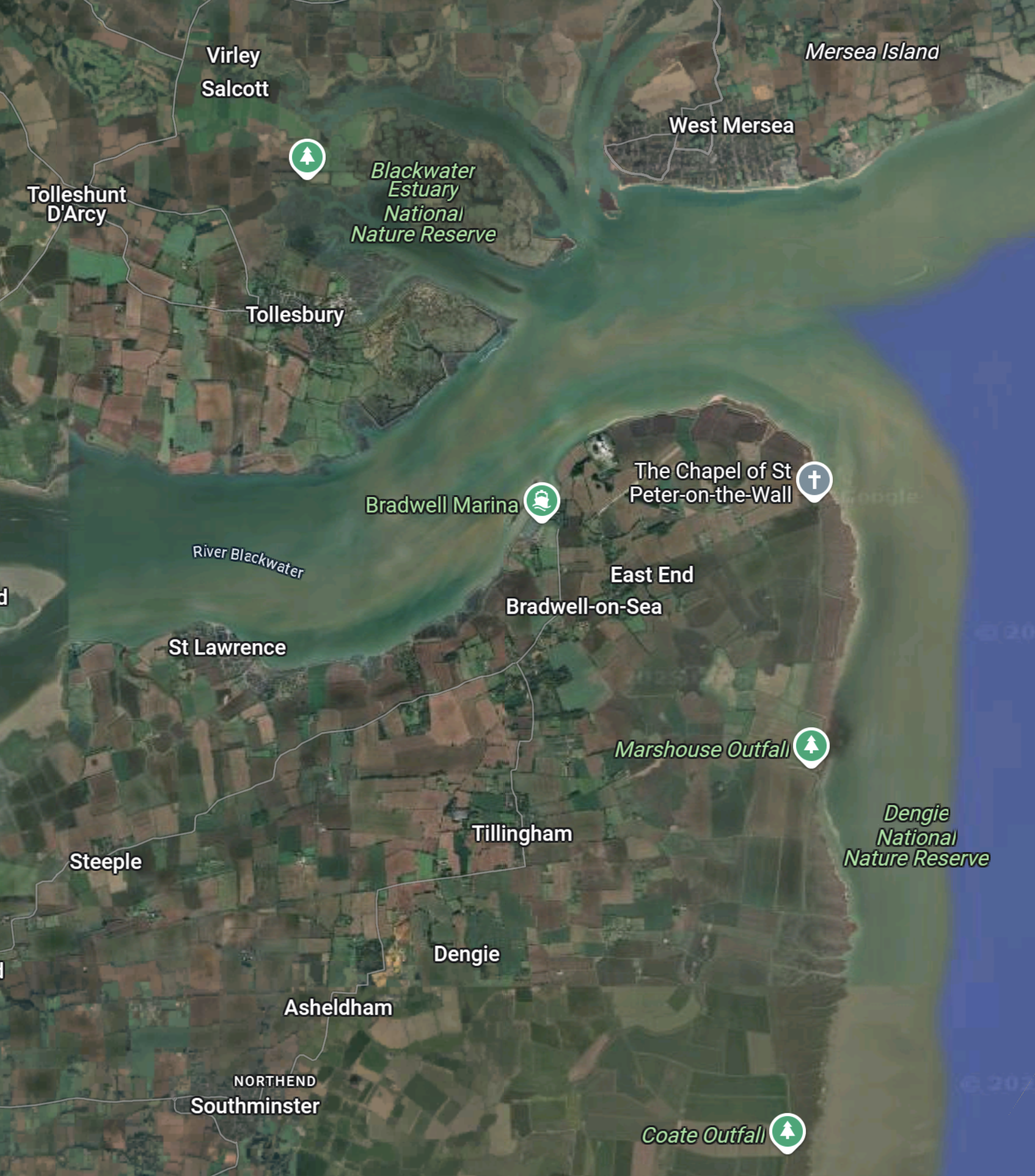
Note.
- The Blackwater Estuary is at the top of the map.
- Bradwell Marina and Bradwell-on-Sea can be seen on the map to the South of the Blackwater Estuary.
- Southminster has a rail connection, which was used to handle the nuclear fuel and now has a passenger service to Wickford on the Southend Victoria to London Liverpool Street Line.
This second Google Map shows Bradwell-on-Sea and the North of the peninsular in greater detail.
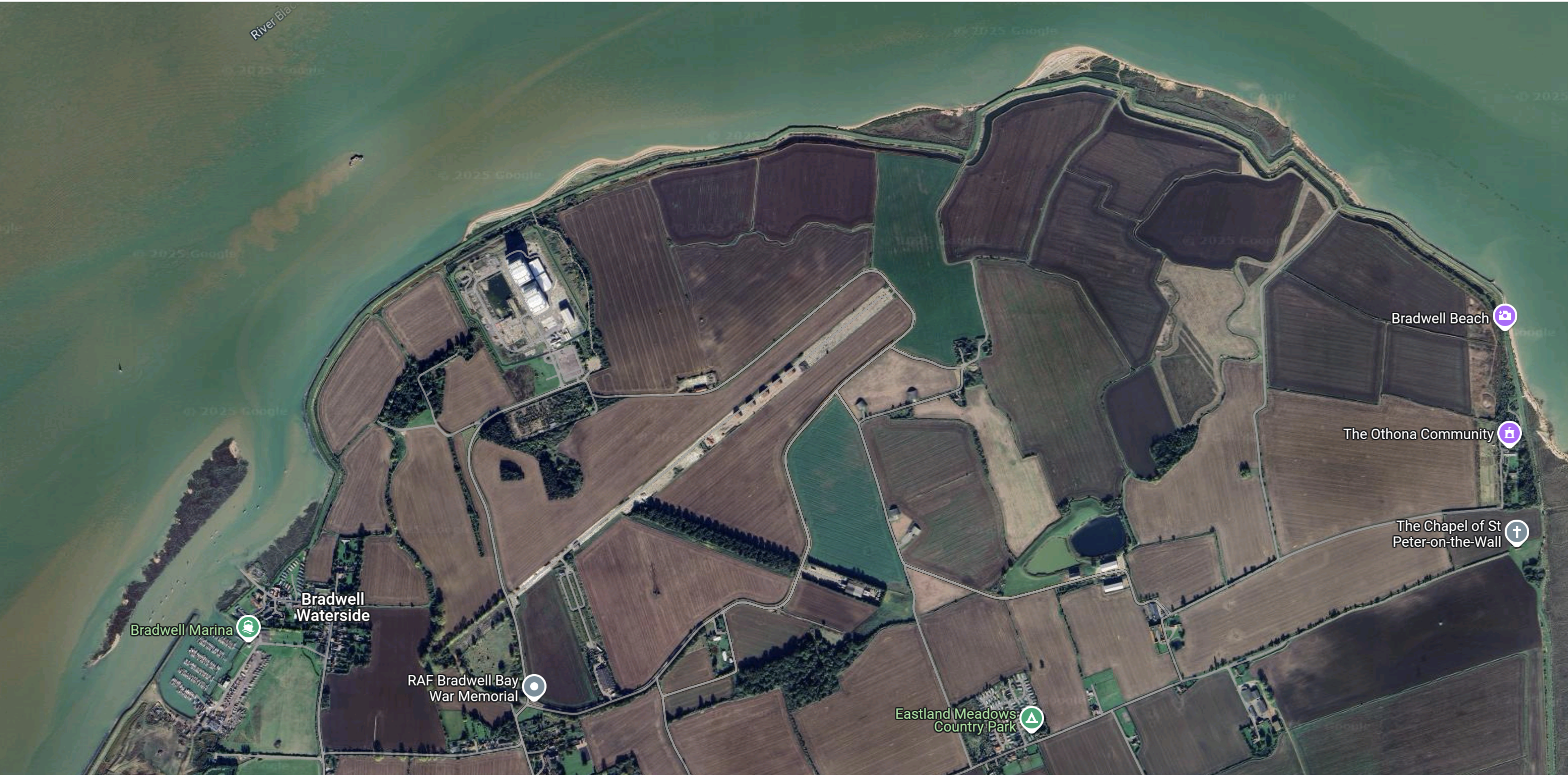
Note.
- The remains of the three runways of the Second World War RAF Bradwell Bay can be picked out.
- The remains of Bradwell A nuclear power station are towards the coast to the North-West of the former runways.
- It is large site.
I wonder, if the site could be used for backup to all the offshore wind farms in the area.
This is a list of all the wind farms, that are planned in the sea to the North and East of the Bradwell site.
- The East Anglia Array is partly operational, but could grow to as much as 7.2 GW.
- Greater Gabbard is 504 MW
- Gunfleet Sands is 172 MW
- London Array is 630 MW
- North Falls is 504 MW
Note.
- That is a total of roughly 9 GW.
- There’s also plenty of space in the sea for more turbines.
All these wind turbines will need backup for when the wind goes on strike.
These are possibilities for backup.
Another Hinckley Point C Or Sizewell C
You can see why the government wants to build a big nuke on the Bradwell site.
The 3.26 GW of a power station, which would be the size of Hinckley Point C would provide more than adequate backup.
But the builders of these power stations haven’t exactly covered themselves in glory!
- Construction of Hinckley Point C started in the late 2010s and first power is expected in 2031.
- Hinckley Point C power station has all the stink of bad project management.
- The Nimbbies would also be out in force at Bradwell.
There are also all the financial problems and those with the Chinese, indicated in The Times article.
A Fleet Of Small Modular Reactors
Hinckley Point C will hopefully be a 3260 MW nuclear power station and Rolls-Royce are saying that their small modular reactors will have a capacity of 470 MW.
Simple mathematics indicate that seven Rolls-Royce SMRs could do the same job as Hinckley Point C.
The advantages of providing this capacity with a fleet of SMRs are as follows.
- Each reactor can be built separately.
- They don’t all have to be of the same type.
- The total 3260 MW capacity could also be built at a pace, that matched the need of the wind farms.
- Building could even start with one of each of the chosen two initial types, the Government has said it will order.
- I also believe that there could be advantages in the sharing of resources.
- The rail link to Southminster would enable the bringing in of the smaller components needed for SMRs by rail.
Hopefully, the power of a big nuke could be added to the grid in a shorter time.
A Number of Long Duration Energy Stores
Highview Power is building 4 x 200 MW/2.5 GWh liquid air batteries for Orsted in the UK ; 2 in Scotland and 2 in England. They are backed by the likes of Centrica, Goldman Sachs, Rio Tinto, the Lego family trust and others.
Each GWh of liquid air needs a tank about the largest size of those used to store LNG. I suspect like LNG tanks they could be partly underground to reduce the bulk.
A Hybrid System
Bradwell is a large site and could easily accommodate a pair of Highview Power batteries, two SMRs, and all the other electrical gubbins, which would total to around 1.5 GW/5 GWh. This should be sufficient backup, but there would be space to add more batteries or SMRs as needed.
Another Headache For Fossil Fuels: Liquid Air Energy Storage
The title of this post, is the same as that of this article on Clean Technica.
This article is an honest American look at Highview Power’s liquid air batteries and a must-read.
This is the first paragraph.
Whatever happened to liquid air energy storage? The UK startup Highview Power was going to bring its new liquid air system to the US back in 2019, providing the kind of scaled-up and long duration energy storage needed to support more wind and solar power on the grid. Highview switched gears and headed back home where the grass is greener. Our loss is the UK’s gain…
They first wrote about Highview Power in 2011, which shows how long some of these projects take to come to fruition.
The article also has this view on the state of offshore wind in the United States today.
Perhaps it’s just as well that Highview dropped its US plans when it did. Offshore wind stakeholders in the US were just beginning to find their footing along the Atlantic coast when President Trump took office on January 20 and promptly sent the offshore industry into a death spiral.
If I lived in the US today, I’d thinking about leaving given Trump’s barmy energy policies.
This paragraph from Highview Power’s web site, discloses their backers.
The £300 million funding round was led by the UK Infrastructure Bank (UKIB) and the British multinational energy and services company Centrica, alongside a syndicate of investors including Rio Tinto, Goldman Sachs, KIRKBI and Mosaic Capital.
So at least some American companies believe in Highview Power. KIRKBI is the investment vehicle of the family, that invented Lego.
Eastern Green Link 2 Moves Up A Gear Using Low Carbon Fuel For Material Handling Trucks
The title of this post is the same, as that of this press release from National Grid.
These three bullet points act as sub-headings.
- Eastern Green Link 2 (EGL2), a high voltage direct current (HVDC) 436km subsea transmission cable connecting Scotland and England, is being delivered as a joint venture by National Grid Electricity Transmission and SSEN Transmission.
- Project sustainability efforts are accelerating by adopting Hydrogenated Vegetable Oil (HVO) fuelled trucks to move materials in Yorkshire.
- The introduction of HVO fuel will deliver up to 90% reduction in direct CO2 emissions.
The use of HVO fuel is good and the carbon dioxide emission savings are to be welcomed, but there is only so much of this HVO fuel available.
If hydrogen-fueled trucks were available, then this would deliver up to 100% reduction in direct CO2 emissions.
This paragraph from the press release talks about where the HVO fuel will be used.
HVO, a low-carbon biofuel made from waste vegetable oils, will be used at the Wren Hall converter station site in North Yorkshire, where 20-tonne construction trucks will transport approximately 370,000 tonnes of quarry stone from a quarry 27 miles away. This switch from conventional diesel to HVO is expected to deliver up to a 90% reduction in direct CO2 emissions and an 80% reduction in other harmful emissions such as particulate matter.
This Google Map shows the location of Wren Hall with respect to Drax power station.
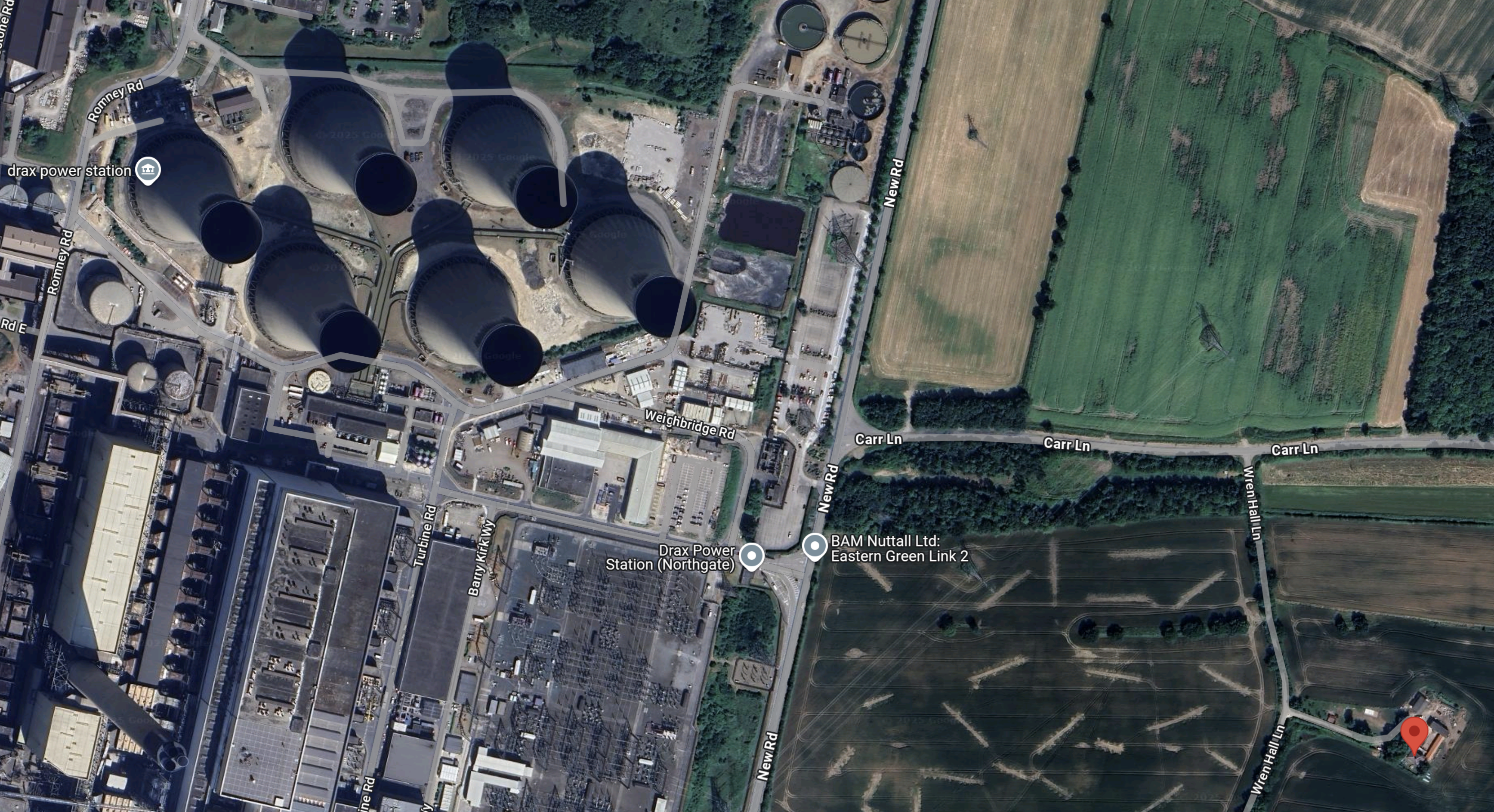
Note.
- The six large cooling towers of the Drax power station are in the North-West corner of the map.
- Google Maps indicate, where they think Wren Hall is, with a red arrow.The lane running North-South to the West of the red arrow is called Wren Hall Lane.
- There is a legend saying BAM Nuttall Ltd Eastern Green Link 2 on the opposite side of the square of lanes to the red arrow.
Click the map to show it to a larger scale.
It looks to me, that if hydrogen could be provided on the Drax site, then the 370,000 tonnes of quarry stone from a quarry 27 miles away could be brought to the site by hydrogen-powered 20-tonne construction trucks.
So how could hydrogen be provided on the Drax site?
- Drax is a 2.6 GW biomass power station, so I’m sure that some electricity could be used to generate hydrogen.
- Drax is a rail-connected site, so hydrogen could be brought in by rail.
- Depending on the amount of hydrogen needed, hydrogen could surely be brought in by road.
I feel that if hydrogen-powered 20-tonne construction trucks were available, this transfer of quarry stone could be performed carbon-free.
Conclusion
This project illustrates a problem with large infrastructure projects all over the UK.
Moving the large amounts of stone, concrete, sand and rubble into and out of construction sites generates a lot of carbon dioxide and pollution from the 20-tonne trucks employed.
If I were to be given Ed Miliband’s job of Secretary of State for Energy Security and Net Zero, one of my first actions, would be to say that all new 20 tonne construction and cement trucks would have to be zero carbon.
I suspect, that zero-carbon with trucks this size, will mean hydrogen, as the weight of the battery would destroy the mathematics of the truck.
This would obviously reduce carbon emissions, but more importantly, what would it do for the health of those working on large construction sites?
In MAN Expands Its Zero-Emission Portfolio, I show MAN’s heavy hydrogen trucks.
This is an articulated heavy hydrogen truck.

I’m sure that MAN could build a hydrogen-powered 20-tonne construction truck.
In Cummins Agrees To Integrate Its Hydrogen ICE Technology Into Terex® Advance Trucks, I talk about the solution to the cement truck problem.
This is a side view of the top-of-the-range monster.

Note.
- Front is to the right.
- I suspect the driver doesn’t have to get out of the cab to discharge the concrete.
- The engine is at the rear with vertical exhausts.
- All axles are driven.
You’d certainly notice one of these if they were to be used in the City of London.
And this is the baby of the range.

Three axles is normal for the UK. so I wonder if this machine will ever make it across the pond.
This last paragraph in the original article describes the X15H hydrogen internal combustion engine.
The X15H was showcased at the Advanced Clean Transportation (ACT) Expo in May (2023), along with its hydrogen ICE-powered concept truck. The X15H features a 700-bar pressure 80kg capacity hydrogen storage system and a range of more than 500 miles, with up to 500 horsepower.
Could one of these trucks really deliver ready-mix concrete from London to Manchester and return?
The trucks would appear to be available, so let’s get a few over and try them out.
Incidentally, if someone had told me ten years ago, there would be rear-wheel drive trucks like Volkswagen Beetles, I’d have said they were wrong in no uncertain terms.
The Wren Hall substation would appear to be an ideal trial project for hydrogen-powered construction trucks and cement trucks.
AI Forecast To Fuel Doubling In Data Centre Electricity Demand By 2030
The title of this post, is the same as that as this article in The Times.
This is the sub-heading.
International Energy Agency predicts that artificial intelligence could help reduce total greenhouse gas emissions
These are the first two paragraphs.
Data centres will use more than twice as much electricity by 2030 than they do today as artificial intelligence drives demand, the International Energy Agency predicts.
The agency forecast that all data centres globally will use about 945 terawatt-hours of electricity each year by 2030, roughly three times as much as the UK’s total annual demand of 317 terawatt-hours in 2023.
I am very much an optimist, that here in the UK, we will be able to satisfy demand for the generation and distribution of electricity.
- Our seas can accommodate enough wind turbines to provide the baseload of electricity we will need.
- Roofs and fields will be covered in solar panels.
- SSE seem to be getting their act together with pumped storage hydro in Scotland.
- I am confident, that new energy storage technologies like Highview Power with the packing of companies like Centrica, Goldman Sachs, Rio Tinto and others will come good, in providing power, when the wind doesn’t blow and the sun doesn’t shine.
- Hopefully, Hinckley Point C and Sizewell C will be online and soon to be joined by the first of the new small modular nuclear reactors.
- Hopefully, Mersey Tidal Power will be operating.
- There will be innovative ideas like heata from Centrica’s research. The economical water heater even made BBC’s One Show last week.
The only problem will be the Nimbies.
 The Anonymous Widower