Q4 2023 Sees Largest Quarterly Increase In Battery Energy Storage
The title of this post, is the same as that of this article on Solar Power Portal.
These three paragraphs outline the story.
Energy research consultancy Modo Energy has confirmed that Q4 2023 saw 420MW of new battery energy storage capacity become commercially operational.
This new capacity represents a 13% increase on the previous quarter and, in doing so, becomes the largest ever quarterly increase in operating battery capacity in GB. The previous record was set in Q2 2023 when 413MW was added.
It is worth noting that the additional capacity now means that GB’s operational grid-scale battery energy storage capacity has now reached 4.6GWh. Modo also confirmed that 1.5GW of battery storage was added across 2023 – a record for a one-year period.
Note.
- Modo Energy has a web site.
- Hinckley Point C has a nameplate capacity 3.26 GW.
- The article also says that the average duration of battery storage in GB is now 1.3 hours.
Strangely, this gives a BESS total storage capacity of 4.55 GWh, which is half the capacity of Electric Mountain.
Exagen Given Green light for new 500MW / 1GWh Battery Storage Project In Leicestershire
The title of this post is the same as that of this article on PV Magazine.
This is the outline of the project, which will be called the Normanton Energy Reserve.
The new 500MW / 1GWh battery site will be capable of powering 235,000 homes for two hours, equivalent to 80% of the homes in Leicestershire.
Approximately 45% of the 19-acre site will be set aside to improve biodiversity by extending Normanton Millennium Wood and creating wildflower meadows. The project will deliver more than 25% biodiversity net gain.
Exagen will establish a circa £4M community fund to spend on improvements in the local area, with residents consulted on how the fund is used.
Note.
- A 500MW / 1GWh battery is not small.
- The size probably makes it a good backup for Leicestershire.
- Nineteen acres is a 277 metre square.
- Any biodiversity net gain is worthwhile.
- A £4M community fund is not to be sneezed at.
It all sounds very good.
Normanton Wood has a web site, where this is said on the home page.
Normanton Wood is one of The Woodland Trust’s ‘Woods on Your Doorstep’ woodlands created to commemorate the Millennium. It lies near Earl Shilton Leicestershire and was planted by members of the local community.
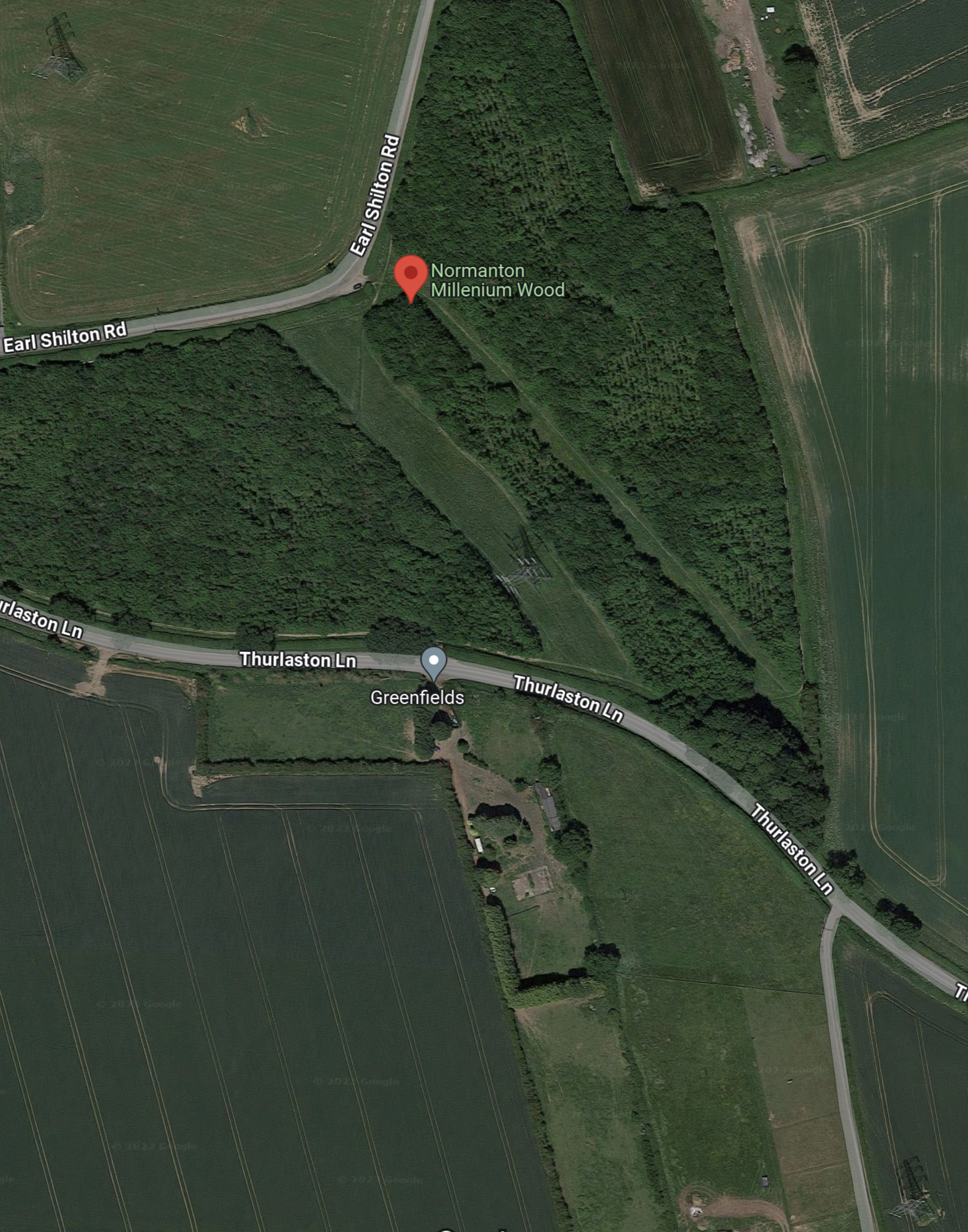
This Google map shows the wood.
Note.
- The red arrow indicates Normanton Millennium Wood.
- I suspect that cleared space in the woodland leading South-East from the red arrow is about 300 metres long and 15 metres wide, which is about 1.1 acres
- As Normanton Millennium Wood is 16.75 acres, I suspect it includes all the woodland to the East of the red arrow, up to the cultivated farmland.
- If you look carefully, you can see a large electricity pylon in the wider cleared area, to the South of the red arrow.
- When I created this map, I clipped it so that the next pylons to the North-West and South-East were in the respective corners of the map.
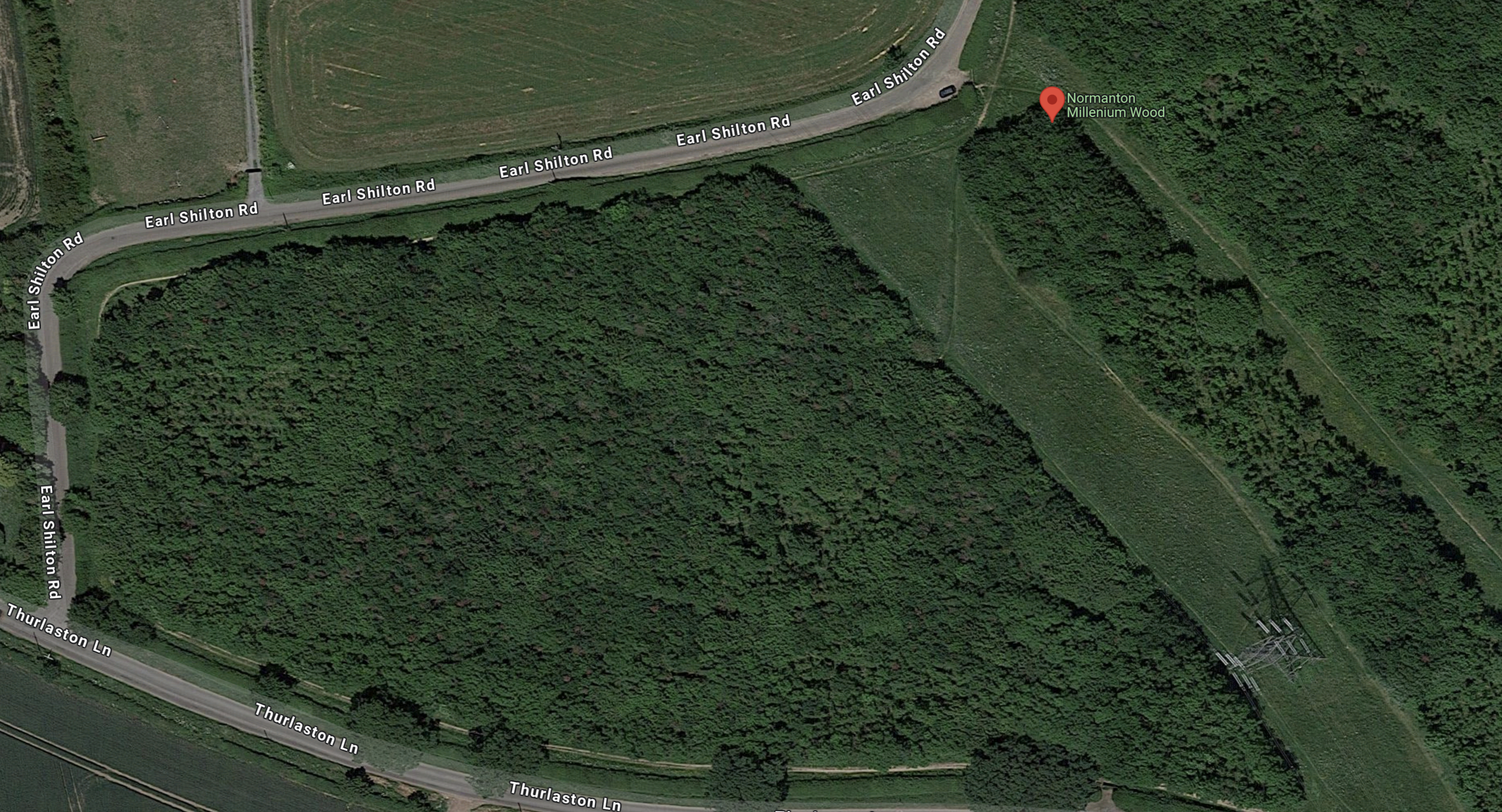
This second map shows the land to the West of the red arrow, which is enclosed by the roads.
Note.
- As before the red arrow indicates Normanton Millennium Wood.
- The electricity pylon is clearly visible on the cleared strip.
- The land to the East of the cleared strip looks like its been planted with trees in the last decade or so.
- The land to the West of the cleared strip looks more like scrub, that has grown up after years of neglect.
- I estimate that the area of the cleared strip and the scrub, is around nineteen acres.
- This news story from Exagen, is entitled Woodland Planting At Normanton Energy Reserve – Becca Leake is a must-read as it outlines how woodland will be planted at the site.
As there is no local substation, it looks to me, that a new substation will be built close to the electricity pylon, with the battery to its West.
Conclusion
It seems a good design for a large battery site, which will be shielded from neighbours by a large area of woodland.
I am also sure, that this battery and the one talked about in New Octopus Energy Makes First Investment To Develop UK’s Largest Battery, are the same battery.
All the numbers in both articles are identical.
World’s First Floating Wind Farm To Undergo First Major Maintenance Campaign, Turbines To Be Towed To Norwegian Port
The title of this post, is the same as that of this article on offshoreWIND.biz.
This is the sub-heading.
The world’s first commercial-scale floating wind farm, the 30 MW Hywind Scotland, officially entered the operations and maintenance (O&M) phase in October 2017. After a little over six years of operation, the wind farm’s Siemens Gamesa wind turbines are now due for some major maintenance work.
And this is the first paragraph.
While offshore wind farms undergo turbine maintenance work more than once during their lifespans and tasks such as major component exchange are nothing uncommon, this is the first time a campaign of this kind will be done on a floating farm.
Hywind Scotland has a web site, where this is said on the home page.
The world’s first floating wind farm, the 30 MW Hywind Scotland pilot park, has been in operation since 2017, demonstrating the feasibility of floating wind farms that could be ten times larger.
Equinor and partner Masdar invested NOK 2 billion to realise Hywind Scotland, achieving a 60-70% cost reduction compared with the Hywind Demo project in Norway. Hywind Scotland started producing electricity in October 2017.
Each year since Hywind Scotland started production the floating wind farm has achieved the highest average capacity factor of all UK offshore windfarms, proving the potential of floating offshore wind farms.
This news item from Equinor is entitled Equinor Marks 5 Years Of Operations At World’s First Floating Wind Farm, says this about the capacity factor of Hywind Scotland.
Hywind Scotland, located off the coast of Peterhead, Scotland, is the world’s first floating offshore wind farm and the world’s best-performing offshore wind farm, achieving a capacity factor of 54% over its five years of operations. Importantly, Hywind Scotland has run to high safety standards, marking five years of no loss time injuries during its operation.
Any capacity factor over 50 % is excellent and is to be welcomed.
Maintaining A Floating Wind Farm
One of the supposed advantages of floating wind farms, is that the turbines can be towed into port for maintenance.
This first major maintenance of a floating wind farm, will test that theory and hopefully provide some spectacular pictures.
Wales Puts Another Pumped Storage Hydroelectric Power Station Into Play
This page on World Energy is entitled Fortune Hydro AG and Voith Acquire 450 MW Dorothea Lakes Pump Storage.
This paragraph introduced the article.
Fortune Hydro AG, in collaboration with Voith Small Hydro, has acquired the 450 MW Dorothea Lakes Pump Storage project as part of an £800 million (US$1 billion) strategic investment in renewable energy in the UK.
It looks to me that this was a good buy in July 2023, as after last week, when I wrote Price Framework Paves Way For Vast Electricity Storage Scheme, in response to a UK Government announcement about funding pumped storage hydroelectricity.
These two paragraphs give more details of the project.
Located in Snowdonia, Northern Wales, this green storage facility presents a unique opportunity to integrate wind, solar and hydroelectric power, Fortune Hydro said. The Dorothea Lakes site was one of the largest slate quarries in Europe and the largest in North Wales.
Electricity produced by solar and wind during low demand can be stored until demand is there. This storage allows balancing of the production cycle in the large solar and wind farms in the north against the demand cycle of consumers and businesses in central and southern UK. It will generate up to 600 jobs and bring economic development and new business opportunities to the local community, the company said.
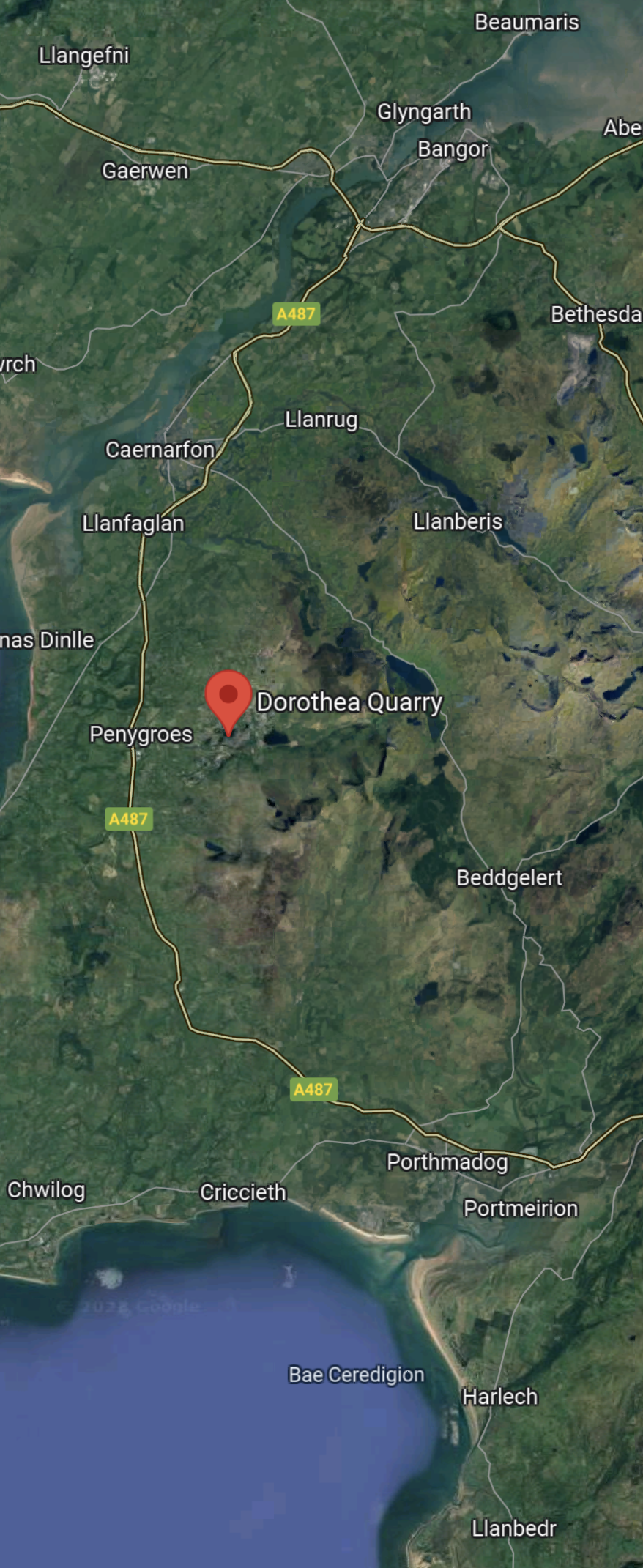
This map shows the location of Dorothea Lakes.
Note.
- Dorothea Lakes is indicated by the red arrow.
- The Menai Strait between Bangor and Caernarfon is at the top of the map.
- It is certainly in a convenient place, with all the wind farms off the North Wales Coast.
At 450 MW, it’s about a third the size of Electric Mountain, so I suspect it could hold about 3 GWh of electricity.
UK Offshore Wind In 2030 – Calculated January 2024
With the election coming up in the next year, I thought I’d add how much offshore wind will be available in the next few years.
In October 2023, according to this Wikipedia entry, there were offshore wind farms consisting of 2,695 turbines with a combined capacity of 14,703 megawatts.
These wind farms are due to be commissioned between now and the end of 2030.
- Dogger Bank A – 1235 MW – 2023
- Neart Na Gaoithe – 450 MW – 2024
- Dogger Bank B – 1235 MW – 2024
- Forthwind – 12 MW – 2024
- Moray West – 882 MW – 2025
- Dogger Bank C – 1218 MW – 2025
- Sofia Offshore Wind Farm – 1400 MW – 2026
- East Anglia 3 – 1372 MW – 2026
- East Anglia One North – 800 MW – 2026
- East Anglia Two – 900 MW – 2026
- Pentland – 100 MW – 2026 – Floating
- Hornsea Three – 2852 MW – 2027
- Norfolk Boreas, Phase 1 – 1380 MW – 2027
- Llŷr 1 – 100 MW – 2027 – Floating
- Llŷr 2 – 100 MW – 2027 – Floating
- Whitecross – 100 MW – 2027 – Floating
- Morecambe – 480 MW – 2028
- Bellrock – 1200 MW – 2028 – Floating
- Mona – 1500 MW – 2029
- Morgan – 1500 MW – 2029
- West of Orkney – 2000 MW – 2029
- Rampion 2 Extension – 1200 MW – 2030
- Norfolk Vanguard East – 1380 MW – 2030
- Morven – 2907 MW – 2030
- Norfolk Vanguard West – 1380 MW – 2030
- Berwick Bank – 4100 MW – 2030
- Outer Dowsing – 1500 MW – 2030
- Broadshore – 900 MW – 2028 – Floating
- Caledonia – 2000 MW – 2030
- Stromar – 1000 MW – 2028 – Floating
- N3 Project – 495 MW – 2030
- Muir Mhòr – 798 MW – 2030 – Floating
- North Falls – 504 MW – 2030
- Spiorad na Mara – 840 MW – 2031
- Bowdun – 1008 MW – 2033
- Ayre – 1008 MW – 2033 – Floating
- Buchan – 960 MW – 2033 – Floating
These can give these totals for the next few years.
- 2023 – 14.70 GW
- 2024 – 17.64 GW
- 2025 19.74 GW
- 2026 – 24.31 GW
- 2027 – 28.81 GW
- 2028 – 32.39 GW
- 2029 – 37.39 GW
- 2030 – 53.65 GW
- 2031 – 54.50 GW
- 2032 – 54.50 GW
- 2033 – 57.47 GW
Note.
- The Government’s 50 GW target of offshore wind power by 2030 has been achieved.
- A total of 7.27 GW of floating wind power has been installed.
- The Government’s target of 5 GW of floating offshore wind power by 2030 has also been achieved.
Currently, the UK is generating 37.49 GW of electricity.
Price Framework Paves Way For Vast Electricity Storage Scheme
The title of this post, is the same as that of this article on The Times.
This is the sub-heading.
SSE welcomes step forward in plans to build the £1.5bn Coire Glas hydroelectric project
These two paragraphs outline the article.
Ministers have provisionally agreed to a power pricing framework that could pave the way for more pumped storage hydroelectricity projects in Britain, including a gigantic £1.5 billion scheme from SSE that is starting to take shape in the Scottish Highlands.
The Department for Energy Security and Net Zero said it intended to develop a “cap and floor” pricing mechanism that would advance the Coire Glas storage project being developed by SSE, the energy company, and could unlock further pumped storage power stations.
Coire Glas will be one of the largest renewable power projects ever built in the UK.
- It will have a power output of 1.5 GW, which is comparable with some of the large wind farms in the North Sea or four gas-fired power station or Rolls-Royce SMRs.
- It will be able to store 30 GWh of electricity and provide 1.5 GW for twenty hours.
- Coire Glas has a web site.
- Coire Glas will more than double pumped storage hydroelectric capacity in the UK.
Bath County Pumped Storage Station in Virginia, US claims to be the world’s largest battery, but Coire Glas will be able to store more electricity.
You wait decades for one of these monsters to come along in the UK and SSE also have another on the way.
- Loch Sloy hydroelectric power station is the largest conventional hydroelectric power station in the UK.
- It has an output of 152 MW.
- It opened in 1950 and was largely built by German and Italian prisoners-of-war.
SSE plan to convert Loch Sloy power station into a pumped storage hydroelectric power station.
- It will be able to store 25 GWh of electricity.
- Loch Sloy will be the upper lake.
- Loch Lomond will be the lower lake.
- The existing dam, upper lake, pipes and powerhouse will be retained.
- The developments have a web page.
The project is aimed at a commissioning date of 2028.
This paragraph explains how the ‘cap and floor’ mechanism works.
In the scheme, operators would be guaranteed a minimum level of revenue, while consumers would be protected by a price ceiling, above which surplus revenue would be returned to them.
And these two paragraphs give SSE’s reaction.
Finlay McCutcheon, 46, director of onshore Europe at SSE, said the pricing framework was welcome news. He said that a deal for Coire Glas was needed by the end of this year to secure a firm investment decision by early 2026. Planning for the project started in 2007.
“Given the time taken to reach this point, much work is now needed to ensure an effective mechanism is finalised and put in place as early as possible to enable Coire Glas to take final investment decisions and move into construction,” he said.
I believe that the negotiations between the Government and SSE will lead to a monster on Loch Lochy and another one on Loch Lomond.
Conclusion
There are also these pumped storage hydroelectric schemes under development.
- Balliemeanoch Pumped Hydro – 1.5 GW/45 GWh
- Balmacaan Pumped Hydro – 600 MW/15-20 GWh
- Corrievarkie Pumped Hydro – 1.5 GW/14.5 GWh
- Fearna Pumped Hydro – 1.8 GW/37 GWh
- Glenmuckloch Pumped Hydro – 400 MW/1.6 GWh
- Loch Earba Pumped Storage Hydro – 900MW/33 GWh
- Loch Kemp Pumped Storage Hydro – 300MW/9 GWh
- Loch Na Cargeach/Red John Pumped Storage Hydro – 450 MW/2.8 GWh
These total up to 7.4 GW/100+ GWh.
This page on the Strathclyde University web site, gives these GWh figures for the possible amounts of pumped-storage that can be added to existing schemes.
- Errochty – 16
- Glasgarnock – 23
- Luichart – 38
- Clunie – 40
- Fannich – 70
- Rannoch – 41
- Fasnakyle – 78
- Tummel – 38
- Ben Lawers – 12
- Nant – 48
- Invermoriston – 22
- Invergarry – 41
- Quoich – 27
- Sloy – 20
That is a total of 514 GWh.
Scotland will be the Saudi Arabia of energy storage.
Japanese Offshore Wind And Battery Storage Project Begins Commercial Operation
The title of this post, is the same as that of this article on offshoreWIND.biz.
This is the sub-heading.
On 1 January 2024, JERA and Green Power Investment Corporation (GPI) began commercial operations at the 112 MW Ishikari Bay New Port Offshore Wind Farm in Japan, which they own through Green Power Ishikari GK, a special-purpose corporation (SPC).
The most significant thing about this wind farm, is that it has been designed from Day One to operate with a battery, which is detailed in the last paragraph.
The project also features a battery storage component with 100 MW x 180 MWh of capacity.
Note that the output of the battery is 89 % of that of the wind farm. Is that the ideal ratio between battery and wind farm capacities?
Conclusion
Because of my training, as an Electronics and Control Engineer, I belief that most renewable energy can be smoothed with the adding of a battery.
Aker Solutions To Pilot Floating-Wind Power Hub
The title of this post, is the same as that of this press release from Aker Solutions.
This is the sub-heading.
Aker Solutions to pilot world’s first subsea power distribution system for floating offshore wind at Norway´s METCentre
These four paragraphs describe the system and explain how it works.
Note.
Aker Solutions has signed a front-end engineering and design (FEED) contract with the Marine Energy Test Centre (METCentre) in Norway to pilot new subsea power system technology which has the potential to significantly reduce the costs and complexity of offshore wind farms.
The project will see Aker Solutions provide new power transmission technology, Subsea Collector, for the METCentre’s offshore wind test area which today consists of two floating offshore wind turbines located 10 kilometers off the southwestern coast of Karmøy, Norway. The test area will expand to seven floating offshore wind turbines from 2026.
Subsea Collector provides an alternative solution to connect multiple wind turbines electrically in a star configuration instead of the traditional daisy chain pattern, allowing for more flexibility in offshore wind farm architecture and construction. The design also allows for reduced cable length per turbine and park, as well as less vessel time and installation costs. Initial findings support total cost savings on a 1GW floating wind farm of up to 10 percent.
The main component parts of the Subsea Collector comprise a 66kV wet mate connection system provided by Benestad and subsea switchgear with supervisory control and data acquisition by subsea power and automation alliance partner, ABB. Installation will be carried out by Windstaller Alliance, an alliance between Aker Solutions, DeepOcean and Solstad Offshore. Aker Solutions will also provide the static export cable to shore.
Total cost savings of ten percent on any large project are not to be sneezed at.
I also feel that this sort of architecture will be ideal for a test centre, where configurations are probably changed more often.
Offshore Wind Turbines In 2023: 16 MW Model Installed Offshore, 18 MW WTGs Selected For New Project, 22 MW Turbine Announced
The title of this post, is the same as that of this article on offshoreWIND.biz.
This is the sub-heading.
The biggest wind turbines also make for some of the biggest news on offshoreWIND.biz. In 2023, wind turbine OEMs continued making headlines with their models in development and on the path to commercialisation, and by announcing brand new wind turbine generators (WTGs) that further raise the bar in generation capacity and size. Here, we are bringing an overview of the biggest and most powerful wind turbines we reported about in 2023.
This is the first paragraph.
Some of the wind turbines from our lookback article from a year ago, which were announced or launched in 2022, have now advanced to being installed offshore and/or are already being selected for commercial offshore wind projects that are planned to be built in the not-so-distant future.
Offshore wind turbines are certainly getting larger.
- The Chinese seem to be leading the way with turbines that produce over 20 MW, but European and US manufacturers appear to be looking at 16-18 MW.
- This compares with typical farms commissioned in the last few years of about 13-14 MW, which is roughly a 26 % increase in size.
- In Crown Estate Mulls Adding 4 GW Of Capacity From Existing Offshore Wind Projects, I talk about how bigger turbine sizes could be increased in wind farms, that are being planned.
I feel the UK, could benefit from this increase in wind turbine size.

