House Sitting With Ocado
I like animals and I miss having cats, dogs and horses around.
I particularly miss our stallion ; Vague Shot, who had a nickname of Cyril. When I was feeling down, he always had time for a chat and a cuddle.
It may seem strange, but when C died, Cyril was the first I told. But then as he was a stallion, the stud was his personal domain. Hence his understanding.
Recently, I’ve taken to doing my shopping at Ocado, which means that my coeliac disease, is not a problem, if Ocado deliver.
I had thought about house and pet sitting before, but my coeliac disease and the fact I don’t drive seemed to end discussions.
So I think, I’m going to do a bit of house and small pet sitting, mainly to get a welcome change of scenery. I’ll leave the logistics to Ocado.
Consider.
- I have no pets myself.
- I am a non-smoker.
- I am more or less tee-total these days.
- I have no children or grandchildren under 23.
- I will tell Ocado, as I have no connection with them, except as a customer, who uses their services regularly.
What do my readers think?
I’ve Got Uncomplicated Pancolonic Diverticular Disease
No doctor or anybody else for that matter seems at all bothered.
I did ask Dr. Google, if there was a link between pancolonic diverticular disease and coeliac disease and this paper entitled Prevalance Of Celiac Disease In Subjects With Diverticular Disease Of The Colon was indicated.
This was the conclusion of the researchers.
The results show an inverse relationship between
diverticular disease of the colon and celiac disease. These data
support that the presence of celiac antibodies may have a
preventive role in the development of colon diverticular disease.
The mechanism of the presented finding is still unclear. More
research is needed.
I can accept that conclusion.
Click this link to see what the NHS says about Diverticular Disease and Diverticulitis.
It’s not very helpful, but just a bit frightening.
Could it be, that my strong immune system is protecting me?
I have a few extra thoughts.
Living With Uncomplicated Pancolonic Diverticular Disease
I have now been living with Uncomplicated Pancolonic Diverticular Disease for around six months.
But I don’t feel that much different to say, when I was 18, 50 or 70.
In the mid-1990s, I was diagnosed as a coeliac using the new genetic test, in a couple of days between blood test and letter on the mat. So surely, at fifty, I must have had coeliac antibodies in my blood.
I asked Dr. Google how the standard coeliac test worked and got this reply.
The standard coeliac disease test involves a two-step process: blood tests to detect antibodies, followed by an intestinal biopsy to confirm the diagnosis. The blood test looks for specific antibodies produced when the body reacts to gluten, while the biopsy examines a tissue sample from the small intestine for damage characteristic of coeliac disease.
My excellent now-retired GP, told me, that the antibodies test was usually all that was needed.
So have I had coeliac antibodies in my blood, virtually all my life and have these played a preventive role in the development of colon diverticular disease?
So was I protected from a disease with a long and complicated name, by another disease, I didn’t know that I had?
Using AI To Inveestigate Uncomplicated Pancolonic Diverticular Disease
I have been impressed by th answers Google has given for other things using AI, so I’ve been asking a few questions on uncomplicated pancolonic diverticular disease.
Question: Does Uncomplicated Pancolonic Diverticular Disease Make You Want To Poo?
AI Overview
Yes, uncomplicated pancolonic diverticular disease, also known as Symptomatic Uncomplicated Diverticular Disease (SUDD), can cause a change in bowel habits, which may include a feeling of needing to poo. This change can manifest as constipation or diarrhea, or a pattern of constipation followed by diarrhea.
From personal experience I’ll go along with that.
Question: Does Uncomplicated Pancolonic Diverticular Disease Make You Want To Drink More Fluids?
AI Overview
Yes, individuals with uncomplicated pancolonic diverticular disease are often advised to increase their fluid intake. This is because adequate hydration helps soften stools, which can ease the passage of waste and reduce strain on the inflamed colon. Additionally, when experiencing a flare-up of diverticulitis, it’s common to be placed on a liquid diet to allow the colon to rest and heal, further emphasizing the importance of staying hydrated.
No doctor has told me to drink more fluids or suggested I go on a liquid diet. But I do drink a lot of fluids, including two or three bottles of low-alcohol beer per day.
Question: Is Uncomplicated Pancolonic Diverticular Disease Helped By A Gluten-Free Diet?
AI Overview
A gluten-free diet is not specifically recommended or beneficial for uncomplicated pancolonic diverticular disease. While a high-fiber diet is generally recommended to manage and prevent diverticular disease, there’s no evidence to suggest that eliminating gluten from the diet provides any particular advantage.
As I am coeliac, I’m on a strict gluten-free diet anyway, and have been for the last thirty years.
I’m not particularly on a high fibre diet, but an experienced dietician told me to eat a small can of beans a week to lower my cloresterol levels. And it worked!
But from what I found earlier, it does appear that coeliac disease does help to protect you from uncomplicated pancolonic diverticular disease.
Question: Is Uncomplicated Pancolonic Diverticular Disease Helped By Five Portions Of Fruit And Vegetables Per Day?
AI Overview
Yes, eating five portions of fruits and vegetables per day is generally recommended for individuals with uncomplicated pancolonic diverticular disease, as part of a balanced, high-fiber diet. This dietary approach can help to soften stools, reduce the risk of constipation and straining, and potentially prevent further complications.
I try to stick to a diet like this with a lot of non-alcoholic fluids.
Question: Is Uncomplicated Pancolonic Diverticular Disease Linked To Gallstones?
AI Overview
Yes, there is evidence suggesting a link between diverticular disease of the colon and gallstones, with some studies indicating a higher prevalence of gallstones in individuals with diverticular disease. Specifically, one study found that 45% of patients with diverticular disease had gallstones, compared to 22% in a control group, though this difference was only statistically significant in women.
I had gallstones and I described their removal in Goodbye To My Gallstones.
As the answer mentioned women and coeliac disease is more common, in the female of the species, I wonder if that accounts for the results quoted in the AI Overview.
Thousands Of Lobsters Settle At Triton Knoll Offshore Wind Farm
The title of this post, is the same as that of this article on offshoreWIND.biz.
This is the sub-heading.
RWE and the Whitby Lobster Hatchery have released 2,500 juvenile lobsters at the Triton Knoll offshore wind farm in the UK in what the wind farm developer says is an industry-first project, through which more than 15,000 lobsters are planned to be released at Triton Knoll.
These are the first two paragraphs.
The first batch of 2,500 juvenile lobsters was settled at the offshore wind farm in November and a further 2,500 are expected to arrive at the site early next year.
According to RWE, which said last month that the project’s goal was to help increase biodiversity in the North Sea, there is the potential for a further 10,000 lobsters to be released over the next two years, in 2025 and 2026.
The objective seems to be to introduce 100,00 juvenile lobsters into the sea.
Do Coeliacs Like Ocado?
I have been doing most of my food and grocery shopping with Ocado for a few months now!
My first shop was on the 16th of August this year and I have now done a total of fourteen shops.
What is interesting, is that all substitutions made by Ocado has involved products that are gluten-free.
So do coelics and those on a gluten-free diet use Ocado a lot?
That would explain why gluten-free products run out more often. This also applies to products that don’t have a gluten-free label, but are known to be gluten-free from the ingredients.
Drinking And Me
Today, I got up at five and was able to drink my morning cup of tea very quickly.
In fact, I’ve been drinking cups of tea all day at a fast speed.
I’ve also drunk two bottles of Adnams 2.5 % alcohol Ghost Ship beer at a fast pace.
But on other days, I pour a lot away, as I just can’t force it down.
Is it the weather, as it is rather unusual today?
The Americans Who Think RFK Can Make Them Healthy Again
The title of this post, is the same as that as this article in The Times.
This is the sub-heading.
They are poor, sick, jobless and trust no one. But people in one of the most deprived parts of the US are putting their faith in a man who doesn’t believe in vaccines
These three paragraphs introduce the article.
The phone signal vanishes as you drive over the ridge into the purple valley and down to the town of Paw Paw, West Virginia, population 410.
Being born here deals a person a certain hand. A life six years shorter on average than those from California. A likelihood that you’ll be poor and suffer from disease (one in three adults here have a disability).
A high chance of addiction from the opioid epidemic that was brought here by rapacious pharmaceutical companies that has left the valley peppered with children brought up by grandparents.
It is a powerful piece from Louise Callaghan.
These are my thoughts.
As a coeliac myself, I do wonder if there is an epidemic of coeliac disease in Paw Paw.
Coeliac disease is genetic, so once it gets in a close community, it can spread through marriage and childbirth.
My coeliac disease came from my father, who was never diagnosed, but he got it through the generations from his great-great-grandfather, who was a tailor from Konigsberg in East Prussia.
If a coeliac is going to a country, where gluten-free foods are unavailable, they are advised by doctors to take steroids like Dexamethasone. American doctors regularly prescribe this steroid to coeliac patients, as it does work to a certain extent.
Everybody in Paw Paw should be tested for coeliac disease and those with the disease should go on a gluten-free diet.
But I suspect a plan like this wouldn’t go down well in Paw Paw.
First Commercial-Scale Seaweed Farm Between Wind Turbines Fully Operational In Netherlands
The title of this post, is the same as that of this article on offshoreWIND.biz.
This is the sub-heading.
The world’s first commercial-scale seaweed farm within the Hollandse Kust Zuid offshore wind farm in the Netherlands is fully operational.
These initial three paragraphs fill out the details.
According to the non-profit organisation North Sea Farmers (NSF), the final deployment step was completed one week ago by deploying the seeded substrate.
North Sea Farm 1, initiated by NSF with funding from Amazon’s Right Now Climate Fund, is a floating farm located in the open space between wind turbines where seaweed production can be tested and improved.
The seaweed farm is located within the Hollandse Kust Zuid wind farm, nearly 22 kilometres off the coast of Scheveningen. The 1.5 GW project is owned by Vattenfall, BASF, and Allianz.
I find this an interesting concept.
I can remember reading in the Meccano Magazine in the 1950s, about the production of alginates from seaweed in Scotland.
Surprisingly, Wikipedia has very little on alginates, except for this illuminating Wikipedia entry for alginic acid.
This is the opening paragraph.
Alginic acid, also called algin, is a naturally occurring, edible polysaccharide found in brown algae. It is hydrophilic and forms a viscous gum when hydrated. When the alginic acid binds with sodium and calcium ions, the resulting salts are known as alginates. Its colour ranges from white to yellowish-brown. It is sold in filamentous, granular, or powdered forms.
But it does appear that the Scottish production of alginates is very much of the past. Unless someone else can enlighten me!
Perhaps Scottish seaweed farming can be revived to produce alginates, which appear to have a surprising number of uses, as this section of the Wikipedia entry shows.
Alginates do appear to be remarkably useful.
These are a few uses.
- As of 2022 alginate had become one of the most preferred materials as an abundant natural biopolymer.
- Sodium alginate is mixed with soybean protein to make meat analogue.
- They are an ingredient of Gaviscon and other pharmaceuticals.
- Sodium alginate is used as an impression-making material in dentistry, prosthetics, lifecasting, and for creating positives for small-scale casting.
- Sodium alginate is used in reactive dye printing and as a thickener for reactive dyes in textile screen-printing.
- Calcium alginate is used in different types of medical products, including skin wound dressings to promote healing,
Alginates seem to have some rather useful properties.
Four years ago, I tripped over in my bedroom, which I wrote about in An Accident In My Bedroom. I wonder if the Royal London Hospital used calcium alginate skin dressings to restore my hand to its current condition.



Paul Daniels would have said, “It’s magic!”
In the future these dressings may be produced from UK-produced seaweed.
Marks & Spencer Get A Bit Cheeky
I bought these strawberries in Marks and Spencer on Moorgate, yesterday.

Note.
- They have a Best Before Date of Thursday.
- They were grown in West Sussex by the Summer Berry Co.
But I do think it is a bit cheeky to label them with a yellow label saying “New Season”!
Their web site gives a few answers.
A Simple Late Lunch
I’ve just had one of my typical late lunches.

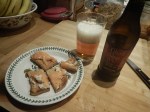


It was one parcel of Marks and Spencer’s smoked salmon pate on toast, washed down with a half-litre bottle of Adnams Ghost Ship 0.5 % beer.
O’ll probably have the second parcel of salmon for lunch tomorrow.
More Mushroom Management On TfL Buses
After my experience in Mushroom Management On TfL Buses, I’ve changed my weekend breakfast routine at weekends, to one where on Saturdays and Sundays, I eat breakfast in London’s poshest Leon at Hanover Square, which I wrote about in A Quality Takeaway With A Station And A Large Garden.
It is a large restaurant.
It has comfortable seating.
It is within my not very long walking distance of the Bakerloo, Central, Elizabeth, Jubilee and Victoria Lines, and Oxford Street with all its buses.
There is a garden with seating in the square.
This picture shows the frontage of the building.
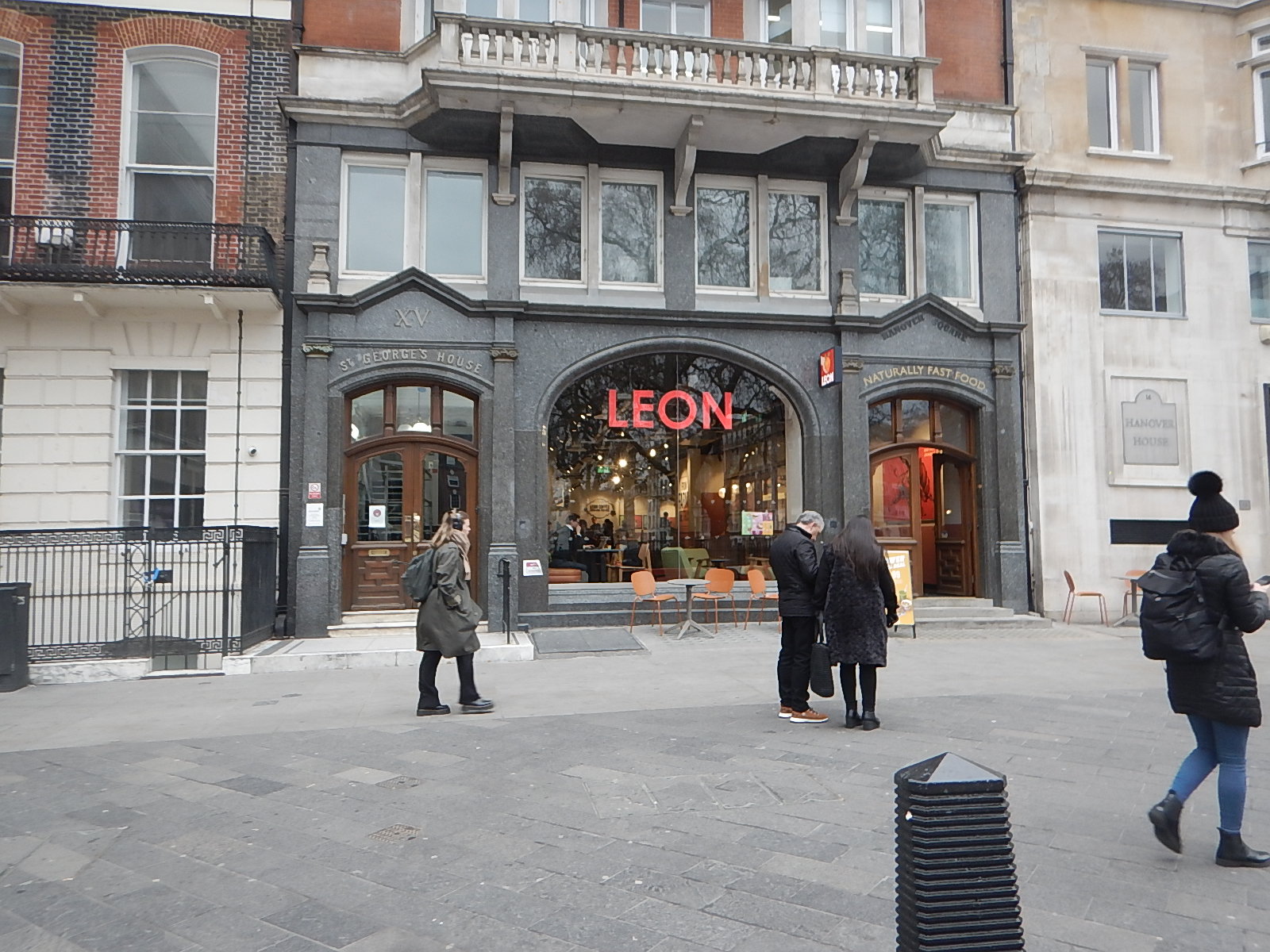
It’s certainly not your average takeaway or fast food outlet.
Normally, Hanover Square is a very easy location for me to travel to.
- I walk round the corner to the stop for the 38 bus.
- The 38 buses are usually every 3-4 minutes and I travel to Tottenham Court Road station.
- I go one stop on the Elizabeth Line, travelling in the rear of the train to Bond Street station.
- I’m then at the right end of the station to exit directly into Hanover Square, after riding up from the depths on a long escalator.
Leon is just a fifty metre walk away.
Today, there were no problems, although I did cut it a bit tight.
But all was fine in the end and I had a good full-English breakfast.
A Difficult Journey Home!
When, I set off from home, I wasn’t sure which way, I would come home.
In the end, I decided to come home the simple way of taking the Elizabeth Line to Moorgate station and then getting the 141 bus from there, as it stops close to my home.
But this route has the Elizabeth Line end-changing problem, in that the Hanover Square entrance at Bond Street station is at the Eastern end of the train and the Moorgate entrance at Liverpool Street station is at the Western end of the train.
So at some point in the journey, I would have to take a two-hundred metre walk, either on the platform or inside the train. The latter is not easy on a train to and from Heathrow, as it is often stuffed full with cases in the aisle. Why do people want to take all the contents of their house on holiday?
So I decided to go via a reverse at Whitechapel, where I positioned myself at the Western end of the train for exit at Moorgate.
It really was necessary to install travellators at Liverpool Street station on the Elizabeth Line, as between the two entrances is a long walk, as this graphic shows.

Note.
- Moorgate is to the left
- Liverpool Street is to the right.
But then Transport for London wanted a spectacular line with spectacular stations, that would win awards. Which it has!
I alighted from the train at the Moorgate end of the station, which meant that after two escalator rides and a short walk, I was at the 141 bus stop on the surface.
But there were no buses of any numbers calling at the stop.
This was because of the Lord Mayor’s Show, which meant there were no buses through the City.
But.
- There were no posters at stations saying that the show was taking place and buses would be diverted.
- Displays on bus stops were not saying anything about the show.
- The BBC hadn’t mentioned the Lord Mayor’s Show on the TV this morning.
- The BBC doesn’t have a local news at weekends, which would surely have mentioned the show and its effects on public transport.
- The display on the bus stop at Moorgate was still broken, as it has been for six months.
- There was a small information poster on the bus stop, but it was positioned too high for me to see.
- Taxis seemed to be avoiding the City.
There were a few stewards about and one suggested, that I walked to Old Street, which would not be easy on my legs.
In the end, I decoded that a retreat via Whitechapel and Dalston Junction was probably the best way to get home, as the Overground would be unlikely to be effected.
But I made the mistake of getting on a Circle Line train at Moorgate, so I didn’t get to Whitechapel.
Instead, I walked to the 141 and 21 bus stop at Monument station and caught a 21 bus North. I hoped that I would be able to connect to the 141 bus, that I needed to get home.
I did get safely home, but only after two long waits at bus stops, where I changed bus routes twice.
Conclusion
Transport for London need to devise bus plans for all major events and publicise them well in advance.
In London’s New 733 Bus Route, I described how Transport for London put in a temporary bus route between Finsbury Square and Oval stations to replace the Northern Line during the upgrade of Bank station.
As the Lord Mayor’s Show happens every year, surely the same plan can be rolled out each year, with any appropriate changes.
I’d be interested to know whether other large cities have plans for big celebrations in city centres.
 The Anonymous Widower