Ricardo’s Hydrogen Fuel Cell Module Successfully Reaches Full Power
The title of this post is the same as that of this press release from Ricardo.
This is the sub-heading.
Ricardo, a global strategic, environmental, and engineering consulting company, today announces a significant milestone in clean energy innovation with its new high-powered, multi-stack hydrogen fuel cell module technology successfully reaching 393kW of net electrical power, achieved within three months development from initial start-up.
These are the first two paragraphs.
This achievement was made possible due to Ricardo’s virtual engineering toolchain, which reduces physical prototyping costs and risks, accelerates development timelines, and provides a deeper understanding of system behaviours under diverse conditions.
Initially developed as part of the Sustainable Hydrogen Powered Shipping (sHYpS) Horizon Europe project for the maritime sector, Ricardo’s multi-stack hydrogen fuel cell module is designed to deliver high energy output with zero emissions. Its modular architecture integrates multiple fuel cell stacks to provide unmatched power density, and scalability while meeting the evolving energy demands of diverse applications, such as maritime, stationary power generation, rail and off-highway.
It certainly looks like Ricardo have developed a heavy end hydrogen fuel cell, that can be applied to a range of applications, in a very short time. Now that’s what I call world class engineering.
The last paragraph of the press release indicates what is possible.
To support the adoption of hydrogen technology, Ricardo has also developed a containerised solution, able to combine multiple fuel cell modules, enabling power output to be scaled up to 3MW per container, with the DC-DC power conversion on board, all without sacrificing efficiency or durability. When scaled up to incorporate multiple fuel cell modules housed within two bespoke containers, a total net electrical plant output of 6MW can be delivered. This is sufficient to power a 50,000 tonne 1,000 passenger cruise ship through important zero-emission mission cycles.
Although, this family of fuel cells, was originally developed for maritime applications, as an example of the flexibility of the system, it would surely be applicable for replacing any diesel engine from 2 MW upwards in a large number of rail, stationary and on and off-road applications.
This picture shows one of several hundred Class 66 locomotives on UK railways.

As they have an electric transmission, the 2 MW diesel engine could be fairly easily changed for a hydrogen fuel-cell of an appropriate size.
Scotch Whisky Is In A Unique Position
Scotland has so much zero-carbon energy now, let alone in a few years, that Scotch whisky would not be the most difficult of industries to make completely zero-carbon, which could marketing-wise completely trump any tariffs, that Trummkopf might impose.
- Already some small distilleries are using hydrogen to distill the whisky.
- Some glass bottles are already made using hydrogen instead of natural gas to make zero-carbon malt whiskies.
- I’m sure Cummins in Darlington, JCB in Rocester and Ricardo in Sussex will be pleased to help make farm machinery, mechanical handling and road transport zero carbon.
- Soft fruit like raspberries are already used to absorb the carbon dioxide from the distillation process in some areas of Scotland. I’m sure dealing with more quality raspberries would not be a problem.
- A large electrolyser is planned for Kintore in the North of Scotland. Think of the good publicity for say Centrica or SSE, if they built the world’s largest hydrogen plant to help make zero-carbon whisky.
These are some more thoughts.
Taste Is Everything
As only the method of providing heat and electricity will have been changed, I can’t see there will be any change to the taste.
It’s Already Happening
This page on the Annandale Distillery web site is entitled Annandale Distillery Pioneers Zero-Carbon Whisky Production with EXERGY 3 Project.
The Kintore Electrolyser
These figures summarise the Kintore Electrolyser.
- Total Electrolyser Capacity – 3 GW
- First Phase – 500 MW
- Hydrogen – 200 kTonnes per year
Explore the Kintore Hydrogen web site.
Marketing Advantage
Scotland, is probably, the only country, where the main ingredients for whisky come together in abundance ; barley, energy, tradition and water.
It also is all produced in a single country in many different brands and types, which could all be produced in a zero-carbon manner.
Conclusion
Let’s give Trump a beating and the planet a kiss.
North Sea Oil Group Equinor Scales Back Investment In Renewables
The title of this post, is the same as that of this article in The Times.
This is the sub-heading.
Equinor, which is attempting to develop one of the largest untapped oilfields in UK waters, also raised its fossil fuel production targets
This is the first paragraph.
The Norwegian state-backed oil company that is attempting to develop one of the largest untapped oil fields in UK waters, has dramatically scaled back its investment in renewables and raised its fossil fuel production targets, becoming the latest of the world’s energy giants to row back on the push towards green power.
A quiet revolution is happening that will change our use of natural gas very much for the better.
- In Rhodesia, which is a suburb of Worksop, a 24 MW Rolls-Royce mtu diesel peaker power plant, that runs on natural gas, but is also hydrogen-ready, has been installed to boost the electricity supply. The diesel engine is fitted with carbon capture and produces food-grade CO2, which is sold for food and engineering uses.
- Most of the excellent British tomatoes and soft fruit, we have been eating this winter, is grown in greenhouses, heated by natural gas-powered combined heat and power units, where the CO2 produced is captured and fed to the plants.
- HiiROC is a start-up from Hull, who are backed by Centrica, who use a plasma process to split any hydrocarbon gas including waste gas from a chemical plant, biomethane from a sewage works or natural gas into pure hydrogen and carbon black, which is needed to manufacture tyres and other products, and also to improve soil.
- In the last few months, a HiiROC device has been installed at Brigg power station, to generate zero-carbon electricity from natural gas.
- Imagine a housing or factory estate, a farm or perhaps a large country house, that wants to decarbonise. The gas feed to the property would be fitted with a HiiROC device and all gas appliances and boilers would be converted to hydrogen.
- I also believe that houses and other premises could have their own hydrogen pumps to fill up cars, ride-on mowers and other vehicles.
- Avnos is a company from the US, that captures CO2 from the air. What makes Avnos unique is that for every ton of CO2 it captures, it captures five tons of pure water.
More ideas like these are being developed.
What is wrong in using natural gas, to generate heat and electricity, if it doesn’t emit any CO2 into the atmosphere?
I suspect, that Equinor believe there will be a market for natural gas for years, as more and more clever ways to use it and turn it into hydrogen are developed.
Ministers Will Relax Rules To Build Small Nuclear Reactors
The title of this post is the same as that of this article in The Times.
This is the sub-heading.
Britain’s five nuclear power stations, which generate about 6GW in total, powering 13 million homes, are all nearing the end of their lives
These first three paragraphs indicate the reasons why, the government wants to relax the rules.
Ministers are preparing to relax planning rules to make it easier to build mini nuclear power plants in more parts of the country in order to hit green energy targets and boost the industry.
They are also examining whether it is possible to streamline the process for approving the safety of new nuclear power plants as a way to reduce construction delays.
At present rules state that only the government may designate sites for potential nuclear power stations, of which there are eight, severely limiting where they can be built.
The article includes a vote and surprisingly to me, the vote embedded in the article, shows 92 % in favour of relaxing the rules and only 8 % against.
I must admit these figures surprise me, as I’d have thought more would have been against.
Certain Words Frighten The Public
It is because nuclear is one of those words, that I felt that the vote in favour would have been much lower.
Regular readers of this blog will know, that in the 1960s,, I worked for ICI doing itinerant computing and instrumentation tasks, in my first job after leaving Liverpool University with a degree in Control Engineering.
I can now classify the experience as a superb apprenticeship, where I learned a lot that has been useful to me in later life.
For a time, I was working on nuclear magnefic resonance or NMR scans. ICI Mond Division in Runcorn had one of the best installations for analysing chemicals using this technique, which is described in this Wikipedia entry, which starts with these sentences.
Nuclear magnetic resonance (NMR) is a physical phenomenon in which nuclei in a strong constant magnetic field are disturbed by a weak oscillating magnetic field (in the near field) and respond by producing an electromagnetic signal with a frequency characteristic of the magnetic field at the nucleus. This process occurs near resonance, when the oscillation frequency matches the intrinsic frequency of the nuclei, which depends on the strength of the static magnetic field, the chemical environment, and the magnetic properties of the isotope involved; in practical applications with static magnetic fields up to ca. 20 tesla, the frequency is similar to VHF and UHF television broadcasts (60–1000 MHz).
One day, the Senior Scientist, who ran the machine came in to work and announced that the property of nuclear magnetic resonance would be replacing X-rays, as the technology had just been used to give a three-dimensional image of something like the tail of a mouse.
Now fifty-five years later, many if not most of us have had MRi scans.
The Wikipedia entry for Magnetic Resonance Imaging or MRi, explains, what happened to the dreaded N-word.
MRI was originally called NMRI (nuclear magnetic resonance imaging), but “nuclear” was dropped to avoid negative associations.
Perhaps, it would be easier to build nuclear power stations, if the level of science teaching in the UK was better.
The Three Paragraphs In Detail
Earlier, I copied three paragraphs from The Times, into this post.
I shall now look at each in detail.
Paragraph 1
Ministers are preparing to relax planning rules to make it easier to build mini nuclear power plants in more parts of the country in order to hit green energy targets and boost the industry.
I was in Suffolk, when the planning of Sizewell B was undertaken.
There appeared to be little strong opposition, but the general feeling was what there was from second home owners, who were worried that the value of their holiday home would decline.
Employment and commerce created by Sizewell B was certainly good for the area in lots of ways.
At the time, my late wife; C was practicing as a family barrister in chambers in Ipswich. She believed that the building of Sizewell B had had a good effect on the area, as it had injected work and money, which had created the finance to allow a couple to end a marriage, that had long since died. She stated a couple of times, that Sizewell B was good for her practice.
Paragraph 2
They are also examining whether it is possible to streamline the process for approving the safety of new nuclear power plants as a way to reduce construction delays.
My worry about streamlining the process for approving safety, is that we approve nuclear power stations so rarely, do we have the qualified personnel to replace elapsed time with people. I would suggest that we don’t.
But we could have.
- We have some excellent universities, where Nuclear Engineering can be studied.
- How many personnel leave the Royal Navy each year, who could be trained as nuclear safety inspectors?
- If say Rolls-Royce and/or Hitachi are building several small modular nuclear reactors a year in the UK, then nuclear engineering will become fashionable, as electronics was for my generation of engineers and it will attract the brightest students.
Perhaps an established university, with access to the needed skills should be funded to set up a Nuclear Safety Institute
Paragraph 3
At present rules state that only the government may designate sites for potential nuclear power stations, of which there are eight, severely limiting where they can be built.
I can envisage new small modular nuclear reactors being built in the UK, where there is a need for lots of electricity to support developments like.
- Offshore wind farms
- Data centres
- Green steelmaking
- Metal refining
- Hydrogen production.
Rolls-Royce have said that their small reactors will be around 470 MW, so I could imagine power stations of this size being placed on disused coal-fired power station sites to boost power in an area. I have already suggested building some on Drax in The Future Of Drax Power Station.
In some locations, the choice could be between a small modular nuclear reactor and some form of energy storage.
Powering Germany
But there is one controversial area, where we can take advantage.
- The Germans are very short of electricity because of their reliance on coal and Russian gas that needs to be replaced.
- The 1.4 GW NeuConnect interconnector is being built by European and Japanese money between the Isle of Grain and Wilhelmshaven.
- The AquaVentus hydrogen system could be extended to Humberside to link with UK hydrogen production and storage.
- A couple of small modular nuclear reactors could be built on Humberside to back up hydrogen production, when the wind isn’t blowing.
But Rolls-Royce and other companies have been putting small nuclear reactors close to the sea bed safely for decades, so why no design an offshore reactor that can be placed at a safe distance offshore?
We would need to solve the Putin and friends problem first, but I can see the UK exporting a lot of electricity and hydrogen produced by nuclear energy.
Rolls-Royce Powers World’s Fastest Offshore Crew Transfer Vessels
The title of this post, is the same as that of this news item from Rolls-Royce.
These three bullet points, act as sub-headings.
- Sea trials demonstrate maximum speed exceeding 53 knots under operational load.
- Each of the three ships is powered by four 16-cylinder mtu Series 2000 engines.
- 35-meter ships are designed as “Surface Effect Ships” (SES)
This is the introductory paragraph.
The Singapore shipbuilder Strategic Marine has commissioned three new offshore supply vessels that, with a maximum speed of over 53 knots, are the fastest of their kind in the world. Each vessel is powered by four 16-cylinder mtu Series 2000M72 engines from Rolls-Royce. The vessels will be used by a national oil company in Africa for passenger transfer to offshore platforms. To enable fast and safe transfer, the 35-meter-long vessels were designed as so-called “Surface Effect Ships”.
This Rolls-Royce image shows one of the Crew Transfer Vessels at 50 knots.
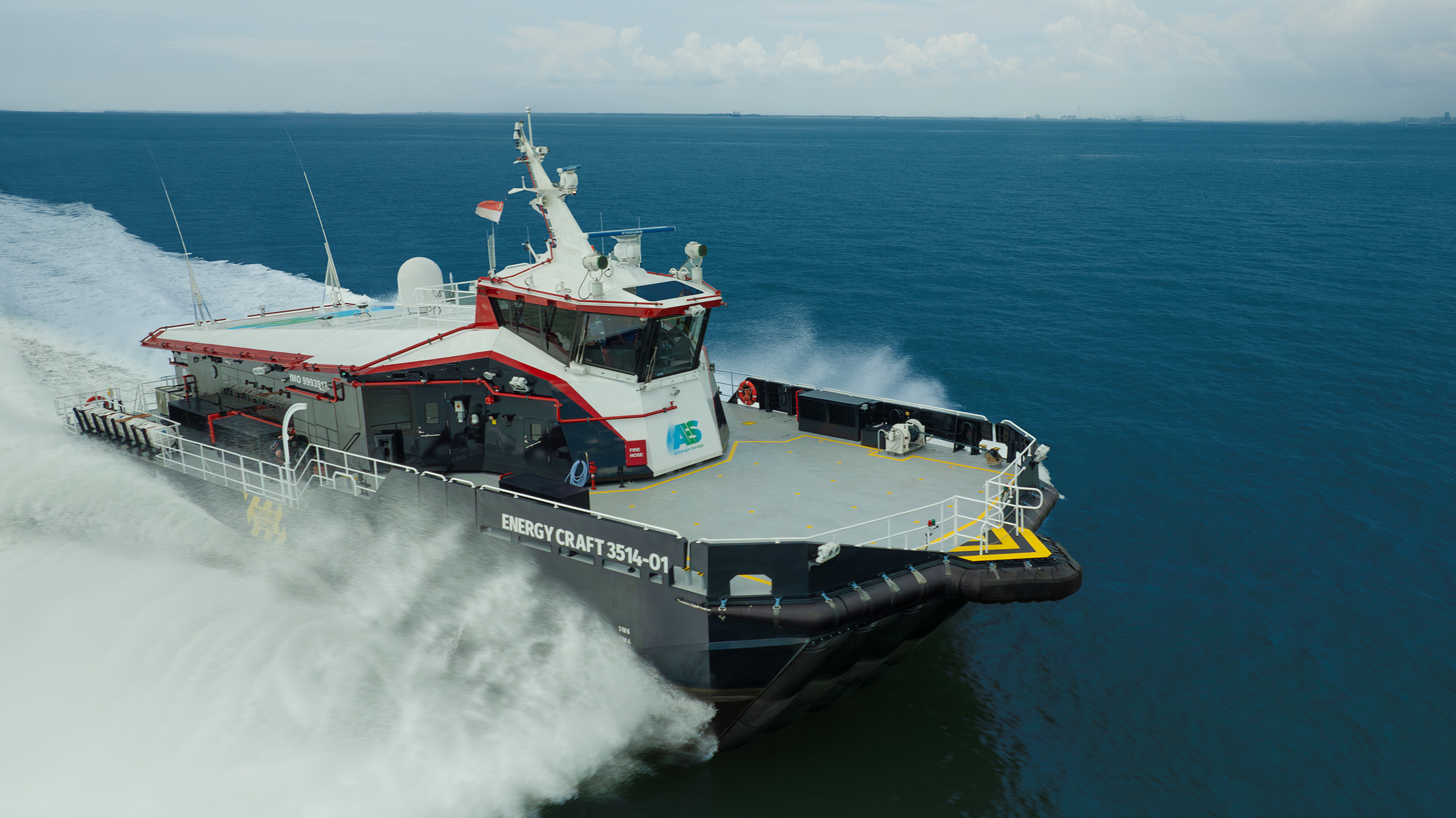
On a slightly different tack, this Rolls-Royce image shows The Spirit of Innovation.

Rolls-Royce described it in this press release which is entitled ‘Spirit of Innovation’ Stakes Claim To Be The World’s Fastest All-Electric Vehicle, using these words.
During its record-breaking runs, the aircraft clocked up a maximum speed of 623 km/h (387.4 mph) which we believe makes the ‘Spirit of Innovation’ the world’s fastest all-electric vehicle.
I’ve probably been over 1,300 mph in Concorde.
So are the three offshore supply vessels, the fastest of their kind in the world?
This video shows one of the Crew Transfer Vessels doing, what they are intended to do.
Rolls-Royce seem to be borrowing a philosophy from their past, where they showed in the Schneider Trophy, just what their engines could do.
These two paragraphs describe the design of the Crew Transfer Vessels.
To enable fast and safe passenger transfer to offshore platforms, the 35-meter-long vessels have been designed as so-called “Surface Effect Ships” (SES). SES uses air-cushion technology within a catamaran hull form. This design was used for the first time in the offshore oil and gas industry.
The boats have an optimized power-to-weight ratio and use powerful fans to generate an air cushion between the hulls that minimizes hull drag and resistance. Combined with the mtu propulsion package (each delivering 5,760 kW of power), the vessels can travel at much higher speeds than conventional monohulls and catamarans, with consumption remaining at the same per hour of operations. The high speed of well over 50 knots (more than 90 km/h) ensures shorter transit times, while the low hull resistance saves fuel and reduces emissions.
I believe, that the Rolls-Royce mtu diesel engines used in these vessels can also be fueled by hydrogen, so is that the next development?
Could we be seeing hydrogen-powered fast ferries on short sea routes around the world?
Vallourec’s Delphy Hydrogen Storage Solution
Hydrogen can be a nuisance to store.
I have just found a YouTube video of a system called Delphy from French company Vallourec.
Delphy seems a neat solution, where hydrogen is stored vertically in a 100 metre hole, that can hold a 100 tonnes of hydrogen.
You can watch this video.
I think this would be an ideal hydrogen storage solution for a bus or coach company or a truck operator.
UK Gov’t Says Offshore Wind Backbone Of 2030 Clean Power System, Plans To Procure 12 GW More In Next Few Allocation Rounds
The title of this post, is the same as that of this article on offshoreWIND.biz.
This is the sub-heading.
Electricity generated by renewable sources and nuclear power will be the foundation of the UK’s electricity system by 2030, according to a new action plan the UK government issued in December 2024. Offshore wind, which now accounts for some 17 per cent of the country’s electricity generation, has “a particularly important role as the backbone of the clean power system”, the government said, revealing plans to make part of the path to building offshore wind farms easier as soon as before the Contract for Difference (CfD) round planned for the summer.
These two paragraphs add a few more details to the plan.
The action plan, issued by the Department for Energy Security and Net Zero (DESNZ), was presented by the UK Energy Secretary Ed Miliband on 13 December and is said to be a “major milestone to deliver on the Prime Minister’s Plan for Change which aims to drive economic growth and rebuild Britain with mission-driven government”.
Clean Power 2030 Action Plan is a roadmap to an (almost) fully clean power system in the UK by 2030, with clean sources making up 95 per cent of Great Britain’s electricity generation with gas being used for no more than 5 per cent of total generation.
This Wikipedia entry is a List of Operational Wind Farms in the UK.
Operational Offshore Wind Farms
In October 2023, there were offshore wind farms consisting of 2,695 turbines with a combined capacity of 14,703 megawatts. Strike price based on £/MWh at 2012 prices.
Wind Farms Under Construction
Offshore wind farms currently under construction (offshore), with a combined capacity in December 2024 of 7,792 MW. Strike price based on £/MWh at 2012 prices.
Pre-Construction Wind Farms
Wind farms that have started onshore construction and have been awarded contracts under the UK Government’s Contracts for Difference Round 3 (2019)/Round 4 (2022). Total capacity of 3,932 MW. Strike price based on £/MWh at 2012 prices. These projects re-bid some capacity in Round 6 (2024) with a higher strike price.
Proposed Wind Farms – Contracts For Difference Round 4
Wind farms proposed under the Round 4 (2022) CFD auction,[88] with a combined capacity of 1,428 MW . Strike price based on £/MWh at 2012 prices.
Proposed Wind Farms – Contracts For Difference Round 6
Wind farms proposed under the Round 6 (2024) CFD auction,[88] with a combined capacity of 3,763 MW . Strike price based on £/MWh at 2012 prices.
Proposed Wind Farms – Previously Awarded In The CfD Round 3
This wind farm was proposed under the UK Government’s Contracts for Difference Round 3 (2019), which it decided to withdraw from. It will likely bid in AR6 with a changed specification from the original submission
Proposed Wind Farms – Early Planning
Wind farms that are in an exploratory phase and have not yet secured a Contract for Difference at auction.
Total capacities: England: 18,423 MW – Wales: 700 MW – Scotland: 30,326 MW
Current Totals
- Operational Offshore Wind Farms – 14,703 MW
- Wind Farms Under Construction – 7,792 MW
- Pre-Construction Wind Farms – 3,932 MW
- Contracts For Difference Round 4 – 1,428 MW
- Contracts For Difference Round 6 – 3,763 MW
- Previously Awarded In The CfD Round 3 – 0 MW
- Earlp Planning – England: 18,423 MW
- Early Planning – Wales: 700 MW
- Early Planning – Scotland: 30,326 MW
Adding up these totals gives 81.067 MW
As I’m typing this, the UK is generating and importing a total of 29,330 MW of electricity.
Conclusion
Another 12 GW of new offshore wind will mean that we will have 81,067 + 12,000 – 29330 MW of electricity to put in store or sell to the Germans and other Europeans.
Perhaps we should be investing in industries, that use large quantities of electricity like hydrogen steel-making or zero-carbon cement making.
Cold Snap Leaves Britain With Less Than A Week’s Worth Of Gas
The title of this post, are the same as that of this article on The Times.
This is the sub-heading.
The closure of Russian pipelines through Ukraine and recent weather conditions have left gas stores ‘concerningly low’
These are the first two paragraphs.
Britain has less than a week of gas supplies in storage, the country’s largest supplier has warned after plunging temperatures and high demand.
Centrica, the owner of British Gas, said the UK’s gas storage was “concerningly low” after coming under pressure this winter.
The two largest gas storage facilities in this country are both in the Humberside area.
- Aldbrough is in salt caverns North of Hull and is owned by SSE.
- Rough is under the North Sea and is owned by Centrica
Both are being converted to store hydrogen.
Some might thing that is a bit stupid if we’re short of storage, but we need the hydrogen storage for four reasons.
- To store hydrogen created by electrolysers on Humberside, which will enable heavy gas users in the area to decarbonise.
- The hydrogen will also be burnt in a 1 GW hydrogen-fired power station at Keadby to back up the wind turbines, with zero-carbon electricity.
- The hydrogen will also be sold to the Germans to replace Putin’s blood-stained gas. It will be sent to Germany in a pipeline called AquaVentus, which will also deliver Scottish hydrogen across the North Sea. Hopefully, the Germans will pay a good price for the hydrogen.
- The hydrogen will be used for transport.
The mistake the Government is making is not to develop smaller gas fields, so that domestic gas users can continue to use natural gas, until the technology to replace it with zero-carbon sources is fully developed.
A New Metier
This article in The Times today is entitled Too many Sir Humpreys are stopping London from taking a punt.
The article is about one of Britain’s most successful private investors ; John Gunn.
The article also introduces a new company to me, with this paragraph.
His latest enthusiasm is for Metier, a company that aims to leapfrog electric vehicle power to convert buses and heavy trucks to hydrogen fuel cells. Several big firms such as Volvo are making new hydrogen-powered vehicles, but Gunn and his partners reckon there is more money in reconfiguring existing ones.
It was Metier, that caught my eye.
In the 1970s, with three others, I started a company called Metier Management Systems, which developed a project management system called Artemis.
We were very successful, in that we sold the company for a nine figure sum and won two Queen’s Awards for Exports.
Since then, there have been several successful companies named Artemis, but we haven’t seen a Metier.
Until now that is and I hope that the hydrogen vehicle company is as successful worldwide as we were.
Strangely, my first job on leaving Liverpool University was in a hydrogen factory and I am a great believer in using the gas as a source of energy.
Metier have a web site, if you want to find out more about the company.
H2Rescue Truck Smashes World Record With 1,806 Miles On A Single Hydrogen Fill!
The title of this post, is the same as that of this article on Hydrogen Fuel News.
This is the sub-heading.
H2Rescue Truck Sets New World Record in Hydrogen Transportation
These first two paragraphs add more detail.
A groundbreaking milestone in hydrogen-powered transportation has been achieved by the H2Rescue truck, a prototype heavy-duty vehicle capable of addressing energy challenges during disaster relief. Built by Accelera (a division of Cummins), with support from the U.S. Department of Energy (DOE) and other federal agencies, the truck recently achieved a Guinness World Record by traveling an astonishing 1,806 miles on a single fill of hydrogen fuel.
What makes this feat remarkable is the environmental implications of the technology. While a traditional internal combustion engine would have emitted 664 pounds of carbon dioxide (CO2) over the same distance, the hydrogen-fueled H2Rescue truck produced zero CO2 emissions. Hydrogen-powered vehicles like this one exemplify cutting-edge innovation in decarbonizing transportation.
This last paragraph describes the use of the vehicle in emergencies.
More than just a long-distance performer, the H2Rescue truck is an essential tool during emergencies. It can provide 25 kilowatts of power for critical relief operations, such as lighting, medical equipment, and communication systems, for up to 72 hours without refueling. This capability could make a significant difference in disaster zones, where reliable energy sources are often scarce.
Cummins are certainly serious about the innovative use of hydrogen.

