Wrightbus Goes Back To The Future As It Relaunches The Contour Coach
The title of this post, is the same as that of this press release from Wrightbus.
This is the detail of the press release.
Wrightbus is entering the coach market for the first time in more than 30 years with the launch of two new vehicles in the next 18 months.
The first vehicle to hit the market is the Contour, a low-emission 55-seater coach that was launched at a customer showcase event today (March 5).
It’s a case of back to the future for Wrightbus, which last produced a Contour coach in 1987 before retiring the vehicle.
The second vehicle, a zero-emission hydrogen coach – which is under development in Ballymena, Northern Ireland – will be added to the Wrightbus coach range within the next 18 months to help drive decarbonisation of the sector.
The low emission Contour has a lead time of just six months from order, which is considerably faster than the current one-to-two-year average wait customers have come to expect from the sector. Featuring a Cummins Euro 6 400BHP X11 engine and a ZF automatic gearbox, the modern-day Contour has been built with comfort in mind, with up to 55 reclining seats – each with its own USB port – alongside other modern safety features. Competitively priced and available with or without PSVAR compliance, there is also the option of the vehicle being ‘pre-prepared’, protecting the vehicle’s ‘second life’ and flexibility.
The coach has a range of bespoke options for customers to choose from and is designed to maximise luggage space and functionality.
It will be supported by a full Wrightbus warranty, alongside an unparalleled service and maintenance package from AllServiceOne, the Wrightbus repair and maintenance arm.
With the largest fleet of mobile technicians throughout the UK and Northern Ireland, AllServiceOne is the ultimate one-stop-shop for fleet support and service.
Wrightbus CEO, Jean-Marc Gales, said bringing the Contour to market was a pivotal move.
“The coach market has changed over the last few years and it’s the right time for a new player to come to the market.
We have long spoken about broadening our portfolio to offer customers an even greater range of Wrightbus vehicles.
Our first entry into the coach sector after an absence of more than three decades is another significant step in our expansion plans,” said Mr Gales.
“We know there are gaps in the market and the demand for coaches is growing.
This partnership allows us to bring high-quality low-emission vehicles to market almost immediately.
Throughout the process of readying the vehicle for our UK market, we have worked alongside our partner closely to ensure the Contour meets the exacting Wrightbus high quality standards that customers have come to expect.
Our AllServiceOne technicians have embarked on an extensive training programme and have a full working knowledge of the coach to ensure excellent fleet support. “At the same time as the launch of the Contour, our world-leading engineers are continuing to develop our own zero-emission hydrogen coach from our factory in Northern Ireland. We expect the hydrogen coach to be ready for launch in the next 18 months, which is a hugely exciting prospect.” The hydrogen coach concept was first revealed in 2024 as a prototype vehicle.
When launched, it will be a tri-axle hydrogen fuel cell electric coach capable of a 1,000km range, putting it on a par with traditional diesel-fuelled coaches.
These are my thoughts.
The Coach Has A Cummins Engine
Cummins will probably build the engines in their UK factory in Darlington.
Thirty years ago, I did a small data analysis consultancy for Cummins in Darlington and I was impressed by the operation and the company’s attitude.
One of their policies was that if the customer wants a special engine, then the company, is prepared to give the customer what they need.
So you can be sure, that the Cummins X11 engine to be supplied for the Contour coach, will be exactly what Wrightbus want.
The Cummins X15 Engine Is Convertible To A X15 Hydrogen Engine
Some of Cummins diesel engines are convertible to hydrogenfuel, by changing the cylinder head and the fuel system.
This can be done with a Cummins X15 engine and I wouldn’t be surprised if the X11 engine fitted to the Contour coach can be converted to hydrogen.
So an operator can buy a diesel coach and if they need, they could convert it to hydrogen.
USB Ports
This is stated in the press release.
Contour has been built with comfort in mind, with up to 55 reclining seats – each with its own USB port.
When I rode recently in a Irizar coach, there were no USB ports.
There Is A Promised Delivery Time Of Six Months
In the 1990s, I used to part-own a finance company, that leased vehicles.
One of the vehicles we used to loan money for was upmarket coaches like the Wrightbus Contour.
- They were a relatively large loan of about £50,000.
- The borrower was often very reputable with a good credit history.
- The repossession rate was very low.
The press release says, that a two-year delivery time is normal for coaches and, I can remember that we could have financed more coaches, if they had been available.
So it would appear to me, that if Wrightbus can deliver a new coach in six months, they will sell a lot of coaches and I believe from past experience, that finance will be available from trusted sources.
The Hydrogen Coach Will Be A Hydrogen Fuel Cell Electric Tri-Axle Coach
This is stated in the press release.
When launched, it will be a tri-axle hydrogen fuel cell electric coach capable of a 1,000km range, putting it on a par with traditional diesel-fuelled coaches.
I suspect to get the 1,000 km range of the diesel coach and to protect the hydrogen tank, means some extra weight and an extra axle.
But I wouldn’t be surprised to see a reduced range hydrogen coach without the third axle.
Wrightbus Are The Company Who Launched Ballard Hydrogen Fuel Cells In London
I wrote London’s Hydrogen Buses in July 2013 and all Wrightbus buses hydrogen buses have used hydrogen full cells from Ballard Power Systems in Canada.
But there could be a complication in that Cummins make fuel cells in Germany and we are approaching Trumpian Tariff War Territory.
On the other hand in Australian Volgren Rolls Out First Hydrogen Bus Based On Wrightbus Chassis Technology, it shows how Wrightbus are prepared to licence their technology to reputable companies.
So any country, like Australia, Brazil, Canada, India, Mexico, Singapore or the United States, who can build coaches, can licence Wrightbus’s designs and fit the appropriate components to make a complete coach.
Note.
- Wrightbus is owned by the Bamford family, who own JCB.
- Wrightbus have licenced designs to Australia, Hong Kong and Singapore in the past.
- JCB have large manufacturing facilities in India.
I’m certain that the Bamfords and their advisors can work it out!
Riding Rail Air Between Reading Station And Heathrow Terminal 5
Today, I rode on a Rail Air coach between Reading station And Heathrow Terminal 5.
I took these pictures as I walked through Reading station and from the coach.








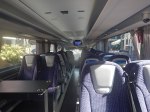






























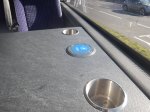








































These are my thoughts on various topics.
Catching The Coach At Reading
Consider.
- The route to Rail Air from the trains at Reading station is well signed.
- The entrance to the Rail Air terminal at Reading station is behind the M & S Simply Food store.
- I estimate that the time between arriving at Reading station and the coach leaving was only a few minutes.
- Rail Air coaches run every twenty minutes.
- My coach had about ten passengers.
- My single fare was £17.30 with my Senior Railcard.
It was all a rather painless process.
On The Coach
Consider.
- The coach was more-or-less what you would expect on a quality route.
- The view was good.
- I had a table, with four seats.
- The table had contactless charging and drink holders.
- There was no charging for my phone and camera, which use USB or 13 amp plugs.
- The seat was reasonably comfortable.
- There was a toilet.
- There was typical storage for heavy luggage underneath the seats.
I would have thought if Wrightbus fit USB ports on their buses, that they are needed.
The Route
This Google Map shows Reading and Heathrow
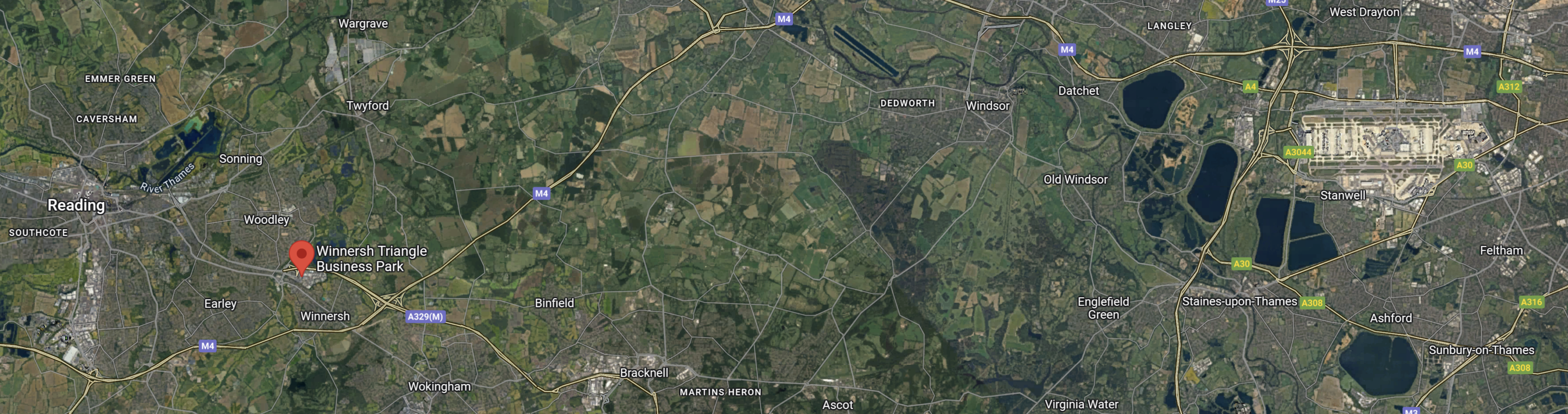
Note.
- Reading is at the Western end of the map.
- Heathrow is at the Eastern end of the map.
- The red arrow indicates Winniersh Triangle station on the Eastern side of Reading.
- The coaches stop at Reading Cemetery and Winnersh Triangle station.
- Most of the route between Winnersh Triangle and Heathrow Airport is on the M4 Motorway or dual-carriageway roads.
- The distance appears to be just under 27 miles and is scheduled to take forty minutes.
- Click the map to show to a larger scale.
It looks to me that it is an ideal route for a coach.
On The Journey
Consider.
- Once clear of Reading and past the stop at Winnersh Triangle, the coach held a good speed all the way to Heathrow, as the motoway was not busy.
- In the UK coaches under twelve metres long, can run at 70 mph and I estimated that this coach was probably at 60 mph.
- The stops were called out like stations on a train.
- Strangely, the roadholding was not as good as that of the Wrightbus hydrogen bus, that I took to Gatwick, a couple of weeks ago.
- The big problem though was the noise of the diesel engine, which was very loud compared to the noise of the fuel cell and electric transmission of the Wrightbus hydrogen bus.
I suspect that transforming the hydrogen bus into a coach, could result in a very high quality coach, with the performance and range of a diesel coach, without the noise, pollution, vibration and carbon emissions.
Heathrow Rail Link Project Could Be ‘Reopened’
The title of this post, is the same as that of this article on the BBC.
This is the sub-heading.
Network Rail has said plans for a rail link between the Great Western mainline and Heathrow Airport could still move forward if funding is found in the future.
These three paragraphs give the current status of the scheme.
The Local Democracy Reporting Service recently reported that the project had been put on hold.
It began in 2012 and involved proposals for a 4 mile (6.5km) rail link to allow train services from Reading and Slough in Berkshire to reach Heathrow using a tunnel.
The £900m scheme would allow people living to the west of Heathrow to travel direct to the airport, instead of having to go into London.
These are some other facts and my thoughts.
The All-Party Parliamentary Group (APPG) For The Western Rail Link To Heathrow
According to the BBC article, this has now been established and this is said.
Labour MP for Slough, Tanmanjeet Singh Dhesi, held a debate in parliament on the western rail link in April and established the All-Party Parliamentary Group (APPG) for the Western Rail Link to Heathrow, to make sure it “remains on the government’s agenda”.
He said the project had been “beset by delays and funding challenges” but still had “wide cross-party and local support”.
Parliamentary backing is surely a good thing.
The Current Scheme
The BBC article shows this map with a rail link connecting the Great Western Main Line to Terminal 5 railway station.
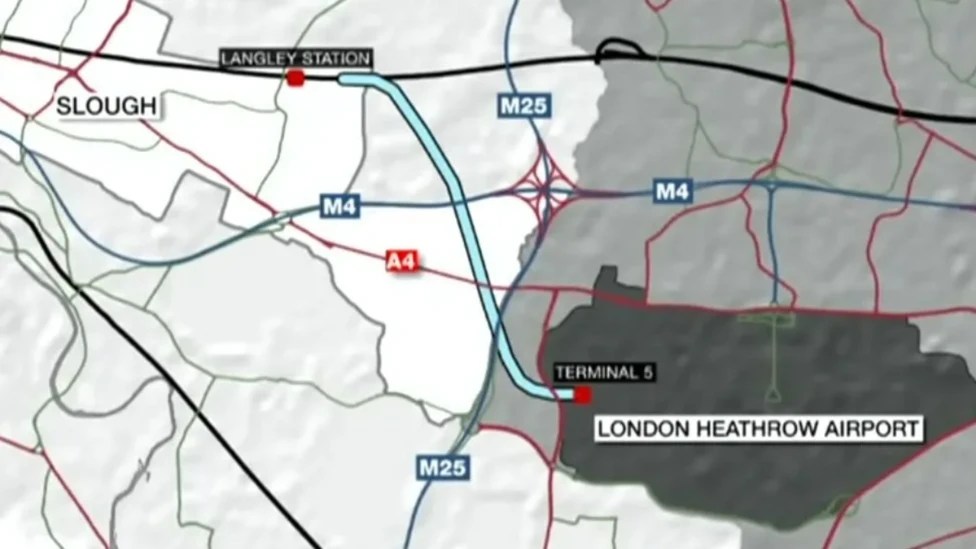
Note.
- The rail link starts from East of Langley station.
- Terminal 5 station can take full-length Elizabeth Line trains.
- Main line trains from Bristol, Cardiff and Wales and the West should be able to access Heathrow.
But I suspect, that there would be extensive changes to Heathrow’s railways to access the other terminals. This would explain the near billion pound cost of the link.
I also suspect that it would take about eight to ten years to build and from what I havc heard, the rail link is urgently needed.
RailAir
RailAir is the current way of travelling between Reading station and Heathrow Airport.
This is the first paragraph of RailAir’s Wikipedia entry.
RailAir describes a number of airport bus and coach services designed to connect the National Rail network to airports in the United Kingdom. Services are currently concentrated on Heathrow Airport, with one other from Luton Airport. RailAir services are operated as public transport services by or on behalf of train operators, where the whole journey is paid for as a through-ticket which combines the railway and bus journey, although journeys can be made using the bus only. As such, many are operated where the train and bus operator are owned by the same company.
Could RailAir be updated to be a more frequent and integrated service?
CoacH2
This page on the Advanced Propulsion Centre UK web site is entitled CoacH2 – Next Generation Hydrogen Fuel-Cell Coach Powertrain Demonstrator.
This is the sub-heading.
Accelerating the development of zero-emission hydrogen fuel-cell electric coaches, with a full on-vehicle technology demonstrator.
These are the first two paragraphs.
Coaches are an integral part of the public transport network, with over 30,000 diesel coaches operating across the UK and Ireland. Due to the specific demands of coach operation (motorway driving, long-range, high passenger and luggage loading capacity) decarbonisation options for this sector are extremely limited with hydrogen fuel-cell technology considered the most viable choice. This project will tackle this difficult to decarbonise sector by developing, testing and validating an innovative hydrogen fuel-cell powertrain suitable for coach applications.
Delivered by a Northern Irish consortium spanning OEM, coach operator and academia, CoacH2 will accelerate the development of zero-emission, fuel-cell electric coaches, with a full on-vehicle technology demonstrator to be manufactured and showcased at Cenex Expo 2024.
As I indicated in British Buses For British Bottoms, Wrightbus build a good well-built, smooth-riding and comfortable bus, so now they can add hydrogen-powered coaches to the product range.
This press release on the Wrightbus web site is entitled Wrightbus Coach Demonstrator Unveiled At Cenex Expo, gives more information on CoacH2.
- The demonstrator has a power of 300 Kw.
- It has a range of 1,000 km. on one refueling.
- An internet search reveals a launch date of 2026 for the hydrogen-powered coach.
I wonder, if RailAir changed their coaches to these new Wrightbus hydrogen-powered coaches, they would transform travel to airports all over the UK.
If the hydrogen-powered coaches are of the same quality of their hydrogen-powered siblings, they will be a quality product with good road-holding, sufficient performance and superb passenger comfort.
RailAir could be the ideal, initial application.
Conclusion
A proper rail link to Heathrow from Reading is needed, but it will take at least ten years to build and cost a billion pounds.
However the RailAir links to Heathrow from Reading and Woking can be improved by using high-performance Wrightbus hydrogen-powered coaches.
Gatwick’s Hydrogen Advantage Over Heathrow
The Future Of Hydrogen In Aviation
I believe that hydrogen will have a big future in aviation.
Powering Aircraft
It will be some years, but not as many as some people think, before we see hydrogen-powered aircraft in the air.
Airbus have produced this infographic of three possible hydrogen-powered aircraft.

Discover the three zero-emission concept aircraft known as ZEROe in this infographic. These turbofan, turboprop, and blended-wing-body configurations are all hydrogen hybrid aircraft.
I wrote a bit more about these three hydrogen-powered concepts in ZEROe – Towards The World’s First Zero-Emission Commercial Aircraft.
My best estimate is that we’ll see hydrogen-powered aircraft in the air by 2035.
Towing Aircraft Around
Most aircraft are very heavy and towing them around needs a lot of zero-carbon energy.
So I think it is likely, that at some time in the near future,tugs to tow large aircraft around an airport will be hydrogen powered.
If you type “hydrogen-powered aircraft tug” into Google, you get several sensible product developments, including ones from.
- Exeter Airport
- Teesside Airport
- The Royal Air Force.
- The US Air Force
Note.
- The involvement of the military.
- At least two of the tugs are conversions of existing equipment.
- The extra weight of the battery in an electric-powered tug, may make the realisation of a viable electric aircraft-tug difficult.
I suspect we’ll see hydrogen-powered aircraft tugs in use on airports around the world in the near future.
Long-Term Car-Park Buses
I would have thought that using hydrogen-powered or battery-electric buses to serve long-term car-parks at an airport would be an obvious application. But it does appear that airports using zero-carbon buses to serve long-term car-parks are not very common.
- Gatwick uses a large fleet of hydrogen buses to bring passengers and staff to the airport, but these don’t appear to be linked to car parking.
- Incheon Airport in Korea does appear to use hydrogen-powered buses.
Please let me know, if you know of any other uses of hydrogen-powered vehicles at airports.
Hydrogen For Heathrow
This Google Map shows Heathrow Airport.
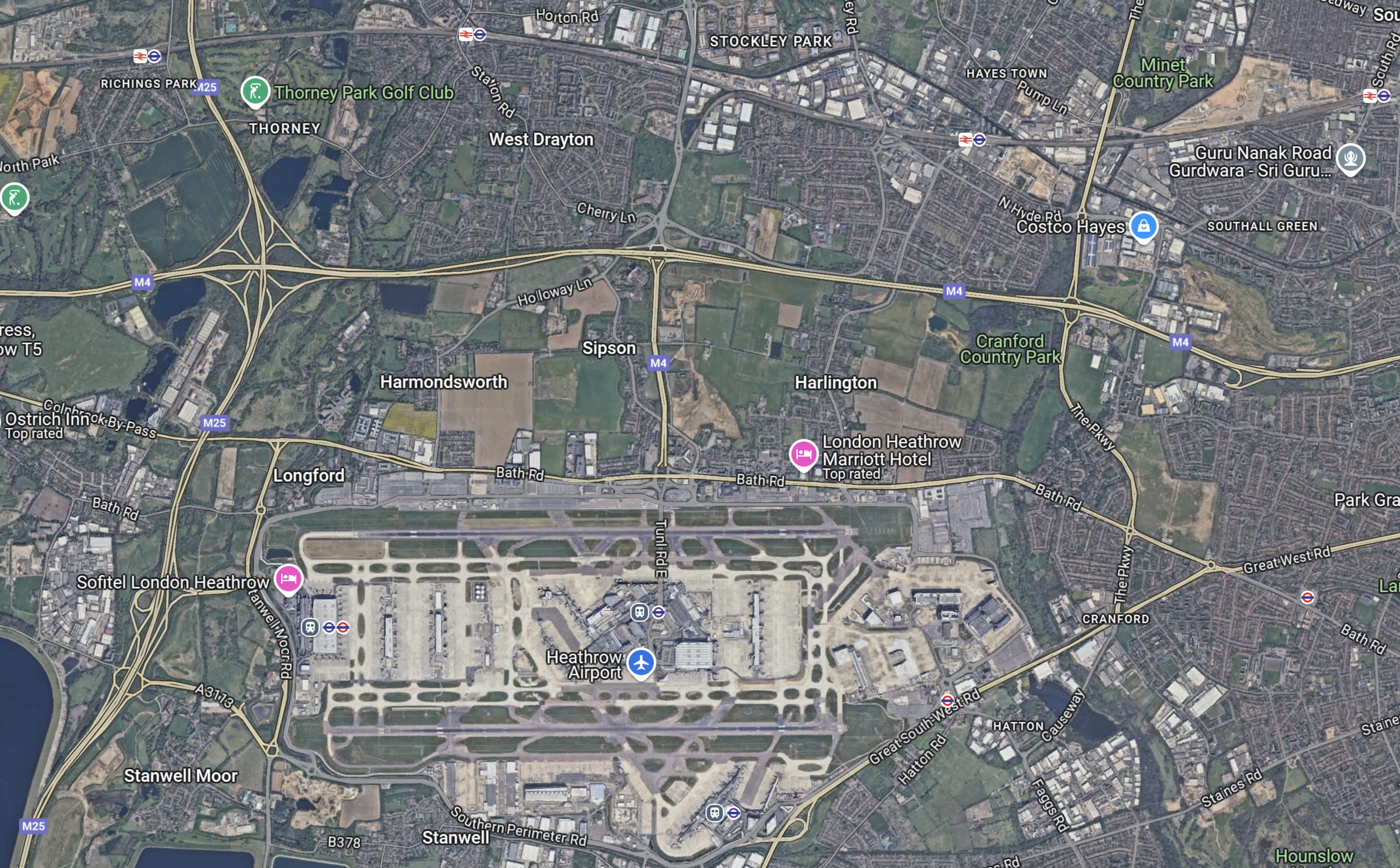
Note.
- The M4 going across the map.
- The two main runways.
- A new third runway would go between the M4 and the Northern runway.
It is likely if the third runway goes ahead, the village of Harmondsworth will be flattened.
It is likely that supplying hydrogen to Heathrow will mean a hydrogen terminal somewhere South of the M4, which could be supplied by rail tankers.
Hydrogen For Gatwick
This Google Map shows Gatwick Airport.
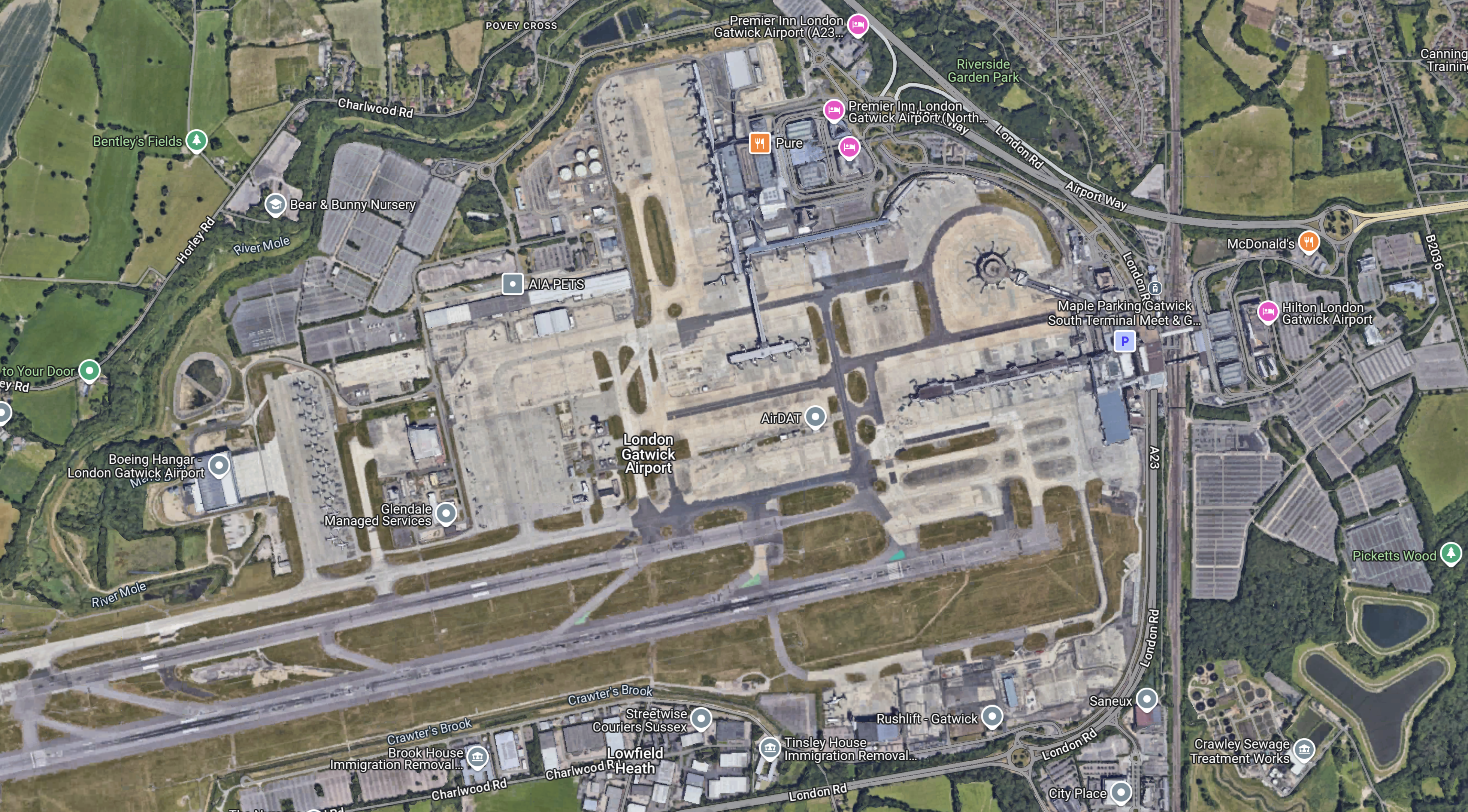
Note.
- The current main runway with the emergency runway to its North.
- Because the runways are too close together they cannot be used simultaneously.
- To create a second runway, the two runways would be moved further apart and the current emergency runway would be enlarged.
- The Brighton Main Line runs North-South past the Eastern end of the main runway.
Gatwick’s expansion plan doesn’t appear to require any properties outside the airport boundaries to be demolished.
This Google Map shows Sussex between Gatwick Airport and Brighton.
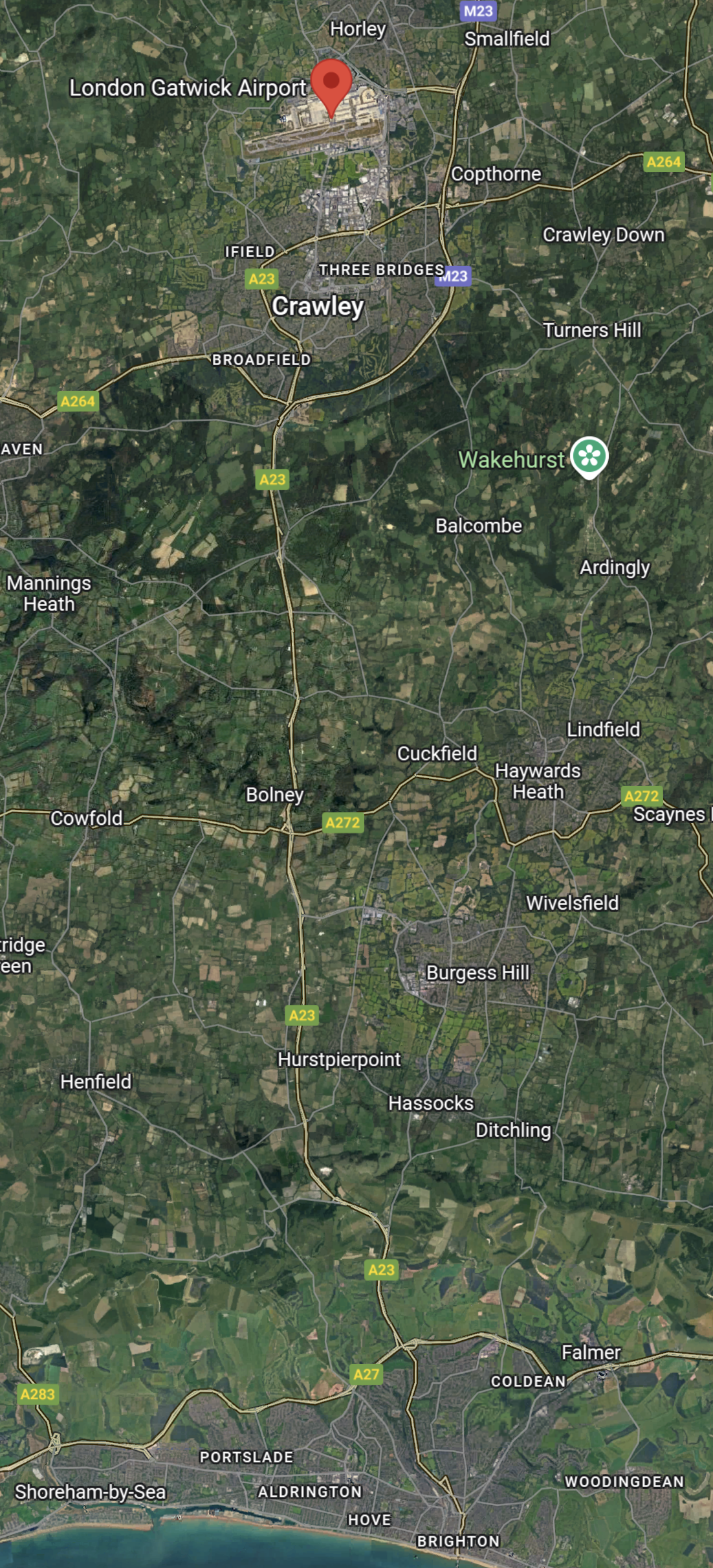
Note.
- Gatwick Airport is indicated by the red arrow at the top of the map.
- Gatwick’s runways can be picked out under the red arrow.
- The South Coast is at the bottom of the map.
- The M23 and the Brighton Main Line connect Gatwick Airport and Brighton.
- Shoreham and Brighton are on the South Coast.
- Click the map to show on a larger scale.
Under current plans, the Ramplion offshore wind farm off the South Coast is going to be increased in size to 1.6 GW.
The simplest plan to provide large amounts of green hydrogen to Gatwick would be to build a large electrolyser in the Port of Shoreham and pipe it along the railway to Gatwick Airport. Hydrogen could also be shipped at night into the Airport using rail tankers.
There’s no doubt in my mind, that it will be much easier to supply large quantities of hydrogen to Gatwick, rather than Heathrow.
In 2023, I wrote Discover How Greater Brighton Is Championing The Transition To Hydrogen, which probably indicates that the locals and their politicians, would welcome the investment in hydrogen in their city.
It should also be noted that world class consultants Ricardo, who are very much involved in the development and promotion of hydrogen technology are based in Shoreham.
Liquid hydrogen could also be imported and distributed from the Port of Shoreham.
Brighton could end up as the South of England’s Hydrogen City.
Never Mind Heathrow: Gatwick Airport Is Close To Getting A New Runway
The title of this post, is the same as that of this article on The Times.
A friend passed through at Gatwick Airport yesterday, so I went to wish him well. For a change , I took a Metrobus from Sutton station to the South terminal – This route is free and doesn’t need a ticket with a Freedom Pass!
The bus was no ordinary bus, but a brand new Wrightbus hydrogen double decker from Ballymena.
It took a round-about route, as its main function is to bring local workers and passengers into the airport and handle traffic to Redhilll, Reigate and East Surrey Hospital.
But if this is the shape of buses to come, then I’m for it. Quality was more coach than bus and performance was sparkling with little or no noise and vibration.
Gatwick and Metrobus are building a network of local hydrogen buses to bring workers and passengers into the airport and I suspect, if the Airport has the fuel, they’ll use it for other purposes, like air-side vehicles, aircraft tow-trucks and car park buses.
Gatwick unlike Heathrow has a close-by source of electricity to produce hydrogen in the soon-to-be-extended 1.6 GW Ramplion offshore wind farm, just off Brighton.
Airbus are talking about bringing hydrogen aircraft into service by 2035 and I believe that by this date we’ll be regularly seeing hydrogen-turboprops on short routes.
As someone, whose software planned the Channel Tunnel, I think it reasonable by 2035, the following projects will be completed.
- Zeroavia are talking of converting aircraft to hydrogen in the next few years.
- A number of short-haul hydrogen aircraft are in service.
- Gatwick’s new runway and terminals are built.
- Ramplion is pumping hydrogen to the airport.
- The station has been updated.
- The Thameslink frequency of trains will have been increased.
Gatwick could be the first major airport to use large amounts of hydrogen, to cut emissions.
Will Hydrogen Buses and Coaches Make Good Rail Replacement Buses?
My near-twenty-mile-ride in a Wrightbus hydrogen-powered bus yesterday, got me thinking.
I believe they would make excellent Rail Replacement Buses.
- The 280 mile range would allow them to both deploy over a l long distance to an incident or cover over a hundred miles or more.
- The quality of the interior is more main line train, than suburban bus.
- Every seat has a charging point.
- The performance of the hydrogen-powered bus, should mean that less time is lost and less compensation will be paid.
- This performance could be used to advantage if the rail line being replaced is alongside a motorway.
I feel it could be good PR for train companies, that they are using quality, fast Rail Replacement Buses.
Sutton Station To Gatwick Airport By Hydrogen-Powered Bus
In Central London and Gatwick Airport For Free On A Freedom Pass, I indicated it was possible to go to Gatwick Airport for nothing, if you had a Freedom Pass, which is also a free bus pass for England.
This morning I took public transport to Gatwick Airport by this route.
- I took a 43 bus to London Bridge station.
- This bus terminates in the bus station in front of the train station, so it was a simple step-free entry into the part of the station, where Southern Trains terminate.
- I took a Southern Train to Sutton station.
- I then took a Metrobus 420 bus from Sutton station to Gatwick Airport.
These pictures show the journey.














































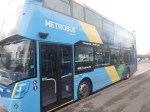
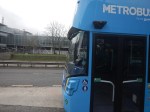
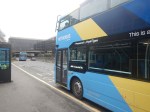

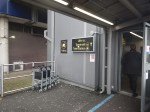
Note.
- The bus stop is directly outside the entrance to Sutton station.
- Sutton station is step-free.
- The information on the Metrobus’s buses at Sutton station is poor.
- The bus had a 74 number plate, so was registered after September 1st, 2024.
- The bus said it was a hydrogen bus.
- The seats were comfortable with leather facings.
- The route was mainly through rural Surrey.
- There were sections of dual-carriageway road with continuous 40 mph running.
- There were a number of steep hills.
- Previously, I have been told by a Bradford Councillor, that the City of Bradford is going for hydrogen-powered buses , as the city has lots of steep hills.
- The unusual Reigate and Redhill War Memorial on the A25.
- The route goes past Hadworth, Reigate and Redhill stations.
- Just before Gatwick Airport, the bus called at East Surrey Hospital.
I have some thoughts.
Does This Hydrogen Bus Have Almost The Quality Passengers Would Expect From A Coach?
Consider.
- I was very impressed with the quality of the bus and its fittings.
- But its biggest assets were the ride and mouse-quiet noise and being vibration-free.
- It was certainly up there, with the best British buses on UK roads.
- Strangely, I never rode in any of London’s Green Line coaches of the 1950s and 1960s.
But as Wrightbus are selling hydrogen-powered single-decker buses to the Germans, the quality must be of a certain standard.
The Performance Of The Bus
I would sum up the bus as follows.
- The bus didn’t hang around and it was well-driven.
- On much of the dual-carriageway, the bus appeared to be at the maximum speed limit of 40 mph
- Ride and seats were comfortable.
- There was virtually no vibration.
- At times, you almost felt you were in a top-of-the-range coach.
- The running gear is from German company ZF, which certainly doesn’t hinder the ride.
- The journey from Sutton to Gatwick Airport is twenty miles and took about ninety minutes.
I would feel that if Wrightbus design their CoachH2 chassis to the same standard of this bus, they’ll have a difficulty to meet sales demand.
Wrightbus Hydrogen Buses For My Local Bus Route 141
Consider.
- The 141 bus route is my local bus, which gets me to Moorgate, Bank, London Bridge and Manor House.
- The length of the full route is twenty miles and it takes about an hour to go from London Bridge station to Palmers Green.
- The route is currently run by older Wrightbus hybrid diesel-electric buses.
- I suspect that modern hydrogen buses could last almost all day on one fill of hydrogen, with perhaps a top-up at lunchtime.
They would have no difficulty handling the route and would greatly increase the customers current rock-bottom satisfaction.
Hydrogen Buses In Leafy Suburbs
- Where I live, is not particularly leafy or a suburb.
- But I seems to remember, when I moved here, that some of my neighbours complained about the noise of the 76 bus route.
- So Transport for London put on some quieter buses.
I would expect, that Metrobus might use the mouse quieter hydrogen buses in post areas, to avoid annoyance.
Hydrogen Buses As Route Extenders
Effectively, the Metrobus route 420 is acting as a route extender for Southern and Thameslink services coming South from London.
As it is a quality bus, that gets a move on, I suspect that some travellers, who previously took a train to Sutton, Tadworth, Reigate, Redhill or other stations and were then picked up, may take a hydrogen bus to a more convenient bus stop.
Because of the long range of a hydrogen bus or coach, zero-carbon performance, should be achieved without any range anxiety for passengers, driver or bus company.
Onward From Oakhampton Parkway Station
Consider.
- In 2014, storms destroyed the railway at Dawlish in Devon.
- As there was no alternative route, the storms cut everything west of Dawlish off from the rest of the UK.
- It is now likely, that a Park-and-Ride station will be built close to Okehanpton, which commuters would use for travel to Exeter.
- The main road to the South-West ; the A 30 will pass nearby.
It would appear, that Okehampton Interchange station could be used, if Nepture decided to show his power again.
Hopefully, the emergency plan will scare Nepture away.
Lumo To The Scottish Borders
Consider.
- Lumo have applied to extend some of their Edinburgh services to Glasgow.
- Talking to a friend in the Scottish Borders, they said, that travelers drive to Newcastle or Morpeth to catch Lumo for London.
- Four or five Lumo services every day stop in each direction at Morpeth station.
- So would it be sensible to run a bus or coach through the Scottish Borders to connect with the Lumo services?
This Google Map shows Morpeth in relation to the Border towns.
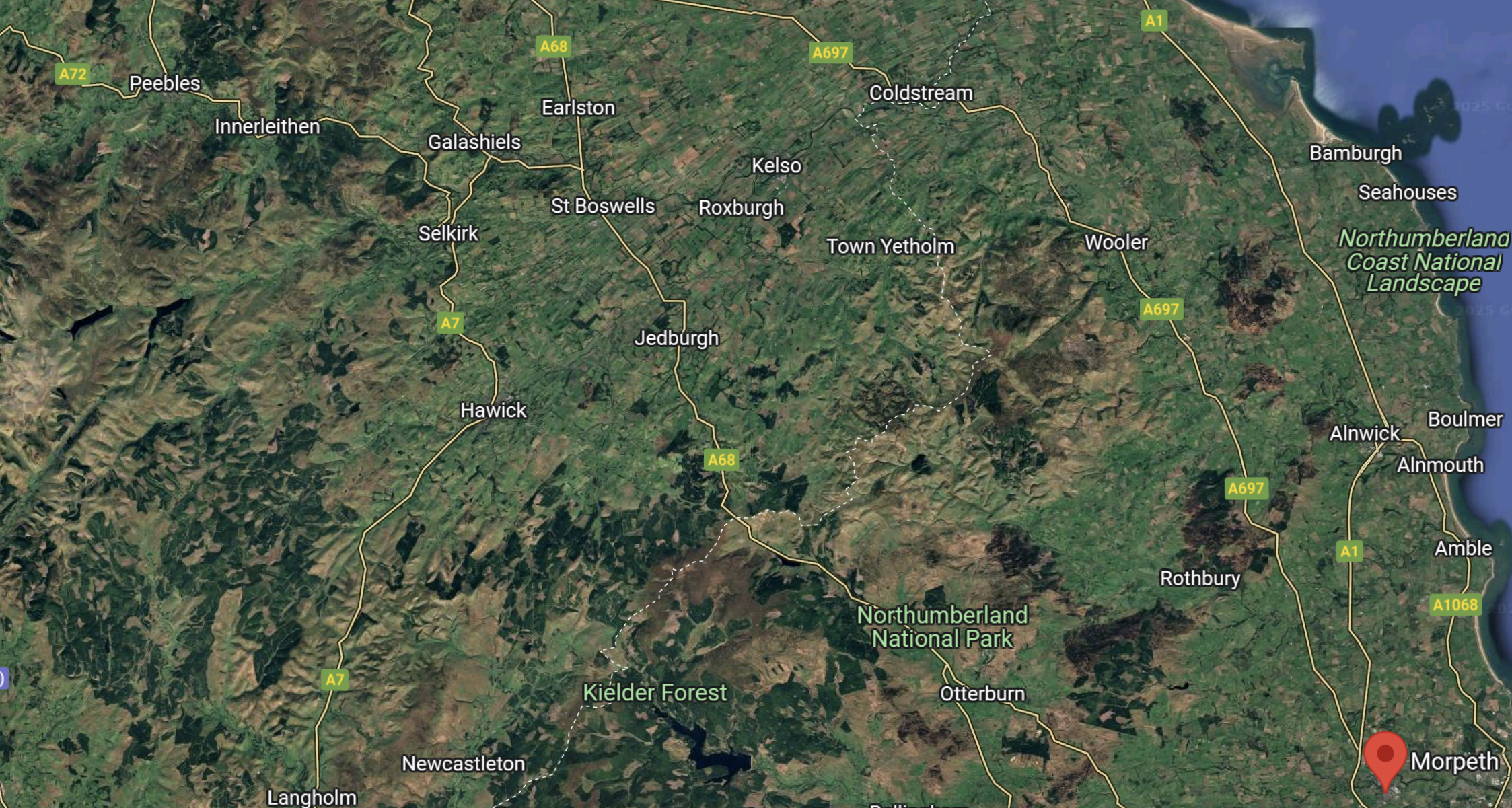
Note.
- Morpeth is marked by the red arrow in the South-East corner of the map.
- Galashiels, Galashiels, Hawick, Jedburgh, Peebles, Saint Boswells and Selkirk can be picked out on the map.
- The coach service would probably terminate at Galashiels, as it has a large bus terminal and and a railway station.
- Click the map to show it to a larger scale.
Morpeth to Galashiels is 69 miles and it should take about an hour and a half.
Hydrogen Buses As Rail Replacement Buses
Consider.
- I have had Rail Replacement Coaches as opposed to buses a few times in the UK.
- Once on the East Coast Main Line but usually on the Great Eastern Main Line to Ipswich or Norwich.
- They are generally more suited to their task. as they are faster and more luxurious.
- Many of our major rail lines run alongside trunk roads or motorways or fast dual carriageways.
So because hydrogen buses and coaches a have superior performance, than their diesel cousins, will hydrogen be the better fuel for a Rail Replacement Bus.
Metrobus’s Hydrogen Buses
This press release on the Metrobus web site is entitled Hydrogen Buses.
This is the sub-heading.
Our commitment to Zero Emissions
As part of our commitment to reducing emissions, twenty new hydrogen fuelled buses will operate on Fastway routes 10 & 20. These new buses demonstrate an ongoing commitment to reducing our local emissions. They deliver against science-based targets set by Metrobus and its parent company, The Go-Ahead Group, of becoming a net zero business by 2045 and decarbonising our bus fleet by 2035.
Conclusion
This bus is the best I’ve ridden in.
The End Of EVs Has Come, And It’s Toyota’s Fault – They’re Going To Change Everything, And It’s Going To Be Hydrogen
The title of this post, is the same as that of this article on El Diario 24.
These are the first two paragraphs.
The future of environmentally sustainable vehicles appears to be hydrogen based and Toyota is the frontrunner in developing this new technology.
The development of electric battery powered vehicles was a gamechanger for the industry and signified the first big shift since the introduction of fossil fuel powered vehicles all those years back. The current downside to electric vehicle, is of course, charging times as well as infrastructure to support charging stations. Japanese automaker, Toyota, has decided to switch lanes on the road to sustainability by investing research and funds into the development of a hydrogen powered system. This model has great potential in terms of environmental sustainability and user-friendliness but are the initial roll outs proving to be a success?
The article is from Argentina, which is a big country and range and charging could be a bigger factor, than in some countries.
But then Ricardo take a similar view to Toyota on hydrogen.
I also believe that hydrogen internal combustion engines will provide an alternative route to affordable zero-carbon vehicles, that are of all sizes.
I’m with Toyota on this one and the article is a must read.
CoacH2 – The Next Generation Coach
This page on the Advanced Propulsion Centre UK web site is entitled CoacH2 – Next Generation Hydrogen Fuel-Cell Coach Powertrain Demonstrator.
This is the sub-heading.
Accelerating the development of zero-emission hydrogen fuel-cell electric coaches, with a full on-vehicle technology demonstrator.
These are the first two paragraphs.
Coaches are an integral part of the public transport network, with over 30,000 diesel coaches operating across the UK and Ireland. Due to the specific demands of coach operation (motorway driving, long-range, high passenger and luggage loading capacity) decarbonisation options for this sector are extremely limited with hydrogen fuel-cell technology considered the most viable choice. This project will tackle this difficult to decarbonise sector by developing, testing and validating an innovative hydrogen fuel-cell powertrain suitable for coach applications.
Delivered by a Northern Irish consortium spanning OEM, coach operator and academia, CoacH2 will accelerate the development of zero-emission, fuel-cell electric coaches, with a full on-vehicle technology demonstrator to be manufactured and showcased at Cenex Expo 2024.
As I indicated in British Buses For British Bottoms, Wrightbus build a good well-built, smooth-riding and comfortable bus, so now they can add hydrogen-powered coaches to the product range.
This press release on the Wrightbus web site is entitled Wrightbus Coach Demonstrator Unveiled At Cenex Expo, gives more information on CoacH2.
- The demonstrator has a power of 300 Kw.
- It has a range of 1,000 km. on one refueling.
- An internet search reveals a launch date of 2026 for the hydrogen-powered coach.
I wonder, if this will be the killer application for hydrogen-powered road transport.
Central London and Gatwick Airport For Free On A Freedom Pass
I have always found it odd, that I can get to Heathrow Airport for free on my Freedom Pass, but for Gatwick Airport, I must buy a ticket.
Not that I’m bothered about the price of the ticket, but for some it might mean that they can’t get to their preferred holiday destination, as planes only fly from Heathrow.
The different treatment of the two airports must also annoy some airport and airline owners and bosses.
But recently, a free route for London’s Freedom Pass holders has opened.
This article on Inside Croydon is entitled Metrobus Rolls Out Zero-Emission Hydrogen Fleet Into Sutton.
These are the first two paragraphs.
Metrobus has been rolling out a fleet of hydrogen-powered buses, and last week its first double deckers, operating the 420 route from Sutton town centre to Gatwick Airport and Crawley, were brought into service.
Metrobus is planning on having more than 40 hydrogen-powered buses, in a partnership with West Sussex, Surrey and Kent county councils and Gatwick, in a £24million investment by the partners including a £10 million grant from the Department for Transport.
Note.
- The range of a Wrightbus Hydroliner is 280 miles on a full tank of hydrogen.
- It looks like as Crawley to Sutton station is a 42.2 miles round trip, so that means six round trips are possible on a tank of hydrogen.
- The Hydroliners may have the speed to use the M23 between Sutton and Crawley.
According to the article, refueling would be at Crawley.
A Zero-Carbon Extension To The Freedom Pass Zone
The free route for Freedom Pass holders to Gatwick Airport will be.
- Southern or Thameslink Train to Sutton.
- 420 bus to Gatwick Airport.
The article says this about the routes that are being planned.
The 420 route runs from Sutton town centre, through Belmont and Banstead, to Tadworth and then on to Reigate and Redhill, serving East Surrey Hospital before going on to the airport and Crawley. Metrobus is planning to use other hydrogen-powered buses on routes that will serve Caterham, Dorking, Tunbridge Wells, Haywards Heath and Brighton.
It appears that the hydrogen buses will add a large zero-carbon area to the Freedom Pass zone.
The only new infrastructure, would be the refueling equipment at Crawley.
I can also see the buses becoming an unusual tourist attraction for the area.
An Extension To An Electric Railway Or Tramway
They may also set a precedent for how a transport network can be extended in a zero-carbon manner from a tram or rail terminal served by an electric railway or tramway.
Battery electric buses could be used, but their range means that on anything but the shortest routes, they would constantly need recharging.
Okehampton Interchange Station
The first paragraph of the Wikipedia entry for Okehampton Interchange station describes it like this.
Okehampton Interchange (formerly known as Okehampton Parkway) is a proposed railway station in Okehampton on the Dartmoor Line. The station would be part of the Devon Metro and has been described as a priority station. The station is to be sited off Exeter Road, by the Business Park and close to the junction with the A30, in the Stockley Hamlet area of Okehampton. It would also serve 900 new homes to be built nearby.
But I believe that Okehampton Interchange station also has another purpose.
If the sea should destroy the coastal railway, as it did a few years ago, then passengers for the South-West could be ferried to and from Okehampton Interchange station by high-speed hydrogen-powered coaches along the A30, to catch trains to Exeter and London.
So, I would build a hydrogen filling station at Okehampton Interchange station, so that if the sea destroys the coastal railway again, the alternative is ready.
Normally, the hydrogen filling station would refuel local hydrogen buses, trucks, cars and other vehicles and those passing on the A30 to and from Cornwall.
Okehampton Interchange station would be the ultimate extension to an electric railway. Even if the Dartmoor Railway was worked by electro-diesel trains.

