Construction Under Way To Double Power Station Capacity At Centrica’s Brigg Energy Park
The title of this post, is the same as that of this press release from Centrica.
This is the sub-heading.
Four ultra-efficient engines have arrived at Centrica’s former combined cycle gas power station at Brigg, with construction work underway on an expansion of the peaking plant at the Lincolnshire site.
These three paragraphs give more details about the project.
The business is installing the four engines inside the former turbine hall at the power station, which was decommissioned in 2020, helping to create nearly 100MW of fast response assets capable of meeting demand when renewable generation is low.
The expanded power plant will be hydrogen-ready, and form part of a trial due to start in late 2024 to blend hydrogen into the gas, ramping up from a three per cent blend to 20 per cent, with a long term vision to move towards 100 per cent hydrogen and to deploy similar technology across all peaking plants.
Work at Brigg is expected to last around nine months and the plant will be fully operational in early 2025.
These are my thoughts.
Hydrogen Blend Operation
The second paragraph indicates that Centrica will be using Brigg power station to research the use of hydrogen blends.
Hydrogen blends could offer a way an easy way to cut hydrogen emissions, so it is good, that Centrica are researching their use in gas-fired power stations.
Brigg As A Peaking Plant
This paragraph from the press release, explains what Centrica means by a peaking plant.
Peaking plants only generate electricity when there’s high or peak demand for electricity, or when generation from renewables is too low to meet demand. Once connected to the grid, the engines will have the capacity to power 20,000 homes for a full day when required, which will maintain stability and deliver reliable power across the grid.
The second paragraph also says this.
A long term vision to move towards 100 per cent hydrogen and to deploy similar technology across all peaking plants.
Does this mean that all peaking plants will move to hydrogen-fired generation?
Brigg Redevelopment
This paragraph from the press release, outlines Centrica’s plans for Brigg power station.
Centrica is redeveloping the Brigg energy park which, once complete, will be home to a 50MW battery, commercial-scale hydrogen production using HiiROC technology (in which Centrica has a five per cent stake), and 100MW of gas peaking plant.
Note.
- I would assume that the battery, will be able to provide 50 MW for at least two hours, so the battery electric storage system (BESS) will be at least a 50 MW/100 MWh unit.
- The HiiROC technology is being developed on the other side of the Humber in Hull.
- HiiROC technology captures the carbon in the gas as carbon black, which has uses in its own right, in agriculture and tyre and other manufacturing.
- Both a battery and a gas peaking plant, will be used at Brigg to match generation with demand.
I wouldn’t be surprised that to use both a battery and a gas peaking plant, is the most efficient way to balance the renewable energy.
Hydrogen Production
The HiiROC technology that will be used at Brigg can extract hydrogen from a variety of sources including biomethane, chemical plant off gas or natural gas.
The HiiROC technology can be scaled to fit the application.
I feel that the versatility of the HiiROC technology, may result in using some unusual feeds to produce hydrogen.
As an example of the deployment of a small HiiROC system , one at a sewage works could provide hydrogen for the utility company’s vehicles.
The main use of the hydrogen would be to provide a clean fuel for the gas-fired peaking plant.
I also wouldn’t be surprised to see the hydrogen, sold and distributed to the local area, from an energy park, like Brigg.
Conclusion
Increasingly, backup for renewables will use a wide range of zero-carbon technologies.
Korean Hydrogen Bus Adoption Emerging To Block Low-Priced Electric Buses From China
The title of this post, is the same as that of this article on BusinessKorea.
These are the first two paragraphs.
Major Korean business groups such as Samsung, SK, Hyundai Motor, and POSCO are expanding the introduction of hydrogen buses. They are more efficient than electric buses, and can run 635 kilometers on a single charge, making them suitable for long-distance commuting. Expanding hydrogen mobility, including buses, is considered the first step in building an entire hydrogen ecosystem.
SK Group is one of the most active companies in expanding hydrogen buses. According to SK Group on May 26, SK siltron has decided to replace its commuter buses for employees of its Gumi plant in North Gyeongsang Province with hydrogen buses. Additional deployments are under consideration after a pilot run in the first half of the year. In early May, SK hynix introduced three of the Universe model, Hyundai’s hydrogen bus for commuting. SK E&S recently completed the world’s largest liquefied hydrogen plant in Incheon and plans to soon expand its hydrogen refueling stations nationwide to 20.
The Korean bus seem to have developed a strategy to protect themselves from the Chinese.
I have a few thoughts.
Korea And HiiROC
Hyundai and Kia have joined Centrica in taking stakes in Hull-based startup HiiROC, which I wrote about in Meet HiiROC, The Startup Making Low-Cost Hydrogen Free From Emissions.
London’s Future Bus Fleet
There are rumours on the Internet that Sadiq Khan, will replace all London’s buses with new Chinese buses.
How will I get around, as I don’t ride in anything that was made in China?
Conclusion
We live in interesting times.
First US Hydrogen-Fueled Ferry Okayed For Commercial Operation
The title of this post, is the same as this of this article on OffshoreEnergy.biz.
This is the sub-heading.
US-based shipping company SWITCH Maritime has received approval from the U.S. Coast Guard for its hydrogen-powered ferry Sea Change to enter commercial operations.
This is the first paragraph.
As informed, the company was presented with the signed Certificate of Inspection (COI) by Captain Taylor Q. Lam, the U.S. Coast Guard Sector San Francisco commander and Captain of the Port, for its flagship hydrogen ferry.
This paragraph gives more details of the ferry.
Built and launched at All American Marine shipyard in Bellingham, Washington, Sea Change is a 75-passenger catamaran ferry featuring an integrated hydrogen power system from Zero Emission Industries (ZEI), with 360kW of fuel cells from Cummins and 600kW of electric motor propulsion from BAE Systems.
As the electric motor propulsion is 600 kW and there are only 360 kW of hydrogen fuel cells, I suspect there is a battery in there somewhere.
The Orkney Islands have their own hydrogen ferry project called HySeasIII.
The Orkney ferry uses 600 kW of Ballard fuel cells.
There is no news this year about what is happening to the Orkney project.
Redevelopment Of Scottish Port Begins As Owner Secures GBP 400 Million For Offshore Wind Upgrade
The title of this post, is the same as that of this article on offshoreWIND.biz.
This is the sub-heading.
Haventus, the owner of the Ardersier Port in the Moray Firth, Scotland, has taken a final investment decision and kicked off construction work on redeveloping the port to serve both fixed-bottom and floating offshore wind projects. The revamped port is expected to open in the second half of 2025.
These are the first two paragraphs.
This month, Haventus was granted a GBP 100 million (approximately 117 million) joint credit facility from the Scottish National Investment Bank and UK Infrastructure Bank with GBP 50 million (approx. EUR 58.5 million) investment from each.
This follows a GBP 300 million (approx. 351 million) investment commitment by the energy investment firm Quantum Capital Group in 2023 when Haventus began the redevelopment of Ardersier Port.
This page on the Haventus web site, gives more details of the Port of Ardersier.
Included are.
- Access channel width – 160 m.
- Access channel depth – 12.4 m.
- Landside area – 350 acres.
- 420m main quay.
- 80 m Ro/Ro capable berth.
- People-friendly midges
- Green Freeport tax site designation
- More space is available if required.
There is also an informative video.
Haventus say they are delivering a world-leading energy transition facility. I can go along with that!
These are my thoughts.
The Location Of The Port of Ardersier
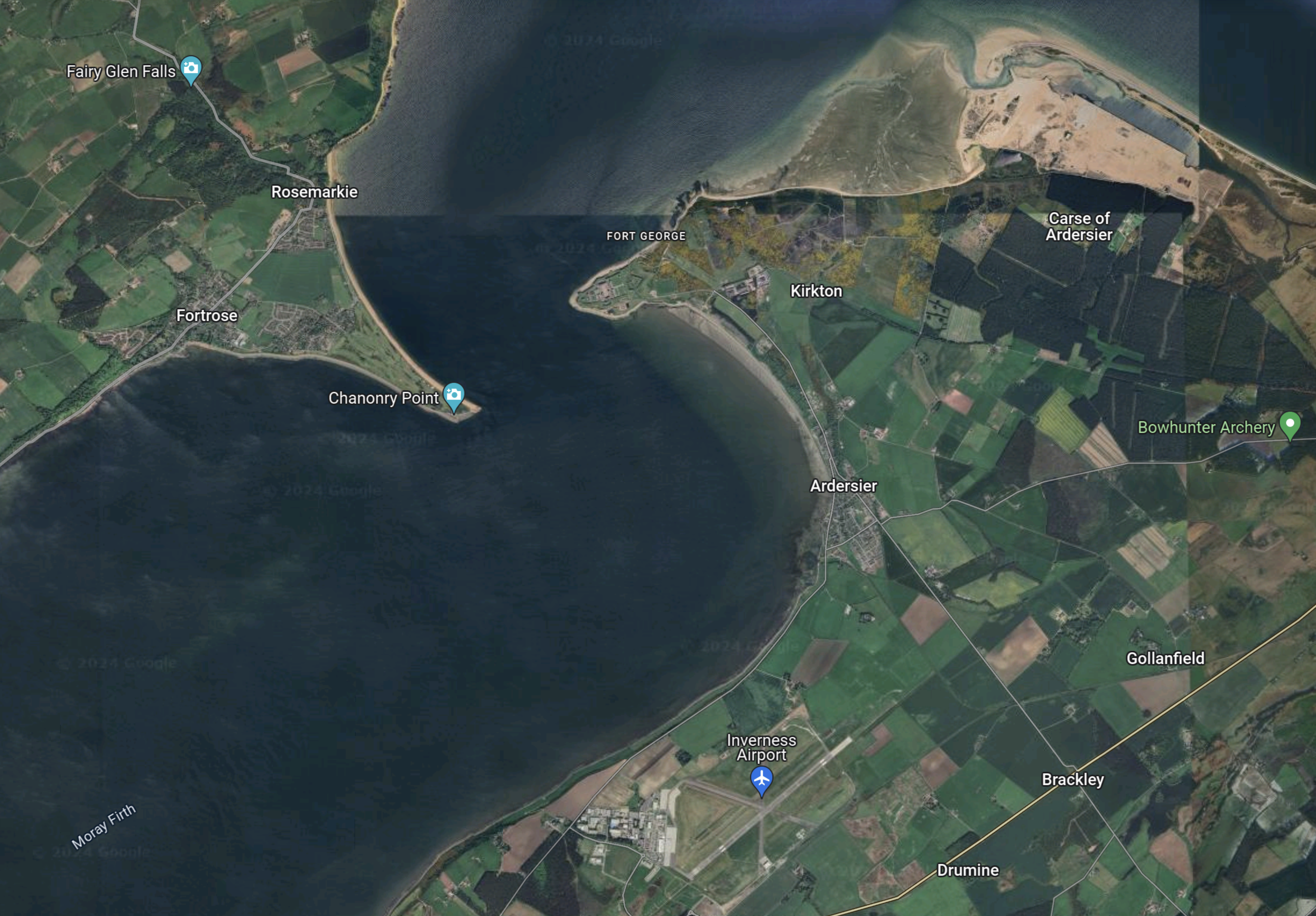
This Google Map shows the location of the Port of Ardersier.
Note.
- The large expanse of water in the middle of the map is Moray Firth.
- The blue arrow at the bottom of the map indicates Inverness Airport.
- Inverness Airport, has a railway station on the Aberdeen and Inverness Line.
- The village of Ardersier is on the the Eastern bank of the Moray Firth
- The Port of Ardersier is in the North-East corner of the map.
The city of Inverness, with a population of around 48,000, is a few miles South-West of the South-West corner of the map.
Which Windfarms Will Be Built And Serviced From The Port Of Ardersier?
This map shows the various ScotWind leases, around the North of Scotland.

The numbers are Scotwind’s lease number in their documents.
These are the Scotwind wind farms to the North-East of Scotland, that could reasonably be assumed to be built and served from the Port of Ardersier.
- 7 – DEME Concessions Wind – 200 km² – 1.0 GW – Floating
- 8 – Falck Renewables Wind – 256 km² – 1.0 GW – Floating
- 9 – Ocean Winds – 429 km² – 1.0 GW – Fixed
- 10 – Falck Renewables Wind – 134 km² – 0.5 GW – Floating
- 11 – Scottish Power Renewables – 684 km² – 3.0 GW – Floating
- 12 – BayWa r.e. UK – 330 km² – 1.0 GW – Floating
These are the Scotwind wind farms to the North-West of Scotland, that could reasonably be assumed to be built and served from the Port of Ardersier.
- 13 – Offshore Wind Power – 657 km² – 2.0 GW – Fixed or Floating
- 14 – Northland Power – 390 km² – 1.5 GW – Floating
- 15 – Magnora – 103 km² – 0.5 GW – Floating
- 16 – Northland Power – 161 km² – 0.8 GW – Floating
These ten wind farms add up to 12.3 GW.
Transport
Consider.
- Obviously, heavy components will be brought in by sea, using the Ro/Ro capable berth or using a crane to unload a barge.
- Personnel will be able to fly in for the day.
- Will some visitors rom London use the Caledonian Sleeper to and from Inverness station to get a full day on site and a good night’s sleep, whilst travelling.
But I do see a problem with local traffic to and from the site.
Hydrogen Buses
This page on the Sizewell C web site, discusses how they will use hydrogen buses.
I could see the Port of Ardersier taking a leaf out of Sizewell C’s book and run hydrogen buses to Inverness, Inverness Airport and other nearby towns.
The North of Scotland certainly won’t be short of green hydrogen to power the buses.
Hydrogen
Conclusion
If you thought that the only useful wind-driven thing to come out of Scotland was bagpipes, you had better think again.
The Port of Ardersier will be the factory and operation and maintenance port for one of the largest offshore wind industries in the world.
RWE And the Norfolk Wind Farms
In March 2024, I wrote RWE And Vattenfall Complete Multi-Gigawatt Offshore Wind Transaction In UK, which described how Vattenfall had sold 4.2 GW of offshore wind farms, situated off North-East Norfolk to RWE.
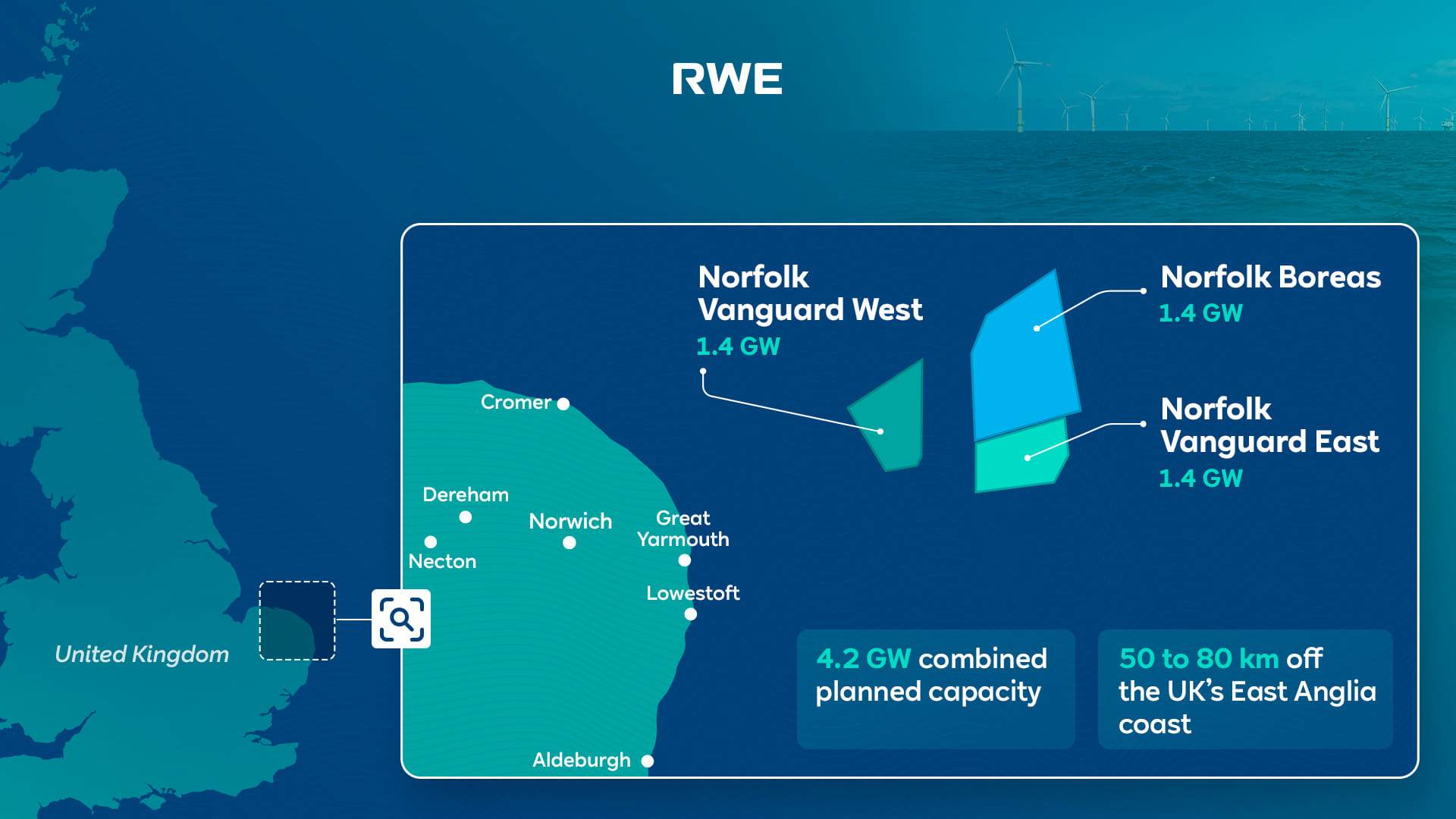
This map from RWE shows the wind farms.
Note.
- The Norfolk Zone consists of three wind farms; Norfolk Vanguard West, Norfolk Boreas and Norfolk Vanguard East.
- The three wind farms are 1.4 GW fixed-foundation wind farms.
- In Vattenfall Selects Norfolk Offshore Wind Zone O&M Base, I describe how the Port of Great Yarmouth had been selected as the O & M base.
- Great Yarmouth and nearby Lowestoft are both ports, with a long history of supporting shipbuilding and offshore engineering.
The wind farms and the operational port are all close together, which probably makes things convenient.
So why did Vattenfall sell the development rights of the three wind farms to RWE?
Too Much Wind?
East Anglia is fringed with wind farms all the way between the Wash and the Thames Estuary.
- Lincs – 270 MW
- Lynn and Inner Dowsing – 194 MW
- Race Bank – 580 MW
- Triton Knoll – 857 MW
- Sheringham Shoal – 317 MW
- Dudgeon – 402 MW
- Hornsea 3 – 2852 MW *
- Scroby Sands – 60 MW
- East Anglia One North – 800 MW *
- East Anglia Two – 900 MW *
- East Anglia Three – 1372 MW *
- Greater Gabbard – 504 MW
- Galloper – 353 MW
- Five Estuaries – 353 MW *
- North Falls – 504 MW *
- Gunfleet Sands – 172 MW
- London Array – 630 MW
Note.
- Wind farms marked with an * are under development or under construction.
- There is 4339 MW of operational wind farms between the Wash and the Thames Estuary.
- An extra 6781 MW is also under development.
If all goes well, East Anglia will have over 11 GW of operational wind farms or over 15 GW, if the three Norfolk wind farms are built.
East Anglia is noted more for its agriculture and not for its heavy industries consuming large amounts of electricity, so did Vattenfall decide, that there would be difficulties selling the electricity?
East Anglia’s Nimbies
East Anglia’s Nimbies seem to have started a campaign against new overground cables and all these new wind farms will need a large capacity increase between the main substations of the National Grid and the coast.
So did the extra costs of burying the cable make Vattenfall think twice about developing these wind farms?
East Anglia and Kent’s Interconnectors
East Anglia and Kent already has several interconnectors to Europe
- Viking Link – Bicker Fen and Jutland – 1.4 GW
- LionLink – Suffolk and the Netherlands – 1.8 GW – In Planning
- Nautilus – Suffolk or Isle of Grain and Belgium – 1.4 GW – In Planning
- BritNed – Isle of Grain and Maasvlakte – 1.0 GW
- NeuConnect – Isle of Grain and Wilhelmshaven – 1.4 GW – Under Construction
- GridLink Interconnector – Kingsnorth and Warande – 1.4 GW – Proposed
- HVDC Cross-Channel – Sellinge and Bonningues-lès-Calais – 2.0 GW
- ElecLink – Folkestone and Peuplingues – 1.0 GW
- Nemo Link – Richborough and Zeebrugge – 1.0 GW
Note.
- Five interconnectors with a capacity of 6.4 GW.
- A further four interconnectors with a capacity of 6 GW are on their way.
At 12.4 GW, the future capacity of the interconnectors between South-East England and Europe, is nor far short of South-East English wind power.
There are also two gas pipelines from the Bacton gas terminal between Cromer and Great Yarmouth to Europe.
The Wikipedia entry for the Bacton gas terminal gives these descriptions of the two gas pipelines.
Interconnector UK – This can import gas from, or export gas to, Zeebrugge, Belgium via a 235 km pipeline operating at up to 147 bar. There is a 30-inch direct access line from the SEAL pipeline. The Interconnector was commissioned in 1998.
BBL (Bacton–Balgzand line) – This receives gas from the compressor station in Anna Paulowna in the Netherlands. The BBL Pipeline is 235 km long and was commissioned in December 2006.
It would appear that East Anglia and Kent are well connected to the Benelux countries, with both electricity and gas links, but with the exception of the Viking Link, there is no connection to the Scandinavian countries.
Did this lack of connection to Sweden make convincing the Swedish government, reluctant to support Vattenfall in their plans?
Bringing The Energy From The Norfolk Wind Farms To Market
It looks to me, that distributing up to 4.2 GW from the Norfolk wind farms will not be a simple exercise.
- Other wind farms like the 2852 MW Hornsea 3 wind farm, may need a grid connection on the North Norfolk coast.
- The Nimbies will not like a South-Western route to the National Grid at the West of Norwich.
- An interconnector to Denmark or Germany from North Norfolk would probably help.
But at least there are two gas pipelines to Belgium and the Netherlands.
RWE, who now own the rights to the Norfolk wind farms, have a large amount of interests in the UK.
- RWE are the largest power producer in the UK.
- They supply 15 % of UK electricity.
- They have interest in twelve offshore wind farms in the UK. When fully-developed, they will have a capacity of almost 12 GW.
- RWE are developing the Pembroke Net Zero Centre, which includes a hydrogen electrolyser.
RWE expects to invest up to £15 billion in the UK by 2030 in new and existing green technologies and infrastructure as part of this.
Could this be RWE’s plan?
As the Norfolk wind farms are badly placed to provide electricity to the UK grid could RWE have decided to use the three Norfolk wind farms to produce hydrogen instead.
- The electrolyser could be placed onshore or offshore.
- If placed onshore, it could be placed near to the Bacton gas terminal.
- There are even depleted gas fields, where hydrogen could be stored.
How will the hydrogen be distributed and/or used?
It could be delivered by tanker ship or tanker truck to anyone who needs it.
In Developing A Rural Hydrogen Network, I describe how a rural hydrogen network could be developed, that decarbonises the countryside.
There are three major gas pipelines leading away from the Bacton gas terminal.
- The connection to the UK gas network.
- Interconnector UK to Belgium.
- BBL to The Netherlands.
These pipelines could be used to distribute hydrogen as a hydrogen blend with natural gas.
In UK – Hydrogen To Be Added To Britain’s Gas Supply By 2025, I describe the effects of adding hydrogen to the UK’s natural gas network.
Are Scotrail Going To Replace The Inter7City Trains With Hydrogen-Powered Trains?
This article in The Times is entitled The Caley Is Ready To Roll With New Venture Building Trains.
I feel that this is one of the most significant paragraphs in the article.
ScotRail has indicated that it wants to replace nearly two thirds of its fleet with new, low-carbon rolling stock between 2027 and 2035, comprising about 675 carriages in total, with an initial core order of 64 four and five-car units. A spokesman confirmed: “We are working on a business case that will go to the Scottish government for the procurement of a new suburban train fleet.”
The current Scotrail fleet includes.
- 25 Inter7City trains which comprise 52 Class 43 power cars and 120 Mark 3 carriages – Diesel – 120 cars – 1975
- 5 Class 153 trains – Diesel – 5 cars – 1987
- 42 Class 156 trains – Diesel – 84 cars – 1987
- 40 Class 158 trains – Diesel – 80 cars – 1987
- 30 Class 170 trains – Diesel – 90 cars – 1998
- 21 Class 318 trains – Electric – 63 cars – 1985
- 34 Class 320 trains – Electric – 66 cars – 1990
- 40 Class 334 trains – Electric – 120 cars – 1999
- 38 Class 380 trains – Electric – 140 cars – 2009
- 70 Class 385 trains – Electric – 234 cars – 2015
Note the last three fields are the traction type, total number of cars and the build year of the first train.
I will split these trains into four groups.
- Inter7City – Diesel – 25 trains – 120 cars
- BR Diesel – Diesel – 117 trains – 259 cars
- BR Electric – Electric – 55 trains – 129 cars
- Modern Electric – Electric – 148 trains – 494 cars
Note.
- This is a grand total of 345 trains and 1002 cars.
- Ignoring the modern electric trains and the total is 197 trains and 508 cars.
- The total for diesel trains is 142 trains and 359 cars.
- As Great Western Railway have withdrawn their similar GWR Castles, there must be reasons for Scotrail to do the same.
I will now look at replacement strategies, based on this statement from Scotrail.
ScotRail has indicated that it wants to replace nearly two thirds of its fleet with new, low-carbon rolling stock between 2027 and 2035, comprising about 675 carriages in total, with an initial core order of 64 four and five-car units.
I would expect 675 carriages would be about 232 trains, if the current average train length of just under three cars is carried over.
The Effect Of 675 New Carriages
Assuming that no modern electric trains were replaced, this would create a fleet size of at least 1169 carriages.
This would be a sixteen percent increase in carriages, which would be welcome news for some rail users.
The Initial Core Order Of 64 Four And Five-Car Units
All we know of this order, is the number of trains and that they will be new and low-carbon, according to indications from Scotrail.
Low-carbon would mean one of these traction options.
- Electric trains with full electrification.
- Battery-electric trains with partial-electrification.
- Hydrogen-powered trains.
Note.
- The heritage Taliban would object violently to full electrification of some historic routes.
- UNESCO would probably remove the World Heritable Site status to the Forth Bridge if it were to be electrified.
- Scotland is developing a hydrogen infrastructure.
- Hydrogen-powered trains have long ranges in the order of a thousand kilometres.
- Hydrogen-powered trains are essentially electric trains with a hydrogen fuel-cell to provide electricity as needed.
- Hydrogen-powered trains would need very little new infrastructure, except for a network of refuelling points across Scotland.
- Well-designed battery-electric and hydrogen-electric trains, should be very quiet and comfortable for passengers.
As an engineer, I would choose hydrogen-power for the initial core order.
Where would the initial core order be deployed?
Twenty-five would be used to replace the carbon-emitting elderly Inter7City trains.
These routes could probably handle the other forty.
- Aberdeen and Inverness
- Edinburgh/Glasgow and Aberdeen.
- Edinburgh/Glasgow and Inverness.
- Glasgow and South Western Line
- West Highland Line.
Note.
- A lot of diesel trains would be retired.
- Trains could be designed, for tourists with proper cycle spaces.
- The West Highland Line would get the five-car trains it needs.
This would be a good start.
Conclusion
It looks to me, that the Inter7City trains will be going and will be replaced by new trains.
But will Scotland take the great leap forward and power the new trains by Scottish hydrogen?
Feadship Ushers In The Fuel-Cell Era With The Launch Of118.80-metre Project 821
The title of this post, is the same as this press release from Feadship.
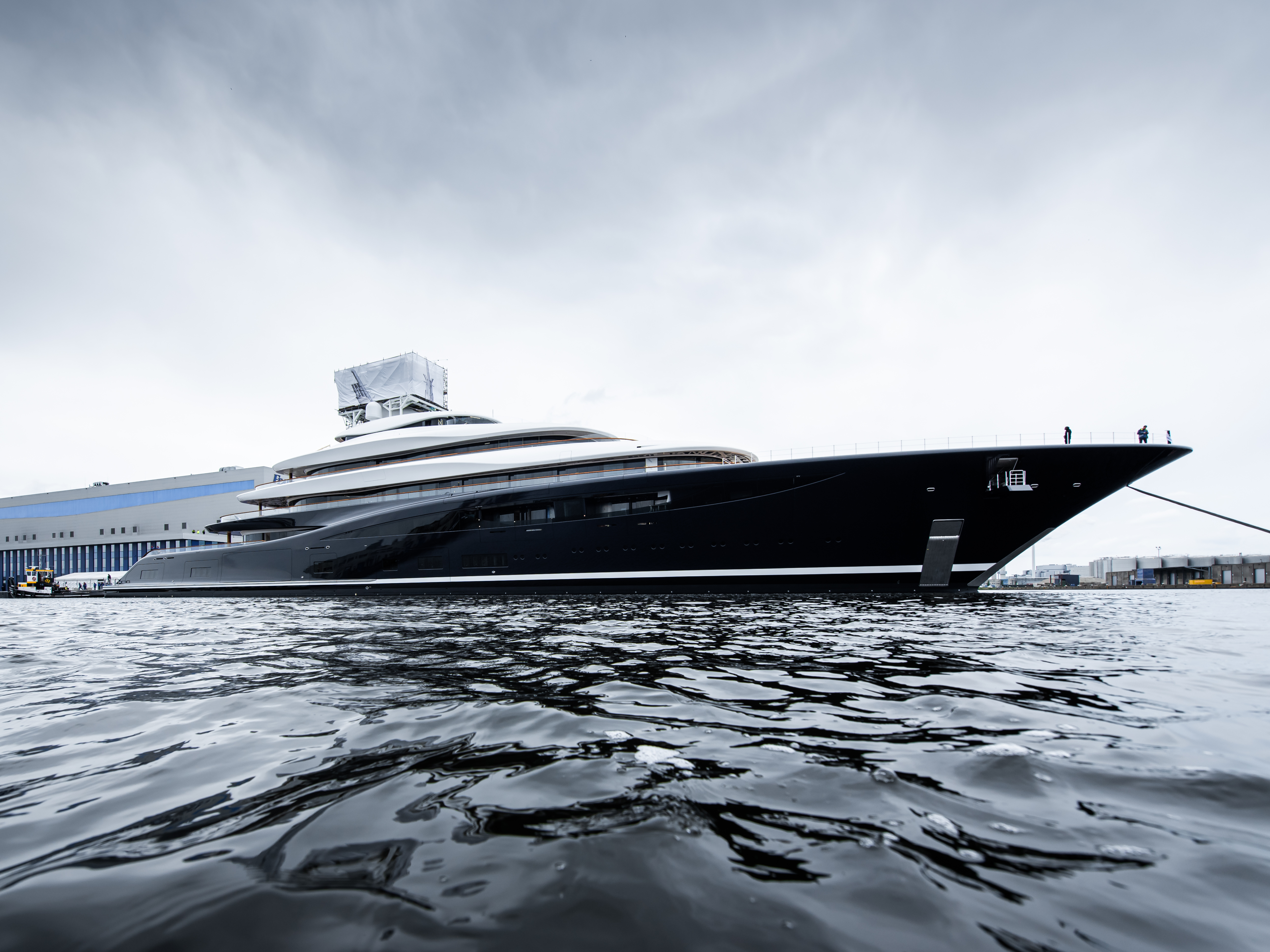
This picture from Feadship shows project 821.
These are the first two paragraphs of the press release.
When the drydock doors slid open on 4 May at Feadship’s Amsterdam shipyard, the yachting
world was forever changed. Say hello to Project 821, the world’s first hydrogen fuel-cell
superyacht. Five years in the making, innovation-packed Feadship Project 821 is the answer to
a fundamental question: “How far can we push green technology on superyachts?”Designed by RWD and with owners representation by Edmiston, Feadship’s bold response was
a multi-faceted, zero-diesel approach designed to cruise between harbours or anchorages and
to operate the yacht’s hotel load and amenities with emission-free power from green hydrogen.
“The aim has been to develop a new, clean technology not just for this project, but for the
world,” said Jan-Bart Verkuyl, Feadship Director / CEO Royal Van Lent Shipyard. The size of
the proposed yacht – 100-metres-plus – made it a good candidate to explore pure green
hydrogen as the fuel-cell source. For those captivated by cutting-edge innovations, this yacht
presents an opportunity for potential acquisition as it showcases the pinnacle of modern
technological advancements.
As the superyacht is 118.8 metres long, I can see a lot of ships of this size being powered by hydrogen.
ITM Power Seals PEM Electrolyser Deal With Hygen
The title of this post, is the same as that of this article on gasworld.
These three paragraphs give details of the deal.
ITM Power has struck a partnership with Hygen Energy to become the preferred supplier for Proton Exchange Membrane (PEM) electrolysers for major hydrogen projects within the UK and across Europe.
Hygen, a leading developer, producer and asset owner of low-carbon hydrogen production on the continent, focusing on the decarbonisation of mobility, construction and hard-to-electrify industries and power, is targeting 200 Megawatt (MW) of electrolyser projects across the continent.
The two-phase collaboration will see 50 MW of Neptune Plug and Play electrolysers across several projects, many of which will be based on UK government HAR2 or similar funding programmes, followed by 150 MW of larger-scale modular electrolysers. Each project will be subject to a Final Investment Decision (FID).
Note.
- This page on the iTM Power web site gives details of the Neptune electrolyser.
- Neptune appears to be a 2 MW electrolyser, so the first phase could be around 25 electrolysers.
- This news item on the iTM Power web site is entitled iTM Power And Sumitomo Complete Installation Of First If Its Kind Demonstration Electrolyser Un Japan.
Things seem to be looking up for iTM Power.
Conclusion
I can see a time in the not to distant future, where a large number of small-to-medium size electrolysers will be mopping up surplus electricity to create hydrogen.
How Hydrogen Will Power The Green Construction Eevolution
The title of this post, is the same as that of this news item from Ryze Hydrogen.
These two paragraphs introduce the news item.
According to the International Energy Agency buildings operations and construction emissions account for more than one-third of global energy-related emissions, significantly contributing to environmental degradation, with heavy machinery and standby power solutions relying heavily on fossil fuels.
Yet here at Ryze we know the industry stands on the brink of a green revolution, as clean energy solutions lead the charge towards decarbonisation.
The news item, is a must-read for anybody involved in construction.
Recently, a gas leak killed the roadside tree outside my house. I wrote about the incident in It Looks Like The Gas Leak Has Killed The Tree Outside My House.
What I didn’t say, was that when they cleaned up the mess, I had an eight-wheeled diesel truck with a grab, working outside my house for a couple of hours, spewing fumes everywhere.
Hopefully, green construction is friendlier to the neighbours and the workers on site.
High Speed Two is using green construction for this reason in sensitive locations.
Wrightbus Secures Further German Order For 46 Hydrogen Buses
The title of this post, is the same as that of this press release from Wrightbus.
These paragraphs outline the deal.
World-beating zero-emission bus manufacturer Wrightbus today announced a milestone deal to provide 46 hydrogen buses to Germany – taking a demo bus from Belfast to showcase its reliability and range.
The buses ordered by Cottbusverkehr GmbH will serve the city of Cottbus, the second largest city in the state of Brandenburg, and and in the western part of the district of Spree-Neiße.
It follows a landmark announcement by the German government to implement a €350 million scheme to support the production of renewable hydrogen.
Wrightbus is Europe’s fastest-growing bus manufacturer and follows the company’s rapid rise since it was bought out of administration in 2019. It was named Northern Ireland’s fastest-growing company by Growth Index this week – employing 1,650 people and producing 22 buses a week.
The Cottbus order for the Kite Hydroliner buses follow deals in Germany with West Verkehr, Regionalverkehr Köln GmbH (RVK), and Saarbahn GmbH, with more European orders in the pipeline.
If Northern Irish hydrogen buses are selling well to the Germans, why are there so few in the UK.
These pictures show the UK version of the German buses in Crawley.





They are excellent buses.
 The Anonymous Widower