New Mobile Hydrogen Unit Unveiled By Logan Energy In Bid To Accelerate Greener Transport
The title of this post, is the same as that of this article on Fuel Cell Works.
This sums up the development, that has been unveiled by Logan Energy.
It is a compression trailer, that looks like it could be towed by any vehicle capable of towing a horse box.
- The compressor can transfer hydrogen between any two cylinders at all the usual pressures.
- It is aimed at both the bus and heavy goods vehicle market.
- The hydrogen capacity of the trailer is not stated.
I feel that this sort of development will help operators embrace hydrogen.
A bus company for instance could have an appropriate number of trailers, for their fleet of hydrogen buses.
- The bus company would need a suitable towing vehicle, like a light truck.
- Trailers would be filled at an electrolyser outside of the city.
- Each bus depot could have a space, where a trailer could be parked to fill the buses.
- A schedule would probably need to be developed for filling the trailers.
We will see more developments like this.
But they will have to compete with companies like ITM Power, who can supply on-site electrolysers.
Work Begins In South Africa On Largest Fuel-Cell Vehicle In The World
The title of this post, is the same as that of this article on Hydrogen Fuel News.
This is an explanatory paragraph.
The Anglo American mining company in South Africa is seeking to lead the way in reducing its greenhouse gas emissions. It will be starting this effort with a 210 metric ton truck. The fuel-cell vehicle is the largest in the world and will operate at the Mogalakwena platinum mine.
These are some points from the article.
- The nuGen haul truck began as a Komatsu 930E with a diesel-electric powertrain.
- The haul truck’s traction motors are now powered by eight 100-kilowatt hydrogen fuel cell modules. The modules were provided by Ballard.
- They are complemented by a Williams Advanced Engineering lithium-ion battery pack capable of outputting 1.1MW.
- The components were integrated in Seattle by First Mode.
- The fuel-cell vehicle’s powertrain is 2MW (2,682 hp).
- That is adequate for the haul truck to keep up its rating of 300 metric tons.
- The truck and payload will reach 510 metric tons combined.
There are a lot of heavy numbers there.
There is this video from Anglo American.
Clean Air Power Adds Hydrogen To Class 66 Fuel Mix
The title of this post, is the same as that of this article on the International Rail Journal.
This is the first two paragraphs.
Fuel injection technology developed by Clean Air Power that enables a class 66 locomotive to run on a combination of diesel, biogas and hydrogen has successfully completed nine months of trials with British freight operator Freightliner.
This is the first time that the injection technology has been tested by the rail freight sector and, according to Clean Air Power, paves the way for reducing the emissions of other class 66 locomotives.
Note.
- There are 450 Class 66 locomotives in service in the UK, with more in service in Europe.
- Freightliner was Clean Air Power’s main project partner.
- Nothing was disclosed about carbon savings.
- The trial was backed by £400,000 of Government money.
- The locomotive has completed a nine month trial.
This would appear to be a good professional start to decarbonisation of rail freight.
It’s also rather ironic, that this successful trial of a diesel-saving locomotive was announced on the day of Vlad the Mad’s big parade.
Could Fortescue Future Industries’ Green Hydrogen Help Europe Ditch Russian Energy?
The title of this post, is the same as that of this article on Motley Fool Australia.
This is the first paragraph.
Green hydrogen may help interrupt the Kremlin’s ability to conduct “war games”, says Fortescue chief Andrew Forrest.
I very much think that Andrew ‘Twiggy’ Forrest is right.
My last three hydrogen articles were.
- Poland May Become A Green Hydrogen Tycoon.
- Will The Orkney Become A Major Green Hydrogen Production Centre?
- Wind And Solar Boom Will Bring Energy Surplus.
If the projects in these articles don’t blow the bottom out of the market for Russia’s bloodstained gas, with a little bit of help from Twiggy’s hydrogen kanganaut, then I’ll be very surprised. Especially, as countries like Argentina, Australia, Brazil, Canada, Chile, Denmark, Iceland, Ireland, Jordan, Japan, Kenya, Namibia, Morocco, Norway, Papua New Guinea, Portugal, South Korea, Spain, Sweden and the United States are all planning to produce green hydrogen in large quantities.
Poland May Become A Green Hydrogen Tycoon
The title of this post, is the same as that of this article on Hydrogen Central.
This is the first two paragraphs.
In 2050, Poland may become one of the most competitive producers of green hydrogen in the European Union. In addition, we could export it to other countries, using the already existing infrastructure – e.g. the Yamal gas pipeline.
According to analysts of the Polish Economic Institute (PIE), in the next three decades Poland could become a very competitive producer of green hydrogen. Particularly economically beneficial in Polish conditions would be the production of hydrogen based on energy from onshore wind energy.
Note.
- The Yamal pipeline comes all the way from Siberia.
- The Baltic pipeline will connect Norway and Poland.
- Poland currently has over 7 GW of wind power.
- Wikipedia says this “In 2019, wind was the second most important source of electricity produced in Poland, after coal, and accounted for about 10% of the electricity production.”
- I have been to quite a few parts of Poland and it seems that it can be flat and windy.
- 1.2 GW of offshore wind is under development near Slupsk.
I very much feel that the conclusion of the article could be right.
Will Orkney Become A Major Green Hydrogen Production Centre?
Two projects seem to be coming together to the West of and on Orkney.
The West Of Orkney Wind Farm
This map shows the awarded leases in the latest ScotWind round, which I analysed in ScotWind Offshore Wind Leasing Delivers Major Boost To Scotland’s Net Zero Aspirations.

Note the wind farm numbered 13 to the West of Orkney.
- It is now called the West of Orkney wind farm.
- It has its own web site.
This page on the web site describes the project.
The West of Orkney Windfarm is being developed around 30km off the west coast of Orkney and around 25km from the north Caithness coast. With an expected capacity of 2GW, and first power scheduled for 2029, the project will be capable of powering the equivalent of more than two million homes.
The West of Orkney Windfarm lies wholly within the “N1” Plan Option, which is one of 15 areas around Scotland which the Scottish Government considered suitable for the development of commercial scale offshore windfarms. The Scottish Government published the Sectoral Marine Plan for Offshore Wind Energy in October 2020 following over two years of extensive analysis, consideration and engagement with a wide range of stakeholders.
In January 2022 OWPL were successful in securing an Option Agreement from Crown Estate Scotland for the project in the ScotWind leasing process.
The West of Orkney Windfarm has a grid connection agreement with National Grid for a connection in Caithness. Additionally, the project partners are exploring an option to power the Flotta Hydrogen Hub. There is the potential for both power export options to be utilised.
The project is currently considering both fixed-bottom foundations and floating substructures for the wind turbines.
The West of Orkney wind farm will be one of the largest offshore wind farms in Scotland.
The Flotta Hydrogen Hub
The Flotta Hydrogen Hub is described on its web site.
This section describes the low carbon ambition of the Flotta Hydrogen Hub.
This potential £multi-billion project would utilise a repurposed area of the existing Flotta Terminal to create a green hydrogen hub powered by offshore wind projects in the seas to the west of Orkney.
If successful, this ambitious plan – which could be realised in the later years of this decade – would deliver a new wave of renewable employment alongside significant quantities of green hydrogen.
This hydrogen could be exported to Europe or other destinations, blended into the gas grid at St Fergus and drive forward an international maritime green hydrogen refueling hub.
If realised, the Flotta Hydrogen Hub would contribute significantly to the UK’s low carbon ambitions, sustain and create long-term skilled jobs and place Scotland at the front of the global hydrogen revolution.
The proposal is supported locally by EMEC Hydrogen which has spearheaded Orkney’s leading position in green hydrogen production.
It is certainly a comprehensive vision.
I have my thoughts.
Will The West Of Orkney Wind Farm Have Fixed Foundations Or Floating Substructures?
If you look on the map earlier in this post, you will notice a cluster of wind farms at the North of Scotland.
- 7 – DEME Concessions Wind – 200 km² – 1.0 GW – Floating
- 8 – Falck Renewables Wind – 256 km² – 1.0 GW – Floating
- 9 – Ocean Winds – 429 km² – 1.0 GW – Fixed
- 13 – Offshore Wind Power – 657 km² – 2.0 GW – Fixed or Floating
- 14 – Northland Power – 390 km² – 1.5 GW – Floating
- 15 – Magnora – 103 km² – 0.5 GW – Floating
Given that floating wind farms outnumber those on fixed foundations, I wouldn’t be surprised to see the West of Orkney wind farm, built as a floating wind farm.
Where Is Flotta?
This Google Map shows the North of Scotland and the Southern part of Orkney.
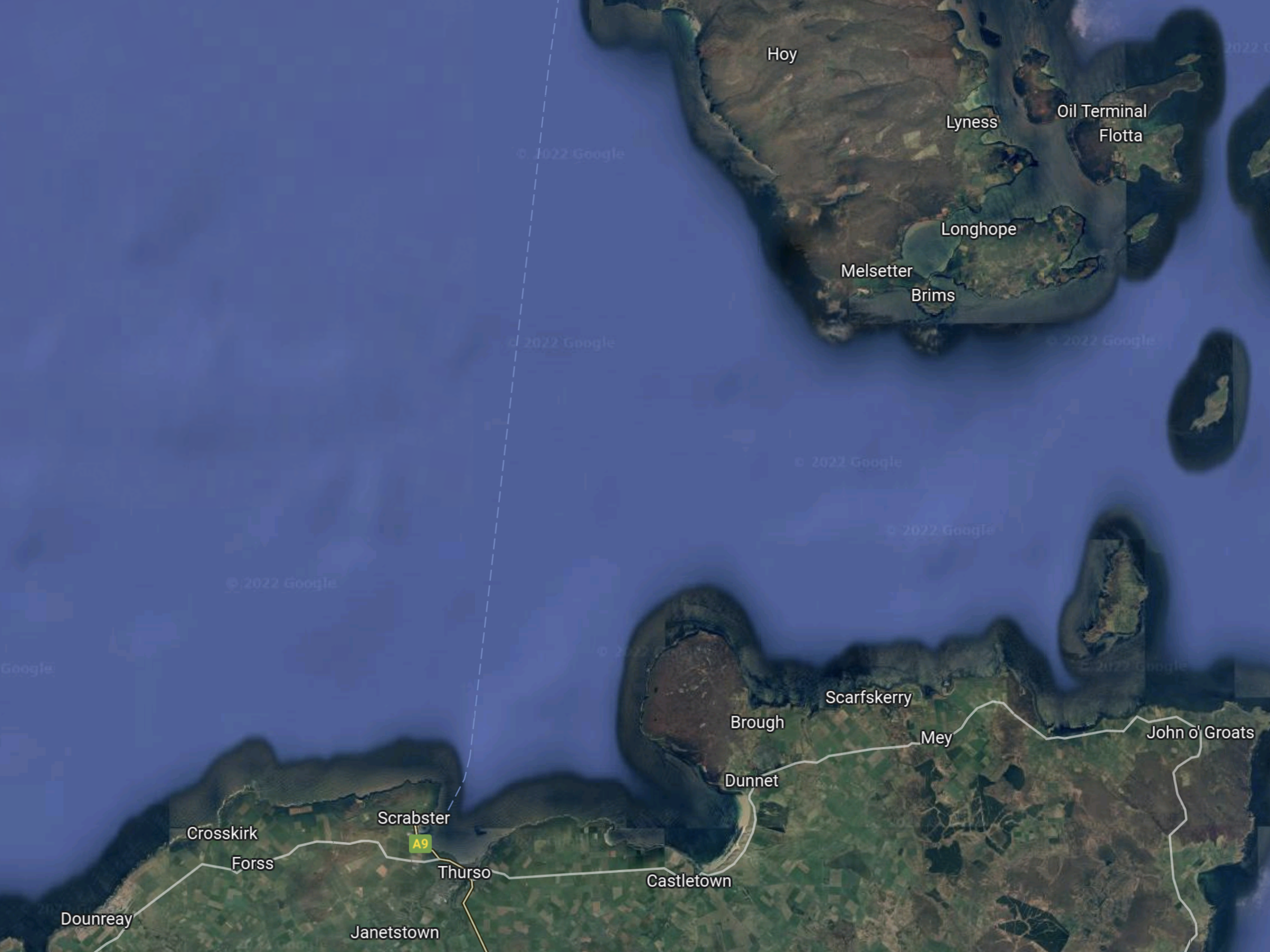
Note.
- Flotta and its Oil Terminal in the North-East corner of the map.
- John o’Groats in the South-East corner of the map.
- The ferry between Scrabster and Orkney.
- Dounreay in the South-West corner of the map.
The West of Orkney Windfarm web site says that the wind farm is being developed around 30km off the west coast of Orkney and around 25km from the north Caithness coast.
This Google Map shows the island of Flotta.

Note.
- The oil terminal is clearly visible.
- Will it get tight for space on the island of Flotta, if they need a tank farm for all the hydrogen?
- I suspect that a pipeline to deliver hydrogen elsewhere, would have a high priority!
This Google Map shows the Caithness coast in more detail.
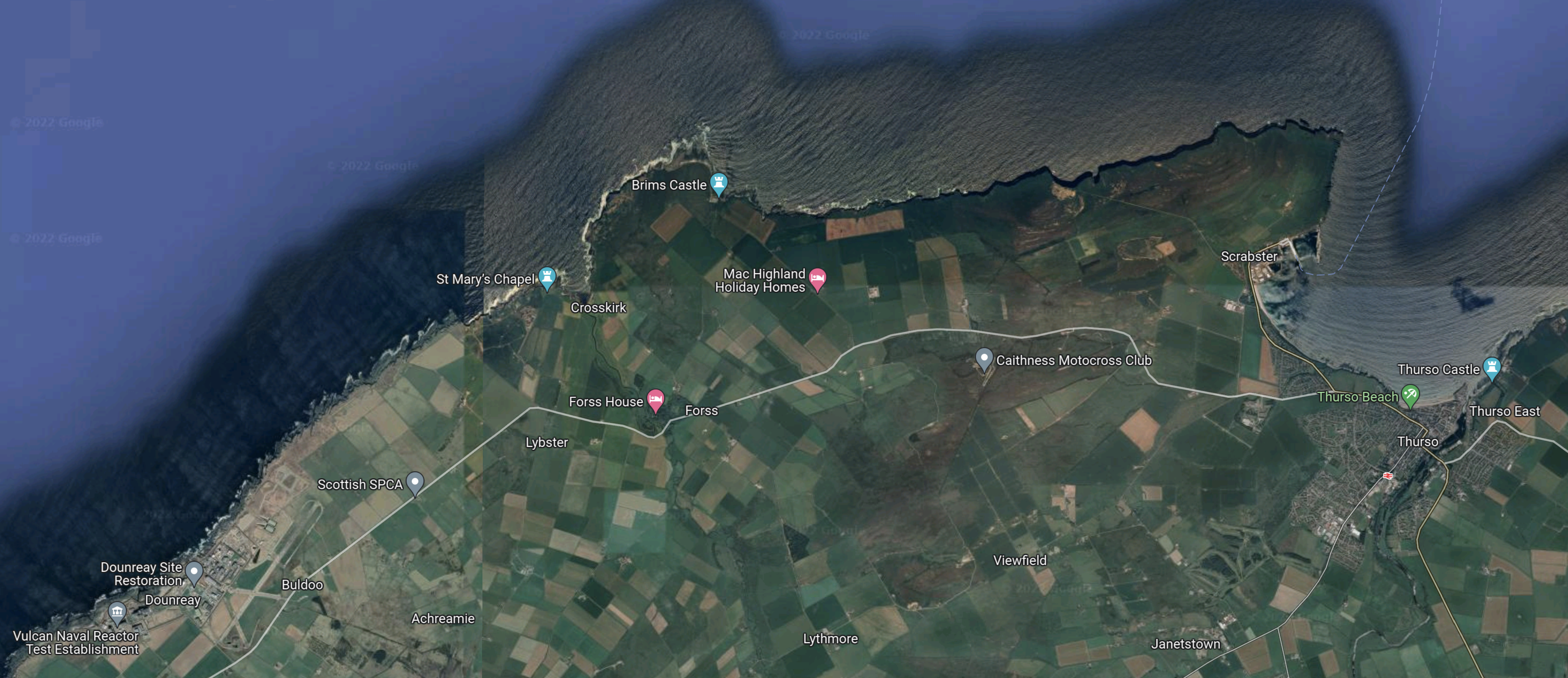
Note.
- Thurso and Scrabster are at the East of the map.
- The former nuclear research at Dounreay, is in the South-West corner of the map.
This article on the Stornaway Gazette is entitled SSE Plan To Bypass Isles Condemned and has this sub-title.
The Western Isles could be massively disadvantaged for decades to come if Scottish and Southern Energy are allowed to take power from offshore windfarms direct to a hub at Dounreay in Caithness.
This appears to indicate that West of Orkney wind farm and others in the area could be connected to the National Grid using a sub-station at Dounreay.
What Will Be The Capacity Of The Flotta Hydrogen Hub?
As I said previously, if the Flotta Hydrogen Hub is well-designed, possibly with a pipeline to take hydrogen out, that the Flotta Hydrogen Hub will have limitations on how much hydrogen it can produce due to the site size.
So the limitation of the capacity of the Flotta Hydrogen Hub will depend on the size of the electrolyser and how much electricity can be fed from the West of Orkney wind farm and possibly other wind farms to the site.
The West of Orkney wind farm has a capacity of 2 GW.
The other site that could possibly be connected would be Northland’s 1.5 GW wind farm in ScotWind N2.
Note that the combined area of these two wind-farms would be a 33 km square.
This Google Map shows the North of Scotland, Orkney, Shetland and the Faroe Islands.
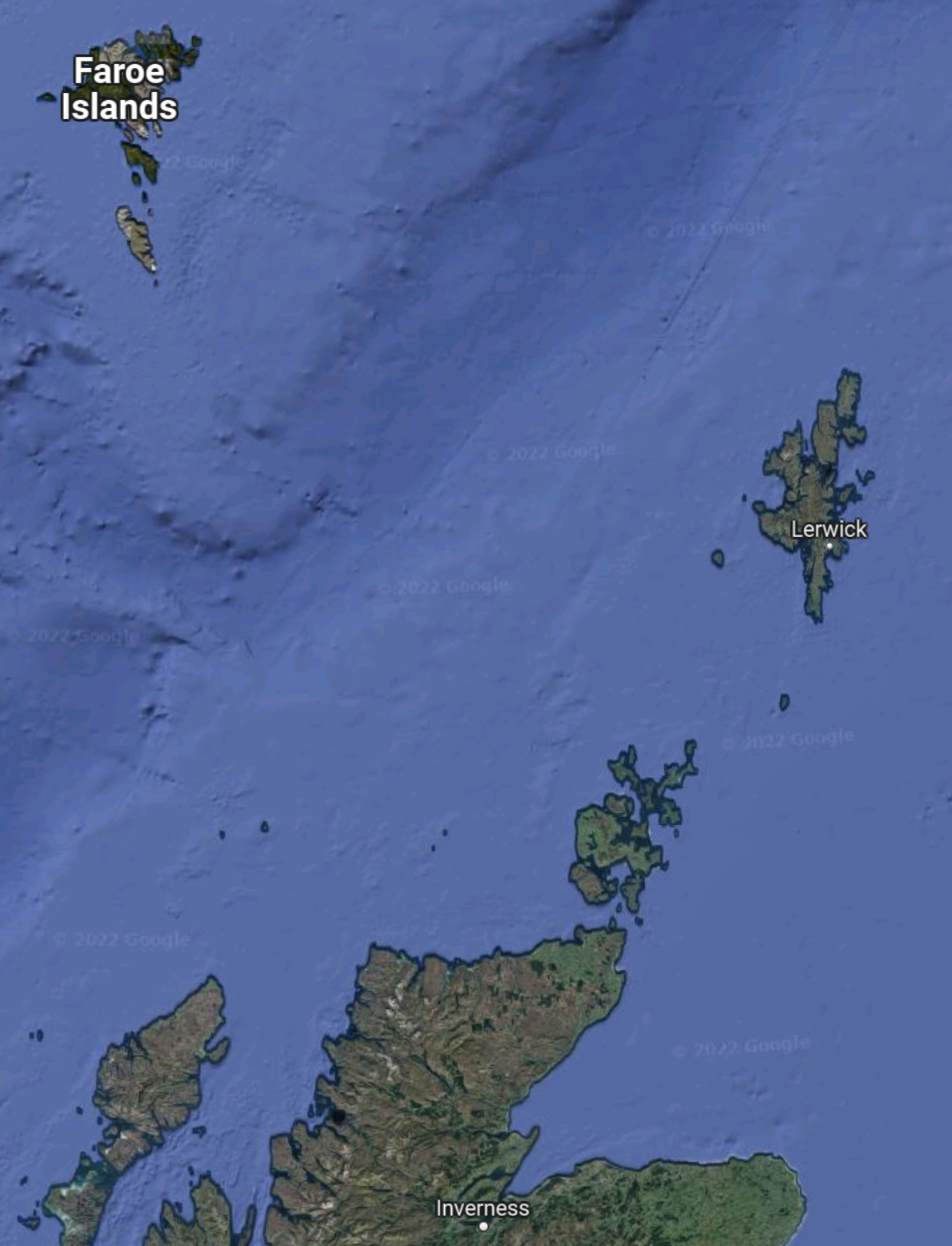
Note.
- The distance between Cape Wrath and John o’Groats is just over 100 km.
- There is nothing to the West of Orkney, except a few rocky stacks, sea, fish and sea-birds.
- I could see the West of Orkney wind farm and the one Northland are building in the ScotWind N2 being extended further out.
A 100 km square would hold about 13.5 GW of floating turbines, so lets say that a round 10 GW could be cabled to Orkney.
Could The West of Orkney Wind Farm And ScotWind N2 Use Identical Technology?
I wouldn’t be surprised if this happened and a massive floating wind farm expanded to the North and West.
The capacity of the wind farm could be upwards of 10 GW.
How Much Hydrogen Could Be Produced In The Flotta Hydrogen Hub?
In Can The UK Have A Capacity To Create Five GW Of Green Hydrogen?, I said the following.
Ryze Hydrogen are building the Herne Bay electrolyser.
- It will consume 23 MW of solar and wind power.
- It will produce ten tonnes of hydrogen per day.
The electrolyser will consume 552 MWh to produce ten tonnes of hydrogen, so creating one tonne of hydrogen needs 55.2 MWh of electricity.
A GW of electricity for a year is 8760 GWh, which would produce over 150,000 tonnes of hydrogen.
Conclusion
This plan could generate huge amounts of green hydrogen on Orkney.
Wind And Solar Boom Will Bring Energy Surplus
The title of this post, is the same as that of this article on The Times.
Under the picture, is this sub-title.
The government has set a target of 50 gigawatts of offshore wind farms by 2030, up from about 10 gigawatts at present.
According to this Wikipedia list of offshore wind farms, the UK currently has 2180 offshore turbines with a capacity of 8113 MW.
These wind farms appear to be planned.
Hornsea
The Hornsea wind farm is currently supplying 1.2 GW to the grid, but it is planned to be expanded to 6 GW, which is another 4.8 GW.
East Anglia Array
The East Anglia Array is currently supplying 0.7 GW to the grid, but it is planned to be expanded to 7.2 GW, which is another 6.5 GW.
Sofia
The Sofia wind farm will supply 1.4 GW from 2026.
Moray East
The Moray East wind farm will supply 0.95 GW from 2022.
Neart Na Gaoithe
The Neart Na Gaoithe wind farm will supply 0.45 GW from 2023.
Triton Knoll
The Triton Knoll wind farm will supply 0.86 GW from 2022.
Seagreen
The Seagreen wind farm will supply 1.1 GW from 2023.
Dogger Bank
The Dogger Bank wind farm will supply 3.6 GW from 2025.
Moray West
The Moray West wind farm will supply 1.2 GW from 2025.
Rampion 2
The Rampion 2 wind farm will supply 1.2 GW before 2030.
Norfolk Boreas
The Norfolk Boreas wind farm will supply 1.8 GW before 2030
Norfolk Vanguard
The Norfolk Vanguard wind farm will supply 1.8 GW before 2030
These wind farms total up to 31.1 GW
Morgan And Mona
The Morgan and Mona wind farms will supply 3 GW from 2028.
ScotWind
This map shows the wind farms in the latest round of leasing in Scotland.
These wind farms should be providing 24.8 GW by 2030.
Celtic Sea
In Two More Floating Wind Projects In The Celtic Sea, I give details of six wind farms to be developed in the Celtic Sea, that will produce a total of 1.2 GW.
All should be delivered by 2030.
Northern Horizons
In Is This The World’s Most Ambitious Green Energy Solution?, I talk about Northern Horizons, which will produce 10 GW of wind energy from 2030.
An Armada Of Wind Farms
As many of these wind farms will be floating and wind-powered, the collective noun must surely be an armada.
These are some figures.
- The size is certainly spectacular at 70.1 GW.
- As the UK electricity consumption in 2020-2021 was 265.4 TWh, the average hourly production throughout the year is 30.3 GW.
- As I write this post, the UK is generating 30.1 GW.
As the best offshore wind farms have a capacity factor of around fifty percent, we should be able to power the UK with wind power alone.
So when The Times says this in the first two paragraphs of the article.
Britain will have excess electricity supplies for more than half of the year by 2030 as a huge expansion of wind and solar power transforms the energy system, a new analysis suggests.
Energy storage technologies, including batteries and electrolysers to make hydrogen, will need to be deployed at massive scale to prevent this surplus electricity going to waste, according to LCP, a consultancy.
The article would appear to correct.
The Need For Energy Storage
If we look at energy production at the current time, energy production is as follows.
- Biomass – 0.5 GW
- Gas – 17 GW
- Nuclear – 5 GW
- Onshore Wind – 12 GW with 20 % capacity factor – 2.4 GW
- Offshore Wind – 8.1 GW with 30 % capacity factor – 2.4 GW
- Interconnects – 0.4 GW
- Others – 0.5 GW
This totals up to 28.2 GW.
In 2030, energy production could be as follows.
- Biomass – 0.5 GW
- Nuclear – 5 GW
- Onshore Wind – 12 GW with 20 % capacity factor – 2.4 GW
- Offshore Wind – 30 GW with 30 % capacity factor – 9 GW
- Floating Offshore Wind – 40 GW with 50 % capacity factor – 20 GW
- Others – 0.5 GW
This totals up to 37.4 GW.
So if you take a typical day, where on average throughout the day we are producing around 7 GW more of electricity than we need, we will actually produce around 7 * 24 GWh = 168 GWh of excess electricity
Whichever was you look at it, we have got to do something concrete with a large amount of electricity.
- Store it in batteries of various types from lithium ion, through new types of batteries like those being developed by Highview Power and Gravitricity to pumped hydro storage.
- Store the energy in the batteries of electric cars, vans, buses, trucks, trains and ships.
- Store the energy in Norwegian pumped hydro storage.
- Convert it to hydrogen using an electrolyser and blend the hydrogen with the natural gas supply.
- Convert it to hydrogen using an electrolyser and use the hydrogen to make zero-carbon steel, concrete and chemicals.
- Convert it to hydrogen using an electrolyser and develop new zero-carbon industries.
- Convert it to hydrogen using an electrolyser and store the hydrogen in a depleted gas field.
- Sell it to Europe, either as electricity or hydrogen.
Note.
- We are going to have to build a lot of batteries and I suspect they will be distributed all round the country.
- We are going to have to build a lot of hydrogen electrolysers.
- We have world class battery and electrolyser companies.
We should also fund the following.
- Developments of technology, that makes better batteries, electrolysers, boilers and heat pumps.
- I would also do a lot of work to increase the capacity factor of wind farms.
I also believe that if we have masses of electricity and hydrogen, we might find as a country, it’s very beneficial in terms of jobs, exports and a healthier economy to invest in certain industries.
Conclusion
The future is rosy.
SGN And INEOS Hydrogen Fuel Network Trial Launches In Scotland
The title of this post, is the same as that of this article on Hydrogen Fuel News.
These are some points from the article.
- The project appears to be based at Grangemouth.
- It will help determine how existing gas networks can be repurposed.
- SGN has partnered with INEOS on a hydrogen fuel network trial designed to help bring the UK a step closer to widespread H2 distribution networks.
- The trial is being funded by the Energy Regulator as well as gas distribution companies.
- It will involve using INEOS-supplied H2 along a 29-kilometer section of decommissioned pipeline that runs from the Grangemouth site.
It is a good idea to do thorough research to identify any problems early.
Are The Office Of Rail And Road (Or Their Lawyers) Too Risk Averse?
An article in the April 2022 Edition of Modern Railways is entitled Uckfield Third Rail Is NR Priority.
This is the first two paragraphs.
Electrification of the line between Hurst Green and Uckfield in East Sussex and the remodelling of East Croydon are the top Network Rail investment priorities south of the river, according to Southern Region Managing Director John Halsall. He told Modern Railways that third rail is now the preferred option for the Uckfield Line, as it would allow the route to use the pool of third-rail EMUs in the area. This is in preference to the plan involving overhead electrification and use of dual-voltage units put forward by then-Network Rail director Chris Gibb in his 2017 report (p66, September 2017 issue).
NR has put forward options for mitigating the safety risk involved with the third-rail system, including switching off the power in station areas when no trains are present and section isolation systems to protect track workers. ‘The Office of Rail and Road hasn’t yet confirmed third rail would be acceptable, but we are working out ways in which it could be’ Mr Halsall told Modern Railways. He added that bi-mode trains with batteries were not a feasible option on this line, as the 10-car trains in use on the route would not be able to draw sufficient charge between London and Hurst Green to power the train over the 25 miles on to Uckfield.
As an Electrical Engineer, who’s first real job in industry at fifteen was installing safety guards on guillotines nearly sixty years ago, I don’t believe that an acceptable solution can’t be devised.
But as at Kirkby on Merseyside, the Office Of Rail And Road, do seem to be stubbornly against any further third-rail installations in the UK.
I wonder what, the Office Of Rail And Road would say, if Transport for London wanted to extend an Underground Line for a few miles to serve a new housing development? On previous experience, I suspect Nanny would say no!
But is it more than just third-rail, where the Office Of Rail And Road is refusing to allow some technologies on the railway?
Battery-Electric Trains
I first rode in a viable battery-electric train in February 2015, but we still haven’t seen any other battery-electric trains in service on UK railways running under battery power.
Does the Office Of Rail And Road, believe that battery-electric trains are unsafe, with the lithium-ion batteries likely to catch fire at any time?
Hydrogen-Powered Trains
The hydrogen-powered Alstom Coradia iLint has been in service in Germany since September 2018.
But progress towards a viable hydrogen train has been very slow in the UK, with the only exception being demonstrations at COP26.
Are The Office Of Rail And Road still frightened of the Hindenburg?
Although hydrogen-powered buses have been allowed.
A Tale From Lockheed
When Metier Management Systems were sold to Lockheed, I worked for the American company for a couple of years.
I met some of their directors and they told some good American lawyer jokes, such was their disgust for the more money-grabbing of the American legal profession.
At the time, Flight International published details of an innovative landing aid for aircraft, that had been developed by Lockheed. It was a suitcase-sized landing light, that could be quickly setup up on a rough landing strip, so that aircraft, like a Hercules, with an outstanding rough field performance could land safely.
I read somewhere that a Flying Doctor service or similar had acquired some of these landing aids, so they could provide a better service to their clients.
But Lockheed’s lawyers were horrified, that they would get sued, if someone was seriously injured or even died, whilst the aid was being used.
Apparently, in the end, the aids were marked Not For Use In The USA.
Conclusion
I do wonder, if third-rail electrification, battery-electric trains and hydrogen-powered trains have come up against a wall created by over-cautious lawyers.
Study Suggests Solar Energy Can Be Cleanly’ Converted Into Storable Hydrogen Fuel
The title of this post, is the same as that, as this news item from Strathclyde University.
This section entitled Green Hydrogen, describes the research.
Most hydrogen is still made from natural gas, producing greenhouse gasses, and green hydrogen production is urgently needed. Green hydrogen is produced from water using a photocatalyst – a material which drives the decomposition of water into hydrogen and oxygen using sunlight.
The study, ‘Photocatalytic overall water splitting under visible light enabled by a particulate conjugated polymer loaded with iridium’ is published in Angewandte Chemie, a journal of the German Chemical Society. It suggests that using a photocatalyst under simulated sun light facilitates the decomposition of water when loaded with an appropriate metal catalyst – in this case iridium.
When used in a fuel cell, hydrogen does not emit any greenhouse gasses at the point of use and can help decarbonise sectors such as shipping and transportation, where it can be used as a fuel, as well as in manufacturing industries.
Using this photocatalyst may not be the final solution, but I do believe from my mathematical modelling of catalysts in an unrelated application in the 1970s, that this research could lead to an affordable way to create green hydrogen.
 The Anonymous Widower