New Proton Ceramic Reactor Stack For Highly Efficient Hydrogen Production And Carbon Capture In A Single Step
The title of this post, is the same as that of this article on Green Car Congress.
This is the opening paragraph.
A team of researchers from CoorsTek Membrane Sciences and SINTEF in Norway, and Universitat Politècnica de València in Spain, has demonstrated a 36-cell well-balanced proton ceramic reactor stack enabled by a new interconnect that achieves complete conversion of methane with more than 99% recovery to pressurized hydrogen, leaving a concentrated stream of carbon dioxide. The team has also demonstrated that the process can be scaled up for commercial application.
A paper has been published in the journal; Science.
I find this concept interesting for a number of reasons.
- I’ve believed for some time, that applications, that need a good supply of pure carbon dioxide will be developed. One obvious use is feeding it to plants in large greenhouses, so we can have our CO2 and eat it!
- 99 % is a very high efficiency.
- Ammonia, natural gas or biogas can be used as a feedstock.
Coors were an Artemis user for project management and I had an enjoyable few days Golden, Colorado and at the Coors brewery, sometime in the 1980s.
- It was then that I first heard of CoorsTek, who used to make ceramics for the US defence industry.
- In those days, the beer was made to German brewing rules and was unpasteurised.
- The beer had to be delivered to customers within a certain time, so long distance deliveries used trains.
- Coors Brewing Company has since merged with Molson, but CoorsTek appears to be still owned by the Coors family.
- I had taken a few small bottles of Adnams Broadside with me and one of their managers analysed one before drinking the rest of the bottle. He informed me that it was a felony to be in possession of such a strong beer in Colorado.
Coors were and probably still are in some ways not your average brewing company.
Coors News Item On Proton Ceramic Membranes For Hydrogen Production
This page on the CoorsTek web site, which is entitled Proton Ceramic Membranes For Hydrogen Production Published In ‘Science’, gives more details.
Conclusion
This technology could be massive.
Will We See More Multi-Country Renewable Energy Deals?
In this blog, I have talked about various deals, where two or more countries and/or companies are getting together to generate electricity in one country and transfer it to another, either as electricity or as hydrogen
Examples include.
- The Asian Renewable Energy Hub, which I first wrote about in Vast Australian Renewable Energy Site Powers BP’s Ambitions.
- The Australia-Asia PowerLink, which I first wrote about in Sun Cable’s Australia-Asia PowerLink.
- Fortescue Future Industries will convert cattle stations in Western Australia into renewable power stations.
- The EuroAfrica Interconnector is a HVDC interconnector and submarine power cable between the Greek, Cypriot, and Egypt power grids, which I first wrote about in The EuroAfrica Interconnector.
- The EuroAsia Interconnector is a proposed HVDC interconnector between the Greek, Cypriot, and Israeli power grids via the world’s longest submarine power cable, which I first wrote about in The EuroAsia Interconnector.
- Icelink is a proposed electricity interconnector between Iceland and Great Britain, which I first wrote about in Is Iceland Part Of The Solution To The Problem Of Russia?
- The Morocco-UK Power Project, which I first wrote about in Moroccan Solar-Plus-Wind To Be Linked To GB In ‘Ground-Breaking’ Xlinks Project.
- Namibian Green Hydrogen, which I first wrote about in Namibia Is Building A Reputation For The Cheapest Green Hydrogen.
There are also all the hydrogen deals done by Fortescue Future Industries.
Where Are There Possibilities Of More Multi-Country Renewable Energy Deals?
These are a few serious possibilities.
Argentina
This is an extract from this page on Wind Energy International, which is entitled Argentina.
Argentina has an estimated technical wind energy potential of 300 GW. In southern Patagonia (Chubut and Santa Cruz provinces), average wind speeds range between 9.0 and 11.2 m/s, whereas in the north (Neuquén and Río Negro provinces), wind speeds range from 7.2 to 8.4 m/s. The general average capacity factor for Argentina is 35% and in the Patagonia region it ranges between as much as 47% and 59%. Especially in Northwest Patagonia, locally known as the Comahue region, hydro and wind may seasonally complement each other and.benefit both technologies. One other promising region for wind power development is the Atlantic sea coast.
As I wrote in Australia’s FFI Plans $8.4 Billion Green Hydrogen Project In Argentina, it appears that Andrew Forrest and FFI are already on the ground.
Australia
There are already three major schemes based on Australia and I am certain they will be more. Especially, as Japan, Korea, Malaysia and Singapore will need the zero-carbon energy.
It would appear that except for the Australia-Asia PowerLink, the energy will be transferred as liquid hydrogen or liquid ammonia.
Bangladesh
Bangladesh wouldn’t be on the lists of many, where ideal countries for renewable energy are being discussed.
But, this report on Energy Tracker Asia is entitled The Renewable Energy Potential of Bangladesh, where this is said.
A report investigating the renewable energy technical capacity of Bangladesh found that the country could deploy up to 156 GW of utility-scale solar on 6,250 km2 of land and 150 GW of wind. Offshore wind power would account for 134 GW of this total capacity.
I wouldn’t be surprised to see Bangladesh, supplying renewable energy to the East, with international companies and organisations developing the renewable infrastructure.
I think it should be noted that international companies flock to countries, where the investment opportunities are good. That has happened in the UK, with offshore wind, where many wind farms have been developed by companies such as Equinor, Iberola, RWE and Wattenfall.
Chile
Chile has started to develop the 100,000 square kilometres of the Atacama Desert for solar power and I wrote about this in The Power Of Solar With A Large Battery.
This sentence in the Wikipedia entry for Energy In Chile, illustrates the potential of solar power in the Atacama Desert.
In 2013, Total S.A. announced the world’s largest unsubsidised solar farm would be installed with assistance from SunPower Corp into Chile’s Atacama desert.
I also wrote Chile Wants To Export Solar Energy To Asia Via 15,000km Submarine Cable, about Chile’s ambitions to supply Asia with energy.
Ethiopia
Andrew Forrest of Fortescue Future Industries is on the case, as I wrote in Fortescue Future Industries Enters Ethiopia to Produce Green Energy.
North Africa
Consider.
- The major North African countries of Morocco, Algeria, Tunisia, Libya and Egypt, all have and depend on to a certain extent on fossil fuels.
- There are gas pipelines to Spain and Italy.
- Morocco will be the Southern end of the Morocco-UK Power Project, if it gets developed.
- All five countries have some nuclear power stations.
- All five countries have lots of sun for solar power.
- Some Saharan countries to the South of Morocco, Algeria and Libya could also provide energy from the sun.
- Egypt has substantial hydro-electric power on the River Nile.
- Egypt will be connected to Greece through the EuroAfrica Interconnector.
I believe that a well-designed and co-ordinated project could generate a lot of electricity and hydrogen for Europe and bring much-needed income and employment to North Africa.
I feel that if the Morocco-UK Power Project can be successfully built, then this could create a flurry of activity all over North Africa.
Saudi Arabia
Saudi Arabia has a problem. As the rest of the world moves away from fossil fuels in the next few decades, they will see the revenues from oil and natural gas come under pressure.
But as a rich country, with 2.15 million km² of land and lots of sun, they must have some potential to generate solar electricity.
In the Wikipedia entry for Solar Power In Saudi Arabia, this is said.
The Saudi agency in charge of developing the nations renewable energy sector, Ka-care, announced in May 2012 that the nation would install 41 gigawatts (GW) of solar capacity by 2032.[2] It was projected to be composed of 25 GW of solar thermal, and 16 GW of photovoltaics. At the time of this announcement, Saudi Arabia had only 0.003 gigawatts of installed solar energy capacity. A total of 24 GW of renewable energy was expected by 2020, and 54 GW by 2032.
Wikipedia also says that Saudi Arabia also has nuclear ambitions.
I can see that Saudi Arabia will replace some of their oil and gas exports with green hydrogen.
Green Hydrogen Namibia
The title of this post, is the same as that of this web site.
This is the mission statement on the home page.
With its abundant, world-class renewable energy resources and increasing demand for green hydrogen worldwide, Namibia is quickly emerging as an early entrant in this new market and has ambitions of becoming the leading exporter of Green Hydrogen in Africa.
Namibia is serious about green hydrogen.
easyJet And Rolls-Royce Pioneer Hydrogen Energy Combustion Technology In H2ZERO Partnership
The title of this post, is the same as that of this press release from Rolls-Royce.
These three opening paragraphs outline the project.
easyJet and Rolls-Royce today announced a ground-breaking new partnership, H2ZERO, that will pioneer the development of hydrogen combustion engine technology capable of powering a range of aircraft, including those in the narrow-body market segment.
Both companies have committed to working together on a series of engine tests on the ground, starting later this year and have a shared ambition to take the technology into the air. The objective of the partnership is to demonstrate that hydrogen has the potential to power a range of aircraft from the mid-2030s onwards.
While Rolls-Royce will bring its expertise in engine development and combustion systems, easyJet will contribute its operational knowledge and experience to H2ZERO and will also directly invest in the test programme.
This to my mind is good news.
This paragraph gives details of some of the planned work.
Through H2ZERO, the companies will support an early concept ground test of a Rolls-Royce AE 2100 engine in the UK later this year. This will be followed by a full-scale ground test of a Rolls-Royce Pearl 15 jet engine – a range of location options are being assessed for this including the Rolls-Royce test facility in Mississippi, USA. The programme will build on initial hydrogen combustion and fuel system rig tests that Rolls-Royce is undertaking with both Cranfield and Loughborough universities.
Note.
- The Rolls-Royce AE 2100 engine, powers the Lockheed Super Hercules amongst others.
- Rolls-Royce Pearl 15 powers various business jets.
easyJet and Rolls-Royce certainly have ambitions, and as there is little about the route they are taking to decarbonise, I would assume, that the main purpose of the study, is to find the optimal route.
I have just found this paper on the German Aerospace Centre web site, which is entitled Assessment Of Hydrogen Fuel Tank Integration At
Aircraft Level.
It uses as a baseline aircraft, the Airbus A320neo, of which easyJet have a few!
I suspect that using some of the techniques outlined in this paper, Rolls-Royce could decarbonise an Airbus A320neo.
A Trip To Skegness
Last Thursday, I took a trip to Skegness to get out of the heat.
I took these pictures on the way.




































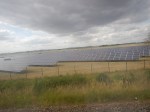
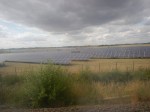



These are my observations and thoughts.
Changing At Grantham
A few minutes after getting off the LNER Azuma, the East Midlands Railway Class 156 train arrived at the opposite face of the wide platform.
Unlike some changes you get on trains in the UK, it was all rather painless and unhurried.
The change coming home was a bit slower, but there is a bar on the London platform, that serves a good selection of good beers.
Grantham To Skegness
The journey to Skegness took around an hour and a half and I arrived at 13:51.
Skegness Station
Skegness station is not the grandest, but it does have six platforms, which is probably a lot for just an hourly service from Nottingham and Grantham.
Skegness
I didn’t stay long, as it was surprisingly too cold and I hadn’t brought a coat.
Skegness To Grantham
The return trip was better, as the train was a more modern Class 170 train.
Surely, when East Midland Railways get their full quota of Class 170 trains, then the Poacher Line between Nottingham and Skegness will be one of the routes, where they will be used.
I also suspect that with 100 mph trains always running the service, as opposed to the Class 156 trains, which are only 75 mph units, there could be speed improvements on the line.
- Grantham and Skegness is 58 miles.
- There are a large number of level crossings.
An hour service between Grantham and Skegness could be possible and might generate more passengers.
Rolls-Royce MTU Hybrid PowerPacks
I wonder if this route could be improved by fitting the Class 170 trains with Rolls-Royce MTU Hybrid PowerPacks?
- The hybrid technology would have a lower fuel consumption and allow electric operation in stations.
- The prototype hybrid is already working on Chiltern Railways in a Class 168 train.
- The Class 168 train is an earlier version of the Class 170 train and they are members of the Turbostar family.
- Rolls-Royce are developing versions of these hybrid transmissions, that will work with sustainable fuels.
- As we have a total of 207 Turbostar trainsets, these could be a convenient way of cutting carbon emissions on long rural lines.
- As Rolls-Royce MTU are also developing the technology, so their diesel engines can run on hydrogen, it is not outrageous to believe that they could be on a route to complete decarbonisation of this type of train.
I believe that we could see hydrogen-hybrid Class 170 trains, with a Rolls-Royce badge on the side.
The Massive Greenhouse
I found that this was owned by Fountain Plants.
Is Lincolnshire going to grow the UK’s greens? Or at least give them a good start in life?
More greenhouses like this will enable the UK to create our carbon dioxide and eat it!
Will Our Gas Supplies Hold Up This Winter?
I am prompted to ask this question because of this article in The Times, which is entitled ‘Really High Gas Prices’ Loom For UK As Europe Faces Winter Rationing.
These are a few thoughts.
UK Gas-Fired Power Station Capacity
This entry in Wikipedia is entitled List Of Natural Gas Power Stations In The United Kingdom.
This statement summarises the capacity.
There are currently 32 active gas fired combined cycle power plants operating in the United Kingdom, which have a total generating capacity of 28.0 GW.
This section is entitled Decline Of Gas For Power In The United Kingdom, where this is said.
In 2016 gas fired power stations generated a total of 127 TWh of electricity. Generation has dropped to 119 TWh in 2017, 115 TWh in 2018, 114 TWh in 2019 and 95 TWh in 2020. The decline is largely due to the increase in renewable sources outweighing the decline of coal, and an overall reduction in demand.
Putting these pictures as a table and applying a simple numerical analysis technique gives the following.
- 2016 – 127 TWh
- 2017 – 119 TWh – Drop of 8TWh
- 2018 – 115 TWh – Drop of 4 TWh
- 2019 – 114 TWh – Drop of 1 TWh
- 2020 – 95 TWh – Drop of 19 TWh
In four years the amount of electricity generated each year by gas-fired power stations has dropped by an amazing 8 TWh on average per year.
Factors like the increase in renewables and an overall reduction in demand will still apply.
I wouldn’t be surprised to see a continuous reduction of electricity generated by gas of 8 TWh per year.
Figures like these could be possible.
- 2021 – 87 TWh
- 2022 – 79 TWh
- 2023 – 71 TWh
- 2024 – 63 TWh
- 2025 – 55 TWh
- 2026 – 47 TWh
- 2027 – 39 TWh
I have stopped these figures at 2027, as one major event should happen in that year, as Hinckley Point C is planned to switch on in June 2027, which will contribute 3.26 GW. or 28.5 TWh per year.
In Will We Run Out Of Power This Winter?, I also summarised the energy that will be produced by the various projects, that were signed off recently in the Contracts for Difference Allocation Round 4′, where I said this.
Summarising the figures for new capacity gives.
- 2022 – 3200 MW
- 2023 – 1500 MW
- 3024 – 2400 MW
- 2025 – 6576 MW
- 2026 – 1705 MW
- 2027 – 7061 GW
This totals to 22442 MW.
Note that a 1 GW power source would generate 8.76 TWh of electricity per year.
One problem we may have is too much electricity and as we are not blessed with much storage in the UK, where will be able to put it?
In a strange way, Vlad the Mad may solve the problem, by cutting off Europe’s gas.
Jackdaw Gas Field
This document on the Shell web site is the standard information sheet for the Jackdaw field development.
This is the short description of the development.
The Jackdaw field is an uHPHT reservoir that will be developed with a not permanently
attended WHP. Four wells will be drilled at the Jackdaw WHP. Produced fluids will be
exported via a subsea pipeline to the Shearwater platform where these will be processed
before onward export via the Fulmar Gas Line and the Forties Pipeline System.
The proposed development may be summarised as follows:
- Installation of a new WHP
- Drilling of four production wells
- Installation of a new approximately 31 km pipeline from the Jackdaw WHP to the Shearwater platform
- Processing and export of the Jackdaw hydrocarbons via the Shearwater host platform
First production expected between Q3 – Q4 2025.
Note.
- Production could start in just over three years.
- This gas will come ashore at the Bacton gas terminal in Norfolk.
- Bacton has two gas interconnectors to Europe; one to Belgium and one to The Netherlands, so is ideally connected to export gas to Europe.
Given the high gas prices, I am sure any company would pull out all the stops to shorten the project development time.
HyDeploy
I described HyDeploy, which is a project to blend up to 20 % of hydrogen into the distributed natural gas in HyDeploy.
In The Mathematics Of Blending Twenty Percent Of Hydrogen Into The UK Gas Grid, I worked how much electricity would be needed for HyDeploy’s target blending of hydrogen.
It was 8.2 GW, but!
- It would save a lot of carbon emissions.
- Boilers and other appliances wouldn’t have to be changed, although they would probably need a service.
- It would significantly cut the amount of natural gas we need.
- It might even be a product to export in its own right.
I certainly feel that HyDeploy is a significant project.
Gas Imports And Existing Fields
This entry in Wikipedia is entitled Energy in the United Kingdom.
In this section, which is entitled Natural Gas, this is said.
United Kingdom produced 60% of its consumed natural gas in 2010. In five years the United Kingdom moved from almost gas self-sufficient (see North Sea gas) to 40% gas import in 2010. Gas was almost 40% of total primary energy supply (TPES) and electricity more than 45% in 2010. Underground storage was about 5% of annual demand and more than 10% of net imports.
Gasfields include Amethyst gasfield, Armada gasfield, Easington Catchment Area, East Knapton, Everest gasfield and Rhum gasfield.
Consider.
- We know that the amount of gas used for generating electricity is reducing , due to the increase in renewables and an overall reduction in demand.
- The cost of both gas imports and exports are rising.
- In two years time the Jackdaw gas field should be producing gas.
Would it be sensible to squeeze as much gas out of the existing fields, as by the time they run out, renewables, an overall reduction in demand, the Jackdaw gasfield and other factors will mean that we will have enough gas and electricity for our needs.
Hydrogen Fuel Cells Could Get A Lot Cheaper With Newly Developed Iron Catalyst
The title of this post, is the same ass that of this article on Hydrogen Fuel News.
These are the first two paragraphs.
Scientists have been looking for an alternative to precious metals such as platinum for decades, in the hopes of bringing down the cost of hydrogen fuel cells.
An alternative to a platinum catalyst that costs considerably less will help to bring down the cost of hydrogen fuel cells and of using H2 as a carbon emission-free fuel. This would make it cheaper to both produce and use H2.
Researchers at the University of Buffalo, appear to be on the road to using iron as an affordable catalyst.
This paragraph describes he structure of the catalyst.
The researchers looked to iron because of its low cost and abundance. On its own, iron does not perform as well as platinum as a catalyst, particularly because it isn’t as durable in the face of highly corrosive and oxidative environments such as those within hydrogen fuel cells. The researchers bonded four nitrogen atoms to the iron in order to overcome that barrier, followed by embedding the material within a few graphene layers “with accurate atomic control of local geometric and chemical structures,” said Wu.
Gang Wu is leading the research.
In the early 1970s, I worked with one of ICI’s catalyst experts and he said, that improvements in this area will be large in the future.
Increasingly, I see his prediction being proved right, in the varied fields, where catalysts are used.
Global Electrolyzer Capacity To Reach 8.52GW By 2026
The title of this post, is the same as that of this article on Power Technology.
This is the first paragraph.
GlobalData’s latest report, ‘Hydrogen Electrolyzers Market Report Market Size, Share and Trends Analysis by Technology, Installed Capacity, Generation, Key Players and Forecast, 2021-2026’, reveals that the global electrolyzer capacity is estimated to grow to 8.52GW in 2026. Hydrogen is gaining prominence as a critical component of the energy transition, as significant policy support and government commitment to deep decarbonisation are spurring investments in hydrogen. By the end of 2021, seventeen governments released hydrogen strategies, with more than 20 governments publicly announcing that they are developing strategies, and numerous companies planning to tap business opportunities in hydrogen.
Hydrogen certainly appears to be coming.
In The Mathematics Of Blending Twenty Percent Of Hydrogen Into The UK Gas Grid, I calculated how much electricity would be needed to blend twenty percent of hydrogen into the UK gas grid.
To achieve this blending, which would reduce our carbon emissions by a large amount and still be compatible with existing boilers and appliances would 8.2 GW of electricity to generate the hydrogen.
The world needs to be developing more electrolysers for green hydrogen.
Ørsted Awarded Contract For World’s Single Biggest Offshore Wind Farm
The title of this post, is the same as that of this press release from Ørsted.
This is the sub-title.
The UK Department for Business, Energy and Industrial Strategy (BEIS) has awarded Ørsted a contract for difference for its Hornsea 3 offshore wind farm. The project was awarded at an inflation-indexed strike price of GBP 37.35 per MWh in 2012 prices.
And this is the first paragraph, which describes the size of the farm.
With a capacity of 2,852 MW, Hornsea 3 will produce enough low-cost, clean, renewable electricity to power 3.2 million UK homes, making a significant contribution to the UK Government’s ambition of having 50 GW offshore wind in operation by 2030 as part of the British Energy Security Strategy.
This map from Ørsted shows the location of the Hornsea wind farm and its three sections.
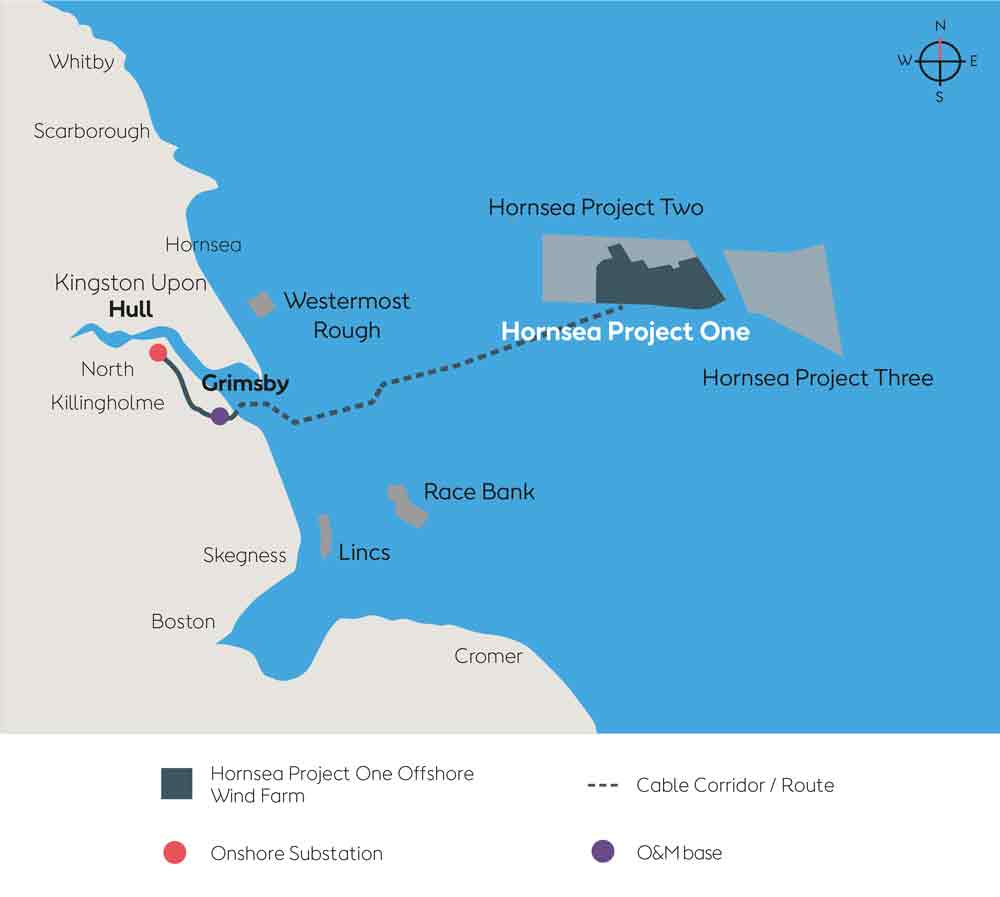
Note.
- The Hornsea Wind Farm, when fully developed, with a fourth section, is likely to have a capacity of around six GW.
- The Lincs, Race Bank and the Westernmost Rough wind farms are about another GW.
Looking at the map, I can see Humberside hosting the world’s largest hydrogen electrolyser to feed into the Humber Zero hydrogen network.
The Concept Of Remote Island Wind
This document from the Department of Business, Industry and Industrial Strategy lists all the Contracts for Difference Allocation Round 4 results for the supply of zero-carbon electricity that were announced yesterday.
The contracts have also introduced a concept that is new to me, called Remote Island Wind. All have got the same strike price of £46.39 per MWh.
Two of the projects on Orkney are community projects of around 30 MW, run by local trusts. This is surely, a model that will work in many places.
There is more on Orkney’s Community Wind Farm Project on this page of the Orkney Islands Council web site.
It could even have an electrolyser to provide hydrogen for zero-carbon fuel, when there is more electricity than is needed. Companies like ITM Power and others already build filling stations with an electrolyser, that can be powered by wind-generated electricity.
The other Remote Island Wind projects are larger with two wind farms of over 200 MW.
It does look to me, that the Department of BEIS is nudging wind farm developers in remote places to a model, that all stakeholders will embrace.
The Viking Wind Farm
I wrote about this wind farm in Shetland’s Viking Wind Farm.
There are more details in this press release from SSE enewables, which is entitled CfD Contract Secured For Viking Energy Wind Farm.
These introductory paragraphs, give a good explanation of the finances of this farm.
SSE Renewables has been successful in the UK’s fourth Contract for Difference (CfD) Allocation Round, announced today, and has secured a low-carbon power contract for 220MW for its wholly-owned Viking Energy Wind Farm (Viking) project, currently being constructed in Shetland.
Viking’s success in securing a contract follows a competitive auction process in Allocation Round 4 (AR4) where it competed within Pot 2 of the allocation round set aside for ‘less established’ technologies including Remote Island Wind.
The 443MW Viking project, which SSE Renewables is currently building in the Shetland Islands, has secured a CfD for 220MW (50% of its total capacity) at a strike price of £46.39/MWh for the 2026/27 delivery year.
The successful project will receive its guaranteed strike price, set on 2012 prices but annually indexed for CPI inflation, for the contracted low carbon electricity it will generate for a 15-year period. Securing a CfD for Viking stabilises the revenue from the project whilst also delivering price security for bill payers.
It’s very professional and open to explain the capacity, the contract and the finances in detail.
The press release also has this paragraph, which details progress.
Viking is progressing through construction with over 50 per cent of turbine foundation bases poured. When complete in 2024, Viking Energy Wind Farm will be the UK’s most productive onshore wind farm in terms of annual electricity output, with the project also contributing to Shetland’s security of supply by underpinning the HVDC transmission link that will connect the islands to the mainland for the first time.
SSE also released this press release, which is entitled Major Milestone Reached As First Subsea Cable Installation Begins On Shetland HVDC Link, where this is the first paragraph.
The first phase of cable laying as part of the SSEN Transmission Shetland High-Voltage Direct Current (HVDC) Link began this week off the coast of Caithness, marking a major milestone in the £660M project.
SSE seem to be advancing on all fronts on the two projects!
The Stornoway Wind Farm
This press release from EDF Renewables is entitled EDF Renewables UK Welcomes Contract for Difference Success, where these are the first two paragraphs.
Two EDF Renewables UK projects bid into the Contract for Difference (CfD) auction round held by the UK Government’s BEIS department have been successful.
The projects are the Stornoway wind farm on the Isle of Lewis and Stranoch wind farm in Dumfries and Galloway. Together these onshore wind farms will provide 300 MW of low carbon electricity which is an important contribution to reaching net zero.
The press release also gives this information about the contract and completion of the Stornoway wind farm.
Stornoway Wind Farm on the Isle of Lewis is a joint venture with Wood. The project has won a CfD for 200 MW capacity, the strike price was £46.39, the target commissioning date is 31 March 2027.
This page on the Lewis Wind Power web site, gives these details of the Stornoway Wind Farm.
The Stornoway Wind Farm would be located to the west of the town of Stornoway in an area close to the three existing wind farm sites.
The project has planning consent for up to 36 turbines and is sited on land owned by the Stornoway Trust, a publicly elected body which manages the Stornoway Trust Estate on behalf of the local community.
The local community stands to benefit as follows:
- Community benefit payments currently estimated at £900,000 per annum, which would go to an independent trust to distribute to local projects and organisations
- Annual rental payments to local crofters and the Stornoway Trust – which we estimate could total more than £1.3m, depending on the CfD Strike Price secured and the wind farm’s energy output
- Stornoway Wind Farm is the largest of the three consented wind farm projects with a grid connection in place and is therefore key to the needs case for a new grid connection with the mainland. Indeed, the UK energy regulator Ofgem has stated that it will support the delivery of a new 450MW cable if the Stornoway and Uisenis projects are successful in this year’s Contract for Difference allocation round.
Note the last point, where only the Stornoway wind farm was successful.
The Uisenis Wind Farm
This press release from EDF Energy is entitled Lewis Wind Power Buys Uisenis Wind Farm, gives these details of the sale.
Lewis Wind Power (LWP), a joint venture between Amec Foster Wheeler and EDF Energy Renewables has bought the Uisenis Wind Farm project on the Isle of Lewis. The wind farm has planning consent for the development of 45 turbines with a maximum capacity of 162 MW. This would be enough to power 124,000 homes and would be the biggest renewable energy development on the Western Isles.
LWP owns the Stornoway Wind Farm project located around 20km to the north of Uisenis which has planning consent to develop 36 turbines to a maximum capacity of 180 MW – enough to power 135,000 homes.
This would bring Stornoway and Uisenis wind farms under the similar ownership structures.
This is a significant paragraph in the press release.
On behalf of Eishken Limited, the owner of the site where the Uisenis Wind Farm will be located, Nick Oppenheim said: “I am delighted that LWP are taking forward the wind farm. The resources available on the Eishken estate, and the Western Isles in general, means that it is an excellent location for renewable energy projects and, as such, the company is also developing a 300MW pumped storage hydro project immediately adjacent to the Uisenis wind farm. With such potential for renewables and the positive effect they will have on the local community, economy, and the UK as a whole I am are looking forward to positive news on both support for remote island projects and the interconnector.”
Note the mention of pumped storage.
This article on the BBC is entitled Pumped Storage Hydro Scheme Planned For Lewis, where this paragraph introduces the scheme.
A pumped storage hydro scheme using sea water rather than the usual method of drawing on freshwater from inland lochs has been proposed for Lewis.
The only other information is that it will provide 300 MW of power, but nothing is said about the storage capacity.
It looks like Lewis will have a world-class power system.
Mossy Hill And Beaw Field Wind Farms
Mossy Hill near Lerwick and Beaw Field in Yell are two Shetland wind farms being developed by Peel L & P.
This press release from Peel L & P is entitled Government Support For Two Shetland Wind Farms, where these are the first two paragraphs.
Plans for two onshore wind farms on the Shetland Islands which would help meet Scotland’s targets for renewable energy production are a step closer to being delivered after receiving long-term Government support.
Clean energy specialists Peel NRE has been successful in two bids in the Department for Business, Energy and Industrial Strategy’s (BEIS) Contracts for Difference (CfD) scheme; one for its Mossy Hill wind farm near Lerwick and the other for Beaw Field wind farm in Yell.
It looks like the two wind farms will power 130,000 houses and are planned to be operational in 2027.
Conclusion
I must admit that I like the concept. Especially, when like some of the schemes, it is linked to community involvement and improvement.
Only time will tell, if the concept of Remote Island Wind works well.
 The Anonymous Widower