A Planned Trip To Belfast
I’m thinking about going over to Belfast for a couple of days to have a look at the transport systems in the city and the wider Northern Ireland.
I have several things, I would like to do.
- Ride in the latest Wrightbus hydrogen and battery-electric buses.
- Ride in a Glider. I also intend to go to Pau to ride in a hydrogen-powered version of these Van Hool Equicity articulated buses, but Belfast is nearer.
- Perhaps, if I have enough time, I’ll visit a few touristy bits.
- Do a bit of research into offshore wind farms in Northern Ireland.
Has anybody got any advice?
How Britannia With Help From Her Friends Can Rule The Waves And The Wind
The Government doesn’t seem to have published its future energy plans yet, but that hasn’t stopped the BBC speculating in this article on their web site, which is entitled Energy Strategy: UK Plans Eight New Nuclear Reactors To Boost Production.
These are the first two paragraphs.
Up to eight more nuclear reactors could be delivered on existing sites as part of the UK’s new energy strategy.
The plan, which aims to boost UK energy independence and tackle rising prices, also includes plans to increase wind, hydrogen and solar production.
Other points include.
- Up to 95% of the UK’s electricity could come from low-carbon sources by 2030.
- 50 gigawatts (GW) of energy through offshore wind farms, which would be more than enough to power every home in the UK.
- One of the big points of contention is thought to have been the construction of onshore wind turbines.
- Targets for hydrogen production are being doubled to help provide cleaner energy for industry as well as for power, transport and potentially heating.
- A new licensing round for North Sea oil and gas projects.
- A heat pump accelerator program.
In this post I shall only be looking at one technology – offshore wind and in particular offshore floating wind.
Who Are Our Friends?
I will start with explaining, who I see as our friends, in the title of this post.
The Seas Around Us
If we are talking about offshore winds around the the UK, then the seas around the UK are surely our biggest and most-needed friend.
The Island Of Ireland
The seas are shared with the island of Ireland and the UK and the Republic must work together to maximise our joint opportunities.
As some of the largest offshore wind farm proposals, between Wales and Ireland involve a Welsh company called Blue Gem Wind, who are a partnership between Irish company; Simply Blue Energy, and French company; TotalEnergies, we already seem to be working with the Irish and the French.
The City Of London
Large insurance and pension companies, based in the City of London like, abrdn, Aviva, L & G and others are always looking for investments with which to provide income to back their insurance business and our pensions.
In World’s Largest Wind Farm Attracts Huge Backing From Insurance Giant, I describe why and how, Aviva back wind farms.
Germany
Germany are certainly on our side, despite being in a mess of Mutti Merkel’s making, because she got the country too deeply dependant on Vlad the Mad’s tainted gas.
- German utilities are providing finance to build wind farms in British waters.
- German company; Siemens is manufacturing turbine blades in Hull.
- Germany wouldn’t mind buying any electricity and hydrogen we have spare. Especially, as we haven’t invaded them since 1944.
I suspect a mutually-beneficial relationship can be negotiated.
Norway
I have customised software for a number of countries, including Iran, Saudi Arabia, South Korea and the United States and despite selling large numbers of systems to Norway, the Norwegians never requested any modifications.
They are generally easy-going people and they are great friends of the UK. They were certainly a fertile country for the sale of Artemis systems.
Just as the UK worked together with the Norwegians to deliver North Sea Oil, we are now starting to work together to develop renewable energy in the North Sea.
In UK To Norway Sub-Sea Green Power Cable Operational, I describe how we have built the North Sea Link with the Norwegians, which will link the British and Norwegian energy networks to our mutual benefit.
In Is This The World’s Most Ambitious Green Energy Solution?, I describe an ambitious plan called Northern Horizons, proposed by Norwegian company; Aker Solutions to build a 10 GW floating wind farm, which will be 120 km to the North-East of the Shetlands.
Floating Wind Turbines
This is the introduction of the Wikipedia entry for floating wind turbines.
A floating wind turbine is an offshore wind turbine mounted on a floating structure that allows the turbine to generate electricity in water depths where fixed-foundation turbines are not feasible. Floating wind farms have the potential to significantly increase the sea area available for offshore wind farms, especially in countries with limited shallow waters, such as Japan, France and US West coast. Locating wind farms further offshore can also reduce visual pollution, provide better accommodation for fishing and shipping lanes, and reach stronger and more consistent winds.
At its simplest a floating wind farm consists of a semi-submersible platform, which is securely anchored to the sea-bed to provide a firm platform on which to erect a standard wind turbine.
There are currently two operational floating wind farms off the East Coast of Scotland and one in the Atlantic off the Portuguese coast.
- These wind farms are fairly small and use between three and five turbines to generate between 25-50 MW.
- The largest current floating turbines are the 9.5 MW turbines in the Kincardine Wind Farm in Scotland, but already engineers are talking of 14 MW and 20 MW floating turbines.
- Experience of the operation of floating wind turbines, indicates that they can have capacity factors in excess of 50 %.
- Floating wind turbines can be erected on their floats in the safety of a port using a dockside crane and then towed into position.
- Floating wind turbines can be towed into a suitable port for servicing and upgrading.
Many serious engineers and economists, think that floating wind farms are the future.
The Energy Density of Fixed Foundation And Floating Wind Farms
In ScotWind Offshore Wind Leasing Delivers Major Boost To Scotland’s Net Zero Aspirations, I summarised the latest round of Scotwind offshore wind leases.
- Six new fixed foundation wind farms will give a capacity of 9.7 GW in 3042 km² or about 3.2 MW per km².
- Ten new floating wind farms will give a capacity of 14.6 GW in 4193 km² or about 3.5 MW per km².
Note.
- Floating wind farms have a small advantage in terms of energy density over those with fixed foundations.
- Suppose these energy densities are achieved using 14 MW turbines.
- Engineers are talking of 20 MW turbines.
- Using large turbines could increase the energy density by 20/14 or 43 %
We could see in a few years with 20 MW turbines, fixed foundation turbines having an energy density of 4.6 MW per km², with floating turbines having 5 MW per km².
The Potential Of A Ten-Mile Square In The Seas Around Us
I will assume.
- It is at least 100 km from land.
- The water would be at least 100 metres deep.
- There are no structures in the area.
And calculate.
- The area will be a hundred square miles, which is smaller than the county of Rutland.
- This will be 259 square kilometres.
If it were to be filled with floating wind turbines at a density of 5 MW per km², the capacity would be 1300 MW or 1.3 GW.
There must be hundreds of empty ten-mile squares in the seas around us.
Offshore Hydrogen Production And Storage
I believe in the near future, that a lot of offshore wind energy will be converted to hydrogen offshore.
- Electrolysers could be combined with wind turbines.
- Larger electrolysers could be combined with sub-stations collecting the electricity.
- In Torvex Energy, I discuss a method to create hydrogen from seawater, without having to desalinate the water. Surely, this technology would be ideal for offshore electrolysis.
Hydrogen would be brought to shore using pipelines, some of which could be repurposed from existing gas pipelines, that are now redundant, as the gas-fields they served have no gas left.
I also suspect that hydrogen could be stored in a handy depleted gas field or perhaps some form of specialist storage infrastructure.
Combining Wind And Wave Power In A Single Device
Marine Power Systems are a Welsh company, that has developed a semi-submersible structure, that can support a large wind turbine and/or a wave-power generator.
This is the mission statement on their home page.
Marine Power Systems is revolutionising the way in which we harvest energy from the world’s oceans.
Our flexible technology is the only solution of its type that can be configured to harness wind and wave energy, either as a combined solution or on their own, in deep water. Built on common platform our devices deliver both cost efficiency and performance throughout the entire product lifecycle.
Our structurally efficient floating platform, PelaFlex, brings excellent stability and straightforward deployment and maintenance. The PelaGen wave energy converter represents market-leading technology and generates energy at an extremely competitive cost of energy.
Through optimised farm layout and the combination of wind and wave energy, project developers can best exploit the energy resource for any given area of seabed.
We are unlocking the power of oceans.
There is a link on the page to more pages, that explain the technology.
It looks to me, that it is well-designed technology, that has a high-chance of being successful.
It should also be noted that according to this news page on the Marine Power Systems web site, which is entitled MPS Lands £3.5M Of Funding From UK Government, the UK government feel the technology is worth backing.
I certainly believe that if Marine Power Systems are not successful, then someone else will build on their original work.
If wind and wave power can successfully be paired in a single float, then this must surely increase the energy production at each float/turbine in the floating wind farm.
Energy Storage In Wind Turbines
The output of wind farms can be very variable, as the wind huffs and puffs, but I believe we will see energy storage in wind turbines to moderate the electricity and deliver a steadier output.
Using lithium-ion or other batteries may be possible, but with floating offshore turbines, there might be scope to use the deep sea beneath the float and the turbine.
Hybrid Wind Farms
In the latest round of Scotwind offshore wind leases, one wind farm stands out as different. Magnora ASA’s ScotWind N3 Offshore Wind Farm is described as a floating offshore wind farm with a concrete floater.
I can see more wind farms built using this model, where there is another fixed or floating platform acts as control centre, sub-station, energy store or hydrogen electrolyser.
How Much Electricity Could Be Produced In UK And Irish Waters?
I will use the following assumptions.
- Much of the new capacity will be floating wind turbines in deep water.
- The floating wind turbines are at a density of around 5 MW per km²
This Google Map shows the British Isles.
I will look at various seas.
The Celtic Sea
The Celtic Sea is to the South-West of Wales and the South of Ireland.
In Blue Gem Wind, I posted this extract from the The Our Projects page of the Blue Gem Wind web site.
Floating wind is set to become a key technology in the fight against climate change with over 80% of the worlds wind resource in water deeper than 60 metres. Independent studies have suggested there could be as much as 50GW of electricity capacity available in the Celtic Sea waters of the UK and Ireland. This renewable energy resource could play a key role in the UK meeting the 2050 Net-Zero target required to mitigate climate change. Floating wind will provide new low carbon supply chain opportunities, support coastal communities and create long-term benefits for the region.
Consider.
- The key figure would appear 50 GW of electricity capacity available in the Celtic Sea waters of the UK and Ireland.
- Earlier I said that floating turbines can have a wind turbine density of 5 MW per km².
- According to Wikipedia, the surface area of the Celtic Sea is 300,000 km².
To accommodate enough floating turbines to generate 50 GW would need 10000 km², which is a 100 km. square, or 3.33 % of the area of the Celtic Sea.
This wind generation capacity of 50 GW would appear to be feasible in the Celtic Sea and still leave plenty of space for the shipping.
The Irish Sea
According to Wikipedia, the surface area of the Irish Sea is 46,000 km².
Currently, there are ten wind farms in the Irish Sea.
- Six are in English waters, three are in Welsh and one is in Irish.
- None are more than sixteen kilometres from the coast.
The total power is 2.7 GW.
I feel that the maximum number of wind farms in the Irish Sea would not cover more than the 3.33 % proposed for the Celtic Sea.
3.33 % of the Irish Sea would be 1532 km², which could support 7.6 GW of wind-generated electricity.
I can’t leave the Irish Sea without talking about two wind farms Mona and Morgan, that are being developed by an enBW and BP joint venture, which I discussed in Mona, Morgan And Morven. This infographic from the joint venture describes Mona and Morgan.
That would appear to be a 3 GW development underway in the Irish Sea.
Off The Coast Of South-East England, East Anglia, Lincolnshire And Yorkshire
These wind farms are proposed in these areas.
- Hornsea – 6 GW
- Triton Knoll – 900 MW
- Dogger Bank – 3.6 GW
- Norfolk Boreas – 1.8 GW
- Norfolk Vanguard – 1.8 GW
- East Anglia Array – 7.2 GW
- Rampion Extension – 1.2 GW
Note.
All wind farms have comprehensive web sites or Wikipedia entries.
The total capacity of these wind farms is 22.5 GW
The North Sea
According to Wikipedia, the surface area of the North Sea is 570,000 km².
Would it is reasonable to assume, that perhaps a tenth of this area would be available for new wind farms in UK waters?
3.33 % of the available North Sea would be 1898 km², which could support 9.5 GW of wind-generated electricity.
On The East Coast Of Scotland
In Wind Farms On The East Coast Of Scotland, I summarised the wind farms off the East coast of Scotland, that are being built in a cluster in the First of Forth.
This map shows the proposed wind farms in this area.
There are five wind farms in the map.
- The green area is the cable corridor for Seagreen 1a
- Inch Cape is the odd-shaped wind farm to the North and West of the green area
- Seagreen at the top of the map, to the North of Inch Cape.
- Marr Bank with the pink NE-SW hatching
- Berwick Bank with the green NW-SE hatching
- Neart Na Gaoithe is edged in blue to the South of the green area.
Berwick Bank and Marr Bank are both owned by SSE and appear to have been combined.
The capacity of the wind farms can be summarised as follows.
- Seagreen – 1075 MW
- Neart Na Gaoithe – 450 MW
- Inch Cape – 1000 MW
- Berwick Bank and Marr Bank – 4100 MW
This gives a total of 6625 MW or just over 6.6 GW.
Around The North Of Scotland
This map shows the latest successful ScotWind leases.
Note.
- Several of these proposed wind farms have detailed web sites.
These seventeen leases total up to 24.3 GW.
An Interim Total
I believe these figures are realisable.
- Celtic Sea – 50 GW
- Irish Sea – 7.6 GW – 3 GW already underway
- South East England, East Anglia, Lincolnshire And Yorkshire – 22.5 GW
- North Sea – 9.5 GW
- On The East Coast Of Scotland – 6.6 GW
- Around The North Of Scotland – 24.3 GW
Note.
- I have tried to be as pessimistic as possible.
- Irish and North Sea estimates are based on Blue Gem Wind’s professional estimate for the Celtic Sea.
- I have used published figures where possible.
My estimates total up to 120.1 GW of extra wind-power capacity. As I write this, current UK electricity production is around 33 GW.
Vikings Will Invade
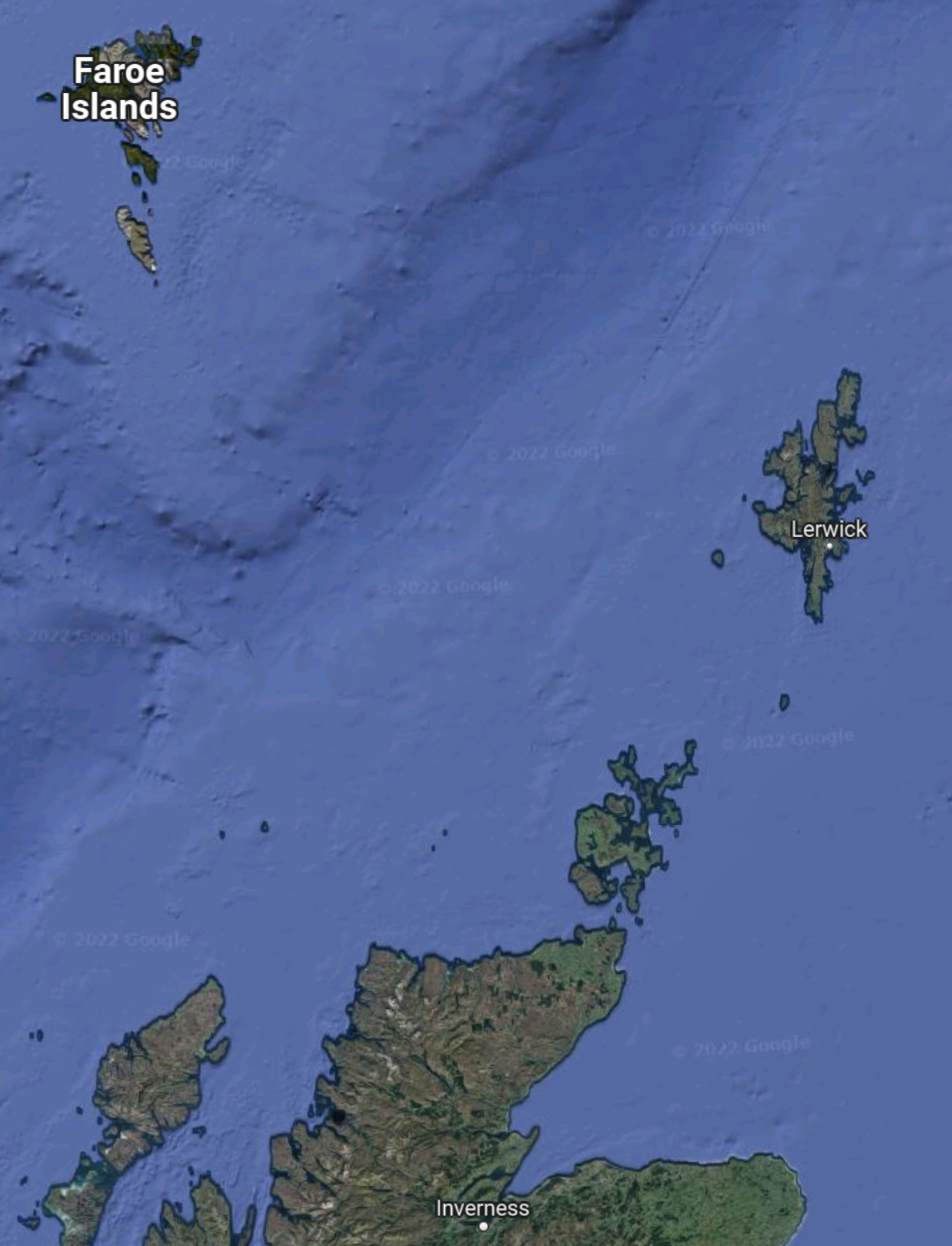
This Google Map shows the Faroe Islands, the North of Scotland, Norway and Denmark.
To get an idea of scale, the Shetland Isles are around 70 miles or 113 km. from North to South.
In Is This The World’s Most Ambitious Green Energy Solution?, I talked about Norwegian company; Aker Solutions’s plan for Northern Horizons.
- It would be a 10 GW offshore floating wind farm 136 km to the North-East of the Shetlands.
- This position would probably place it about halfway between the Faroes and the Norwegian coast.
- The project is best described in this article on the Engineer, which is entitled Northern Horizons Plans Clean Energy Exports For Scotland.
- In the article, there is a good graphic and a video.
This will be offshore engineering of the highest class, but then I first came across Norwegian offshore engineering like this in the 1970s, where nothing was too difficult for Norwegian engineers.
There are two major points to remember about the Norwegians.
- They have the Sovereign Wealth Fund to pay for the massive investment in Northern Horizons.
- They need to replace their oil and gas income, with a zero-carbon investment stream.
I feel that Northern Horizons will not be a one-off and the virgin sea in the map above will be liberally carpeted with more floating wind farms.
- On Shetland, electricity can be fed into the UK grid.
- On Norway, electricity can be fed into the Norwegian grid or stored in Norwegian pumped storage systems.
- On Scotland, more pumped storage systems can be built to store energy.
- Hydrogen can be piped to where it is needed to decarbonise heavy industry and transport.
- Norwegian fjords, Shetland harbours, Scottish lochs and possibly Scapa Flow would be ideal places to assemble and service the giant floating turbines and build the other needed floating infrastructure.
- I can also see Denmark getting in on the act, as they will probably want to decarbonise the Faroe Islands.
I estimate that between the Faroes, Scotland and Norway, there are 510,000 km² of virgin sea.
With a potential of 5 MW per km², that area has the potential to create an amazing amount of both electricity and hydrogen.
Exporting Power To Europe
There will need to be more interconnectors from the UK to Europe.
These are already working.
- BritNed – 1 GW – Isle of Grain and Rotterdam
- ElecLink – 1 GW – Through the Channel Tunnel
- HVDC Cross-Channel – 2 GW – England and France
- IFA-2 – 1 GW – England and France
- NemoLink – 1 GW – Kent and Belgium
- North Sea Link – 1.4 GW – Blyth and Norway
- Viking Link – 1.4 GW – Lincolnshire and Denmark
These are proposed.
- GridLink – 1.4 GW – Kent and Dunkirk
- NeuConnect – 1.4 GW – Isle of Grain and Germany
- North Connect – 1.4 GW – Scotland and Norway
There are also gas interconnectors, that could be converted to hydrogen.
This press release from National Grid, which is entitled Undersea Electricity Superhighways That Will Help Deliver Net Zero Move A Step Closer, has these bullet points.
- Positive progress on plans for £3.4bn electricity super-highway projects – Scotland to England Green Links.
- Ofgem opens consultation that recognises the “clear case” and “consumer benefit” of two subsea high voltage cables to transport clean between Scotland and England.
- The cables form part of a planned 16 project £10 billion investment from National Grid to deliver on the government’s target of 40GW of offshore wind generation by 2030.
This paragraph expands on the work by National Grid to meet the third point.
These projects are part of National Grid’s work upgrading the electricity transmission system to deliver the UK government’s target of 40GW of offshore wind generation by 2030. In addition to the Eastern Links, it is developing 14 major projects across its network to facilitate the target representing a £10 billion investment. This includes two further Scotland to England high voltage links (also in partnership with the Scottish transmission network owners) and proposals in the Humber, Lincolnshire, East Midlands, North of England, Yorkshire, North Kent, as well as four in East Anglia (one of which is a proposed offshore link between Suffolk and Kent).
I think we can assume, that National Grid will do their part to allow the UK government’s target of 40GW of offshore wind generation by 2030 to be met.
Will The UK Have 40 GW Of Offshore Wind Generation By 2030?
In the Wikipedia entry for Windpower In The UK, this is the opening sentence.
The United Kingdom is one of the best locations for wind power in the world and is considered to be the best in Europe. By the beginning of March 2022, the UK had 11,091 wind turbines with a total installed capacity of over 24.6 gigawatts (GW): 14.1 GW of onshore capacity and 10.4 GW of offshore capacity.
It would appear an extra 30 GW of wind power is needed.
In An Interim Total earlier, I gave these figures.
- Celtic Sea – 50 GW
- Irish Sea – 7.6 GW – 3 GW already underway
- South East England, East Anglia, Lincolnshire And Yorkshire – 22.5 GW
- North Sea – 9.5 GW
- On The East Coast Of Scotland – 6.6 GW
- ScotWind – 24.3 GW
The wind farms in South East England, East Anglia, Lincolnshire And Yorkshire and ScotWind and Mona and Morgan are either being planned or under construction, and in many cases leases to construct wind farms are being paid.
I would feel, that at least 30 GW of these 56.4 GW of wind farms will be completed by 2030.
Conclusion
Boris’s vision of the UK becoming a Saudi Arabia of wind is no fantasy of a man with massive dreams.
Standard floating wind turbines, with the possibility of also harvesting wave power could be assembled in ports along the coasts, towed into position and then connected up.
Several GW of wind-power capacity could probably be added each year to what would become the largest zero-carbon power station in the world.
By harvesting the power of the winds and waves in the seas around the British Isles it is an engineering and mathematical possibility, that could have been developed by any of those great visionary Victorian engineers like Armstrong, Bazalgette, Brunel and Reynolds, if they had had access to our modern technology.
Up Yours! Putin!
Will Twiggy Save The World?
This article on the Sydney Morning Herald is entitled ‘No One’s Married To Coal’: How Forrest Is Taking On The World To Save The Climate.
The article is the story of Andrew ‘Twiggy’ Forrest’s Damascene conversion to hydrogen.
These three paragraphs sums up Andrew Forrest‘s vision and ambitions.
Forrest’s companies, including its mining arm, Fortescue, and its green energy arm, Fortescue Future Industries, would be net zero by 2030. This would necessitate inventing and then developing hydrogen-powered trucks, trains and ships. This way the mining operation would avoid burning up to a billion litres in diesel a year.
The project would include the construction of vast solar and wind power stations in the Pilbara that would create green hydrogen to first fuel the trains, trucks and ships of the iron ore empire and then for export to a clean-energy starved world. The electrolysers needed to make the hydrogen for the early phases of the plan would be built by a vast new factory in Queensland, that itself would double the global supply of the machines.
Hydrogen would soon become the world’s largest shipborne trade. The Fortescue revolution would occur at a blistering pace set by the demands of addressing global warming, and it would be done for profit, to remove the excuses of governments and businesses that objected to ambitious climate action.
Note.
- How many other companies are intending to be net-zero by 2030?
- Certainly not many Chinese, German or Russian companies.
- And how many companies have planned to achieve net-zero at a profit?
If Forrest achieves his ambitions, the world will be a much better place.
Torvex Energy
Hydrogen And Chlorine Production At ICI Mond Division in The 1960s.
In my time in the late 1960s, when I worked For ICI Mond Division, I spent time in the Castner-Kellner works trying fairly unsuccessfully to develop an analyser to detect mercury-in-air in the Castner-Kellner process, that created chlorine and hydrogen from brine.
The process is not a nice one as it uses a mercury cathode and Wikipedia says this about safety.
The mercury cell process continues in use to this day. Current-day mercury cell plant operations are criticized for environmental release of mercury leading in some cases to severe mercury poisoning (as occurred in Japan). Due to these concerns, mercury cell plants are being phased out, and a sustained effort is being made to reduce mercury emissions from existing plants.
ICI felt that a mercury-in-air analyser would help to make the plant safer.
But ICI did have an alternative way to produce the chlorine they needed for selling as a gas or liquid or using as a base chemical for products like disinfectants, bleaches and dry cleaning fluids, without the use of mercury.
It was only a small plant and I was taken there once.
As with the Castner-Kellner process, it used a series of electrolyser cells.
- These were smaller and had a tub, with a concrete lid.
- The anode and cathode and the pipes collecting the hydrogen and the chlorine went through the lid.
- They were rebuilt regularly.
- As with the Castner-Kellner process, brine is electrolysed.
- The process was old and probably dated from before the Castner-Kellner process.
But of course as there was no mercury, the hydrogen and chlorine were pure and could be used for certain types of manufacture like pharmaceuticals.
Torvex Energy
This article on Hydrogen Fuel News is entitled Stockton R&D Firm Unveils New Hydrogen From Seawater Production Process.
These are some points from the article.
- Torvex Energy, a Stockton research and development company, recently unveiled a new technique for producing hydrogen from seawater.
- This unique method of producing hydrogen from seawater does not result in oxygen gas emissions.
- As such, it is clearly quite different from more traditional water electrolysis methods used for producing green H2.
- The team behind the production method call it an environmentally friendly technique.
- There is no desalination process.
- The firm has patents pending on this unique form of electrochemical process.
- It worked with the Material Processing Institute to establish proof of concept for this purpose.
I originally felt that Torvex Energy may have updated the ancient ICI process, that I saw over forty years ago, but when I asked the company, they said it was different.
It now appears that they haven’t, which means they must have found a totally new process.
There is certainly an ongoing patent application with a number of gb1900680.8.
How Efficient Is The Torvex Energy Process?
This will be key and there is nothing on their web site or on the Internet to indicate, if the Torvex Energy process is more or less efficient than traditional electrolysis.
Offshore Hydrogen Production
The main application for the Torvex Energy process must surely be in the production of hydrogen offshore.
- A fleet of floating wind turbines could surround a mother platform with a Torvex Energy process.
- The hydrogen could then be sent ashore in a pipeline.
- If there to be a handy depleted gas field, this possibly could be used to store the gas.
Depending on the efficiency of the Torvex Energy process, this could be a more cost-effective way to bring energy ashore, as gas pipelines can be more affordable, than HVDC electrical links. Especially, if the pipeline already exists.
Conclusion
Torvex Energy would have appeared to have made a major breakthrough in the production of hydrogen.
Shell To Develop Blue Hydrogen Plant
The title of this post, is the same as that of this article in The Times.
The article is based on this press release from Shell, which is entitled Shell And Uniper To Work Together On Blue Hydrogen Production Facility In The UK.
These are the three bullet points of the press release.
- Shell and Uniper sign co-operation agreement to progress plans for low-carbon hydrogen production at Uniper’s Killingholme site in North Lincolnshire
- Hydrogen produced could be used to decarbonise heavy industry, transport, heating and power across Humber and beyond.
- Project recently passed eligibility phase for UK Government’s Phase-2 carbon capture, usage and storage Cluster Sequencing Process.
Note.
- The Killingholme site is currently occupied by the 900 MW gas-fired Killingholme power station.
- Heavy industry on Humberside includes chemicals and oil refineries and the Scunthorpe steelworks.
This Google Map shows the location of Killingholme power station.
Note.
- Killingholme power station is marked by the red arrow.
- The river is the Humber.
- The Port of Immingham is on the power station side of the river.
- Cleethorpes Beach is marked by the green dot in the bottom-right hand corner.
- Grimsby is to the North of Cleethorpes.
- Between Grimsby and Killingworth power station is a mass of chemical works.
This second Google Map shows the area to the South-East of the power station.
Note.
- Killingholme power station is marked by the red arrow.
- The Hornsea 02 substation to the North of the power station.
- The large Uniper site to the South of the power station.
- The large number of tanks inland from the port and the chemical works.
I have some thoughts.
A Full Description Of The Project
This paragraph from the press release described the project.
Uniper has signed an agreement with Shell to progress plans to produce blue hydrogen at Uniper’s Killingholme power station site in the East of England. The hydrogen produced could be used to decarbonise industry, transport and power throughout the Humber region.
The Humber Hub Blue project includes plans for a blue hydrogen production facility with a capacity of up to 720 megawatts, using gas reformation technology with carbon capture and storage (CCS).
The captured carbon would be fed through the proposed Zero Carbon Humber onshore pipeline, part of the East Coast Cluster, recently selected as one of two CCS clusters to receive initial government support under the government’s cluster sequencing process.
I suspect that a lot of the plant from the existing Killingholme power station will be repurposed.
This is the specification of the power station.
The Uniper (Formerly E.ON UK) plant consists of two 450 MW Siemens V94.2 gas turbine modules each connected to a heat recovery steam generator using only a single steam turbine in a 2 into 1 configuration. Gas is supplied from a 26-mile pipeline from Theddlethorpe.
When it was built by Powergen (now called Uniper) and opened in April 1993 it was only the second gas-fired power station built in the UK. It was taken out of service in 2002 due to the lower price of electricity and was then restored to full service in August 2005, with one of the 450 MW units returning to service in April 2005.
It was announced that the power station will be closed in 2015.
Will The Project Use The Shell Blue Hydrogen Process?
Will the plant use the Shell Blue Hydrogen Process, that I described in Shell Process To Make Blue Hydrogen Production Affordable?
It appears the Shell Blue Hydrogen Process offers advantages.
- Shell are claiming, that with carbon dioxide costing $25-35/tonne, that their process is more economic than grey or green hydrogen.
- Steam reforming also needs steam, but this new process actually generates steam as a by-product, which further improves the economics, as integrated chemical plants use a lot of steam. Killingholme’s neighbours would probably welcome the steam.
- Shell are reporting capturing 99% of the carbon.
- It looks like savings of between 10 and 25 % are possible.
The most-fervent greens, may claim blue hydrogen is totally wrong.
But if it is more affordable than both grey and green hydrogen and all but one percent of the carbon dioxide is captured, I believe that this should be an option, that is fully investigated.
This appears to be a victory for top-class chemical engineering.
Northern Endurance Partnership
The Northern Endurance Partnership is described on this page of the Equinor web site, where this is said.
BP, Eni, Equinor, National Grid, Shell and Total today confirmed they have formed a new partnership, the Northern Endurance Partnership (NEP), to develop offshore carbon dioxide (CO2) transport and storage infrastructure in the UK North Sea, with bp as operator.
This infrastructure will serve the proposed Net Zero Teesside (NZT) and Zero Carbon Humber (ZCH) projects that aim to establish decarbonised industrial clusters in Teesside and Humberside.
There is also a map.
Note.
- One facility would appear to serve the Tees and the Humber.
It looks like the depleted gas fields could hold a lot of carbon dioxide.
Carbon Capture
Some points from the Equinor press release about carbon capture.
- Blue hydrogen production at Killingholme could see the capture of around 1.6 million metric tonnes (Mt) of carbon a year through CCS.
- The UK Government has set a target to capture 10 Mt of carbon a year by 2030.
- NEP has submitted a bid for funding through Phase 2 of the UK Government’s Industrial Decarbonisation Challenge, aiming to accelerate the development of an offshore pipeline network to transport captured CO2 emissions from both NZT and ZCH to offshore geological storage beneath the UK North Sea.
These projects could could decarbonise a lot of businesses on Teesside and the Humber.
Carbon Capture And Use
The Equinor press release says this about carbon capture and use.
The Northern Endurance Partnership will channel the extensive experience of its members to develop and deliver the offshore transport and storage infrastructure we need to unlock the enormous benefits of deploying CCUS across the Humber and Teesside. We’re delighted to start working together with five really world class energy companies to deliver a solution that will play a critical role in decarbonising the UK’s largest industrial heartland and protecting tens of thousands of jobs in the process.”
Uses include.
- Feeding to salad vegetables, tomatoes, soft fruit and flowers in giant greenhouses.
- Creating sustainable aviation fuel.
- Creating building products like blocks and plaster board.
- Making better concrete.
This is a list that will grow.
Making Hydrogen With An Electrolyser
The Shell press release says this.
Uniper continues to develop a separate green hydrogen project, using electrolytic hydrogen production technology, as part of the overall Humber Hub development at Uniper’s Killingholme site. Uniper, along with its project partners, will shortly complete the Project Mayflower feasibility study, part funded by the Department for Transport’s Clean Maritime Demonstration Competition, administered by InnovateUK, looking at the decarbonisation of port related activities at the Port of Immingham.
Note that the sub station for the 1.4 GW Hornsea 2 wind farm is close to both Killingholme power station and the Uniper web site.
What Will Happen To Shell’s Blue Hydrogen Plant?
I think there are two possible scenarios.
- It will be closed when Uniper’s electrolyser is fully on stream.
- It will become an emergency hydrogen source, when the wind is not blowing.
In both cases it will produce less carbon dioxide, thus leaving more space in the Northern Endurance Partnership.
Conclusion
It looks like there could be a comprehensive hydrogen production facility at Killingholme.
NeuConnect Awards Two Major Contracts
This page on the NeuConnect web site is entitled NeuConnect Awards Over £1.5 billion Of Major Contracts As First Ever UK-German Energy Link Moves An Important Step Closer.
NeuConnect is a proposed interconnector between England and Germany.
- It will have a capacity of 1.4 GW.
- The interconnector will be around 450 miles long.
- It will be HVDC, like many similar undersea power cables.
- As the title says, it will be the first-ever UK-German energy link.
Wikipedia describes the route like this.
The cable will run between the Greystones substation on the Isle of Grain, in Kent in England to the new Fedderwarden substation in Wilhelmshaven in the Lower Saxony region of Germany. Landfall will be next to Grain Coastal Park, in Kent, and at Hooksiel, near Wilhemshaven in Germany.
Two contracts have been awarded.
- The contract to design, manufacture, install, test and commission the 725km interconnector has been awarded to Prysmian Group.
- The contract to design and build two converter stations in the UK and Germany has been awarded to Siemens Energy.
This sounds like a very simple plan to add an important interconnector between the UK and Germany.
I have some observations and thoughts.
The Isle Of Grain
The Isle of Grain is described in Wikipedia like this.
Isle of Grain (Old English Greon, meaning gravel) is a village and the easternmost point of the Hoo Peninsula within the district of Medway in Kent, south-east England. No longer an island and now forming part of the peninsula, the area is almost all marshland and is a major habitat for diverse wetland birds. The village constitutes a civil parish, which at the 2011 census had a population of 1,648, a net decrease of 83 people in 10 years.
Apart for the birds, over the last few decades it has been home to the following.
- Until 1982, it was the location of a BP oil refinery.
- In the 1990s, the isle was used to make the segments for the lining of the Channel Tunnel.
- Following completion of the Channel Tunnel, the site is now part-occupied by Thamesport, the UK’s third largest container port.
- Next to the former BP site is Grain Power Station, built in the 1970s, which previously burnt oil.
- This power station was demolished in the 2015 and replaced with a 1.275 GW gas-fired power station.
- Another major installation is a new Grain Liquefied Natural Gas (LNG) import facility, which takes heat from the gas-fired power station.
- The Isle of Grain is the landing point for the BritNed undersea power cable between The Netherlands and the UK.
The Google Map shows the Isle of Grain.
Note.
- Thamesport is in the South-West corner
- To its North is the LNG import facility.
- To the North-East of Thamesport is the 735 MW Medway power station.
- There is a rail connection to Hoo Junction on the North Kent Line.
This second Google Map shows the Eastern side of the Isle.
Note.
- Grain Coastal Park, where NeuConnect will make landfall, is marked by the green arrow at the top of the map.
- Towards the South-Eastern corner of the map is the 1.275 GW Grain gas-fired power station.
- To the East of the power station, there is more switchgear than you see in a bad Frankenstein film.
- The smaller square at the bottom with the two white squares could be the converter station for the BritNed interconnector.
I am sure there is space on the island for a connection for NeuConnect.
There is also a total of 2.01 GW of gas-fired power stations on the Isle of Grain.
Wind Power In The Thames Estuary
This Google Map shows the Thames Estuary.
Note that the red arrow indicates the Isle of Grain.
This map from Wikipedia shows the wind farms in the area.
These are the ones that are operational.
- 2 – East Anglia Array – 714 MW
- 8 – Greater Gabbard – 504 MW
- 9 – Gunfleet Sands – 184 MW
- 13 – Kentish Flats – 140 MW
- 15 – London Array – 630 MW
- 27 – Thanet – 300 MW
Note.
- The Isle of Grain is just above the second o in London.
- I have ignored the Ramplion wind farm (21!), as it is too far from the Isle of Grain.
- This is a total of nearly 2.5 GW.
Planned extensions in the area include.
- East Anglia Array – 3.1 GW – Completion date of 2026
But the Wikipedia entry for the East Anglia Array says this about the wind farm.
The target capacity for the entire East Anglia Zone is 7200 MW which could require up to 1200 turbines.
Could we see one of the following?
- A connector from the East Anglia Array to the Isle of Grain.
- One or more new wind farms in the Thames Estuary connected to the Isle of Grain.
- German investment in a wind farm or farms connected to the Isle of Grain.
The Isle of Grain could become an island of energy providing power for London, the South-East of England, Germany and The Netherlands.
An Electrolyser On The Isle Of Grain
Consider.
- There will be plenty of renewable electricity.
- As there is a liquified natural gas terminal, there is plenty of gas storage.
- One or both of the gas-fired power stations can be converted to run on hydrogen.
- As more and more trucks are converted to hydrogen, there will be a large demand for hydrogen for heavy transport.
This must surely make a large electrolyser on the Isle of Grain a possibility.
The BritNed Interconnector
The BritNed interconnector is described like this in Wikipedia.
BritNed is a 1,000 MW high-voltage direct-current (HVDC) submarine power cable between the Isle of Grain in Kent, the United Kingdom; and Maasvlakte in Rotterdam, the Netherlands.
The BritNed interconnector would serve as a link for the foreseeable European super grid project.
Up to now, most of the electricity flow has been to the UK.
But surely, as more wind farms are developed power will flow the other way.
Wilhelmshaven Will Be A German Hub For Green Hydrogen
In Uniper To Make Wilhelmshaven German Hub For Green Hydrogen; Green Ammonia Import Terminal, I described plans by the Germans for a hydrogen hub at Wilhelmshaven.
The original story came from an article with the same name on Green Car Congress.
This is the first two paragraphs.
Under the name “Green Wilhelmshaven,” Germany-based international energy company Uniper plans to establish a German national hub for hydrogen in Wilhelmshaven and is working on a corresponding feasibility study.
Plans include an import terminal for green ammonia. The terminal will be equipped with an ammonia cracker for producing green hydrogen and will also be connected to the planned hydrogen network. A 410-megawatt electrolysis plant is also planned, which—in combination with the import terminal—would be capable of supplying around 295,000 metric tons or 10% of the demand expected for the whole of Germany in 2030.
As I said in the original post, I’m not happy about green ammonia, but the 1.4 GW NeuConnect interconnector has more than enough power to run a 410 MW electrolyser plant at full capacity.
It could even run three electrolysers of this size.
Hooksiel And Wilhelmshaven
NeuConnect will make landfall at Hooksiel.
This Google Map shows Hooksiel and Wilhelmshaven.
Note.
- Hooksiel is the village outlined in red.
- The water to the right of the map is the Jade Bight.
- The square block sticking out into the bight appears to be a container port.
- There appears to be chemical works or oil refineries North of the port.
- Wilhelmshaven is the town to the South of the port.
There would appear to be plenty of space for Uniper to construct Green Wilhelmshaven.
German And UK Wind Power Production
According to this page on Wikipedia, which is entitled Wind Power By Country, in 2020, these were installed wind power in various countries.
- Germany – 62,184 MW
- Spain – 27,089 MW
- UK – 24,665 MW
- France – 17,382 MW
- Italy – 10,389 MW
- Netherlands – 6,600 MW
In 2020 we were 37.5 GW behind Germany.
It looks like we’ll commission 3.3 GW this year and 6.1 in 2023, with Wikipedia saying that 12.9 GW is under development, which should close the gap to a certain extent.
In ScotWind Offshore Wind Leasing Delivers Major Boost To Scotland’s Net Zero Aspirations, I described how Scotland will add 15.1 GW of floating and 9.7 GW of fixed foundation offshore wind.
It looks like initially, we’ll be buying German wind-generated electricity, but in the future the direction could easily change around.
Boris And Olaf
There were mumblings from Boris, that energy was talked about in their meeting in Downing Street last week.
It does appear there is a lot of ways that the UK and Germany can co-operate in the future with respect to energy.
- German finance can be used to build wind farms in UK waters.
- German companies can build the turbines and the interconnectors we need to develop vast offshore wind farms.
- We can supply surplus energy to Germany through the NeuConnect interconnector.
I wouldn’t be surprised if Boris and Olaf had signed a very comprehensive energy co-operation agreement.
A Chiltern Class 68 Locomotive At Marylebone Station
As I was passing through Marylebone station, I took these pictures of a very clean Class 68 locomotive.
If I’m going to Birmingham, I generally use Chiltern, as often you get to travel in one of these well-restored Mark 3 coaches hauled by a Class 68 locomotive.
With the Mark 3 coach, you get a full size table and a large window to enjoy the countryside.
- The Class 68 locomotives were all built by Stadler in Spain, within the last ten years.
- The UK has a fleet of 34 Class 68 locomotives.
- They are powered by a Caterpillar diesel engine.
- The only problem with the trains is that the Class 68 locomotives are diesel.
But is Caterpillar working on a simple solution?
Search the Internet for “Caterpillar Hydrogen” and you find press releases and other items, like this press release, which is entitled Caterpillar to Expand Hydrogen-Powered Solutions to Customers.
I wouldn’t be surprised to find out, that Stadler and Caterpillar were working on a program to provide a solution to convert Class 68 locomotives to hydrogen.
The ZEROe Demonstrator Has Arrived
The title of this post, is the same as that of this press release from Airbus.
This is the introductory paragraph.
2022 marks a new and exciting phase for ZEROe – Airbus’ ambition to develop the world’s first zero-emission commercial aircraft by 2035. The multi-year demonstrator programme has officially been launched with the objective to test a variety of hydrogen technologies both on the ground and in the air.
The ZEROe demonstrator will be the first Airbus A 380 aircraft and it is shown in this Airbus visualisation.
Note.
- The four hydrogen tanks in the fuselage.
- The fifth engine mounted in a pod on the fuselage.
- There’s certainly lots of space inside the fuselage for more hydrogen tanks and test and monitoring equipment.
I have a few thoughts.
This Aircraft Will Be A Superb Demonstrator
The press release says this about the use of an A 380 as a demonstrator.
The A380 is the world’s largest and most spacious passenger jet ever built – a size that makes it ideally suited to the role of test platform.
Today, the A380 MSN1 test aircraft is earmarked for a new role: to take the lead on testing the technologies that will be vital to bringing the world’s first zero-emission aircraft to market by 2035.
“The A380 MSN1 is an excellent flight laboratory platform for new hydrogen technologies,” says Mathias Andriamisaina, Airbus ZEROe Demonstrator Leader. “It’s a safe and reliable platform that is highly versatile to test a wide range of zero-emission technologies. In addition, the platform can comfortably accommodate the large flight test instrumentation that will be needed to analyse the performance of the hydrogen in the hydrogen-propulsion system.”
Initially, I suspect the aircraft will fly as a four-engined turbofan aircraft running on standard or sustainable aviation fuel.
The performance of the hydrogen engine will be tested in all phases of operation and at different altitudes.
What Size Is The Fifth Engine?
This layout is clever.
If Airbus want to test a smaller hydrogen engine for say an Airbus A 320-sized hydrogen aircraft like the ZEROe Turbofan shown in this Airbus visualisation, they fit it to the fifth pylon.
Note.
- The fifth pylon on the ZEROe Demonstrator could be the proposed pylon for the ZEROe Turbofan.
- The ZEROe Demonstrator could probably carry a lot of hydrogen to test out the hydrogen engine over a long duration.
- The hydrogen engine could be tested out over the full flight envelop of an Airbus A 380.
I would suspect that the tests on the hydrogen engine would be some of the most comprehensive ever carried out on a new engine.
If Airbus want to test a larger hydrogen engine for say an Airbus A 350-sized hydrogen aircraft, they would probably replace one of the four main engines with the hydrogen engine.
It looks like Airbus will be able to test hydrogen engines for all sizes of plane in their current range.
What Will Happen To Current A 380s?
Consider.
- The production of the A 380 has been stopped.
- There are 251 aircraft in service.
- They appear to be a reliable and safe aircraft.
- The aircraft can run on sustainable aviation fuel.
- The oldest aircraft are only thirteen years old.
- They are still reasonably modern aircraft, that if they needed to be updated to the latest standards could probably be easily done so.
- The aircraft have a lot of volume, which can hold over 500 passengers in a typical configuration.
- The flying characteristics and structure of the aircraft is well known.
I suspect there are a lot of aircraft leasing companies, who feel these aircraft are too good to scrap, just because they are not zero-carbon.
Could Hydrogen Be Stored In The Wing Of An A 380?
Hydrogen storage will get more capable in the next few years and we will see hydrogen stored in strange places in vehicles and aircraft using the gas as a fuel.
The A 380 may well have an advantage in that its wing is relatively thick compared to that of other airliners.
- The A 380 has a wing aspect ratio of 7.53.
- The Boeing 787 has a wing aspect ratio of 11.
- Gliders have wing aspect ratios as upwards of 30.
High aspect ratios are generally more economical on fuel.
But this relatively thick wing, may make it possible to store hydrogen in the wing of an A 380.
Could There Be A Hydrogen-Powered A 380?
I suspect part of the Airbus ZEROe progam will be to investigate the possibility of converting existing A 380 aircraft into a capable hydrogen-powered aircraft.
In Could An A320 neo Be Rebuilt As A ZEROe Turbofan?, I looked at the possibility of turning an existing Airbus A 320 neo into a ZEROe Turbofan running on hydrogen.
This was my conclusion.
I very much feel that there will be a route to convert some or all of the A 320 neo aircraft to hydrogen power.
So what will a ZEROe A 380 look like if it follows the same design route as an A 320 neo to a ZEROe Turbofan?
- There would be a large hydrogen tank in the rear fuselage.
- As I explained earlier, there may be a possibility for some hydrogen to be stored in the wing.
- Both passenger decks would be shortened and perhaps be able to hold the 350-410 passengers of the Airbus A350-1000.
- The cockpit, front part of the fuselage, wings, tailplane and landing gear would be unchanged.
- The aircraft would fit existing jetways at any airport, that can handle an existing A 380.
I believe that converting an existing Airbus A380 to a hydrogen-powered aircraft is possible and the conversion falls within Barnes Wallis‘s rule of problem solving.
There is no greater thrill in life, that proving something is impossible and then showing how it can be done.
The quote comes from a BBC program, where he was interviewed by Chris Brasher, who was another for whom impossible was just a minor hurdle in the way of meeting objectives.
Could There Be A Hydrogen-Powered A 380 Freighter?
Consider.
- I think it is likely, that companies like Amazon will come under pressure over their carbon footprint, as they transport increasing numbers of packages around the world.
- In DHL Express Shapes Future For Sustainable Aviation With First Order Of All-Electric Cargo Planes From Eviation, I talk about how DHL Express have ordered twelve Eviation Alice aircraft to create a zero-carbon service. DHL must feel this would be good for their image. So would they like an intercontinental zero-carbon freighter?
- Some people worry about the air-miles on their food!
There could be a worthwhile niche market for a high capacity intercontinental zero-carbon freighter.
Because it has such a large internal volume, an Airbus A 380 might make an ideal aircraft to convert.
Conclusion
Airbus will learn a lot from the ZEROe Demonstrator.
They may even learn how to develop, a long-range hydrogen-powered zero-carbon A 380 variant that could carry four hundred passengers between Europe and Australia.
Lidl Supermarket Chain Dumps Battery Electrics For Hydrogen Fuel Cell Fleet
The title of this post, is the same as that of this article on Hydrogen Fuel News.
These are a few points from the article.
- Lidl Germany is replacing electric vehicles with hydrogen fuel cell vehicles.
- They are the first retailer to do this in Europe.
- They are also replacing electric fork-lifts in a major depot in France with hydrogen-powered ones.
- The green hydrogen for the depot will be produced by Lhyfe 75 kilometres away from wind energy.
- Lidl is also considering converting some of its delivery trucks to hydrogen.
With respect to the forklifts the article lists the advantages of hydrogen forklifts over electric.
- Hydrogen forklifts have a 97 % availability, as opposed to 50 % for battery ones.
- Refuelling a hydrogen forklift takes 2 to 3 minutes, whereas recharging a battery forklift can take several hours.
- Hydrogen forklifts allow a smaller fleet.
- Hydrogen forklifts need less refuelling bays.
The article shows some of the advantages of using hydrogen.
Conclusion
How many other supermarket groups will switch to hydrogen?
Fortescue And E.ON To Supply Europe With Green Hydrogen
The title of this post, is the same as that of this article on Hydrogen Fuel News.
This is the introductory paragraph.
Fortescue Future Industries Pty Ltd. of Australia and E.ON SE, energy giant from Germany, have teamed up to supply green hydrogen to Europe. This strategy is meant to help the EU to reduce its reliance on Russian energy.
These are other points from the article.
- FFI intends to supply five million tonnes of hydrogen per year by 2030.
- The hydrogen will be produced by renewable hydrogen in Australia.
- E.ON will handle the distribution.
- Five million tonnes is about a third of Germany’s energy imports.
I have some further thoughts.
How Much Energy Is Needed to Produce Five Million Tonnes Per Year Of Hydrogen?
In Can The UK Have A Capacity To Create Five GW Of Green Hydrogen?, I said the following.
Ryze Hydrogen are building the Herne Bay electrolyser.
- It will consume 23 MW of solar and wind power.
- It will produce ten tonnes of hydrogen per day.
The electrolyser will consume 552 MWh to produce ten tonnes of hydrogen, so creating one tonne of hydrogen needs 55.2 MWh of electricity.
55.2 MWh/tonne is 55.2 kWh/kg.
To produce five million tonnes of hydrogen will need 55.2 * 5.000,000 / 10 MWh.
- This is 27,600,000 MWh or 27,600 GWh.
- It works out at an average of 75.6 GWh per day or 3.15 GWh per hour.
This article on vox is entitled The Economic Limitations Of Wind And Solar Power, where this is said.
“Capacity factor” refers to how often a power plant runs and thus how much power it produces relative to its total potential (capacity). Nuclear power plants in the US run around 90 percent of the time, so they have a 90 percent capacity factor. On average, the capacity factor of solar ranges anywhere from 10 to just over 30 percent. For wind, it ranges from 20 to just over 50 percent, averaging around 34 percent in the US.
If FFI is using solar to generate electricity in Australia, I suspect that the capacity factor will be around twenty percent at best.
So will FFI need around 16 GW of solar power to satisfy the supply to Germany?
The Wikipedia entry for Solar Power In Australia gives a good insight into its capability of providing the 16 GW of energy needed. This statement is key.
Using solar to supply all the energy needed would use less than 0.1% of land.
It does look that Australia could provide Germany with some of the hydrogen it needs.
Would It Be Cheaper To Produce The Hydrogen In The North Sea?
This is probably heresy to Andrew Forrest, who is the Australian billionaire behind Fortescue Future Industries.
Consider.
- North Sea Hydrogen could be piped to Germany.
- Australia and Germany would probably need transfer by liquid hydrogen tanker.
- Electrolysers would need to be used to create hydrogen from renewable energy in both Australia and the North Sea.
- Floating wind farms in the North Sea could be more efficient than solar in Australia, as the capacity factor is higher.
We obviously won’t know until both wind and solar technologies are fully developed.
Will There Be Price Competition Between Australian And North Sea Hydrogen?
It does appear that Andrew Forrest believes in research and I wouldn’t be surprised to see his company developing ideas that drop the price of solar-produced hydrogen.
Research and good engineering on both sides will also drop prices, so I suspect price competition will occur.
Will Fortescue Future Industries Develop North Sea Hydrogen?
Given the ambition being shown by Andrew Forrest to be the Hydrogen King, I wouldn’t be surprised if he joined the streams of international investors in the North Sea, who are developing wind farms.
Conclusion
Go! Aussie! Go!