Metrolink Tram Drivers To Strike After ‘Pitiful’ Pay Offer
The title of this post, is the same as that of this article on Railnews.
The strikes will be on the 25th and 26th September, which coincide with a Manchester United home match and the Great Manchester Run.
It would appear that Unite’s new boss; Sharon Graham means business. And in Manchester’s case, a drop in business activity for two days.
I wonder how many extra tonnes of carbon dioxide will be emitted in Manchester on each day of the strike, as people swap from the electric trams to their cars.
High Speed Two Services
This diagram shows High Speed Two services.
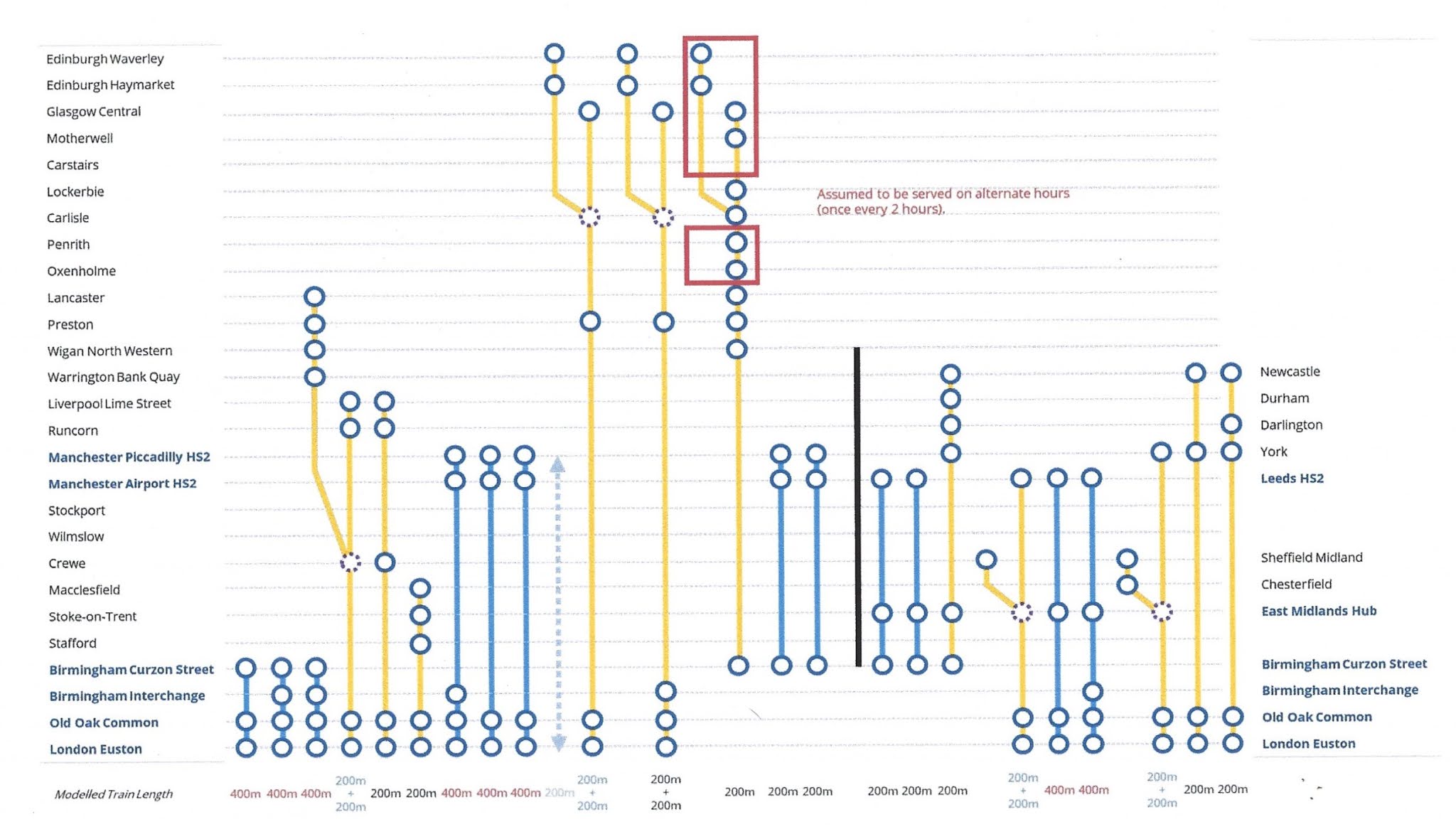
Note.
- Trains to the left of the vertical black line are Phase 1 and those to the right are Phase 2.
- Full-Size trains are shown in blue.
- Classic-Compatible trains are shown in yellow.
- The dotted circles are where trains split and join.
- In the red boxes routes alternate every hour.
Click on the diagram to enlarge it.
Could Avanti West Coast Run A Lumo-Style Service Between London And Liverpool?
Avanti West Cost’s Class 807 Trains
Avanti West Coast will be introducing their new Class 807 trains by 2023.
One of the routes, on which they will run, will be between London Euston and Liverpool Lime Street stations.
These trains are members of Hitachi’s AT300 family, with these characteristics.
- Seven cars.
- 453 seats
- 125 mph operating speed, with 140 mph possible under in-cab signalling, where the track allows.
They have been designed to be able to achieve or better times from the Class 390 trains, which have the advantage of tilt.
The Seats In The New Trains
Seats are important to passengers and there has been criticism, that some of the seats in Hitachi trains are like ironing boards.
But, so far nothing has been said about the seats on the new Class 807 trains.
453 seats in seven cars of a Class 807 train is 64.7 seats per car.
These are comparison figures for other trains.
- On a nine-car Class 801 train, there are 611 seats or 67.8 seats per car.
- On a five-car Class 801 train, there are 302 seats or 60.4 seats per car.
- On a five-car Class 810 train, there are 301 seats or 60.2 seats per car.
- On a five-car Class 803 train, there are 406 seats or 81.2 seats per car.
- On a nine-car Class 390 train, there are 469 seats or 52.1 seats per car.
- On an eleven-car Class 390 train, there are 589 seats or 53.5 seats per car.
Note.
- The Class 390 trains or Pendolinos have less seats per car, than the Hitachi trains. Is this because of all the space taken up by the tilting mechanism?
- As the seats per car for a Class 807 is between the five- and nine-car Class 801 trains, it would appear that the seat density is not much different to the trains on LNER and Great Western Railway.
- Lumo’s Class 803 trains on their low-cost service would appear to have a higher seating density. But Lumo says that they have redesigned the seats for more comfort.
- In The Seat Of Aurora, I looked at a report from Modern Railways on the seats in the Class 810 trains, which the writer found were much more comfortable.
It would appear that the two latest fleets of Hitachi trains have seats that are designed for more comfort.
Consider.
- First Group own seventy percent of Avanti West Coast.
- First Group own hundred percent of two train operating companies; Great Western and TransPennine Express, who run versions of Hitachi AT300 trains, so they probably have a lot of bottom-level feedback.
- In the current Class 390 train upgrade, Avanti West Coast are replacing all the Standard Class seats, the company must care about seat quality.
- First Group own hundred percent of Lumo, who have acquired new trains with comfortable seats.
I would be very surprised if the seats in the new Class 807 trains for Avanti West Coast were not custom-designed for their routes.
The Unusual Length Of The Class 807 Train
These are the length of the Class 390 and Class 807 trains.
- Class 390/0 – nine-car – 217.5 metres
- Class 390/1 – eleven-car – 265.3 metres
- Class 807 – seven-car – 182 metres
Note.
- A ten-car Class 807 train would be 260 metres.This could be convenient, if more eleven-car Pendolinos were needed.
- The Class 807 train is thirty-five metres shorter, than the nine-car Pendolino.
As eleven-car Class 390 trains commonly run London Euston and Liverpool Lime Street, why would they need the Class 807 train to be shorter?
I think there is a clue in this picture.

It shows a Class 390 train in Liverpool South Parkway station.
- At the time, Liverpool Lime Street station was closed for track remodelling.
- Liverpool South Parkway was acting as Liverpool’s main terminus.
- To accommodate the Pendolinos a temporary platform extension was built in the station.
Could it be that shorter trains were ordered to avoid the expense of lengthening the platforms at Liverpool South Parkway and perhaps other stations, that Avanti West Coast might serve?
The Current Service Between London Euston And Liverpool
The current London Euston and Liverpool Lime Street service is as follows.
- There is one train per hour (tph)
- The service calls at Milton Keynes Central, Stafford, Crewe and Runcorn.
- All of the stations can accommodate an eleven-car Pendolino.
- Trains take around an average of two hours and twelve minutes.
- The first Northbound train leaves at 07:07 and the last at 21:07.
- The first Southbound train leaves at 07:00 and the last at 20:48.
Services are generally run by eleven-car Class 390 trains, which gives a capacity of 589 passengers per hour.
I always think, there a need for a later train back to London, but then that could be said of many places.
A Possible Service From December 2022
Wikipedia says this.
- There will be two tph.
- The second service will call at Liverpool South Parkway station.
If two tph were to be run by Class 807 trains, this would give the following.
- A capacity of 906 seats per hour.
- This is a 54 % increase in capacity.
But if only the Liverpool South Parkway service was run by a Class 807 train and the other service was still run by an eleven-car Class 390 train, this would give the following.
- A capacity of 1042 seats per hour.
- This is a 77 % increase in capacity.
And all without expensive and disruptive platform extensions at Liverpool South Parkway station.
According to Wikipedia, the plans will need to be approved by the Office of Road and Rail.
How Fast Will A Class 807 Train Travel Between London Euston And Liverpool?
The Class 807 trains will have these features.
- The trains will have no diesel engines or batteries. This must save weight and that means better acceleration.
- The trains will have no tilt mechanism.. This must save weight and that means better acceleration.
- The trains will have a new nose. Is it more aerodynamic, which would cause less drag and increase operating speed?
Would these features mean the Class 807 trains can match the performance of the Class 390 train, despite not having tilt?
There are also improvements on the West Coast Main Line, that have not been fully reflected in the timetable.
I did a full analysis about how a two-hour journey time might be achieved in Will Avanti West Coast’s New Trains Be Able To Achieve London Euston and Liverpool Lime Street In Two Hours? This analysis led me to these conclusions.
- I am convinced that the new trains are designed for a two hour journey between London Euston and Liverpool Lime Street stations.
- Refurbished Class 390 trains should also be able to do the same time.
- I also calculated that nine trains would be needed for the two tph service, if they can arrange a fifteen minute turnround at both ends of the route. So would, the Class 807 trains be used on the Liverpool service to release newly-refurbished Class 390 trains to boost Blackpool and Birmingham services?
Alternatively, if the two services are run using eleven-car Class 390 trains for the current service and seven-car Class 807 trains for the one via Liverpool South Parkway, Avanti West Coast would need five of each train.
- They could fit in thirty minute turnrounds at both ends of the route.
- The mixed pair of trains would give a 77 % increase in capacity.
- The Class 807 service would be a two-hour trip.
- If the Class 390 service couldn’t match the time it could use current timings.
Whatever is done, it would be a flagship service between London and Liverpool.
The new trains will pay for themselves many times over, if this is the case, as a two-hour journey will surely attract passengers.
Organising The Service
If you really wanted to make the service simple and passenger-friendly, you would have dedicated platforms for the trains at both ends of the route.
- In Liverpool Lime Street station trains seem to have used one platform for many years. Currently, they seem to be using Platform 9.
- Surely, a similar arrangement could be setup at London Euston.
The service could also be setup with contactless ticketing, if that was felt the way things should be done.
Going The Whole Way
Suppose, that the London Euston and Liverpool Lime Street service is very successful for any number of reasons.
- The two hour journey time.
- The all-electric service.
- The doubling of the frequency.
- The availability of more seats.
- The expansion of Merseyrail into England’s first battery-electric Metro, which I wrote about in Chancellor To Fund £710m Merseyrail Expansion.
- The cost of driving, due to a mileage charge on all journeys.
Will this lead to a need to expand the service?
If it does, the obvious way would be to lengthen Liverpool South Parkway station and run longer trains.
An Eleven-car Class 390 train would carry 589 passengers.
Adding three-cars to a seven-car and the train would still be shorter than an eleven-car Class 390 train, but it would carry around 650 passengers.
This would add an extra ten percent capacity to the route.
This would surely provide the capacity until High Speed Two arrives towards the end of the decade.
I do wonder if Avanti West Coast are using the London Euston and Liverpool Lime Street service to experiment with how they might run High Speed Two services.
Conclusion
As a two tph service run by Class 807 trains in two hours would be over 4,500,000 seats in each direction, I feel that this will be a very popular and intensive service.
I feel that Avanti West Coast will need to apply lessons learned on sister company’s Lumo’s service between London Kings Cross and Edinburgh.
Planning Permission Granted For The First New Railway Station On The Northumberland Line
The title of this post, is the same as that of this article on ITV.
The station concerned is Ashington station.
One of the reasons, I wrote this post, is that the ITV article has a very good map of the railway being reopened.
These two paragraphs describe the station’s features.
The new platform will be approximately 100 metres long, with a range of facilities including waiting shelters, CCTV, help points and lighting.
Plans also include car park providing up to 270 spaces including 17 accessible spaces and 18 electric vehicle charging bays.
It also gives the reopening date of the railway as 2024, when the service will be a half-hourly one between Newcastle and Ashington stations that should take thirty-five minutes.
Caterpillar, Cummins Move On Hydrogen For Trains
The title of this post, is the same as that of this article on Construction Equipment.
This is the first paragraph.
Caterpillar and Cummins are working separately to put hydrogen to work in locomotives.
They have a lot to lose with the extinction of their diesel businesses, so why not join the party.
Lumo And Dogs
I have just asked Lumo what is their policy on dogs!
I got this reply!
Dogs are welcome on Lumo trains, we would just ask that they are kept on a lead. We also provide water bowls and stool bags, just ask one of our Lumo ambassadors on board who will be able to help.
Sounds good to me! But then, I don’t have a dog, although I know a lady who does!
The Seat Of Aurora
The title of this post, is the same as that of an article in the August 2021 Edition of Modern Railway.
The article has this sub-title.
East Midlands Railway has finalised the new seats for its new trains, and they’re completely useless – as ironing boards.
Note.
- East Midlands Railway‘s new trains are Class 810 trains, which are Hitachi AT300 express trains, as used by several operators.
- Some passengers and industry commentators have criticised the seats in these trains as like ironing boards.
- Abellio Greater Anglia, who are a sister company to East Midlands Railway, also choose the seats for their new trains with care. I wrote No ‘Ironing Board seats’ For Greater Anglia’s New Trains, about their seat choice.
Ian Walmsley, who wrote the article for Modern Railways says this about the Seat of Aurora.
My verdict is that it is a good seat, and that is in absolute terms – not just saying it is better than an 800, which it would have to be really.
For myself, the proof of the seating will be in the sitting.
Israeli All-Electric Plane Maker Readies For 1st Flight, New ‘Age Of Aviation’
The title of this post, is the same as that of this article on the Times of Israel.
It is a comprehensive progress report on the Eviation Alice.
The big news is that the first flight is expected before the end of the year.
What Happened To The Class 158/159 Bi-Mode Study?
In Class 158/159 Bi-Modes?, I discussed the possibility of turning South Western Railway‘s Class 158 and Class 159 trains into bi-modes.
I said this.
In the March 2018 Edition of Modern Railways, there is a short news item, which is entitled Bi-Mode Study For SWR DMUs.
The Class 158 and Class 159 diesel multiple units used by South Western Railway are diesel-hydraulic units.
Under their franchise agreement, South Western Railway, agreed to perform a study, to see if the multiple units could be converted from diesel-hydraulic to diesel-electric transmission.
If this is successful, then the plan would be to fit a third-rail capability to the trains, so they could use the electrification between Basingstoke and Waterloo on services to Salisbury and Exeter.
Could the conversion also raise the operating speed of the trains from their current 90 mph to a more timetable-friendly 100 mph?
It looks like it could be a feasible , especially as the article states they might re-use redundant modern traction equipment from Class 455 trains, which are due for replacement.
It sounded a sensible plan to do a study.
But we’ve heard nothing since.
- Has the late delivery of the Class 701 trains, pushed the availability of the Class 455 trains, that wioll donate the traction system, too far into the future?
- Has the Covids delayed another project?
- Would First Group prefer more Hitachi trains as five of their companies use them or have them on order?
- Is the 90 mph speed of the diesel trains, too slow for the busy London Waterloo and Basingstoke route?
Or could it be that Alstom, CAF, Hitachi, Stadler or another manufacturer have a much better zero-carbon plan?
LNER’s Middlesbrough And London Service Starts On December 13th
Tucked at the bottom of the article entitled LNER Tickets For Christmas Getaway in Edition 939 of Rail Magazine, there is this paragraph separated from the article by a sole bullet point.
LNER has confirmed that from December 13 it will run a new weekday service between London King’s Cross and Middlesbrough.
It has already made an appearance on Real Time Trains and I can find the following details.
- There will be one train per day (tpd)
- Intermediate stops will be at Thornaby and York.
- The Middlesbrough and London service will leave Middlesbrough from Platform 1 at 07:08 and arrive in King’s Cross at 10:22.
- The London and Middlesbrough service will leave King’s Cross at 15:25 and arrive in Middlesbrough in Platform 2 at 18:18.
These are my thoughts.
Trains Per Day
One train per day, is obviously an introductory service and like services to Harrogate and Lincoln, the number of services will ramp up to perhaps four or five tpd, if the demand is there and the paths and trains are available.
Journey Times
Consider
- The Southbound journey takes three hours and fourteen minutes with a time of two hours and nine minutes between York and King’s Cross
- The Northbound journey takes two hours and fifty-three minutes with a time of one hour and fifty-six minutes between King’s Cross and York.
- Some services between King’s Cross and York are as fast as one hour and forty-eight minutes.
- Middlesbrough and York seems to take around 52-58 minutes.
- These Middlesbrough and York timings are consistent with TransPennine Express.
- Digital signalling could offer savings in journey time between York and London.
I think it is very likely as the timetable improves, that timings between Middlesbrough and London could be around two hours and forty minutes.
Electrification
The route is fully electrified except for between Middlesbrough and Longlands Junction, where it joins the electrification of the East Coast Main Line, which is a distance of twenty-two miles.
Hitachi are developing a battery-train, which they call the Hitachi Intercity Tri-Mode Battery Train, which is described in this Hitachi infographic.

Note.
- LNER’s current Class 800 trains will probably be able to be converted to this train.
- A range on battery power of upwards of forty miles would be expected.
If the range on battery-power can be stretched to perhaps sixty miles, this train should be capable of serving Middlesbrough without the need for any extra charging at the terminus.
I am sure Hitachi would like to see their battery-electric trains running between King’s Cross and Middlesbrough, as it would be an ideal route on which to show the trains to prospective customers, given that their factory is at Newton Aycliffe.
Conclusion
This could be good demonstration battery-electric service for Hitachi and LNER.
 The Anonymous Widower