LNER To Keep Class 91s Until 2023
The title of this post is the same as that of this article on Rail Magazine.
This is the two introductory paragraphs.
Class 91s hauling Mk 4s will remain with London North Eastern Railway until 2023.
Ten rakes of coaches and ten ‘91s’ will be used, with two additional spare ‘91s’ and a handful of spare Mk 4s also retained.
It looks like LNER are keeping enough Class 91 locomotives and Mark 4 coaches to guarantee having ten trains in service.
Why 2023?
The answer to this question is probably contained in an article in Issue 901 of Rail Magazine, which is entitled ORR Approves New Hitachi Inter-Car Connector Design, which has these two statements.
- All inter-car connectors will have been updated by Summer 2022.
- Hitachi has deals for a further 61 trains for three operators and all will be in traffic by the end of 2022.
It looks like Hitachi could have production capability from 2023.
The original Rail Magazine article also says this.
The extension is until the end of 2023 while LNER sources brand new trains, which would take a minimum of around two years to build and deliver. The operator has previously told RAIL it needs around six new trains.
It appears the difference between retaining ten InterCity 225 trains and adding six new trains to the fleet, is to cover for the retrofit of the inter-car connectors.
The Performance Of A Class 91 Locomotive And Five Mark 4 Coaches
I have seen in mentioned that Virgin East Coast were intending to run shortened rakes of Mark 4 coaches.
In the Wikipedia entry for the Class 91 locomotive, there is a section called Speed Record, where this is said.
A Class 91, 91010 (now 91110), holds the British locomotive speed record at 161.7 mph (260.2 km/h), set on 17 September 1989,[ just south of Little Bytham on a test run down Stoke Bank with the DVT leading. Although Class 370s, Class 373s and Class 374s have run faster, all are EMUs which means that the Electra is officially the fastest locomotive in Britain. Another loco (91031, now 91131), hauling five Mk4s and a DVT on a test run, ran between London King’s Cross and Edinburgh Waverley in 3 hours, 29 minutes and 30 seconds on 26 September 1991. This is still the current record. The set covered the route in an average speed of 112.5 mph (181.1 km/h) and reached the full 140 mph (225 km/h) several times during the run.
When you consider, this was nearly forty years ago, there can’t be much wrong with British Rail’s train engineering.
What Average Speed Do You Need To Achieve London And Edinburgh In Four Hours?
The rail distance between London and Edinburgh is 393 miles, so four hours needs an average speed of 98 mph.
Consider.
- I have travelled in InterCity 125 and InterCity 225 trains, where I have measured the speed at around 125 mph for perhaps thirty or forty miles.
- In Norwich-In-Ninety Is A Lot More Than Passengers Think!, I travelled to Norwich and back, at around 100 mph most of the way.
- Continuous 125 mph running is just as much about the track as the train.
- I have watched a driver in an InterCity 125 at work and these guys and girls know the route and their charges, like the backs of their hands.
I think it is possible to arrange train pathing, so that trains could run between London and Edinburgh in excess of 100 mph.
I believe, that this would enable London and Edinburgh in under four hours.
Will LNER Run Faster Services With Short Sets?
Virgin East Coast’s original plan, was to run short sets between London and Edinburgh.
Would these short sets have been faster, than full size sets?
- The power-to-weight ratio is higher, so acceleration would be better.
- A five-car train would probably need half the power of a ten-car train to cruise at a given speed.
- It might be possible to save weight to increase performance.
- There would be no intermediate stops.
- They know that the Kings Cross and Edinburgh record is three-and-a-half hours, which was set by a five-car train.
- In-cab digital signalling and other improvements could be fitted.
It should also be noted, that a short set would probably do significantly less damage to the track than a full-size set at 140 mph.
Possible Short InterCity 225 Routes
LNER have only six fully-electrified routes, where they could run short InterCity 225 sets.
- Kings Cross and Leeds
- Kings Cross and Doncaster
- Kings Cross and York
- Kings Cross and Newcastle
- Kings Cross and Edinburgh
- Kings Cross and Stirling
Note.
- All routes are fully-electrified, which is a pre-requisite, as InterCity 225 sets have no self-power capability.
- Kings Cross and Leeds will probably be run by pairs of Class 800 trains, as LNER looks like it will split trains at Leeds and serve two destinations.
- Do Doncaster, York and Newcastle generate enough traffic for a fast service?
- The Edinburgh route will have direct competition from East Coast Trains, who will be running five-car Class 803 trains.
- The Stirling route at over five hours is probably too long.
It looks to me, that the preferred route for InterCity 225 sets,; short or full-size will be Kings Cross and Edinburgh.
How Many Trains Would Be Needed To Run An Edinburgh Service?
A flagship service between London and Edinburgh might have the following timetable.
- One tph perhaps leaving at a fixed time in every hour.
- A timing of under four hours.
- Minimal numbers of intermediate stops.
- The service would not be extended past Edinburgh, as the trains need electrified lines.
Suppose, the trains could do a round trip in eight hours, this would mean that eight trains would be needed to provide a service.
Ten trains would allow one train in maintenance and one ready to be brought into service at a moment’s notice.
Does this explain, why ten InterCity 225 sets are being retained.
Would In-Cab Signalling Be Needed?
I suspect that under current rules, in-cab digital signalling might be needed! But as I observed in Partners On Board For In-Cab Signalling Project On East Coast Main Line, this is on its way!
But, as the average speed needed to do London and Edinburgh in four hours is only 98 mph, I wonder what time could be achieved by one of the top drivers, using the following.
- All their route knowledge and driving skill.
- A five-car train.
- Maximum acceleration.
- A well-thought out pathing structure.
- A clear track
- No hold-ups
- A non-stop run.
If the train were to run at 125 mph all the way without stopping, the journey time would be around three hours and ten minutes.
Wikipedia says this about in-cab digital signalling on the East Coast Main Line.
The line between London King’s Cross and Bawtry, on the approach to Doncaster, will be signalled with Level 2 ERTMS. The target date for operational ERTMS services is December 2018 with completion in 2020.
- I estimate that that this will mean that 145 miles of the route will have full in-cab digital signalling.
- Currently, the fastest London and Doncaster times are around 90 minutes, with many taking 97-98 minutes for the 155 miles.
This means the fast train takes 84 minutes between King’s Cross and Bawtry, at an average speed of 103 mph.
Suppose this fast train could go at 125 mph for all but twenty of the distance between King’s Cross and Bawtry, how much time would this save?
- 125 miles at 125 mph would take 60 minutes.
- 125 miles at 103 mph would take 72 minutes.
This means that just by running at 125 mph continuously for all but twenty miles could save up to twelve minutes.
If 140 mph running could be maintained on this section, another six minutes would be saved.
As they say, every little helps!
Lessons From Norwich-in-Ninety
In Norwich-In-Ninety Is A Lot More Than Passengers Think!, I travelled to Norwich and back, at around 100 mph most of the way.
Liverpool Street and Norwich is 114 miles and a ninety minute journey is an average of just 76 mph, which is 24 mph below the maximum cruise of a Class 90 locomotive and a rake of eight Mark 3 coaches. Compare this with an average speed of 98 mph needed for London and Edinburgh in four hours and the 125 mph maximum certified cruise of an InterCity 225 train, without in-cab digital signalling.
It should also be noted that Greater Anglia, run an additional stopping train after the Norwich-in-Ninety expresses, that call at several important stations and not just Ipswich.
Will LNER use a similar strategy? It was working well and successfully for Greater Anglia, until services were decimated by COVID-19!
Will LNER Increase Frequency Between London And Edinburgh To Three Trains Per Hour?
It would seem that the current two tph service running nine- or ten-car trains, runs with a high level of occupancy, so to replace some of these trains with faster and shorter trains might cause capacity problems.
But to add, a third faster train in the hour might be possible. Especially, if the Norwich-in-Ninety strategy were to be used. The timetable in both directions could be something like.
- XX:00 – Four hour express
- XX:06 – Four-hour plus train to current timing
- XX:30 – Four-hour plus train to current timing
LNER’s Marketing Department would like it.
Could Hitachi Trains Achieve London and Edinburgh In Four Hours?
The all-electric Class 801 trains most certainly have a performance to match an InterCity 225 in terms of acceleration and maximum operating speed without in-cab digital signalling. After all, the Japanese train was designed as a direct replacement for British Rail’s last high performance train!
So I believe that with a well-designed timetable, electric Hitachi trains will be able to run between London and Edinburgh in under four hours, with a small number of stops.
Note that LNER will have a fleet of thirty nine-car and twelve five-car all-electric Class 801 trains.
But East Coast Trains will have a fleet of five five-car all-electric Class 803 trains, which could get near to a four-hour timing, despite their four stops at Stevenage, Durham, Newcastle and Morpeth.
- I have timed a Class 800 train leaving Kings Cross and they get up to 125 mph fairly fast, by about Potters Bar, which is reached in eleven minutes.
- Stops at Stevenage, Durham and Morpeth will probably each add two minutes to the timing, with Newcastle adding five minutes.
- 125 mph all the way from Kings Cross to Edinburgh would be a timing of three hours and ten minutes.
Add up the stationary times at the stops (2+2+2+5) and that gives a journey time of three hours and twenty-one minutes, which leaves thirty-nine minutes for the five decelerations and accelerations between stationary and 125 mph.
This page on the Eversholt Rail web site, has a data sheet for a Class 802 train, which is a Class 800 train with larger engines.
The data sheet shows that a five-car train can accelerate to 125 mph and then decelerate to a stop in six minutes in electric mode. So five accelerations/deceleration cycles to 125 mph would take thirty minutes. This gives a journey time between London and Edinburgh of three hours and fifty-one minutes.
Note that Class 801 trains, which don’t lug diesel engines about will have better acceleration, due to the lower weight, so should have better acceleration and deceleration.
Does this time seem reasonable? First Group with their extensive experience of running Class 800 trains on the Great Western Main Line will know the capabilities of the trains, down to the last mph.
I doubt, they’d have bought the trains for East Coast Trains, if they couldn’t do London and Edinburgh in four hours.
I believe that both InterCity 225 and Class 801/803 trains can do London and Edinburgh in four hours and any train company that doesn’t offer this timing, will come second!
A Possible Hitachi-Based Timetable For LNER
I would be very surprised if a service pattern like this wouldn’t be possible.
- XX:00 – Four hour express – Class 801 train
- XX:06 – Four-hour plus train to current timing – Class 801 train or InterCity 225
- XX:30 – Four-hour plus train to current timing – Class 801 train or InterCity 225
Note.
- As there is only one extra train per hour, ten extra trains would be the addition to the fleet, needed to run this service pattern.
- Class 801 trains could be five-car or nine-car sets as passenger numbers require.
- InterCity 225 trains could be as long as are needed.
InterCity 225 trains would only be doing the job, they’ve done for many years.
Targeting The Airline Market
In Trains Ordered For 2021 Launch Of ‘High-Quality, Low Fare’ London – Edinburgh Service, which described the launch of First East Coast Trains, I said this about their target market.
First East Coast Trains is targeting the two-thirds of passengers, who fly between London and Edinburgh. The company are also targeting business passengers, as the first train arrives in Edinburgh at 10:00. Trains will take around four hours.
Note that currently, LNER’s first train arrives at 11:12. In the future, I would envisage that LNER intend to go for four hour journeys.
It would seem to me, that both train companies will be attempting to take passengers from the airlines.
Conclusion
It looks to me that ten InterCity 225 trains could add a third train in each hour between London and Edinburgh for LNER, that would do the journey in under four hours.
The third train could either be an InterCity 225 or a Class 801 train.
Flying Taxi Start-Up Raises $240m From Existing Investors Led By Tencent
The title of this post, is the same as that as this article on the Financial Times.
This is the introductory paragraph.
Lilium, a German flying taxi start-up, has raised $240m from existing investors led by Chinese technology group Tencent to fund the next stage of its growth.
The article has a picture of the Lilium Jet, which looks to be an interesting design.
- It is an electric VTOL aircraft.
- Power comes from no less than thirty-six electric motors driving ducted fans.
- The fans will tilt for take-off and landing.
- Maximum speed will be 190 mph, with a cruise of 170 mph.
- Range will be 300 kilometres or 186 miles
- Total installed power is 320 kW.
- Less than 150 kW will be needed for cruise.
- A MW (?) battery will be fitted according to Wikipedia. Do they mean MWh?
- It can carry two passengers with five from 2025.
- Empty weight is 440 Kg.
- Maximum take-off is 640 Kg.
- Initially, it will have a pilot, but the aim is for a completely autonomous aircraft.
Lilium aims to run a city-to-city taxi service starting in 2025.
I have a few thoughts.
Aerodynamics
There have been a lot of developments in aerodynamics in the last few years and the Lilium Jet and other electric aircraft like the Eviation Alice take full advantage of the developments.
So don’t expect electric aircraft to look convectional, unless perhaps they are an electric-engined conversion of an existing conventional aircraft!
Structure
The structure of aircraft is getting lighter and Airbus and Boeing with the 787 Dreamliner are showing what is possible.
Will an empty weight of 440 Kg be possible? Especially, if that includes the battery.
The Wikipedia figures allow a payload of 200 Kg. That must be only two passengers.
Power
Wikipedia talks about a one MW battery, but I suspect they mean one MWh, as this is the unit of battery capacity.
In Sparking A Revolution, I quoted Hitachi’s predictions and suggested that they could have a five-tonne battery, that held 15 MWh by 2035.
This would mean that a one MWh battery would weigh 333 Kg.
This must be near to the target weight of the battery needed to power a Lilium Jet.
But a one MWh battery that weighs just 333 Kg. would be a tough ask given the limitations of today’s battery chemistry.
Fire
Wikipedia says this about a fire.
The first prototype was destroyed by fire during maintenance on 27 February 2020.
As the Eviation Alice also suffered a fire, are these aircraft pushing batteries too hard.
Conclusion
I am sceptical about some of the figures quoted for the Lilium Jet in Wikipedia.
When I see the following.
- A Lilium Jet in the air, taking-off and landing.
- Two passengers flying in the aircraft.
- A Lilium Jet on a set of scales.
I’ll revise my opinion.
There is this video.
Obviously, I’m doing something wrong in my calculations.
Partners On Board For In-Cab Signalling Project On East Coast Main Line
The title of this post, is the same as that of this article on Rail Advent.
This is the introductory paragraph.
Network Rail has announced that it has brought Siemens and Atkins on as its partners in a project to introduce in-cab signalling on the southern section of the East Coast Main Line.
It is good, that a start is being made on this significant project, which should increase capacity between Kings Cross and Doncaster.
An Unprecedented Display Of Rail Solidarity
These pictures show an advert for National Rail in The Sunday Times.




Let’s hope that this co-operation between staff, unions and train operating companies brings us through the COVID-19 crisis.
Step-Free Access At Kentish Town Station
On a web page recently, I saw a suggestion about how to add step-free access to Kentish Town station.
The suggestion was that it was too difficult to add it to the Underground station, but why not add it to the Thameslink station?
This Google Map shows the station.
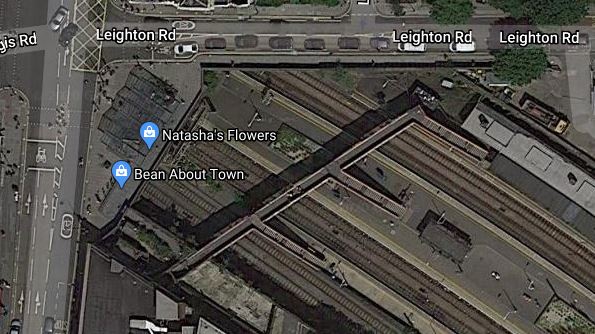
Note the pedestrian bridge across the tracks with steps going down to the platforms.
Adding a lift to each platform would give full step-free access to Thameslink and would give an alternative step-free route to these step-free stations in Central and South London.
- Kings Cross St. Pancras
- Farringdon
- Blackfriars for the South Bank
- London Bridge
- Elephant & Castle
- Denmark Hill
- Herne Hill
- Mitcham Eastfield
- Wimbledon
- Sutton
The step-free access would be much easier to install, than on the Northern Line platforms.
Connecting The North West Of England’s Three Powerhouses
It could reasonably be argued that the three most important economic centres of the North West of England are.
- The City of Liverpool and Merseyside
- Manchester Airport
- The City of Manchester and Greater Manchester
I’ll take a quick look at each, with particular reference to public transport links.
The City of Liverpool and Merseyside
Liverpool is introduced by this paragraph in Wikipedia.
Liverpool is a city and metropolitan borough in Merseyside, England. As of 2018, the population is approximately 494,814. Liverpool is the ninth-largest English district by population, and the largest in Merseyside and the Liverpool City Region. It lies within the United Kingdom’s sixth-most populous urban area. Liverpool’s metropolitan area is the fifth-largest in the United Kingdom, with a population of 2.24 million.
Knowing Liverpool with affection as I do, I find the City difficult to describe in an unbiased manner, but in my experience few people go for a visit to Liverpool and don’t come back enchanted in some way. It is a many-faceted city!
One of Liverpool’s strengths is the local rail system; Merseyrail, which connects the suburbs to the centre, just like the Underground does in London. As with London, Merseyrail is backed up by a comprehensive bus network. And like London, Liverpool is introducing hydrogen-powered double-deck buses.
Merseyrail is also in a strong expansionist phase.
- New trains are being delivered to replace some of the oldest trains on the national network in the UK.
- New stations are being added to the core Merseyrail network.
- Stations are being improved with refurbishment and step-free access.
- Merseyrail have ambitions to expand their network to Liverpool Airport, Preston, Skelmersdale, Warrington and Wrexham.
The City of Liverpool and Merseyside in general are getting ready to expand their economy.
Manchester Airport
This Google Map shows Manchester Airport.

Note.
- The two runways.
- The railway station in the middle of the Airport.
- The M56 motorway passing across the North-West of the Airport.
Manchester Airport is the third-busiest airport in the UK in terms of passenger numbers.
- It is a two-runway airport like Heathrow, which helps a lot in operational efficiency.
- In 2018, it handled 61% of the number of passengers as Gatwick, but 71% of the aircraft movements.
- The airport has three terminals.
- The airport has rail connections to Crewe, Manchester, Northern England, the Central Belt of Scotland and Wales.
- The airport is connected to the trams of the Manchester Metrolink.
I’ve never flown from the airport as a passenger, so I can’t comment.
Wikipedia has a section on the Future of Manchester Airport, which says.
- Terminal 2 will be expanded with fifteen more covered stands,
- The airport will expand to handle more freight.
Airport City Manchester is an £800million expansion to create an airport city on the lines of those at Barcelona and Frankfurt, alongside the airport.
Manchester Airport is certainly building for a future expansion.
Reading about rail links to the airport, you get the impression that some places like Bradford, Derby and Nottingham would like direct links to Manchester Airport.
The City of Manchester and Greater Manchester
Manchester is introduced like this in Wikipedia.
Manchester is a city and metropolitan borough in Greater Manchester, England, with a population of 547,627 as of 2018 (making it the fifth most populous English district). It lies within the United Kingdom’s second-most populous urban area, with a population of 2.5 million and second most populous metropolitan area, with a population of 3.3 million. It is fringed by the Cheshire Plain to the south, the Pennines to the north and east, and an arc of towns with which it forms a continuous conurbation.
I don’t know Manchester as well as I know Liverpool and most of my visits to the City are usually with limited objectives and a possible overnight stay.
Like Liverpool, Manchester has an extensive public transport network based on the trams of the Metrolink and some local railway lines, backed up by lots of buses.
Transport for Greater Manchester is developing the transport network, with a new Metrolink line to the Trafford Centre opening soon.
Note that if Manchester’s rail system has a problem, it is congestion in the Castlefield Corridor through Manchester Piccadilly, Manchester Oxford Road and Deangate stations and on to Manchester Victoria and Salford Crescent stations. A permanent long-term solution is needed.
The City of Manchester and Greater Manchester are getting putting in the necessary transport links to expand their economy.
Connecting The Three Powerhouses
In Changes Signalled For HS2 Route In North, I wrote the following, which I am now repeating in an updated form.
This clip of a map from this Transport for the North report , which is entitled At A Glance – Northern Powerhouse Rail, shows a schematic of the current and possible rail links in the triangle between Crewe, Liverpool and Manchester.

High Speed Two, which is shown in dark green, would appear to come North and split into two routes.
- One continues North to join the existing West Coast Main Line just South of Wigan.
- Another goes through Crewe station.
North of Crewe, the two routes join and then split into three at the Junction labelled 6.
- To Warrington and Liverpool
- To Wigan, Preston and Scotland
- To Manchester Airport and Manchester.
A second Junction labelled 5, allows Northern Powerhouse Rail trains to run Liverpool-Warrington-Manchester Airport-Manchester.
This is a new layout and has the following advantages.
- I estimate that trains could save 7-8 minutes on services running between Crewe and Wigan because of the longer running at High Speed Two operating speeds at 225 mph.
- ,If they don’t stop at Crewe and Runcorn, further minutes could be saved.
- Trains between London and Preston and London and Glasgow could skip the stop at Warrington to save further minutes.
- There could be an advantageous reorganisation of stopping patterns.
- London and Liverpool services and Liverpool and Manchester services could stop at Warrington, which would give Warrington very good connections.
- The Liverpool-Manchester and Liverpool-Crewe Lines could be built to High Speed Two standards, which could allow 225 mph running.
I also think the track layout can be run alongside or underneath the various motorways in the area for a lot of the route between Liverpool, Crewe, Warrington and Manchester Airport.
It would appear to be a very good solution to a complex problem and overall, I suspect it gives better connectivity, at a more affordable cost, whilst creating a railway that can be built with less disruption and will ultimately produce less noise.
The Transport for the North report, also says the following.
- There could be a new Warrington South Parkway station.
- Six tph between Liverpool and Manchester via Warrington are planned.
- Journey times will be 26 minutes.
The Twenty-first Century will finally get a modern and fast Liverpool and Manchester Railway.
- Trains would stop at Manchester Airport, a new Warrington South Parkway and possibly Liverpool South Parkway.
- Trains would run every ten minutes.
- Trains would take 26 minutes between Liverpool and Manchester.
These are a few other thoughts on the route.
The Liverpool Terminus
The Transport for the North report proposes a new High Speed station in Liverpool.
- It would possibly be alongside Liverpool Lime Street station.
- It would handle both High Speed Two and Northern Powerhouse Rail services.
- The station would need at least four platforms.
- The station could be connected to Liverpool Lime Street station’s Wirral Line platform.
I believe that a well-designed station could be squeezed in, on the edge of Liverpool City Centre.
Should Trains Stop At Liverpool South Parkway?
I think this could be important, especially, if the station gets a link to Liverpool Airport.
Between Manchester Airport And Manchester City Centre
Most current trains between Manchester Piccadilly and Manchester Airport stations take between 15-18 minutes.
I don’t believe that these times are compatible with a 26 minute time between Liverpool and Manchester.
So I am fairly certain that to achieve the planned time in the Transport for the North report, that an almost direct tunnel between Manchester Airport and Manchester City Centre is necessary.
The Manchester City Centre Station
Could the tunnel pass through underground platforms at Manchester Piccadilly station, which run across the station and then surface to connect with the chosen route to Leeds?
In an earlier plan, referenced under Manchester City Centre (Phase 2b) in the Wikipedia entry for High Speed Two,, this is said.
The route will continue from the airport into Manchester city centre via a 7.5-mile (12.1 km) twin bore branch tunnel under the dense urban districts of south Manchester before surfacing at Ardwick.
Under the earlier plan, trains would have gone into a rebuilt Manchester Piccadilly station.
I also wonder, if the solution would be to bore a tunnel under Manchester City Centre with stations under Manchester Piccadilly station, Piccadilly Gardens and Manchester Victoria.
- It might be just one set of platforms with travellators, escalators and lifts all over Manchester City Centre.
- It should be noted that two High Speed Two trains, running as a pair would be four hundred metres long.
One of the advantages of a train connection between Manchester Piccadilly and Manchester Victoria station, would be that the Castlefield Corridor would be by-passed.
- TransPennine Express services between Manchester Airport and the North-East would be replaced by Northern Powerhouse Rail services between Liverpool and the North-East via Manchester Airport.
- The Castlefield Corridor would probably be reserved for local services.
- Passengers needing Manchester Oxford Road or Deansgate stations would use the current Manchester Airport station.
There are probably other advantages.
Building The High Speed Liverpool And Manchester Line
I believe that this line can be built without too much disruption to existing services, because Crossrail’s construction didn’t disrupt London.
Conclusion
My overall conclusion is that it is feasible to build a Liverpool and Manchester High Speed Line, as an early part of Northern Powerhouse Rail, that will also be used by High Speed Two, when that is extended to Liverpool and Manchester.
Put Thameslink On The Tube Map Says London Assembly
The title of this post is the same as that of this article on Ian Visits.
This is the introductory paragraph.
A report on improving accessibility on London’s Transport services has called for the fully accessible Thameslink line to be on the Tube map as a matter of some urgency.
I’m all for this happening.
I use Thameslink quite a bit, as if I’m in some places South of the River and am coming home, taking Thameslink to West Hampstead Thameslink and then using the Overground to Canonbury, from where I walk home, is a convenient route.
- It is step-free.
- There is a Marks and Spencer at West Hampstead, where I can do a bit of food shopping.
- Walking from Canonbury station to my house is gently downhill.
These are some other thoughts about Thameslink,
The Underground Train With A Toilet
Sometimes, I also find it doubly-convenient, as I need to spent a penny or more. Often, the toilets on Thameslink trains are free in the tunnels under London!
How many other Underground trains have toilets?
Obviously, Eurostar does, but does anybody know of any other trains that run deep under the surface, that have toilets?
Do Thameslink Want The Extra Passengers That Being On The Map Would Bring?
This may seem a dumb question, but sometimes, I do wonder, if the answer is that they don’t!
Thameslink Would Surely Make A Good Travel Partner For Eurostar
Increasing, many visitors from the Continent to London and the South East are travelling across the Channel using the excellent Eurostar.
As the Thameslink and Eurostar platforms at St. Pancras International, there could be mutual advantages to both companies to be partners.
Suppose you were travelling on these routes.
- Paris and Gatwick
- Brussels and Greenwich
- Amsterdam and Brighton
- Rotterdam and Luton Airport
And for one reason or other you didn’t want to fly; climate change, you like trains, awkward baggage or just plain fear of flying.
Surely, using Eurostar and Thameslink would be the obvious travel companies.
Note that Thameslink have posters, saying that they are the ideal way to get to Luton Airport.
Do they have posters, saying they are the ideal way to get to Eurostar at St. Pancras?
If I was running Thameslink, I’d do the following.
- Make sure, that all Thameslink stations accepted contactless ticketing using bank or credit cards.
- Put information and advertising on Eurostar trains and stations, telling passengers how to get to and from any Thameslink station without buying a physical ticket.
- Devise a simple add on ticket, that would be printed on your Eurostar boarding pass or held in Eurostar’s app.
- Market Thameslink to the French as the UK’s answer to the RER.
- Put travel information in at least Chinese, English, French, German, Italian, Japanese and Spanish, at St. Pancras station.
I would think, that a properly thought-out plan, could be a nice little earner for Thameslink.
Manchester Piccadilly, Liverpool Lime Street And Some Other Stations Compared
I am doing this exercise to get a handle on the scale of the problem at Platforms 13 and 14 at Manchester Piccadilly station.
In 2018/19, these were some passenger statistics for the two stations and some others.
- Birmingham New Street station handled 47.928 million passengers on its thirteen platforms or 3.62 million per platform per year.
- Brighton station handled 17.385 million passengers on its eight platforms or 2.17 million per platform per year.
- Bristol Temple Meads station handled 11.368 million passengers on its thirteen platforms or 0.87 million per platform per year.
- Cardiff station handled 14.205 million passengers on its eight platforms or 1.78 million per platform per year.
- Chelmsford station handled 8.927 million passengers on two platforms of 4.46 million per platform per year.
- Crewe station handled 3.318 million passengers on its twelve platforms or 0.28 million per platform per year.
- Deansgate station handled 0.458 million passengers on its two platforms or 0.23 million per platform per year.
- Doncaster station handled 3,918 million passengers on its nine platforms or 0.44 million per platform per year.
- East Croydon station handled 24.770 million passengers on its six platforms or 4.12 million per platform per year.
- Exeter St. Davids station handled 2.620 million passengers on its six platforms or 0.44 million per platform per year.
- Gatwick Airport station handled 21.225 million passengers on its seven platforms or 3.03 million per platform per year.
- Leeds station handled 30.839 million passengers on its seventeen train platforms or 1.81 million per platform per year.
- Leicester station handled 5.582 million passengers on its four platforms or 1.40 million per platform per year.
- Liverpool Lime Street station handled 14.221 million passengers on its eleven platforms or 1.29 million per platform per year.
- London Bridge station handled 61.308 million passengers on its fifteen platforms or 4.08 million per platform per year.
- London Fenchurch Street station handled 18.508 million passengers on its four platforms or 4.63 million per platform per year.
- London Paddington station handled 38.18 million passengers on its thirteen platforms or 2,94 million per platform per year.
- Manchester Oxford Road station handled 9.338 million passengers on its five platforms or 1.87 million per platform per year.
- Manchester Piccadilly station handled 30.252 million passengers on its fourteen platforms and two tram platforms or 1.89 million per platform per year.
- Manchester Victoria station handled 8.950 million passengers on its eight platforms or 1.12 million per platform per year.
- Newcastle station handled 8,914 million passengers on its twelve platforms or 0.74 million per platform per year.
- Nottingham station handled 8.005 million passengers on its nine platforms or 0.89 million per platform per year.
- Peterborough station handled 5.060 million passengers on its seven platforms or 0.72 million per platform per year.
- Preston station handled 4.646 million passengers on its nine platforms or 0.52 million per platform per year.
- Reading station handled 17.081 million passengers on its fifteen platforms or 1.14 million per platform per year.
- York station handled 9.991 million passengers on its eleven platforms or 0.90 million per platform per year.
These figures have given rise to a few thoughts.
Brighton
Brighton station is an eight platform terminal station, that handles a lot of passengers, considering that the City doesn’t have any mass transit system and passengers rely on walking, bicycles, buses and private cars for onward travel.
- There are upwards of eight trains per hour (tph) at the station to and from London, all of which can be up to twelve cars.
- The West Coastway and East Coastway Lines have at least six tph in the Off Peak.
- Arriving passengers can walk straight through the wide gate line and out to walking routes and the buses, with leaving passengers walking the other way.
I wouldn’t be surprised to hear that Brighton station is at capacity.
Chelmsford
It is truly remarkable that Chelmsford station is the second busiest station in terms of passengers per platform per year on my list.
- The station has two separate platforms on either side of the tracks.
- Access is via wide stairs and lifts.
- The station appears to handle five tph in both directions in the Off Peak, with up to twice that number in the Peak.
- Most trains calling at the station are between eight and twelve cars.
- Chelmsford station could get even busier in terms of passengers when the new longer Class 720 trains and Class 745 trains are brought into service in the next twelve months, as these trains have higher capacities, than the current trains.
- It is aimed, that the new trains though will have level access between train and platform, at some point in the future.
I very much feel, that Chelmsford shows what can be done at an ordinary two platform station with the application of good simple design.
London Fenchurch Street
London Fenchurch Street is the busiest station on my list.
- The limited number of platforms will increase the number of passengers per platform per year.
- The station has two entrances to each platform.
- Arriving passengers can walk straight through the wide gate line at the main entrance and down escalators to walking routes at street level, with leaving passengers walking the other way.
- Many trains in the Peak are twelve cars.
- Adding extra platforms would be difficult.
It does appear, that work has been done to maximise the station’s capacity.
Crewe, Doncaster, Exeter St. Davids, Newcastle, Peterborough, Preston and York
All these stations are interchange stations on the main lines, that may have been improved, but have not been substantially rebuilt.
They all manage to handle between 0.5 million and 1 million passengers per platform per year.
Leeds
Leeds station has been improved over the last few years.
- There are six through platforms and eleven where trains can terminate.
- After passing through the gate line, passengers are in a concourse from where long distance services to London and the North and local services to Bradford, Harrogate, Ilkley and Skipton can be boarded.
- A new wide bridge with escalators, a lift and steps leads from this concourse across the through lines and platforms to the other side of the station.
- There are lifts and escalators from the bridge to some of the through platforms and the terminating platforms beyond them.
- At the far side of the bridge, a new Southern entrance has been added.
<The bridge works well and shows how a wide bridge over or a wide concourse under the tracks, can improve circulation in a station.
If you compare the bridge at Leeds, with the bridge at Reading, which was designed at around the same time, the Reading one is better in that it is wider and has more escalators, with one up and one down escalator to each pair of platforms.
Was a certain amount of design at Leeds station performed by accountants?
London Bridge
London Bridge station shows what can be done by applying good design in a new or rebuilt station.
- There are nine through and six terminal platforms.
- All platforms can take full-length twelve-car trains.
- There is a massive concourse underneath all fifteen platforms.
- There are lots of escalators and lifts between the concourse and the platforms.
- Steps provide additional and reserve capacity.
- Passengers changing between routes can take an escalator or lift to the concourse and another one to their new route.
- Arriving passengers can walk straight through the wide gate lines and out to walking routes, the Underground and the buses, with leaving passengers walking the other way.
- London Bridge station was designed by Grimshaw Architects
It is a design with a wow factor that works very well.
Reading
Reading station is another good design applied to a rebuilt station.
- There are nine through platforms, three East-facing bay platforms and three West-facing bay platforms.
- All through platforms can take full-length trains.
- All bay platforms are a level walk from the Southernmost through platform and the main entrance gate line to the station.
- There is a massive bridge over all nine through platforms.
- There are lots of escalators and lifts between the bridge and the through platforms.
- Steps provide additional and reserve capacity.
- Passengers changing between routes can take an escalator or lift to the bridge and another one to their new route.
- Arriving passengers can walk straight through the wide gate lines and out to walking routes, the car-parks and the buses, with leaving passengers walking the other way.
- Reading station was designed by Grimshaw architects.
It is a design with a wow factor that works very well.
Redesigning Manchester Piccadilly
Could some of the principles of these stations be applied to rebuilding Manchester Piccadilly station?
There are currently twelve terminal platforms numbered 1-12 in the main part of the station.
- Platforms 1 to 4 are used for services to Marple, New Mills, Rose Hill and Sheffield via the Hope Valley Line, and services on the Glossop Line.
- Platforms 5 to 9 are the longest and used by Avanti West Coast and CrossCountry services.
- Platforms 10 to 12 are shorter than the others and are usually used to accommodate local trains to Crewe and Manchester Airport, plus Mid-Cheshire line, Buxton Line and South Wales services.
The two through platforms 13 and 14 are on the Southern side of the station.
These ideas might be possible.
A Wide Bridge Or Concourse Connecting The Platforms At The London End
Currently, there is a bridge over the platforms 1 to 12 at the London end, but compared to the bridges at Leeds or Reading stations, it is a rather feeble affair.
- It is narrow.
- It doesn’t have any kiosks or shops.
- It is only connected to the platforms by steps.
Could this be replaced by a wide bridge, like say the one at Reading?
It would certainly give advantages if it could!
- Passengers arriving in Manchester Piccadilly needing to change to another service, might find it more convenient to use the bridge, rather than exit on to the main concourse.
- The bridge could be designed as a waiting area, with kiosks, shops, cafes and other facilities.
- The bridge would be connected to all platforms by escalators and lifts.
- Steps would provide additional and reserve capacity.
Note that if you buy a ticket to Manchester stations, that allows you to go to either Manchester Piccadilly, Manchester Oxford Road, Deansgate or Manchester Victoria stations, So a quick route up and down an escalator at the London end of Piccadilly station to Platform 14 would be very convenient.
Access To Platforms 13 And 14
Compared to the wide island platforms at Leeds and Reading, platform 13 and 14 are a bit narrow, but I’m fairly sure, that a good layout for escalators and lifts could be designed, so that access to these two platforms can be improved.
Trains Through Platforms 13 and 14
These must be arranged, so that they are all similar with wide double doors and step-free access between platform and train.
Improvement Along The Castlefield Corridor
Various improvements need to be done on the Castlefield Corridor.
- Deansgate can be improved to provide better access to the Metrolink at Castlefield.
- Manchester Oxford Road station needs a complete rebuilt and a better track layout.
- The Liverpool Lime Street and Manchester Airport service via Warrington and Manchester Oxford Road needs a strong rethink.
It appears that it has already been decided to reduce the number of trains, as I wrote about in Castlefield Corridor Trade-Off Plan For Fewer Trains.
Wide Gate Lines
Passengers arriving at Manchester Piccadilly station in the main part of the station should be able to walk forward to a gate line stretching right across all the platforms.
- The present gate line isn’t continuous.
- There is still a lot of manual checking of tickets.
The current layout can certainly be improved.
Access To Metrolink
I also wonder if better access to the Metrolink could be provided, so that passengers access the Metrolink station from inside the gate line. Now that the Metrolink allows contactless ticketing, this might be easier.
Conclusion
I believe there’s a solution in there somewhere!
Crossrail Bond Street Site Closed For Deep Clean
The title of this post, is the same as that of this article on Construction Enquirer.
This is the introductory paragraph.
Bond Street Station Crossrail site was shut down for deep cleaning on Thursday after a member of the construction team tested positive for the coronavirus.
It looks like COVID-19 will now be delaying Crossrail.
Coronavirus Pushes Switch From Cash To Card Payment
The title of this post is the same as that as this article on Railway Gazette.
This is the introductory paragraph.
Cash sales of tickets on the Metlink transport network in Greater Wellington will end on March 23, in a move which Metlink said was designed ‘to stay one step ahead of Covid-19 and give our passengers and staff more peace of mind’.
Should all buses, trams and trains go cash-free and contactless in the UK?
 The Anonymous Widower